
• Trade
  • Markets
  • Copy
  • Contests
  • News
  • 24/7
  • Calendar
  • Q&A
  • Chats
Trending
Screeners
SYMBOL
LAST
BID
ASK
HIGH
LOW
NET CHG.
%CHG.
SPREAD
SPX
S&P 500 Index
6827.42
6827.42
6827.42
6899.86
6801.80
-73.58
-1.07%
--
DJI
Dow Jones Industrial Average
48458.04
48458.04
48458.04
48886.86
48334.10
-245.98
-0.51%
--
IXIC
NASDAQ Composite Index
23195.16
23195.16
23195.16
23554.89
23094.51
-398.69
-1.69%
--
USDX
US Dollar Index
97.990
98.070
97.990
98.020
97.980
+0.040
+ 0.04%
--
EURUSD
Euro / US Dollar
1.17379
1.17389
1.17379
1.17385
1.17285
-0.00015
-0.01%
--
GBPUSD
Pound Sterling / US Dollar
1.33680
1.33694
1.33680
1.33732
1.33580
-0.00027
-0.02%
--
XAUUSD
Gold / US Dollar
4304.17
4304.61
4304.17
4304.65
4294.68
+4.78
+ 0.11%
--
WTI
Light Sweet Crude Oil
57.272
57.309
57.272
57.348
57.194
+0.039
+ 0.07%
--

Community Accounts

Signal Accounts
--
Profit Accounts
--
Loss Accounts
--
View More

Become a signal provider

Sell trading signals to earn additional income

View More

Guide to Copy Trading

Get started with ease and confidence

View More

Signal Accounts for Members

All Signal Accounts

Best Return
  • Best Return
  • Best P/L
  • Best MDD
Past 1W
  • Past 1W
  • Past 1M
  • Past 1Y

All Contests

  • All
  • Trump Updates
  • Recommend
  • Stocks
  • Cryptocurrencies
  • Central Banks
  • Featured News
Top News Only
Share

Nomura CEO: Aim To Develop Japanese Direct Lending Market

Share

Nomura CEO: Aim To Bring Private Debt Know-How From Overseas

Share

HSBC - Scheme Consideration Refers To Proposal For Privatisation Of Hang Seng Bank

Share

[Report: SpaceX Launches Bake-Off Process To Select Underwriters For Potential IPO] According To Sources Familiar With The Matter, SpaceX Executives Have Initiated A Process To Select Wall Street Investment Banks To Advise The Company On Its Initial Public Offering (IPO). Several Investment Banks Are Scheduled To Submit Their First Round Of Proposals This Week, A Process Known As "bake-off," Which Represents The Most Concrete Step The Rocket Maker Has Taken Towards A Potentially "blockbuster IPO," According To The Sources

Share

RBNZ: ASB Has Co-Operated With The Reserve Bank And Has Admitted Liability For All Seven Causes Of Action

Share

RBNZ: Court Proceedings For Breaches Of Core Requirements Under Anti-Money Laundering And Countering Financing Of Terrorism Act From At Least December 2019

Share

Jose Antonio Kast Leads Chile Presidential Election's Runoff Vote With 4.46% Of Ballots Counted: Official Count

Share

Mayor: Russian Air Defence Units Destroy Drone Heading For Moscow

Share

Australia's ASIC - ASIC And Reserve Bank Of Australia Will Step Up Their Review To Uplift Their Joint Supervisory Model

Share

US Envoy Witkoff Says A Lot Of Progress Was Made At Berlin Talks On Russia/Ukraine War

Share

Syria's President Sharaa Sends Condolences To Trump Over Killing Of USA Soldiers In Syria - Syrian Presidency

Share

ECOWAS Commission President: ECOWAS Rejects Guinea-Bissau Junta Transition Plan, Demands Return To Constitutional Order

Share

On Sunday (December 14), The Bangladesh DSE Broad Index Closed Down 0.62% At 4932.97 Points

Share

US President Trump: A New Federal Reserve Chairman Will Be Chosen Soon

Share

US President Trump: Inflation Is “completely Offset” And You Don’t Want To See Deflation

Share

Trump: Will Be A Lot Of Damage Done To The People That Attacked Troops In Syria

Share

Trump: Terrible Attack In Bondi Beach

Share

Interior Ministry - Syria Arrests Five Suspects In Shooting Of USA And Syrian Troops In Palmyra

Share

France Says Conditions For EU Vote On MERCOSUR Deal Not Yet Met, Despite Recent Progress — Prime Minister's Office

Share

CEO: Tokyo Gas To Steer More Than Half Of Overseas Investments To US In Next 3 Years

TIME
ACT
FCST
PREV
U.K. Trade Balance (Oct)

A:--

F: --

P: --

U.K. Services Index MoM

A:--

F: --

P: --

U.K. Construction Output MoM (SA) (Oct)

A:--

F: --

P: --

U.K. Industrial Output YoY (Oct)

A:--

F: --

P: --

U.K. Trade Balance (SA) (Oct)

A:--

F: --

P: --

U.K. Trade Balance EU (SA) (Oct)

A:--

F: --

P: --

U.K. Manufacturing Output YoY (Oct)

A:--

F: --

P: --

U.K. GDP MoM (Oct)

A:--

F: --

P: --

U.K. GDP YoY (SA) (Oct)

A:--

F: --

P: --

U.K. Industrial Output MoM (Oct)

A:--

F: --

P: --

U.K. Construction Output YoY (Oct)

A:--

F: --

P: --

France HICP Final MoM (Nov)

A:--

F: --

P: --

China, Mainland Outstanding Loans Growth YoY (Nov)

A:--

F: --

P: --

China, Mainland M2 Money Supply YoY (Nov)

A:--

F: --

P: --

China, Mainland M0 Money Supply YoY (Nov)

A:--

F: --

P: --

China, Mainland M1 Money Supply YoY (Nov)

A:--

F: --

P: --

India CPI YoY (Nov)

A:--

F: --

P: --

India Deposit Gowth YoY

A:--

F: --

P: --

Brazil Services Growth YoY (Oct)

A:--

F: --

P: --

Mexico Industrial Output YoY (Oct)

A:--

F: --

P: --

Russia Trade Balance (Oct)

A:--

F: --

P: --

Philadelphia Fed President Henry Paulson delivers a speech
Canada Building Permits MoM (SA) (Oct)

A:--

F: --

P: --

Canada Wholesale Sales YoY (Oct)

A:--

F: --

P: --

Canada Wholesale Inventory MoM (Oct)

A:--

F: --

P: --

Canada Wholesale Inventory YoY (Oct)

A:--

F: --

P: --

Canada Wholesale Sales MoM (SA) (Oct)

A:--

F: --

P: --

Germany Current Account (Not SA) (Oct)

A:--

F: --

P: --

U.S. Weekly Total Rig Count

A:--

F: --

P: --

U.S. Weekly Total Oil Rig Count

A:--

F: --

P: --

Japan Tankan Large Non-Manufacturing Diffusion Index (Q4)

--

F: --

P: --

Japan Tankan Small Manufacturing Outlook Index (Q4)

--

F: --

P: --

Japan Tankan Large Non-Manufacturing Outlook Index (Q4)

--

F: --

P: --

Japan Tankan Large Manufacturing Outlook Index (Q4)

--

F: --

P: --

Japan Tankan Small Manufacturing Diffusion Index (Q4)

--

F: --

P: --

Japan Tankan Large Manufacturing Diffusion Index (Q4)

--

F: --

P: --

Japan Tankan Large-Enterprise Capital Expenditure YoY (Q4)

--

F: --

P: --

U.K. Rightmove House Price Index YoY (Dec)

--

F: --

P: --

China, Mainland Industrial Output YoY (YTD) (Nov)

--

F: --

P: --

China, Mainland Urban Area Unemployment Rate (Nov)

--

F: --

P: --

Saudi Arabia CPI YoY (Nov)

--

F: --

P: --

Euro Zone Industrial Output YoY (Oct)

--

F: --

P: --

Euro Zone Industrial Output MoM (Oct)

--

F: --

P: --

Canada Existing Home Sales MoM (Nov)

--

F: --

P: --

Euro Zone Total Reserve Assets (Nov)

--

F: --

P: --

U.K. Inflation Rate Expectations

--

F: --

P: --

Canada National Economic Confidence Index

--

F: --

P: --

Canada New Housing Starts (Nov)

--

F: --

P: --

U.S. NY Fed Manufacturing Employment Index (Dec)

--

F: --

P: --

U.S. NY Fed Manufacturing Index (Dec)

--

F: --

P: --

Canada Core CPI YoY (Nov)

--

F: --

P: --

Canada Manufacturing Unfilled Orders MoM (Oct)

--

F: --

P: --

Canada Manufacturing New Orders MoM (Oct)

--

F: --

P: --

Canada Core CPI MoM (Nov)

--

F: --

P: --

Canada Manufacturing Inventory MoM (Oct)

--

F: --

P: --

Canada CPI YoY (Nov)

--

F: --

P: --

Canada CPI MoM (Nov)

--

F: --

P: --

Canada CPI YoY (SA) (Nov)

--

F: --

P: --

Canada Core CPI MoM (SA) (Nov)

--

F: --

P: --

Canada CPI MoM (SA) (Nov)

--

F: --

P: --

Q&A with Experts
    • All
    • Chatrooms
    • Groups
    • Friends
    Connecting
    .
    .
    .
    Type here...
    Add Symbol or Code

      No matching data

      All
      Trump Updates
      Recommend
      Stocks
      Cryptocurrencies
      Central Banks
      Featured News
      • All
      • Russia-Ukraine Conflict
      • Middle East Flashpoint
      • All
      • Russia-Ukraine Conflict
      • Middle East Flashpoint
      Search
      Products

      Charts Free Forever

      Chats Q&A with Experts
      Screeners Economic Calendar Data Tools
      Membership Features
      Data Warehouse Market Trends Institutional Data Policy Rates Macro

      Market Trends

      Market Sentiment Order Book Forex Correlations

      Top Indicators

      Charts Free Forever
      Markets

      News

      News Analysis 24/7 Columns Education
      From Institutions From Analysts
      Topics Columnists

      Latest Views

      Latest Views

      Trending Topics

      Top Columnists

      Latest Update

      Signals

      Copy Rankings Latest Signals Become a signal provider AI Rating
      Contests
      Brokers

      Overview Brokers Assessment Rankings Regulators News Claims
      Broker listing Forex Brokers Comparison Tool Live Spread Comparison Scam
      Q&A Complaint Scam Alert Videos Tips to Detect Scam
      More

      Business
      Events
      Careers About Us Advertising Help Center

      White Label

      Data API

      Web Plug-ins

      Affiliate Program

      Awards Institution Evaluation IB Seminar Salon Event Exhibition
      Vietnam Thailand Singapore Dubai
      Fans Party Investment Sharing Session
      FastBull Summit BrokersView Expo
      Recent Searches
        Top Searches
          Markets
          News
          Analysis
          User
          24/7
          Economic Calendar
          Education
          Data
          • Names
          • Latest
          • Prev

          View All

          No data

          Scan to Download

          Faster Charts, Chat Faster!

          Download App
          English
          • English
          • Español
          • العربية
          • Bahasa Indonesia
          • Bahasa Melayu
          • Tiếng Việt
          • ภาษาไทย
          • Français
          • Italiano
          • Türkçe
          • Русский язык
          • 简中
          • 繁中
          Open Account
          Search
          Products
          Charts Free Forever
          Markets
          News
          Signals

          Copy Rankings Latest Signals Become a signal provider AI Rating
          Contests
          Brokers

          Overview Brokers Assessment Rankings Regulators News Claims
          Broker listing Forex Brokers Comparison Tool Live Spread Comparison Scam
          Q&A Complaint Scam Alert Videos Tips to Detect Scam
          More

          Business
          Events
          Careers About Us Advertising Help Center

          White Label

          Data API

          Web Plug-ins

          Affiliate Program

          Awards Institution Evaluation IB Seminar Salon Event Exhibition
          Vietnam Thailand Singapore Dubai
          Fans Party Investment Sharing Session
          FastBull Summit BrokersView Expo

          Funds Cling to CBOT Soybean Long and Heavily Cover Corn Shorts

          Owen Li

          Commodity

          Summary:

          Chicago-traded soybean futures last week closed below $13 per bushel for the first time in a year-and-a-half, though speculators are still hanging on to the net long position they have maintained since April 2020.
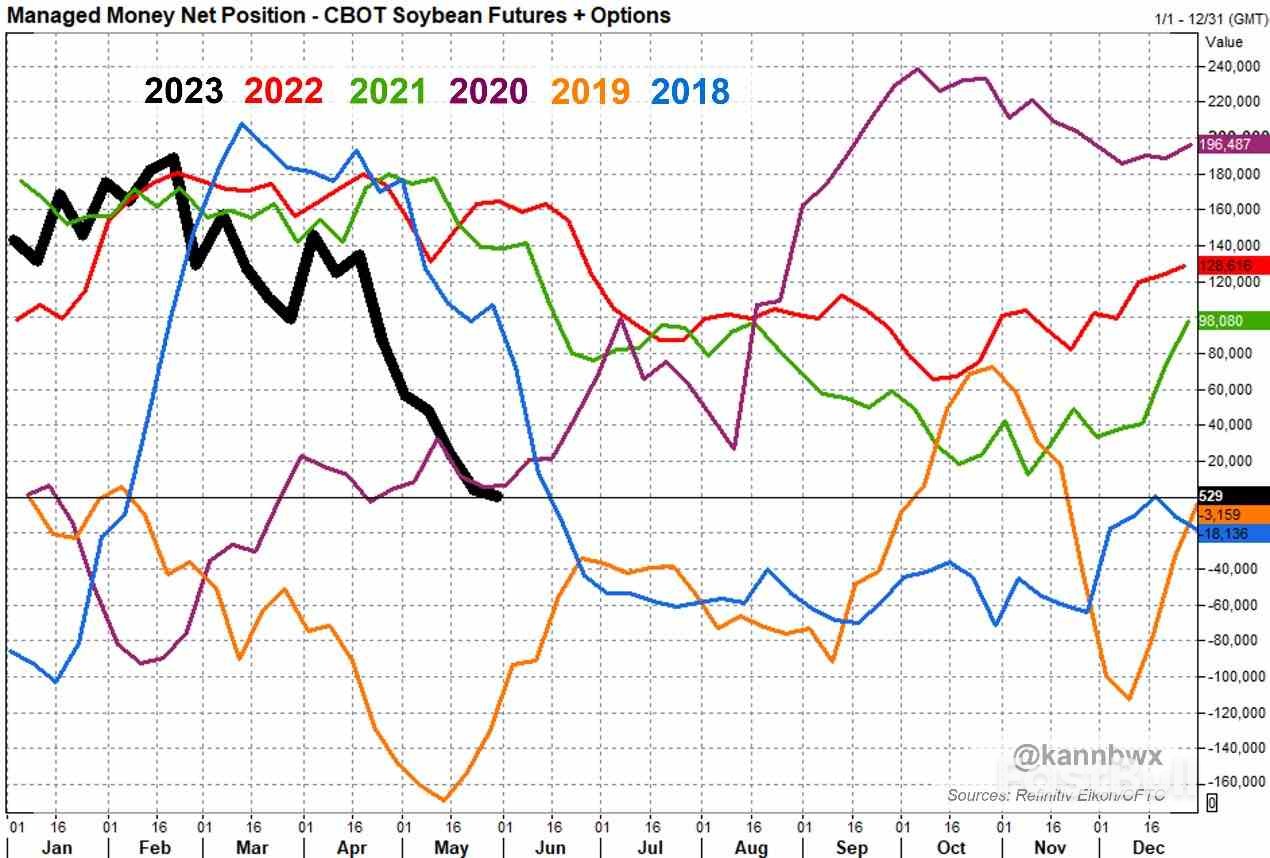
          Chicago-traded soybean futures last week closed below $13 per bushel for the first time in a year-and-a-half, though speculators are still hanging on to the net long position they have maintained since April 2020.
          Meanwhile, an unusually dry end to May across the U.S. Corn Belt and the possible continuation of that pattern into mid-June sparked funds' biggest weekly round of short covering in CBOT corn in nearly three years.
          Most-active CBOT soybean futures tumbled 2% in the week ended May 30, seemingly cementing funds into bearish territory. May 30 featured most-active beans' first settle below $13 per bushel since December 2021, and November soybeans lost nearly 3% during the four-day trading week.
          As of May 30, money managers' net long in CBOT soybeans stood at just 529 futures and options contracts versus 4,147 the week before. Exiting longs were more prominent, but funds also covered soybean shorts, the first such instance in eight weeks.
          Funds Cling to CBOT Soybean Long and Heavily Cover Corn Shorts_1Most-active CBOT corn futures rose nearly 3% and new-crop December futures gained 1.6% in the week ended May 30, motivated by unfavorable U.S. weather. Money managers slashed their net corn short by nearly 47,000 contracts to 51,065 futures and options contracts.
          That was entirely on short covering, the largest such round since August 2020, though speculators started padding their short positions only in late February.
          Funds Cling to CBOT Soybean Long and Heavily Cover Corn Shorts_2Both soybean meal and soybean oil futures shed more than 3% in the week ended May 30, though funds were notable sellers only in meal. Money managers cut their net long in CBOT soybean meal futures and options to 59,676 contracts, the lightest in a year. That compares with 73,789 a week earlier.
          Soybean oil had been gaining throughout that week but plunged on May 30 along with other global vegoils and crude oil on broad economic concerns.
          Money managers expanded their net short in CBOT soybean oil futures and options by 572 contracts to 37,449 as of May 30, their most bearish oil view since July 2019. They have been net sellers of the vegoil in 22 of the last 28 weeks.
          Most-active CBOT wheat futures fell 5% in the week ended May 30, finishing it off with the first settle below $6 per bushel since December 2020. Money managers extended their net short to 126,998 futures and options contracts, the largest since January 2018, up more than 8,200 on the week.
          They also cut nearly 7,000 contracts from their net long in Kansas City wheat futures and options, which fell to 9,628 contracts. Funds increased their net short in Minneapolis wheat to 7,703 contracts from 6,402 a week earlier.
          The 2.5-year low in CBOT wheat combined with China's waterlogged crop and strength in corn lifted most-active wheat futures 4.7% between Wednesday and Friday. Most-active corn on Friday hit the highest levels since April 26, rising 2.5% over the three sessions and possibly erasing more fund shorts.
          December corn rose 3% over that period as forecasts still showed dryness for parts of the U.S. Corn Belt through at least next week. November beans were up 2.6% and most-active beans rose more than 4%, meaning funds are likely still long.
          Most-active soymeal added 1.3% between Wednesday and Friday, but soyoil surged over 7%.
          In the livestock sector, benchmark CME lean hog futures set contract lows on May 26, though both August live cattle and feeder cattle set contract highs on Friday.
          Money managers as of May 30 held a record net short in lean hogs of 31,110 futures and options contracts, up from 24,129 a week earlier. They held a net long in live cattle of 107,835 contracts as of May 30, up from 101,990 in the prior week and their most bullish since early March.
          Funds' record net long in live cattle is 154,550 contracts from April 2019.

          Source: Market Screener

          Risk Warnings and Disclaimers
          You understand and acknowledge that there is a high degree of risk involved in trading. Following any strategies or investment methods may lead to potential losses. The content on the site is provided by our contributors and analysts for information purposes only. You are solely responsible for determining whether any trading assets, securities, strategy, or any other product is suitable for investing based on your own investment objectives and financial situation.
          Comments
          Add to Favorites
          Share

          Weekly Financial Outlook: Macro Data and Central Bank Decisions Dominate the Week Ahead - June 5th

          Warren Takunda

          Traders' Opinions

          After the recent resolution of the debt ceiling issue in the United States, the upcoming week is expected to be relatively calm on the domestic front. However, global investors will have their eyes on several key economic indicators and monetary policy meetings taking place around the world. Additionally, inflation rates and trade data from major economies will provide further insights into the current state of the global economy. In the coming week, keep an eye out for:
          United States
          In the United States, the primary focus will be on the release of the ISM Services PMI, factory orders, and trade data. The ISM survey for May is anticipated to reveal an expansion in the service sector, indicating a strengthening in overall economic activity. Investors will be particularly interested in the gauge that measures price pressures, as concerns about service-led inflation persist. Additionally, the trade deficit is expected to widen due to a decline in exports and an increase in imports, while factory orders are forecasted to rise for the second consecutive month.
          Canada
          The Bank of Canada is scheduled to announce its monetary policy decision, and market expectations suggest no change in the key interest rate, which is projected to remain at 4.5%. In addition, important economic data to watch includes Canada's foreign trade and Ivey PMI. Mexico's CPI data and consumer morale, as well as Brazil's inflation rate and services PMI, will also be closely monitored.
          Euro Area
          In the Euro Area, a downward revision to a modest 0.1% Q1 GDP growth figure is expected, indicating a second consecutive quarter of economic stagnation. However, retail sales in the Eurozone are anticipated to rebound, and Germany's industrial activity is set to recover following a significant drop, aided by a rebound in factory orders. Other releases to watch for include Germany's balance of trade, as well as the inflation rates of Switzerland, Turkey, and Russia. The UK's Halifax house price index and updated Services PMI will also provide insights into the British economy. A benchmark reference rate of 6.75% is expected to be maintained by the National Bank of Poland.
          China
          In China, attention will be on the trade balance and inflation rate for May, offering further insight into the country's economic recovery post-COVID. Recent data has cast doubt on previous recovery expectations, making these releases crucial for assessing the current state of the Chinese economy.
          India
          The Reserve Bank of India is anticipated to keep its interest rate unchanged for a second consecutive meeting, signaling a cautious approach to monetary policy. The release of industrial and manufacturing output data for April by MOSPI will provide additional clarity on the country's economic performance.
          Other Countries
          Australia's Reserve Bank is expected to maintain its cash rate following last month's unexpected hike. Australia's GDP growth figures for Q1 and the trade balance for April will shed light on the country's economic trajectory. Inflation rates for May will be released by South Korea, the Philippines, and Indonesia, providing an indication of price pressures in these respective economies.
          Overall, the week ahead will be defined by macroeconomic data releases and central bank decisions. Investors will closely monitor the performance of major economies and analyze the potential impact on global financial markets. With concerns about inflation lingering, the data will be crucial in shaping future monetary policy decisions and investment strategies.
          Risk Warnings and Disclaimers
          You understand and acknowledge that there is a high degree of risk involved in trading. Following any strategies or investment methods may lead to potential losses. The content on the site is provided by our contributors and analysts for information purposes only. You are solely responsible for determining whether any trading assets, securities, strategy, or any other product is suitable for investing based on your own investment objectives and financial situation.
          Comments
          Add to Favorites
          Share

          UK Property Market Lacks Spring Bounce but A Crash Is Unlikely

          Devin

          Economic

          April is supposed to herald the start of a British ritual: the house-buying season. Traditionally, it is the time when demand for homes picks up and the property supplements in the weekend papers are full of suggestions for sellers bidding to attract the interest of buyers.
          But not this year. According to the latest bulletin from the Bank of England, repayments on existing mortgages in April were £1.4bn higher than new loans. This is unusual. Apart from during lockdown, it was the lowest figure since records began in 1993. The number of new mortgage approvals – loans agreed but not yet advanced – fell in April and were well below the average in the five years leading up to the pandemic.
          There are a number of reasons for the lack of spring bounce in the property market. The availability of mortgages at ultra-low rates meant prices soared in the two years after the start of the pandemic, making it harder for new buyers to afford their first home. The inevitable pause for breath then happened to coincide with rising interest rates and a slowdown in the economy.
          These two factors – rising borrowing costs and sluggish growth – will continue to affect the market over the coming months. The Bank has raised interest rates from 0.1% to 4.5% in the space of 18 months – and looks certain to raise them further given the failure of inflation to fall as quickly as expected. Financial markets are pricing in three more quarter-point increases from Threadneedle Street by the end of the year. Mortgage lenders have responded to higher rates by raising mortgage rates and pulling some of their more attractive products.
          So far, falls in house prices have been modest, with the average cost of a home down 3.4% on a year ago, according to the Nationwide building society. Even so, this was the biggest annual decline recorded since 2009, during the global financial crisis – and there is more to come. Activity in the housing market is likely to remain subdued for at least the rest of this year, and perhaps longer if – as seems probable – the first cuts in interest rates from the Bank don't materialise until well into 2024.
          A full-blown housing market crash of the sort seen in the early 1990s looks unlikely, though. Net migration stood at more than 600,000 last year, and that will underpin demand. What's more, the low level of unemployment means there are few forced sellers. The five-year slump in the first half of the 90s was caused by the dovetailing of 15% interest rates and a jobless total in excess of 3 million. The economy may still fall into recession this year as a result of interest rates staying higher for longer than previously envisaged, but there is no immediate prospect of a wave of newly unemployed owner-occupiers having to sell up.
          All that said, it would be reasonable to expect a peak-to-trough fall in nominal house prices of at least 10%, which would amount to a real terms fall of more than 20% once inflation is accounted for. That's a chunky fall. It's also a welcome one.
          Even though it's been said before, it's worth repeating that the UK is a country wrongly convinced that inflation-busting increases in house prices are a good thing. They are not. The flip side to over-investment in bricks and mortar is under-investment in other more productive uses of capital. The regular booms in the economy driven by consumers extracting and spending equity from the rising value of their homes are invariably followed by busts.
          Those who benefit from rising prices tend to be better off people in older age groups. Those who lose out tend to be two over-lapping categories: renters and the young. Anybody under 35 who is saving up for a deposit on a flat will be glad of a drop in house prices.
          Housing is likely to be a central issue at the next general election, with the two main parties each backing a different side. The Conservatives – who have all but dropped housebuilding targets – are lining up behind existing owner-occupiers. Labour has said it would impose targets and be prepared to build on parts of the green belt. It is also drawing up plans that would force landowners to sell plots of land for less than their potential market price in an attempt to stop land hoarding and so increase the supply of new homes.
          Even if Labour actually goes ahead with its plan, it looks certain to be challenged in the courts. Currently, if a council wants to compulsory purchase a piece of farmland for housing development it has to pay a "hope" value. That's the value not of the farmland but of the value of the farmland adjusted for planning permission, which is substantially higher.
          What is certain is that Labour's approach makes more sense than the government's. The current levels of housebuilding are incompatible with a rising population, and increasing the supply of homes requires reform of the planning system.
          The politics are also interesting. Onward, a right of centre thinktank, produced a report last week in which it said the current crop of 25- to 40-year-olds was the first not to become more rightwing as it grew older, and housing is one reason for this.
          Current Conservative housing policy will help those in their 50s and 60s who have already benefited from house-price inflation rather than those in their 20s and 30s struggling to get on the housing ladder. If Labour has concluded this is dumb economics and dumb politics, it is right on both counts.

          Source: The Guardian

          To stay updated on all economic events of today, please check out our Economic calendar
          Risk Warnings and Disclaimers
          You understand and acknowledge that there is a high degree of risk involved in trading. Following any strategies or investment methods may lead to potential losses. The content on the site is provided by our contributors and analysts for information purposes only. You are solely responsible for determining whether any trading assets, securities, strategy, or any other product is suitable for investing based on your own investment objectives and financial situation.
          Comments
          Add to Favorites
          Share

          OPEC and Allies Consider Deeper Production Cuts Amidst Lingering Concerns of Oversupply

          Warren Takunda
          In response to mounting concerns over a potential new supply glut and the recent decline in oil prices towards the $70 per barrel mark, OPEC and its allies are reportedly engaged in discussions regarding the deepening of oil production cuts. According to reliable sources, these cuts could amount to as much as 1 million barrels per day (bpd), supplementing the existing cuts of 2 million bpd and voluntary cuts of 1.6 million bpd that were unexpectedly announced in April.
          The Organization of the Petroleum Exporting Countries (OPEC) and its allies, collectively known as OPEC+, collectively account for approximately 40 percent of global crude oil production. Therefore, any policy decisions made by this alliance can have a significant impact on oil prices worldwide.
          While OPEC+ ministers are scheduled to gather in Vienna at 2 pm on Sunday to discuss various options, including potential production cuts, OPEC ministers will convene at 11 am on Saturday to lay the groundwork for these discussions.
          If the proposed cuts are approved, they would result in a total reduction of 4.66 million bpd, which represents approximately 4.5 percent of global demand. This move comes as Western nations accuse OPEC of manipulating oil prices and thereby impeding global economic growth due to high energy costs. In response, OPEC officials and insiders argue that the West's extensive money-printing practices in recent years have contributed to inflation, necessitating actions to safeguard the value of oil exports.
          Iraq's Oil Minister Hayan Abdel-Ghani emphasized their commitment to achieving global oil market stability, stating, "We will never hesitate to take any decision to achieve more balance and stability (on) the global oil market."
          The surprise announcement of production cuts in April initially drove oil prices up by approximately $9 per barrel to exceed $87. However, market concerns over global economic growth and demand have since exerted downward pressure on prices. As of Friday, the international benchmark Brent crude was trading around $76 per barrel.
          Saudi Arabia's Energy Minister Prince Abdulaziz previously warned investors who were shorting the oil price to "watch out," which many interpreted as a signal for potential additional supply cuts. Conversely, Russian Deputy Prime Minister Alexander Novak indicated that he did not anticipate any further measures from OPEC+ during the Vienna meeting, according to Russian media reports.
          The International Energy Agency predicts a potential increase in global oil demand in the second half of 2023, which could help bolster oil prices. However, analysts at JP Morgan have criticized OPEC for not responding quickly enough to adjust supply levels in light of substantial US fuel output.
          In a note, JP Morgan analysts stated, "Demand growth continues to be robust. Rather, there is simply too much supply... The alliance waited too long to reduce supply. The alliance - or at least some members - would likely need to cut more."
          Analysts at Rapidan Energy Group estimate a 40 percent likelihood of further production cuts, emphasizing the ministers' determination to prevent a repeat of the 2008 scenario. During that period, a sudden collapse in global economic and financial stability caused crude prices to plummet from over $140 to $35 per barrel within six months.
          As the OPEC+ meetings unfold in Vienna, market participants will closely monitor the decisions and announcements made by the alliance. The potential deepening of production cuts holds the key to rebalancing the global oil market and stabilizing oil prices in the face of prevailing concerns of oversupply.
          Risk Warnings and Disclaimers
          You understand and acknowledge that there is a high degree of risk involved in trading. Following any strategies or investment methods may lead to potential losses. The content on the site is provided by our contributors and analysts for information purposes only. You are solely responsible for determining whether any trading assets, securities, strategy, or any other product is suitable for investing based on your own investment objectives and financial situation.
          Comments
          Add to Favorites
          Share

          OPEC+ Members Agree to Extend Voluntary Oil Output Cuts Until End of 2024

          Cohen
          OPEC+ members Saudi Arabia, the UAE, Iraq, Kuwait, Oman and Algeria will extend their voluntary oil production cuts until the end of 2024 as economic growth concerns weigh on the outlook for crude demand.
          Saudi Arabia, the world's largest crude exporter, will make an additional voluntary output cut of 1 million barrels per day in July, which could be extended if required, the kingdom's energy minister said during a press conference after Sunday's OPEC+ meeting.
          "We continue to set the example of how much one needs to be transparent in order to achieve the most … dominant and more important priorities, which is seeking stability and sustainability," Prince Abdulaziz bin Salman said.
          The UAE, OPEC's third-largest producer, will have its voluntary cut of 144,000 bpd in place until the end of December 2024.
          This is "a precautionary measure, in coordination with the countries participating in the OPEC+ agreement, which had previously announced voluntary cuts in April", Suhail Al Mazrouei, the UAE's Minister of Energy and Infrastructure, said on Twitter.
          "This voluntary cut will be from the required production level," Mr Al Mazrouei said.
          Russia will also extend its voluntary output cut of 500,000 bpd until the end of next year.
          In a separate statement on Sunday, the OPEC+ alliance of 23 oil-producing countries said it set a new production target of 40.46 million barrels per day for next year.
          The decision was taken "in light of the continued commitment … to achieve and sustain a stable oil market, and to provide long-term guidance for the market, and in line with the successful approach of being precautious, proactive, and pre-emptive", OPEC+ said.
          The group will hold its next meeting on November 26 in Vienna.
          The announcement comes as Brent, the benchmark for two thirds of the world's oil, lost about 11 per cent of its value this year on weak economic growth in the US and China – the two top oil-consuming nations.
          Brent settled 2.49 per cent higher at $76.13 a barrel on Friday after the US Senate passed a debt ceiling agreement, averting what would have been a first-ever default.
          West Texas Intermediate, the gauge that tracks US crude, was up 2.34 per cent at $71.74 a barrel.
          The international benchmark crossed $85 a barrel in April after some OPEC+ producers surprised markets by announcing combined voluntary output cuts of 1.16 million barrels per day from May until the end of the year.
          The move took the group's total production curbs to 3.66 million bpd, or 3.7 per cent of global demand.
          At an event in Qatar, Saudi Arabia's Energy Minister told oil market short sellers to "watch out" amid volatility in the market.
          "I keep advising them that they will be 'ouching'. They did 'ouch' in April," Prince Abdulaziz bin Salman said.
          Short sellers strategically position themselves to make a profit if prices decline, by selling borrowed assets in the hope of repurchasing them at a lower price.
          The Saudi minister's comments helped to lift prices before a sudden turnaround after Russia's Deputy Prime Minister, Alexander Novak said OPEC+ was likely to stick to existing production targets at their meeting.
          Traders are looking for signs of falling Russian exports after the country extended its output cut of 500,000 bpd until the end of the year.
          Russian exports surged to 8.3 million bpd in April, the highest since Moscow's invasion of Ukraine last year, the International Energy Agency said in its latest oil market report.
          The agency, which attributed the rise in exports to higher production volumes, said that Russia did not adhere to the output curbs.
          Swiss lender UBS said the discrepancy between Russia's stated production cuts and resilient seaborne exports may be due to changes in pipeline exports, domestic oil demand and exports of refined products.
          The IEA has predicted that global crude demand will hit record levels this year on the back of an economic recovery in China, the world's second-largest economy and top crude importer.
          But economic growth in the Asian country has been largely uneven since it lifted Covid-19 restrictions earlier this year.
          "The non-synchronised recovery in Chinese economic growth is perhaps the biggest challenge for the oil market," Energy Aspects, a London-based consultancy, said.
          "Not all sectors have risen and definitely not at the same pace."
          Oil prices fell more than 2 per cent in a single session last week after a key gauge of China's manufacturing sector came in lower than market expectations.
          China's manufacturing purchasing managers' index (PMI) for May fell to 48.8 from 49.2 in April, according to data from the National Bureau of Statistics, its lowest in five months.
          It marked the second consecutive reading below the 50-point mark that separates expansion from contraction.
          Analysts and oil industry executives expect the market to tighten in the second half of 2023 on higher Asian consumption and lower output from OPEC+ members.
          "This is primarily the winter effect in Asia … but also a strong view that we still have that pre-Covid demand yet to come," Mike Muller, head of Vitol Asia, said at an event in Dubai last month.
          There are a lot of "green shoots" for oil bulls in the summer amid production cuts and projections of strong crude demand growth in China, Energy Aspects said.
          "But, fundamentals are not going to drive crude's flat price higher until strong inventory draws are blindingly obvious," the consultancy said.

          Source: The National News

          Risk Warnings and Disclaimers
          You understand and acknowledge that there is a high degree of risk involved in trading. Following any strategies or investment methods may lead to potential losses. The content on the site is provided by our contributors and analysts for information purposes only. You are solely responsible for determining whether any trading assets, securities, strategy, or any other product is suitable for investing based on your own investment objectives and financial situation.
          Comments
          Add to Favorites
          Share

          China's Services Activity Picks up in May on Improved Demand- Caixin PMI

          Thomas

          Economic

          China's services activity picked up in May, a private-sector survey showed on Monday, as a rise in new orders shored up a consumption-led economic recovery in the second quarter.
          The Caixin/S&P Global services purchasing managers' index (PMI) rose to 57.1 in May from 56.4 in April. The 50-point mark separates expansion from contraction in activity.
          The reading contrasts with the official PMI released last week that showed a slower pace of expansion in the services sector.
          Some economists warn the pent-up demand for in-person services may fade due to slowing income growth and mounting unemployment pressures, raising headaches for policymakers already struggling with weak foreign demand and an uneven post-COVID recovery.
          The Caixin survey showed service companies reported a rise in new business last month when the first May Day holiday following China's COVID reopening boosted orders for hotels, restaurants and travel agencies.
          Increased workloads led firms to grow headcount for the fourth consecutive month, although the speed of job creation slowed.
          Average prices charged by service companies rose by the fastest since February 2022.
          The survey also indicated that capacity pressures persisted, as highlighted by sustained growth in outstanding business.
          Caixin/S&P's composite PMI, which includes both manufacturing and services activity, picked up to 55.6 from 53.6 in April, marking the quickest expansion since December 2020.
          Even if firms in the services sector remained upbeat with business activity over the next 12 months, the level of optimism eased to the lowest since December 2022 when Beijing lifted anti-virus curbs.
          China's economy rebounded faster than expected in the first quarter but lost momentum at the beginning of the second quarter as April data broadly undershot forecasts.
          Factory activity in May shrank faster than expected on weakening demand, reinforcing the unbalanced feature in the economic recovery.
          "In general, it remains a prominent feature of the Chinese economy that the services sector is stronger than manufacturing," said Wang Zhe, senior economist at Caixin Insight Group.
          "This divergence highlights that economic growth is lacking internal drive and market entities lack sufficient confidence, underscoring the importance of expanding and restoring demand," he said.

          Source: The Edge Malaysia

          To stay updated on all economic events of today, please check out our Economic calendar
          Risk Warnings and Disclaimers
          You understand and acknowledge that there is a high degree of risk involved in trading. Following any strategies or investment methods may lead to potential losses. The content on the site is provided by our contributors and analysts for information purposes only. You are solely responsible for determining whether any trading assets, securities, strategy, or any other product is suitable for investing based on your own investment objectives and financial situation.
          Comments
          Add to Favorites
          Share

          Euro Bears Beware: Bulls Eyeing a Strong Rebound after a Challenging Month

          Warren Takunda

          Traders' Opinions

          As the month of May draws to a close, Euro bulls find themselves nursing wounds inflicted by a 3% decline against the US dollar, marking the Euro's worst performance in a year. However, financial analysts are eagerly looking ahead to a potential relief in the form of a pause by the US Federal Reserve, which could provide the much-needed catalyst for a Euro rebound.
          The Euro's recent struggles can be attributed to a combination of factors, including concerns about the economic recovery in the Eurozone, political uncertainties, and the strength of the US dollar. Investors have been increasingly cautious, opting for safe-haven assets such as the greenback, leading to a downward pressure on the Euro.
          Despite these challenges, prominent financial institutions like Paribas and Lombard Odier are maintaining an optimistic stance on the Euro's future prospects. They anticipate the Euro to gain momentum and push above the $1.10 level, based on several key factors.
          Firstly, the potential for a pause in the Federal Reserve's tightening cycle has become a significant driver for the Euro's rebound. The Fed's recent signals of a more cautious approach to interest rate hikes have eased concerns about a strengthening US dollar, thus creating an environment conducive for Euro bulls to regain their confidence.
          Moreover, Paribas and Lombard Odier point to underlying strengths in the Eurozone economy that could contribute to its recovery. Despite some recent economic setbacks, the Eurozone continues to show resilience, supported by robust manufacturing activity, steady employment rates, and improving business sentiment. These factors, combined with potential fiscal stimulus measures, may act as a springboard for the Euro's resurgence.
          In addition, political developments within the Eurozone could also play a role in shaping the Euro's trajectory. With the resolution of certain political uncertainties and an increasing focus on unity and stability, market sentiment towards the Euro may experience a positive shift, potentially leading to increased demand and upward pressure on the currency.
          While the road to recovery may not be without its challenges, the Euro bulls are finding solace in the belief that the worst may be behind them. However, it is essential to acknowledge the inherent uncertainties in the financial markets, which could affect the Euro's performance in the coming months.
          In conclusion, after a challenging month marked by a 3% decline against the US dollar, Euro bulls are looking to a potential pause by the Federal Reserve as a catalyst for relief. Financial institutions such as Paribas and Lombard Odier maintain an optimistic outlook, anticipating a Euro rebound and a push above the $1.10 level. Factors such as a potential Fed pause, underlying strengths in the Eurozone economy, and positive political developments within the region provide the groundwork for a possible Euro recovery. Nevertheless, investors should remain vigilant and mindful of market uncertainties that may impact the currency's future performance.
          Risk Warnings and Disclaimers
          You understand and acknowledge that there is a high degree of risk involved in trading. Following any strategies or investment methods may lead to potential losses. The content on the site is provided by our contributors and analysts for information purposes only. You are solely responsible for determining whether any trading assets, securities, strategy, or any other product is suitable for investing based on your own investment objectives and financial situation.
          Comments
          Add to Favorites
          Share
          FastBull
          Copyright © 2025 FastBull Ltd

          728 RM B 7/F GEE LOK IND BLDG NO 34 HUNG TO RD KWUN TONG KLN HONG KONG

          TelegramInstagramTwitterfacebooklinkedin
          App Store Google Play Google Play
          Products
          Charts

          Chats

          Q&A with Experts
          Screeners
          Economic Calendar
          Data
          Tools
          Membership
          Features
          Function
          Markets
          Copy Trading
          Latest Signals
          Contests
          News
          Analysis
          24/7
          Columns
          Education
          Company
          Careers
          About Us
          Contact Us
          Advertising
          Help Center
          Feedback
          User Agreement
          Privacy Policy
          Business

          White Label

          Data API

          Web Plug-ins

          Poster Maker

          Affiliate Program

          Risk Disclosure

          The risk of loss in trading financial instruments such as stocks, FX, commodities, futures, bonds, ETFs and crypto can be substantial. You may sustain a total loss of the funds that you deposit with your broker. Therefore, you should carefully consider whether such trading is suitable for you in light of your circumstances and financial resources.

          No decision to invest should be made without thoroughly conducting due diligence by yourself or consulting with your financial advisors. Our web content might not suit you since we don't know your financial conditions and investment needs. Our financial information might have latency or contain inaccuracy, so you should be fully responsible for any of your trading and investment decisions. The company will not be responsible for your capital loss.

          Without getting permission from the website, you are not allowed to copy the website's graphics, texts, or trademarks. Intellectual property rights in the content or data incorporated into this website belong to its providers and exchange merchants.

          Not Logged In

          Log in to access more features

          FastBull Membership

          Not yet

          Purchase

          Become a signal provider
          Help Center
          Customer Service
          Dark Mode
          Price Up/Down Colors

          Log In

          Sign Up

          Position
          Layout
          Fullscreen
          Default to Chart
          The chart page opens by default when you visit fastbull.com