• Trade
  • Markets
  • Copy
  • Contests
  • News
  • 24/7
  • Calendar
  • Q&A
  • Chats
Trending
Screeners
SYMBOL
LAST
BID
ASK
HIGH
LOW
NET CHG.
%CHG.
SPREAD
SPX
S&P 500 Index
6827.42
6827.42
6827.42
6899.86
6801.80
-73.58
-1.07%
--
DJI
Dow Jones Industrial Average
48458.04
48458.04
48458.04
48886.86
48334.10
-245.98
-0.51%
--
IXIC
NASDAQ Composite Index
23195.16
23195.16
23195.16
23554.89
23094.51
-398.69
-1.69%
--
USDX
US Dollar Index
97.920
98.000
97.920
98.070
97.810
-0.030
-0.03%
--
EURUSD
Euro / US Dollar
1.17447
1.17454
1.17447
1.17596
1.17262
+0.00053
+ 0.05%
--
GBPUSD
Pound Sterling / US Dollar
1.33849
1.33856
1.33849
1.33961
1.33546
+0.00142
+ 0.11%
--
XAUUSD
Gold / US Dollar
4331.51
4331.92
4331.51
4350.16
4294.68
+32.12
+ 0.75%
--
WTI
Light Sweet Crude Oil
56.860
56.890
56.860
57.601
56.789
-0.373
-0.65%
--

Community Accounts

Signal Accounts
--
Profit Accounts
--
Loss Accounts
--
View More

Become a signal provider

Sell trading signals to earn additional income

View More

Guide to Copy Trading

Get started with ease and confidence

View More

Signal Accounts for Members

All Signal Accounts

Best Return
  • Best Return
  • Best P/L
  • Best MDD
Past 1W
  • Past 1W
  • Past 1M
  • Past 1Y

All Contests

  • All
  • Trump Updates
  • Recommend
  • Stocks
  • Cryptocurrencies
  • Central Banks
  • Featured News
Top News Only
Share

Bank Of America Expects A Deficit In Aluminium Next Year And Sees Prices Pushing Above $3000/T

Share

Fed Data - USA Effective Federal Funds Rate At 3.64 Percent On 12 December On $102 Billion In Trades Versus 3.64 Percent On $99 Billion On 11 December

Share

Brazil's Petrobras Says No Impact Seen On Oil, Petroleum Products Output As Workers Start Planned Strike

Share

Statement: US Travel Group Warns New Proposed Trump Administration Requirements For Foreign Tourists To Provide Social Media Histories Could Mean Millions Of People Opting Not To Visit

Share

Blackrock: Kerry White Will Become Head Of Citi Investment Management At Citi Wealth

Share

Blackrock: Rob Jasminski, Head Of Citi Investment Management, Has Joined With Team

Share

Blackrock: Effective Dec 15, Citi Investment Management Employees Will Join Blackrock

Share

Blackrock: Formally Launch Citi Portfolio Solutions Powered By Blackrock

Share

According To Data From The Federal Reserve Bank Of New York, The Secured Overnight Funding Rate (Sofr) Was 3.67% On The Previous Trading Day (December 15), Compared To 3.66% The Day Before

Share

Peru Energy And Mines Ministry: Copper Production Up 4.8% Year-On-Year In October To 248192 Metric Tons

Share

Security Source: Ukrainian Drones Hits Russian Oil Infrastructure In Caspian Sea For Third Time

Share

Spot Palladium Extends Gains, Last Up 5% To $1562.7/Oz

Share

Mexico's Economy Ministry Announces Start Of Anti-Dumping Investigation And Anti-Subsidy Investigations Into USA Pork Imports

Share

Canada Nov CPI Common +2.8%, CPI Median +2.8%, CPI Trim +2.8% On Year

Share

NY Fed's Empire State Prices Paid Index +37.6 In December Versus+49.0 In November

Share

Canada Nov Consumer Prices +0.1% On Month, +2.2% On Year

Share

Canada Nov CPI Core -0.1% On Month, +2.9% On Year

Share

Canada Nov Core CPI, Seasonally Adjusted +0.2% On Month, Oct +0.3% (Unrevised)

Share

UK Health Minister Streeting On Doctors' Strike: Vote To Go Ahead Reveals The Bma's Shocking Disregard For Patient Safety

Share

Venezuelan State Oil Company Pdvsa Says Was Subject To Cyber Attack But Operations Unaffected

TIME
ACT
FCST
PREV
Japan Tankan Small Manufacturing Outlook Index (Q4)

A:--

F: --

P: --

Japan Tankan Large Non-Manufacturing Outlook Index (Q4)

A:--

F: --

P: --

Japan Tankan Large Manufacturing Outlook Index (Q4)

A:--

F: --

P: --

Japan Tankan Small Manufacturing Diffusion Index (Q4)

A:--

F: --

P: --

Japan Tankan Large Manufacturing Diffusion Index (Q4)

A:--

F: --

P: --

Japan Tankan Large-Enterprise Capital Expenditure YoY (Q4)

A:--

F: --

P: --

U.K. Rightmove House Price Index YoY (Dec)

A:--

F: --

P: --

China, Mainland Industrial Output YoY (YTD) (Nov)

A:--

F: --

P: --

China, Mainland Urban Area Unemployment Rate (Nov)

A:--

F: --

P: --

Saudi Arabia CPI YoY (Nov)

A:--

F: --

P: --

Euro Zone Industrial Output YoY (Oct)

A:--

F: --

P: --

Euro Zone Industrial Output MoM (Oct)

A:--

F: --

P: --

Canada Existing Home Sales MoM (Nov)

A:--

F: --

P: --

Canada National Economic Confidence Index

A:--

F: --

P: --

Canada New Housing Starts (Nov)

A:--

F: --

P: --
U.S. NY Fed Manufacturing Employment Index (Dec)

A:--

F: --

P: --

U.S. NY Fed Manufacturing Index (Dec)

A:--

F: --

P: --

Canada Core CPI YoY (Nov)

A:--

F: --

P: --

Canada Manufacturing Unfilled Orders MoM (Oct)

A:--

F: --

P: --

U.S. NY Fed Manufacturing Prices Received Index (Dec)

A:--

F: --

P: --

U.S. NY Fed Manufacturing New Orders Index (Dec)

A:--

F: --

P: --

Canada Manufacturing New Orders MoM (Oct)

A:--

F: --

P: --

Canada Core CPI MoM (Nov)

A:--

F: --

P: --

Canada Trimmed CPI YoY (SA) (Nov)

A:--

F: --

P: --

Canada Manufacturing Inventory MoM (Oct)

A:--

F: --

P: --

Canada CPI YoY (Nov)

A:--

F: --

P: --

Canada CPI MoM (Nov)

A:--

F: --

P: --

Canada CPI YoY (SA) (Nov)

A:--

F: --

P: --

Canada Core CPI MoM (SA) (Nov)

A:--

F: --

P: --

Canada CPI MoM (SA) (Nov)

A:--

F: --

P: --

Federal Reserve Board Governor Milan delivered a speech
U.S. NAHB Housing Market Index (Dec)

--

F: --

P: --

Australia Composite PMI Prelim (Dec)

--

F: --

P: --

Australia Services PMI Prelim (Dec)

--

F: --

P: --

Australia Manufacturing PMI Prelim (Dec)

--

F: --

P: --

Japan Manufacturing PMI Prelim (SA) (Dec)

--

F: --

P: --

U.K. 3-Month ILO Employment Change (Oct)

--

F: --

P: --

U.K. Unemployment Claimant Count (Nov)

--

F: --

P: --

U.K. Unemployment Rate (Nov)

--

F: --

P: --

U.K. 3-Month ILO Unemployment Rate (Oct)

--

F: --

P: --

U.K. Average Weekly Earnings (3-Month Average, Including Bonuses) YoY (Oct)

--

F: --

P: --

U.K. Average Weekly Earnings (3-Month Average, Excluding Bonuses) YoY (Oct)

--

F: --

P: --

France Services PMI Prelim (Dec)

--

F: --

P: --

France Composite PMI Prelim (SA) (Dec)

--

F: --

P: --

France Manufacturing PMI Prelim (Dec)

--

F: --

P: --

Germany Services PMI Prelim (SA) (Dec)

--

F: --

P: --

Germany Manufacturing PMI Prelim (SA) (Dec)

--

F: --

P: --

Germany Composite PMI Prelim (SA) (Dec)

--

F: --

P: --

Euro Zone Composite PMI Prelim (SA) (Dec)

--

F: --

P: --

Euro Zone Services PMI Prelim (SA) (Dec)

--

F: --

P: --

Euro Zone Manufacturing PMI Prelim (SA) (Dec)

--

F: --

P: --

U.K. Services PMI Prelim (Dec)

--

F: --

P: --

U.K. Manufacturing PMI Prelim (Dec)

--

F: --

P: --

U.K. Composite PMI Prelim (Dec)

--

F: --

P: --

Euro Zone ZEW Economic Sentiment Index (Dec)

--

F: --

P: --

Germany ZEW Current Conditions Index (Dec)

--

F: --

P: --

Germany ZEW Economic Sentiment Index (Dec)

--

F: --

P: --

Euro Zone Trade Balance (Not SA) (Oct)

--

F: --

P: --

Euro Zone ZEW Current Conditions Index (Dec)

--

F: --

P: --

Euro Zone Trade Balance (SA) (Oct)

--

F: --

P: --

U.S. Retail Sales MoM (Excl. Automobile) (SA) (Oct)

--

F: --

P: --

Q&A with Experts
    • All
    • Chatrooms
    • Groups
    • Friends
    Connecting
    .
    .
    .
    Type here...
    Add Symbol or Code

      No matching data

      All
      Trump Updates
      Recommend
      Stocks
      Cryptocurrencies
      Central Banks
      Featured News
      • All
      • Russia-Ukraine Conflict
      • Middle East Flashpoint
      • All
      • Russia-Ukraine Conflict
      • Middle East Flashpoint
      Search
      Products

      Charts Free Forever

      Chats Q&A with Experts
      Screeners Economic Calendar Data Tools
      Membership Features
      Data Warehouse Market Trends Institutional Data Policy Rates Macro

      Market Trends

      Market Sentiment Order Book Forex Correlations

      Top Indicators

      Charts Free Forever
      Markets

      News

      News Analysis 24/7 Columns Education
      From Institutions From Analysts
      Topics Columnists

      Latest Views

      Latest Views

      Trending Topics

      Top Columnists

      Latest Update

      Signals

      Copy Rankings Latest Signals Become a signal provider AI Rating
      Contests
      Brokers

      Overview Brokers Assessment Rankings Regulators News Claims
      Broker listing Forex Brokers Comparison Tool Live Spread Comparison Scam
      Q&A Complaint Scam Alert Videos Tips to Detect Scam
      More

      Business
      Events
      Careers About Us Advertising Help Center

      White Label

      Data API

      Web Plug-ins

      Affiliate Program

      Awards Institution Evaluation IB Seminar Salon Event Exhibition
      Vietnam Thailand Singapore Dubai
      Fans Party Investment Sharing Session
      FastBull Summit BrokersView Expo
      Recent Searches
        Top Searches
          Markets
          News
          Analysis
          User
          24/7
          Economic Calendar
          Education
          Data
          • Names
          • Latest
          • Prev

          View All

          No data

          Scan to Download

          Faster Charts, Chat Faster!

          Download App
          English
          • English
          • Español
          • العربية
          • Bahasa Indonesia
          • Bahasa Melayu
          • Tiếng Việt
          • ภาษาไทย
          • Français
          • Italiano
          • Türkçe
          • Русский язык
          • 简中
          • 繁中
          Open Account
          Search
          Products
          Charts Free Forever
          Markets
          News
          Signals

          Copy Rankings Latest Signals Become a signal provider AI Rating
          Contests
          Brokers

          Overview Brokers Assessment Rankings Regulators News Claims
          Broker listing Forex Brokers Comparison Tool Live Spread Comparison Scam
          Q&A Complaint Scam Alert Videos Tips to Detect Scam
          More

          Business
          Events
          Careers About Us Advertising Help Center

          White Label

          Data API

          Web Plug-ins

          Affiliate Program

          Awards Institution Evaluation IB Seminar Salon Event Exhibition
          Vietnam Thailand Singapore Dubai
          Fans Party Investment Sharing Session
          FastBull Summit BrokersView Expo

          For the Sake of Its Economy, China Must Address Youth Unemployment

          Kevin Du

          Economic

          Summary:

          Beijing is already throwing the sink at the problem, from finding ‘new productive forces’ and sending youth to the countryside to making university deans knock on company doors for jobs.

          Beyond the economic issues highlighted at China’s “two sessions” or parliamentary meetings, the government must address increasing youth discontent, which is primarily due to rising youth unemployment.
          While the previous generation was enriched by China’s reforms and opening up, those born under the one-child policy face different concerns amid economic and job market challenges as the country embraces a dual circulation strategy.
          Adding to the diversity of youth frustrations, which has spawned the “lying flat” movement among others, is growing unemployment. From April 2019 to April 2023, the urban youth unemployment rate doubled to 21.3 per cent, exacerbated by the zero-Covid policy and stringent lockdowns.
          Local governments focused on virus containment often overlooked the economic impact of their actions, in particular on the service sector, which employs many young people. The challenging youth job market has intensified generational tensions even as the economic slowdown spotlights the burden of an entire generation of only children having to support their parents.
          Among the jobless, there are those lucky enough to be “full-time children”, paid by generous parents in return for care – a phenomenon that reflects job market challenges more than filial piety. But even such arrangements can eventually lead to frustrations.
          This year, China is expected to produce a record 11.8 million graduates, even as the government faces pressure to create enough jobs for them. Last year, an estimated 7.7 million people took the civil service examination to vie for about 200,000 jobs, according to CNBC. This was seen as a fundamental skills mismatch in the Chinese job market.
          In the annual work report delivered by Premier Li Keqiang, he noted the difficulties in China’s economic recovery and development after three years of Covid-19. He also observed that the pressure of maintaining national employment and “structural contradictions” coexist – though he did not elaborate on these “contradictions”.
          A generation of Chinese youth who grew up in a rising Chinese economy naturally have high income expectations. To manage the contradiction between these expectations and the realities on the ground, the government has offered two types of solutions. One is driven by ideological motivations that have drawn comparison with the Mao-era “Down to the Countryside” campaign, while the other is more oriented towards improving education and job-seeking.
          In 2019, the Communist Youth League of China launched plans to involve over 10 million undergraduates in the rural revitalisation effort by 2022, through summer programmes focusing on culture, technology and health. This initiative aimed to integrate urban youth into rural development through short-term engagements.
          Echoing this, the 2022 Central Rural Work Conference discussed strategies to guide graduates, skilled individuals, migrant workers and entrepreneurs to contribute to countryside development, emphasising a structured approach to rural engagement and revitalisation.
          This idea was implemented at the local level. Last year, for instance, Guangdong unveiled an ambitious three-year plan to send 300,000 young people to the countryside.
          This initiative aims to mobilise 100,000 young people to help in the rural areas, provide another 100,000 with practical rural experience, and enhance the skills of a further 100,000 for the rural revitalisation effort by end-2025.
          It also seeks to enable 10,000 young people to secure rural jobs in rural regions and help another 10,000 become entrepreneurs. In addition, it wants exceptional undergraduates and graduates across its cities to come forward for two to three years of voluntary service in rural revitalisation efforts.
          Meanwhile, the education ministry is focusing on building and honing a national “platform” to promote smart education, including working on the Smart Education of China portal, a one-stop shop offering educational and job-seeking resources, and the National Public Service Platform for Educational Resources website, a key resource for educational and public services for students and teachers.
          Additionally, it has increased support for young science and tech talent in universities, to encourage them to take on challenges and explore new areas for groundbreaking achievements, potentially boosting China’s innovative capacity.
          In 2022, the education ministry launched a special campaign for leaders in universities, including deans and party secretaries, to visit companies and promote employment for their graduates, with each university required to make contact with no less than 100 enterprises.
          Merely relocating young people to the rural areas may adjust employment statistics at the local level but it doesn’t solve the problem. At the national economic level, there appears to be a renewed push for exports but the international environment presents challenges.
          As the hi-tech manufacturing sector assumes a dominant role within the economy, it is projected that around 30 million manufacturing positions will be vacant by 2025. Such a big shortfall may well prompt the government to reconsider resurrecting the job assignment system that it abolished in 1996, or some version of it.
          China has put its hope in “new productive forces” to rejuvenate the economy but for all the emphasis on innovation and self-reliance, external markets remain important. To sustain economic growth at the targeted 5 per cent, export markets must be found to absorb the overproduction in China’s hi-tech sectors from electric vehicles and lithium batteries to solar panels.
          In such an economy, youth unemployment is giving rise to concerns about a loss of social status and consumption power. Beijing cannot fully enact its dual circulation strategy without first effectively addressing the country’s youth unemployment problem.

          Source: SCMP

          To stay updated on all economic events of today, please check out our Economic calendar
          Risk Warnings and Disclaimers
          You understand and acknowledge that there is a high degree of risk involved in trading. Following any strategies or investment methods may lead to potential losses. The content on the site is provided by our contributors and analysts for information purposes only. You are solely responsible for determining whether any trading assets, securities, strategy, or any other product is suitable for investing based on your own investment objectives and financial situation.
          Add to Favorites
          Share

          Bank of England Expected to Keep Rate Cut Talk on Ice for Now

          Devin

          Economic

          Central Bank

          The Bank of England looks set to keep its cards close to its chest on Thursday and not speed up its progress towards cutting interest rates, as it awaits clearer signs that the country's hot inflation problem has been doused.
          The BoE is widely expected to keep Bank Rate at 5.25%, its highest level since 2008, in its March policy announcement at 1200 GMT, a day after data showed inflation fell to its lowest in almost two-and-a-half years but stayed too high for comfort.
          Investors will be watching closely for any hint of an acceleration of discussions within the Monetary Policy Committee about when to cut borrowing costs for the first time since the onset of the COVID-19 pandemic.
          The U.S. Federal Reserve indicated on Wednesday that it remained on course to cut rates three times this year but stayed on alert about the path of price growth ahead.
          The European Central Bank has tried to cool talk about a run of rate cuts that has gathered steam as investors increasingly consider the fight against global inflation to have been won.
          Britain's headline inflation rate - which topped 11% in October 2022 and led to a historic living standard squeeze - fell by a bit more than expected to 3.4% in February from 4.0% in January but was still the highest in the Group of Seven.
          Although it is expected to drop to the BoE's 2% target in April, it is forecast to pick up again slightly after that, and services inflation - which largely reflects strong wage growth - remains high at 6.1%.
          Analysts polled by Reuters expect the BoE's Monetary Policy Committee to split three ways for a second time in a row but this time with only one vote for a hike and one for a cut with the other seven in favour of keeping Bank Rate at 5.25%.
          At February's meeting, two MPC members voted for an increase to 5.5% and one for a cut to 5.0% with six backing a hold.

          Cuts Later This Year

          Most analysts and investors think the BoE will only cut rates for the first time in the third quarter, probably at its August meeting.
          But financial markets currently put a roughly 60% chance on the BoE cutting rates in June with almost three quarter-point reductions priced in for borrowing costs over 2024.
          The central bank wants to see wage growth slowing further before making its move.
          Britain's minimum wage will rise by nearly 10% next month, and retailers that often pay staff only slightly more have raised salaries ahead of the increase.
          Employers overall have offered pay settlements of about 5% since the start of 2024. Average wage growth is about 6%, higher than about 4% in the United States and the euro zone.
          James Smith, an economist with ING, said stronger-than-expected falls in services inflation and wage growth data could lead to a BoE rate cut in June.
          "But more likely we think the Committee will wait for a few more numbers and also a new round of forecasts, which makes August a more likely candidate for the first rate cut," he said.
          As well as employers, mortgage-holders and consumers, the ruling Conservative Party is also keen to see rates come down as it struggles to rein in the opposition Labour Party's strong lead in opinion polls with an election expected later this year.
          Finance minister Jeremy Hunt took the unusual step of commenting on what Wednesday's inflation data might mean for the BoE, saying: "As inflation gets closer to its target that opens the door for the Bank of England to consider bringing down interest rates."
          The BoE will not hold a press conference on Thursday as no new economic forecasts are due to be published.

          Source: Yahoo

          To stay updated on all economic events of today, please check out our Economic calendar
          Risk Warnings and Disclaimers
          You understand and acknowledge that there is a high degree of risk involved in trading. Following any strategies or investment methods may lead to potential losses. The content on the site is provided by our contributors and analysts for information purposes only. You are solely responsible for determining whether any trading assets, securities, strategy, or any other product is suitable for investing based on your own investment objectives and financial situation.
          Add to Favorites
          Share

          Yen Jumps; Aussie Gets A Boost from Strong Jobs Data

          Thomas

          Forex

          Economic

          The yen rose sharply on Thursday in part due to a broadly weaker dollar, but also drew support from expectations of further rate hikes from the Bank of Japan later this year and some jawboning efforts from Japanese government officials.
          Down Under, the Australian dollar jumped after data on Thursday showed employment rebounded sharply in February and the jobless rate dived far below forecasts, pointing to a still-tight labour market.
          The yen gained more than 0.5% to 150.46 per dollar, reversing some of its heavy losses in the wake of the BOJ's policy pivot.
          Analysts said factors supporting the yen's rise included growing bets of another BOJ rate hike in July or October, as well as a rebound in business confidence in the Japanese economy.
          Earlier on Thursday, the country's finance minister Shunichi Suzuki also said the government was watching currency market moves with "a high sense of urgency", following the yen's decline to a four-month trough of 151.82 in the previous session and toward a multi-decade low.
          "I think there's a bit of jawboning going on... given that the speed of the yen move has probably been a bit too rapid for what the Ministry of Finance officials would like to see," said Moh Siong Sim, a currency strategist at Bank of Singapore.
          "That may have explained why dollar/yen has come off as well."
          Still, the main driver remained a sliding U.S. dollar, after the Federal Reserve maintained its interest rate cut projections for the year in the face of upside surprises on inflation, and did not strike a more hawkish tone as some investors had feared.
          At the conclusion of the Fed's policy meeting on Wednesday, Chair Jerome Powell said recent high inflation rate readings had not changed the underlying trend of slowly easing price pressures in the United States. The central bank stayed on track for three rate cuts this year, even though it projected slightly slower progress on inflation.
          That sent the greenback tumbling as traders were quick to rebuild bets of a Fed easing cycle beginning in June, with markets now pricing in a 75% chance of a rate cut that month, as compared to 59% chance a day earlier, according to the CME FedWatch tool.
          The euro and sterling notched one-week highs against the dollar on Thursday, rising to $1.0939 and $1.2803, respectively.
          "The Fed really, really wants its soft-landing ending. Stronger growth, lower unemployment, higher inflation - and yet still no change to the median dot," said Seema Shah, chief global strategist at Principal Asset Management.
          "Powell has perhaps shown his cards: he needs a good reason not to cut rates, rather than a reason to cut rates."
          The dollar index was little changed at 103.22, after having slid more than 0.5% in the previous trading session.
          With the Fed meeting out of the way, focus now turns to a rate decision from the Bank of England (BoE) later on Thursday, where expectations are for the central bank to keep rates on hold.
          British inflation slowed in February, official data on Wednesday showed, keeping the BoE on track to start cutting borrowing costs later this year.

          JOBS SURPRISE

          A resurgence in Australia's February employment figures and a downtick in its jobless rate gave the Aussie a boost on Thursday.
          Figures from the Australian Bureau of Statistics on Thursday showed net employment jumped 116,500 in February from January, surging past market expectations for a 40,000 increase, while the jobless rate dropped to 3.7%.
          The Australian dollar jumped 0.6% to a one-week high of $0.6626.
          "Employment data is always very volatile, and no single month of data should be read in isolation. However, today's figures are too strong to ignore," said Rob Carnell, ING's regional head of research for Asia-Pacific.
          "In light of this data, (the Reserve Bank of Australia) are probably quietly relieved that they did not go further and adopt an outright easing bias this week."
          The RBA had, at its policy meeting earlier this week, held interest rates steady and watered down its tightening bias.
          Elsewhere, the New Zealand dollar was last 0.24% higher at $0.60965, though its gains were capped by domestic data showing New Zealand's economy shrank slightly in the fourth quarter, putting the country into a technical recession.

          Source: Reuters

          To stay updated on all economic events of today, please check out our Economic calendar
          Risk Warnings and Disclaimers
          You understand and acknowledge that there is a high degree of risk involved in trading. Following any strategies or investment methods may lead to potential losses. The content on the site is provided by our contributors and analysts for information purposes only. You are solely responsible for determining whether any trading assets, securities, strategy, or any other product is suitable for investing based on your own investment objectives and financial situation.
          Add to Favorites
          Share

          NZ GDP, December Quarter 2023

          Westpac

          Economic

          Central Bank

          The New Zealand economy was broadly flat over the December quarter. The production measure of GDP fell by 0.1%, slightly weaker than the zero growth that we and the Reserve Bank were expecting. Both the expenditure and income measures (the latter being a new addition to today's release) were flat in inflation-adjusted terms.
          Along with some modest revisions to growth in previous quarters – mostly due to recalculating the seasonal factors – output has shrunk by 0.3% over the last year. Again, this was softer than the flat outturn that we and the Reserve Bank had forecast.
          The mix of activity was similar to what we expected. Goods-based sectors are tending to do it tougher, with declines in retail, wholesaling, manufacturing and residential construction. This was partly offset by gains in the services sectors, though even here the growth was patchy. Finance, rental services and professional services saw solid gains, but transport and arts and recreational services were down as the recovery in international tourism faltered over the quarter. The biggest lift was in public administration (up 2.8%), though it's likely that at least some of this related to the October election.
          In the context of the very strong population growth that New Zealand is currently seeing, a flat outturn for GDP is quite a soft result. Output was down 0.7% in per capita terms for the December quarter, and has fallen by 3.1% compared to a year ago. That's a sharp decline compared to history – something that would normally be associated with recession – but in this case it highlights the degree to which the economy had become overheated in the first place.
          On balance, today's report suggests slightly less need to keep monetary policy tight for an extended period. That said, the scale of the surprise for the RBNZ is less than we saw in the September 2023 release, which the RBNZ has tended to downplay. There is also a lot of water still to go under the bridge before the May Monetary Policy Statement, including the next QSBO business survey (early April), the March quarter CPI (mid-April) and the March quarter labour market surveys (early May). There's also the crucial first Budget for the new coalition Government – while that will be unveiled after the MPS, the RBNZ will no doubt be briefed on the key details.
          To stay updated on all economic events of today, please check out our Economic calendar
          Risk Warnings and Disclaimers
          You understand and acknowledge that there is a high degree of risk involved in trading. Following any strategies or investment methods may lead to potential losses. The content on the site is provided by our contributors and analysts for information purposes only. You are solely responsible for determining whether any trading assets, securities, strategy, or any other product is suitable for investing based on your own investment objectives and financial situation.
          Add to Favorites
          Share

          March FOMC Meeting: Still Building Confidence

          WELLS FARGO

          Economic

          Central Bank

          FOMC Signals Cuts Coming, Just Not Yet

          As widely expected, the FOMC left the target range for the federal funds rate unchanged at 5.25-5.50% at the conclusion of its March meeting. The last rate hike occurred in July 2023, and the Committee has left its policy rate unchanged in the eight months since.
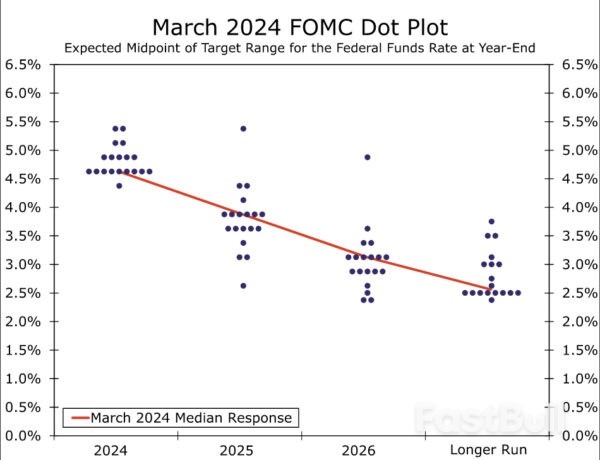
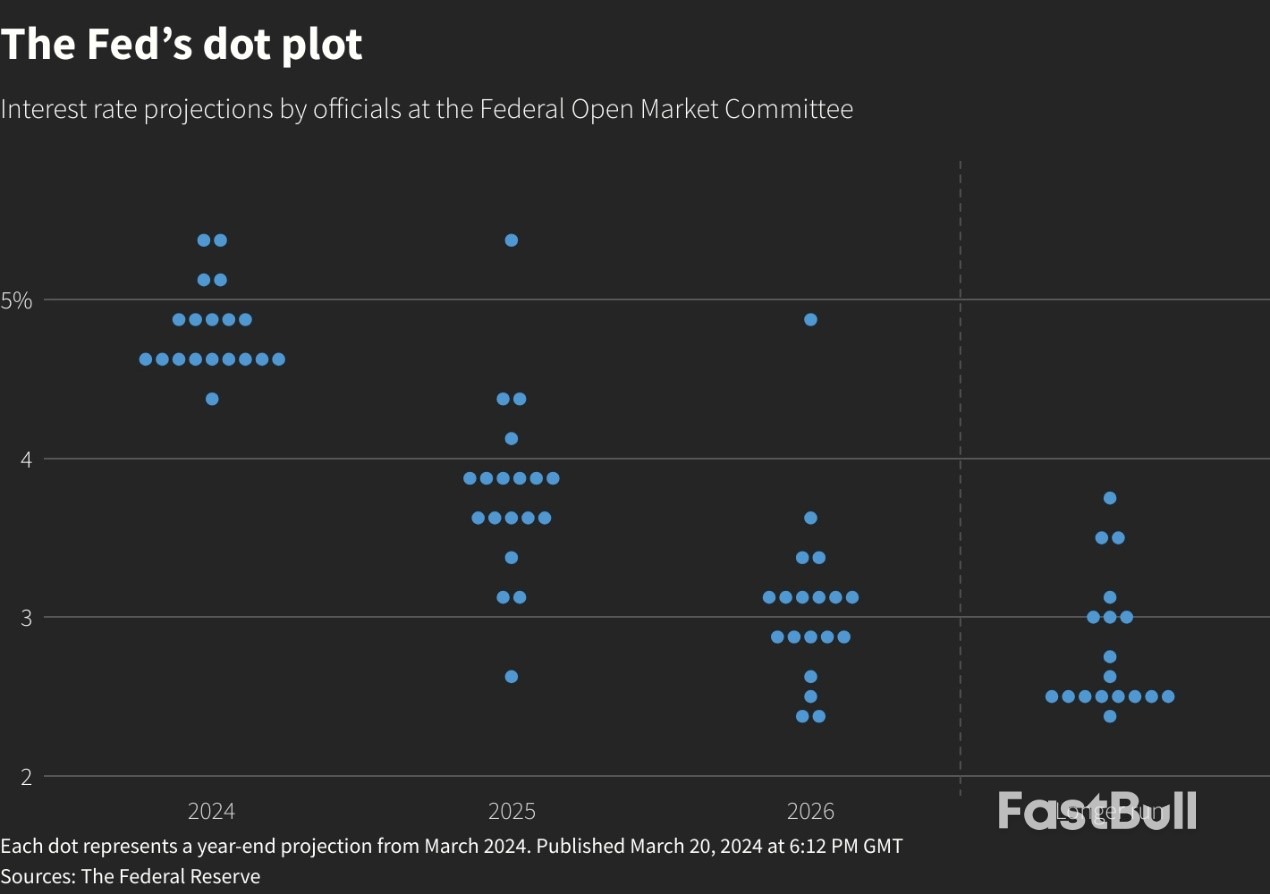
          The Summary of Economic Projections (SEP) signaled that all but two of the Committee members expect to start cutting rates this year, with the median participant projecting 75 bps of easing by year-end 2024 (chart). The 2024 median dot was unchanged from the December SEP, although the distribution drifted higher in a sign that policymakers remain on guard against sticky inflation. In that vein, the median dots for 2025 and 2026 rose by 25 bps in each year, consistent with 75 bps of easing in 2025 and another 75 bps of cuts in 2026.March FOMC Meeting: Still Building Confidence_1
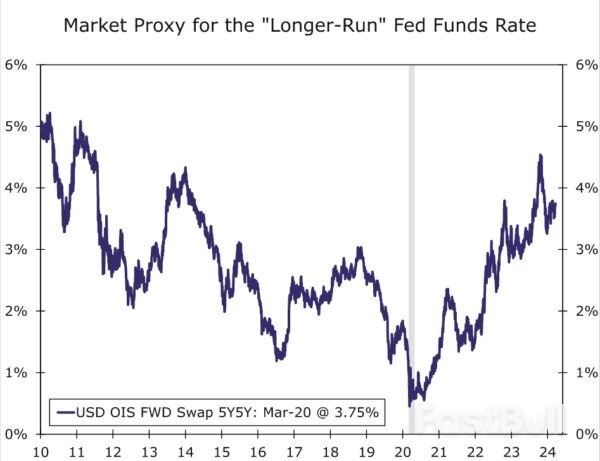
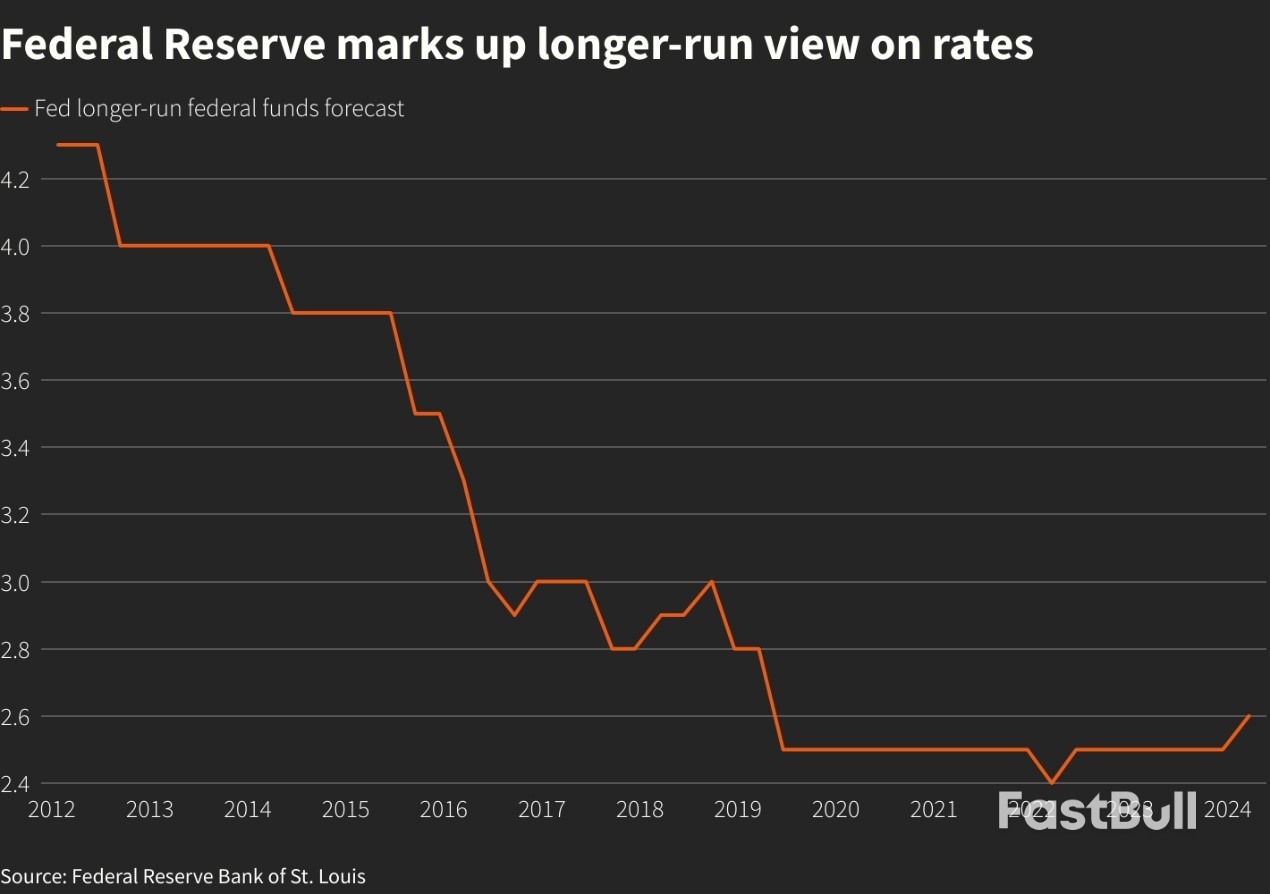
          The median "longer-run" dot also moved higher. The longer-run dot represents each participant's view of the level of the federal funds rate that would be most consistent with achieving the Federal Reserve's dual mandate of maximum employment and price stability over the long-run. The increase in the longer-run dot was small, just 6 bps, but it marks the first time the median has been above 2.5% since March 2019. We suspect the longer-run dot will drift higher very slowly to reflect a neutral rate that may have moved somewhat higher relative to the pre-pandemic period. Markets appear to be ahead of the Committee and are priced for short-term interest rates to be between three and four percent over the longer-run (chart).March FOMC Meeting: Still Building Confidence_2
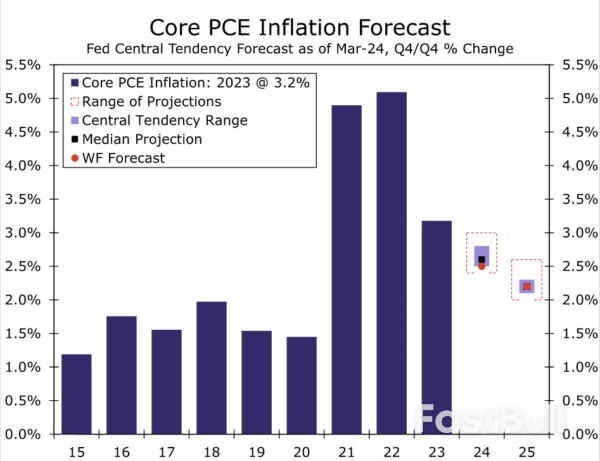
          Elsewhere, the Committee's projections for the economy reflected continued resilience in both output and price growth. The median projection for real GDP growth in 2024 is 2.1%—up from 1.4% in the December SEP. Growth projections in 2025 and 2026 were also revised up by two tenths and one tenth of a percentage point, respectively. The Committee's inflation projections also rose modestly, most notably an increase in the median projection for 2024 core PCE inflation from 2.4% to 2.6% (chart). That said, the median forecasts for core inflation in 2025 and 2026 were left unchanged in a sign that the Committee remains confident that inflation progress will continue, just at a slightly slower pace than previously believed.March FOMC Meeting: Still Building Confidence_3
          The post-meeting statement contained virtually no changes to what was released following the January 31 meeting. Job gains were still characterized as "strong," although the phrase that hiring has "moderated since early last year" was stricken with payrolls averaging 265K the past three months. The remainder of the statement contained no changes. Economic activity continues to expand at a "solid" pace, and inflation "remains elevated." Notably, the FOMC continues to seek "greater confidence that inflation is moving sustainably toward 2%" before reducing the fed funds rate.
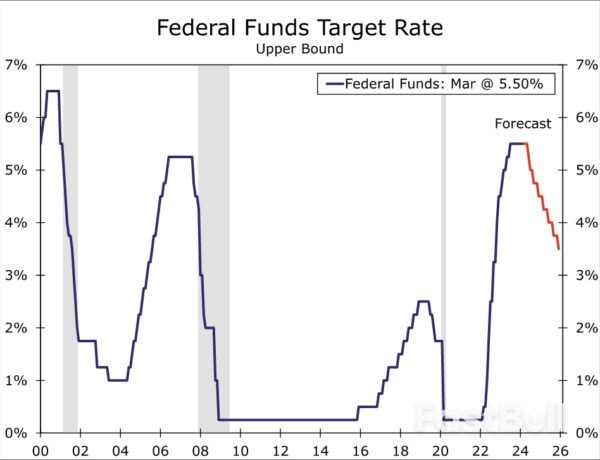
          Overall, the updated Summary of Economic Projections suggests that the FOMC believes that inflation is on a path back to its 2% target, but it is likely to be achieved slightly later than previously expected. We currently expect the Committee to first ease policy at its June 12 meeting, at which time officials will have seen three more months of inflation and employment data, and ultimately reduce the fed funds rate by a total of 100 bps this year (chart). However, with the Committee more upbeat on prospects for economic activity and a bit more worried about inflation, the risks to our outlook are skewed toward the FOMC beginning to ease a little later in the summer (at its July 31 meeting), or potentially proceeding at a slower pace (e.g., every other meeting).March FOMC Meeting: Still Building Confidence_4
          The Committee also reaffirmed its ongoing pace of balance sheet runoff, commonly referred to as quantitative tightening (QT), but Chair Powell's comments in the post-meeting press conference suggested that changes are coming. Powell stated that it is the Committee's view that it would be appropriate to slow the pace of asset runoff "fairly soon." Note that a slower pace of QT would still involve shrinking the Fed's balance sheet, just at a slower pace than what has occurred since QT ramped up in mid-2022. Coming into the meeting, our forecast assumed that the FOMC would announce a plan to slow the pace of QT at its June meeting. In light of Powell's comments today, an announcement at the May meeting seems slightly more likely than a June announcement, although we would not be surprised if it slipped to the June meeting. Either way, we expect the runoff caps for Treasury securities to be reduced to $30 billion while mortgage-backed securities caps are dropped to $20 billion, with this slower pace of runoff continuing until roughly year-end 2024.
          To stay updated on all economic events of today, please check out our Economic calendar
          Risk Warnings and Disclaimers
          You understand and acknowledge that there is a high degree of risk involved in trading. Following any strategies or investment methods may lead to potential losses. The content on the site is provided by our contributors and analysts for information purposes only. You are solely responsible for determining whether any trading assets, securities, strategy, or any other product is suitable for investing based on your own investment objectives and financial situation.
          Add to Favorites
          Share

          Fed Lifts Neutral View; More to Come?

          Cohen

          Economic

          Central Bank

          Fed policymakers on Wednesday kept their 2024 U.S. interest rate projection unchanged, but the floor for rates once cuts start is moving higher.
          In their quarterly Summary of Economic Projections, officials raised the median outlook for 2025 and 2026, and more importantly, increased their longer-run median interest rate outlook above 2.5% for the first time in five years.
          The median 2025 and 2026 rate views were raised by three tenths of one percent to 2.9% and 3.1%, respectively, and the longer-run rate was lifted by one tenth of a percentage point to 2.6%.
          As the Fed maintained its long-run inflation projection at its 2% target, this implies a slight increase in what policymakers deem to be the neutral real rate of interest, or 'R-star', to 0.6% from 0.5%.
          These were small changes, particularly to the longer run projection, but they could be significant.
          Collectively, they show the Fed recognizes that policy needs to be tighter for longer in the post-pandemic world to get inflation back down to target and keep it there. Seven Fed officials now see a neutral rate of 2.9% or higher, compared with four in December.Fed Lifts Neutral View; More to Come?_1
          Fed Lifts Neutral View; More to Come?_2Another way of looking at it, with growth consistently surprising on the upside, the post-pandemic U.S. economy is much less responsive to interest rate hikes than it was before March 2020.
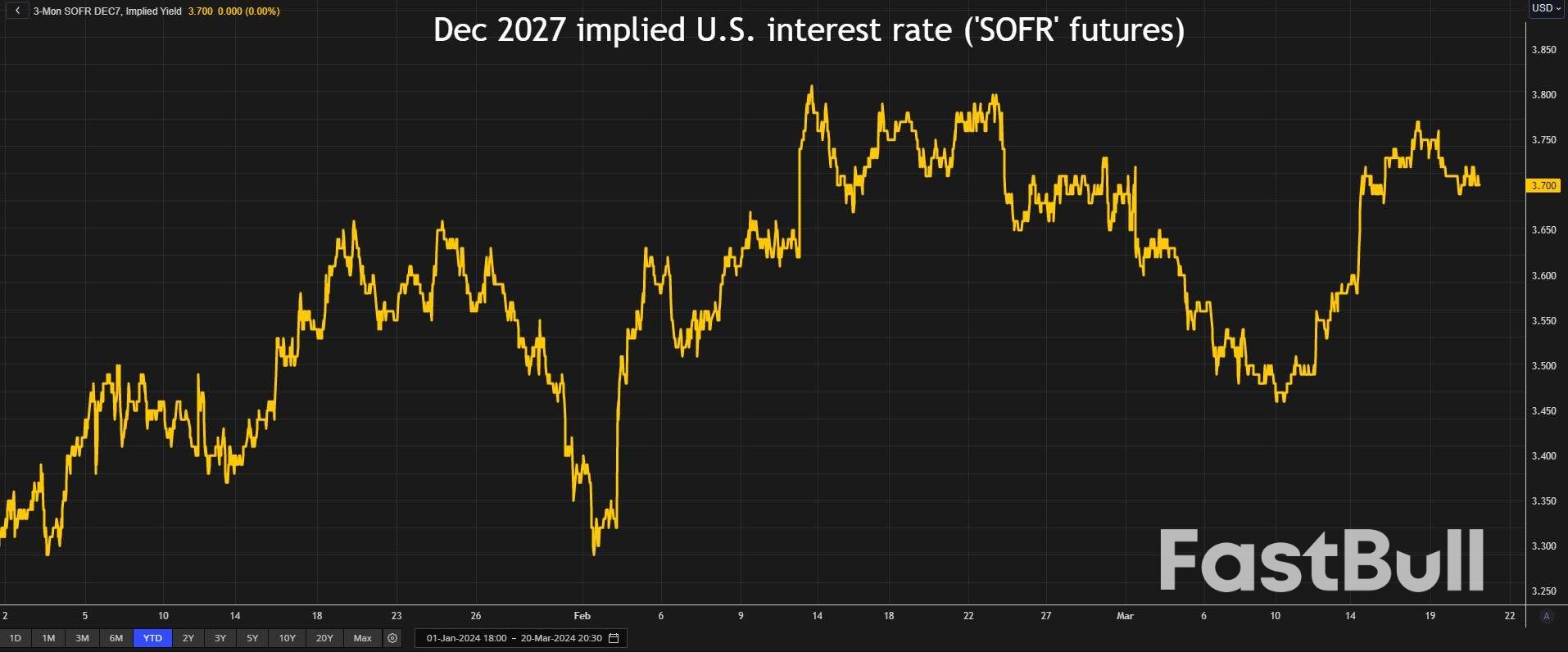
          These are hardly new revelations - rates futures markets have for some time priced in a higher terminal rate than that implied in the SEP projections - but the highest neutral rate outlook since 2018 is a marker.
          The question now is whether that gap between the market-based and Fed view for the terminal rate, the policy rate once the easing cycle ends, begins to converge.
          "We're on a higher glide path," said Gregory Daco, chief economist at EY. "There's a more consistent view between the market and the Fed on ending the easing cycle at a level that is higher than what had been consistent with previous cycles."

          Baby Steps

          Fed Chair Jerome Powell downplayed the new neutral rate projection, calling the move "modest" and noting that the long-term horizon is shrouded in huge uncertainty.
          In addition structural factors like demographics, productivity trends and cross-border capital flows help determine 'R-star', and the pace of change in these can be glacial.
          But Powell did say his "instinct" is that interest rates will not return to pre-pandemic low levels.
          Again, this is not a particularly revelatory position but it does chime with what the bond and rates markets have been signaling recently.
          Breakeven inflation rates on 10- and 30-year inflation-linked Treasury bonds are hovering around 2.3% and drifting closer to 2.5%, a sign that bond traders are not fully convinced the Fed will get inflation back down to target.Fed Lifts Neutral View; More to Come?_3
          Interest rate futures currently imply a terminal rate of 3.7% by the end of 2026, a good bit higher than the Fed's projected 3.1% over the same time horizon, never mind the long-run neutral view of 2.6%.
          With growth running hotter than nearly all forecasts and inflation proving stickier than Fed officials would like, it's more likely that any convergence will see the Fed's rate view drift towards the market's rather than the other way around.
          "There is still a clear difference between the market and the Fed in terms of where the terminal rate will land," says Charlie Ripley, senior investment strategist at Allianz Investment Management.
          "The main implication (of this) is that a policy rate set lower than the natural rate for a longer period of time could bring on unintended price instability or unwanted inflation."
          The first step to closing that gap was taken on Wednesday. It may not be the last.

          Source: Reuters

          To stay updated on all economic events of today, please check out our Economic calendar
          Risk Warnings and Disclaimers
          You understand and acknowledge that there is a high degree of risk involved in trading. Following any strategies or investment methods may lead to potential losses. The content on the site is provided by our contributors and analysts for information purposes only. You are solely responsible for determining whether any trading assets, securities, strategy, or any other product is suitable for investing based on your own investment objectives and financial situation.
          Add to Favorites
          Share

          March 21st Financial News

          FastBull Featured

          Daily News

          [Quick Facts]

          1. Australian employment data is strong, so the RBA is possible to raise rates.
          2. New Zealand's economy slips into recession, so the central bank has to cut rates earlier.
          3. WSJ's Timiraos says the Fed has not cut the rate-cut expectations.
          4. Fed rate decision: Three rate cuts in 2024, scaling back rate-cut forecasts for 2025.

          [News Details]

          Australian employment data is strong, so the RBA is possible to raise rates
          Australian employment soared and the unemployment rate fell in February, highlighting the continued resilience of the country's labor market against the restrictive monetary policy. 116,500 new jobs were created in February, almost triple the expected 40,000. The unemployment rate fell to 3.7% from 4.1% and the employment participation rate fell slightly to 66.7%. As a result, the AUD/USD rose as much as 0.4%, while the policy-sensitive three-year bond yield climbed to 3.68%. The Reserve Bank of Australia (RBA) kept its benchmark interest rate at a 12-year high of 4.35% this week and declined to hike rates. Employment data on Thursday and monthly inflation data due next week will help shape the policy debate further.
          New Zealand's economy slips into recession, so the central bank has to cut rates earlier
          New Zealand's economy unexpectedly contracted in the last three months of last year as high interest rates continued to dampen consumer spending and investment, confirming the economy was in recession. Following a 0.3% decline in GDP in the third quarter of last year, New Zealand's fourth-quarter GDP fell by 0.1% quarter-on-quarter, compared with an expected 0.1% increase, and fell by 0.3% year-on-year, worse than the expected 0%.
          In the face of aggressive monetary tightening by the Reserve Bank of New Zealand (RBNZ), as it tries to control inflation, weak growth could pressure policymakers to consider an early shift to lower interest rates. The RBNZ has kept interest rates on hold at 5.5% since last May and hinted last month that it didn't plan to cut rates until 2025. Most economists expect the bank to cut rates for the first time in the last months of 2024.
          WSJ's Timiraos says the Fed has not cut the rate-cut expectations
          Wall Street Journal reporter Nick Timiraos wrote after the Fed rate decision that, despite the strong U.S. economic growth in recent months and higher-than-expected inflation, the Federal Reserve officials did not significantly change the expectations of rate cuts. Most officials still expect three rate cuts this year, but some officials predicted milder rate cuts than last year.
          Federal Reserve Chairman Jerome Powell acknowledged that inflation has been stickier than expected over the past two months and warned policymakers that they should not "ignore data we don't like." But he said officials had previously anticipated that the decline in inflation could be bumpy and it was too early to say that the recent downward trajectory of inflation had stalled or reversed. We don't know if it's a bump in the road (of bringing inflation down) or something else. We have to find out.
          Fed rate decision: Three rate cuts in 2024, scaling back rate-cut forecasts for 2025
          On March 20, local time, the Fed left interest rates unchanged at its policy meeting, in line with market expectations. The monetary policy statement is as follows:
          Recent indicators suggest that economic activity is expanding at a solid pace. Job growth remains strong and the unemployment rate remains low. Inflation has slowed over the past year but remains high.
          The economic outlook is uncertain and the Committee maintains a high level of concern about inflation risks.
          In considering any adjustment to the target range for the federal funds rate, the Committee will carefully assess the latest data, the evolving outlook, and the balance of risks. The Committee does not expect that a reduction in the target range would be appropriate until it gains greater confidence that inflation is moving sustainably toward 2%. In addition, the Committee will continue to reduce its holdings of Treasuries, agency debt, and agency mortgage-backed securities by its previously announced plans.
          The Committee's assessment will take into account a wide range of information, including labor market conditions, inflationary pressures and inflation expectations, and financial and international developments.
          The SEP was also updated at this meeting, with upward revisions to economic growth forecasts across the board: 2.1% in 2024 (vs. the previous 1.4%), 2.0% in 2025 (vs. the previous 1.8%), and 2.0% in 2026 (vs. the previous 1.9%).
          In terms of inflation expectations, the 2025 inflation estimate was raised slightly to 2.2% from the previous 2.1% and the core inflation forecast for the current year was raised slightly to 2.6% from the previous 2.4%.
          In terms of the dot plot, expectations for three rate cuts in 2024 were unchanged, but the number of supporters increased to nine from six. The number of rate cuts in 2025 was scaled back (by 50 basis points, that is, 2 rate cuts, each by 25 basis points).

          [Focus of the Day]

          UTC+8 16:30 Swiss Central Bank March Interest Rate Decision
          UTC+8 17:30 Eurozone March Markit Manufacturing PMI Preliminary Value
          UTC+8 17:30 UK March Markit Services PMI Preliminary Value
          UTC+8 20:00 Bank of England March Interest Rate Decision
          UTC+8 21:45 U.S. March Markit Manufacturing PMI Preliminary Value
          Risk Warnings and Disclaimers
          You understand and acknowledge that there is a high degree of risk involved in trading. Following any strategies or investment methods may lead to potential losses. The content on the site is provided by our contributors and analysts for information purposes only. You are solely responsible for determining whether any trading assets, securities, strategy, or any other product is suitable for investing based on your own investment objectives and financial situation.
          Add to Favorites
          Share
          FastBull
          Copyright © 2025 FastBull Ltd

          728 RM B 7/F GEE LOK IND BLDG NO 34 HUNG TO RD KWUN TONG KLN HONG KONG

          TelegramInstagramTwitterfacebooklinkedin
          App Store Google Play Google Play
          Products
          Charts

          Chats

          Q&A with Experts
          Screeners
          Economic Calendar
          Data
          Tools
          Membership
          Features
          Function
          Markets
          Copy Trading
          Latest Signals
          Contests
          News
          Analysis
          24/7
          Columns
          Education
          Company
          Careers
          About Us
          Contact Us
          Advertising
          Help Center
          Feedback
          User Agreement
          Privacy Policy
          Business

          White Label

          Data API

          Web Plug-ins

          Poster Maker

          Affiliate Program

          Risk Disclosure

          The risk of loss in trading financial instruments such as stocks, FX, commodities, futures, bonds, ETFs and crypto can be substantial. You may sustain a total loss of the funds that you deposit with your broker. Therefore, you should carefully consider whether such trading is suitable for you in light of your circumstances and financial resources.

          No decision to invest should be made without thoroughly conducting due diligence by yourself or consulting with your financial advisors. Our web content might not suit you since we don't know your financial conditions and investment needs. Our financial information might have latency or contain inaccuracy, so you should be fully responsible for any of your trading and investment decisions. The company will not be responsible for your capital loss.

          Without getting permission from the website, you are not allowed to copy the website's graphics, texts, or trademarks. Intellectual property rights in the content or data incorporated into this website belong to its providers and exchange merchants.

          Not Logged In

          Log in to access more features

          FastBull Membership

          Not yet

          Purchase

          Become a signal provider
          Help Center
          Customer Service
          Dark Mode
          Price Up/Down Colors

          Log In

          Sign Up
          Position
          Layout
          Fullscreen
          Default to Chart
          The chart page opens by default when you visit fastbull.com