• Trade
  • Markets
  • Copy
  • Contests
  • News
  • 24/7
  • Calendar
  • Q&A
  • Chats
Trending
Screeners
SYMBOL
LAST
BID
ASK
HIGH
LOW
NET CHG.
%CHG.
SPREAD
SPX
S&P 500 Index
6846.50
6846.50
6846.50
6878.28
6827.18
-23.90
-0.35%
--
DJI
Dow Jones Industrial Average
47739.31
47739.31
47739.31
47971.51
47611.93
-215.67
-0.45%
--
IXIC
NASDAQ Composite Index
23545.89
23545.89
23545.89
23698.93
23455.05
-32.22
-0.14%
--
USDX
US Dollar Index
99.000
99.080
99.000
99.000
99.000
+0.050
+ 0.05%
--
EURUSD
Euro / US Dollar
1.16379
1.16387
1.16379
1.16389
1.16322
+0.00015
+ 0.01%
--
GBPUSD
Pound Sterling / US Dollar
1.33225
1.33233
1.33225
1.33239
1.33140
+0.00020
+ 0.02%
--
XAUUSD
Gold / US Dollar
4191.90
4192.34
4191.90
4193.80
4189.64
+2.20
+ 0.05%
--
WTI
Light Sweet Crude Oil
58.650
58.692
58.650
58.676
58.543
+0.095
+ 0.16%
--

Community Accounts

Signal Accounts
--
Profit Accounts
--
Loss Accounts
--
View More

Become a signal provider

Sell trading signals to earn additional income

View More

Guide to Copy Trading

Get started with ease and confidence

View More

Signal Accounts for Members

All Signal Accounts

Best Return
  • Best Return
  • Best P/L
  • Best MDD
Past 1W
  • Past 1W
  • Past 1M
  • Past 1Y

All Contests

  • All
  • Trump Updates
  • Recommend
  • Stocks
  • Cryptocurrencies
  • Central Banks
  • Featured News
Top News Only
Share

Brazil Finance Minister Haddad: Loan For Correios Is Possible This Year, But It Is Not The Only Option Under Works

Share

KCNA: North Korea's Supreme Leader Kim Jong UN Sends Condolences To Russian Embassy For Ambassador's Death

Share

Japan Prime Minister Takaichi: 30 Injuries Reported So Far From Monday Earthquake

Share

USA Senate Committee Votes To Advance Nomination Of Jared Isaacman To Head Nasa

Share

Singapore Post - New Rate For Standard Regular Mail & Standard Large Mail Will Be S$0.62 And S$0.90 Respectively

Share

Australia's S&P/ASX 200 Index Down 0.27% At 8601.10 Points In Early Trade

Share

Trump: The USA Needs Mexico To Release 200000 Acre-Feet Of Water Before December 31St, And The Rest Must Come Soon After

Share

Trump: I Have Authorized Documentation To Impose A 5% Tariff On Mexico If This Water Isn't Released

Share

Brazil's Sao Paulo State Governor Tarcisio De Freitas Says Flavio Bolsonaro Will Have His Support - Cnn Brasil

Share

Ukraine's Security Must Be Guaranteed, In The Long Term, As A First Line Of Defence For Our Union, Says European Commission President

Share

Ukraine's Sovereignty Must Be Respected, Says European Commission President

Share

The Goal Is A Strong Ukraine, On The Battlefield And At The Negotiating Table, Says European Commission President

Share

As Peace Talks Are Ongoing, The EU Remains Ironclad In Its Support For Ukraine, Says European Commission President

Share

Pepsico: Asking USA-Based Pepna Employees As Well As Pbus Division Offices And Pfus Region Offices To Work Remotely This Week

Share

A U.S. Judge Ruled That President Trump’s Ban On Several Wind Power Projects Was Illegal

Share

Senior USA Administration Official: We Continue To Monitor Drc-Rwanda Situation Closely, Continue To Work With All Sides To Ensure Commitments Are Honored

Share

Israeli Military Says It Has Struck Infrastructure Belonging To Hezbollah In Several Areas In Southern Lebanon

Share

SPDR Gold Holdings Down 0.11%, Or 1.14 Tonnes

Share

On Monday (December 8), In Late New York Trading, S&P 500 Futures Fell 0.21%, Dow Jones Futures Fell 0.43%, NASDAQ 100 Futures Fell 0.08%, And Russell 2000 Futures Fell 0.04%

Share

Morgan Stanley: Data Center ABS Spreads Are Expected To Widen In 2026

TIME
ACT
FCST
PREV
France Trade Balance (SA) (Oct)

A:--

F: --

P: --
Euro Zone Employment YoY (SA) (Q3)

A:--

F: --

P: --
Canada Part-Time Employment (SA) (Nov)

A:--

F: --

P: --

Canada Unemployment Rate (SA) (Nov)

A:--

F: --

P: --

Canada Full-time Employment (SA) (Nov)

A:--

F: --

P: --

Canada Labor Force Participation Rate (SA) (Nov)

A:--

F: --

P: --

Canada Employment (SA) (Nov)

A:--

F: --

P: --

U.S. PCE Price Index MoM (Sept)

A:--

F: --

P: --

U.S. Personal Income MoM (Sept)

A:--

F: --

P: --

U.S. Core PCE Price Index MoM (Sept)

A:--

F: --

P: --

U.S. PCE Price Index YoY (SA) (Sept)

A:--

F: --

P: --

U.S. Core PCE Price Index YoY (Sept)

A:--

F: --

P: --

U.S. Personal Outlays MoM (SA) (Sept)

A:--

F: --

P: --
U.S. 5-10 Year-Ahead Inflation Expectations (Dec)

A:--

F: --

P: --

U.S. Real Personal Consumption Expenditures MoM (Sept)

A:--

F: --

P: --
U.S. Weekly Total Rig Count

A:--

F: --

P: --

U.S. Weekly Total Oil Rig Count

A:--

F: --

P: --

U.S. Consumer Credit (SA) (Oct)

A:--

F: --

P: --
China, Mainland Foreign Exchange Reserves (Nov)

A:--

F: --

P: --

Japan Trade Balance (Oct)

A:--

F: --

P: --

Japan Nominal GDP Revised QoQ (Q3)

A:--

F: --

P: --

China, Mainland Imports YoY (CNH) (Nov)

A:--

F: --

P: --

China, Mainland Exports (Nov)

A:--

F: --

P: --

China, Mainland Imports (CNH) (Nov)

A:--

F: --

P: --

China, Mainland Trade Balance (CNH) (Nov)

A:--

F: --

P: --

China, Mainland Exports YoY (USD) (Nov)

A:--

F: --

P: --

China, Mainland Imports YoY (USD) (Nov)

A:--

F: --

P: --

Germany Industrial Output MoM (SA) (Oct)

A:--

F: --

P: --
Euro Zone Sentix Investor Confidence Index (Dec)

A:--

F: --

P: --

Canada National Economic Confidence Index

A:--

F: --

P: --

U.K. BRC Like-For-Like Retail Sales YoY (Nov)

--

F: --

P: --

U.K. BRC Overall Retail Sales YoY (Nov)

--

F: --

P: --

Australia Overnight (Borrowing) Key Rate

--

F: --

P: --

RBA Rate Statement
RBA Press Conference
Germany Exports MoM (SA) (Oct)

--

F: --

P: --

U.S. NFIB Small Business Optimism Index (SA) (Nov)

--

F: --

P: --

Mexico 12-Month Inflation (CPI) (Nov)

--

F: --

P: --

Mexico Core CPI YoY (Nov)

--

F: --

P: --

Mexico PPI YoY (Nov)

--

F: --

P: --

U.S. Weekly Redbook Index YoY

--

F: --

P: --

U.S. JOLTS Job Openings (SA) (Oct)

--

F: --

P: --

China, Mainland M1 Money Supply YoY (Nov)

--

F: --

P: --

China, Mainland M0 Money Supply YoY (Nov)

--

F: --

P: --

China, Mainland M2 Money Supply YoY (Nov)

--

F: --

P: --

U.S. EIA Short-Term Crude Production Forecast For The Year (Dec)

--

F: --

P: --

U.S. EIA Natural Gas Production Forecast For The Next Year (Dec)

--

F: --

P: --

U.S. EIA Short-Term Crude Production Forecast For The Next Year (Dec)

--

F: --

P: --

EIA Monthly Short-Term Energy Outlook
U.S. API Weekly Gasoline Stocks

--

F: --

P: --

U.S. API Weekly Cushing Crude Oil Stocks

--

F: --

P: --

U.S. API Weekly Crude Oil Stocks

--

F: --

P: --

U.S. API Weekly Refined Oil Stocks

--

F: --

P: --

South Korea Unemployment Rate (SA) (Nov)

--

F: --

P: --

Japan Reuters Tankan Non-Manufacturers Index (Dec)

--

F: --

P: --

Japan Reuters Tankan Manufacturers Index (Dec)

--

F: --

P: --

Japan Domestic Enterprise Commodity Price Index MoM (Nov)

--

F: --

P: --

Japan Domestic Enterprise Commodity Price Index YoY (Nov)

--

F: --

P: --

China, Mainland PPI YoY (Nov)

--

F: --

P: --

China, Mainland CPI MoM (Nov)

--

F: --

P: --

Italy Industrial Output YoY (SA) (Oct)

--

F: --

P: --

Q&A with Experts
    • All
    • Chatrooms
    • Groups
    • Friends
    Connecting
    .
    .
    .
    Type here...
    Add Symbol or Code

      No matching data

      All
      Trump Updates
      Recommend
      Stocks
      Cryptocurrencies
      Central Banks
      Featured News
      • All
      • Russia-Ukraine Conflict
      • Middle East Flashpoint
      • All
      • Russia-Ukraine Conflict
      • Middle East Flashpoint
      Search
      Products

      Charts Free Forever

      Chats Q&A with Experts
      Screeners Economic Calendar Data Tools
      Membership Features
      Data Warehouse Market Trends Institutional Data Policy Rates Macro

      Market Trends

      Market Sentiment Order Book Forex Correlations

      Top Indicators

      Charts Free Forever
      Markets

      News

      News Analysis 24/7 Columns Education
      From Institutions From Analysts
      Topics Columnists

      Latest Views

      Latest Views

      Trending Topics

      Top Columnists

      Latest Update

      Signals

      Copy Rankings Latest Signals Become a signal provider AI Rating
      Contests
      Brokers

      Overview Brokers Assessment Rankings Regulators News Claims
      Broker listing Forex Brokers Comparison Tool Live Spread Comparison Scam
      Q&A Complaint Scam Alert Videos Tips to Detect Scam
      More

      Business
      Events
      Careers About Us Advertising Help Center

      White Label

      Data API

      Web Plug-ins

      Affiliate Program

      Awards Institution Evaluation IB Seminar Salon Event Exhibition
      Vietnam Thailand Singapore Dubai
      Fans Party Investment Sharing Session
      FastBull Summit BrokersView Expo
      Recent Searches
        Top Searches
          Markets
          News
          Analysis
          User
          24/7
          Economic Calendar
          Education
          Data
          • Names
          • Latest
          • Prev

          View All

          No data

          Scan to Download

          Faster Charts, Chat Faster!

          Download App
          English
          • English
          • Español
          • العربية
          • Bahasa Indonesia
          • Bahasa Melayu
          • Tiếng Việt
          • ภาษาไทย
          • Français
          • Italiano
          • Türkçe
          • Русский язык
          • 简中
          • 繁中
          Open Account
          Search
          Products
          Charts Free Forever
          Markets
          News
          Signals

          Copy Rankings Latest Signals Become a signal provider AI Rating
          Contests
          Brokers

          Overview Brokers Assessment Rankings Regulators News Claims
          Broker listing Forex Brokers Comparison Tool Live Spread Comparison Scam
          Q&A Complaint Scam Alert Videos Tips to Detect Scam
          More

          Business
          Events
          Careers About Us Advertising Help Center

          White Label

          Data API

          Web Plug-ins

          Affiliate Program

          Awards Institution Evaluation IB Seminar Salon Event Exhibition
          Vietnam Thailand Singapore Dubai
          Fans Party Investment Sharing Session
          FastBull Summit BrokersView Expo

          Five Charts on the Japanese Yen's Decades-Long Drop

          Kevin Du

          Economic

          Forex

          Summary:

          Japan's yen saw a sudden jump on Monday, suggesting the country's authorities may have finally followed through on the FX market intervention warnings they have be making for months.
          Monday's moves follow a near-11% drop in the yen's value against the dollar this year and a 35% slump over the last three decades that has pushed it to a 34-year low.
          Here are five charts to show what has been happening.

          1/INTERVENTION EFFORTS

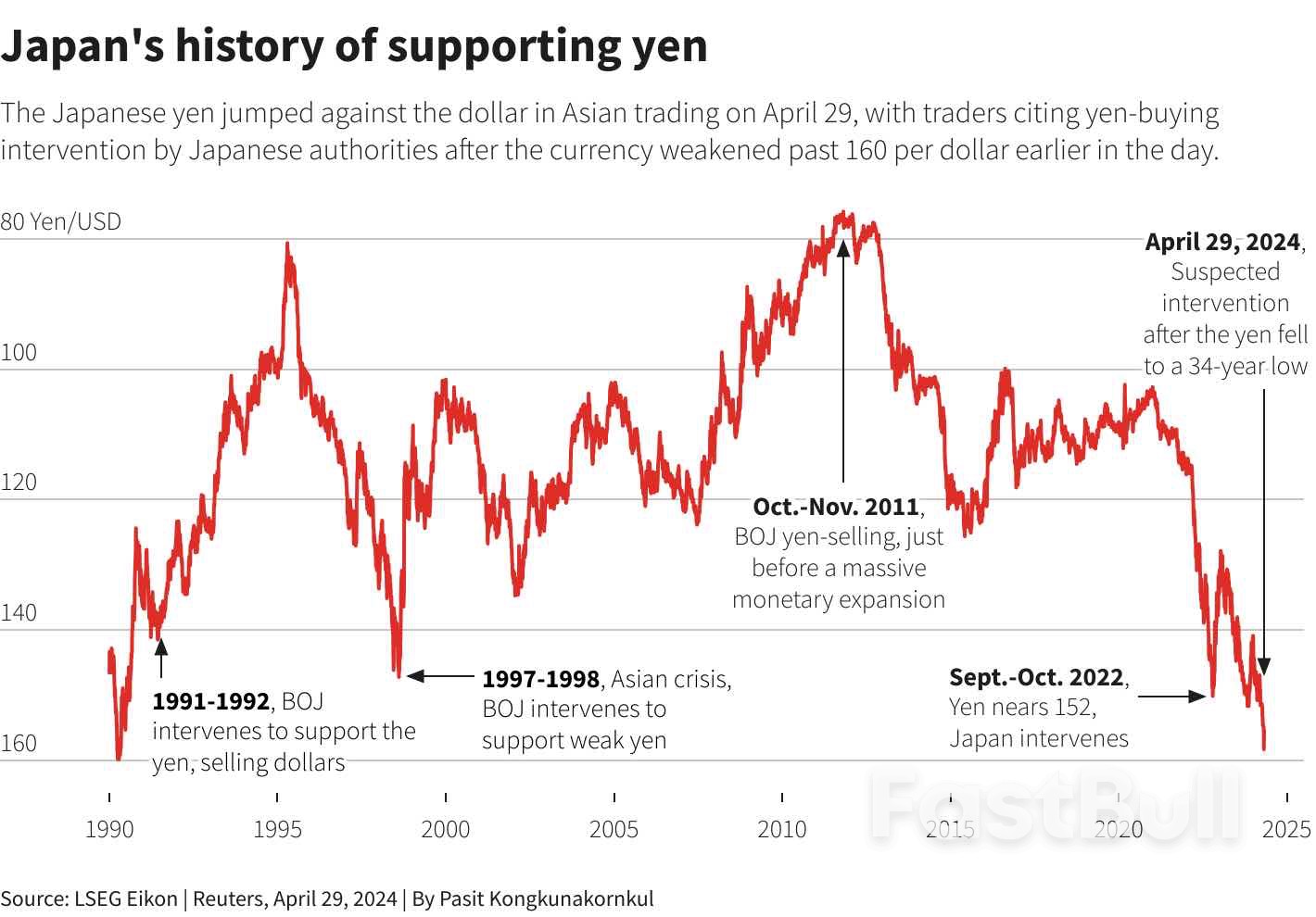
          Monday's suspected intervention came after the yen dived past 160 to the dollar , well below where most FX traders had thought it would get to before the Bank of Japan reacted.
          The last time authorities intervened was in September and October of 2022. They were estimated to have spent as much as 9.2 trillion yen ($60.78 billion) defending the currency at that time.
          The other big effort came during the Asian financial crisis in 1998, when the yen lost almost 25% in just 14 months and reached nearly 148 per dollar in August that year. The United States joined in with the intervention push and the yen rallied over 35% in the following four months.
          There has been intervention in the opposite direction too. In March 2011, Group of Seven (G7) nations jointly stepped in to stem yen strength when the currency spiked to a record high in the aftermath of a major earthquake that also crippled the large Fukushima nuclear plant.
          Five Charts on the Japanese Yen's Decades-Long Drop_1

          2/TOKYO DRIFT

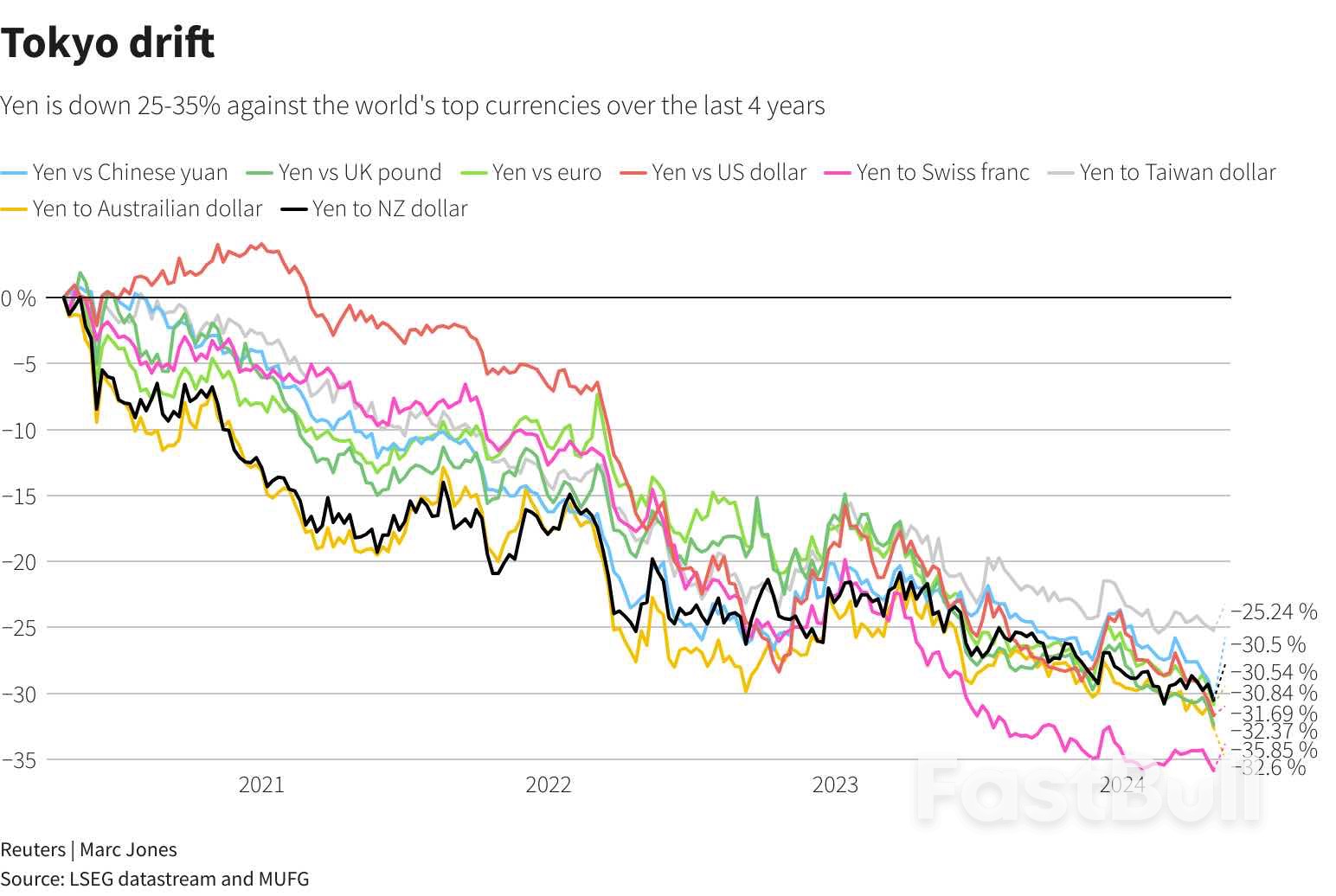
          This isn't a sudden thing. The yen has been universally weak over the last four years. Not only is it down 31% against the greenback over this period, it is down 29% against China's currency , 29.5% against the euro and nearly 36% against the safe-haven Swiss franc .
          Five Charts on the Japanese Yen's Decades-Long Drop_2

          3/STOCK UP

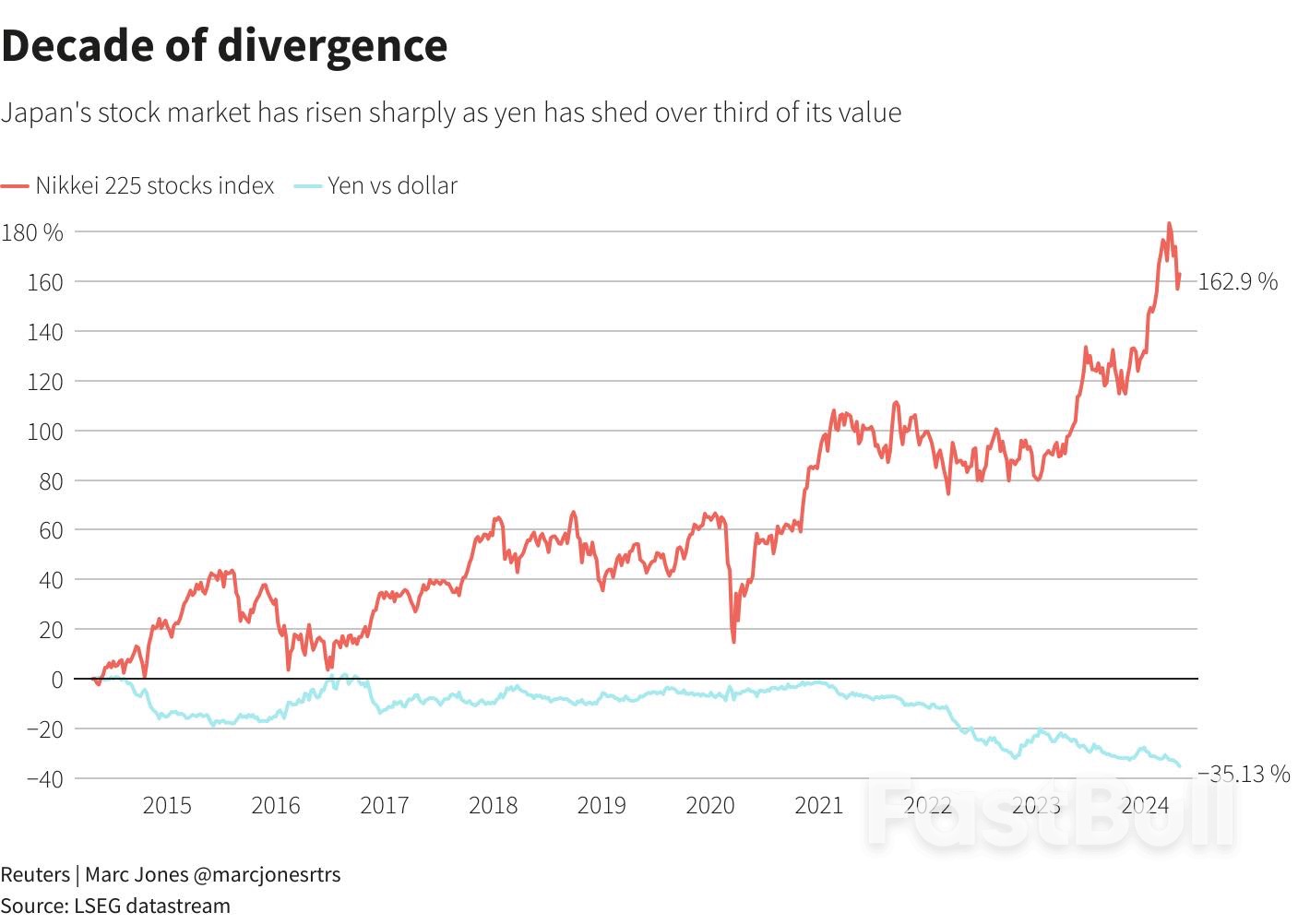
          The weak yen has been no bad thing for Japan's stock market (.N225), opens new tab which is filled with companies that sell their products around the world. The weak yen keeps them competitive and has helped lift the market over 162% over the last decade, which is not far off the 174% rise the U.S. S&P 500 (.SPX), opens new tab has seen over the same timeframe.
          Five Charts on the Japanese Yen's Decades-Long Drop_3

          4/YIELD VS YEN

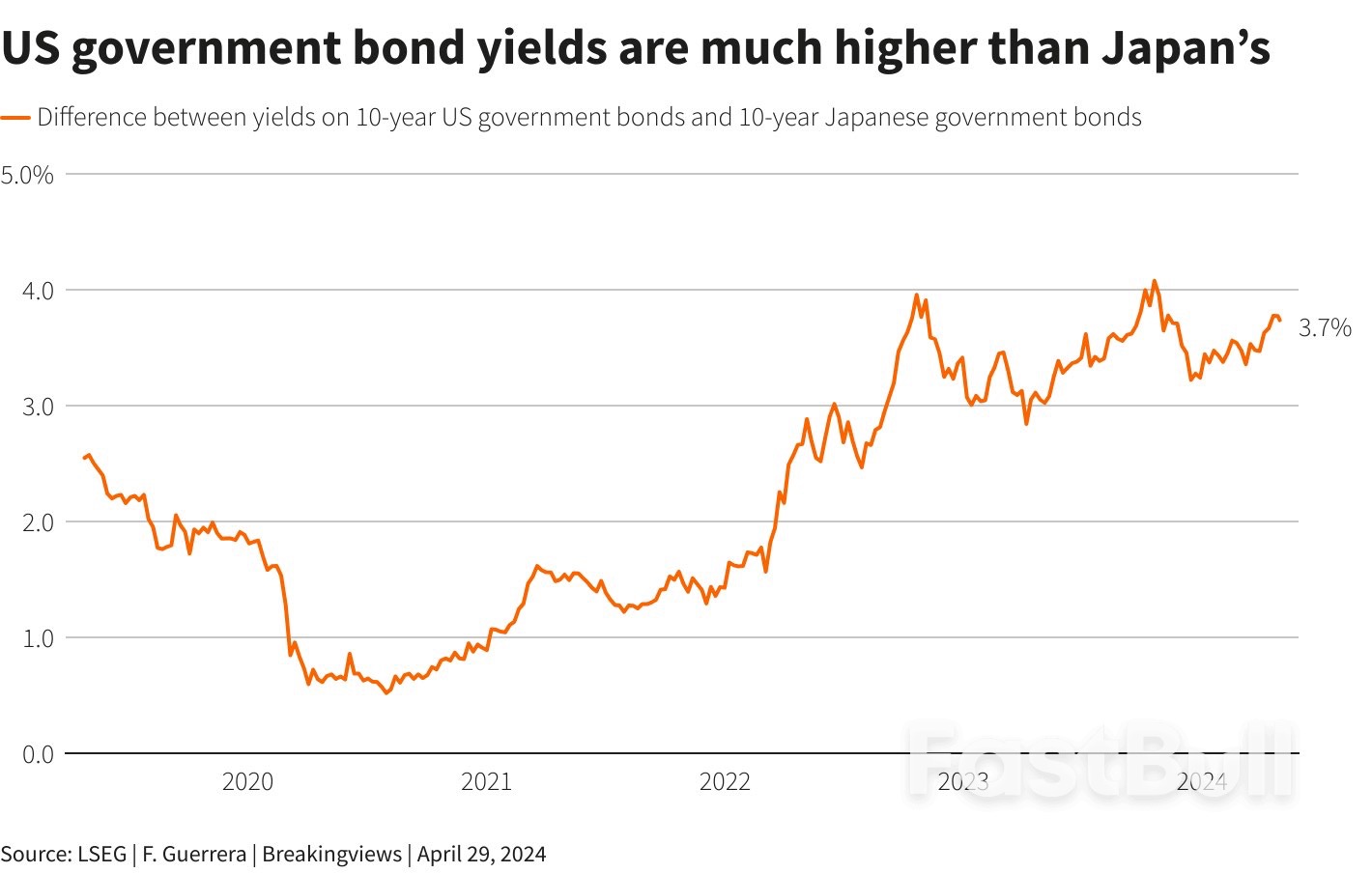
          One of the main drivers of the yen's weakness is that Japanese interest rates are far lower than elsewhere in the world. Benchmark 10-year U.S. government bonds, for example, currently yield 3.7 percentage points more than Japan's.
          This differential means it is not appealing for big international investors like pension funds to buy those Japanese government bonds, or JGBs as they are known, which it turn caps the demand for the yen.
          Japan's government debt-to-GDP ratio is also among the highest in the world, having more than trebled to close to 260% from 85% back in 1994.
          Five Charts on the Japanese Yen's Decades-Long Drop_4

          5/WHERE WE ARE AT

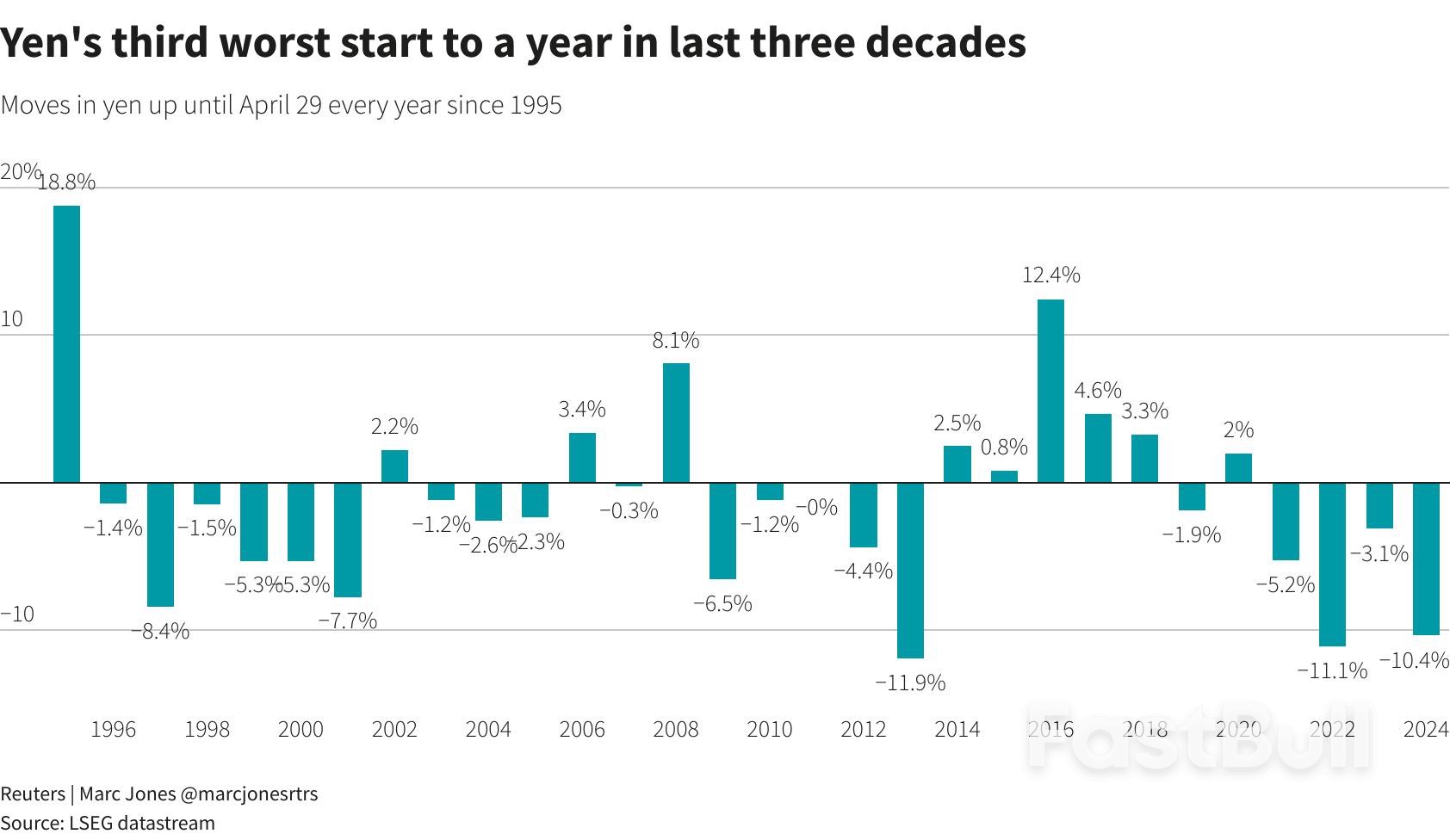
          The yen's drop since the start of January is its third worst start to a year in the last three decades and the fifth time in the last six years that it has been down at this stage of the year.
          Five Charts on the Japanese Yen's Decades-Long Drop_5

          Source: Reuters

          To stay updated on all economic events of today, please check out our Economic calendar
          Risk Warnings and Disclaimers
          You understand and acknowledge that there is a high degree of risk involved in trading. Following any strategies or investment methods may lead to potential losses. The content on the site is provided by our contributors and analysts for information purposes only. You are solely responsible for determining whether any trading assets, securities, strategy, or any other product is suitable for investing based on your own investment objectives and financial situation.
          Add to Favorites
          Share

          Japan's Factory Output Records Weakest Quarter Since Pandemic

          Samantha Luan

          Economic

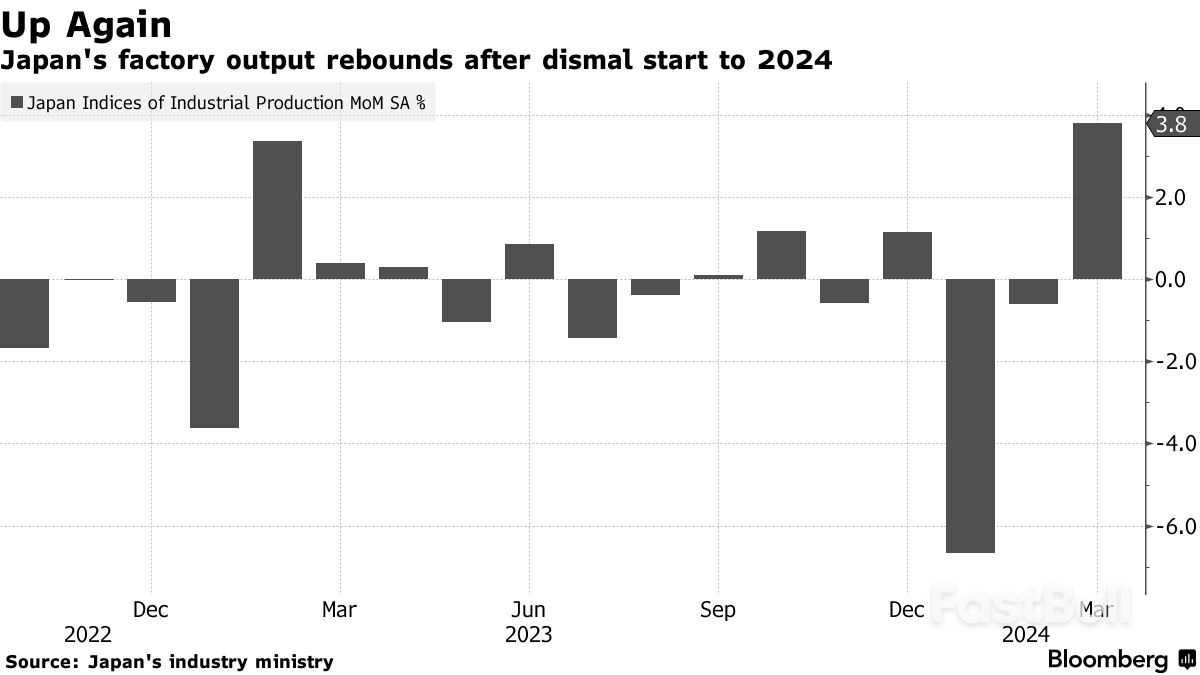
          Japan’s factory output rebounded in March from a dismal start to the year, with the quarterly figure registering the weakest performance since the height of the pandemic in a sign the economy may have contracted during the period.
          Industrial production rose 3.8% in March from February, as demand picked up after two straight months of declines, industry ministry data showed Tuesday. The result exceeded the consensus forecast of a 3.3% gain.
          The improvement in output comes after weakness early in the first quarter, as a New Year’s Day earthquake northwest of Tokyo and output suspensions in the auto industry weighed on activity from January. On a quarterly basis, output slumped 5.4% in the January-March period, the worst performance since the second quarter of 2020.
          Japan's Factory Output Records Weakest Quarter Since Pandemic_1
          “The auto safety scandal caused a sharp drop in production in January and February,” said Taro Saito, head of economic research at NLI Research Institute. “We can finally confirm a recovery from that.”
          Economists forecast Japan’s economy contracted a bit in the first quarter of 2024 after eking out growth in the last period of 2023. Saito said he believes the economy will return to growth in the second period. The ministry predicted factory production would rise 4.1% in April and gain 4.4% in May.
          Other reports Tuesday showed retail sales fell 1.2% from the previous month, while the labor market remained tight.
          The readings of production, retail sales and the labor market underscore the fragile state of Japan’s economic recovery, with domestic consumption one of the prime concerns.
          Policymakers are hopeful that strong wage hikes in the current fiscal year will spur consumption, supporting growth and demand-led price gains, in a virtuous cycle that would allow domestic demand to become the main driver for the economy.
          Japan’s labor market showed further signs of tightness in March, driven by a manpower shortage across a swath of sectors. The job-to-applicants ratio edged higher to 1.28, topping economists’ expectations for the gauge to be unchanged at 1.26, the labor ministry reported, while the unemployment rate held steady at 2.6%, according to the ministry of internal affairs.
          External demand has been the main engine of growth recently. Exports grew for a fourth consecutive month in March as the weak yen provided a tailwind and demand in China picked up.
          There are risks to the outlook. The International Monetary Fund raised its expectations for global economic growth while warning that the outlook remains fragile due to persistent inflation and geopolitical risks.
          The World Trade Organization offered a similar assessment last month, flagging expectations for a gradual recovery in global commerce in the early months of 2024 while citing the possibility gains could evaporate because of regional conflicts and geopolitical tensions.
          The yen’s plunge to a fresh 34-year low versus the dollar could spur a resurgence of cost—push inflation via higher costs for imports of food and energy. If so, it could prompt households to tighten their budgets further, casting doubts on hopes for a virtuous cycle.

          Source:Bloomberg

          To stay updated on all economic events of today, please check out our Economic calendar
          Risk Warnings and Disclaimers
          You understand and acknowledge that there is a high degree of risk involved in trading. Following any strategies or investment methods may lead to potential losses. The content on the site is provided by our contributors and analysts for information purposes only. You are solely responsible for determining whether any trading assets, securities, strategy, or any other product is suitable for investing based on your own investment objectives and financial situation.
          Add to Favorites
          Share

          AUD to USD Forecast: China PMIs, Aussie Retail Sales, and the RBA

          Thomas

          Economic

          Forex

          Australian Retail Sales in Focus
          On Tuesday (April 30), Australian retail sales figures for March will put the AUD/USD in focus.
          Economists forecast retail sales to increase by 0.2% in March after advancing by 0.3% in February. Stronger-than-expected figures could fuel investor expectations of an RBA interest rate cut.
          Upward trends in consumer spending could fuel demand-driven inflation. A more hawkish RBA rate path may raise borrowing costs and reduce disposable income. Downward trends in disposable income could force consumers to curb spending on non-essential items, dampening demand-driven inflation.
          The RBA is likely watching Australian economic indicators closely. Recent consumer and producer price figures suggest the battle to tame inflation remains ongoing.
          Beyond the Australian economic calendar, China NBS private sector PMIs and the all-important Caixin Manufacturing PMI will be in focus. The Caixin Manufacturing PMI will likely have more influence on buyer appetite for the Aussie dollar and the RBA rate path.
          Economists forecast the Caixin Manufacturing PMI to fall from 51.1 to 51.0 in April.
          An improving Chinese economy could drive demand. China accounts for one-third of Australian exports. Australia has a trade-to-GDP ratio above 50%, with 20% of the workforce in trade-related jobs.
          Upward trends in demand would boost the Australian economy and the Aussie dollar. An improving Chinese economy would also influence the RBA rate path. The RBA staff considered the Chinese macroeconomic backdrop for the 2024 economic and inflation projections. Upward revisions to inflation and growth forecasts would support a more hawkish RBA rate path.

          US Economic Calendar: Employment Costs and Consumer Confidence

          Later in the session, employment cost – wages and the CB Consumer Confidence will be in focus.
          Economists forecast employment cost – wages to increase by 0.9% quarter-on-quarter in Q1 2024. In Q4 2023, employment cost – wages rose by 0.9%. Higher-than-expected wages could further affect investor expectations of a September Fed rate cut.
          Upward trends in wages could increase disposable income and consumer spending. A more hawkish Fed rate path could raise borrowing costs and reduce disposable income, dampening demand-driven inflation.
          However, the CB Consumer Confidence Index could influence the Fed rate path more. Economists forecast the Index to decline from 104.7 to 104.0 in April. Downward trends in consumer confidence could signal a pullback in consumer spending and softer inflation.
          Other US economic indicators include the Chicago PMI and house price data. However, wage data and consumer confidence figures will likely impact the AUD/USD more.

          Short-Term Forecast

          Near-term AUD/USD trends remain hinged on Australian retail sales figures, US labor market numbers, and the FOMC press conference. Better-than-expected Australian retail sales could raise investor bets on an RBA rate hike. Upbeat retail sales figures could tilt monetary policy divergence toward the Aussie dollar.
          Conversely, better-than-expected US data could reduce the number of 2024 Fed rate cuts. However, the markets are not considering a Fed rate hike.

          AUD/USD Price Action

          Daily Chart
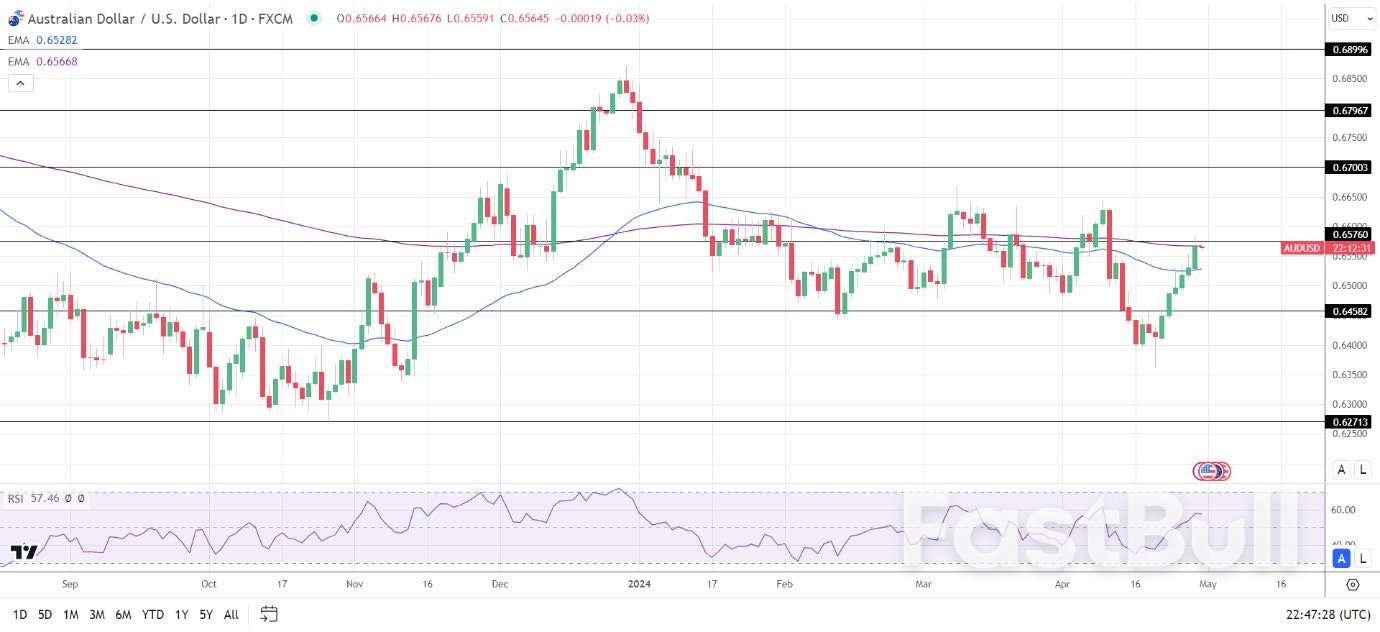
          AUD to USD Forecast: China PMIs, Aussie Retail Sales, and the RBA_1The AUD/USD remained above the 50-day EMA while hovering below the 200-day EMA, affirming bullish near-term but bearish longer-term price signals.
          An Aussie dollar breakout from the 200-day EMA and the $0.65760 resistance level would give the bulls a run at the $0.66 handle.
          Aussie retail sales, manufacturing PMI numbers from China, and the US economic calendar need consideration.
          Conversely, an AUD/USD break below the $0.65500 handle could signal a fall to the 50-day EMA. A drop below the 50-day EMA could give the bears a run at the $0.64582 support level.
          Given a 14-period Daily RSI reading of 57.46, the AUD/USD could return to the $0.66 handle before entering overbought territory.

          Source: FX Empire

          To stay updated on all economic events of today, please check out our Economic calendar
          Risk Warnings and Disclaimers
          You understand and acknowledge that there is a high degree of risk involved in trading. Following any strategies or investment methods may lead to potential losses. The content on the site is provided by our contributors and analysts for information purposes only. You are solely responsible for determining whether any trading assets, securities, strategy, or any other product is suitable for investing based on your own investment objectives and financial situation.
          Add to Favorites
          Share

          German Inflation Highlights the Difficulty of the ECB's Last Lap

          ING

          Economic

          Central Bank

          According to the just-released flash estimate, the disinflationary trend in Germany has come to an end as energy and food prices offset the dampening effects of transportation and communication on inflation in April. Headline inflation came in at 2.2% year-on-year, unchanged from March and still below the 2.5% YoY recorded in February. The European inflation measure came in at 2.4% YoY from 2.3% in March, slightly higher than consensus expectations.
          Remember that the main differences between the national and the European inflation measures are varying weights for individual consumer goods and the fact that the national measure includes prices for gambling and owner-occupied housing.

          Inflation on the rise again

          Judging from the available components, the increase in inflation was driven by energy and food prices. Core inflation seems to have come down somewhat but the expected reversed 'Easter bunny' effect hardly materialised. In fact, despite the early timing of Easter this year, prices for leisure, packaged holidays and hotels and restaurants did not fall in April.
          Today's German inflation data not only illustrates the high impact oil and food prices are having on headline inflation but also stresses how sticky inflation remains.
          This stickiness looks set to continue, and headline inflation in Germany could rebound to 3% next month. In fact, over the coming months, inflation will be determined by two opposing factors: the still delayed impact of monetary policy tightening and, at the same time, less favourable base effects, supply chain frictions as a result of the Middle East tensions as well as the cyclical improvement of the German economy. The stickiness of inflation is also reflected by companies' selling price expectations, which in manufacturing have stabilised slightly below historical averages and, in the services sector, clearly above. As a result, we continue seeing inflation hovering within the broader range of between 2% and 3% rather than continuing on a straight line to 2%.

          New headaches for ECB

          Today's increase in German headline inflation is a good reminder of how difficult the last mile of bringing inflation sustainably back to 2% will be for the European Central Bank. Still, given the ECB communication over the past few months, a rate cut at the June meeting still looks like a done deal. However, looking beyond June, the path for the Bank is anything but clear. The recent reacceleration of inflation in the US will have reignited inflation worries in the eurozone as well, at least with some ECB hawks. The recent increase in oil prices, as well as a weaker euro exchange rate, could easily push the ECB's own inflation projections for 2025 above 2% again, undermining the case for rate cuts beyond the June meeting.
          In fact, right now, there's a risk the ECB could experience a "reverse Trichet moment". Back in 2008, the ECB hiked interest rates shortly before the US subprime crisis became a global financial crisis. A mistake. And in 2011, the ECB under president Jean-Claude Trichet, hiked interest rates, assuming the euro crisis was over. Also a mistake. Six months later, new ECB president Mario Draghi came into office and cut interest rates as the eurozone economy was stuck in recession. Any fears of a 'reverse Trichet moment' will not stop the ECB from cutting rates at the June meeting, but will not only play a role in the June communication but also in the months after. A longer substantial rate cut cycle will only materialise if inflation quickly returns to 2%. Any signs of reflation and also stronger economic activity will limit the ECB's room for manoeuvre.
          In January, Bundesbank president Joachim Nagel said that the ECB had tamed the 'greedy beast' of inflation. To paraphrase this analogy, today's German inflation numbers could remind some ECB officials of a bad zombie movie, in which the 'beasts' always return several times before they are defeated for good.
          To stay updated on all economic events of today, please check out our Economic calendar
          Risk Warnings and Disclaimers
          You understand and acknowledge that there is a high degree of risk involved in trading. Following any strategies or investment methods may lead to potential losses. The content on the site is provided by our contributors and analysts for information purposes only. You are solely responsible for determining whether any trading assets, securities, strategy, or any other product is suitable for investing based on your own investment objectives and financial situation.
          Add to Favorites
          Share

          USD/JPY Forecast: Japan’s Economic Indicators Signal Yen’s Path

          Samantha Luan

          Economic

          Forex

          Industrial Production, Retail Sales, Unemployment, and the Bank of Japan
          Industrial production, retail sales, and unemployment figures from Japan will impact buyer demand for the USD/JPY. Significantly, the stats could influence the Bank of Japan interest rate trajectory.
          Upward trends in retail sales could fuel demand-driven inflation and allow the BoJ to begin discussions about rate hikes. Furthermore, tighter labor market conditions could support wage growth. Higher wages would increase disposable income and signal upward trends in consumer spending.
          The BoJ hopes the services sector and wage growth will fuel demand-driven inflation. Nevertheless, a jump in industrial production could also influence expectations of a near-term BoJ rate hike. An improving macroeconomic environment could boost consumer confidence and spending.
          Economists forecast retail sales to increase 2.5% year-on-year in March after rising 4.6% in February. Furthermore, economists expect the unemployment rate to fall from 2.6% to 2.5%.
          Economists predict industrial production to increase 3.4% in March after falling 0.6% in February.
          Beyond the economic calendar, Bank of Japan chatter also need consideration. BoJ concerns about the effects of a weaker Yen on inflation will likely linger despite the retreat from 160.

          US Economic Calendar: Employment Costs and Consumer Confidence

          Later in the Tuesday session, US employment costs and consumer confidence will attract investor attention.
          Economists forecast employment cost – wages to increase by 0.9% quarter-on-quarter in Q1 2024. In Q4 2023, employment cost – wages advanced by 0.9% quarter-on-quarter.
          Higher-than-expected wages could increase disposable income and consumer spending. Upward trends in consumer spending could fuel demand-driven inflation. A more hawkish rate path would raise borrowing costs and reduce disposable income.
          However, consumer confidence trends also need consideration. Economists expect the CB Consumer Confidence Index to decline from 104.7 to 104.0 in April.
          Weaker-than-expected numbers could signal a pullback in consumer spending. A weaker outlook for spending would signal a softer inflation outlook and support investor expectations of a September Fed rate cut. The CB Consumer Confidence Index offers a forward looking view on consumption and may impact the USD/JPY more.
          Other stats include house price data and Chicago PMI numbers. However, these will likely play second fiddle to the wage and consumer confidence figures.

          Short-term Forecast

          Near-term trends for the USD/JPY hinge on the US economic data and the FOMC press conference. Upbeat numbers and a hawkish Fed could tilt monetary policy divergence toward the US dollar. However, Japanese government interventions could overshadow the effects of the US economic calendar on the USD/JPY.

          USD/JPY Price Action

          Daily Chart
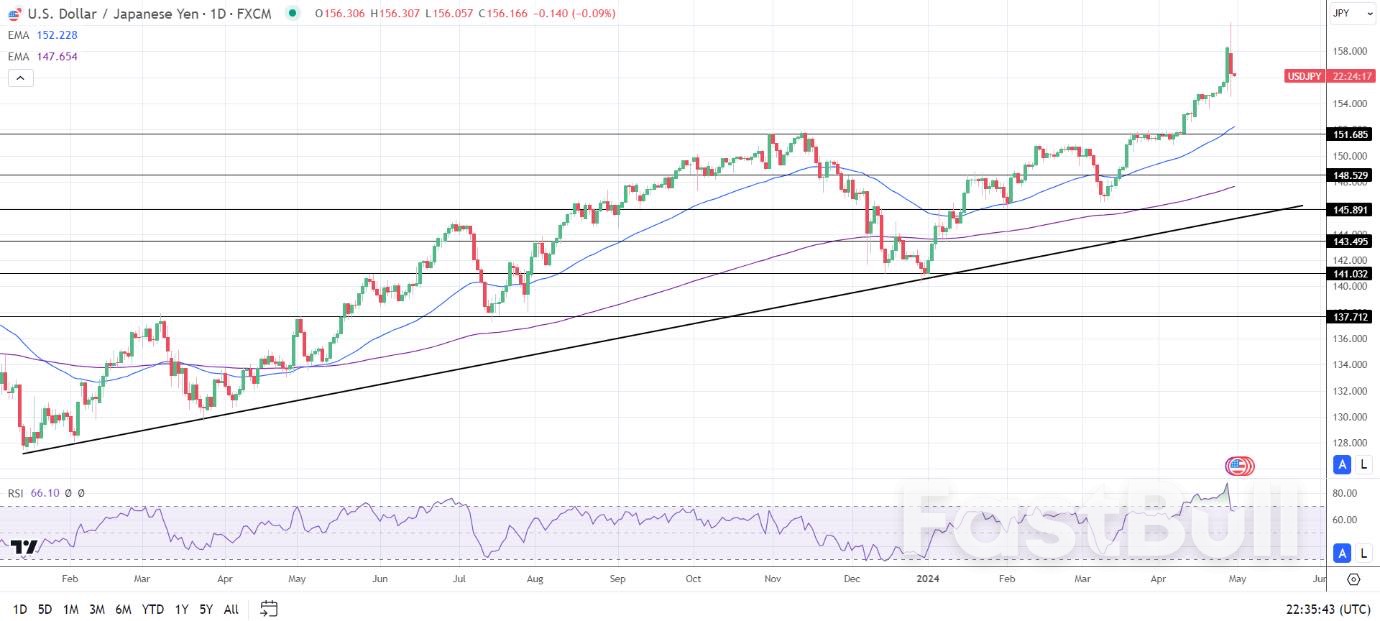
          USD/JPY Forecast: Japan’s Economic Indicators Signal Yen’s Path_1The USD/JPY hovered comfortably above the 50-day and 200-day EMAs, affirming the bullish price signals.
          A USD/JPY return to the 158 handle would support a move to the April 29 high of 160.209.
          Bank of Japan commentary, Japanese government interventions, and the US economic calendar need consideration.
          Conversely, a USD/JPY drop below the 155 handle could give the bears a run at the 50-day EMA and the 151.685 support level.
          The 14-day RSI at 66.10 suggests the USD/JPY could return to 158 before entering overbought territory.

          Source: FX Empire

          To stay updated on all economic events of today, please check out our Economic calendar
          Risk Warnings and Disclaimers
          You understand and acknowledge that there is a high degree of risk involved in trading. Following any strategies or investment methods may lead to potential losses. The content on the site is provided by our contributors and analysts for information purposes only. You are solely responsible for determining whether any trading assets, securities, strategy, or any other product is suitable for investing based on your own investment objectives and financial situation.
          Add to Favorites
          Share

          Weekly Technical Outlook – USDJPY, EURUSD, Oil

          XM

          Economic

          Forex

          Energy

          FOMC policy meeting --> USDJPY

          The US calendar might send some important messages this week, particularly on Wednesday when the Fed announces its rate decision. Although changes in interest rates are not on the agenda this week, it would be interesting to see if the central bank will raise the possibility of a rate hike again after the latest inflation setbacks and some hawkish comments from policymakers.
          June's rate cut scenario went from being almost certain to extremely unlikely and futures markets are now less confident that the Fed will reduce borrowing costs before September. Nonetheless, there are several data releases this week, including the highly significant nonfarm payrolls report (Friday, 12:30 GMT) and the ISM manufacturing PMI (Wednesday, 14:00 GMT). The Fed might allow the data to steer investors.
          Although the stats are expected to come under pressure in April, a potential hawkish outcome and a subsequent resurgence in USDJPY, might force Japanese authorities to buy the yen again. The sharp downfall to 155 after the steep rise to 160.2o was interpreted as an FX intervention earlier today, even though Japan's top currency diplomat refused to comment.
          From a technical perspective, the latest pullback has not violated the upward pattern in the market and there are a couple of key levels that could still support the market initially within the 153.00-153.83 territory, and then somewhere between 151.50 and 151.00.

          Eurozone flash CPI inflation --> EURUSD

          In the eurozone, there is a high likelihood of a rate cut in June, around 70%, but traders may reassess their predictions after the release of the flash CPI inflation data on Tuesday at 09:00 GMT. Forecasts point to a steady headline inflation of 2.4% y/y and a softer core CPI at 2.7% y/y from 2.9% previously.
          EURUSD will need stronger than expected eurozone data or weaker US numbers to break the constraining 20-day simple moving average (SMA) and the 1.0743 barrier before it rallies towards the next barrier seen at 1.0787-1.0830.
          Otherwise, a step below the nearby base of 1.0694 would justify the discouraging technical signals in the market, sending the price to 1.0650 and then down to April's low of 1.0600.

          China manufacturing PMI, geopolitics --> WTI oil futures

          Oil prices might face a new round of volatility as a Hamas negotiator will be in Cairo today for peace talks. If there's a deal to release hostages, Israel may delay an attack in Rafah, leading to a drop in oil prices. Nevertheless, if China's manufacturing PMI data exceed expectations on Tuesday, it could restrict any possible declines in oil prices by signaling an ongoing revival in business operations and a surge in energy product demand from the global economy's second-largest consumer.
          WTI oil futures managed to pivot near the protective 50-day EMA for the fourth time, but have yet to climb above the wall at $84.00. A decisive close above that bar could prompt a quick bounce towards April's high of $86.92.
          On the downside, a drop below the 50-day EMA at $81.47 could squeeze the price towards the 200-day EMA at $79.10.
          To stay updated on all economic events of today, please check out our Economic calendar
          Risk Warnings and Disclaimers
          You understand and acknowledge that there is a high degree of risk involved in trading. Following any strategies or investment methods may lead to potential losses. The content on the site is provided by our contributors and analysts for information purposes only. You are solely responsible for determining whether any trading assets, securities, strategy, or any other product is suitable for investing based on your own investment objectives and financial situation.
          Add to Favorites
          Share

          SNDL Q1 Earnings: Examining the Canadian Cannabis Giant's Report Card

          Glendon

          Economic

          On May 9th, 2024, Canadian cannabis heavyweight SNDL unveiled its financial results for the first quarter (Q1) of 2024. This highly anticipated report sheds light on the company's recent performance and offers valuable insights into its future trajectory within the evolving cannabis industry. Here's a comprehensive breakdown of the key points to consider from SNDL's Q1 earnings report:

          Financial Performance: Unveiling the Numbers

          Revenue: A critical metric will be revenue growth, particularly from SNDL's vast cannabis retail network, the largest private-sector chain in Canada. Analysts predict a 3.4% increase in revenue compared to Q1 2023. Did SNDL meet or surpass this expectation?
          Earnings per Share (EPS): Investors will be looking closely at the EPS, a key indicator of profitability. While reducing losses remains an industry-wide challenge, did SNDL make progress toward achieving a positive EPS? Analyst estimates suggest a potential improvement compared to the previous year's Q1 EPS.
          Profitability: Beyond EPS, the report will be scrutinized for signs of improved operational efficiency. This could involve cost-cutting measures or strategic partnerships that enhance profitability.

          Operational Efficiency and Growth Strategies

          Retail Expansion: Any updates on new store openings or potential acquisitions will be significant. Is SNDL expanding its physical retail presence or focusing on optimizing existing stores?
          Market Expansion: Did the report mention any plans for entering new geographical markets or product categories within the cannabis industry? This could signal SNDL's long-term growth strategy.

          Beyond the Financials: Market Reaction and Long-Term Outlook

          The market's response to the earnings report will likely hinge on whether SNDL met or surpassed analyst expectations. Positive results that showcase strong revenue growth and a clear path to profitability could lead to a stock price increase. Conversely, significant deviations from forecasts or concerns about operational challenges might trigger a sell-off.
          Looking beyond the immediate market reaction, the following questions will be central to understanding SNDL's long-term potential:
          Can SNDL navigate the competitive Canadian cannabis market and achieve sustainable profitability?
          How will the company adapt to evolving regulations and consumer preferences within the cannabis industry?
          Will SNDL leverage its vast retail network to expand into new product categories or markets?

          Staying Informed: Resources for Following SNDL's Earnings

          Here are some resources to stay informed about SNDL's Q1 2024 earnings and future developments:
          SNDL Investor Relations: The company website often includes press releases, presentations, and webcasts related to earnings announcements https://sndl.com/news/default.aspx.
          Financial News Websites: Major financial news websites will likely cover SNDL's earnings report, offering analysis and commentary.
          Stock Market Analysis Platforms: These platforms can provide real-time data and charts to track SNDL's stock price movement following the earnings release.
          Industry News and Reports: Staying updated on broader cannabis industry trends and reports can provide valuable context for analyzing SNDL's performance.

          Conclusion: A Turning Point for SNDL?

          The Q1 earnings report represents a significant turning point for SNDL. By analyzing the financial results, market reaction, and long-term outlook, investors and those interested in the cannabis industry can gain a comprehensive understanding of SNDL's current standing and its potential for future growth within the ever-changing cannabis landscape.
          To stay updated on all economic events of today, please check out our Economic calendar
          Risk Warnings and Disclaimers
          You understand and acknowledge that there is a high degree of risk involved in trading. Following any strategies or investment methods may lead to potential losses. The content on the site is provided by our contributors and analysts for information purposes only. You are solely responsible for determining whether any trading assets, securities, strategy, or any other product is suitable for investing based on your own investment objectives and financial situation.
          Add to Favorites
          Share
          FastBull
          Copyright © 2025 FastBull Ltd

          728 RM B 7/F GEE LOK IND BLDG NO 34 HUNG TO RD KWUN TONG KLN HONG KONG

          TelegramInstagramTwitterfacebooklinkedin
          App Store Google Play Google Play
          Products
          Charts

          Chats

          Q&A with Experts
          Screeners
          Economic Calendar
          Data
          Tools
          Membership
          Features
          Function
          Markets
          Copy Trading
          Latest Signals
          Contests
          News
          Analysis
          24/7
          Columns
          Education
          Company
          Careers
          About Us
          Contact Us
          Advertising
          Help Center
          Feedback
          User Agreement
          Privacy Policy
          Business

          White Label

          Data API

          Web Plug-ins

          Poster Maker

          Affiliate Program

          Risk Disclosure

          The risk of loss in trading financial instruments such as stocks, FX, commodities, futures, bonds, ETFs and crypto can be substantial. You may sustain a total loss of the funds that you deposit with your broker. Therefore, you should carefully consider whether such trading is suitable for you in light of your circumstances and financial resources.

          No decision to invest should be made without thoroughly conducting due diligence by yourself or consulting with your financial advisors. Our web content might not suit you since we don't know your financial conditions and investment needs. Our financial information might have latency or contain inaccuracy, so you should be fully responsible for any of your trading and investment decisions. The company will not be responsible for your capital loss.

          Without getting permission from the website, you are not allowed to copy the website's graphics, texts, or trademarks. Intellectual property rights in the content or data incorporated into this website belong to its providers and exchange merchants.

          Not Logged In

          Log in to access more features

          FastBull Membership

          Not yet

          Purchase

          Become a signal provider
          Help Center
          Customer Service
          Dark Mode
          Price Up/Down Colors

          Log In

          Sign Up

          Position
          Layout
          Fullscreen
          Default to Chart
          The chart page opens by default when you visit fastbull.com