Markets
News
Analysis
User
24/7
Economic Calendar
Education
Data
- Names
- Latest
- Prev


Signal Accounts for Members
All Signal Accounts
All Contests


Euro Zone IHS Markit Construction PMI (Nov)A:--
F: --
P: --
Italy IHS Markit Construction PMI (Nov)A:--
F: --
P: --
U.K. Markit/CIPS Construction PMI (Nov)A:--
F: --
P: --
France 10-Year OAT Auction Avg. YieldA:--
F: --
P: --
Euro Zone Retail Sales MoM (Oct)A:--
F: --
P: --
Euro Zone Retail Sales YoY (Oct)A:--
F: --
P: --
Brazil GDP YoY (Q3)A:--
F: --
P: --
U.S. Challenger Job Cuts (Nov)A:--
F: --
P: --
U.S. Challenger Job Cuts MoM (Nov)A:--
F: --
P: --
U.S. Challenger Job Cuts YoY (Nov)A:--
F: --
P: --
U.S. Initial Jobless Claims 4-Week Avg. (SA)A:--
F: --
P: --
U.S. Weekly Initial Jobless Claims (SA)A:--
F: --
P: --
U.S. Weekly Continued Jobless Claims (SA)A:--
F: --
P: --
Canada Ivey PMI (SA) (Nov)A:--
F: --
P: --
Canada Ivey PMI (Not SA) (Nov)A:--
F: --
P: --
U.S. Non-Defense Capital Durable Goods Orders Revised MoM (Excl. Aircraft) (SA) (Sept)A:--
F: --
U.S. Factory Orders MoM (Excl. Transport) (Sept)A:--
F: --
P: --
U.S. Factory Orders MoM (Sept)A:--
F: --
P: --
U.S. Factory Orders MoM (Excl. Defense) (Sept)A:--
F: --
P: --
U.S. EIA Weekly Natural Gas Stocks ChangeA:--
F: --
P: --
Saudi Arabia Crude Oil ProductionA:--
F: --
P: --
U.S. Weekly Treasuries Held by Foreign Central BanksA:--
F: --
P: --
Japan Foreign Exchange Reserves (Nov)A:--
F: --
P: --
India Repo RateA:--
F: --
P: --
India Benchmark Interest RateA:--
F: --
P: --
India Reverse Repo RateA:--
F: --
P: --
India Cash Reserve RatioA:--
F: --
P: --
Japan Leading Indicators Prelim (Oct)A:--
F: --
P: --
U.K. Halifax House Price Index YoY (SA) (Nov)A:--
F: --
P: --
U.K. Halifax House Price Index MoM (SA) (Nov)A:--
F: --
P: --
France Current Account (Not SA) (Oct)--
F: --
P: --
France Trade Balance (SA) (Oct)--
F: --
P: --
France Industrial Output MoM (SA) (Oct)--
F: --
P: --
Italy Retail Sales MoM (SA) (Oct)--
F: --
P: --
Euro Zone Employment YoY (SA) (Q3)--
F: --
P: --
Euro Zone GDP Final YoY (Q3)--
F: --
P: --
Euro Zone GDP Final QoQ (Q3)--
F: --
P: --
Euro Zone Employment Final QoQ (SA) (Q3)--
F: --
P: --
Euro Zone Employment Final (SA) (Q3)--
F: --
Brazil PPI MoM (Oct)--
F: --
P: --
Mexico Consumer Confidence Index (Nov)--
F: --
P: --
Canada Unemployment Rate (SA) (Nov)--
F: --
P: --
Canada Labor Force Participation Rate (SA) (Nov)--
F: --
P: --
Canada Employment (SA) (Nov)--
F: --
P: --
Canada Part-Time Employment (SA) (Nov)--
F: --
P: --
Canada Full-time Employment (SA) (Nov)--
F: --
P: --
U.S. Personal Income MoM (Sept)--
F: --
P: --
U.S. Dallas Fed PCE Price Index YoY (Sept)--
F: --
P: --
U.S. PCE Price Index YoY (SA) (Sept)--
F: --
P: --
U.S. PCE Price Index MoM (Sept)--
F: --
P: --
U.S. Personal Outlays MoM (SA) (Sept)--
F: --
P: --
U.S. Core PCE Price Index MoM (Sept)--
F: --
P: --
U.S. UMich 5-Year-Ahead Inflation Expectations Prelim YoY (Dec)--
F: --
P: --
U.S. Core PCE Price Index YoY (Sept)--
F: --
P: --
U.S. Real Personal Consumption Expenditures MoM (Sept)--
F: --
P: --
U.S. 5-10 Year-Ahead Inflation Expectations (Dec)--
F: --
P: --
U.S. UMich Current Economic Conditions Index Prelim (Dec)--
F: --
P: --
U.S. UMich Consumer Sentiment Index Prelim (Dec)--
F: --
P: --
U.S. UMich 1-Year-Ahead Inflation Expectations Prelim (Dec)--
F: --
P: --
U.S. UMich Consumer Expectations Index Prelim (Dec)--
F: --
P: --


No matching data
Latest Views
Latest Views
Trending Topics
Top Columnists
Latest Update
White Label
Data API
Web Plug-ins
Affiliate Program
View All

No data
Federal Reserve Bank of Boston President Susan Collins indicated on August 22 that a short-term rate cut could be considered if the U.S. labor market outlook worsens.
Key Points:
Federal Reserve Bank of Boston President Susan Collins indicated on August 22 that a short-term rate cut could be considered if the U.S. labor market outlook worsens.
This potential rate cut highlights the Federal Reserve's readiness to navigate economic uncertainties, potentially boosting risk assets, including cryptocurrencies like Bitcoin and Ethereum, amidst ongoing elevated inflation concerns.
Susan Collins, speaking at a Boston event, emphasized the need for potential short-term rate adjustments to address labor market deterioration. While inflation persists, the Fed remains open to easing monetary policy preemptively. Her comments have prompted discussions due to the Fed's cautious approach, weighing ongoing inflation against economic uncertainty.
In line with Collins' comments, the Federal Reserve has shown a capability to pivot monetary stances. Market stakeholders observe USD's dip, driven partly by the anticipation of rate cuts, affecting holdings like BTC and ETH. Her call for flexibility in monetary approaches aligns with historical patterns, where interest rate cuts led to increased liquidity and investor confidence in risk assets.
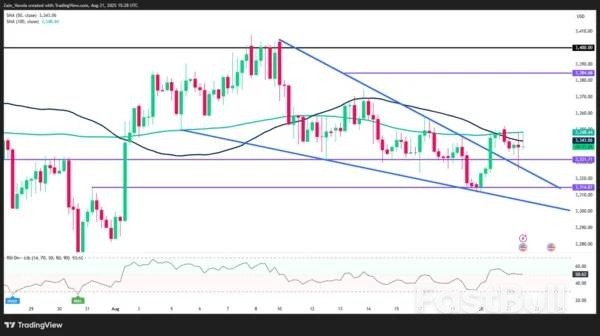
Gold prices have remained choppy this week with the precious metal remaining in the range between $3300-$3350/oz for the majority of the week. Two key levels which for now it appears buyers and sellers are defending ahead of the Jackson Hole Symposium and Geopolitical developments.
A strong PMI release may have just aided Fed Chair Jerome Powell. The S&P Global US Composite PMI rose to 55.4 in August 2025, up from 55.1 in July, showing growth for the 31st straight month, according to flash estimates.This was also the fastest growth seen this year. The services sector continued to grow strongly, though activity slightly slowed from July’s peak (55.4 vs 55.7). Meanwhile, manufacturing bounced back, with the PMI rising to 53.3 from 49.8 in July, its highest level since May 2022.
Hiring picked up, with job creation hitting one of the fastest rates in three years. Businesses also reported the biggest backlog of unfinished work since May 2022.Now all of this sounds like a solid economy and looking at the data more closely we see a few other interesting points.S&P Global’s Chris Williamson noted the survey also showed mounting inflation pressures. Businesses are increasingly passing tariff-related costs through to consumers, and the PMI price indices are now running at their highest levels in three years. Selling prices for goods and services have moved higher, suggesting that consumer inflation will “rise further above the Fed’s 2% target in the coming months.
The PMI results create more uncertainty for the Fed. Instead of supporting the idea of immediate rate cuts, the data suggest the economy is closer to conditions that typically lead to rate hikes.“With increased business activity, hiring, and rising prices shown in the survey, the PMI data lean more toward rate hikes than cuts,” Williamson explained.
The move did lead to an immediate bounce for the US Dollar Index which has since continued its advance. However as has been the case with Gold of late, the precious metal saw an immediate drop but has since recovered to a near daily high at $3345/oz.This highlights the indecision in Gold at the moment with market participants likely keeping an eye on the Jackson Hole Symposium and Fed Chair Powell.
Heading into Fed Chair Jerome Powell’s speech at Jackson Hole tomorrow Gold appears in desperate need of a catalyst.The Russia-Ukraine situation has a lot of variables to contend with before an actual peace deal may be agreed. Thus geopolitical risk premium is likely to remain in play in the near-term.This leaves monetary policy, where like we discussed above today’s PMI data has created more uncertainty for the Fed. The FED minutes also did not really provide anything new to the equation so will there be sparks tomorrow or will the market reaction be muted?
Technical analysis paints a nice picture for bulls though with a break of a bullish pennant pattern which was in play.If you believe the old trading adage ‘technicals hint at what’s to come from the fundamentals’ then the question is, are we getting a hint of a dovish speech by Fed Chair Powell tomorrow?From a technical standpoint, Gold has broken the bullish pennant on the four-hour chart. A pullback and retest occurred today so Gold is on its way toward a potential target of $3383/oz.
There is significant resistance just ahead which Gold needs to overcome. The 50 and 100-day MA rest at 3343 and 3348 respectively and at this stage are providing a significant hurdle.Supporting a bullish narrative is the period-14 RSI remains above the 50 level which hints that the momentum remains bullish.
Gold (XAU/USD) Daily Chart, August 21, 2025

Client Sentiment Data – XAU/USD
Looking at OANDA client sentiment data and market participants are Long on Gold with 70% of traders net-long. I prefer to take a contrarian view toward crowd sentiment and thus the fact that the majority of traders are net-long suggests that Gold prices could continue to slide in the near-term.
The hit to New Zealand confidence caused by global uncertainty will fade as businesses get used to a time of heightened economic policy unpredictability, the chief economist at the country’s central bank said on Friday.
Paul Conway, chief economist at the Reserve Bank of New Zealand, said the confidence shock will pass and business will “just get on with it.”
"I fully expect uncertainty to persist into the future but to some extent, we get used to it,” Conway told Reuters in an interview. "We can't sort of wait and see what's going to happen…forever," he said.
He added the central bank’s decision to cut the cash rate by 25 bps this week to 3.0% and flag further cuts was encouraging businesses to get on with it.
At its decision on Wednesday, the central bank highlighted weakness in both consumer and business confidence and the impact that this was having on spending as being one factor of concern for the economy. Governor Christian Hawkesby has said the impact of this uncertainty had been greater than the bank thought.
The U.S. has placed a 15% tariff on goods being imported from New Zealand, which was worse than the 10% initially signalled but not as bad as many other trading partners.
Conway said the changes to tariff rates were creating uncertainty and that is like “another shock on top of the tariff in the first place.”
“Those types of factors are ... causing businesses to be a little more reticent, households to be a little more reticent and that's perfectly rational,” he said.
The central bank decision to cut by 25 bps was not unanimous with two of the six board members voting to cut by 50 bps.
Conway said one member was "particularly keen" on a hold but ultimately the committee decided only to vote on cutting.
He said the member thought a hold at 3.25% might be a good idea as high frequency indicators were showing some improvement and inflation is nearing the top of the target range.
The member was concerned it "could sort of morph into more persistent inflation pressure," he said.

Meta has agreed to spend more than $10 billion on Google cloud services, according to two people familiar with the matter.The agreement spans six years, said the people, who asked not to be named because the terms are confidential. The deal was reported earlier by The Information.
Google is aiming to land big cloud contracts as it chases larger rivals Amazon Web Services and Microsoft Azure in cloud infrastructure. Earlier this year Google won cloud business from OpenAI, which had earlier been deeply dependent on Microsoft's Azure infrastructure.Alphabet said in July that the Google Cloud unit, which contains productivity software subscriptions in addition to infrastructure, produced $2.83 billion in operating income on $13.6 billion in revenue during the second quarter. Revenue growth of 32% outpaced expansion of 13.8% for the company as a whole.
Meta's deal with Google is mainly around artificial intelligence infrastructure, said one of the people. Meta said in its earnings report last month that it expects total expenses for 2025 to come in the range of $114 billion and $118 billion. It's investing heavily in AI infrastructure and talent, building out its Llama family of models and adding AI across its portfolio of services.Meta and Google have long been rivals in online ads. But Meta needs all the cloud infrastructure it can access. The company operates data centers and has made commitments to use cloud services from Amazon and Microsoft.
The pace of Japan’s consumer inflation stayed well above the Bank of Japan’s target even as price growth moderated, supporting market speculation that the central bank will hike its benchmark interest rate again this year.
Consumer prices excluding fresh food rose 3.1% from a year earlier in July, slowing from a 3.3% gain in the previous month, the Ministry of Internal Affairs and Communications reported Friday. The median estimate of economists was for a gain of 3%, with expectations there would be a drag from energy prices after they spiked a year earlier.
A deeper price measure that also strips out energy advanced 3.4%, unchanged from the previous period and matching the consensus estimate.
Friday’s data suggest inflation remains relatively sticky. The figures come about a week after US Treasury Secretary Scott Bessent took the unusual step of suggesting the BOJ is mishandling the fight against inflation, saying in an interview with Bloomberg TV that “they’re behind the curve.” Market bets on a BOJ hike have ramped up in recent weeks, helping push bond yields higher.
The slowdown in core CPI was largely expected among forecasters after energy prices jumped 12 months ago due to the end of the government’s subsidy program. Oil prices were also down by about 10% last month compared with levels a year ago.
The price of rice, a primary driver of inflation this year, rose 90.7% from 12 months ago, with the increase moderating from 100.2% in June. The skyrocketing cost of the staple food has caused consternation across the nation. Policymakers are expecting to see a slowdown in annual comparisons in coming months after prices began their precipitous ascent last autumn, although record heat could reduce production, causing more shortages.
Food prices excluding fresh food rose 8.3%, the fastest pace since September 2023, while service prices rose 1.5%, the same pace as in the previous month.
The public’s deep discontent over soaring costs of living played a key role in handing Prime Minister Shigeru Ishiba and his ruling coalition a historic setback in an election last month. Having lost majorities in both chambers of parliament, the premier now faces demands to resign from some lawmakers. Analysts are watching to see if Ishiba will seek to shore up support by promising more fiscal spending to mollify consumers.
At the July monetary policy meeting, BOJ Governor Kazuo Ueda’s board raised its price projection more than expected for this fiscal year in its quarterly report, citing the impact of food inflation. The BOJ is largely expected to stand pat on rates when it next sets policy on Sept. 19.
Traders see about a 51% chance of a BOJ rate hike by the end of October, as reflected by movements in the overnight swap index. That compares with around a 42% likelihood showing in the market a month ago. Benchmark 10-year bond yields hit the highest level since 2008 Thursday owing partly to speculation that the policy rate is headed higher.
Key points:
The U.S. Department of Agriculture's plan to close its flagship laboratory near Washington, D.C., could undermine research on pests, blight and crop genetics crucial to American farms, according to lawmakers, a farm group, and staff of the facility.The USDA has already lost thousands of research staff to PresidentDonald Trump's effort to shrink the federal government, even as Agriculture Secretary Brooke Rollins has said farm research is a pillar of national security.
Rollins said in July that the USDA will close the Beltsville Agricultural Research Center, which occupies nearly 7,000 acres in the Maryland suburbs outside Washington, as part of an agency reorganization effort that will also move roughly half its Washington-area staff to hubs in North Carolina, Utah and elsewhere.The agency has said it is closing BARC and several other USDA buildings because of costly necessary renovations and underutilized space. Workers at BARC in 2023 filed whistleblower complaints about unsafe working conditions there.
But critics of the plan to close BARC say it could backfire by interrupting the facility's ongoing research, and by pushing the scientists conducting it to resign."It is unlikely that senior scientists of this caliber with mature research partnerships and rich professional lives will simply move somewhere else," said Donnell Brown, president of the National Grape Research Alliance, which depends on BARC research into vine stress and water usage.
U.S. Senator Chris Van Hollen, a Maryland Democrat, also slammed the plan.
"You have a lot of people who have invested their time and effort in research for farmers across the country, and this plan would destroy that ongoing research," he said.Three staff at the facility, who requested anonymity out of fear of retribution, said the co-location of many labs at BARC allows for economies of scale and cost savings, and that the proximity to Washington enables researchers to easily brief lawmakers or other parts of the USDA.
A USDA spokesperson said the $500 million required to modernize the BARC facility, plus another $40 million in annual maintenance, was not a wise use of taxpayer funds and that the agency's other laboratories could house BARC research.Rollins said in a July memo outlining the relocation effort that the BARC facility would be closed over several years to avoid disruptions to critical research.
The USDA on July 25 told the House of Representatives and Senate agriculture and appropriations committees that it did not have data or analysis underpinning its reorganization plan to share with members of Congress or their staff, according to a letter sent from Democrats on the House Agriculture Committee to Rollins on August 14."Ostensibly they’re saying it would save money, but I haven’t seen any study that suggests that’s the case," said U.S. Representative Glenn Ivey, whose Maryland district contains the BARC site.
Key Takeaways:
DBS Bank, Singapore's largest, has announced issuing tokenized structured notes on the Ethereum blockchain, enhancing accessibility for institutional investors.This initiative reflects DBS's trust in public blockchain technology, potentially increasing Ethereum's institutional usage and impacting digital asset markets significantly.
DBS Bank, Singapore's largest financial institution, has begun issuing tokenized structured notes on the Ethereum blockchain, shifting to public networks from previous permissioned systems. This decision expands access to previously exclusive investment vehicles.Li Zhen, Head of Foreign Exchange and Digital Assets at DBS, highlighted the growing demand for digital assets among institutional investors as a driving factor behind this transition. This marks a significant move for DBS in the crypto finance space.
The reduction of entry barriers, enabling a minimum investment of $1,000, significantly impacts the structured notes market. The involvement of Ethereum implies broader adoption of blockchain technology in financial products.Financial markets may observe increased liquidity and trading volumes as these tokenized notes become available on licensed Singapore digital exchanges like ADDX and DigiFT. This could lead to notable shifts in market dynamics.
DBS's shift could inspire other institutions to adopt similar tokenization strategies. The ongoing use of Ethereum may affect the network’s market position, fostering greater institutional use.Potential outcomes include stronger regulatory frameworks to support such innovations. The success of these notes could elevate Ethereum's profile in institutional finance, bridging traditional and digital markets more effectively.
Li Zhen, Head of Foreign Exchange and Digital Assets for Global Financial Markets, DBS Bank, "The launch of crypto-linked notes aims to meet growing institutional demand for digital assets," referencing DBS’s ongoing tokenization efforts since 2021.
White Label
Data API
Web Plug-ins
Poster Maker
Affiliate Program
The risk of loss in trading financial instruments such as stocks, FX, commodities, futures, bonds, ETFs and crypto can be substantial. You may sustain a total loss of the funds that you deposit with your broker. Therefore, you should carefully consider whether such trading is suitable for you in light of your circumstances and financial resources.
No decision to invest should be made without thoroughly conducting due diligence by yourself or consulting with your financial advisors. Our web content might not suit you since we don't know your financial conditions and investment needs. Our financial information might have latency or contain inaccuracy, so you should be fully responsible for any of your trading and investment decisions. The company will not be responsible for your capital loss.
Without getting permission from the website, you are not allowed to copy the website's graphics, texts, or trademarks. Intellectual property rights in the content or data incorporated into this website belong to its providers and exchange merchants.
Not Logged In
Log in to access more features

FastBull Membership
Not yet
Purchase
Log In
Sign Up