Markets
News
Analysis
User
24/7
Economic Calendar
Education
Data
- Names
- Latest
- Prev


Signal Accounts for Members
All Signal Accounts
All Contests


Brazil's Petrobras Estimates 2025 Proven Reserves Of Oil, Condensate, And Natural Gas At 12.1 Billion BOE, Up From 11.4 BOE In 2024
Norway Sovereign Wealth Fund's Holdings In USA Treasuries Worth $199 Billion At December 31 Versus$181 Billion At June 30, Fund Data Shows
Bessent Says 'Independence Does Not Mean No Accountability' In Defending Justice Department Probe Of Fed Chief
Spot Gold Broke Through $5,380 Per Ounce, Up 3.8% On The Day. Spot Silver Extended Its Gains To 4%, Currently Trading At $116.49 Per Ounce
Jeff Rosenberg Of BlackRock: The Federal Reserve's Response Mechanism (compared To Its Focus On Price Stability) Is More Focused On The Labor Side
Chicago Wheat Futures Rose About 2.3%, Corn Rose 1%. In Late New York Trading On Wednesday (January 28), The Bloomberg Grains Index Rose 1.19% To 29.3655 Points, Reaching A Daily High Of 29.5851 Points At 23:06 Beijing Time. CBOT Corn Futures Rose 1.00%, And CBOT Wheat Futures Rose 2.29%. CBOT Soybean Futures Rose 0.70% To $10.7475 Per Bushel, Reaching A Daily High Of $10.8475 At 22:41; Soybean Meal Futures Rose 1.22%, And Soybean Oil Futures Fell 0.11%
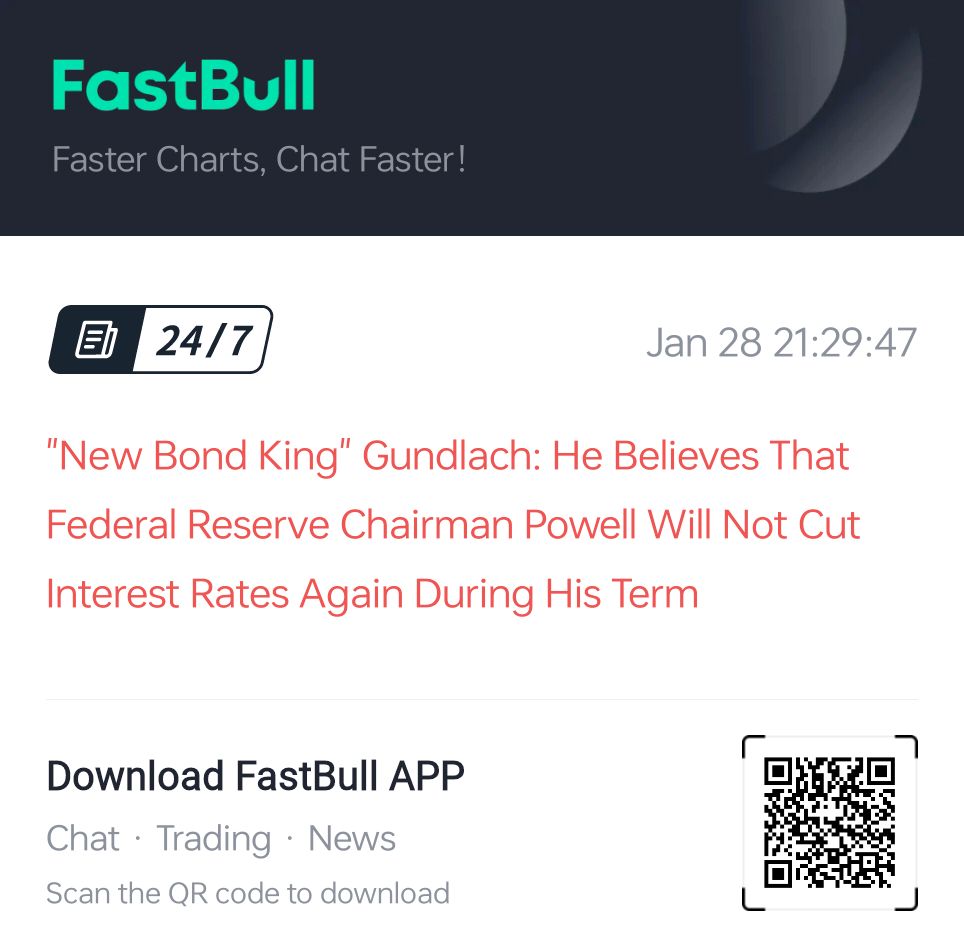
"New Bond King" Gundlach: He Believes That Federal Reserve Chairman Powell Will Not Cut Interest Rates Again During His Term
Powell: The Message Is Simply Not About Our Credibility, Inflation Expectations Show We Have Credibility
Powell: Also Advice For The Next Fed Chair Is The Need To Earn Democratic Legitimacy With Congressional Overseers

U.S. 5-Year Note Auction Avg. YieldA:--
F: --
P: --
U.S. API Weekly Refined Oil StocksA:--
F: --
P: --
U.S. API Weekly Crude Oil StocksA:--
F: --
P: --
U.S. API Weekly Gasoline StocksA:--
F: --
P: --
U.S. API Weekly Cushing Crude Oil StocksA:--
F: --
P: --
Australia RBA Trimmed Mean CPI YoY (Q4)A:--
F: --
P: --
Australia CPI YoY (Q4)A:--
F: --
P: --
Australia CPI QoQ (Q4)A:--
F: --
P: --
Germany GfK Consumer Confidence Index (SA) (Feb)A:--
F: --
P: --
Germany 10-Year Bund Auction Avg. YieldA:--
F: --
P: --
India Industrial Production Index YoY (Dec)A:--
F: --
P: --
India Manufacturing Output MoM (Dec)A:--
F: --
P: --
U.S. MBA Mortgage Application Activity Index WoWA:--
F: --
P: --
Canada Overnight Target RateA:--
F: --
P: --
BOC Monetary Policy Report
U.S. EIA Weekly Crude Stocks ChangeA:--
F: --
P: --
U.S. EIA Weekly Cushing, Oklahoma Crude Oil Stocks ChangeA:--
F: --
P: --
U.S. EIA Weekly Crude Demand Projected by ProductionA:--
F: --
P: --
U.S. EIA Weekly Crude Oil Imports ChangesA:--
F: --
P: --
U.S. EIA Weekly Heating Oil Stock ChangesA:--
F: --
P: --
U.S. EIA Weekly Gasoline Stocks ChangeA:--
F: --
P: --
BOC Press Conference
Russia PPI MoM (Dec)A:--
F: --
P: --
Russia PPI YoY (Dec)A:--
F: --
P: --
U.S. Interest Rate On Reserve BalancesA:--
F: --
P: --
U.S. Target Federal Funds Rate Lower Limit (Overnight Reverse Repo Rate)A:--
F: --
P: --
U.S. Federal Funds Rate TargetA:--
F: --
P: --
U.S. Target Federal Funds Rate Upper Limit (Excess Reserves Ratio)A:--
F: --
P: --
FOMC Statement
FOMC Press Conference
Brazil Selic Interest Rate--
F: --
P: --
Australia Import Price Index YoY (Q4)--
F: --
P: --
Japan Household Consumer Confidence Index (Jan)--
F: --
P: --
Turkey Economic Sentiment Indicator (Jan)--
F: --
P: --
Euro Zone M3 Money Supply (SA) (Dec)--
F: --
P: --
Euro Zone Private Sector Credit YoY (Dec)--
F: --
P: --
Euro Zone M3 Money Supply YoY (Dec)--
F: --
P: --
Euro Zone 3-Month M3 Money Supply YoY (Dec)--
F: --
P: --
South Africa PPI YoY (Dec)--
F: --
P: --
Euro Zone Consumer Confidence Index Final (Jan)--
F: --
P: --
Euro Zone Selling Price Expectations (Jan)--
F: --
P: --
Euro Zone Industrial Climate Index (Jan)--
F: --
P: --
Euro Zone Services Sentiment Index (Jan)--
F: --
P: --
Euro Zone Economic Sentiment Indicator (Jan)--
F: --
P: --
Euro Zone Consumer Inflation Expectations (Jan)--
F: --
P: --
Italy 5-Year BTP Bond Auction Avg. Yield--
F: --
P: --
Italy 10-Year BTP Bond Auction Avg. Yield--
F: --
P: --
France Unemployment Class-A (Dec)--
F: --
P: --
South Africa Repo Rate (Jan)--
F: --
P: --
Canada Average Weekly Earnings YoY (Nov)--
F: --
P: --
U.S. Nonfarm Unit Labor Cost Final (Q3)--
F: --
P: --
U.S. Initial Jobless Claims 4-Week Avg. (SA)--
F: --
P: --
U.S. Weekly Continued Jobless Claims (SA)--
F: --
P: --
U.S. Trade Balance (Nov)--
F: --
P: --
U.S. Weekly Initial Jobless Claims (SA)--
F: --
P: --
Canada Trade Balance (SA) (Nov)--
F: --
P: --
U.S. Exports (Nov)--
F: --
P: --
Canada Imports (SA) (Nov)--
F: --
P: --
Canada Exports (SA) (Nov)--
F: --
P: --
U.S. Unit Labor Cost Revised MoM (SA) (Q3)--
F: --


No matching data
Latest Views
Latest Views
Trending Topics
Top Columnists
Latest Update
White Label
Data API
Web Plug-ins
Affiliate Program
View All

No data
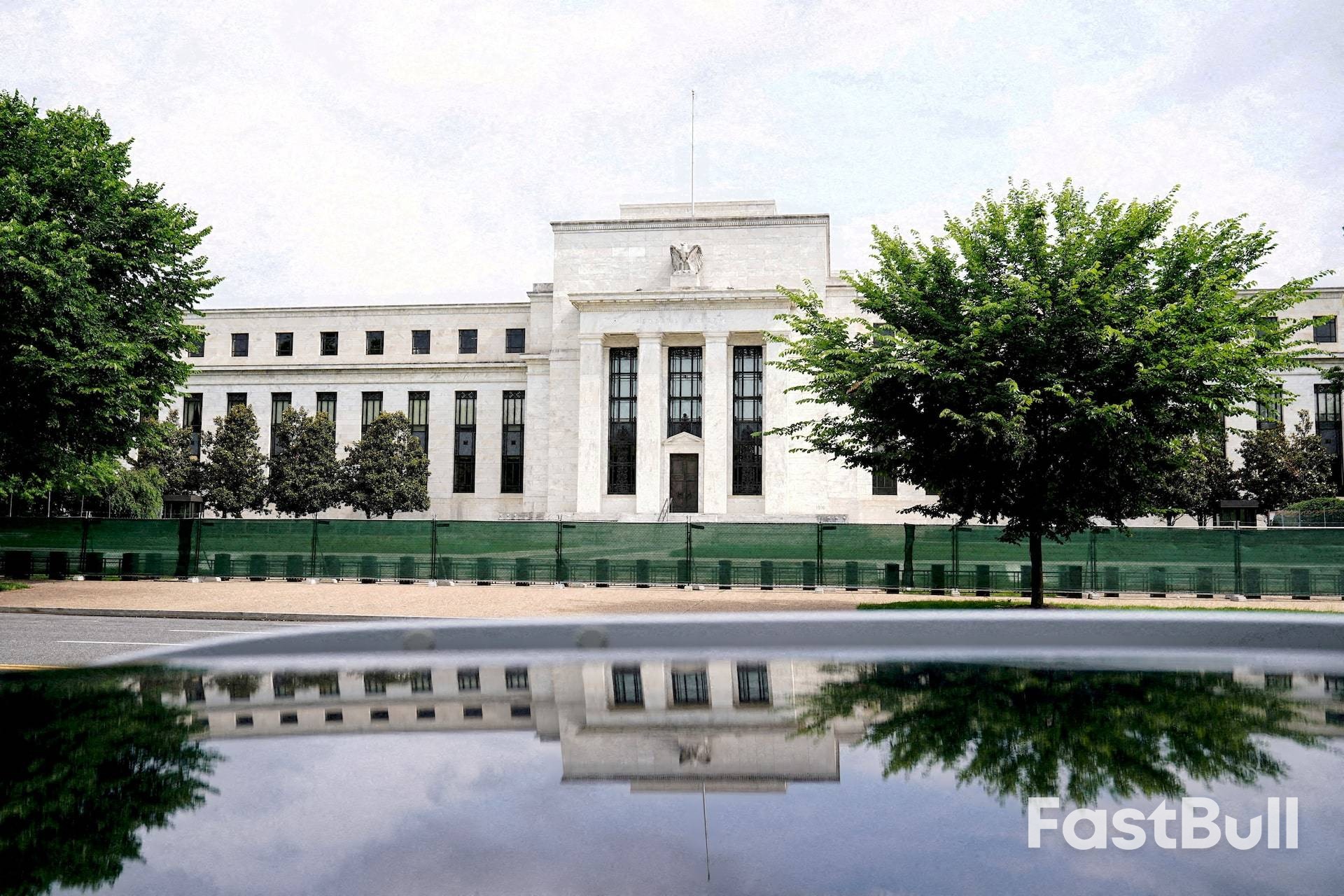
"Economic activity has been expanding at a solid pace," Fed policymakers said in the statement after voting 10-2 to hold the U.S. central bank's benchmark interest rate in the 3.50%-3.75% range following a two-day meeting.

The U.S. Federal Reserve held interest rates steady on Wednesday, keeping its benchmark policy rate in the 3.50%-3.75% range while offering little guidance on when the next cut might occur.
In its latest policy statement, the central bank pointed to a combination of solid economic expansion and persistent inflation as key factors behind the decision. The move signals a pause in the monetary easing cycle that began under the Biden administration and continued into President Donald Trump's second term.
Fed Chair Jerome Powell is expected to provide further details on the economic outlook in a press conference scheduled for 2:30 p.m. EST.
The decision was not unanimous. The Federal Open Market Committee (FOMC) voted 10-2 to maintain the current rate, highlighting a growing split among policymakers.
The two dissenting votes came from:
• Governor Christopher Waller: A contender to replace Jerome Powell as Fed Chair.
• Governor Stephen Miran: An economic adviser at the White House currently on leave.
Both Waller and Miran advocated for a quarter-percentage-point rate cut, signaling a desire to lower borrowing costs sooner rather than later.
The official statement offered no clear timeline for future policy changes, noting that "the extent and timing of additional adjustments" will depend entirely on incoming economic data. Policymakers explicitly stated that inflation "remains somewhat elevated."
While the Fed acknowledged that "job gains have remained low," it also made a notable change to its statement. The central bank removed previous language indicating that "downside risks to employment had risen."
This subtle shift suggests that policymakers are becoming less concerned about a potential sharp downturn in the U.S. labor market. Officials have increasingly described the job market as being in a state of balance, with slower hiring aligning with reduced growth in the number of job seekers, partly influenced by the Trump administration's immigration policies.
The unemployment rate stood at 4.4% in December.
The current pause follows three consecutive quarter-percentage-point rate cuts at the end of 2025. The final cut of that year, made at the December 9-10 meeting, revealed an unusually divided committee, with three of twelve members dissenting.
These internal divisions have carried over into 2026. Recent economic data has done little to bridge the gap between officials worried that inflation is not returning to the 2% target and those more concerned about rising unemployment if credit conditions remain tight.
This ongoing debate is set to define the early days of the next Fed Chair. President Trump is expected to announce a successor to Jerome Powell, whose term ends in May, in the near future. The new chair is anticipated to be in place for the central bank's June 16-17 policy meeting. For now, investors are betting that the Fed will keep rates on hold until at least that meeting.
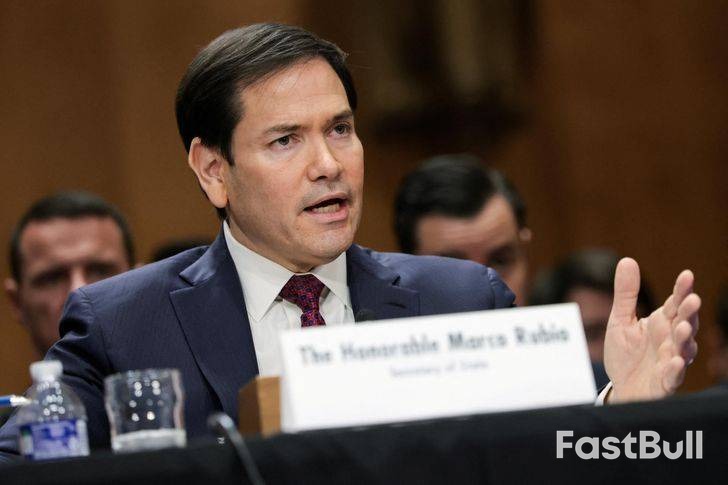
The United States, Denmark, and Greenland have initiated a formal process to resolve the ongoing standoff over the semi-autonomous territory, U.S. Secretary of State Marco Rubio announced on Wednesday.
Speaking to the Senate Foreign Relations Committee, Rubio confirmed that representatives from all three parties are now engaged in technical-level meetings. He expressed optimism about the negotiations, stating, "We're in a good place right now," and anticipates the process will lead to a "good outcome for everybody."

While details about the participants and location were not disclosed, Rubio explained that the talks are intentionally structured to avoid a "media circus" around each meeting. This approach is designed to provide greater flexibility as the parties work toward a solution.
"I think we're going to get there," Rubio told the committee during the public session.
The diplomatic effort marks a significant shift from President Donald Trump's aggressive push earlier in the year for the U.S. to acquire Greenland from Denmark. That move raised the unusual prospect of the United States confronting a NATO ally over territory.
Rubio described as "important" President Trump's recent statement at the World Economic Forum in Davos, where he declared he was no longer pursuing a military solution to the crisis. In Davos, Trump also mentioned that a "framework of a future deal with respect to Greenland" had been reached, though the specifics of that framework have not been made public.
Danish officials have also confirmed the establishment of a dialogue. Last week, Danish Foreign Minister Lars Løkke Rasmussen announced that a "high-level working group" was being formed between the U.S., Denmark, and Greenland.
However, Rasmussen also cautioned that "fundamental disagreement" with Washington persists, signaling that the path to a final resolution may be complex.
Treasury Secretary Scott Bessent confirmed Wednesday that President Donald Trump is still considering four "great" candidates to succeed Jerome Powell as the next Chairman of the Federal Reserve.
The confirmation followed an extended discussion on the matter between Bessent and Trump during a flight from Iowa back to Washington.
Speaking to CNBC, Bessent described a detailed, two-hour conversation with the president about the central bank's leadership. He clarified his advisory role, stating, "I don't make recommendations. I give the president options and outcomes. It's going to be the president's decision."
The timeline for an official announcement remains unclear. When asked about the timing, Bessent noted, "Only the president knows." The White House did not provide an immediate comment on when a decision might be made.
This follows earlier remarks from Trump, who said he was "down to one in my mind," suggesting a decision was imminent.
While Bessent did not name the four individuals, several candidates have been identified in recent weeks. According to the prediction market Kalshi, Rick Rieder, BlackRock’s chief bond investment manager, is the clear favorite to succeed Powell when his term ends in May. Trump previously described Rieder's interview as "very impressive."
Other potential nominees mentioned by Trump and his aides include:
• Christopher Waller, a current Fed Governor.
• Kevin Warsh, a former Fed Governor.
• Kevin Hassett, Trump's top economic adviser, although the president has also expressed a desire to keep him in his current role.
Beyond the nomination process, Bessent offered his perspective on monetary policy, urging the Federal Reserve to maintain an "open mind" regarding interest rates. He suggested that many on the board hold "a false narrative" about inflation.
"I hope that they will have an open mind and see what's coming over the next couple months," he said.
Bessent argued that strong U.S. economic growth and rising wages do not automatically guarantee higher inflation, especially given counteracting forces like substantial decreases in rents.
Interim Board Stability
Bessent also noted that Stephen Miran could continue serving on the Fed's Board of Governors for now. Miran, who is on leave from his position as chairman of the White House Council of Economic Advisers, joined the board in September to complete the 14-year term of Adriana Kugler, who resigned.
Miran has indicated he will likely remain on the board until the Senate confirms Trump's nominee for the next Fed chair, providing stability during the transition.
Brazil's Treasury has set a target for federal public debt to close the year between 9.7 trillion and 10.3 trillion reais ($1.86 to $1.98 trillion). This projection signals a potential increase of up to 19% from the 8.635 trillion reais recorded in 2025.
The forecast marks another year of double-digit expansion for the public debt of Latin America's largest economy, following an 18% increase last year.
In its Annual Financing Plan, the Treasury detailed a strategy for a "more frequent market presence." The plan involves consistent U.S. dollar bond issuances and an openness to other currencies, including the euro and yuan, to diversify Brazil's financing sources.
A central objective is to gradually refine the public debt's composition. The Treasury aims to achieve this by increasing the share of fixed-rate bonds and extending the maturities of its debt instruments.
According to its new guidelines, fixed-rate bonds are projected to represent 21% to 25% of the total debt by year-end, a shift from 22% in 2025.
Meanwhile, debt linked to the benchmark Selic interest rate is estimated to account for 46% to 50% of the total, after rising to 48.3% last year. These floating-rate bonds, known as LFTs, tend to be more attractive to investors during periods of elevated risk aversion. However, they also expose public debt servicing costs to sharp increases when interest rates climb.
Many market participants expect volatility to intensify this year due to Brazil's upcoming general election in October.
The nation's benchmark Selic rate currently stands at 15%, a near 20-year high, where it has remained since July. The central bank is holding rates firm to bring inflation back to its 3% target. This comes as the economy has been slow to show clear signs of cooling amid government stimulus under President Luiz Inacio Lula da Silva.
The sharp monetary tightening last year, which saw the Selic rise from 12.25%, was a primary driver of the increase in public debt. Policymakers are set to announce their next monetary policy decision late on Wednesday, with markets widely expecting another hold.
($1 = 5.2074 reais)
Ecuador just made a stunning return to global credit markets, and investors are betting Argentina could be next. In its first major bond sale since a 2020 debt restructuring, Ecuador successfully sold $4 billion in bonds—its largest global offering ever.
The deal attracted so much demand that the South American nation secured its lowest borrowing costs in years. The positive momentum was reinforced when Moody's Ratings upgraded the country's credit score, causing yields to compress even further.
This successful issuance is more than just a win for Ecuador, which plans to use the funds to repay existing debt. It’s a clear signal of strong investor appetite for high-yield emerging-market credits and raises hopes for Argentina, which has also been locked out of global markets since its own 2020 restructuring.
"Ecuador's debt issuance this week shows that even countries with a long history of defaults, high political risk and scarce reserves can access international markets at single-digit yields," noted Diego Chameides, chief economist at Banco Galicia, one of Argentina's largest lenders. "It appears the window for Argentina's market access could open up, which is key to dealing with large debt maturities in the coming years."
Reflecting this optimism, Argentine bonds rallied alongside Ecuadorian debt, and a key measure of the country's risk has fallen below 500 basis points—a level officials previously identified as compatible with a market return.
Despite Argentina's economy being roughly four times larger than Ecuador's, the two nations share several key financial characteristics.
• History of Defaults: Both have restructured their debt multiple times. Since the early 1800s, Argentina has defaulted nine times and Ecuador ten.
• IMF Programs: Both countries remain under International Monetary Fund programs.
• Weak Reserves: Both face chronically weak foreign-reserve positions, a major concern for debt investors.
However, their prospects are improving under new administrations focused on fiscal consolidation. In Ecuador, President Daniel Noboa cut a diesel subsidy while containing the resulting social unrest. In Argentina, President Javier Milei has eased investor concerns by loosening currency restrictions and rebuilding foreign reserves since his victory in October's midterm elections.
For many analysts, Ecuador’s strategy of using the new issuance to buy back debt and reduce near-term maturities could serve as a direct template for Argentina.
"Ecuador's latest transaction is a clean read-through for how Argentina's curve could react to a well-designed liability management deal," said Mauro Favini, a senior portfolio manager at Vanguard. "Argentina is clearly improving, but until it extends its debt stack through a transaction akin to Ecuador's, the market will struggle to take the curve meaningfully tighter."
Argentina has been considering a return to markets ever since Milei's election win pushed yield spreads toward the 550 basis-point range. While corporate and provincial entities have successfully issued debt, the sovereign has held back, using a repurchase agreement with banks to handle January payments.
A top priority for Argentina is rebuilding its depleted foreign reserves. The central bank has been actively buying U.S. dollars, but may want to demonstrate more substantial progress before tapping the markets.
"Our impression is that they want to show several billion in FX purchases before going to market, as they are very focused on bringing down country risk before launching the deal," explained Walter Stoeppelwerth, chief investment officer at Grit Capital Group. "But it's not as simple as Ecuador. Argentina's swap could be gigantic in comparison."
Argentine officials have tried to manage expectations. Economy Minister Luis Caputo has stated a desire to reduce the nation's reliance on Wall Street, and President Milei recently said, "the only thing we would go to international markets for would be rollover." This marks a sharp contrast to the 2016-2018 period under former President Mauricio Macri, when broad market access fueled a debt boom that ultimately collapsed.
Despite the cautious rhetoric, Argentina has limited time to wait. According to calculations by Galicia, foreign-currency debt payments for 2026 and 2027 total nearly $43 billion, making a return to market financing critical.
With yields on its 2035 global bonds near 9.1%, Argentina remains one of the few large emerging-market credits offering such attractive returns. As sovereign bond risk in the developing world hits a 13-year low, the pool of high-yielding assets is shrinking, driving more demand toward riskier debt.
Investors argue that this combination of factors should push Argentina to act sooner rather than later.
"To push the curve toward true normalization and lower long-term funding costs, Argentina will need an Ecuador-style, proactive liability management strategy," Favini concluded. "Even after covering its 2026 liquidity needs via the repo, Argentina still needs to use the current market window."
White Label
Data API
Web Plug-ins
Poster Maker
Affiliate Program
The risk of loss in trading financial instruments such as stocks, FX, commodities, futures, bonds, ETFs and crypto can be substantial. You may sustain a total loss of the funds that you deposit with your broker. Therefore, you should carefully consider whether such trading is suitable for you in light of your circumstances and financial resources.
No decision to invest should be made without thoroughly conducting due diligence by yourself or consulting with your financial advisors. Our web content might not suit you since we don't know your financial conditions and investment needs. Our financial information might have latency or contain inaccuracy, so you should be fully responsible for any of your trading and investment decisions. The company will not be responsible for your capital loss.
Without getting permission from the website, you are not allowed to copy the website's graphics, texts, or trademarks. Intellectual property rights in the content or data incorporated into this website belong to its providers and exchange merchants.
Not Logged In
Log in to access more features
Log In
Sign Up