• Trade
  • Markets
  • Copy
  • Contests
  • News
  • 24/7
  • Calendar
  • Q&A
  • Chats
Trending
Screeners
SYMBOL
LAST
BID
ASK
HIGH
LOW
NET CHG.
%CHG.
SPREAD
SPX
S&P 500 Index
6827.42
6827.42
6827.42
6899.86
6801.80
-73.58
-1.07%
--
DJI
Dow Jones Industrial Average
48458.04
48458.04
48458.04
48886.86
48334.10
-245.98
-0.51%
--
IXIC
NASDAQ Composite Index
23195.16
23195.16
23195.16
23554.89
23094.51
-398.69
-1.69%
--
USDX
US Dollar Index
97.990
98.070
97.990
98.020
97.980
+0.040
+ 0.04%
--
EURUSD
Euro / US Dollar
1.17378
1.17388
1.17378
1.17385
1.17285
-0.00016
-0.01%
--
GBPUSD
Pound Sterling / US Dollar
1.33668
1.33682
1.33668
1.33732
1.33580
-0.00039
-0.03%
--
XAUUSD
Gold / US Dollar
4304.06
4304.50
4304.06
4304.65
4294.68
+4.67
+ 0.11%
--
WTI
Light Sweet Crude Oil
57.297
57.334
57.297
57.348
57.194
+0.064
+ 0.11%
--

Community Accounts

Signal Accounts
--
Profit Accounts
--
Loss Accounts
--
View More

Become a signal provider

Sell trading signals to earn additional income

View More

Guide to Copy Trading

Get started with ease and confidence

View More

Signal Accounts for Members

All Signal Accounts

Best Return
  • Best Return
  • Best P/L
  • Best MDD
Past 1W
  • Past 1W
  • Past 1M
  • Past 1Y

All Contests

  • All
  • Trump Updates
  • Recommend
  • Stocks
  • Cryptocurrencies
  • Central Banks
  • Featured News
Top News Only
Share

Nomura CEO: Aim To Develop Japanese Direct Lending Market

Share

Nomura CEO: Aim To Bring Private Debt Know-How From Overseas

Share

HSBC - Scheme Consideration Refers To Proposal For Privatisation Of Hang Seng Bank

Share

[Report: SpaceX Launches Bake-Off Process To Select Underwriters For Potential IPO] According To Sources Familiar With The Matter, SpaceX Executives Have Initiated A Process To Select Wall Street Investment Banks To Advise The Company On Its Initial Public Offering (IPO). Several Investment Banks Are Scheduled To Submit Their First Round Of Proposals This Week, A Process Known As "bake-off," Which Represents The Most Concrete Step The Rocket Maker Has Taken Towards A Potentially "blockbuster IPO," According To The Sources

Share

RBNZ: ASB Has Co-Operated With The Reserve Bank And Has Admitted Liability For All Seven Causes Of Action

Share

RBNZ: Court Proceedings For Breaches Of Core Requirements Under Anti-Money Laundering And Countering Financing Of Terrorism Act From At Least December 2019

Share

Jose Antonio Kast Leads Chile Presidential Election's Runoff Vote With 4.46% Of Ballots Counted: Official Count

Share

Mayor: Russian Air Defence Units Destroy Drone Heading For Moscow

Share

Australia's ASIC - ASIC And Reserve Bank Of Australia Will Step Up Their Review To Uplift Their Joint Supervisory Model

Share

US Envoy Witkoff Says A Lot Of Progress Was Made At Berlin Talks On Russia/Ukraine War

Share

Syria's President Sharaa Sends Condolences To Trump Over Killing Of USA Soldiers In Syria - Syrian Presidency

Share

ECOWAS Commission President: ECOWAS Rejects Guinea-Bissau Junta Transition Plan, Demands Return To Constitutional Order

Share

On Sunday (December 14), The Bangladesh DSE Broad Index Closed Down 0.62% At 4932.97 Points

Share

US President Trump: A New Federal Reserve Chairman Will Be Chosen Soon

Share

US President Trump: Inflation Is “completely Offset” And You Don’t Want To See Deflation

Share

Trump: Will Be A Lot Of Damage Done To The People That Attacked Troops In Syria

Share

Trump: Terrible Attack In Bondi Beach

Share

Interior Ministry - Syria Arrests Five Suspects In Shooting Of USA And Syrian Troops In Palmyra

Share

France Says Conditions For EU Vote On MERCOSUR Deal Not Yet Met, Despite Recent Progress — Prime Minister's Office

Share

CEO: Tokyo Gas To Steer More Than Half Of Overseas Investments To US In Next 3 Years

TIME
ACT
FCST
PREV
U.K. Trade Balance (Oct)

A:--

F: --

P: --

U.K. Services Index MoM

A:--

F: --

P: --

U.K. Construction Output MoM (SA) (Oct)

A:--

F: --

P: --

U.K. Industrial Output YoY (Oct)

A:--

F: --

P: --

U.K. Trade Balance (SA) (Oct)

A:--

F: --

P: --

U.K. Trade Balance EU (SA) (Oct)

A:--

F: --

P: --

U.K. Manufacturing Output YoY (Oct)

A:--

F: --

P: --

U.K. GDP MoM (Oct)

A:--

F: --

P: --

U.K. GDP YoY (SA) (Oct)

A:--

F: --

P: --

U.K. Industrial Output MoM (Oct)

A:--

F: --

P: --

U.K. Construction Output YoY (Oct)

A:--

F: --

P: --

France HICP Final MoM (Nov)

A:--

F: --

P: --

China, Mainland Outstanding Loans Growth YoY (Nov)

A:--

F: --

P: --

China, Mainland M2 Money Supply YoY (Nov)

A:--

F: --

P: --

China, Mainland M0 Money Supply YoY (Nov)

A:--

F: --

P: --

China, Mainland M1 Money Supply YoY (Nov)

A:--

F: --

P: --

India CPI YoY (Nov)

A:--

F: --

P: --

India Deposit Gowth YoY

A:--

F: --

P: --

Brazil Services Growth YoY (Oct)

A:--

F: --

P: --

Mexico Industrial Output YoY (Oct)

A:--

F: --

P: --

Russia Trade Balance (Oct)

A:--

F: --

P: --

Philadelphia Fed President Henry Paulson delivers a speech
Canada Building Permits MoM (SA) (Oct)

A:--

F: --

P: --

Canada Wholesale Sales YoY (Oct)

A:--

F: --

P: --

Canada Wholesale Inventory MoM (Oct)

A:--

F: --

P: --

Canada Wholesale Inventory YoY (Oct)

A:--

F: --

P: --

Canada Wholesale Sales MoM (SA) (Oct)

A:--

F: --

P: --

Germany Current Account (Not SA) (Oct)

A:--

F: --

P: --

U.S. Weekly Total Rig Count

A:--

F: --

P: --

U.S. Weekly Total Oil Rig Count

A:--

F: --

P: --

Japan Tankan Large Non-Manufacturing Diffusion Index (Q4)

--

F: --

P: --

Japan Tankan Small Manufacturing Outlook Index (Q4)

--

F: --

P: --

Japan Tankan Large Non-Manufacturing Outlook Index (Q4)

--

F: --

P: --

Japan Tankan Large Manufacturing Outlook Index (Q4)

--

F: --

P: --

Japan Tankan Small Manufacturing Diffusion Index (Q4)

--

F: --

P: --

Japan Tankan Large Manufacturing Diffusion Index (Q4)

--

F: --

P: --

Japan Tankan Large-Enterprise Capital Expenditure YoY (Q4)

--

F: --

P: --

U.K. Rightmove House Price Index YoY (Dec)

--

F: --

P: --

China, Mainland Industrial Output YoY (YTD) (Nov)

--

F: --

P: --

China, Mainland Urban Area Unemployment Rate (Nov)

--

F: --

P: --

Saudi Arabia CPI YoY (Nov)

--

F: --

P: --

Euro Zone Industrial Output YoY (Oct)

--

F: --

P: --

Euro Zone Industrial Output MoM (Oct)

--

F: --

P: --

Canada Existing Home Sales MoM (Nov)

--

F: --

P: --

Euro Zone Total Reserve Assets (Nov)

--

F: --

P: --

U.K. Inflation Rate Expectations

--

F: --

P: --

Canada National Economic Confidence Index

--

F: --

P: --

Canada New Housing Starts (Nov)

--

F: --

P: --

U.S. NY Fed Manufacturing Employment Index (Dec)

--

F: --

P: --

U.S. NY Fed Manufacturing Index (Dec)

--

F: --

P: --

Canada Core CPI YoY (Nov)

--

F: --

P: --

Canada Manufacturing Unfilled Orders MoM (Oct)

--

F: --

P: --

Canada Manufacturing New Orders MoM (Oct)

--

F: --

P: --

Canada Core CPI MoM (Nov)

--

F: --

P: --

Canada Manufacturing Inventory MoM (Oct)

--

F: --

P: --

Canada CPI YoY (Nov)

--

F: --

P: --

Canada CPI MoM (Nov)

--

F: --

P: --

Canada CPI YoY (SA) (Nov)

--

F: --

P: --

Canada Core CPI MoM (SA) (Nov)

--

F: --

P: --

Canada CPI MoM (SA) (Nov)

--

F: --

P: --

Q&A with Experts
    • All
    • Chatrooms
    • Groups
    • Friends
    Connecting
    .
    .
    .
    Type here...
    Add Symbol or Code

      No matching data

      All
      Trump Updates
      Recommend
      Stocks
      Cryptocurrencies
      Central Banks
      Featured News
      • All
      • Russia-Ukraine Conflict
      • Middle East Flashpoint
      • All
      • Russia-Ukraine Conflict
      • Middle East Flashpoint
      Search
      Products

      Charts Free Forever

      Chats Q&A with Experts
      Screeners Economic Calendar Data Tools
      Membership Features
      Data Warehouse Market Trends Institutional Data Policy Rates Macro

      Market Trends

      Market Sentiment Order Book Forex Correlations

      Top Indicators

      Charts Free Forever
      Markets

      News

      News Analysis 24/7 Columns Education
      From Institutions From Analysts
      Topics Columnists

      Latest Views

      Latest Views

      Trending Topics

      Top Columnists

      Latest Update

      Signals

      Copy Rankings Latest Signals Become a signal provider AI Rating
      Contests
      Brokers

      Overview Brokers Assessment Rankings Regulators News Claims
      Broker listing Forex Brokers Comparison Tool Live Spread Comparison Scam
      Q&A Complaint Scam Alert Videos Tips to Detect Scam
      More

      Business
      Events
      Careers About Us Advertising Help Center

      White Label

      Data API

      Web Plug-ins

      Affiliate Program

      Awards Institution Evaluation IB Seminar Salon Event Exhibition
      Vietnam Thailand Singapore Dubai
      Fans Party Investment Sharing Session
      FastBull Summit BrokersView Expo
      Recent Searches
        Top Searches
          Markets
          News
          Analysis
          User
          24/7
          Economic Calendar
          Education
          Data
          • Names
          • Latest
          • Prev

          View All

          No data

          Scan to Download

          Faster Charts, Chat Faster!

          Download App
          English
          • English
          • Español
          • العربية
          • Bahasa Indonesia
          • Bahasa Melayu
          • Tiếng Việt
          • ภาษาไทย
          • Français
          • Italiano
          • Türkçe
          • Русский язык
          • 简中
          • 繁中
          Open Account
          Search
          Products
          Charts Free Forever
          Markets
          News
          Signals

          Copy Rankings Latest Signals Become a signal provider AI Rating
          Contests
          Brokers

          Overview Brokers Assessment Rankings Regulators News Claims
          Broker listing Forex Brokers Comparison Tool Live Spread Comparison Scam
          Q&A Complaint Scam Alert Videos Tips to Detect Scam
          More

          Business
          Events
          Careers About Us Advertising Help Center

          White Label

          Data API

          Web Plug-ins

          Affiliate Program

          Awards Institution Evaluation IB Seminar Salon Event Exhibition
          Vietnam Thailand Singapore Dubai
          Fans Party Investment Sharing Session
          FastBull Summit BrokersView Expo

          Fed Cut Seen Near Certain After Inflation Data

          Daniel Carter

          Central Bank

          Economic

          Summary:

          The likelihood of a Federal Reserve rate cut in September is now seen near 100% after new data showed U.S. inflation increased at a moderate pace in July and Treasury Secretary Scott Bessent said he thought an aggressive half-point cut was possible given recent weak employment numbers.

          Traders in contracts tied to the benchmark federal funds rate on Wednesday put the odds of a quarter-percentage point cut at the Fed's September 16-17 meeting at 99.9%, according to estimates calculated by the CME Group's FedWatch tool that followed the release of July Consumer Price Index data on Tuesday and later comments by Bessent noting that the Fed had used fears of a weakening job market as justification for a larger cut last September.Trump has slammed last year's cut, the first of three that took place before and after his election, as politically motivated given the proximity to the November presidential vote.
          Bessent rooted his argument in recent Bureau of Labor Statistics revisions showing job growth had slowed to a crawl in May, June and July, in contrast to initial BLS estimates for May and June indicating stronger employment growth. Fed officials relied on those stronger numbers to argue that the labor market remained in good shape and to hold rates steady at meetings in June and July.
          "If we'd seen those numbers in May, in June, I suspect we could have had rate cuts in June and July. So that tells me that there's a very good chance of a 50 basis-point rate cut," in September, Bessent said in an interview on Bloomberg television."Rates are too constrictive...We should probably be 150 to 175 basis points lower," Bessent said, adding to the Trump administration's penchant for public criticism and detailed policy advice for the independent central bank.
          Bessent urged the rate cuts as the administration moves forward with its searching for a replacement for Fed Chair Jerome Powell, with the list of potential candidates now grown to 11, far larger than the short list of three Trump said he was considering just a few days ago.
          The expanded list, confirmed by a White House official, now includes both of the Fed's vice chairs, Philip Jefferson and Vice Chair for Supervision Michelle Bowman, current Governor Christopher Waller, Dallas Fed President Lorie Logan, and top Trump economic adviser Kevin Hassett, along with several private sector figures.
          Absent was current Council of Economic Advisers chair Stephen Miran, nominated to fill an open Fed board seat with a term that ends in January. Bessent said in his comments to Bloomberg that even if confirmed by the Senate he did not expect Miran to stay at the Fed beyond that point.
          The opening Miran is filling could be needed to make room for Trump's pick to replace Powell, whose term as chair ends in May.
          The rate cuts Bessent suggested stop far short of Trump's call for the benchmark rate to be cut to 1%, but would drop it from the current 4.25% to 4.5% range to around 3% - roughly what Fed policymakers consider to be a "neutral" stance that is neither boosting nor holding back the economy.
          It suggests both a comfort level with the expected path of inflation toward the Fed's 2% target and the ability of the economy to maintain roughly full employment.
          Fed officials have been reluctant to declare their inflation battle won, with prices rising faster than their target and expected to gather pace at least temporarily in coming months due to the impact of Trump administration tariffs.
          But arguments to look past any tariff-related bump in prices are gathering steam, with more Fed policymakers saying the jobs revisions had made them more attuned to the possibility of rising unemployment, and some rate cut advocates arguing that the central bank needed to get ahead of the curve.
          "A proactive approach in moving policy closer to neutral, from its current moderately restrictive stance, would help avoid a further unnecessary erosion in labor market conditions and reduce the chance that the Committee will need to implement a larger policy correction should the labor market deteriorate further," Bowman said in remarks on Saturday.

          Source: Kitco

          To stay updated on all economic events of today, please check out our Economic calendar
          Risk Warnings and Disclaimers
          You understand and acknowledge that there is a high degree of risk involved in trading. Following any strategies or investment methods may lead to potential losses. The content on the site is provided by our contributors and analysts for information purposes only. You are solely responsible for determining whether any trading assets, securities, strategy, or any other product is suitable for investing based on your own investment objectives and financial situation.
          Add to Favorites
          Share

          China and India Rebuild Ties After Modi’s Rupture With Trump

          Adam

          Economic

          India and China are restoring economic links strained by a deadly 2020 border clash, the latest sign Prime Minister Narendra Modi is drawing closer to the BRICS countries after US President Donald Trump hit the South Asian nation with a 50% tariff.
          Modi’s latest move is to resume direct flights with China as soon as next month, said people familiar with the negotiations who asked for anonymity to discuss private matters. The deal could be formally announced when Modi is expected to head to China for the first time in seven years and meet leader Xi Jinping at the Shanghai Cooperation Organisation held in Tianjin from Aug. 31, the people said.
          Flights were suspended during the Covid-19 pandemic, which coincided with a sharp decline in relations between the nuclear-armed neighbors after border clashes in the Himalayas killed 20 Indian soldiers and an unknown number of Chinese troops.
          Modi’s economic calculus was fundamentally altered this month when Trump doubled tariffs on Indian goods to 50% as a penalty for its purchases of Russian oil. The US president’s remarks that India’s economy was “dead” and its tariff barriers “obnoxious” further strained relations.
          The blow from India’s largest trading partner hit hard, especially after Modi had lavished praise on Trump and was among the first foreign leaders to visit after his return to the White House.
          Henry Wang, president of the Center for China and Globalization think tank in Beijing, said relations between India and China are in an “up cycle,” and as leaders of the Global South, “they have to really speak to each other.”
          “Trump’s tariff war on India has made India realize that they have to maintain some kind of strategic autonomy and strategic independence,” he said.
          China, also a prime target in Trump’s trade wars, has shown signs it’s ready for a thaw. This month, it eased curbs on urea shipments to India — the world’s largest importer of the fertilizer.
          Although initial volumes are small, the trade could expand, easing global shortages and prices. China relaxed the ban in June but had maintained restrictions on India until now.
          The Adani Group is exploring a tieup with Chinese EV giant BYD Co. that would allow billionaire Gautam Adani’s conglomerate to manufacture batteries in India and extend its push into clean energy, according to people familiar with the matter.
          Modi’s government recently allowed tourist visas for Chinese nationals after years of curbs. China is India’s second-largest trade partner after the US, and India needs key inputs from China to develop its manufacturing base.
          While there may be a thaw, the two Asian powers are not likely to restore full trust overnight. They have seen each other as rivals for years and friction increased a few months ago when China supplied weapons and intelligence to Pakistan in its recent military dispute with India.
          Part of Trump’s recent anger toward New Delhi comes from India denying his claims that his mediation helped defuse tensions with Pakistan. Modi also challenged those assertions directly in a call with Trump in June. India saw a shift in tone from the White House after that, according to the officials in New Delhi.
          Modi is also strengthening ties with Brazil and Russia, fellow BRICS founding members. In August, he invited President Vladimir Putin to visit India as relations with the US soured.
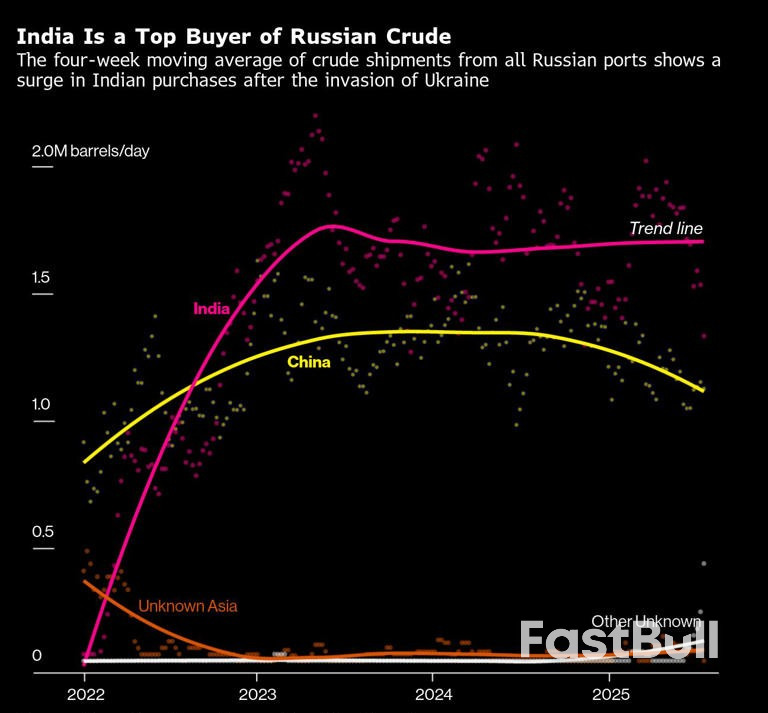
          Trump is frustrated with India’s continued imports of discounted Russian oil, which help fund the Kremlin’s war in Ukraine. Modi has shown no signs of backing down, and his government signed agreements with Moscow this month to deepen economic cooperation.
          China and India Rebuild Ties After Modi’s Rupture With Trump_1

          India Is a Top Buyer of Russian Crude | The four-week moving average of crude shipments from all Russian ports shows a surge in Indian purchases after the invasion of Ukraine

          Modi has also talked trade and the imposition of unilateral tariffs against their nations with Brazilian President Luiz Inacio Lula da Silva. Bolstering commercial ties between Brazil and India was a key topic of Modi’s visit to Brasilia in July. During the call in early August, Lula and Modi also agreed to expand India’s trade deal with Mercosur, the South American customs union that includes Brazil.
          The US has long courted India as a counterbalance to China in geopolitics but with Trump’s trade wars, Beijing and New Delhi are finding common ground. Xu Feihong, China’s ambassador to India, has offered Modi moral support over the tariffs.
          “Give the bully an inch, he will take a mile,” Xu last week wrote on X over a quote from Chinese Foreign Minister Wang Yi denouncing the use of tariffs “as a weapon to suppress other countries.”

          Source: Bloomberg

          To stay updated on all economic events of today, please check out our Economic calendar
          Risk Warnings and Disclaimers
          You understand and acknowledge that there is a high degree of risk involved in trading. Following any strategies or investment methods may lead to potential losses. The content on the site is provided by our contributors and analysts for information purposes only. You are solely responsible for determining whether any trading assets, securities, strategy, or any other product is suitable for investing based on your own investment objectives and financial situation.
          Add to Favorites
          Share

          Goldman Stands By Call That Consumers Will Bear The Brunt Of Tariffs After Trump Blasts Bank's Economist

          Thomas

          Economic

          In the face of blistering criticism from President Donald Trump, Goldman Sachs economist David Mericle on Wednesday stood by a controversial forecast that tariffs will begin to hit consumer wallets.

          Trump lashed out at the bank in a Tuesday post on Truth Social, suggesting that CEO David Solomon "get a new Economist" or consider resigning.

          Mericle, though, said in a CNBC interview that the firm is confident in its research, the president's objections notwithstanding.

          "We stand by the results of this study," he said on "Squawk on the Street." "If the most recent tariffs, like the April tariff, follow the same pattern that we've seen with those earliest February tariffs, then eventually, by the fall, we estimate that consumers would bear about two thirds of the cost."

          The source of the president's ire was a Goldman note over the weekend, authored by economist Elsie Peng, asserting that while exporters and businesses thus far have absorbed most of Trump's tariffs, that burden will switch in the months ahead to consumers.

          In fact, Peng wrote that Goldman's models indicate consumers will take on about two-thirds of all the costs. If that's the case, it will push the personal consumption expenditures price index, the Federal Reserve's main inflation forecasting gauge, to 3.2% by the end of the year, excluding food and energy. Core PCE inflation for June was at 2.8%, while the Fed targets inflation at 2%.

          "If you are a company producing in the U.S. who is now protected from foreign competition, you can raise your prices and benefit," Mericle said. "So those are our estimates, and I think actually, they're quite consistent with what many other economists have found."

          Of note, Mericle said Trump likely still will get at least some of the interest rate cuts he's been demanding of the Fed.

          "I do think most of the impact is still ahead of us. I'm not worried about it. I think, like the White House, like Fed officials, we would see this as a one-time price level effect," he said. "I don't think this will matter a whole lot to the Fed, because now they have a labor market to worry about, and I think that's going to be the dominant concern."

          Following modest gains reported this week for the consumer price index, and a weak July nonfarm payrolls report that featured sharp downward revisions to the prior two months, markets are pricing in cuts from the Fed at each of its three remaining meetings this year.

          Source: CNBC

          To stay updated on all economic events of today, please check out our Economic calendar
          Risk Warnings and Disclaimers
          You understand and acknowledge that there is a high degree of risk involved in trading. Following any strategies or investment methods may lead to potential losses. The content on the site is provided by our contributors and analysts for information purposes only. You are solely responsible for determining whether any trading assets, securities, strategy, or any other product is suitable for investing based on your own investment objectives and financial situation.
          Add to Favorites
          Share

          China And The US-Nvidia Deal: National Security For Sale?

          Samantha Luan

          Economic

          Political

          Commodity

          For several years – especially since the United States banned ZTE and Huawei in 2018 and 2019, respectively – U.S. export controls on cutting-edge technologies have been framed as a measure to safeguard national security. On the same grounds, the Biden administration banned the sale of certain U.S.-made chips to China in 2022 and 2023. To circumvent such restrictions, Nvidia developed the H20 chip, a downgraded form of its H-100 Graphic Processing Unit (GPU), and AMD developed the MI308, both to serve the Chinese markets.

          Nvidia’s CEO Jensen Huang has often vocally opposed the restrictive export controls targeting China, claiming the policy is counterproductive for the United States’ economic and strategic interests. Through active lobbying during the current Trump administration, which is following a more inward-looking approach, Nvidia managed to get an official permit for H20 sales to China – albeit for a fee.In a highly unusual settlement, Nvidia and AMD will hand over 15 percent of their revenue from H20 and MI308 chip sales to China directly to the U.S. government. This arrangement is not a standard export tariff, nor a conventional tax. It is a direct revenue-sharing deal between the government and the two companies, targeted at a single foreign market, i.e., China.

          According to estimates by Bernstein Research, by the end of 2025, Nvidia will have sold over 1.5 million H20 chips in China, generating about $23 billion in revenue, and AMD is projected to record $800 million in China chip sales. That means the deal could deliver more than $2 billion directly to the U.S. Treasury.Unlike in China, where the provision of “golden shares” (a shareholding arrangement enabling the Chinese government to buy a certain percentage of shares in private enterprises) highlights the intimate relationship between the Chinese state and its private corporations, such policy moves in the United States are extremely rare. However, the Trump administration in July followed a similar approach when it approved the takeover of U.S. Steel by Japan’s Nippon Steel.

          While the Nippon Steel deal aimed at securing critical industries from falling under foreign control, it also indicated a growing trend of state capitalism in the United States. Now the revenue-sharing agreement with AMD and Nvidia exemplifies a larger pattern where companies are falling into quid-pro-quo arrangements to prevent the imposition of tariffs and preserve their own market position, while pledging to bring jobs, revenues, and market concentration to the United States. However, the deal also risks replacing principle-driven trade policy with ad hoc bargaining, leaving both allies and adversaries uncertain about U.S. red lines.For U.S. chipmakers, it’s better to earn some revenue from China than none. While the deal gives direct access to the lucrative China market, it also directly eats into Nvidia’s and AMD’s profits. This will create ripples in the broader market ecosystem, wherein corporate planning, profit margins, and investor confidence could all be affected.

          Major U.S. companies with considerable market share in China will be watching closely. If the government is willing to impose a revenue-sharing requirement for chip sales, might it do the same for other strategic sectors? This could prompt firms to rethink their China strategies, diversify supply chains, or intensify lobbying to either pursue or avoid similar arrangements. The message to shareholders becomes clearer after this move: geopolitical risk is no longer an abstract factor; instead, it directly shapes revenue streams.

          One possible explanation behind the decision is the “engage to constrain” strategy: selling downgraded chips keeps China reliant on U.S. technology, thereby maintaining a degree of influence over its AI development. The H20 and MI308 chips, being less powerful than flagship models, are intended to fall below the threshold of national security risk.This could prove to be a pitfall for two reasons. First, Washington has previously failed to accurately gauge Chinese firms’ ability to refurbish outdated hardware and optimize it for higher-grade applications. This means that even downgraded chips can accelerate China’s AI capabilities, including in areas with military applications.

          Second, the free flow of H20 chips is unlikely to halt China’s renewed drive toward indigenous chip development. In fact, the renewed synergies between governments and private chipmakers in China are likely to take advantage of this policy relaxation to prepare themselves for any future restrictions. Thus the new policy, which resolves to protect domestic interests, will again fuel Beijing’s determination to achieve chip independence and undermine U.S. strategic objectives in the long term.

          By reversing the ban and taking a revenue share, Washington risks sending a conflicting message: that security concerns can be waived in exchange for commercial concessions. The shift from safeguarding national security to commodifying strategic concerns poses several questions. If sensitive technology can be sold for a price, how credible will future restrictions appear to allies, adversaries, and U.S. companies alike?

          More broadly, U.S. allies involved in semiconductor supply chains – Japan, South Korea, Taiwan, and the Netherlands – may see this as a signal to adopt similarly transactional policies, fragmenting the global trade environment. During the Biden administration, these allies were part of the broader export control regime. If this model is perceived as putting a price tag on national security, it could weaken the legitimacy of future export controls, embolden adversaries to test U.S. resolve, and encourage allies to question U.S. consistency.The United States now walks a fine line. Whether this is a masterstroke of transactional diplomacy or a short-sighted policy gamble will depend on whether Washington can secure broader strategic gains without undermining its own credibility.

          Source: The Diplomat

          To stay updated on all economic events of today, please check out our Economic calendar
          Risk Warnings and Disclaimers
          You understand and acknowledge that there is a high degree of risk involved in trading. Following any strategies or investment methods may lead to potential losses. The content on the site is provided by our contributors and analysts for information purposes only. You are solely responsible for determining whether any trading assets, securities, strategy, or any other product is suitable for investing based on your own investment objectives and financial situation.
          Add to Favorites
          Share

          S&P 500: Is Bad Breadth the Norm, Not the Exception?

          Adam

          Stocks

          ince the pandemic, markets have been behaving abnormally. One such instance is a somewhat regular occurrence of bad market breadth. In other words, the market-cap weighted S&P 500 drives higher, yet fewer and fewer stocks are participating in the rally. For instance, in Monday’s Commentary, we discussed the current instance of bad breadth. To wit:
          Market breadth has also narrowed, as shown, with fewer than 60% of S&P 500 stocks above their 50 and 200-day moving averages, highlighting the reliance on mega-cap technology to prop up index levels.
          Given we have seen many instances of bad breadth over the last few years, it’s worth quantifying the number of cases before and after the pandemic.
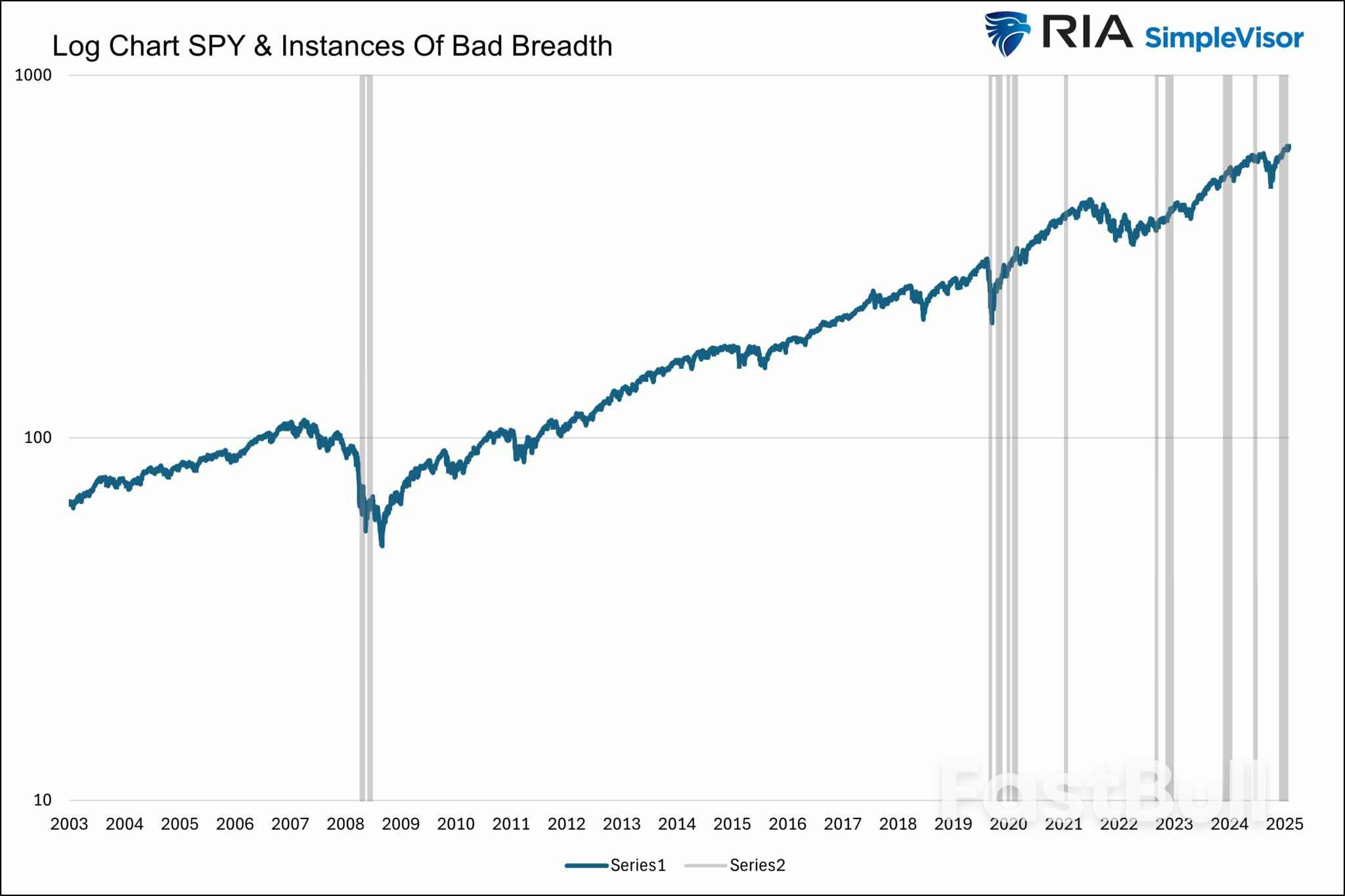
          The graph below charts SPY on a logarithmic scale versus instances of bad breadth. Bad breadth is the 50-day return differential between the marketcap (SPY) and equal weighted RSP S&P 500, diverging two standard deviations from the norm.
          Between 2003 and the pandemic, there were 38 daily instances. All of these instances occurred between October and December of 2008, during the heart of the financial crisis. In 2020, there were 52 instances. Like 2008, the episodes of poor breadth accompany periods of high volatility.
          However, since 2020, there have been 95 instances. That is almost 3x the amount occurring in the 17 years prior to the pandemic. Moreover, many of the cases did not happen when markets were in disarray.
          While bad breadth is certainly a warning today, we should be careful to appreciate that this warning has not been a great indicator recently.
          S&P 500: Is Bad Breadth the Norm, Not the Exception?_1
          CPI Comes In As Expected
          CPI rose 0.2% as expected, keeping the year-over-year CPI rate at 2.7%. Simply, it was just right, not too hot, not too cold. While the annualized monthly rate is 2.4% and above the Fed’s target, the latest round of data should ease the Fed’s concern that tariffs are highly inflationary.
          The table below breaks out inflation by its broader categories and weighting. Shelter and rents continue to cool slowly, which is offsetting some pressure from items that carry much lesser weights. For instance, footwear rose 0.9% last month after declining in the prior months. However, the 0.1% decline in shelter prices offset the rise in footwear by a factor of 4.
          It’s possible the price hike in footwear due to tariffs is a one-time, and not persistent, increase. For example, if there is a new 10% tariff on an item and it’s passed through entirely to the consumer, prices should rise by 10%. However, that 10% increase will occur when the tariff takes effect.
          Thus, the price change in the following months will likely revert to its prior changes. Moreover, with higher prices, some consumers may negatively impact demand by delaying purchases or buying a different, lower-cost item. As a result, companies that hiked prices due to tariffs may need to reduce prices after the tariff. In some instances, we may see disinflation or deflation after a bump up in prices.

          Source: investing

          Risk Warnings and Disclaimers
          You understand and acknowledge that there is a high degree of risk involved in trading. Following any strategies or investment methods may lead to potential losses. The content on the site is provided by our contributors and analysts for information purposes only. You are solely responsible for determining whether any trading assets, securities, strategy, or any other product is suitable for investing based on your own investment objectives and financial situation.
          Add to Favorites
          Share

          Trump Wants Ukraine To Have Say On Territory Talks With Russia

          Daniel Carter

          Political

          Russia-Ukraine Conflict

          U.S. President Donald Trump has said Ukraine must be involved in talks about territory in any ceasefire deal with Russia, French President Emmanuel Macron said on Wednesday.
          The comments were the first indication of what came out of talks between Trump, European leaders and Ukrainian President Volodymyr Zelenskiy, intended to shape Trump's meeting with Russian President Vladimir Putin in Alaska on Friday.
          Trump's insistence on involving Ukraine, if confirmed, could bring a measure of relief to Ukraine and its allies, who have feared that Trump and Putin could reach a deal that sells out Europe's and Ukraine's security interests and proposes to carve up Ukraine's territory.
          Trump and Putin are due to meet in Alaska on Friday for talks on how to end the three-and-a-half-year-old conflict, the biggest in Europe since World War Two. Trump has said both sides will have to swap land to end fighting that has cost tens of thousands of lives and displaced millions.
          On a day of intense diplomacy, Zelenskiy flew into Berlin for German-hosted virtual meetings with European leaders and then with Trump. The Europeans worry that a land swap could leave Russia with almost a fifth of Ukraine and embolden Putin to expand further west into the future.

          Source: Reuters

          Risk Warnings and Disclaimers
          You understand and acknowledge that there is a high degree of risk involved in trading. Following any strategies or investment methods may lead to potential losses. The content on the site is provided by our contributors and analysts for information purposes only. You are solely responsible for determining whether any trading assets, securities, strategy, or any other product is suitable for investing based on your own investment objectives and financial situation.
          Add to Favorites
          Share

          Trump attacks Powell, as yields rise, but US stocks rise to fresh record

          Adam

          Economic

          President Trump has re-started his public humiliation of the chairman of the Federal Reserve, Jerome Powell. Earlier on Tuesday, he demanded that ‘too late’ Powell lower the US interest rate now. As usual, when a head of state demands that borrowing costs are reduced it tends to have the opposite effect, and US Treasury yields are rising on the back of Trump’s comments.

          UK yields march higher, as labour market data erodes hopes of rate cuts

          US Treasury yields are rising at a slower pace than European yields, which are surging on Tuesday. The UK 10-year yield is higher by 6bps, and European yields are higher by a similar amount. The spike in European bond yields coincided with the release of the UK labour market data, which showed stubbornly high wage data and a slowdown in job losses in recent weeks and months. As we move through Tuesday, interest rate cut expectations for the UK are being scaled back, there is now less than 1 rate cut getting priced in by the end of the year, and only a 40% chance of a cut priced in for November.

          US political risk premium rises

          The President’s outburst at the Fed chair, could keep US interest rates elevated, at least in the near term, as it raises the risk of official policy interference. Added to this, since the President has failed in actually firing Jerome Powell, he is now considering suing him because of the ‘horrible and grossly incompetent job’ he is accused of doing while managing building works at the Federal Reserve. Powell is in Trump’s cross hairs, and he is unlikely to come away unscathed unless he cuts rates sharply.

          Tariff inflation fails to materialize in July

          The US CPI data was a mixed bag, but for those looking for a big surge in tariff-related inflation, they were sorely disappointed. The headline rate of price growth remained at 2.7%, while the core rate jumped from 2.9% to 3.1%, driven by increases in shelter costs, airfares and medical costs, which are unrelated to tariffs.
          This has boosted expectations for Fed rate cuts, the chance of a rate cut in September is now at 96%, according to the Fed Fund Futures market. However, in the strange world that we live in, higher expectations of rate cuts are only having a mildly moderating impact on Treasury yields, which are rising due to a political risk premium being priced in by investors.

          Nasdaq makes record high

          For now, UK bonds are taking the brunt of the selling, and Gilt yields are rising faster than yields in Europe and the US. Due to the UK’s weak fiscal position, this is to be expected. The increase in global bond yields is only having a mild impact on stocks. European indices are mildly lower, although tech stocks and real estate stocks are the weakest performers on Tuesday, as both sectors are impacted by rising bond yields.
          US stocks are managing to extend gains, and the Nasdaq has made another intra day record high this afternoon. This comes even though Nvidia and AMD are continuing to register losses due to the ongoing fall out of the deal they have cut with the White House to give 15% of all profits from sales of H20 chips into China.
          Ahead today, all focus will be on the bond market to see if yields continue to rise, and if this starts to drain sentiment from the stock market. For now, US stocks are resilient in the face of rising yields.

          Source: xtb

          To stay updated on all economic events of today, please check out our Economic calendar
          Risk Warnings and Disclaimers
          You understand and acknowledge that there is a high degree of risk involved in trading. Following any strategies or investment methods may lead to potential losses. The content on the site is provided by our contributors and analysts for information purposes only. You are solely responsible for determining whether any trading assets, securities, strategy, or any other product is suitable for investing based on your own investment objectives and financial situation.
          Add to Favorites
          Share
          FastBull
          Copyright © 2025 FastBull Ltd

          728 RM B 7/F GEE LOK IND BLDG NO 34 HUNG TO RD KWUN TONG KLN HONG KONG

          TelegramInstagramTwitterfacebooklinkedin
          App Store Google Play Google Play
          Products
          Charts

          Chats

          Q&A with Experts
          Screeners
          Economic Calendar
          Data
          Tools
          Membership
          Features
          Function
          Markets
          Copy Trading
          Latest Signals
          Contests
          News
          Analysis
          24/7
          Columns
          Education
          Company
          Careers
          About Us
          Contact Us
          Advertising
          Help Center
          Feedback
          User Agreement
          Privacy Policy
          Business

          White Label

          Data API

          Web Plug-ins

          Poster Maker

          Affiliate Program

          Risk Disclosure

          The risk of loss in trading financial instruments such as stocks, FX, commodities, futures, bonds, ETFs and crypto can be substantial. You may sustain a total loss of the funds that you deposit with your broker. Therefore, you should carefully consider whether such trading is suitable for you in light of your circumstances and financial resources.

          No decision to invest should be made without thoroughly conducting due diligence by yourself or consulting with your financial advisors. Our web content might not suit you since we don't know your financial conditions and investment needs. Our financial information might have latency or contain inaccuracy, so you should be fully responsible for any of your trading and investment decisions. The company will not be responsible for your capital loss.

          Without getting permission from the website, you are not allowed to copy the website's graphics, texts, or trademarks. Intellectual property rights in the content or data incorporated into this website belong to its providers and exchange merchants.

          Not Logged In

          Log in to access more features

          FastBull Membership

          Not yet

          Purchase

          Become a signal provider
          Help Center
          Customer Service
          Dark Mode
          Price Up/Down Colors

          Log In

          Sign Up

          Position
          Layout
          Fullscreen
          Default to Chart
          The chart page opens by default when you visit fastbull.com