• Trade
  • Markets
  • Copy
  • Contests
  • News
  • 24/7
  • Calendar
  • Q&A
  • Chats
Trending
Screeners
SYMBOL
LAST
BID
ASK
HIGH
LOW
NET CHG.
%CHG.
SPREAD
SPX
S&P 500 Index
6827.42
6827.42
6827.42
6899.86
6801.80
-73.58
-1.07%
--
DJI
Dow Jones Industrial Average
48458.04
48458.04
48458.04
48886.86
48334.10
-245.98
-0.51%
--
IXIC
NASDAQ Composite Index
23195.16
23195.16
23195.16
23554.89
23094.51
-398.69
-1.69%
--
USDX
US Dollar Index
97.950
98.030
97.950
98.500
97.950
-0.370
-0.38%
--
EURUSD
Euro / US Dollar
1.17394
1.17409
1.17394
1.17496
1.17192
+0.00011
+ 0.01%
--
GBPUSD
Pound Sterling / US Dollar
1.33707
1.33732
1.33707
1.33997
1.33419
-0.00148
-0.11%
--
XAUUSD
Gold / US Dollar
4299.39
4299.39
4299.39
4353.41
4257.10
+20.10
+ 0.47%
--
WTI
Light Sweet Crude Oil
57.233
57.485
57.233
58.011
56.969
-0.408
-0.71%
--

Community Accounts

Signal Accounts
--
Profit Accounts
--
Loss Accounts
--
View More

Become a signal provider

Sell trading signals to earn additional income

View More

Guide to Copy Trading

Get started with ease and confidence

View More

Signal Accounts for Members

All Signal Accounts

Best Return
  • Best Return
  • Best P/L
  • Best MDD
Past 1W
  • Past 1W
  • Past 1M
  • Past 1Y

All Contests

  • All
  • Trump Updates
  • Recommend
  • Stocks
  • Cryptocurrencies
  • Central Banks
  • Featured News
Top News Only
Share

Iranian Media Says 18 Crew Members Of Foreign Tanker Seized In Gulf Of Oman Over Carrying 'Smuggled Fuel' Detained

Share

Regional Governor: Two Killed In Ukrainian Drone Strike On Russia's Saratov

Share

Chinese Foreign Ministry - China Foreign Minister Met With United Arab Emirates Counterpart On Dec 12

Share

China's Central Financial And Economic Affairs Commission Deputy Director: Will Expand Export And Increase Import In 2026

Share

Thai Leader Anutin: Landmine Blast That Killed Thai Soldiers 'Not A Roadside Accident'

Share

Thai Leader Anutin: Thailand To Continue Military Action Until 'We Feel No More Harm'

Share

Cambodian Prime Minister Hun Manet Says He Had Phone Calls With Trump And Malaysian Leader Anwar About Ceasefire

Share

Cambodia's Hun Manet Says USA, Malaysia Should Verify 'Which Side Fired First' In Latest Conflict

Share

Cambodia's Hun Manet: Cambodia Maintains Its Stance In Seeking Peaceful Resolution Of Disputes

Share

Nasdaq Companies: Allergan, Ferrovia, Insmed, Monolithic Power Systems, Seagate Technology, And Western Digital Will Be Added To The NASDAQ 100 Index. Biogen, CdW, GlobalFoundries, Lululemon, ON Semiconductor, And Tradedesk Will Be Removed From The NASDAQ 100 Index

Share

Witkoff Headed To Berlin This Weekend To Meet With Zelenskiy, European Leaders -Wsj Reporter On X

Share

Russia Attacks Two Ukrainian Ports, Damaging Three Turkish-Owned Vessels

Share

[Historic Flooding Occurs In At Least Four Rivers In Washington State Due To Days Of Torrential Rains] Multiple Areas In Washington State Have Been Hit By Severe Flooding Due To Days Of Torrential Rains, With At Least Four Rivers Experiencing Historic Flooding. Reporters Learned On The 12th That The Floods Caused By The Torrential Rains In Washington State Have Destroyed Homes And Closed Several Highways. Experts Warn That Even More Severe Flooding May Occur In The Future. A State Of Emergency Has Been Declared In Washington State

Share

Trump Says Proposed Free Economic Zone In Donbas Would Work

Share

Trump: I Think My Voice Should Be Heard

Share

Trump Says Will Be Choosing New Fed Chair In Near Future

Share

Trump Says Proposed Free Economic Zone In Donbas Complex But Would Work

Share

Trump Says Land Strikes In Venezuela Will Start Happening

Share

US President Trump: Thailand And Cambodia Are In A Good Situation

Share

State Media: North Korean Leader Kim Hails Troops Returning From Russia Mission

TIME
ACT
FCST
PREV
U.K. Trade Balance Non-EU (SA) (Oct)

A:--

F: --

P: --

U.K. Trade Balance (Oct)

A:--

F: --

P: --

U.K. Services Index MoM

A:--

F: --

P: --

U.K. Construction Output MoM (SA) (Oct)

A:--

F: --

P: --

U.K. Industrial Output YoY (Oct)

A:--

F: --

P: --

U.K. Trade Balance (SA) (Oct)

A:--

F: --

P: --

U.K. Trade Balance EU (SA) (Oct)

A:--

F: --

P: --

U.K. Manufacturing Output YoY (Oct)

A:--

F: --

P: --

U.K. GDP MoM (Oct)

A:--

F: --

P: --

U.K. GDP YoY (SA) (Oct)

A:--

F: --

P: --

U.K. Industrial Output MoM (Oct)

A:--

F: --

P: --

U.K. Construction Output YoY (Oct)

A:--

F: --

P: --

France HICP Final MoM (Nov)

A:--

F: --

P: --

China, Mainland Outstanding Loans Growth YoY (Nov)

A:--

F: --

P: --

China, Mainland M2 Money Supply YoY (Nov)

A:--

F: --

P: --

China, Mainland M0 Money Supply YoY (Nov)

A:--

F: --

P: --

China, Mainland M1 Money Supply YoY (Nov)

A:--

F: --

P: --

India CPI YoY (Nov)

A:--

F: --

P: --

India Deposit Gowth YoY

A:--

F: --

P: --

Brazil Services Growth YoY (Oct)

A:--

F: --

P: --

Mexico Industrial Output YoY (Oct)

A:--

F: --

P: --

Russia Trade Balance (Oct)

A:--

F: --

P: --

Philadelphia Fed President Henry Paulson delivers a speech
Canada Building Permits MoM (SA) (Oct)

A:--

F: --

P: --

Canada Wholesale Sales YoY (Oct)

A:--

F: --

P: --

Canada Wholesale Inventory MoM (Oct)

A:--

F: --

P: --

Canada Wholesale Inventory YoY (Oct)

A:--

F: --

P: --

Canada Wholesale Sales MoM (SA) (Oct)

A:--

F: --

P: --

Germany Current Account (Not SA) (Oct)

A:--

F: --

P: --

U.S. Weekly Total Rig Count

A:--

F: --

P: --

U.S. Weekly Total Oil Rig Count

A:--

F: --

P: --

Japan Tankan Large Non-Manufacturing Diffusion Index (Q4)

--

F: --

P: --

Japan Tankan Small Manufacturing Outlook Index (Q4)

--

F: --

P: --

Japan Tankan Large Non-Manufacturing Outlook Index (Q4)

--

F: --

P: --

Japan Tankan Large Manufacturing Outlook Index (Q4)

--

F: --

P: --

Japan Tankan Small Manufacturing Diffusion Index (Q4)

--

F: --

P: --

Japan Tankan Large Manufacturing Diffusion Index (Q4)

--

F: --

P: --

Japan Tankan Large-Enterprise Capital Expenditure YoY (Q4)

--

F: --

P: --

U.K. Rightmove House Price Index YoY (Dec)

--

F: --

P: --

China, Mainland Industrial Output YoY (YTD) (Nov)

--

F: --

P: --

China, Mainland Urban Area Unemployment Rate (Nov)

--

F: --

P: --

Saudi Arabia CPI YoY (Nov)

--

F: --

P: --

Euro Zone Industrial Output YoY (Oct)

--

F: --

P: --

Euro Zone Industrial Output MoM (Oct)

--

F: --

P: --

Canada Existing Home Sales MoM (Nov)

--

F: --

P: --

Euro Zone Total Reserve Assets (Nov)

--

F: --

P: --

U.K. Inflation Rate Expectations

--

F: --

P: --

Canada National Economic Confidence Index

--

F: --

P: --

Canada New Housing Starts (Nov)

--

F: --

P: --

U.S. NY Fed Manufacturing Employment Index (Dec)

--

F: --

P: --

U.S. NY Fed Manufacturing Index (Dec)

--

F: --

P: --

Canada Core CPI YoY (Nov)

--

F: --

P: --

Canada Manufacturing Unfilled Orders MoM (Oct)

--

F: --

P: --

Canada Manufacturing New Orders MoM (Oct)

--

F: --

P: --

Canada Core CPI MoM (Nov)

--

F: --

P: --

Canada Manufacturing Inventory MoM (Oct)

--

F: --

P: --

Canada CPI YoY (Nov)

--

F: --

P: --

Canada CPI MoM (Nov)

--

F: --

P: --

Canada CPI YoY (SA) (Nov)

--

F: --

P: --

Canada Core CPI MoM (SA) (Nov)

--

F: --

P: --

Q&A with Experts
    • All
    • Chatrooms
    • Groups
    • Friends
    Connecting
    .
    .
    .
    Type here...
    Add Symbol or Code

      No matching data

      All
      Trump Updates
      Recommend
      Stocks
      Cryptocurrencies
      Central Banks
      Featured News
      • All
      • Russia-Ukraine Conflict
      • Middle East Flashpoint
      • All
      • Russia-Ukraine Conflict
      • Middle East Flashpoint
      Search
      Products

      Charts Free Forever

      Chats Q&A with Experts
      Screeners Economic Calendar Data Tools
      Membership Features
      Data Warehouse Market Trends Institutional Data Policy Rates Macro

      Market Trends

      Market Sentiment Order Book Forex Correlations

      Top Indicators

      Charts Free Forever
      Markets

      News

      News Analysis 24/7 Columns Education
      From Institutions From Analysts
      Topics Columnists

      Latest Views

      Latest Views

      Trending Topics

      Top Columnists

      Latest Update

      Signals

      Copy Rankings Latest Signals Become a signal provider AI Rating
      Contests
      Brokers

      Overview Brokers Assessment Rankings Regulators News Claims
      Broker listing Forex Brokers Comparison Tool Live Spread Comparison Scam
      Q&A Complaint Scam Alert Videos Tips to Detect Scam
      More

      Business
      Events
      Careers About Us Advertising Help Center

      White Label

      Data API

      Web Plug-ins

      Affiliate Program

      Awards Institution Evaluation IB Seminar Salon Event Exhibition
      Vietnam Thailand Singapore Dubai
      Fans Party Investment Sharing Session
      FastBull Summit BrokersView Expo
      Recent Searches
        Top Searches
          Markets
          News
          Analysis
          User
          24/7
          Economic Calendar
          Education
          Data
          • Names
          • Latest
          • Prev

          View All

          No data

          Scan to Download

          Faster Charts, Chat Faster!

          Download App
          English
          • English
          • Español
          • العربية
          • Bahasa Indonesia
          • Bahasa Melayu
          • Tiếng Việt
          • ภาษาไทย
          • Français
          • Italiano
          • Türkçe
          • Русский язык
          • 简中
          • 繁中
          Open Account
          Search
          Products
          Charts Free Forever
          Markets
          News
          Signals

          Copy Rankings Latest Signals Become a signal provider AI Rating
          Contests
          Brokers

          Overview Brokers Assessment Rankings Regulators News Claims
          Broker listing Forex Brokers Comparison Tool Live Spread Comparison Scam
          Q&A Complaint Scam Alert Videos Tips to Detect Scam
          More

          Business
          Events
          Careers About Us Advertising Help Center

          White Label

          Data API

          Web Plug-ins

          Affiliate Program

          Awards Institution Evaluation IB Seminar Salon Event Exhibition
          Vietnam Thailand Singapore Dubai
          Fans Party Investment Sharing Session
          FastBull Summit BrokersView Expo

          Exclusive-Labubu-maker Pop Mart Learns From Disney To Capitalise On Toy's Viral Success

          Samantha Luan

          Economic

          Forex

          Stocks

          Summary:

          China's Pop Mart is borrowing from Disney's playbook to turn toothy monster Labubu's blockbuster sales into long-term success, Executive Director and co-COO Si De told Reuters in a rare interview.

          China's Pop Mart is borrowing from Disney's playbook to turn toothy monster Labubu's blockbuster sales into long-term success, Executive Director and co-COO Si De told Reuters in a rare interview.Pop Mart has already done what many thought impossible - making Labubu the first Chinese product to win a global audience for its emotional and creative appeal rather than because it represents value-for-money.

          Now it aims to capitalise on the art toy's success.

          "We have learned from Disney for a long time. In fact, Disney's great value lies in its ability to operate IP (intellectual property) over the long-term, even up to 100 years," Si said, pointing to the example of Mickey Mouse, created as a cartoon nearly a century ago.Even as analysts question Pop Mart's reliance on Labubu and the company's fate as the toy's popularity inevitably cools, the firm itself still sees plenty of potential to develop content, entertainment, theme parks and more merchandise around the character - as Disney does with its most popular IP.

          Si did not give a timeline or estimate on investment during the first interview a top executive from the firm has done with foreign media since 2022.He said Pop Mart's focus in the near-term was not to find the "next big hit" but to invest in "better products, finding better collaborations, developing content, theme parks, store displays" for Labubu, and the eventual goal was to have five to 10 IPs with similar long-term potential to Labubu.

          THE LABUBU PARADOX

          Labubu's global success has sent the Hong Kong-listed company's shares up almost 200% so far this year, and Pop Mart is now worth more than Hasbro, Mattel and Sanrio combined."Pop Mart is selling a lifestyle that consumers are buying because they want to be part of it," said Louis Houdart, China managing partner at Mad, a consulting firm, adding that its margins rivalled some luxury brands.It has also fuelled investment in China's red-hot art toy industry, intensifying the competitive pressure on Pop Mart, the market leader.

          Estimates in July from Industry World, a Chinese market intelligence platform, said the Chinese art toy market was expected to reach more than 120 billion yuan ($16.85 billion) in revenue this year, accounting for more than 35% of the global market and maintaining double-digit growth in China.Though Pop Mart does not break out Labubu sales, the series it belongs to, The Monsters, accounted for almost 35% of total first-half revenue this year, raising questions about the company's dependence on the character.

          Labubu's popularity has boosted sales of stablemates such as Molly, Skullpanda and Crybaby (which each had more than 1 billion yuan in sales in the first half), but also fuelled curiosity beyond Pop Mart's offerings."Because of the success of Pop Mart, there are more people with money wanting to invest in this industry. You see right now there's a lot of new companies and there's definitely more and more artists trying to do IP as a way of making money," said Runyu, the 24-year-old winner of China's first art toy design competition reality TV show.

          Other major art toy retailers in China include 52 Toys and Miniso, which traditionally relied on licensing IP from the likes of Disney and Sanrio but is now investing more in original IP development and signing partnerships with art toy designers."Pop Mart has blazed a trail" for the rest of China's art toy industry, said Zhou Junyu, head of IP at Siguworks, one of the art toy companies working with Miniso.As Pop Mart has studied Disney, other firms in China have studied Pop Mart. Whether the Disney model will help it see off the growing competition remains unclear.

          "We all know Disney's playbook, which overall is relatively easy to replicate, but its success is not," said Morningstar analyst Jeff Zhang. "I mean, compared to the legacy IP operators like Disney and Sanrio, Pop Mart still has a long way to go and during the process, there is also execution risk."

          FOUNDATION FOR SUCCESS

          Pop Mart's success with Labubu did not happen overnight, and was largely due to strategic decisions taken by founder and CEO Wang Ning over the past decade, three current and former Pop Mart employees said. They declined to be named because they were not authorised to speak to the media.In 2010, Wang, only 23 but with a string of entrepreneurial ventures behind him, opened a hip lifestyle store in Beijing.Within a few years he saw collectible figurines accounting for a significant portion of revenue, and decided to focus on art toys.

          Wang also realised Pop Mart needed to own the IP it sold, according to two former employees, leading him to Kenny Wong - the designer of Molly, with her distinctive pouty face.Hong Kong-based Wong was dismissive when Wang first approached him in 2016, but he eventually agreed to a trial collaboration."During my most difficult years, inventory was my biggest concern, then Wang Ning showed up. He first solved my inventory problem, selling out all of it in a short period of time," Wong told Reuters. Wong handed regional licensing for Molly over to Pop Mart and the success continued. Labubu made its Pop Mart debut in 2019.

          "Each time, they achieved remarkable results and progress, so much so that I finally gave them everything I had," Wong said.Pop Mart's "blind box" retail strategy - where consumers buy packages for around $10 to $20 without knowing exactly which toy is inside - and its focus on characters with appeal to young women, a high-spending consumer group that had previously been largely overlooked by the art toy industry, were the twin foundations of its success, the Pop Mart insiders told Reuters.

          "I wouldn't say they have the model 100% right, that every IP is going to be a hit, but I think with the experience they have, they will get it right more than most," one said.

          Source: Yahoo Finance

          To stay updated on all economic events of today, please check out our Economic calendar
          Risk Warnings and Disclaimers
          You understand and acknowledge that there is a high degree of risk involved in trading. Following any strategies or investment methods may lead to potential losses. The content on the site is provided by our contributors and analysts for information purposes only. You are solely responsible for determining whether any trading assets, securities, strategy, or any other product is suitable for investing based on your own investment objectives and financial situation.
          Add to Favorites
          Share

          Another US Government Shutdown Looms. Here’s Why It Keeps Happening.

          James Riley

          Looming federal government shutdowns have become almost routine in Washington. In March, Congress was just days away from a partial shutdown before lawmakers reached a spending deal to fund parts of the government. It was another instance of Congress putting off hard decisions until the last minute.

          Now, with the Oct. 1 deadline looming, Congress faces another standoff over government funding. The Republican-led House passed a stopgap bill that would extend funding through Nov. 21, but to pass in the Senate, the bill needs the support of at least eight Democrats. Democratic leaders are insisting on the inclusion of health care provisions absent from the Republican-led bill: an extension of premium Affordable Care Act (ACA) subsidies — which are set to expire at the end of the year — and a reversal of cuts to Medicaid funding that were enacted earlier this year. They also want new restrictions on President Donald Trump’s ability to refuse to spend money appropriated by Congress.

          Congressional leaders showed no signs of progress toward a deal on a short-term spending bill during a meeting with Trump on Sept. 29. Trump has signaled he is unwilling to grant Democrats concessions and has threatened to permanently fire federal workers en masse if the government shuts down.

          Memories remain fresh of the longest shutdown in US history – 35 days in late 2018 into early 2019 – over Trump’s insistence on adding $5.7 billion to the budget for a wall on the border with Mexico.

          The US government runs on 12 appropriations bills passed each year by Congress and signed by the president. In fiscal years like the one about to begin, when all 12 bills aren’t adopted by the Oct. 1 start of the fiscal year — the current count is zero, for those keeping score — Congress and the president keep the machinery of government humming by passing short-term extensions of current funding, known formally as continuing resolutions (CR). If they can’t agree to a CR, the US government has what’s called a funding gap and federal agencies may need to take steps to shut down. For fiscal year 2025, Congress has passed three such temporary funding patches, with the final one coming in March.

          There have been 14 shutdowns since 1981, ranging in duration from a single day to the 35-day shutdown in 2018-2019. (Before 1981, agencies operated mostly as normal during funding gaps, their expenses covered retroactively once a deal was reached.)

          Shutdowns over spending disagreements are different (and less grave) than what would happen if the US breached its debt ceiling and defaulted on some of its obligations. That’s never happened, though the US came close in 2023.

          It means many, though not all, federal government functions are suspended, and many, though not all, federal employees are furloughed. Services that the government deems “essential,” such as those related to law enforcement and public safety, continue. These essential employees work without pay until the shutdown ends. In 2019, Congress passed a law guaranteeing that federal workers who are furloughed will receive back pay once the government is funded again.

          That determination will be up to Trump political appointees and the White House if Congress fails to avoid a shutdown. Individual government departments — and the political appointees who run them — have a say over who comes to work and who stays home. In theory at least, a federal employee who works during a shutdown, but isn’t supposed to, could face fines or a prison term under what’s called the Anti-deficiency Act.

          Among the most noticeable disruptions are closures of national park facilities and the Smithsonian museums in Washington and delays in processing applications for passports and visas. Oversight of financial swap markets and investigations of workplace civil-rights complaints are expected to stop. Economic reports from the Labor and Commerce departments could be delayed, depending on how long a shutdown lasts. The Treasury Department has said most core tax functions will pause in the event of a government shutdown, meaning that taxpayer phone calls will go unanswered and refunds will not be processed for returns that weren’t e-filed.

          Military operations, air traffic control, medical care of veterans and federal criminal investigations are among the essential activities that go on. US troops would work but without pay. (In the 2019 shutdown, air traffic controllers threatened to walk off the job after a month of working without pay — a development that hastened the end of the shutdown.) The US Postal Service and the Federal Reserve have their own funding streams so are largely unaffected.

          Private companies that rely on federal contract work — ranging from Elon Musk’s SpaceX to janitorial service providers for local federal buildings — would face lost revenue. Service contract employees historically have been furloughed during shutdowns and haven’t received back pay when the government resumes operations.

          Entitlement programs such as Social Security and Medicare are considered mandatory spending, meaning they don’t need annual appropriations to continue distributing money. That doesn’t mean such programs are guaranteed to be unaffected. During a 1996 shutdown, even as Social Security checks continued to go out, “staff who handled new enrollments and other services, such as changing addresses or handling requests for new Social Security cards, were initially furloughed,” according to the Committee for a Responsible Federal Budget. And during the 2018-2019 shutdown, the Department of Agriculture had to rely on a special authority included in the previous continuing resolution to continue issuing food stamps.

          Source: Bloomberg Europe

          Risk Warnings and Disclaimers
          You understand and acknowledge that there is a high degree of risk involved in trading. Following any strategies or investment methods may lead to potential losses. The content on the site is provided by our contributors and analysts for information purposes only. You are solely responsible for determining whether any trading assets, securities, strategy, or any other product is suitable for investing based on your own investment objectives and financial situation.
          Add to Favorites
          Share

          Japan Factory Output Falls More Than Expected In Aug; Retail Sales Hit 4-yr Low

          Patrick Turner

          Japanese industrial production fell more than expected in August after a similar decline last month as U.S. trade tariffs weighed on exports, while retail sales dropped unexpectedly to their lowest in four years.

          Industrial production fell 1.2% month-on-month in August, government data showed on Tuesday. The print was weaker than expectations for a 0.7% contraction, and held steady from a 1.2% decline in July.

          Retail sales fell 1.1% year-on-year, marking their first decline since Feb 2022, and their biggest fall since Aug 2021. The print came in against expectations of a 1% rise, and reversed from a 0.4% rise in July.

          The weakness comes despite confirmation of a new U.S.–Japan trade deal last month that lowered planned duties on Japanese cars and parts to a baseline 15%, down from initial proposals of 25%. The revised tariffs still represent a drag on automakers, with manufacturers seeing thinner margins and weaker U.S. demand.

          The unexpected weakness in retail sales data signaled that Japanese private consumption, a key driver of the economy, remained subdued due to headwinds from sticky inflation and economic uncertainty.

          Private spending has been a major driver of Japanese inflation in recent years, and was also a motivating factor for the Bank of Japan to hike interest rates.

          The BOJ held its interest rates steady at 0.5% earlier this month, but two board members dissented, calling for a quarter-point hike, signaling the central bank’s hawkish tilt.

          Source: Investing

          Risk Warnings and Disclaimers
          You understand and acknowledge that there is a high degree of risk involved in trading. Following any strategies or investment methods may lead to potential losses. The content on the site is provided by our contributors and analysts for information purposes only. You are solely responsible for determining whether any trading assets, securities, strategy, or any other product is suitable for investing based on your own investment objectives and financial situation.
          Add to Favorites
          Share

          What Are Order Blocks And Breaker Blocks In The Smart Money Concept?

          FXOpen

          Commodity

          Cryptocurrency

          Stocks

          Forex

          Economic

          Order blocks and breaker blocks are key price action concepts that reflect how institutional participants place and manage their trades. While often overlooked by retail traders, these structures can offer valuable insights into market intent and potential turning points.This article explains what order blocks and breaker blocks are, how they differ, and how traders can use them in market analysis. With a practical approach and clear examples, you'll learn how to identify these patterns on the chart and integrate them into your trading strategy.

          What Is an Order Block in Trading?

          An order block, also known as a supply or demand zone, represents a significant area on the price chart where large market participants, such as banks or institutional traders, have placed substantial buy or sell orders. They’re crucial in understanding the flow and direction of an asset, as they often precede notable movements in price. Particularly in the realm of forex, where the magnitude of transactions can be immense, identifying these zones can provide traders with a strategic edge.

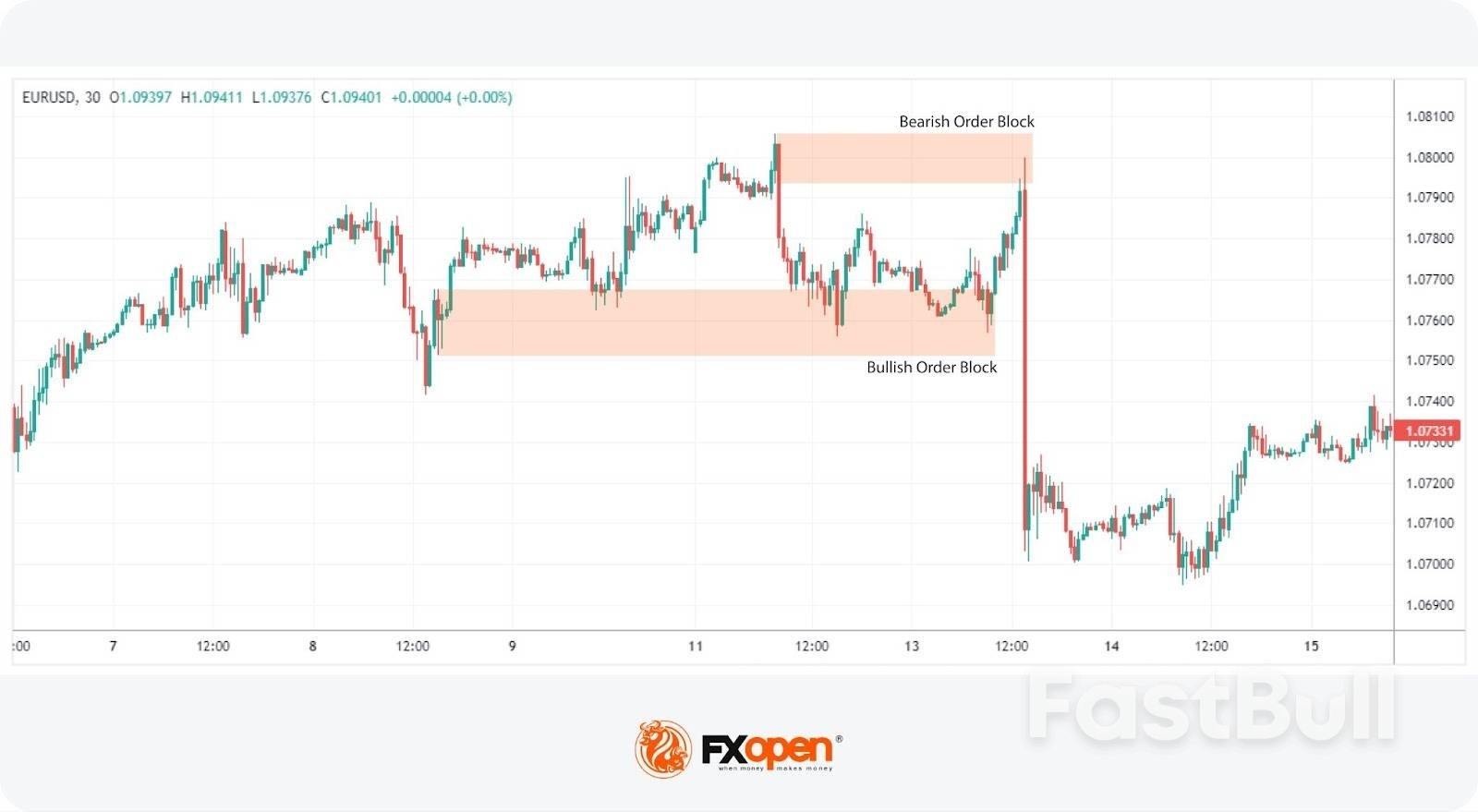
          A bullish order block, or demand zone, is identified during a downward price movement and is the area where the last bearish candle before a substantial upward price movement occurs. This indicates that institutional buyers are stepping in, absorbing sell orders, and preparing to push the price higher. Traders eyeing bullish order blocks anticipate these areas as potential points of interest where price may find support, thus offering a strategic entry point for long positions.

          Conversely, a bearish order block, or supply zone, is found during an upward price movement and is characterised by the area where the last bullish candle appears before a significant downward price shift. This suggests that institutional sellers are overwhelming buyers, likely leading to a decrease in price. Bearish order blocks signal potential resistance zones, presenting opportunities to enter short positions in anticipation of a downward price trajectory.

          In both instances, they typically create an impulse move that breaks a nearby high or low to continue or start a given trend. When the market returns to these areas, they often prompt a reversal of the short-term trend and a continuation of a higher timeframe trend.

          Order blocks in forex are particularly telling due to the high market liquidity and the sheer volume of trades. Recognising these areas allows traders to align their strategies with the likely actions of major institutional players, potentially leading to more informed and effective trade decisions.

          Why Order Blocks Work

          These blocks work because they tap into the underlying dynamics of supply and demand, reflecting the actions of large institutional players whose trades can significantly impact price direction. They’re essentially snapshots of where significant buying or selling pressure has accumulated, offering clues to future price movements.

          When a market approaches a supply or demand zone, the likelihood of a reaction—whether it's a continuation or reversal of the trend—increases because these levels are where institutional traders have previously shown interest, either by initiating large positions or placing take-profit orders.

          Finding and Using Order Blocks

          Now, let’s take a closer look at how to identify and use order blocks for trading.

          Identifying Order Blocks

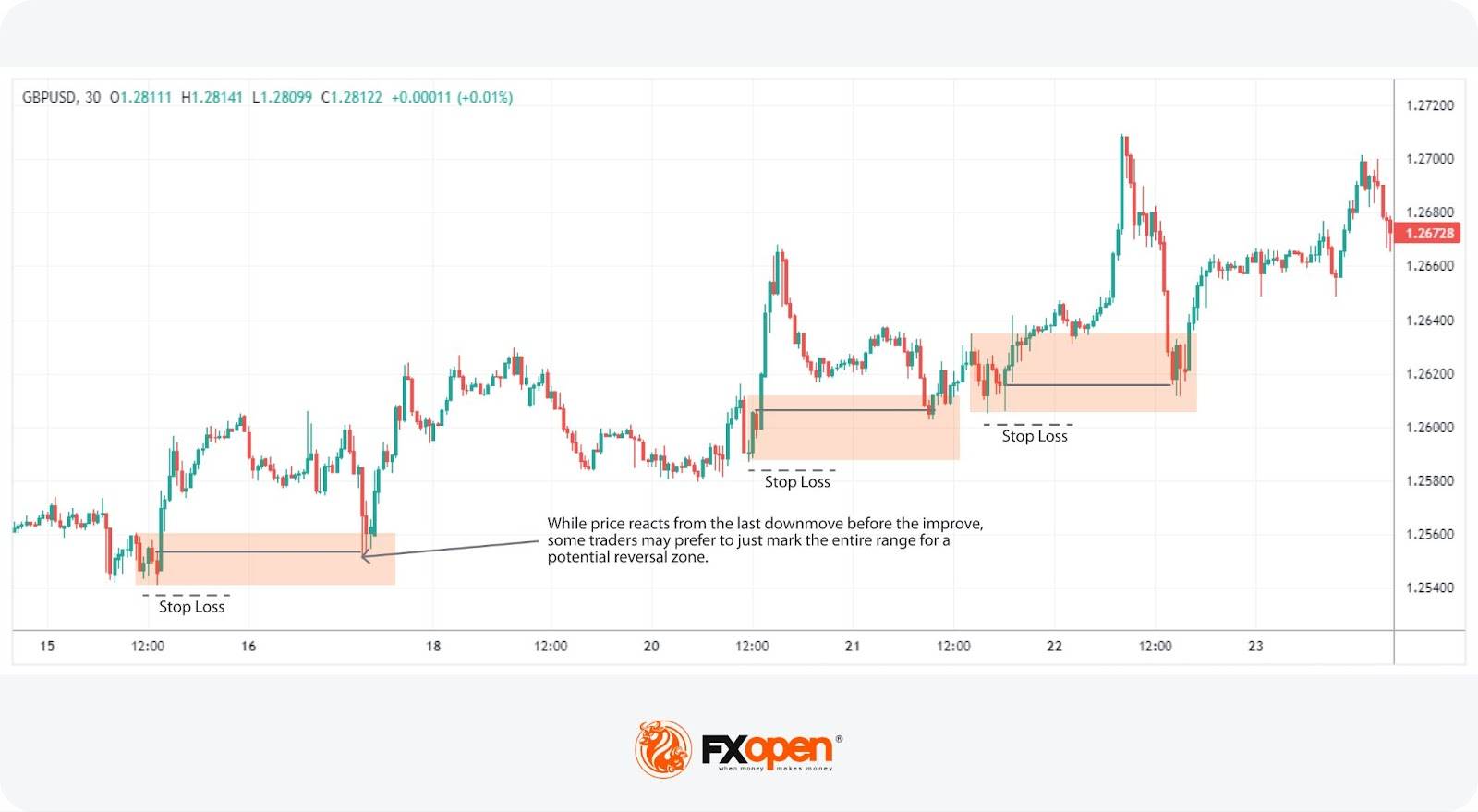
          Traders often start by analysing historical price charts to locate order blocks. Typically, these are found where there was significant trading activity, often in the form of a consolidation, followed by a strong directional price move.A bullish order block is where the last bearish candle in a downtrend occurred before a sharp rise. Conversely, in a bearish order block, traders identify the last bullish candle before a significant fall.Note that order block candles visible on a higher timeframe tend to be more probable. Similarly, a small high-low range on a lower timeframe would appear as a single candlestick on a higher timeframe, meaning that the entire range can be plotted as a supply or demand zone.

          Incorporating Order Blocks into a Trading Strategy

          Incorporating order blocks into a strategy involves observing how the price behaves as it approaches these marked areas. Traders typically watch for price reactions near these zones, using them as indicators of potential entry or exit points. For instance, a price bounce off a demand zone may signal a good opportunity to go long, anticipating upward momentum as institutional interest possibly resurfaces.

          Traders might also combine these areas with indicators and other analysis tools, such as moving averages or Fibonacci retracements, to validate their signals. This multi-faceted approach helps in fine-tuning entry and exit strategies, potentially increasing the likelihood of effective trades.

          Risk Management

          As with any strategy, it's crucial to practise sound risk management when trading with order blocks. Traders often set stop-losses just outside the zone with the assumption that institutional players won’t let the market trade beyond this point. However, when these zones fail, they become known as breaker blocks.

          Understanding Breaker Blocks in Forex

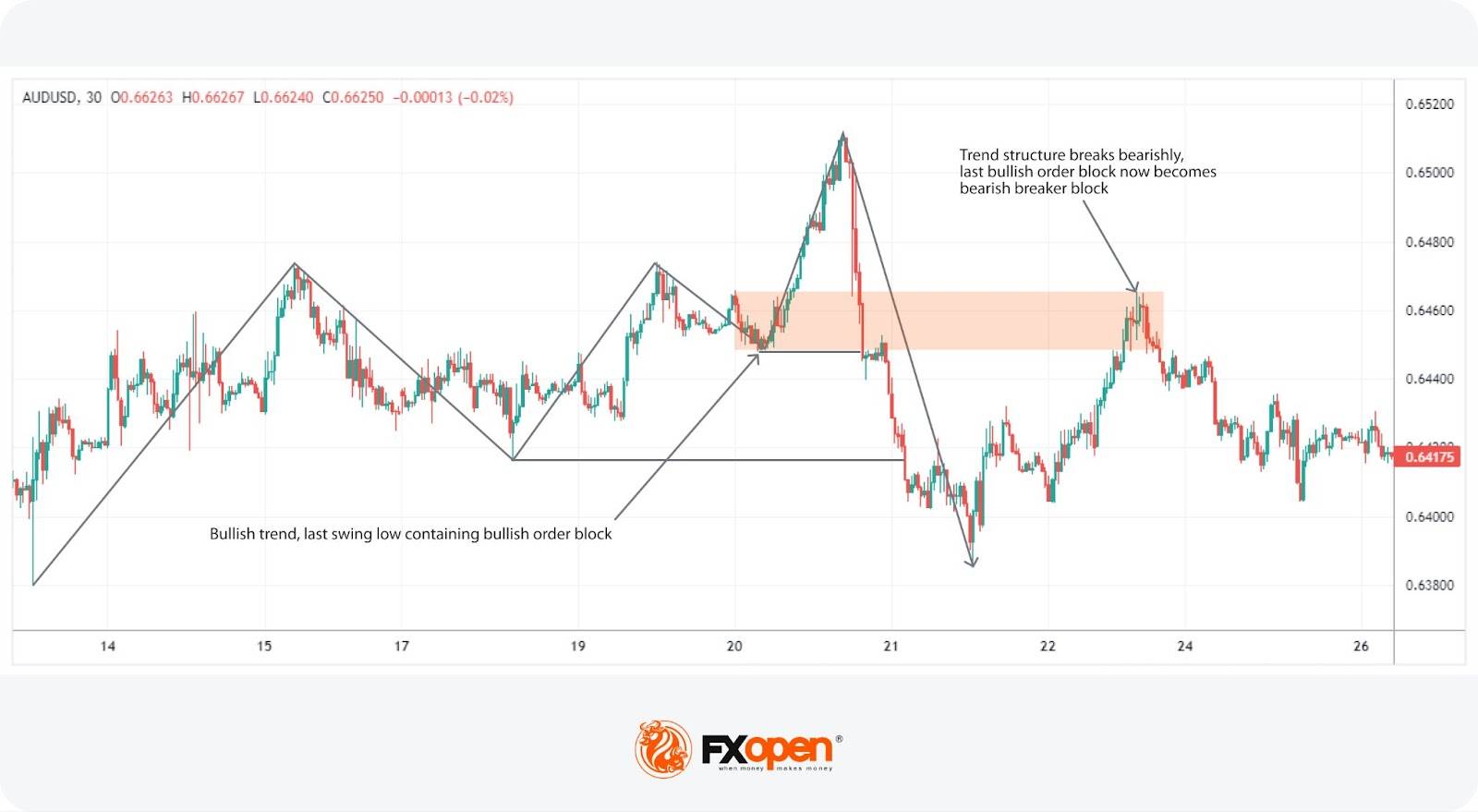
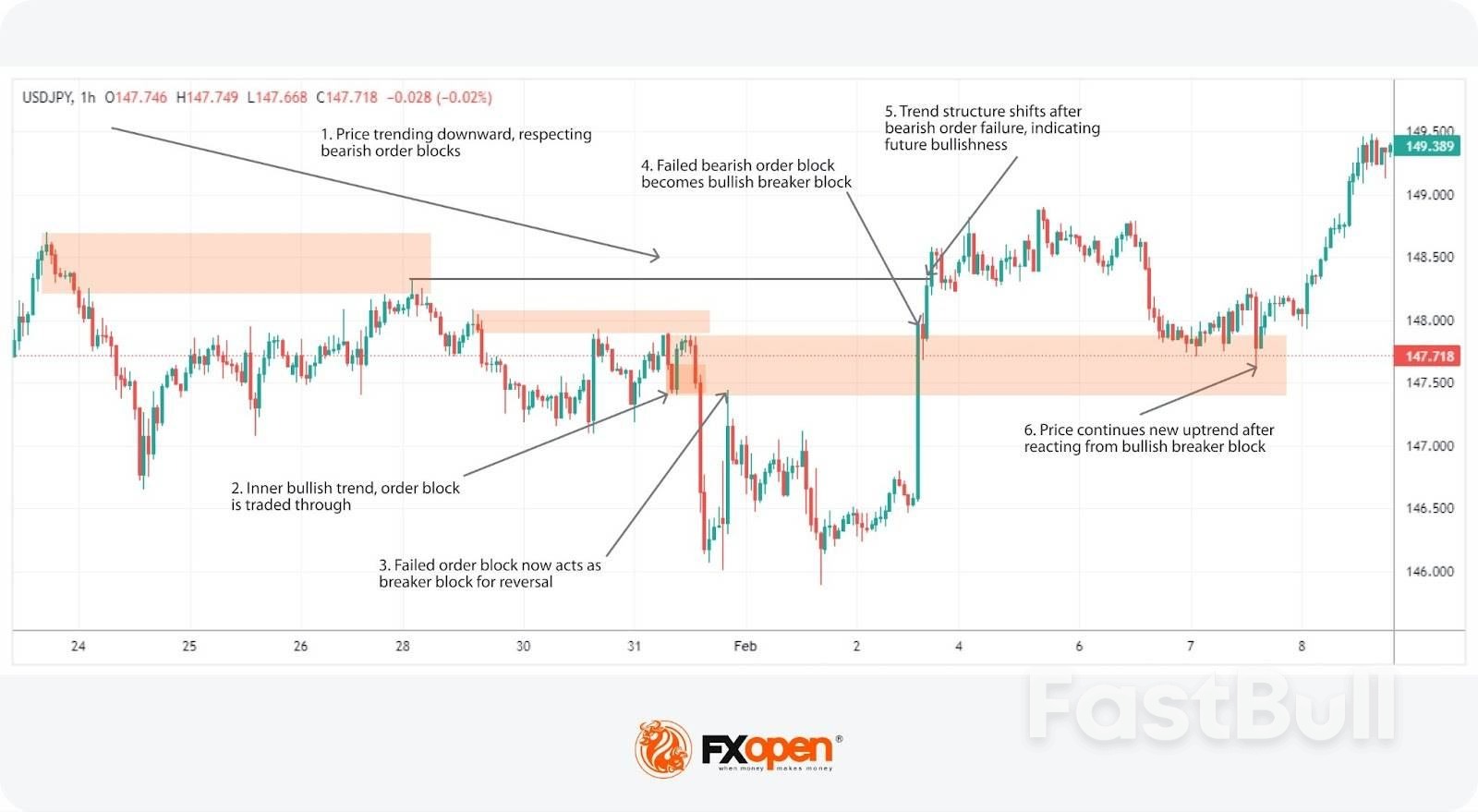
          In the realm of forex, understanding the concept of breaker blocks can be crucial when it comes to identifying potential reversals and continuations in trends. Breaker blocks emerge from the failure of order blocks. When these supply or demand zones do not hold, and the market structure shifts, breaker blocks are formed, marking significant levels to watch.A bearish breaker block occurs after a bullish order block fails. This typically happens when there's an upward trend, and a certain level that was expected to support the market's rise instead gives way, leading to a sharp decline. This decline indicates that sellers have overcome the buyers, absorbing liquidity and shifting the sentiment from bullish to bearish.

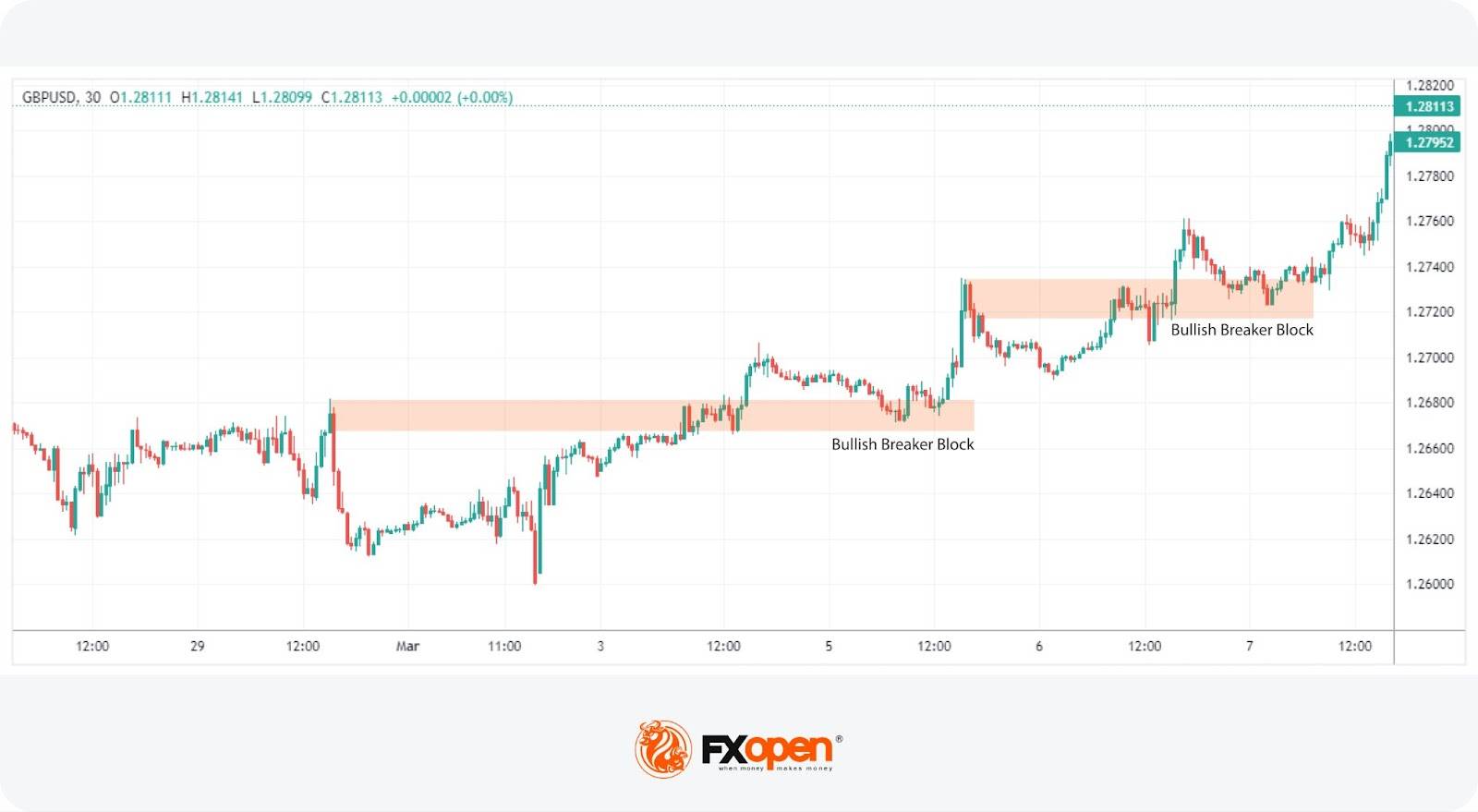
          Conversely, a bullish breaker block is formed from the failure of a bearish order block. In a downtrend, when a level that was expected to act as resistance is breached, and the price shoots up, it signifies that buyers have taken control, overpowering the sellers.In both scenarios, price often retraces to the failed zone before continuing the newly formed trend.

          Finding and Using Breaker Blocks

          To harness the power of breakers, traders adeptly identify these pivotal points and integrate them into a coherent strategy.

          Identifying Breaker Blocks

          The first step involves scrutinising price charts for significant reversals that follow the failure of established supply or demand zones. A bearish breaker block, for instance, would be marked by a sudden decline after a bullish trend fails to sustain, trading through a bullish order block, and vice versa.The most notable breaker blocks are often the order blocks that stand out visually or would need to stay intact if a given trend is to continue. When they fail, they can then be plotted as a valid horizontal level to look for a retracement before a potential move away.

          Strategic Application

          Once identified, these zones can be strategically employed as markers for potential trade entries. For a bearish breaker, traders might consider short positions, anticipating further declines as price retests and rejects the previously failed support level. Conversely, a bullish breaker suggests a potential long position as the market may continue to rise, having breached a significant resistance.

          Combining Order Blocks and Breakers

          Combining these two ideas offers a nuanced approach to forex, especially when integrating the concept of liquidity voids or fair value gaps. These gaps occur when the price makes an impulsive move away from an order block without retracing, potentially marking areas for future reversals. This strategy shines in trending assets, where the directional momentum aligns with the formation of these critical zones, offering potential entry and exit signals.

          Trending and Ranging Markets

          In a trending market, order blocks that prompt sharp price movements away can be key areas to mark for a trend reversal. These marked zones can indicate where significant buying or selling pressure originated, offering potential entry points. However, it's essential to recognise that in a ranging or consolidating market, they might not hold as expected.

          The Role of Breaker Blocks

          When institutional interests shift, leading to the failure of an order block to act as support or resistance, this is where breaker blocks come into play, becoming a critical level to watch. Particularly after a sudden move, if a supply or demand zone ripe for reversal is now too far away to see an immediate retracement, the breaker serves as a strategic entry point ahead of a trend continuation.

          Setting Market Direction with Breaker Blocks

          Breaker blocks not only signal potential entry points but also help set market direction. The breach of an order block by price action indicates a strong likelihood that the asset will continue in that direction, underscoring a shift in institutional interest. When price trades through an order block, showing no signs of halting, it suggests a path for the trend, offering traders insight into the prevailing momentum.

          Limitations of Order and Breaker Blocks

          While order and breaker blocks provide insightful strategies in navigating forex markets, they come with limitations that traders should be aware of:

          ● Market Volatility: High volatility can disrupt the reliability of these zones, leading to false signals.
          ● Institutional Disguise: Large market players may mask their activities, making it challenging to identify genuine order or breaker blocks.
          ● Lagging Indicators: These areas are based on past price behaviour, which might not always be effective when analysing future movements.
          ● Overreliance: Solely depending on these strategies without incorporating other analyses can lead to missed opportunities or misinterpretations.

          FAQs

          What Is an Order Block in Trading?

          An order block refers to a price area on the chart where significant buy or sell orders were previously placed by large institutional traders. These zones are key to identifying potential support or resistance levels, providing insights into future price movements.

          What Is a Breaker Block in Trading?

          A breaker block is a concept that emerges when an order block fails, leading to a change in market structure. It signifies a pivotal point where the market shifts direction, offering traders opportunities to enter trades based on anticipated trend continuation.

          How to Identify Order Blocks?

          Order blocks can be identified by analysing price charts for areas where there was significant trading activity, followed by a strong directional movement. Traders look for the last bullish candle before a downturn for a bearish block, or the last bearish candle before an uptrend for a bullish block, indicating potential zones of interest for traders.

          Source: FXOpen

          To stay updated on all economic events of today, please check out our Economic calendar
          Risk Warnings and Disclaimers
          You understand and acknowledge that there is a high degree of risk involved in trading. Following any strategies or investment methods may lead to potential losses. The content on the site is provided by our contributors and analysts for information purposes only. You are solely responsible for determining whether any trading assets, securities, strategy, or any other product is suitable for investing based on your own investment objectives and financial situation.
          Add to Favorites
          Share

          US Government Shutdown Would Halt September Jobs Report, Other Data

          James Whitman

          Economic

          Political

          ● US funding lapse to halt Labor, Commerce departments' data activities
          ● Prolonged shutdown could impact third-quarter US GDP estimate
          ● September jobs data, August trade and construction data among first shutdown casualties
          ● Social Security Cost of Living Adjustment may be delayed if CPI report is postponed

          The U.S. Labor and Commerce departments said on Monday that their statistics agencies would halt economic data releases in the event of a partial government shutdown, including closely watched employment data for September, construction spending and possibly international trade data for August.

          The employment report, crucial for decision-making by officials at the Federal Reserve, businesses and households, is scheduled for Friday. Government funding will expire at midnight on Tuesday unless Republicans and Democrats agree to a last-minute temporary spending deal.

          The Labor Department identified the Bureau of Labor Statistics as among the key agencies whose activities would cease during a lapse in funding. President Donald Trump was due to meet with Republican and Democratic leaders on Monday.

          While it would suspend some activities, the statistical agency said it would publish the August Metropolitan Area Employment and Unemployment report due on Wednesday.

          Similarly, the Commerce Department said monthly economic indicators from the U.S. Census Bureau would not be available in the event of a government shutdown. The department's Bureau of Economic Analysis would cease most services.

          The Census Bureau is scheduled to release U.S. construction spending data for August on Wednesday and manufacturers' shipments, inventories and orders for August on Thursday.

          The two agencies are scheduled to release data on August international goods and services trade on October 7. A prolonged shutdown could impact the Bureau of Economic Analysis' initial estimate of third-quarter gross domestic product due on October 30.

          BLS also said a prolonged shutdown could delay the release of other data.

          "Once funding is restored, BLS will resume normal operations and notify the public of any changes to the news release schedule on the BLS release calendar," the agency said in a statement.

          It was not clear whether the weekly jobless claims report would continue to be published. The data is collected by states, which run the unemployment insurance programs, but the BLS does the seasonal adjustment.

          CONCERNS ARE RISING OVER DATA QUALITY

          Possible delays publishing the employment report would come at a time when concerns are growing over the quality of government-produced economic data, long viewed as the gold standard.

          The BLS warned "a reduction in quality of data collected might impact the quality of future estimates produced."

          The BLS has suffered years of underfunding under both Republican and Democratic administrations. That situation has been worsened by mass firings, voluntary resignations, early retirements and hiring freezes, which are part of an unprecedented campaign by the Trump administration to drastically reduce the size of government.

          Response rates for the employment report have declined and the agency has suspended data collection for portions of the consumer price index in some areas across the country.

          Should September's CPI report be delayed, that could leave the Social Security Administration unable to make its annual Cost of Living Adjustment announcement, which retirees depend on to plan their budgets.

          Source: Reuters

          To stay updated on all economic events of today, please check out our Economic calendar
          Risk Warnings and Disclaimers
          You understand and acknowledge that there is a high degree of risk involved in trading. Following any strategies or investment methods may lead to potential losses. The content on the site is provided by our contributors and analysts for information purposes only. You are solely responsible for determining whether any trading assets, securities, strategy, or any other product is suitable for investing based on your own investment objectives and financial situation.
          Add to Favorites
          Share

          White House Releases Trump Plan To End Israel War With Hamas In Gaza

          James Whitman

          Political

          Palestinian-Israeli conflict

          The White House on Monday released a 20-point plan by President Donald Trump to end the war in Gaza between Israel and Hamas.

          The release came minutes before Trump began speaking at the White House about the proposal, which has not been agreed to by Hamas.

          Trump was joined by Israeli Prime Minister Benjamin Netanyahu.

          Trump said that Israel, and other nations have accepted the outline he detailed.

          "If accepted by Hamas, this proposal calls for the release of all remaining hostages, immediately, but in no case more than 72 hours," Trump said.

          "I hope that we're going to have a deal for peace, and if Hamas rejects the deal, which is always possible, they're the only one left," Trump said.

          "Everyone else has accepted it. But I have a feeling that we're going to have a positive answer. But if not, as you know Bibi you'd have our full backing to do what you would have to do."

          Source: CNBC

          Risk Warnings and Disclaimers
          You understand and acknowledge that there is a high degree of risk involved in trading. Following any strategies or investment methods may lead to potential losses. The content on the site is provided by our contributors and analysts for information purposes only. You are solely responsible for determining whether any trading assets, securities, strategy, or any other product is suitable for investing based on your own investment objectives and financial situation.
          Add to Favorites
          Share

          What a Government Stoppage Could Look Like

          Manuel

          Economic

          Political

          A meeting in the Oval Office doesn't appear to have lessened the chances of a partial government shutdown with both sides leaving the gathering saying no deal is in the immediate offing.
          "We have very large differences," said Senate Democratic Leader Chuck Schumer after he left the Oval Office.
          Vice President JD Vance went further saying in a separate appearance: "I think we're headed to a shutdown." Republican Senate Leader John Thune added of the Democratic approach: "This is purely and simply hostage taking."
          The lack of progress boosts the odds of the first government shutdown since 2019 that could begin on Wednesday morning at 12:01 a.m. ET without a last-minute deal.
          Such a stalemate could produce unpredictable economic impacts, some of which could be felt quickly and others that could grow with each passing day.
          Some effects are already in evidence in currency markets, but much of the market focus for now is on the government’s economic data that is set to cease being published and gathered if a stoppage goes forward.
          That comes as both investors and the central bankers at the Federal Reserve are looking for all the information they can get about both the slowing labor market and persistent inflation ahead of another policy meeting in October.
          "It's important to understand the U.S. economy is already on a knife's edge—the labor market has softened and inflation has risen," noted Michael Linden of the Washington Center for Equitable Growth this week. "Adding a government shutdown to the mix certainly won't help."
          And a new and unpredictable feature around the shutdown is a Trump administration promise to consider mass firings if there is no deal, but with details scarce so far on how deep any permanent cuts could go.
          The country could also wrestle with a host of familiar effects seen in previous shutdowns, from Transportation Security Administration (TSA) agents being forced to work without pay to national parks closed to visitors to no one being available at the IRS to answer the phones for tax questions.
          Deliberations remain ongoing — and last-minute votes in the Senate are tentatively scheduled — but with expectations low that they will do much more than repeat the failed efforts seen earlier this month short of a last-minute sea change in the political dynamic.
          "They are going to have to do some things because their ideas are not very good ones, they are very bad for the country," Trump said Monday afternoon of Democrats.
          Here is a closer look at three areas where a shutdown could be noticed quickly:

          Delayed (and then potentially less fulsome) economic data

          A contingency plan released Monday by the Department of Labor laid out how its Bureau of Labor Statistics (BLS) would "completely cease operations" during a stoppage.
          The agency would temporarily go from a workforce of 2,055 to just 1 full-time employee.
          The agency's fulsome calendar of economic releases would halt to a stop — starting with Friday's jobs report. The already gathered data would then eventually be released but might wait for the duration of a shutdown.
          And the longer a stoppage goes on, the more future data could be impacted with "all active data collection activities" ceasing — per the BLS plan.
          That raises the prospect that October's economic data — from the Consumer Price Index to newer jobs data — would not only be delayed but would be less complete in a way that could be felt even after a shutdown has ended.
          Another key source of government economic data — such as quarterly GDP numbers and the Personal Consumption Expenditures (PCE) price index — is the Bureau of Economic Analysis operated by the Department of Commerce. As of Monday afternoon, that agency's contingency plan had not yet been published.
          The length of any stoppage may determine the effects on the data and the larger economy.
          Experts have said that significant economic effects are quickly reversed during at least a limited shutdown — which often sees government spending cease but then be quickly made up when the government reopens.

          Fear of a new layoffs among the government's workforce

          Perhaps the most novel feature of a potential coming shutdown surrounds a plan to use the stoppage to not just furlough government workers but instead remove at least some of them from their positions permanently.
          A directive circulated last week from President Trump's Office of Management and Budget (OMB) directed agencies "to use this opportunity to consider Reduction in Force (RIF) notices," adding that the possible permanent cuts would be in areas "not consistent with the president's priorities."
          The idea is for these agencies to eventually reopen and retain "the minimal number of employees necessary to carry out statutory functions."
          Such a move would represent a sharp departure from past shutdown procedures — where a wide swath of government workers were furloughed temporarily but with the promise of not just a return to work but also back pay after the shutdown ends.
          It remains to be seen how aggressively various agencies will take up the directive, but the president himself told NBC News over the weekend "we are going to cut a lot of the people that ... we're able to cut on a permanent basis" if the government shuts down.

          Uncertainty at airports and other scattered shutdown effects

          A shutdown will leave government employees, including military personnel, temporarily without a paycheck but with many being asked to continue reporting to work.
          A perennial public-facing example of this dynamic is at airports with both air traffic controllers and TSA agents expected to continue working even in a shutdown.
          Past shutdowns have seen higher-than-normal unscheduled absences — especially among the lower paid TSA workforce — leading to some disruptions.
          In a recent Yahoo Finance Live appearance, Breeze Airways founder and CEO David Neeleman said that air travel will be "fine" during a shutdown, adding "good thing it's not a really peak travel time of year."
          Other prominent closures in past shutdowns have been national parks with everything from scenic natural areas to major tourist attractions shuttered.
          The Internal Revenue Service is also again set to close operations such as call centers during a shutdown. And regulators overseeing financial markets will be cut back.
          The most recently available plan from the Securities and Exchange Commission (SEC) lays out a plan to only keep on hand an "extremely limited number of staff members available to respond to emergency situations."
          Getting a passport will still be possible but historically has been more difficult with many government buildings closed.
          After Monday's Oval Office meeting, House Speaker Mike Johnson said "this is serious business" and ticked through the list of agencies that would face challenges from FEMA to food assistance programs and added "all that which is funded by the government would stop."
          Meanwhile, many services would remain open.
          Medicare benefits and Social Security checks will continue going out. And a number of entities — including the Federal Reserve — are expected to see minimal effects as they aren't primarily funded by Congress's annual appropriations process.
          The nation's public schools — those are funded at the local level — will also remain open, although some federally funded programs like Head Start have historically shuttered during stoppages.
          Finally, the mail will still be delivered, as the US Postal Service is largely self-funded through things like the sale of stamps.

          Source: Yahoo Finance

          To stay updated on all economic events of today, please check out our Economic calendar
          Risk Warnings and Disclaimers
          You understand and acknowledge that there is a high degree of risk involved in trading. Following any strategies or investment methods may lead to potential losses. The content on the site is provided by our contributors and analysts for information purposes only. You are solely responsible for determining whether any trading assets, securities, strategy, or any other product is suitable for investing based on your own investment objectives and financial situation.
          Add to Favorites
          Share
          FastBull
          Copyright © 2025 FastBull Ltd

          728 RM B 7/F GEE LOK IND BLDG NO 34 HUNG TO RD KWUN TONG KLN HONG KONG

          TelegramInstagramTwitterfacebooklinkedin
          App Store Google Play Google Play
          Products
          Charts

          Chats

          Q&A with Experts
          Screeners
          Economic Calendar
          Data
          Tools
          Membership
          Features
          Function
          Markets
          Copy Trading
          Latest Signals
          Contests
          News
          Analysis
          24/7
          Columns
          Education
          Company
          Careers
          About Us
          Contact Us
          Advertising
          Help Center
          Feedback
          User Agreement
          Privacy Policy
          Business

          White Label

          Data API

          Web Plug-ins

          Poster Maker

          Affiliate Program

          Risk Disclosure

          The risk of loss in trading financial instruments such as stocks, FX, commodities, futures, bonds, ETFs and crypto can be substantial. You may sustain a total loss of the funds that you deposit with your broker. Therefore, you should carefully consider whether such trading is suitable for you in light of your circumstances and financial resources.

          No decision to invest should be made without thoroughly conducting due diligence by yourself or consulting with your financial advisors. Our web content might not suit you since we don't know your financial conditions and investment needs. Our financial information might have latency or contain inaccuracy, so you should be fully responsible for any of your trading and investment decisions. The company will not be responsible for your capital loss.

          Without getting permission from the website, you are not allowed to copy the website's graphics, texts, or trademarks. Intellectual property rights in the content or data incorporated into this website belong to its providers and exchange merchants.

          Not Logged In

          Log in to access more features

          FastBull Membership

          Not yet

          Purchase

          Become a signal provider
          Help Center
          Customer Service
          Dark Mode
          Price Up/Down Colors

          Log In

          Sign Up

          Position
          Layout
          Fullscreen
          Default to Chart
          The chart page opens by default when you visit fastbull.com