• Trade
  • Markets
  • Copy
  • Contests
  • News
  • 24/7
  • Calendar
  • Q&A
  • Chats
Trending
Screeners
SYMBOL
LAST
BID
ASK
HIGH
LOW
NET CHG.
%CHG.
SPREAD
SPX
S&P 500 Index
6827.42
6827.42
6827.42
6899.86
6801.80
-73.58
-1.07%
--
DJI
Dow Jones Industrial Average
48458.04
48458.04
48458.04
48886.86
48334.10
-245.98
-0.51%
--
IXIC
NASDAQ Composite Index
23195.16
23195.16
23195.16
23554.89
23094.51
-398.69
-1.69%
--
USDX
US Dollar Index
97.950
98.030
97.950
98.500
97.950
-0.370
-0.38%
--
EURUSD
Euro / US Dollar
1.17394
1.17409
1.17394
1.17496
1.17192
+0.00011
+ 0.01%
--
GBPUSD
Pound Sterling / US Dollar
1.33707
1.33732
1.33707
1.33997
1.33419
-0.00148
-0.11%
--
XAUUSD
Gold / US Dollar
4299.39
4299.39
4299.39
4353.41
4257.10
+20.10
+ 0.47%
--
WTI
Light Sweet Crude Oil
57.233
57.485
57.233
58.011
56.969
-0.408
-0.71%
--

Community Accounts

Signal Accounts
--
Profit Accounts
--
Loss Accounts
--
View More

Become a signal provider

Sell trading signals to earn additional income

View More

Guide to Copy Trading

Get started with ease and confidence

View More

Signal Accounts for Members

All Signal Accounts

Best Return
  • Best Return
  • Best P/L
  • Best MDD
Past 1W
  • Past 1W
  • Past 1M
  • Past 1Y

All Contests

  • All
  • Trump Updates
  • Recommend
  • Stocks
  • Cryptocurrencies
  • Central Banks
  • Featured News
Top News Only
Share

Pentagon Says Two USA Army Soldiers And One Civilian USA Interpreter Were Killed, And Three Were Wounded In Syria

Share

Israel Says It Kills Senior Hamas Commander Raed Saed In Gaza

Share

Ukraine's Navy Says Russian Drone Attack Hit Civilian Turkish Vessel Carrying Sunflower Oil To Egypt On Saturday

Share

Israeli Military Says It Put Planned Strike On South Lebanon Site On Hold After Lebanese Army Requested Access

Share

Norwegian Nobel Committee: Calls On The Belarusian Authorities To Release All Political Prisoners

Share

Norwegian Nobel Committee: His Freedom Is A Deeply Welcome And Long-Awaited Moment

Share

Ukraine Says It Received 114 Prisoners From Belarus

Share

USA Embassy In Lithuania: Maria Kalesnikava Is Not Going To Vilnius

Share

USA Embassy In Lithuania: Other Prisoners Are Being Sent From Belarus To Ukraine

Share

Ukraine President Zelenskiy: Five Ukrainians Released By Belarus In US-Brokered Deal

Share

USA Vilnius Embassy: USA Stands Ready For "Additional Engagement With Belarus That Advances USA Interests"

Share

USA Vilnius Embassy: Belarus, USA, Other Citizens Among The Prisoners Released Into Lithuania

Share

USA Vilnius Embassy: USA Will Continue Diplomatic Efforts To Free The Remaining Political Prisoners In Belarus

Share

USA Vilnius Embassy: Belarus Releases 123 Prisoners Following Meeting Of President Trump's Envoy Coale And Belarus President Lukashenko

Share

USA Vilnius Embassy: Masatoshi Nakanishi, Aliaksandr Syrytsa Are Among The Prisoners Released By Belarus

Share

USA Vilnius Embassy: Maria Kalesnikava And Viktor Babaryka Are Among The Prisoners Released By Belarus

Share

USA Vilnius Embassy: Nobel Peace Prize Laureate Ales Bialiatski Is Among The Prisoners Released By Belarus

Share

Belarusian Presidential Administration Telegram Channel: Lukashenko Has Pardoned 123 Prisoners As Part Of Deal With US

Share

Two Local Syrian Officials: Joint US-Syrian Military Patrol In Central Syria Came Under Fire From Unknown Assailants

Share

Israeli Military Says It Targeted 'Key Hamas Terrorist' In Gaza City

TIME
ACT
FCST
PREV
U.K. Trade Balance Non-EU (SA) (Oct)

A:--

F: --

P: --

U.K. Trade Balance (Oct)

A:--

F: --

P: --

U.K. Services Index MoM

A:--

F: --

P: --

U.K. Construction Output MoM (SA) (Oct)

A:--

F: --

P: --

U.K. Industrial Output YoY (Oct)

A:--

F: --

P: --

U.K. Trade Balance (SA) (Oct)

A:--

F: --

P: --

U.K. Trade Balance EU (SA) (Oct)

A:--

F: --

P: --

U.K. Manufacturing Output YoY (Oct)

A:--

F: --

P: --

U.K. GDP MoM (Oct)

A:--

F: --

P: --

U.K. GDP YoY (SA) (Oct)

A:--

F: --

P: --

U.K. Industrial Output MoM (Oct)

A:--

F: --

P: --

U.K. Construction Output YoY (Oct)

A:--

F: --

P: --

France HICP Final MoM (Nov)

A:--

F: --

P: --

China, Mainland Outstanding Loans Growth YoY (Nov)

A:--

F: --

P: --

China, Mainland M2 Money Supply YoY (Nov)

A:--

F: --

P: --

China, Mainland M0 Money Supply YoY (Nov)

A:--

F: --

P: --

China, Mainland M1 Money Supply YoY (Nov)

A:--

F: --

P: --

India CPI YoY (Nov)

A:--

F: --

P: --

India Deposit Gowth YoY

A:--

F: --

P: --

Brazil Services Growth YoY (Oct)

A:--

F: --

P: --

Mexico Industrial Output YoY (Oct)

A:--

F: --

P: --

Russia Trade Balance (Oct)

A:--

F: --

P: --

Philadelphia Fed President Henry Paulson delivers a speech
Canada Building Permits MoM (SA) (Oct)

A:--

F: --

P: --

Canada Wholesale Sales YoY (Oct)

A:--

F: --

P: --

Canada Wholesale Inventory MoM (Oct)

A:--

F: --

P: --

Canada Wholesale Inventory YoY (Oct)

A:--

F: --

P: --

Canada Wholesale Sales MoM (SA) (Oct)

A:--

F: --

P: --

Germany Current Account (Not SA) (Oct)

A:--

F: --

P: --

U.S. Weekly Total Rig Count

A:--

F: --

P: --

U.S. Weekly Total Oil Rig Count

A:--

F: --

P: --

Japan Tankan Large Non-Manufacturing Diffusion Index (Q4)

--

F: --

P: --

Japan Tankan Small Manufacturing Outlook Index (Q4)

--

F: --

P: --

Japan Tankan Large Non-Manufacturing Outlook Index (Q4)

--

F: --

P: --

Japan Tankan Large Manufacturing Outlook Index (Q4)

--

F: --

P: --

Japan Tankan Small Manufacturing Diffusion Index (Q4)

--

F: --

P: --

Japan Tankan Large Manufacturing Diffusion Index (Q4)

--

F: --

P: --

Japan Tankan Large-Enterprise Capital Expenditure YoY (Q4)

--

F: --

P: --

U.K. Rightmove House Price Index YoY (Dec)

--

F: --

P: --

China, Mainland Industrial Output YoY (YTD) (Nov)

--

F: --

P: --

China, Mainland Urban Area Unemployment Rate (Nov)

--

F: --

P: --

Saudi Arabia CPI YoY (Nov)

--

F: --

P: --

Euro Zone Industrial Output YoY (Oct)

--

F: --

P: --

Euro Zone Industrial Output MoM (Oct)

--

F: --

P: --

Canada Existing Home Sales MoM (Nov)

--

F: --

P: --

Euro Zone Total Reserve Assets (Nov)

--

F: --

P: --

U.K. Inflation Rate Expectations

--

F: --

P: --

Canada National Economic Confidence Index

--

F: --

P: --

Canada New Housing Starts (Nov)

--

F: --

P: --

U.S. NY Fed Manufacturing Employment Index (Dec)

--

F: --

P: --

U.S. NY Fed Manufacturing Index (Dec)

--

F: --

P: --

Canada Core CPI YoY (Nov)

--

F: --

P: --

Canada Manufacturing Unfilled Orders MoM (Oct)

--

F: --

P: --

Canada Manufacturing New Orders MoM (Oct)

--

F: --

P: --

Canada Core CPI MoM (Nov)

--

F: --

P: --

Canada Manufacturing Inventory MoM (Oct)

--

F: --

P: --

Canada CPI YoY (Nov)

--

F: --

P: --

Canada CPI MoM (Nov)

--

F: --

P: --

Canada CPI YoY (SA) (Nov)

--

F: --

P: --

Canada Core CPI MoM (SA) (Nov)

--

F: --

P: --

Q&A with Experts
    • All
    • Chatrooms
    • Groups
    • Friends
    Connecting
    .
    .
    .
    Type here...
    Add Symbol or Code

      No matching data

      All
      Trump Updates
      Recommend
      Stocks
      Cryptocurrencies
      Central Banks
      Featured News
      • All
      • Russia-Ukraine Conflict
      • Middle East Flashpoint
      • All
      • Russia-Ukraine Conflict
      • Middle East Flashpoint
      Search
      Products

      Charts Free Forever

      Chats Q&A with Experts
      Screeners Economic Calendar Data Tools
      Membership Features
      Data Warehouse Market Trends Institutional Data Policy Rates Macro

      Market Trends

      Market Sentiment Order Book Forex Correlations

      Top Indicators

      Charts Free Forever
      Markets

      News

      News Analysis 24/7 Columns Education
      From Institutions From Analysts
      Topics Columnists

      Latest Views

      Latest Views

      Trending Topics

      Top Columnists

      Latest Update

      Signals

      Copy Rankings Latest Signals Become a signal provider AI Rating
      Contests
      Brokers

      Overview Brokers Assessment Rankings Regulators News Claims
      Broker listing Forex Brokers Comparison Tool Live Spread Comparison Scam
      Q&A Complaint Scam Alert Videos Tips to Detect Scam
      More

      Business
      Events
      Careers About Us Advertising Help Center

      White Label

      Data API

      Web Plug-ins

      Affiliate Program

      Awards Institution Evaluation IB Seminar Salon Event Exhibition
      Vietnam Thailand Singapore Dubai
      Fans Party Investment Sharing Session
      FastBull Summit BrokersView Expo
      Recent Searches
        Top Searches
          Markets
          News
          Analysis
          User
          24/7
          Economic Calendar
          Education
          Data
          • Names
          • Latest
          • Prev

          View All

          No data

          Scan to Download

          Faster Charts, Chat Faster!

          Download App
          English
          • English
          • Español
          • العربية
          • Bahasa Indonesia
          • Bahasa Melayu
          • Tiếng Việt
          • ภาษาไทย
          • Français
          • Italiano
          • Türkçe
          • Русский язык
          • 简中
          • 繁中
          Open Account
          Search
          Products
          Charts Free Forever
          Markets
          News
          Signals

          Copy Rankings Latest Signals Become a signal provider AI Rating
          Contests
          Brokers

          Overview Brokers Assessment Rankings Regulators News Claims
          Broker listing Forex Brokers Comparison Tool Live Spread Comparison Scam
          Q&A Complaint Scam Alert Videos Tips to Detect Scam
          More

          Business
          Events
          Careers About Us Advertising Help Center

          White Label

          Data API

          Web Plug-ins

          Affiliate Program

          Awards Institution Evaluation IB Seminar Salon Event Exhibition
          Vietnam Thailand Singapore Dubai
          Fans Party Investment Sharing Session
          FastBull Summit BrokersView Expo

          EURUSD: What's next for the fiber?

          Olatunji Tolu

          Traders' Opinions

          Summary:

          From the beginning of this year, the trend has been down without a doubt and the best positions have been shorts, how long will this weakness last for?

          The ECB finally hiked rate by 50 basis points last week and this is in response to the rising inflation. Gas and food prices are up amongst other things and this is a big cause for concern.
          Ever since the fiber broke out of the 1.05 support from the monthly time frame and tested parity, we have been asking ourselves what next for the Euro versus the USD?
          We can see some buying pressure after parity but the bears are still very much in control and 1.05 should now act as a resistance flip zone with a long-term view of 0.9550 demand.
          EURUSD: What's next for the fiber?_1
          If you're looking forward to being a seller in order to follow the prevailing trend for this year then 1.0350 would be a good area of untested resistance from the weekly time frame for fresh shorts to come into the market and take it back down to the lows of this year at 0.9950
          This can also be clearly seen from the daily timeframe perspective and after 1.0350, we have 1.06 and 1.08 as key areas of resistance.
          EURUSD: What's next for the fiber?_2
          EURUSD: What's next for the fiber?_3
          The buyers definitely have a tough time on their hands but this doesn't mean that it is not possible to get long positions on this euro USD currency pair. 4 hours time frame clearly shows price bouncing off 1.0150 which can easily be used as an area to propel longs to 1.0350
          EURUSD: What's next for the fiber?_4
          The areas for buying and selling have been marked on the charts, best to ensure that stop loss is always in place just in case price decides to do otherwise.
          Trade safely
          Risk Warnings and Disclaimers
          You understand and acknowledge that there is a high degree of risk involved in trading. Following any strategies or investment methods may lead to potential losses. The content on the site is provided by our contributors and analysts for information purposes only. You are solely responsible for determining whether any trading assets, securities, strategy, or any other product is suitable for investing based on your own investment objectives and financial situation.
          Comments
          Add to Favorites
          Share

          Colombo's Controversial New President

          Damon
          On 20 July 2022, Sri Lanka's parliament voted to make Ranil Wickremasinghe the country's eighth Executive President until November 2024. That is when Gotabaya Rajapaksa, who fled the island on 13 July, would have completed his term. Gotabaya's humiliating exit stemmed from ferocious island-wide protests precipitated by Sri Lanka's worst ever post-independence economic crisis.
          Wickremasinghe's appointment is controversial. He was once considered a highly credible presidential candidate. Yet most Sri Lankans believe he now lacks legitimacy to be president, which is why they opposed his candidacy.
          Wickremasinghe's election is procedurally legitimate. But it is politically less so. He won less than 31,000 votes during the August 2020 parliament elections and his United National Party (UNP) failed to win a single seat. The UNP is a storied party that negotiated Sri Lanka's independence and Wickremasinghe is related to nearly all its important leaders.
          The UNP has withered under Wickremasinghe's leadership. In the 2020 parliamentary elections it qualified for one of 29 national list seats. This is how Wickremasinghe managed to become a party of one in parliament.
          The constitutional prerogative that allows the prime minister to succeed a deposed president assumes that the prime minister will have been elected to parliament. But Wickremasinghe was not elected and is considered to have entered parliament through the back door.
          His close ties to the Rajapaksa family is the second reason Wickremasinghe is considered ill-suited to be president. Wickremasinghe shielded the Rajapaksas from prosecution when he was prime minister between 2015 and 2019. The Rajapaksas picked him to be prime minister because they believed that he would continue to protect their interests. He is now branded 'Ranil Rajapaksa'.
          Wickremasinghe's reputation was further tarnished during the 2015 bond scandal involving the UNP when he was prime minister. Having prevented Mahinda Rajapaksa from winning a third term and campaigning on a platform that promised good governance, the national unity government Wickremasinghe was part of turned out to be as corrupt as its predecessor. In typical Sri Lankan fashion, no one has been held responsible for the scandal.
          Wickremasinghe has always sought to be politically relevant. After insisting he would not enter parliament via the national list following the 2020 elections debacle, he went months without nominating anyone from UNP and then appointed himself. His determination to latch on to UNP's leadership despite successive election losses is why the party split. The breakaway group formed the Samagi Jana Balawegaya (SJB).
          After Gotabaya fled to the Maldives, Wickremasinghe agreed to step down as prime minister. But the gazette Gotabaya released conveniently appointed Wickremasinghe acting president. Once Gotabaya resigned, Wickremasinghe became interim president and now he has been elected president.
          Sajith Premadasa, leader of the SJB opposition, was supposed to compete against Wickremasinghe. He ended up backing Dulles Alahapperuma, a former journalist with strong ties to the Rajapaksa-led Sri Lanka Podujana Peramuna (SLPP). In exchange for the support, Premadasa was to become prime minister in an Alahapperuma presidency.
          Leading up to the secret ballot vote in parliament, it appeared Alahapperuma's candidacy was building momentum. But the Rajapaksas preferred Wickremasinghe and most SLPP members did too.
          Wickremasinghe won handily with 134 votes, while Alahapperuma captured 82 votes. Mahinda Rajapaksa pretends he is sorry to see the SLPP's candidate losing to Wickremasinghe, but this is what the Rajapaksas preferred. Bribing parliamentarians to secure their votes to pass constitutional amendments or switch parties is now a common practice in Sri Lanka. It appears the Rajapaksas may have resorted to bribery in helping Wickremasinghe get as many votes as possible.
          Wickremasinghe's election does not represent the will of the people. The public already view him as a Rajapaksa stooge. Under his leadership, the Rajapaksas will avoid being prosecuted for their sundry crimes. Gotabaya Rajapaksa is bound to return to Sri Lanka and enjoy a high security retirement. This does not mean that the Rajapaksas would have been held accountable for their economic malpractice and plunder under president Allahapperuma. He too has long operated within the Rajapaksa camp. The family can continue using the SLPP parliament majority to dictate the government's agenda until the next parliamentary elections.
          The struggle to get rid of the Rajapaksas has only partly succeeded. Mahinda Rajapaksa may have been ousted as prime minister but the family continue to be represented in parliament. The protestors wanted Wickremasinghe out, but he is now president — an outcome no one envisioned. And with Wickremasinghe picking former schoolmate Dinesh Gunawardena to be the new prime minister, the Rajapaksa family will also have a strong ally overseeing parliamentary affairs.
          Wickremasinghe's election is bound to rattle China, given its close ties to the Rajapaksa family. On the one hand, China is a major creditor and Wickremasinghe will need the country's help restructuring Sri Lanka's debts. On the other hand, the new president has long championed neoliberal economics and is more sensitive to Indian and western interests in the Indo-Pacific. His election, therefore, has geopolitical ramifications as well.
          Once Wickremasinghe was elected president, a magistrate's court barred people from congregating within 50 metres around the statue of SWRD Bandaranaike, Sri Lanka's fourth prime minister. The statue lies next to the main protest site outside the Presidential Secretariat. The ruling was in response to police claiming that protestors could damage the statue — despite the protestors having gathered at the site for 103 days. Wickremasinghe will not tolerate disorderly conduct, which may herald a more muted struggle going forward.
          The protestors' demands are laudable but come across as utopian. Their struggle also disregards how the country's majoritarian politics has fanned nepotism and corruption. The now fatigued protest movement may fizzle and this is especially likely if Wickremasinghe can form a cross-party government and minimise the current scarcities. Sri Lanka represents an economy of deficits. It must cough up US$500 million a month just for fuel. Food inflation exceeded 80 per cent in June 2022. Nearly 90 per cent of Sri Lankans are skipping meals.
          The island needs to restructure its debts and restructure its economy. How long the pain lasts and how future protests pan out will determine Wickremasinghe's presidency.

          Source: eastasiaforum

          Risk Warnings and Disclaimers
          You understand and acknowledge that there is a high degree of risk involved in trading. Following any strategies or investment methods may lead to potential losses. The content on the site is provided by our contributors and analysts for information purposes only. You are solely responsible for determining whether any trading assets, securities, strategy, or any other product is suitable for investing based on your own investment objectives and financial situation.
          Comments
          Add to Favorites
          Share

          FOMC Week Finally

          Jason
          The U.S. FOMC policy meetings falls at the end of the month, instead of its usual mid-month slot. But as the last week of July arrives, so does the FOMC policy meeting, with the results due out in the early hours of Thursday morning Singapore time. For what it's worth, I am in Team Taylor, and going for 75 basis points, with 100 being a bridge to far.
          Last Friday's price action may have softened the ardour of the 100 basis point hikes on the committee as well. Equity markets finished sharply lower, ostensibly because of soft social media earnings, but given Wall Street's schizophrenic nature of late, it was just as likely to be recession fears, booking some short-term profits, and cutting exposure ahead of the weekend and any potential risks that emerged over it. Currency markets had a noisy day but finished not far from unchanged across the DM and EM space, so I don't think Friday's equity sell-off was a structural move.
          Friday's S&P Global Manufacturing and Services PMIs for Europe and the U.S. were disappointing to say the least, coming in softer across the board. Eurozone bond yields moved sharply lower as the market falls over itself to price in a recession there. Even Italian BTPs rallied. That seems to have flowed into the U.S. bond market as well, with the U.S. yield also moving sharply lower across the 5 to 30-year tenors, and even 2-years closed under 3.0%. The R-word remains on everyone's lips. Even gold managed to string two consecutive positive days together, while oil markets were broadly unchanged.
          Agricultural commodities fell on Friday after Russia and Ukraine signed a Turkey-brokered deal to allow Ukrainian grain exports to resume from Black Sea ports such as Odessa. Naturally, Russia decided to rain cruise missiles down on Odessa over the weekend, including one that hit a grain silo. That has seen wheat futures rise by 2.0% this morning and has led to some U.S. Dollar strength and extended the risk-off tone to equity markets. Various news outlets are also running a story about China's increasingly strident warnings behind the scenes to U.S. officials around Nancy Pelosi's intended visit to Taiwan sometime in the next few weeks.
          This week features a raft of heavyweight U.S. second-quarter earnings from tech heavyweights, which could drive volatility on stock markets in addition to the FOMC. Alphabet and Microsoft announce tomorrow, Meta on Wednesday, perhaps the highest risk one looking at the ad-strewn content-light wasteland of my Facebook and Instagram feed. Apple announces after the bell on Thursday evening NYT. Falling across the FOMC, we could be in for some tasty volatility around the mid-week hump.
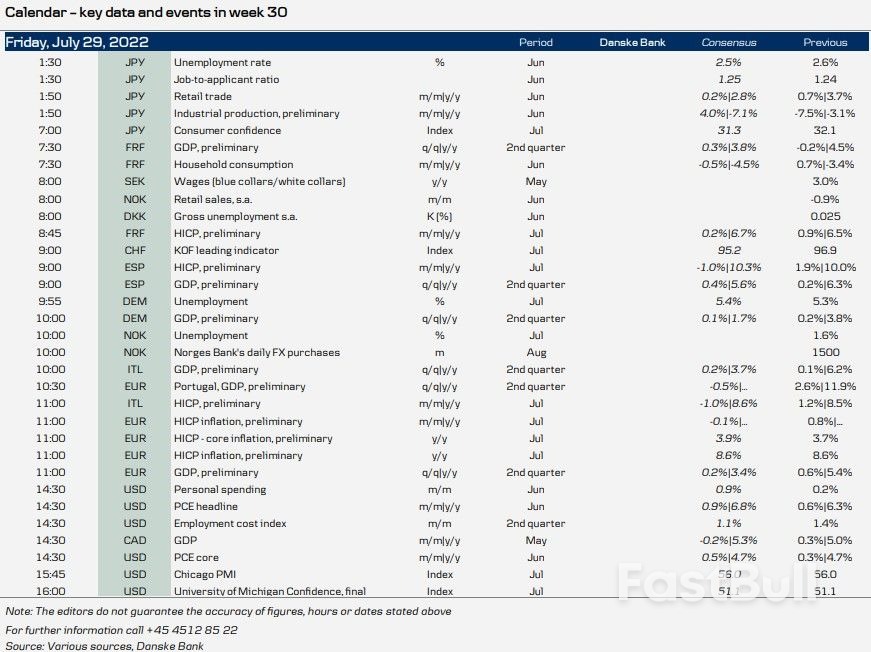
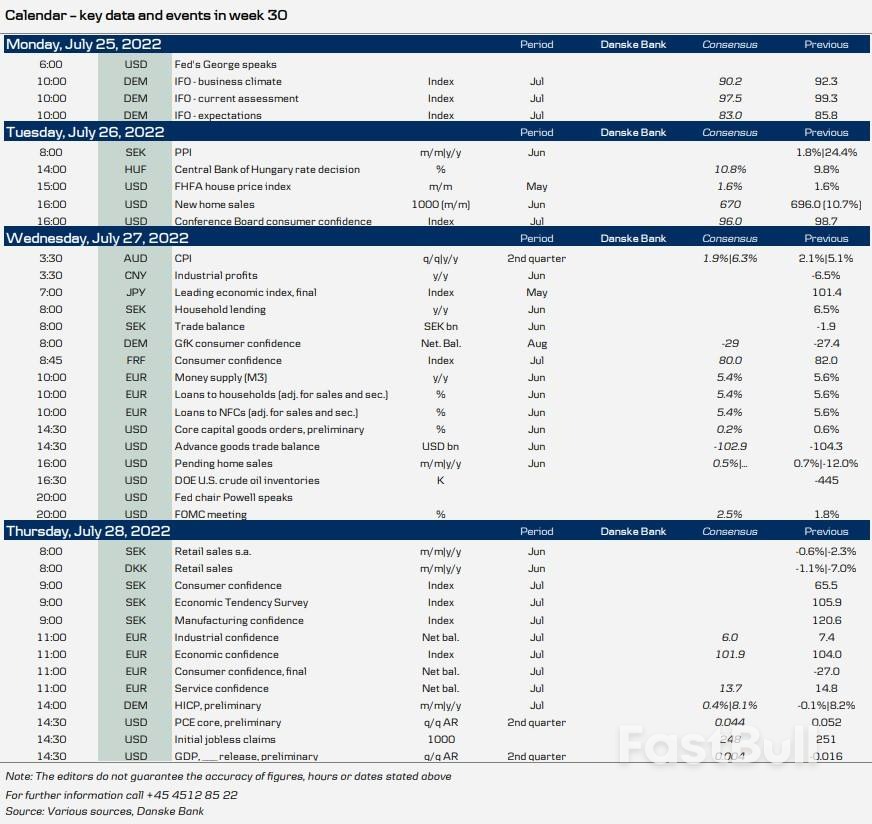
          Alongside the FOMC, we have the German Ifo this afternoon, U.S. Durable Goods Wednesday, German Inflation and U.S. GDP on Thursday, and German, French, Italian, Spanish and Eurozone GDPs Thursday, and then Eurozone Inflation prints and U.S. Personal Consumption and Expenditure data and the Chicago PMI on Friday. Slap in some China property and Taiwan risk, Eastern Europe risk, and the U.S. President who has covid, and good luck picking the bones out of this week. It's the show with everything but Yul Brunner. I'll be in Bali next week for four days, and mightily glad I am, watching the dust settle from the distance.
          We see Singapore Core Inflation for June (4.20% exp. YoY), and Headline Inflation (6.20% exp YoY), released at 1300 SGT today. Having already made an unscheduled monetary tightening this month, higher than expected inflation data this afternoon will lock-and-load the Monetary Authority of Singapore to tighten again at their scheduled October meeting. I am in Singapore this week, and although COE's have hit record high prices in July, I am still seeing a lot of brand-new Mercedes and Range Rovers being driven around. I also paid just over seven dollars for a quite small, but pleasing, hipster latte in Singapore this morning. My feeling is that inflation will come in on the high side this afternoon, which may give local equities some headwinds this week, while supporting the Singapore Dollar.
          On a similar note, Australia releases its Q2 CPI on Wednesday, and we can expect volatility over the number as the street uses it to reprice the trajectory of the Reserve Bank of Australia tightening cycle. The Australian Dollar's value is a function of international investors macro outlook for the world economy, risk-on/risk-off for those of us in pilot fish part of the financial markets. A high CPI print could also be a headwind for Australian equities though, although they have been mostly content to follow Wall Street like a doting puppy of late.
          It is a slow week for China data, with just Industrial Profits on Wednesday. However, we do see official PMIs released this weekend on Sunday, and the Caixin PMI next Monday. The focus is likely to remain on China's covid-19 trajectory and the China property market woes. Evergrande is approaching an end-of-month deadline around debt restructuring, and if no progress is made, this could start grabbing more headlines as the week advances.
          The bear market rally in equities faces more than a few hurdles this week as outlined above. Currency markets technical picture look a bit clearer and the U.S. Dollar correction lower would appear to still have legs. There are rising and falling wedge breakouts everywhere. The dollar index is testing the base of its rising wedge, USD/JPY has broken lower out of its, GBP/USD, AUD/USD and NZD/USD have all broken higher out of falling wedges. USD/JPY has the potential to be the most emotional, especially if the evolution of the week sees U.S. yields move sharply lower again. Long USD/JPY is a very crowded trade, and a thinning of the herd is long overdue.
          One could also argue that both Bitcoin and gold are trying to form bases as well, but let's not get too far ahead of ourselves, they remain the ugliest horses in the glue factory. However this week plays out, I suspect today will be the most sedate day of the week to come, enjoy the peace and quiet while you can.

          Asian equity markets mostly softer

          Wall Street unwound some of its gains on Friday, as investors lightened positions ahead of the weekend ahead of heavyweight U.S. earnings this week, and recession nerves. The S&P 500 finished 0.93% lower, the Nasdaq slumped by 1.87%, and the Dow Jones eased by 0.43%. In Asia, U.S. futures are mixed, S&P 500 and Dow futures edging 0.15% lower, with Nasdaq futures gaining 0.15%.
          Asian markets have been mostly content to follow Wall Street once again, although without the tail-chasing volatility, and are cautiously lower today. The exception is South Korea's Kospi, which has moved 0.40% higher today. Elsewhere, Japan's Nikkei 225 is down 0.80%. News that China is setting up an investment fund to prop up embattled China property developers has had little to no impact on markets today. The Shanghai Composite is down 0.55%, the CSI 300 is 0.65% lower, while the Hang Seng has fallen by 0.85%.
          In regional markets, Singapore has gained 0.40%, while Taipei has fallen by 0.20%. Jakarta and Kuala Lumpur unchanged, with Bangkok down 0.25%, and Manila drooping by a hefty 1.30%. Australian markets are slightly softer, the All Ordinaries and ASX 200 have eased 0.10% lower.
          European markets finished modestly higher on Friday, but the move lower by Wall Street, and the cruise missile attack on Odessa over the weekend just after the grain export deal was signed, is likely to spook European markets once again. Wall Street has so many variables this week, I am not even going to hazard a guess as to what mode the FOMO gnomes will show up in today.

          U.S. Dollar moves higher in Asia

          The U.S. Dollar has moved slightly higher in Asia today versus both the DM and Asia FX space, most likely due to the Russian attack on Odessa over the weekend. Friday saw a noisy session, with large intra-day trading ranges versus the major currencies. As the dust settled though, the U.S. Dollar finished only modestly lower.
          The dollar index was almost unchanged at 106.55 on Friday, edging higher to 108.65 in sedate Asian trading. The bottom of its rising wedge is at 106.30 today, and a sustained failure suggests a much deeper correction to 104.00, and potentially to its 102.50 long-term breakout point. Resistance remains at 107.40 and 108.00.
          EUR/USD traded another wide range on Friday, but closed just 0.15% lower at 1.0215, easing to 1.0205 in Asia. It has resistance at 1.0275, which allows for a test of the 1.0360/1.0400 resistance zone. Only a sustained rise above would suggest a longer-term low is in place. EUR/USD has support at 1.0130 and 1.0100.
          GBP/USD closed almost unchanged overnight at 1.2010 on Friday, falling to 1.1990 in Asia. GBP/USD has broken out of its falling wedge but need to take our heavyweight resistance around 1.2060 to confirm a low is in place. It has support at 1.1900 and 1.1800, with resistance at 1.2060 and 1.2200.
          Lower U.S. yields across the curve saw the Japanese Yen emerge a winner overnight as the US/Japan rate differential narrowed, with the street still long to the eyeballs of USD/JPY. USD/JPY finished 0.92% lower at 136.10 overnight, rising slightly to 136.20 in Asia. Its has broken out of its rising wedge support at 135.50 initially. Initial resistance is distance at 139.00, followed by 139.40. The US/Japan rate differential continues to hold USD/JPY in its thrall, and if U.S. yields move sharply lower this week, the technical picture suggests USD/JPY could fall back to 132.00.
          AUD/USD and NZD/USD fell slightly overnight to 0.6925 and 0.6250, easing to 0.6905 and 0.6235 in Asia, likely due to the Russia missile attack on Odessa. Both currencies remain well above their upside breakout points and only a move back below either 0.6700 or 0.6100 changes the bullish technical outlook.
          USD/Asia finished almost unchanged on Friday, with the USD between 0.10% and 0.20% versus the THB, TWD, MYR, and CNY today. Both the INR and KRW have strengthened slightly and in USD/IDRs case, it looks like Bank Indonesia is on top at 15,000.00 today. I expect volatility in Asian currencies to increase as the week goes on and we get more inputs from tier-1 data, the U.S. FOMC, and U.S. earnings. Overall, Asian currencies remain under pressure versus the greenback, and I believe we will need to see a sustained move lower by the U.S. 2-year yield to change that dynamic. A hawkish FOMC likely sees selling pressure return to Asia FX.

          Oil prices ease in Asia

          Brent crude and WTI had another choppy intra-day session on Friday, but like currency markets, closed almost unchanged as the dust settled on the day. ​ Futures markets remain deeply in backwardation, suggesting that in the real world, prompt supplies are as tight as ever, however rising recession fears globally do suggest that gains are likely to be limited in the shorter-term, geopolitics aside. Oil futures biggest problem is that the mind-boggling intra-day volatility seen of late, is likely to reduce risk positioning, and thus, trading liquidity. A negative feedback loop likely to exacerbate prices moves.
          Brent crude closed 0.25% lower at $103.60 on Friday, falling by 1.10% to $102.50 a barrel in Asia today. WTI closed 1.45% lower at $95.00 on Friday, losing another 1.0% to $94.05 a barrel in Asia today. Brent crude has well-denoted resistance at $108.00 a barrel on the charts, and then 111.00. It has support at $101.75 and $101.00 a barrel.
          WTI looks the more vulnerable, moving below its 200-day moving average (DMA) at $94.75 today, and taking out support at $94.30 a barrel. traced a double bottom $94.30, its overnight low and its 200-day moving average. (DMA). That now opens a retest of the July lows at $90.60 a barrel. Resistance is distant at $100.00 a barrel.
          Brent's outperformance likely reflects its use as the international benchmark for global trade in oil, where physical supplies remain tight. WTI, on the other hand, is a domestic benchmark meaning that U.S. recession nerves seem to be more heavily weighing on its price. Brent crude continues to hold comfortably above its 200-DMA at $97.65 a barrel, and until that comprehensively breaks, I am not yet pencilling in the demise of high oil prices, although I have long said I believe a medium-term high is in place. The more analysts there were calling for $200 and $300 a barrel crude, the more confident I became.

          Gold's is trying to form a base

          Gold closed higher for the second session in a row on Friday, quite the achievement given its woeful performance of late. Gold closed 0.50% higher at $1727.50 an ounce on Friday, edging slightly lower in moribund Asian trading to $1728.75. Two positive sessions do not mean gold is out of the woods, but the technical picture does suggest it is trying to form a base, having bounced of long-term support near $1680.00 an ounce last week. It faces a myriad of data and event risk this week, but the chart does suggest buying the dips toward $1700.00 with a tight stop wouldn't be the dumbest call of your career.
          Gold needs to overcome heavy resistance at the $1745.00 an ounce triple top before the gold bugs can really start to get excited. ​ It has support at $1680.00, and then the longer-term support around $1675.00 an ounce zone. A sustained failure of $1675.00 will signal a much deeper move lower targeting the $1450.00 to $1500.00 an ounce regions.

          Source: MarketPulse

          Risk Warnings and Disclaimers
          You understand and acknowledge that there is a high degree of risk involved in trading. Following any strategies or investment methods may lead to potential losses. The content on the site is provided by our contributors and analysts for information purposes only. You are solely responsible for determining whether any trading assets, securities, strategy, or any other product is suitable for investing based on your own investment objectives and financial situation.
          Comments
          Add to Favorites
          Share

          Draghi's Fall Leaves Monte Dei Paschi's Cash call in the Lurch

          Devin
          Monte dei Paschi di Siena (MPS) 's seventh capital raising in 14 years was always going to be a hard sell, now Italy's political crisis risks turning it into a mission impossible.
          Even before Prime Minister Mario Draghi's national unity government collapsed this week, propelling Italy towards an election on Sept. 25, MPS CEO Luigi Lovaglio faced a tough job to convince investors the Tuscan bank is a more attractive buy than healthier, cheaper rivals in Italy.
          State-controlled MPS, the world's oldest bank, plans to raise 2.5 billion euros ($2.6 billion) by mid-November to bolster capital and fund some 3,500 voluntary staff exits.
          Italy's Treasury is determined to complete the capital raising despite the political chaos, a person with knowledge of the matter said.
          And a lawmaker in the far-right Brothers of Italy party, which is likely to emerge as the largest single party in the next parliament, told Reuters they had no desire to take the blame for MPS's demise.
          After burning through 15 billion euros of investors' money since 2008, MPS had to be rescued in 2017 in a 5.4-billion-euro taxpayer bailout, leaving the government with a 64% stake.
          Having failed to sell MPS to UniCredit last year, Italy had to ask the European Union to extend a re-privatisation deadline.
          A successful fundraising was considered a priority for Draghi's executive, two people close to discussions around the transactions said, with investment banks eager to play a role on a deal considered of national importance.

          Turnaround Expert

          MPS needs private investors to fund the 900-million-euro portion of the cash call that is not covered by the Treasury to comply with EU rules.
          To attract buyers the Treasury in February bet on the turnaround skills of Lovaglio, a veteran UniCredit executive who built his career in eastern Europe and returned to Italy in 2018 to steer small bank Creval towards a merger - making it a takeover target for France's Credit Agricole.
          But MPS is seeking to raise a sum more than five times its market value of 450 million euros, capping the discount at which it can sell new shares.
          Analysts calculated the shares could be priced at a discount of just over 60% to the bank's tangible book value - making them more expensive than UniCredit's.
          They say Lovaglio's needs to find anchor investors for the capital raising, using his cachet as one of Italy's most experienced banking executives.
          "Without anchor investors, launching the capital increase amid the uncertainty stoked by the crisis becomes extremely hazardous," Bocconi University finance professor Stefano Gatti said.
          Despite saying MPS remains open to all prospective investors, Lovaglio has dampened speculation the bank's commercial partners, French insurer AXA and asset manager Anima could play a role in the capital increase.
          People working on the deal say strengthening commercial partnerships to help deliver the cash call could diminish MPS' appeal as a merger partner - hampering efforts to market the new shares to buyers via the prospect of a tie-up.
          The Treasury has ruled out seeking a waiver from the EU to pick up the tab in full were investors to shun the share issue, the person with knowledge of the matter said.
          A lack of interest from investors would allow the four banks that have signed a pre-underwriting agreement, Bank of America, Citigroup, Credit Suisse and Mediobanca, to walk away from a contract that would see them mop up unsold shares, MPS has said.

          Tricky Timing

          Lovaglio told parliament earlier this month investor meetings on his new strategic plan for MPS had gone well but the outlook for Italian banks has since darkened.
          "What could go wrong is going wrong and (higher interest) rates are of little relief," Mediobanca Securities analysts said in a note on Friday.
          The political turmoil has widened the gap between Italian and German government bond yields, which was already increasing in response to the Ukraine conflict and rising interest rates.
          Italy's reliance on Russian gas and its large manufacturing sector have increased the chances of a recession in the country, where small businesses make up the backbone of the economy.
          MPS is the most exposed to sovereign risks among Italy's leading banks. Its sovereign bond holdings still amount to 2.4 times its best-quality capital, though that is down from 6.3 times five years ago, based on JPMorgan's analysis.
          Shares in MPS have more than halved in value since Lovaglio's appointment, against a 35% drop in Italy's banking index since then.Draghi's Fall Leaves Monte Dei Paschi's Cash call in the Lurch_1
          "A further drop in MPS' stock price in the coming months ... and the discount that new shares would need to offer may well push the hyper-dilution beyond what is reasonably acceptable," Gatti said, referring to the fact that amount MPS needs to raise is disproportionate to its market value.
          ($1 = 0.9813 euros)

          Source: Reuters

          Risk Warnings and Disclaimers
          You understand and acknowledge that there is a high degree of risk involved in trading. Following any strategies or investment methods may lead to potential losses. The content on the site is provided by our contributors and analysts for information purposes only. You are solely responsible for determining whether any trading assets, securities, strategy, or any other product is suitable for investing based on your own investment objectives and financial situation.
          Comments
          Add to Favorites
          Share

          China's Mooted End to Australian Coal Ban Will Have Zero Market Impact

          Owen Li
          Talk that China may end its unofficial ban on imports of Australian coal is unlikely to result in any significant increase in shipments to the world's biggest coal buyer.
          Media reports last week suggested that Beijing is considering lifting the informal embargo, put in place in the second half of 2020 as tensions escalated with Canberra over a series of issues.
          Coal wasn't the only commodity affected, as China placed restrictions or bans on imports of barley, seafood and wine, among others.
          The unofficial ban was effective, with Australia going from being China's biggest supplier of coal in July 2020 to shipping hardly any of the polluting fuel by January 2021, a situation that has persisted.
          In July 2020, China imported 8.68 million tonnes of all grades of Australian coal, which exceeded the 8.54 million bought from Indonesia, the second-biggest source of imports, according to data from commodity analysts Kpler.
          Those two countries accounted for 76.7% of China's total imports of 22.44 million tonnes in July 2020.
          In July 2022, China is on track to import 23.14 million tonnes of coal, according to Kpler, with Indonesia slated to be the source of 13.65 million and Russia some 6.7 million.
          The July import figures show why the mooted ending of the ban on Australian coal imports would have very little impact on actual physical flows.
          It is far more likely that the proposed end to the ban is part of political overtures related to efforts to improve relations since the election of the centre-left Australian Labor Party in May, replacing the conservative Liberal-National coalition.
          The simple fact is that Australian coal, both thermal and coking, is too expensive for Chinese utilities and steel makers to consider buying.
          China can end the unofficial ban on imports from Australia, likely win some brownie points with the new Australian federal government, and the end result doesn't really change, as Chinese buyers shun Australian fuel, but now based on price not politics.

          Price Barrier

          Benchmark Australian thermal coal, the Newcastle weekly index, as assessed by commodity price reporting agency Argus, ended at $410.47 a tonne on July 22.
          While this was down from the prior week's $421.17 a tonne, it is still close to the all-time high of $425.31 on May 20, and an astonishing 757% above the $47.91 that prevailed in the same week in July 2020.
          The price of Australian thermal coal has been driven to record levels by the fallout from Russia's invasion of Ukraine, which sparked a scramble for the fuel from European buyers as they sought to end their dependence on shipments from Russia.
          However, the same price dynamics haven't been played out for Indonesian thermal coal, which is of a lower quality than Australian and is thus not viable for European utilities.
          Indonesia, the world's largest shipper of thermal coal, effectively remains a supplier to Asian markets, especially China and India, which are happy to take the lower energy coal if the price is right.
          Indonesian coal with an energy value of 4,200 kilocalories per kilogram (kcal/kg) ended last week at $82.67 a tonne.
          Indonesian coal has been trending weaker in recent months, in stark contrast to Australian thermal coal.
          Even allowing for the Newcastle benchmark's higher energy value of 6,000 kcal/kg, it is clear that the Australian grade is vastly more expensive that supplies from Indonesia.
          Russian thermal coal is also being sold at significantly lower prices than Australian cargoes, with McCloskey World Coal assessing cargoes at the Pacific port of Vostochny at $179 a tonne, or less than half the Australian equivalent.
          It is also likely that Russian producers are offering discounts to Chinese buyers, as they try to make up for lower volumes to major Asian coal importers such as Japan and South Korea.
          It is also worth noting that China's domestic coal output has been rising strongly, with production hitting 2.19 billion tonnes in the first half of 2022, up 11% from the same period last year.
          This surge in output, along with official steps to control prices, has kept China's domestic prices well below what Australian imports would cost.
          Benchmark thermal coal at Qinhuangdao ended at 970 yuan a tonne on July 22, equivalent to about $143.70 a tonne, which is little more than one-third of the price of Australian coal.
          If there are Australian coal miners hoping for a return of Chinese buyers, their hopes are likely to be dashed.
          Australian coal is massively uncompetitive against its rivals, and China's rising domestic output means imports are likely to become less needed over time.

          Source: Reuters

          Risk Warnings and Disclaimers
          You understand and acknowledge that there is a high degree of risk involved in trading. Following any strategies or investment methods may lead to potential losses. The content on the site is provided by our contributors and analysts for information purposes only. You are solely responsible for determining whether any trading assets, securities, strategy, or any other product is suitable for investing based on your own investment objectives and financial situation.
          Comments
          Add to Favorites
          Share

          ECB Says Goodbye to Negative Rates

          Devin
          An immediate European gas crisis has been averted, after Russia restarted gas supply through the North Stream 1 pipeline after the maintenance period. However, flows remain at only 40% capacity and the risk of cut-offs still lingers in the background. The EU Commission has unveiled new plan to cut EU gas consumption by 15% until next spring, which has received a lukewarm reception from EU countries. Meanwhile, Italy has been plunged into a new government crisis, just at a time when the economic outlook is clouding, and early elections will be held on 15 September.
          Concerns about the global growth outlook intensified. While the Chinese economy recovered in June in a post-lockdown rebound, Q2 GDP growth at 2.6% q/q surprised on the downside and China is facing renewed headwinds from rising property stress and weakening U.S. and euro area demand. PMIs brought more evidence that economic momentum is slowing on both sides of the Atlantic, as tighter financial conditions and persistently high inflation are weighing on demand, bringing the euro area to the brink of recession. Our forward-looking business cycle model, Macroscope, is projecting weakening growth prospects across regions. On the other hand, we also see first signs of relief in global inflationary pressures, with a fall in commodity prices like oil, metals and some foodstuff items, while freight rates have continued to fall in step with improvements in supply chains as China has reopened. An upcoming phone call between U.S. President Biden and China's Xi Jinping could bring further progress on possible tariff reductions.
          ECB Says Goodbye to Negative Rates_1Central banks are increasingly frontloading monetary policy tightening. Amid rising inflation risks, ECB surprised with a 50bp rate hike, while also complementing its normalisation process with a new Transmission Protection Instrument (TPI) to limit unwarranted spread widening. Despite higher-than-expected inflation, the Fed is expected to hike its policy rate by 75bp at their 27 July meeting.
          Market developments

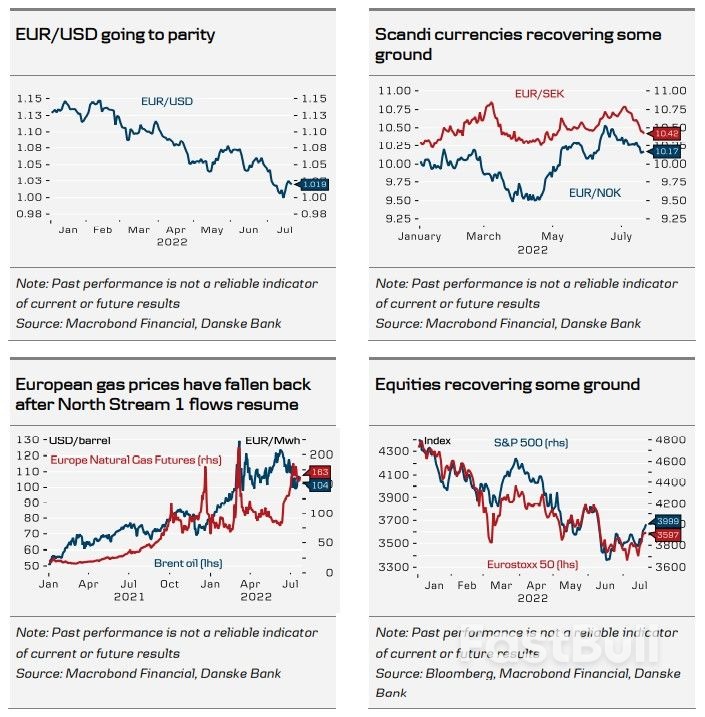
          Risk sentiment remains fragile amid recession fears. After falling sharply in the first half 2022, equity markets have recovered some ground. Amid moderating inflation expectations and front-loaded rate hikes, yield curves have flattened further. Italian bonds have come under pressure following the government crisis and lingering market doubts about the effectiveness of ECB's TPI.
          USD has continued to strengthen on a broad basis with EUR/USD falling briefly below parity on 14 July. We expect a further drop in the cross to 0.95 over the next year, as the euro area continues to suffer from a negative terms of trade shock and EUR/USD is overvalued vs fair value.ECB Says Goodbye to Negative Rates_2
          ECB Says Goodbye to Negative Rates_3
          ECB Says Goodbye to Negative Rates_4
          ECB Says Goodbye to Negative Rates_5

          Source: Danske Bank

          Risk Warnings and Disclaimers
          You understand and acknowledge that there is a high degree of risk involved in trading. Following any strategies or investment methods may lead to potential losses. The content on the site is provided by our contributors and analysts for information purposes only. You are solely responsible for determining whether any trading assets, securities, strategy, or any other product is suitable for investing based on your own investment objectives and financial situation.
          Comments
          Add to Favorites
          Share

          Weekly Outlook7.25

          Jan Aldrin Laruscain

          Traders' Opinions

          Gold has finally seen its best performance yet since the middle of June after rising by an ample 1%. We could also attribute this rise to a weaker US Dollar following a slump on treasury yields last week. However, this does not mean that the general trend for XAUUSD has finally halted--as the market may just be waiting for the Fed’s 75-basis point rate hike seen to happen this Wednesday.
          Weekly Outlook7.25_1
          Going to the Weekly charts, Gold has been on a 5-week-losing-streak against the dollar. Price has violated 3 weekly key levels--indicating that the bears are in full control. However, last week was an exception as price has finally printed a green candle in response to the key level found on the $1680 level. Our team is expecting for gold to waddle between the range of $1680 to $1760--obeying the resistance and fibonacci retracement of 38.2%.
          Weekly Outlook7.25_2
          Zooming into the Daily Timeframe, Gold is hovering in a daily key level. However, it is very likely that it will zoom past that level as its higher time frame objective is to reach $1760 at minimum.
          Weekly Outlook7.25_3
          In the 4 hour timeframe, we could confirm that a possible bullish upswing is highly probable following a break and retest on the daily level and multiple break of structures. Furthermore, it is important to note that the bounce is supported by a weekly key level which generally provides strong momentum--however, price may encounter a bit of turbulence along the way as it is set to bump through a 4 hour key level.
          As a summary, our team is flagging posisble bullish intent for the week before it would proceed with the general trend.
          Risk Warnings and Disclaimers
          You understand and acknowledge that there is a high degree of risk involved in trading. Following any strategies or investment methods may lead to potential losses. The content on the site is provided by our contributors and analysts for information purposes only. You are solely responsible for determining whether any trading assets, securities, strategy, or any other product is suitable for investing based on your own investment objectives and financial situation.
          Comments
          Add to Favorites
          Share
          FastBull
          Copyright © 2025 FastBull Ltd

          728 RM B 7/F GEE LOK IND BLDG NO 34 HUNG TO RD KWUN TONG KLN HONG KONG

          TelegramInstagramTwitterfacebooklinkedin
          App Store Google Play Google Play
          Products
          Charts

          Chats

          Q&A with Experts
          Screeners
          Economic Calendar
          Data
          Tools
          Membership
          Features
          Function
          Markets
          Copy Trading
          Latest Signals
          Contests
          News
          Analysis
          24/7
          Columns
          Education
          Company
          Careers
          About Us
          Contact Us
          Advertising
          Help Center
          Feedback
          User Agreement
          Privacy Policy
          Business

          White Label

          Data API

          Web Plug-ins

          Poster Maker

          Affiliate Program

          Risk Disclosure

          The risk of loss in trading financial instruments such as stocks, FX, commodities, futures, bonds, ETFs and crypto can be substantial. You may sustain a total loss of the funds that you deposit with your broker. Therefore, you should carefully consider whether such trading is suitable for you in light of your circumstances and financial resources.

          No decision to invest should be made without thoroughly conducting due diligence by yourself or consulting with your financial advisors. Our web content might not suit you since we don't know your financial conditions and investment needs. Our financial information might have latency or contain inaccuracy, so you should be fully responsible for any of your trading and investment decisions. The company will not be responsible for your capital loss.

          Without getting permission from the website, you are not allowed to copy the website's graphics, texts, or trademarks. Intellectual property rights in the content or data incorporated into this website belong to its providers and exchange merchants.

          Not Logged In

          Log in to access more features

          FastBull Membership

          Not yet

          Purchase

          Become a signal provider
          Help Center
          Customer Service
          Dark Mode
          Price Up/Down Colors

          Log In

          Sign Up

          Position
          Layout
          Fullscreen
          Default to Chart
          The chart page opens by default when you visit fastbull.com