• Trade
  • Markets
  • Copy
  • Contests
  • News
  • 24/7
  • Calendar
  • Q&A
  • Chats
Trending
Screeners
SYMBOL
LAST
BID
ASK
HIGH
LOW
NET CHG.
%CHG.
SPREAD
SPX
S&P 500 Index
6857.13
6857.13
6857.13
6865.94
6827.13
+7.41
+ 0.11%
--
DJI
Dow Jones Industrial Average
47850.93
47850.93
47850.93
48049.72
47692.96
-31.96
-0.07%
--
IXIC
NASDAQ Composite Index
23505.13
23505.13
23505.13
23528.53
23372.33
+51.04
+ 0.22%
--
USDX
US Dollar Index
98.760
98.840
98.760
98.980
98.750
-0.220
-0.22%
--
EURUSD
Euro / US Dollar
1.16671
1.16678
1.16671
1.16692
1.16408
+0.00226
+ 0.19%
--
GBPUSD
Pound Sterling / US Dollar
1.33589
1.33598
1.33589
1.33601
1.33165
+0.00318
+ 0.24%
--
XAUUSD
Gold / US Dollar
4226.91
4227.32
4226.91
4230.62
4194.54
+19.74
+ 0.47%
--
WTI
Light Sweet Crude Oil
59.388
59.425
59.388
59.469
59.187
+0.005
+ 0.01%
--

Community Accounts

Signal Accounts
--
Profit Accounts
--
Loss Accounts
--
View More

Become a signal provider

Sell trading signals to earn additional income

View More

Guide to Copy Trading

Get started with ease and confidence

View More

Signal Accounts for Members

All Signal Accounts

Best Return
  • Best Return
  • Best P/L
  • Best MDD
Past 1W
  • Past 1W
  • Past 1M
  • Past 1Y

All Contests

  • All
  • Trump Updates
  • Recommend
  • Stocks
  • Cryptocurrencies
  • Central Banks
  • Featured News
Top News Only
Share

Shanghai Aluminium Warehouse Stocks Up 8353 Tons

Share

Shanghai Copper Warehouse Stocks Down 9025 Tons

Share

Equinor: Preliminary Estimates Indicate Reservoirs May Contain Between 5 -18 Million Standard Cubic Meters Of Recoverable Oil Equivalents

Share

Japan Chief Cabinet Secretary Kihara: Government To Take Appropriate Steps On Excessive And Disorderly Moves In Foreign Exchange Market, If Necessary

Share

[Report: Amazon Pays €180 Million To Italy To End Tax And Labor Investigations] Amazon Has Paid A Settlement And Dismantled Its Monitoring System For Delivery Drivers In Italy, Ending An Investigation Into Alleged Tax Fraud And Illegal Labor Practices. In July 2024, The Group's Logistics Services Division Was Accused Of Circumventing Labor And Tax Laws By Relying On Cooperatives Or Limited Liability Companies To Supply Workers, Evading VAT, And Reducing Social Security Payments. Sources Say The Group Has Now Paid Approximately €180 Million To Italian Tax Authorities As Part Of A €1 Billion Settlement Involving 33 Companies

Share

Airbus - Booked 797 Gross Aircraft Orders In January-November

Share

[Market Update] Spot Gold Broke Through $4,230 Per Ounce, Up 0.51% On The Day

Share

Reserve Bank Of India Chief Malhotra: There Will Be Ample Liquidity As Long As We Are In An Easing Cycle

Share

Reserve Bank Of India Chief Malhotra: Quantum Of System Liquidity Will Be Managed To Ensure Monetary Transmission Is Happening

Share

China's Foreign Ministry: World Bank, IMF, WTO Top Officials To Join

Share

China's Foreign Ministry: China To Hold 1+1 Dialogue With International Economic Orgs On Dec 9

Share

Reserve Bank Of India Chief Malhotra: 5% Of Inr Depreciation Leads To 35 Bps Of Inflation

Share

Eurostoxx 50 Futures Up 0.14%, DAX Futures Up 0.12%, CAC 40 Futures Up 0.26%, FTSE Futures Up 0.03%

Share

Getlink - Over 1 Million Trucks Crossed Channel Since January 2025

Share

Malaysia International Reserves At $124.1 Billion On November 28 Versus$124.1 Billion On November 14 - Central Bank

Share

Reserve Bank Of India Chief Malhotra: Conscious Effort On Diversifying Gold Reserves

Share

Russian President Putin Thanks Indian Prime Minister Modi For Attention To Ukraine Peace Efforts

Share

Russian President Putin: India-Russia Relations Should Grow And Touch New Heights

Share

Russian President Putin: India Is Not Neutral, India Is On The Side Of Peace

Share

Russian President Putin: We Support Every Effort Towards Peace

TIME
ACT
FCST
PREV
Euro Zone IHS Markit Construction PMI (Nov)

A:--

F: --

P: --

Italy IHS Markit Construction PMI (Nov)

A:--

F: --

P: --

U.K. Markit/CIPS Construction PMI (Nov)

A:--

F: --

P: --

France 10-Year OAT Auction Avg. Yield

A:--

F: --

P: --

Euro Zone Retail Sales MoM (Oct)

A:--

F: --

P: --

Euro Zone Retail Sales YoY (Oct)

A:--

F: --

P: --

Brazil GDP YoY (Q3)

A:--

F: --

P: --

U.S. Challenger Job Cuts (Nov)

A:--

F: --

P: --

U.S. Challenger Job Cuts MoM (Nov)

A:--

F: --

P: --

U.S. Challenger Job Cuts YoY (Nov)

A:--

F: --

P: --

U.S. Initial Jobless Claims 4-Week Avg. (SA)

A:--

F: --

P: --

U.S. Weekly Initial Jobless Claims (SA)

A:--

F: --

P: --

U.S. Weekly Continued Jobless Claims (SA)

A:--

F: --

P: --

Canada Ivey PMI (SA) (Nov)

A:--

F: --

P: --

Canada Ivey PMI (Not SA) (Nov)

A:--

F: --

P: --

U.S. Non-Defense Capital Durable Goods Orders Revised MoM (Excl. Aircraft) (SA) (Sept)

A:--

F: --

P: --
U.S. Factory Orders MoM (Excl. Transport) (Sept)

A:--

F: --

P: --

U.S. Factory Orders MoM (Sept)

A:--

F: --

P: --

U.S. Factory Orders MoM (Excl. Defense) (Sept)

A:--

F: --

P: --

U.S. EIA Weekly Natural Gas Stocks Change

A:--

F: --

P: --

Saudi Arabia Crude Oil Production

A:--

F: --

P: --

U.S. Weekly Treasuries Held by Foreign Central Banks

A:--

F: --

P: --

Japan Foreign Exchange Reserves (Nov)

A:--

F: --

P: --

India Repo Rate

A:--

F: --

P: --

India Benchmark Interest Rate

A:--

F: --

P: --

India Reverse Repo Rate

A:--

F: --

P: --

India Cash Reserve Ratio

A:--

F: --

P: --

Japan Leading Indicators Prelim (Oct)

A:--

F: --

P: --

U.K. Halifax House Price Index YoY (SA) (Nov)

A:--

F: --

P: --

U.K. Halifax House Price Index MoM (SA) (Nov)

A:--

F: --

P: --

France Current Account (Not SA) (Oct)

--

F: --

P: --

France Trade Balance (SA) (Oct)

--

F: --

P: --

France Industrial Output MoM (SA) (Oct)

--

F: --

P: --

Italy Retail Sales MoM (SA) (Oct)

--

F: --

P: --

Euro Zone Employment YoY (SA) (Q3)

--

F: --

P: --

Euro Zone GDP Final YoY (Q3)

--

F: --

P: --

Euro Zone GDP Final QoQ (Q3)

--

F: --

P: --

Euro Zone Employment Final QoQ (SA) (Q3)

--

F: --

P: --

Euro Zone Employment Final (SA) (Q3)

--

F: --

P: --
Brazil PPI MoM (Oct)

--

F: --

P: --

Mexico Consumer Confidence Index (Nov)

--

F: --

P: --

Canada Unemployment Rate (SA) (Nov)

--

F: --

P: --

Canada Labor Force Participation Rate (SA) (Nov)

--

F: --

P: --

Canada Employment (SA) (Nov)

--

F: --

P: --

Canada Part-Time Employment (SA) (Nov)

--

F: --

P: --

Canada Full-time Employment (SA) (Nov)

--

F: --

P: --

U.S. Personal Income MoM (Sept)

--

F: --

P: --

U.S. Dallas Fed PCE Price Index YoY (Sept)

--

F: --

P: --

U.S. PCE Price Index YoY (SA) (Sept)

--

F: --

P: --

U.S. PCE Price Index MoM (Sept)

--

F: --

P: --

U.S. Personal Outlays MoM (SA) (Sept)

--

F: --

P: --

U.S. Core PCE Price Index MoM (Sept)

--

F: --

P: --

U.S. UMich 5-Year-Ahead Inflation Expectations Prelim YoY (Dec)

--

F: --

P: --

U.S. Core PCE Price Index YoY (Sept)

--

F: --

P: --

U.S. Real Personal Consumption Expenditures MoM (Sept)

--

F: --

P: --

U.S. 5-10 Year-Ahead Inflation Expectations (Dec)

--

F: --

P: --

U.S. UMich Current Economic Conditions Index Prelim (Dec)

--

F: --

P: --

U.S. UMich Consumer Sentiment Index Prelim (Dec)

--

F: --

P: --

U.S. UMich 1-Year-Ahead Inflation Expectations Prelim (Dec)

--

F: --

P: --

U.S. UMich Consumer Expectations Index Prelim (Dec)

--

F: --

P: --

Q&A with Experts
    • All
    • Chatrooms
    • Groups
    • Friends
    Connecting
    .
    .
    .
    Type here...
    Add Symbol or Code

      No matching data

      All
      Trump Updates
      Recommend
      Stocks
      Cryptocurrencies
      Central Banks
      Featured News
      • All
      • Russia-Ukraine Conflict
      • Middle East Flashpoint
      • All
      • Russia-Ukraine Conflict
      • Middle East Flashpoint
      Search
      Products

      Charts Free Forever

      Chats Q&A with Experts
      Screeners Economic Calendar Data Tools
      Membership Features
      Data Warehouse Market Trends Institutional Data Policy Rates Macro

      Market Trends

      Market Sentiment Order Book Forex Correlations

      Top Indicators

      Charts Free Forever
      Markets

      News

      News Analysis 24/7 Columns Education
      From Institutions From Analysts
      Topics Columnists

      Latest Views

      Latest Views

      Trending Topics

      Top Columnists

      Latest Update

      Signals

      Copy Rankings Latest Signals Become a signal provider AI Rating
      Contests
      Brokers

      Overview Brokers Assessment Rankings Regulators News Claims
      Broker listing Forex Brokers Comparison Tool Live Spread Comparison Scam
      Q&A Complaint Scam Alert Videos Tips to Detect Scam
      More

      Business
      Events
      Careers About Us Advertising Help Center

      White Label

      Data API

      Web Plug-ins

      Affiliate Program

      Awards Institution Evaluation IB Seminar Salon Event Exhibition
      Vietnam Thailand Singapore Dubai
      Fans Party Investment Sharing Session
      FastBull Summit BrokersView Expo
      Recent Searches
        Top Searches
          Markets
          News
          Analysis
          User
          24/7
          Economic Calendar
          Education
          Data
          • Names
          • Latest
          • Prev

          View All

          No data

          Scan to Download

          Faster Charts, Chat Faster!

          Download App
          English
          • English
          • Español
          • العربية
          • Bahasa Indonesia
          • Bahasa Melayu
          • Tiếng Việt
          • ภาษาไทย
          • Français
          • Italiano
          • Türkçe
          • Русский язык
          • 简中
          • 繁中
          Open Account
          Search
          Products
          Charts Free Forever
          Markets
          News
          Signals

          Copy Rankings Latest Signals Become a signal provider AI Rating
          Contests
          Brokers

          Overview Brokers Assessment Rankings Regulators News Claims
          Broker listing Forex Brokers Comparison Tool Live Spread Comparison Scam
          Q&A Complaint Scam Alert Videos Tips to Detect Scam
          More

          Business
          Events
          Careers About Us Advertising Help Center

          White Label

          Data API

          Web Plug-ins

          Affiliate Program

          Awards Institution Evaluation IB Seminar Salon Event Exhibition
          Vietnam Thailand Singapore Dubai
          Fans Party Investment Sharing Session
          FastBull Summit BrokersView Expo

          EUR/USD Holds Ground Amid Firm Focus on Fed Policy

          Blue River

          Forex

          Technical Analysis

          Summary:

          The EUR/USD pair retreated to 1.1612 on Tuesday, pulling back from a recent two-week high. The catalyst for the move was a significant repricing of US interest rate expectations following weak manufacturing data.

          The EUR/USD pair retreated to 1.1612 on Tuesday, pulling back from a recent two-week high. The catalyst for the move was a significant repricing of US interest rate expectations following weak manufacturing data. The ISM Manufacturing Index confirmed a ninth consecutive month of contraction, with the pace of decline the fastest in four months.

          This data solidified market expectations for a Federal Reserve rate cut. Futures markets now imply an 88% probability of a 25-basis-point reduction at next week's FOMC meeting.

          In related news, President Donald Trump announced he has selected a candidate for the next Fed Chair. Media reports suggest the leading contender is Kevin Hassett, the current head of the White House National Economic Council.

          Investor attention is now focused on an upcoming speech by current Chair Jerome Powell later today, which may offer further clues on the Fed's policy trajectory.

          Technical Analysis: EUR/USD

          H4 Chart:

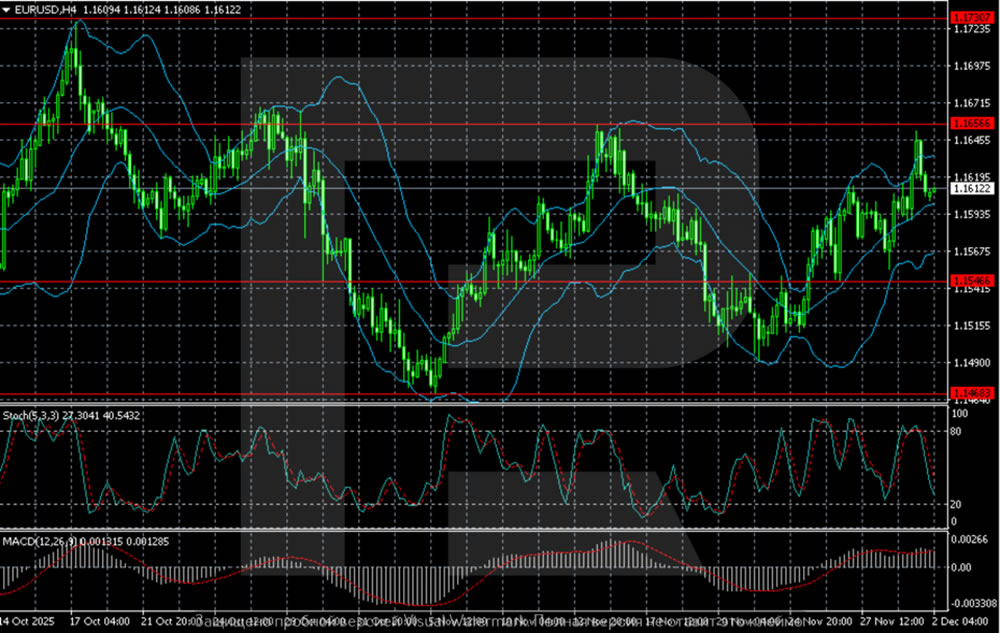
          On the H4 chart, EUR/USD continues to trade within an established ascending channel. The pair is currently testing a key resistance zone at 1.1655, where buying momentum has met significant selling pressure. A decisive breakout above this level would open the path towards the next major resistance at 1.1730.

          The Stochastic Oscillator is rising from the middle zone, indicating sustained bullish momentum without overbought conditions. The MACD remains above its zero line, maintaining a stable, albeit weak, buy signal. Conversely, a break and close below the key support at 1.1545 would signal a deeper correction, likely targeting the lower boundary of the current range near 1.1468.
          H1 Chart:

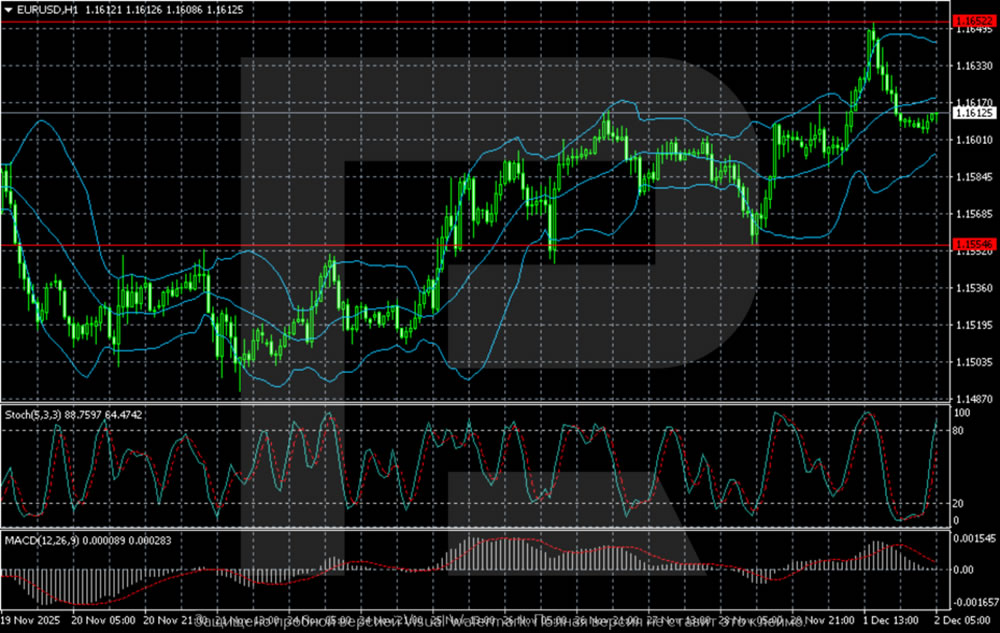
          On the H1 chart, the pair is undergoing a correction after being rejected from local resistance at 1.1652. Buyers are currently defending the price above the middle Bollinger Band, suggesting short-term bullish control remains intact.

          The Stochastic Oscillator is in overbought territory (above 80) and is turning down, pointing to a near-term corrective pullback. However, the MACD remains in positive territory, supporting the broader upward bias. This technical picture suggests a brief downward pause is likely, with a potential retest of support in the 1.1600–1.1585 zone. A successful hold above this area would increase the probability of a fresh upward impulse, targeting a renewed test of 1.1652 and an eventual push towards 1.1700.
          Conclusion

          EUR/USD remains confidently bid, supported by growing expectations of Fed easing. While a short-term technical correction is underway, the broader structure on both the H4 and H1 charts remains constructive. The key for continued upside is a successful defence of the 1.1600–1.1585 support zone. A break above 1.1655 would be a significant bullish confirmation, while a failure to hold support could trigger a deeper pullback towards 1.1545.

          Source: ACTIONFOREX

          Risk Warnings and Disclaimers
          You understand and acknowledge that there is a high degree of risk involved in trading. Following any strategies or investment methods may lead to potential losses. The content on the site is provided by our contributors and analysts for information purposes only. You are solely responsible for determining whether any trading assets, securities, strategy, or any other product is suitable for investing based on your own investment objectives and financial situation.
          Add to Favorites
          Share

          European Markets Struggle for Direction as December Opens with Tepid Sentiment

          Gerik

          Economic

          Lackluster Start to December as Markets Search for Catalysts

          European markets are entering December with muted energy, opening flat to lower across major indices. Forecasts from IG Markets suggested the UK’s FTSE 100 would open 0.12% lower, France’s CAC 40 down 0.16%, Germany’s DAX flat, and Italy’s FTSE MIB just marginally below the flatline. The movement continues a subdued pattern observed on Monday when regional stocks dipped, signaling caution among investors despite an improving inflation backdrop.
          This sluggish performance suggests a correlation between investor indecision and the absence of strong macroeconomic or earnings signals in early December. As the final trading month of 2025 unfolds, sentiment is shaped more by policy anticipation than corporate fundamentals.

          Focus Shifts to Central Bank Policy Moves

          The market is increasingly looking to upcoming monetary policy decisions, particularly from the U.S. Federal Reserve, which is scheduled to meet on December 9–10. According to the CME FedWatch Tool, traders have priced in an 87.2% chance of a 25-basis-point rate cut. This reflects a shift in expectations toward easing, driven by signs of moderating inflation and softening economic data in the U.S.
          In the UK, the Bank of England (BOE) remains cautious. BOE Monetary Policy Committee member Megan Greene noted in an interview with CNBC that external factors particularly movements in the U.S. influence roughly half of the UK’s yield curve shifts. This comment suggests a direct causal link between global monetary developments and UK market conditions, increasing the importance of Fed signals for domestic policy decisions.
          While the BOE has not confirmed a December rate cut, economists increasingly expect one, citing declining inflation trends, weak GDP figures, and a fragile labor market. The disinflationary measures from the recent Autumn Budget are likely reinforcing this expectation.

          Global Markets Offer Mixed Cues

          Across the Atlantic, U.S. futures remained relatively flat Monday night, following a subdued start to the month. Meanwhile, Asia-Pacific markets showed modest gains on Tuesday, highlighting a divergence in global sentiment. The contrasting performance reflects varying regional catalysts, with Asia reacting more positively to local earnings and policy stability, while Europe and the U.S. remain preoccupied with macroeconomic pivots.
          With no major earnings scheduled in Europe on Tuesday, attention turns to macroeconomic releases. These include unemployment figures from Spain and Italy and broader EU inflation data. These reports are expected to offer further insight into the health of the eurozone labor market and inflation trajectory, which in turn could influence near-term policy decisions by the European Central Bank (ECB).
          European markets remain in a holding pattern as investors await confirmation of rate cuts and clearer economic signals. While inflation is showing signs of easing and rate reductions appear increasingly probable, the lack of earnings catalysts and uncertainty over central bank timing continue to weigh on confidence. Until monetary policy directions solidify, the region’s markets are likely to remain directionless, vulnerable to external shocks and sentiment-driven fluctuations.

          Source: CNBC

          To stay updated on all economic events of today, please check out our Economic calendar
          Risk Warnings and Disclaimers
          You understand and acknowledge that there is a high degree of risk involved in trading. Following any strategies or investment methods may lead to potential losses. The content on the site is provided by our contributors and analysts for information purposes only. You are solely responsible for determining whether any trading assets, securities, strategy, or any other product is suitable for investing based on your own investment objectives and financial situation.
          Add to Favorites
          Share

          Zelenskyy’s Right-hand Man Has Gone. Here’s What Should Happen Next

          Samantha Luan

          Political

          Ukraine's second most powerful man resigned on 28 November, just as the country found itself fighting for its life on two fronts – militarily and diplomatically.

          Andriy Yermak had served as the head of President Volodymyr Zelenskyy's presidential office for well over five years, long before Russia's full-scale invasion of Ukraine in February 2022. All that time he was both a solution and a problem for Zelenskyy.

          It was Yermak who assumed a key role in the administration of a war-battered country in 2022, and shaped an international alliance in support of Ukraine. Early in the war, it was Yermak who encouraged Zelenskyy to assume global leadership in the fight against an axis of revisionist autocracies.

          After the 2022 invasion Yermak consolidated his influence by handling both domestic and foreign affairs.

          Zelenskyy relied on him to shape executive power. It was his job to select the prime minister and ministers, heads of state agencies, and to assert control over areas of law enforcement. The current prime minister, Yulia Svyrydenko, and prosecutor general, Ruslan Kravchenko, are seen as his protégés. He sidelined the parliament to shape the executive, something that goes against the constitution. With Zelenskyy's party holding a majority, members of parliament were rubber-stamping decisions taken in the Office of the President. It diminished their oversight, and their capacity to course-correct policies. For an unelected official, Yermak amassed enormous power.

          Andriy Yermak was not a popular figure inside Ukraine, where he was seen by many as a mastermind behind the centralisation of power, and as a gatekeeper to Zelenskyy. Scandals surrounded his rise to power, including 'Wagnergate', an abortive special operation to arrest Wagner mercenaries in 2020.

          But it was a corruption investigation in the energy sector that triggered his eventual fall. At this stage he is not a suspect, but Ukrainian civil society believes that it was Yermak who oversaw efforts to curtail the powers of investigative agencies such as the National Anti-Corruption Bureau of Ukraine (NABU) and the Special Anti-Corruption Prosecutor (SAPO), efforts that led to massive protests in the summer.

          White House liability

          By late 2025 the shadow of Yermak was also complicating intense and excruciating talks with the Americans. In recent weeks Moscow and Washington have dialled up pressure on Kyiv to accept what Ukraine regards as wholly unreasonable peace conditions. Although Yermak was a key part of the negotiating team, Zelenskyy could not risk having Ukraine represented by somebody with a dubious reputation – Russia's propaganda operatives would certainly have used his presence to make their case to US President Donald Trump that Ukraine was hopelessly corrupt.

          Any deal agreed by Yermak would have been a hard sell in Ukraine, and a continuing problem for Zelenskyy as he struggles to shape a war termination strategy that will bring the majority of citizens along with him.

          But the ousting of Yermak, though undoubtedly an extremely difficult decision for the President, could – if handled correctly – ultimately strengthen Zelenskyy's position and Ukraine's wartime resilience.

          The industrial-scale nature of the war and its attritional character require effective mobilization of resources and a stable international coalition in support of Ukraine.

          In order to defend Ukraine's sovereignty and maintain a pathway to restoring its territorial integrity, Zelenskyy needs to increase the country's military staying power, boost the climate for military-technological innovation, and sustain high morale at home.

          To protect its future Ukraine must align its position with Europeans, and ensure that the so-called 'coalition of the willing' backs that common strategy with significant resources, some to be transferred directly to state-owned companies and Ukraine's treasury. Demonstrating that Ukraine is determined to eradicate corrupt schemes and to prosecute graft is fundamental to continued and uninterrupted external finance. In 2026-2027 Kyiv needs around $60 billion to balance its budget.

          At home, corruption is increasingly seen as weakening the war effort. A Chatham House survey from July 2025 shows that Ukrainian society sees fighting institutional corruption as the key element of societal resilience in wartime – 64 per cent of respondents identified it as the number one task for Ukraine.

          Post-Yermak

          However, just replacing one head of the president's office with another will not be enough. Zelenskyy's team, together with the parliament and active civil society, must come up with a strategy that would strengthen governance in war, andlay the foundations to win the peace. This means decentralization of power, strengthening the organs of justice, and injecting new talent into leading state agencies.

          The anti-corruption agencies and courts must be protected from political interference and allowed to conduct unobstructed investigations, so that those found guilty are brought to justice and the state is compensated for losses.

          The corruption scandal is a testimony to the effectiveness of these agencies: despite strong resistance from the old system. NABU and SAPO have already recovered a total of £200 million for the Ukrainian state. Other law enforcement agencies, especially the national police, the prosecutor's office and the security service of Ukraine (SBU), must also be freed from political influence, especially in the area of economic affairs. Ukraine's strategic industries (defence, energy, transport) must operate free of undue influence and with strong protection of property rights. These are vital measures if foreign capital is to consider investing in Ukraine's recovery or in future privatizations of state-owned industries.

          Zelenskyy now has a chance to re-balance power and strengthen democracy by empowering the government, parliament and local authorities. Foreign policy, defence and national security are the president's constitutional realms. The new head of office should ensure the uninterrupted delivery of these key functions, and relinquish the pattern of overseeing the shadow economy and exerting influence through law enforcement.

          The rest – economic policy, defence-industrial base, energy, privatization, human capital, and reconstruction – should be designed and implemented as a collaborative multi-level government initiative. Ukrainian cities and regional and local communities need to be resourced to address human security, services for war-affected populations, local economic development, and non-critical infrastructure.

          Projects for a decentralized energy grid were, for too long, blocked by ministers implicated in the current corruption scandal. This could be a litmus test for whether change is really taking shape. Decentralised systems are more agile, prone to better adaptation and innovation.

          Finally, people.

          Zelenskyy needs a new drive to inject fresh energy into the public sector. The last government re-shuffle was too much a game of musical chairs, and no new people were really brought in. After nearly four years of full-scale, high-intensity war, exhaustion and stress are taking their toll. Sending a sign that government service is of critical importance would help to attract young people from top universities and business schools to serve Ukraine. Reaching out to Ukrainian graduates who are studying at Western universities, building on the model of the Create Ukraine fellowship, Zelenskyy could tap a new pool of talent for Ukraine.

          Meritocracy and integrity should be two guiding principles to replace the system of loyalty and abuse of power cemented by Andriy Yermak.

          Source: Chatham House

          Risk Warnings and Disclaimers
          You understand and acknowledge that there is a high degree of risk involved in trading. Following any strategies or investment methods may lead to potential losses. The content on the site is provided by our contributors and analysts for information purposes only. You are solely responsible for determining whether any trading assets, securities, strategy, or any other product is suitable for investing based on your own investment objectives and financial situation.
          Add to Favorites
          Share

          Exclusive: China Issues First Batch Of Streamlined Rare Earth Export Licences, Source Says

          Winkelmann

          Commodity

          Political

          Stocks

          · China had introduced rare earth export controls in April
          · Parts of auto supply chain had been hit hard by move
          · New 'general licences' follow Trump-Xi meeting in October
          · Three firms issued licences in first batch

          China has issued the first batch of new rare earth export licences that should accelerate shipments to certain customers, a source said on Tuesday, fulfilling a key outcome of the summit between Presidents Donald Trump and Xi Jinping.

          The approvals come after months of disruption triggered by China's introduction of rare earth export controls in April at the height of the trade war.

          By forcing companies to apply for licences for each export, Beijing created shortages that brought parts of the auto supply chain to a halt and handed it enormous leverage in trade talks with Washington.

          The new "general licences" are designed to ease that pressure by allowing more exports under year-long permits for individual customers, Reuters reported exclusively in November, and were a key outcome of the Trump-Xi meeting in late October.

          AUTO INDUSTRY SUPPLIERS

          Chinese magnet maker JL Mag Rare Earth (300748.SZ), opens new tab has received general licences for nearly all of its clients, while Ningbo Yunsheng (600366.SS), opens new tab and Beijing Zhong Ke San Huan High-Tech (000970.SZ), opens new tab have secured licences for some of their clients, the source said, declining to be identified due to the sensitivity of the matter.

          The three firms and China's Ministry of Commerce did not immediately respond to questions.

          All three companies sell to the automotive industry among others, according to their websites. JL Mag has a subsidiary in Europe and Ningbo Yunsheng says it has clients in Europe and the Americas.

          The new licences will supplement but not replace the existing licensing regime, Reuters reported in November. For now, only large Chinese rare earth companies are eligible for general licences, but the criteria could widen if the rollout proves successful, the source said.

          QUESTIONS REMAIN

          The new licences go some way to closing the gap between Beijing and Washington's respective accounts of what was agreed at the leaders' summit in South Korea.

          While the White House likened general licences to the effective end of China's rare earth export controls, Beijing has said little about the new licences in public and given no sign it intends to dismantle its regime.

          It remains to be seen how widely licences will be issued and whether they will be off limits for some customers, for example defence or sensitive sectors such as aerospace or semiconductors.

          Meanwhile European firms on Monday complained again about long delays and a lack of transparency in the existing export control system.

          Source: Reuters

          Risk Warnings and Disclaimers
          You understand and acknowledge that there is a high degree of risk involved in trading. Following any strategies or investment methods may lead to potential losses. The content on the site is provided by our contributors and analysts for information purposes only. You are solely responsible for determining whether any trading assets, securities, strategy, or any other product is suitable for investing based on your own investment objectives and financial situation.
          Add to Favorites
          Share

          FOMO or Fundamentals? AI Stock Surge Raises Valuation Concerns as Strategists Urge Caution

          Gerik

          Economic

          Stocks

          AI Rally Faces Scrutiny Amid Soaring Valuations and Investor Euphoria

          The surge in AI-related equities particularly among U.S. tech giants known as the "Magnificent 7" is prompting both optimism and caution as investors debate whether the rally is sustainable or driven by fear of missing out (FOMO). The European Central Bank (ECB), in its latest Financial Stability Review, warns that current market dynamics reflect a potentially fragile equilibrium, underpinned by high valuations and increased concentration in a small group of AI-driven hyperscalers.
          Companies such as Nvidia, Microsoft, Alphabet, and Meta have become focal points of investor enthusiasm, contributing to persistent global equity highs. However, the ECB highlights a mismatch between pricing and perceived vulnerabilities, suggesting that optimism may be masking deeper risks.

          ECB Flags Concentration and Disconnect from Fundamentals

          According to the ECB, market pricing does not seem to reflect elevated risks or uncertainties. While investors may be betting that major economic or technological shocks will not materialize, a large portion of current price momentum could also stem from FOMO rather than rational analysis. This behavioral factor introduces instability, as markets become more susceptible to abrupt sentiment shifts especially if AI-driven companies underdeliver on their lofty growth expectations.
          ECB Vice President Luis de Guindos echoed this concern, stating that parallels to the dot-com era are evident, even if today's earnings performance is stronger. Still, a downturn in AI-related earnings or broader economic deterioration could rapidly unwind the current rally. He also cautioned that non-bank financial intermediaries, such as hedge funds and investment funds with exposure to AI equities, could experience outsized losses in such a scenario.

          Strategists Advise Differentiation, Not Panic

          Despite warnings, many market strategists are not calling for a retreat. Julien Lafargue of Barclays emphasized that while AI valuations are high, they are not uniformly unjustified. Some companies particularly those with proven earnings and robust market share may warrant premium pricing. In contrast, firms in emerging fields like quantum computing with little revenue but high valuations appear to be driven more by speculative sentiment.
          Lafargue stressed the need for clear differentiation between fundamentally sound investments and those riding a hype wave. This distinction becomes even more crucial as newer technologies draw speculative capital without delivering commercial performance.

          Investor Sentiment Split Between Bubble Concerns and Long-Term Optimism

          Opinions remain divided on whether the AI sector is in a bubble. Prominent figures like Ray Dalio and Cathie Wood have expressed opposing views, with some suggesting that broader markets are experiencing an “everything bubble,” while others argue that the AI sector is undergoing a multi-year structural expansion.
          Morningstar’s Michael Field noted that the Magnificent 7 stocks now comprise 40% of the Morningstar US Index, a level of concentration that inherently increases systemic risk. Field also pointed out valuation disparities, citing ARM Holdings' trading multiple of nearly 90 times its 2026 earnings forecast almost double Nvidia’s ratio. He described Tesla as overvalued by more than 50%.
          Still, Field does not recommend a mass exit from the market. Instead, he urges investors to remain aware of the risks associated with elevated valuations and to avoid being swept up in speculative fervor.

          Long-Term Outlook: A Continuing AI Buildout

          Wedbush analyst Dan Ives rejected the idea of a tech bubble, framing the current rally as part of an eight- to ten-year AI supercycle. Ives views the market as entering its third year of this phase, with at least two more years of expansion ahead before any slowdown.
          He metaphorically described the AI investment cycle as a party still in full swing: “It’s 10:30 p.m. in the AI party and it goes until 4 a.m.” Ives also criticized Europe’s lag in tech innovation, suggesting that the region is merely observing the U.S.-led revolution rather than actively participating.
          While parts of the AI rally are grounded in tangible earnings growth, the presence of FOMO-driven investments and extreme market concentration pose structural risks. The causal link between investor behavior and inflated valuations suggests that any disappointment in earnings could trigger a sharp correction. The ECB’s warnings reflect a prudent assessment of systemic vulnerability not a forecast of collapse but a recognition of imbalances that may become exposed as the market matures. Investors are encouraged to stay engaged but selective, distinguishing between durable innovation and fleeting speculation.

          Source: CNBC

          To stay updated on all economic events of today, please check out our Economic calendar
          Risk Warnings and Disclaimers
          You understand and acknowledge that there is a high degree of risk involved in trading. Following any strategies or investment methods may lead to potential losses. The content on the site is provided by our contributors and analysts for information purposes only. You are solely responsible for determining whether any trading assets, securities, strategy, or any other product is suitable for investing based on your own investment objectives and financial situation.
          Add to Favorites
          Share

          Bank Of England Warns Debt-Fueled Spending Boom Could Unravel

          Daniel Carter

          Economic

          Central Bank

          The UK central bank said on Tuesday that a correction in AI stocks would spill over to wider debt markets and pointed to early warning signs in credit default swaps of companies leaning on debt to fund their investments.
          While currently investment in the technology is mostly driven by cash held by "hyperscalers," it said around half of the expected $5 trillion of AI spending over the next five years will be financed externally, largely through debt.
          In its twice-yearly Financial Stability Report, the BOE said that a sharp fall in stock valuations could hit UK household wealth, feeding through to consumer spending. It would also trigger losses on lending to firms investing heavily in AI infrastructure, ramping up borrowing costs for companies more widely.
          It's the latest warning about a possible AI bubble collapsing, with some drawing parallels with the dotcom boom that burst in stock markets in the early 2000s. As concerns build that valuations are reaching irrational levels, firms are investing heavily in AI infrastructure, such as building out the data centers needed for the technology.
          The BOE estimates that AI has driven two thirds of this year's gains on the S&P 500 index and investment in the technology was behind half of US economic growth in the first half of 2025.
          "The financing of AI development is reaching an inflection point," the BOE said. "If material credit losses on AI lending were to occur (directly or indirectly), this could have spillovers to broader credit conditions including in the UK."
          The central bank said there has recently been rising corporate debt issuance by AI companies and pointed to some warning signs building.
          "The five-year credit default swap spreads of Oracle – an AI company which has lower free cash flow margins than some other larger hyperscalers and has issued a large amount of debt this year to finance AI infrastructure spending – has widened from less than 40 basis points to around 120 basis points since end-July," it said.
          That contrasts with the steady credit default swap spreads of US investment-grade corporates more broadly.
          Credit default swaps insure against a company defaulting on its debts. They usually rise when investor confidence in the firm's credit quality falls.

          Source: Bloomberg Europe

          To stay updated on all economic events of today, please check out our Economic calendar
          Risk Warnings and Disclaimers
          You understand and acknowledge that there is a high degree of risk involved in trading. Following any strategies or investment methods may lead to potential losses. The content on the site is provided by our contributors and analysts for information purposes only. You are solely responsible for determining whether any trading assets, securities, strategy, or any other product is suitable for investing based on your own investment objectives and financial situation.
          Add to Favorites
          Share

          EU Faces Uphill Battle to Shift Household Savings Away from Cash and Toward Productive Investment

          Gerik

          Economic

          Persistent Fragmentation Hampers Capital Market Integration

          The European Union's ambition to build a unified capital market that channels domestic savings into productive investment remains elusive. Although more than 60 legislative proposals have been introduced since 2015, national divisions and regulatory complexity have slowed momentum. A 2024 report warned that €300 billion in savings leave the EU annually, often flowing into U.S. firms that later reinvest in Europe. Former Italian Prime Minister Enrico Letta described this capital outflow as a form of “collective suicide,” underscoring the detrimental consequences of ongoing fragmentation.
          The European Central Bank echoed these concerns in a May 2025 study, attributing the slow progress to diverging national interests, regulatory overload, and shifting political will. A new reform package aimed at enhancing integration particularly under the Savings and Investments Union (SIU) is set to be unveiled this week.

          Household Saving Behavior Reflects Deep-Rooted Risk Aversion

          The EU’s slow progress is mirrored in the financial behavior of its citizens. Over the past five years, household holdings in cash and bank deposits increased by 15%, reaching €12.1 trillion or about 30% of household wealth. This contrasts with the U.S., where only 11% of wealth is held in cash. In Germany, a particularly risk-averse nation, over 40% of household financial assets are stored in cash or deposits, with just 12% in equities.
          This pattern highlights a strong cultural resistance to investing in capital markets. It is not merely a product of financial illiteracy but also linked to trust issues with financial intermediaries. For instance, one retired Italian doctor expressed reluctance to invest due to opaque fees and difficulty reaching his bank revealing a clear causal link between limited trust and low investment participation.

          ‘Finance Europe’ Label and PIR Expansion Reflect Grassroots Efforts

          With centralized EU reforms moving slowly, some countries have begun experimenting with local solutions. A pilot initiative led by Spain proposes a “Finance Europe” label to help savers identify investment products that support EU-based companies. This label, coupled with assessments of regulatory barriers and market demand, aims to make domestic investment more accessible and appealing.
          At the same time, think tanks in Italy, France, Germany, and Spain are exploring the expansion of Italy’s PIR (Piani Individuali di Risparmio) scheme to the EU level. The PIR, launched in 2017, successfully attracted €21 billion over five years by offering tax incentives for long-term investments in Italian firms. The proposed EU-wide version would shift the requirement from 70% investment in one national economy to a broader focus on EU-wide companies, with a smaller portion still allocated domestically. The success of the Italian model provides a correlation between tax incentives and increased retail investor participation.

          Reform Plans Under SIU Aim to Empower Institutions

          The upcoming SIU framework will reportedly propose expanded authority for the European Securities and Markets Authority (ESMA) and measures to eliminate cross-border obstacles for asset managers and trading platforms. These institutional changes, if implemented effectively, could provide the necessary infrastructure to support retail investment. However, without accompanying national follow-through and cultural shifts, these reforms risk being symbolic.
          Critics, including Dutch and Italian market regulators, emphasize the need for simplicity, transparency, and investor protection. As the SIU builds upon the Retail Investment Strategy (RIS), the updated focus on reducing burdens for the financial industry may dilute its original goals, which were centered on investor empowerment.

          Low Returns and Inflation Erode Confidence

          EU households also face a fundamental economic disincentive: low deposit returns. As of September, euro area current accounts yielded just 0.25% on average, with term deposits offering 1.78% both below the 2.2% inflation rate. This negative real return disincentivizes saving in traditional accounts but has not yet translated into greater capital market participation. In contrast, U.S. households experienced a 151% rise in net wealth from 2009 to 2023, compared to only 55% in the euro area a divergence partly driven by more aggressive equity investment and higher returns on financial products.
          While the EU continues to develop frameworks like the SIU and push for more empowered regulatory bodies, the core challenge lies in altering investor behavior and rebuilding trust in financial markets. Without coordinated national implementation, attractive product design, and cultural reorientation, savers are unlikely to shift away from the safety of cash. The EU’s comparative disadvantage in wealth accumulation stems not only from policy but also from structural and psychological barriers, which must be addressed in tandem for integration efforts to succeed.

          Source: Reuters

          To stay updated on all economic events of today, please check out our Economic calendar
          Risk Warnings and Disclaimers
          You understand and acknowledge that there is a high degree of risk involved in trading. Following any strategies or investment methods may lead to potential losses. The content on the site is provided by our contributors and analysts for information purposes only. You are solely responsible for determining whether any trading assets, securities, strategy, or any other product is suitable for investing based on your own investment objectives and financial situation.
          Add to Favorites
          Share
          FastBull
          Copyright © 2025 FastBull Ltd

          728 RM B 7/F GEE LOK IND BLDG NO 34 HUNG TO RD KWUN TONG KLN HONG KONG

          TelegramInstagramTwitterfacebooklinkedin
          App Store Google Play Google Play
          Products
          Charts

          Chats

          Q&A with Experts
          Screeners
          Economic Calendar
          Data
          Tools
          Membership
          Features
          Function
          Markets
          Copy Trading
          Latest Signals
          Contests
          News
          Analysis
          24/7
          Columns
          Education
          Company
          Careers
          About Us
          Contact Us
          Advertising
          Help Center
          Feedback
          User Agreement
          Privacy Policy
          Business

          White Label

          Data API

          Web Plug-ins

          Poster Maker

          Affiliate Program

          Risk Disclosure

          The risk of loss in trading financial instruments such as stocks, FX, commodities, futures, bonds, ETFs and crypto can be substantial. You may sustain a total loss of the funds that you deposit with your broker. Therefore, you should carefully consider whether such trading is suitable for you in light of your circumstances and financial resources.

          No decision to invest should be made without thoroughly conducting due diligence by yourself or consulting with your financial advisors. Our web content might not suit you since we don't know your financial conditions and investment needs. Our financial information might have latency or contain inaccuracy, so you should be fully responsible for any of your trading and investment decisions. The company will not be responsible for your capital loss.

          Without getting permission from the website, you are not allowed to copy the website's graphics, texts, or trademarks. Intellectual property rights in the content or data incorporated into this website belong to its providers and exchange merchants.

          Not Logged In

          Log in to access more features

          FastBull Membership

          Not yet

          Purchase

          Become a signal provider
          Help Center
          Customer Service
          Dark Mode
          Price Up/Down Colors

          Log In

          Sign Up

          Position
          Layout
          Fullscreen
          Default to Chart
          The chart page opens by default when you visit fastbull.com
