• Trade
  • Markets
  • Copy
  • Contests
  • News
  • 24/7
  • Calendar
  • Q&A
  • Chats
Trending
Screeners
SYMBOL
LAST
BID
ASK
HIGH
LOW
NET CHG.
%CHG.
SPREAD
SPX
S&P 500 Index
6827.42
6827.42
6827.42
6899.86
6801.80
-73.58
-1.07%
--
DJI
Dow Jones Industrial Average
48458.04
48458.04
48458.04
48886.86
48334.10
-245.98
-0.51%
--
IXIC
NASDAQ Composite Index
23195.16
23195.16
23195.16
23554.89
23094.51
-398.69
-1.69%
--
USDX
US Dollar Index
97.950
98.030
97.950
98.500
97.950
-0.370
-0.38%
--
EURUSD
Euro / US Dollar
1.17394
1.17409
1.17394
1.17496
1.17192
+0.00011
+ 0.01%
--
GBPUSD
Pound Sterling / US Dollar
1.33707
1.33732
1.33707
1.33997
1.33419
-0.00148
-0.11%
--
XAUUSD
Gold / US Dollar
4299.39
4299.39
4299.39
4353.41
4257.10
+20.10
+ 0.47%
--
WTI
Light Sweet Crude Oil
57.233
57.485
57.233
58.011
56.969
-0.408
-0.71%
--

Community Accounts

Signal Accounts
--
Profit Accounts
--
Loss Accounts
--
View More

Become a signal provider

Sell trading signals to earn additional income

View More

Guide to Copy Trading

Get started with ease and confidence

View More

Signal Accounts for Members

All Signal Accounts

Best Return
  • Best Return
  • Best P/L
  • Best MDD
Past 1W
  • Past 1W
  • Past 1M
  • Past 1Y

All Contests

  • All
  • Trump Updates
  • Recommend
  • Stocks
  • Cryptocurrencies
  • Central Banks
  • Featured News
Top News Only
Share

Thai Leader Anutin: Landmine Blast That Killed Thai Soldiers 'Not A Roadside Accident'

Share

Thai Leader Anutin: Thailand To Continue Military Action Until 'We Feel No More Harm'

Share

Cambodian Prime Minister Hun Manet Says He Had Phone Calls With Trump And Malaysian Leader Anwar About Ceasefire

Share

Cambodia's Hun Manet Says USA, Malaysia Should Verify 'Which Side Fired First' In Latest Conflict

Share

Cambodia's Hun Manet: Cambodia Maintains Its Stance In Seeking Peaceful Resolution Of Disputes

Share

Nasdaq Companies: Allergan, Ferrovia, Insmed, Monolithic Power Systems, Seagate Technology, And Western Digital Will Be Added To The NASDAQ 100 Index. Biogen, CdW, GlobalFoundries, Lululemon, ON Semiconductor, And Tradedesk Will Be Removed From The NASDAQ 100 Index

Share

Witkoff Headed To Berlin This Weekend To Meet With Zelenskiy, European Leaders -Wsj Reporter On X

Share

Russia Attacks Two Ukrainian Ports, Damaging Three Turkish-Owned Vessels

Share

[Historic Flooding Occurs In At Least Four Rivers In Washington State Due To Days Of Torrential Rains] Multiple Areas In Washington State Have Been Hit By Severe Flooding Due To Days Of Torrential Rains, With At Least Four Rivers Experiencing Historic Flooding. Reporters Learned On The 12th That The Floods Caused By The Torrential Rains In Washington State Have Destroyed Homes And Closed Several Highways. Experts Warn That Even More Severe Flooding May Occur In The Future. A State Of Emergency Has Been Declared In Washington State

Share

Trump Says Proposed Free Economic Zone In Donbas Would Work

Share

Trump: I Think My Voice Should Be Heard

Share

Trump Says Will Be Choosing New Fed Chair In Near Future

Share

Trump Says Proposed Free Economic Zone In Donbas Complex But Would Work

Share

Trump Says Land Strikes In Venezuela Will Start Happening

Share

US President Trump: Thailand And Cambodia Are In A Good Situation

Share

State Media: North Korean Leader Kim Hails Troops Returning From Russia Mission

Share

The 10-year Treasury Yield Rose About 5 Basis Points During The "Fed Rate Cut Week," And The 2/10-year Yield Spread Widened By About 9 Basis Points. On Friday (December 12), In Late New York Trading, The Yield On The Benchmark 10-year US Treasury Note Rose 2.75 Basis Points To 4.1841%, A Cumulative Increase Of 4.90 Basis Points For The Week, Trading Within A Range Of 4.1002%-4.2074%. It Rose Steadily From Monday To Wednesday (before The Fed Announced Its Rate Cut And Treasury Bill Purchase Program), Subsequently Exhibiting A V-shaped Recovery. The 2-year Treasury Yield Fell 1.82 Basis Points To 3.5222%, A Cumulative Decrease Of 3.81 Basis Points For The Week, Trading Within A Range Of 3.6253%-3.4989%

Share

Trump: Lots Of Progress Being Made On Russia-Ukraine

Share

NOPA November US Soybean Crush Estimated At 220.285 Million Bushels

Share

SPDR Gold Trust Reports Holdings Up 0.22%, Or 2.28 Tonnes, To 1053.11 Tonnes By Dec 12

TIME
ACT
FCST
PREV
U.K. Trade Balance Non-EU (SA) (Oct)

A:--

F: --

P: --

U.K. Trade Balance (Oct)

A:--

F: --

P: --

U.K. Services Index MoM

A:--

F: --

P: --

U.K. Construction Output MoM (SA) (Oct)

A:--

F: --

P: --

U.K. Industrial Output YoY (Oct)

A:--

F: --

P: --

U.K. Trade Balance (SA) (Oct)

A:--

F: --

P: --

U.K. Trade Balance EU (SA) (Oct)

A:--

F: --

P: --

U.K. Manufacturing Output YoY (Oct)

A:--

F: --

P: --

U.K. GDP MoM (Oct)

A:--

F: --

P: --

U.K. GDP YoY (SA) (Oct)

A:--

F: --

P: --

U.K. Industrial Output MoM (Oct)

A:--

F: --

P: --

U.K. Construction Output YoY (Oct)

A:--

F: --

P: --

France HICP Final MoM (Nov)

A:--

F: --

P: --

China, Mainland Outstanding Loans Growth YoY (Nov)

A:--

F: --

P: --

China, Mainland M2 Money Supply YoY (Nov)

A:--

F: --

P: --

China, Mainland M0 Money Supply YoY (Nov)

A:--

F: --

P: --

China, Mainland M1 Money Supply YoY (Nov)

A:--

F: --

P: --

India CPI YoY (Nov)

A:--

F: --

P: --

India Deposit Gowth YoY

A:--

F: --

P: --

Brazil Services Growth YoY (Oct)

A:--

F: --

P: --

Mexico Industrial Output YoY (Oct)

A:--

F: --

P: --

Russia Trade Balance (Oct)

A:--

F: --

P: --

Philadelphia Fed President Henry Paulson delivers a speech
Canada Building Permits MoM (SA) (Oct)

A:--

F: --

P: --

Canada Wholesale Sales YoY (Oct)

A:--

F: --

P: --

Canada Wholesale Inventory MoM (Oct)

A:--

F: --

P: --

Canada Wholesale Inventory YoY (Oct)

A:--

F: --

P: --

Canada Wholesale Sales MoM (SA) (Oct)

A:--

F: --

P: --

Germany Current Account (Not SA) (Oct)

A:--

F: --

P: --

U.S. Weekly Total Rig Count

A:--

F: --

P: --

U.S. Weekly Total Oil Rig Count

A:--

F: --

P: --

Japan Tankan Large Non-Manufacturing Diffusion Index (Q4)

--

F: --

P: --

Japan Tankan Small Manufacturing Outlook Index (Q4)

--

F: --

P: --

Japan Tankan Large Non-Manufacturing Outlook Index (Q4)

--

F: --

P: --

Japan Tankan Large Manufacturing Outlook Index (Q4)

--

F: --

P: --

Japan Tankan Small Manufacturing Diffusion Index (Q4)

--

F: --

P: --

Japan Tankan Large Manufacturing Diffusion Index (Q4)

--

F: --

P: --

Japan Tankan Large-Enterprise Capital Expenditure YoY (Q4)

--

F: --

P: --

U.K. Rightmove House Price Index YoY (Dec)

--

F: --

P: --

China, Mainland Industrial Output YoY (YTD) (Nov)

--

F: --

P: --

China, Mainland Urban Area Unemployment Rate (Nov)

--

F: --

P: --

Saudi Arabia CPI YoY (Nov)

--

F: --

P: --

Euro Zone Industrial Output YoY (Oct)

--

F: --

P: --

Euro Zone Industrial Output MoM (Oct)

--

F: --

P: --

Canada Existing Home Sales MoM (Nov)

--

F: --

P: --

Euro Zone Total Reserve Assets (Nov)

--

F: --

P: --

U.K. Inflation Rate Expectations

--

F: --

P: --

Canada National Economic Confidence Index

--

F: --

P: --

Canada New Housing Starts (Nov)

--

F: --

P: --

U.S. NY Fed Manufacturing Employment Index (Dec)

--

F: --

P: --

U.S. NY Fed Manufacturing Index (Dec)

--

F: --

P: --

Canada Core CPI YoY (Nov)

--

F: --

P: --

Canada Manufacturing Unfilled Orders MoM (Oct)

--

F: --

P: --

Canada Manufacturing New Orders MoM (Oct)

--

F: --

P: --

Canada Core CPI MoM (Nov)

--

F: --

P: --

Canada Manufacturing Inventory MoM (Oct)

--

F: --

P: --

Canada CPI YoY (Nov)

--

F: --

P: --

Canada CPI MoM (Nov)

--

F: --

P: --

Canada CPI YoY (SA) (Nov)

--

F: --

P: --

Canada Core CPI MoM (SA) (Nov)

--

F: --

P: --

Q&A with Experts
    • All
    • Chatrooms
    • Groups
    • Friends
    Connecting
    .
    .
    .
    Type here...
    Add Symbol or Code

      No matching data

      All
      Trump Updates
      Recommend
      Stocks
      Cryptocurrencies
      Central Banks
      Featured News
      • All
      • Russia-Ukraine Conflict
      • Middle East Flashpoint
      • All
      • Russia-Ukraine Conflict
      • Middle East Flashpoint
      Search
      Products

      Charts Free Forever

      Chats Q&A with Experts
      Screeners Economic Calendar Data Tools
      Membership Features
      Data Warehouse Market Trends Institutional Data Policy Rates Macro

      Market Trends

      Market Sentiment Order Book Forex Correlations

      Top Indicators

      Charts Free Forever
      Markets

      News

      News Analysis 24/7 Columns Education
      From Institutions From Analysts
      Topics Columnists

      Latest Views

      Latest Views

      Trending Topics

      Top Columnists

      Latest Update

      Signals

      Copy Rankings Latest Signals Become a signal provider AI Rating
      Contests
      Brokers

      Overview Brokers Assessment Rankings Regulators News Claims
      Broker listing Forex Brokers Comparison Tool Live Spread Comparison Scam
      Q&A Complaint Scam Alert Videos Tips to Detect Scam
      More

      Business
      Events
      Careers About Us Advertising Help Center

      White Label

      Data API

      Web Plug-ins

      Affiliate Program

      Awards Institution Evaluation IB Seminar Salon Event Exhibition
      Vietnam Thailand Singapore Dubai
      Fans Party Investment Sharing Session
      FastBull Summit BrokersView Expo
      Recent Searches
        Top Searches
          Markets
          News
          Analysis
          User
          24/7
          Economic Calendar
          Education
          Data
          • Names
          • Latest
          • Prev

          View All

          No data

          Scan to Download

          Faster Charts, Chat Faster!

          Download App
          English
          • English
          • Español
          • العربية
          • Bahasa Indonesia
          • Bahasa Melayu
          • Tiếng Việt
          • ภาษาไทย
          • Français
          • Italiano
          • Türkçe
          • Русский язык
          • 简中
          • 繁中
          Open Account
          Search
          Products
          Charts Free Forever
          Markets
          News
          Signals

          Copy Rankings Latest Signals Become a signal provider AI Rating
          Contests
          Brokers

          Overview Brokers Assessment Rankings Regulators News Claims
          Broker listing Forex Brokers Comparison Tool Live Spread Comparison Scam
          Q&A Complaint Scam Alert Videos Tips to Detect Scam
          More

          Business
          Events
          Careers About Us Advertising Help Center

          White Label

          Data API

          Web Plug-ins

          Affiliate Program

          Awards Institution Evaluation IB Seminar Salon Event Exhibition
          Vietnam Thailand Singapore Dubai
          Fans Party Investment Sharing Session
          FastBull Summit BrokersView Expo

          Euro-Dollar 2024 Forecast: Commonwealth Bank Predicts Uphill Battle Amidst Yield Differentials

          Warren Takunda

          Traders' Opinions

          Summary:

          The Euro to Dollar exchange rate (EURUSD) is poised for a challenging trajectory in 2024, with Commonwealth Bank of Australia (CBA) analysts foreseeing limited change in yield differentials, a critical factor influencing FX valuation.

          The Euro to Dollar exchange rate (EURUSD) is poised for a challenging trajectory in 2024, with Commonwealth Bank of Australia (CBA) analysts foreseeing limited change in yield differentials, a critical factor influencing FX valuation. Despite earlier expectations of a substantial decline in the Dollar, CBA has revised its forecast downward, attributing the adjustment to a projected uplift in the USD. As economic uncertainties loom, the article delves into the complex interplay of Eurozone economic struggles, potential interest rate cuts by the European Central Bank (ECB), and global economic conditions shaping the Euro-Dollar landscape.
          The Euro to Dollar exchange rate (EURUSD) is facing headwinds in the upcoming year, as per the projections of Commonwealth Bank of Australia (CBA). In what may disappoint those anticipating a considerable fall in the Dollar, CBA analysts highlight the persistent influence of yield differentials on the FX valuation, signaling little change over the coming months.
          Throughout the preceding year, CBA maintained a bearish outlook on EUR/USD. In early 2024, the bank revised its forecast from 1.10 to 1.05, anticipating a renewed strengthening of the USD. This adjustment reflects the market sentiment that has gradually shifted since late November when the exchange rate peaked at 1.10. The decline in the Euro-Dollar exchange rate in December aligns with investor expectations of earlier-than-expected interest rate cuts by the European Central Bank (ECB).
          The Eurozone's economic challenges, marked by falling inflation and disappointing activity data, have intensified concerns within the ECB Governing Council. Unlike counterparts at the Bank of England and the Federal Reserve, ECB members are less alarmed by rising expectations for rate cuts, citing the weakened Eurozone economy as a potential weight on EUR/USD.
          Euro-Dollar 2024 Forecast: Commonwealth Bank Predicts Uphill Battle Amidst Yield Differentials_1
          While the Euro-Dollar is still anticipated to rise in the latter half of the year amid improving global economic and market conditions, CBA tempers expectations, forecasting a more modest uplift than previously envisioned. The bank predicts that interest rate differentials will persist as a headwind for EUR/USD, projecting both the US Federal Open Market Committee (FOMC) and the ECB to initiate a rate-cutting cycle around mid-2024. However, with rate cuts expected to occur at a similar pace, the overall interest rate differential is not expected to undergo significant change.
          Euro-Dollar 2024 Forecast: Commonwealth Bank Predicts Uphill Battle Amidst Yield Differentials_2
          CBA's specific numerical forecasts add granularity to their outlook. The EURUSD is expected to reach 1.05 by the end of March 2024, down from the earlier forecast of 1.10. As the year progresses, the pair is projected to rise to 1.12 by the end of September, a figure lower than the initially anticipated 1.19. Finally, by year-end, CBA forecasts the EURUSD to be at 1.15, down from the previous expectation of 1.22.
          In conclusion, the Euro-Dollar exchange rate appears poised for a complex journey in 2024, influenced by economic indicators, central bank policies, and global market dynamics. Investors and analysts will be closely monitoring these factors as the year unfolds, navigating the nuances of yield differentials and interest rate movements that shape the trajectory of EUR/USD.
          Risk Warnings and Disclaimers
          You understand and acknowledge that there is a high degree of risk involved in trading. Following any strategies or investment methods may lead to potential losses. The content on the site is provided by our contributors and analysts for information purposes only. You are solely responsible for determining whether any trading assets, securities, strategy, or any other product is suitable for investing based on your own investment objectives and financial situation.
          Comments
          Add to Favorites
          Share

          Two-Thirds of BOJ Watchers Expect End of Negative Rate Regime by April

          Thomas

          Central Bank

          Economic

          Bank of Japan (BOJ) watchers are increasingly expecting the bank to achieve its inflation target, with a growing majority forecasting authorities will end the world's last negative rate regime by April, according to a Bloomberg survey.
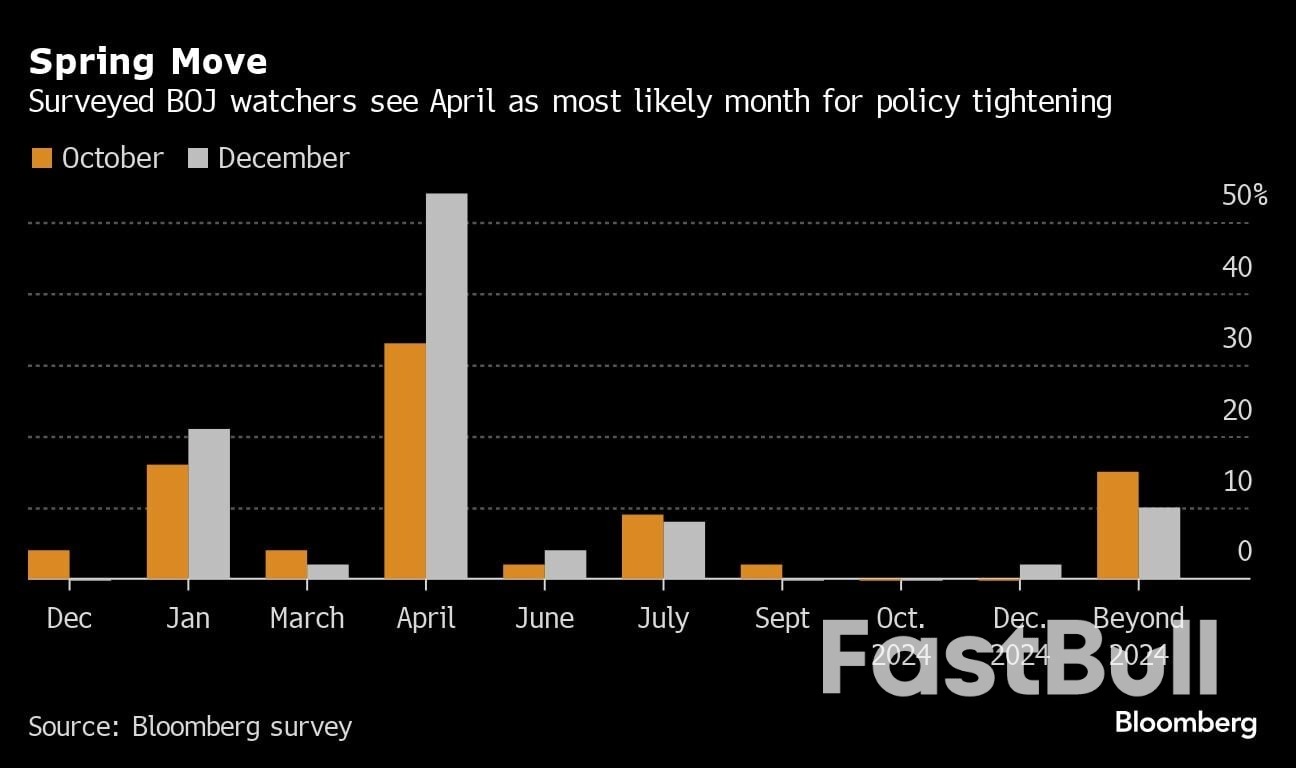
          More than two-thirds of polled economists see the BOJ scrapping its negative rate by April, with half of the 52 respondents saying it will happen that month. In the previous survey in October, 29% saw the move coming in April.
          The results come in a week where financial markets were jolted by the prospect of an even earlier end to sub-zero borrowing costs as traders reacted to comments from BOJ governor Kazuo Ueda and one of his deputies. Amid hints they could be preparing for a policy shift, Japanese bond yields surged by the most in a year and the yen strengthened almost 4%.
          Almost all of those surveyed expect the policy board to retain the negative rate and yield curve control programme when it gathers this month, with the focus falling on whether Ueda might drop any indication of changes to come in a policy statement or at his press conference following the Dec 19 decision.
          Two-Thirds of BOJ Watchers Expect End of Negative Rate Regime by April_1Leaving aside the issue of timing, some 78% of respondents said raising the short-term rate would be the next BOJ policy step when multiple options for such predictions were allowed.
          The results show growing expectations that authorities will seize the opportunity to normalise policy after getting confirmation of solid wage gains as part of annual spring wage negotiations.
          Some 52% said they expect the outcome from the talks to exceed results achieved this year. That's twice as many optimists compared with the previous survey and follows a series of ambitious pronouncements from labour unions aiming to build on this year's gains, which were the biggest in three decades.
          "The most beautiful scenario is the end of the negative rate in April," said Yasunari Ueno, chief market economist at Mizuho Securities. "Still, there is more than a little chance of scrapping it even in January or March as they want to get their homework done as early as possible given uncertainties in financial markets and the political climate."
          The BOJ added flexibility to its yield curve control (YCC) programme at the latest meeting in October. Only one economist expected a back-to-back move on YCC. More than three quarters of economists see zero risk of a change to rate policy this month.
          Two-Thirds of BOJ Watchers Expect End of Negative Rate Regime by April_2With that in mind, a key question for the BOJ watchers is whether Ueda and his board may use the December meeting to send smoke signals flagging the approach of policy normalisation. Some 36% said there is a chance that might happen, while half don't expect it.
          In an indication that market participants are getting more comfortable with the idea of a policy transition, some 94% of the economists said scrapping the negative rate wouldn't exert a major drag on the economy.
          On Thursday, 10-year sovereign debt yields climbed, while the yen rose to its strongest versus the dollar in months after remarks by BOJ deputy governor Ryozo Himino on Wednesday and by Ueda on Thursday prompted traders to move forward bets on policy normalisation. Nervousness continued on Friday with the 10-year gauge extending an increase to 0.8% and the yen surging by more than 1% at one point.
          "It seems more likely to us that, under governor Ueda, the BOJ makes an important policy shift when there is also a quarterly review of forecasts — ie in the January, April, July, October meetings," said Joey Chew, Head of Asia FX Research at HSBC Holdings plc. "But we can imagine how some market participants would recall previous governor Kuroda's penchant for policy surprises and therefore regard every meeting as 'live'."

          Source: Bloomberg

          To stay updated on all economic events of today, please check out our Economic calendar
          Risk Warnings and Disclaimers
          You understand and acknowledge that there is a high degree of risk involved in trading. Following any strategies or investment methods may lead to potential losses. The content on the site is provided by our contributors and analysts for information purposes only. You are solely responsible for determining whether any trading assets, securities, strategy, or any other product is suitable for investing based on your own investment objectives and financial situation.
          Comments
          Add to Favorites
          Share

          December's ECB Cheat Sheet: A Reality Check for Ultra-Dovish Expectations

          ING

          Economic

          Central Bank

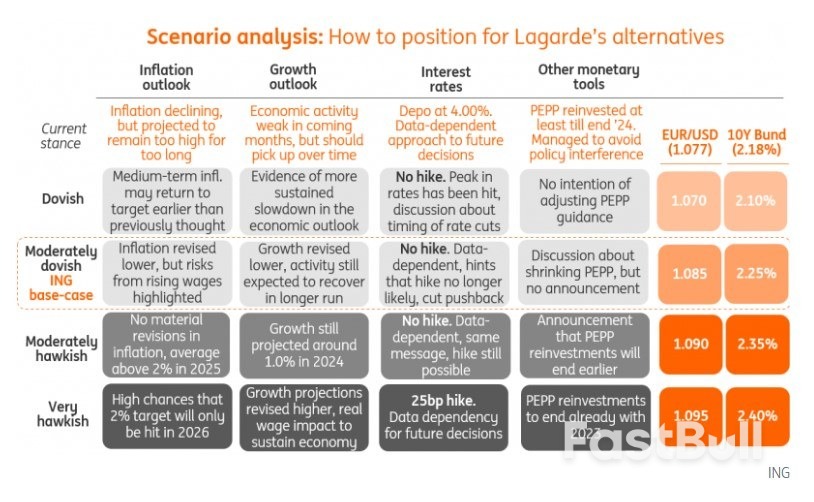
          December's ECB Cheat Sheet: A Reality Check for Ultra-Dovish Expectations_1Heading into the European Central Bank's December meeting, there is growing evidence that the Governing Council is split about the messaging being presented to markets. The generally arch-hawk Isabel Schnabel dropped strong dovish hints by ruling out rate hikes this week, and markets are now pricing in 135bp of cuts in the next 12 months. We see a good chance that the overall message at this meeting will fall short of endorsing aggressive rate cut expectations. Above are the market implications in various scenarios.

          A still-cautious ECB may not validate aggressive front end pricing

          A reassessment of inflation expectations has been in the lead in driving rates lower and raising the expectations of first rate cuts at the end of the first quarter next year. From next summer onwards, market indications point to anticipated headline inflation fixes below 2%. Indeed, the 2Y inflation swap has dropped to 1.8%.
          It is easy to overlook that at the same time, core inflation is currently still running at an elevated 3.6% year-on-year, giving the ECB enough reason to remain cautious. However, the pushback against aggressive market pricing has been half-hearted at best, with officials' remarks having put cuts in the first half of next year clearly into the realm of possibility. But whether they're likely is a different question. The ECB may well decide to let the data be the judge – but at the same time, it remains more reluctant to extrapolate to the extent that the market does. Its own inflation forecast may come down next week, but potentially not to the degree that markets are discounting.
          We see a good chance that the rally in front end rates – which currently discounts a 75% probability of a cut next March – stalls, if not unwinds to some extent. The longer end may see less upward pressure, though. In the extreme, the Governing Council coming across as overly hawkish and brushing off the faster disinflationary momentum could push markets into the belief that a policy mistake is in the making.

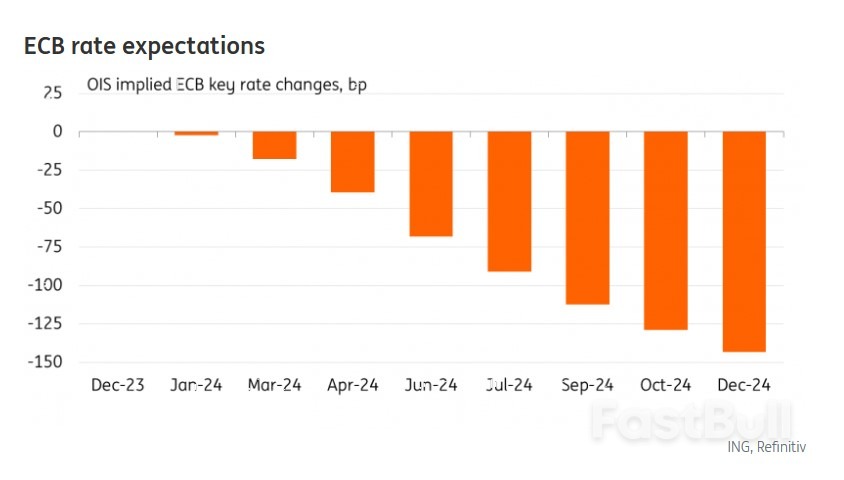
          December's ECB Cheat Sheet: A Reality Check for Ultra-Dovish Expectations_2Lagarde can throw a lifeline to the unloved euro

          The idiosyncratic decline of the euro has been one of the key themes in FX lately, with the common currency being the worst-performing currency so far in G10. The aggressive dovish repricing of ECB rate expectations has been the main driver, and the comments by Isabel Schnabel right before the pre-meeting quiet period have fuelled the bearish narrative further.
          With 125bp of cuts priced in by October and markets actively considering a start to the easing cycle already in March, it's difficult to see a bigger dovish repricing happening at this stage. That would suggest the euro does not have to fall much further from the current levels. Still, if only short-term rate differentials are taken into account, a decline to the 1.06 area in EUR/USD would not be an aberration. What is already halting the euro slump is the upbeat risk sentiment, which favours pro-cyclical currencies like the euro and caps the upside for the safe-haven dollar.
          We expect the ECB to continue its transition to a dovish narrative, but that will – in our view – happen at a slower pace than what markets are implying. We see tangible risks that the the central bank will push back against aggressive dovish speculations at this meeting, and the market may be forced to unwind some of those rate cuts bets, offering room for a EUR/USD rebound. That said, a EUR/USD recovery would struggle to extend much longer after the meeting due to the short-term EUR-USD swap spreads still pointing to a lower exchange rate.
          To stay updated on all economic events of today, please check out our Economic calendar
          Risk Warnings and Disclaimers
          You understand and acknowledge that there is a high degree of risk involved in trading. Following any strategies or investment methods may lead to potential losses. The content on the site is provided by our contributors and analysts for information purposes only. You are solely responsible for determining whether any trading assets, securities, strategy, or any other product is suitable for investing based on your own investment objectives and financial situation.
          Comments
          Add to Favorites
          Share

          Yen Rallies on Hints of BOJ Policy Shift

          Samantha Luan

          Forex

          The yen extended its towering rally on Friday and marched toward its best week against the dollar in nearly five months, as traders ramped up expectations that the end of Japan's ultra-low interest rates was closing in.
          The broad strength from the yen kept a lid on the dollar, which stayed on the defensive ahead of the closely-watched U.S. nonfarm payrolls report due later on Friday.
          Bank of Japan (BOJ) governor Kazuo Ueda said on Thursday the central bank had several options on which interest rates to target once it pulls short-term borrowing costs out of negative territory, and had on the same day met with Prime Minister Fumio Kishida.
          Markets took those comments as the clearest sign yet that the BOJ could soon phase out its ultra-loose monetary policy and catapulted the yen to multi-month highs against its major peers.
          Against the dollar, the yen was last steady at 144.30, after having surged over 2 per cent in the previous session and striking a four-month high of 141.60.
          The yen had, as recently as a month ago, fallen to a one-year low of 151.92 per dollar, coming under pressure as a result of growing interest rate differentials with the United States.
          That kept traders on edge over potential intervention from Japanese authorities to prop up the currency as it had done last year.
          The Japanese currency similarly stood near Thursday's four-month peak on the euro, and was last at 155.67 per euro.
          The Aussie meanwhile last bought 95 yen, retracing some of its losses from the previous session where it fell nearly 2 per cent.
          Attention now turns to the BOJ's upcoming two-day monetary policy meeting on Dec. 18.
          "Obviously, the markets got very excited," said Ray Attrill, head of FX strategy at National Australia Bank (NAB). "But I think a lot of us have felt that we were going to have some sort of more meaningful policy change this year, and we've been disappointed. So I'm a bit reluctant to jump on the bandwagon and say that (a change) is going to happen on the 19th.
          "But obviously, there's no smoke without fire... So I guess the market is understandably taking the view that the December meeting is live now."
          All Eyes on Payrolls
          In the broader market, the dollar largely drifted sideways, with currency moves outside of the yen subdued ahead of Friday's U.S. jobs data.
          The euro steadied at $1.0792 though was eyeing a weekly decline of more than 0.8 per cent, while sterling last bought $1.2589 and was similarly headed for a weekly fall of nearly 1 per cent.
          The U.S. dollar index slipped 0.05 per cent to 103.63, though was on track to gain 0.4 per cent for the week. That would snap three straight weeks of declines, as the greenback attempts to stem losses from its heavy selloff in November.
          "I'm more interested in seeing what happens with the unemployment rate and what happens with average earnings than the nonfarm payrolls numbers," said NAB's Attrill.
          "Obviously, if we get a big shock on the payrolls - a big downside or upside surprise - the markets' initial reaction will be governed by that."
          Elsewhere, the Australian dollar slipped 0.05 per cent to $0.6599.
          In China, the offshore yuan edged 0.1 per cent higher to 7.1560 per dollar.
          Data on Thursday showed the country's exports grew for the first time in six months in November, though imports unexpectedly shrunk.
          Concerns over the country's growth outlook continue to mount, with investor sentiment still fragile on the back of an uneven post-COVID recovery in the world's second-largest economy.
          Moody's had, earlier this week, slapped a downgrade warning on China's credit rating, and followed up a day later with cuts to its outlook on Hong Kong, Macau and swathes of China's state-owned firms and banks.
          "Moody's downgrade of China's rating outlook was motivated by concern over China's rising debt levels and possible need to bailout local state-owned enterprises," said William Xin, fixed income portfolio manager at M&G Investments, though he said the move had "failed to consider" Chinese policymakers' emphasis on reducing debt over the years.

          Source: Reuters

          Risk Warnings and Disclaimers
          You understand and acknowledge that there is a high degree of risk involved in trading. Following any strategies or investment methods may lead to potential losses. The content on the site is provided by our contributors and analysts for information purposes only. You are solely responsible for determining whether any trading assets, securities, strategy, or any other product is suitable for investing based on your own investment objectives and financial situation.
          Comments
          Add to Favorites
          Share

          December 8th Financial News

          FastBull Featured

          Daily News

          [Quick Facts]

          1. Yen-short positions may have been liquidated considerably.
          2. Biden impeachment inquiry set for House vote next week.
          3. Russia may lose two-thirds of its gas export revenue in 2023.
          4. Initial jobless claims edge up, signaling a cooling labor market.

          [News Details]

          Yen-short positions may have been liquidated considerably
          Bank of Japan (BOJ) Deputy Governor Himino Ryozo said at a press conference yesterday that the exit from the negative interest rate policy will have a relatively small impact on the Japanese economy. The BOJ will carefully assess the situation and consider the timing and procedures for exiting from negative interest rates.
          It has led to widespread speculation that the BOJ will raise interest rates, which are in negative territory now, in the first half of 2024. At one point in the day, overnight index swaps showed a nearly 45% probability of the BOJ ending its negative interest rate policy this month.
          Daiwa Securities said the near-term low for the USDJPY could be near $141, given its rapid rebound to around 143. Yen-short positions may have been liquidated considerably due to market speculation that the Bank of Japan will adjust its policy ahead of schedule. However, with increased volatility, a second or third wave of yen appreciation is still possible.
          With U.S. employment data due later in the day, the market is likely to react before the release of the data. Weak U.S. employment data could cause more selling of the U.S. dollar and send the USDJPY exchange rate to 141 again.
          Biden impeachment inquiry set for House vote next week
          U.S. House Republicans moved forward on Thursday to formally authorize an impeachment inquiry against Joe Biden for reasons related to his family's business dealings. Conservative Republicans have been pushing for an impeachment inquiry in recent months. The vote, which is expected to take place next week, will require all House members to publicly express support or opposition to the inquiry.
          For the 18 Republicans and some other lawmakers from districts that Biden won in 2020, they may be reluctant to take such action. House Speaker Mike Johnson, however, said he believes a vote is necessary, in part to counter the notion that the ongoing investigation is legally improper. For this authorization vote to succeed, Johnson and his deputy can only afford a "defection" of up to three Republicans, while Democrats may vote unanimously against the resolution. Johnson said he believes the resolution will pass.
          Russia may lose two-thirds of its gas export revenue in 2023
          Gazprom's revenue from overseas gas sales may plunge more than 70% this year, resulting in budget proceeds from gas exports falling to $6.5 billion from $24 billion in 2022, Reuters calculations show. Europe used to be Russia's key source of revenue from gas sales. However, Moscow's gas exports to the region have significantly diminished due to the Russia-Ukraine conflict and following last year's blasts at Nord Stream undersea gas pipelines.
          Gazprom's gas export revenue could fall to around $22 billion this year from a record $80 billion in 2022 when European spot prices soared to record high levels amid tight supplies, calculations show. The company's gas exports to regions outside the former Soviet Union will fall further from 100.9 billion cubic meters in 2022 to 68 billion cubic meters this year. Russia's Finance Ministry, however, expects budget revenues from gas exports to remain largely unchanged at around 567 billion rubles in 2024 and could increase to 620- 645 billion rubles in 2025-2026.
          Initial jobless claims edge up, signaling a cooling labor market
          The U.S. initial jobless claims came in at 220,000 for the week ended Dec. 2, compared to the expected 222,000 and the previous reading of 218,000. The U.S. continued jobless claims for the week of Nov. 25 were 1.861 million, compared with the expected 1.91 million and the previous 1.927 million. The four-week average initial jobless claims in the U.S. for the week of Dec. 2 rose to 220,750, compared with 220,000 in the previous week.
          Initial jobless claims declined, but the overall trend remains upward. And, despite following a climb over the past two months, U.S. continued jobless claims saw their biggest drop during the holiday week since July, dropping by 64,000 to 1.86 million in the week of Nov. 25. It was the second decline since early September, after spiking in the previous week. This was largely thanks to the volatility of the data and U.S. bonds, especially during the holiday. The four-week average of continued jobless claims is at its highest level in two years, and the data erased some of the volatility.
          Initial jobless claims are more volatile this time of year due to the holiday factor, making it difficult to get a clear signal on the job market. The report showed that there were 1.34 vacancies for every unemployed person in October, the lowest since August 2021.
          Several job market reports released this week suggest that the labor market is cooling. There remains one last "big show" of non-farm payrolls to verify the market's speculation.

          [Focus of the Day]

          UTC+8 15:35 ECB Governing Council Member Muller Speaks
          UTC+8 17:30 BOE Inflation Attitudes Survey
          UTC+8 21:30 U.S. Non-Farm Payrolls (SA) (Nov)
          Risk Warnings and Disclaimers
          You understand and acknowledge that there is a high degree of risk involved in trading. Following any strategies or investment methods may lead to potential losses. The content on the site is provided by our contributors and analysts for information purposes only. You are solely responsible for determining whether any trading assets, securities, strategy, or any other product is suitable for investing based on your own investment objectives and financial situation.
          Comments
          Add to Favorites
          Share

          Policy's Effect Being Felt

          Westpac

          Economic

          Q3 GDP for Australia surprised to the downside, printing 0.2% (2.1%yr). Relative to expectations, the key disappointment in the quarter was consumer spending, unchanged in Q3 after just a 0.1% gain in Q2. Per capita consumption growth is in the realm of –2.0%yr, second only to the GFC experience. Interest costs and tax payments are putting households under significant pressure, the drag from the latter being the largest ever recorded. Together these detractors wiped out a robust gain in nominal gross income in Q3. Also accounting for inflation, real disposable income has deteriorated materially (–4.3%yr).
          Elsewhere in the domestic economy, public demand was a key contributor to growth, rising 1.4% in the quarter. In part this explains some of the weakness in consumption – government subsidies reducing the cost of electricity for households. That public investment meanwhile extended its uptrend (+12%yr) reflects the pursuit of capacity to meet the needs of a growing population. The impetus seen in business investment H1 2023 is, in contrast, fading after the expiration of generous tax incentives. From 2.5% in Q2, quarterly growth in business investment is now just 0.6%.
          On trade, Australia's current account balance fell from a surplus of $7.8bn in Q2 to a slight deficit of –$0.2bn in Q3. That was primarily driven by a moderation in the trade position as the terms of trade continued to slip (–2.6% ), a trend that extended into October for goods. In real terms, the decline in export volumes (–0.7%) in Q3 was met with a lift in imports (+2.1%), leading net exports to subtract a material 0.6ppts from GDP in the three months to September.
          As detailed by Chief Economist Luci Ellis, the RBA's decision to leave policy unchanged earlier in the week was unsurprising given the constructive dataflow ahead of the decision. The Board's patience – to allow careful assessment of the dataflow – was further justified by the picture the National Accounts painted of the household sector.
          Westpac remains of the view that the RBA does not need to tighten any further. The Q4 CPI still holds some risk; but with the consumer clearly pulling back on discretionary spending in response to higher interest rates and a growing tax burden, not only is the Q4 CPI likely to show softer momentum, but the detail is also expected to imply persistence in this downtrend through 2024.
          Before moving offshore, a final note on housing. October's housing finance data showcased a 5.6% bounce in the value of owner-occupier loan approvals, centred on a surge in construction-related lending (+9.1%) and, to a lesser extent, loans for the purchase of existing dwellings (+4.6%). Highlighting the price-led nature of the cycle thus far, the volume of total owner-occupier loans is little-changed from last year (–0.6%) whilst the total value of loans has lifted 12.1% over the same period. Affordability will continue to have a significant bearing on housing market outcomes in 2024.
          Offshore, North America was in focus.
          The Bank of Canada kept rates steady at 5% in December. The statement noted "the economy is no longer in excess demand", implying that monetary policy is achieving its aims. Despite this, the Governing Council are still cautious on risks to wages and inflation and so "remains prepared to raise the policy rate further if needed". Arguably, the BoC are keen to restrain market participants from pricing in rate cuts too soon, thereby easing financial conditions and risking additional momentum in inflation. Having already had to resume rate hikes once, they won't want a repeat. Elevated wage growth is the primary risk for inflation, but it is receding as job creation and vacancies slow.
          South of the border, U.S. data pointed to a gradual easing in activity and the labour market. Factory orders fell 3.6%mth, with weakness in both durable and non-durable goods. Weaker demand sets the stage for a continued cooling of the labour market. The job openings rate declined 0.3ppts in October while hiring and separation rates were broadly stable, in line with pre-pandemic levels. The official U.S. employment report is out tonight; but, ahead of that release, the services ISM this week, and other business surveys previously, pointed to downside risks for employment from November.
          To stay updated on all economic events of today, please check out our Economic calendar
          Risk Warnings and Disclaimers
          You understand and acknowledge that there is a high degree of risk involved in trading. Following any strategies or investment methods may lead to potential losses. The content on the site is provided by our contributors and analysts for information purposes only. You are solely responsible for determining whether any trading assets, securities, strategy, or any other product is suitable for investing based on your own investment objectives and financial situation.
          Comments
          Add to Favorites
          Share

          Ripple vs. SEC Lawsuit Heats Up: $2 Billion Fine Despite XRP Win

          Glendon

          Economic

          The SEC (U.S. Securities and Exchange Commission) is seeking a hefty $2 billion fine from Ripple Labs for the alleged unlawful sale of XRP cryptocurrency. This comes after a partial victory for Ripple in court, where a judge ruled that some XRP sales were unregistered securities, but not all.

          SEC Claims Unregistered Security Sales

          The SEC filed a lawsuit against Ripple in 2020, accusing the company and its executives of raising over $1.3 billion through unregistered securities offerings of XRP. However, in a July 2023 ruling, Judge Analisa Torres determined that only XRP sales directly by Ripple to institutional investors qualified as unregistered securities, not sales on public exchanges. This was a significant setback for the SEC.

          Ripple Sees Growth Despite Legal Battle

          Despite the ongoing legal battle, Ripple has experienced a surge in institutional interest in XRP, particularly for cross-border transactions. Crypto expert Zach Rector points out that Ripple has secured 80 institutional sales contracts since the SEC lawsuit began. Additionally, Ripple's revenue from XRP sales has skyrocketed between 2021 and 2023, exceeding its total revenue from the previous six years (exact figures remain undisclosed).

          SEC Seeks Fine and Sales Ban

          In light of these continued sales and revenue growth, the SEC is seeking a $2 billion fine against Ripple and a permanent injunction to prevent future unregistered securities sales through institutional channels.

          Ripple Manages XRP Supply for Growth

          To meet institutional demand, Ripple releases 1 billion XRP from escrow each month, allocating 200 million for specific clients and returning the remaining 800 million into escrow. Ripple also actively buys XRP on the open market, showcasing its commitment to facilitating swift and affordable cross-border settlements for institutional users.

          Potential Advantage for Ripple in SEC's Damaged Case

          In a recent development potentially favoring Ripple, crypto experts James Murphy and Scott Melker highlighted a critical aspect of the SEC's case that could be weak. According to a precedent set by the Second Circuit Court of Appeals, the SEC must prove actual financial losses suffered by identifiable victims to claim damages. However, the SEC seems unable to pinpoint XRP buyers who have incurred such losses, weakening the foundation of its case against Ripple.
          This lack of identifiable victims undermines the SEC's arguments, particularly its claim for $200 million in interest based on disgorgement (returning ill-gotten gains to those harmed). Without clear evidence of financial harm, the legitimacy of the SEC's proposed $850 million penalty against Ripple is questionable. This scenario suggests a potentially favorable outcome for Ripple, highlighting the importance of proving real financial harm in securities lawsuits.

          SEC's Fine Seen as Excessive and Potentially Damaging

          The SEC's demand for a $2 billion fine has been criticized as an intimidation tactic and an overreach. If the court enforces such a fine, Ripple might be forced to liquidate approximately 3.22 billion XRP coins at the current market rate to cover the penalty. Alternatively, Ripple could utilize its reported $1 billion cash reserves, potentially mitigating the impact on XRP's market dynamics. This development signals a possible advantage for Ripple in its ongoing legal battle with the SEC.
          The Ripple case highlights the ongoing debate surrounding cryptocurrency regulation. The SEC's pursuit of a hefty fine despite a partial legal loss suggests the fight over XRP's classification and the future of crypto regulation is far from over.
          To stay updated on all economic events of today, please check out our Economic calendar
          Risk Warnings and Disclaimers
          You understand and acknowledge that there is a high degree of risk involved in trading. Following any strategies or investment methods may lead to potential losses. The content on the site is provided by our contributors and analysts for information purposes only. You are solely responsible for determining whether any trading assets, securities, strategy, or any other product is suitable for investing based on your own investment objectives and financial situation.
          Add to Favorites
          Share
          FastBull
          Copyright © 2025 FastBull Ltd

          728 RM B 7/F GEE LOK IND BLDG NO 34 HUNG TO RD KWUN TONG KLN HONG KONG

          TelegramInstagramTwitterfacebooklinkedin
          App Store Google Play Google Play
          Products
          Charts

          Chats

          Q&A with Experts
          Screeners
          Economic Calendar
          Data
          Tools
          Membership
          Features
          Function
          Markets
          Copy Trading
          Latest Signals
          Contests
          News
          Analysis
          24/7
          Columns
          Education
          Company
          Careers
          About Us
          Contact Us
          Advertising
          Help Center
          Feedback
          User Agreement
          Privacy Policy
          Business

          White Label

          Data API

          Web Plug-ins

          Poster Maker

          Affiliate Program

          Risk Disclosure

          The risk of loss in trading financial instruments such as stocks, FX, commodities, futures, bonds, ETFs and crypto can be substantial. You may sustain a total loss of the funds that you deposit with your broker. Therefore, you should carefully consider whether such trading is suitable for you in light of your circumstances and financial resources.

          No decision to invest should be made without thoroughly conducting due diligence by yourself or consulting with your financial advisors. Our web content might not suit you since we don't know your financial conditions and investment needs. Our financial information might have latency or contain inaccuracy, so you should be fully responsible for any of your trading and investment decisions. The company will not be responsible for your capital loss.

          Without getting permission from the website, you are not allowed to copy the website's graphics, texts, or trademarks. Intellectual property rights in the content or data incorporated into this website belong to its providers and exchange merchants.

          Not Logged In

          Log in to access more features

          FastBull Membership

          Not yet

          Purchase

          Become a signal provider
          Help Center
          Customer Service
          Dark Mode
          Price Up/Down Colors

          Log In

          Sign Up

          Position
          Layout
          Fullscreen
          Default to Chart
          The chart page opens by default when you visit fastbull.com