• Trade
  • Markets
  • Copy
  • Contests
  • News
  • 24/7
  • Calendar
  • Q&A
  • Chats
Trending
Screeners
SYMBOL
LAST
BID
ASK
HIGH
LOW
NET CHG.
%CHG.
SPREAD
SPX
S&P 500 Index
6827.42
6827.42
6827.42
6899.86
6801.80
-73.58
-1.07%
--
DJI
Dow Jones Industrial Average
48458.04
48458.04
48458.04
48886.86
48334.10
-245.98
-0.51%
--
IXIC
NASDAQ Composite Index
23195.16
23195.16
23195.16
23554.89
23094.51
-398.69
-1.69%
--
USDX
US Dollar Index
97.950
98.030
97.950
98.500
97.950
-0.370
-0.38%
--
EURUSD
Euro / US Dollar
1.17394
1.17409
1.17394
1.17496
1.17192
+0.00011
+ 0.01%
--
GBPUSD
Pound Sterling / US Dollar
1.33707
1.33732
1.33707
1.33997
1.33419
-0.00148
-0.11%
--
XAUUSD
Gold / US Dollar
4299.39
4299.39
4299.39
4353.41
4257.10
+20.10
+ 0.47%
--
WTI
Light Sweet Crude Oil
57.233
57.485
57.233
58.011
56.969
-0.408
-0.71%
--

Community Accounts

Signal Accounts
--
Profit Accounts
--
Loss Accounts
--
View More

Become a signal provider

Sell trading signals to earn additional income

View More

Guide to Copy Trading

Get started with ease and confidence

View More

Signal Accounts for Members

All Signal Accounts

Best Return
  • Best Return
  • Best P/L
  • Best MDD
Past 1W
  • Past 1W
  • Past 1M
  • Past 1Y

All Contests

  • All
  • Trump Updates
  • Recommend
  • Stocks
  • Cryptocurrencies
  • Central Banks
  • Featured News
Top News Only
Share

USA Embassy In Lithuania: Maria Kalesnikava Is Not Going To Vilnius

Share

USA Embassy In Lithuania: Other Prisoners Are Being Sent From Belarus To Ukraine

Share

Ukraine President Zelenskiy: Five Ukrainians Released By Belarus In US-Brokered Deal

Share

USA Vilnius Embassy: USA Stands Ready For "Additional Engagement With Belarus That Advances USA Interests"

Share

USA Vilnius Embassy: Belarus, USA, Other Citizens Among The Prisoners Released Into Lithuania

Share

USA Vilnius Embassy: USA Will Continue Diplomatic Efforts To Free The Remaining Political Prisoners In Belarus

Share

USA Vilnius Embassy: Belarus Releases 123 Prisoners Following Meeting Of President Trump's Envoy Coale And Belarus President Lukashenko

Share

USA Vilnius Embassy: Masatoshi Nakanishi, Aliaksandr Syrytsa Are Among The Prisoners Released By Belarus

Share

USA Vilnius Embassy: Maria Kalesnikava And Viktor Babaryka Are Among The Prisoners Released By Belarus

Share

USA Vilnius Embassy: Nobel Peace Prize Laureate Ales Bialiatski Is Among The Prisoners Released By Belarus

Share

Belarusian Presidential Administration Telegram Channel: Lukashenko Has Pardoned 123 Prisoners As Part Of Deal With US

Share

Two Local Syrian Officials: Joint US-Syrian Military Patrol In Central Syria Came Under Fire From Unknown Assailants

Share

Israeli Military Says It Targeted 'Key Hamas Terrorist' In Gaza City

Share

Rwanda's Actions In Eastern Drc Are A Clear Violation Of Washington Accords Signed By President Trump - Secretary Of State Rubio

Share

Israeli Military Issues Evacuation Warning In Southern Lebanon Village Ahead Of Strike - Spokesperson On X

Share

Belarusian State Media Cites US Envoy Coale As Saying He Discussed Ukraine And Venezuela With Lukashenko

Share

Belarusian State Media Cites US Envoy Coale As Saying That US Removes Sanctions On Belarusian Potassium

Share

Thai Prime Minister: No Ceasefire Agreement With Cambodia

Share

US, Ukraine To Discuss Ceasefire In Berlin Ahead Of European Summit

Share

Incoming Czech Prime Minister Babis: Czech Republic Will Not Take On Guarantees For Ukraine Financing, European Commission Must Find Alternatives

TIME
ACT
FCST
PREV
U.K. Trade Balance Non-EU (SA) (Oct)

A:--

F: --

P: --

U.K. Trade Balance (Oct)

A:--

F: --

P: --

U.K. Services Index MoM

A:--

F: --

P: --

U.K. Construction Output MoM (SA) (Oct)

A:--

F: --

P: --

U.K. Industrial Output YoY (Oct)

A:--

F: --

P: --

U.K. Trade Balance (SA) (Oct)

A:--

F: --

P: --

U.K. Trade Balance EU (SA) (Oct)

A:--

F: --

P: --

U.K. Manufacturing Output YoY (Oct)

A:--

F: --

P: --

U.K. GDP MoM (Oct)

A:--

F: --

P: --

U.K. GDP YoY (SA) (Oct)

A:--

F: --

P: --

U.K. Industrial Output MoM (Oct)

A:--

F: --

P: --

U.K. Construction Output YoY (Oct)

A:--

F: --

P: --

France HICP Final MoM (Nov)

A:--

F: --

P: --

China, Mainland Outstanding Loans Growth YoY (Nov)

A:--

F: --

P: --

China, Mainland M2 Money Supply YoY (Nov)

A:--

F: --

P: --

China, Mainland M0 Money Supply YoY (Nov)

A:--

F: --

P: --

China, Mainland M1 Money Supply YoY (Nov)

A:--

F: --

P: --

India CPI YoY (Nov)

A:--

F: --

P: --

India Deposit Gowth YoY

A:--

F: --

P: --

Brazil Services Growth YoY (Oct)

A:--

F: --

P: --

Mexico Industrial Output YoY (Oct)

A:--

F: --

P: --

Russia Trade Balance (Oct)

A:--

F: --

P: --

Philadelphia Fed President Henry Paulson delivers a speech
Canada Building Permits MoM (SA) (Oct)

A:--

F: --

P: --

Canada Wholesale Sales YoY (Oct)

A:--

F: --

P: --

Canada Wholesale Inventory MoM (Oct)

A:--

F: --

P: --

Canada Wholesale Inventory YoY (Oct)

A:--

F: --

P: --

Canada Wholesale Sales MoM (SA) (Oct)

A:--

F: --

P: --

Germany Current Account (Not SA) (Oct)

A:--

F: --

P: --

U.S. Weekly Total Rig Count

A:--

F: --

P: --

U.S. Weekly Total Oil Rig Count

A:--

F: --

P: --

Japan Tankan Large Non-Manufacturing Diffusion Index (Q4)

--

F: --

P: --

Japan Tankan Small Manufacturing Outlook Index (Q4)

--

F: --

P: --

Japan Tankan Large Non-Manufacturing Outlook Index (Q4)

--

F: --

P: --

Japan Tankan Large Manufacturing Outlook Index (Q4)

--

F: --

P: --

Japan Tankan Small Manufacturing Diffusion Index (Q4)

--

F: --

P: --

Japan Tankan Large Manufacturing Diffusion Index (Q4)

--

F: --

P: --

Japan Tankan Large-Enterprise Capital Expenditure YoY (Q4)

--

F: --

P: --

U.K. Rightmove House Price Index YoY (Dec)

--

F: --

P: --

China, Mainland Industrial Output YoY (YTD) (Nov)

--

F: --

P: --

China, Mainland Urban Area Unemployment Rate (Nov)

--

F: --

P: --

Saudi Arabia CPI YoY (Nov)

--

F: --

P: --

Euro Zone Industrial Output YoY (Oct)

--

F: --

P: --

Euro Zone Industrial Output MoM (Oct)

--

F: --

P: --

Canada Existing Home Sales MoM (Nov)

--

F: --

P: --

Euro Zone Total Reserve Assets (Nov)

--

F: --

P: --

U.K. Inflation Rate Expectations

--

F: --

P: --

Canada National Economic Confidence Index

--

F: --

P: --

Canada New Housing Starts (Nov)

--

F: --

P: --

U.S. NY Fed Manufacturing Employment Index (Dec)

--

F: --

P: --

U.S. NY Fed Manufacturing Index (Dec)

--

F: --

P: --

Canada Core CPI YoY (Nov)

--

F: --

P: --

Canada Manufacturing Unfilled Orders MoM (Oct)

--

F: --

P: --

Canada Manufacturing New Orders MoM (Oct)

--

F: --

P: --

Canada Core CPI MoM (Nov)

--

F: --

P: --

Canada Manufacturing Inventory MoM (Oct)

--

F: --

P: --

Canada CPI YoY (Nov)

--

F: --

P: --

Canada CPI MoM (Nov)

--

F: --

P: --

Canada CPI YoY (SA) (Nov)

--

F: --

P: --

Canada Core CPI MoM (SA) (Nov)

--

F: --

P: --

Q&A with Experts
    • All
    • Chatrooms
    • Groups
    • Friends
    Connecting
    .
    .
    .
    Type here...
    Add Symbol or Code

      No matching data

      All
      Trump Updates
      Recommend
      Stocks
      Cryptocurrencies
      Central Banks
      Featured News
      • All
      • Russia-Ukraine Conflict
      • Middle East Flashpoint
      • All
      • Russia-Ukraine Conflict
      • Middle East Flashpoint
      Search
      Products

      Charts Free Forever

      Chats Q&A with Experts
      Screeners Economic Calendar Data Tools
      Membership Features
      Data Warehouse Market Trends Institutional Data Policy Rates Macro

      Market Trends

      Market Sentiment Order Book Forex Correlations

      Top Indicators

      Charts Free Forever
      Markets

      News

      News Analysis 24/7 Columns Education
      From Institutions From Analysts
      Topics Columnists

      Latest Views

      Latest Views

      Trending Topics

      Top Columnists

      Latest Update

      Signals

      Copy Rankings Latest Signals Become a signal provider AI Rating
      Contests
      Brokers

      Overview Brokers Assessment Rankings Regulators News Claims
      Broker listing Forex Brokers Comparison Tool Live Spread Comparison Scam
      Q&A Complaint Scam Alert Videos Tips to Detect Scam
      More

      Business
      Events
      Careers About Us Advertising Help Center

      White Label

      Data API

      Web Plug-ins

      Affiliate Program

      Awards Institution Evaluation IB Seminar Salon Event Exhibition
      Vietnam Thailand Singapore Dubai
      Fans Party Investment Sharing Session
      FastBull Summit BrokersView Expo
      Recent Searches
        Top Searches
          Markets
          News
          Analysis
          User
          24/7
          Economic Calendar
          Education
          Data
          • Names
          • Latest
          • Prev

          View All

          No data

          Scan to Download

          Faster Charts, Chat Faster!

          Download App
          English
          • English
          • Español
          • العربية
          • Bahasa Indonesia
          • Bahasa Melayu
          • Tiếng Việt
          • ภาษาไทย
          • Français
          • Italiano
          • Türkçe
          • Русский язык
          • 简中
          • 繁中
          Open Account
          Search
          Products
          Charts Free Forever
          Markets
          News
          Signals

          Copy Rankings Latest Signals Become a signal provider AI Rating
          Contests
          Brokers

          Overview Brokers Assessment Rankings Regulators News Claims
          Broker listing Forex Brokers Comparison Tool Live Spread Comparison Scam
          Q&A Complaint Scam Alert Videos Tips to Detect Scam
          More

          Business
          Events
          Careers About Us Advertising Help Center

          White Label

          Data API

          Web Plug-ins

          Affiliate Program

          Awards Institution Evaluation IB Seminar Salon Event Exhibition
          Vietnam Thailand Singapore Dubai
          Fans Party Investment Sharing Session
          FastBull Summit BrokersView Expo

          Equatorial Guinea's Oil and Gas Industry Continues to Shrink

          Cohen

          Energy

          Summary:

          Oil and gas production was a boon for one of Africa's smallest nations, but it is now caught between dwindling hydrocarbon reserves and the pressures of the energy transition.
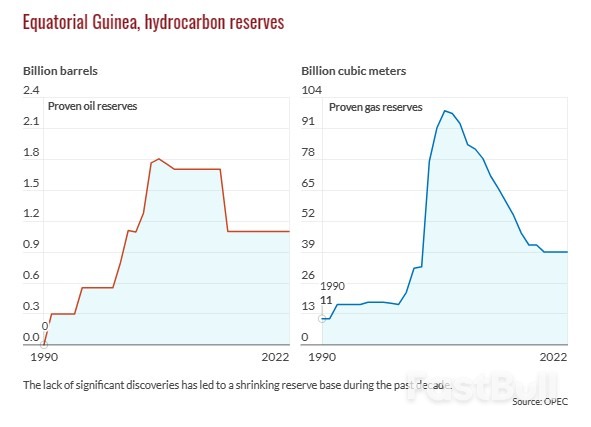
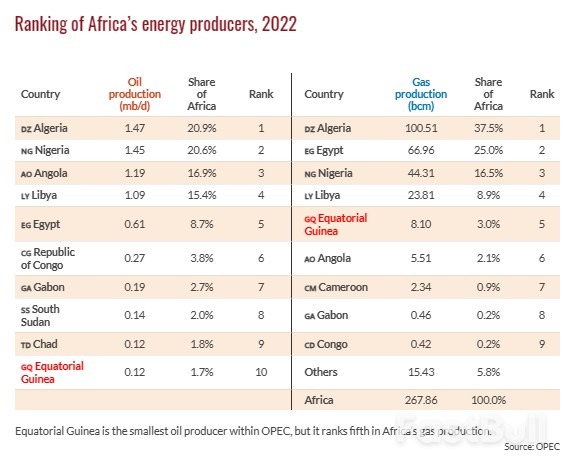
          In February 2024, American oil giant ExxonMobil announced it was exiting the Republic of Equatorial Guinea, effectively severing a nearly three-decade-long relationship. The company played a leading role in the development of the oil sector in the African nation. In 1995, Mobil Corporation discovered the Zafiro oil field, and Exxon entered the scene after its takeover of Mobil in 1999. The Zafiro field turned the country into a net exporter of oil. At its peak, it accounted for more than half of Equatorial Guinea's oil output, resulting in substantial economic benefits for the country.
          ExxonMobil's exit risks sending negative signals to other investors at a time when the government is keen on maintaining interest in its declining oil and gas sector. Darren Woods, CEO of ExxonMobil, said that the decision to leave the country is consistent with the company's strategy of reducing capital spending and focusing on regions with higher growth potential, such as Guyana and the Permian Basin in the United States. In other words, ExxonMobil did not see lucrative potential in the Equatorial Guinean oil sector. Meanwhile, the country's ambition to become a regional gas hub, capitalizing on its location on Central Africa's west coast, has yet to materialize.
          The decline of oil and gas production and the shrinking of an already small oil and gas reserves base spell serious trouble for an economy that is notably reliant on the proceeds of fossil fuels. To lead the oil-dependent country out of this crunch, the government of Equatorial Guinea would need to succeed simultaneously in a number of tough challenges. One is attracting suitable investment to expand the oil sector domestically. Another is reaching agreements with neighboring countries on both gas supplies and joint field development. At the same time, essential institutional reforms and economic diversification also need to occur in the country.
          Only this combined approach could help Equatorial Guinea reduce its vulnerability as the energy transition accelerates and marginalizes smaller oil and gas producers.

          Marginal producer with small proven reserves

          Equatorial Guinea is not particularly rich in oil or gas. Its proven oil reserves (1.1 billion barrels) account for about 0.07 percent of the world's total and 0.9 percent of Africa's, ranking 37th in the world and ninth in the continent. It has not even half of the reserves of its neighbor Gabon and only a fraction of those of Nigeria, with which it shares maritime borders.Equatorial Guinea's Oil and Gas Industry Continues to Shrink_1
          Its proven gas reserves are even smaller on both global and regional scales. At only 39 billion cubic meters, they are equivalent to what the United Kingdom consumed in 2022. This leaves Equatorial Guinea ranked 50th globally (at 0.02 percent of global reserves) and ninth in Africa (0.2 percent).
          The country's oil and gas output comes exclusively from its offshore fields. Oil production averaged 0.119 million barrels per day in 2022 (or 1.7 percent of Africa's production, and 0.1 percent of the world's), but that still puts the country among the continent's top 10 oil producers. Equatorial Guinea is the smallest producer within OPEC.Equatorial Guinea's Oil and Gas Industry Continues to Shrink_2

          Favorable conditions for energy exports

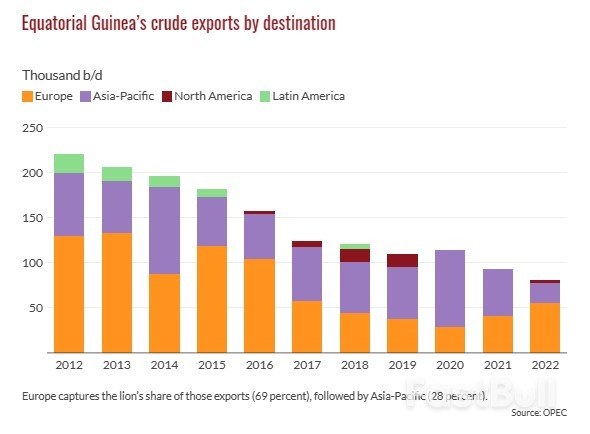
          Equatorial Guinea's domestic energy consumption is small – its population of around 1.75 million consumes only 4 percent of the country's oil output – which creates a sizeable surplus for exports. The country's location at an almost equal distance between the markets in Europe, Asia and North America gives it an additional advantage.Equatorial Guinea's Oil and Gas Industry Continues to Shrink_3
          Although natural gas plays a larger role in the country's energy mix (82 percent compared to 12 percent for oil) and electricity mix (67 percent versus 0.6 percent for oil), the local gas market is also small. That allows Equatorial Guinea to export the surplus in the form of liquefied natural gas (LNG) through its only liquefaction plant (operated by the company EG LNG in the capital city of Malabo). The plant has a capacity of five billion cubic meters per year – equivalent to 0.8 percent of the global liquefaction capacity.
          In 2022, Equatorial Guinea ranked 15th among LNG exporters globally. Its gas exports are more diversified than its oil exports, almost equally targeting the markets in Europe (37 percent), Asia-Pacific (34 percent) and Latin America (29 percent).
          Historically, the oil and gas sector generated substantial wealth for this small nation. Between 2007 and 2014, Equatorial Guinea was Africa's richest country on a per-capita basis – after being one of the poorest in the continent – and achieved an upper-middle-income status. Hydrocarbons account for nearly 50 percent of both exports and gross domestic product (GDP) and over 70 percent of government revenues (in 2022).
          That high dependence highlights the peril Equatorial Guinea is facing. According to the World Bank, declining oil reserves and a failure to diversify its economy have been contracting the country's output for almost a decade. Between 2013 and 2023, it shrunk at an average rate of 4.2 percent per year.

          Short-lived boom followed by decline

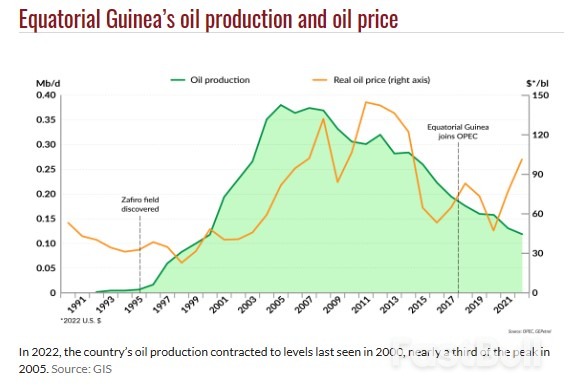
          Equatorial Guinea's oil industry experienced a golden era from the mid-1990s to 2005, starting with the discovery of Zafiro's oil field. ExxonMobil held a 71.25 percent interest in the field, while state-owned Guinea Equatorial de Petroleos (GEPetrol) and the government have 23.75 percent and 5 percent participating interests, respectively.
          The field began production in record time in 1996, which was followed by several discoveries. However, the rapid ramp-up in production and a short-lived peak in 2005 of 380,000 barrels per day was followed by a substantial decline. In 2022, oil production contracted to levels last seen in 2000, nearly a third of the peak. There are no signs that the decline will be reversed under existing conditions. The main reason for that decline can be attributed to the scarcity of discoveries: the last discovery made was in 2007, in the Aseng field.
          In 2017, Equatorial Guinea joined the Organization of the Petroleum Exporting Countries (OPEC), becoming the fourth sub-Saharan country to join the producers' organization after Nigeria (1971), Gabon (1975) and Angola (2007). Interestingly, the other three joined OPEC when their oil outputs were experiencing rapid expansions, whereas Equatorial Guinea joined when its production was at half its peak. The World Bank explains the country's decision to join OPEC as an attempt to boost foreign investment and technology transfers from other member countries, especially those in the Persian Gulf.Equatorial Guinea's Oil and Gas Industry Continues to Shrink_4
          Natural gas has performed relatively better, even though the gas era started with the discovery of the Alba gas field in 1984, and production began in 1991 – earlier than oil production. The field still accounts for approximately 45 percent of the country's daily output, and it is its sole supplier of feed gas to its LNG plant in Malabo, which has been operational since 2007. The aging of the Alba field has reduced the total output of the country: production peaked already in 2013, but the decline has been smoother compared to the precipitous fall in oil production. Meanwhile, the growth in domestic demand is further reducing the country's export capacity.
          In the hope of safeguarding Equatorial Guinea's gas exports and attracting international interest, its government set forth a vision of establishing the country as a regional gas liquefaction hub, receiving the commodity from domestic fields and also from neighboring Cameroon and Nigeria for processing and exporting it to international markets.
          Such a plan would extend the lifespan of the country's LNG facility, which is in jeopardy since gas supplies from the Alba field have begun to decline. The project, however, is progressing at a slow pace. It faces hurdles that include finalizing agreements with neighboring countries on the development of cross-border oil and gas fields, securing potential supplies and building connecting pipelines.

          Trying a different approach

          In 2019, Malabo launched a licensing round to allocate 27 oil and gas blocks. In the end, three blocks were awarded to small players, such as Africa Oil Corp, a Canadian oil and gas company focused on Africa, and Panoro Energy, a London-based independent company. Following the licensing round, the then Minister of Mines and Hydrocarbons Gabriel Mbaga Obiang Lima was quoted as saying, "We will plan to do another licensing round and it will be done differently." In 2023, the government adopted an "open-door policy" whereby any company can express interest and enter into direct negotiations with the government. One block was awarded in 2023 to Panoro Energy as a result of such negotiations.
          An open-door strategy is usually adopted when the success of a bidding round is doubtful. Generally, bidding rounds are the superior and most widely-pursued strategies for allocating oil and gas licenses. However, their success hinges on several factors – some that go beyond a country's borders, such as prevailing oil and gas prices. Others relate to the country's potential. When prices are high and the country's oil and gas sector has a promising outlook, then competition among bidders tends to be strong, resulting in a windfall for the government.
          A failed bidding round that does not attract sufficient interest can damage a government's bargaining position. To avoid such an outcome, governments use direct negotiations. However, the problems with this policy are the lack of transparency in allocating the licenses, and that there is no guarantee of the best outcome for the government as a competitive bidding round would offer.

          Source: GIS

          Risk Warnings and Disclaimers
          You understand and acknowledge that there is a high degree of risk involved in trading. Following any strategies or investment methods may lead to potential losses. The content on the site is provided by our contributors and analysts for information purposes only. You are solely responsible for determining whether any trading assets, securities, strategy, or any other product is suitable for investing based on your own investment objectives and financial situation.
          Add to Favorites
          Share

          Is the Stock Market Set for A Cruel Summer?

          Kevin Du

          Economic

          Stocks

          Summer is coming, and all too often that spells a slowdown for the stock market, as traders grow drowsy and dream of beaches.
          Many recall the old advice to "Sell in May and go away …" and wonder whether there's truth in it.
          April was the cruellest month, with the S&P 500 falling 4.1 per cent. With the long-awaited first US interest rate cut postponed to the autumn, or possibly 2025, investors could be forgiven for having sunshine on their minds, rather than stocks and shares.
          Those feeling guilty about absenting themselves can take solace from summers past, says Tony Hallside, chief executive of Dubai-based prime brokerage firm STP Partners.
          "Historically, the S&P 500 has grown just 2 per cent for the six months from May through October, compared with a 7 per cent gain from November through April."
          While this supports the "Sell in May" thesis, as ever with investing, past performance is no guide to the future, Mr. Hallside warns.
          Not every summer is a washout. So, what about this one?
          Mr. Hallside is wary as the spring rally has left stocks looking overvalued.
          "Investors are right to be cautious, due to the potential for a correction," he says.
          Selling in May – or any month – is never a good idea, unless you need the money. It's better to sit tight, let the dividends roll in, and keep an eye open for opportunities.
          "Investors should consider adopting a defensive approach, taking advantage of the recent pullback to buy quality stocks at lower prices," Mr. Hallside says.
          Fears that 2024 would be a cruel summer for investors have been fuelled by US consumer price inflation, which climbed from 3.2 per cent in February to 3.5 per cent in March, instead of falling as hoped.
          Markets had hoped for six interest rate cuts across 2024, which would cut borrowing costs and increase growth.
          With inflation proving hot and sticky, they now expect two at best, with the first delayed until September. We may get none at all.
          Marc Pussard, head of risk at APM Capital, says that given today's heavy weather, even buying the dip may be risky.
          The S&P 500 is up 6 per cent this year, despite April's dip, which he suggests looks "frothy", given that the US economy grew a disappointing 1.6 per cent in the first quarter.
          A recession cannot be ruled out, either. The US yield curve has been signalling a slump since July 2022.
          "If that continues, it would only be a matter of time before equity markets reflect this sentiment," Mr. Pussard says.
          He notes that US Federal Reserve chair Jerome Powell has said that its decisions will be data-dependent.
          "Maybe this isn't the time to buy the dip, but rather sit on your hands and wait for more data," Mr. Pussard says.
          Or sit on the beach, maybe? It's tempting.
          Yet, there was a flurry of excitement when April's US labour market report was published last week and turned out to be softer than expected.
          "With fewer job gains, moderate earnings growth and slightly higher unemployment, the market is seemingly finally cooling," says Julius Baer chief economist David Kohl.
          "Lower inflation risks increase the probability of more rate cuts in 2024."
          Just not in the summer. "We continue to expect the Fed to start cutting at its September meeting," Mr. Kohl adds.
          Mohamed Hashad, chief market strategist at Noor Capital, is not expecting a cool, quiet summer.
          Not with inflation high, trading volumes down and inflation falling faster in Britain and Europe than in the US.
          Monetary policies are starting to diverge. "Inflation is declining in the EU and the UK, but interest rate volatility exists in Japan," he says.
          The UK was hit harder by the inflation shock than most, because of its reliance on imported oil and gas. Now price growth seems to be slowing faster than elsewhere. April's data could see inflation falling back to the Bank of England's 2 per cent target.
          If that happens, the central bank will come under intense pressure to slash interest rates even if the Fed doesn't.
          The UK economy desperately needs a lift, with the Organisation for Economic Co-operation and Development predicting it will be the slowest growing in the G7 over the next two years.
          While Wall Street fell in April, London's FTSE 100 broke the 8,000 barrier for only the second time ever, as it hit a string of all-time highs.
          UK shares remain cheap after Brexit, and international investors have taken note.
          Eurozone inflation fell to just 2.4 per cent in March, which means the European Central Bank could have a decision to make, too.
          Yet the US still leads the way and it's facing a bumpy summer, says Vijay Valecha, chief investment officer at Century Financial.
          US tech has driven the market rally, but Nvidia and Tesla look pricey.
          "The S&P 500 is trading at about 20 times earnings forecasts, above the historical average. Strong earnings alone may not sustain the rally, and companies will need to consistently surpass estimates to justify higher stock prices," he adds.
          Investors are becoming more demanding and seeking positive surprises. They may not get them, Mr. Valecha says. "Stagflation is a real risk."
          With US interest rates stuck at a 22-year high, borrowers are coming under pressure, increasing the risk of company defaults.
          "In a higher-for-longer interest rate environment, firms are depleting their cash reserves as earnings moderate and debt servicing costs rise," Mr. Valecha says.
          The International Monetary Fund highlighted the growing number of small and medium-sized companies whose cash reserves are running low, he adds.
          "Defaults are also increasing in the leveraged loan market, where financially weaker firms borrow, yet most investors have disregarded these concerns."
          Mr. Valecha suggests that investors should "go light on their equity investments", and even consider seeking safety in US government bonds.
          Many will read that and wonder whether they should follow their instincts and hit the beach after all.
          The excitement may arrive in September when we get that first-rate cut.
          It's tempting but investors shouldn't completely tune out. Markets called spring wrong. Summer might be full of surprises, too.

          Source: The National News

          To stay updated on all economic events of today, please check out our Economic calendar
          Risk Warnings and Disclaimers
          You understand and acknowledge that there is a high degree of risk involved in trading. Following any strategies or investment methods may lead to potential losses. The content on the site is provided by our contributors and analysts for information purposes only. You are solely responsible for determining whether any trading assets, securities, strategy, or any other product is suitable for investing based on your own investment objectives and financial situation.
          Add to Favorites
          Share

          India Fires Up Coal Use and Emissions During Election, Heat Wave

          Thomas

          Energy

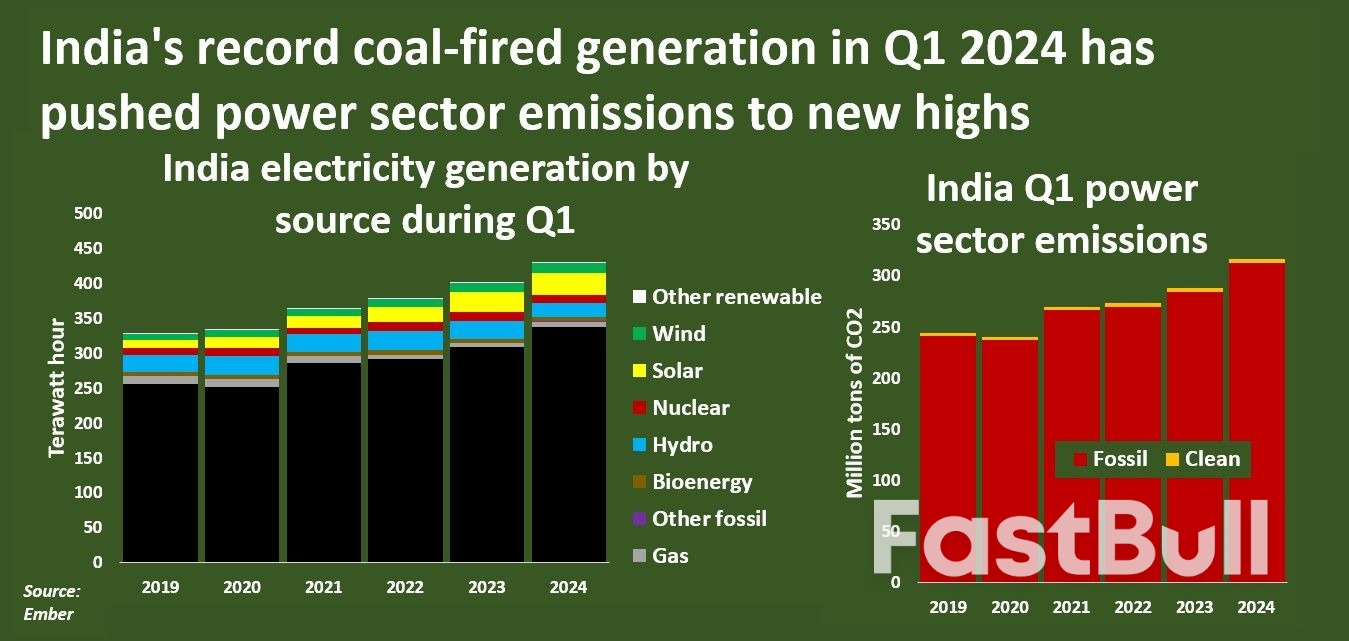
          India's coal-fired electricity generation and power sector emissions hit record highs during the first quarter as above-average temperatures spurred higher air conditioner use and economic expansion drove greater overall power consumption.
          Coal-fired electricity output hit 338 terawatt hours during the first quarter of 2024, according to think tank Ember, which marked a 9.6% rise from the same quarter in 2023.
          Total power sector emissions climbed by the same degree to a record 316 million metric tons of carbon dioxide and equivalent gases.India Fires Up Coal Use and Emissions During Election, Heat Wave_1
          The country's power sector discharged a record 108 million tons of CO2 in March alone, and has emitted more than 100 million tons of CO2 each month so far in 2024, a record stretch for the country's power suppliers.
          An extended heat wave throughout much of the country has likely resulted in even higher coal-fired generation since March, as power firms attempt to avert outages during the ongoing general election.

          Intense Heat

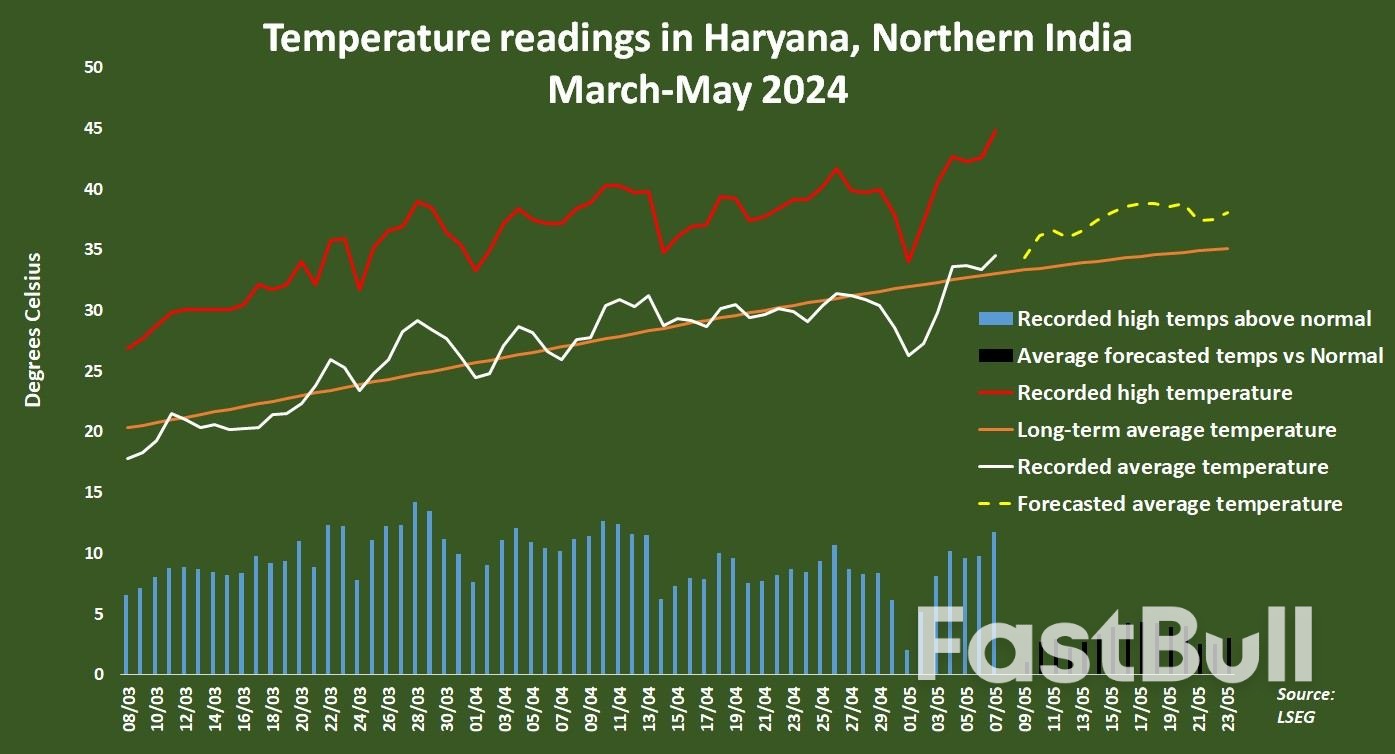
          A key driver of the high levels of coal use has been the extended stretch of above-normal temperatures across much of the country.
          Recorded high temperatures in the northern state of Haryana, which borders the country's capital New Delhi, have averaged 38.7 degrees Celsius (101.6 degrees Fahrenheit) since April 1, 9.2 C or 31% above the long-term average, according to LSEG data.India Fires Up Coal Use and Emissions During Election, Heat Wave_2
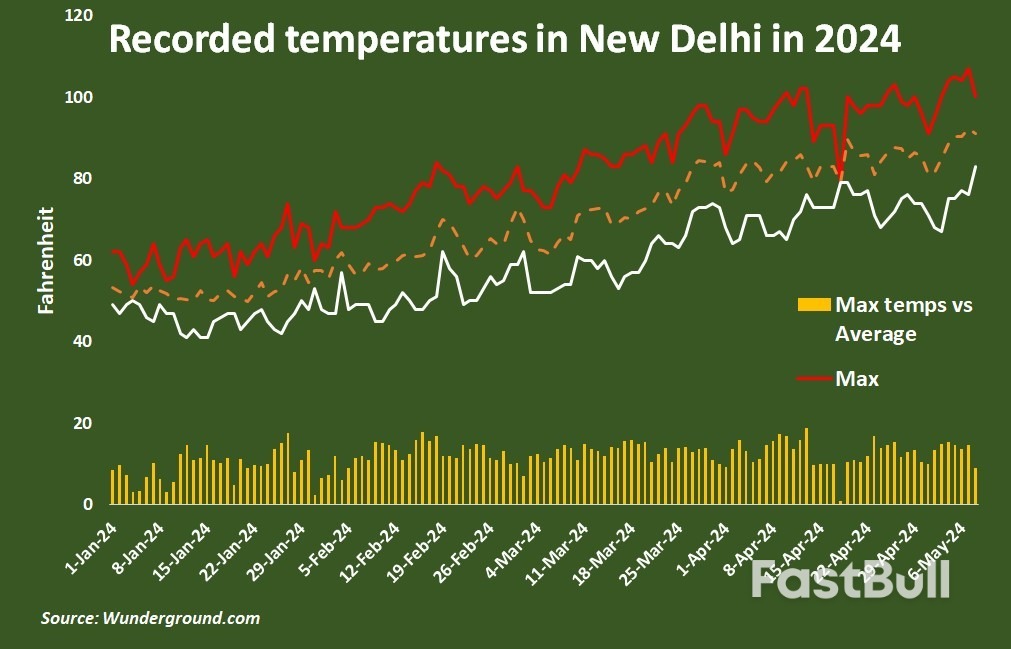
          In New Delhi itself, recorded high temperatures have surpassed 35 C (95 F) on 26 of the 38 days since April 1, with temperatures averaging around 15% above normal, according to the Weather Underground data service.India Fires Up Coal Use and Emissions During Election, Heat Wave_3
          The mean temperature in eastern India during April was 28.12 C (82.61 F), the highest since records began in 1901, according to the India Meteorological Department.
          Such a prolonged heat wave has resulted in at least nine deaths and reduced voter turnout at election offices as people sought refuge during the hottest parts of the day.

          Cool Drive

          A key means of keeping cool is through the use of air conditioners, which are power-hungry devices that are becoming increasingly popular in homes and businesses throughout the country.
          India has an estimated 93 million air conditioning units installed as of 2024, according to the International Energy Agency (IEA), which in a 2023 report noted that space cooling demand has been a major driver of India's growing electricity demand.
          "Between 2019 and 2023, India's hourly electricity demand on a high-temperature day in June (above 36 C maximum daily temperature) increased on average by about 28%, caused largely by increased ownership of air conditioners to meet higher cooling needs and other appliances."
          Due to expected further increases in average temperatures in India over the coming decades, electricity demand for household air conditioners is projected to increase nine-fold by 2050, to more than 1.1 billion air conditioning units, IEA data shows.

          Cooling With Coal

          To keep up with demand, India's electricity producers must crank coal-fired power generation, which accounts for more than 75% of total electricity output in the country, according to Ember.
          Indian utilities have aggressively increased generation from renewable sources in recent years, with solar output during the first quarter of 2024 roughly twice the generation total during the same period in 2020.
          Output from wind farms has also grown since 2020, by around 30%.
          But production from hydro dams is historically volatile due to swings in India's rainfall patterns, with first-quarter 2024 hydro output down 20% from the same period of 2023. And generation from nuclear plants is largely flat, so power firms remain highly reliant on fossil fuels for the lion's share of the country's electricity.
          As the emissions stemming from the use of those fuels contributes to further climate change and rising temperatures, the country looks set to remain locked in a vicious cycle of needing to burn more coal to keep cool.

          Source: Reuters

          Risk Warnings and Disclaimers
          You understand and acknowledge that there is a high degree of risk involved in trading. Following any strategies or investment methods may lead to potential losses. The content on the site is provided by our contributors and analysts for information purposes only. You are solely responsible for determining whether any trading assets, securities, strategy, or any other product is suitable for investing based on your own investment objectives and financial situation.
          Add to Favorites
          Share

          Economic Hard Landing Is Delayed But Not Cancelled

          Thomas

          Economic

          Two years ago, central banks around the world started hiking interest rates. At the time many commentators, including this one, predicted that the end of years of easy money would cause asset prices to collapse and economies to buckle. Yet no recession arrived. Indeed U.S. economic growth picked up after 2022. Following the briefest of bear markets, American stocks hit a new high.
          In his book “Expert Political Judgment: How Good Is It? How Can We Know?”, published in 2005, the political scientist Philip Tetlock argues that experts often provide rationalisations for their forecasting failures after the event. One of the most common is “it would have happened except for…”. There is no shortage of such arguments to explain the absence of an economic hard landing.
          To start, it is worth pointing out that the bears did not get everything wrong. Bond markets in 2022 suffered their worst 12-month performance since the introduction of British consols in 1753, according to Professor Edward McQuarrie of Santa Clara University. Many speculative investments have crashed. Commercial property markets in many parts of the world are in distress.
          Nevertheless, the transmission mechanism between monetary policy and the economy appears weaker than in the past. Yields on long-term U.S. government debt have been lower than short-term bond yields for 18 months. Investors formerly considered such an inverted yield curve as the most reliable leading indicator of a recession.
          Economic Hard Landing Is Delayed But Not Cancelled_1
          Covid-19 stimulus lingered long after the emergency was over. During the pandemic, the federal government in Washington made vast transfers to American households. Excess consumer savings peaked at $2.5 trillion in September 2021, according to Julien Garran of the Macrostrategy Partnership. The subsequent drawing down of this savings pile has boosted consumption.
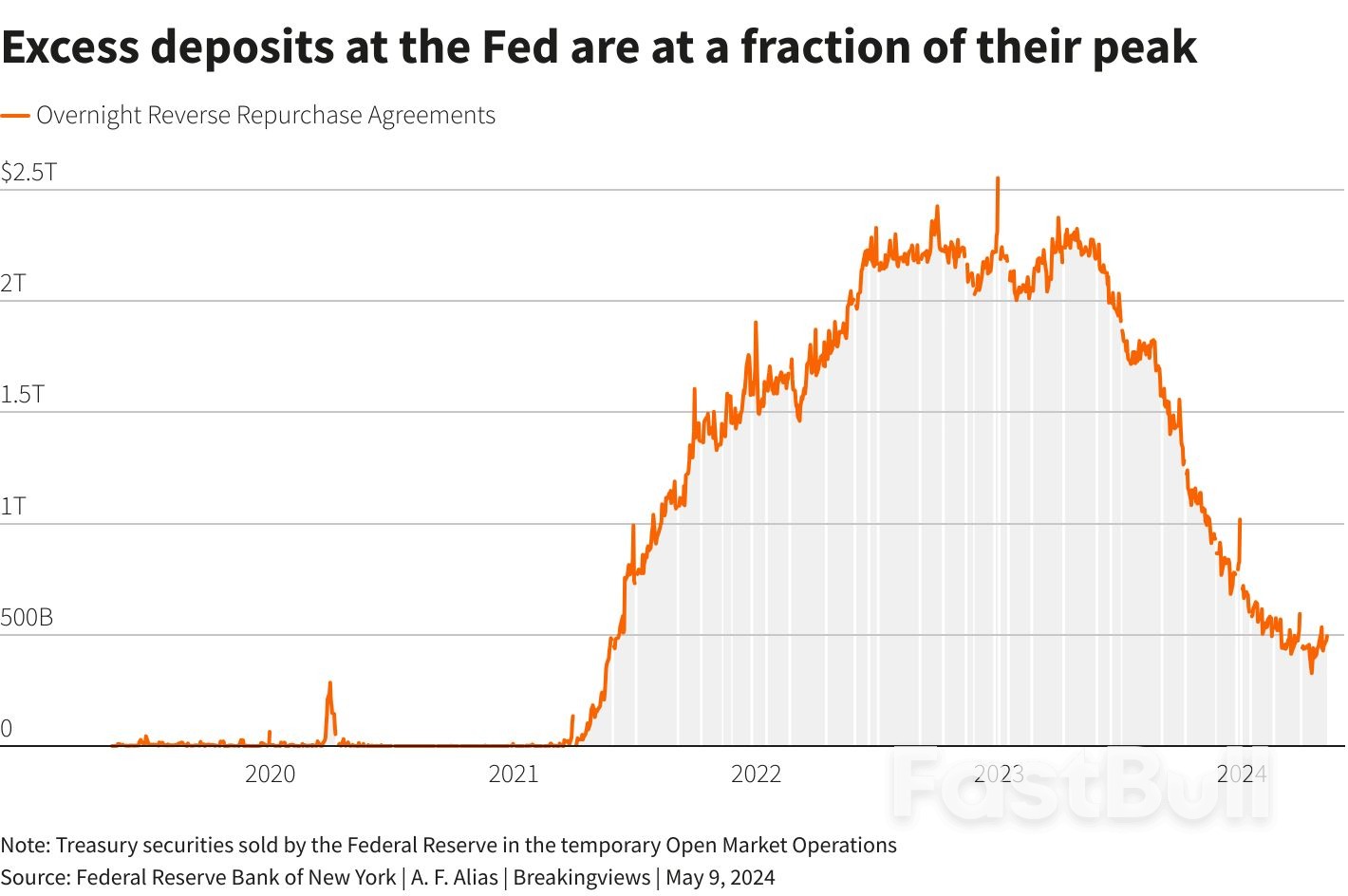
          Furthermore, much of the liquidity provided to the financial system by the Federal Reserve in 2021 and 2022 initially flowed back into the central bank's overnight reverse repo facility. Garran estimates that the recent outflow of these deposits from the Fed has pumped a net $1.25 trillion into U.S. markets, more than offsetting the impact of higher interest rates and the Fed's shrinking balance sheet.
          Jamie Lee of The Grantham Foundation has another explanation for why higher interest rates have not choked the economy. Before the financial crisis of 2008, central banks did not pay interest on excess bank reserves. As a result, commercial banks immediately felt the pain of tighter monetary policy. Lee points out that deposits at the central bank are the safest and most liquid form of money, used for settling transactions between lenders. In the past these deposits were scarce and, because they did not attract interest, expensive for banks to hold.
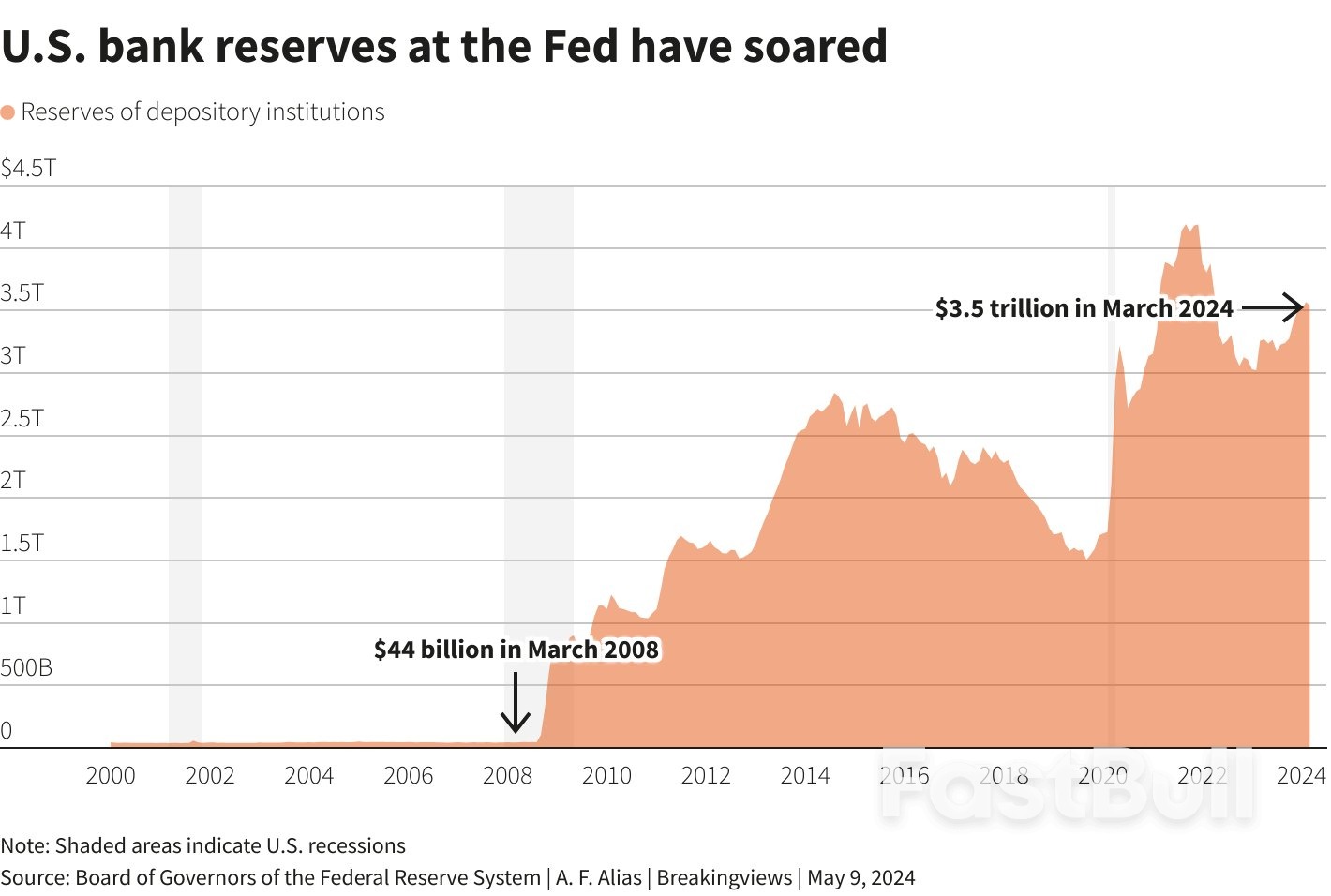
          Since 2008, however, the Fed has been paying interest on reserves. They have become super-abundant, rising from $44 billion in March 2008 to $3.5 trillion by March 2024. When the central bank hikes interest rates, it therefore creates money which is paid into the banking system, boosting liquidity. “When the Fed ‘raises rates', it leaves the bid-ask spread for final settlement money unchanged, at virtually zero. Tightening is not tightening after all,” Lee explains. In this sense, more restrictive monetary policy is actually easier.
          Economic Hard Landing Is Delayed But Not Cancelled_2
          There are two other reasons why the U.S. economy has shown itself less sensitive to higher interest rates. Torsten Slok, chief economist of Apollo Global Management, argues that both homebuyers and corporations took advantage of easy money conditions to borrow at low interest rates. Because interest payments on most U.S. residential mortgages are fixed for decades, homeowners have been insulated against rate hikes.
          Meanwhile, large U.S. corporations extended the maturity of their debt during the pandemic. With the investment-grade corporate debt market having grown from $3 trillion in 2009 to $9 trillion today, American companies have become less sensitive to short-term movements in interest rates, according to Slok.
          At the same time, large companies are now receiving more interest income on their deposits. This explains the curious fact that net corporate interest payments in the United States fell after the Fed raised interest rates.
          The second reason for the U.S. economy's resilience to monetary tightening is an extraordinary spending splurge by the government. The federal deficit in 2023 was $1.7 trillion, equal to 6.3% of GDP. This provided a strong tailwind for growth, employment, and corporate profits.
          Economic Hard Landing Is Delayed But Not Cancelled_3
          These various monetary and fiscal supports are now largely exhausted. U.S. aggregate demand and corporate earnings will face a squeeze when Washington reins in spending. Excess deposits in the Federal Reserve's reverse repo facility are at a fraction of their peak. Consumers have largely spent their pandemic-era excess savings.
          Meanwhile, tighter monetary policy is pinching. The U.S. commercial real estate market is a slow-motion train wreck: vacancies are sky-high and property valuations are down sharply. Hedges against higher interest rates, which typically last for three years, are expiring and are prohibitively expensive to renew. Defaults on commercial mortgage-backed securities are rising.
          Many real estate borrowers are seeking to amend and extend their maturing loans. Owners of multi-family apartments — buildings divided into multiple homes — are struggling to pay interest on floating-rate loans, many of which are held by collateralised loan obligations. Apartment construction in the United States surged during the pandemic: a record one million multi-family apartments were under construction last year. Oversupply may further depress prices, hurting both real estate developers and lenders.
          Economic Hard Landing Is Delayed But Not Cancelled_4
          The leveraged buyout industry is wilting under the heat of higher interest rates. The International Monetary Fund recently warned of systemic risks posed by the $2.1 trillion “opaque and highly inter-connected” world of private credit dominated by private equity groups. Private companies which cannot access the bond markets are also suffering from higher interest costs. Hordes of corporate zombies are slowly returning to their graves.
          The economist Milton Friedman famously said that monetary policy works with long and variable lags. Those lags may be longer and more variable today than in earlier times. But sooner or later, they end. Tetlock's experts had another favourite comeback when faced with a mistaken prediction: “it hasn't happened yet,” they said. Those who foresaw a hard landing that has so far proved elusive might say the same.

          Source: Reuters

          To stay updated on all economic events of today, please check out our Economic calendar
          Risk Warnings and Disclaimers
          You understand and acknowledge that there is a high degree of risk involved in trading. Following any strategies or investment methods may lead to potential losses. The content on the site is provided by our contributors and analysts for information purposes only. You are solely responsible for determining whether any trading assets, securities, strategy, or any other product is suitable for investing based on your own investment objectives and financial situation.
          Add to Favorites
          Share

          Wall St Gains Ahead of Fed Officials' Remarks; Dow Nears 40,000 Mark

          Warren Takunda

          Economic

          Stocks

          U.S. stocks rose on Friday, as investors eagerly awaited comments from Federal Reserve officials to get more clarity on the U.S. monetary policy path, after economic data this week supported bets of interest rate cuts.
          Wall Street indexes were inching closer to record highs following a selloff last month, as a slew of economic data pointed to a cooling U.S. labor market, raising expectations that the Fed will cut borrowing costs more than once this year.
          A much better-than-expected earnings season has also helped put the benchmark S&P 500 (.SPX) and the tech-heavy Nasdaq Composite (.IXIC) on track for their third consecutive week of gains.
          The Dow Jones Industrial Average (.DJI) was up for the eight straight session, its longest daily winning run since December, and set for a fourth week of gains.
          The blue-chip index was also closing in on the 40,000 threshold for the first time.
          "This is the classic point of bad news is good news because the employment data over the last two weeks has been what the Fed has finally been looking for," said Hugh Anderson, managing director at HighTower Advisors.
          "Of course it isn't good for the job seeker, but it creates an optimistic environment for the market because now they're looking for their interest rate cuts."
          Traders are currently pricing in 45 basis points of rate cuts by the end of 2024, according to LSEG's rate probabilities tool, with the first cut of 25 bps seen in September.
          While most Fed policymakers have reiterated that the next policy move will be a rate cut, doubt still remains about when the easing will begin.
          There is "considerable" uncertainty about where U.S. inflation will head in coming months, San Francisco Fed President Mary Daly said on Thursday.
          Speeches from a host of Fed policymakers — Minneapolis President Neel Kashkari, Dallas President Lorie Logan and Vice Chair for Supervision Michael Barr — during the day, could offer more clues on the rate path.
          Investors will also closely monitor the University of Michigan's preliminary survey of consumer sentiment for May, which is due at 10 a.m. ET.
          Of the 11 S&P 500 sectors, information technology (.SPLRCT) led gains with a 1% advance.
          At 09:37 a.m. ET, the Dow Jones Industrial Average (.DJI) rose 165.26 points, or 0.42%, to 39,553.02, the S&P 500 (.SPX) gained 20.84 points, or 0.40%, to 5,234.92 and the Nasdaq Composite (.IXIC) gained 67.49 points, or 0.41%, to 16,413.76.
          Nvidia (NVDA.O) gained 2% in early trading after Taiwan Semiconductor Manufacturing Co (2330.TW), the world's largest chipmaker and a major supplier to Nvidia, reported a near 60% jump in April sales.
          Novavax shares (NVAX.O) more than doubled in value after the vaccine maker removed doubts about its ability to remain in business and struck a licensing deal worth up to $1.2 billion with Sanofi (SASY.PA) for COVID-19 vaccines.
          SoundHound AI (SOUN.O) jumped 19.5% after its first-quarter revenue beat market estimates.
          Advancing issues outnumbered decliners by a 2.37-to-1 ratio on the NYSE and by a 1.41-to-1 ratio on the Nasdaq.
          The S&P 500 posted 42 new 52-week highs and no new lows, while the Nasdaq recorded 104 new highs and 17 new lows.

          Source: Reuters

          To stay updated on all economic events of today, please check out our Economic calendar
          Risk Warnings and Disclaimers
          You understand and acknowledge that there is a high degree of risk involved in trading. Following any strategies or investment methods may lead to potential losses. The content on the site is provided by our contributors and analysts for information purposes only. You are solely responsible for determining whether any trading assets, securities, strategy, or any other product is suitable for investing based on your own investment objectives and financial situation.
          Add to Favorites
          Share

          Euro-Dollar Looks to Clock 4th Consecutive Weekly Advance

          Warren Takunda

          Economic

          Dollar exchange rates continue to retrace 2024 strength, with the most recent declines being attributed to fresh evidence that the U.S. economy is cooling.
          "The dollar was slammed lower as traders interpreted the cracks in the labor market as a harbinger of cooler inflation ahead, which in turn would allow the Fed to cut interest rates faster," says Marios Hadjikyriacos, Senior Investment Analyst at XM.com.
          Applications for unemployment benefits - initial jobless claims - rose by a brisk 231K last week, which is usually an early sign of workers being laid off. "The highest reading in nearly nine months supported the case for rate cuts," says analyst John Meyer at the SP Angel.
          "This is another indication that the jobs market is losing momentum, following an uptick in the unemployment rate last month and warnings from business surveys that companies have started to reduce workforce numbers," says Hadjikyriacos.
          Euro-Dollar rose above the 1.07 marker last week after the official jobs report showed non-farm payrolls increased 175K in April, down from March's 315K and undershooting expectations for 238K.
          The official unemployment rate unexpectedly rose to 3.9% from 3.8% while average hourly earnings rose 0.2% month-on-month in April, down from the previous month's 0.3% and below expectations for 0.3%.
          "Our bullish USD view has been based on two motivating pillars: the dollars carry advantage despite being a defensive currency and persistent U.S. exceptionalism. The former remains intact, but the latter appears to be in the early stages of losing its sheen," says Meera Chandan, an analyst at JPMorgan in London.Euro-Dollar Looks to Clock 4th Consecutive Weekly Advance_1

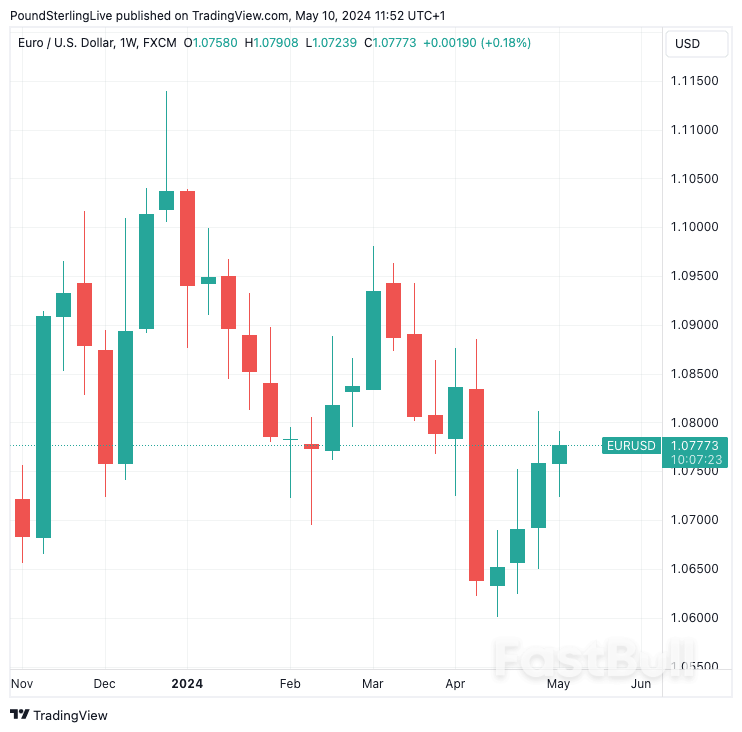
          Above: EUR/USD at weekly intervals. It is still too soon to say the trend has turned.

          Euro-Dollar continues to be driven by the bigger Dollar, meaning the advance will depend on further signs of a U.S. economic slowdown.
          "Next week will be critical for the US dollar, featuring the simultaneous release of the latest retail sales and CPI inflation prints on Wednesday. It is a rare phenomenon for two top-tier US economic datasets to be released together, which sets the stage for heightened volatility in the markets," says Hadjikyriacos.
          Valentin Marinov, Head of FX Research at Crédit Agricole, says in the absence of any significant upside inflation surprises or hawkish signals from the Federal Reserve, global financial conditions should remain supportive for FX carry trades.
          The Dollar is a leading beneficiary of the carry trade, a trade that sees investors borrow in low interest rate currencies (JPY, CHF) and invest in high interest rate currencies (USD).
          "Next week’s US CPI and retail sales as well as Fed speeches (including a speech by Jerome Powell on 14 May) would thus attract considerable attention," says Marinov.
          For now analysts see weakness as a counter-trend correction from overbought conditions, but doubts about the Dollar's ability to retest 2024 highs will grow if next week's inflation figures suggest the stalled disinflation process is underway again.

          Source: Poundsterlinglive

          To stay updated on all economic events of today, please check out our Economic calendar
          Risk Warnings and Disclaimers
          You understand and acknowledge that there is a high degree of risk involved in trading. Following any strategies or investment methods may lead to potential losses. The content on the site is provided by our contributors and analysts for information purposes only. You are solely responsible for determining whether any trading assets, securities, strategy, or any other product is suitable for investing based on your own investment objectives and financial situation.
          Add to Favorites
          Share

          ‘The Lower Income Consumer in the US Is Stretched’: Pepsi's CEO Isn’t The Only Executive Worried about the Economy

          Samantha Luan

          Economic

          Consumer goods giants from PepsiCo to Kraft Heinz have described recently how the combination of high inflation and higher interest rates is hurting their lower-income customers.
          It's the culmination of everything getting more expensive amid high inflation, even if it's not as bad as before, and the drag of higher interest rates because of more expensive credit-card and other payments.
          Remarkably resilient spending by U.S. consumers overall has been one of the main reasons the economy has avoided a recession, at least so far. Capitulation at the lower end of the spectrum could be the first crack for the economy.
          “The lower income consumer in the U.S. is stretched,” PepsiCo CEO Ramon Laguarta said late last month when reporting better profit than expected, and “is strategizing a lot to make their budgets get to the end of the month. And that's a consumer that is choosing what to buy, where to buy, and making a lot of choices.”
          At Tyson Foods, during a conference call to discuss its better-than-expected results for the latest quarter, one of the first questions asked by a Wall Street analyst was for executives of the company to describe how they see the state of the U.S. consumer.
          “As you know, the consumer is under pressure, especially the lower income households,” Chief Growth Officer Melanie Boulden said.
          She said the producer of beef, pork, chicken and prepared foods has seen customers shift away from fine dining and toward quick-service restaurants. It's also seen customers drop down from those not-as-expensive restaurants to eating more at home.
          Kraft Heinz CEO Carlos Arturo Abrams-Rivera also said lower-income customers are pulling back from restaurants and convenience stores. That's even as higher-income earners buy more Kraft Heinz products because they're spending more on travel and entertainment.
          At Mondelez International, Chief Financial Officer Luca Zaramella recently told analysts that U.S. sales of some products particularly popular with lower-income households have been weakening, such as Chips Ahoy cookies.
          Much of the commentary recently has come from big food and drink companies, but several retailers will be joining them in upcoming weeks. Walmart, Dollar General and others will offer more evidence about how well or not lower-income Americans are faring.
          Of course, it's not just the lowest-earning households bothered by higher prices for seemingly everything.
          “We're in an environment where the consumer is being price discriminating and, again, that's not just something that's low income,” McDonald's CEO Chris Kempczinski said after reporting his company's latest quarterly results. “I think all consumers are looking for good value, for good affordability, and so we're focused on that action.”

          Source: Fortune

          To stay updated on all economic events of today, please check out our Economic calendar
          Risk Warnings and Disclaimers
          You understand and acknowledge that there is a high degree of risk involved in trading. Following any strategies or investment methods may lead to potential losses. The content on the site is provided by our contributors and analysts for information purposes only. You are solely responsible for determining whether any trading assets, securities, strategy, or any other product is suitable for investing based on your own investment objectives and financial situation.
          Add to Favorites
          Share
          FastBull
          Copyright © 2025 FastBull Ltd

          728 RM B 7/F GEE LOK IND BLDG NO 34 HUNG TO RD KWUN TONG KLN HONG KONG

          TelegramInstagramTwitterfacebooklinkedin
          App Store Google Play Google Play
          Products
          Charts

          Chats

          Q&A with Experts
          Screeners
          Economic Calendar
          Data
          Tools
          Membership
          Features
          Function
          Markets
          Copy Trading
          Latest Signals
          Contests
          News
          Analysis
          24/7
          Columns
          Education
          Company
          Careers
          About Us
          Contact Us
          Advertising
          Help Center
          Feedback
          User Agreement
          Privacy Policy
          Business

          White Label

          Data API

          Web Plug-ins

          Poster Maker

          Affiliate Program

          Risk Disclosure

          The risk of loss in trading financial instruments such as stocks, FX, commodities, futures, bonds, ETFs and crypto can be substantial. You may sustain a total loss of the funds that you deposit with your broker. Therefore, you should carefully consider whether such trading is suitable for you in light of your circumstances and financial resources.

          No decision to invest should be made without thoroughly conducting due diligence by yourself or consulting with your financial advisors. Our web content might not suit you since we don't know your financial conditions and investment needs. Our financial information might have latency or contain inaccuracy, so you should be fully responsible for any of your trading and investment decisions. The company will not be responsible for your capital loss.

          Without getting permission from the website, you are not allowed to copy the website's graphics, texts, or trademarks. Intellectual property rights in the content or data incorporated into this website belong to its providers and exchange merchants.

          Not Logged In

          Log in to access more features

          FastBull Membership

          Not yet

          Purchase

          Become a signal provider
          Help Center
          Customer Service
          Dark Mode
          Price Up/Down Colors

          Log In

          Sign Up

          Position
          Layout
          Fullscreen
          Default to Chart
          The chart page opens by default when you visit fastbull.com