Markets
News
Analysis
User
24/7
Economic Calendar
Education
Data
- Names
- Latest
- Prev


Signal Accounts for Members
All Signal Accounts
All Contests


China, Mainland M1 Money Supply YoY (Nov)--
F: --
P: --
China, Mainland M0 Money Supply YoY (Nov)--
F: --
P: --
China, Mainland M2 Money Supply YoY (Nov)--
F: --
P: --
U.S. 30-Year Bond Auction Avg. YieldA:--
F: --
P: --
Argentina CPI MoM (Nov)A:--
F: --
P: --
Argentina National CPI YoY (Nov)A:--
F: --
P: --
Argentina 12-Month CPI (Nov)A:--
F: --
P: --
U.S. Weekly Treasuries Held by Foreign Central BanksA:--
F: --
P: --
Japan Industrial Output Final MoM (Oct)A:--
F: --
P: --
Japan Industrial Output Final YoY (Oct)A:--
F: --
P: --
U.K. Services Index MoM (SA) (Oct)A:--
F: --
P: --
U.K. Services Index YoY (Oct)A:--
F: --
P: --
Germany HICP Final YoY (Nov)A:--
F: --
P: --
Germany HICP Final MoM (Nov)A:--
F: --
P: --
U.K. Trade Balance Non-EU (SA) (Oct)A:--
F: --
P: --
U.K. Trade Balance (Oct)A:--
F: --
P: --
U.K. Services Index MoMA:--
F: --
P: --
U.K. Construction Output MoM (SA) (Oct)A:--
F: --
P: --
U.K. Industrial Output YoY (Oct)A:--
F: --
P: --
U.K. Trade Balance (SA) (Oct)A:--
F: --
P: --
U.K. Trade Balance EU (SA) (Oct)A:--
F: --
P: --
U.K. Manufacturing Output YoY (Oct)A:--
F: --
P: --
U.K. GDP MoM (Oct)A:--
F: --
P: --
U.K. GDP YoY (SA) (Oct)A:--
F: --
P: --
U.K. Industrial Output MoM (Oct)A:--
F: --
P: --
U.K. Manufacturing Output MoM (Oct)A:--
F: --
P: --
U.K. Monthly GDP 3M/3M Change (Oct)A:--
F: --
P: --
Germany CPI Final MoM (Nov)A:--
F: --
P: --
Germany CPI Final YoY (Nov)A:--
F: --
P: --
U.K. Construction Output YoY (Oct)A:--
F: --
P: --
France HICP Final MoM (Nov)--
F: --
P: --
China, Mainland Outstanding Loans Growth YoY (Nov)--
F: --
P: --
U.K. Inflation Rate Expectations--
F: --
P: --
India CPI YoY (Nov)--
F: --
P: --
India Deposit Gowth YoY--
F: --
P: --
Brazil Services Growth YoY (Oct)--
F: --
P: --
Mexico Industrial Output YoY (Oct)--
F: --
P: --
Germany Current Account (Not SA) (Oct)--
F: --
P: --
Russia Trade Balance (Oct)--
F: --
P: --
Philadelphia Fed President Henry Paulson delivers a speech
Canada Building Permits MoM (SA) (Oct)--
F: --
P: --
Canada Wholesale Sales YoY (Oct)--
F: --
P: --
Canada Wholesale Inventory MoM (Oct)--
F: --
P: --
Canada Wholesale Inventory YoY (Oct)--
F: --
P: --
Canada Wholesale Sales MoM (SA) (Oct)--
F: --
P: --
U.S. Weekly Total Rig Count--
F: --
P: --
U.S. Weekly Total Oil Rig Count--
F: --
P: --
Japan Tankan Large Non-Manufacturing Diffusion Index (Q4)--
F: --
P: --
Japan Tankan Small Manufacturing Outlook Index (Q4)--
F: --
P: --
Japan Tankan Large Non-Manufacturing Outlook Index (Q4)--
F: --
P: --
Japan Tankan Large Manufacturing Outlook Index (Q4)--
F: --
P: --
Japan Tankan Small Manufacturing Diffusion Index (Q4)--
F: --
P: --
Japan Tankan Large Manufacturing Diffusion Index (Q4)--
F: --
P: --
Japan Tankan Large-Enterprise Capital Expenditure YoY (Q4)--
F: --
P: --
China, Mainland Industrial Output YoY (YTD) (Nov)--
F: --
P: --
China, Mainland Urban Area Unemployment Rate (Nov)--
F: --
P: --
Saudi Arabia CPI YoY (Nov)--
F: --
P: --
Euro Zone Industrial Output YoY (Oct)--
F: --
P: --
Euro Zone Industrial Output MoM (Oct)--
F: --
P: --
Canada Existing Home Sales MoM (Nov)--
F: --
P: --
Euro Zone Total Reserve Assets (Nov)--
F: --
P: --


No matching data
Latest Views
Latest Views
Trending Topics
Top Columnists
Latest Update
White Label
Data API
Web Plug-ins
Affiliate Program
View All

No data
Economists predict the next shift in European Central Bank interest rates will be up, aligning with the views of investors and influential Executive Board member Isabel Schnabel as inflation settles around 2%.
More than 60% of respondents in a Bloomberg survey say officials are more likely to raise borrowing costs than lower them — a meaningful change from October, when only a third shared that outlook.
It's not something they expect to happen anytime soon, however: The deposit rate is seen remaining at 2% on Dec. 18 and throughout the next two years.
Analysts are revising their forecasts after inflation stabilized and the euro zone's economy weathered global trade stress and geopolitical upheaval surprisingly well.
In an interview, Schnabel cited such resilience — and rosier prospects, helped by a glut of government spending — among reasons why she's "rather comfortable" with wagers for rates to rise next. One gauge points to a first increase in the latter half of 2027.
Most Governing Council members say simply that rates are in a "good place" for the time being. For President Christine Lagarde, the task will be to reflect their confidence that dangers to the economy are waning without encouraging the idea that hikes are getting close, according to Jan von Gerich, chief strategist at Nordea. That's an opinion shared by others.
"The biggest challenge is one of communication, particularly against a backdrop of rapidly-evolving market expectations," said Paul Hollingsworth, chief European economist at BNP Paribas.
Hollingsworth and von Gerich both forecast quarter-point hikes in September and December 2027. Were traders to bet on more rapid action, tighter financing conditions would pose a headwind for the economy — just as it's expected to pick up.
Indeed, survey respondents reckon next week's new quarterly projections from the ECB will paint a brighter picture for growth — something Lagarde herself has also suggested.
On inflation, concerns linger about 2027, when a holdup in the European Union's new carbon-pricing system could weigh. Most economists, though, expect a September forecast for prices to rise 1.9% that year to be maintained.
Eyes will then shift to 2028 — the first time it will feature in the outlook. The poll indicates a figure just above the ECB's 2% goal, leaving almost two-thirds of analysts more worried about an overshoot of the medium-term target than an undershoot.
Even those who think price pressures will be materially weaker in three years don't consider them soft enough alone to trigger another decrease in borrowing costs.
"The ECB should feel rates are properly set at present as inflation risks are comparatively balanced," Scope economist Dennis Shen said. "We don't expect any rate reductions in 2026, but the ECB will keep its options open."
One reason to remain flexible, according to Shen, is the potential for more US cuts next year. The Federal Reserve eased for a third straight meeting this week and may lower once more in 2026. Kevin Hassett, the frontrunner to replace Chair Jerome Powell, sees "plenty of room" for more substantial moves, however.
US policy — monetary as well as trade — is still deemed the most acute threat to the euro area, with the war in Ukraine remaining a big concern.
Against that backdrop, Swedbank's Chief Economist Nerijus Maciulis foresees one more cut by the ECB in March, arguing that bullishness on the region's growth prospects "rests on flimsy foundations."
"Unless we are talking about hiking down the well-trodden scenic Alpine paths, Governing Council members are unlikely to hike any time soon," he said.
About 45% of respondents, though, say economic growth is predominantly restrained by structural forces beyond the ECB's control. These include sluggish manufacturing amid stiffer competition from China, costly energy and excessive bureaucracy.
Nearly half say those hurdles are just as strong as cyclical drags, illustrating why policymakers are expected to show patience before considering more rate cuts — even if growth and inflation disappoint.
"Monetary policy can't solve structural growth problems," said ING's Carsten Brzeski, who sees officials standing pat at least through 2027. "A 25 basis-point rate cut by the ECB won't make the German automotive industry more competitive vis-a-vis China."
Former Prime Minister Theresa May suggested the threat to her Conservative Party posed by the poll-leading Reform UK is over-egged, saying that while Nigel Farage's outfit "makes a lot of noise," plenty can change before the next election.
Speaking on Bloomberg's Leaders with Francine Lacqua show, May pointed to Reform only having five of the 650 Members of Parliament, and said the party's economic policies are "all over the place."
"The only poll that ever counts is the general election," said May, who served as prime minister from 2016 to 2019. "It's all very well doing well in opinion polls this far out from a general election, but when it comes to it, people want to ask who should be in government? Critical to that will be the economy."
May's remarks will be seen as a call for the Conservatives to avoid the pull of Reform's populism and instead stake out the center ground of UK politics at a time when Labour Prime Minister Keir Starmer is tacking to the left with higher taxes and public spending.
"They are forgetting some of the fundamentals of growth," May said in the wider interview, pointing to the current government's move last year to hike payroll taxes for employers. "I think they don't understand business."
The Tories may take May's views on electoral strategy with a pinch of salt, given her decision to call a snap election in 2017 backfired spectacularly. She had hoped to increase her slim majority to strengthen her hand as she negotiated a Brexit deal, but ended up losing her Parliamentary advantage altogether and being forced to rely on the support of Northern Ireland's Democratic Unionist Party in order to govern.
Still, the former premier — who's now a member of the House of Lords — said "there's always a role for a center, center-right party" such as the Conservatives, and gave words of encouragement for the current Tory leader, Kemi Badenoch, who after a rocky start delivered a well-received speech at the party's annual conference in October.
"She's doing well in what is the most difficult job in politics," May said, referring to the role of leader of the opposition.
Asked about the Tory prime ministers that followed her, May appeared to take a swipe at her immediate successor, Boris Johnson, and the premier who replaced him, Liz Truss. Johnson was eventually forced out of his office by his own party following the Partygate scandal involving lockdown-breaking gatherings during the pandemic, while Truss lasted just 7 weeks in power after the financial markets rejected her disastrous so-called mini-budget.
"Unfortunately as a Conservative Party we seem to have lost our value of integrity and our economic competence," May said.
May's own premiership was defined by her struggle to find a path to Brexit which pleased the Eurosceptic and remain elements of her party. She said that her biggest regret was not getting a deal passed — before reflecting that the need to devote time to other foreign affairs issues may have hampered her efforts.
"You do have to spend quite a bit of time on foreign policy" as prime minister, May said. "It perhaps doesn't leave as much time for being with your colleagues in Parliament," she said, adding that "I wonder whether if I'd been able to spend more time with them, we would've had a different result."
While she didn't mention Starmer, those words could be applied to the current premier, who's been dubbed "Never Here Keir" by British media for the amount of time he spends abroad, having racked up dozens of overseas visits since coming to power in July 2024.
Starmer on Wednesday batted away implicit criticism of his travels from a Tory lawmaker as a "load of nonsense," pointing out that his engagement with foreign leaders had yielded progress on trade with the US, India and EU and was necessary at a "critical stage" of talks to end the conflict in Ukraine.
May said that ultimately, the issue that's likely to determine the next general election, due in mid-2029, is the economy. Reform has led the national polls since April, with Labour and the Tories — the two parties that have dominated British politics for a century — around 10 points adrift and struggling to close the gap.
May said she worries that in this increasingly "polarized world" politicians are losing the ability to compromise which she sees as central to government. She attributed the rise of populist parties such as Farage's in part to social media, which she said made politicians "feel they've got to be talking about what they're doing the whole time, putting it out there."
"The trouble with that is it means it focuses it much more on them rather than on what the overall good is, what they're trying to achieve," she said. "In government, you don't just deliver by snapping your fingers."
Japan's core inflation rate likely held well above the central bank's 2% target in November, a Reuters poll showed on Friday, although moderating food price hikes have taken some pressure off consumers ahead of an expected rate hike next week.
The nationwide core consumer price index (CPI), which includes energy items but excludes fresh food prices, was expected to have risen 3.0% in November from a year earlier, according to the median forecast of the 18 economists polled.
The rate would be the same as in October, after a 2.9% rise in September and a 2.7% increase in August.
Analysts pointed to easing food price inflation offsetting an uptick in energy bills because of the end of the government's summer-time utility subsidies.
Core inflation has exceeded the Bank of Japan's 2% target for more than 3.5 years. The central bank is likely to raise interest rates at its December 18-19 meeting, sources have told Reuters.

Most economists expect the BOJ to hike the short-term interest rate to 0.75% from current 0.5% next week, polls have found.
The government will announce the November CPI data at 8:30 a.m. on December 19 (2330 GMT on December 18), just hours before the BOJ's decision.

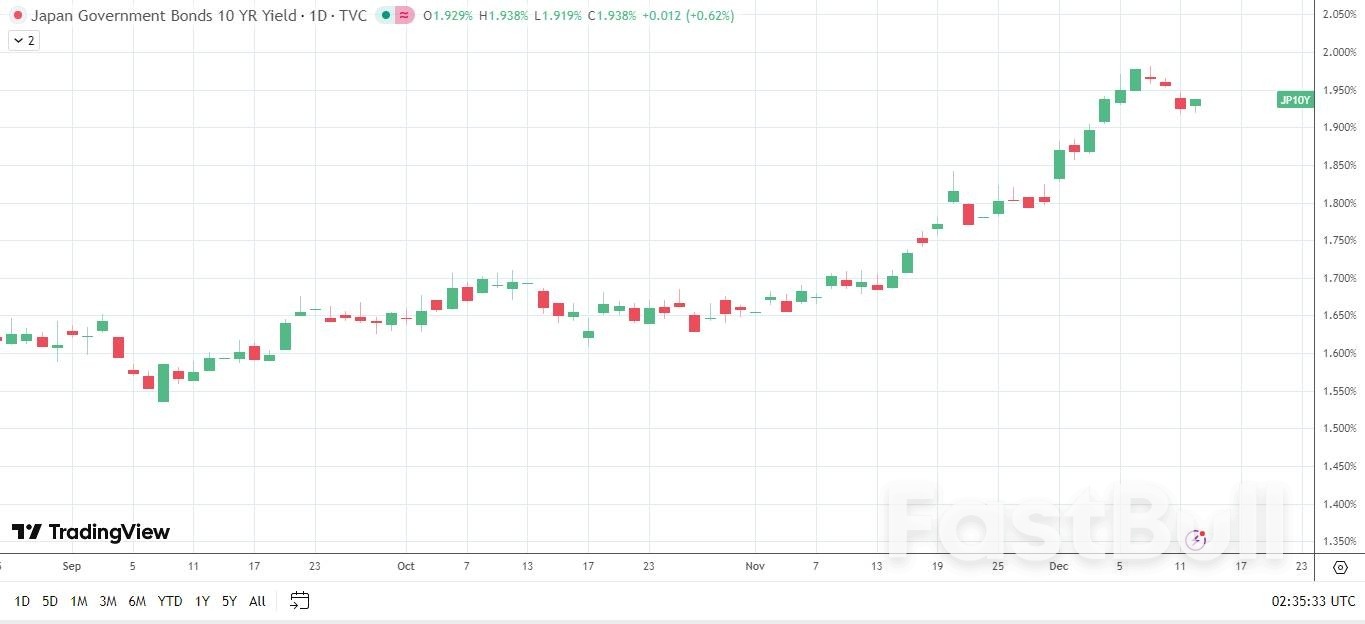
Japanese Government Bond (JGB) yields dropped for three consecutive sessions on Thursday, December 11, easing fears of a yen carry trade unwind. However, rising bets on a December Bank of Japan rate hike continue to cushion the downside on 10-year JGB yields.
Meanwhile, overnight US jobs data showed a spike in jobless claims, supporting a more dovish Fed policy stance. 10-year US Treasury yields dropped to a four-day low before stabilizing.
Falling 10-year Treasury and JGB yields bolstered demand for risk assets such as US stock futures. Furthermore, easing concerns over a yen carry trade unwind supports a bullish short- to medium-term outlook for US index futures.
JGB 10-Year – Daily Chart – 121225Below, I'll outline the key market drivers, the medium-term outlook, and the key technical levels traders should watch.
Rising bets on a December BoJ rate hike collided with increasing speculation about the Bank's neutral rate. The neutral rate is where monetary policy is neither restrictive nor accommodative.
For markets and yen carry trades, a neutral rate would influence expectations of the number of rate hikes in the BoJ's policy tightening cycle.
A higher neutral rate would narrow US-Japan rate differentials more, making yen carry trades into assets less attractive. Conversely, a lower neutral rate would keep carry trades profitable, supporting the bullish short- to medium-term price outlook for US stock futures.
This week, former BoJ policymaker Hideo Hayakawa warned of multiple BoJ rate hikes and a 1.5% neutral rate. Bank of Japan Governor Kazuo Ueda previously stated that there was no consensus on the neutral rate, which remained in a wide range, between 1% and 2.5%. A 1.5% neutral rate would dampen interest in yen carry trades into US assets, but keep them profitable.
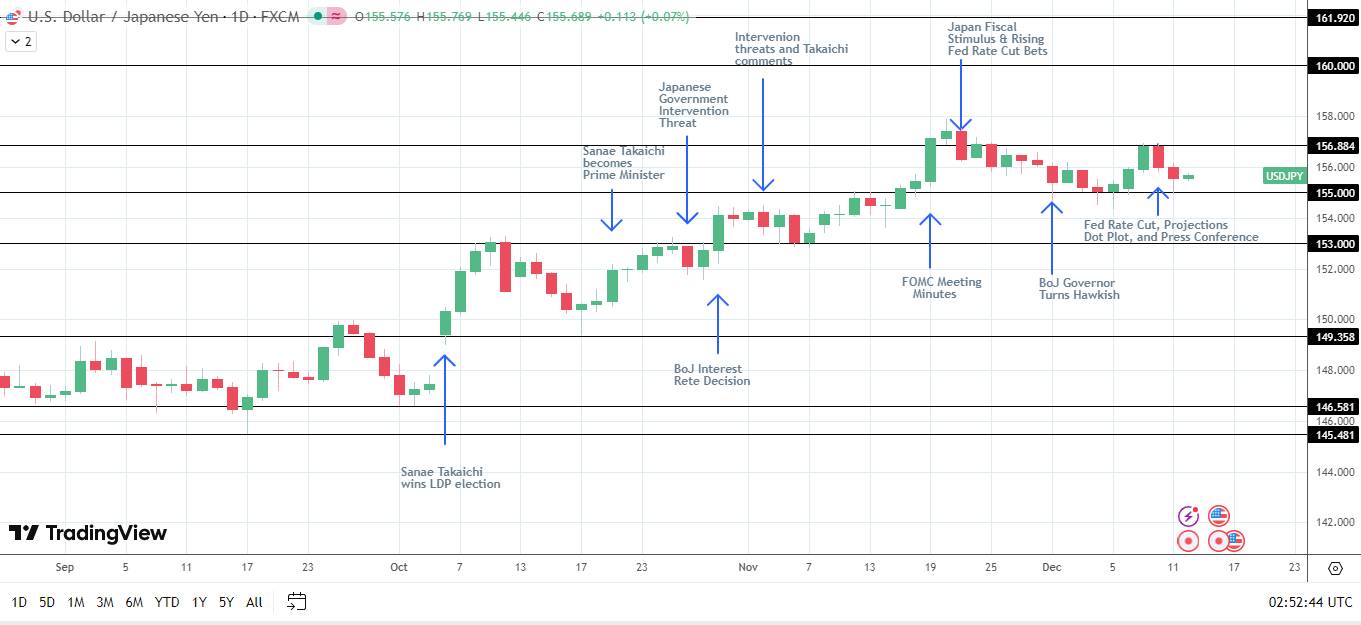
10-year JGB yield, USD/JPY, and Nikkei 225 trends suggest fading concerns about a yen carry trade unwind. The Nikkei 225 gained 0.89% in morning trading on Friday, December 12, while 10-year JGBs remained well below the December 9 high of 1.981% and USD/JPY edged 0.07% higher.
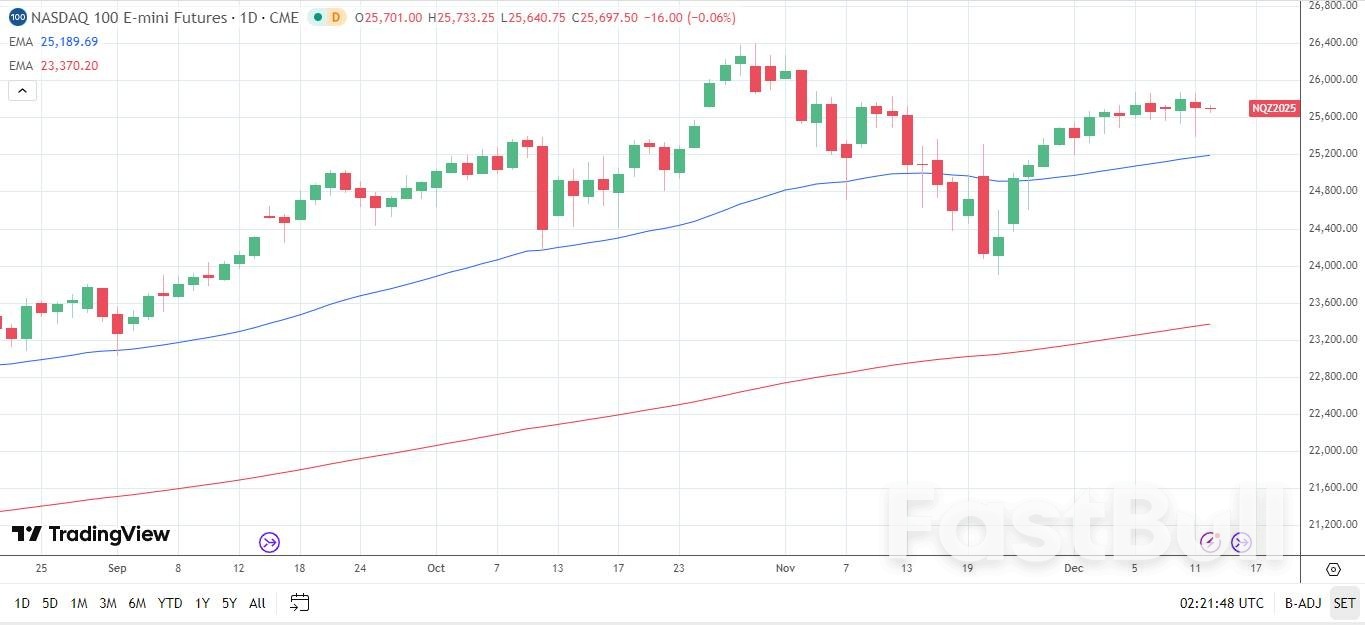
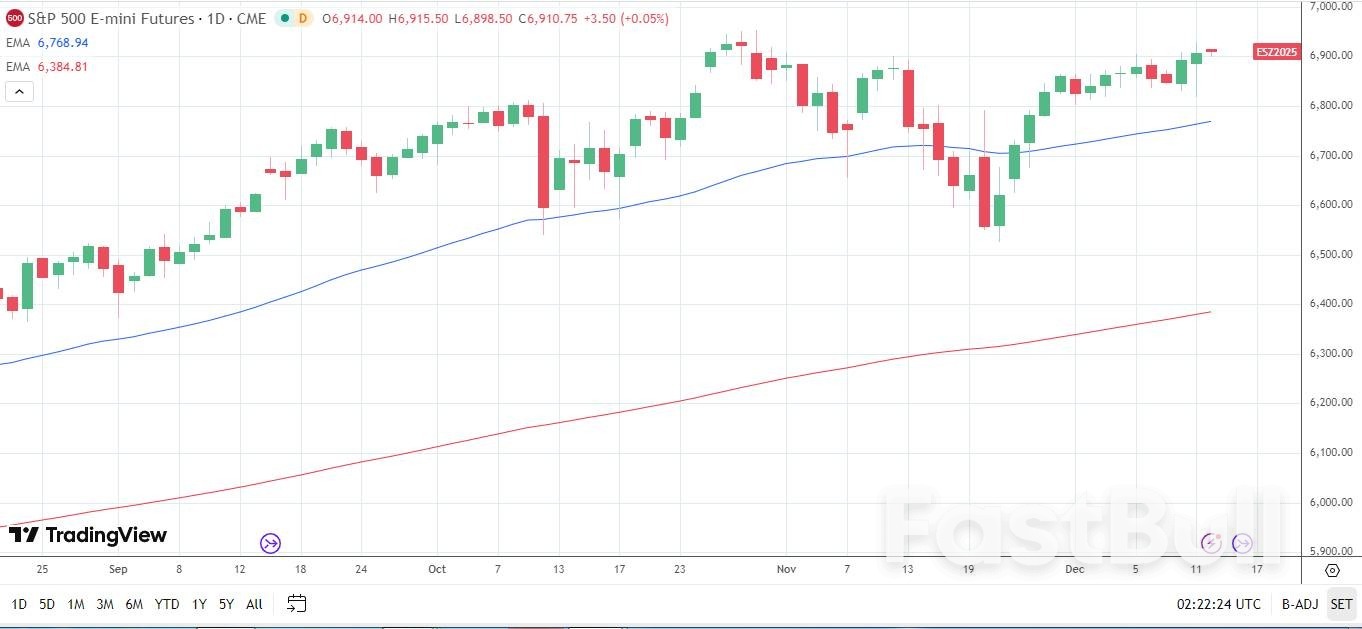
USDJPY – Daily Chart – 121225Futures had a mixed Asian morning session. The Dow Jones E-mini rose 115 points, and the S&P 500 E-mini gained 4 points. Meanwhile, the Nasdaq 100 E-mini dropped 16 points, weighed down by Oracle and Broadcom. Oracle tumbled 10.83% overnight as investors reacted to the company's significant spending and weak forecasts, raising concerns about the timing of returns on investments.
Later on Friday, traders should monitor FOMC members' speeches after Wednesday's dot plot signaled a single 2026 Fed rate cut. Dovish Fed rhetoric would lift sentiment, supporting a bullish short- to medium-term outlook for US stock futures.
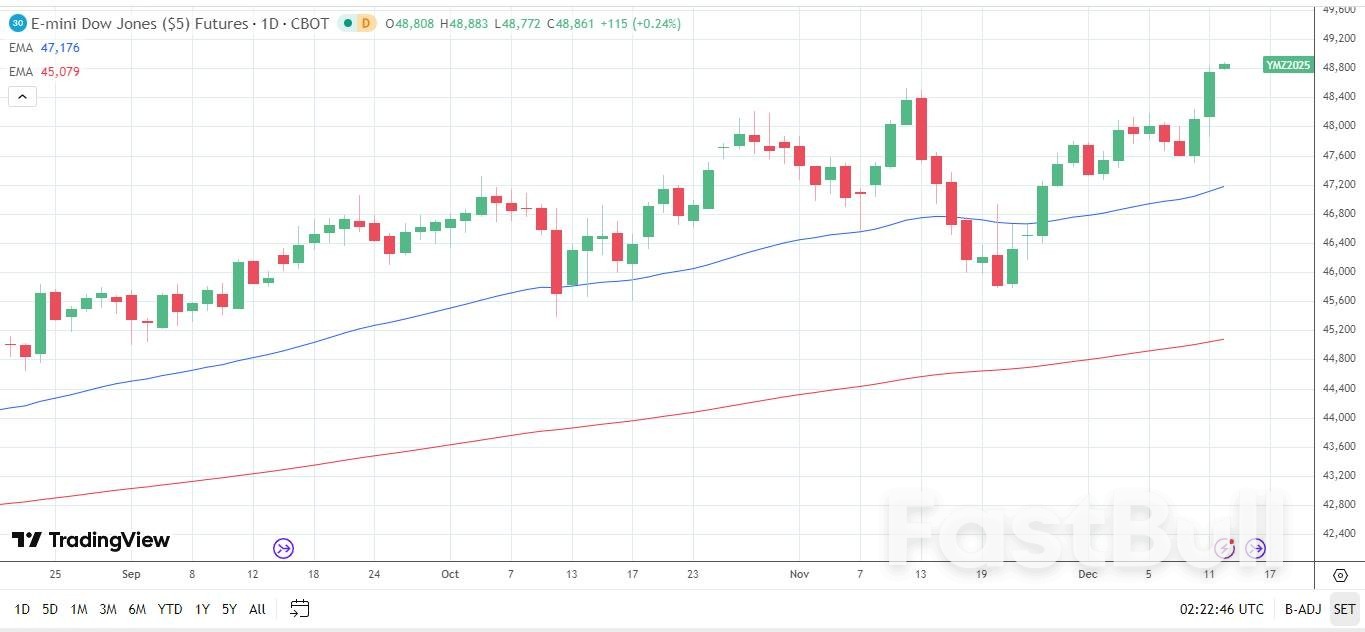
According to the CME FedWatch Tool, the chances of a March Fed rate cut increased from 42.2% on Wednesday, December 10, to 49.6% on December 11. Higher-than-expected US jobless claims raised bets on a March Fed rate cut, sending the Dow Jones E-mini futures to an all-time high.
Despite the mixed morning, the Dow Jones E-mini, the Nasdaq 100 E-mini, and the S&P 500 E-mini remained above their 50-day and 200-day EMAs, indicating a bullish bias.
Near-term trends will hinge on BoJ rhetoric, 10-year US Treasury and JGB yields, USD/JPY trends, and Fed commentary. Key levels to monitor include:
Dow Jones – Daily Chart – 121225
Nasdaq 100 – Daily Chart – 121225
S&P 500 – Daily Chart – 121225In my opinion, the short- to medium-term outlook remains bullish despite the Fed's single 2026 rate cut and hawkish BoJ policy stance. Given easing concerns about a yen carry trade unwind, rate differentials will continue to influence the near-term trends.
Several scenarios could derail the bullish short- and medium-term outlooks, including:
In summary, a more dovish Fed policy stance would boost demand for US equity futures. However, traders should continue monitoring BoJ signals, JGB yields, the USD/JPY, and the Nikkei 225 for potential yen carry trade unwind warning signals.
Key levels would include a USD/JPY drop to 150 and 10-year JGBs at 2%, an important level to watch. These sharp moves would likely trigger a Nikkei 225 sell-off, weighing on broader risk sentiment.
The latest pullback in 10-year JGB yields provided some market relief. Nevertheless, yields remain elevated, exposing US stock futures to unwind risk.
At least three executives from Chinese bargain e-commerce platform Pinduoduo were detained by police last Friday after allegedly physically fighting with market regulators who were conducting an on-site inspection of the company's Shanghai headquarters, Nikkei Asia has learned.
One official was injured in the clash, people familiar with the matter told Nikkei. The cause of the alleged altercation and the latest status of the executives is not yet clear. Such incidents at a major company are rare in China, where authorities often have much more power.
Last week, staff from the State Administration for Market Regulation (SAMR) carried out a routine inspection at the company, part of the market watchdog's regular checks across various companies, including other Chinese tech giants. The length of such inspections can vary by project and sometimes last several days.
The inspection of records at Pinduoduo was part of a nationwide campaign targeting food-safety issues on platforms, according to people familiar with the matter. Pinduoduo sells a wide range of food products. SAMR said in late November that it had conducted 5.7 million food-safety inspections this year and found a substandard rate of 2.74%, with most issues involving excessive pesticide residue, improper use of food additives and microbial contamination.
"This account is false and bears no relation to reality," a Pinduoduo spokesperson told Nikkei Asia.
SAMR did not respond to an request for comment.
Pinduoduo, which means "together, more savings," was established in 2015 by Colin Huang, a former Google employee and the founder of multiple startups, including a gaming company. The online retailer started out selling cheap fresh groceries and swiftly diversified into other inexpensive product categories.
As China's consumer demand weakened and a culture of "consumption downgrade" took hold, Pinduoduo quickly gained traction by selling low-priced goods. In its early years, however, the platform faced numerous complaints from users about poor-quality products. In 2018, SAMR summoned Pinduoduo over the sale of counterfeit and property rights-infringing goods, instructing the company to strengthen product oversight on the platform.
Over the past three years, cases released by SAMR and the National Medical Products Administration have repeatedly cited merchants on Pinduoduo, sometimes along with those on other platforms, for selling fake or substandard items.
However, Pinduoduo has been working to shed its reputation for inferior goods by rolling out a series of measures in recent years to promote high-quality merchants and crack down on problematic sellers.
In late 2022, PDD Holdings launched cross-boarder e-commerce platform Temu to sell inexpensive products to the world. In 2023, the company's market capitalization once surpassed that of Alibaba to make it the most valuable U.S.-listed Chinese company. Now, PDD Holdings' market cap is less than half that of Alibaba's, which has been working hard on its large language model for artificial intelligence and has seen its share price surge amid China's DeepSeek-driven tech stock rally this year.
Even before the U.S. in late August effectively suspended its de minimis exemption, which allowed goods under $800 to enter the country duty-free, Temu and rival Shein had started to shift resources to other countries. However, both platforms are facing similar challenges in Europe.
White Label
Data API
Web Plug-ins
Poster Maker
Affiliate Program
The risk of loss in trading financial instruments such as stocks, FX, commodities, futures, bonds, ETFs and crypto can be substantial. You may sustain a total loss of the funds that you deposit with your broker. Therefore, you should carefully consider whether such trading is suitable for you in light of your circumstances and financial resources.
No decision to invest should be made without thoroughly conducting due diligence by yourself or consulting with your financial advisors. Our web content might not suit you since we don't know your financial conditions and investment needs. Our financial information might have latency or contain inaccuracy, so you should be fully responsible for any of your trading and investment decisions. The company will not be responsible for your capital loss.
Without getting permission from the website, you are not allowed to copy the website's graphics, texts, or trademarks. Intellectual property rights in the content or data incorporated into this website belong to its providers and exchange merchants.
Not Logged In
Log in to access more features

FastBull Membership
Not yet
Purchase
Log In
Sign Up