Markets
News
Analysis
User
24/7
Economic Calendar
Education
Data
- Names
- Latest
- Prev


Signal Accounts for Members
All Signal Accounts
All Contests


U.K. Trade Balance Non-EU (SA) (Oct)A:--
F: --
P: --
U.K. Trade Balance (Oct)A:--
F: --
P: --
U.K. Services Index MoMA:--
F: --
P: --
U.K. Construction Output MoM (SA) (Oct)A:--
F: --
P: --
U.K. Industrial Output YoY (Oct)A:--
F: --
P: --
U.K. Trade Balance (SA) (Oct)A:--
F: --
P: --
U.K. Trade Balance EU (SA) (Oct)A:--
F: --
P: --
U.K. Manufacturing Output YoY (Oct)A:--
F: --
P: --
U.K. GDP MoM (Oct)A:--
F: --
P: --
U.K. GDP YoY (SA) (Oct)A:--
F: --
P: --
U.K. Industrial Output MoM (Oct)A:--
F: --
P: --
U.K. Construction Output YoY (Oct)A:--
F: --
P: --
France HICP Final MoM (Nov)A:--
F: --
P: --
China, Mainland Outstanding Loans Growth YoY (Nov)A:--
F: --
P: --
China, Mainland M2 Money Supply YoY (Nov)A:--
F: --
P: --
China, Mainland M0 Money Supply YoY (Nov)A:--
F: --
P: --
China, Mainland M1 Money Supply YoY (Nov)A:--
F: --
P: --
India CPI YoY (Nov)A:--
F: --
P: --
India Deposit Gowth YoYA:--
F: --
P: --
Brazil Services Growth YoY (Oct)A:--
F: --
P: --
Mexico Industrial Output YoY (Oct)A:--
F: --
P: --
Russia Trade Balance (Oct)A:--
F: --
P: --
Philadelphia Fed President Henry Paulson delivers a speech
Canada Building Permits MoM (SA) (Oct)A:--
F: --
P: --
Canada Wholesale Sales YoY (Oct)A:--
F: --
P: --
Canada Wholesale Inventory MoM (Oct)A:--
F: --
P: --
Canada Wholesale Inventory YoY (Oct)A:--
F: --
P: --
Canada Wholesale Sales MoM (SA) (Oct)A:--
F: --
P: --
Germany Current Account (Not SA) (Oct)A:--
F: --
P: --
U.S. Weekly Total Rig CountA:--
F: --
P: --
U.S. Weekly Total Oil Rig CountA:--
F: --
P: --
Japan Tankan Large Non-Manufacturing Diffusion Index (Q4)--
F: --
P: --
Japan Tankan Small Manufacturing Outlook Index (Q4)--
F: --
P: --
Japan Tankan Large Non-Manufacturing Outlook Index (Q4)--
F: --
P: --
Japan Tankan Large Manufacturing Outlook Index (Q4)--
F: --
P: --
Japan Tankan Small Manufacturing Diffusion Index (Q4)--
F: --
P: --
Japan Tankan Large Manufacturing Diffusion Index (Q4)--
F: --
P: --
Japan Tankan Large-Enterprise Capital Expenditure YoY (Q4)--
F: --
P: --
U.K. Rightmove House Price Index YoY (Dec)--
F: --
P: --
China, Mainland Industrial Output YoY (YTD) (Nov)--
F: --
P: --
China, Mainland Urban Area Unemployment Rate (Nov)--
F: --
P: --
Saudi Arabia CPI YoY (Nov)--
F: --
P: --
Euro Zone Industrial Output YoY (Oct)--
F: --
P: --
Euro Zone Industrial Output MoM (Oct)--
F: --
P: --
Canada Existing Home Sales MoM (Nov)--
F: --
P: --
Euro Zone Total Reserve Assets (Nov)--
F: --
P: --
U.K. Inflation Rate Expectations--
F: --
P: --
Canada National Economic Confidence Index--
F: --
P: --
Canada New Housing Starts (Nov)--
F: --
P: --
U.S. NY Fed Manufacturing Employment Index (Dec)--
F: --
P: --
U.S. NY Fed Manufacturing Index (Dec)--
F: --
P: --
Canada Core CPI YoY (Nov)--
F: --
P: --
Canada Manufacturing Unfilled Orders MoM (Oct)--
F: --
P: --
Canada Manufacturing New Orders MoM (Oct)--
F: --
P: --
Canada Core CPI MoM (Nov)--
F: --
P: --
Canada Manufacturing Inventory MoM (Oct)--
F: --
P: --
Canada CPI YoY (Nov)--
F: --
P: --
Canada CPI MoM (Nov)--
F: --
P: --
Canada CPI YoY (SA) (Nov)--
F: --
P: --
Canada Core CPI MoM (SA) (Nov)--
F: --
P: --


No matching data
Latest Views
Latest Views
Trending Topics
Top Columnists
Latest Update
White Label
Data API
Web Plug-ins
Affiliate Program
View All

No data
With eurozone interest rates approaching their lowest point after seven consecutive cuts, European Central Bank policymakers are increasingly divided over the future course of monetary policy...
The initial tariff announcement in early April was so draconian — such an aggressive fiscal tightening — that it looked as though the White House was going to unilaterally push the US economy into recession.
Since then, of course, the tariffs have been dialed back considerably. And while technically what we’ve seen is a series of 90-day delays, the widespread expectation is that we’re not going to go back to anything like what we saw in that initial chart that Trump held up on April 2.
There are still reasons to be concerned about the new baseline level of tariffs. Doing business in the US has become more costly. Supply chains may be re-structured in such a way so as to become less efficient and productive. Personally, my main concern is that US businesses themselves become less competitive (because they enjoy some increased level of protectionism) creating an ongoing degradation of their productivity. But these are longer-term structural worries. (Brexit is probably a decent analogy at this point).
But at least in the short-term, just strictly from a cyclical perspective, it looks less and less like the tariffs will grind business to a halt as was the worry a month ago.
So to my mind, the focus has to return to the Fed, and the speed with which it responds to underlying economic conditions. How are underlying economic conditions? They seem ok, but not great.
This is something that Neil Dutta has been warning about in the newsletter, both this week, and also back in February. The US labor market hasn’t fallen off a cliff, but it is decelerating. Housing activity continues to be pressured by high interest rates. Just today we got data showing that housing starts rose by just 1.6% in April (lower than the 3.0% that economists had expected) and building permits actually shrunk by 4.7% in the month. Most sentiment measures are still dismal. We got another ugly regional business survey this morning from the Empire Fed. Also just as I’m typing this, we got the May Preliminary UMich Sentiment report of consumers, which fell to its second lowest reading ever.
Today on the podcast, we had the pleasure of talking to Atlanta Fed President Raphael Bostic about setting monetary policy during a period of such extreme uncertainty. As of right now, after the pause with China, he sees just one rate cut as being appropriate in 2025. As he sees it, we’ve only gotten modestly more clarity on the trade picture, and so there’s a reluctance to act more forcefully.
It makes sense that the Fed doesn’t want to make any major moves when there’s so much that’s seemingly up in the air. And the fact that inflation expectations (again, as seen in today’s UMich report) are rising creates a further reluctance to do cuts. But from a recession standpoint, this is probably the source of concern and risk — that the data continues to decelerate and eventually reverse, before the Fed feels comfortable acting against it.
As mentioned, today we had the pleasure of talking to Atlanta Federal Reserve Bank President Raphael Bostic. We discussed the overall economic picture, tariffs, his outlook for monetary policy and his process for setting policy in a time when conditions seem to change by the day.
In a sign of shifting capital flows, Canadian investors acquired $15.6 billion worth of foreign securities in March, most of it in U.S. bonds, while foreign investors pulled $4.2 billion from Canadian markets, according to data released by Statistics Canada. This net outflow of $19.9 billion marked the second consecutive month of capital leaving Canada and brought the first quarter’s total outflow to $45.9 billion.
The investment spree by Canadian investors focused primarily on U.S. fixed-income assets, with March seeing $9.3 billion in U.S. bond purchases and an additional $1.8 billion in American government money market instruments. At the same time, investors trimmed their holdings of non-U.S. foreign debt by $1.8 billion, underscoring a clear preference for U.S. assets amid uncertain global macroeconomic trends.
Canadian appetite for foreign equities also remained solid, though moderated from a February surge. In March, Canadians acquired $7.0 billion in foreign equities, led by $5.0 billion in U.S. shares, following a blockbuster $29.9 billion investment in February, just before the S&P 500 pulled back slightly from its record highs.
On the other side of the ledger, foreign investors continued their retreat from Canadian equities, divesting $12.0 billion in March following an even steeper $21.9 billion exit in February. Those moves reflected broad disinvestment in banking, trade and transportation, and energy and mining sectors, all of which saw equity valuations dented amid a 1.9 percent drop in the S&P/TSX Composite Index.
Despite backing away from Canadian stocks, global investors increased their exposure to Canadian bonds, acquiring $11.9 billion in March. Most of this was concentrated in federal government debt with $13.1 billion in bond purchases, offset only in part by exits from federal government enterprise issuance.
However, non-residents also pulled $4.1 billion from Canadian money market instruments, primarily targeting federal government paper, which declined by $4.4 billion. The juxtapositions suggest that while Canadian debt remains attractive for longer durations, short-term instruments are falling out of favor among global investors.
This trend holds deeper significance as it may reflect growing investor caution toward Canadian markets amid heightened trade and policy uncertainty. With ongoing tensions surrounding North American supply chains and global tariff policies, investors appear increasingly reluctant to commit capital to Canadian assets that may be exposed to regulatory or geopolitical volatility.
The Bank of Canada’s decision in March to cut its policy rate to 2.75 percent may have helped sustain foreign demand for long-term government bonds even as equity markets softened. The Canadian dollar, meanwhile, posted a modest 0.4 percent gain against the U.S. dollar, aiding returns for some foreign bondholders hedging currency exposure.
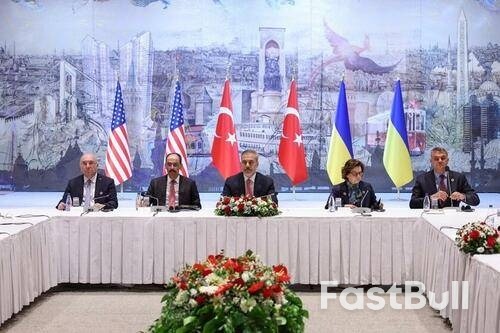
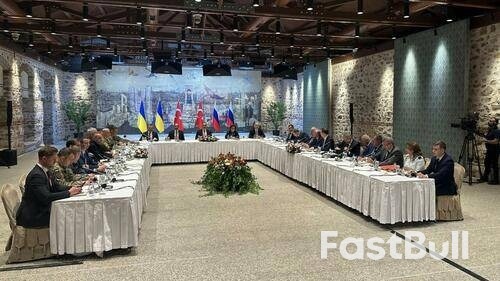
The Friday meeting between Ukrainian and Russian officials, the first direct engagement of its kind in some three years, has ended, according to Turkey’s foreign ministry, and lasted a little under two hours.
Each side will in the aftermath convey to the press its version of things, and Ukraine has been right out the gate telling CNN that there was nothing meaningful to come out of these first talks.
A Ukrainian source said the Russia delegation "did not have a mandate to make important decisions" and that "they are not ready to decide anything meaningful to end the war."
Turkish Foreign Minister's Press Office/EPA/ShutterstockMany international headlines Thursday described the team of junior officials sent by the Kremlin as an 'insult' to the peace process; however, it's also the case that no matter who President Putin sends, he is the one who will ultimately make the decisions.
Wall Street Journal has described that "The talks, in the Dolmabahçe Palace in Istanbul, came about as the result of President Trump’s pressure, so far mostly applied on Ukrainian President Volodymyr Zelensky, to find an end to the war."
But, "Just as the negotiations started, Russia struck near the Ukrainian city of Dnipro with a salvo of ballistic missiles, according to local officials."
And Reuters agrees in its assessment that there are "no apparent sign of progress so far in narrowing the gap between the sides, and a Ukrainian source called Moscow's demands 'non-starters'.
Ukrainian Foreign Ministry via AFPNeither side has so far offered no major concessions, and issues like permanent control over Crimea and the four eastern territories remain sticking points for Moscow.
During the Istanbul meeting, according to WSJ's foreign correspondent Yaroslav Trofimov:
Russia demanded in Istanbul that Ukraine withdraw its troops from four regions — areas that Moscow has been trying to conquer but failed since 2022 — as a precondition for ceasefire. That’s an area twice the size of the country of Lebanon and home to more than a million Ukrainians. Not going to happen.
Donetsk, Luhansk, Zaporizhzhia, and Kherson were annexed in 2022, declared part of the Russian Federation, but Moscow forces still don't have 100% control over them.
And it doesn't look like there was any progress on achieving a Trump and Zelensky-backed 30-day ceasefire. Moscow sees this as a tactic for Ukraine forces to simply rearm and regroup, at a moment they are in dire need of more manpower and artillery.
President Zelensky has meanwhile been making clear that Ukraine will not surrender its territory as "this is Ukraine's land" - and he isn't so much as ready to even offer Crimea. Zelensky and European leaders are reportedly holding a phone call with US President Trump in the wake of the Istanbul meeting.
They will likely try to convince the US leader that attempts to negotiate an end to the war with Putin are futile. This seems to have been Zelensky's aim all along: getting Washington and Trump back on his side, and securing the unending flow of weapons, cash, and intelligence.
White Label
Data API
Web Plug-ins
Poster Maker
Affiliate Program
The risk of loss in trading financial instruments such as stocks, FX, commodities, futures, bonds, ETFs and crypto can be substantial. You may sustain a total loss of the funds that you deposit with your broker. Therefore, you should carefully consider whether such trading is suitable for you in light of your circumstances and financial resources.
No decision to invest should be made without thoroughly conducting due diligence by yourself or consulting with your financial advisors. Our web content might not suit you since we don't know your financial conditions and investment needs. Our financial information might have latency or contain inaccuracy, so you should be fully responsible for any of your trading and investment decisions. The company will not be responsible for your capital loss.
Without getting permission from the website, you are not allowed to copy the website's graphics, texts, or trademarks. Intellectual property rights in the content or data incorporated into this website belong to its providers and exchange merchants.
Not Logged In
Log in to access more features

FastBull Membership
Not yet
Purchase
Log In
Sign Up