Markets
News
Analysis
User
24/7
Economic Calendar
Education
Data
- Names
- Latest
- Prev



Signal Accounts for Members
All Signal Accounts
All Contests


U.S. Dallas Fed New Orders Index (Jan)A:--
F: --
P: --
U.S. 2-Year Note Auction Avg. YieldA:--
F: --
P: --
U.K. BRC Shop Price Index YoY (Jan)A:--
F: --
P: --
China, Mainland Industrial Profit YoY (YTD) (Dec)A:--
F: --
P: --
Germany 2-Year Schatz Auction Avg. YieldA:--
F: --
P: --
Mexico Trade Balance (Dec)A:--
F: --
P: --
U.S. Weekly Redbook Index YoYA:--
F: --
P: --
U.S. S&P/CS 20-City Home Price Index YoY (Not SA) (Nov)A:--
F: --
P: --
U.S. S&P/CS 20-City Home Price Index MoM (SA) (Nov)A:--
F: --
U.S. FHFA House Price Index MoM (Nov)A:--
F: --
P: --
U.S. FHFA House Price Index (Nov)A:--
F: --
P: --
U.S. FHFA House Price Index YoY (Nov)A:--
F: --
U.S. S&P/CS 10-City Home Price Index YoY (Nov)A:--
F: --
P: --
U.S. S&P/CS 10-City Home Price Index MoM (Not SA) (Nov)A:--
F: --
P: --
U.S. S&P/CS 20-City Home Price Index (Not SA) (Nov)A:--
F: --
P: --
U.S. S&P/CS 20-City Home Price Index MoM (Not SA) (Nov)A:--
F: --
P: --
U.S. Richmond Fed Manufacturing Composite Index (Jan)A:--
F: --
P: --
U.S. Conference Board Present Situation Index (Jan)A:--
F: --
P: --
U.S. Conference Board Consumer Expectations Index (Jan)A:--
F: --
P: --
U.S. Richmond Fed Manufacturing Shipments Index (Jan)A:--
F: --
P: --
U.S. Richmond Fed Services Revenue Index (Jan)A:--
F: --
P: --
U.S. Conference Board Consumer Confidence Index (Jan)A:--
F: --
U.S. 5-Year Note Auction Avg. YieldA:--
F: --
P: --
U.S. API Weekly Refined Oil StocksA:--
F: --
P: --
U.S. API Weekly Crude Oil StocksA:--
F: --
P: --
U.S. API Weekly Gasoline StocksA:--
F: --
P: --
U.S. API Weekly Cushing Crude Oil StocksA:--
F: --
P: --
Australia RBA Trimmed Mean CPI YoY (Q4)A:--
F: --
P: --
Australia CPI YoY (Q4)A:--
F: --
P: --
Australia CPI QoQ (Q4)A:--
F: --
P: --
Germany GfK Consumer Confidence Index (SA) (Feb)--
F: --
P: --
Germany 10-Year Bund Auction Avg. Yield--
F: --
P: --
India Industrial Production Index YoY (Dec)--
F: --
P: --
India Manufacturing Output MoM (Dec)--
F: --
P: --
U.S. MBA Mortgage Application Activity Index WoW--
F: --
P: --
Canada Overnight Target Rate--
F: --
P: --
BOC Monetary Policy Report
U.S. EIA Weekly Crude Stocks Change--
F: --
P: --
U.S. EIA Weekly Cushing, Oklahoma Crude Oil Stocks Change--
F: --
P: --
U.S. EIA Weekly Crude Demand Projected by Production--
F: --
P: --
U.S. EIA Weekly Crude Oil Imports Changes--
F: --
P: --
U.S. EIA Weekly Heating Oil Stock Changes--
F: --
P: --
U.S. EIA Weekly Gasoline Stocks Change--
F: --
P: --
BOC Press Conference
Russia PPI MoM (Dec)--
F: --
P: --
Russia PPI YoY (Dec)--
F: --
P: --
U.S. Target Federal Funds Rate Lower Limit (Overnight Reverse Repo Rate)--
F: --
P: --
U.S. Interest Rate On Reserve Balances--
F: --
P: --
U.S. Federal Funds Rate Target--
F: --
P: --
U.S. Target Federal Funds Rate Upper Limit (Excess Reserves Ratio)--
F: --
P: --
FOMC Statement
FOMC Press Conference
Brazil Selic Interest Rate--
F: --
P: --
Australia Import Price Index YoY (Q4)--
F: --
P: --
Japan Household Consumer Confidence Index (Jan)--
F: --
P: --
Turkey Economic Sentiment Indicator (Jan)--
F: --
P: --
Euro Zone M3 Money Supply (SA) (Dec)--
F: --
P: --
Euro Zone Private Sector Credit YoY (Dec)--
F: --
P: --
Euro Zone M3 Money Supply YoY (Dec)--
F: --
P: --
Euro Zone 3-Month M3 Money Supply YoY (Dec)--
F: --
P: --
South Africa PPI YoY (Dec)--
F: --
P: --


No matching data
Latest Views
Latest Views
Trending Topics
Top Columnists
Latest Update
White Label
Data API
Web Plug-ins
Affiliate Program
View All

No data
ECB's Cipollone urges European payment system autonomy, citing geopolitical risks that could also derail economic growth.
European Central Bank Executive Board member Piero Cipollone has declared that escalating geopolitical tensions are building a powerful case for Europe to establish its own fully controlled payment systems.
In an interview with Spanish newspaper El Pais, Cipollone highlighted the increasing "militarisation" of economic and technological tools, a trend he said exposes global vulnerabilities and reinforces the need for a payment infrastructure built exclusively on European technology.
"We need a system that is totally under our control," Cipollone stated. "This is what we are doing with the digital euro."
Currently, Europe lacks a homegrown cross-border payments giant to compete with the American duopoly of Visa and Mastercard, a gap that a digital euro could help address.
When asked about the potential impact of political pressure on U.S. Federal Reserve Chair Jerome Powell, Cipollone stressed that the ECB’s monetary policy decisions remain independent and centered on the euro-area economy.
"We are the central bank of the euro area, not of the United States," he affirmed.
Cipollone clarified the ECB's singular focus: "We set interest rates to ensure price stability — a 2% inflation target over the medium-term. What happens elsewhere matters only if it affects inflation in the euro zone."
Despite global uncertainty, Cipollone noted that the euro-area economy has demonstrated resilience and may deliver growth figures that exceed current forecasts. He attributed a recent upward revision in outlook primarily to investment, which boosts both immediate demand and long-term productive capacity, enabling faster growth without compromising price stability.
However, he issued a strong warning that rising geopolitical uncertainty could threaten this recovery.
"If uncertainty persists, it could undermine investment," Cipollone cautioned. "This would affect growth and, inevitably, inflation. If it persists, it will have an impact on the real economy."
The Federal Reserve is widely expected to pause its interest rate cuts at today's Federal Open Market Committee (FOMC) meeting, a move that defies sustained pressure from President Trump.
Led by Chair Jerome Powell, the central bank's decision to hold rates steady could have significant ripple effects across financial markets. For assets like Bitcoin (BTC) and Ethereum (ETH), which are highly sensitive to shifts in U.S. monetary policy, the outcome of the 2 p.m. ET meeting is a critical focal point. Powell's stance is seen as an effort to maintain the Fed's independence and promote economic stability.
Financial markets are signaling near-unanimous conviction that the Fed will not cut rates. Current pricing reflects a 97.2% probability that the central bank will keep its policy rate unchanged.
This consensus holds firm despite the visible tension between the Trump administration and the Federal Reserve. Investors appear confident that the institution will prioritize its mandate over political influence.
Benjamin Shoesmith, an economist at KPMG, highlighted this sentiment, stating, "Financial markets have not changed their pricing for rate cuts, despite an escalation of tension between the administration and Fed Chairman Jay Powell. Investors are betting the Fed keeps its independence from political influence."
The Federal Reserve's decisions on interest rates directly influence liquidity and borrowing costs across the economy. These changes often impact investor behavior toward higher-risk assets.
Historically, the market performance of cryptocurrencies like Bitcoin and Ethereum has been correlated with U.S. monetary policy. A pause in rate cuts could therefore alter trading dynamics and liquidity conditions for these digital assets.
Today's anticipated pause follows three consecutive rate reductions implemented by the Fed in 2025. This period of easing was set against a backdrop reminiscent of the high-inflation environment of 2022, underscoring the central bank's independent approach to managing the economy.
Looking ahead, market experts do not foresee an immediate return to rate cuts. According to Gregory Daco, Chief Economist at EY-Parthenon, any further easing is likely months away.
"We anticipate 50 basis points of easing through 2026," Daco noted, adding that "the first 2026 rate cut is unlikely to occur before June."
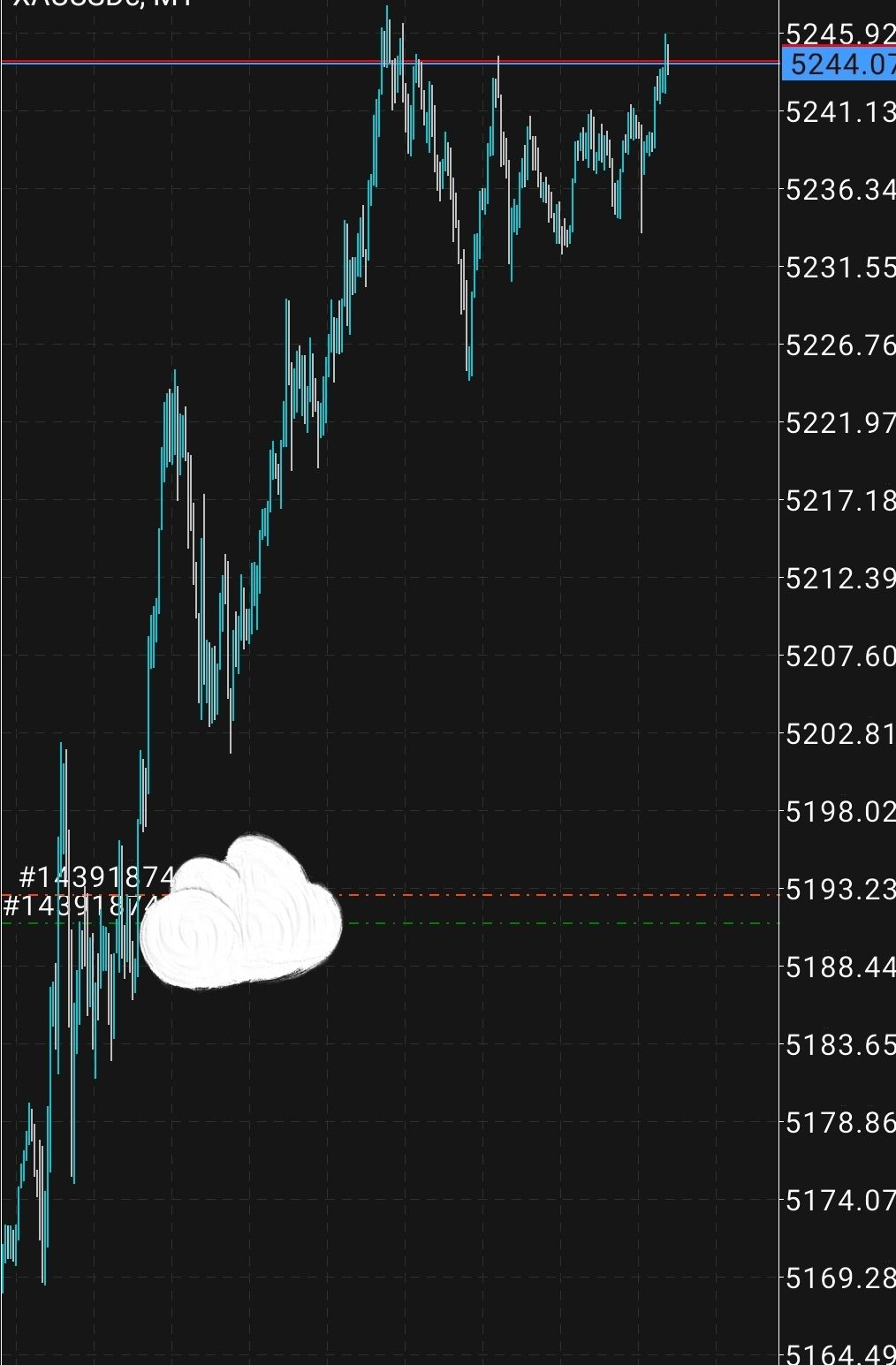
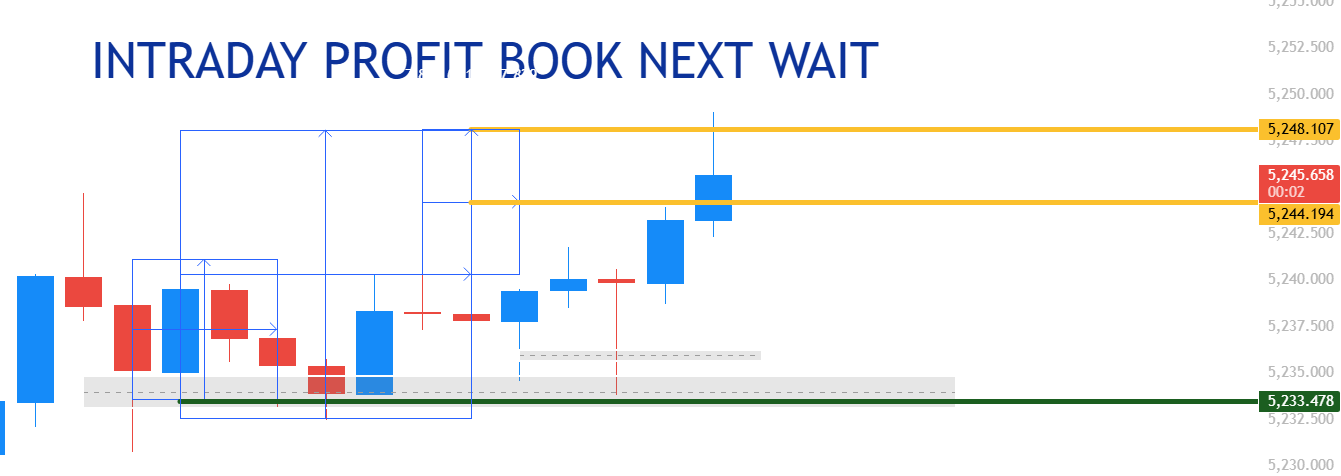
Gold prices saw a minor pullback in Asian trading on Wednesday, stabilizing after a powerful rally that pushed the precious metal to a record high near $5,200 per ounce. The market action reflects sustained investor demand for safe-haven assets amid rising geopolitical and economic uncertainty.
Spot gold was trading at $5,179.41 per ounce after touching an all-time high of $5,190.42 on Tuesday. Meanwhile, April gold futures jumped 1.8% to settle at $5,215.46 per ounce, signaling strong bullish sentiment.
The safe-haven bid for gold remains strong, largely fueled by global geopolitical tensions. Comments from U.S. President Donald Trump about a second armada heading toward Iran added to market uncertainty, helping gold trim earlier losses.
This follows a pattern of events this year that have consistently supported gold prices. An incursion in Venezuela and diplomatic friction over Greenland have also contributed to a risk-off environment, keeping investors on edge and increasing the metal's appeal.
A weakening U.S. dollar provided another significant tailwind for gold. The dollar fell to multi-year lows this week as investor concerns grew over U.S. fiscal spending and the future independence of the Federal Reserve.
President Trump's recent statements have amplified this uncertainty. On Tuesday, he announced he was close to selecting a new Fed chair to replace Jerome Powell, explicitly stating that a change in leadership would lead to lower interest rates. This has driven investors out of the dollar and into alternative assets like gold.
The rally was not confined to gold. Other precious metals have also seen strong performance, with both silver and platinum trading near their own recent record highs.
• Spot silver increased by 1.2% to $113.4325 per ounce.
• Spot platinum gained 0.6%, reaching $2,669.61 per ounce.
Key Points:
In their latest report, 'Charting Crypto: Q1 2026', Coinbase Institutional and Glassnode noted Bitcoin's enhanced market resilience and diminished leverage post-Q4 2025, reflecting evolving market dynamics.
This shift signals Bitcoin's transition to a macro-sensitive asset, influenced by global liquidity and institutional strategies, potentially stabilizing cryptocurrency markets and fostering measured growth.
The latest report by Coinbase Institutional, in collaboration with Glassnode, outlines notable market evolution for Bitcoin. Labeled "Charting Crypto: Q1 2026," the study underlines Bitcoin's increasing stability and resilience. Following a notable deleveraging in Q4 2025, Bitcoin's market influence now leans more towards institutional factors rather than high-leverage trading cycles typically seen during speculative booms.
Evolving sentiment highlights a more cautious approach. Current market structures exhibit a preference for downside protection, with options open interest surpassing perpetual contracts. The ongoing market activity emphasizes portfolio strategies and institutional positioning. Investors show a heightened awareness of macro-level impacts by aligning with global liquidity trends.
BingX offers exclusive rewards and top-tier security for new and high-volume crypto traders.
"We have a constructive view for 1Q26. We believe that crypto markets are entering 2026 in a healthier state, with excess leverage having been largely flushed." - David Duong, CFA, Global Head of Research, Coinbase Institutional, Bitcoin Forum
The community and industry experts are increasingly observing shifts in sentiment. Fueled by significant changes in the market structure, interactions on Bitcoin forums reflect the prevailing positivity for Q1 2026, while caution remains in anticipation of varying liquidity growth rates. Overall, experts express a measured optimism for Bitcoin's current market momentum.
Did you know? Bitcoin's maximum supply is capped at 21 million coins, making it a deflationary asset.
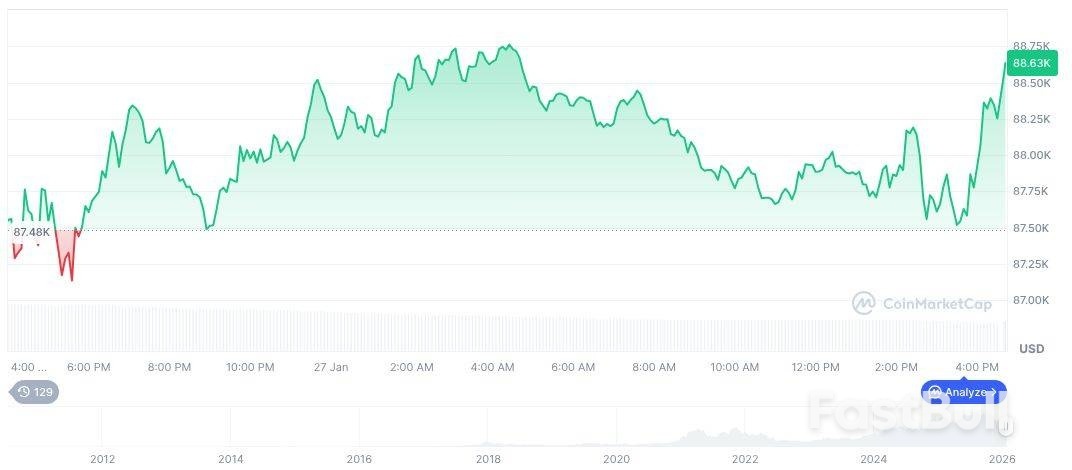
As of January 28, 2026, Bitcoin trades at $89,058.54 with a market cap of $1,779,508,882,244.47. Dominating 58.90% of the market, Bitcoin reflects a 0.29% increase over seven days despite recent price volatility. Circulating supply nears 19,981,340 against a max supply of 21,000,000, according to CoinMarketCap.
Source: CoinMarketCapThe Coincu research team emphasizes the potential for increased regulatory scrutiny as Bitcoin emerges as a macro-sensitive asset, reshaping traditional market perceptions. The report's data-driven observations suggest evolving investment landscapes and technological adaptability within the crypto sphere are resulting in strategic market positioning.
In a recent debate, media personality Tucker Carlson and economist Peter Schiff tackled the future of money, dissecting Bitcoin's potential to challenge the U.S. dollar amid rising inflation and government spending.
Schiff, a vocal cryptocurrency critic and gold advocate, argued that Bitcoin is little more than a speculative commodity with no real-world utility beyond its price chart.
During the exchange, Schiff dismantled the idea of creating a U.S. strategic Bitcoin reserve. He framed the proposal not as sound monetary policy but as a "taxpayer-funded bailout" designed to benefit early crypto investors.
According to Schiff, demand for Bitcoin is driven primarily by the expectation of selling it to someone else at a higher price later—a dynamic he equated to the "greater fool theory" rather than a productive investment.
The conversation expanded to the broader economic pressures facing households. Schiff told Carlson that official inflation statistics, like the Consumer Price Index (CPI), have been modified over the years and no longer capture the true increase in the cost of living.
He asserted that rising prices are a direct result of money and credit expansion, not corporate pricing decisions. Schiff criticized the fiscal policies of both Democratic and Republican administrations, specifically pointing to the "Big Beautiful Bill" proposed by President Donald Trump as a policy that worsened the deficit through a combination of higher spending and tax cuts.
Schiff traced today's economic challenges back to 1971, when the U.S. dollar was completely severed from the gold standard and became a pure fiat currency. He argued that the decades of low interest rates and monetary expansion that followed have systematically eroded purchasing power and distorted asset prices.
This system, he explained, has been propped up by the dollar's status as the world's primary reserve currency, which has allowed the United States to run persistent trade deficits.
However, Schiff warned that this arrangement is under strain. He pointed to sanctions on Russia as a key event that demonstrated the risks for foreign nations holding dollar-denominated reserves. As a result, central banks are diversifying into gold, a trend reflected in its recent price action. He also cited a recent drop in Bitcoin's price as evidence that investors still prefer traditional stores of value over speculative digital assets.
When Carlson asked directly if Bitcoin could replace the dollar as confidence in fiat currency wanes, Schiff flatly rejected the idea. He argued that Bitcoin is fundamentally unsuitable as a reserve currency because it lacks two critical features: intrinsic value and non-monetary demand.
While acknowledging that both fiat currencies and Bitcoin rely on confidence, Schiff drew a sharp distinction with gold. He defined gold as a tangible commodity with deep, established uses in jewelry, electronics, aerospace, and medicine, giving it a stable foundation of value that Bitcoin cannot match.
The debate highlights a core tension in modern finance. As U.S. national debt climbs past $37 trillion, Bitcoin proponents continue to position the cryptocurrency as "digital gold," citing its fixed supply and decentralized nature as the future of money.
Australia's inflation rate accelerated more than anticipated in December, challenging expectations for a steady decline and putting renewed pressure on the Reserve Bank of Australia (RBA).
The consumer price index (CPI) rose 3.8% year-on-year, according to data from the Australian Bureau of Statistics (ABS), outpacing forecasts of a 3.5% increase.
A key measure of underlying inflation, the trimmed mean CPI, also ticked higher, rising to 3.3% in December from 3.2% in the previous month. This figure remains well above the RBA’s target range of 2% to 3%, signaling persistent price pressures across the economy.
On a quarterly basis, the main CPI increased by 0.6% in the December quarter, aligning with expectations. However, the quarterly trimmed mean CPI grew 0.9%, a reading slightly above what analysts had forecast.
The latest inflation data reinforces a challenging environment for the RBA, effectively reducing the likelihood of near-term interest rate cuts. The central bank had already adopted a hawkish stance, holding rates steady in December following a rebound in inflation during the latter half of 2025. Officials at the time even floated the possibility of a future rate hike if price pressures did not subside.
With inflation proving stickier than hoped, some analysts are warning that the central bank might be forced to consider another interest rate increase as far out as 2026 to bring inflation firmly back to its target.
The release of this data comes as the ABS transitions its reporting methodology. The agency announced it is re-referencing its quarterly CPI figures as it moves toward a monthly calculation model. While quarterly data will still be published, the monthly CPI report is now considered Australia's primary inflation indicator.
Iran has activated emergency contingency plans to secure critical supplies and maintain government operations, signaling high alert over the possibility of new attacks from the US or Israel. The move follows President Trump's announcement that a "beautiful armada" of US warships, led by the USS Abraham Lincoln, has arrived in the region.
"In June, we obliterated Iran's nuclear capacity in Operation Midnight Hammer," Trump stated on Tuesday. "They were about a month away from having a nuclear weapon. We had to do it."
He added, "There's another beautiful armada floating beautifully towards Iran right now," expressing hope that Iran will "make a deal."
In response to the heightened threat, Iranian President Masoud Pezeshkian is implementing measures to shore up the country's resilience. According to a Financial Times report citing state media, Pezeshkian met with governors of border provinces on Tuesday to streamline the government's crisis response.
The orders aim to "eliminate redundant bureaucracy and accelerate the import of basic commodities."
"We are handing over authorities to provinces so that governors can contact the judiciary and officials in other organisations and make decisions themselves," Pezeshkian said.
The Trump administration is pursuing a two-track policy. A senior US official told Axios that Washington "is open for business" on negotiations, stating, "If they want to talk, and they know our terms, we are open to have a conversation."
However, alongside this stated openness to diplomacy, President Trump is reportedly considering a range of escalation options designed to force regime change in Tehran.
Washington is weighing several aggressive actions, moving beyond sanctions to more direct forms of pressure.
Precision Strikes on Leadership
According to a Middle East Eye report citing Arab officials, the US is actively considering direct military action. A Gulf official familiar with the talks stated, "The US is weighing precision strikes on 'high-value' Iranian officials and commanders who it deems responsible for the deaths of protesters."

Economic Blockade
Another option, reported by The Jerusalem Post, is a full blockade of Iranian oil exports. This strategy mirrors the playbook used against Venezuela, which involved an embargo, the seizure of oil tankers, and a military raid that captured President Nicolás Maduro.
Treasury Secretary Scott Bessent is a leading proponent of this economic warfare. The strategy aims to collapse Iran's economy, creating conditions that could trigger an internal uprising or starve the system until it breaks. The US Treasury has already begun imposing new sanctions on Tehran officials related to recent protests.
Limited Military Action
Other senior officials are pushing for a more kinetic but controlled approach. Members of Trump's cabinet have advocated for targeted military strikes on Iranian government and military assets, potentially limited in scope, similar to the June 12-day war involving Israel.
President Trump has reportedly received multiple intelligence reports indicating that the Iranian government's position is weakening. According to The New York Times, these reports suggest Tehran's hold on power is at its weakest since the 1979 revolution.
This assessment is emboldening hawks within the administration. However, Trump's advisors remain divided. While the president has warned he could strike Iran, some question the benefit of strikes, "particularly if they were simply symbolic," according to the NYT report.
A former US official told Middle East Eye that the odds of a strike are now higher than they were weeks ago. A major military buildup across the Middle East—including the aircraft carrier strike group, additional fighter jets, and advanced air defense systems—signals that all options are being seriously considered.
The current US strategy appears to be an ultimatum designed to be rejected, creating a pretext for military action. Jason Brodsky, Policy Director at United Against Nuclear Iran (UANI), suggests that while Iran may want a JCPOA-like deal, it is unlikely to accept Washington's terms.
"It is highly unlikely Khamenei will agree to the terms America is demanding because it would basically amount to a form of regime change," Brodsky wrote. He believes the Islamic Republic will feign negotiations to avoid an attack and "entrap the U.S. in endless negotiations."
From Tehran's perspective, there is little reason to trust Washington's intentions, especially after the first Trump administration unilaterally withdrew from the original JCPOA nuclear deal.
White Label
Data API
Web Plug-ins
Poster Maker
Affiliate Program
The risk of loss in trading financial instruments such as stocks, FX, commodities, futures, bonds, ETFs and crypto can be substantial. You may sustain a total loss of the funds that you deposit with your broker. Therefore, you should carefully consider whether such trading is suitable for you in light of your circumstances and financial resources.
No decision to invest should be made without thoroughly conducting due diligence by yourself or consulting with your financial advisors. Our web content might not suit you since we don't know your financial conditions and investment needs. Our financial information might have latency or contain inaccuracy, so you should be fully responsible for any of your trading and investment decisions. The company will not be responsible for your capital loss.
Without getting permission from the website, you are not allowed to copy the website's graphics, texts, or trademarks. Intellectual property rights in the content or data incorporated into this website belong to its providers and exchange merchants.
Not Logged In
Log in to access more features
Log In
Sign Up