• Trade
  • Markets
  • Copy
  • Contests
  • News
  • 24/7
  • Calendar
  • Q&A
  • Chats
Trending
Screeners
SYMBOL
LAST
BID
ASK
HIGH
LOW
NET CHG.
%CHG.
SPREAD
SPX
S&P 500 Index
6827.42
6827.42
6827.42
6899.86
6801.80
-73.58
-1.07%
--
DJI
Dow Jones Industrial Average
48458.04
48458.04
48458.04
48886.86
48334.10
-245.98
-0.51%
--
IXIC
NASDAQ Composite Index
23195.16
23195.16
23195.16
23554.89
23094.51
-398.69
-1.69%
--
USDX
US Dollar Index
97.950
98.030
97.950
98.500
97.950
-0.370
-0.38%
--
EURUSD
Euro / US Dollar
1.17394
1.17409
1.17394
1.17496
1.17192
+0.00011
+ 0.01%
--
GBPUSD
Pound Sterling / US Dollar
1.33707
1.33732
1.33707
1.33997
1.33419
-0.00148
-0.11%
--
XAUUSD
Gold / US Dollar
4299.39
4299.39
4299.39
4353.41
4257.10
+20.10
+ 0.47%
--
WTI
Light Sweet Crude Oil
57.233
57.485
57.233
58.011
56.969
-0.408
-0.71%
--

Community Accounts

Signal Accounts
--
Profit Accounts
--
Loss Accounts
--
View More

Become a signal provider

Sell trading signals to earn additional income

View More

Guide to Copy Trading

Get started with ease and confidence

View More

Signal Accounts for Members

All Signal Accounts

Best Return
  • Best Return
  • Best P/L
  • Best MDD
Past 1W
  • Past 1W
  • Past 1M
  • Past 1Y

All Contests

  • All
  • Trump Updates
  • Recommend
  • Stocks
  • Cryptocurrencies
  • Central Banks
  • Featured News
Top News Only
Share

Kuwait's Oil Minister Says Searching For Partner In Petrochemical Project In Oman's Duqm But Ready To Move Ahead With Oman If No Investor Found

Share

Kuwait's Oil Minister Says: We Expected Prices To Remain At Least As They Were, If Not Better, But We Were Surprised By Their Drop

Share

Kuwait Sees Fair Oil Price At $60-$68 A Barrel Under Current Conditions

Share

Syria Produces About 100000 Barrels/Day And Aims To Boost Output If Issues East Of The Euphrates Are Resolved

Share

Australia Intelligence Official: National Terrorism Threat Level Remains At Probable

Share

Australia Intelligence Official: We're Looking To See If There Are Anyone In The Community That Has Similar Intent

Share

Australia Intelligence Official: We Are Looking At The Identities Of The Attackers

Share

Australia Prime Minister: Tells Jews We Will Dedicate Every Resource Required To Making Sure You Are Safe And Protected

Share

Australia Prime Minister: Police And Security Agencies Are Working To Determine Anyone Associated With This Outrage

Share

Australia Police: Police Bomb Disposal Unit Currently Working On Several Suspected Improvised Explosive Devices

Share

Syria's Oil Ministry Forecasts Country's Gas Production To Increase To 15 Million Cubic Meters By End Of 2026

Share

His Office: Ukraine's President Zelenskiy Landed In Germany

Share

Australia Police: This Is Not A Time For Retribution. This Is A Time To Allow The Police To Do Their Duty

Share

Australia Police: We Know That We Have Two Definite Offenders, But We Want To Make Sure The Community Is Safe

Share

Australia Police: Our Counter-Terrorism Command Will Lead This Investigation With Investigators From The State Crime Command. No Stone Will Be Left Unturned

Share

Australia Police: This Is A Terrorist Incident

Share

Ukraine President Zelenskiy: Ukraine-Russia Ceasefire Along The Current Frontlines Would Be A Fair Option

Share

New South Wales Premier Chris Minns: This Is A Massive, Complex And Just Beginning Investigation

Share

New South Wales Premier Chris Minns: 12 Killed In Bondi Shooting

Share

Ukraine President Zelenskiy: Security Guarantees Should Be Legally Binding

TIME
ACT
FCST
PREV
U.K. Trade Balance (Oct)

A:--

F: --

P: --

U.K. Services Index MoM

A:--

F: --

P: --

U.K. Construction Output MoM (SA) (Oct)

A:--

F: --

P: --

U.K. Industrial Output YoY (Oct)

A:--

F: --

P: --

U.K. Trade Balance (SA) (Oct)

A:--

F: --

P: --

U.K. Trade Balance EU (SA) (Oct)

A:--

F: --

P: --

U.K. Manufacturing Output YoY (Oct)

A:--

F: --

P: --

U.K. GDP MoM (Oct)

A:--

F: --

P: --

U.K. GDP YoY (SA) (Oct)

A:--

F: --

P: --

U.K. Industrial Output MoM (Oct)

A:--

F: --

P: --

U.K. Construction Output YoY (Oct)

A:--

F: --

P: --

France HICP Final MoM (Nov)

A:--

F: --

P: --

China, Mainland Outstanding Loans Growth YoY (Nov)

A:--

F: --

P: --

China, Mainland M2 Money Supply YoY (Nov)

A:--

F: --

P: --

China, Mainland M0 Money Supply YoY (Nov)

A:--

F: --

P: --

China, Mainland M1 Money Supply YoY (Nov)

A:--

F: --

P: --

India CPI YoY (Nov)

A:--

F: --

P: --

India Deposit Gowth YoY

A:--

F: --

P: --

Brazil Services Growth YoY (Oct)

A:--

F: --

P: --

Mexico Industrial Output YoY (Oct)

A:--

F: --

P: --

Russia Trade Balance (Oct)

A:--

F: --

P: --

Philadelphia Fed President Henry Paulson delivers a speech
Canada Building Permits MoM (SA) (Oct)

A:--

F: --

P: --

Canada Wholesale Sales YoY (Oct)

A:--

F: --

P: --

Canada Wholesale Inventory MoM (Oct)

A:--

F: --

P: --

Canada Wholesale Inventory YoY (Oct)

A:--

F: --

P: --

Canada Wholesale Sales MoM (SA) (Oct)

A:--

F: --

P: --

Germany Current Account (Not SA) (Oct)

A:--

F: --

P: --

U.S. Weekly Total Rig Count

A:--

F: --

P: --

U.S. Weekly Total Oil Rig Count

A:--

F: --

P: --

Japan Tankan Large Non-Manufacturing Diffusion Index (Q4)

--

F: --

P: --

Japan Tankan Small Manufacturing Outlook Index (Q4)

--

F: --

P: --

Japan Tankan Large Non-Manufacturing Outlook Index (Q4)

--

F: --

P: --

Japan Tankan Large Manufacturing Outlook Index (Q4)

--

F: --

P: --

Japan Tankan Small Manufacturing Diffusion Index (Q4)

--

F: --

P: --

Japan Tankan Large Manufacturing Diffusion Index (Q4)

--

F: --

P: --

Japan Tankan Large-Enterprise Capital Expenditure YoY (Q4)

--

F: --

P: --

U.K. Rightmove House Price Index YoY (Dec)

--

F: --

P: --

China, Mainland Industrial Output YoY (YTD) (Nov)

--

F: --

P: --

China, Mainland Urban Area Unemployment Rate (Nov)

--

F: --

P: --

Saudi Arabia CPI YoY (Nov)

--

F: --

P: --

Euro Zone Industrial Output YoY (Oct)

--

F: --

P: --

Euro Zone Industrial Output MoM (Oct)

--

F: --

P: --

Canada Existing Home Sales MoM (Nov)

--

F: --

P: --

Euro Zone Total Reserve Assets (Nov)

--

F: --

P: --

U.K. Inflation Rate Expectations

--

F: --

P: --

Canada National Economic Confidence Index

--

F: --

P: --

Canada New Housing Starts (Nov)

--

F: --

P: --

U.S. NY Fed Manufacturing Employment Index (Dec)

--

F: --

P: --

U.S. NY Fed Manufacturing Index (Dec)

--

F: --

P: --

Canada Core CPI YoY (Nov)

--

F: --

P: --

Canada Manufacturing Unfilled Orders MoM (Oct)

--

F: --

P: --

Canada Manufacturing New Orders MoM (Oct)

--

F: --

P: --

Canada Core CPI MoM (Nov)

--

F: --

P: --

Canada Manufacturing Inventory MoM (Oct)

--

F: --

P: --

Canada CPI YoY (Nov)

--

F: --

P: --

Canada CPI MoM (Nov)

--

F: --

P: --

Canada CPI YoY (SA) (Nov)

--

F: --

P: --

Canada Core CPI MoM (SA) (Nov)

--

F: --

P: --

Canada CPI MoM (SA) (Nov)

--

F: --

P: --

Q&A with Experts
    • All
    • Chatrooms
    • Groups
    • Friends
    Connecting
    .
    .
    .
    Type here...
    Add Symbol or Code

      No matching data

      All
      Trump Updates
      Recommend
      Stocks
      Cryptocurrencies
      Central Banks
      Featured News
      • All
      • Russia-Ukraine Conflict
      • Middle East Flashpoint
      • All
      • Russia-Ukraine Conflict
      • Middle East Flashpoint
      Search
      Products

      Charts Free Forever

      Chats Q&A with Experts
      Screeners Economic Calendar Data Tools
      Membership Features
      Data Warehouse Market Trends Institutional Data Policy Rates Macro

      Market Trends

      Market Sentiment Order Book Forex Correlations

      Top Indicators

      Charts Free Forever
      Markets

      News

      News Analysis 24/7 Columns Education
      From Institutions From Analysts
      Topics Columnists

      Latest Views

      Latest Views

      Trending Topics

      Top Columnists

      Latest Update

      Signals

      Copy Rankings Latest Signals Become a signal provider AI Rating
      Contests
      Brokers

      Overview Brokers Assessment Rankings Regulators News Claims
      Broker listing Forex Brokers Comparison Tool Live Spread Comparison Scam
      Q&A Complaint Scam Alert Videos Tips to Detect Scam
      More

      Business
      Events
      Careers About Us Advertising Help Center

      White Label

      Data API

      Web Plug-ins

      Affiliate Program

      Awards Institution Evaluation IB Seminar Salon Event Exhibition
      Vietnam Thailand Singapore Dubai
      Fans Party Investment Sharing Session
      FastBull Summit BrokersView Expo
      Recent Searches
        Top Searches
          Markets
          News
          Analysis
          User
          24/7
          Economic Calendar
          Education
          Data
          • Names
          • Latest
          • Prev

          View All

          No data

          Scan to Download

          Faster Charts, Chat Faster!

          Download App
          English
          • English
          • Español
          • العربية
          • Bahasa Indonesia
          • Bahasa Melayu
          • Tiếng Việt
          • ภาษาไทย
          • Français
          • Italiano
          • Türkçe
          • Русский язык
          • 简中
          • 繁中
          Open Account
          Search
          Products
          Charts Free Forever
          Markets
          News
          Signals

          Copy Rankings Latest Signals Become a signal provider AI Rating
          Contests
          Brokers

          Overview Brokers Assessment Rankings Regulators News Claims
          Broker listing Forex Brokers Comparison Tool Live Spread Comparison Scam
          Q&A Complaint Scam Alert Videos Tips to Detect Scam
          More

          Business
          Events
          Careers About Us Advertising Help Center

          White Label

          Data API

          Web Plug-ins

          Affiliate Program

          Awards Institution Evaluation IB Seminar Salon Event Exhibition
          Vietnam Thailand Singapore Dubai
          Fans Party Investment Sharing Session
          FastBull Summit BrokersView Expo

          Dubai Financial Market at Highest Point in Nearly Eight Years as UAE Draws Investors

          Devin

          Stocks

          Summary:

          With a continuing focus on IPOs and a strong economic outlook, equity markets in the Emirates remain robust.
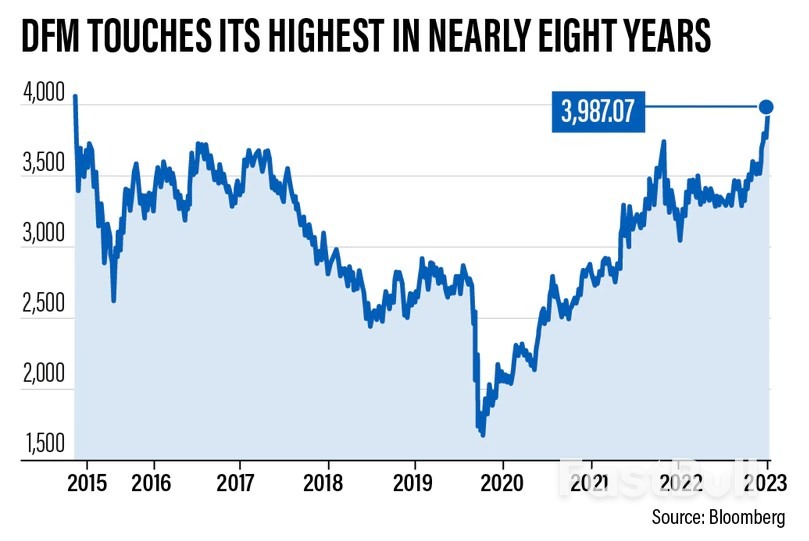
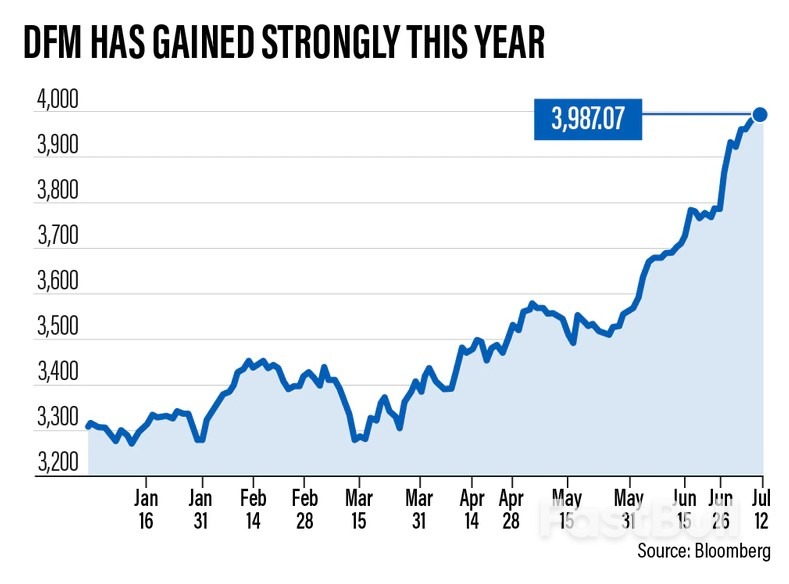
          The Dubai Financial Market reached its highest point in nearly eight years on Wednesday, a sign of growing investor confidence in the UAE's capital markets amid continued structural reforms and efforts to boost liquidity.
          The DFM crossed the 3,987 level, the highest since August 2015, and is up nearly 20 per cent so far this year, beating MSCI World Index's 12.6 per cent.Dubai Financial Market at Highest Point in Nearly Eight Years as UAE Draws Investors_1
          The strong growth momentum in the UAE this year is continuation of the robust performance of equity markets in the six-member economic bloc of the GCC, which outperformed global indices last year.
          Global stock markets suffered the worst performance last year since the 2008 financial crisis, as appetite for risker assets ebbed amid mounting economic uncertainty.
          Markets were hit hard as major central banks continued to tighten their monetary policies to rein in inflation. The MSCI All-Country World Index declined more than 20 per cent, the Nasdaq 100 fell 33 per cent in 2022, while the S&P 500 lost 19.4 per cent.
          The Abu Dhabi Securities Exchange was the best-performing market in the GCC for a second consecutive year in 2022, gaining more than 20 per cent.
          The UAE capital attracted $3 billion worth of listing proceeds in the first quarter of this year, placing it third worldwide, with Adnoc Gas raising about Dh9.1 billion ($2.5 billion) from the sale of a 5 per cent stake.
          At the time of its listing, Adnoc Gas was the largest initial public offering globally this year.
          Abu Dhabi alone accounted for 14 per cent of all listings worldwide during the first three months of the year.
          Analysts say the GCC markets continue to remain a bright spot amid volatile global financial markets facing continued economic uncertainty as central banks tighten monetary policy further.
          "Economic growth in the non-oil sector is likely to remain a key bright spot. Positive momentum here is likely to extend on a combination of public policy, domestic demand and performance of key sectors like tourism," said Manpreet Gill, chief investment officer for Africa, Middle East and Europe at Standard Chartered's wealth management unit.
          Dubai Financial Market at Highest Point in Nearly Eight Years as UAE Draws Investors_2IPO boom
          The GCC dominated global initial public offering activity in 2022, raising about 23 per cent ($21 billion) of the $91 billion raised in all IPOs worldwide last year, according to EFG Hermes.
          The flurry of listings on regional bourses came amid strong investor demand as GCC economies rebounded at a quicker pace from the coronavirus-induced slowdown and liquidity has been shored up by high oil prices.
          The outlook for the rest of 2023 remains positive, EY said in its Global IPO Trends report in March.
          Initiatives such as the Dh5 billion ($1.36 billion) Abu Dhabi IPO Fund will support the listing of private companies that will help maintain the IPO momentum in the local markets.
          "This will help in generating a good pipeline for the ADX," EY said in the report.
          Mena's weight to rise in EM index
          Looking ahead, the Mena markets are set to continue posting strong growth, driven by the GCC, Goldman Sachs said in a recent report.
          It expects the Mena region's weight in the MSCI emerging market index to rise to 10 per cent from 7.3 per cent currently, over the coming years, the investment bank said.
          "We have on average 17 per cent upside for our Mena financials coverage, on our 12-month price targets (the highest across sectors in Mena), and we are selectively constructive on financials within Saudi Arabia, UAE and Qatar," the investment bank said.
          "We calculate that EM investors moving from their current underweight position to market weight on Mena could drive more than $50 billion of inflows over the medium term."
          Goldman Sachs economists expect Mena equity markets to increase in size by around 10 times by 2075 from their current levels, and become a sizeable bloc within EM market cap.
          While the outlook remains robust, global headwinds persist in the short-term, analysts say.
          Nabil Sleiman, chief investment officer, Al Dhabi Capital, says while regional markets received a boost from strong oil prices in the first half of the year, the crude demand outlook for the second half of the year remains uncertain.
          "Oil prices have held up well during the first half of the year, lending support to expansionary policies of governments in the GCC," he told The National.
          However, concerns regarding demand from China remain, and this is a significant risk given that China accounts for nearly 15 per cent of oil demand, he added.
          GCC equity markets have moved mostly in tandem with emerging markets so far this year, said Ibrahim Masood, head of equities at Mashreq Capital.
          Historically emerging markets tend to be weak during period of economic softness in the US.
          "There are competing views about sticky inflation or an upcoming US recession in [the second half of the year]. In a recession scenario, GCC markets should outperform broader emerging markets due to better fiscal buffers and lack of material forex risk though oil price weakness may increase volatility," said Mr. Masood.
          "In a sticky inflation/stagflation scenario, nominal growth will help to offset valuations coming down as rates stay higher for longer. Given the uncertainty at present a fundamental focus appears appropriate for investors for H2."

          Source: The National News

          Risk Warnings and Disclaimers
          You understand and acknowledge that there is a high degree of risk involved in trading. Following any strategies or investment methods may lead to potential losses. The content on the site is provided by our contributors and analysts for information purposes only. You are solely responsible for determining whether any trading assets, securities, strategy, or any other product is suitable for investing based on your own investment objectives and financial situation.
          Comments
          Add to Favorites
          Share

          The Pound's Rally and the Looming Risks of Interest Rate Expectations for the Bank of England

          Warren Takunda

          Traders' Opinions

          The Bank of England (BoE) is facing a challenging dilemma as rising market expectations for a higher Bank Rate could potentially lead to financial instability and pose risks to the country's economy. The rally in Pound Sterling, which has outperformed other major currencies this year, has been largely driven by concerns over inflation and the market's response to potential interest rate hikes.
          Governor Andrew Bailey acknowledged the signs of cooling in the labor market during a press conference, emphasizing that current levels of wage increases are not in line with the inflation target. The Consumer Price Index (CPI) inflation measure in the UK has not fallen since March, while core inflation has even risen. Adding to the concerns, measures of wage growth and unemployment have increased, further fueling expectations of a potential Bank Rate hike.
          The Office for National Statistics reported a rise in the unemployment rate to 4% in the three months leading up to May, along with an increase in wage growth. Interest rate swap markets are now implying a high probability of the Bank Rate being raised from 5% to 6.5% by early next year. These implied rates have surpassed the peak of 6% assumed by the BoE in its stress test conducted as part of the latest financial stability review.
          While the BoE's analysis suggests that the financial system can handle a Bank Rate of up to 6%, the increase in unemployment poses a potential challenge. Employment levels are considered a lagging indicator of economic health, but with unemployment on the rise, there is a possibility of further increases in the coming months.
          The consequences of rising unemployment could have a significant impact on the banking sector, with loan defaults compromising assets and capital reserves. This presents a vulnerability for both the economy and financial stability. Additionally, the rally in Pound Sterling, driven by market expectations of higher interest rates, could be undermined if these risks materialize.
          The duration of these emerging risks and their potential to undermine the Pound's rally remain uncertain. It is also unclear how long the interest rate swap market activity will continue to be self-defeating. However, the July financial stability report and recent economic data highlight the growing risk of an accident in the economy.
          As the Bank of England prepares for its August forecast and interest rate decision, it will need to carefully assess all available information. Balancing the need to control inflation and support economic growth while mitigating financial stability risks will be a complex task for policymakers. The evolving situation calls for a cautious approach and close monitoring of economic indicators to navigate potential challenges and seize opportunities in the financial markets.
          Risk Warnings and Disclaimers
          You understand and acknowledge that there is a high degree of risk involved in trading. Following any strategies or investment methods may lead to potential losses. The content on the site is provided by our contributors and analysts for information purposes only. You are solely responsible for determining whether any trading assets, securities, strategy, or any other product is suitable for investing based on your own investment objectives and financial situation.
          Comments
          Add to Favorites
          Share

          The Commodities Feed: Brent Breaks Above $80

          Owen Li

          Commodity

          Energy: Urals trading above price cap
          The oil market continued its move higher yesterday, which saw ICE Brent not only break above US$80/bbl, but settle above this level. As a result, Brent has finally broken out of the range it has spent almost two months trading in. The key catalyst for the move was U.S. CPI data coming in below consensus. And while the data is unlikely to change expectations for the Fed to hike at its next meeting, it does call into question the need for further tightening after the July meeting. While the fundamentals continue to support the view that oil prices should trend higher over the remainder of the year, there are still clear macro concerns in the market. In addition, in the very short term, the 200-day moving average is likely to provide some strong resistance to the market.
          According to Argus, Russian Urals are now trading slightly above the US$60/bbl G7 price cap for shipments from Black Sea ports. Western insurance and shipping services can only be used for Russian crude priced under the cap. Obviously, there is nothing stopping this crude oil from moving with the use of alternative ships and insurance. And the fact that Russia has managed to secure a large amount of non-western shipping capacity does make the price cap less effective. If Urals remain above the cap for a sustained period, it will be interesting to see if it eventually has any impact on Russian export volumes.
          The latest trade data from China this morning shows that crude oil imports averaged 12.67MMbbls/d over June, up 4% month-on-month and 45% higher year-on-year. Obviously imports were under pressure last year due to Covid related lockdowns. Meanwhile year-to-date crude imports are up 11.7% YoY.
          Yesterday's EIA report saw some big inventory builds in crude and products. Commercial U.S. crude oil inventories increased by 5.95MMbbls over the last week, which was quite a lot more than the 3MMbbls increase reported by the API the previous day. The crude build was largely driven by lower exports with crude oil exports falling by 1.76MMbbls/d week-on-week to 2.14MMbbls/d, which is the lowest weekly export number since January. On the product side, distillate fuel oil inventories increased by 4.82MMbbls, whilst there was little change in gasoline stocks. Meanwhile, refinery run rates increased by 2.6pp over the week to 93.7%. Overall, the report was on the bearish side, given the large builds and weaker implied demand. However, clearly the market was more focused on U.S. CPI data yesterday.
          Both the IEA and OPEC will be releasing their monthly oil market reports today, which will include their latest outlook for the oil market. Despite broader macro concerns, last month the IEA remained constructive on the demand picture, with the agency forecasting oil demand to grow by 2.4MMbbls/d in 2023. However, the agency believes the macro picture will provide more headwinds for demand in 2024, with demand estimated to grow by 860Mbbls/d next year.
          European natural gas prices continue to come under pressure. TTF settled more than 8% lower yesterday and front month prices have traded down to their lowest levels in more than a month. Norwegian gas flows continue to edge higher from the lows seen in late May and over much of June (due to maintenance), whilst European storage is more than 80% full at the moment, well above the average of 65% for this time of year. Prices are likely to remain under pressure through the summer with storage expected to be full well ahead of the heating season. The Asian market is more profitable for LNG, with Asian spot LNG prices trading at its largest premium to TTF since January- more than US$3/MMBtu.
          Agriculture: Bearish WASDE report
          The USDA's latest WASDE report was a largely bearish affair, particularly for corn and soybeans. The USDA revised up its U.S. corn production estimate by 55m bushels to 15.32bn bushels, on the back of a larger than expected planted area as reported in its recent acreage report. A reduction in yield estimates (due to recent dry weather) was not enough to offset the higher acreage. The market was expecting a larger fall in yields, therefore the USDA's production estimate was above the 15.15b bushels the market was expecting. Higher output sees U.S. ending stock estimates for 2023/24 at 2,262m bushels, up slightly from the previous forecast and above the 2,166m bushels the market was expecting. For the global balance, corn production for 2023/24 is forecast to increase by 1.7mt to 1,224.5mt, as output increases from Canada (+0.7mt) and Ukraine (+0.5mt) partially offset by reductions from the EU (-0.9mt). 2023/24 global ending stocks for corn were left largely unchanged at 314.1mt, although this was above the little more than 312mt the market was expecting.
          The USDA lowered 2023/24 U.S. soybean output estimates by 210m bushels to 4,300m bushels due to lower acreage. The market was expecting further downside to soybean output, however, the agency left yields unchanged from last month. U.S. 2023/24 ending stock estimates were reduced from 350m bushels to 300m bushels, which was still well above the roughly 206m bushels the market was expecting. For the global market, 2023/24 soybean production estimates were lowered by 5.4mt to 405.3mt, which leaves ending stocks for 2023/24 at just under 121mt.
          Lastly, the USDA projects U.S. wheat supplies to increase by 74m bushels to 1,739m bushels. This pushes U.S. ending stock estimates up by 30m bushels to 592m bushels, which is above the roughly 565m bushels the market was expecting. For the global wheat market, the USDA expects 2023/24 wheat production to fall to 796.7mt this season, down from an earlier estimate of 800.2mt. As a result, ending stocks for 2023/24 were lowered by 4.2mt to 266.5mt, which is less than the market was expecting.

          Source: ING

          Risk Warnings and Disclaimers
          You understand and acknowledge that there is a high degree of risk involved in trading. Following any strategies or investment methods may lead to potential losses. The content on the site is provided by our contributors and analysts for information purposes only. You are solely responsible for determining whether any trading assets, securities, strategy, or any other product is suitable for investing based on your own investment objectives and financial situation.
          Comments
          Add to Favorites
          Share

          Dollar Might Take a Breather after Steep Selloff, Swiss Franc Taking the Top Spot

          Samantha Luan

          Forex

          Following a significant post-CPI sell-off, Dollar's plunge appears to be losing some momentum during today's Asian trading session on oversold conditions. However, the greenback is yet to demonstrate any considerable signs of a rebound. Investors seem buoyed by the waning likelihood of Fed extending its tightening phase beyond the imminent July interest rate hike. As it stands, Fed fund futures are reflecting less than 30% chance for further rate hikes throughout the remainder of the year. In sync with this development, major Asian stock indexes are showing considerable gains, riding on the coattails of US market rally overnight.
          New Zealand and Australian Dollar are the stronger ones for today. followed by Swiss Franc. Meanwhile, Dollar, Yen and Canadian are the worst. But for the week, Swiss Franc is the top gainer at this point, helped by EUR/CHF breaking through a key near term support level. Yen is still strong as the second, but got its first place taken by the Franc. Canadian Dollar is the second worst following Dollar despite yesterday's BoC rate hike. Euro is having a slight advantage over Sterling while Aussie and Kiwi are mixed.
          Technically, EUR/CHF's dive through 0.9670 support confirms resumption of whole decline from 1.0095. The structure of the fall still suggests that it's a corrective move. But deeper decline would remain in favor as long as 0.9721 support turned resistance holds. Next target is 100% projection of 0.9995 to 0.9670 from 0.9840 at 0.9515. If realized, the extended fall in EUR/CHF would make USD/CHF short a better trade than EUR/USD long.Dollar Might Take a Breather after Steep Selloff, Swiss Franc Taking the Top Spot_1
          In Asia, at the time of writing, Nikkei is up 1.40%. Hong Kong HSI is up 2.32%. China Shanghai SSE is up 0.99%. Singapore Strait Times is up 1.75%. Japan 10-year JGB yield is down -0.0080 at 0.472. Overnight, DOW rose 0.25%. S&P 500 rose 0.74%. NASDAQ rose 1.15%. 10-year yield dropped -0.119 to 3.861.

          Fed Beige Book: Slight increase in economic activity and modest price rises

          Fed's Beige Book report noted that the "overall economic activity increased slightly since late May." Notably, the level of economic development varied across the twelve districts, with five districts reporting growth, five noticing no change, and two marking modest declines.
          The Beige Book described a cautiously optimistic picture for the future, stating that "overall economic expectations for the coming months generally continued to call for slow growth."
          Despite the uneven growth rate, the districts generally agreed on the direction of price changes. The report noted that "prices increased at a modest pace overall, and several districts noted some slowing in the pace of increase."
          Looking ahead, the report suggests that the "price expectations were generally stable or lower over the next several months".
          The employment situation was characterized by a modest rise, with the Beige Book stating that "employment increased modestly this period, with most districts experiencing some job growth."

          NZ BNZ PMI fell to 47.5, sector remains entrenched in contraction

          New Zealand's manufacturing sector is experiencing a continuous contraction according to BusinessNZ Performance of Manufacturing Index. The Index showed a drop from 48.7 in May to 47.5 in June, marking another month of activity below the crucial 50.0-point mark which separates expansion from contraction.
          An analysis of the sub-indices revealed mixed performances across different facets of the sector. While production showed a modest rise from 46.0 to 47.5, new orders experienced a significant drop from 50.2 to 43.8. Meanwhile, employment levels decreased from 49.3 to 47.0. Both finished stocks and deliveries saw rises, from 51.6 to 52.2 and 46.1 to 50.5 respectively.
          Alongside this contraction in activity, the report noted an increase in negative sentiment among manufacturers. In June, the proportion of negative comments increased to 74.5%, up from 66.7% in May and 70.3% in April. According to manufacturers, the primary negative influences on current activity are declining demand, inflationary pressures, and issues surrounding production and staffing.
          BusinessNZ's Director, Advocacy Catherine Beard, pointed out the persisting contraction in the sector, saying, "the sector remains entrenched in contraction, with eight of the last ten months showing overall activity below the 50.0-point mark."

          China's exports down -12.4% yoy in Jun, imports down -6.8% yoy

          China's trade dynamics in June spun a story of steeper than expected declines on both the import and export front. With the largest export drop since February 2020.
          June's figures reveal a -12.4% yoy slump in China's exports, far exceeding anticipated -9.5% yoy decline and outpacing May's -7.5% yoy drop. Imports followed a similar pattern, decreasing by -6.8% yoy, steeper fall than projected 4.0% and more significant contraction than May's -4.5% yoy shrinkage.
          Despite these challenges, China's trade surplus managed to grow from USD 68.1B to USD 70.62B. However, this increase didn't quite hit expectation of a USD 74.8B surplus.
          Lu Daliang, a spokesperson for China's customs bureau, cautioned that the nation's trade is expected to face substantial pressure in the second half of the year. During a press conference, Lu attributed these pressures to high inflation in developed countries and geopolitical issues.

          Looking ahead

          UK GDP, production and goods trade balance; Eurozone industrial production, and ECB meeting accounts are the main highlights in European session. US will release jobless claims and PPI later in the day.

          USD/CHF Daily Outlook

          USD/CHF hits as low as 0.8650 so far today and intraday bias stays on the downside. Current fall should target 100% projection of 0.9439 to 0.8818 from 0.9146 at 0.8525 next. On the upside, above 0.8762 minor resistance will turn intraday bias neutral and bring consolidations first. But outlook will remain bearish as long as 0.8900 support turned resistance holds.Dollar Might Take a Breather after Steep Selloff, Swiss Franc Taking the Top Spot_2
          In the bigger picture, the break of 0.8756 (2021 low) indicates break out from the long-term range pattern. For now, medium term outlook will stay bearish as long as 0.9146 resistance holds. Further fall would be seen to 61.8% retracement of 0.7065 (2011 low) to 1.0342 (2016 high) at 0.8317 next.Dollar Might Take a Breather after Steep Selloff, Swiss Franc Taking the Top Spot_3Dollar Might Take a Breather after Steep Selloff, Swiss Franc Taking the Top Spot_4

          Source: ActionForex.com

          Risk Warnings and Disclaimers
          You understand and acknowledge that there is a high degree of risk involved in trading. Following any strategies or investment methods may lead to potential losses. The content on the site is provided by our contributors and analysts for information purposes only. You are solely responsible for determining whether any trading assets, securities, strategy, or any other product is suitable for investing based on your own investment objectives and financial situation.
          Comments
          Add to Favorites
          Share

          Bank of Canada Hikes Again as Inflation Fears Linger

          Alex

          Forex

          Second hike in a row after a long pause

          The Bank of Canada has raised rates a further 25 basis points today, leaving it at 5%. This follows a five-month pause between the January hike and the restart of policy tightening in June, triggered by concerns that demand was proving to be more resilient and inflation more persistent than the BoC had expected. This argument was used again today with the BoC stating that “three-month rates of core inflation running around 3½-4% since last September, underlying price pressures appear to be more persistent than anticipated. This is reinforced by the Bank's business surveys, which find businesses are still increasing their prices more frequently than normal”.
          The BoC also place a heavy emphasis on the strength in consumer demand and the tightness in the labour market, which is keeping wage pressures elevated. It sees inflation staying around 3% for the next year before only returning to target in 2025. The BoC offer little in the way of forward guidance, merely stating that the “Governing Council will continue to assess the dynamics of core inflation and the outlook for CPI inflation. In particular, we will be evaluating whether the evolution of excess demand, inflation expectations, wage growth and corporate pricing behaviour are consistent with achieving the 2% inflation target”.
          The chart above shows that inflation and the unemployment rate are moving in the direction the BoC would like to see, but clearly it isn't happening quickly enough and may not be sustainable enough for the BoC to keep rates at 5%. The market is currently pricing around a 75% chance of another hike at the September meeting and we feel this is about right. The tone of the statement suggests the BoC are not convinced it has done enough yet so we will need to see significant softness in activity, labour and inflation numbers to prevent another move.Bank of Canada Hikes Again as Inflation Fears Linger_1

          CAD: On track to hit sub-1.30 levels

          The market reaction to the BoC hike was – as we had expected – positive for the loonie, although the proximity to the surprisingly soft CPI print in the U.S. meant that CAD lagged other pro-cyclical currencies on the day. That, once again, boils down to the rather tight correlation of the loonie with incoming data from the US.
          Looking beyond the very short-term impact, the extra hike by the BoC and no pushback against further moves in the future means that CAD can keep benefitting from an attractive carry. It's worth remembering that the loonie has the best volatility-adjusted carry in the G10 space. We don't necessarily see this as the inception of a broader USD downtrend, but the close USD-CAD correlation also means that CAD is more shielded in the event of a USD rebound than other pro-cyclical currencies. A move below 1.3000 is surely possible in the coming weeks, although we may need to wait the fourth quarter of this year to see USD/CAD sustainably trade around 1.27/1.28.

          Source: ING

          Risk Warnings and Disclaimers
          You understand and acknowledge that there is a high degree of risk involved in trading. Following any strategies or investment methods may lead to potential losses. The content on the site is provided by our contributors and analysts for information purposes only. You are solely responsible for determining whether any trading assets, securities, strategy, or any other product is suitable for investing based on your own investment objectives and financial situation.
          Comments
          Add to Favorites
          Share

          UK Economy Set to Contract in May, U.S. PPI to Slow Further

          Devin

          Forex

          We saw another day of strong gains for European markets yesterday, with the FTSE100 undergoing its best one-day gain since early June, after U.S. CPI came in below forecasts.
          U.S. markets also saw strong gains with the S&P500 and Nasdaq 100 breaking above their highs of this year, and pushing up to their highest levels since April 2022, with the Nasdaq 100 leading the gains.
          Asia markets followed suit with strong gains across the board despite the latest set of China trade data for June showing that economic activity slowed further. Exports fell by -12.4% from a year ago, missing expectations by a large margin, while imports also declined more than expected, by -6.8%, further reinforcing concerns about deflation, but on the more positive side increasing expectations of stronger stimulus by Chinese authorities in the weeks ahead.
          Yesterday's U.S. CPI numbers for June were never likely to change the calculus behind another 25bps rate hike when the Fed meets in two weeks' time, but they have altered the story when it comes to what might come next, and it is this that markets are reacting to, with the U.S. dollar and yields falling back sharply.
          The nature of yesterday's numbers suggest that whatever other Fed officials would have us believe in the context of their current hawkishness, further rate hikes beyond this month will be a big ask, and probably won't happen, hence the weakness seen in both the U.S. dollar, and U.S. yields seen so far this week.
          That said we can still expect Fed officials to continue to adopt a hawkish tone on the basis that they won't want markets to prematurely start pricing in rate cuts, and will want to keep the option of further hikes very much on the table.
          Nonetheless the shift seen in the last few days does help to explain why the U.S. dollar has slipped so much against the Japanese yen, although some are suggesting it is because we might see a policy shift from the Bank of Japan when it meets at the end of this month. Whichever way you come at it from, the net effect is likely to be the same, in that U.S. and Japanese rates are likely to converge, rather than diverge.
          Today's PPI numbers for June are expected to reinforce the disinflation trends being seen rippling out through the global economy. On the headline numbers PPI is expected to see another sharp slowdown from 1.1% in May to 0.4% in June, while core PPI is forecast to slow down more modestly from 2.8% to 2.6%.
          Whichever way you look at it, further weakness here is likely to trickle down into the CPI numbers in the coming months, and reinforce the disinflationary narrative, but more importantly signal that U.S. rate hikes are done bar the move in two weeks' time.
          Yesterday's U.S. inflation numbers could prove to be good news for UK homeowners, if yesterday's move in UK yields is any guide, in that they might reduce the pressure on the Bank of England to be more aggressive in terms of their own rate hiking policy.
          If this month's expected July hike from the Federal Reserve is in fact the last one, then the Bank of England may only need to do another 50bps in August before similarly signalling a pause, which means that UK current terminal rate pricing is too high. This would be an enormous relief for mortgage holders worried that the base rate might rise as high as 6.5%.
          The problem for the UK is the energy price cap is keeping inflation levels way too high, and now it has outlived its usefulness it really ought to be scrapped. It was useful in containing the upside, however by way of its design its not reflecting the sharp declines in gas prices in the last 12 months.
          Consequently, it is contriving to exert upward pressure on wages as consumers struggle with the higher cost of living due to energy prices not coming down quickly enough.
          This failure is likely to be reflected in today's UK economic data for May, which is expected to see manufacturing and industrial production to sharp 0.4% declines in economic activity for both.
          The monthly GDP numbers for May are also forecast to show a -0.3% contraction due to the multiple bank holidays during the month, as well as widespread public sector strike action, with index of services seeing a sharp slowdown from 0.3% in April to -0.2%. The weak performance in May is likely to act as a sizeable drag on Q2 GDP, although we should see some of that recovered in June.
          EUR/USD – broke higher through the highs of this year and could well retest the highs of March 2022 at 1.1185. This becomes next resistance, with a break targeting the 1.1485 area, with support now at 1.1020.
          GBP/USD – has encountered resistance at the 1.3000 area. We need to see a break above 1.3020 to target a move towards 1.3300, and the March 2022 highs. Support now comes in at the 1.2850 area.
          EUR/GBP – failed again at the 0.8500 area, with the rebound currently holding below the 0.8570/80 area. A break above here targets the 50-day SMA which is now at 0.8610.
          USD/JPY – slid down to the 138.15 area where we have cloud support. If this gives way, we could see further losses towards 137.20. We now have resistance back at the 140.20 area.

          Source: CMC

          Risk Warnings and Disclaimers
          You understand and acknowledge that there is a high degree of risk involved in trading. Following any strategies or investment methods may lead to potential losses. The content on the site is provided by our contributors and analysts for information purposes only. You are solely responsible for determining whether any trading assets, securities, strategy, or any other product is suitable for investing based on your own investment objectives and financial situation.
          Comments
          Add to Favorites
          Share

          Pound Surges to 1.30 Against the Dollar as U.S. Inflation Eases Pressure on Fed

          Warren Takunda

          Traders' Opinions

          The Pound to Dollar exchange rate (GBPUSD) experienced a significant rally, surpassing the psychologically important level of 1.30. This surge was triggered by the release of data indicating a sharp decline in U.S. inflation, which alleviates pressure on the U.S. Federal Reserve to raise interest rates beyond the anticipated hike in July.Pound Surges to 1.30 Against the Dollar as U.S. Inflation Eases Pressure on Fed_1
          The rally in GBPUSD is noteworthy, as the last time the exchange rate reached the 1.30 milestone was in April 2022 when it was heading in the opposite direction.
          The data released by the U.S. Bureau of Labor Statistics (BLS) revealed a rapid cooling in inflationary pressures in the largest global economy. However, despite the decline, the slower decrease in core inflation readings suggests that the Federal Reserve will not be deterred from raising interest rates at least one more time.
          Here are the key inflation figures from the BLS:
          Core CPI (year-over-year) in June: 4.8%, estimate: 5.0%, previous: 5.3%
          Core CPI (month-over-month) in June: 0.2%, estimate: 0.3%, previous: 0.4%
          CPI (year-over-year) in June: 3.0%, estimate: 3.1%, previous: 4.0%
          CPI (month-over-month) in June: 0.2%, estimate: 0.3%, previous: 0.1%
          The drop in inflation was partially influenced by base effects, as a strong increase from a year ago was no longer factored into the calculations.
          Following the release of the inflation data, the Pound to Dollar exchange rate rallied back to 1.2955, reversing its downward trend earlier in the day.
          Meanwhile, the Euro to Dollar rate also advanced by half a percent to 1.1062. The U.S. Dollar weakened against most major currencies as U.S. bond yields declined, reflecting the belief that the Federal Reserve is gaining control over inflation.
          Encouragingly for the Fed, there was relief in the preferred measure of core services prices, which excludes the impact of shelter prices. This measure provides a better gauge of underlying price pressures tied to demand. In June, it showed a -0.01% month-over-month pace, indicating that past rate hikes are starting to cool inflation.
          The expectations of cooling inflation bolstered demand for U.S. Treasury bonds, leading to a decrease in the yields they offer. The 2-year yield eased further below the symbolic 5% barrier.
          The Dollar's weakness following the CPI release comes as GBPUSD aims to extend its multi-month rally towards, and potentially beyond, the 1.30 level.
          Pound bulls may need to wait for the market to settle before they are able to get back into the market, however, according to analysts and technical studies.
          According to analysts, breaking the 1.30 level will be challenging for Pound Sterling, which is starting to appear overextended after its recent rally. It is advisable to exercise caution, as after a strong rally this month, breaking 1.30 could be difficult.
          In conclusion, the Pound's surge against the Dollar was fueled by easing U.S. inflationary pressures, which relieved some pressure on the Federal Reserve to aggressively raise interest rates. While the 1.30 level presents a challenge, the Pound's rally demonstrates its strength. Investors will closely monitor further developments in inflation and central bank policies as they navigate the foreign exchange market.
          Risk Warnings and Disclaimers
          You understand and acknowledge that there is a high degree of risk involved in trading. Following any strategies or investment methods may lead to potential losses. The content on the site is provided by our contributors and analysts for information purposes only. You are solely responsible for determining whether any trading assets, securities, strategy, or any other product is suitable for investing based on your own investment objectives and financial situation.
          Comments
          Add to Favorites
          Share
          FastBull
          Copyright © 2025 FastBull Ltd

          728 RM B 7/F GEE LOK IND BLDG NO 34 HUNG TO RD KWUN TONG KLN HONG KONG

          TelegramInstagramTwitterfacebooklinkedin
          App Store Google Play Google Play
          Products
          Charts

          Chats

          Q&A with Experts
          Screeners
          Economic Calendar
          Data
          Tools
          Membership
          Features
          Function
          Markets
          Copy Trading
          Latest Signals
          Contests
          News
          Analysis
          24/7
          Columns
          Education
          Company
          Careers
          About Us
          Contact Us
          Advertising
          Help Center
          Feedback
          User Agreement
          Privacy Policy
          Business

          White Label

          Data API

          Web Plug-ins

          Poster Maker

          Affiliate Program

          Risk Disclosure

          The risk of loss in trading financial instruments such as stocks, FX, commodities, futures, bonds, ETFs and crypto can be substantial. You may sustain a total loss of the funds that you deposit with your broker. Therefore, you should carefully consider whether such trading is suitable for you in light of your circumstances and financial resources.

          No decision to invest should be made without thoroughly conducting due diligence by yourself or consulting with your financial advisors. Our web content might not suit you since we don't know your financial conditions and investment needs. Our financial information might have latency or contain inaccuracy, so you should be fully responsible for any of your trading and investment decisions. The company will not be responsible for your capital loss.

          Without getting permission from the website, you are not allowed to copy the website's graphics, texts, or trademarks. Intellectual property rights in the content or data incorporated into this website belong to its providers and exchange merchants.

          Not Logged In

          Log in to access more features

          FastBull Membership

          Not yet

          Purchase

          Become a signal provider
          Help Center
          Customer Service
          Dark Mode
          Price Up/Down Colors

          Log In

          Sign Up

          Position
          Layout
          Fullscreen
          Default to Chart
          The chart page opens by default when you visit fastbull.com