• Trade
  • Markets
  • Copy
  • Contests
  • News
  • 24/7
  • Calendar
  • Q&A
  • Chats
Trending
Screeners
SYMBOL
LAST
BID
ASK
HIGH
LOW
NET CHG.
%CHG.
SPREAD
SPX
S&P 500 Index
6920.92
6920.92
6920.92
6965.70
6919.18
-23.90
-0.34%
--
DJI
Dow Jones Industrial Average
48996.07
48996.07
48996.07
49621.43
48951.99
-466.00
-0.94%
--
IXIC
NASDAQ Composite Index
23584.26
23584.26
23584.26
23723.37
23504.22
+37.10
+ 0.16%
--
USDX
US Dollar Index
98.610
98.690
98.610
98.640
98.390
+0.130
+ 0.13%
--
EURUSD
Euro / US Dollar
1.16593
1.16600
1.16593
1.16827
1.16560
-0.00160
-0.14%
--
GBPUSD
Pound Sterling / US Dollar
1.34221
1.34228
1.34221
1.34651
1.34154
-0.00347
-0.26%
--
XAUUSD
Gold / US Dollar
4429.68
4430.09
4429.68
4466.25
4407.63
-26.46
-0.59%
--
WTI
Light Sweet Crude Oil
56.966
56.996
56.966
57.076
55.890
+0.666
+ 1.18%
--

Community Accounts

Signal Accounts
--
Profit Accounts
--
Loss Accounts
--
View More

Become a signal provider

Sell trading signals to earn additional income

View More

Guide to Copy Trading

Get started with ease and confidence

View More

Signal Accounts for Members

All Signal Accounts

Best Return
  • Best Return
  • Best P/L
  • Best MDD
Past 1W
  • Past 1W
  • Past 1M
  • Past 1Y

All Contests

  • All
  • Trump Updates
  • Recommend
  • Stocks
  • Cryptocurrencies
  • Central Banks
  • Featured News
Top News Only
Share

[US Media Figure: Trump's Increased Military Spending Indicates The US May Be Preparing For A "World War"] Former Fox News Host Tucker Carlson Stated On The 7th That US President Trump's Announcement Of Increasing US Military Spending To $1.5 Trillion In Fiscal Year 2027 Indicates The US May Be Preparing For A "world War." Carlson Posted A Video Of His Conversation With An American Journalist On His Social Media Account That Evening. In The Video, He Stated That The Pentagon's Budget Increase To $1.5 Trillion Demonstrates "the Characteristics Of A Country Preparing For A Global Or Regional War." Carlson Said This Trend Indicates The US Is Moving In A Direction Where A "world War" May Break Out

Share

[Turkish Media Reports That A Russian-linked Oil Tanker Was Attacked By A Drone In The Black Sea] Turkish Media Reports That A Russian-linked Oil Tanker Was Attacked By A Drone In The Black Sea. According To Ntv, The Palau-flagged Tanker "Elbus" Was Attacked Approximately 30 Miles Off The Turkish Coast. The Media Outlet Stated That The Vessel Issued A Distress Call And Dispatched The Coast Guard To The Scene. The Industry Database Equasis Did Not Provide Contact Information For The Ship's Owner

Share

Governor: Lebanon Central Bank Seeks To Recuperate Embezzled Funds To Bolster Liquidity

Share

Israeli Forces Kill Four In Gaza, Say They Hit Rocket Launch Site

Share

Fed Data - USA Effective Federal Funds Rate At 3.64 Percent On 07 January On $83 Billion In Trades Versus 3.64 Percent On $88 Billion On 06 January

Share

According To Data From The Federal Reserve Bank Of New York, The Secured Overnight Funding Rate (Sofr) Was 3.65% On The Previous Trading Day (January 7), Compared To 3.66% The Day Before

Share

USA Dollar Index Edges Higher Following Initial Jobless Claim Data, Last Up 0.08% At 98.814

Share

Euro Loses Ground Against Dollar Following Initial Jobless Claim Data, Last Down 0.06% At $1.167025

Share

EU's Kallas: We Have Had Discussions Among Europeans What Would Be Our Response If Threat From USA Is Real

Share

US Dollar Pares Losses Against Japanese Yen Following Initial Jobless Claim Data, Last Up 0.01% At 156.785 Yen

Share

Canada Oct Imports C$66.19 Billion, Up 3.4% From Sept C$64.04 Billion (Revised From C$64.08 Billion)

Share

USA Oct Exports $302.02 Billion Versus Sept $294.23 Billion, Imports $331.37 Billion Versus Sept $342.36 Billion

Share

US Jobless Claims 4-Week Average Fell To 211750 Jan 3 Week From 219000 Prior Week (Previous 218750)

Share

The Preliminary Estimate Of U.S. Nonfarm Unit Labor Costs For The Third Quarter Was -1.9%, Compared To An Expected -0.1% And A Previous Reading Of 1%

Share

US Oct Oil Import Price $60.47/Bbl Versus Sept $62.07/Bbl, -11.5% From Oct'24 $68.36/Bbl

Share

USA Oct Goods Deficit $59.15 Billion, Services Surplus $29.80 Billion

Share

USA - China Oct Trade Deficit $14.94 Billion Versus Sept Deficit $15.03 Billion

Share

USA Oct Capital Goods Imports $94.42 Billion Versus Sept Imports $87.58 Billion

Share

USA Oct Exports +2.6% Versus Sept +3.6%, Imports -3.2% Versus Sept +0.8%

Share

US Insured Unemployment Rate Unchanged At 1.2% Dec 27 Week From 1.2% Prior Week (Previous 1.2%)

TIME
ACT
FCST
PREV
France Trade Balance (SA) (Nov)

A:--

F: --

P: --
France Current Account (Not SA) (Nov)

A:--

F: --

P: --

South Africa Manufacturing PMI (Dec)

A:--

F: --

P: --

Italy Unemployment Rate (SA) (Nov)

A:--

F: --

P: --

France 10-Year OAT Auction Avg. Yield

A:--

F: --

P: --

Euro Zone Consumer Inflation Expectations (Dec)

A:--

F: --

P: --

Euro Zone Unemployment Rate (Nov)

A:--

F: --

P: --

Euro Zone PPI MoM (Nov)

A:--

F: --

P: --

Euro Zone Selling Price Expectations (Dec)

A:--

F: --

P: --

Euro Zone PPI YoY (Nov)

A:--

F: --

P: --

Euro Zone Industrial Climate Index (Dec)

A:--

F: --

P: --

Euro Zone Economic Sentiment Indicator (Dec)

A:--

F: --

P: --
Euro Zone Services Sentiment Index (Dec)

A:--

F: --

P: --
Euro Zone Consumer Confidence Index Final (Dec)

A:--

F: --

P: --

Mexico 12-Month Inflation (CPI) (Dec)

A:--

F: --

P: --

Mexico Core CPI YoY (Dec)

A:--

F: --

P: --

Mexico PPI YoY (Dec)

A:--

F: --

P: --

Mexico CPI YoY (Dec)

A:--

F: --

P: --

U.S. Challenger Job Cuts MoM (Dec)

A:--

F: --

P: --

U.S. Challenger Job Cuts (Dec)

A:--

F: --

P: --

U.S. Challenger Job Cuts YoY (Dec)

A:--

F: --

P: --

U.S. Exports (Oct)

A:--

F: --

P: --

U.S. Trade Balance (Oct)

A:--

F: --

P: --
U.S. Initial Jobless Claims 4-Week Avg. (SA)

A:--

F: --

P: --
Canada Imports (SA) (Oct)

A:--

F: --

P: --
U.S. Weekly Initial Jobless Claims (SA)

A:--

F: --

P: --
U.S. Weekly Continued Jobless Claims (SA)

A:--

F: --

P: --
Canada Exports (SA) (Oct)

A:--

F: --

P: --
Canada Trade Balance (SA) (Oct)

A:--

F: --

P: --
U.S. Unit Labor Cost Prelim (SA) (Q3)

A:--

F: --

P: --

U.S. Wholesale Sales MoM (SA) (Oct)

--

F: --

P: --

U.S. EIA Weekly Natural Gas Stocks Change

--

F: --

P: --

U.S. Consumer Credit (SA) (Nov)

--

F: --

P: --

U.S. Weekly Treasuries Held by Foreign Central Banks

--

F: --

P: --

China, Mainland CPI YoY (Dec)

--

F: --

P: --

China, Mainland PPI YoY (Dec)

--

F: --

P: --

China, Mainland CPI MoM (Dec)

--

F: --

P: --

Indonesia Retail Sales YoY (Nov)

--

F: --

P: --

Japan Leading Indicators Prelim (Nov)

--

F: --

P: --

Germany Industrial Output MoM (SA) (Nov)

--

F: --

P: --

Germany Exports MoM (SA) (Nov)

--

F: --

P: --
France Industrial Output MoM (SA) (Nov)

--

F: --

P: --

Italy Retail Sales MoM (SA) (Nov)

--

F: --

P: --

Euro Zone Retail Sales MoM (Nov)

--

F: --

P: --

Euro Zone Retail Sales YoY (Nov)

--

F: --

P: --

Italy 12-Month BOT Auction Avg. Yield

--

F: --

P: --

India Deposit Gowth YoY

--

F: --

P: --

Brazil IPCA Inflation Index YoY (Dec)

--

F: --

P: --

Mexico Industrial Output YoY (Nov)

--

F: --

P: --

Brazil CPI YoY (Dec)

--

F: --

P: --

U.S. Building Permits Revised MoM (SA) (Sept)

--

F: --

P: --

U.S. Building Permits Revised YoY (SA) (Sept)

--

F: --

P: --

U.S. Unemployment Rate (SA) (Dec)

--

F: --

P: --

U.S. Nonfarm Payrolls (SA) (Dec)

--

F: --

P: --

U.S. Average Hourly Wage YoY (Dec)

--

F: --

P: --

Canada Full-time Employment (SA) (Dec)

--

F: --

P: --

Canada Part-Time Employment (SA) (Dec)

--

F: --

P: --

Canada Unemployment Rate (SA) (Dec)

--

F: --

P: --

Canada Labor Force Participation Rate (SA) (Dec)

--

F: --

P: --

Canada Employment (SA) (Dec)

--

F: --

P: --

Q&A with Experts
    • All
    • Chatrooms
    • Groups
    • Friends
    Kung Fu flag
    ethane
    Like this one
    @ethanejust click the arrow at the top to your right, Brother
    Size flag
    Prosenjit
    @ProsenjitNice one bro. Two TPs already well done.
    Prosenjit flag
    Kung Fu
    @Kung Funo bro just monitoring . Are you place any position ?
    Size flag
    All good on my end too, just staying patient and sticking to the plan@Prosenjit
    Prosenjit flag
    Size
    @Size@Sizeyes bro
    Izuul flag
    Size
    All good on my end too, just staying patient and sticking to the plan@Prosenjit
    @SizeWhat is your plan again brother?
    Size flag
    What pair did you catch the TPs on?@Prosenjit
    Kung Fu flag
    Prosenjit
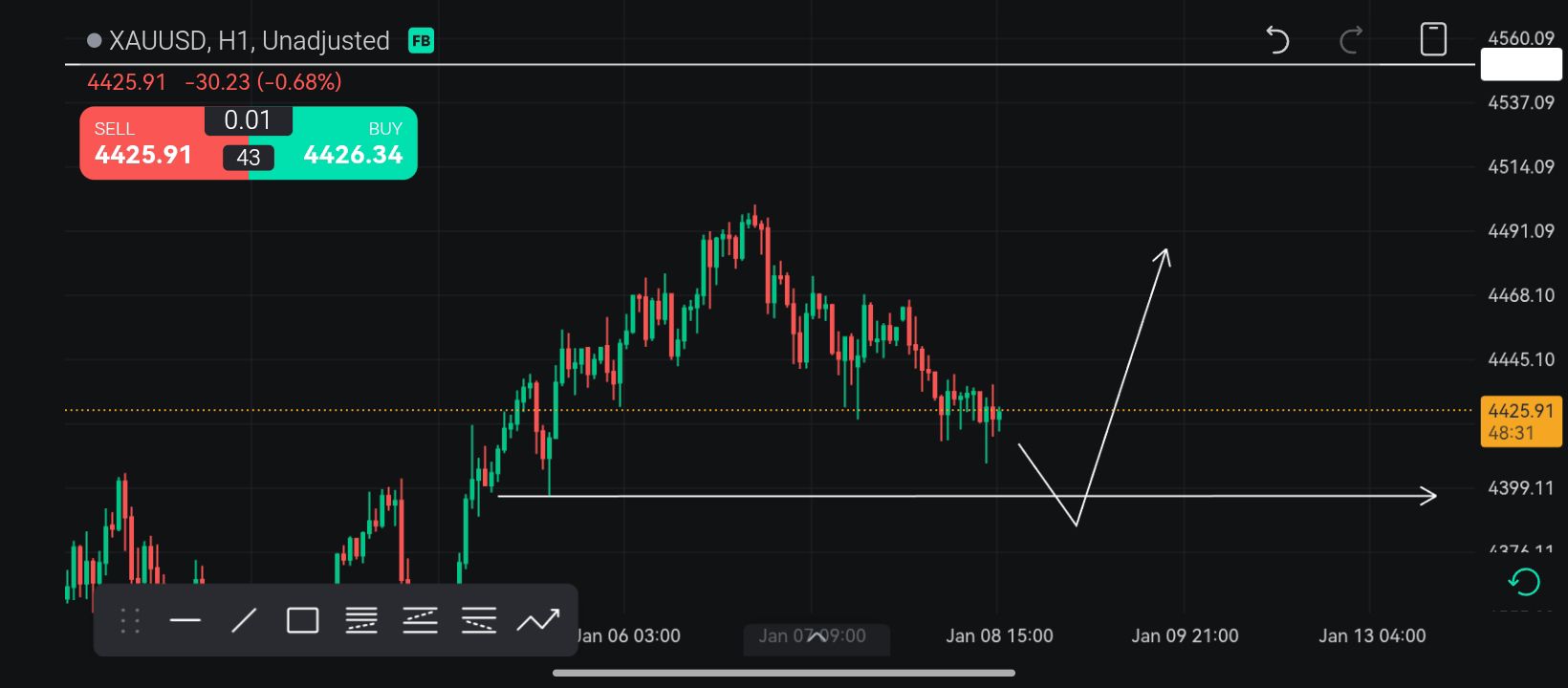
    @Prosenjityes, I'm still swinging my gold position and day trading two forex assets
    Prosenjit flag
    Size
    All good on my end too, just staying patient and sticking to the plan@Prosenjit
    @Sizealways bro. Without plan we can't win any war
    Size flag
    Exactly.. The past is done all we can do is learn from it and execute better going forward...@Prosenjit
    EuroTrader flag
    ethane
    How to display economic data
    @ethaneyou can actually do it right there on the fastbull application seamlessly mate
    Prosenjit flag
    Kung Fu
    @Kung FuGood bro. If I ever need any help I ask you . please don't denied bro
    Prosenjit flag
    Size
    Exactly.. The past is done all we can do is learn from it and execute better going forward...@Prosenjit
    @Sizeexactly bro .
    EuroTrader flag
    EuroTrader flag
    EuroTrader
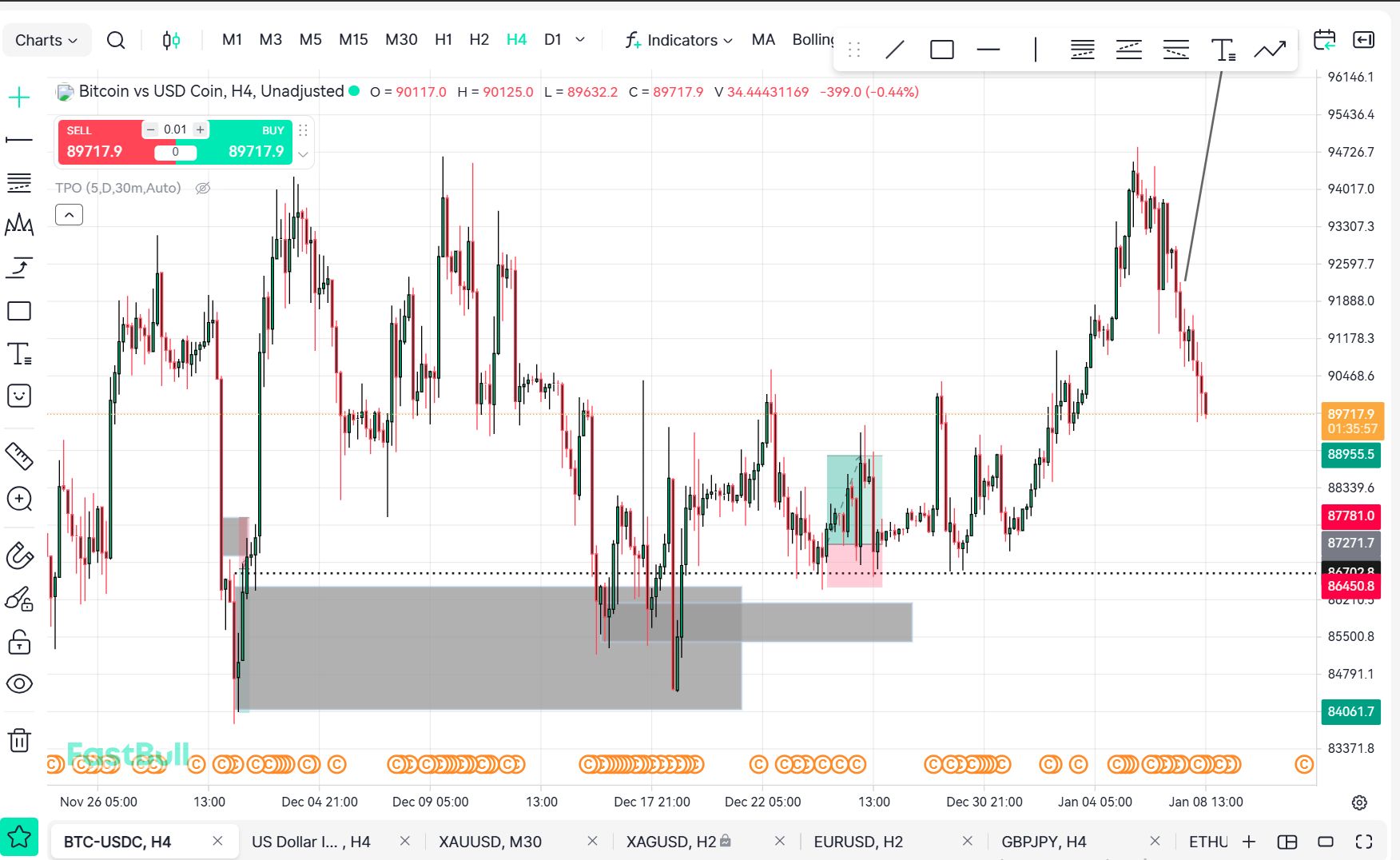
    @Prosenjitdo you have eyes on bitcoin, its really giving us signs that its gonna head further to the downside shortly
    Kung Fu flag
    Prosenjit
    @Prosenjityou probably have yet to know me. Ask around. I don't hesitate to help
    Size flag
    Stay disciplined, protect profits, and keep the mindset clean. One good decision at a time .@Prosenjit
    Prosenjit flag
    Kung Fu
    @Kung Futhank you bro
    Size flag
    Size flag
    Size
    @IzuulThis is my plan mate...
    Type here...
    Add Symbol or Code

      No matching data

      All
      Trump Updates
      Recommend
      Stocks
      Cryptocurrencies
      Central Banks
      Featured News
      • All
      • Russia-Ukraine Conflict
      • Middle East Flashpoint
      • All
      • Russia-Ukraine Conflict
      • Middle East Flashpoint
      Search
      Products

      Charts Free Forever

      Chats Q&A with Experts
      Screeners Economic Calendar Data Tools
      Membership Features
      Data Warehouse Market Trends Institutional Data Policy Rates Macro

      Market Trends

      Market Sentiment Order Book Forex Correlations

      Top Indicators

      Charts Free Forever
      Markets

      News

      News Analysis 24/7 Columns Education
      From Institutions From Analysts
      Topics Columnists

      Latest Views

      Latest Views

      Trending Topics

      Top Columnists

      Latest Update

      Signals

      Copy Rankings Latest Signals Become a signal provider AI Rating
      Contests
      Brokers

      Overview Brokers Assessment Rankings Regulators News Claims
      Broker listing Forex Brokers Comparison Tool Live Spread Comparison Scam
      Q&A Complaint Scam Alert Videos Tips to Detect Scam
      More

      Business
      Events
      Careers About Us Advertising Help Center

      White Label

      Data API

      Web Plug-ins

      Affiliate Program

      Awards Institution Evaluation IB Seminar Salon Event Exhibition
      Vietnam Thailand Singapore Dubai
      Fans Party Investment Sharing Session
      FastBull Summit BrokersView Expo
      Recent Searches
        Top Searches
          Markets
          News
          Analysis
          User
          24/7
          Economic Calendar
          Education
          Data
          • Names
          • Latest
          • Prev

          View All

          No data

          Scan to Download

          Faster Charts, Chat Faster!

          Download App
          English
          • English
          • Español
          • العربية
          • Bahasa Indonesia
          • Bahasa Melayu
          • Tiếng Việt
          • ภาษาไทย
          • Français
          • Italiano
          • Türkçe
          • Русский язык
          • 简中
          • 繁中
          Open Account
          Search
          Products
          Charts Free Forever
          Markets
          News
          Signals

          Copy Rankings Latest Signals Become a signal provider AI Rating
          Contests
          Brokers

          Overview Brokers Assessment Rankings Regulators News Claims
          Broker listing Forex Brokers Comparison Tool Live Spread Comparison Scam
          Q&A Complaint Scam Alert Videos Tips to Detect Scam
          More

          Business
          Events
          Careers About Us Advertising Help Center

          White Label

          Data API

          Web Plug-ins

          Affiliate Program

          Awards Institution Evaluation IB Seminar Salon Event Exhibition
          Vietnam Thailand Singapore Dubai
          Fans Party Investment Sharing Session
          FastBull Summit BrokersView Expo

          Delcy Rodríguez Emerges as Washington’s Pragmatic Choice to Lead Post-Maduro Venezuela

          Gerik

          Political

          Summary:

          Following Maduro’s removal, the Trump administration has endorsed Delcy Rodríguez a seasoned oil minister and long-time regime insider to lead Venezuela...

          Washington’s Unexpected Endorsement Signals Strategic Continuity

          In a stunning geopolitical development, Delcy Rodríguez a staunch Maduro loyalist and Venezuela’s current oil minister has been sworn in as acting president with the tacit endorsement of the Trump administration. Despite her deep roots in the socialist government, Rodríguez is now seen by U.S. officials and oil executives as the most viable figure to stabilize the country’s oil industry and facilitate cooperation with American energy interests.
          Sources close to the administration reveal that Rodríguez’s selection was less about ideology and more about operational continuity. U.S. officials, wary of post-conflict chaos akin to the Iraq aftermath, prioritized a leader capable of managing complex state infrastructure particularly oil over dissident figure María Corina Machado, who lacked business ties and was considered politically volatile. The CIA reportedly backed this approach in a succession report commissioned prior to the intervention.

          Rodríguez: A Trusted Liaison to the Oil Sector

          Rodríguez’s tenure in Venezuela’s oil sector has earned her credibility among global energy executives, despite international sanctions and internal mismanagement. Appointed oil minister in 2024, she took charge of the state-run Petróleos de Venezuela SA (PDVSA), overseeing transparency efforts and managing production in an increasingly isolated industry.
          Her long-standing relationships with companies across Houston, Moscow, and Beijing have made her a trusted point of contact for stakeholders operating in or eyeing a return to the Venezuelan market. These ties, combined with her reputation for accessibility and discipline, have reassured both U.S. policymakers and creditors looking to restructure $60 billion in sovereign debt.

          Market Stakeholders See Path to Sanction Relief

          With Rodríguez now installed, the oil sector is pressing the White House to ease sanctions swiftly to prevent further damage to Venezuela’s fragile production system. The country had already begun shutting down wells in December due to storage limitations exacerbated by the blockade, and more shut-ins risk irreversible harm to infrastructure.
          Chevron, the only U.S. oil major still operating in Venezuela under current authorization, stated it had no advance warning of Maduro’s capture and is now seeking clarity on regulatory and commercial frameworks. Other global players including Shell, Repsol, Eni, and Maurel et Prom are also watching closely for signs of normalization and market re-entry.

          Balancing Pragmatism and Controversy

          Rodríguez’s rise is not without controversy. While she maintains no U.S. indictment unlike Maduro she remains deeply associated with a regime accused of systemic human rights violations. Critics argue that her appointment represents a transactional compromise rather than a democratic solution. Nonetheless, her combination of technocratic competence and regime loyalty presents a short-term stabilizing option as Washington seeks to reopen oil flows and contain further regional disruption.
          Rodríguez’s initial public posture has also been dual-track: while condemning Maduro’s capture as a “kidnapping,” she has simultaneously invited the U.S. to pursue a cooperative development agenda. Analysts interpret this rhetorical split as a strategic hedge appeasing domestic power centers while signaling openness to foreign investment and diplomatic normalization.

          Political Legacy and Global Energy Stakes

          A lawyer by training and daughter of a prominent Marxist dissident who died in custody, Rodríguez’s political identity is steeped in the revolutionary history of the Chávez era. Her familial ties including her brother Jorge Rodríguez, a key regime figure underscore the enduring influence of socialist elites in Venezuela’s political structure.
          Still, her practical orientation has distinguished her in high-level discussions with financial and energy stakeholders. As Hans Humes of Greylock Capital noted, Rodríguez’s experience operating under “the worst conditions” may equip her to manage a complex transition and re-engage with creditors and companies that had long written off Venezuela.
          The Trump administration’s backing of Delcy Rodríguez reflects a calculated bet on stability over disruption. While politically contentious, her leadership offers the fastest route to restoring Venezuela’s vital oil sector and unlocking economic opportunities for global energy firms. Yet whether Rodríguez can deliver lasting reform or merely reinforce old structures under a new guise remains an open question one with far-reaching implications for global energy markets and Latin American geopolitics.

          Source: Bloomberg

          Risk Warnings and Disclaimers
          You understand and acknowledge that there is a high degree of risk involved in trading. Following any strategies or investment methods may lead to potential losses. The content on the site is provided by our contributors and analysts for information purposes only. You are solely responsible for determining whether any trading assets, securities, strategy, or any other product is suitable for investing based on your own investment objectives and financial situation.
          Add to Favorites
          Share

          France Construction Activity Falls Sharply In December, Outlook Grim

          Winkelmann

          Forex

          Economic

          French construction activity continued its steep decline in December, extending the sector's downturn to over three-and-a-half years, according to the latest HCOB PMI survey.

          The headline HCOB France Construction PMI Total Activity Index registered 43.4 in December, slightly below November's 43.6, indicating a marginally sharper contraction. Any reading below 50 signals a decline in activity.

          Unlike November, when housing and commercial activity drove the overall contraction, December's downturn was primarily fueled by the civil engineering sub-sector, which saw its steepest decline since February. Residential building work fell at its softest rate since August 2022, while commercial construction posted its slowest drop in four months.

          New orders decreased rapidly as companies reported weak demand conditions and fewer calls for tender. This slump in new business led French constructors to become increasingly pessimistic about the future, with sentiment reaching its lowest level since October 2014.

          Approximately 35% of surveyed firms expect activity levels to be lower by the end of 2026, while only 6% anticipate growth.

          In response to weak conditions, construction companies continued to reduce purchasing activity, though the pace of decline was the slowest in seven months. Employment in the sector has fallen continuously since May 2024, with December showing the weakest drop in seven months.

          Cost pressures intensified for the third consecutive month, with input price inflation reaching its highest level in almost a year, though still below the survey's historical average.

          Jonas Feldhusen, Junior Economist at Hamburg Commercial Bank, noted that the construction recession, which began alongside the ECB's rate-hiking cycle in summer 2022, remains deep and persistent. He added that while there are "tentative signs of recovery in residential construction," civil engineering activity "collapsed in December."

          Feldhusen pointed to several factors weighing on the sector's outlook, including weak order books, limited room for further ECB rate cuts, France's ongoing fiscal concerns, and political uncertainty.

          Source: Investing

          To stay updated on all economic events of today, please check out our Economic calendar
          Risk Warnings and Disclaimers
          You understand and acknowledge that there is a high degree of risk involved in trading. Following any strategies or investment methods may lead to potential losses. The content on the site is provided by our contributors and analysts for information purposes only. You are solely responsible for determining whether any trading assets, securities, strategy, or any other product is suitable for investing based on your own investment objectives and financial situation.
          Add to Favorites
          Share

          Trump's Venezuela Oil Plan: A High-Stakes Economic Gamble

          Daniel Foster

          Economic

          Remarks of Officials

          Commodity

          Political

          Energy

          Following US attacks on Venezuela and the capture of President Nicolás Maduro, President Donald Trump declared that American companies would move in to develop the nation's vast oil sector. His announcement framed Venezuela's resources as a source of "tremendous amount of wealth" ripe for extraction.

          This move marks a stark departure from an international system based on rules, suggesting a new era where military power dictates economic rights. For President Trump, however, it's a clear economic opportunity. Venezuela holds the world's largest proven crude oil reserves, accounting for 19.4% of the global total in 2024. Yet, it's currently a minor player, producing just 960,000 barrels per day (b/d) in 2024—a fraction of its 3.3 million b/d peak in 2006.

          Reviving this dormant giant is the goal, but the price tag is staggering.

          The $183 Billion Challenge to Revive Venezuelan Oil

          Years of underinvestment, corruption, and sanctions have left Venezuela's oil infrastructure in ruins. According to an estimate from Rystad Energy, simply tripling the country's output from 1 million to 3 million b/d by 2040 would require an investment of $183 billion.

          The underlying economics are just as challenging. Most of Venezuela's reserves consist of a viscous, heavy crude that is difficult and expensive to produce. It requires specialized techniques like steam injection for extraction and must be mixed with diluents to flow through pipelines.

          This heavy crude also sells at a discount because it demands complex refining to be turned into consumer products like gasoline and diesel. While the sheer scale of the reserves could justify the cost in a high-priced market, global trends are pointing in the opposite direction.

          Global Oil Prices Signal Trouble Ahead

          The world consumed roughly 104 million barrels of oil per day in 2025, but a market flooded with supply is putting downward pressure on prices. Since the highs of mid-2022, which were driven by post-lockdown demand and Russia's invasion of Ukraine, the price of Brent crude has been in a gradual decline.

          This trend was officially acknowledged by the US Energy Information Administration in a January 5 bulletin titled: "Crude oil prices fell in 2025 amid oversupply."

          Since the shale revolution of the 2010s, American oil and gas firms have focused on shareholder returns rather than major upstream investments. Persistently low prices give them little incentive to pour billions into a high-risk venture like Venezuela.

          The Electric Vehicle Revolution Changes the Game

          Weak global economic growth is partly to blame for falling oil prices, but a more permanent structural shift is underway. The rise of low-carbon technologies, especially electric vehicles (EVs), is steadily eroding demand for fossil fuels.

          This transition is visible across major economies:

          • Europe: Wind, solar, and battery storage are increasingly displacing natural gas for electricity generation.

          • China: An explosive boom in EVs—including cars, buses, and trucks—is cutting into oil consumption in the world's second-largest market.

          In China, the share of electric and hybrid vehicles in all new vehicle sales hit 50% between January and September 2025, a massive jump from just 6.5% during the same period in 2020. As a result, oil demand in China's transport sector has likely already peaked, with a peak in the country's overall oil demand expected to follow.

          China may be a frontrunner, but EV adoption is accelerating globally. Cars are becoming more affordable, battery capacity is improving, and charging infrastructure is expanding, all of which reduces "range anxiety" for consumers. For policymakers in oil-importing nations, EVs offer a path to greater energy security by reducing reliance on foreign suppliers, volatile prices, and the US dollar.

          As the electrification of transport—the single largest consumer of oil—dampens demand, global supply continues to rise with new production coming from Argentina, Brazil, Guyana, and the United States itself. This dynamic suggests prices are set to fall further, making large-scale investment in new oil projects a questionable bet.

          Beyond Profits: The Real US Motives in Venezuela

          The oil bonanza promised by President Trump has so far been met with a muted public response from America's energy majors. The president has even suggested that if profits fail to materialize, the government could reimburse corporate losses—a move that would amount to a massive public subsidy for some of the world's most profitable companies.

          Whether this offer is enough to incentivize investment remains uncertain, especially given the political instability in both post-intervention Venezuela and the US.

          However, other strategic motives may be at play:

          • Energy Security: Many US refineries are designed to process heavy crude, like Venezuela's. Securing a new source would reduce dependence on Canadian tar sands.

          • Market Influence: Controlling one of the world's largest oil reserves provides leverage over global prices, a classic energy strategy.

          • Geopolitical Leverage: China is currently the primary buyer of Venezuelan oil and has companies operating there. US control would be a direct challenge to a key rival.

          • Historical "Compensation": President Trump has framed the move as payback for past actions by the Venezuelan government, like the 1976 nationalization of its oil industry, which harmed American corporate interests.

          Regardless of the motive, attempting to exploit Venezuela's oil reserves is a risky economic gambit. It is a bet that the global transition to electric vehicles will stall—a bet against the future of energy.

          To stay updated on all economic events of today, please check out our Economic calendar
          Risk Warnings and Disclaimers
          You understand and acknowledge that there is a high degree of risk involved in trading. Following any strategies or investment methods may lead to potential losses. The content on the site is provided by our contributors and analysts for information purposes only. You are solely responsible for determining whether any trading assets, securities, strategy, or any other product is suitable for investing based on your own investment objectives and financial situation.
          Add to Favorites
          Share

          Hamas Reasserts Gaza Control, Defying US Peace Plan

          James Riley

          Remarks of Officials

          Latest news on the Israeli-Palestinian conflict

          Political

          Middle East Situation

          Despite being encircled by Israeli forces and facing threats of annihilation under a US peace plan, Hamas is methodically rebuilding its governance in the parts of Gaza it still holds. The defiant Islamist group is re-establishing a semblance of its pre-war authority, creating a direct challenge to international efforts to secure a lasting peace.

          Surviving civil servants are returning to their posts, and tax collection has resumed—even from Palestinians now living in tents. Courts are reopening for those who can afford legal action, while Hamas functionaries, some of whom were recently fighting Israeli troops, now patrol street corners to maintain order.

          This resurgence highlights Hamas's rejection of the disarmament mandated by President Donald Trump's peace proposal, which is currently stalled in a fragile ceasefire. While the group can no longer deploy the large force that invaded southern Israel on October 7, 2023, its remaining armed presence is enough to give any foreign intervention force serious pause.

          "Hamas is taking advantage of delaying the second phase of Trump's plan by rebuilding its political and security control," says Mkhaimar Abusada, a political science professor from Gaza's Al-Azhar University, now at Northwestern University in Chicago.

          The New Order: Taxes, Gas, and Public Control

          For many Palestinians who remain in Gaza, Hamas's authority is the only system they have known for two decades. However, private conversations and social media posts reveal growing frustration with the group's increasingly firm methods.

          Hamas claims it is simply trying to restore order amid the chaos of a two-year war, ongoing Israeli airstrikes, and humanitarian aid shortages. Since the ceasefire began on October 10, Israel has killed more than 400 Palestinians in strikes it says target Hamas attacks or military threats. In turn, Hamas has accused Israel of violating the truce, cracked down on rival militias, and held public shootings of individuals accused of looting or insurrection.

          The group's control extends deep into daily life. A Hamas-formed "Petroleum Commission" has seized control over cooking gas, a critical resource for heating. Families now receive half-full cylinders in a stated effort to distribute limited supplies more widely. However, this nationalization of a previously private market has drawn criticism. Ahmed Shaldan, a restaurant owner, claims businesses like his are forced to pay high prices to "middlemen" to secure the gas needed to operate. The commission denies selling gas directly to restaurants.

          In Gaza City's once-thriving Remal shopping district, vendors whose stores were destroyed have set up tents along main roads. The Hamas-run city hall is now demanding rent from them, classifying their makeshift stalls as municipal property.

          One resident, Maisara Mohammed, posted a screenshot of a message from the Hamas-run Land Authority demanding two years of back-fees within a week. "This is after my house, my apartment and the building I had were destroyed," he wrote. Another vendor reported receiving a demand for 4,200 shekels ($1,320) for the last three months. "Our livelihoods are shattered," he said. "Why aren't they letting us make a living?"

          The Land Authority later claimed the messages were a "software error."

          A Weakened but Resilient Organization

          Hamas is working to rebuild its internal structure. A spokesman confirmed that government departments have resumed operations with "flexible work plans based on crisis management."

          Before the war, the group employed 50,000 Palestinians. That number has been reduced by a third due to casualties, detentions, and displacement. Still, the basic monthly wage of 800 shekels is a powerful incentive in a population heavily dependent on aid.

          Militarily, Hamas has been severely weakened. The loss of senior commanders has crippled its armed wing, and Israel estimates its fighting force is now around 20,000—half its pre-war strength and bolstered by teenage recruits and field-promoted junior operatives.

          Despite these losses, the organization remains defiant. "Hamas will never give up its arms as long as the occupation continues, and will never surrender even if it has to fight with its nails," a spokesman stated.

          Three Hamas members confirmed the group is streamlining its command structure and selecting a replacement for its politburo head, Ismail Haniyeh, who was assassinated by Israel in Iran in 2024.

          A Peace Plan on the Brink of Deadlock

          The core of the Trump plan hinges on the complete demilitarization of Gaza, a condition Israel insists upon. Hamas has indicated it might relinquish its remaining rockets and explosives but refuses to give up its small arms. The group also demands a full Israeli withdrawal from the territory.

          Progress is further complicated by other issues, such as Hamas's failure to return the body of the last hostage from the October 7 attack, which it claims it cannot locate.

          Under the current ceasefire, Israeli forces have redeployed to eastern Gaza. The peace plan calls for them to hand over control to an International Stabilization Force (ISF), which would facilitate a transition to non-Hamas Palestinian rule. However, Israel wants assurances the ISF will control the entire Gaza Strip. With contributing countries for the ISF yet to be decided and none likely willing to fight Hamas, the situation is heading toward a stalemate.

          This deadlock could ultimately lead to a renewed Israeli offensive. As Professor Abusada noted, Hamas's actions are providing a rationale for continued Israeli presence. "Hamas will give Netanyahu the justification to delay Israeli withdrawal from Gaza," he said.

          Risk Warnings and Disclaimers
          You understand and acknowledge that there is a high degree of risk involved in trading. Following any strategies or investment methods may lead to potential losses. The content on the site is provided by our contributors and analysts for information purposes only. You are solely responsible for determining whether any trading assets, securities, strategy, or any other product is suitable for investing based on your own investment objectives and financial situation.
          Add to Favorites
          Share

          Yen Recovers Amid China Export Curb, Aussie Firm Despite Softer CPI

          Samantha Luan

          Forex

          Political

          Economic

          Yen recovered modestly during the Asian session as Japanese equities edged lower, but both moves lacked conviction. The pullback in the Nikkei 225 was mild, and the corresponding FX response suggests investors see little reason to reassess the broader trend.

          Geopolitical developments are weighing on Japanese sentiment after China imposed export curbs on selected dual-use items destined for Japan. The measures cover goods and technologies with both civilian and military applications, including rare earths essential for chipmaking and drone production. The restrictions appear linked to comments by Prime Minister Sanae Takaichi last November on Taiwan. Beijing reacted strongly after Takaichi warned that a Chinese attack on the island could represent an existential threat to Japan, further straining already fragile ties.

          Japan's dependence on China remains significant, with around 60% of rare-earth imports sourced from country. Still, the lack of clarity on which items are affected makes it difficult to gauge the real economic impact for now. Meanwhile, some observers argue the move may be largely symbolic. China has historically avoided actions that would severely disrupt Japanese industry, and the latest step may be intended to stir domestic criticism of Takaichi rather than materially damage bilateral trade.

          In contrast, Australian Dollar stayed well bid after extending gains earlier in the day, even as inflation data surprised slightly to the downside. The softer CPI reduced pressure for an immediate February hike by the RBA, but did little to derail the broader tightening narrative. Even with the softer headline outcome today, disinflation in underlying pressures remains modest. That persistence keeps the door open for rate hikes later in the year, even if February proves too soon.

          Markets currently price around a two-thirds chance of a February hold, with a hike expected by June and a strong probability of a second before year-end. Nevertheless, RBA policymakers are expected to place greater weight on the full Q4 inflation report later this month. A 0.9% quarter-on-quarter or higher rise in core inflation could still push the RBA toward tightening in February.

          In FX performance terms this week so far, Aussie continues to lead, followed by Sterling and Yen. Loonie sits at the bottom, with Swiss Franc and Euro also under pressure. Dollar and Kiwi are trading d in the middle. Focus now shifts to US ADP jobs and ISM Services PMI later today, though the decisive catalyst is expected to be Friday's non-farm payrolls.

          In Asia, Nikkei fell -1.06%. Hong Kong HSI is down -1.12%. China Shanghai SSE rose 0.05%. Singapore Strait Times is flat. Japan 10-year JGB yield fell -0.008 to 2.122. Overnight, DOW rose 0.99%. S&P 500 rose 0.62%. NASDAQ rose 0.65%. 10-year yield rose 0.014 to 4.179.

          Australia CPI cools more than expected to 3.4%, easing near-term pressure on RBA

          Australia's inflation cooled more than expected in November, offering some relief after months of intensifying price pressure. Headline CPI slowed from 3.8% yoy to 3.4%, undershooting expectations of 3.6%. Trimmed mean inflation eased modestly from 3.3% yoy to 3.2%, pointing to a gradual moderation in underlying pressures.

          The slowdown was broad-based. Annual goods inflation fell to 3.3% yoy from 3.8%, driven largely by a sharp deceleration in electricity prices, which rose 19.7% over the year compared with 37.1% previously. Services inflation also eased, slowing to 3.6% yoy from 3.9%, helped by a pullback in domestic holiday travel costs after October's school-holiday and major sporting-event surge.

          Despite the moderation, price pressures remain elevated in key areas. Housing inflation stayed firm at 5.2% yoy, while rents and medical services continued to rise at a solid pace. The data ease immediate pressure on the RBA for rate hike. But with inflation still well above target range, policymakers are likely to remain cautious about declaring victory too early.

          Japan PMI composite finalized at 51.1, but confidence and hiring hold up

          Japan's service sector lost some momentum at the end of 2025, with Services PMI finalized at 51.6 in December, down from 53.2 in November. Composite PMI eased to 51.1 from 52.0, marking a seven-month low.

          According to S&P Global Market Intelligence Economics Associate Director Annabel Fiddes, services firms reported slower growth in activity and new orders, while manufacturing showed relative improvement. Despite softer demand signals, business confidence across Japan's private sector remained firm, supporting a "solid and accelerated rise in employment".

          Cost pressures, however, remain a key challenge. Input prices rose at the fastest pace since April, driven by higher costs, prompting firms to lift selling prices at a solid rate. With demand conditions softening slightly, companies face a "difficult balance" between passing on higher costs to protect margins and maintaining competitiveness.

          EUR/JPY Daily Outlook

          Daily Pivots: (S1) 182.87; (P) 183.26; (R1) 183.53;

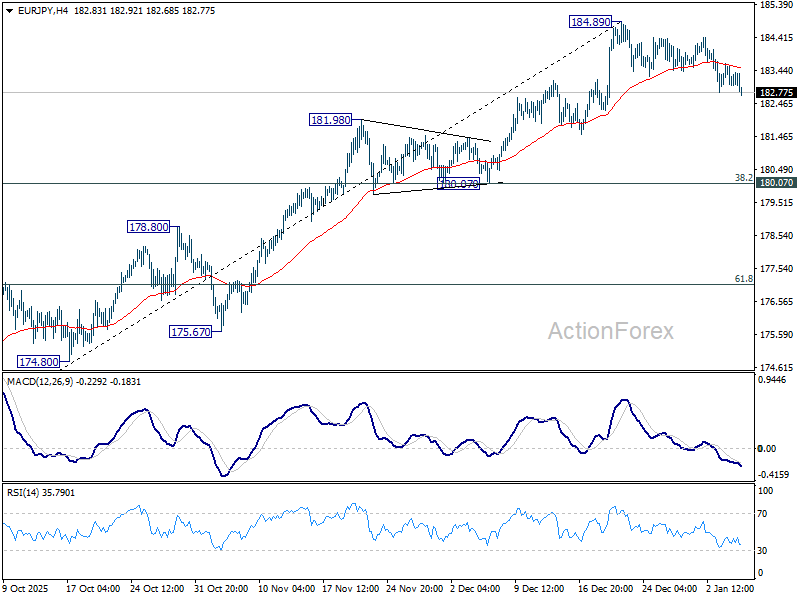
          EUR/JPY edges lower today and the sustained trading below 55 4H EMA (now at 183.45) argues that fall from 184.89 short term top is already correcting the rally from 172.24. Intraday bias is mildly on the downside for 55 D EMA (now at 180.74). But strong support should emerge from 180.07 cluster (38.2% retracement of 172.24 to 184.89 at 180.05) to bring rebound. ON the upside, firm break of 184.89 will resume larger up trend to 186.31 fibonacci level.

          In the bigger picture, up trend from 114.42 (2020 low) is in progress and should target 61.8% projection of 124.37 to 175.41 from 154.77 at 186.31. Considering bearish divergence condition in D MACD, upside could be capped by 186.31 on first attempt. Still, outlook will stay bullish as long as 55 W EMA (now at 172.16) holds, even in case of deep pullback. Sustained break of 186.31 will pave the way to 100% projection at 205.81 next.

          Economic Indicators Update

          GMTCCYEVENTSACTF/CPPREV
          00:30JPYServices PMI Dec F51.652.552.5
          00:30AUDCPI M/M Nov0.00%0.10%0.00%
          00:30AUDCPI Y/Y Nov3.40%3.60%3.80%
          00:30AUDTrimmed Mean CPI M/M Nov0.30%0.20%0.30%0.40%
          00:30AUDTrimmed Mean CPI Y/Y Nov3.20%
          3.30%
          00:30AUDBuilding Permits M/M Nov20.20%2.10%-6.40%-6.10%
          07:00EURGermany Retail Sales M/M Nov-0.60%0.20%-0.30%
          08:55EURGermany Unemployment Rate Nov
          6.30%6.30%
          08:55EURGermany Unemployment Change Nov
          5K1K
          09:30GBPConstruction PMI Dec
          42.439.4
          10:00EUREurozone CPI Y/Y Dec P
          2.10%2.10%
          10:00EUREurozone Core CPI Y/Y Dec P
          2.40%2.40%
          13:15USDADP Employment Change Dec
          50K-32K
          15:00USDISM Services PMI Dec
          52.352.6
          15:00USDFactory Orders M/M Oct
          -1.00%0.20%
          15:00CADIvey PMI Dec
          49.548.4
          15:30USDCrude Oil Inventories (Jan 2)
          -1.2M-1.9M

          Source: ACTIONFOREX

          To stay updated on all economic events of today, please check out our Economic calendar
          Risk Warnings and Disclaimers
          You understand and acknowledge that there is a high degree of risk involved in trading. Following any strategies or investment methods may lead to potential losses. The content on the site is provided by our contributors and analysts for information purposes only. You are solely responsible for determining whether any trading assets, securities, strategy, or any other product is suitable for investing based on your own investment objectives and financial situation.
          Add to Favorites
          Share

          GBP/USD Maintains Strength, Even As Upside Momentum Pauses

          Titan FX

          Forex

          Technical Analysis

          Key Highlights

          · GBP/USD started a fresh increase above 1.3480 and 1.3500.
          · A key bullish trend line is forming with support at 1.3450 on the 4-hour chart.
          · USD/JPY is consolidating above the 156.00 pivot level.
          · XRP price surged over 20% and climbed above $2.30.

          GBP/USD Technical Analysis

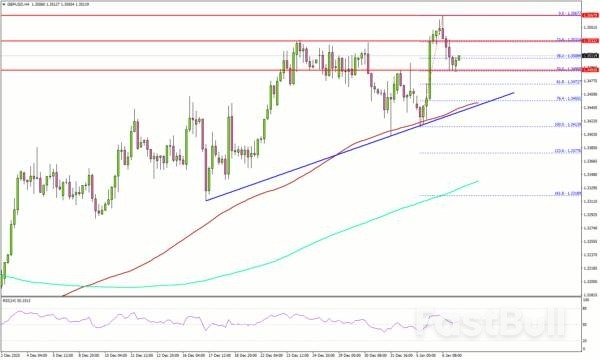
          The British Pound remained supported for more gains against the US Dollar. GBP/USD climbed above 1.3450 to start another increase.

          Looking at the 4-hour chart, the pair settled above 1.3450, the 100 simple moving average (red, 4-hour), and the 200 simple moving average (green, 4-hour). The pair even spiked above 1.3550 before the bears appeared.

          A high was formed at 1.3567, and the pair is now correcting some gains. On the downside, immediate support is near the 1.3490 level. The first major area for the bulls might be near 1.3450 and a bullish trend line.

          The 100 simple moving average (red, 4-hour) is also near 1.3450. A close below 1.3450 might spark heavy bearish moves. The next support could be 1.3420, below which the bears might aim for a move toward 1.3350.

          Immediate resistance sits near 1.3550. The first key hurdle is seen near 1.3565. A close above 1.3565 could open the doors for a move toward 1.3620. Any more gains could set the pace for a steady increase toward 1.3650.

          Looking at XPR, the bulls took control and pushed the price above many key hurdles such as $2.20, $2.30, and $2.35.

          Upcoming Key Economic Events:

          · US ISM Services PMI for Dec 2025 – Forecast 52.3, versus 52.6 previous.
          · US ADP Employment Change for Dec 2025 – Forecast 45K, versus -32K previous.

          Source: Titan FX

          Risk Warnings and Disclaimers
          You understand and acknowledge that there is a high degree of risk involved in trading. Following any strategies or investment methods may lead to potential losses. The content on the site is provided by our contributors and analysts for information purposes only. You are solely responsible for determining whether any trading assets, securities, strategy, or any other product is suitable for investing based on your own investment objectives and financial situation.
          Add to Favorites
          Share

          Australia November CPI: Momentum Not As Strong As First Thought

          Westpac

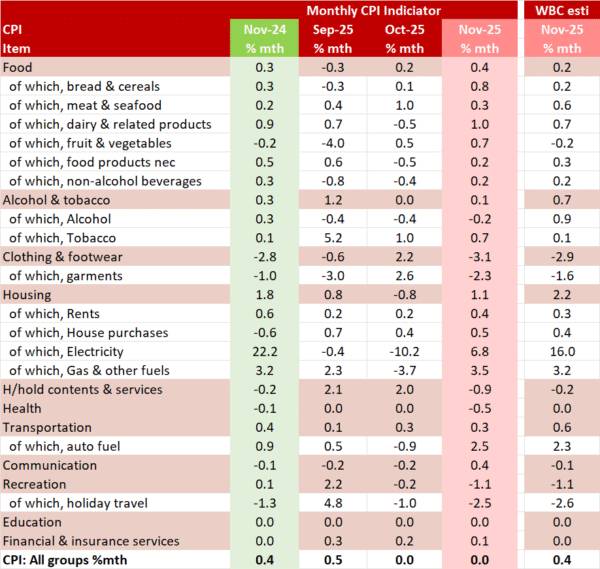
          The new Complete Monthly CPI printed softer than we thought presenting downside risk to our December quarter estimates.

          · Headline CPI came in softer than Westpac had expected; 0.0% in the month compared to our 0.4% forecast.
          · As such, this presents a downside risk to our current December quarter nearcast of 0.6%qtr for the Headline CPI and 0.8%qtr for the Trimmed Mean.
          · If this is correct, it should be enough to comfort the RBA that they do not need to lift rates at the February meeting.
          · Outside of administered prices, known supply shocks and items that are known to be volatile, we continue to expect the currently inflationary pulse to moderate through 2026.

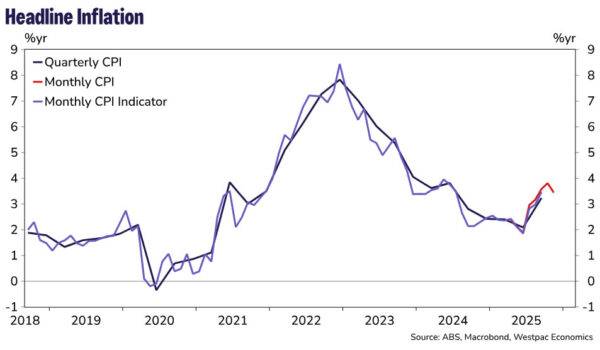
          The new Complete Monthly CPI gained 3.4% in the year to November, softer than Westpac's estimate of 3.8%yr and the market estimate of 3.6%yr. At face value, this suggests downside risk to our December quarter estimates of 0.8%qtr for the Trimmed Mean (TM) and 0.6% for the CPI. However, we still need to complete a full review of the monthly data to confirm this.

          November's headline figure was flat in the month, softer than Westpac's published near-cast of 0.4% on the back of a smaller than expected rise in electricity (6.8% vs 16.0% estimated), a larger than expected fall in household contents & services (–0.9% vs –0.2% estimated), clothing & footwear (–3.1% vs. –2.9% estimate) and health (–0.5% vs. 0.0% expected), a smaller than expected rise in transport (0.3% vs. 0.6% forecast) to be partially offset by stronger gains in food (0.4% vs 0.2% estimated), rents (0.4% vs 0.3% estimated), dwellings (0.5% vs 0.4% estimated) and communication (0.4% vs. –0.1% estimated).

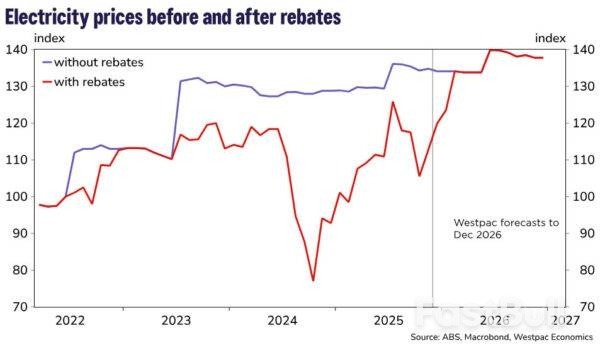
          As has been the norm for some time, the energy rebates continue to have a significant impact on estimates of consumer price inflation. Electricity costs rose 19.7% in the year to November, held down by households using the Queensland State Government electricity rebate . This is a moderation from the 37.1%yr pace in October 2025 reflecting, as the ABS noted, that more households received catch-up payments of the Commonwealth Energy Bill Relief Fund (EBRF) rebate in 2024 compared to 2025.

          The ABS estimates that excluding the impact of the Commonwealth and State Government electricity rebates over the past year, electricity prices rose 4.6% in the year to November compared to a 5.0% increase in the year to October. This reflects annual price reviews from energy retailers in July 2025.

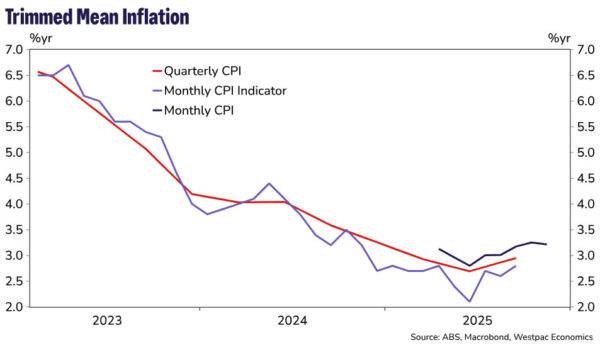
          The TM measure was reported to have increased 3.2% in the year to November, a slight moderation from the 3.3%yr pace in October. Due to its short history, the annual pace of monthly TM inflation can only be calculated back to April 2025. Before then the ABS noted that annual movements are calculated by comparing each quarter to the same quarter in the previous year.

          The TM lifted 0.3% in the month of November, the same monthly increase it has seen for the previous four months and down from the 0.5%mth increase in July but stronger than the 0.2%mth prints from March to June.

          While we note that the current annual pace of the Monthly TM, at 3.2%yr, matches our current December quarter TM estimate of 3.2%yr, we do know that the RBA will, at least for the near term, remain focused on the quarterly TM, rather than the Monthly TM. This is because the ABS does not have enough history to complete a full seasonal adjustment process for all the components of the Monthly CPI. The ABS has also noted it will take at least 18 months to gather that data so it is likely to be a year and a half before we will be able to make a more detailed assessment of core inflation directly via the monthly TM. As such, we anticipate the RBA will use the December print to guide their decision. Our expectation is that the Monetary Policy will remain cautious and pause at its next meeting in February and remain on hold for the remainder of the year.

          As we have noted, see our November CPI preview, while some series did have a longer monthly history coming from the previously published monthly CPI indicator and the ABS can potentially use historical seasonal analysis we caution that some of the new data sets have a different history to the old data and as such, we expect it is going to take some time to understand the seasonal behaviour of the new data.

          Source: Westpac Banking Corporation

          Risk Warnings and Disclaimers
          You understand and acknowledge that there is a high degree of risk involved in trading. Following any strategies or investment methods may lead to potential losses. The content on the site is provided by our contributors and analysts for information purposes only. You are solely responsible for determining whether any trading assets, securities, strategy, or any other product is suitable for investing based on your own investment objectives and financial situation.
          Add to Favorites
          Share
          FastBull
          Copyright © 2026 FastBull Ltd

          728 RM B 7/F GEE LOK IND BLDG NO 34 HUNG TO RD KWUN TONG KLN HONG KONG

          TelegramInstagramTwitterfacebooklinkedin
          App Store Google Play Google Play
          Products
          Charts

          Chats

          Q&A with Experts
          Screeners
          Economic Calendar
          Data
          Tools
          Membership
          Features
          Function
          Markets
          Copy Trading
          Latest Signals
          Contests
          News
          Analysis
          24/7
          Columns
          Education
          Company
          Careers
          About Us
          Contact Us
          Advertising
          Help Center
          Feedback
          User Agreement
          Privacy Policy
          Personal Information Protection Statement
          Business

          White Label

          Data API

          Web Plug-ins

          Poster Maker

          Affiliate Program

          Risk Disclosure

          The risk of loss in trading financial instruments such as stocks, FX, commodities, futures, bonds, ETFs and crypto can be substantial. You may sustain a total loss of the funds that you deposit with your broker. Therefore, you should carefully consider whether such trading is suitable for you in light of your circumstances and financial resources.

          No decision to invest should be made without thoroughly conducting due diligence by yourself or consulting with your financial advisors. Our web content might not suit you since we don't know your financial conditions and investment needs. Our financial information might have latency or contain inaccuracy, so you should be fully responsible for any of your trading and investment decisions. The company will not be responsible for your capital loss.

          Without getting permission from the website, you are not allowed to copy the website's graphics, texts, or trademarks. Intellectual property rights in the content or data incorporated into this website belong to its providers and exchange merchants.

          Not Logged In

          Log in to access more features

          FastBull Membership

          Not yet

          Purchase

          Become a signal provider
          Help Center
          Customer Service
          Dark Mode
          Price Up/Down Colors

          Log In

          Sign Up

          Position
          Layout
          Fullscreen
          Default to Chart
          The chart page opens by default when you visit fastbull.com