Markets
News
Analysis
User
24/7
Economic Calendar
Education
Data
- Names
- Latest
- Prev



Signal Accounts for Members
All Signal Accounts
All Contests


Japan Trade Balance (Customs Data) (SA) (Nov)A:--
F: --
P: --
U.K. BRC Overall Retail Sales YoY (Dec)A:--
F: --
P: --
U.K. BRC Like-For-Like Retail Sales YoY (Dec)A:--
F: --
P: --
Turkey Retail Sales YoY (Nov)A:--
F: --
P: --
U.S. NFIB Small Business Optimism Index (SA) (Dec)A:--
F: --
P: --
Brazil Services Growth YoY (Nov)A:--
F: --
P: --
Canada Building Permits MoM (SA) (Nov)A:--
F: --
U.S. CPI MoM (SA) (Dec)A:--
F: --
P: --
U.S. CPI YoY (Not SA) (Dec)A:--
F: --
P: --
U.S. Real Income MoM (SA) (Dec)A:--
F: --
P: --
U.S. CPI MoM (Not SA) (Dec)A:--
F: --
P: --
U.S. Core CPI (SA) (Dec)A:--
F: --
P: --
U.S. Core CPI YoY (Not SA) (Dec)A:--
F: --
P: --
U.S. Core CPI MoM (SA) (Dec)A:--
F: --
P: --
U.S. Weekly Redbook Index YoYA:--
F: --
P: --
U.S. Building Permits Revised YoY (SA) (Oct)A:--
F: --
P: --
U.S. Building Permits Revised MoM (SA) (Oct)A:--
F: --
P: --
U.S. New Home Sales Annualized MoM (Oct)A:--
F: --
U.S. Annual Total New Home Sales (Oct)A:--
F: --
U.S. Cleveland Fed CPI MoM (SA) (Dec)A:--
F: --
P: --
U.S. Cleveland Fed CPI MoM (Dec)A:--
F: --
P: --
China, Mainland Exports (Dec)--
F: --
P: --
China, Mainland Imports YoY (CNH) (Dec)--
F: --
P: --
China, Mainland Imports (CNH) (Dec)--
F: --
P: --
China, Mainland Trade Balance (CNH) (Dec)--
F: --
P: --
China, Mainland Imports YoY (USD) (Dec)--
F: --
P: --
China, Mainland Exports YoY (USD) (Dec)--
F: --
P: --
China, Mainland M0 Money Supply YoY (Dec)--
F: --
P: --
China, Mainland M1 Money Supply YoY (Dec)--
F: --
P: --
China, Mainland M2 Money Supply YoY (Dec)--
F: --
P: --
U.S. EIA Natural Gas Production Forecast For The Next Year (Jan)--
F: --
P: --
U.S. EIA Short-Term Crude Production Forecast For The Next Year (Jan)--
F: --
P: --
U.S. EIA Short-Term Crude Production Forecast For The Year (Jan)--
F: --
P: --
EIA Monthly Short-Term Energy Outlook
U.S. 30-Year Bond Auction Avg. Yield--
F: --
P: --
U.S. Budget Balance (Dec)--
F: --
P: --
Argentina 12-Month CPI (Dec)--
F: --
P: --
Argentina National CPI YoY (Dec)--
F: --
P: --
Argentina CPI MoM (Dec)--
F: --
P: --
Richmond Federal Reserve President Barkin delivered a speech.
U.S. API Weekly Cushing Crude Oil Stocks--
F: --
P: --
U.S. API Weekly Crude Oil Stocks--
F: --
P: --
U.S. API Weekly Refined Oil Stocks--
F: --
P: --
U.S. API Weekly Gasoline Stocks--
F: --
P: --
South Korea Unemployment Rate (SA) (Dec)--
F: --
P: --
Japan Reuters Tankan Non-Manufacturers Index (Jan)--
F: --
P: --
Japan Reuters Tankan Manufacturers Index (Jan)--
F: --
P: --
China, Mainland Trade Balance (USD) (Dec)--
F: --
P: --
China, Mainland Exports YoY (CNH) (Dec)--
F: --
P: --
China, Mainland Outstanding Loans Growth YoY (Dec)--
F: --
P: --
U.K. 10-Year Note Auction Yield--
F: --
P: --
Canada Leading Index MoM (Dec)--
F: --
P: --
U.S. MBA Mortgage Application Activity Index WoW--
F: --
P: --
U.S. Core PPI YoY (Nov)--
F: --
P: --
U.S. PPI MoM (SA) (Nov)--
F: --
P: --
U.S. PPI YoY (Nov)--
F: --
P: --
U.S. Current Account (Q3)--
F: --
P: --
U.S. PPI MoM Final (Excl. Food, Energy and Trade) (SA) (Nov)--
F: --
P: --
U.S. PPI YoY (Excl. Food, Energy & Trade) (Nov)--
F: --
P: --
U.S. Core Retail Sales (Nov)--
F: --
P: --
U.S. Retail Sales MoM (Nov)--
F: --
P: --


No matching data
Latest Views
Latest Views
Trending Topics
Top Columnists
Latest Update
White Label
Data API
Web Plug-ins
Affiliate Program
View All

No data
Cuba confronts dire shortages and blackouts as US policy severs its vital Venezuelan oil supply, straining the economy.
Cubans are bracing for severe shortages and widespread blackouts as a critical lifeline of Venezuelan oil has been cut off, a direct result of U.S. policy under President Donald Trump. The island nation is now confronting a siege-like scenario, compounding an already fragile economy.
Shipping data and internal documents from Venezuelan state oil company PDVSA confirm that no crude oil or fuel has been sent to Cuba for approximately a month. This halt in shipments began even before the U.S. capture of Venezuelan leader Nicolas Maduro in early January, as an American blockade tightened its grip on the trade route.

The last oil delivery intended for refining in Cuba departed from PDVSA's Jose port in mid-December. The tanker, carrying around 600,000 barrels of Venezuelan crude, sailed with its transponder turned off to avoid detection.
The sudden stop in Venezuelan oil deliveries represents a massive shock to Cuba's energy system. In 2025, Venezuela was the island's primary supplier, providing 26,500 barrels per day (bpd), which accounted for roughly one-third of the nation's daily consumption. Mexico was a distant second, supplying around 5,000 bpd.
Energy experts are sounding the alarm about the potential consequences. "I just don't see any light at the end of the tunnel for Cuba to survive the next few months facing zero deliveries of oil from Venezuela," said Jorge Pinon, an energy researcher at the University of Texas at Austin. "The situation is going to be catastrophic."
President Trump has openly stated his goal of using the U.S. intervention in Venezuela to destabilize Cuba. He recently intensified his rhetoric, urging the island nation on Sunday to negotiate a deal "before it is too late."

The critical question now is how long Cuban President Miguel Diaz-Canel's government can withstand the pressure of dwindling fuel imports. For the island's residents, who already struggle to find food, medicine, and fuel, the uncertainty is palpable.
"It's very stressful because we don't know what decision the Cuban government will make or what actions the United States government will take," commented Victor Romero, a 75-year-old retired state worker from Havana.
President Diaz-Canel has responded with defiance. "Nobody tells us what to do," he declared on Sunday following Trump's threats. "Cuba is...prepared to defend the homeland until the last drop of blood."
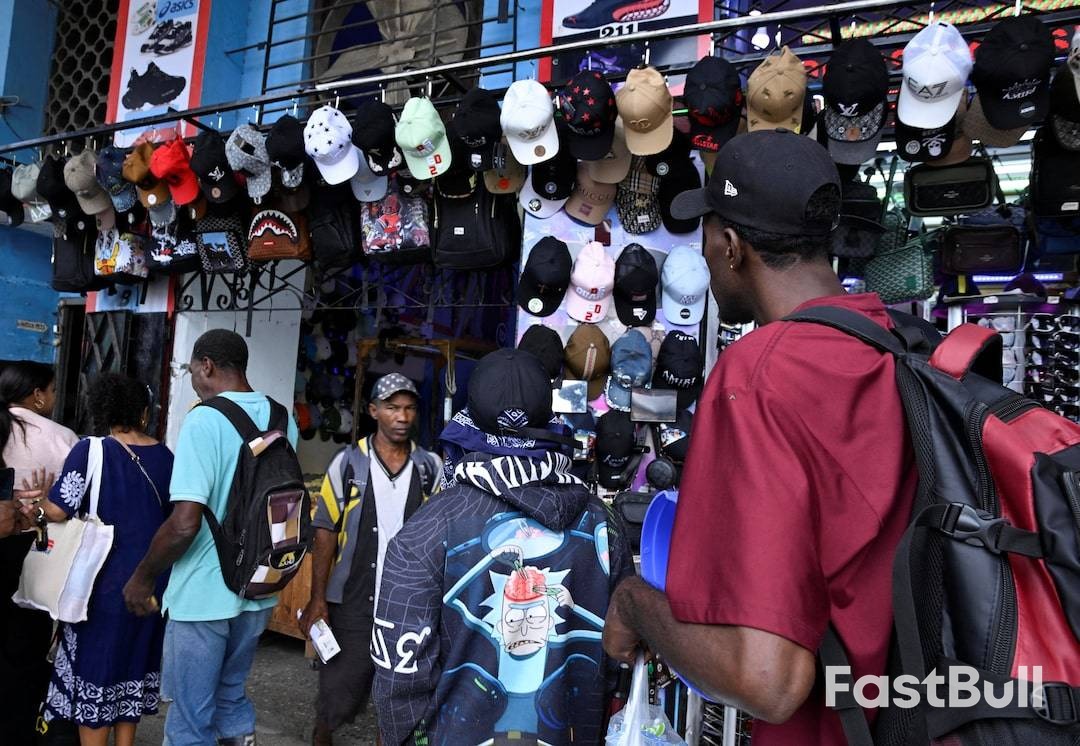
Outside the capital, much of rural Cuba already operates with minimal modern infrastructure. Horse-drawn carriages and bicycles are common modes of transportation, internet access is unreliable, and electricity is often off for more hours than it is on.
Deyanira Gonzalez, a 57-year-old housewife living in the countryside near Havana, says she already cooks with charcoal due to inconsistent electricity and the high cost or unavailability of liquefied gas. "What will happen now? If Donald Trump doesn't let fuel into Cuba we'll be in the dark with our kids suffering," she said.
So far, the capital city of Havana has been partially insulated from the immediate impact of the fuel cutoff. Many residents report that blackouts have eased slightly in early January as power demand fell from its December peak. Gasoline and diesel remain available at service stations, though they are rationed in the local peso currency.

It remains unclear how much oil Cuba has in its strategic reserves. Furthermore, the island's traditional political allies appear unwilling to risk angering the United States by providing significant aid.
"We have not seen any support whatsoever from Cuba's political allies, who are also exporters of oil, like Angola, Algeria, Brazil," noted energy expert Pinon. "No one is coming to Cuba's aid, with the exception of maybe Mexico, in limited amount, and also Russia, in limited amount."
A tanker from Mexico, the Ocean Mariner, did arrive in Havana on Friday with approximately 85,000 barrels of fuel from the state-owned Pemex terminal. However, this shipment is a small fraction of what Venezuela once supplied and is insufficient to power the island of 10 million people.
This reality leaves many Cubans in a state of anxiety. "It's the uncertainty of not knowing what's going to happen," said Ivet Rodriguez, a 39-year-old entrepreneur in Havana. "I try not to even think about it."
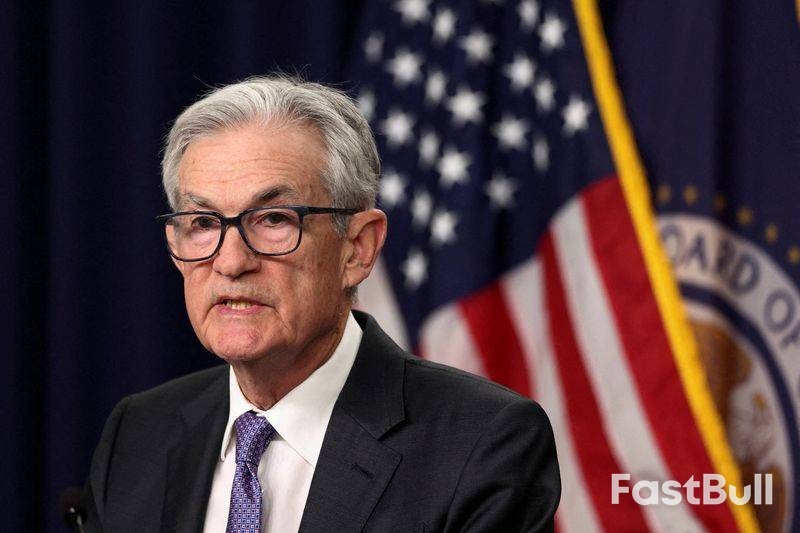
Central banks across the globe are preparing a coordinated statement to publicly support U.S. Federal Reserve Chair Jerome Powell, according to two sources familiar with the matter. The move comes in response to the Trump administration threatening Powell with a criminal indictment.
The joint declaration, expected on Tuesday, will feature signatures from international central bankers. Its core message is a firm endorsement of Powell and a defense of the critical principle of central bank independence.

While the statement has been revised extensively over the past day and is still being finalized, it aims to present a united front. One source indicated that it remains unclear how many central banks will sign the initial release, but others will be welcome to join later.
The U.S. administration's probe is officially centered on the renovation of the Federal Reserve's headquarters. However, Powell has reportedly described this investigation as a "pretext" designed to exert presidential influence over interest rate decisions. This action has already drawn sharp criticism from the financial world and from prominent members of the Republican Party.
The international support for Powell is rooted in a fundamental economic concern: that political interference could shatter trust in the Federal Reserve's commitment to its inflation target. Such a loss of confidence could trigger higher inflation and significant volatility in global financial markets.
Because the United States is the world's dominant economy, any resulting inflation would likely spread through international financial channels. This "exported inflation" would complicate the efforts of other central banks to maintain price stability in their own countries, creating a ripple effect across the global economy.

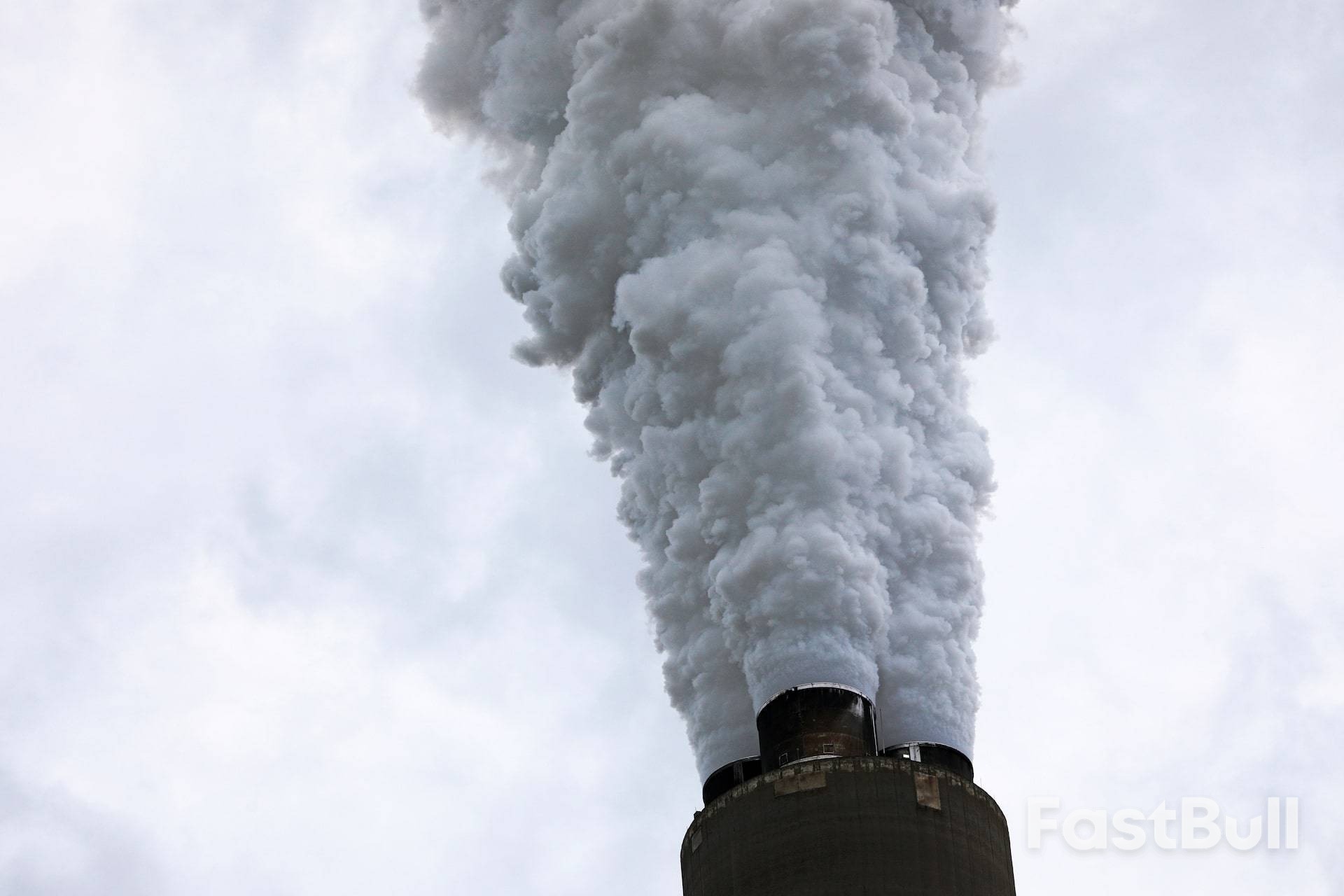
United States greenhouse gas emissions climbed 2.4% in 2025, marking the first increase in two years and outpacing the nation's economic growth, according to a new report from the Rhodium Group. The analysis highlights a reversal of the recent trend where economic expansion was decoupled from emissions growth.
The primary drivers behind the surge were increased energy consumption in buildings and a significant uptick in power sector emissions. The U.S. economy, measured by real GDP, expanded by a projected 1.9% during the same period, meaning emissions intensity rose for the first time since 2022.
The power industry was a major contributor to the emissions increase, with its output rising by 3.8%. This was largely a consequence of soaring electricity demand from data centers powering artificial intelligence and bitcoin mining operations.
This surge in demand pushed natural gas prices higher, making coal a more economically viable alternative for power generation. As a result, coal-fired generation jumped by 13% in 2025. This marks only the second year in the past decade that the use of this carbon-intensive fuel has increased, interrupting a long-term decline that has seen coal generation fall by 64% since its 2007 peak.
Beyond the power grid, direct fuel use for heating buildings also drove emissions higher, rising by 6.8% from the previous year.
Meanwhile, transportation emissions were contained, partly due to the growing adoption of electric vehicles. However, the report cautions that the repeal of federal tax credits in 2025 could slow the growth of the EV market and apply upward pressure on emissions in this sector.
According to the Rhodium Group, the 2025 emissions increase does not yet reflect the full impact of policy shifts under the Trump administration, which has moved to roll back environmental regulations and reduce incentives for renewable energy.
The report warns that the situation could change in the coming years, particularly if electricity demand from data centers continues to surge and is met by existing fossil fuel plants rather than new clean energy sources.
This policy landscape represents a departure from the previous administration's climate goals. The Biden administration had set a target under the Paris climate agreement to cut greenhouse gas emissions by 61%-66% below 2005 levels by 2035. The Trump administration subsequently withdrew the United States from the Paris agreement and abandoned that target.
President Donald Trump has announced a 25% tariff on goods from any country doing business with Iran, a move that places China and the United Arab Emirates at the forefront of economic risk.
The new policy, which Trump stated would be effective "immediately," aims to intensify pressure on the regime of Supreme Leader Ayatollah Ali Khamenei. The threat comes as Iranian authorities crack down on over two weeks of nationwide protests, which have received vocal support from the U.S. president.
According to data from the International Monetary Fund, China is Tehran's largest trading partner, with their commerce totaling $17.8 billion in 2024. The relationship is critical for Iran, which sends nearly 90% of its oil exports to China. This trade activity now exposes Beijing to significant U.S. tariffs, despite a trade truce agreed upon with Washington in October.
The United Arab Emirates follows closely, with $16.1 billion in trade with Iran. The exposure drops off significantly after the top two, with Turkey in third place at $8.8 billion.
The tariff threat extends beyond the Middle East and Asia, implicating several of Washington's European allies. Germany and Switzerland, for instance, have combined trade with Iran amounting to nearly $3.5 billion.
Other major economies also face potential consequences. India, which has previously navigated trade disputes with the U.S., is Iran's fourth-largest partner. Uzbekistan, a nation that signed a new trade and economic deal with the Trump administration in November, recorded $1.3 billion in trade with Iran in 2024.
The political backdrop for these measures is the widespread unrest within Iran. The protests originally erupted late last year following a sharp devaluation of the Iranian currency, a direct result of severe sanctions tied to the country's nuclear program.
These demonstrations have since evolved into the most significant and violent challenge to Khamenei's authority, drawing global attention and contributing to a rise in oil prices. The sentiment was echoed by German Chancellor Friedrich Merz, who on Tuesday became the first G7 leader to predict the Iranian regime was in its "final days."
Despite the announcement, crucial details about the tariffs remain unspecified. The Trump administration has not clarified which specific transactions, goods, or entities would be targeted, nor how the policy would be enforced.
Tracking compliance is further complicated by the opacity of Iran's official trade data, as the country often limits statistical releases and uses third-country channels to circumvent sanctions. So far, China, the UAE, Turkey, and India have not issued public comments on the proposed tariffs.
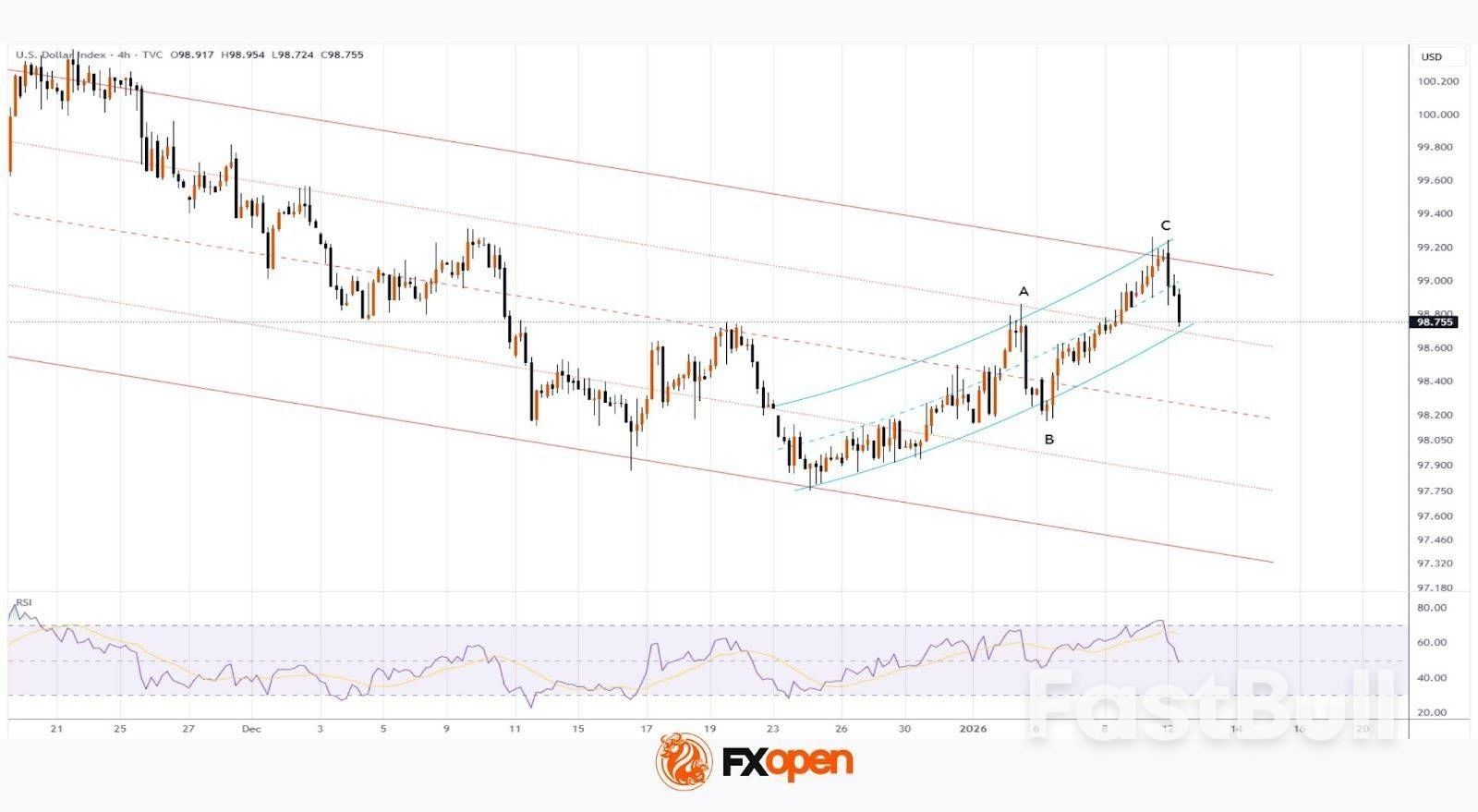
Capital flows into gold amid rising geopolitical and broader market risks, together with Jerome Powell's remarks about potential criminal prosecution, have not only driven XAU/USD to record highs (as discussed earlier today) but have also put pressure on the US Dollar Index (DXY).
Markets are also digesting the latest Non-Farm Payrolls data released on Friday. The figures pointed to a slowdown in the US economy, with actual job growth at 50K versus expectations of 66K. This reinforces the case for interest-rate cuts and acts as a bearish factor for the US dollar.
As a result, the dollar index is moving lower today.

In the final days of 2025, when reviewing the DXY chart, we:
→ reaffirmed the descending channel (highlighted in red);
→ suggested that it would remain a key technical guide into early 2026.
This view has been confirmed, as the upper boundary of the channel is acting as strong resistance. Today's decline appears to be a reversal from this level. In this context, it is reasonable to assume that:
→ the recent move represents an intermediate A–B–C corrective rise within a broader downtrend, with point C coinciding with RSI overbought conditions;
→ the short-term upward trajectory (marked by blue lines) may soon be broken by sellers. If the broader downtrend resumes, DXY could slide towards the median of the descending channel.
President Donald Trump is launching a new populist economic message, using social media and high-profile interviews to address voter frustration ahead of the midterm elections. His next stop is a key battleground state where he will make his case directly to workers and business leaders.
On Tuesday, Trump will visit a Ford Motor Co. factory that builds F-150 trucks and speak at a Detroit Economic Club event, promoting his tariff and manufacturing policies as solutions to rising costs.
This visit is his third to a bellwether state since early December, signaling a new push from the administration to combat inflation and high gas prices. "With a little bit of patience, the American people are going to continue to see that the best is yet to come," White House Press Secretary Karoline Leavitt told Fox News.
With the November midterms approaching, the Trump administration is accelerating efforts to convince voters it is focused on their financial well-being. Since the start of the year, the administration has proposed a series of populist measures, including:
• Capping credit card charges.
• Banning institutional investors from purchasing rental homes.
• Buying mortgage-backed securities to lower interest rates.
• Intensifying pressure on the Federal Reserve.
In a recent social media post, Trump also stated he wants to prevent "big Technology Companies" from passing higher utility bills to consumers, a consequence of the energy demand from new AI-linked data centers.
Democratic strategist Jim Manley sees this as a sign of desperation. "It reinforces the idea that he understands that he's in a bad place right now and he's throwing everything but the kitchen sink at it," he said.
In a surprising move demonstrating the political weight of "affordability," Trump called longtime critic Senator Elizabeth Warren on Monday. The call came just after the Democratic senator gave a speech criticizing her own party for not fully embracing a populist economic agenda.
"I'm not going to talk about details of a conversation, but I just want to say it was all about costs, about how we reduce costs for American families," Warren said on Bloomberg Television.
While critical of the president's broader economic policies, Warren said she would "absolutely" work with him on issues she supports, such as passing legislation to cap credit card rates, "if he will actually fight for it."
A White House official confirmed the two had a productive conversation about credit card interest rates and housing affordability.
Despite the focus on pocketbook issues, many Republican lawmakers worry that headlines about foreign policy—from Venezuela to Iran and Greenland—are overshadowing the administration's economic message.
Recent polling reflects this challenge. A Quinnipiac University poll last month showed Trump's approval at 40%, with 54% disapproving. Only a third of voters rated the economy as "excellent" or "good," while 65% described it as "not so good" or "poor."
Trump's visit to Michigan is his second this term, underscoring the state's importance. Michigan was a key part of the "blue wall" that narrowly fell to him in 2024, and this year its governor's race, a Senate seat, and several close House races could be pivotal.
The state's economy under Trump presents a mixed picture. While Michigan's unemployment rate fell from 5.5% in April to 5% in November, the improvement was partly due to a shrinking labor force, with over 55,000 fewer people working or looking for work.
Michigan's economy is also uniquely exposed to Trump's tariff policies. Automakers have seen profits squeezed and costs rise, though they have so far managed by focusing on more expensive trucks and SUVs and getting some tariff relief on parts from Canada and Mexico. Forecasters at the University of Michigan project the state will lose 2,000 jobs this year, with unemployment expected to rise to 5.6% by the second quarter.
It remains unclear if Trump will increase his travel to battleground states. With ten months until the midterms, a Republican source close to the White House expressed confidence in holding the Senate but was more skeptical about the House. The source noted that the administration should have been more attuned to cost-of-living issues, which drove many voters to Trump in 2024.
After limited domestic travel in 2025, Trump held two campaign-style events in December in Pennsylvania and North Carolina. Advisers reportedly want him on the campaign trail more often to sell his policies.
Republican pollster Greg Strimple noted that Trump has a significant financial advantage. "I think that they are going to have money to define the race economically earlier in the cycle than normal," he said. Strimple also suggested that Trump's own anxieties could be a powerful motivator, pointing to the president's warning to lawmakers that he could face impeachment if Democrats retake the House. "I think that's animating," Strimple said.
The second week of the new year started with a lot of jitters and soul-searching as Donald Trump stepped up pressure on the Federal Reserve (Fed), sending the DoJ after Fed Chair Jerome Powell over the Fed's HQ renovations. But remember: Powell stood up for himself and made it very clear that the allegations had more to do with Trump's frustration that the Fed is not cutting interest rates at the speed he desires — a pace that would better serve his political ambitions.
And it's striking how powerful politicians are not told by those around them that the Fed cannot simply cut rates without consequences. Doing so would — leaving reputational issues aside — revive inflation and make matters worse. It wouldn't help solve the cost-of-living crisis, it wouldn't bring inflation down, and it wouldn't make housing more affordable. It would have the opposite effect.
This is why we are seeing the US yield curve steepen in response to serious attacks on the Fed's independence. The long end of the curve is rising faster than the short end on expectations that aggressive rate cuts today would push down short-dated yields, but ultimately fuel inflation and require tighter policy further down the road.
The US dollar is also feeling the pinch from the turmoil around the Fed. The debasement trade continues as investors lose confidence in a weakened Fed, which would be forced into looser monetary policy — resulting in weaker growth and higher inflation. I found the latest reactions from former Fed heads — iconic names such as Janet Yellen, Ben Bernanke and Alan Greenspan — exceptionally sincere. They warned that "this is how monetary policy is made in emerging markets with weak institutions, with highly negative consequences for inflation and the functioning of their economies."
If you have any doubt, Turkey is a striking example of what happens when a country undermines its central bank and hands control to a president who insisted that "higher rates cause inflation," pointing to Japan as historical evidence. Of course, Japan's liquidity trap had nothing to do with Turkey's economic fundamentals. Outcome? Inflation exploded, the lira collapsed — and not into golden dust — and the country has been steadily getting poorer since then.
Could the same happen to the US? The Titanic was made of iron, Sirs — and yes, it sank.
The debasement trade — the trade of a weakening US — is also boosting appetite for hard commodities. Gold and silver traded at fresh record highs yesterday, with silver consolidating near $85 per ounce this morning. I think it's only a matter of time before the white metal tests the $100 mark. There is little to stop the debasement trade as headlines worsen by the day.
Another example of a fallen star is Great Britain. Even though institutions remain strong, trust in — and appetite for — sterling deteriorated so badly after Brexit that reversing the trend looks extremely difficult. So again, yes: the Titanic can sink. And this time, the consequences would be global. The US dollar is involved in roughly 90% of global FX transactions, so the ripple effects could be enormous.
Turning to US equities, markets gap-opened lower yesterday, as rising rate-cut expectations are only half-good news. But buyers stepped back in, particularly into tech names helped by a weaker dollar, and the S&P 500 closed the session at a fresh record.
Make no mistake: the cheap dollar is powering part of this rally. While S&P 500 gains look impressive in nominal terms, the picture changes once returns are converted into other major currencies. The SMI, for example, may look unappetizing at first glance, but the Swiss index returned more than 15% last year, while the S&P 500 lost value in Swiss-franc terms. This is why hedging USD exposure matters. The US dollar is no longer the automatic safe haven it once was. In a selloff today, there is little reason to expect capital to flow into the dollar. Gold and silver look far more likely to absorb safety flows.
Today, the US releases its latest CPI data, while big banks kick off earnings season, with JPMorgan reporting Q4 results — just a day after Trump suggested credit-card interest rates should be capped at 10%, a comment that sent related stocks sharply lower. While last year was strong for trading and deal-making revenues, investors will focus on banks' economic outlook, loan-loss provisions, and views on AI productivity, credit quality, margins and capital deployment. Their guidance could set the tone for earnings season, as investors look for proof that Big Tech deserves its elevated valuations.
The S&P 500 is expected to deliver 8.3% earnings growth this quarter — the tenth consecutive quarter of positive EPS growth. Excluding the Magnificent Seven, earnings growth would fall to 4.6%. But expectations for coming quarters remain optimistic, helping avert a broader selloff despite unhelpful headlines — alongside continued liquidity support from the Fed. So I wouldn't necessarily sell America, but I would hedge US dollar risk.
In Japan, markets are shining as reports that PM Takaichi may dissolve the lower house and call a snap election boost sentiment. A strong victory could unlock greater fiscal stimulus, giving rise to what some are calling the "Takaichi rally." Tech stocks are leading gains, with the Topix up more than 2.5% at the time of writing, as she prioritises technology and defence investment. But the yields are to keep in mind: the 10-year JGB yield jumped to 2.16% this morning and the USDJPY is approaching the 159 level — a move that could soon trigger official pushback. Caution is warranted for those shorting the yen at current levels.
And a quick word on the risks posed by rising Japanese yields for global markets:Normally, rising JGB yields increase the risk of a global selloff, as higher domestic yields raise the incentive for large Japanese investors to repatriate capital and lock in more attractive returns at home. Today, however, global liquidity remains so ample that this channel matters less than it normally would.
White Label
Data API
Web Plug-ins
Poster Maker
Affiliate Program
The risk of loss in trading financial instruments such as stocks, FX, commodities, futures, bonds, ETFs and crypto can be substantial. You may sustain a total loss of the funds that you deposit with your broker. Therefore, you should carefully consider whether such trading is suitable for you in light of your circumstances and financial resources.
No decision to invest should be made without thoroughly conducting due diligence by yourself or consulting with your financial advisors. Our web content might not suit you since we don't know your financial conditions and investment needs. Our financial information might have latency or contain inaccuracy, so you should be fully responsible for any of your trading and investment decisions. The company will not be responsible for your capital loss.
Without getting permission from the website, you are not allowed to copy the website's graphics, texts, or trademarks. Intellectual property rights in the content or data incorporated into this website belong to its providers and exchange merchants.
Not Logged In
Log in to access more features

FastBull Membership
Not yet
Purchase
Log In
Sign Up