• Trade
  • Markets
  • Copy
  • Contests
  • News
  • 24/7
  • Calendar
  • Q&A
  • Chats
Trending
Screeners
SYMBOL
LAST
BID
ASK
HIGH
LOW
NET CHG.
%CHG.
SPREAD
SPX
S&P 500 Index
6859.57
6859.57
6859.57
6878.28
6859.47
-10.83
-0.16%
--
DJI
Dow Jones Industrial Average
47802.88
47802.88
47802.88
47971.51
47771.72
-152.10
-0.32%
--
IXIC
NASDAQ Composite Index
23589.67
23589.67
23589.67
23698.93
23579.88
+11.56
+ 0.05%
--
USDX
US Dollar Index
99.090
99.170
99.090
99.090
98.730
+0.140
+ 0.14%
--
EURUSD
Euro / US Dollar
1.16274
1.16282
1.16274
1.16717
1.16273
-0.00152
-0.13%
--
GBPUSD
Pound Sterling / US Dollar
1.33127
1.33137
1.33127
1.33462
1.33126
-0.00185
-0.14%
--
XAUUSD
Gold / US Dollar
4178.38
4178.79
4178.38
4218.85
4175.92
-19.53
-0.47%
--
WTI
Light Sweet Crude Oil
58.964
58.994
58.964
60.084
58.892
-0.845
-1.41%
--

Community Accounts

Signal Accounts
--
Profit Accounts
--
Loss Accounts
--
View More

Become a signal provider

Sell trading signals to earn additional income

View More

Guide to Copy Trading

Get started with ease and confidence

View More

Signal Accounts for Members

All Signal Accounts

Best Return
  • Best Return
  • Best P/L
  • Best MDD
Past 1W
  • Past 1W
  • Past 1M
  • Past 1Y

All Contests

  • All
  • Trump Updates
  • Recommend
  • Stocks
  • Cryptocurrencies
  • Central Banks
  • Featured News
Top News Only
Share

US Dollar Extends Gains Versus Yen After Japan Earthquake, Last Up 0.2% At 155.64 Yen

Share

US Natural Gas Futures Drop 6% On Less Cold Forecasts, Near-Record Output

Share

Russian Central Bank: Sets Official Rouble Rate For December 9 At 77.2733 Roubles Per USA Dollar (Previous Rate - 76.0937)

Share

Russian Deputy Prime Minister Novak: Russia Will Restrict Gold Exports Starting In 2026

Share

US Dollar Touches Session High Versus Yen On Earthquake News, Last Up 0.5% At 155.81%

Share

NHK: A 40-centimeter-high Tsunami Has Reached Mutsuki Port In Aomori, Japan

Share

ICE Cotton Stocks Totalled To 13971 - December 08, 2025

Share

Japan Prime Minister Takaichi: Trying To Gather Information After Quake

Share

UK Trade Minister To Visit US This Week For Talks On Tariffs

Share

Head Of Yemen's Anti-Houthi Presidential Council Says Actions Of Southern Transitional Council Across South Yemen Undermines Legitimacy Of Internationally-Recognised Government

Share

Carvana Rose 9.1% And Crh Rose 6.8% As Both Companies Were Added To The S&P 500 Index

Share

Japanese Regulators Say No Problems Have Been Found At The Onagawa Nuclear Power Plant

Share

KYODO News: Some Tohoku Shinkansen Services Have Been Suspended Following The Earthquake In Japan

Share

The Japan Meteorological Agency Has Issued Tsunami Warnings For The Central Pacific Coast Of Hokkaido, The Pacific Coast Of Aomori Prefecture, And Iwate Prefecture

Share

Euro Hits Session High Versus Yen Following Strong Japan Quake, Last Up 0.3% At 181.36 Yen

Share

The S&P 500 Opened 4.80 Points Higher, Or 0.07%, At 6875.20; The Dow Jones Industrial Average Opened 16.52 Points Higher, Or 0.03%, At 47971.51; And The Nasdaq Composite Opened 60.09 Points Higher, Or 0.25%, At 23638.22

Share

Reuters Poll - Swiss National Bank Policy Rate To Be 0.00% At End-2026, Said 21 Of 25 Economists, Four Said It Would Be Cut To -0.25%

Share

USGS - Magnitude 7.6 Earthquake Strikes Misawa, Japan

Share

Reuters Poll - Swiss National Bank To Hold Policy Rate At 0.00% On December 11, Said 38 Of 40 Economists, Two Said Cut To -0.25%

Share

Traders Believe There Is A 20% Chance That The European Central Bank Will Raise Interest Rates Before The End Of 2026

TIME
ACT
FCST
PREV
France Trade Balance (SA) (Oct)

A:--

F: --

P: --
Euro Zone Employment YoY (SA) (Q3)

A:--

F: --

P: --
Canada Part-Time Employment (SA) (Nov)

A:--

F: --

P: --

Canada Unemployment Rate (SA) (Nov)

A:--

F: --

P: --

Canada Full-time Employment (SA) (Nov)

A:--

F: --

P: --

Canada Labor Force Participation Rate (SA) (Nov)

A:--

F: --

P: --

Canada Employment (SA) (Nov)

A:--

F: --

P: --

U.S. PCE Price Index MoM (Sept)

A:--

F: --

P: --

U.S. Personal Income MoM (Sept)

A:--

F: --

P: --

U.S. Core PCE Price Index MoM (Sept)

A:--

F: --

P: --

U.S. PCE Price Index YoY (SA) (Sept)

A:--

F: --

P: --

U.S. Core PCE Price Index YoY (Sept)

A:--

F: --

P: --

U.S. Personal Outlays MoM (SA) (Sept)

A:--

F: --

P: --
U.S. 5-10 Year-Ahead Inflation Expectations (Dec)

A:--

F: --

P: --

U.S. Real Personal Consumption Expenditures MoM (Sept)

A:--

F: --

P: --
U.S. Weekly Total Rig Count

A:--

F: --

P: --

U.S. Weekly Total Oil Rig Count

A:--

F: --

P: --

U.S. Consumer Credit (SA) (Oct)

A:--

F: --

P: --
China, Mainland Foreign Exchange Reserves (Nov)

A:--

F: --

P: --

Japan Trade Balance (Oct)

A:--

F: --

P: --

Japan Nominal GDP Revised QoQ (Q3)

A:--

F: --

P: --

China, Mainland Imports YoY (CNH) (Nov)

A:--

F: --

P: --

China, Mainland Exports (Nov)

A:--

F: --

P: --

China, Mainland Imports (CNH) (Nov)

A:--

F: --

P: --

China, Mainland Trade Balance (CNH) (Nov)

A:--

F: --

P: --

China, Mainland Exports YoY (USD) (Nov)

A:--

F: --

P: --

China, Mainland Imports YoY (USD) (Nov)

A:--

F: --

P: --

Germany Industrial Output MoM (SA) (Oct)

A:--

F: --

P: --
Euro Zone Sentix Investor Confidence Index (Dec)

A:--

F: --

P: --

Canada National Economic Confidence Index

A:--

F: --

P: --

U.K. BRC Like-For-Like Retail Sales YoY (Nov)

--

F: --

P: --

U.K. BRC Overall Retail Sales YoY (Nov)

--

F: --

P: --

Australia Overnight (Borrowing) Key Rate

--

F: --

P: --

RBA Rate Statement
RBA Press Conference
Germany Exports MoM (SA) (Oct)

--

F: --

P: --

U.S. NFIB Small Business Optimism Index (SA) (Nov)

--

F: --

P: --

Mexico 12-Month Inflation (CPI) (Nov)

--

F: --

P: --

Mexico Core CPI YoY (Nov)

--

F: --

P: --

Mexico PPI YoY (Nov)

--

F: --

P: --

U.S. Weekly Redbook Index YoY

--

F: --

P: --

U.S. JOLTS Job Openings (SA) (Oct)

--

F: --

P: --

China, Mainland M1 Money Supply YoY (Nov)

--

F: --

P: --

China, Mainland M0 Money Supply YoY (Nov)

--

F: --

P: --

China, Mainland M2 Money Supply YoY (Nov)

--

F: --

P: --

U.S. EIA Short-Term Crude Production Forecast For The Year (Dec)

--

F: --

P: --

U.S. EIA Natural Gas Production Forecast For The Next Year (Dec)

--

F: --

P: --

U.S. EIA Short-Term Crude Production Forecast For The Next Year (Dec)

--

F: --

P: --

EIA Monthly Short-Term Energy Outlook
U.S. API Weekly Gasoline Stocks

--

F: --

P: --

U.S. API Weekly Cushing Crude Oil Stocks

--

F: --

P: --

U.S. API Weekly Crude Oil Stocks

--

F: --

P: --

U.S. API Weekly Refined Oil Stocks

--

F: --

P: --

South Korea Unemployment Rate (SA) (Nov)

--

F: --

P: --

Japan Reuters Tankan Non-Manufacturers Index (Dec)

--

F: --

P: --

Japan Reuters Tankan Manufacturers Index (Dec)

--

F: --

P: --

Japan Domestic Enterprise Commodity Price Index MoM (Nov)

--

F: --

P: --

Japan Domestic Enterprise Commodity Price Index YoY (Nov)

--

F: --

P: --

China, Mainland PPI YoY (Nov)

--

F: --

P: --

China, Mainland CPI MoM (Nov)

--

F: --

P: --

Q&A with Experts
    • All
    • Chatrooms
    • Groups
    • Friends
    Connecting
    .
    .
    .
    Type here...
    Add Symbol or Code

      No matching data

      All
      Trump Updates
      Recommend
      Stocks
      Cryptocurrencies
      Central Banks
      Featured News
      • All
      • Russia-Ukraine Conflict
      • Middle East Flashpoint
      • All
      • Russia-Ukraine Conflict
      • Middle East Flashpoint
      Search
      Products

      Charts Free Forever

      Chats Q&A with Experts
      Screeners Economic Calendar Data Tools
      Membership Features
      Data Warehouse Market Trends Institutional Data Policy Rates Macro

      Market Trends

      Market Sentiment Order Book Forex Correlations

      Top Indicators

      Charts Free Forever
      Markets

      News

      News Analysis 24/7 Columns Education
      From Institutions From Analysts
      Topics Columnists

      Latest Views

      Latest Views

      Trending Topics

      Top Columnists

      Latest Update

      Signals

      Copy Rankings Latest Signals Become a signal provider AI Rating
      Contests
      Brokers

      Overview Brokers Assessment Rankings Regulators News Claims
      Broker listing Forex Brokers Comparison Tool Live Spread Comparison Scam
      Q&A Complaint Scam Alert Videos Tips to Detect Scam
      More

      Business
      Events
      Careers About Us Advertising Help Center

      White Label

      Data API

      Web Plug-ins

      Affiliate Program

      Awards Institution Evaluation IB Seminar Salon Event Exhibition
      Vietnam Thailand Singapore Dubai
      Fans Party Investment Sharing Session
      FastBull Summit BrokersView Expo
      Recent Searches
        Top Searches
          Markets
          News
          Analysis
          User
          24/7
          Economic Calendar
          Education
          Data
          • Names
          • Latest
          • Prev

          View All

          No data

          Scan to Download

          Faster Charts, Chat Faster!

          Download App
          English
          • English
          • Español
          • العربية
          • Bahasa Indonesia
          • Bahasa Melayu
          • Tiếng Việt
          • ภาษาไทย
          • Français
          • Italiano
          • Türkçe
          • Русский язык
          • 简中
          • 繁中
          Open Account
          Search
          Products
          Charts Free Forever
          Markets
          News
          Signals

          Copy Rankings Latest Signals Become a signal provider AI Rating
          Contests
          Brokers

          Overview Brokers Assessment Rankings Regulators News Claims
          Broker listing Forex Brokers Comparison Tool Live Spread Comparison Scam
          Q&A Complaint Scam Alert Videos Tips to Detect Scam
          More

          Business
          Events
          Careers About Us Advertising Help Center

          White Label

          Data API

          Web Plug-ins

          Affiliate Program

          Awards Institution Evaluation IB Seminar Salon Event Exhibition
          Vietnam Thailand Singapore Dubai
          Fans Party Investment Sharing Session
          FastBull Summit BrokersView Expo

          Credit Suisse: a Failure of Regulatory Culture

          Justin

          Central Bank

          Economic

          Summary:

          Banks are paralysed by a level of bureaucracy that cannot work.

          It might not seem as though the sad demise of Credit Suisse has much to teach surveillance professionals. But look harder and it exposes many of the issues that have become apparent over the past half decade.
          The failure of Credit Suisse is peculiar because it has not involved the revelation of hidden losses or a ‘black hole’ in the bank’s accounts, but instead the erosion and finally collapse of its reputation in the eyes of its customers. Banking is above all about trust and customers finally voted with their deposits.
          The big picture lesson is clear enough: regardless of ‘tone’ from the top – and it’s behaviour, not tone, that counts – the culture of the bank seems to have remained firmly rooted in traditional (and outdated) concepts of Swiss bank secrecy that prioritise wealth concealment, anonymity and tax avoidance.
          That culture is reflected in those multiple fines for failures in financial crime prevention and repeated exposure in media leaks of controversial financial activity. But it’s also reflected in the aftermath of failure: looking at the firing of Chief Compliance Officer Lara Warner in the wake of Archegos, or at the revolving door that has spat out her replacement Rafael Lopez Lorenzo and Head of Regulatory Compliance Julian Gooding, it’s hard not to conclude that compliance was treated as a scapegoat for cultural and control failings that went much deeper.

          Blame the system?

          But those cultural failings then pose a bigger question. Given the volume and granularity of global financial regulation around conduct, culture and financial crime in the last 15 years, how did one of the world’s most important banks continue to generate so many problems that it ended like this?
          If regulators understand that culture drives conduct (and they do), isn’t the failure of Credit Suisse also the failure of a regulatory model obsessed with hyper-granular risk assessments and documented audit trails explaining why actions were and were not taken in relation to individual transactions?
          Take the bank’s annual report describing the US Securities and Exchange Commission’s queries around cash flow restatements going back to 2019 in relation to the netting treatment of some securities’ lending and borrowing activities.
          The report says, ‘management did not design and maintain an effective risk assessment process to identify and analyse the risk of material misstatements in its financial statements’. In a separate statement, auditors PricewaterhouseCoopers said that ‘management did not design and maintain effective controls over the completeness and the classification and presentation of non-cash items in the consolidated statements of cash flows’.
          This is what’s wrong with much of the risk and control process in banks at present. There is no risk assessment process that can identify every possible risk in a business to this level of detail and nor should there be. There should be no need for a bank to define every possible mistake one could make in preparing the annual report of a global bank and then develop a risk and control framework to monitor for those mistakes.
          These are not the kinds of ‘risks’ that belong in a risk control self-assessment. These are questions of professional competence and, in this case, understanding accounting rules. You don’t need a risk assessment checklist for them, devised by another department and debated by a committee. You need qualified staff whose work is checked by senior internal and external staff upon whose expertise you rely in matters of technical detail. Non-financial risk functions should be concerned with the bigger picture and they should not be building that from the bottom up to that degree.
          Credit Suisse said its management team was developing a remediation plan to address the weakness and would ‘implement robust controls to ensure that all non-cash items are classified appropriately within the consolidated statement of cash flows’.
          This granularity is ridiculous. The financial reporting and audit departments of banks are the controls that should ensure that all non-cash items are classified appropriately. In this case, the external auditors picked up the issue, which is their job, and the error (which was technical and did not invalidate the annual report under Swiss law) was rectified. If there was any real failure, it was that the external auditors did not pick the error up quickly enough so that a last-minute SEC query could then delay publication.

          A regulatory problem

          This is an example of the regulator-driven obsession with more rules and risk assessments that is paralysing banks with bureaucracy that cannot work. It is replacing reliance on good hiring and management with dependence on spreadsheets whose granularity gives the illusion of control while in practice swamping control teams with data they cannot use effectively.
          It is creating a culture in which, no matter what banks and regulators say, risk and control teams are taking day-to-day ownership of risk because the business assumes those infrastructures can be relied upon to flag concerns instead of keeping track themselves. In practice, those teams are struggling simply to achieve basic regulatory compliance, let alone significant risk mitigation. And they are spending more and more time, as one compliance chief said recently, ‘writing reports about why we did not file a suspicious activity report’. (Imagine the infinity of reports that could be.)
          With Archegos, the basic failure was simple: profitability from the relationship was low (tens of millions of dollars at most over several years), yet the risk exposure was reportedly more than $20bn, or half the bank’s equity cushion against potential losses, and it only held a tenth of that against the position. It shouldn’t need an RCSA to spot that. And how far up the material risk list was a $5bn loss in prime brokerage anyway? Upheavals are always the result of large surprises that, by definition, are not flagged early by risk and control systems.

          Time to change tack

          More layers of rules and controls are not the answer. Better big picture business management is. As the huge third-party report commissioned by Credit Suisse on Archegos showed, the key causes were staff turnover and the replacement of experienced professionals with juniors.
          Sure, there were also failures of reporting and data systems, but the head of a prime brokerage unit should know whether they are running a $5bn risk or a $20bn equity exposure and whether a few million dollars is sufficient compensation. And they should be more concerned with the health of the bank than with their own payslip. That way they wouldn’t shrug off the concerns of risk and control teams.
          So why did Credit Suisse ultimately fall? Yes, the regulators are driving a compliance culture that is unintentionally undermining management responsibility at business unit level and below. Yes, the obsession with ever more detailed risk assessments is a distraction from real material risks. Yes, the drive to regulate and put a number on every single aspect of banks’ operational processes, as though they were foreign exchange positions, is daft and doomed to fail.
          And yes, maybe Credit Suisse was unlucky. With 2m customers you get a few bad apples. But it was unlucky a lot. And it kept being unlucky in the same way.
          When your customers – many of whom will have been with you for their whole lives – pull the plug, it’s your culture that has gone wrong.

          Source: Simon Brady

          To stay updated on all economic events of today, please check out our Economic calendar
          Risk Warnings and Disclaimers
          You understand and acknowledge that there is a high degree of risk involved in trading. Following any strategies or investment methods may lead to potential losses. The content on the site is provided by our contributors and analysts for information purposes only. You are solely responsible for determining whether any trading assets, securities, strategy, or any other product is suitable for investing based on your own investment objectives and financial situation.
          Comments
          Add to Favorites
          Share

          Spring Global Growth Forecasts Are Looking Up

          Justin

          Economic

          The global economic outlook for 2023 has faced multiple mood swings. Another might now be in the offing. Spring projections are likely to start trending upwards. But the path forward faces major uncertainties. Forecasters are hardly to be envied.
          Last autumn, gloom pervaded projections, with a global outlook weighed down by rising inflation, concerns over the continued pass-through from energy price hikes, rising interest rates, geopolitical fallout from Russia’s barbaric invasion of Ukraine and widespread near-term recession fears.
          By January, modest optimism crept in because the worst was over, though the outlook was hardly upbeat. China had begun reopening, energy prices were down, winter temperatures were mild, energy inventories were holding up and inflation was peaking.

          Figure 1. Global growth forecasts show modest optimism in January

          Spring Global Growth Forecasts Are Looking Up_1

          Source: International Monetary Fund World Economic Outlooks

          While overall spring growth estimates are likely to be boosted a bit, recent developments may set in motion another mood swing. Critical conundrums are facing the largest economies and there are questions about how to gauge the uncertainties permeating the outlook.
          In the US, stronger than expected consumer price data this year hit markets somewhat less concerned about inflation after several months of moderation. Strong payroll data painted a picture of far greater labour market strength than previously anticipated. These developments abruptly reversed last autumn’s downturn in short- and longer-term rates and easing in financial conditions, lifted expectations of the Federal Reserve’s terminal rate from roughly 5% to 5.5% and dashed market expectations of Fed 2023 rate cuts.
          But in the last week, given the enormous market turmoil set off by developments at Silicon Valley Bank followed by Credit Suisse, growth may be set back and markets are dialling way back on terminal rate expectations. How this plays out fully is yet to be seen.
          Juxtaposed against these latest market developments, there is now widespread questioning about how much progress is actually being made in reducing core inflation and how biting prior Fed hikes are, as well as rising doubts about the Fed’s ability to bring inflation down to 2% in the near future without significant pain. Forecasters seem even more inclined to expect a US recession but, prior to the collapse of SVB, the timing increasingly was being put off till the end of 2023 or 2024. Meanwhile, others were wondering if the US economy would face a Wile E. Coyote moment.
          China’s rapid reopening has been widely perceived as the key factor bolstering the outlook. But expectations may be a bit heady. The National People’s Congress 2023 growth target of around 5% was viewed as modest, dashing hopes for a strong surge in Chinese growth. Despite talk of massive potential for personal ‘revenge’ spending, consumers may remain cautious, especially given a limited social safety net, and uncertainties surround the housing market.
          Chinese macroeconomic authorities have exercised considerable restraint in recent years, keeping a lid on leverage and recognising that the investment-led growth model is increasingly flailing. That trend is unlikely to change and local government finances are strained. President Xi Jinping seems intent on bolstering centralisation and control. Low global growth will keep a lid on external demand. Chinese total factor productivity is quite low. US-China economic tensions will not help to boost confidence either.
          The euro area is throwing curveballs at forecasters. Energy prices are lower than previously anticipated and energy supplies are in good shape. There is growing confidence the supply for next winter is secure. The February purchasing managers index was favourable. But the outlook isn’t bright. National statistics are creating a cacophony about the real economy and Germany may already be in mild recession.
          Inflation is proving stickier on the upside than anticipated – 8.5% year over year in January. The European Central Bank had previously swung decidedly towards a hawkish mode – even doves were throwing in the towel. Debates had emerged about whether a 4% terminal deposit rate was a possibility, versus expectations of a 3.5% peak. But now, whether there is a lasting impact from Credit Suisse developments may be somewhat determinative.
          Japan, after years of deflation and slow growth, is also raising red flags for global markets. With inflation around 3.5%, economists are debating whether Japan has broken the back of deflation and the 2% target can durably be met or whether mean reversion will set in. This debate is tied up with forthcoming spring wage developments. More significantly, the Bank of Japan’s new leadership is seen as likely to modify or end yield curve control, and how that unfolds could have potentially disruptive consequences for global bond markets.
          Upward revisions to forecasts for emerging markets and middle-income countries also may not continue against a backdrop of mediocre global growth.
          On balance, global forecasts may be marked up a bit this spring. But questions facing the outlook and markets – especially in advanced economies – are only growing. How will US and European rate hikes impact real activity and when? Will China’s rebound be cautious or robust? Will an end to YCC disrupt global financial markets? How will the latest US and European financial instability impact growth and monetary policies?

          Source: Mark Sobel

          To stay updated on all economic events of today, please check out our Economic calendar
          Risk Warnings and Disclaimers
          You understand and acknowledge that there is a high degree of risk involved in trading. Following any strategies or investment methods may lead to potential losses. The content on the site is provided by our contributors and analysts for information purposes only. You are solely responsible for determining whether any trading assets, securities, strategy, or any other product is suitable for investing based on your own investment objectives and financial situation.
          Comments
          Add to Favorites
          Share

          UK Inflation Resurgence Points to Final 25bp Rate Hike This Week

          Justin

          Central Bank

          Economic

          Headline inflation in February, up from 10.1% in January

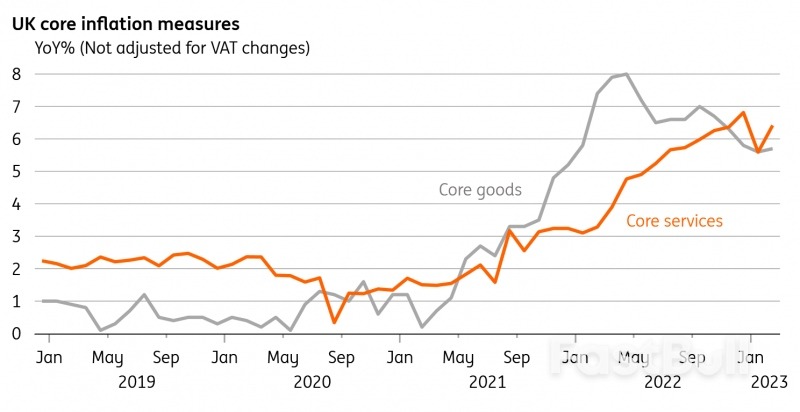
          A day before the Bank of England announces its latest decision, it is faced with an unwelcome resurgence in UK core inflation. Core CPI is back up at 6.2% (from 5.8% in January), and more importantly shows that the surprise dip in services CPI last month was a temporary one.
          Policymakers have signalled this is an area they’re paying particular attention to, not least because service-sector inflation tends to be more ‘persistent’ (that is, trends tend to be more long-lasting than for goods) and less volatile. Inflation in hospitality is proving particularly sticky.
          The caveat here is that the Bank has indicated it is paying less attention to any one single indicator, and is focused more on a broader definition of “inflation persistence” and price-setting behaviour. And in general, the data has been encouraging over the past month or so. The Bank’s own Decision Maker Panel survey of businesses points to less aggressive price and wage rises in the pipeline, and the official wage data finally appears to be gradually easing.

          Core services inflation has bounced back after January's dip

          UK Inflation Resurgence Points to Final 25bp Rate Hike This Week_1
          We suspect the Bank will want to see more evidence before ending its rate hike cycle entirely, and that’s particularly true after these latest inflation numbers. We’re still narrowly expecting a 25bp hike on Thursday, and we think the BoE will take a leaf out of the European Central Bank’s book and reiterate that it has the tools available if needed to tackle financial stability, thereby allowing monetary policy to focus on inflation-fighting. This was the mantra it adopted last October/November during the mini-budget and LDI pensions fallout in UK markets.
          However, assuming the broader inflation data continues to point to an easing in pipeline pressures, then we suspect the committee will be comfortable with pausing by the time of the next meeting in May.

          Source: ING

          To stay updated on all economic events of today, please check out our Economic calendar
          Risk Warnings and Disclaimers
          You understand and acknowledge that there is a high degree of risk involved in trading. Following any strategies or investment methods may lead to potential losses. The content on the site is provided by our contributors and analysts for information purposes only. You are solely responsible for determining whether any trading assets, securities, strategy, or any other product is suitable for investing based on your own investment objectives and financial situation.
          Comments
          Add to Favorites
          Share

          How Will the 'Partygate' Inquiry into Boris Johnson Work?

          Devin

          Political

          Former British prime minister Boris Johnson will be grilled by lawmakers on Wednesday as they decide whether he intentionally misled parliament about illegal parties at his office during coronavirus lockdowns.
          Below is a look at how parliament's privileges committee is conducting its inquiry and how it could affect Johnson, who remains an influential figure in British politics and attempted a return to the premiership as recently as October.
          What is the privileges committee?
          It is one of the many committees of lawmakers in the British parliament which oversees the government's work and parliament's internal affairs.
          The Committee of Privileges examines specific matters referred to it by parliament that involve a potential contempt of parliament and breaches of parliamentary privilege by lawmakers.
          Lawmakers, including from Johnson's Conservative Party, backed an opposition motion last April that his statements "appear to amount to misleading the House" and should be investigated by its Committee of Privileges.
          Johnson has since resigned as prime minister but remains a lawmaker representing a west London constituency.
          Who is part of the committee?
          The seven-member committee is made up of four Conservatives and three opposition lawmakers, in proportion to the parties' representation in parliament. The committee, by convention, is chaired by an opposition lawmaker and Labour's Harriet Harman is its current chair.
          How will the committee carry out its work?
          The committee has been collecting "written evidence" - diaries, emails, photos, documents and mobile phone messages - from Johnson and his No. 10 Downing Street staff.
          On March 3, the committee said the evidence "strongly suggests that breaches of guidance would have been obvious" to Johnson at the time he was at the gatherings.
          On Tuesday, it published a document given to it by Johnson in which he said there was no evidence he intentionally misled lawmakers.
          In its oral evidence stage of the inquiry, the committee will call a range of individuals - including Johnson on Wednesday - to testify under oath in televised hearings.
          All oral evidence will be taken publicly but the committee has said it will consider requests to give evidence anonymously or in private on a case-by-case basis if necessary.
          Johnson, or any other witness, may be accompanied by a legal adviser from whom they can take advice during the session.
          What power does the committee have?
          The committee only has the power to issue a report to parliament setting out its findings from the inquiry and whether it believes Johnson "committed a contempt". It can also recommend what, if any, sanction he should face.
          Possible sanctions include reprimanding Johnson, requiring him to make an oral or written apology, suspending him for a number of days or even expelling him.
          A suspension of 10 or more sitting days would automatically lead to a recall petition, which if signed by more than 10% of the electorate in his constituency, would trigger a fresh vote for his parliamentary seat.
          Members of parliament will vote on whether to ratify the committee's report and approve any sanction.
          What if the committee finds Johnson misled parliament?
          A ruling that Johnson misled parliament intentionally, whatever the sanction, would make it harder for him to convince his party — and the British public — that he could ever become prime minister again.
          While expulsion from parliament would mean he would be unlikely to ever return to high office, there is no rule preventing him running for election to parliament again.
          Can Johnson challenge the findings?
          Not exactly. If the committee intends to criticise Johnson, it will first send him a warning letter with the evidence it has used to arrive at its findings.
          Johnson can respond to any such letter within 14 days, and the committee will consider the response before reporting its findings to the house.
          What happens if the committee finds in Favour of Johnson?
          If the committee concludes that Johnson did not mislead parliament, he could use the findings to strengthen his case for a political comeback.

          Source: Reuters

          Risk Warnings and Disclaimers
          You understand and acknowledge that there is a high degree of risk involved in trading. Following any strategies or investment methods may lead to potential losses. The content on the site is provided by our contributors and analysts for information purposes only. You are solely responsible for determining whether any trading assets, securities, strategy, or any other product is suitable for investing based on your own investment objectives and financial situation.
          Comments
          Add to Favorites
          Share

          Market Turmoil Is Doing Central Bankers' Jobs for Them

          Alex

          Economic

          Tighter financing conditions in markets sparked by banking sector turmoil may have done much of central banks' jobs for them, boosting the case for an end to interest rate hikes soon.
          In less than two weeks, U.S. banking shares alone have slid over 15%, weaker companies' borrowing costs have jumped and the risk premium on U.S. financial debt is at its highest since May 2020.
          Such moves, some economists estimate, are the equivalent of multiple rate hikes by the U.S. Federal Reserve. The turmoil has also prompted investors to scale back rate-hike bets.
          The Fed is tipped to raise rates by 25 basis points on Wednesday, compared with expectations of a 50 bps move earlier this month.
          European Central Bank President Christine Lagarde reckons market turmoil may do some of the ECB's tightening for it if it dampens demand and inflation.
          Financial conditions reflect the availability of funding in an economy, so they dictate spending, saving and investment plans of businesses and households. Central banks have been trying to tighten them by raising rates to slow rising prices.
          Since the collapse of Silicon Valley Bank and a rout in Credit Suisse shares that led to its takeover on Sunday by Swiss rival UBS, market funding conditions have tightened sharply.
          Torsten Slok, chief economist at Apollo Global Management, reckons the scale of tightening was equivalent to adding 1.5 percentage points to the Fed's policy rate.
          "Financial conditions are the tightest they have been since the Fed began to increase interest rates," he said, noting a Bloomberg U.S. index factoring in money markets, corporate debt and stock market moves had hit its tightest since March 2020.
          Signs of tightening financial conditions were plentiful.
          Since March 9, the additional yield U.S. corporate junk bonds pay on top of risk-free rates has risen by a whopping 88 bps.
          U.S. bank stocks have fallen some 16%. European banks are down 11% even after a post Credit Suisse-rescue bounce.
          The risk premium on debt issued by banks and other financial companies has surged 56 basis points in the United States and 76 bps in the euro zone.
          Those moves and heightened uncertainty could lead to a significant tightening in euro zone and UK bank lending standards, Goldman Sachs said, although of less magnitude than during the 2008 financial crisis or 2011 euro zone debt crisis.
          Market Turmoil Is Doing Central Bankers' Jobs for Them_1"Even assuming that market volatility does subside over the coming days and weeks, we think some residual tightness in financial conditions is likely to remain," said ABN AMRO senior economist Bill Diviney.
          "Given that this will do some of the Fed's tightening work for it, by depressing lending to the real economy, this is likely to reduce the need for further policy tightening."
          Diviney said this could also be a reason for the Fed to cut rates this year.
          Oil prices meanwhile are down 9% since March 9, another disinflationary factor that could help central bankers.

          "Largely guesswork"

          Goldman Sachs said the tightening in bank lending standards it expects could subtract 0.25 to 0.5 percentage points from 2023 economic growth in the United States, equivalent to the impact of another 25-50 bps of Fed rate hikes. The impact risked being even larger, it added.
          Market Turmoil Is Doing Central Bankers' Jobs for Them_2Others were wary of using market-based indicators to interpret financial conditions at a time when poor liquidity is driving outsized market moves.
          "The rates volatility has been driven by inflation and growth fears and positioning washouts so these moves should be taken with a grain of salt," said Patrick Saner, head of macro strategy at Swiss Re, referring to wild swings in government bonds.
          "An abrupt tightening of financial conditions matters only to the extent that the tightness is maintained and remains orderly," he said, adding that this depends on central banks maintaining their inflation-fighting resolve.
          Dario Perkins, managing director, global macro at consultancy TS Lombard and a former advisor to Britain's Treasury, called estimates of the impact recent turmoil would have on effective policy rates "largely guesswork".
          "Central banks no longer have a good idea about the true tightness of monetary policy," he said.
          He expected smaller banks to restrict lending in a way that could have a big impact on smaller and medium-sized businesses, in a blow to aggregate demand.
          "This will help the authorities to defeat inflation, but in a way that is uncontrolled and intractable, risking unnecessary hardship."

          Source: Reuters

          To stay updated on all economic events of today, please check out our Economic calendar
          Risk Warnings and Disclaimers
          You understand and acknowledge that there is a high degree of risk involved in trading. Following any strategies or investment methods may lead to potential losses. The content on the site is provided by our contributors and analysts for information purposes only. You are solely responsible for determining whether any trading assets, securities, strategy, or any other product is suitable for investing based on your own investment objectives and financial situation.
          Comments
          Add to Favorites
          Share

          FX Daily: Hiking Confidence

          Samantha Luan

          Forex

          USD: Fed to hike by 25bp
          Late last week, we published our FOMC meeting preview and discussed how our base case was for a 25bp rate hike if market conditions didn't deteriorate further. Since then, the US regional banking crisis has remained broadly unresolved, but the Treasury is now examining an extension of the FDIC deposit guarantee (Secretary Janet Yellen pledged intervention if needed) and the Federal Reserve itself boosted money market liquidity via higher-frequency USD swap line operations. In Europe, sentiment appears to be stabilising after markets digested the fallout of the UBS-Credit Suisse deal for some categories of bondholders (AT1, in particular). We recommend reading this note from our credit colleagues on the topic "Credit chaos: is the worst behind us?". Ultimately, two straight days of gains in global equities tell us that investors have indeed turned tentatively more optimistic about the financial turmoil.
          In other words, even if it is still a close call, market conditions have – if anything – become slightly more favourable and a 25bp hike is our base case for today's FOMC announcement. We think such a move is not purely motivated by the inflation battle, but probably fits the need to send a message of confidence to the financial system. Pausing rates after having opened the door to a 50bp hike only a few weeks ago might be read as an emergency move and risks exacerbating market concerns about financial stability.
          Markets have also moved closer to pricing in such a scenario as sentiment recovered and currently factor in around 20bp (or an 80% implied probability). If a 25bp hike is now a more widely expected outcome, markets will zoom their lenses on: a) financial stability assessment and tools; b) forward guidance, especially the dot plots. On this first point, a lot of focus will be on details about the new Term Funding Facility, fundamentally because this will re-build bond holdings into the Fed balance sheet, which may appear inconsistent with the Fed's quantitative tightening policy. When it comes to the dot plot, our economics team expects the FOMC median projections to signal a 5.4% policy rate for 2023, up from 5.1% from the December update. This could also have a symbolic value: signalling that the Committee is confident the banking crisis will be resolved and the inflation battle can return as the priority. Finally, it will be important to see how much Fed Chair Jerome Powell stresses how the current financial turmoil is by itself a tightening of financial conditions and can accelerate the disinflationary process.
          In terms of the FX impact, we think there is room for the dollar to recover some ground on the back of a moderate hawkish surprise by the Fed. However, we are observing a gradual improvement in investor sentiment on the global financial situation – and especially in Europe – which makes us tilt to a bearish short-term bias in the dollar. That is, naturally, highly conditional on no further setbacks in the ongoing banking crisis – which is a big caveat.
          EUR: Equities behind the euro rally
          A soft ZEW print yesterday was not enough to halt the good EUR/USD momentum, which boils down to European equities' outperformance versus US stocks as well as the general improvement in risk sentiment. We are observing how markets are returning to some pro-cyclical European currencies to the detriment of those Asian G10 currencies (JPY, AUD, NZD) that appeared as safe havens last week.
          We think that today's FOMC announcement can trigger some recovery in the dollar, and therefore see mostly downside risks for EUR/USD. At the same time, regulators' efforts to contain the adverse side-effects of the UBS-CS deal for some bondholder categories appear to be yielding some positive effects for European sentiment, and possibly means that the balance of market concern is now tilted to the US given the still unresolved regional banking crisis. Beyond the FOMC impact, we think there is room for a break above 1.0800 in the near term as long as sentiment continues to stabilise.
          The European Central Bank is playing a role in this, by staying rather hawkish on monetary policy while opening the door to deploying financial stability tools. There are a lot of speakers today, as the ECB holds a conference in Frankfurt: President Lagarde, Chief Economist Philip Lane, and then members from all parts of the dove-hawk spectrum. Still, the impact on the euro may ultimately be small given the proximity to the FOMC announcement. There are no market-moving data releases to flag in the eurozone calendar today.
          GBP: Surprise acceleration in inflation
          On Monday, we had called for a break higher in EUR/GBP as we deemed the recent resilience in the pound versus the euro as hardly sustainable. The pair traded close to 0.8850 yesterday but dropped back below 0.8800 this morning after a surprise acceleration in UK inflation. Headline CPI year-on-year rose from 10.1% to 10.4%, defying expectations for a drop below 10.0%. Core inflation also accelerated, from 5.8% to 6.2%.
          This morning's data – along with the tentative recovery in market sentiment - reinforces the prospect of a Bank of England rate hike tomorrow (which is also our base case). Still, our economics team still deems a May pause as highly likely, and we continue to see the direction for EUR/GBP as bullish over the coming weeks.
          CEE: US dollar will slow recovery
          Yesterday's prints from Poland finished the monthly set of data confirming the weak economy. Today we will see only consumer confidence in Poland while in the Czech Republic, the Ministry of Finance will test the primary bond market for the first time since the recent rally to see whether Czech bonds are still attractive with yields well below 5%.
          The FX market in the region yesterday confirmed the positive sentiment coming from the core market, supported by a higher EUR/USD. The rally led by the Hungarian forint and the Czech koruna will follow a further decline in risk aversion, in our view. However, the Fed and a stronger US dollar may be a drag on the EM recovery in the days ahead. Even so, we should see further gains in the CEE region. In our view, the Hungarian forint should settle below 390 EUR/HUF and the Czech koruna below 23.75 EUR/CZK. The Polish zloty and Romanian leu are likely to continue to stagnate at current levels and as we mentioned earlier, this part of the region will have to wait for a stronger move higher in EUR/USD.

          Source: ING

          Risk Warnings and Disclaimers
          You understand and acknowledge that there is a high degree of risk involved in trading. Following any strategies or investment methods may lead to potential losses. The content on the site is provided by our contributors and analysts for information purposes only. You are solely responsible for determining whether any trading assets, securities, strategy, or any other product is suitable for investing based on your own investment objectives and financial situation.
          Comments
          Add to Favorites
          Share

          Rates Spark: The Dam Holds, Just in Time for The Fed

          Devin

          Central Bank

          The Fed set to go ahead and deliver the 25bp that's discounted. But then what?
          With a 25bp hike 80% discounted there is a green light for the Fed to go ahead and deliver that. It's unlikely the Fed will provide much guidance for the May meeting though, but it's also unlikely we get a so-called dovish hike. The Fed needs to keep some form of pressure on. The big take-away is likely to come from the press conference, which should include lots of questions on the banking system, and the (emergency) measures already employed to secure it.
          There will be a keen ear to any commentary from Chair Powell on the new Term Funding Program. The terms on this facility are so good that a significant take-up is quite probable. Initially there may be reluctance to take advantage, so as to avoid raising red flags on individual names. But names will not be published, and once volumes build, more and more (mostly smaller) banks will likely use the facility. Note that this will re-build bonds on the Fed's balance sheet. Not quite quantitative easing, but going in the opposite direction to the quantitative tightening process that's ongoing (through allowing redeeming bonds to roll off the front end at a pace of US$95bn per month). Meanwhile, there is still some US$2tn of liquidity going back to the Fed through the reverse repo facility, the counter of which shows up in lower excess reserves than there would otherwise be. In fact, falling deposits in the banking system generally is reflected here too, with many such deposits showing up in money markets funds, and from there into the Fed reverse repo facility.
          Directionally we doubt there is huge room to the downside for market rates, especially given the virtual collapse seen in the past week or so. That said, further falls in the near term are entirely possible should the banking story deteriorate further. But so far the banking issues are more idiosyncratic than systemic, and a system breakdown has become far less likely in the wake of the extraordinary deposit support announced by the Fed in the wake of the Silicon Valley Bank collapse. Plus, delivery of a 25bp hike still means the Fed is tightening, there is likely at least another hike to come. In the background we envisage a medium-term fed funds rate equilibrium at 3%, so long rates should not really be shooting below this, barring exceptional circumstances. There is in fact a probable scenario where longer dated rates are under rising pressure, even as the front end ultimately sees pressure for lower rates later in 2023. The inflation issue remains a significant one, and any let-off through interest rate cuts, or even the discount thereof, would leave longer rates less protected from residual medium-term inflation risks.

          Rates Spark: The Dam Holds, Just in Time for The Fed_1How high can euro rates go?

          The stabilisation of various banking stress and broader financial market indicators has put markets back on alert for more monetary tightening. In Europe, the swap curve is implying a terminal deposit rate around 3.25%, only 25bp higher than the current rate. This compares with our (pre-banking crisis) call for a 3.50% peak, and market pricing of around 4% just two weeks ago. Clearly, the world has changed since then, but European Central Bank (ECB) officials have, in recent days, implied that more tightening will be required. In some instance, this took the form to oblique references to too high inflation. In other cases, of a direct rebuttal of markets pricing a terminal rate under 3.25%.
          The ECB's Watchers conference today should be an opportunity for governing council members to drive the message home. ECB Supervisory Board chairman Andrea Enria's parliament hearing yesterday seemed to suggest the central bank sees it as its base case that no further contagion will occur. We surmise that as time passes with no further lapses in banking stability, the central bank will progressively become more confident in its ability to deliver further hikes. The question is how many.
          Using the previous peak in Estr forwards as a guide, we think the curve can at least price one more 25bp hike than currently, which would take us to June, in line with our earlier call. Even 50bp would not be a surprise at all. Based on recent trading relationships, this should translate one-to-one into 2Y yields, and roughly half of that should be reflected into 10Y yields (a little more for Bund, a little less for swaps). This should put 2Y German yields above 3%, and 10Y above 2.5% (equivalent in 10Y swaps of 3.2%) in case of further hawkish re-pricing, with 2.80% and 2.40% realistic short term forecast for 2Y and 10Y yields respectively. This, of course, is subject to no further banking contagion, and provided the Fed presses ahead with its own hike at this evening.

          Rates Spark: The Dam Holds, Just in Time for The Fed_2Today's events and market view

          There is a full roster of ECB speakers at the ECB Watchers conference in Frankfurt, culminating with speeches from Chief Economist Philip Lane and board member Fabio Panetta, both leaning dovish to varying degrees. Should they (Lane most likely) endorse further hikes, this would reinforce the impression that hawkish thinking still dominates ECB deliberations.
          Bond supply today consists in 4Y gilts and 10Y Bund. Data consists in eurozone current account balance.
          The minutes of the Bank of Canada will be released, although this will quickly be eclipsed by the Fed's FOMC meeting (which is one hour earlier for European watchers as the US has already switched to summer time). We've pencilled in a 25bp hike provided no further signs of contagion.

          Source: ING

          Risk Warnings and Disclaimers
          You understand and acknowledge that there is a high degree of risk involved in trading. Following any strategies or investment methods may lead to potential losses. The content on the site is provided by our contributors and analysts for information purposes only. You are solely responsible for determining whether any trading assets, securities, strategy, or any other product is suitable for investing based on your own investment objectives and financial situation.
          Comments
          Add to Favorites
          Share
          FastBull
          Copyright © 2025 FastBull Ltd

          728 RM B 7/F GEE LOK IND BLDG NO 34 HUNG TO RD KWUN TONG KLN HONG KONG

          TelegramInstagramTwitterfacebooklinkedin
          App Store Google Play Google Play
          Products
          Charts

          Chats

          Q&A with Experts
          Screeners
          Economic Calendar
          Data
          Tools
          Membership
          Features
          Function
          Markets
          Copy Trading
          Latest Signals
          Contests
          News
          Analysis
          24/7
          Columns
          Education
          Company
          Careers
          About Us
          Contact Us
          Advertising
          Help Center
          Feedback
          User Agreement
          Privacy Policy
          Business

          White Label

          Data API

          Web Plug-ins

          Poster Maker

          Affiliate Program

          Risk Disclosure

          The risk of loss in trading financial instruments such as stocks, FX, commodities, futures, bonds, ETFs and crypto can be substantial. You may sustain a total loss of the funds that you deposit with your broker. Therefore, you should carefully consider whether such trading is suitable for you in light of your circumstances and financial resources.

          No decision to invest should be made without thoroughly conducting due diligence by yourself or consulting with your financial advisors. Our web content might not suit you since we don't know your financial conditions and investment needs. Our financial information might have latency or contain inaccuracy, so you should be fully responsible for any of your trading and investment decisions. The company will not be responsible for your capital loss.

          Without getting permission from the website, you are not allowed to copy the website's graphics, texts, or trademarks. Intellectual property rights in the content or data incorporated into this website belong to its providers and exchange merchants.

          Not Logged In

          Log in to access more features

          FastBull Membership

          Not yet

          Purchase

          Become a signal provider
          Help Center
          Customer Service
          Dark Mode
          Price Up/Down Colors

          Log In

          Sign Up

          Position
          Layout
          Fullscreen
          Default to Chart
          The chart page opens by default when you visit fastbull.com