• Trade
  • Markets
  • Copy
  • Contests
  • News
  • 24/7
  • Calendar
  • Q&A
  • Chats
Trending
Screeners
SYMBOL
LAST
BID
ASK
HIGH
LOW
NET CHG.
%CHG.
SPREAD
SPX
S&P 500 Index
6827.42
6827.42
6827.42
6899.86
6801.80
-73.58
-1.07%
--
DJI
Dow Jones Industrial Average
48458.04
48458.04
48458.04
48886.86
48334.10
-245.98
-0.51%
--
IXIC
NASDAQ Composite Index
23195.16
23195.16
23195.16
23554.89
23094.51
-398.69
-1.69%
--
USDX
US Dollar Index
97.990
98.070
97.990
98.070
97.920
+0.040
+ 0.04%
--
EURUSD
Euro / US Dollar
1.17336
1.17343
1.17336
1.17447
1.17283
-0.00058
-0.05%
--
GBPUSD
Pound Sterling / US Dollar
1.33563
1.33573
1.33563
1.33740
1.33546
-0.00144
-0.11%
--
XAUUSD
Gold / US Dollar
4329.51
4329.96
4329.51
4330.00
4294.68
+30.12
+ 0.70%
--
WTI
Light Sweet Crude Oil
57.536
57.573
57.536
57.601
57.194
+0.303
+ 0.53%
--

Community Accounts

Signal Accounts
--
Profit Accounts
--
Loss Accounts
--
View More

Become a signal provider

Sell trading signals to earn additional income

View More

Guide to Copy Trading

Get started with ease and confidence

View More

Signal Accounts for Members

All Signal Accounts

Best Return
  • Best Return
  • Best P/L
  • Best MDD
Past 1W
  • Past 1W
  • Past 1M
  • Past 1Y

All Contests

  • All
  • Trump Updates
  • Recommend
  • Stocks
  • Cryptocurrencies
  • Central Banks
  • Featured News
Top News Only
Share

India's Nifty Auto Index Down 1.2%

Share

Hsi Closes Midday At 25736, Down 240 Pts, Hsti Closes Midday At 5537, Down 100 Pts, Hansoh Pharma Down Over 7%, Ping An, Youran Dairy, Logan Group Hit New Highs

Share

India Foreign Ministry: Foreign Minister To Visit United Arab Emirates And Israel

Share

Reuters Poll - Bank Of Thailand To Lower Key Policy Rate To 1.00% In Q1 Of 2026, Said A Majority Of Economists

Share

Reuters Poll - Bank Of Thailand To Cut Its Key Interest Rate To 1.25% On December 17, Said 26 Of 27 Economists

Share

Thai Finance Minister: Earlier Stimulus Measures To Shore Up Economy

Share

Thai Finance Minister: Strong Baht Driven By Capital Inflows

Share

Thai Finance Minister: Has Discussed With Central Bank To Handle Baht

Share

India's Nifty Bank Futures Down 0.1% In Pre-Open Trade

Share

India's Nifty 50 Futures Down 0.3% In Pre-Open Trade

Share

India's Nifty 50 Index Down 0.45% In Pre-Open Trade

Share

Indian Rupee Weakens Past 90.55 Versus USA Dollar To All-Time Low

Share

China's Fossil-Fuelled Power Generation Falls 4.2% Year-On-Year In November

Share

Indian Rupee Opens Down 0.1% At 90.5450 Per USA Dollar, Versus 90.4150 Previous Close

Share

Australia Home Minister: Father Involved In Bondi Gun Attack Came To Australia On Student Visa, Son Is An Australian-Born Citizen

Share

Australian Prime Minister Albanese: Stricter Gun Control Laws Will Include Restrictions On The Number Of Guns An Individual Can Own Or License To Use

Share

Australia's Prime Minister Albanese: We Are Considering A Review Of Gun Licenses For Some Time

Share

Australia's Prime Minister Albanese: Government Considering Tougher Gun Laws

Share

China Stats Bureau Spokesperson: Next Year, Adverse Impact Of Protectionism And Unilateralism May Continue

Share

China's Onshore Yuan Strengthens To A High Of 7.0516 Per Dollar, Strongest Level Since Oct 8, 2024

TIME
ACT
FCST
PREV
U.K. Trade Balance (Oct)

A:--

F: --

P: --

France HICP Final MoM (Nov)

A:--

F: --

P: --

China, Mainland Outstanding Loans Growth YoY (Nov)

A:--

F: --

P: --

China, Mainland M2 Money Supply YoY (Nov)

A:--

F: --

P: --

China, Mainland M0 Money Supply YoY (Nov)

A:--

F: --

P: --

China, Mainland M1 Money Supply YoY (Nov)

A:--

F: --

P: --

India CPI YoY (Nov)

A:--

F: --

P: --

India Deposit Gowth YoY

A:--

F: --

P: --

Brazil Services Growth YoY (Oct)

A:--

F: --

P: --

Mexico Industrial Output YoY (Oct)

A:--

F: --

P: --

Russia Trade Balance (Oct)

A:--

F: --

P: --

Philadelphia Fed President Henry Paulson delivers a speech
Canada Building Permits MoM (SA) (Oct)

A:--

F: --

P: --

Canada Wholesale Sales YoY (Oct)

A:--

F: --

P: --

Canada Wholesale Inventory MoM (Oct)

A:--

F: --

P: --

Canada Wholesale Inventory YoY (Oct)

A:--

F: --

P: --

Canada Wholesale Sales MoM (SA) (Oct)

A:--

F: --

P: --

Germany Current Account (Not SA) (Oct)

A:--

F: --

P: --

U.S. Weekly Total Rig Count

A:--

F: --

P: --

U.S. Weekly Total Oil Rig Count

A:--

F: --

P: --

Japan Tankan Small Manufacturing Outlook Index (Q4)

A:--

F: --

P: --

Japan Tankan Large Non-Manufacturing Diffusion Index (Q4)

A:--

F: --

P: --

Japan Tankan Large Non-Manufacturing Outlook Index (Q4)

A:--

F: --

P: --

Japan Tankan Large Manufacturing Outlook Index (Q4)

A:--

F: --

P: --

Japan Tankan Small Manufacturing Diffusion Index (Q4)

A:--

F: --

P: --

Japan Tankan Large Manufacturing Diffusion Index (Q4)

A:--

F: --

P: --

Japan Tankan Large-Enterprise Capital Expenditure YoY (Q4)

A:--

F: --

P: --

U.K. Rightmove House Price Index YoY (Dec)

A:--

F: --

P: --

China, Mainland Industrial Output YoY (YTD) (Nov)

A:--

F: --

P: --

China, Mainland Urban Area Unemployment Rate (Nov)

A:--

F: --

P: --

Saudi Arabia CPI YoY (Nov)

--

F: --

P: --

Euro Zone Industrial Output YoY (Oct)

--

F: --

P: --

Euro Zone Industrial Output MoM (Oct)

--

F: --

P: --

Canada Existing Home Sales MoM (Nov)

--

F: --

P: --

Euro Zone Total Reserve Assets (Nov)

--

F: --

P: --

U.K. Inflation Rate Expectations

--

F: --

P: --

Canada National Economic Confidence Index

--

F: --

P: --

Canada New Housing Starts (Nov)

--

F: --

P: --

U.S. NY Fed Manufacturing Employment Index (Dec)

--

F: --

P: --

U.S. NY Fed Manufacturing Index (Dec)

--

F: --

P: --

Canada Core CPI YoY (Nov)

--

F: --

P: --

Canada Manufacturing Unfilled Orders MoM (Oct)

--

F: --

P: --

U.S. NY Fed Manufacturing Prices Received Index (Dec)

--

F: --

P: --

U.S. NY Fed Manufacturing New Orders Index (Dec)

--

F: --

P: --

Canada Manufacturing New Orders MoM (Oct)

--

F: --

P: --

Canada Core CPI MoM (Nov)

--

F: --

P: --

Canada Trimmed CPI YoY (SA) (Nov)

--

F: --

P: --

Canada Manufacturing Inventory MoM (Oct)

--

F: --

P: --

Canada CPI YoY (Nov)

--

F: --

P: --

Canada CPI MoM (Nov)

--

F: --

P: --

Canada CPI YoY (SA) (Nov)

--

F: --

P: --

Canada Core CPI MoM (SA) (Nov)

--

F: --

P: --

Canada CPI MoM (SA) (Nov)

--

F: --

P: --

Federal Reserve Board Governor Milan delivered a speech
U.S. NAHB Housing Market Index (Dec)

--

F: --

P: --

Australia Composite PMI Prelim (Dec)

--

F: --

P: --

Australia Services PMI Prelim (Dec)

--

F: --

P: --

Australia Manufacturing PMI Prelim (Dec)

--

F: --

P: --

Japan Manufacturing PMI Prelim (SA) (Dec)

--

F: --

P: --

U.K. Unemployment Rate (Nov)

--

F: --

P: --

U.K. 3-Month ILO Unemployment Rate (Oct)

--

F: --

P: --

Q&A with Experts
    • All
    • Chatrooms
    • Groups
    • Friends
    Connecting
    .
    .
    .
    Type here...
    Add Symbol or Code

      No matching data

      All
      Trump Updates
      Recommend
      Stocks
      Cryptocurrencies
      Central Banks
      Featured News
      • All
      • Russia-Ukraine Conflict
      • Middle East Flashpoint
      • All
      • Russia-Ukraine Conflict
      • Middle East Flashpoint
      Search
      Products

      Charts Free Forever

      Chats Q&A with Experts
      Screeners Economic Calendar Data Tools
      Membership Features
      Data Warehouse Market Trends Institutional Data Policy Rates Macro

      Market Trends

      Market Sentiment Order Book Forex Correlations

      Top Indicators

      Charts Free Forever
      Markets

      News

      News Analysis 24/7 Columns Education
      From Institutions From Analysts
      Topics Columnists

      Latest Views

      Latest Views

      Trending Topics

      Top Columnists

      Latest Update

      Signals

      Copy Rankings Latest Signals Become a signal provider AI Rating
      Contests
      Brokers

      Overview Brokers Assessment Rankings Regulators News Claims
      Broker listing Forex Brokers Comparison Tool Live Spread Comparison Scam
      Q&A Complaint Scam Alert Videos Tips to Detect Scam
      More

      Business
      Events
      Careers About Us Advertising Help Center

      White Label

      Data API

      Web Plug-ins

      Affiliate Program

      Awards Institution Evaluation IB Seminar Salon Event Exhibition
      Vietnam Thailand Singapore Dubai
      Fans Party Investment Sharing Session
      FastBull Summit BrokersView Expo
      Recent Searches
        Top Searches
          Markets
          News
          Analysis
          User
          24/7
          Economic Calendar
          Education
          Data
          • Names
          • Latest
          • Prev

          View All

          No data

          Scan to Download

          Faster Charts, Chat Faster!

          Download App
          English
          • English
          • Español
          • العربية
          • Bahasa Indonesia
          • Bahasa Melayu
          • Tiếng Việt
          • ภาษาไทย
          • Français
          • Italiano
          • Türkçe
          • Русский язык
          • 简中
          • 繁中
          Open Account
          Search
          Products
          Charts Free Forever
          Markets
          News
          Signals

          Copy Rankings Latest Signals Become a signal provider AI Rating
          Contests
          Brokers

          Overview Brokers Assessment Rankings Regulators News Claims
          Broker listing Forex Brokers Comparison Tool Live Spread Comparison Scam
          Q&A Complaint Scam Alert Videos Tips to Detect Scam
          More

          Business
          Events
          Careers About Us Advertising Help Center

          White Label

          Data API

          Web Plug-ins

          Affiliate Program

          Awards Institution Evaluation IB Seminar Salon Event Exhibition
          Vietnam Thailand Singapore Dubai
          Fans Party Investment Sharing Session
          FastBull Summit BrokersView Expo

          ‘Copper Is the New Oil,’ And Prices Could Soar 50% as AI, Green Energy, And Military Spending Boost Demand

          Samantha Luan

          Economic

          Commodity

          Summary:

          Copper is emerging as the next indispensable industrial commodity, mirroring oil's rise in earlier decades, a top commodities analyst said.

          Copper is emerging as the next indispensable industrial commodity, mirroring oil's rise in earlier decades, a top commodities analyst said.
          This time around, new forces in the economy, namely the advent of artificial intelligence, explosion of data centers, and the green energy revolution, are boosting demand for copper, while the development of new weapons is adding to it as well, according to Jeff Currie, chief strategy officer of Energy Pathways at Carlyle.
          “Copper is the new oil,” he told Bloomberg TV on Tuesday, noting that his conversations with traders also reinforce his bullishness. “It is the highest-conviction trade I've ever seen.”
          Copper has long been a key industrial bellwether as its uses range widely from manufacturing and construction to electronics and other high-tech products.
          But billions of dollars pouring into artificial intelligence and renewable energy are a relatively new part of copper's outlook, Currie noted, acknowledging that he made a similar prediction in 2021 when he was an analyst at Goldman Sachs.
          “I'm confident that this time is lift-off, and I think we're going to see more momentum behind it,” he said. What's different this time is there are now three sources of demand—AI, green energy, and the military—instead of just green energy three years ago.
          And while demand is high, supply remains tight as bringing new copper mines online can take 12 to 26 years, Currie pointed out.
          That should eventually send prices soaring to $15,000 per ton, he predicted. Coppers prices are already at record highs, with benchmark prices in London at about $10,000 per ton, more than doubling from the pandemic-era lows in early 2020.
          At some point, the price will get so high that it will create “demand destruction,” meaning buyers balk at paying so much. But Currie doesn't know what that level is.
          “But I go back to the 2000s, I was bullish on oil then as I am on copper today,” he added, recalling that crude shot up from $20 to $140 per barrel at the time. “So the upside on copper here is very significant.”
          Copper was also a key catalyst in BHP's proposed a takeover of Anglo American, a $40 billion deal that would create the world's top copper producer. But Anglo has rejected the offer and recently announced plans to restructure the group, including selling its diamond business De Beers.

          Source: Fortune

          To stay updated on all economic events of today, please check out our Economic calendar
          Risk Warnings and Disclaimers
          You understand and acknowledge that there is a high degree of risk involved in trading. Following any strategies or investment methods may lead to potential losses. The content on the site is provided by our contributors and analysts for information purposes only. You are solely responsible for determining whether any trading assets, securities, strategy, or any other product is suitable for investing based on your own investment objectives and financial situation.
          Add to Favorites
          Share

          [U.S.] April Leading Economic Index: Economy at a Lower Risk of Recession but Remains Weak

          FastBull Featured

          Data Interpretation

          The Conference Board released the April Leading Economic Index (LEI) for the U.S. on May 17 as follows.
          The Conference Board LEI for the U.S. decreased by 0.6% in April 2024 after decreasing by 0.3% in March and the expected reading was -0.3%.
          Over the six-month period between October 2023 and April 2024, the LEI contracted by 1.9%, a smaller decrease than its 3.5% decline over the previous six months.
          Another decline in the Conference Board LEI for the U.S. confirms that softer economic conditions lay ahead. Deterioration in consumers' outlook on business conditions, weaker new orders, a negative yield spread, and a drop in new building permits fueled April's decline.
          Although the rate of growth of the LEI suggests a reduced risk of recession (the LEI did not signal a recession for the 2nd consecutive month), it still indicates significant challenges to economic growth.
          While the LEI did not signal a recession for the second consecutive month due to improvement in the six-month growth rate, it still points to serious headwinds to growth ahead.
          In light of this, U.S. real GDP growth is expected to slow to under 1% over the Q2 to Q3 2024 period.

          Conference Board LEI for the U.S.

          Risk Warnings and Disclaimers
          You understand and acknowledge that there is a high degree of risk involved in trading. Following any strategies or investment methods may lead to potential losses. The content on the site is provided by our contributors and analysts for information purposes only. You are solely responsible for determining whether any trading assets, securities, strategy, or any other product is suitable for investing based on your own investment objectives and financial situation.
          Add to Favorites
          Share

          Thailand’s Economic Growth Slows Even as It Beats Estimate

          Samantha Luan

          Economic

          Thailand’s economy grew better-than-expected in the first quarter, fueled by tourism and private consumption, easing the pressure on the central bank to respond to the government’s call for lower borrowing costs.
          Gross domestic product in the three months through March increased 1.5% from a year earlier, the National Economic and Social Development Council said Monday. While that’s slower than the 1.7% pace in the fourth quarter, it was well above the 0.8% median estimate in a Bloomberg survey. Only one analyst correctly predicted the print, while the rest expected the slowest expansion since the end of the pandemic.
          Quarter-on-quarter, the economy expanded 1.1% compared with a median estimate for 0.6% growth. GDP contracted a revised 0.4% in the October-December period. The baht was up 0.1% against the dollar after the data, poised to extend a four-day rally.
          Private consumption jumped 6.9% year-on-year in the first quarter, offsetting a 2.1% decline in government spending. according to the data release.
          The better-than-forecast GDP data may ease pressure on Bank of Thailand to cut borrowing costs that are at a decade-high. The data comes as tensions between the government and the central bank appear to have cooled after Finance Minister Pichai Chunhavajira last week said they would leave the monetary decision-making to the BOT, explaining that access to lending and liquidity were more important than the level of borrowing costs.
          Thailand’s Economic Growth Slows Even as It Beats Estimate_1
          The central bank’s policy rate has stood at 2.5% since September even as consumer prices slipped into negative territory in the fourth quarter of 2023 and GDP growth stuttered.
          Headline inflation finally quickened in April, showing the first gain in the past seven months. The BOT said last month that holding the rate steady had given it “policy optionality” to deal with currency volatility, geopolitical risks and uncertainty around the Federal Reserve’s pivot to easing.
          Southeast Asia’s second-largest economy is expected to pick up pace in the second half, supported by public spending after the much-delayed passing of the national budget. The government is targeting to roll out the $14 billion cash handout later this year to boost consumption. Critics have warned this could fan inflation and set back fiscal consolidation.

          Source:Bloomberg

          To stay updated on all economic events of today, please check out our Economic calendar
          Risk Warnings and Disclaimers
          You understand and acknowledge that there is a high degree of risk involved in trading. Following any strategies or investment methods may lead to potential losses. The content on the site is provided by our contributors and analysts for information purposes only. You are solely responsible for determining whether any trading assets, securities, strategy, or any other product is suitable for investing based on your own investment objectives and financial situation.
          Add to Favorites
          Share

          [ECB] Guindos: Wage Growth Slows but Labor Costs Remain Rising

          FastBull Featured

          Remarks of Officials

          The European Central Bank (ECB) Vice President Luis Guindos said in an interview on May 17 as follows.
          Inflation has been performing well, but we still need to pay attention to the risks associated with wage growth. The ECB believes that the fundamental risk to inflation is the evolution of wage growth. Despite the slowdown in nominal wage growth from 5% to 4%, unit labor costs are still rising as productivity remains at a low level.
          Inflation is expected to fluctuate around 2.4% in the coming months and will reach the 2% target by mid-2025.
          The ECB has been clear that monetary policy decisions in June and beyond will be based on its economic data. The economic growth rate has improved from the previous very low level, the labor market is performing well, and macroeconomic risks are playing a smaller role. However, there is still a need to be wary of future threats to financial stability.
          This year's global elections could lead to a stunting of globalization as protectionist measures implemented by some economies could lead to a fragmentation of the global economic environment, which in turn could affect inflation and economic growth.
          Risk Warnings and Disclaimers
          You understand and acknowledge that there is a high degree of risk involved in trading. Following any strategies or investment methods may lead to potential losses. The content on the site is provided by our contributors and analysts for information purposes only. You are solely responsible for determining whether any trading assets, securities, strategy, or any other product is suitable for investing based on your own investment objectives and financial situation.
          Add to Favorites
          Share

          The Commodities Feed: Metals Surge Higher

          ING

          Economic

          Commodity

          Energy

          Energy - Specs trim Brent longs
          Oil prices remain rangebound. ICE Brent settled 0.85% higher on Friday, but oil prices have traded in less than a $3.50/bbl range since early May. To the upside, the market will likely face resistance along the 200-day moving average. We might have to wait for further clarity from OPEC+ and its output policy for the second half of the year to provide any impetus to the market and for it to break out of its recent range.
          A fair amount of speculative selling in ICE Brent occurred over the last week. Positioning data shows that speculators sold 47,146 lots over the last reporting week, leaving them with a net long of 213,502 lots as of last Tuesday. The move was predominantly driven by longs liquidating. However, for NYMEX WTI, speculators increased their net long by 11,095 lots over the week to 128,746, largely due to short covering.
          The natural gas market remains well supported. In the US, front-month Henry Hub futures are trading above $2.60/MMBtu. The market has rallied more than 60% since late April with fundamentals looking tighter. While US inventories are still very comfortable, flat supply and stronger demand growth this year should start to tighten up the US gas balance.
          More recently, the gap between current inventories and the 5-year average has narrowed due to weaker builds. Speculators have also started covering their shorts in Henry Hub. Speculators bought 44,565 lots over the last reporting week, leaving them with a net short of just 12,701 lots as of last Tuesday. This move was predominantly driven by short covering.
          In Europe, TTF remains above EUR30/MWh despite storage being almost 67% full and still above levels seen at the same stage last year. We expect Europe to go into next winter with storage full, which suggests prices should trade lower from current levels. However, large speculative inflows into European gas has kept the market well supported.

          Metals – prices surge

          Spot gold prices broke above $2,400/oz on Friday, leaving it near the record level reached in April, while silver prices hit an 11-year high on Friday, as softer US data over the last week or so raised expectations of rate cuts. Silver prices surged above US$30/oz for the first time since February 2013 at the end of last week on robust financial and industrial demand, and there are suggestions that physical sales have also picked up.
          In addition, the market is set for a fourth straight year of supply deficits. Speculators have increased their positioning in COMEX gold and silver over the last week. CFTC data shows speculators increased their net long in gold by 9,810 lots to 172,942 lots. While for silver the speculative net long increased by 6,707 lots to 41,621 lots as of last Tuesday.
          Industrial metals also saw significant strength last week. LME nickel prices settled more than 6% higher on Friday, which took total gains for the week to more than 11%. Reports of unrest in New Caledonia have triggered supply concerns. New Caledonia's nickel output was already slashed earlier this year, following a drop in nickel prices. According to the International Nickel Study Group (INSG), New Caledonia accounted for 6% of global nickel output in 2023.
          LME copper rallied almost 7% last week, dragged higher by COMEX copper, which witnessed a short squeeze. Sentiment in the copper market is bullish, reflected by the speculative buying seen in the market. However, short-term fundamentals remain a concern, particularly when it comes to China. SHFE copper stocks are at their highest levels for this time of year in at least 15 years, while premia for imported refined copper into China remains at zero.
          Cancelled warrants for aluminium rose by 60,000 tonnes (+15.3% DoD) to 452,175 tonnes as of Friday, the highest since October 2021. The majority of the increase was in warehouses in Malaysia's Port Klang. Cancelled warrants are up by 329,200 tonnes in the last week alone. On-warrant inventories declined for a third straight session to 641,100 tonnes as of Friday.
          To stay updated on all economic events of today, please check out our Economic calendar
          Risk Warnings and Disclaimers
          You understand and acknowledge that there is a high degree of risk involved in trading. Following any strategies or investment methods may lead to potential losses. The content on the site is provided by our contributors and analysts for information purposes only. You are solely responsible for determining whether any trading assets, securities, strategy, or any other product is suitable for investing based on your own investment objectives and financial situation.
          Add to Favorites
          Share

          May 20th Financial News

          FastBull Featured

          Daily News

          [Quick Facts]

          1. The Bank of Japan may not be able to raise rates in July.
          2. Neither Russia nor Ukraine agrees to a truce during Olympics.
          3. Fed's Bowman is open to a rate hike.
          4. U.S. economic conditions will be weaker in the future.
          5. ECB is likely to cut rates in June, but future path remains uncertain.
          6. WTI may break above $80 again but will weaken in next few days.

          [News Details]

          The Bank of Japan may not be able to raise rates in July
          Some investors expect the Bank of Japan (BOJ) to raise interest rates in July. However, given the performance of Japan's first-quarter GDP data which showed a weaker-than-expected economy, it is difficult for Japan to tighten financial and fiscal policies in the short term with insufficient aggregate demand. In other words, the BOJ cannot accept another rate hike under the current economic conditions, which may be determined until the release of the second-quarter GDP data in August.
          At the same time, the weak yen is unlikely to justify another rate hike. The Bank of Japan's interest rate hikes will have a limited boost to the yen unless the financial markets expect the Bank of Japan to hike interest rates to deal with accelerating inflation.
          Neither Russia nor Ukraine agrees to a truce during Olympics
          Ukrainian President Volodymyr Zelensky rejected France's call for a truce during the Paris Olympics on May 17 in an interview with AFP, AFP reported on May 17. Zelensky said that a truce would only help Russia mobilize its troops and heavy equipment. Russian President Vladimir Putin also said on the same day that Moscow does not support a truce during this summer's Paris Olympics. "I think these Olympic principles, including the 'Olympic truce', are very right, said Putin, "Today's international sporting officials are themselves disobeying the principles of the Olympic charter" (referring to the fact that the international sports bodies do not allow Russian athletes to use the Russian flag and anthem when participating in competitions).
          Fed's Bowman is open to a rate hike
          After seeing considerable progress on slowing inflation last year, we have not yet seen further progress this year, Fed Governor Bowman said in a speech on May 17. Inflation is expected to remain high for some time.
          While the current monetary policy appears to be at a restrictive level, I remain willing to raise the target range for the federal funds rate at subsequent meetings if future data releases suggest that progress in U.S. inflation has stalled or reversed. My baseline outlook continues to be that inflation will decline further with the policy rate held steady, but I still see a number of upside inflation risks that affect my outlook, said Bowman.
          Although we have seen signs that the labor market is coming into better balance, progress has slowed. Recent employment reports have shown a strong job market, with the number of job openings relative to unemployed workers still above its pre-pandemic level.
          U.S. economic conditions will be weaker in the future
          The U.S. Leading Economic Index fell 0.6% MoM during April following an unrevised 0.3% March decline, according to a report by The Conference Board. Deterioration in consumers' outlook on business conditions, weaker new orders, a negative yield spread, and a drop in new building permits fueled April's decline. It suggests that the U.S. economic conditions will be weaker in the future.
          In addition, stock prices contributed negatively for the first time since October of last year. While the six-month and annual growth rates for the U.S. Leading Economic Index no longer signal a forthcoming recession, they still point to serious headwinds to growth ahead. Indeed, elevated inflation, high interest rates, rising household debt, and depleted pandemic savings are all expected to continue weighing on the U.S. economy in 2024.
          ECB is likely to cut rates in June, but future path remains uncertain
          Unless there are major surprises, June could be the right time to start cutting rates, said Boštjan Vasle, European Central Bank (ECB) Governing Council member and Governor of the Bank of Slovenia, on Friday. He is open to different possibilities after that and thinks they need to wait for more information.
          On the same day, ECB Executive Board member Isabel Schnabel said that a rate cut in June is appropriate according to the ECB's forecasts and based on economic data, but the rate path after it is not yet certain. Based on current data, there is no need for a rate cut in July (meaning no consecutive rate cuts, i.e., no rate cut in July after the June move). The ECB needs to be more cautious.
          WTI may break above $80 again but will weaken in next few days
          Crude oil futures are on track to record a weekly gain, although monthly performance remains subdued. "We expect energy assets to end the week on a stable or strong note, with WTI crude likely to break above $80 again," Ritterbusch said in a report. The consulting firm said the current oil rig count "could decline again, and the improved drilling efficiency remains a key factor contributing to the decline." Ritterbusch saw signs that prices could soften in the coming days and expected WTI crude to remain between $75 and $80.

          [Focus of the Day]

          UTC+8 19:30 Atlanta Fed President Bostic Gives an Interview
          UTC+8 21:00 Federal Reserve Governor Barr Speaks
          UTC+8 21:00 Fed Governor Waller Gives a Welcome Speech at an Event
          UTC+8 22:30 Fed Vice Chairman Jefferson Speaks on the Economic Outlook and the Real Estate Market
          Risk Warnings and Disclaimers
          You understand and acknowledge that there is a high degree of risk involved in trading. Following any strategies or investment methods may lead to potential losses. The content on the site is provided by our contributors and analysts for information purposes only. You are solely responsible for determining whether any trading assets, securities, strategy, or any other product is suitable for investing based on your own investment objectives and financial situation.
          Add to Favorites
          Share

          Is Investing In Asia About More Than Just China?

          JPMorgan

          Economic

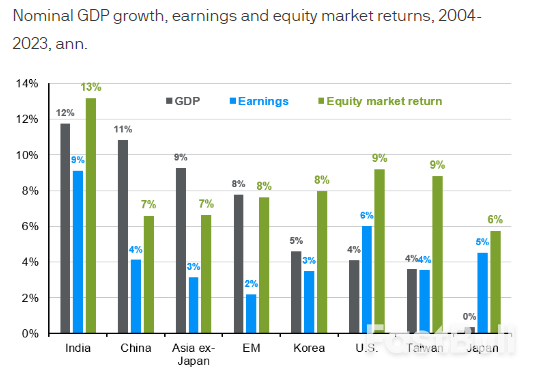
          2023 marked a third consecutive year of double-digit declines for Chinese equity markets. Investors are now reconsidering how to invest in that market and whether investing in Asia is about more than just China. Over the past twenty years, other markets in Asia have delivered strong performance, such as: India, Korea, Taiwan – and more recently, Japan. There markets have overperformed or kept up with U.S. markets, a fact overshadowed by the extreme U.S. concentration in global indices (a 63% weighting in the MSCI All Country World Index). As investors start to decrease their decade-long underweight in international stocks, Asia is a key place to look. The region is at the epicenter of this decade’s biggest trends: artificial intelligence, automation, “friendshoring”, energy transition, and the growth of the emerging market middle class. Opportunities in China still exist, but investing in Asia is about much more than just one story.
          The opportunity set in Asia is large: Asia is home to over half of the global population, a third of global growth, a third of global exports, a quarter of global consumption, over a third of global savings – and five of the ten largest major equity markets. Interestingly, certain markets in Asia have a low correlation to Chinese equities, such as Japan at 0.5 and India at 0.6, similar to the correlation U.S. markets have to China. Long-term tailwinds are boosting other economies and markets in the region, suggesting correlations should decline further. These include:
          Japan: The return of inflation and positive interest rates is a game changer for domestically oriented companies. Most importantly, corporate governance reforms are gaining more and more momentum, a key change to change Japan’s 30-year discount to other markets. The post-pandemic decline in Japanese equities’ correlation to the Japanese Yen signals that investing in Japan is about much more than just exporters – and now deserves a strategic, rather than tactical, allocation in portfolios.
          India: The combination of favorable demographics, plus economic policy reforms, should sustain India’s track record of elevated economic growth and may bring over 800 million people into the middle class over the next decade. Plus, India is a key beneficiary of the reorganization of supply chains towards geopolitically aligned countries (“friendshoring”). Most importantly, companies in India have shown the ability to translate strong economic growth into strong earnings growth and equity market returns.
          Taiwan & South Korea: These markets have delivered equity market returns significantly above what their low economic growth would suggest, a result of their 80% and 55% weighting to technology, respectively. These markets are key beneficiaries of the artificial intelligence transformation.
          Southeast Asia: Comparatively smaller markets, like Indonesia, offer investors a way to invest in the energy transition through its dominance of the critical minerals (such as nickel) used in the energy transition.
          With that said, it’s important to note that specific equity markets in Asia have different characteristics in terms of liquidity, valuations, earnings quality, and trends. As investors look to markets beyond just the U.S. and seek to diversify their Chinese equity holdings, the broader Asia region has plenty to offer.

          Some markets in Asia have delivered strong earnings and equity returns

          Is Investing In Asia About More Than Just China?_1
          To stay updated on all economic events of today, please check out our Economic calendar
          Risk Warnings and Disclaimers
          You understand and acknowledge that there is a high degree of risk involved in trading. Following any strategies or investment methods may lead to potential losses. The content on the site is provided by our contributors and analysts for information purposes only. You are solely responsible for determining whether any trading assets, securities, strategy, or any other product is suitable for investing based on your own investment objectives and financial situation.
          Add to Favorites
          Share
          FastBull
          Copyright © 2025 FastBull Ltd

          728 RM B 7/F GEE LOK IND BLDG NO 34 HUNG TO RD KWUN TONG KLN HONG KONG

          TelegramInstagramTwitterfacebooklinkedin
          App Store Google Play Google Play
          Products
          Charts

          Chats

          Q&A with Experts
          Screeners
          Economic Calendar
          Data
          Tools
          Membership
          Features
          Function
          Markets
          Copy Trading
          Latest Signals
          Contests
          News
          Analysis
          24/7
          Columns
          Education
          Company
          Careers
          About Us
          Contact Us
          Advertising
          Help Center
          Feedback
          User Agreement
          Privacy Policy
          Business

          White Label

          Data API

          Web Plug-ins

          Poster Maker

          Affiliate Program

          Risk Disclosure

          The risk of loss in trading financial instruments such as stocks, FX, commodities, futures, bonds, ETFs and crypto can be substantial. You may sustain a total loss of the funds that you deposit with your broker. Therefore, you should carefully consider whether such trading is suitable for you in light of your circumstances and financial resources.

          No decision to invest should be made without thoroughly conducting due diligence by yourself or consulting with your financial advisors. Our web content might not suit you since we don't know your financial conditions and investment needs. Our financial information might have latency or contain inaccuracy, so you should be fully responsible for any of your trading and investment decisions. The company will not be responsible for your capital loss.

          Without getting permission from the website, you are not allowed to copy the website's graphics, texts, or trademarks. Intellectual property rights in the content or data incorporated into this website belong to its providers and exchange merchants.

          Not Logged In

          Log in to access more features

          FastBull Membership

          Not yet

          Purchase

          Become a signal provider
          Help Center
          Customer Service
          Dark Mode
          Price Up/Down Colors

          Log In

          Sign Up

          Position
          Layout
          Fullscreen
          Default to Chart
          The chart page opens by default when you visit fastbull.com