• Trade
  • Markets
  • Copy
  • Contests
  • News
  • 24/7
  • Calendar
  • Q&A
  • Chats
Trending
Screeners
SYMBOL
LAST
BID
ASK
HIGH
LOW
NET CHG.
%CHG.
SPREAD
SPX
S&P 500 Index
6827.42
6827.42
6827.42
6899.86
6801.80
-73.58
-1.07%
--
DJI
Dow Jones Industrial Average
48458.04
48458.04
48458.04
48886.86
48334.10
-245.98
-0.51%
--
IXIC
NASDAQ Composite Index
23195.16
23195.16
23195.16
23554.89
23094.51
-398.69
-1.69%
--
USDX
US Dollar Index
97.950
98.030
97.950
98.500
97.950
-0.370
-0.38%
--
EURUSD
Euro / US Dollar
1.17394
1.17409
1.17394
1.17496
1.17192
+0.00011
+ 0.01%
--
GBPUSD
Pound Sterling / US Dollar
1.33707
1.33732
1.33707
1.33997
1.33419
-0.00148
-0.11%
--
XAUUSD
Gold / US Dollar
4299.39
4299.39
4299.39
4353.41
4257.10
+20.10
+ 0.47%
--
WTI
Light Sweet Crude Oil
57.233
57.485
57.233
58.011
56.969
-0.408
-0.71%
--

Community Accounts

Signal Accounts
--
Profit Accounts
--
Loss Accounts
--
View More

Become a signal provider

Sell trading signals to earn additional income

View More

Guide to Copy Trading

Get started with ease and confidence

View More

Signal Accounts for Members

All Signal Accounts

Best Return
  • Best Return
  • Best P/L
  • Best MDD
Past 1W
  • Past 1W
  • Past 1M
  • Past 1Y

All Contests

  • All
  • Trump Updates
  • Recommend
  • Stocks
  • Cryptocurrencies
  • Central Banks
  • Featured News
Top News Only
Share

Thai Leader Anutin: Landmine Blast That Killed Thai Soldiers 'Not A Roadside Accident'

Share

Thai Leader Anutin: Thailand To Continue Military Action Until 'We Feel No More Harm'

Share

Cambodian Prime Minister Hun Manet Says He Had Phone Calls With Trump And Malaysian Leader Anwar About Ceasefire

Share

Cambodia's Hun Manet Says USA, Malaysia Should Verify 'Which Side Fired First' In Latest Conflict

Share

Cambodia's Hun Manet: Cambodia Maintains Its Stance In Seeking Peaceful Resolution Of Disputes

Share

Nasdaq Companies: Allergan, Ferrovia, Insmed, Monolithic Power Systems, Seagate Technology, And Western Digital Will Be Added To The NASDAQ 100 Index. Biogen, CdW, GlobalFoundries, Lululemon, ON Semiconductor, And Tradedesk Will Be Removed From The NASDAQ 100 Index

Share

Witkoff Headed To Berlin This Weekend To Meet With Zelenskiy, European Leaders -Wsj Reporter On X

Share

Russia Attacks Two Ukrainian Ports, Damaging Three Turkish-Owned Vessels

Share

[Historic Flooding Occurs In At Least Four Rivers In Washington State Due To Days Of Torrential Rains] Multiple Areas In Washington State Have Been Hit By Severe Flooding Due To Days Of Torrential Rains, With At Least Four Rivers Experiencing Historic Flooding. Reporters Learned On The 12th That The Floods Caused By The Torrential Rains In Washington State Have Destroyed Homes And Closed Several Highways. Experts Warn That Even More Severe Flooding May Occur In The Future. A State Of Emergency Has Been Declared In Washington State

Share

Trump Says Proposed Free Economic Zone In Donbas Would Work

Share

Trump: I Think My Voice Should Be Heard

Share

Trump Says Will Be Choosing New Fed Chair In Near Future

Share

Trump Says Proposed Free Economic Zone In Donbas Complex But Would Work

Share

Trump Says Land Strikes In Venezuela Will Start Happening

Share

US President Trump: Thailand And Cambodia Are In A Good Situation

Share

State Media: North Korean Leader Kim Hails Troops Returning From Russia Mission

Share

The 10-year Treasury Yield Rose About 5 Basis Points During The "Fed Rate Cut Week," And The 2/10-year Yield Spread Widened By About 9 Basis Points. On Friday (December 12), In Late New York Trading, The Yield On The Benchmark 10-year US Treasury Note Rose 2.75 Basis Points To 4.1841%, A Cumulative Increase Of 4.90 Basis Points For The Week, Trading Within A Range Of 4.1002%-4.2074%. It Rose Steadily From Monday To Wednesday (before The Fed Announced Its Rate Cut And Treasury Bill Purchase Program), Subsequently Exhibiting A V-shaped Recovery. The 2-year Treasury Yield Fell 1.82 Basis Points To 3.5222%, A Cumulative Decrease Of 3.81 Basis Points For The Week, Trading Within A Range Of 3.6253%-3.4989%

Share

Trump: Lots Of Progress Being Made On Russia-Ukraine

Share

NOPA November US Soybean Crush Estimated At 220.285 Million Bushels

Share

SPDR Gold Trust Reports Holdings Up 0.22%, Or 2.28 Tonnes, To 1053.11 Tonnes By Dec 12

TIME
ACT
FCST
PREV
U.K. Trade Balance Non-EU (SA) (Oct)

A:--

F: --

P: --

U.K. Trade Balance (Oct)

A:--

F: --

P: --

U.K. Services Index MoM

A:--

F: --

P: --

U.K. Construction Output MoM (SA) (Oct)

A:--

F: --

P: --

U.K. Industrial Output YoY (Oct)

A:--

F: --

P: --

U.K. Trade Balance (SA) (Oct)

A:--

F: --

P: --

U.K. Trade Balance EU (SA) (Oct)

A:--

F: --

P: --

U.K. Manufacturing Output YoY (Oct)

A:--

F: --

P: --

U.K. GDP MoM (Oct)

A:--

F: --

P: --

U.K. GDP YoY (SA) (Oct)

A:--

F: --

P: --

U.K. Industrial Output MoM (Oct)

A:--

F: --

P: --

U.K. Construction Output YoY (Oct)

A:--

F: --

P: --

France HICP Final MoM (Nov)

A:--

F: --

P: --

China, Mainland Outstanding Loans Growth YoY (Nov)

A:--

F: --

P: --

China, Mainland M2 Money Supply YoY (Nov)

A:--

F: --

P: --

China, Mainland M0 Money Supply YoY (Nov)

A:--

F: --

P: --

China, Mainland M1 Money Supply YoY (Nov)

A:--

F: --

P: --

India CPI YoY (Nov)

A:--

F: --

P: --

India Deposit Gowth YoY

A:--

F: --

P: --

Brazil Services Growth YoY (Oct)

A:--

F: --

P: --

Mexico Industrial Output YoY (Oct)

A:--

F: --

P: --

Russia Trade Balance (Oct)

A:--

F: --

P: --

Philadelphia Fed President Henry Paulson delivers a speech
Canada Building Permits MoM (SA) (Oct)

A:--

F: --

P: --

Canada Wholesale Sales YoY (Oct)

A:--

F: --

P: --

Canada Wholesale Inventory MoM (Oct)

A:--

F: --

P: --

Canada Wholesale Inventory YoY (Oct)

A:--

F: --

P: --

Canada Wholesale Sales MoM (SA) (Oct)

A:--

F: --

P: --

Germany Current Account (Not SA) (Oct)

A:--

F: --

P: --

U.S. Weekly Total Rig Count

A:--

F: --

P: --

U.S. Weekly Total Oil Rig Count

A:--

F: --

P: --

Japan Tankan Large Non-Manufacturing Diffusion Index (Q4)

--

F: --

P: --

Japan Tankan Small Manufacturing Outlook Index (Q4)

--

F: --

P: --

Japan Tankan Large Non-Manufacturing Outlook Index (Q4)

--

F: --

P: --

Japan Tankan Large Manufacturing Outlook Index (Q4)

--

F: --

P: --

Japan Tankan Small Manufacturing Diffusion Index (Q4)

--

F: --

P: --

Japan Tankan Large Manufacturing Diffusion Index (Q4)

--

F: --

P: --

Japan Tankan Large-Enterprise Capital Expenditure YoY (Q4)

--

F: --

P: --

U.K. Rightmove House Price Index YoY (Dec)

--

F: --

P: --

China, Mainland Industrial Output YoY (YTD) (Nov)

--

F: --

P: --

China, Mainland Urban Area Unemployment Rate (Nov)

--

F: --

P: --

Saudi Arabia CPI YoY (Nov)

--

F: --

P: --

Euro Zone Industrial Output YoY (Oct)

--

F: --

P: --

Euro Zone Industrial Output MoM (Oct)

--

F: --

P: --

Canada Existing Home Sales MoM (Nov)

--

F: --

P: --

Euro Zone Total Reserve Assets (Nov)

--

F: --

P: --

U.K. Inflation Rate Expectations

--

F: --

P: --

Canada National Economic Confidence Index

--

F: --

P: --

Canada New Housing Starts (Nov)

--

F: --

P: --

U.S. NY Fed Manufacturing Employment Index (Dec)

--

F: --

P: --

U.S. NY Fed Manufacturing Index (Dec)

--

F: --

P: --

Canada Core CPI YoY (Nov)

--

F: --

P: --

Canada Manufacturing Unfilled Orders MoM (Oct)

--

F: --

P: --

Canada Manufacturing New Orders MoM (Oct)

--

F: --

P: --

Canada Core CPI MoM (Nov)

--

F: --

P: --

Canada Manufacturing Inventory MoM (Oct)

--

F: --

P: --

Canada CPI YoY (Nov)

--

F: --

P: --

Canada CPI MoM (Nov)

--

F: --

P: --

Canada CPI YoY (SA) (Nov)

--

F: --

P: --

Canada Core CPI MoM (SA) (Nov)

--

F: --

P: --

Q&A with Experts
    • All
    • Chatrooms
    • Groups
    • Friends
    Connecting
    .
    .
    .
    Type here...
    Add Symbol or Code

      No matching data

      All
      Trump Updates
      Recommend
      Stocks
      Cryptocurrencies
      Central Banks
      Featured News
      • All
      • Russia-Ukraine Conflict
      • Middle East Flashpoint
      • All
      • Russia-Ukraine Conflict
      • Middle East Flashpoint
      Search
      Products

      Charts Free Forever

      Chats Q&A with Experts
      Screeners Economic Calendar Data Tools
      Membership Features
      Data Warehouse Market Trends Institutional Data Policy Rates Macro

      Market Trends

      Market Sentiment Order Book Forex Correlations

      Top Indicators

      Charts Free Forever
      Markets

      News

      News Analysis 24/7 Columns Education
      From Institutions From Analysts
      Topics Columnists

      Latest Views

      Latest Views

      Trending Topics

      Top Columnists

      Latest Update

      Signals

      Copy Rankings Latest Signals Become a signal provider AI Rating
      Contests
      Brokers

      Overview Brokers Assessment Rankings Regulators News Claims
      Broker listing Forex Brokers Comparison Tool Live Spread Comparison Scam
      Q&A Complaint Scam Alert Videos Tips to Detect Scam
      More

      Business
      Events
      Careers About Us Advertising Help Center

      White Label

      Data API

      Web Plug-ins

      Affiliate Program

      Awards Institution Evaluation IB Seminar Salon Event Exhibition
      Vietnam Thailand Singapore Dubai
      Fans Party Investment Sharing Session
      FastBull Summit BrokersView Expo
      Recent Searches
        Top Searches
          Markets
          News
          Analysis
          User
          24/7
          Economic Calendar
          Education
          Data
          • Names
          • Latest
          • Prev

          View All

          No data

          Scan to Download

          Faster Charts, Chat Faster!

          Download App
          English
          • English
          • Español
          • العربية
          • Bahasa Indonesia
          • Bahasa Melayu
          • Tiếng Việt
          • ภาษาไทย
          • Français
          • Italiano
          • Türkçe
          • Русский язык
          • 简中
          • 繁中
          Open Account
          Search
          Products
          Charts Free Forever
          Markets
          News
          Signals

          Copy Rankings Latest Signals Become a signal provider AI Rating
          Contests
          Brokers

          Overview Brokers Assessment Rankings Regulators News Claims
          Broker listing Forex Brokers Comparison Tool Live Spread Comparison Scam
          Q&A Complaint Scam Alert Videos Tips to Detect Scam
          More

          Business
          Events
          Careers About Us Advertising Help Center

          White Label

          Data API

          Web Plug-ins

          Affiliate Program

          Awards Institution Evaluation IB Seminar Salon Event Exhibition
          Vietnam Thailand Singapore Dubai
          Fans Party Investment Sharing Session
          FastBull Summit BrokersView Expo

          Chinese Businesses Target Vietnam And Mexico As Trade Tensions With US Rise

          Alex

          Economic

          Summary:

          Investment increases in countries that offer alternative supply chain route to US.

          Chinese businesses are increasingly favouring investment in countries including Vietnam and Mexico as trade tensions rise between western governments and Beijing.
          During the year to March, at least 41 Chinese manufacturing and logistics projects were announced for Mexico, while at least 39 were scheduled for Vietnam, according to the latest data from Financial Times subsidiary FDI Markets.
          This represents the highest number of announced projects in either country since FDI Intelligence began tracking foreign investment news and company announcements in 2003, with both Mexico and Vietnam now overtaking the US as the top destinations for Chinese manufacturing and logistics projects. Thailand, Malaysia, Hungary and Egypt also welcomed record levels of Chinese projects in the year to the end of March.
          The developments highlight how, as western multinationals and politicians seek to break decades of dependence on factories in China and limit the country’s role in supplying critical products, Chinese manufacturers are building their presence overseas.
          Chinese Businesses Target Vietnam And Mexico As Trade Tensions With US Rise_1
          Among the big Chinese investments is an up to $2bn Mexican plant announced by the local subsidiary of state-owned Shanghai Automotive Industry Corporation.
          With US President Joe Biden last month declaring fresh tariffs on $18bn-worth of Chinese goods, even small Chinese manufacturers are looking to spend their limited funds on overseas expansions.
          As the US imports more from countries beyond China, Chinese businesses are also boosting exports to these countries.
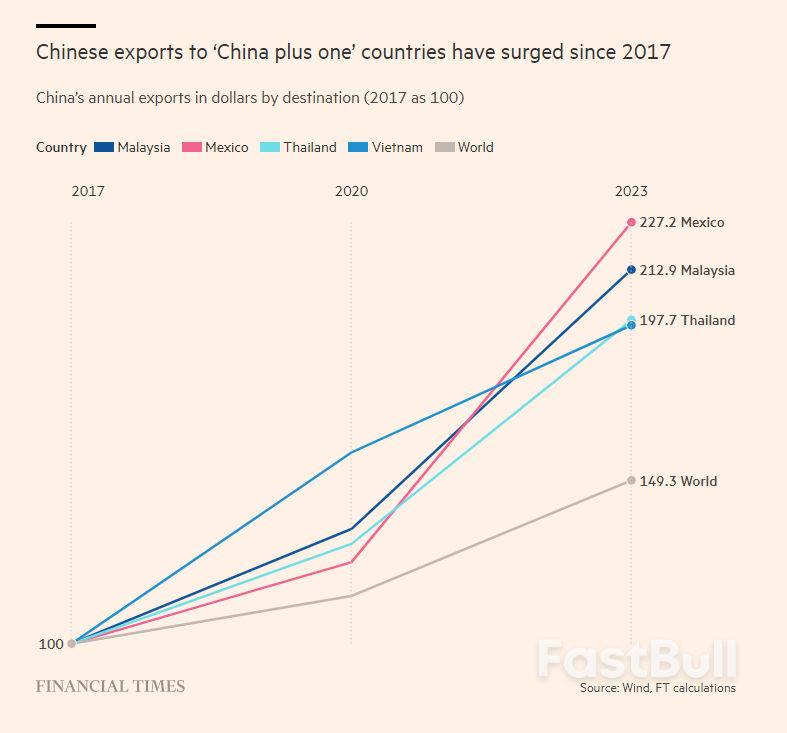
          The total value of Chinese exports to Mexico and Thailand more than doubled to $158.7bn between 2017 and 2023, according to China’s customs data. China’s overall exports grew just 49 per cent to $3.4tn over the same period.Chinese Businesses Target Vietnam And Mexico As Trade Tensions With US Rise_2
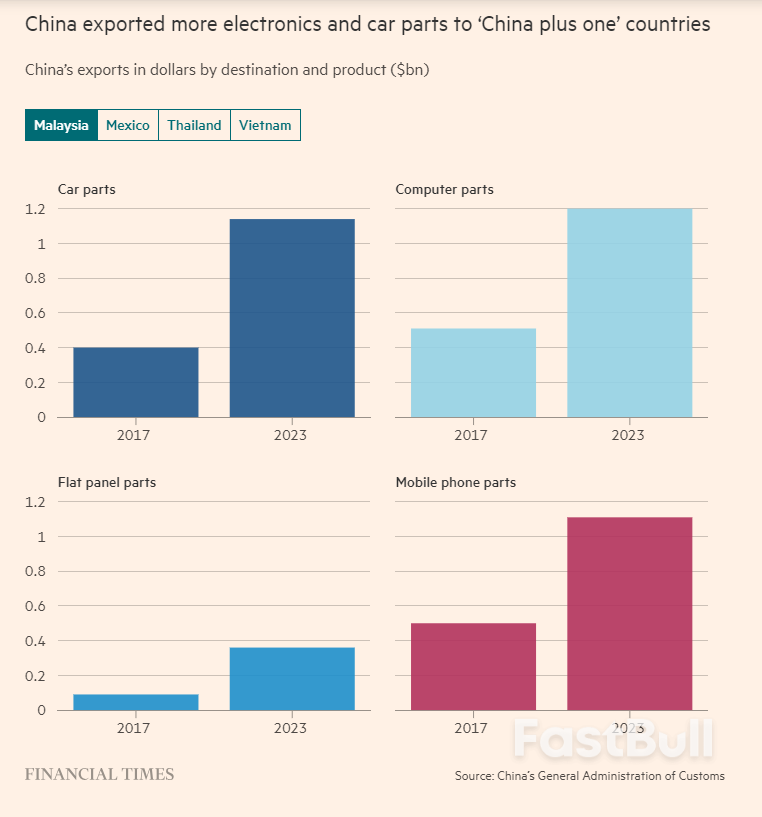
          Chinese exports of computer parts to Vietnam more than tripled to $1.7bn between 2017 and 2023, according to China’s General Administration of Customs.
          However, the Eurasia Group consultancy pointed out in April that Vietnam’s trade surplus with the US had increased substantially not only because of an actual shift in production from China, but also because Chinese companies were simply rerouting products through Vietnam.
          “Direct importing [from China] may be down. But one only has to look at indirect routes through which the US continues to be plugged into Chinese supply chains,” said Davin Chor, an economics professor at New Hampshire’s Dartmouth College.
          Audrey Liang, a sales representative at knife and tool manufacturer Summit Enterprise, said that, having been based in a single factory in Yanjiang, in southern China’s Guangdong province, for 26 years, it is now fitting out a second site in Vietnam. It hopes the Vietnamese site will be operational by the end of next year.
          Chinese Businesses Target Vietnam And Mexico As Trade Tensions With US Rise_3
          Clients had asked Summit Enterprise to consider a site in Vietnam because of “political reasons” and the lower tariffs on Vietnamese goods, despite higher production costs and the lower skill levels of domestic workers, she said. “If the customers didn’t have this requirement, we wouldn’t go to Vietnam,” she added.
          There are still many advantages to operating in China, said Jack Ye, a sales representative at Chinese backpack-maker Xiamen Obaili Manufacturing, noting that Chinese production had the advantage of better delivery times, costs and quality. But the company would consider overseas sites if Donald Trump, who has threatened even greater crackdowns on Chinese trade, was re-elected as US president, he said.

          Source:Financial Times

          To stay updated on all economic events of today, please check out our Economic calendar
          Risk Warnings and Disclaimers
          You understand and acknowledge that there is a high degree of risk involved in trading. Following any strategies or investment methods may lead to potential losses. The content on the site is provided by our contributors and analysts for information purposes only. You are solely responsible for determining whether any trading assets, securities, strategy, or any other product is suitable for investing based on your own investment objectives and financial situation.
          Add to Favorites
          Share

          A BTC Price Breakout "Never Seen Before" - 5 Things to Know in Bitcoin This Week

          Warren Takunda

          Cryptocurrency

          Bitcoin heads into June in fighting form as an early push puts key resistance back in play.
          BTC price momentum is targeting $69,000 as TradFi markets return to the scene — will this week finally see a breakout?
          This is the main question for Bitcoin market participants, and one which has fielded a variety of opinions in recent weeks.
          Rangebound for nearly three months, BTC/USD, they argue, is long overdue upside continuation — but hodlers may need to wait longer still.
          The coming few days could provide the fuel that bulls need to do the job: United States unemployment figures, recently a catalyst for risk-asset volatility, are due at the end of the week.
          Meanwhile, on-chain indicators are lining up to call for a bullish comeback on Bitcoin, while behind the scenes, network fundamentals are inching back toward all-time highs of their own.
          As price and sentiment slowly recoups lost ground, Cointelegraph takes a look at the major issues facing Bitcoin traders as June gets underway.

          $69,000 forms week's "important price"

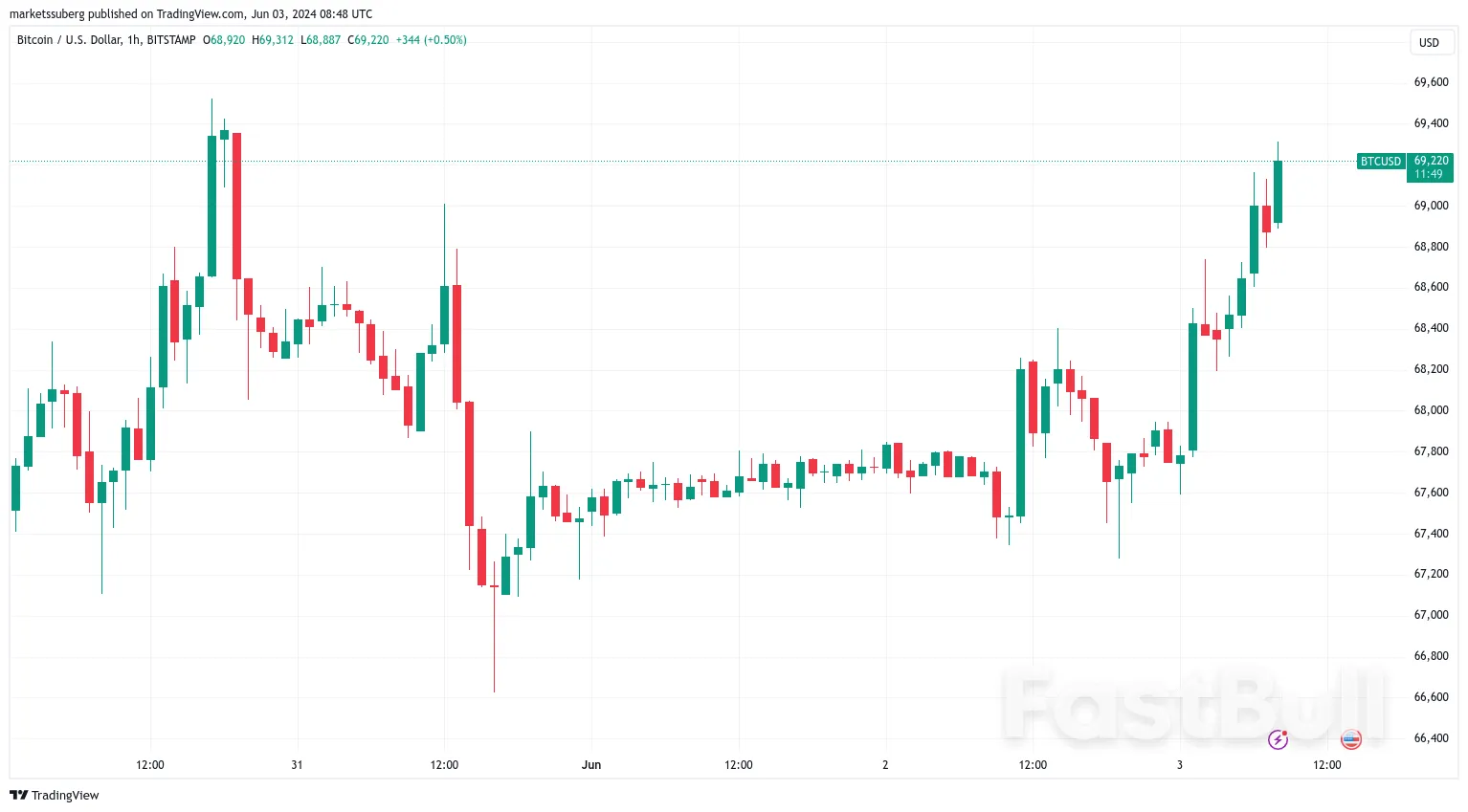
          After some spates of volatility over the weekend, BTC/USD had ultimately come full circle by the weekly close, data from Cointelegraph Markets Pro and TradingView shows.A BTC Price Breakout "Never Seen Before" - 5 Things to Know in Bitcoin This Week _1

          BTC/USD 1-hour chart. Source: TradingView

          No sooner had the June 3 candle begun, however, did Bitcoin bulls set the tone for the Asia trading session — higher.
          Now back above $69,000 at the time of writing, BTC price action continues to pick battles around that area, with traders seeing a clear need to flip it to solid support.
          “TLDR; Market needs to accept & sustain above $69K for continuation higher (new ATHs) so for now we see how things develop into monday,” popular trader Skew wrote in his latest analysis on X (formerly Twitter).
          “Early week dips would be my focus for opportunities if given later (following the criteria of risk on or risk off factors).”
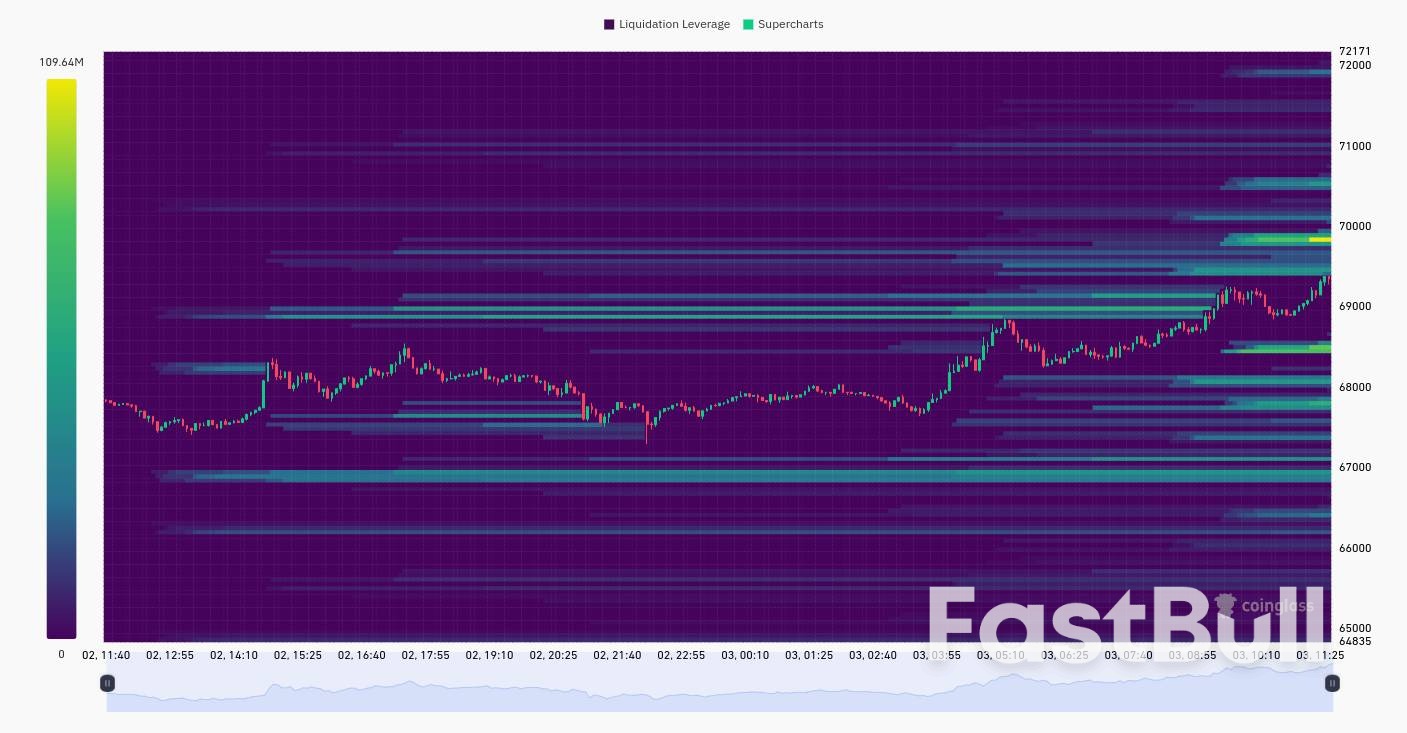
          Describing $69,000 as “likely an important price this week,” Skew noted increasing ask liquidity above $70,000, with the majority of bids still lower down at around $66,000.
          “Current Spot Demand is still around $66K - $65K, with current market bid would like to see some spot bids get moved higher towards $67K,” he summarized.
          Data from monitoring resource CoinGlass showed ongoing attempts to keep price contained in its current range.A BTC Price Breakout "Never Seen Before" - 5 Things to Know in Bitcoin This Week _2

          BTC liquidation heatmap (screenshot). Source: CoinGlass

          Over the weekend, Cointelegraph reported on on-chain metrics repeating key breakout patterns from earlier this year.
          Popular trader and commentator TechDev added to the mood with a chart showing five-day compression at its highest levels in eight years. Prior to that, he had revealed a Bollinger Band breakout against U.S. M1 money supply, which had also been absent since 2017.

          Unemployment data precedes FOMC week

          A relatively quiet start to the week in terms of macroeconomic data does not mean a complete absence of potential volatility for risk assets.
          U.S. initial jobless claims come on June 6, while the day after will see further unemployment numbers.
          As Cointelegraph continues to report, Bitcoin and crypto markets have been particularly sensitive to employment data, which misses expectations this year.
          The implication from surprisingly high unemployment is that tight financial conditions put in place by the Federal Reserve are making themselves felt within the economy. As such, the chances of these being unwound sooner rather than later could increase.
          Clarity should come later this month when the Federal Open Market Committee, or FOMC, meets to discuss interest rate changes.
          “This is the last week of employment data before the June Fed meeting kicks off,” trading resource The Kobeissi Letter noted in part of X commentary on the topic.A BTC Price Breakout "Never Seen Before" - 5 Things to Know in Bitcoin This Week _3

          Fed target rate probabilities comparison (screenshot). Source: CME Group

          The latest data from CME Group’s FedWatch Tool nonetheless preserves the status quo among markets — no significant chance of a rate cut until September or later.
          “Even if the Fed does manage to squeeze in one rate cut this year, the central bank looks forced into holding rates higher for longer,” trading firm Mosaic Asset wrote in the latest edition of its regular newsletter, “The Market Mosaic,” on June 2.
          It added that declining chances of a cut were nonetheless “not necessarily a bad thing for the stock market.”

          BTC price preps breakout from "longest consolidation yet"

          Bitcoin and global liquidity are a match which for bulls was made in heaven — and the latest chart data says it all.
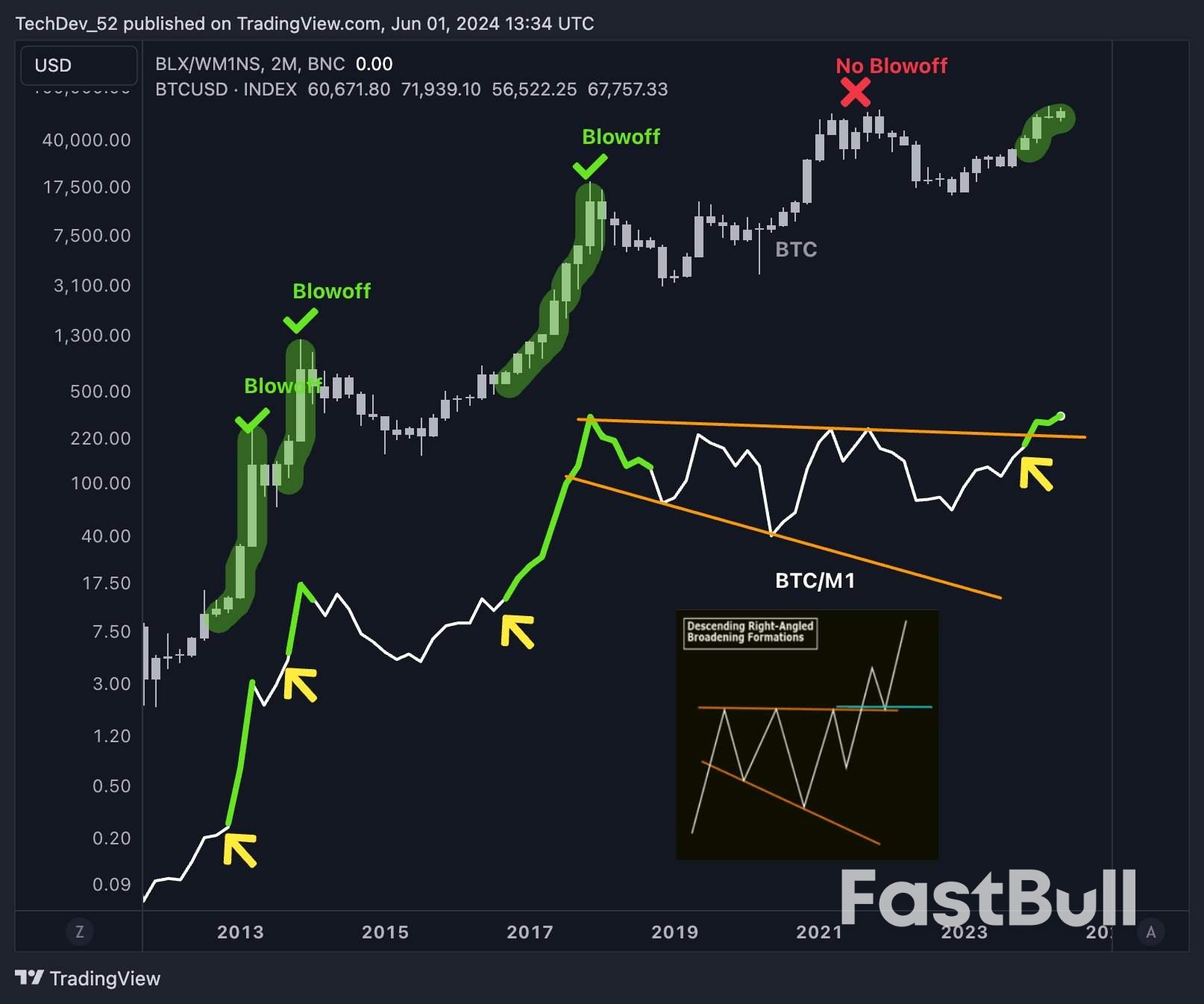
          Currently circulating on social media is an “extremely bullish” comparison between BTC/USD and the U.S. M1 money supply.
          M1 supply refers to the sum of cash, demand deposits and checks in the U.S. economy. Over the years, Bitcoin has exhibited a key dynamic against M1, and as of June 2024 looks to be repeating its biggest-ever breakout against it.
          “Significant,” popular trader and analyst TechDev wrote in commentary while uploading the comparison to X on June 1.
          “Bitcoin has only seen blow-off tops after breakouts against M1 money supply. And the longer it's consolidated, the longer it's run. This breakout follows the longest consolidation yet.”

          A BTC Price Breakout "Never Seen Before" - 5 Things to Know in Bitcoin This Week _4BTC/USD vs. U.S. M1 money supply chart. Source: TechDev/X
          The chart shows that the breakout phase in fact began last year, but by historical standards, it is yet to make its presence felt.
          The status quo has in fact stayed in place for a record seven years — with the implication that the fledgling breakout should be uniquely volatile to match.
          “In fact, it represents a textbook breakout of a 5 year broadening wedge,” TechDev continued.
          “The last 5 years have been corrective against M1. $BTC is once again impulsive against it for the first time since 2017. We've never seen a Bitcoin breakout like this one.”
          The phenomenon was not lost on the trading community, being noticed by figures including veteran trader Peter Brandt.
          “We never had the blowoff top in 2021 and it just all has been consolidation against M1 money supply so we're in for mega moon,” popular commentator WhalePanda continued in part of his own response.
          During the 2017 breakout, BTC/USD enjoyed parabolic upside for the following nine months.

          Difficulty bounces as miners decrease BTC exposure

          Bitcoin network fundamentals are slowly bouncing back after a rapid cooling during early May’s downward price action.
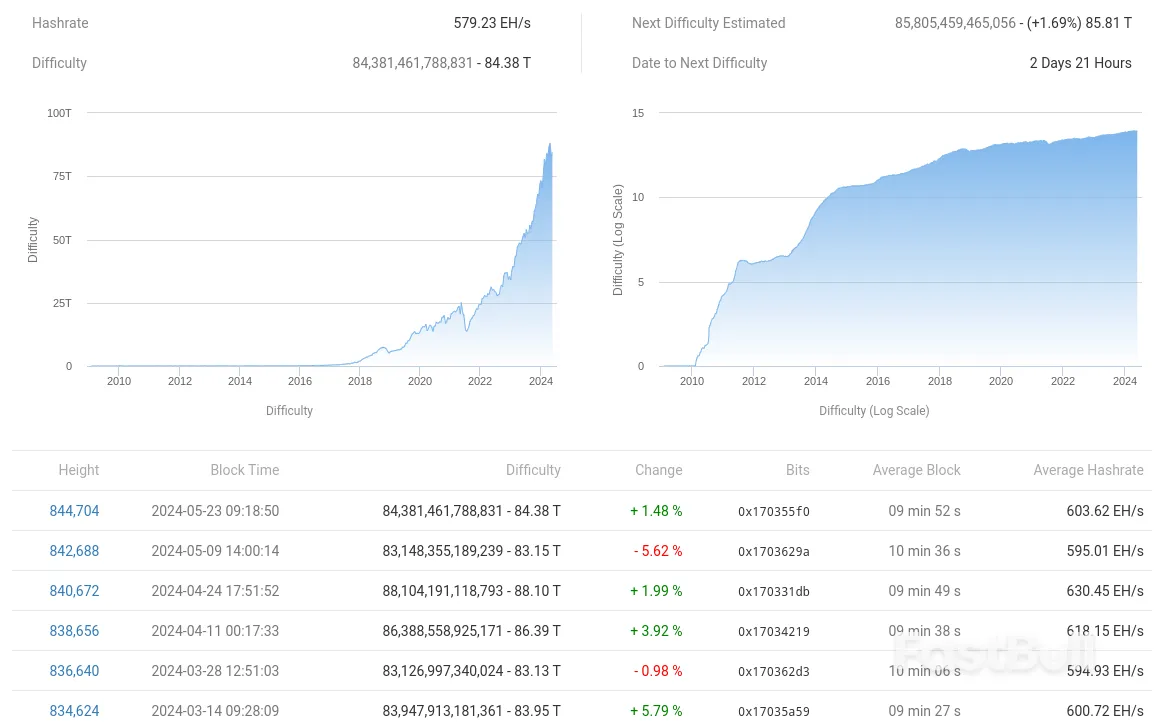
          The latest data from monitoring resource BTC.com predicts a roughly 1.7% difficulty increase on June 6.
          This will build on a 1.5% jump from two weeks ago, helping mitigate the 5.6% drop, which came before that which cost difficulty its all-time high position.A BTC Price Breakout "Never Seen Before" - 5 Things to Know in Bitcoin This Week _5

          Bitcoin network fundamentals overview (screenshot). Source: BTC.com

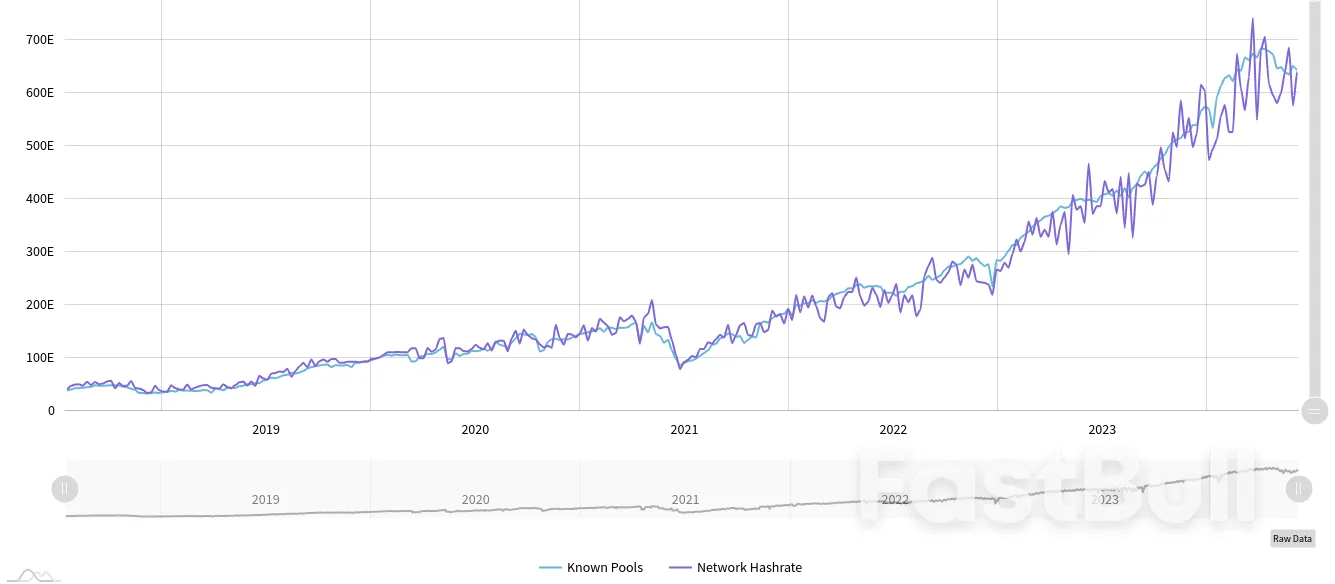
          Hash rate, the aggregate processing power dedicated to the network by miners, continues to consolidate after hitting record highs in April, per raw data from MiningPoolStats.A BTC Price Breakout "Never Seen Before" - 5 Things to Know in Bitcoin This Week _6

          Bitcoin hash rate raw data (screenshot). Source: MiningPoolStats

          According to on-chain analytics firm Glassnode, however, miners themselves face challenging conditions.
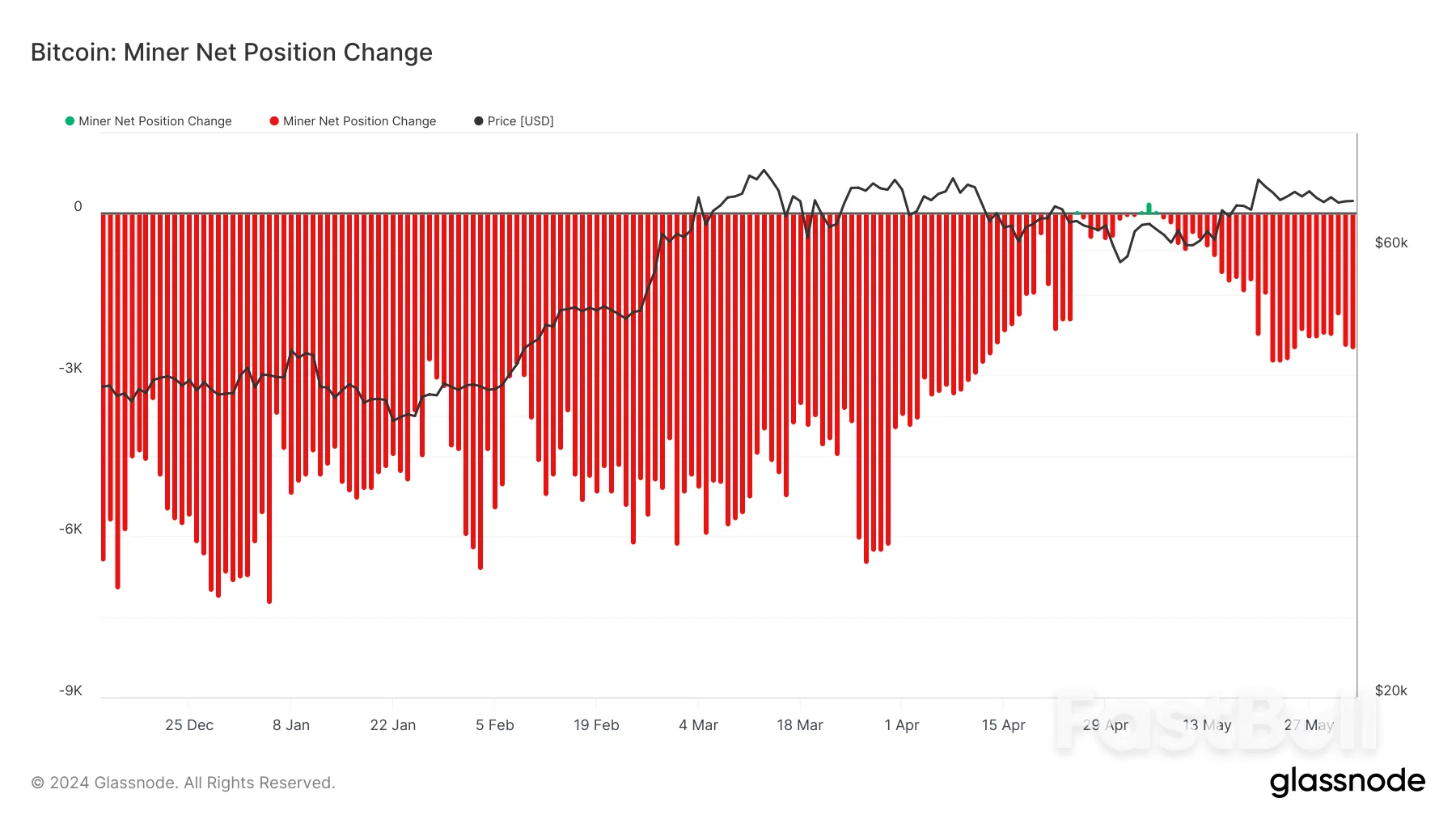
          More than one month after April’s block subsidy halving, miners’ net BTC holdings are declining on a rolling 30-day basis — a trend which is accelerating.
          As on June 2, the latest date for which data is available, miner balances were 2,500 BTC lower than they were 30 days prior.
          Compared to the run-up to the halving, the balance reduction is not as steep. Beginning in November 2023, miners began selling BTC in moves which became the norm throughout Q1, Glassnode shows.A BTC Price Breakout "Never Seen Before" - 5 Things to Know in Bitcoin This Week _7

          Miner rolling 30-day BTC net position change. Source: Glassnode

          Kraken sees giant 48,000 BTC withdrawal

          Amid a general trend of declining BTC balances across crypto exchanges, one in particular stood out this weekend.
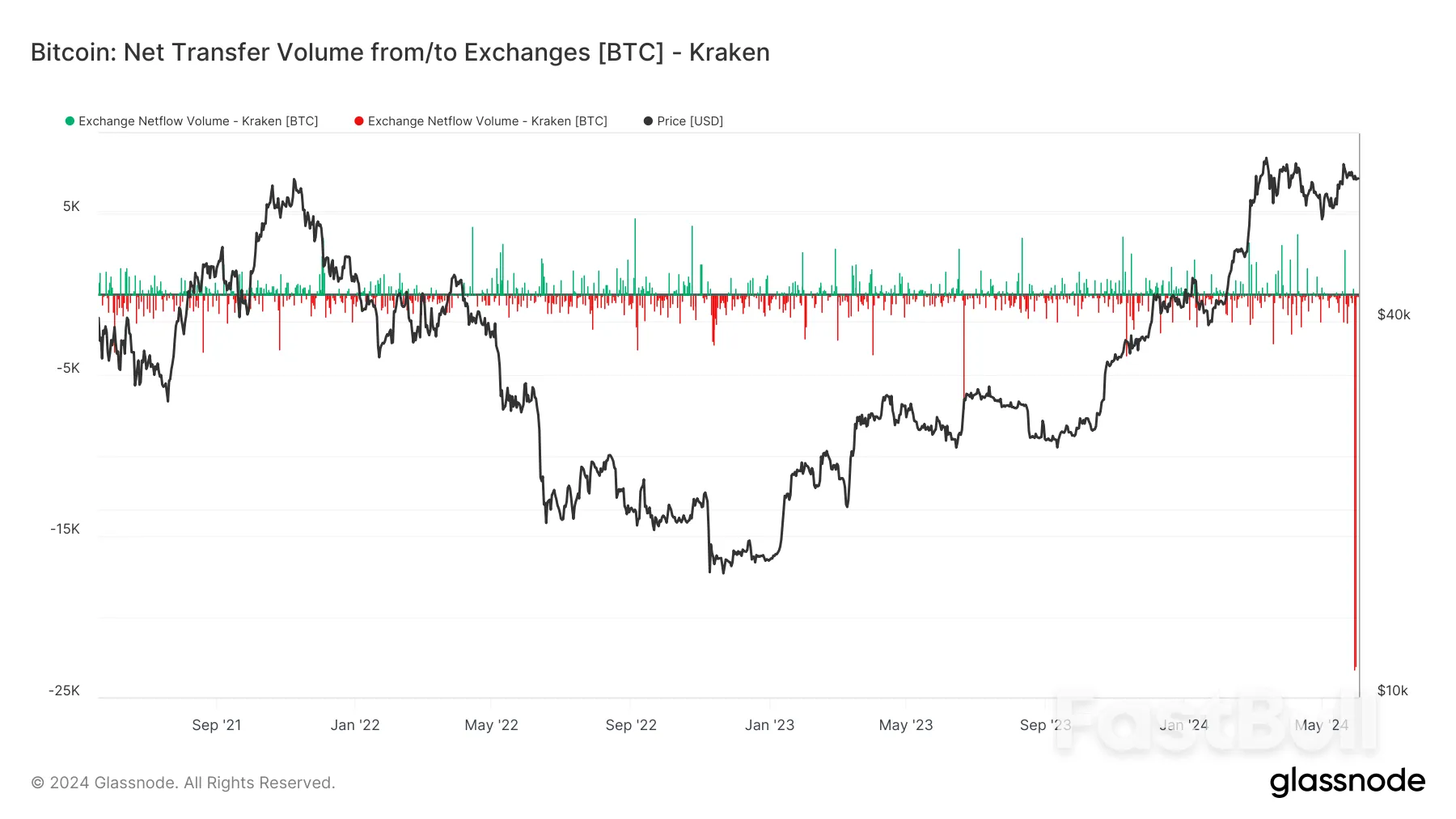
          Glassnode confirms that on May 30 and May 31, withdrawals at the popular trading platform totaled nearly 50,000 BTC ($3.44 billion).
          The May 30 figure alone marks the second-largest daily withdrawal from any exchange in BTC terms since the end of the 2022 Bitcoin bear market. For Kraken, it was one of the largest on record.A BTC Price Breakout "Never Seen Before" - 5 Things to Know in Bitcoin This Week _8

          Bitcoin net transfer volume from Kraken. Source: Glassnode

          The moves were not lost on market observers, with Vivek Vivek Sen, founder of Bitcoin public relations firm Bitgrow Lab, describing them as “wild.”
          “Supply shock incoming, ATH is imminent,” he wrote in part of a further X post after the second day’s outflows hit.
          Kashif Raza, founder of Bitcoin education platform Bitinning, noted coins leaving Kraken to external wallets in several transactions.
          As Cointelegraph reported, exchanges have been seeing solid demand for BTC for years, with aggregate balances now at levels not seen since 2017.

          Source: Cointelegraph

          Risk Warnings and Disclaimers
          You understand and acknowledge that there is a high degree of risk involved in trading. Following any strategies or investment methods may lead to potential losses. The content on the site is provided by our contributors and analysts for information purposes only. You are solely responsible for determining whether any trading assets, securities, strategy, or any other product is suitable for investing based on your own investment objectives and financial situation.
          Add to Favorites
          Share

          China/Hong Kong Market Pulse: Symbolism at Play Approaching the Third Plenary Session

          SAXO

          Economic

          A Notable Symbolism in Xi's Consultative Meeting on May 23

          As China's leadership prepares for the long-awaited Third Plenary Session of the 20th Central Committee, announced on April 30 to be held in July, a consultative meeting on May 23 with private entrepreneurs and economists, chaired by General Secretary Xi Jinping, has stirred speculation that the top leadership might be preparing the country for a shift towards more pro-market reforms.
          In recent years, communications from the Chinese leadership have predominantly emphasized the state sector and industrial policies. These industrial policies are state actions meant to allocate resources in support of selected industries to achieve goals determined by political processes with significant political stakes. While the focus on industrial policies will continue to be the core pillar of China's development strategies, the inclusion of economics professor Zhou Qiren as one of the nine selected speakers at the consultative meeting suggests that the top leadership might make use of his market-oriented views and the symbol he carries to send a signal.
          Zhou contends that the drastic fall in transaction costs, organization costs, and most importantly system costs was the primary driver of China's astonishing growth rate in the three decades since its reform and opening started in 1978. He claims that system-wide institutional reforms are crucial for the Chinese economy to regain cost advantages and achieve breakthroughs, rather than relying on aggregate demand stimulus and industrial policies.
          While we caution against putting too much weight on Zhou himself or academia in general regarding the Chinese leadership's deliberation on economic development models, the signalling implication is hard to ignore. Zhou has been absent from the spotlight for quite some time and is well known for his alternative views on the driving forces of the Chinese economy.
          His new institutional economics roots, which were first popularized by Ronald Coase, emphasize the central roles of institutional arrangements in the economy, property rights, transaction costs, and political economy in economic development. This approach is markedly different from the New Keynesian approach that dominates the mainstream economic profession or the Marxist political economy that the Chinese Communist Party (CCP) maintains as the overarching guiding principle in economic thought.
          Furthermore, Xi rarely chairs consultative sessions with private entrepreneurs himself. Over the past decade, besides this recent one, the previous consultative session with the private sector chaired by Xi was in July 2020 during the COVID-19 pandemic, and the one before that was in November 2018 when China and the US were embroiled in a trade war. This time, Xi held the meeting right before the Third Plenary Session, which will formulate the long-term strategic direction and development model of China. The selection of Zhou as a speaker at this meeting carries significant symbolism and could serve to send out signals. What Zhou said at the meeting is not as important as what Zhou is perceived to represent.

          What Professor Zhou Represents

          According to Zhou, China's economic miracle is not a result of low-cost labour but a consequence of system-wide institutional reform and the opening up of the economy that lowered the ‘system costs' of China's economy. Zhou (2017) defines ‘system costs' as the costs incurred in the operation of the institutional framework of enforcing property rights and contracts. The essence of China's reform is to “redefine property rights by decentralizing the power of the super state-firm” (Zhou, 2010). The narrative that China's economic success is solely due to cheap labour is overly simplistic.
          Before the economic reforms, China's labour was even cheaper, but the country did not experience the same economic boom. Today, many countries around the world also offer cheaper labour, yet they do not replicate China's success. This discrepancy underscores that low labour costs alone are insufficient for economic transformation.
          As Zhou(2023) points out, the critical factor is the transformation of these inputs into more products that are competitive. This requires effective organization and functioning within a supportive institutional framework to lower transaction costs, organization costs, and most importantly system costs. Before reforms, China's highly centralized economic system, akin to a "super state-firm," was plagued by inefficiencies and high organizational costs. By decentralizing economic control and redefining property rights, China significantly lowered these costs, thereby enhancing its competitiveness.
          China's initial reforms, such as the shift from collective farming to a household farm production contractual responsibility system, followed by allowing the establishment of private enterprises to absorb the labour freed from farm activities, exemplify the impact of institutional change. These reforms not only increased agricultural productivity but also released labour for the growing industrial sector, creating a foundation for China's manufacturing boom. Moreover, China's opening to and engagement with global markets, highlighted by its economic and regulatory reforms which earned its accession to the WTO, illustrate the importance of institutional support in leveraging low-cost labour.
          The problem China is now facing, according to Zhou (2023), is that system costs in China have been rising fast due to dramatic increases in costs incurred by higher taxes and charges, local governments pushing up land prices, and more regulations, as well as inconsistencies in dealing with new technologies in the private sector and the inefficiency of state-driven urbanization. These changes have stifled economic progress. His prescription for the Chinese economy is to lower system costs through reform and opening the economy and to innovate. Reducing system costs through streamlined regulations, greater transparency, and better definition and enforcement of property rights is essential for fostering growth and innovation.

          Echoes of the Potentially Transformative 2013 Decision that Peters Out

          In our article published in October 2023, we asked if the upcoming Third Plenary Session could mark a pivotal moment for China's economic strategy, potentially embracing pro-market reforms and emphasizing the market's "decisive role" in allocating resources, as outlined in a blueprint unveiled by the Chinese leadership 10 years ago. The “Decision of the Central Committee of the Communist Party of China on Some Major Issues Concerning Comprehensively Deepening the Reform,” adopted at the Third Plenary Session of the 18th Central Committee held in November 2013, pledged to deepen marketization and privatization.
          However, these initiatives have petered out over the years. The May 23 meeting, as discussed above, gives a glimmer of anticipation that the upcoming Third Plenary Session this July might echo the 2013 Decision, contrary to the downbeat expectations of investors regarding its outcome.

          Concluding Remarks

          Once again, we want to emphasize that the Chinese top leaders' adherence to focusing on fostering new productive forces, a concept rooted in the Marxist political economy, and their commitment to state-driven industrial policies to boost self-reliance and comprehensive national security, along with their strategic initiatives in deleveraging the economy and containing the monopoly power of large private enterprises, will remain.
          What we are exploring is the plausibility that the top leadership is sending signals that they are preparing to fine-tune their strategic development model, at least tactically, to foster the market and the private sector. It is important to remember that the Chinese leadership has demonstrated remarkable pragmatism over the past few decades in steering the gigantic Chinese economy. A tactical change to green in the “traffic light” that regulates the reform of the institutional frameworks in which the economy functions is plausible.
          We are not predicting what will happen at the Third Plenary Session in July because Zhou spoke at Xi's consultative meeting on May 23. We are simply exploring what might have happened that made Zhou's high-profile appearance at the meeting possible. We hope that thinking through this non-consensus observation as one of the possibilities of what has been going on will better prepare investors to interpret the outcome of the Third Plenary Session when it arrives in July.
          To stay updated on all economic events of today, please check out our Economic calendar
          Risk Warnings and Disclaimers
          You understand and acknowledge that there is a high degree of risk involved in trading. Following any strategies or investment methods may lead to potential losses. The content on the site is provided by our contributors and analysts for information purposes only. You are solely responsible for determining whether any trading assets, securities, strategy, or any other product is suitable for investing based on your own investment objectives and financial situation.
          Add to Favorites
          Share

          Extreme Weather and Red Sea Crisis Trigger Commodities Rally

          Alex

          Economic

          Commodity

          After three years of extreme volatility, many experts predicted that commodities prices would broadly stabilize in 2024. However, adverse weather conditions, escalating geopolitical tensions and soaring shipping costs are turning those predictions on their heads. According to data gathered by the the United States’ National Oceanic and Atmospheric Association (NOAA), the European Union’s Copernicus Climate Change Service (CCCS), the United Nations World Meteorological Organization (WMO), last year not only broke 2016’s heat record but shattered it by a wide margin. 2023 was 1.48°C warmer than the pre-industrial period, with global average temperatures at least 1°C warmer than pre-industrial averages on every single day. Well, 2024 could be even hotter, with the National Centres for Environment Information (NCEI) predicting a 22 percent chance that the current year will be the warmest year on record and a 99 percent probability that it will rank in the top five warmest years. NCEI data reveals that the first four months of the current year were the warmest in 175 years.
          Wild weather driven by climate change is elevating the cost of energy, food and fuel; increasing the frequency of natural disasters and raising insurance costs. According to Munich Re, last year, extreme weather and earthquakes inflicted global losses of $250 billion, a new norm for insurers. These wild weather patterns--coupled with geopolitical tensions--have changed the outlook for certain commodities. Gary Cunningham, director of market research at Tradition Energy, has predicted that U.S. natural gas futures could soar to $4 per million British thermal units later this year if the ongoing hot weather persists and increases cooling demand. That would mark a large 60% jump from the current Henry Hub price of $2.50/MMbtu. The same case applies to Europe. European natural gas prices held around €35 per megawatt-hour in the last week of May, close to a 5-month high amid expectations of lower supply and robust cooling demand. New weather forecasts anticipate hotter temperatures in Northern Europe at the beginning of June; aggressive heat waves in Europe later in the summer and excessive heat in France and Spain.
          “This summer will almost certainly bring a rash of debilitating heat waves, particularly in the US midsection and Europe,” said Jennifer Francis, a senior scientist at the Woodwell Climate Research Center, has predicted.
          Meanwhile, soaring temperatures in Asia have intensified bidding competition for LNG in major hubs, underscored by the 16.7% annual increase in imports from Japan in April. Europe now competes with Asia for LNG cargoes from exporters like the US, Qatar and Nigeria.
          However, ample reserves in European storages and added capacity in Norwegian gas fields are helping temper shortage risks.
          Hot weather and dry conditions have triggered shortages of several agricultural commodities resulting in price spikes. Wheat futures have hit the highest since July, reversing bearish bets by hedge funds they held for almost two years. In North America, much of Kansas is still suffering from extreme drought, though harvests are expected to improve from last year when drought was so bad many fields didn’t make it to harvest. Still, with hot conditions prevailing more than a month before the harvest season kicks in, experts are warning that those rosier forecasts might not be realized.
          “It better start raining pretty quick to get these numbers,” said Dave Green, executive vice president of the Wheat Quality Council and leader of the crop tour.
          Meanwhile, Citigroup analysts have predicted that extreme weather could see prices of Arabica coffee jump about 30% to hit $2.60 a pound over the next few months if adverse weather and production issues prevail in Brazil and Vietnam.

          Shipping Bull Market

          Shipping stocks have so far been the biggest winners in the energy sector. From tankers to dry bulk to containers to LPG, shipping equities are constantly taking out fresh highs. Indeed, with the exception of the pandemic, 2024 is on track to be the best year for shipping equities since the shipping supercycle in 2004-2008.
          With shipping rates soaring, leading commodity shipping stocks are firmly in the green this year, and show no signs of slowing down.

          Source: Drewry

          To stay updated on all economic events of today, please check out our Economic calendar
          Risk Warnings and Disclaimers
          You understand and acknowledge that there is a high degree of risk involved in trading. Following any strategies or investment methods may lead to potential losses. The content on the site is provided by our contributors and analysts for information purposes only. You are solely responsible for determining whether any trading assets, securities, strategy, or any other product is suitable for investing based on your own investment objectives and financial situation.
          Add to Favorites
          Share

          Pound to New Zealand Dollar Week Ahead Forecast: Threatening Another Breakdown

          Warren Takunda

          Economic

          Forex

          GBP/NZD dropped 2.25% in April, the biggest monthly drop since September 2023. This is a signal that the tide has turned in favour of the Kiwi recently.
          The New Zealand Dollar has been buoyed by expectations that the antipodean central banks will be amongst the last of the major central banks to cut interest rates, bestowing a degree of support via the interest rate channel.
          A broader recovery by the Pound following April's above-consensus inflation print and the calling of a general election stabilised GBP/NZD. However, it's important to note the potential risks of further downside in the near term, urging our audience to exercise caution.
          At the time of writing on Monday, we're back below the 200-day moving average, and we will be watching to see whether the exchange rate closes below here today and in the coming days. The RSI is at 39 and pointed lower, confirming the downside is favoured in the next few days.
          If the pair registers a string of closes below the 200 DMA, we will take that as confirmation of a decisive flip in fortunes from the upside to the downside of GBP/NZD. A break below horizontal support at 2.0677 is being threatened as part of this mix; moves below here would take the market back to the February lows at 2.04 in the next two to four weeks.
          Pound to New Zealand Dollar Week Ahead Forecast: Threatening Another Breakdown_1

          Above: GBP/NZD at daily intervals.

          A breakdown of this support then opens the door to the late-2023 lows at 2.01.
          There are no significant calendar events due from New Zealand or the UK this week, leaving the focus squarely on the global setup.
          We will be watching Thursday's European Central Bank (ECB) policy decision where interest rates are to be cut by 25 basis points. But, we see risks of policymakers warning it is too soon to speculate about further rate cuts owing to recent signs Eurozone inflation is proving resilient.
          This would add to the sense that global interest rates won't be falling quickly, which will act as a headwind to stock markets and risk-sensitive currencies like the NZD.
          In the same vein, Friday's U.S. labour report will be instrumental in determining when the U.S. Federal Reserve cuts interest rates.
          The market is looking for a headline non-farm payroll reading of 180K and an unemployment rate of 3.9%. Average hourly earnings are expected to have risen 3.9% year-on-year.
          If the data comes in at softer-than-expected levels, the New Zealand Dollar would potentially be a leading beneficiary.
          This is because a soft print would suggest to the market that U.S. interest rates will be cut sooner than previously expected, which can boost global investor sentiment and stock markets.
          NZD is a 'high beta' currency, meaning it tends to benefit when stock markets are rising and investors are confident. Under such a scenario, a breakdown in GBP/NZD and a resumption of the April selloff might ensue.
          "If U.S. labour market data are on the soft side, markets may upgrade the likelihood of a first rate cut in July, which would weaken the USD even more," says Dominic Schnider, a strategist with UBS' Chief Investment Office.
          An above-consensus job report would have the opposite effect, as markets would be resigned to a belief the Fed will struggle to get away with a rate cut before year-end.
          Indeed, the risks would grow that the Fed will not cut rates until 2025, potentially meaning the Fed cuts after the RBNZ and diminishes any yield advantage the Kiwi Dollar has recently garnered.
          Falling stocks and souring investor sentiment can lead to notable NZD underperformance and a potential break by GBP/NZD back towards 2.09 and into a more constructive technical setup.

          Source: Poundsterlinglive

          To stay updated on all economic events of today, please check out our Economic calendar
          Risk Warnings and Disclaimers
          You understand and acknowledge that there is a high degree of risk involved in trading. Following any strategies or investment methods may lead to potential losses. The content on the site is provided by our contributors and analysts for information purposes only. You are solely responsible for determining whether any trading assets, securities, strategy, or any other product is suitable for investing based on your own investment objectives and financial situation.
          Add to Favorites
          Share

          We're About to Get Central Bank Rate Cuts Soon

          Thomas

          Central Bank

          Economic

          The European Central Bank could open the door to a weaker euro on Thursday as its first interest-rate cut of the cycle puts the region on a divergent policy path from the US.
          With a quarter-point reduction all but certain, officials will finally embrace a widening in the difference between borrowing costs on either side of the Atlantic, the implications of which they've discussed for months.
          ECB policymakers led by President Christine Lagarde have insisted they're comfortable plowing a separate furrow from the Federal Reserve, even if that risks a weaker currency that could stoke inflation.
          How tolerant officials will be is likely to loom large in their debate on further possible easing — even more so after recent reports hinted at lingering consumer-price pressures. Most recently, data on Friday featured an underlying inflation gauge that unexpectedly rose in May for the first time in a year.
          The ECB can already see how diverging policy prospects have begun to impact global markets. The euro has fallen to its weakest level against the pound in almost two years on the view that the Bank of England will lag the ECB in lowering rates.
          What Bloomberg Economics Says: “Bloomberg Economics forecasts a cut of 25 bps in June, and, after a pause in July, more reductions of the same size in September, October and December.”
          Bank of Italy Governor Fabio Panetta acknowledged on Friday that cutting borrowing costs poses a currency risk to prices, but added that tight US policy could also hurt global demand and thereby curb euro-area inflation.
          His Austrian colleague Robert Holzmann recently sounded more ominous, acknowledging that “the Fed with the dollar is, figuratively speaking, the gorilla in the room” for officials.
          Thursday's decision will include quarterly forecasts that will be scrutinized for hints of future policy intentions, as will Lagarde's press conference. Money markets for now are betting on two reductions in total this year, with a small chance of a third.
          Denmark's central bank is likely to match the ECB move with a quarter-point cut of its own just hours after the euro zone outcome.
          Elsewhere, US payrolls and a suspenseful Canadian decision on a possible rate cut will be among highlights in the coming week.

          US and Canada

          In the wake of fresh US inflation and spending data, the government's jobs report on Friday is expected to show show steady employment growth again in May. The median forecast in a Bloomberg survey calls for a 190,000 increase, a modest acceleration from the prior month.
          That would produce a cooling in average job growth over the most recent three months, adding to evidence that labor demand is softening. The unemployment rate, based on a separate survey of households, is projected to hold at 3.9%.
          Average hourly earnings are seen rising 3.9% from May of 2023, matching the prior month's annual gain. While earnings growth is holding at a three-year low, worker pay gains remain stronger than before the pandemic.
          The Labor Department will also issue March job openings data on Tuesday, and economists project nearly 8.4 million vacancies — slightly lower than the prior month. Openings continue to ease as employers have greater success filling positions as the job market becomes more balanced.
          In addition to government data, the Institute for Supply Management will release results of its May surveys of manufacturers and services providers on Monday and Wednesday, respectively.
          Looking north, the Bank of Canada is in a position to soon begin an easing cycle. The country has seen four disinflationary reports in a row, and a report on Friday showed slower-than-expected economic growth as well.
          Economists and traders broadly expect the central bank to deliver a 25-basis point cut to its key policy rate on Wednesday. Still, there remains some uncertainty about how a cautious Governor Tiff Macklem and his policymakers will respond.
          Given that household consumption remains strong and job gains blew past expectations last month, they may wait for more data and kick off an easing cycle at the July 24 meeting instead.

          Asia

          Asia gets a slew of purchasing manager indexes on Monday.
          China's Caixin manufacturing PMI is likely to show activity at small- and medium-sized enterprises continuing to hum along, with the gauge forecast to inch higher in May to mark a seventh month above the 50 boom-or-bust threshold. The services reading is also seen edging higher.
          Indonesia, South Korea, the Philippines, and Vietnam get PMIs the same day.
          Figures on Wednesday are expected to show Australia's economy grew a tad in the first quarter versus the previous period, in what would be the 10th straight expansion.
          Exports and inventories data a day earlier will give economists reference material to fine-tune their gross domestic product estimates.
          In Japan, corporate profits and capital spending numbers will provide a steer on how first-quarter GDP may be revised.
          Headline inflation may have slowed a bit in Indonesia in May. Statistics on consumer-price growth are also due from South Korea, Thailand, Chinese Taiwan region and the Philippines.
          Real wages in Japan probably fell for a 25th month in Japan, a possible topic when Bank of Japan policy board member Toyoaki Nakamura speaks on Thursday.
          Elsewhere in central banks, the Reserve Bank of India is expected to hold its benchmark repurchase rate steady at 6.5% for an eighth straight meeting when the policy committee meets on Friday, as hotter-than-usual weather pushes back expectations for a pivot to rate cuts.
          The week ends with China's May exports.

          Europe, Middle East, Africa

          While the ECB will take center stage, a slew of industrial numbers will also be released throughout the week.
          Italian and Spanish factory PMIs for May are released on Monday, while production numbers for April will be published in France, Spain and Germany, respectively, starting on Wednesday — offering clues on the health of the economy at the start of the second quarter. German factory orders and trade statistics are also due.
          On Friday, a gauge of wages — a key indicator studied by officials trying to gauge risks to inflation — will be released by the ECB.
          BOE policymakers will stick to a self-imposed quiet period with the election campaign under way before the UK's July 4 general election. Whichever political party wins that ballot, a massive debt hangover is in store, severely limiting what the poll-leading Labour Party or governing Conservatives can do in office.
          Turning south, Turkish officials hope that May inflation data on Monday will mark the peak, and that price growth will rapidly decelerate thereafter thanks to aggressive monetary tightening. Analysts surveyed by Bloomberg anticipate an outcome of almost 75% in May, up from 69.8% a month earlier.

          Latin America

          Mexico posts full-month and bi-weekly inflation reports, both currently running a bit above central bank forecasts. While a quarter-point interest-rate cut at Banxico's next meeting on June 27 remains the consensus, it's not a given.
          Chile's economy accelerated sharply in the first quarter and analysts expect April GDP-proxy data out this week to show that the second quarter got off to a strong start as well.
          On the other hand, consumer prices are expected to drift higher in the near term, and the May print posted this week likely inched up from April's 4% reading to just above the tolerance range.
          Brazil watchers will pay close attention to the central bank's weekly Focus market readout, which over the last month has seen inflation expectations for 2024 to 2026 creep progressively higher above the 3% target.
          Central bank chief Roberto Campos Neto noted in May that inflation expectations have been rising steeply.
          On a more positive note, first-quarter output data for Brazil are all but certain to show Latin America's biggest economy rebounding after stalling out in the second half of 2023.

          Source: Fortune

          To stay updated on all economic events of today, please check out our Economic calendar
          Risk Warnings and Disclaimers
          You understand and acknowledge that there is a high degree of risk involved in trading. Following any strategies or investment methods may lead to potential losses. The content on the site is provided by our contributors and analysts for information purposes only. You are solely responsible for determining whether any trading assets, securities, strategy, or any other product is suitable for investing based on your own investment objectives and financial situation.
          Add to Favorites
          Share

          ECB Rate Cut Will Be Rare Bright Spot in Troubled Euro Region

          Samantha Luan

          Central Bank

          Economic

          For the first time in two decades policymakers get to start a monetary-easing cycle without having their hand forced by a financial emergency. Instead, investors are signaling confidence about the euro area and keeping yields in check. European Central Bank.
          For the first time in two decades policymakers get to start a monetary-easing cycle without having their hand forced by a financial emergency. Instead, investors are signaling confidence about the euro area and keeping yields in check.
          But despite the calm on the surface, the economy is starting to see the consequences of problems that have been decades in the making. Increasingly eclipsed by the dynamism of the US and the rise of China, the euro zone is languishing with anemic growth, weak productivity, poor demographics, and bloated public finances in key countries.
          Benign markets and a recovering economy offer Brussels and national capitals rare breathing space to try to address those challenges. If politicians — navigating European elections this week — don’t take advantage to deliver growth-enhancing reforms and public-finance repair soon, the region risks sliding ever further into irrelevance.
          “Without a major jolt, the European Union will become a much-diminished global power, leaving the US battling it out with China for economic supremacy,” said Jamie Rush, chief European economist for Bloomberg Economics.
          ECB Rate Cut Will Be Rare Bright Spot in Troubled Euro Region_1
          The sense of a turning point for the euro region right now is palpable. The ECB rate cut comes as worst bout of inflation in the currency’s history seems largely over and a shallow recession just ended with an unexpected growth surge.
          The spread between Italy’s bonds and German equivalents, a key measure of risk, narrowed earlier in 2024 to a two-year low. While yields have risen somewhat as investors assess just how much the ECB can cut given a more resilient than expected economy, there’s no sign of the fragmentation fears that stalked the market before the first hike in 2022.
          “‘Europe’s a basket case’ — it’s all you ever used to hear” from investors outside the region, said Roger Hallam, global head of rates at Vanguard Asset Management. “You don’t hear that now.”
          ECB Rate Cut Will Be Rare Bright Spot in Troubled Euro Region_2
          Supporting that view is a more cohesive policy backdrop at regional level, encompassing the European Union’s previously unthinkable pandemic-era recovery program — NextGenEU — that even involved the pooling of debt, and new crisis-fighting tools unveiled by the ECB to deliver stimulus and to keep bond markets in check.
          Evidence of the region’s resilience emerged last year when investor panic brought down banks in the US and Switzerland. There were no such casualties in the euro zone, which will mark a decade of a unified supervision regime later this year.
          And yet the region’s long-term problems look more ominous than ever.
          “While Europe is doing better now, deep structural challenges — aging, climate change, and global fragmentation — await,” Alfred Kammer, a senior official at the International Monetary Fund, warned in May.
          Weak productivity — and with it, poor potential growth — is one such problem. The EU as a whole has done consistently worse than the US on that since the current century dawned. Slower improvements in living standards and a “decline in global economic power” are the outcome, the European Centre for International Political Economy said in a study in May.
          The gap between the European and US economies since 2000 reached about 18% of potential GDP in 2023 — equivalent to more than €3 trillion ($3.3 trillion), according to Bloomberg Economics, which reckons the shortfall will reach almost 40% by 2050.
          “It is on us as Europeans to do more,” German Finance Minister Christian Lindner told reporters in Italy last month at a meeting with peers that focused on the disparity between the US and Europe.
          Another major problem is an aging population — adding to low potential growth and debt sustainability concerns, not least since pensions across the region are largely publicly funded out of current tax revenues.
          “The birth rate is much worse than expected,” said Oliver Rakau, an economist at Oxford Economics. “This is not a problem in two, three or five years, but it is a big problem in the longer-run.”
          Most pressing is the deterioration of public finances in countries already struggling to impose fiscal restraint. Italy will have Europe’s biggest pile of borrowings in just three years, according to Scope Ratings.
          IMF forecasts now show debt as a percentage of gross domestic product creeping up there and in France and Belgium — with deficits well above the 3% ceiling that the EU seeks to enforce.ECB Rate Cut Will Be Rare Bright Spot in Troubled Euro Region_3
          While bond markets show investors to be unperturbed, the region’s previous sovereign turmoil offers salutary lessons in how quickly sentiment can shift.
          “The risks are rising,” said Moritz Kraemer, chief economist at LBBW and a former senior ratings analyst at S&P Global Ratings. “I think there’s not enough anxiety in the market.”
          For all the effort that governments might make to bring debt deficits under control through spending cuts or tax increases, their best prospects to repair public finances in the long run will be through achieving better economic growth.
          That’s one area where EU-level ideas are currently proliferating.
          In mid-April former Italian Prime Minister Enrico Letta presented a report on the future of the bloc’s single market. Among other things, he urged consolidation for telecom operators and further integration of energy markets.
          Former ECB President Mario Draghi will soon publish an eagerly-awaited report on the future of European competitiveness, which will attempt to stop the rot with a call for “radical change” that could include a lower regulatory burden and, in some cases, massive subsidies.
          “Without strategically designed and coordinated policy actions, it is logical that some of our industries will shut down capacity or relocate outside the EU,” he said in April.
          Meanwhile French president Emmanuel Macron is pursuing an agenda of his own that includes pushing for greater capital market integration to emulate the success of the US in creating huge pools of finance.
          “My concern is not just France, it is Europe in comparison with the US and China,” he told Bloomberg last month. “My top priority is to have a European policy saying we have to be much more innovative, we have to create a much more efficient capital market, we have to invest much more from a common budget as Europeans and from the private sector.”
          There’s arguably greater momentum than usual to the EU’s drive for self improvement, even if the bloc has never been short of ideas that struggle to come to fruition.
          “I’m hopeful that, with both the Letta report and upcoming Draghi report and the EU elections acting as a sort of catalyst, there’s an opportunity for policymakers to focus on what matters,” said Paul Hollingsworth, chief European economist at BNP Paribas.
          But Konstantin Veit, a portfolio manager at Pimco, notes that Europe’s record of delivery isn’t great. “Such reports contain a lot of the right things, but, if history is any guide, probably little will actually be implemented,” he said.
          Big reports and initiatives used to be a more normal way for European integration to proceed, as evidenced by its 1980s push to create one of its signature successes, the single Market.
          But more recent innovations, such as Draghi’s creation of a market-calming tool in 2012 and the recovery fund measure during the pandemic, were born out of turmoil.
          “I would love to see a NextGeneration EU 2.0 or even a permanent one, in combination with the capital markets union,” said Michala Marcussen, group chief economist at Societe Generale. “I hope that we don’t have to go through another crisis to move on.”

          Source:Bloomberg

          To stay updated on all economic events of today, please check out our Economic calendar
          Risk Warnings and Disclaimers
          You understand and acknowledge that there is a high degree of risk involved in trading. Following any strategies or investment methods may lead to potential losses. The content on the site is provided by our contributors and analysts for information purposes only. You are solely responsible for determining whether any trading assets, securities, strategy, or any other product is suitable for investing based on your own investment objectives and financial situation.
          Add to Favorites
          Share
          FastBull
          Copyright © 2025 FastBull Ltd

          728 RM B 7/F GEE LOK IND BLDG NO 34 HUNG TO RD KWUN TONG KLN HONG KONG

          TelegramInstagramTwitterfacebooklinkedin
          App Store Google Play Google Play
          Products
          Charts

          Chats

          Q&A with Experts
          Screeners
          Economic Calendar
          Data
          Tools
          Membership
          Features
          Function
          Markets
          Copy Trading
          Latest Signals
          Contests
          News
          Analysis
          24/7
          Columns
          Education
          Company
          Careers
          About Us
          Contact Us
          Advertising
          Help Center
          Feedback
          User Agreement
          Privacy Policy
          Business

          White Label

          Data API

          Web Plug-ins

          Poster Maker

          Affiliate Program

          Risk Disclosure

          The risk of loss in trading financial instruments such as stocks, FX, commodities, futures, bonds, ETFs and crypto can be substantial. You may sustain a total loss of the funds that you deposit with your broker. Therefore, you should carefully consider whether such trading is suitable for you in light of your circumstances and financial resources.

          No decision to invest should be made without thoroughly conducting due diligence by yourself or consulting with your financial advisors. Our web content might not suit you since we don't know your financial conditions and investment needs. Our financial information might have latency or contain inaccuracy, so you should be fully responsible for any of your trading and investment decisions. The company will not be responsible for your capital loss.

          Without getting permission from the website, you are not allowed to copy the website's graphics, texts, or trademarks. Intellectual property rights in the content or data incorporated into this website belong to its providers and exchange merchants.

          Not Logged In

          Log in to access more features

          FastBull Membership

          Not yet

          Purchase

          Become a signal provider
          Help Center
          Customer Service
          Dark Mode
          Price Up/Down Colors

          Log In

          Sign Up

          Position
          Layout
          Fullscreen
          Default to Chart
          The chart page opens by default when you visit fastbull.com