• Trade
  • Markets
  • Copy
  • Contests
  • News
  • 24/7
  • Calendar
  • Q&A
  • Chats
Trending
Screeners
SYMBOL
LAST
BID
ASK
HIGH
LOW
NET CHG.
%CHG.
SPREAD
SPX
S&P 500 Index
6827.42
6827.42
6827.42
6899.86
6801.80
-73.58
-1.07%
--
DJI
Dow Jones Industrial Average
48458.04
48458.04
48458.04
48886.86
48334.10
-245.98
-0.51%
--
IXIC
NASDAQ Composite Index
23195.16
23195.16
23195.16
23554.89
23094.51
-398.69
-1.69%
--
USDX
US Dollar Index
97.990
98.070
97.990
98.070
97.920
+0.040
+ 0.04%
--
EURUSD
Euro / US Dollar
1.17305
1.17312
1.17305
1.17447
1.17283
-0.00089
-0.08%
--
GBPUSD
Pound Sterling / US Dollar
1.33614
1.33623
1.33614
1.33740
1.33546
-0.00093
-0.07%
--
XAUUSD
Gold / US Dollar
4339.95
4340.36
4339.95
4347.21
4294.68
+40.56
+ 0.94%
--
WTI
Light Sweet Crude Oil
57.537
57.574
57.537
57.601
57.194
+0.304
+ 0.53%
--

Community Accounts

Signal Accounts
--
Profit Accounts
--
Loss Accounts
--
View More

Become a signal provider

Sell trading signals to earn additional income

View More

Guide to Copy Trading

Get started with ease and confidence

View More

Signal Accounts for Members

All Signal Accounts

Best Return
  • Best Return
  • Best P/L
  • Best MDD
Past 1W
  • Past 1W
  • Past 1M
  • Past 1Y

All Contests

  • All
  • Trump Updates
  • Recommend
  • Stocks
  • Cryptocurrencies
  • Central Banks
  • Featured News
Top News Only
Share

India Trade Secretary: Reduction In Imports In November Due To Fall In Gold, Oil And Coal Shipments

Share

India Trade Secretary: Gold Imports Have Declined In Nov By About 60%

Share

India Trade Secretary: Exports In Sectors Such Engineering, Electronics , Gems And Jewellery Aided November Figures

Share

India's Nov Merchandise Trade Deficit At $24.53 Billion - Reuters Calculation (Poll $32 Billion)

Share

India's Nov Merchandise Imports At $62.66 Billion

Share

India's Nov Merchandise Exports At $38.13 Billion

Share

Stats Office - Swiss November Producer/Import Prices -1.6% Year-On-Year (Versus-1.7% In Prior Month)

Share

Stats Office - Swiss November Producer/Import Prices -0.5% Month-On-Month (Versus-0.3% In Prior Month)

Share

Thailand To Hold Elections On Feb 8 - Multiple Local Media Reports

Share

Taiwan Dollar Falls 0.6% To 31.384 Per USA Dollar, Lowest Since December 3

Share

Stats Office - Botswana November Consumer Inflation At 0.0% Month-On-Month

Share

Stats Office - Botswana November Consumer Inflation At 3.8% Year-On-Year

Share

Statistics Bureau - Kazakhstan's Jan-Nov Industrial Output +7.4% Year-On-Year

Share

Fca: Sets Out Plans To Help Build Mortgage Market Of Future

Share

Eurostoxx 50 Futures Up 0.38%, DAX Futures Up 0.43%, FTSE Futures Up 0.37%

Share

[Delivery Of New US Presidential Aircraft Delayed Again] According To The Latest Timeline Released By The US Air Force, The Delivery Of The First Of The Two Newly Commissioned Air Force One Presidential Aircraft Will Not Be Earlier Than 2028. This Means That The Delivery Of The New Air Force One Has Been Delayed Once Again

Share

German Nov Wholesale Prices +0.3% Month-On-Month

Share

Norway's Nov Trade Balance Nok 41.3 Billion - Statistics Norway

Share

German Nov Wholesale Prices +1.5% Year-On-Year

Share

Romania's Adjusted Industrial Production +0.4% Month-On-Month In October, +0.2% Year-On-Year - Statistics Board

TIME
ACT
FCST
PREV
U.K. Trade Balance Non-EU (SA) (Oct)

A:--

F: --

P: --

France HICP Final MoM (Nov)

A:--

F: --

P: --

China, Mainland Outstanding Loans Growth YoY (Nov)

A:--

F: --

P: --

China, Mainland M2 Money Supply YoY (Nov)

A:--

F: --

P: --

China, Mainland M0 Money Supply YoY (Nov)

A:--

F: --

P: --

China, Mainland M1 Money Supply YoY (Nov)

A:--

F: --

P: --

India CPI YoY (Nov)

A:--

F: --

P: --

India Deposit Gowth YoY

A:--

F: --

P: --

Brazil Services Growth YoY (Oct)

A:--

F: --

P: --

Mexico Industrial Output YoY (Oct)

A:--

F: --

P: --

Russia Trade Balance (Oct)

A:--

F: --

P: --

Philadelphia Fed President Henry Paulson delivers a speech
Canada Building Permits MoM (SA) (Oct)

A:--

F: --

P: --

Canada Wholesale Sales YoY (Oct)

A:--

F: --

P: --

Canada Wholesale Inventory MoM (Oct)

A:--

F: --

P: --

Canada Wholesale Inventory YoY (Oct)

A:--

F: --

P: --

Canada Wholesale Sales MoM (SA) (Oct)

A:--

F: --

P: --

Germany Current Account (Not SA) (Oct)

A:--

F: --

P: --

U.S. Weekly Total Rig Count

A:--

F: --

P: --

U.S. Weekly Total Oil Rig Count

A:--

F: --

P: --

Japan Tankan Small Manufacturing Outlook Index (Q4)

A:--

F: --

P: --

Japan Tankan Large Non-Manufacturing Diffusion Index (Q4)

A:--

F: --

P: --

Japan Tankan Large Non-Manufacturing Outlook Index (Q4)

A:--

F: --

P: --

Japan Tankan Large Manufacturing Outlook Index (Q4)

A:--

F: --

P: --

Japan Tankan Small Manufacturing Diffusion Index (Q4)

A:--

F: --

P: --

Japan Tankan Large Manufacturing Diffusion Index (Q4)

A:--

F: --

P: --

Japan Tankan Large-Enterprise Capital Expenditure YoY (Q4)

A:--

F: --

P: --

U.K. Rightmove House Price Index YoY (Dec)

A:--

F: --

P: --

China, Mainland Industrial Output YoY (YTD) (Nov)

A:--

F: --

P: --

China, Mainland Urban Area Unemployment Rate (Nov)

A:--

F: --

P: --

Saudi Arabia CPI YoY (Nov)

A:--

F: --

P: --

Euro Zone Industrial Output YoY (Oct)

--

F: --

P: --

Euro Zone Industrial Output MoM (Oct)

--

F: --

P: --

Canada Existing Home Sales MoM (Nov)

--

F: --

P: --

Euro Zone Total Reserve Assets (Nov)

--

F: --

P: --

U.K. Inflation Rate Expectations

--

F: --

P: --

Canada National Economic Confidence Index

--

F: --

P: --

Canada New Housing Starts (Nov)

--

F: --

P: --

U.S. NY Fed Manufacturing Employment Index (Dec)

--

F: --

P: --

U.S. NY Fed Manufacturing Index (Dec)

--

F: --

P: --

Canada Core CPI YoY (Nov)

--

F: --

P: --

Canada Manufacturing Unfilled Orders MoM (Oct)

--

F: --

P: --

U.S. NY Fed Manufacturing Prices Received Index (Dec)

--

F: --

P: --

U.S. NY Fed Manufacturing New Orders Index (Dec)

--

F: --

P: --

Canada Manufacturing New Orders MoM (Oct)

--

F: --

P: --

Canada Core CPI MoM (Nov)

--

F: --

P: --

Canada Trimmed CPI YoY (SA) (Nov)

--

F: --

P: --

Canada Manufacturing Inventory MoM (Oct)

--

F: --

P: --

Canada CPI YoY (Nov)

--

F: --

P: --

Canada CPI MoM (Nov)

--

F: --

P: --

Canada CPI YoY (SA) (Nov)

--

F: --

P: --

Canada Core CPI MoM (SA) (Nov)

--

F: --

P: --

Canada CPI MoM (SA) (Nov)

--

F: --

P: --

Federal Reserve Board Governor Milan delivered a speech
U.S. NAHB Housing Market Index (Dec)

--

F: --

P: --

Australia Composite PMI Prelim (Dec)

--

F: --

P: --

Australia Services PMI Prelim (Dec)

--

F: --

P: --

Australia Manufacturing PMI Prelim (Dec)

--

F: --

P: --

Japan Manufacturing PMI Prelim (SA) (Dec)

--

F: --

P: --

U.K. Unemployment Claimant Count (Nov)

--

F: --

P: --

U.K. Unemployment Rate (Nov)

--

F: --

P: --

Q&A with Experts
    • All
    • Chatrooms
    • Groups
    • Friends
    Connecting
    .
    .
    .
    Type here...
    Add Symbol or Code

      No matching data

      All
      Trump Updates
      Recommend
      Stocks
      Cryptocurrencies
      Central Banks
      Featured News
      • All
      • Russia-Ukraine Conflict
      • Middle East Flashpoint
      • All
      • Russia-Ukraine Conflict
      • Middle East Flashpoint
      Search
      Products

      Charts Free Forever

      Chats Q&A with Experts
      Screeners Economic Calendar Data Tools
      Membership Features
      Data Warehouse Market Trends Institutional Data Policy Rates Macro

      Market Trends

      Market Sentiment Order Book Forex Correlations

      Top Indicators

      Charts Free Forever
      Markets

      News

      News Analysis 24/7 Columns Education
      From Institutions From Analysts
      Topics Columnists

      Latest Views

      Latest Views

      Trending Topics

      Top Columnists

      Latest Update

      Signals

      Copy Rankings Latest Signals Become a signal provider AI Rating
      Contests
      Brokers

      Overview Brokers Assessment Rankings Regulators News Claims
      Broker listing Forex Brokers Comparison Tool Live Spread Comparison Scam
      Q&A Complaint Scam Alert Videos Tips to Detect Scam
      More

      Business
      Events
      Careers About Us Advertising Help Center

      White Label

      Data API

      Web Plug-ins

      Affiliate Program

      Awards Institution Evaluation IB Seminar Salon Event Exhibition
      Vietnam Thailand Singapore Dubai
      Fans Party Investment Sharing Session
      FastBull Summit BrokersView Expo
      Recent Searches
        Top Searches
          Markets
          News
          Analysis
          User
          24/7
          Economic Calendar
          Education
          Data
          • Names
          • Latest
          • Prev

          View All

          No data

          Scan to Download

          Faster Charts, Chat Faster!

          Download App
          English
          • English
          • Español
          • العربية
          • Bahasa Indonesia
          • Bahasa Melayu
          • Tiếng Việt
          • ภาษาไทย
          • Français
          • Italiano
          • Türkçe
          • Русский язык
          • 简中
          • 繁中
          Open Account
          Search
          Products
          Charts Free Forever
          Markets
          News
          Signals

          Copy Rankings Latest Signals Become a signal provider AI Rating
          Contests
          Brokers

          Overview Brokers Assessment Rankings Regulators News Claims
          Broker listing Forex Brokers Comparison Tool Live Spread Comparison Scam
          Q&A Complaint Scam Alert Videos Tips to Detect Scam
          More

          Business
          Events
          Careers About Us Advertising Help Center

          White Label

          Data API

          Web Plug-ins

          Affiliate Program

          Awards Institution Evaluation IB Seminar Salon Event Exhibition
          Vietnam Thailand Singapore Dubai
          Fans Party Investment Sharing Session
          FastBull Summit BrokersView Expo

          China's Strong Metal Imports Not as Bullish as They Seem

          Devin

          Economic

          Summary:

          China's appetite for base metal imports appears to be growing.
          Refined copper volumes hit a year-to-date monthly high in August and primary aluminium imports were the highest since November 2021.
          The country has also fully reverted to being a net importer of unwrought zinc after flipping to net exporter in 2022.
          Rising imports are flowing through an open arbitrage window resulting from Shanghai Futures Exchange (ShFE) prices outperforming the London Metal Exchange (LME).
          While LME forward curves are in contango, cash is commanding a premium in Shanghai due to low visible exchange inventory.
          Higher imports would seem to fit the bullish narrative that the Chinese government's piecemeal stimulus programme is gaining traction and the world's largest buyer is recovering its metallic mojo.
          However, robust copper and aluminium imports come with important caveats and the broader metals trade picture is far more mixed.China's Strong Metal Imports Not as Bullish as They Seem_1
          From Russia With Love
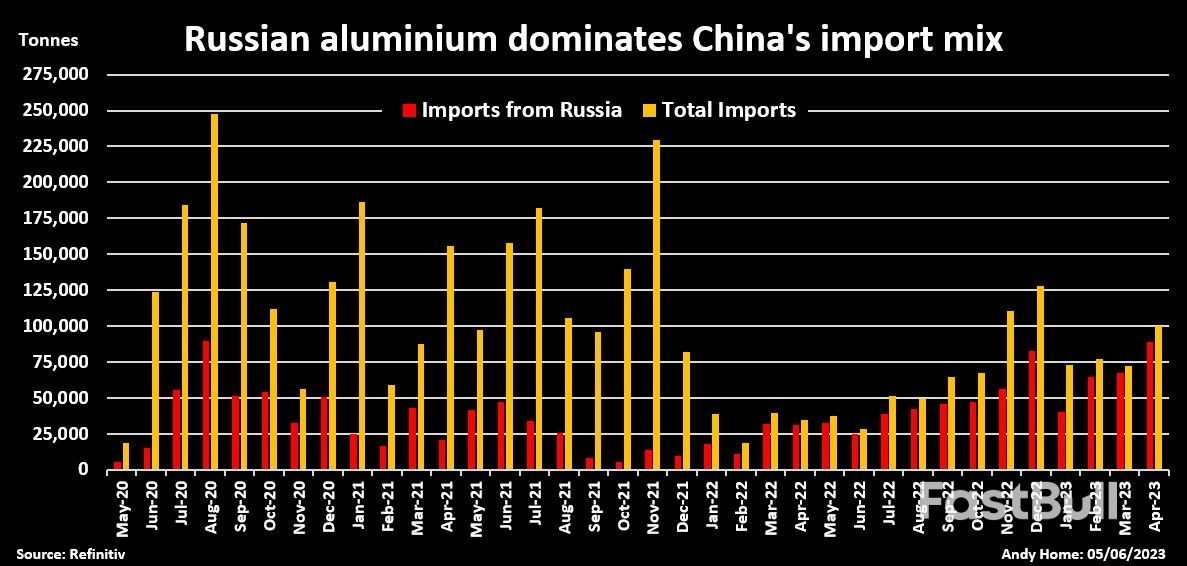
          China's imports of primary aluminium surged to a near two-year high of 153,000 metric tons in August, bringing the year-to-date count to 755,000 metric tons. Last year's equivalent tally was just 298,000 metric tons.
          However, just about all the metal being imported is Russian-brand. Imports of Russian aluminium accounted for 87% of the total in the first eight months of 2023.
          Is the headline acceleration in imports down to demand pull or supply push?
          Russian aluminium is not officially sanctioned but the U.S. market has been effectively closed by penal 200% import duties and many Western consumers are self-sanctioning by opting for different origin metal.
          China is clearly soaking up a large part of this displaced metal and it appears to be doing so at a discount.
          The average value of Russian imports was $2,162 per metric ton in August, compared with $2,279 for Malaysian-brand metal and $2,355 for both Australian and New Zealand imports.
          Without the Russian push, would China's aluminium imports look so impressively robust?China's Strong Metal Imports Not as Bullish as They Seem_2
          Slow Copper Boat To Shanghai
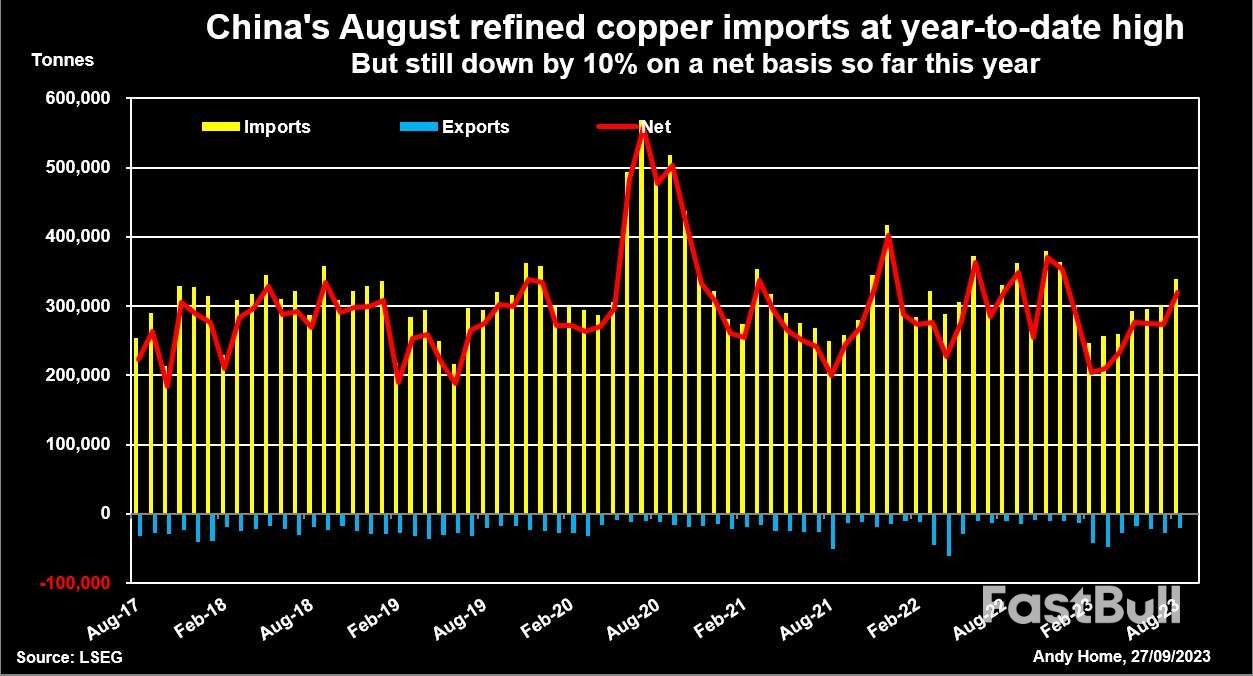
          Refined copper imports were 340,000 metric tons in August, the highest monthly tally this year.
          However, cumulative imports of 2.29 million metric tons are still down by 8% on last year and net imports are down by 10% due to slightly higher exports in 2023 relative to 2022.
          The mini-surge also has much to do with Democratic Republic of Congo (DRC). Imports of copper from DRC have accelerated sharply from 57,000 metric tons in June to 74,000 in July and an all-time record 97,000 in August.
          These are catch-up shipments from China's CMOC Group, which was blocked from exporting between June last year and April this year during a prolonged stand-off with the government over taxes.
          CMOC, which produced 254,000 metric tons of refined copper last year, began shipping from its stockpile in June with the metal evidently starting to arrive in China in July and August.
          Imports of copper from DRC have accounted for more than 25% of total inbound shipments in the last two reported months and have kicked the headline figure higher.China's Strong Metal Imports Not as Bullish as They Seem_3
          Zinc Business As Usual
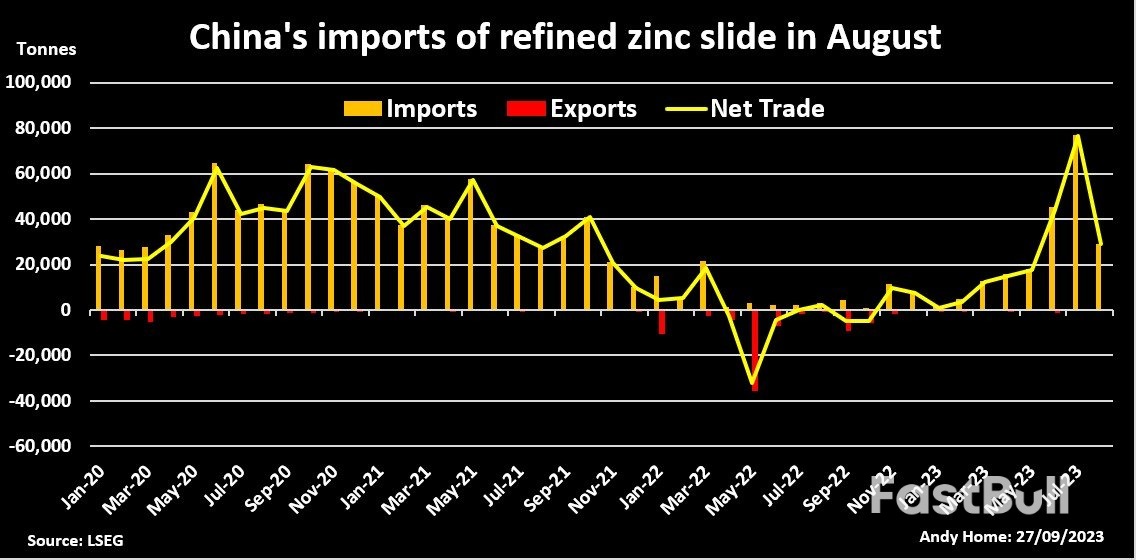
          China was a net exporter of refined zinc last year for the first time since 2007. Western smelter outages sent physical premiums sky-high, sucking metal out of China as the supplier of last resort.
          The country's refined zinc trade has reverted to net imports this year but volumes remain modest by historical standards.
          Net imports of 199,000 metric tons over the first eight months of the year were, barring last year, the lowest since 2010.
          Moreover, imports of 29,000 metric tons in August itself were sharply off the pace of the 77,000 recorded in July. The next few months will tell whether zinc imports will return to the levels seen over the last decade.
          Shifting The Nickel Mix
          There has been no pick-up in China's imports of refined nickel. Indeed, they've been declining steadily since the start of last year.
          They've fallen another 50% to 48,000 metric tons over the first eight months of 2023.
          China's electric vehicle battery manufacturers don't need so much nickel in this form as they pivot to increased flows of intermediate products coming from Indonesia.
          Indonesian shipments of ferronickel grew by 51% in the first eight months of this year. Those of intermediate products and nickel matte were up by 92% and 138% respectively.
          Imports of Indonesian nickel sulphate only began in May but have already grown to 25,000 metric tons, accounting for 38% of total year-to-date arrivals.
          The share of refined metal in China's import mix is continually shrinking and with many Indonesian producers still ramping up new capacity that trend seems likely to run.
          All change in lead?
          China has been a significant exporter of refined lead since the middle of 2021, when, similar to sister metal zinc, smelter problems in the West caused physical premiums to soar.
          However, unlike their zinc peers, China's lead producers are still exporting to the tune of a net 101,000 metric tons in the first eight months of 2023.
          That was up by 10% on the same period last year and begs the question as to whether this is the new norm in terms of global flows of unwrought lead.

          Source: Metals Mine

          To stay updated on all economic events of today, please check out our Economic calendar
          Risk Warnings and Disclaimers
          You understand and acknowledge that there is a high degree of risk involved in trading. Following any strategies or investment methods may lead to potential losses. The content on the site is provided by our contributors and analysts for information purposes only. You are solely responsible for determining whether any trading assets, securities, strategy, or any other product is suitable for investing based on your own investment objectives and financial situation.
          Comments
          Add to Favorites
          Share

          Why is China's Yuan So Close to Its Lower Limit?

          Thomas

          Forex

          China's yuan has weakened more than 5% against the dollar this year and has lately been squeezed to the lower extremity of its trading band as the U.S. currency climbed.
          It is unusual and partially caused by Chinese authorities leaning against market forces in setting the trading band's level.
          Here's a breakdown of how that works:
          What Is The Trading Band And Midpoint Fixing?
          China's yuan is not a fully-convertible currency and its onshore exchange rate is a managed floating rate mechanism.
          The central bank sets a daily midpoint rate against the dollar at 9:15 a.m. (0115 GMT) every day. The onshore spot price can trade in a band either side of the rate, which has been widened over the years from 0.3% in 1994 to 2% since March 2014.
          How Is It Calculated?
          Fourteen midpoint contributing banks set prices with reference to the yuan's previous-day official domestic close at 0830 GMT and moves in global markets overnight. Their quotes are sent to a unit of the central bank which then sets the midpoint rate.
          China introduced a so-called "counter-cyclical factor" into the midpoint formula in 2017 in what regulators said was an effort to better reflect market supply and demand. The factor was adjusted multiple times since then.
          Analysts, who calculate their own estimates for the fix by reverse-engineering the formula, said the goal was to dial down the input from the closing price and increase the influence of fundamental factors.
          What's Been Happening To The Fix?
          China's central bank has been setting far firmer-than-expected midpoint guidance for months, in what traders and analysts interpret as a sign that the authorities are getting increasingly uncomfortable with the currency's weakness.
          The gap between the midpoint and Reuters' estimates hit a record on Sept. 26, when the fix was 1,447 pips stronger.
          Setting the midpoint so far from the market level means that the currency, without necessarily moving much, trades close to the edge of the band - such as on Wednesday when it was within 14 pips of the downside limit.
          What happens if the limit is reached?
          Currency traders said they are not sure what will happen when the yuan hits the limit, and whether trading will be suspended.
          In the past, it has only ever brushed it; touching the down limit in 2011 when the trading band was only 0.5% and coming within 1 pip of the limit last October.
          State-owned banks have been selling dollars for yuan to steady the currency, and such trading could also protect the downside.
          Does It Work?
          It avoids spending reserves to stabilise the currency and, so far, the market has been heeding the authorities' signals.
          Ahead of the Golden Week break, beginning on Friday, the yuan has held steady in spite of a rising dollar. This means that the Chinese currency has strengthened against the currencies of its other trading partners.
          The CFETS basket index, a gauge that measures the yuan's value against its peers, is up 0.9% this year while the yuan has lost more than 5% against the dollar during the same period.

          Source: Yahoo

          Risk Warnings and Disclaimers
          You understand and acknowledge that there is a high degree of risk involved in trading. Following any strategies or investment methods may lead to potential losses. The content on the site is provided by our contributors and analysts for information purposes only. You are solely responsible for determining whether any trading assets, securities, strategy, or any other product is suitable for investing based on your own investment objectives and financial situation.
          Comments
          Add to Favorites
          Share

          US Crypto Industry Comes to Washington, But Faces Uphill Struggle

          Kevin Du

          Cryptocurrency

          Crypto companies are descending on Capitol Hill on Wednesday, but their push to advance industry-friendly laws is likely to be overshadowed by a fight over the federal budget and a Senate crackdown on the use of crypto for money laundering.
          Dozens of executives from digital asset companies are meeting with lawmakers and their staff on Wednesday as part of a grassroots advocacy campaign organized by Coinbase, the biggest U.S. crypto exchange, and Stand With Crypto, a non-profit it founded.
          The House Financial Services Committee in July passed two major bills that would help provide clarity over which existing financial rules apply to the industry, and crypto lobbyists hope they can convince lawmakers to advance those through Congress.
          But with lawmakers focused on averting a government shutdown and other competing bills that must pass this year, including the Farm Bill and National Defense Authorization Act (NDAA), the industry may struggle to be heard.
          "There's a mind-boggling number of competing areas but ... we need to keep pounding the table," said Katherine Dowling, general counsel and chief compliance officer at Bitwise, a crypto investment manager. The company is one of several pushing for the U.S. Securities and Exchange Commission to approve a spot bitcoin exchange-traded fund.
          Crypto companies have been expanding in Washington to combat growing regulatory scrutiny, especially from the SEC which says the industry has been flouting its rules. Lobbying escalated after the SEC sued Coinbase and its rival Binance in June for allegedly failing to register tokens, claims they deny.
          The industry spent nearly $13 million on federal lobbying in the first half of 2023, putting it on track for another record year after spending $21.6 million in 2022, new data provided by OpenSecrets to Reuters showed. Coinbase led the pack at $1.4 million.
          The crypto delegation on Wednesday includes Coinbase CEO Brian Armstrong, who is meeting with Democrats and Republicans from both chambers of Congress, a spokesperson said. It also includes an executive from OpenSea, the top non-fungible token marketplace.
          "Everybody wants to make sure that what they're doing isn't going to be erased by the government," said Kara Calvert, head of U.S. policy at Coinbase, referring to the crypto industry.
          An OpenSea spokesperson said the company was excited that policymakers have taken an interest in NFTs, and "hope(s) that a collaborative approach" to regulation will foster innovation and protect users.
          Coinbase also this month launched a media campaign which will include advertisements in Washington and calls-to-action on its own platform for crypto users to urge their members of Congress to pass crypto legislation.
          The outcome is uncertain, said Mark Hays, senior policy analyst at Americans for Financial Reform and Demand Progress.
          "It's not clear to me whether the industry's efforts to bootstrap a crypto grassroots campaign out of nowhere is going to translate into something that's politically impactful."
          'Last thing we need'
          The July bills would define when a cryptocurrency is a security or a commodity, curtailing the SEC's authority. Another bill would create federal rules for stablecoins, tokens pegged to a traditional asset.
          The next step is consideration by the full House, or for the bills to be introduced in the Senate. A House vote before year-end is possible, but the outlook is dimmer in the Senate, where industry-friendly crypto bills have failed to gain traction.
          Instead, both sides of the aisle are focused on curbing the use of crypto in money laundering and terrorist financing. The Senate in July passed its version of the NDAA, which included an amendment increasing scrutiny of anonymous crypto transactions.
          And Senate Banking Committee Chair Sherrod Brown of Ohio has shown little interest in making it a priority to advance the House bills.
          "The last thing we need is for the crypto industry to write their own rulebook — too many Ohioans have been burned by fraud and scams," said Brown in a statement to Reuters.
          "We need a framework of rules for crypto that protects our economy and protects Ohioans' hard-earned money."
          Still, Coinbase is stepping up its efforts in Ohio, where Brown is facing re-election next year, with grassroots events raising awareness of the industry's role in the local economy.
          Without Brown's support, industry-backed crypto legislation in the near-term remains unlikely, said Ian Katz, managing director of policy research firm Capital Alpha Partners. "If it doesn't seem urgent, and the chairman of the relevant committee isn't that into it, it's hard to see it happening."

          Source: Yahoo

          Risk Warnings and Disclaimers
          You understand and acknowledge that there is a high degree of risk involved in trading. Following any strategies or investment methods may lead to potential losses. The content on the site is provided by our contributors and analysts for information purposes only. You are solely responsible for determining whether any trading assets, securities, strategy, or any other product is suitable for investing based on your own investment objectives and financial situation.
          Comments
          Add to Favorites
          Share

          Crypto Needs Financial Chaos for Growth

          FxPro Group

          Cryptocurrency

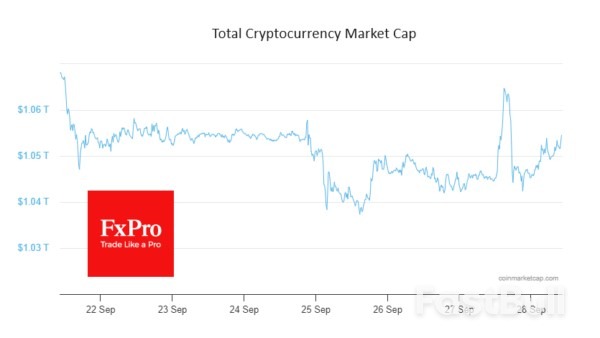
          Crypto market capitalisation rose 0.7% in 24 hours to 1.053 trillion. This is a return to the levels seen at the end of last week. Cryptocurrencies saw increased buying when equity markets were under the most pressure and the dollar was gaining momentum. However, this momentum didn't last long.Crypto Needs Financial Chaos for Growth_1
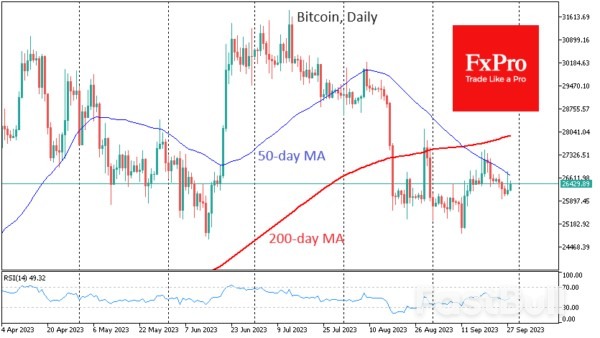
          Bitcoin briefly rose to $26.7K but again found resistance at the 50-day moving average, which had already fallen to the abovementioned level. These growth impulses promise to remain a bull trap, offering the best opportunity to sell on the upside.Crypto Needs Financial Chaos for Growth_2
          Cryptocurrencies need banking problems or uncertainty about the solvency of governments to generate sustainable growth momentum. Recent moves in bond markets show that something like this is brewing. But it's too early to call cryptocurrencies a safe haven from the chaos of the traditional financial system.
          News background
          The SEC has delayed until the 10th of January 2024 a decision on spot bitcoin ETF applications from ARK Invest and 21Shares and until the 21st of November 2023 for Global X Bitcoin Trust ETF. The regulator cited the need for “sufficient time to review the documents”.
          Stablecoins are vulnerable in times of large-scale turmoil in the cryptocurrency market and could cause instability in the broader financial system, the New York Fed said in a study.
          Forbes noted that the crypto market had responded positively to global financial uncertainty and remains resilient amid rising bond market volatility. Therefore, investing in Bitcoin or Ethereum could be a safer choice on the cusp of a possible recession.
          According to the Wall Street Journal, U.S. authorities have been investigating Binance for a year and could face criminal charges and billions of dollars in fines.
          Risk Warnings and Disclaimers
          You understand and acknowledge that there is a high degree of risk involved in trading. Following any strategies or investment methods may lead to potential losses. The content on the site is provided by our contributors and analysts for information purposes only. You are solely responsible for determining whether any trading assets, securities, strategy, or any other product is suitable for investing based on your own investment objectives and financial situation.
          Comments
          Add to Favorites
          Share

          Perfect Storm Drives Dollar Stronger Still

          Samantha Luan

          Forex

          USD: The low-polnt in the next Fed easing cycle is priced at 4.3%
          The dollar remains very well bid and has rallied around 7% from its low point in mid-July. Corrections have been few and far between - largely because of a confluence of factors. At the heart of it is strong US growth and a Federal Reserve that is showing no signs of letting up its hawkish rhetoric. And increasingly, the market is building the view that the next Fed easing cycle - whenever it comes - will not be the kind of 300-400bp affair we have been used to over prior decades. This has lifted the market pricing of the low point for the next Fed easing cycle - priced in around three years - to 4.29%. This was just at 3.99% last Friday and around 3% in the spring. This has been a key factor driving long-end US rates higher. 5.00% on the US 10-year Treasury yield is the bias from our rates strategy team.
          At the same time, higher crude oil prices, as Saudi supply cuts keep the market in deficit, are driving a renewed wedge between the 'haves' - the US - and the 'have nots' - Europe and Asia. Our commodities team sees the risk that Brent crude briefly spikes above $100/bbl.
          Add in developments in Europe and China, and one can see why the high-yielding dollar remains in demand. For Europe, we would highlight two new euro negatives this week - Italy pushing the budget boundaries and some European Central Bank officials discussing large rises in Minimum Required Reserves. And in China, the news out of the property sector remains bleak.
          We have been saying for a while that a softening in US activity data is required to turn the dollar around. But because of the poor investment outlook overseas, that bar for poor US activity data is now higher. On that subject, today sees the weekly jobless claims. These have been really robust. We also see the 3Q23 PCE deflator.
          In theory, a US government shutdown should be slightly dollar-negative in that it provides a hit to activity and not to US creditworthiness. But it is going to take a lot to turn the dollar and it could well stay bid into mid-October when US corporates in California need to pay their taxes. DXY looks like it can grind to 107.00/107.20 and perhaps the biggest threat to the dollar is the Bank of Japan selling $20-30bn near 150 in USD/JPY as Japanese officials watch FX 'with a strong sense of urgency'.
          EUR: Some new negatives
          EUR/USD near 1.05 would suggest that a lot of confidence has been lost in the euro. Yet the European Central Bank's trade-weighted euro is just 2.5% off its July highs. We can probably all agree that the dominant trend is a strong dollar. However, two developments this week warn that the euro may be due some independent weakness. The first is the suggestion from some ECB officials that Minimum Required Reserves for European banks need to be raised - perhaps substantially. Our banking specialists in research feel that such a move would hit banking liquidity at a crucial juncture and no doubt weigh further on already soft bank lending. We think an MRR hike would be a clear euro negative.
          Additionally, another emerging story this week is the Italian BTP- German Bund 10-year spread widening out to 200bp as the Italian government announces looser fiscal policy. This will put the issue of the return of Maastricht fiscal criteria back in the spotlight for early next year and will be a factor worth assessing for whether it puts a renewed risk premium back into the euro.
          Based on the above, there seems no reason to fight this bearish EUR/USD trend just yet. But for today, keep a look out for German and Spanish inflation - in case it builds momentum for one last ECB hike. If not, expect EUR/USD to continue drifting to the 1.0400/0410 area.
          Elsewhere, the Czech National Bank (CNB) has laid out its strategy for its forthcoming easing cycle - a cycle we expect to start in November.
          GBP: Caught in the crossfire
          Like the euro, sterling has probably been caught in the crossfire of position adjustment. Speculators had been trying to hold onto long euro and sterling positions through the spring, despite the strengthening dollar. Presumably, these positions have now been cut. Like EUR/USD, GBP/USD remains vulnerable to the 1.20/21 area.
          MXN: September correction continues
          High US interest rates are proving a headwind to emerging currencies worldwide - even to the mighty Mexican peso. In addition, the peso this month is facing the unwind of Banxico's FX intervention book - a front-loaded exercise that we felt could weigh on the peso this month and perhaps into October, too. With the dollar set to stay strong for the next few weeks, USD/MXN could head up to the 200-day moving average at 17.85 or even briefly trade above 18. However, we like the peso multi-quarter and expect good peso buying interest should USD/MXN trade over 18.
          Today also sees Banxico announce its latest monetary policy decision. No one expects a change in the 11.25% policy rate. And with US rates so high, it seems too early for Banxico to start entertaining speculation of an easing cycle. This month, the market has priced out 125bp of Banxico easing over the next two years. However, the market still has 200bp of easing priced in. A little more could be taken out of market pricing for the easing cycle today - but not much.

          Source: ING

          Risk Warnings and Disclaimers
          You understand and acknowledge that there is a high degree of risk involved in trading. Following any strategies or investment methods may lead to potential losses. The content on the site is provided by our contributors and analysts for information purposes only. You are solely responsible for determining whether any trading assets, securities, strategy, or any other product is suitable for investing based on your own investment objectives and financial situation.
          Comments
          Add to Favorites
          Share

          Fed's Higher-For-Longer Mantra Has Doubters in Bond Market

          Alex

          Economic

          Amid signs the bond market has bought into the Federal Reserve keeping interest rates higher for longer, a cohort of investors is placing bets on the economy hitting a wall — and a sharp policy reversal in short order.
          Treasury yields have settled into tight ranges this month near the highest levels in more than a decade as data show a resilient economy and inflation still well above the Fed's 2% target. But with yields anticipating a peak in the policy rate, the outlook for growth takes on greater importance.
          The past week has seen a pickup in demand for options that will turn a profit should interest rates tumble before the middle of next year. That's a more dire scenario than what's seen in the swaps market, where traders are no longer pricing in a rate cut during the first half of 2024.
          Bond traders have been placing these sorts of bets since the hiking cycle began and so far they haven't panned out. But this time may be different as the Fed's tightening cycle has had more time to work through the economy.
          The Fed is widely expected to leave its policy rate unchanged next week after lifting it in July for the 10th time in an aggressive hiking cycle that began in March last year. It's also seen significantly raising its forecast for growth and indicating another rate increase this year in its so-called dot plot. The rate outlook for 2024 remains up for debate. In June, the median projection showed a full percentage point cut by the end of next year.
          The longer rates stay elevated so does the risk of a downturn, and at the margin there are more signs of consumer stress as higher borrowing costs and weaker hiring start to erode household spending. With the Fed seen being close to its policy rate peak, the focus is now on growth softening.
          "There is a question mark around whether the economy is transitioning to a soft landing or does the labor market weaken towards a more recessionary outlook," said Roger Hallam, global head of rates at Vanguard Asset Management.
          The week saw notable demand for options linked to the Secured Overnight Financing Rate — which closely aligns to the projected path of Fed's policy rate — hedging multiple rate cuts before June. These trades likely accompany existing positions that reflect the Fed's current message, allowing some traders to benefit from a surprise policy pivot.
          One trade positioned for a 3% rate by the middle of next year versus a current market level around 5%. The premium paid on that bet was in excess of $10 million. Other similar trades surrounding March were also made over the course of the week.
          Ramping up wagers that the Fed could pivot to rate cuts by mid-2024, or even before, stands in sharp contrast to policy makers stressing a higher-for-longer narrative. Meanwhile, the current Fed rate at 5.25%-5.5%, well above the US annual inflation rate and three-month annualized figure, is seen as threatening the growth outlook.
          As a result, investors are more worried about recession than they were nine months ago, according to Robert Waldner at Invesco.
          "There is an increasing risk of recession as rates stay high and nominal growth comes down," the chief strategist said. "As inflation is coming down, central bank policy is getting tighter, and if they don't consider this, it will increase the risk of an accident."
          Positioning through options for next year's Fed meetings in March and June may make sense, given the bond market faces the likelihood of being stuck in a holding pattern as investors wait for clarity on the economy.
          It's very reasonable to see lower yields in an economic environment heading into a downturn, according to Vanguard's Hallam. But the picture for bond buyers gets complicated should higher energy prices stall the recent disinflationary trends.
          "Sticky inflation would make it very difficult for the Fed to ease next year," he said.
          Given the uncertainty over the outlook for the economy and rates, parking funds in cash-like equivalents has been gaining favor. Shorter-dated Treasuries returning 5%-plus have seen a significant slice of investment flows locking in relatively high yields, according to EPFR fund data for this year.
          For Monica Defend, head of the Amundi Institute, the middle of the Treasury curve looks attractive for a multi-strategy portfolio.
          With rates staying higher for longer, yields should turn lower as the economy weakens, and the five- to 10-year sectors "are a good alternative to equities," she said.

          Source: Bloomberg

          To stay updated on all economic events of today, please check out our Economic calendar
          Risk Warnings and Disclaimers
          You understand and acknowledge that there is a high degree of risk involved in trading. Following any strategies or investment methods may lead to potential losses. The content on the site is provided by our contributors and analysts for information purposes only. You are solely responsible for determining whether any trading assets, securities, strategy, or any other product is suitable for investing based on your own investment objectives and financial situation.
          Comments
          Add to Favorites
          Share

          Dollar Soars on Sky-High Yields, Gold Plummets

          Samantha Luan

          Forex

          Dollar's strength remains unabated, particularly against its European counterparts and Yen. The greenback rose alongside 10-year yield, which soared past the 4.6% mark overnight, a level unseen in over 15 years. The surging global treasury yields are a clear indicator of the market's expectation for a prolonged period of restrictive monetary policies by central banks across the globe. This comes as the market grapples with the looming shadow of a potential U.S. government shutdown, adding another layer of complexity to the fiscal equation.
          However, this bullish momentum for Dollar is somewhat stymied against commodity currencies. Canadian Dollar emerging as the second strongest for the week so far, spurred by soaring oil prices. New Zealand Dollar is not far behind, buoyed by speculation of another interest rate hike by RBNZ in the fourth quarter. Conversely, the Australian Dollar trails the pack among its commodity-based peers.
          Swiss Franc continues its underperformance against Euro and Sterling. Yen paints a mixed picture, as Japanese authorities seem to be adeptly employing verbal interventions, effectively slowing the currency's decline by putting potential Yen sellers on alert.
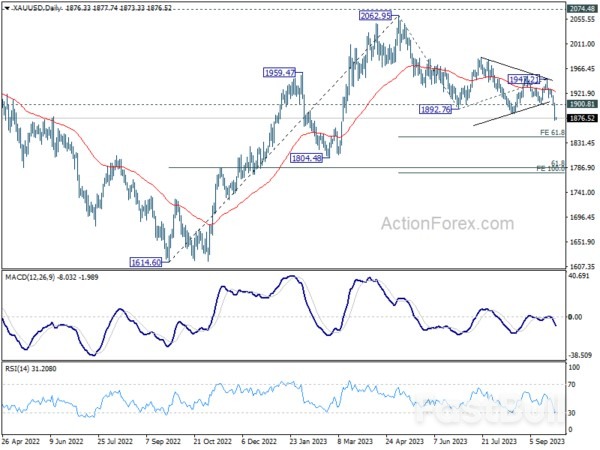
          Technically, Gold's accelerated decline confirms resumption of whole down trend from 2062.95. Near term outlook will now stay bearish as long as 1900.81 support turned resistance holds. Next target is 61.8% projection of 2062.95 to 1892.76 from 1947.21 at 1842.03. This decline from 2062.95 is viewed as a medium term move inside the long term pattern from 2074.84 (2020 high). Break of 1842.03 will target 100% projection at 1777.02 and below.Dollar Soars on Sky-High Yields, Gold Plummets_1
          In Asia, Nikkei closed down -1.55%. Hong Kong HSI is down -1.20%. China Shanghai SSE is up 0.17%. Singapore Strait Times is up 0.13%. Japan 10-year JGB yield is up 0.0124 at 0.752. Overnight, DOW dropped -0.20%. S&P 500 rose 0.02%. NASDAQ rose 0.22%. 10-year yield rose 0.068 to 4.626.
          Mixed signals in New Zealand business confidence, ANZ anticipates another RBNZ hike
          September has seen a noteworthy rebound in New Zealand's ANZ Business Confidence, rising from -3.7 to 1.5. However, a closer examination of the details offers a more nuanced picture.
          Metrics such as own activity output experienced a slight decline, dropping from 11.2 to 10.9. More alarmingly, export intentions plummeted from a positive 7.5 to a -0.4. There were also declines in investment intentions (from -1.3 to -4.1) and employment intentions (from 4.6 to 1.2).
          On the inflation front, cost expectations edged upwards from 75.3 to 78.6, while profit expectations showed an improvement, moving from -17.6 to -13.2. Pricing intentions rose from 44.0 to 47.1, but inflation expectations took a downward turn, shifting from 5.06 to 4.95.
          ANZ provided their insights on this mixed bag of indicators, stating, "The New Zealand economy is certainly patchy, and the rebound in activity indicators – that's been evident since the start of the year – may be running out of steam."
          They further highlighted the complexities in the inflation scenario: "Inflation pressures are gradually waning in the big picture, but not rapidly nor in a straight line, and the jury remains out on whether it's occurring fast enough to bring core inflation pressures down in a timely fashion."
          Looking ahead, ANZ anticipates further action from RBNZ to ensure inflation is reined in effectively, with a 25 bps hike expected in November.
          Australian retail sales see modest 0.2% mom rise amid cost-of-living pressures
          The latest retail statistics out of Australia show a muted picture of consumer spending, with retail sales turnover in August rising only 0.2% mom (in seasonally adjusted terms) to AUD 35.4B, falling short of the anticipated 0.3% increase. Through the year, sales turnover was up 1.5% yoy.
          According to Ben Dorber, the head of retail statistics at the Australian Bureau of Statistics (ABS), this modest rise indicates a notable restraint in consumer spending. Dorber noted, "The modest rise in August shows consumers continued to restrain their retail spending."
          The trend growth in retail sales paints an even starker image. "In trend terms, retail turnover rose 0.1 per cent, and was up only 1.3 per cent compared to August 2022 – the smallest trend growth over 12 months in the history of the series," Dorber added.
          Dorber highlighted, "Considering how high inflation and strong population growth have added to retail turnover in the past year, the historically low trend growth highlights just how much consumers have pulled back in response to cost-of-living pressures."
          Oil prices hit yearly high on shrinking inventories, WTI in march to 100
          Oil prices saw a sharp ascent overnight, extending their gains into Asian trading session today and marking their highest point in over a year. With technical indicators pointing to a potential acceleration, WTI oil is on the march towards 100 psychological level.
          A factor propelling this surge is the pronounced drop in US crude stocks, amplifying concerns about tightening global supply in light of OPEC+ production cuts, spearheaded by Saudi Arabia. Yesterday's data revealed that oil inventories dipped by -2.2m barrels last week, settling at 416.3m barrels.
          Furthermore, the stockpiles at Cushing, Oklahoma, a crucial storage hub and the delivery point for US crude futures, saw a reduction of -943k barrels over the week, dropping to just under 22m barrels, lowest since July 2022. Significantly, these reserves at Cushing have been on decline for seven consecutive weeks. Many market participants view these current levels as bordering on the minimum required for operational functionality of the storage tanks.
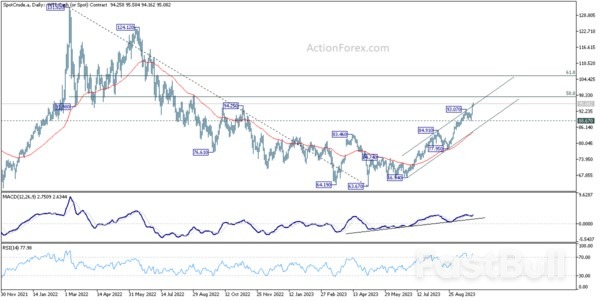
          Technically, WTI crude oil's recent up trend resumed after brief consolidations and surged through 95 handle. There is sign of upside acceleration with break of the rising channel resistance. Near term outlook will stay bullish as long as 88.67 support holds. Next target is 50% retracement of 131.82 to 63.67 at 97.74. Decisive break there could pave the way through 100 psychological to 61.8% retracement at 105.78.Dollar Soars on Sky-High Yields, Gold Plummets_2

          Looking ahead

          ECB monthly bulletin and Eurozone economic sentiment indicator will be released in European session. Germany will publish CPI flash. Later in the day, US jobless claims and pending home sales will be featured along with Q2 GDP final.

          USD/CHF Daily Outlook

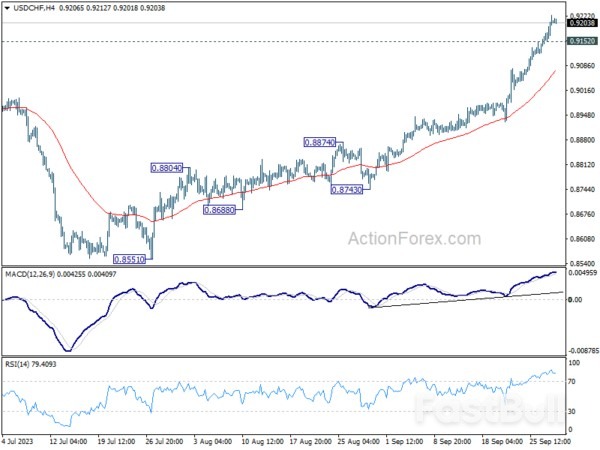
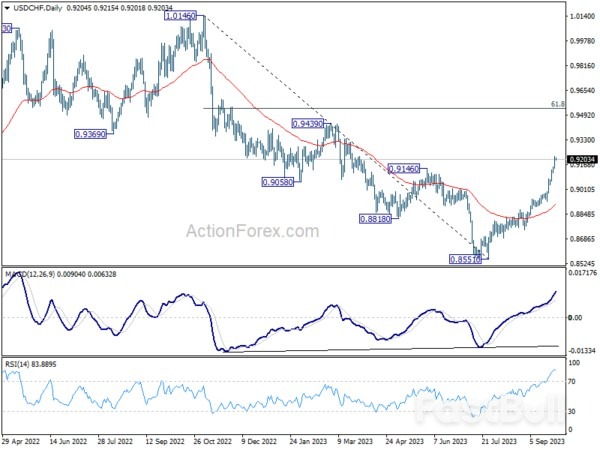
          USD/CHF's rally continues and hit as high as 0.9224. Intraday bias stays on the upside for 0.9439 resistance next. On the downside, below 0.9152 minor support will turn intraday bias neutral and bring consolidations, before staging another rally.Dollar Soars on Sky-High Yields, Gold Plummets_3
          In the bigger picture, current development indicates that rise from 0.8551 is reversing whole down trend from 1.0146. Further rally would then be seen to 61.8% retracement at 0.9537 and above. For now, this will be the favored case as long as 55 D EMA (now at 0.8917) holds, even in case of deep pullback.Dollar Soars on Sky-High Yields, Gold Plummets_4

          Source: ActionForex

          Risk Warnings and Disclaimers
          You understand and acknowledge that there is a high degree of risk involved in trading. Following any strategies or investment methods may lead to potential losses. The content on the site is provided by our contributors and analysts for information purposes only. You are solely responsible for determining whether any trading assets, securities, strategy, or any other product is suitable for investing based on your own investment objectives and financial situation.
          Comments
          Add to Favorites
          Share
          FastBull
          Copyright © 2025 FastBull Ltd

          728 RM B 7/F GEE LOK IND BLDG NO 34 HUNG TO RD KWUN TONG KLN HONG KONG

          TelegramInstagramTwitterfacebooklinkedin
          App Store Google Play Google Play
          Products
          Charts

          Chats

          Q&A with Experts
          Screeners
          Economic Calendar
          Data
          Tools
          Membership
          Features
          Function
          Markets
          Copy Trading
          Latest Signals
          Contests
          News
          Analysis
          24/7
          Columns
          Education
          Company
          Careers
          About Us
          Contact Us
          Advertising
          Help Center
          Feedback
          User Agreement
          Privacy Policy
          Business

          White Label

          Data API

          Web Plug-ins

          Poster Maker

          Affiliate Program

          Risk Disclosure

          The risk of loss in trading financial instruments such as stocks, FX, commodities, futures, bonds, ETFs and crypto can be substantial. You may sustain a total loss of the funds that you deposit with your broker. Therefore, you should carefully consider whether such trading is suitable for you in light of your circumstances and financial resources.

          No decision to invest should be made without thoroughly conducting due diligence by yourself or consulting with your financial advisors. Our web content might not suit you since we don't know your financial conditions and investment needs. Our financial information might have latency or contain inaccuracy, so you should be fully responsible for any of your trading and investment decisions. The company will not be responsible for your capital loss.

          Without getting permission from the website, you are not allowed to copy the website's graphics, texts, or trademarks. Intellectual property rights in the content or data incorporated into this website belong to its providers and exchange merchants.

          Not Logged In

          Log in to access more features

          FastBull Membership

          Not yet

          Purchase

          Become a signal provider
          Help Center
          Customer Service
          Dark Mode
          Price Up/Down Colors

          Log In

          Sign Up
          Position
          Layout
          Fullscreen
          Default to Chart
          The chart page opens by default when you visit fastbull.com