• Trade
  • Markets
  • Copy
  • Contests
  • News
  • 24/7
  • Calendar
  • Q&A
  • Chats
Trending
Screeners
SYMBOL
LAST
BID
ASK
HIGH
LOW
NET CHG.
%CHG.
SPREAD
SPX
S&P 500 Index
6827.42
6827.42
6827.42
6899.86
6801.80
-73.58
-1.07%
--
DJI
Dow Jones Industrial Average
48458.04
48458.04
48458.04
48886.86
48334.10
-245.98
-0.51%
--
IXIC
NASDAQ Composite Index
23195.16
23195.16
23195.16
23554.89
23094.51
-398.69
-1.69%
--
USDX
US Dollar Index
97.970
98.050
97.970
98.070
97.920
+0.020
+ 0.02%
--
EURUSD
Euro / US Dollar
1.17326
1.17333
1.17326
1.17447
1.17283
-0.00068
-0.06%
--
GBPUSD
Pound Sterling / US Dollar
1.33633
1.33643
1.33633
1.33740
1.33546
-0.00074
-0.06%
--
XAUUSD
Gold / US Dollar
4341.52
4341.86
4341.52
4347.21
4294.68
+42.13
+ 0.98%
--
WTI
Light Sweet Crude Oil
57.520
57.557
57.520
57.601
57.194
+0.287
+ 0.50%
--

Community Accounts

Signal Accounts
--
Profit Accounts
--
Loss Accounts
--
View More

Become a signal provider

Sell trading signals to earn additional income

View More

Guide to Copy Trading

Get started with ease and confidence

View More

Signal Accounts for Members

All Signal Accounts

Best Return
  • Best Return
  • Best P/L
  • Best MDD
Past 1W
  • Past 1W
  • Past 1M
  • Past 1Y

All Contests

  • All
  • Trump Updates
  • Recommend
  • Stocks
  • Cryptocurrencies
  • Central Banks
  • Featured News
Top News Only
Share

Stats Office - Botswana November Consumer Inflation At 0.0% Month-On-Month

Share

Stats Office - Botswana November Consumer Inflation At 3.8% Year-On-Year

Share

Statistics Bureau - Kazakhstan's Jan-Nov Industrial Output +7.4% Year-On-Year

Share

Fca: Sets Out Plans To Help Build Mortgage Market Of Future

Share

Eurostoxx 50 Futures Up 0.38%, DAX Futures Up 0.43%, FTSE Futures Up 0.37%

Share

[Delivery Of New US Presidential Aircraft Delayed Again] According To The Latest Timeline Released By The US Air Force, The Delivery Of The First Of The Two Newly Commissioned Air Force One Presidential Aircraft Will Not Be Earlier Than 2028. This Means That The Delivery Of The New Air Force One Has Been Delayed Once Again

Share

German Nov Wholesale Prices +0.3% Month-On-Month

Share

Norway's Nov Trade Balance Nok 41.3 Billion - Statistics Norway

Share

German Nov Wholesale Prices +1.5% Year-On-Year

Share

Romania's Adjusted Industrial Production +0.4% Month-On-Month In October, +0.2% Year-On-Year - Statistics Board

Share

Russia Says It Destroyed 130 Ukrainian Drones Overnight, Some Moscow Airports Disrupted

Share

EU Commissioner Kos: This Is No Time To Speculate On Timeframe For Ukraine's Accession To EU

Share

Lithuania Foreign Minister: Ukraine Needs Article 5-Alike Security Guarantees, With Nuclear Deterrent

Share

Russia's Central Bank Says It Seeks 18.2 Trillion Roubles In Damages From Euroclear

Share

Lithuania's Foreign Minister Says Expects EU Today To Broaden Belarus Sanctions Regime To Include Hybrid Activity

Share

India's Nifty 50 Index Pares Losses, Last Down 0.1%

Share

EU's Kallas: Important To Have Belgium On Board For Reparations Loan

Share

EU's Kallas: Work On Reparations Loan For Ukraine "Increasingly Difficult" But Still Have Some Days To Reach Agreement

Share

EU's Kallas: If Russian Agression Is Rewarded, We Will See More Of It

Share

India's Sept WPI Inflation Revised To 0.19% Year-On-Year

TIME
ACT
FCST
PREV
U.K. Trade Balance Non-EU (SA) (Oct)

A:--

F: --

P: --

France HICP Final MoM (Nov)

A:--

F: --

P: --

China, Mainland Outstanding Loans Growth YoY (Nov)

A:--

F: --

P: --

China, Mainland M2 Money Supply YoY (Nov)

A:--

F: --

P: --

China, Mainland M0 Money Supply YoY (Nov)

A:--

F: --

P: --

China, Mainland M1 Money Supply YoY (Nov)

A:--

F: --

P: --

India CPI YoY (Nov)

A:--

F: --

P: --

India Deposit Gowth YoY

A:--

F: --

P: --

Brazil Services Growth YoY (Oct)

A:--

F: --

P: --

Mexico Industrial Output YoY (Oct)

A:--

F: --

P: --

Russia Trade Balance (Oct)

A:--

F: --

P: --

Philadelphia Fed President Henry Paulson delivers a speech
Canada Building Permits MoM (SA) (Oct)

A:--

F: --

P: --

Canada Wholesale Sales YoY (Oct)

A:--

F: --

P: --

Canada Wholesale Inventory MoM (Oct)

A:--

F: --

P: --

Canada Wholesale Inventory YoY (Oct)

A:--

F: --

P: --

Canada Wholesale Sales MoM (SA) (Oct)

A:--

F: --

P: --

Germany Current Account (Not SA) (Oct)

A:--

F: --

P: --

U.S. Weekly Total Rig Count

A:--

F: --

P: --

U.S. Weekly Total Oil Rig Count

A:--

F: --

P: --

Japan Tankan Small Manufacturing Outlook Index (Q4)

A:--

F: --

P: --

Japan Tankan Large Non-Manufacturing Diffusion Index (Q4)

A:--

F: --

P: --

Japan Tankan Large Non-Manufacturing Outlook Index (Q4)

A:--

F: --

P: --

Japan Tankan Large Manufacturing Outlook Index (Q4)

A:--

F: --

P: --

Japan Tankan Small Manufacturing Diffusion Index (Q4)

A:--

F: --

P: --

Japan Tankan Large Manufacturing Diffusion Index (Q4)

A:--

F: --

P: --

Japan Tankan Large-Enterprise Capital Expenditure YoY (Q4)

A:--

F: --

P: --

U.K. Rightmove House Price Index YoY (Dec)

A:--

F: --

P: --

China, Mainland Industrial Output YoY (YTD) (Nov)

A:--

F: --

P: --

China, Mainland Urban Area Unemployment Rate (Nov)

A:--

F: --

P: --

Saudi Arabia CPI YoY (Nov)

A:--

F: --

P: --

Euro Zone Industrial Output YoY (Oct)

--

F: --

P: --

Euro Zone Industrial Output MoM (Oct)

--

F: --

P: --

Canada Existing Home Sales MoM (Nov)

--

F: --

P: --

Euro Zone Total Reserve Assets (Nov)

--

F: --

P: --

U.K. Inflation Rate Expectations

--

F: --

P: --

Canada National Economic Confidence Index

--

F: --

P: --

Canada New Housing Starts (Nov)

--

F: --

P: --

U.S. NY Fed Manufacturing Employment Index (Dec)

--

F: --

P: --

U.S. NY Fed Manufacturing Index (Dec)

--

F: --

P: --

Canada Core CPI YoY (Nov)

--

F: --

P: --

Canada Manufacturing Unfilled Orders MoM (Oct)

--

F: --

P: --

U.S. NY Fed Manufacturing Prices Received Index (Dec)

--

F: --

P: --

U.S. NY Fed Manufacturing New Orders Index (Dec)

--

F: --

P: --

Canada Manufacturing New Orders MoM (Oct)

--

F: --

P: --

Canada Core CPI MoM (Nov)

--

F: --

P: --

Canada Trimmed CPI YoY (SA) (Nov)

--

F: --

P: --

Canada Manufacturing Inventory MoM (Oct)

--

F: --

P: --

Canada CPI YoY (Nov)

--

F: --

P: --

Canada CPI MoM (Nov)

--

F: --

P: --

Canada CPI YoY (SA) (Nov)

--

F: --

P: --

Canada Core CPI MoM (SA) (Nov)

--

F: --

P: --

Canada CPI MoM (SA) (Nov)

--

F: --

P: --

Federal Reserve Board Governor Milan delivered a speech
U.S. NAHB Housing Market Index (Dec)

--

F: --

P: --

Australia Composite PMI Prelim (Dec)

--

F: --

P: --

Australia Services PMI Prelim (Dec)

--

F: --

P: --

Australia Manufacturing PMI Prelim (Dec)

--

F: --

P: --

Japan Manufacturing PMI Prelim (SA) (Dec)

--

F: --

P: --

U.K. Unemployment Claimant Count (Nov)

--

F: --

P: --

U.K. Unemployment Rate (Nov)

--

F: --

P: --

Q&A with Experts
    • All
    • Chatrooms
    • Groups
    • Friends
    Connecting
    .
    .
    .
    Type here...
    Add Symbol or Code

      No matching data

      All
      Trump Updates
      Recommend
      Stocks
      Cryptocurrencies
      Central Banks
      Featured News
      • All
      • Russia-Ukraine Conflict
      • Middle East Flashpoint
      • All
      • Russia-Ukraine Conflict
      • Middle East Flashpoint
      Search
      Products

      Charts Free Forever

      Chats Q&A with Experts
      Screeners Economic Calendar Data Tools
      Membership Features
      Data Warehouse Market Trends Institutional Data Policy Rates Macro

      Market Trends

      Market Sentiment Order Book Forex Correlations

      Top Indicators

      Charts Free Forever
      Markets

      News

      News Analysis 24/7 Columns Education
      From Institutions From Analysts
      Topics Columnists

      Latest Views

      Latest Views

      Trending Topics

      Top Columnists

      Latest Update

      Signals

      Copy Rankings Latest Signals Become a signal provider AI Rating
      Contests
      Brokers

      Overview Brokers Assessment Rankings Regulators News Claims
      Broker listing Forex Brokers Comparison Tool Live Spread Comparison Scam
      Q&A Complaint Scam Alert Videos Tips to Detect Scam
      More

      Business
      Events
      Careers About Us Advertising Help Center

      White Label

      Data API

      Web Plug-ins

      Affiliate Program

      Awards Institution Evaluation IB Seminar Salon Event Exhibition
      Vietnam Thailand Singapore Dubai
      Fans Party Investment Sharing Session
      FastBull Summit BrokersView Expo
      Recent Searches
        Top Searches
          Markets
          News
          Analysis
          User
          24/7
          Economic Calendar
          Education
          Data
          • Names
          • Latest
          • Prev

          View All

          No data

          Scan to Download

          Faster Charts, Chat Faster!

          Download App
          English
          • English
          • Español
          • العربية
          • Bahasa Indonesia
          • Bahasa Melayu
          • Tiếng Việt
          • ภาษาไทย
          • Français
          • Italiano
          • Türkçe
          • Русский язык
          • 简中
          • 繁中
          Open Account
          Search
          Products
          Charts Free Forever
          Markets
          News
          Signals

          Copy Rankings Latest Signals Become a signal provider AI Rating
          Contests
          Brokers

          Overview Brokers Assessment Rankings Regulators News Claims
          Broker listing Forex Brokers Comparison Tool Live Spread Comparison Scam
          Q&A Complaint Scam Alert Videos Tips to Detect Scam
          More

          Business
          Events
          Careers About Us Advertising Help Center

          White Label

          Data API

          Web Plug-ins

          Affiliate Program

          Awards Institution Evaluation IB Seminar Salon Event Exhibition
          Vietnam Thailand Singapore Dubai
          Fans Party Investment Sharing Session
          FastBull Summit BrokersView Expo

          China's Services Activity Picks up in May on Improved Demand- Caixin PMI

          Thomas

          Economic

          Summary:

          China's services activity picked up in May, a private-sector survey showed on Monday, as a rise in new orders shored up a consumption-led economic recovery in the second quarter.

          China's services activity picked up in May, a private-sector survey showed on Monday, as a rise in new orders shored up a consumption-led economic recovery in the second quarter.
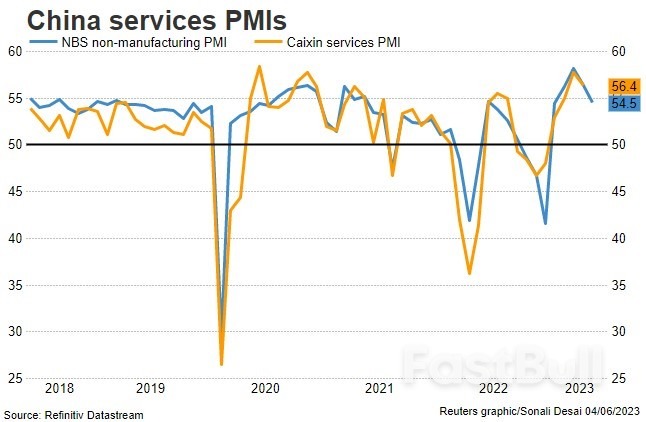
          The Caixin/S&P Global services purchasing managers' index (PMI) rose to 57.1 in May from 56.4 in April. The 50-point mark separates expansion from contraction in activity.
          The reading contrasts with the official PMI released last week that showed a slower pace of expansion in the services sector.
          Some economists warn the pent-up demand for in-person services may fade due to slowing income growth and mounting unemployment pressures, raising headaches for policymakers already struggling with weak foreign demand and an uneven post-COVID recovery.
          The Caixin survey showed service companies reported a rise in new business last month when the first May Day holiday following China's COVID reopening boosted orders for hotels, restaurants and travel agencies.
          Increased workloads led firms to grow headcount for the fourth consecutive month, although the speed of job creation slowed.
          Average prices charged by service companies rose by the fastest since February 2022.
          The survey also indicated that capacity pressures persisted, as highlighted by sustained growth in outstanding business.
          Caixin/S&P's composite PMI, which includes both manufacturing and services activity, picked up to 55.6 from 53.6 in April, marking the quickest expansion since December 2020.
          Even if firms in the services sector remained upbeat with business activity over the next 12 months, the level of optimism eased to the lowest since December 2022 when Beijing lifted anti-virus curbs.
          China's economy rebounded faster than expected in the first quarter but lost momentum at the beginning of the second quarter as April data broadly undershot forecasts.
          Factory activity in May shrank faster than expected on weakening demand, reinforcing the unbalanced feature in the economic recovery.
          "In general, it remains a prominent feature of the Chinese economy that the services sector is stronger than manufacturing," said Wang Zhe, senior economist at Caixin Insight Group.
          "This divergence highlights that economic growth is lacking internal drive and market entities lack sufficient confidence, underscoring the importance of expanding and restoring demand," he said.

          Source: The Edge Malaysia

          To stay updated on all economic events of today, please check out our Economic calendar
          Risk Warnings and Disclaimers
          You understand and acknowledge that there is a high degree of risk involved in trading. Following any strategies or investment methods may lead to potential losses. The content on the site is provided by our contributors and analysts for information purposes only. You are solely responsible for determining whether any trading assets, securities, strategy, or any other product is suitable for investing based on your own investment objectives and financial situation.
          Comments
          Add to Favorites
          Share

          Euro Bears Beware: Bulls Eyeing a Strong Rebound after a Challenging Month

          Warren Takunda

          Traders' Opinions

          As the month of May draws to a close, Euro bulls find themselves nursing wounds inflicted by a 3% decline against the US dollar, marking the Euro's worst performance in a year. However, financial analysts are eagerly looking ahead to a potential relief in the form of a pause by the US Federal Reserve, which could provide the much-needed catalyst for a Euro rebound.
          The Euro's recent struggles can be attributed to a combination of factors, including concerns about the economic recovery in the Eurozone, political uncertainties, and the strength of the US dollar. Investors have been increasingly cautious, opting for safe-haven assets such as the greenback, leading to a downward pressure on the Euro.
          Despite these challenges, prominent financial institutions like Paribas and Lombard Odier are maintaining an optimistic stance on the Euro's future prospects. They anticipate the Euro to gain momentum and push above the $1.10 level, based on several key factors.
          Firstly, the potential for a pause in the Federal Reserve's tightening cycle has become a significant driver for the Euro's rebound. The Fed's recent signals of a more cautious approach to interest rate hikes have eased concerns about a strengthening US dollar, thus creating an environment conducive for Euro bulls to regain their confidence.
          Moreover, Paribas and Lombard Odier point to underlying strengths in the Eurozone economy that could contribute to its recovery. Despite some recent economic setbacks, the Eurozone continues to show resilience, supported by robust manufacturing activity, steady employment rates, and improving business sentiment. These factors, combined with potential fiscal stimulus measures, may act as a springboard for the Euro's resurgence.
          In addition, political developments within the Eurozone could also play a role in shaping the Euro's trajectory. With the resolution of certain political uncertainties and an increasing focus on unity and stability, market sentiment towards the Euro may experience a positive shift, potentially leading to increased demand and upward pressure on the currency.
          While the road to recovery may not be without its challenges, the Euro bulls are finding solace in the belief that the worst may be behind them. However, it is essential to acknowledge the inherent uncertainties in the financial markets, which could affect the Euro's performance in the coming months.
          In conclusion, after a challenging month marked by a 3% decline against the US dollar, Euro bulls are looking to a potential pause by the Federal Reserve as a catalyst for relief. Financial institutions such as Paribas and Lombard Odier maintain an optimistic outlook, anticipating a Euro rebound and a push above the $1.10 level. Factors such as a potential Fed pause, underlying strengths in the Eurozone economy, and positive political developments within the region provide the groundwork for a possible Euro recovery. Nevertheless, investors should remain vigilant and mindful of market uncertainties that may impact the currency's future performance.
          Risk Warnings and Disclaimers
          You understand and acknowledge that there is a high degree of risk involved in trading. Following any strategies or investment methods may lead to potential losses. The content on the site is provided by our contributors and analysts for information purposes only. You are solely responsible for determining whether any trading assets, securities, strategy, or any other product is suitable for investing based on your own investment objectives and financial situation.
          Comments
          Add to Favorites
          Share

          Saudi Arabia's Solo Play Shows Mess of Oil Market Contradictions

          Devin

          Commodity

          Saudi Arabia's decision to deepen its crude oil production cuts, without matching contributions from its allies, underscores how the market is being skewed by a series of contradictory influences.
          The world's biggest oil exporter said it will cut about 1 million barrels per day (bpd) in July, even though the rest of the OPEC+ group decided against any further joint action at its meeting in Vienna on Sunday.
          It had been widely expected that OPEC+, which consists of the Organization of the Petroleum Exporting Countries and allies including Russia, would stand pat on output cuts at its weekend talks.
          What was a surprise was Saudi Energy Minister Prince Abdulaziz bin Salman's revelation at a news conference that the kingdom would trim its production from about 10 million bpd in May to about 9 million bpd in July.
          "We wanted to ice the cake. We always want to add suspense. We don't want people to try to predict what we do ... This market needs stabilisation," the minister said.
          These comments represent just one of the contradictions in the current oil market.
          The desire for a stable oil market is extremely difficult to reconcile with being unpredictable.
          The very nature of being unpredictable detracts from stability, with market participants having to adjust to Saudi "surprises", or even the threat that one of the global oil market's key players is effectively a rogue actor.
          If the aim of OPEC+ is stability, as opposed to defending a price level, then being unpredictable is probably the wrong way of achieving the goal.
          The unexpected 1.16 million bpd supply cut OPEC+ agreed to at its April 2 meeting is an example of unpredictability undermining stability.
          That move led to global benchmark Brent futures jumping as much as 8.4% higher when trading resumed, although the price only took a few weeks to slip back below the levels prior to the April 2 meeting.
          The latest Saudi surprise also sent Brent higher, with the front-month contract gaining as much as 3.4% to $78.73 a barrel in early Asian trade on Monday.
          But the risk is that the increase isn't sustained, largely as a result of another oil market contradiction.
          Saudi Arabia's unilateral move to cut its output in July is a tacit admission that global oil demand isn't as strong as most analysts and groups such as the International Energy Agency (IEA) have been forecasting.
          If demand was indeed as robust as had been predicted, the price of Brent would be able to hold above $75 a barrel with ease, and would likely be biased towards eyeing the $100 level predicted by some analysts.
          Instead, Brent keeps slipping towards the $70 level, and it takes extraordinary actions, such as the Saudi solo cut, to keep a positive price bias going.
          In effect, the oil market is still operating under the view that demand may be struggling a little currently, but will come roaring back in the second half of the year.
          Second Half Optimism
          Much of this optimism is built around expectations of sharply higher fuel consumption in China, the world's biggest oil importer, and to a lesser extent strong demand in India and other developing Asian nations.
          The one factor that tends be ignored by the oil market is the role of prices and inventories in shaping Asia's crude oil import volumes.
          China has shown in the past that if refiners believe that prices are rising too fast and too high, they will trim imports and turn to their plentiful stockpiles.
          They will also seek out the cheapest global crudes available, and they are already doing so by buying as much Russian, Iranian and Venezuelan oil as possible.
          It's another contradiction for the oil market to resolve as those three exporters are all under some form of Western sanctions.
          This means effectively their oil is disconnected from the pricing of the rest of freely available and tradable crude grades.
          A further contradiction is the possibility that even as Saudi Arabia cuts output in a move largely viewed as more about boosting prices than achieving stability, the state-controlled exporter Saudi Aramco will actually be cutting its prices.
          Aramco releases its official selling prices (OSPs) around the fifth of each month, and a Reuters survey found that Asian refiners are expecting a cut of about $1 a barrel to the benchmark Arab Light grade for July-loading cargoes.
          While output cuts are largely a political decision driven by the energy ministry, the OSP levels reflect Aramco's view of actual physical market conditions.
          If the OSPs are trimmed for July, it adds to the view that demand is not living up to the bullish expectations that OPEC, the IEA and others are still espousing.
          It may well be the case that the second half of this year sees a huge pick-up in crude oil demand.
          But the contradiction that will have to be overcome is China's economy will need to shake off its so far lethargic recovery, and the rest of the global economy will somehow avoid the recession that most current indicators are pointing towards.

          Source: Reuters

          Risk Warnings and Disclaimers
          You understand and acknowledge that there is a high degree of risk involved in trading. Following any strategies or investment methods may lead to potential losses. The content on the site is provided by our contributors and analysts for information purposes only. You are solely responsible for determining whether any trading assets, securities, strategy, or any other product is suitable for investing based on your own investment objectives and financial situation.
          Comments
          Add to Favorites
          Share

          June 5th Financial News

          FastBull Featured

          Daily News

          [Quick Facts]

          1. OPEC and non-OPEC oil-producing countries reach an agreement on oil output cuts.
          2. The Fed may raise rates by 50bps in July if no rate hikes this month.
          3. Non-farm payrolls in May show the labor market remains strong.
          4. U.S. debt crisis comes to an end.

          [News Details]

          OPEC and non-OPEC oil-producing countries reach an agreement on oil output cuts
          OPEC and non-OPEC oil-producing countries held a meeting in Vienna on June 3-4, local time, reaching an agreement on oil output cuts after difficult talks. The oil output cut agreement already reached between OPEC and non-OPEC oil producers in 2023 will be extended to the end of the year, according to the statement issued after the meeting. Those countries agreed that OPEC and non-OPEC oil producers would adjust their daily crude oil production to 40.463 million barrels per day (bpd) from January 1, 2024, to December 31, 2024, which is a downward adjustment of about 1.4 million bpd compared with the current production.
          The Fed may raise rates by 50bps in July if no rate hikes this month
          Lawrence H. Summers, former U.S. Treasury Secretary, said the Federal Reserve should be open to raising its benchmark interest rate by 50 basis points in July if the central bank pauses its round of policy tightening this month. The overheated economy is once again the main risk the Fed needs to watch out for. Summers said the employment data in May released last Friday was generally strong. While the unemployment rate jumped to 3.7% from 3.4% in April, data from the household survey from which the jobless figures are drawn can be noisy, especially in May when schools let out.
          Non-farm payrolls in May show labor market remains strong
          The U.S. non-farm payrolls added 339,000 jobs in May, significantly exceeding market expectations, indicating that demand in the job market remains strong and that the marginal slowdown did not ultimately lead to a cooling of demand. Continued job growth shows that the market remains resilient.
          Overall, it was a strong non-farm report on jobs. While the labor force, unemployment, and illegal immigration increased, the number of newly unemployed people decreased. It suggests that most of the newly unemployed people got jobs, so the unemployment rate was not driven up. The number of the re-unemployed (the unemployed who have worked before and who can be easily replaced) increased. This depends on how tough the policy is on illegal immigration. Perhaps the supply side will continue to improve, but this one-legged approach can not fully address the current imbalance in the job market.
          U.S. debt crisis comes to an end
          U.S. President Joe Biden signed a bill on the federal government's debt ceiling and budget on June 3, local time, making it official and temporarily preventing the U.S. government from falling into debt default. The bill suspends the debt ceiling until the beginning of 2025 and limits spending in 2024 and 2025. It was the 103rd adjustment of the debt ceiling since the end of World War II.
          Biden's signing of the bill gives the Treasury permission to resume new debt issuance after a hiatus of several months, allowing the Treasury to resume its cash in hand to a more normal level. It's a replenishment process that could involve well over $1 trillion in new debt issuance and could have unintended consequences. For example: draining liquidity from the banking sector, raising short-term financing rates, and tightening the economy. At the same time, many economists believe the U.S. economy is headed for recession.

          [Focus of the Day]

          UTC+8 22:00 U.S. Factory Orders MoM (Apr)
          UTC+8 22:00 U.S. ISM Non-Manufacturing PMI (May)
          Risk Warnings and Disclaimers
          You understand and acknowledge that there is a high degree of risk involved in trading. Following any strategies or investment methods may lead to potential losses. The content on the site is provided by our contributors and analysts for information purposes only. You are solely responsible for determining whether any trading assets, securities, strategy, or any other product is suitable for investing based on your own investment objectives and financial situation.
          Comments
          Add to Favorites
          Share

          Israeli Prime Minister Benjamin Netanyahu Accuses Iran of Deception Regarding Nuclear Enrichment

          Warren Takunda

          Traders' Opinions

          In a recent statement, Israeli Prime Minister Benjamin Netanyahu expressed strong condemnation towards Iran, accusing the nation of deceiving the International Atomic Energy Agency (IAEA) regarding its nuclear enrichment activities. Netanyahu emphasized that the agency's acceptance of Iran's explanations represented a significant setback and tarnished its credibility.
          According to Netanyahu, Israel had previously disclosed evidence five years ago that unequivocally demonstrated Iran's nuclear program was primarily intended for military purposes rather than civilian use. The prime minister's remarks suggest a growing frustration with the international community's response to Iran's nuclear ambitions.
          Netanyahu's concerns were fueled by recent developments, specifically the IAEA inspectors' discovery of uranium particles enriched to a startling 84% level of purity. Such enrichment levels approach the threshold required for the production of nuclear weapons. Despite these alarming findings, the agency seemingly accepted Iran's explanation regarding the presence of highly enriched uranium particles.
          The Israeli prime minister's criticism of the IAEA stems from his belief that the agency's capitulation to Iranian pressure undermines its mission to maintain international peace and security by preventing the proliferation of nuclear weapons. Netanyahu referred to this episode as a "black stain" on the conduct of the IAEA.
          The Israeli government has consistently maintained a firm stance against Iran's nuclear ambitions, expressing deep concern about the potential regional and global implications. Netanyahu's recent accusations, coupled with the IAEA's reported acceptance of Iran's explanation, could further escalate tensions between Israel and Iran.
          It remains to be seen how the international community will respond to Netanyahu's allegations and whether they will trigger a reevaluation of the IAEA's approach to Iran's nuclear program. As the situation unfolds, global financial markets and geopolitical stability may be influenced by the outcome of these developments.
          Risk Warnings and Disclaimers
          You understand and acknowledge that there is a high degree of risk involved in trading. Following any strategies or investment methods may lead to potential losses. The content on the site is provided by our contributors and analysts for information purposes only. You are solely responsible for determining whether any trading assets, securities, strategy, or any other product is suitable for investing based on your own investment objectives and financial situation.
          Comments
          Add to Favorites
          Share

          Teed up for A Bullish Start to The Week

          Damon

          Economic

          Asian markets are set for a strong start on Monday, extending last week's upward momentum and rising risk appetite on growing hopes the U.S. economy is headed for a 'soft landing' after Congress's approval last week of a debt ceiling deal that averts U.S. default.
          Regional and global markets on Friday chalked up solid gains and volatility measures slumped after the release of forecast-smashing U.S. jobs figures. It looks like the 'sell in May and go away' maxim won't apply this year - investors are bullish and they are buying.
          Some of the moves in major regional stock markets last week are worth noting: the MSCI Asia ex-Japan index on Friday rose more than 2%, its best day in five months; Japan's Nikkei 225 - at a 33-year high - last week rose for an eighth straight week, its best run in five years; the Hang Seng tech index snapped its longest weekly losing streak on record and rose 3.6%.
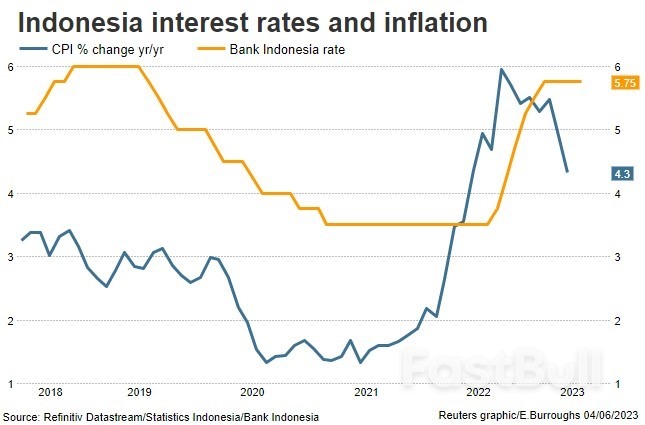
          The Asian and Pacific economic data calendar on Monday will be dominated by a raft of purchasing managers index (PMI) reports, most notably for China, Japan, India and Australia, with Indonesian inflation thrown in for good measure.
          Teed up for A Bullish Start to The Week_1Asia's PMIs have been mixed. Manufacturing in India is growing at its fastest pace in two and a half years, South Korea's is in its longest spell of contractionary readings in 14 years.
          Market sentiment in Asia on Monday could also get a lift from signs of a potential thaw in U.S.-Sino relations, as a senior U.S. State Department official arrived in Beijing on Sunday with meetings planned for the coming week.
          On the other hand, oil prices could spike higher on the news that OPEC+ is looking to cut production to counter flagging prices and a looming supply glut.
          Looking ahead, investors in Asia have plenty of economic events and monetary policy decisions to get their teeth into this week.
          Inflation data from Indonesia, the Philippines, Thailand, Taiwan and China will be released, starting with Indonesia on Monday. Economists polled by Reuters expect annual CPI inflation eased in May to a one-year low of 4.22% from 4.33% in April.
          Teed up for A Bullish Start to The Week_2Revised Japanese GDP is out on Thursday, while the monthly 'data dump' from China this week includes consumer and producer price inflation, trade, FX reserves and total social financing (TSF), a broad measure of credit and liquidity in the economy.
          These reports will give a clearer picture on how the world's second largest economy is emerging from its pandemic lockdown. So far, it has massively undershot expectations, which is why Chinese assets have been under so much pressure.
          On Tuesday, the Reserve Bank of Australia is expected to keep its cash rate on hold at 3.85%, and on Thursday the Reserve Bank of India is also expected to keep its repo rate unchanged at 6.50%, according to Reuters polls.
          Here are three key developments that could provide more direction to markets on Monday:
          - PMIs from China, Japan, India, Australia
          - Indonesia CPI inflation (May)
          - Singapore retails sales (April)

          Source: Yahoo

          To stay updated on all economic events of today, please check out our Economic calendar
          Risk Warnings and Disclaimers
          You understand and acknowledge that there is a high degree of risk involved in trading. Following any strategies or investment methods may lead to potential losses. The content on the site is provided by our contributors and analysts for information purposes only. You are solely responsible for determining whether any trading assets, securities, strategy, or any other product is suitable for investing based on your own investment objectives and financial situation.
          Comments
          Add to Favorites
          Share

          Tata Group's $1.6 Billion Investment Sets Stage for Indian EV Battery Manufacturing Revolution

          Warren Takunda

          Traders' Opinions

          In a significant development for India's burgeoning electric vehicle (EV) industry, Tata Group, one of the country's largest conglomerates, has announced plans to construct a state-of-the-art giga-factory in Sanand, Gujarat, dedicated to the production of lithium-ion cells. This landmark agreement, backed by an estimated initial investment of approximately 130 billion rupees ($1.6 billion), is poised to reshape the nation's EV landscape and reinforce India's commitment to building a robust electric vehicle supply chain.
          The strategic decision made by Tata Group reflects a deep understanding of the growing demand for EVs in India, along with the need for a localized battery manufacturing ecosystem. The new facility, with an initial manufacturing capacity of 20 Gigawatt hours (GWh), will play a pivotal role in fulfilling India's ambition to establish a self-reliant EV industry.
          By investing in this giga-factory, Tata Group aims to leverage the rapid growth potential of the Indian EV market and position itself as a frontrunner in the domestic battery manufacturing sector. This move aligns with the company's broader sustainability objectives and its commitment to reducing carbon emissions.
          The plant's location in Sanand, Gujarat, was strategically chosen due to its favorable business environment, proximity to key markets, and strong support from the local government. This collaborative effort between Tata Group and the Gujarat government highlights the commitment of both parties to foster industrial development and promote clean energy solutions in the region.
          The giga-factory's first phase will provide an initial manufacturing capacity of 20 GWh, a substantial boost to India's domestic battery production capabilities. Notably, plans for the future include the possibility of doubling the plant's capacity through a second phase of expansion. This forward-thinking approach demonstrates Tata Group's long-term commitment to meeting the evolving demands of the EV industry and contributing to India's green energy revolution.
          The establishment of this advanced battery manufacturing facility will not only bolster the domestic supply chain but also create significant employment opportunities. It is anticipated that the project will generate a substantial number of direct and indirect jobs, further driving economic growth in the region and supporting India's overall development objectives.
          The Tata Group's foray into EV battery production represents a transformative milestone for the Indian automotive industry. By localizing the manufacturing of lithium-ion cells, India can significantly reduce its dependence on imports and establish a robust ecosystem for electric vehicle production. This development is expected to catalyze further investment in the sector and encourage the growth of ancillary industries, including EV component manufacturing and research and development.
          With Tata Group's commitment to innovation, sustainability, and technological advancements, their ambitious investment in the giga-factory marks a pivotal moment in India's journey towards a cleaner and greener transportation future. The project aligns with the government's ambitious vision for electric mobility, contributing to a more sustainable and eco-friendly transportation landscape for the nation.
          Overall, Tata Group's $1.6 billion investment in the giga-factory signifies a significant stride towards India's ambition of becoming a global leader in the electric vehicle sector. The project holds the potential to revolutionize the country's EV industry, foster economic growth, and contribute to a greener and more sustainable future for India.
          Risk Warnings and Disclaimers
          You understand and acknowledge that there is a high degree of risk involved in trading. Following any strategies or investment methods may lead to potential losses. The content on the site is provided by our contributors and analysts for information purposes only. You are solely responsible for determining whether any trading assets, securities, strategy, or any other product is suitable for investing based on your own investment objectives and financial situation.
          Comments
          Add to Favorites
          Share
          FastBull
          Copyright © 2025 FastBull Ltd

          728 RM B 7/F GEE LOK IND BLDG NO 34 HUNG TO RD KWUN TONG KLN HONG KONG

          TelegramInstagramTwitterfacebooklinkedin
          App Store Google Play Google Play
          Products
          Charts

          Chats

          Q&A with Experts
          Screeners
          Economic Calendar
          Data
          Tools
          Membership
          Features
          Function
          Markets
          Copy Trading
          Latest Signals
          Contests
          News
          Analysis
          24/7
          Columns
          Education
          Company
          Careers
          About Us
          Contact Us
          Advertising
          Help Center
          Feedback
          User Agreement
          Privacy Policy
          Business

          White Label

          Data API

          Web Plug-ins

          Poster Maker

          Affiliate Program

          Risk Disclosure

          The risk of loss in trading financial instruments such as stocks, FX, commodities, futures, bonds, ETFs and crypto can be substantial. You may sustain a total loss of the funds that you deposit with your broker. Therefore, you should carefully consider whether such trading is suitable for you in light of your circumstances and financial resources.

          No decision to invest should be made without thoroughly conducting due diligence by yourself or consulting with your financial advisors. Our web content might not suit you since we don't know your financial conditions and investment needs. Our financial information might have latency or contain inaccuracy, so you should be fully responsible for any of your trading and investment decisions. The company will not be responsible for your capital loss.

          Without getting permission from the website, you are not allowed to copy the website's graphics, texts, or trademarks. Intellectual property rights in the content or data incorporated into this website belong to its providers and exchange merchants.

          Not Logged In

          Log in to access more features

          FastBull Membership

          Not yet

          Purchase

          Become a signal provider
          Help Center
          Customer Service
          Dark Mode
          Price Up/Down Colors

          Log In

          Sign Up

          Position
          Layout
          Fullscreen
          Default to Chart
          The chart page opens by default when you visit fastbull.com