• Trade
  • Markets
  • Copy
  • Contests
  • News
  • 24/7
  • Calendar
  • Q&A
  • Chats
Trending
Screeners
SYMBOL
LAST
BID
ASK
HIGH
LOW
NET CHG.
%CHG.
SPREAD
SPX
S&P 500 Index
6886.69
6886.69
6886.69
6900.68
6824.70
+46.18
+ 0.68%
--
DJI
Dow Jones Industrial Average
48057.74
48057.74
48057.74
48197.30
47462.94
+497.46
+ 1.05%
--
IXIC
NASDAQ Composite Index
23654.15
23654.15
23654.15
23704.08
23435.17
+77.67
+ 0.33%
--
USDX
US Dollar Index
98.550
98.630
98.550
98.720
98.490
-0.040
-0.04%
--
EURUSD
Euro / US Dollar
1.17046
1.17054
1.17046
1.17070
1.16821
+0.00098
+ 0.08%
--
GBPUSD
Pound Sterling / US Dollar
1.33745
1.33755
1.33745
1.33917
1.33578
-0.00052
-0.04%
--
XAUUSD
Gold / US Dollar
4215.51
4215.92
4215.51
4247.68
4204.22
-12.71
-0.30%
--
WTI
Light Sweet Crude Oil
57.667
57.697
57.667
58.772
57.584
-1.010
-1.72%
--

Community Accounts

Signal Accounts
--
Profit Accounts
--
Loss Accounts
--
View More

Become a signal provider

Sell trading signals to earn additional income

View More

Guide to Copy Trading

Get started with ease and confidence

View More

Signal Accounts for Members

All Signal Accounts

Best Return
  • Best Return
  • Best P/L
  • Best MDD
Past 1W
  • Past 1W
  • Past 1M
  • Past 1Y

All Contests

  • All
  • Trump Updates
  • Recommend
  • Stocks
  • Cryptocurrencies
  • Central Banks
  • Featured News
Top News Only
Share

Mexico Tariff Hike To Impact $1 Billion Worth Of India Car Exports - Sources, Industry Group Letter

Share

Swiss National Bank: Baseline Scenario, Anticipates Growth In The Global Economy Will Be Moderate Over The Coming Quarters

Share

Swiss National Bank: Although US Tariffs And Trade Policy Uncertainty Weighed On The Global Economy, Economic Development In Many Countries Has Thus Far Remained More Resilient Than Had Been Assumed

Share

Swiss National Bank: Economic Outlook For Switzerland Has Improved Slightly Due To The Lower US Tariffs Andsomewhat Better Development Globally

Share

Swiss National Bank: Main Risk To The Economic Outlook For Switzerland Is The Development Of The Globaleconomy

Share

SNB Sees Q3 2028 Inflation At 0.8%

Share

Swiss National Bank: Inflationary Pressure Is Virtually Unchanged Compared To The Last Monetary Policy Assessment

Share

SNB Sees 2026 Swiss GDP At Around 1% (Previous Forecast Was For Around 1%)

Share

SNB Sees 2025 Swiss GDP At Around 1.5% (Previous Forecast Was For 1.0-1.5%)

Share

Banks' Sight Deposits Held At The SNB Will Be Remunerated At The SNB Policy Rate Up To A Certain Threshold

Share

SNB Sees 2027 Inflation At 0.6% (Previous Forecast Was For 0.7%)

Share

SNB Sees 2026 Inflation At 0.3% (Previous Forecast Was For 0.5%)

Share

SNB Sees 2025 Inflation At 0.2% (Previous Forecast Was For 0.2%)

Share

SNB: Remain Willing To Be Active In The Foreign Exchange Market As Necessary

Share

Swiss National Bank Keeps Interest Rate Unchanged At 0.00%

Share

French Otc Day-Ahead Baseload Power Price Up 9% At 82 EUR/Mwh - Lseg Data

Share

Russian Foreign Minister Lavrov: The Root Causes Of The Conflict Need To Be Resolved - NATO Membership For Ukraine Is Unacceptable For Russia

Share

Russian Foreign Minister Lavrov: There Should Be Security Guarantees For All Sides

Share

Oman Oct Conventional Bank Lending +8.57% Year-On-Year - Central Bank

Share

Russian Foreign Minister Lavrov: We Want A Package Of Documents On A Long-Term Sustainable Peace For Ukraine

TIME
ACT
FCST
PREV
U.S. EIA Weekly Gasoline Stocks Change

A:--

F: --

P: --

U.S. EIA Weekly Crude Demand Projected by Production

A:--

F: --

P: --

U.S. EIA Weekly Cushing, Oklahoma Crude Oil Stocks Change

A:--

F: --

P: --

U.S. EIA Weekly Crude Stocks Change

A:--

F: --

P: --

U.S. EIA Weekly Crude Oil Imports Changes

A:--

F: --

P: --

U.S. EIA Weekly Heating Oil Stock Changes

A:--

F: --

P: --

U.S. Refinitiv/Ipsos Primary Consumer Sentiment Index (PCSI) (Dec)

A:--

F: --

P: --

China, Mainland M1 Money Supply YoY (Nov)

--

F: --

P: --

China, Mainland M0 Money Supply YoY (Nov)

--

F: --

P: --

China, Mainland M2 Money Supply YoY (Nov)

--

F: --

P: --

Russia CPI YoY (Nov)

A:--

F: --

P: --

U.S. Federal Funds Rate Projections-Longer Run (Q4)

A:--

F: --

P: --

U.S. Federal Funds Rate Projections-1st Year (Q4)

A:--

F: --

P: --

U.S. Target Federal Funds Rate Lower Limit (Overnight Reverse Repo Rate)

A:--

F: --

P: --

U.S. Federal Funds Rate Projections-2nd Year (Q4)

A:--

F: --

P: --

U.S. Budget Balance (Nov)

A:--

F: --

P: --

U.S. Target Federal Funds Rate Upper Limit (Excess Reserves Ratio)

A:--

F: --

P: --

U.S. Interest Rate On Reserve Balances

A:--

F: --

P: --

U.S. Federal Funds Rate Projections-Current (Q4)

A:--

F: --

P: --

U.S. Federal Funds Rate Target

A:--

F: --

P: --

U.S. Federal Funds Rate Projections-3rd Year (Q4)

A:--

F: --

P: --

FOMC Statement
FOMC Press Conference
Brazil Selic Interest Rate

A:--

F: --

P: --

U.K. 3-Month RICS House Price Balance (Nov)

A:--

F: --

P: --

Australia Employment (Nov)

A:--

F: --

P: --

Australia Full-time Employment (SA) (Nov)

A:--

F: --

P: --

Australia Unemployment Rate (SA) (Nov)

A:--

F: --

P: --

Australia Labor Force Participation Rate (SA) (Nov)

A:--

F: --

P: --

Turkey Retail Sales YoY (Oct)

A:--

F: --

P: --

South Africa Mining Output YoY (Oct)

--

F: --

P: --

South Africa Gold Production YoY (Oct)

--

F: --

P: --

Italy Quarterly Unemployment Rate (SA) (Q3)

--

F: --

P: --

IEA Oil Market Report
Turkey 1-Week Repo Rate

--

F: --

P: --

South Africa Refinitiv/Ipsos Primary Consumer Sentiment Index (PCSI) (Dec)

--

F: --

P: --

Turkey Overnight Lending Rate (O/N) (Dec)

--

F: --

P: --

Turkey Late Liquidity Window Rate (LON) (Dec)

--

F: --

P: --

U.K. Refinitiv/Ipsos Primary Consumer Sentiment Index (PCSI) (Dec)

--

F: --

P: --

Brazil Retail Sales MoM (Oct)

--

F: --

P: --

U.S. Weekly Continued Jobless Claims (SA)

--

F: --

P: --

U.S. Exports (Sept)

--

F: --

P: --

U.S. Trade Balance (Sept)

--

F: --

P: --

U.S. Weekly Initial Jobless Claims (SA)

--

F: --

P: --

Canada Imports (SA) (Sept)

--

F: --

P: --

U.S. Initial Jobless Claims 4-Week Avg. (SA)

--

F: --

P: --

Canada Trade Balance (SA) (Sept)

--

F: --

P: --

Canada Exports (SA) (Sept)

--

F: --

P: --

U.S. Wholesale Sales MoM (SA) (Sept)

--

F: --

P: --

U.S. EIA Weekly Natural Gas Stocks Change

--

F: --

P: --

U.S. 30-Year Bond Auction Avg. Yield

--

F: --

P: --

Argentina CPI MoM (Nov)

--

F: --

P: --

Argentina National CPI YoY (Nov)

--

F: --

P: --

Argentina 12-Month CPI (Nov)

--

F: --

P: --

U.S. Weekly Treasuries Held by Foreign Central Banks

--

F: --

P: --

Japan Industrial Output Final MoM (Oct)

--

F: --

P: --

Japan Industrial Output Final YoY (Oct)

--

F: --

P: --

Germany HICP Final YoY (Nov)

--

F: --

P: --

Germany HICP Final MoM (Nov)

--

F: --

P: --

Germany CPI Final MoM (Nov)

--

F: --

P: --

Germany CPI Final YoY (Nov)

--

F: --

P: --

Q&A with Experts
    • All
    • Chatrooms
    • Groups
    • Friends
    Connecting
    .
    .
    .
    Type here...
    Add Symbol or Code

      No matching data

      All
      Trump Updates
      Recommend
      Stocks
      Cryptocurrencies
      Central Banks
      Featured News
      • All
      • Russia-Ukraine Conflict
      • Middle East Flashpoint
      • All
      • Russia-Ukraine Conflict
      • Middle East Flashpoint
      Search
      Products

      Charts Free Forever

      Chats Q&A with Experts
      Screeners Economic Calendar Data Tools
      Membership Features
      Data Warehouse Market Trends Institutional Data Policy Rates Macro

      Market Trends

      Market Sentiment Order Book Forex Correlations

      Top Indicators

      Charts Free Forever
      Markets

      News

      News Analysis 24/7 Columns Education
      From Institutions From Analysts
      Topics Columnists

      Latest Views

      Latest Views

      Trending Topics

      Top Columnists

      Latest Update

      Signals

      Copy Rankings Latest Signals Become a signal provider AI Rating
      Contests
      Brokers

      Overview Brokers Assessment Rankings Regulators News Claims
      Broker listing Forex Brokers Comparison Tool Live Spread Comparison Scam
      Q&A Complaint Scam Alert Videos Tips to Detect Scam
      More

      Business
      Events
      Careers About Us Advertising Help Center

      White Label

      Data API

      Web Plug-ins

      Affiliate Program

      Awards Institution Evaluation IB Seminar Salon Event Exhibition
      Vietnam Thailand Singapore Dubai
      Fans Party Investment Sharing Session
      FastBull Summit BrokersView Expo
      Recent Searches
        Top Searches
          Markets
          News
          Analysis
          User
          24/7
          Economic Calendar
          Education
          Data
          • Names
          • Latest
          • Prev

          View All

          No data

          Scan to Download

          Faster Charts, Chat Faster!

          Download App
          English
          • English
          • Español
          • العربية
          • Bahasa Indonesia
          • Bahasa Melayu
          • Tiếng Việt
          • ภาษาไทย
          • Français
          • Italiano
          • Türkçe
          • Русский язык
          • 简中
          • 繁中
          Open Account
          Search
          Products
          Charts Free Forever
          Markets
          News
          Signals

          Copy Rankings Latest Signals Become a signal provider AI Rating
          Contests
          Brokers

          Overview Brokers Assessment Rankings Regulators News Claims
          Broker listing Forex Brokers Comparison Tool Live Spread Comparison Scam
          Q&A Complaint Scam Alert Videos Tips to Detect Scam
          More

          Business
          Events
          Careers About Us Advertising Help Center

          White Label

          Data API

          Web Plug-ins

          Affiliate Program

          Awards Institution Evaluation IB Seminar Salon Event Exhibition
          Vietnam Thailand Singapore Dubai
          Fans Party Investment Sharing Session
          FastBull Summit BrokersView Expo

          China’s Record Trade Surplus Reveals Its Biggest Strength – and Hidden Weakness

          Warren Takunda

          Economic

          Summary:

          Booming Chinese exports have driven trade surplus past $1tn but also reveal the extent of country’s reliance on foreign markets

          A boom in exports that has pushed China’s trade surplus past $1tn for the first time reveals the extent to which its economy is still overwhelmingly reliant on foreign markets – and the difficulty figures like Donald Trump will have in trying to rebalance global trade.
          Data released on Monday shows that in the first 11 months of this year, China’s trade surplus in goods was $1.076tn. The record trade surplus comes even as exports to the US have plummeted, a reflection of the bruising US-China trade war that, despite a recent cooling, has dampened the flow of goods between the world’s two largest economies.
          Exports to the US plummeted by nearly a third in November. Speaking on Tuesday, Chinese premier Li Qiang said the “mutually destructive consequences of tariffs have become increasingly evident”.
          The fall in exports to the US has led to concerns that China is flooding other parts of the world – especially south-east Asia and Europe – with cheap goods that threaten local industry.
          But experts believe that many of the goods bound for south-east Asia ultimately end up in the US, via a practice known as trans-shipment where products are sent via a third country to avoid tariffs. That is because the demand in the US for cheap products has not gone away, and few countries can replicate China’s mammoth ability to produce consumer goods at scale at low prices.
          In the first eight months of this year, the US imported $23.1bn in goods from Indonesia, an increase of nearly a third on the same period in 2024. Experts believe this rise is largely down to Chinese goods being redirected via Indonesia.
          There have also been increases in imports from Malaysia and the Philippines.
          The statistics suggest that the huge tariffs placed by the US and China on each other’s goods has dented bilateral trade but done little to change the overall flow of goods in the global economy.
          And as China becomes dominant in the production of hi-tech goods such as electric vehicles and batteries, it is unlikely to lose its place as the world’s factory for the products that are vital to global development. While overall Chinese exports grew by 5.4% this year, certain products – such as semiconductors – saw even larger increases, with a 24.7% jump in exports, according to Chatham House.
          Exports to the EU rose sharply in November, by 14.8%, compared with 0.9% in October.
          French president Emmanuel Macron said in an interview published over the weekend that on a recent trip to China he had threatened China’s leader, Xi Jinping, with tariffs if there was no action taken to reduce the trade deficit with the EU.
          Economists at Morgan Stanley expect China to increase its share of global exports from 15% to 16.5% by 2030.
          Zichun Huang, China economist at Capital Economics, agreed, telling Reuters: “We expect China’s exports will remain resilient, with the country continuing to gain global market share next year.”
          The data also reveal the extent to which China’s economy is still dependent on exports, despite efforts in Beijing to rebalance the economy at home and boost domestic demand.
          Xi chaired a meeting of the Chinese Communist party’s ruling politburo on Monday. According to a readout in state media, the cadres discussed the need to “continuously expand domestic demand” and to make consumption the “main driver” of the economy.
          Boosting consumer spending is expected to be a top economic priority in 2026. But policymakers have a big hill to climb. Chinese households are keen on saving money, a trend exacerbated by the pandemic and real estate crash in China that wiped out many people’s savings. Chinese consumption as a share of GDP is about 50%, compared to about 80% in the US.

          Source: Theguardian

          To stay updated on all economic events of today, please check out our Economic calendar
          Risk Warnings and Disclaimers
          You understand and acknowledge that there is a high degree of risk involved in trading. Following any strategies or investment methods may lead to potential losses. The content on the site is provided by our contributors and analysts for information purposes only. You are solely responsible for determining whether any trading assets, securities, strategy, or any other product is suitable for investing based on your own investment objectives and financial situation.
          Add to Favorites
          Share

          Fed May Need QE If Market Questions New Chair, Man Group Says

          Adam

          Economic

          The Federal Reserve may have to turn to quantitative easing to lower long-term borrowing costs if bond markets start to question the independence of the next chairman, according to Man Group.
          Investors only have to look at what happened in the UK when traders sold off gilts in 2022 due to a lack of confidence in the economic policies of then-Prime Minister Liz Truss, said Kristina Hooper, chief market strategist at the world’s largest publicly traded hedge fund group.
          UK borrowing costs have been higher than many other Group-of-Seven economies since then, which is a reminder that “credibility of public officials matters,” Hooper wrote in a LinkedIn post.
          “If anyone perceived to be less than independent is chosen as Fed chair and is focused on lowering rates at the long end, I suspect that person will have to resort to quantitative easing to offer the best chance to achieve that objective,” she said.
          Treasury 10-year yields have already climbed more than 20 basis points from their October lows, an unusual phenomenon given the Fed is likely to make another quarter-point interest-rate cut this week.
          President Donald Trump has said he’s close to naming his choice to replace Chair Jerome Powell, whose term ends in May. White House National Economic Council Director Kevin Hassett has emerged as the front-runner.
          Hassett is widely considered a supporter of Trump’s preference for lower rates. Trump said earlier this month that the race for the central bank chief job is “down to one” while referring to Hassett as a “potential Fed chair.”
          Hassett said on Monday it would be irresponsible for the Fed to lay out a plan for where it aims to take interest rates over the next six months.
          While equity investors typically have “simple motivations” such as loose monetary policy, bond investors are more focused on fiscal sustainability and Fed independence, according to Man Group’s Hooper.
          “Cutting the fed funds rate does not ensure that rates on the long end move lower; in fact, it could have the opposite effect,” she said.
          Fed May Need QE If Market Questions New Chair, Man Group Says_1
          PGIM Fixed Income’s co-chief investment officer Gregory Peters last week pointed to the rise in Treasury yields since it was first reported that Hassett had emerged as the leading contender to take over from Powell.
          The increasing chance of Hassett getting the job has fueled questions about the independence of the Fed, which remains a major concern for investors, said Peters, who is also a member of the Treasury Borrowing Advisory Committee.

          Source: Bloomberg

          To stay updated on all economic events of today, please check out our Economic calendar
          Risk Warnings and Disclaimers
          You understand and acknowledge that there is a high degree of risk involved in trading. Following any strategies or investment methods may lead to potential losses. The content on the site is provided by our contributors and analysts for information purposes only. You are solely responsible for determining whether any trading assets, securities, strategy, or any other product is suitable for investing based on your own investment objectives and financial situation.
          Add to Favorites
          Share

          Global Pilots Warn India's Rest Rule Exemption For IndiGo Raises Safety Concerns

          Samantha Luan

          Political

          Economic

          · India grants IndiGo exemption from pilot night-duty rules
          · IFALPA president warns exemption not based on scientific evidence
          · Pilots push for global common standard to combat fatigue
          · Canadian pilots say regulator has proposed exemptions to duty rules

          India's decision to ease stricter rules on pilot rest following a wave of flight cancellations by the country's largest carrier should be reversed due to the adverse effect of fatigue on safety, the head of global pilot union group IFALPA said.

          IndiGo (INGL.NS), which controls about 65% of India's domestic aviation market, has said it failed to plan adequately for a November 1 deadline to implement stricter rules on night flying and weekly rest for pilots.

          The poor planning resulted in at least 2,000 flight cancellations this month, leaving tens of thousands of passengers stranded, upending vacation plans and weddings, and sparking growing fury about lost luggage.

          India's aviation regulator on Friday granted IndiGo a one-time exemption from new pilot night-duty rules and withdrew a rule that stopped airlines from counting pilot leave as weekly rest.

          Captain Ron Hay, president of the Montreal-based International Federation of Air Line Pilots' Associations (IFALPA), said India's decision to grant the exemption to the rest rules was concerning because it was not based on scientific evidence.

          "We are informed that the change is due to staffing issues," he told Reuters on Monday. "This is troubling as fatigue clearly affects safety."

          Hay warned the government's decision could also exacerbate staffing issues given that working conditions account for one of the reasons pilots depart airlines based in the country.

          India's civil aviation ministry did not immediately respond to a request for comment outside regular business hours.

          MORE SPECIFIC GLOBAL PILOT FATIGUE STANDARD SOUGHT

          Hay's comments come as IFALPA is pushing for a more specific global standard that would combat pilot fatigue evenly across regions, as aviators in other countries also press back against exemptions.

          Under the U.N. aviation agency's global standard, each country can set its own duty-time limits using scientific knowledge and operational experience.

          The result is there are still regional differences, with some of the most robust systems to promote pilot rest found in Europe and the United States, Hay said.

          In Canada, the Air Line Pilots Association said the country's regulator has proposed exemptions to science-based duty-time regulations.

          For example, one proposed exemption from Transport Canada would allow pilots to work up to 23 days in a row rather than having a day off per week, ALPA Canada President Captain Tim Perry said in an interview.

          "If adopted we would have more pilots fatigued, more often, and with worse fatigue symptoms, all to the detriment of air safety," he said.

          Transport Canada did not respond immediately to a request for comment.

          Source: Reuters

          To stay updated on all economic events of today, please check out our Economic calendar
          Risk Warnings and Disclaimers
          You understand and acknowledge that there is a high degree of risk involved in trading. Following any strategies or investment methods may lead to potential losses. The content on the site is provided by our contributors and analysts for information purposes only. You are solely responsible for determining whether any trading assets, securities, strategy, or any other product is suitable for investing based on your own investment objectives and financial situation.
          Add to Favorites
          Share

          Is Japan in a Death Spiral? A Contrarian Take

          Adam

          Economic

          A day doesn’t seem to go by without a market pundit asserting that Japan is in a monetary and fiscal death spiral. It’s easy to come to such a conclusion given:
          Debt to GDP: 230%.
          Bank of Japan (BOJ): Holds over 50% Japanese Treasury debt.
          Population: Shrinking by 0.5% a year.
          GDP Stagnation: Real GDP has grown by less than 0.5% annualized since 2008.
          Debt Servicing: Nearly 25% of Japan’s fiscal budget is spent on servicing its debt.
          Yen: Its currency has fallen by over 50% against the US dollar since 2012, as shown below.
          Based on those stats and others, it’s easy to see why many think it’s only a matter of time before Japan’s economic system collapses. Michael Nicoletos, in Japan Isn’t Losing Control, argues otherwise.
          In fact, he thinks everything is going according to plan. To wit, he deems the BOJ as “the most experienced unconventional monetary operator on the planet.” With the Bank of Japan owning about half of all Japanese government bonds and domestic holders a large majority of the remaining debt, Japan effectively is its own bond market. This allows the BOJ to let long‑term yields rise and engineer a weaker yen, which boosts exporters’ profits. To wit:
          When Toyota’s finance team crunches the numbers, they estimate they gain about $300 million in profit for every single yen the currency weakens against the dollar.
          Michael believes Japan and China are in a “diplomatic crisis.” Given that their second-largest trade customer is China, Japan needs to diversify. A weaker yen allows such to occur. He states:
          Japanese goods are becoming cheaper relative to Chinese alternatives, not just for American buyers, but also for customers throughout Southeast Asia, Europe, and Latin America. Just as political tensions make relying on China riskier, Japan becomes a more attractive alternative supplier.
          Overall, Michael claims that “the yen is not crashing because Japan lost control” but because “Japan wants it to.” Furthermore, this is a major but “underappreciated” story in global finance.
          Is Japan in a Death Spiral? A Contrarian Take_1
          Breadth Is Good, But Confusing
          As we share below, all but one of the stock factors is overbought on an absolute basis. The one oversold factor is low-beta stocks. Interestingly, the high dividend yield factor is among the most overbought sectors. Generally, over the last six months, low-beta, high-dividend, small-cap, and value-oriented sectors have had similar scores and, for the most part, been among the worst performers.
          The current divergence is unique for this cycle. Similarly, note the divergence between emerging and developed markets. And for that matter, the separation between small-cap value and small caps.
          Sector analysis shows that interest rate-sensitive sectors, especially utilities, are oversold relative to the market. It’s worth noting that natural gas prices are up by more than 50% since mid-October. Given that many utilities’ customer pricing is regulated, the higher prices of its primary input are weighing on margins.
          Is Japan in a Death Spiral? A Contrarian Take_2

          Source: investing

          To stay updated on all economic events of today, please check out our Economic calendar
          Risk Warnings and Disclaimers
          You understand and acknowledge that there is a high degree of risk involved in trading. Following any strategies or investment methods may lead to potential losses. The content on the site is provided by our contributors and analysts for information purposes only. You are solely responsible for determining whether any trading assets, securities, strategy, or any other product is suitable for investing based on your own investment objectives and financial situation.
          Add to Favorites
          Share

          U.S. Private Payrolls Increase By 4,750 On Average In 4 Weeks To November 22 - ADP

          Justin

          Economic

          U.S. private payrolls increased by 4,750 on average per week in the four weeks ending on November 22, according to a weekly update of the monthly ADP National Employment Report.

          The data comes after hiring in the American private sector notched its biggest drop in more than two and a half years in November.

          However, analysts cautioned against reading too much into the figures, arguing that the monthly estimate has recently diverged from a separate gauge of the U.S. employment market from the Labor Department's Bureau of Labor Statistics.

          The BLS is due to release its closely-monitored nonfarm payrolls report for November on December 16, after it was delayed by a record-long U.S. government shutdown. The October unemployment rate will also never be known, after having hovered around a four-year high of 4.4% in September.

          But the economy is still tipped to have shed jobs in October, as thousands of federal workers accepted buyout packages which would take them off government payrolls.

          Federal Reserve policymakers and investors alike have been forced to rely on alternative data sources because of the blackout of official data, intensifying the spotlight recently on some of these numbers.

          On Tuesday, the Fed is due to begin its latest two-day policy gathering. Markets are widely betting that the central bank, assessing a slowing labor market, resilient consumer spending and sticky inflation, will slash interest rates by 25 basis points at the end of the meeting.

          Source: Investing

          To stay updated on all economic events of today, please check out our Economic calendar
          Risk Warnings and Disclaimers
          You understand and acknowledge that there is a high degree of risk involved in trading. Following any strategies or investment methods may lead to potential losses. The content on the site is provided by our contributors and analysts for information purposes only. You are solely responsible for determining whether any trading assets, securities, strategy, or any other product is suitable for investing based on your own investment objectives and financial situation.
          Add to Favorites
          Share

          Silver (XAG) Forecast: Can Powell Extend The Silver Rally? Key Silver Outlook Explained

          Golden Gleam

          Commodity

          Technical Analysis

          Silver Firms as Traders Brace for the Fed

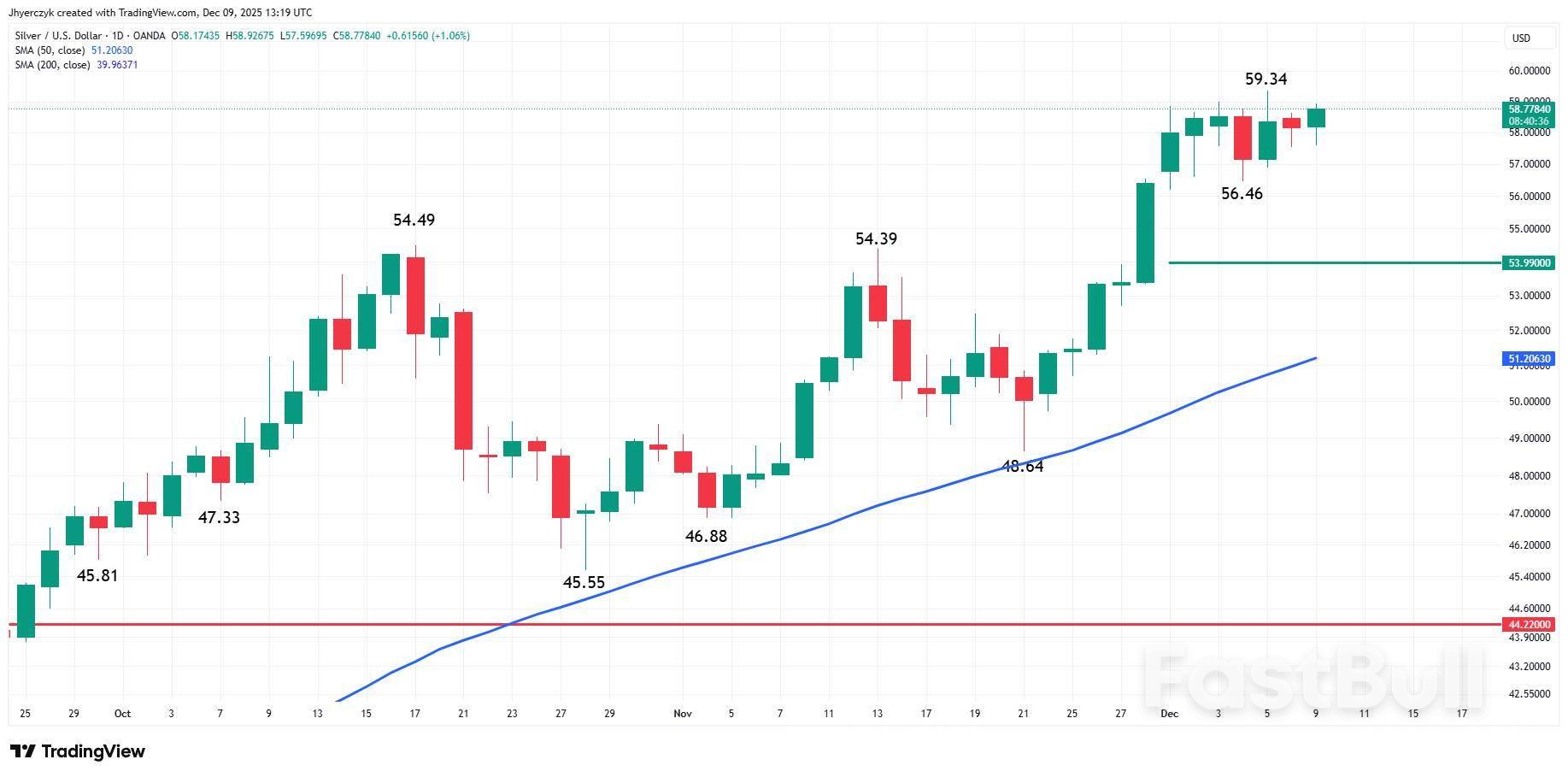
          Spot Silver is holding steady on Tuesday, ahead of the December 10 Fed decision, with the market essentially coiling for the next catalyst. Traders have priced in a near-certain 25-bp cut, and that expectation has kept a steady bid under precious metals. When the cost of holding non-yielding assets falls, silver tends to attract interest — and that pattern is showing up again.

          At 13:19 GMT, XAGUSD is trading $58.77, up $0.61 or +1.04%.

          ETF Inflows Keep Fueling the Upside

          One of the strongest supports for the market has been persistent ETF demand. Nearly 590 tonnes flowed into silver ETFs over the past week, while November added 15.7 million ounces — the heaviest monthly intake since July.

          That kind of buying isn't passive allocation; it's institutional money leaning into the trade. Sustained inflows across nine of the past eleven months tighten available supply and make short exposure harder to carry.

          Traders aren't chasing every uptick, but they're willing to buy weakness, and the flow backdrop explains why.

          Physical Tightness Remains a Core Theme

          Supply deficits now stretch into a fifth straight year. Exchange inventories sit at unusually low levels, and Shanghai warehouse stocks are at decade lows. China's decision to ship refined silver into London underscores how tight the physical market has become. Even if sentiment softens, the structural shortage acts like a cushion under prices and limits the depth of pullbacks.

          Dollar Softness Adds Another Tailwind

          The dollar index slipping under 100.000 recently has removed some pressure from metals, with dovish expectations for the Fed encouraging dollar sellers. It isn't the main driver this week, but it supports the broader bid for silver by making the metal more accessible to overseas buyers.

          Industrial Appetite Underwrites Medium-Term Strength

          Strong demand from solar manufacturing, electric vehicles, and broader green technologies continues to provide a sturdy foundation. Silver's dual role — investment asset and industrial input — gives traders confidence that the metal has meaningful demand behind it, even if investment flows pause.

          Short-Term Outlook: Powell Will Set the Tone

          Daily Silver (XAG/USD)

          The $56.46–$59.34 range reflects current trading behavior. The expected rate cut is largely baked in, so attention is locked on Chair Powell's guidance for 2026. A firmer stance on limiting further easing could trigger profit-taking toward support near $56.46. But a more accommodative message may encourage buyers to press through $59.34 and test the path toward $62, a level widely monitored by analysts.

          Bottom line: silver is leaning higher, but the follow-through depends on how far Powell opens — or closes — the door to additional cuts next year.

          Source: FX Empire

          Risk Warnings and Disclaimers
          You understand and acknowledge that there is a high degree of risk involved in trading. Following any strategies or investment methods may lead to potential losses. The content on the site is provided by our contributors and analysts for information purposes only. You are solely responsible for determining whether any trading assets, securities, strategy, or any other product is suitable for investing based on your own investment objectives and financial situation.
          Add to Favorites
          Share

          US stock market outlook for 2026: earnings and Fed support point higher

          Adam

          Stocks

          US stock market outlook 2026

          ​​​The case for US equities in 2026 rests on two pillars: earnings growth and a supportive Federal Reserve (Fed). Both look set to deliver, even if the path proves choppier than the straight-line gains seen in parts of 2024 and 2025.
          ​Corporate earnings have weathered the storm of higher rates and elevated costs remarkably well. Margins have held up, productivity gains are finally showing through, and revenue growth remains solid across most sectors. The pessimism that dominated much of 2022 and 2023 has proven misplaced, with companies demonstrating pricing power and operational efficiency that exceeded expectations.
          ​The AI investment boom is beginning to translate into tangible benefits. While sceptics focus on the massive capital expenditure, the productivity gains are becoming visible in corporate results. This supports both margin expansion and top-line growth, providing a foundation for continued earnings momentum through 2026.
          ​The Fed, meanwhile, has room to ease policy without reigniting inflation concerns. Disinflation is sufficiently entrenched that rate cuts can proceed at a measured pace, providing a tailwind for risk assets without requiring an economic crisis to justify them. This "goldilocks" scenario of growth with easing financial conditions is exactly what equity markets need.
          ​Valuation concerns are overblown. Yes, the market isn't cheap, but it rarely is at the start of sustained bull runs. Elevated multiples reflect strong fundamentals and improving earnings visibility, not irrational exuberance. The concentration in mega-cap tech simply reflects where the growth is, and there's no reason to expect this leadership to falter when these companies continue to deliver.
          ​Mid-term election years bring volatility, but the overall trajectory remains upward. Historical weakness in these periods tends to create buying opportunities rather than signalling sustained declines. With corporate balance sheets strong, buyback activity robust, and liquidity conditions improving, the path of least resistance is higher.
          ​Pullbacks will happen, as they always do. But the fundamental backdrop of earnings growth, Fed support and solid corporate fundamentals argues for buying dips rather than fighting the trend. The bull market has further to run.

          ​Technical analysis

          ​Dow Jones
          ​While 50,000 eluded the Dow Jones index in 2025, it staged an impressive recovery from the tariff panic of April. After dropping below the 200-day simple moving average (SMA) in March, and then falling to below 37,000, the index recovered its losses and then moved higher, and by mid-August it was at a new record high.
          ​For the moment, the progression of new highs and higher lows confirms the solid technical outlook to match the strong earnings and macroeconomic picture.
          Dow Jones candlestick chart
          US stock market outlook for 2026: earnings and Fed support point higher_1

          S&P 500

          ​It is a similar picture for this index, and the S&P 500's bigger weighting to the tech sector meant that the recovery has been even stronger. The rally since April has been remarkably quiet, with only the November pullback really threatening to disrupt the broader uptrend.
          ​S&P 500 candlestick chart
          US stock market outlook for 2026: earnings and Fed support point higher_2
          A note on volatility
          ​Apart from March-May, the year has been quite a quiet one overall. Investors and traders alike need to be prepared for the possibility that this will not be the case next year. It is now around eight months since the 20% drop in April, which means we may be closer to the next drop than to the one last April. The ‘average’ year sees at least one fall of 14% for the S&P 500, and a similar one for the Dow.
          ​The quiet period of the last eight months will not last for ever, and it is important to be aware that volatility can return at some point in the new year.

          Source:ig

          Risk Warnings and Disclaimers
          You understand and acknowledge that there is a high degree of risk involved in trading. Following any strategies or investment methods may lead to potential losses. The content on the site is provided by our contributors and analysts for information purposes only. You are solely responsible for determining whether any trading assets, securities, strategy, or any other product is suitable for investing based on your own investment objectives and financial situation.
          Add to Favorites
          Share
          FastBull
          Copyright © 2025 FastBull Ltd

          728 RM B 7/F GEE LOK IND BLDG NO 34 HUNG TO RD KWUN TONG KLN HONG KONG

          TelegramInstagramTwitterfacebooklinkedin
          App Store Google Play Google Play
          Products
          Charts

          Chats

          Q&A with Experts
          Screeners
          Economic Calendar
          Data
          Tools
          Membership
          Features
          Function
          Markets
          Copy Trading
          Latest Signals
          Contests
          News
          Analysis
          24/7
          Columns
          Education
          Company
          Careers
          About Us
          Contact Us
          Advertising
          Help Center
          Feedback
          User Agreement
          Privacy Policy
          Business

          White Label

          Data API

          Web Plug-ins

          Poster Maker

          Affiliate Program

          Risk Disclosure

          The risk of loss in trading financial instruments such as stocks, FX, commodities, futures, bonds, ETFs and crypto can be substantial. You may sustain a total loss of the funds that you deposit with your broker. Therefore, you should carefully consider whether such trading is suitable for you in light of your circumstances and financial resources.

          No decision to invest should be made without thoroughly conducting due diligence by yourself or consulting with your financial advisors. Our web content might not suit you since we don't know your financial conditions and investment needs. Our financial information might have latency or contain inaccuracy, so you should be fully responsible for any of your trading and investment decisions. The company will not be responsible for your capital loss.

          Without getting permission from the website, you are not allowed to copy the website's graphics, texts, or trademarks. Intellectual property rights in the content or data incorporated into this website belong to its providers and exchange merchants.

          Not Logged In

          Log in to access more features

          FastBull Membership

          Not yet

          Purchase

          Become a signal provider
          Help Center
          Customer Service
          Dark Mode
          Price Up/Down Colors

          Log In

          Sign Up

          Position
          Layout
          Fullscreen
          Default to Chart
          The chart page opens by default when you visit fastbull.com