Markets
News
Analysis
User
24/7
Economic Calendar
Education
Data
- Names
- Latest
- Prev



Signal Accounts for Members
All Signal Accounts
All Contests


Deutsche Bank: We Are Cooperating Fully With Prosecutor's Office. We Cannot Comment Further On This Matter
US President Trump: The Next Attack On Iran Will Be Worse Than The Attack On Its Nuclear Facilities
Bank Of America Will Match The USA Government's $1000 Pilot Contribution For All Eligible USA Teammates To Trump Accounts
The US MBA Mortgage Application Activity Index Fell 8.5% Week-over-week For The Week Ending January 23, Compared To 14.1% Previously

Mexico Trade Balance (Dec)A:--
F: --
P: --
U.S. Weekly Redbook Index YoYA:--
F: --
P: --
U.S. S&P/CS 20-City Home Price Index YoY (Not SA) (Nov)A:--
F: --
P: --
U.S. S&P/CS 20-City Home Price Index MoM (SA) (Nov)A:--
F: --
U.S. FHFA House Price Index MoM (Nov)A:--
F: --
P: --
U.S. FHFA House Price Index (Nov)A:--
F: --
P: --
U.S. FHFA House Price Index YoY (Nov)A:--
F: --
U.S. S&P/CS 10-City Home Price Index YoY (Nov)A:--
F: --
P: --
U.S. S&P/CS 10-City Home Price Index MoM (Not SA) (Nov)A:--
F: --
P: --
U.S. S&P/CS 20-City Home Price Index (Not SA) (Nov)A:--
F: --
P: --
U.S. S&P/CS 20-City Home Price Index MoM (Not SA) (Nov)A:--
F: --
P: --
U.S. Richmond Fed Manufacturing Composite Index (Jan)A:--
F: --
P: --
U.S. Conference Board Present Situation Index (Jan)A:--
F: --
P: --
U.S. Conference Board Consumer Expectations Index (Jan)A:--
F: --
P: --
U.S. Richmond Fed Manufacturing Shipments Index (Jan)A:--
F: --
P: --
U.S. Richmond Fed Services Revenue Index (Jan)A:--
F: --
P: --
U.S. Conference Board Consumer Confidence Index (Jan)A:--
F: --
U.S. 5-Year Note Auction Avg. YieldA:--
F: --
P: --
U.S. API Weekly Refined Oil StocksA:--
F: --
P: --
U.S. API Weekly Crude Oil StocksA:--
F: --
P: --
U.S. API Weekly Gasoline StocksA:--
F: --
P: --
U.S. API Weekly Cushing Crude Oil StocksA:--
F: --
P: --
Australia RBA Trimmed Mean CPI YoY (Q4)A:--
F: --
P: --
Australia CPI YoY (Q4)A:--
F: --
P: --
Australia CPI QoQ (Q4)A:--
F: --
P: --
Germany GfK Consumer Confidence Index (SA) (Feb)A:--
F: --
P: --
Germany 10-Year Bund Auction Avg. YieldA:--
F: --
P: --
India Industrial Production Index YoY (Dec)A:--
F: --
P: --
India Manufacturing Output MoM (Dec)A:--
F: --
P: --
U.S. MBA Mortgage Application Activity Index WoWA:--
F: --
P: --
Canada Overnight Target Rate--
F: --
P: --
BOC Monetary Policy Report
U.S. EIA Weekly Crude Stocks Change--
F: --
P: --
U.S. EIA Weekly Cushing, Oklahoma Crude Oil Stocks Change--
F: --
P: --
U.S. EIA Weekly Crude Demand Projected by Production--
F: --
P: --
U.S. EIA Weekly Crude Oil Imports Changes--
F: --
P: --
U.S. EIA Weekly Heating Oil Stock Changes--
F: --
P: --
U.S. EIA Weekly Gasoline Stocks Change--
F: --
P: --
BOC Press Conference
Russia PPI MoM (Dec)--
F: --
P: --
Russia PPI YoY (Dec)--
F: --
P: --
U.S. Target Federal Funds Rate Lower Limit (Overnight Reverse Repo Rate)--
F: --
P: --
U.S. Interest Rate On Reserve Balances--
F: --
P: --
U.S. Federal Funds Rate Target--
F: --
P: --
U.S. Target Federal Funds Rate Upper Limit (Excess Reserves Ratio)--
F: --
P: --
FOMC Statement
FOMC Press Conference
Brazil Selic Interest Rate--
F: --
P: --
Australia Import Price Index YoY (Q4)--
F: --
P: --
Japan Household Consumer Confidence Index (Jan)--
F: --
P: --
Turkey Economic Sentiment Indicator (Jan)--
F: --
P: --
Euro Zone M3 Money Supply (SA) (Dec)--
F: --
P: --
Euro Zone Private Sector Credit YoY (Dec)--
F: --
P: --
Euro Zone M3 Money Supply YoY (Dec)--
F: --
P: --
Euro Zone 3-Month M3 Money Supply YoY (Dec)--
F: --
P: --
South Africa PPI YoY (Dec)--
F: --
P: --
Euro Zone Consumer Confidence Index Final (Jan)--
F: --
Euro Zone Selling Price Expectations (Jan)--
F: --
P: --
Euro Zone Industrial Climate Index (Jan)--
F: --
P: --
Euro Zone Services Sentiment Index (Jan)--
F: --
P: --


No matching data
Latest Views
Latest Views
Trending Topics
Top Columnists
Latest Update
White Label
Data API
Web Plug-ins
Affiliate Program
View All

No data
Chinese humanoid robot startups are accelerating global expansion plans, with early deployments targeting the Middle East and exploratory talks underway in the U.S., signaling rising competitive pressure on Western players such as Tesla’s Optimus....
Dollar's selloff extended through the week, only managing a brief pause after slipping through the key psychological level of 1.2 against Euro briefly. While the pace of decline has slowed, there is little sign of a meaningful recovery taking shape. The bounce has so far been shallow. And, Dollar remains under pressure on multiple fronts, with headwinds increasingly coming from within the US rather than from external shocks or data surprises.
Markets took particular note of remarks from US President Donald Trump, who expressed clear comfort with Dollar's decline. In a market accustomed to verbal pushback against sharp currency moves, the lack of resistance from the White House has been interpreted as a green light for further weakness.
Asked directly whether the Dollar had fallen too far after sliding about 10% over the past year, Trump dismissed the concern, saying the currency was "doing great" and pointing to strong business activity as justification. Trump also revisited his long-standing complaints about Asian currencies, recalling past disputes with Japan and China over devaluation. The contrast between those confrontations and his current stance reinforces the impression that a weaker Dollar is no longer seen as a problem.
Such remarks matter for markets. When the President signals indifference—or endorsement—toward currency depreciation, it emboldens traders to maintain pressure rather than anticipate a policy-backed rebound.
Adding to the unease, IMF Managing Director Kristalina Georgieva said earlier this week that the Fund is preparing for scenarios involving sharp selloffs in US dollar-denominated assets. While framed as contingency planning, the comments highlights growing institutional awareness of tail risks around the Dollar. Georgieva noted that the IMF is stress-testing "unthinkable" scenarios, including potential runs on Dollar assets, as part of its broader surveillance work. Even without assigning probabilities, the acknowledgement adds to a fragile confidence backdrop.
In currency markets, the impact is clear. For the week so far, Dollar sits at the bottom of the performance table, followed by Loonie and Sterling. At the other end, Yen remains the strongest, supported by lingering intervention threats, though follow-through buying has been limited. Swiss Franc is the second strongest, with gains against both Euro and Sterling pointing to underlying risk aversion. Aussie ranks third, buoyed by strong inflation data that has all but confirmed an RBA rate hike next week. Euro and Kiwi trade in the middle of the pack.
Australia's Q4 CPI showed little relief for RBA where it matters most for policy. Headline inflation rose 0.6% qoq, slightly below expectations of 0.7% and slowing sharply from the prior quarter's 1.3% gain. However, on an annual basis, CPI accelerated from 3.2% yoy to 3.6% yoy, matching forecasts and keeping inflation well above the RBA's target band.
The more important signal came from underlying inflation. Trimmed mean CPI rose 0.9% qoq, easing marginally from 1.0% previously but beating expectations of 0.8%. Annual trimmed mean inflation climbed from 3.0% yoy to 3.4% yoy, above the expected 3.2%, reinforcing concerns that price pressures remain persistent.
December's monthly details added to that unease. Headline CPI jumped 1.0% mom, lifting the annual rate from 3.5% yoy to 3.8%, both above expectations. Trimmed mean CPI rose a more modest 0.2% mom, but annual core inflation still edged up from 3.2% yoy to 3.3% yoy.
Price pressures remain broad in December. Goods inflation accelerated from 3.2% yoy to 3.4%, driven largely by a 21.5% surge in electricity prices. Services inflation climbed from 3.6% yoy to 4.1%, led by domestic travel and accommodation and rising rents.
Markets are now firming up their expectation that RBA will return to rate hike in February.
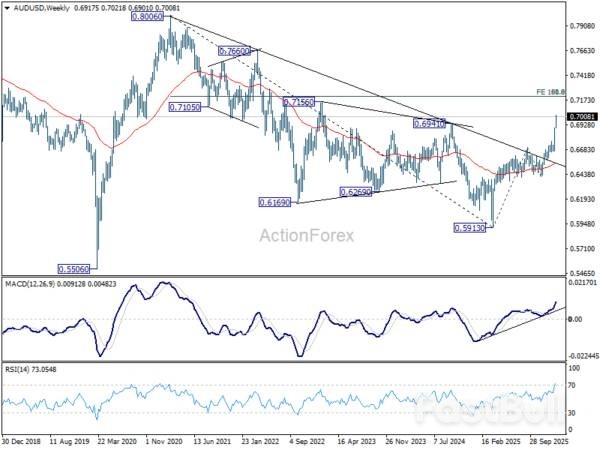
Australian Dollar extended its rally this week, with AUD/USD breaking above 0.70 psychological level. The move has been supported by broad-based Dollar weakness, but domestic factors have played a central role following Australia's stronger-than-expected inflation data.
December CPI showed another month of acceleration, while Q4 headline inflation printed at 3.6%. More importantly for policymakers, trimmed mean CPI at 3.4% underscored persistent underlying inflation that sits uncomfortably above the RBA's target band. That inflation shock has quickly filtered into economist forecasts. Westpac and ANZ revised their outlooks, now expecting the RBA to raise the cash rate at its upcoming meeting next week. All four major Australian banks now forecast a 25bp hike back to 3.85%.
The key uncertainty now lies beyond the initial move. The question is whether the RBA would signal scope for a more extended tightening cycle, or frame the hike as a one-off adjustment designed to reassert inflation control.
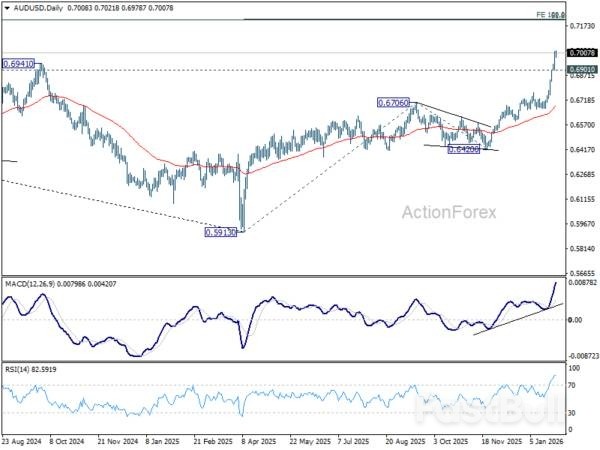
Technically, AUD/USD remains in clear upward acceleration, with D MACD still pointing higher. The advance from 0.5913 is on track toward its 100% projection of 0.5913 to 0.6706 from 0.6420 at 0.7213 next. On the downside, below 0.6901 support will bring consolidations first. But downside should be contained above 0.6706 resistance turned support to bring another rally.

More importantly, the decisive break above 0.6941 structural resistance this week strengthens the case that the rise from 0.5913 is reversing the entire decline from the 0.8006 (2020 high). Next target is 61.8% retracement of 0.8006 to 0.5913 at 0.7206, which is close to the above 0.7213 projection level.
Reactions to this 0.72 resistance zone will decide whether current rise from 0.5913 is the third leg of the pattern from 0.5506 (2020 low), and open the door to further medium up trend through 0.8006.

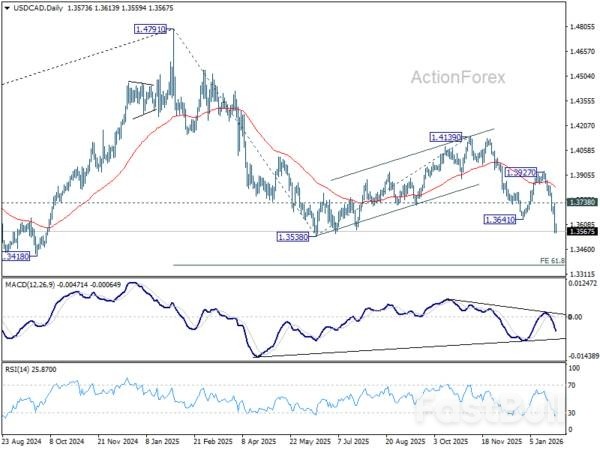
Two major central bank decisions from North America headline the day, with both the BoC and the Fed widely expected to keep interest rates unchanged. USD/CAD, meanwhile, is unlikely to see its broader trend altered by either decision. The current selloff would likely continue through 1.3538 low as driven by the overall selloff in Dollar.
For the BoC, markets expect rates to remain at 2.25%, the lower bound of the bank's estimated 2.25–3.25% neutral range. A recent Reuters poll showed nearly 75% of economists expect the BoC to keep policy unchanged through 2026.
At this stage, the BoC appears comfortable with a prolonged wait-and-see stance. However, slack remains in the labour market, growth momentum is uncertain, and policy is not yet clearly stimulative despite the 275bp of rate cuts delivered between June 2024 and October 2025.
Hence, if policy does move again this year, risks are tilted toward further cuts rather than hikes. That bias hinges heavily on trade outcomes. As long as key sectors retain preferential access to the US—either through deals or prolonged negotiations—the growth outlook remains intact.
However, should tariffs expand to a broader range of industries, the drag on activity would intensify. In that scenario, the BoC would likely be forced to resume easing to cushion the economic impact.
Turning to the Fed, rates are expected to remain unchanged at 3.50–3.75%, making this very much a holding meeting. Markets will be listening closely for any shift in tone that hints at future action rather than focusing on the decision itself.
Voting dynamics will be watched carefully. Stephen Miran, a known dove, is expected to dissent in favor of a cut. Any additional votes for easing beyond Miran would be interpreted as a clear dovish signal.
For now, the Fed is expected to remain on hold through the remainder of Jerome Powell's term in May. Markets price roughly a 63% chance of a June cut, but conviction remains limited given multiple wild cards, including economic data, trade relations, financial market stability, and President Donald Trump's choice of the next Fed chair.
Technically, for USD/CAD, current decline should continue as long as 1.3738 resistance holds. It's seen as part of the downtrend from 14791. Break of 1.3538 will pave the way to 61.8% projection of 1.4791 to 1.3538 from 1.4139 at 1.3365 in the near term.

Daily Pivots: (S1) 1.1902; (P) 1.1992; (R1) 1.2134;
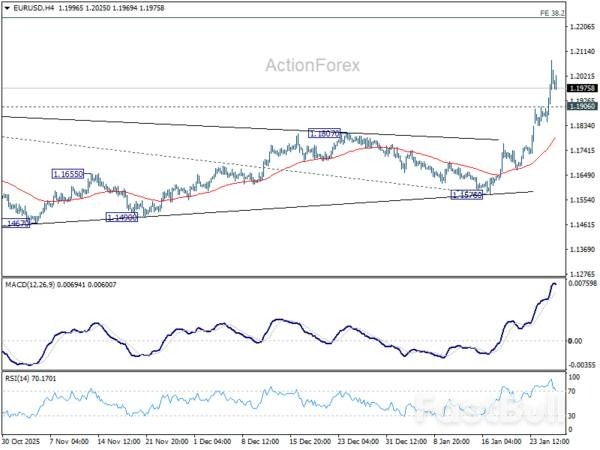
EUR/USD's rally is still in progress and breached 1.2 psychological level before retreating slightly. Intraday bias stays on the upside. Decisive break above 1.2 will carry larger bullish implications. Next near term target will be 38.2% projection of 1.0176 to 1.1917 from 1.1576 at 1.3434. On the downside, below 1.1906 minor support will turn intraday bias neutral first. But outlook will stay bullish as long as 1.1576 support holds, even in case of deep pullback.

In the bigger picture, as long as 55 W EMA (now at 1.1443) holds, up trend from 0.9534 (2022 low) is still in favor to continue. Decisive break of 1.2 key psychological level will add to the case of long term bullish trend reversal. Next medium term target will be 138.2% projection of 0.9534 to 1.1274 from 1.0176 at 1.2581. However, sustained trading below 55 W EMA will argue that rise from 0.9534 has completed as a three wave corrective bounce, and keep long term outlook bearish.
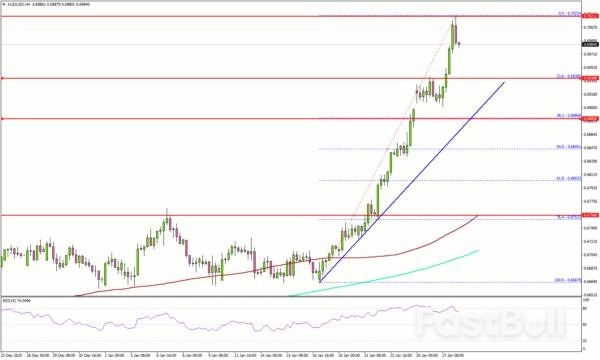
The Aussie Dollar started a major increase above 0.6800 against the US Dollar. AUD/USD cleared the 0.6880 hurdle to enter a bullish zone.
Looking at the 4-hour chart, the pair settled above 0.6920, the 200 simple moving average (green, 4-hour), and the 100 simple moving average (red, 4-hour). The bulls even pumped the pair above 0.6950.

The current price action suggests high chances of more upside. Besides, there is a major bullish trend line forming with support at 0.6900. Immediate resistance sits near 0.6985. The first key hurdle could be 0.7000.
A close above 0.7000 could open the doors for more gains. In the stated case, the bulls could aim for a move toward 0.7120. If there is a pullback, AUD/USD might find bids near 0.6900 or the trend line.
A close below the trend line might initiate an extended drop. The first major area for the bulls might be near 0.6840. The main support sits at 0.6800, below which the pair could accelerate lower. The next support could be 0.6740 and the 100 simple moving average (red, 4-hour).
Looking at EUR/USD, the pair extended gains and traded above 1.1900. The next key hurdle sits near 1.2000.
The main event will be tonight's FOMC meeting. We expect no monetary policy changes, in line with broad consensus and market pricing. As the Fed will not be releasing updated economic projections, attention will centre on Powell's assessment of recent economic data, and the likelihood of further rate cuts this spring. We expect Powell to avoid any specific speculation regarding future Fed nominations and recent challenges to the central bank's independence.
The Bank of Canada also meet today, and we expect the central bank to maintain its policy rate at 2.25%.
What happened yesterday
In the US, the consumer confidence index for January unexpectedly fell to 84.5 (cons: 90.9, prior: 94.2), diverging sharply from the University of Michigan's survey, which had painted a more optimistic picture. The decline was most pronounced in the 'present situation' assessment, with labour market indicators showing weakness. The widely followed 'jobs plentiful' index dropped to its lowest level since February 2021, a time when the unemployment rate stood at 6.2%. This appears more tied to real economic conditions than tariff concerns, as inflation expectations eased. These sentiment indicators have sent somewhat conflicting signals lately, but all else equal, this could fuel some further USD weakness.
The EU and India have concluded a landmark trade agreement that will remove tariffs on over 90% of goods traded between the two economies. Under the deal, India will lower tariffs on European automobiles and agricultural products, while the EU will reciprocate by easing duties on India's labour-intensive exports, which have suffered significantly due to the 50% tariffs imposed by the US. Currently ranked as the EU's ninth-largest trading partner, India accounted for 2.4% of the bloc's total goods trade in 2024. The EU anticipates that the agreement will double its exports to India by 2032, fostering stronger economic ties.
In Hungary, the central bank kept policy rate unchanged at 6.50%, in line with market expectations.
Equities: Equities generally higher, with the same dynamics observed over the last three trading sessions: US tech and related utilities orchestrated a comeback, while small caps underperformed for a third session. Semis were particularly strong, likely speculation of hiked AI capex plans from the hyperscalers. Microsoft is important, reporting today after US closing.
European and Nordic equities also somewhat higher, but below the highs taken prior to the tariff threats. The rapid dollar decline probably plays a role behind the sluggish rebound, as the FX headwind hits earnings. Be aware that earnings revisions will be negative for most Nordic companies after post results, solemnly due to FX, although demand assumption is held constant, or even lifted. Another reason is that there were no contrarian dip to buy in the first place. Despite last week's selloff we did not observe any genuine market stress and positioning were far from oversold. Investors are buying equities, but anchored in fundamental economic strength, which is a slower process higher than a dip buying opportunity.
FI and FX: Broad USD remains under heavy pressure as the prospect of joint FX intervention between the US and Japan added further momentum to the recent USD sell-off. EUR/USD finds itself flirting with the 1.20 mark, whereas EUR/CHF broke below the 0.92 mark, as the CHF has benefitted from the increased uncertainty and as an alternative to the USD. Scandies continue to do well, just as anything with a reverse correlation to USD, and EUR/SEK and EUR/NOK both saw Monday's bounce completely reversed yesterday, with the latter once again breaking below 10.60.
There were plenty of major stories and market moves yesterday, but the most significant — and most impactful — was undoubtedly the sharp sell-off in the US dollar. It pushed the US Dollar Index to a four-year low and continues to drive gold and silver to fresh record highs this morning.
Trade and geopolitical uncertainty, tied to an increasingly unreliable American friend and ally, as well as growing concerns about what will happen to the Federal Reserve's (Fed) credibility once Jerome Powell leaves office (it will fly out of the window), continue to weigh on the US dollar. Add to that the latest US consumer survey, which showed a sharp drop in consumer confidence, a marked deterioration in how households view the current situation, a decline in the share of consumers expecting income growth, and a steady rise in those saying jobs are hard to get. You get a pretty murky picture for the greenback and the two-speed US economy.
Still, this will hardly convince the Fed to cut rates today or in the coming months. Jerome Powell is likely to avoid political commentary at his post-decision speech today and keep the focus firmly on economic data to justify policy decisions.
That said, we all know the US President is waiting just outside the room — and anything he might say about the Fed's decision, or about how much he dislikes Powell, would only risk making matters worse for the US dollar, much to the delight of gold and silver longs. But with or without buzzy headlines, the US dollar looks condemned to weaken.
The only real comfort is that US inflation has not surged as a result of tariffs. That is partly because importers built up stockpiles to buy time, but also because only around 20% of announced tariff threats have actually been implemented since November 2024, according to Bloomberg. In other words, only a fifth of tariff threats have materialised so far — giving the so-called TACO trade ("Trump Always Chickens Out") some concrete data backing today.
This may help explain why Korean equities barely reacted when President Trump threatened to impose 25% tariffs on Korea, citing the lack of formal codification of last year's trade deal. That agreement includes up to $350bn of Korean investment commitments in the US — a massive sum, especially with the won under pressure. South Korea has already signalled it may delay up to $20bn of planned US investment this year. Fury.
Political tensions aside, the Kospi hit fresh highs today, with SK Hynix continuing its "Free Solo" climb after reports it has become the exclusive supplier of memory chips for Microsoft's new AI chip!
Elsewhere, after a year of trade tensions, former US allies appear increasingly keen to diversify. Last week, Canada signed a trade arrangement with China, easing rules on several sensitive areas, including Chinese EV exports. This week, Europe finalised a trade deal with Mercosur and another with India after two+ decades of negotiations. Funny how a common adversary can accelerate diplomacy!
Ursula von der Leyen dubbed the India agreement "the mother of all deals". It eliminates more than 95% of tariffs on both sides and covers cars, industrial goods, wine, pasta, chocolate and other European exports for India's 1.5bn consumers to enjoy without tariffs.
The mood among European investors would have been even better had LVMH not reported weaker sales on the same day. Still, the Stoxx 600 closed close to record highs, led once again by defence stocks, as Europe continues to ramp up spending on security and technology amid an increasingly strained relationship with the US.
Europe has strong players in defence. In tech, the challenge is far greater and will take years to address. That said, there are signs of progress: this week, the EU switched on parts of its home-grown secure satellite communications network, designed to reduce reliance on Starlink for sensitive uses. These efforts are likely to intensify as geopolitical risks grow, justifying investment in European defence and tech.
Speaking of tech, ASML — Europe's largest technology company and the world's sole supplier of the most advanced chip-making machines — reported earnings this morning. Results showed a modest beat on revenue and profit, and a significant upside surprise on bookings. Order intake reached around €13.2bn, roughly double expectations, underlining strong forward demand, particularly for EUV systems.
European futures are higher, while Nasdaq futures are leading gains among major indices, with ASML's results boosting sentiment ahead of a busy US earnings calendar. Meta, Microsoft and Tesla report after the bell. For Microsoft, focus will be on Azure growth, AI-related product revenues and data-centre spending plans. For Meta, attention will centre on costs and monetisation of AI initiatives. I personally remain little convinced with Meta's shift from social media to AI media, but hey… For Tesla, the spotlight is happily less on plunging car sales and more on dream… The pace of robotaxi expansion and the timeline for Optimus will matter more than actual numbers— though Elon Musk has already warned that production will be slow. Market reaction may once again hinge more on a single man's persuasion than on reality.
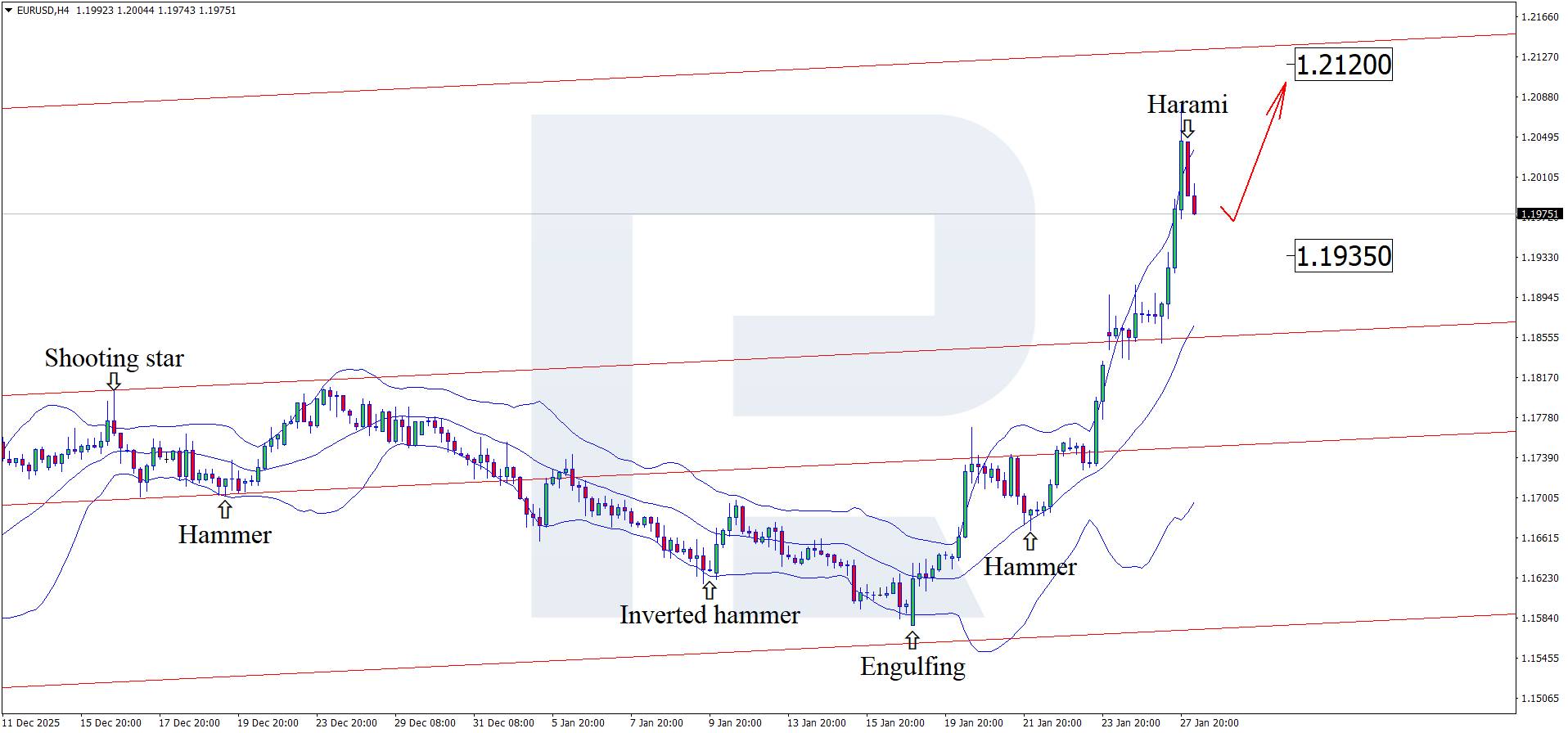
Ahead of the Fed's interest rate decision, the EURUSD pair made a sharp move higher and is trading near 1.1995.
The EURUSD forecast takes into account that today the euro is forming a correction after a sharp rally and is trading near the 1.1985 level.
Amid uncertainty in the global economy and elevated global risks, the market is currently focused on the US Federal Reserve's interest rate meeting.
Today, the Fed is expected to keep the interest rate unchanged at 3.75%, as part of its strategy to fight inflation. While markets generally expect further tight monetary policy, analysts do not rule out an unlikely but possible 0.25% rate hike if US economic data continues to show growth. Such a decision would become a trigger for EURUSD movement, as even small rate changes can affect USD dynamics.
At the same time, today's EURUSD forecast also considers an alternative scenario surrounding the interest rate decision, taking into account Donald Trump's desire to weaken the USD to boost competitiveness. The US president has recently been frequently interfering in the Fed's work and attempting to exert political influence on economic decision-making. In this case, the Fed may leave the interest rate unchanged or lower it.
A rate cut would further weaken the USD and push the EURUSD rate towards the 2021 highs.
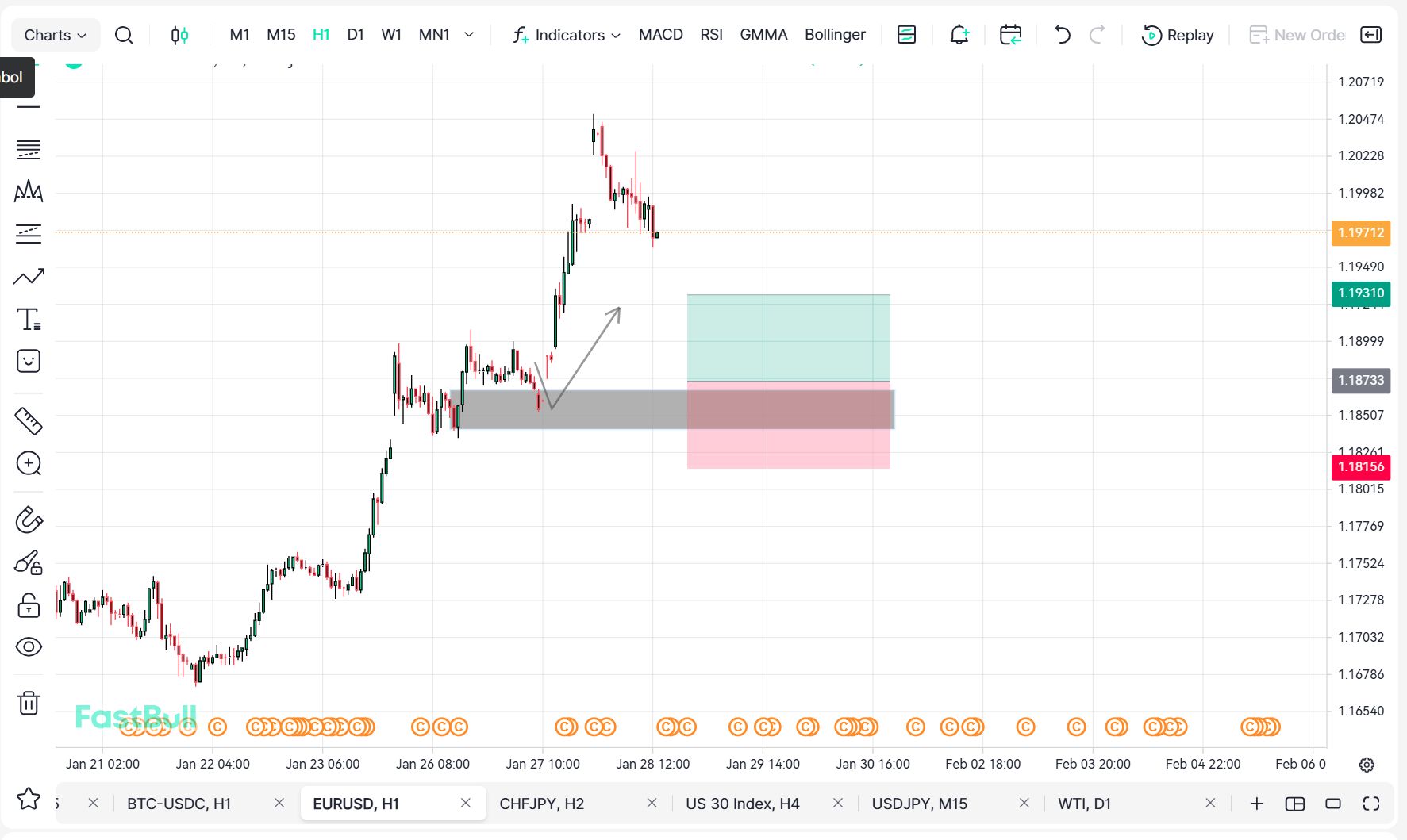
On the H4 chart, the EURUSD pair formed a Harami reversal pattern near the upper Bollinger Band. At this stage, it may develop a corrective wave following this signal. Since quotes have moved outside the ascending channel, they may head towards the 1.1935 level. A rebound from this area would open the way for continued upward momentum.
At the same time, today's EURUSD forecast also suggests an alternative scenario, in which the pair continues to rise towards 1.2120 without testing the support level.

Main scenario (Buy Limit)
A pullback towards the 1.1935 level will allow buyers to build new positions, and amid pressure on the US dollar and expectations surrounding the Fed meeting outcome, the market may continue to move towards the upper targets of the range.
The risk-to-reward ratio exceeds 1:3. The upside potential is around 185 pips, with the risk limited to 50 pips.
Alternative scenario (Sell Stop)
A decline and consolidation below 1.1800 will signal profit-taking and waning bullish momentum after January's sharp rally. In this case, a corrective pullback towards lower support levels is likely.
Any unexpected hawkish signals from the Fed, strong US macroeconomic data, or easing political tensions could temporarily support the US dollar and trigger a correction in the EURUSD pair.
With the market awaiting the Fed's interest rate decision, the EURUSD pair is forming a correction. Technical analysis of EURUSD suggests a pullback towards the 1.1935 support area before further growth.
EURUSD 2026-2027 forecast: key market trends and future predictionsThis article provides the EURUSD forecast for 2026 and 2027 and highlights the main factors determining the direction of the pair's movements. We will apply technical analysis, take into account the opinions of leading experts, large banks, and financial institutions, and study AI-based forecasts. This comprehensive insight into EURUSD predictions should help investors and traders make informed decisions.
Gold (XAUUSD) forecast 2026 and beyond: expert insights, price predictions, and analysisDive deep into the Gold (XAUUSD) price outlook for 2026 and beyond, combining technical analysis, expert forecasts, and key macroeconomic factors. It explains the drivers behind gold's recent surge, explores potential scenarios including a move toward 4,500 to 5,000 USD per ounce, and highlights why the metal remains a strong hedge during global uncertainty.
White Label
Data API
Web Plug-ins
Poster Maker
Affiliate Program
The risk of loss in trading financial instruments such as stocks, FX, commodities, futures, bonds, ETFs and crypto can be substantial. You may sustain a total loss of the funds that you deposit with your broker. Therefore, you should carefully consider whether such trading is suitable for you in light of your circumstances and financial resources.
No decision to invest should be made without thoroughly conducting due diligence by yourself or consulting with your financial advisors. Our web content might not suit you since we don't know your financial conditions and investment needs. Our financial information might have latency or contain inaccuracy, so you should be fully responsible for any of your trading and investment decisions. The company will not be responsible for your capital loss.
Without getting permission from the website, you are not allowed to copy the website's graphics, texts, or trademarks. Intellectual property rights in the content or data incorporated into this website belong to its providers and exchange merchants.
Not Logged In
Log in to access more features
Log In
Sign Up