• Trade
  • Markets
  • Copy
  • Contests
  • News
  • 24/7
  • Calendar
  • Q&A
  • Chats
Trending
Screeners
SYMBOL
LAST
BID
ASK
HIGH
LOW
NET CHG.
%CHG.
SPREAD
SPX
S&P 500 Index
6886.69
6886.69
6886.69
6900.68
6824.70
+46.18
+ 0.68%
--
DJI
Dow Jones Industrial Average
48057.74
48057.74
48057.74
48197.30
47462.94
+497.46
+ 1.05%
--
IXIC
NASDAQ Composite Index
23654.15
23654.15
23654.15
23704.08
23435.17
+77.67
+ 0.33%
--
USDX
US Dollar Index
98.550
98.630
98.550
98.720
98.490
-0.040
-0.04%
--
EURUSD
Euro / US Dollar
1.17049
1.17057
1.17049
1.17070
1.16821
+0.00101
+ 0.09%
--
GBPUSD
Pound Sterling / US Dollar
1.33744
1.33754
1.33744
1.33917
1.33578
-0.00053
-0.04%
--
XAUUSD
Gold / US Dollar
4215.71
4216.05
4215.71
4247.68
4204.22
-12.51
-0.30%
--
WTI
Light Sweet Crude Oil
57.668
57.698
57.668
58.772
57.584
-1.009
-1.72%
--

Community Accounts

Signal Accounts
--
Profit Accounts
--
Loss Accounts
--
View More

Become a signal provider

Sell trading signals to earn additional income

View More

Guide to Copy Trading

Get started with ease and confidence

View More

Signal Accounts for Members

All Signal Accounts

Best Return
  • Best Return
  • Best P/L
  • Best MDD
Past 1W
  • Past 1W
  • Past 1M
  • Past 1Y

All Contests

  • All
  • Trump Updates
  • Recommend
  • Stocks
  • Cryptocurrencies
  • Central Banks
  • Featured News
Top News Only
Share

Mexico Tariff Hike To Impact $1 Billion Worth Of India Car Exports - Sources, Industry Group Letter

Share

Swiss National Bank: Baseline Scenario, Anticipates Growth In The Global Economy Will Be Moderate Over The Coming Quarters

Share

Swiss National Bank: Although US Tariffs And Trade Policy Uncertainty Weighed On The Global Economy, Economic Development In Many Countries Has Thus Far Remained More Resilient Than Had Been Assumed

Share

Swiss National Bank: Economic Outlook For Switzerland Has Improved Slightly Due To The Lower US Tariffs Andsomewhat Better Development Globally

Share

Swiss National Bank: Main Risk To The Economic Outlook For Switzerland Is The Development Of The Globaleconomy

Share

SNB Sees Q3 2028 Inflation At 0.8%

Share

Swiss National Bank: Inflationary Pressure Is Virtually Unchanged Compared To The Last Monetary Policy Assessment

Share

SNB Sees 2026 Swiss GDP At Around 1% (Previous Forecast Was For Around 1%)

Share

SNB Sees 2025 Swiss GDP At Around 1.5% (Previous Forecast Was For 1.0-1.5%)

Share

Banks' Sight Deposits Held At The SNB Will Be Remunerated At The SNB Policy Rate Up To A Certain Threshold

Share

SNB Sees 2027 Inflation At 0.6% (Previous Forecast Was For 0.7%)

Share

SNB Sees 2026 Inflation At 0.3% (Previous Forecast Was For 0.5%)

Share

SNB Sees 2025 Inflation At 0.2% (Previous Forecast Was For 0.2%)

Share

SNB: Remain Willing To Be Active In The Foreign Exchange Market As Necessary

Share

Swiss National Bank Keeps Interest Rate Unchanged At 0.00%

Share

French Otc Day-Ahead Baseload Power Price Up 9% At 82 EUR/Mwh - Lseg Data

Share

Russian Foreign Minister Lavrov: The Root Causes Of The Conflict Need To Be Resolved - NATO Membership For Ukraine Is Unacceptable For Russia

Share

Russian Foreign Minister Lavrov: There Should Be Security Guarantees For All Sides

Share

Oman Oct Conventional Bank Lending +8.57% Year-On-Year - Central Bank

Share

Russian Foreign Minister Lavrov: We Want A Package Of Documents On A Long-Term Sustainable Peace For Ukraine

TIME
ACT
FCST
PREV
U.S. EIA Weekly Gasoline Stocks Change

A:--

F: --

P: --

U.S. EIA Weekly Crude Demand Projected by Production

A:--

F: --

P: --

U.S. EIA Weekly Cushing, Oklahoma Crude Oil Stocks Change

A:--

F: --

P: --

U.S. EIA Weekly Crude Stocks Change

A:--

F: --

P: --

U.S. EIA Weekly Crude Oil Imports Changes

A:--

F: --

P: --

U.S. EIA Weekly Heating Oil Stock Changes

A:--

F: --

P: --

U.S. Refinitiv/Ipsos Primary Consumer Sentiment Index (PCSI) (Dec)

A:--

F: --

P: --

China, Mainland M1 Money Supply YoY (Nov)

--

F: --

P: --

China, Mainland M0 Money Supply YoY (Nov)

--

F: --

P: --

China, Mainland M2 Money Supply YoY (Nov)

--

F: --

P: --

Russia CPI YoY (Nov)

A:--

F: --

P: --

U.S. Federal Funds Rate Projections-Longer Run (Q4)

A:--

F: --

P: --

U.S. Federal Funds Rate Projections-1st Year (Q4)

A:--

F: --

P: --

U.S. Target Federal Funds Rate Lower Limit (Overnight Reverse Repo Rate)

A:--

F: --

P: --

U.S. Federal Funds Rate Projections-2nd Year (Q4)

A:--

F: --

P: --

U.S. Budget Balance (Nov)

A:--

F: --

P: --

U.S. Target Federal Funds Rate Upper Limit (Excess Reserves Ratio)

A:--

F: --

P: --

U.S. Interest Rate On Reserve Balances

A:--

F: --

P: --

U.S. Federal Funds Rate Projections-Current (Q4)

A:--

F: --

P: --

U.S. Federal Funds Rate Target

A:--

F: --

P: --

U.S. Federal Funds Rate Projections-3rd Year (Q4)

A:--

F: --

P: --

FOMC Statement
FOMC Press Conference
Brazil Selic Interest Rate

A:--

F: --

P: --

U.K. 3-Month RICS House Price Balance (Nov)

A:--

F: --

P: --

Australia Employment (Nov)

A:--

F: --

P: --

Australia Full-time Employment (SA) (Nov)

A:--

F: --

P: --

Australia Unemployment Rate (SA) (Nov)

A:--

F: --

P: --

Australia Labor Force Participation Rate (SA) (Nov)

A:--

F: --

P: --

Turkey Retail Sales YoY (Oct)

A:--

F: --

P: --

South Africa Mining Output YoY (Oct)

--

F: --

P: --

South Africa Gold Production YoY (Oct)

--

F: --

P: --

Italy Quarterly Unemployment Rate (SA) (Q3)

--

F: --

P: --

IEA Oil Market Report
Turkey 1-Week Repo Rate

--

F: --

P: --

South Africa Refinitiv/Ipsos Primary Consumer Sentiment Index (PCSI) (Dec)

--

F: --

P: --

Turkey Overnight Lending Rate (O/N) (Dec)

--

F: --

P: --

Turkey Late Liquidity Window Rate (LON) (Dec)

--

F: --

P: --

U.K. Refinitiv/Ipsos Primary Consumer Sentiment Index (PCSI) (Dec)

--

F: --

P: --

Brazil Retail Sales MoM (Oct)

--

F: --

P: --

U.S. Weekly Continued Jobless Claims (SA)

--

F: --

P: --

U.S. Exports (Sept)

--

F: --

P: --

U.S. Trade Balance (Sept)

--

F: --

P: --

U.S. Weekly Initial Jobless Claims (SA)

--

F: --

P: --

Canada Imports (SA) (Sept)

--

F: --

P: --

U.S. Initial Jobless Claims 4-Week Avg. (SA)

--

F: --

P: --

Canada Trade Balance (SA) (Sept)

--

F: --

P: --

Canada Exports (SA) (Sept)

--

F: --

P: --

U.S. Wholesale Sales MoM (SA) (Sept)

--

F: --

P: --

U.S. EIA Weekly Natural Gas Stocks Change

--

F: --

P: --

U.S. 30-Year Bond Auction Avg. Yield

--

F: --

P: --

Argentina CPI MoM (Nov)

--

F: --

P: --

Argentina National CPI YoY (Nov)

--

F: --

P: --

Argentina 12-Month CPI (Nov)

--

F: --

P: --

U.S. Weekly Treasuries Held by Foreign Central Banks

--

F: --

P: --

Japan Industrial Output Final MoM (Oct)

--

F: --

P: --

Japan Industrial Output Final YoY (Oct)

--

F: --

P: --

Germany HICP Final YoY (Nov)

--

F: --

P: --

Germany HICP Final MoM (Nov)

--

F: --

P: --

Germany CPI Final MoM (Nov)

--

F: --

P: --

Germany CPI Final YoY (Nov)

--

F: --

P: --

Q&A with Experts
    • All
    • Chatrooms
    • Groups
    • Friends
    Connecting
    .
    .
    .
    Type here...
    Add Symbol or Code

      No matching data

      All
      Trump Updates
      Recommend
      Stocks
      Cryptocurrencies
      Central Banks
      Featured News
      • All
      • Russia-Ukraine Conflict
      • Middle East Flashpoint
      • All
      • Russia-Ukraine Conflict
      • Middle East Flashpoint
      Search
      Products

      Charts Free Forever

      Chats Q&A with Experts
      Screeners Economic Calendar Data Tools
      Membership Features
      Data Warehouse Market Trends Institutional Data Policy Rates Macro

      Market Trends

      Market Sentiment Order Book Forex Correlations

      Top Indicators

      Charts Free Forever
      Markets

      News

      News Analysis 24/7 Columns Education
      From Institutions From Analysts
      Topics Columnists

      Latest Views

      Latest Views

      Trending Topics

      Top Columnists

      Latest Update

      Signals

      Copy Rankings Latest Signals Become a signal provider AI Rating
      Contests
      Brokers

      Overview Brokers Assessment Rankings Regulators News Claims
      Broker listing Forex Brokers Comparison Tool Live Spread Comparison Scam
      Q&A Complaint Scam Alert Videos Tips to Detect Scam
      More

      Business
      Events
      Careers About Us Advertising Help Center

      White Label

      Data API

      Web Plug-ins

      Affiliate Program

      Awards Institution Evaluation IB Seminar Salon Event Exhibition
      Vietnam Thailand Singapore Dubai
      Fans Party Investment Sharing Session
      FastBull Summit BrokersView Expo
      Recent Searches
        Top Searches
          Markets
          News
          Analysis
          User
          24/7
          Economic Calendar
          Education
          Data
          • Names
          • Latest
          • Prev

          View All

          No data

          Scan to Download

          Faster Charts, Chat Faster!

          Download App
          English
          • English
          • Español
          • العربية
          • Bahasa Indonesia
          • Bahasa Melayu
          • Tiếng Việt
          • ภาษาไทย
          • Français
          • Italiano
          • Türkçe
          • Русский язык
          • 简中
          • 繁中
          Open Account
          Search
          Products
          Charts Free Forever
          Markets
          News
          Signals

          Copy Rankings Latest Signals Become a signal provider AI Rating
          Contests
          Brokers

          Overview Brokers Assessment Rankings Regulators News Claims
          Broker listing Forex Brokers Comparison Tool Live Spread Comparison Scam
          Q&A Complaint Scam Alert Videos Tips to Detect Scam
          More

          Business
          Events
          Careers About Us Advertising Help Center

          White Label

          Data API

          Web Plug-ins

          Affiliate Program

          Awards Institution Evaluation IB Seminar Salon Event Exhibition
          Vietnam Thailand Singapore Dubai
          Fans Party Investment Sharing Session
          FastBull Summit BrokersView Expo

          China’s $71 Billion Treasury Dump Exposes a Critical gap Between Bitcoin’s Narrative and Central Bank Reality

          Manuel

          Cryptocurrency

          Summary:

          The broader market absorbed the official-sector selling without stress, as net foreign private inflows in August and September offset net foreign official outflows, according to the Treasury’s November 18 TIC statement.

          The BRICS bloc now counts 11 members, and several of the largest holders have trimmed their US Treasury positions over the past year.
          China cut its stake by $71.5 billion between September 2024 and September 2025, dropping from $772 billion to $700.5 billion. India reduced holdings by $44.5 billion, Brazil by $61.9 billion, and Saudi Arabia by $9.6 billion, per the US Treasury’s TIC Major Foreign Holders table.
          The moves are real, measurable, and concentrated among the bloc’s heaviest official-sector players.
          But total foreign holdings of Treasuries rose over the same span, climbing from roughly $8.77 trillion to about $9.25 trillion.
          The broader market absorbed the official-sector selling without stress, as net foreign private inflows in August and September offset net foreign official outflows, according to the Treasury’s November 18 TIC statement.
          The story is less “the world dumps US debt,” and more “some large emerging-market central banks diversify while other buyers, often private, step in.”
          The question for crypto markets is whether that marginal rebalancing, combined with currency and real-yield moves, strengthens the case for Bitcoin as a hedge against monetary instability.

          The de-dollar narrative meets exchange-rate reality

          The IMF’s second-quarter COFER data shows the dollar share of allocated global reserves at 56.32%, down from earlier quarters.
          But the IMF’s accompanying blog stresses that currency moves explained about 92% of the decline during the period, tied to the sharp first-half drop in the DXY.
          Exchange-rate effects, not a sudden shift in central bank preferences, drove most of the headline erosion.
          That distinction matters when assessing how much reserve managers are actually rotating out of dollars versus how much the numbers reflect mark-to-market moves in a basket of assets.
          Gold offers a clearer signal. Central-bank gold demand remained at record highs in 2024, accounting for more than one-fifth of global gold demand, according to the ECB’s 2025 analysis, driven by diversification and hedging geopolitical risk.
          The World Gold Council’s 2025 survey found that many reserve managers expect lower dollar holdings over the next five years and higher shares for gold and nontraditional currencies.
          Gold’s appeal as a zero-counterparty reserve asset makes it a natural first stop for official diversification.
          Bitcoin’s case rests on whether the same macro anxieties, such as fiscal trajectory, geopolitical risk, and a softer dollar, also feed private-market appetite for a harder, non-sovereign asset, even if the empirical link between Treasury selling and BTC flows remains unstable.
          Real yields and the hedge logic
          Higher real yields typically tighten financial conditions and pressure long-duration and speculative assets, while easing real yields can be supportive. The 10-year TIPS real yield serves as a barometer for macro desks assessing BTC risk appetite and hedge narratives by indicating whether it is more attractive to hold non-yielding assets like Bitcoin versus yield-bearing alternatives.
          When real yields compress, holding zero-yield assets like Bitcoin becomes relatively less costly, which can reinforce its appeal as a hedge against currency debasement. Conversely, when real yields rise, that hedge logic weakens because yield-bearing assets become more attractive.
          The recent period of elevated real yields has coincided with volatility in crypto risk assets, but the relationship is not mechanical.
          The hedge story for Bitcoin depends on whether market participants interpret rising yields as a sign of inflation-driven stress, which is often BTC-positive, or as tightening liquidity, which is typically BTC-negative. Thus, the impact of Bitcoin as a hedge against macro risks is shaped by prevailing market perceptions.
          The same dynamic applies to BRICS Treasury sales.
          If those sales reflect concerns about US fiscal sustainability or currency debasement, they feed the narrative that Bitcoin offers protection from fiat instability. If they reflect routine portfolio rebalancing or a hunt for higher yields elsewhere, the implications for BTC are weaker.
          The Treasury flow data alone cannot distinguish between these motives. But the broader context of record central-bank gold demand, persistent fiscal deficits, and a gradual decline in the dollar’s share of reserves suggests that some of the official-sector diversification is driven by long-term hedging considerations rather than just tactical asset allocation.

          State adoption remains a high bar

          Private and corporate Bitcoin narratives have evolved faster than state-level adoption. The Swiss National Bank chair rejected Bitcoin as a reserve asset in April 2025, citing volatility and liquidity criteria.
          Central banks prioritize stability, deep markets, and the ability to deploy reserves in crisis without moving prices.
          Bitcoin does not yet meet those standards for most official-sector managers, even as individual firms and allocators treat it as a macro hedge. The disconnect between private enthusiasm and official caution defines the current phase of the BTC reserve debate.
          Bringing the discussion full circle, while BRICS Treasury trimming is real, it is incremental and coexists with rising total foreign holdings.
          The de-dollar drift is measurable but slow, driven more by exchange-rate effects and gold demand than by a coordinated exit from US debt. Bitcoin’s role in this rebalancing is speculative rather than structural.
          Macro forces like reserve diversification, fiscal risk, geopolitics, and currency uncertainty also fuel the BTC-hedge narrative. Still, the connection remains one of narrative resonance rather than direct capital flows.
          Whether that narrative hardens into a durable bid depends on how much weight private markets assign to the idea that a non-sovereign, hard-cap asset belongs in a diversified portfolio when fiat alternatives feel less stable.
          The data show the drift, and the market will decide whether Bitcoin captures it.

          Source: Cryptoslate

          Risk Warnings and Disclaimers
          You understand and acknowledge that there is a high degree of risk involved in trading. Following any strategies or investment methods may lead to potential losses. The content on the site is provided by our contributors and analysts for information purposes only. You are solely responsible for determining whether any trading assets, securities, strategy, or any other product is suitable for investing based on your own investment objectives and financial situation.
          Add to Favorites
          Share

          US Job Openings Rise Slightly After Surging In September; Fewer Workers Quitting Their Jobs

          Justin

          U.S. job openings increased marginally in October after surging in September, but subdued hiring and the lowest level of resignations in five years underscored the economic uncertainty that economists have largely blamed on tariffs.

          The Labor Department's monthly Job Openings and Labor Turnover Survey, or JOLTS report, was released on Tuesday as Federal Reserve officials started a two-day policy meeting. Financial markets expect the U.S. central bank will cut its benchmark overnight interest rate by another 25 basis points to the 3.50%-3.75% range on Wednesday out of concern for the labor market. The Fed has lowered borrowing costs twice this year.

          "The job market isn't collapsing but it is certainly losing steam," said Oren Klachkin, financial markets economist at Nationwide. "We anticipate Fed officials will try to get ahead of labor market weakness with another 25 basis points rate cut tomorrow even as inflation remains above the 2% goal."

          Job openings, a measure of labor demand, were up 12,000 to 7.670 million by the last day of October, the Labor Department's Bureau of Labor Statistics said. Economists polled by Reuters had forecast 7.150 million unfilled jobs. The report incorporated data for September, whose release was canceled because of the 43-day federal government shutdown.

          Vacancies soared 431,000, the most in nearly a year, to 7.658 million in September. The BLS said it had "temporarily suspended use of the monthly alignment methodology for October preliminary estimates," adding that "use of this methodology will resume with the publication of October final estimates."

          The bulk of the job openings in October were in the trade, transportation and utilities sector, with 239,000 vacancies, mostly at retailers. There were 114,000 fewer open positions in the professional and business services industry. Job openings in the accommodation and food services sector fell 33,000. The federal government had 25,000 fewer vacancies.

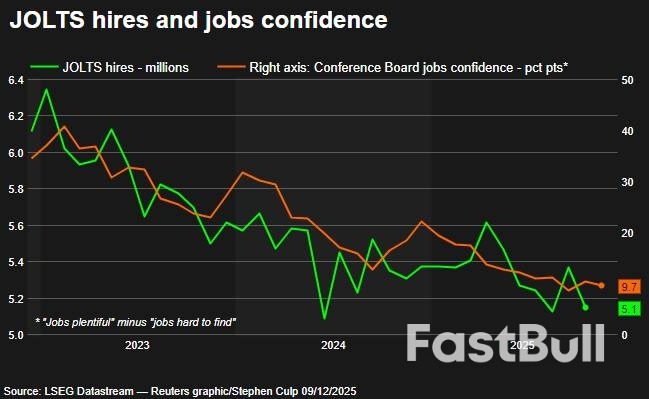
          The job vacancies rate was unchanged at 4.6%. Hiring dropped by 218,000 to 5.149 million in October, with most of the declines in construction, professional and business services, healthcare and social assistance as well as accommodation and food services industries. The hires rate slipped to 3.2% from 3.4% in September. There were 5.367 million hires in September.

          Layoffs crept up 73,000 to a still-low 1.854 million, concentrated in the accommodation and food services sector. The layoffs rate rose to 1.2% from 1.1% in September.

          Stocks on Wall Street were mixed. The dollar gained versus a basket of currencies. U.S. Treasury yields were mostly higher.

          JOLTS hires and jobs confidence

          "NO HIRE, NO FIRE" LABOR MARKET

          The combined September and October reports suggested the labor market remained in what economists and policymakers call a "no-hire, no-fire" state.

          Labor market stagnation has been blamed on reduced labor supply amid a reduction in immigration that started during the final year of former President Joe Biden's term and accelerated under President Donald Trump's second administration. The adoption of artificial intelligence for some job roles is also reducing labor demand, especially for entry-level positions.

          The unemployment rate rose to a four-year high of 4.4% in September. The BLS canceled October's employment report and will not be publishing the unemployment rate for that month as the longest shutdown on record prevented the collection of data for the household survey from which the jobless rate is calculated.

          November's delayed employment report, now due next Tuesday, will include October's nonfarm payrolls data.

          With the labor market wobbly, fewer workers are job hopping in search of greener pastures, pointing to benign wage inflation. The number of people quitting their jobs dropped 187,000, the largest decline since June 2023, to 2.941 million. That was the lowest level since August 2020 when the labor market was recovering from the first wave of the pandemic.

          The quits rate, viewed by policymakers as a gauge of labor market confidence, slipped to 1.8%. That was the lowest reading since May 2020, and was down from 2.0% in September. Lower wages because fewer workers are changing jobs could, however, hurt consumer spending.

          "This (quits rate) is a pretty 'cold' reading that has historically been consistent with wage growth of just 2.5% year-on-year," said James Knightley, chief international economist at ING. "That's not good news for consumption, but given in a service-sector economy, such as the U.S., the biggest cost input is the cost of your workforce, this suggests medium- to longer-term inflation will be on a downward trajectory."

          Source: Reuters

          Risk Warnings and Disclaimers
          You understand and acknowledge that there is a high degree of risk involved in trading. Following any strategies or investment methods may lead to potential losses. The content on the site is provided by our contributors and analysts for information purposes only. You are solely responsible for determining whether any trading assets, securities, strategy, or any other product is suitable for investing based on your own investment objectives and financial situation.
          Add to Favorites
          Share

          Trump Adviser Hassett: "plenty Of Room" For Rate Cuts

          Justin

          Central Bank

          White House economic adviser Kevin Hassett said Tuesday there is "plenty of room" to cut interest rates further, though he noted that rising inflation could alter this outlook.

          Speaking at the WSJ CEO Council, Hassett, who is widely considered a front-runner to become the next Federal Reserve chair, compared the current economic environment to the 1990s, describing it as a "potentially extremely transformative time."

          When asked how he would respond if President Donald Trump requested interest rate cuts that he personally disagreed with, Hassett provided a specific example of when rate cuts would be inappropriate. "If inflation has gone from 2.5% to 4%, you can't cut rates then," he said, according to a tweet from Wall Street Journal Fed reporter Nick Timiraos.

          Source: Investing

          Risk Warnings and Disclaimers
          You understand and acknowledge that there is a high degree of risk involved in trading. Following any strategies or investment methods may lead to potential losses. The content on the site is provided by our contributors and analysts for information purposes only. You are solely responsible for determining whether any trading assets, securities, strategy, or any other product is suitable for investing based on your own investment objectives and financial situation.
          Add to Favorites
          Share

          Gold Holds Steady, Silver Hits All-Time High as Market Eyes Fed Cut and 2026 Outlook

          Gerik

          Economic

          Commodity

          Precious Metals Rally as Interest Rate Path Becomes Central Focus

          Gold prices rose modestly on Tuesday, while silver surged to a record high of $59.751 per ounce, marking a major psychological and technical milestone. The movement in both metals comes ahead of a widely expected 25-basis-point rate cut by the Federal Reserve and amid growing debate over the likely pace of easing throughout 2026. Market participants are closely watching the Fed’s forward guidance, as uncertainty over the longevity of the rate-cut cycle begins to reshape positioning in the commodities market.
          The benchmark 10-year U.S. Treasury yield, which had previously climbed to its highest since September, has since declined, adding downward pressure on real interest rates. This has historically provided support for non-yielding assets like gold, which becomes more attractive when the opportunity cost of holding it falls.

          Fed Outlook and Cautious Optimism Behind Gold’s Strength

          Despite the near certainty of a cut this week, optimism about further cuts in 2026 has faded. Money markets are now pricing in fewer than two cuts next year, down from more aggressive projections seen just weeks ago. Analysts at BMI, a unit of Fitch Solutions, warned that any signals of a slowdown in rate reductions could send gold “below $4,000 an ounce,” particularly if the easing cycle that began in 2024 begins to lose momentum.
          Still, gold remains one of the top-performing assets of 2025, rising approximately 60% year-to-date. This surge has been fueled not only by lower interest rates but also by sustained central bank buying and large inflows into gold-backed exchange-traded funds. According to Pacific Investment Management Co., global central banks have favored gold over U.S. Treasuries in recent quarters, a trend that reflects broader concerns about dollar risk and sovereign debt sustainability.
          The combination of inflation hedging, geopolitical risks, and diversified reserve strategies has reinforced this trend, suggesting a causal relationship between central bank allocation strategies and upward pressure on gold prices.

          Silver Outpaces Gold with Record-Breaking Momentum

          Silver’s dramatic rally, culminating in an intraday high of $59.751, points to growing investor appetite for alternative metals with both industrial and monetary value. The white metal rose 2.6% to $59.66 by mid-morning in New York, having recovered from early losses. Trevor Yates, senior investment analyst at Global X ETFs, noted that silver was “getting a bid this morning alongside gold ahead of the Federal Reserve meeting,” with markets fully pricing in a rate cut.
          While silver tends to be more volatile than gold, its dual demand as both a monetary hedge and industrial input especially in electronics and renewable energy positions it well during periods of speculative enthusiasm and macroeconomic uncertainty. The surge appears closely correlated with gold’s performance and investor rotation toward hard assets amid lower yields.

          Volatility and Diverging Forecasts for 2026

          Although the price of gold has backed off from its late October peak of over $4,380/oz, it continues to find support in dovish policy expectations. However, this support is fragile. Should the Fed signal a potential pause or re-evaluation of its easing policy in 2026 perhaps due to resurging inflation or stronger-than-expected labor data downside risks could materialize quickly.
          Goldman Sachs remains bullish, projecting nearly 20% upside in gold by the end of 2026, a view that contrasts with BMI’s more cautious tone. These diverging forecasts illustrate the degree of uncertainty around monetary policy, inflation control, and fiscal sustainability over the medium term.
          Gold’s steady performance and silver’s breakout to record highs reflect investor sensitivity to interest rate expectations and macroeconomic signals. As the Fed prepares to cut rates this week, attention has shifted to 2026 and the sustainability of monetary easing. While gold has benefited from central bank accumulation and lower real yields, the long-term trajectory remains vulnerable to changes in inflation dynamics and Fed policy clarity. Silver’s rise further underscores a broad pivot to hard assets as financial markets navigate shifting policy signals and global economic fragility.

          Source: Bloomberg

          To stay updated on all economic events of today, please check out our Economic calendar
          Risk Warnings and Disclaimers
          You understand and acknowledge that there is a high degree of risk involved in trading. Following any strategies or investment methods may lead to potential losses. The content on the site is provided by our contributors and analysts for information purposes only. You are solely responsible for determining whether any trading assets, securities, strategy, or any other product is suitable for investing based on your own investment objectives and financial situation.
          Add to Favorites
          Share

          Hassett Hints at Rate-Cutting Flexibility, But Inflation Still a Key Constraint

          Gerik

          Economic

          Rate Cuts on the Table, But Not at All Costs

          At the Wall Street Journal CEO Council on December 9, Kevin Hassett stated that there remains “plenty of room” to cut interest rates, reinforcing a dovish stance amid expectations he may soon lead the Federal Reserve. However, his comments were nuanced. He emphasized that the ability to lower borrowing costs hinges on inflation remaining controlled. Should inflation rise from its current 2.5% level to 4%, Hassett acknowledged that “you can't cut rates then,” drawing a clear boundary for policy flexibility.
          His remarks illustrate a conditional logic: rate cuts are viable as long as inflationary pressures remain subdued. This demonstrates a causal relationship between inflation levels and the feasibility of monetary easing. Hassett’s position reflects an openness to stimulus but with a line drawn at inflation reacceleration.

          A Transformative Economic Moment, Echoing the 1990s

          Hassett also contextualized the current economy as “a potentially extremely transformative time,” likening it to the structural changes of the 1990s. This framing suggests that he sees the current environment as ripe for proactive monetary support to unlock innovation and growth, provided that inflation remains anchored.
          Hassett’s comments offer insight into the potential future direction of the Federal Reserve under a Trump-led administration. While signaling strong support for rate cuts to stimulate the economy, he makes clear that such a move would be unacceptable in an overheating environment. His approach appears pragmatic, balancing pro-growth ambitions with inflation risk management, and it sets the tone for a more responsive, yet cautious, monetary strategy heading into 2026.

          Source: Reuters

          To stay updated on all economic events of today, please check out our Economic calendar
          Risk Warnings and Disclaimers
          You understand and acknowledge that there is a high degree of risk involved in trading. Following any strategies or investment methods may lead to potential losses. The content on the site is provided by our contributors and analysts for information purposes only. You are solely responsible for determining whether any trading assets, securities, strategy, or any other product is suitable for investing based on your own investment objectives and financial situation.
          Add to Favorites
          Share

          Kevin Hassett Emerges as Fed Chair Frontrunner Amid Push for Rate Cuts and Crypto Ties

          Gerik

          Economic

          Hassett Signals Support for Lower Rates as Inflation Outlook Remains Mixed

          Kevin Hassett, the current White House economic adviser and presumed frontrunner for the Federal Reserve chairmanship under President Trump, stated there is “plenty of room” to cut interest rates, reinforcing expectations of a more accommodative monetary stance going into 2026. Speaking at the Wall Street Journal CEO Council on December 9, Hassett acknowledged that any rate cuts would depend on inflation trends. If inflation accelerates to around 4%, rate cuts would no longer be viable, he said, drawing a parallel to policy constraints of the 1990s.
          This view reflects a conditional causal framework: while economic slack and moderate inflation support rate reductions, a spike in inflation would directly constrain such decisions. Hassett's remarks suggest a preference for preemptive easing, though with caution toward inflationary risks that could undermine credibility.

          Trump’s Influence and the Path to Fed Leadership

          Hassett’s public remarks come amid growing speculation that he is President Trump’s top pick to replace Jerome Powell when his term expires in May 2026. Trump has long expressed dissatisfaction with Powell's cautious pace of easing, especially during the latter half of his previous administration. This history of tension adds weight to current speculation that Trump seeks a more compliant or ideologically aligned figure to steer the Fed through the next phase of monetary normalization or stimulus.
          Trump himself hinted on November 18 that he had already made his decision, and Treasury Secretary Scott Bessent confirmed that an announcement could arrive before Christmas. The selection of Hassett who has publicly stated he would already be cutting rates would mark a clear policy pivot, especially as the Fed is grappling with internal divisions over the appropriate stance for 2026.

          Crypto Connections and Market Implications

          Hassett’s nomination also introduces a new dynamic to the Fed’s leadership profile: direct ties to the cryptocurrency industry. His financial disclosure from June reveals advisory work with Coinbase, including a minimum $1 million equity stake and over $50,000 in compensation for service on the company's Academic and Regulatory Advisory Council. That body also includes influential figures from financial regulation and intelligence, suggesting Hassett has been deeply engaged with crypto’s regulatory future.
          While this association does not imply direct policy influence, it may signal a more tolerant or innovation-driven approach to digital assets if Hassett assumes leadership of the Fed. However, given the volatility and systemic concerns around crypto highlighted by recent collapses in MicroStrategy stock and broader skepticism from Fed officials any perceived friendliness to crypto markets could raise regulatory alarm or market instability.

          Internal Fed Dynamics and Future Rate Path

          The Federal Reserve began trimming rates in September and October 2025, each time by 25 basis points, after a prolonged period of stability. The decision to continue easing remains uncertain, with the December meeting seen as a pivotal juncture. Hassett's comments add to speculation that, under his leadership, the Fed could pursue more aggressive easing unless inflation returns forcefully.
          Nonetheless, a deeper tension underpins the policy outlook. While Trump-aligned figures push for looser monetary policy to support growth and markets, rising inflation or external shocks could constrain the Fed’s maneuvering room. This suggests only a partially causal link between presidential preference and policy outcomes: while leadership influences direction, economic data ultimately imposes limits.
          Kevin Hassett’s ascent as the leading candidate for the next Federal Reserve chair signals a significant shift in both tone and policy outlook. His support for additional rate cuts and his connections to the crypto sector reflect a break from the traditional caution that has characterized recent Fed leadership. If appointed, Hassett would likely prioritize pro-growth monetary measures, potentially reshaping how the Fed balances inflation control, financial stability, and innovation. However, this prospective shift must be interpreted in light of real-time economic indicators and institutional constraints, meaning the Fed’s future path remains subject to both political influence and economic necessity.

          Source: Reuters

          To stay updated on all economic events of today, please check out our Economic calendar
          Risk Warnings and Disclaimers
          You understand and acknowledge that there is a high degree of risk involved in trading. Following any strategies or investment methods may lead to potential losses. The content on the site is provided by our contributors and analysts for information purposes only. You are solely responsible for determining whether any trading assets, securities, strategy, or any other product is suitable for investing based on your own investment objectives and financial situation.
          Add to Favorites
          Share

          Political Shake-Up Hits Hedge-Fund Trade As Brazil Markets Swoon

          James Whitman

          Political

          Economic

          As Brazil's markets rallied, month after month, and global investors kept flooding in, the gains were big enough to overshadow the risks from a presidential election that's still almost a year away.

          Then, in just a few hours, that suddenly changed.

          The nation's assets have been dragged down by waves of selling since Flavio Bolsonaro — the son of the now-incarcerated former populist leader Jair Bolsonaro — emerged as a contender in next year's race. That dampened local investors' hopes that the right would coalesce around Tarcisio de Freitas, a governor seen in Brazil financial circles as the strongest challenger to President Luiz Inacio Lula da Silva.

          Friday saw the worst of the selloff. Bond yields jumped. Stocks tumbled as much as 4.5% in the deepest slide in over four years. And the real slumped over 3%, its biggest decline since US President Donald Trump's April tariffs unleashed havoc around the globe. While assets bounced slightly Monday amid mixed signals from Flavio Bolsonaro on whether he would carry out his bid, they were whipsawed by volatility Tuesday when the senator said his candidacy was "final."

          The moves were a stark reminder of the political risks that have been largely ignored as investors stampeded back into developing countries around the world this year.

          Brazil has been a major beneficiary, leaving its currency up more than 13% against the dollar even after its recent pullback. That was partially driven by carry traders, who borrow in countries where rates are low and invest in those offering higher yields and have seized on local interest rates pinned at 15% even as central banks in the US and Europe started nudging them lower.

          "People were caught by surprise," said Jose Oswaldo Monforte, a portfolio manager at hedge fund Vinland Capital.

          "To think that everything would move linearly toward an optimal solution a year in advance seems a bit naive to me," he said. "I can only navigate this well by managing risk and having a safety margin. What I can say is there will be volatility and we need to be prepared."

          The shift marks the latest example of politics imperiling what have been strong rallies across Latin America. Earlier this year, Ecuador's bonds sold off when it looked like the socialist challenger posed a significant threat to President Daniel Noboa, who went on to reelection. And Argentina's markets tumbled when President Javier Milei was delivered a setback in a local vote, only to rebound strongly when he defied expectations by prevailing in October's Congressional elections.

          In Brazil's case, the broader push into emerging markets was strong enough to shunt aside the worries about rising public debt and deficits under Lula.

          While the October 2026 race is still taking shape, in financial circles the attention had largely focused on a potential presidential bid by Freitas, the Sao Paulo governor. He served as infrastructure minister in Bolsonaro's administration, a role that boosted his profile with local and foreign businesses, and as governor oversaw the privatization of the state's water-utility while also taking steps to scale back public spending.

          His name had continued to resurface in political and market discussions. At a September event, Luis Stuhlberger, CEO and CIO of Verde Asset Management, said Freitas "has been very vocal" about reducing costs. Stuhlberger warned of an "extremely negative" scenario for Brazilian assets if Lula wins re-election next year.

          Eduardo Cohn, a portfolio manager at Heritage Capital Partners, said many local hedge funds had been piling into stocks and betting on lower interest rates — positions he said would gain from a Freitas victory. In recent monthly notes, several Brazilian hedge funds said they were doubling down on bullish bets in local assets.

          "Funds were very heavily positioned in this trade, and the tendency now is to protect their performance in this final stretch of the year," Cohn said.

          That primed markets for a sharp jolt from a surprising political turn that — for now at least — seems to have derailed the prospect of Freitas' candidacy. Flavio Bolsonaro's announcement suggested the election will be a rematch between Lula and the Bolsonaro family, or a race with a swath of right-wing names instead of a united bid. Both scenarios could potentially bolster Lula's re-election chances.

          Freitas, who never confirmed he would leave his post as Sao Paulo governor to vie for the nation's top job, announced late Monday that he supports Flavio Bolsonaro's bid. On Tuesday, Bolsonaro's eldest son reiterated he is committed to the race and said he would only step aside if his father was freed from prison — where he's serving a sentence for seeking to overturn the last election — and was allowed to run for office again.

          The shakeup continued to drag on markets Tuesday as traders reassessed the country's outlook. Brazil's real fell as much as 1.1% and interest-rate contracts pushed upward, indicating that traders are anticipating they will remain elevated.

          "Markets are still with the idea that a fractured right will boost Lula's odds," said Daniel Balaban, a foreign-exchange broker at XP Inc. in New York. "The reaction today is aligned with that narrative."

          Source: Bloomberg

          To stay updated on all economic events of today, please check out our Economic calendar
          Risk Warnings and Disclaimers
          You understand and acknowledge that there is a high degree of risk involved in trading. Following any strategies or investment methods may lead to potential losses. The content on the site is provided by our contributors and analysts for information purposes only. You are solely responsible for determining whether any trading assets, securities, strategy, or any other product is suitable for investing based on your own investment objectives and financial situation.
          Add to Favorites
          Share
          FastBull
          Copyright © 2025 FastBull Ltd

          728 RM B 7/F GEE LOK IND BLDG NO 34 HUNG TO RD KWUN TONG KLN HONG KONG

          TelegramInstagramTwitterfacebooklinkedin
          App Store Google Play Google Play
          Products
          Charts

          Chats

          Q&A with Experts
          Screeners
          Economic Calendar
          Data
          Tools
          Membership
          Features
          Function
          Markets
          Copy Trading
          Latest Signals
          Contests
          News
          Analysis
          24/7
          Columns
          Education
          Company
          Careers
          About Us
          Contact Us
          Advertising
          Help Center
          Feedback
          User Agreement
          Privacy Policy
          Business

          White Label

          Data API

          Web Plug-ins

          Poster Maker

          Affiliate Program

          Risk Disclosure

          The risk of loss in trading financial instruments such as stocks, FX, commodities, futures, bonds, ETFs and crypto can be substantial. You may sustain a total loss of the funds that you deposit with your broker. Therefore, you should carefully consider whether such trading is suitable for you in light of your circumstances and financial resources.

          No decision to invest should be made without thoroughly conducting due diligence by yourself or consulting with your financial advisors. Our web content might not suit you since we don't know your financial conditions and investment needs. Our financial information might have latency or contain inaccuracy, so you should be fully responsible for any of your trading and investment decisions. The company will not be responsible for your capital loss.

          Without getting permission from the website, you are not allowed to copy the website's graphics, texts, or trademarks. Intellectual property rights in the content or data incorporated into this website belong to its providers and exchange merchants.

          Not Logged In

          Log in to access more features

          FastBull Membership

          Not yet

          Purchase

          Become a signal provider
          Help Center
          Customer Service
          Dark Mode
          Price Up/Down Colors

          Log In

          Sign Up

          Position
          Layout
          Fullscreen
          Default to Chart
          The chart page opens by default when you visit fastbull.com