Markets
News
Analysis
User
24/7
Economic Calendar
Education
Data
- Names
- Latest
- Prev



Signal Accounts for Members
All Signal Accounts
All Contests


France Trade Balance (SA) (Nov)A:--
F: --
France Current Account (Not SA) (Nov)A:--
F: --
P: --
South Africa Manufacturing PMI (Dec)A:--
F: --
P: --
Italy Unemployment Rate (SA) (Nov)A:--
F: --
P: --
France 10-Year OAT Auction Avg. YieldA:--
F: --
P: --
Euro Zone Consumer Inflation Expectations (Dec)A:--
F: --
P: --
Euro Zone Unemployment Rate (Nov)A:--
F: --
P: --
Euro Zone PPI MoM (Nov)A:--
F: --
P: --
Euro Zone Selling Price Expectations (Dec)A:--
F: --
P: --
Euro Zone PPI YoY (Nov)A:--
F: --
P: --
Euro Zone Industrial Climate Index (Dec)A:--
F: --
P: --
Euro Zone Economic Sentiment Indicator (Dec)A:--
F: --
Euro Zone Services Sentiment Index (Dec)A:--
F: --
Euro Zone Consumer Confidence Index Final (Dec)A:--
F: --
P: --
Mexico 12-Month Inflation (CPI) (Dec)A:--
F: --
P: --
Mexico Core CPI YoY (Dec)A:--
F: --
P: --
Mexico PPI YoY (Dec)A:--
F: --
P: --
Mexico CPI YoY (Dec)A:--
F: --
P: --
U.S. Challenger Job Cuts MoM (Dec)A:--
F: --
P: --
U.S. Challenger Job Cuts (Dec)A:--
F: --
P: --
U.S. Challenger Job Cuts YoY (Dec)A:--
F: --
P: --
U.S. Exports (Oct)A:--
F: --
P: --
U.S. Trade Balance (Oct)A:--
F: --
U.S. Initial Jobless Claims 4-Week Avg. (SA)A:--
F: --
Canada Imports (SA) (Oct)A:--
F: --
U.S. Weekly Initial Jobless Claims (SA)A:--
F: --
U.S. Weekly Continued Jobless Claims (SA)A:--
F: --
Canada Exports (SA) (Oct)A:--
F: --
Canada Trade Balance (SA) (Oct)A:--
F: --
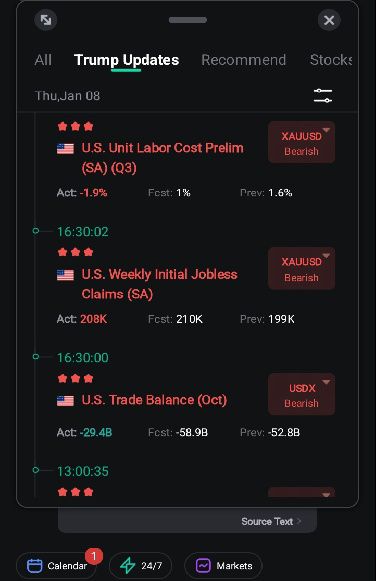
U.S. Unit Labor Cost Prelim (SA) (Q3)A:--
F: --
P: --
U.S. Wholesale Sales MoM (SA) (Oct)--
F: --
P: --
U.S. EIA Weekly Natural Gas Stocks Change--
F: --
P: --
U.S. Consumer Credit (SA) (Nov)--
F: --
P: --
U.S. Weekly Treasuries Held by Foreign Central Banks--
F: --
P: --
China, Mainland CPI YoY (Dec)--
F: --
P: --
China, Mainland PPI YoY (Dec)--
F: --
P: --
China, Mainland CPI MoM (Dec)--
F: --
P: --
Indonesia Retail Sales YoY (Nov)--
F: --
P: --
Japan Leading Indicators Prelim (Nov)--
F: --
P: --
Germany Industrial Output MoM (SA) (Nov)--
F: --
P: --
Germany Exports MoM (SA) (Nov)--
F: --
France Industrial Output MoM (SA) (Nov)--
F: --
P: --
Italy Retail Sales MoM (SA) (Nov)--
F: --
P: --
Euro Zone Retail Sales MoM (Nov)--
F: --
P: --
Euro Zone Retail Sales YoY (Nov)--
F: --
P: --
Italy 12-Month BOT Auction Avg. Yield--
F: --
P: --
India Deposit Gowth YoY--
F: --
P: --
Brazil IPCA Inflation Index YoY (Dec)--
F: --
P: --
Mexico Industrial Output YoY (Nov)--
F: --
P: --
Brazil CPI YoY (Dec)--
F: --
P: --
U.S. Building Permits Revised MoM (SA) (Sept)--
F: --
P: --
U.S. Building Permits Revised YoY (SA) (Sept)--
F: --
P: --
U.S. Unemployment Rate (SA) (Dec)--
F: --
P: --
U.S. Nonfarm Payrolls (SA) (Dec)--
F: --
P: --
U.S. Average Hourly Wage YoY (Dec)--
F: --
P: --
Canada Full-time Employment (SA) (Dec)--
F: --
P: --
Canada Part-Time Employment (SA) (Dec)--
F: --
P: --
Canada Unemployment Rate (SA) (Dec)--
F: --
P: --
Canada Labor Force Participation Rate (SA) (Dec)--
F: --
P: --
Canada Employment (SA) (Dec)--
F: --
P: --


No matching data
Latest Views
Latest Views
Trending Topics
Top Columnists
Latest Update
White Label
Data API
Web Plug-ins
Affiliate Program
View All

No data
After Japanese Prime Minister Sanae Takaichi’s warning about a potential Chinese invasion of Taiwan, China responded by suspending exports of strategic dual-use materials to Japan...
Recent geopolitical events, from a U.S. military operation in Venezuela to tensions over Greenland, are fueling a significant rally in European defense stocks. As the global security landscape becomes less predictable, investors are increasingly viewing military spending not as a cyclical trend but as a long-term structural theme.
A Bloomberg index tracking European defense companies has already climbed 10% this year. The momentum accelerated following the U.S. military's capture of Venezuelan President Nicolás Maduro and continues as U.S. President Donald Trump has not dismissed using military force to acquire Greenland, creating friction with NATO ally Denmark.
Analysts argue that these events reinforce a new reality for Europe: the need for greater military self-reliance. The perception is that U.S. security policy is becoming more unilateral and transactional, even toward its traditional allies.
"That means that Europe has understood it needs to be able to act with or without US support," said Saima Hussain, an analyst at Alphavalue, in an interview with Bloomberg Television.
This sentiment is a key driver behind the sector's performance. The same defense index surged 73% in 2025, and last year, the sector was responsible for about 12% of the total returns for the Stoxx Europe 600 index, second only to banks.
The "less predictable world" is hardening the political will across Europe to boost military investment, according to Aneeka Gupta, macroeconomic research director at WisdomTree. She notes that events like the one in Venezuela encourage nations to meet or exceed NATO's spending target of 2% of GDP.
This directly benefits European defense contractors specializing in key areas:
• Munitions replenishment
• Air and naval power
• Surveillance and cyber capabilities
Germany has already committed to a spending increase of around €50 billion ($58.4 billion) on armored vehicles, air-defense missiles, and satellites. The country aims to meet its NATO spending commitment in 2029, six years ahead of schedule. This follows a pledge from most NATO members to adopt a new spending goal of 3.5% of GDP, spurred by Trump's reluctance to continue underwriting Europe's defense costs.
Strategists at Goldman Sachs Group Inc., including Sharon Bell, remain bullish on the sector, expecting government spending commitments to continue driving profit growth. Furthermore, analysis shows that the European aerospace and defense sector trades at a discount compared to its U.S. counterpart based on forward price-to-earnings ratios.
However, there are risks. Renewed investor interest has pushed valuations to expensive levels relative to the broader European market. High earnings expectations could lead to disappointment, a factor that slowed the rally in the second half of last year. A potential ceasefire in Ukraine could also temporarily cool market sentiment.
Fiscal pressures may also pose a challenge. Ana Andrade of Bloomberg Economics noted that the region’s five largest economies are likely to fall short of spending targets. Germany, with its lower debt levels, is in the best position to lead the military buildup.
Despite these concerns, the sector has started the new year strong.
• Saab AB became the first major European defense company to hit a record stock price in 2026.
• Rheinmetall AG remains a top pick among analysts.
Analysts at Bernstein, led by Adrien Rabier, advise a selective approach, focusing on national champions poised to benefit from their respective government's spending plans. They do not anticipate a Russia-Ukraine ceasefire soon but caution that stock prices may react to peace-related headlines.
"Ceasefire or not, the spending needs to happen," the Bernstein team wrote. They project that topline growth for large-cap defense firms in 2026 will remain as strong as in 2025, forecasting revenue gains of 9% for the group. They see the most potential for upgrades in Rheinmetall, Thales, and Leonardo, with Rheinmetall’s sales growth forecast to accelerate by 40%.
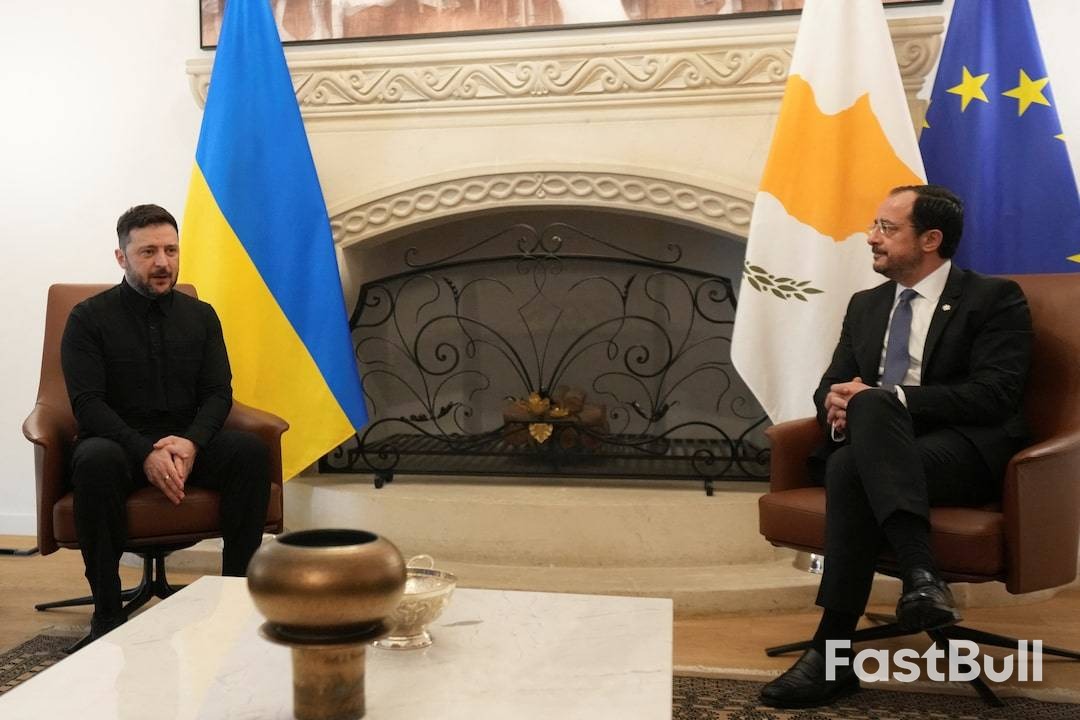
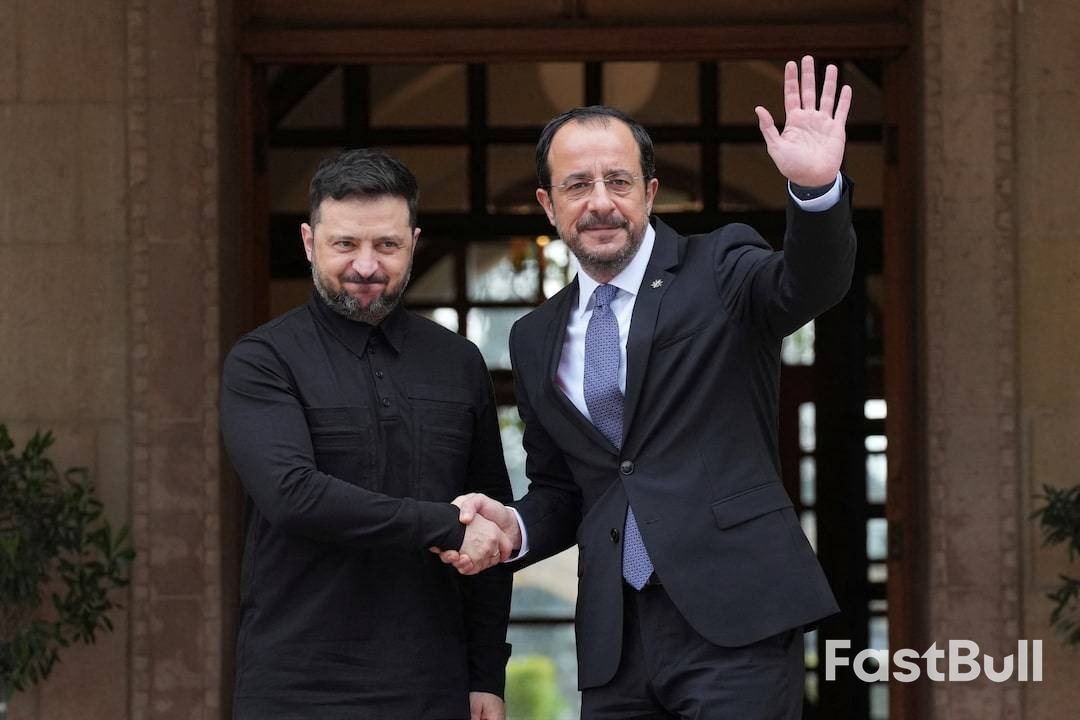
Cyprus began its rotating presidency of the European Union on Wednesday, launching its six-month term with a high-profile meeting attended by Ukrainian President Volodymyr Zelenskyy, European Commission chief Ursula von der Leyen, and European Council President Antonio Costa.
Zelenskyy's presence in Nicosia sends a strong political signal of the EU's continued backing for Kyiv as its war with Russia moves into its fifth year.

Upon his arrival at the presidential palace, Zelenskyy was welcomed by Cypriot President Nikos Christodoulides. During a brief exchange, the Ukrainian leader expressed his goals for the new presidency.
"We hope that during your presidency a lot of steps can be taken forward, closer to membership in the EU," Zelenskyy told Christodoulides.
He added that the meeting was also an opportunity to follow up on discussions from a Paris summit on Tuesday. At that gathering, the United States and a broad coalition of allies pledged to provide security guarantees to support Ukraine in the event of a ceasefire if Russia were to attack again.
The island nation, which is assuming the EU helm for the second time, aims to serve as a strategic bridge between Europe and the Middle East. A formal ceremony in Nicosia will include regional leaders such as Lebanese President Joseph Aoun, highlighting this ambition.

While Cyprus traditionally maintained close cultural and political ties with Russia, it has fully supported sanctions against Moscow. Many on the island draw parallels between Russia's invasion of Ukraine and Turkey's 1974 invasion of northern Cyprus, which followed a coup engineered by the military junta then ruling Greece.
For his part, President Christodoulides stated that Cyprus's presidency will focus on boosting the EU's autonomy and deepening its integration to better address global challenges.
Euro-area inflation has aligned with the European Central Bank's target, reinforcing the view among policymakers that interest rates can remain on hold barring any major shifts in the economic outlook.
Consumer prices in December rose 2% from the previous year, a slight decrease from the 2.1% recorded in the prior month. The figure matched economists' expectations.
A closer look at the data reveals a broader trend of moderating price pressures. Core inflation, which excludes volatile items like food and energy, slowed to 2.3%. Similarly, services inflation, a metric closely watched by the ECB, also showed signs of easing.
Price growth has now been hovering near the central bank's 2% objective for over six months. This stability has allowed the ECB to maintain its current borrowing costs since June, with both economists and investors anticipating no further policy moves in the foreseeable future.
While most ECB officials agree that inflation is largely under control, they have been circumspect about future steps, pointing to persistent uncertainty in the global economy.
At their final meeting of 2025, policymakers revised their forecasts, now expecting inflation to fall only slightly below its target this year. This upward adjustment reflects a slower-than-anticipated easing in the cost of services.
Divergent Inflation Rates Across the Bloc
Recent reports from member states show that while consumer price growth is easing across the Eurozone, the pace differs significantly from country to country.
• Spain: Inflation dropped to 3%.
• France: Inflation eased to 0.7%.
• Germany: Inflation registered at 2%.
Services inflation remains a primary point of concern for the ECB, driven partly by robust wage growth. The most comprehensive measure of pay increases held steady at 4% in the third quarter, a level considered above what is consistent with long-term price stability.
ECB President Christine Lagarde acknowledged last month that this is "a trend that we look at carefully." However, she also expressed confidence that wage pressures should moderate this year as salaries catch up to the post-pandemic price surge.
Several other factors could potentially push inflation away from the 2% target, including the ongoing effects of US tariffs, the strength of the euro, and fiscal expansion in Germany.
Under its baseline scenario, the central bank projects that inflation will average 1.9% in 2026. Following a further decline, it is then expected to accelerate back toward the 2% target by 2028.
White Label
Data API
Web Plug-ins
Poster Maker
Affiliate Program
The risk of loss in trading financial instruments such as stocks, FX, commodities, futures, bonds, ETFs and crypto can be substantial. You may sustain a total loss of the funds that you deposit with your broker. Therefore, you should carefully consider whether such trading is suitable for you in light of your circumstances and financial resources.
No decision to invest should be made without thoroughly conducting due diligence by yourself or consulting with your financial advisors. Our web content might not suit you since we don't know your financial conditions and investment needs. Our financial information might have latency or contain inaccuracy, so you should be fully responsible for any of your trading and investment decisions. The company will not be responsible for your capital loss.
Without getting permission from the website, you are not allowed to copy the website's graphics, texts, or trademarks. Intellectual property rights in the content or data incorporated into this website belong to its providers and exchange merchants.
Not Logged In
Log in to access more features

FastBull Membership
Not yet
Purchase
Log In
Sign Up