• Trade
  • Markets
  • Copy
  • Contests
  • News
  • 24/7
  • Calendar
  • Q&A
  • Chats
Trending
Screeners
SYMBOL
LAST
BID
ASK
HIGH
LOW
NET CHG.
%CHG.
SPREAD
SPX
S&P 500 Index
6870.39
6870.39
6870.39
6895.79
6858.28
+13.27
+ 0.19%
--
DJI
Dow Jones Industrial Average
47954.98
47954.98
47954.98
48133.54
47871.51
+104.05
+ 0.22%
--
IXIC
NASDAQ Composite Index
23578.12
23578.12
23578.12
23680.03
23506.00
+72.99
+ 0.31%
--
USDX
US Dollar Index
98.930
99.010
98.930
98.960
98.730
-0.020
-0.02%
--
EURUSD
Euro / US Dollar
1.16474
1.16481
1.16474
1.16717
1.16341
+0.00048
+ 0.04%
--
GBPUSD
Pound Sterling / US Dollar
1.33197
1.33207
1.33197
1.33462
1.33136
-0.00115
-0.09%
--
XAUUSD
Gold / US Dollar
4200.67
4201.08
4200.67
4218.85
4190.61
+2.76
+ 0.07%
--
WTI
Light Sweet Crude Oil
59.295
59.325
59.295
60.084
58.980
-0.514
-0.86%
--

Community Accounts

Signal Accounts
--
Profit Accounts
--
Loss Accounts
--
View More

Become a signal provider

Sell trading signals to earn additional income

View More

Guide to Copy Trading

Get started with ease and confidence

View More

Signal Accounts for Members

All Signal Accounts

Best Return
  • Best Return
  • Best P/L
  • Best MDD
Past 1W
  • Past 1W
  • Past 1M
  • Past 1Y

All Contests

  • All
  • Trump Updates
  • Recommend
  • Stocks
  • Cryptocurrencies
  • Central Banks
  • Featured News
Top News Only
Share

Chinese Foreign Minister Wang Yi: Hopes Germany Will View China More Objectively And Rationally, Adhere To The Positioning Of China-Germany Partnership

Share

China Foreign Ministry: China's Foreign Minister Wang Yi Meets German Counterpart

Share

Israeli Government Spokesperson: Netanyahu Will Meet Trump On December 29

Share

Stc Did Not Ask Internationally-Government To Leave Aden - Senior Stc Official To Reuters

Share

Members Of Internationally-Recognised Government, Opposed To Northern Houthis, Have Left Aden - Senior Stc Official To Reuters

Share

Yemen's Southern Separatist Group Stc Is Now Present In All Governorates Of South Yemen, Including The Southern City Of Aden - Senior Stc Official To Reuters

Share

[Trump: Single Rule Executive Order For AI To Be Issued This Week] US President Trump Stated That If We Are To Continue To Lead In Artificial Intelligence, There Must Be Only One Rulebook. So Far, We Have Beaten All The Countries In This Race, But If In The Future 50 States Are Involved In Setting The Rules And Approval Processes, And Many Of Those States Are Likely To Violate Those Rules, This Advantage Will Quickly Disappear. There Is No Doubt About That! Artificial Intelligence Will Be Destroyed In Its Infancy! I Will Issue A "single Rule" Executive Order This Week. You Can't Expect A Company To Get Approval From 50 States Every Time It Wants To Do Something. That Will Never Work!

Share

Two Iraq Energy Officials: Iraq Shuts Down Entire West Qurna 2 Production Of Around 460000 Barrels/Day Due To Export Pipeline Leak

Share

Petroleum Ministry: Egypt Exports LNG Shipment To Turkey Chartered By Shell

Share

White House Economic Adviser Hassett: Trump Will Release A Lot Of Positive Economic News

Share

Ukraine President Zelenskiy: We Can't Manage Without Europeans, We Can't Manage Without The Americans, That's Why We Have Some Important Decisions To Make

Share

White House Economic Adviser Hassett On Netflix, Wbd: In The End Justice Department Will Study Impact For Quite A While

Share

White House Economic Adviser Hassett On Trump's Ai 'One Rule': Order Should Help Ai Companies Understand What The Rules Are

Share

German Chancellor Merz: Sceptical About Some Of The Details In Documents Coming From The United States

Share

White House Economic Adviser Hassett On Aca Subsidies: There Is Room For Negotiation

Share

French President Macron: Russia Economy Is Starting To Suffer After Latest Sanctions

Share

Ukraine President Zelenskiy: Unity Between Europe, Ukraine And Unites States Is Important

Share

UK Labour Party Leader Starmer: Matters For Ukraine Are For Ukraine

Share

China's Commerce Minister: China Has Already Implemented Export License Exemptions For Nexperia Chips

Share

China's Commerce Minister: China Is Gradually Applying A General Licensing System In Areas Such As Rare Earths

TIME
ACT
FCST
PREV
France Trade Balance (SA) (Oct)

A:--

F: --

P: --
Euro Zone Employment YoY (SA) (Q3)

A:--

F: --

P: --
Canada Part-Time Employment (SA) (Nov)

A:--

F: --

P: --

Canada Unemployment Rate (SA) (Nov)

A:--

F: --

P: --

Canada Full-time Employment (SA) (Nov)

A:--

F: --

P: --

Canada Labor Force Participation Rate (SA) (Nov)

A:--

F: --

P: --

Canada Employment (SA) (Nov)

A:--

F: --

P: --

U.S. PCE Price Index MoM (Sept)

A:--

F: --

P: --

U.S. Personal Income MoM (Sept)

A:--

F: --

P: --

U.S. Core PCE Price Index MoM (Sept)

A:--

F: --

P: --

U.S. PCE Price Index YoY (SA) (Sept)

A:--

F: --

P: --

U.S. Core PCE Price Index YoY (Sept)

A:--

F: --

P: --

U.S. Personal Outlays MoM (SA) (Sept)

A:--

F: --

P: --
U.S. 5-10 Year-Ahead Inflation Expectations (Dec)

A:--

F: --

P: --

U.S. Real Personal Consumption Expenditures MoM (Sept)

A:--

F: --

P: --
U.S. Weekly Total Rig Count

A:--

F: --

P: --

U.S. Weekly Total Oil Rig Count

A:--

F: --

P: --

U.S. Consumer Credit (SA) (Oct)

A:--

F: --

P: --
China, Mainland Foreign Exchange Reserves (Nov)

A:--

F: --

P: --

Japan Trade Balance (Oct)

A:--

F: --

P: --

Japan Nominal GDP Revised QoQ (Q3)

A:--

F: --

P: --

China, Mainland Imports YoY (CNH) (Nov)

A:--

F: --

P: --

China, Mainland Exports (Nov)

A:--

F: --

P: --

China, Mainland Imports (CNH) (Nov)

A:--

F: --

P: --

China, Mainland Trade Balance (CNH) (Nov)

A:--

F: --

P: --

China, Mainland Exports YoY (USD) (Nov)

A:--

F: --

P: --

China, Mainland Imports YoY (USD) (Nov)

A:--

F: --

P: --

Germany Industrial Output MoM (SA) (Oct)

A:--

F: --

P: --
Euro Zone Sentix Investor Confidence Index (Dec)

A:--

F: --

P: --

Canada National Economic Confidence Index

A:--

F: --

P: --

U.K. BRC Like-For-Like Retail Sales YoY (Nov)

--

F: --

P: --

U.K. BRC Overall Retail Sales YoY (Nov)

--

F: --

P: --

Australia Overnight (Borrowing) Key Rate

--

F: --

P: --

RBA Rate Statement
RBA Press Conference
Germany Exports MoM (SA) (Oct)

--

F: --

P: --

U.S. NFIB Small Business Optimism Index (SA) (Nov)

--

F: --

P: --

Mexico 12-Month Inflation (CPI) (Nov)

--

F: --

P: --

Mexico Core CPI YoY (Nov)

--

F: --

P: --

Mexico PPI YoY (Nov)

--

F: --

P: --

U.S. Weekly Redbook Index YoY

--

F: --

P: --

U.S. JOLTS Job Openings (SA) (Oct)

--

F: --

P: --

China, Mainland M1 Money Supply YoY (Nov)

--

F: --

P: --

China, Mainland M0 Money Supply YoY (Nov)

--

F: --

P: --

China, Mainland M2 Money Supply YoY (Nov)

--

F: --

P: --

U.S. EIA Short-Term Crude Production Forecast For The Year (Dec)

--

F: --

P: --

U.S. EIA Natural Gas Production Forecast For The Next Year (Dec)

--

F: --

P: --

U.S. EIA Short-Term Crude Production Forecast For The Next Year (Dec)

--

F: --

P: --

EIA Monthly Short-Term Energy Outlook
U.S. API Weekly Gasoline Stocks

--

F: --

P: --

U.S. API Weekly Cushing Crude Oil Stocks

--

F: --

P: --

U.S. API Weekly Crude Oil Stocks

--

F: --

P: --

U.S. API Weekly Refined Oil Stocks

--

F: --

P: --

South Korea Unemployment Rate (SA) (Nov)

--

F: --

P: --

Japan Reuters Tankan Non-Manufacturers Index (Dec)

--

F: --

P: --

Japan Reuters Tankan Manufacturers Index (Dec)

--

F: --

P: --

Japan Domestic Enterprise Commodity Price Index MoM (Nov)

--

F: --

P: --

Japan Domestic Enterprise Commodity Price Index YoY (Nov)

--

F: --

P: --

China, Mainland PPI YoY (Nov)

--

F: --

P: --

China, Mainland CPI MoM (Nov)

--

F: --

P: --

Q&A with Experts
    • All
    • Chatrooms
    • Groups
    • Friends
    Connecting
    .
    .
    .
    Type here...
    Add Symbol or Code

      No matching data

      All
      Trump Updates
      Recommend
      Stocks
      Cryptocurrencies
      Central Banks
      Featured News
      • All
      • Russia-Ukraine Conflict
      • Middle East Flashpoint
      • All
      • Russia-Ukraine Conflict
      • Middle East Flashpoint
      Search
      Products

      Charts Free Forever

      Chats Q&A with Experts
      Screeners Economic Calendar Data Tools
      Membership Features
      Data Warehouse Market Trends Institutional Data Policy Rates Macro

      Market Trends

      Market Sentiment Order Book Forex Correlations

      Top Indicators

      Charts Free Forever
      Markets

      News

      News Analysis 24/7 Columns Education
      From Institutions From Analysts
      Topics Columnists

      Latest Views

      Latest Views

      Trending Topics

      Top Columnists

      Latest Update

      Signals

      Copy Rankings Latest Signals Become a signal provider AI Rating
      Contests
      Brokers

      Overview Brokers Assessment Rankings Regulators News Claims
      Broker listing Forex Brokers Comparison Tool Live Spread Comparison Scam
      Q&A Complaint Scam Alert Videos Tips to Detect Scam
      More

      Business
      Events
      Careers About Us Advertising Help Center

      White Label

      Data API

      Web Plug-ins

      Affiliate Program

      Awards Institution Evaluation IB Seminar Salon Event Exhibition
      Vietnam Thailand Singapore Dubai
      Fans Party Investment Sharing Session
      FastBull Summit BrokersView Expo
      Recent Searches
        Top Searches
          Markets
          News
          Analysis
          User
          24/7
          Economic Calendar
          Education
          Data
          • Names
          • Latest
          • Prev

          View All

          No data

          Scan to Download

          Faster Charts, Chat Faster!

          Download App
          English
          • English
          • Español
          • العربية
          • Bahasa Indonesia
          • Bahasa Melayu
          • Tiếng Việt
          • ภาษาไทย
          • Français
          • Italiano
          • Türkçe
          • Русский язык
          • 简中
          • 繁中
          Open Account
          Search
          Products
          Charts Free Forever
          Markets
          News
          Signals

          Copy Rankings Latest Signals Become a signal provider AI Rating
          Contests
          Brokers

          Overview Brokers Assessment Rankings Regulators News Claims
          Broker listing Forex Brokers Comparison Tool Live Spread Comparison Scam
          Q&A Complaint Scam Alert Videos Tips to Detect Scam
          More

          Business
          Events
          Careers About Us Advertising Help Center

          White Label

          Data API

          Web Plug-ins

          Affiliate Program

          Awards Institution Evaluation IB Seminar Salon Event Exhibition
          Vietnam Thailand Singapore Dubai
          Fans Party Investment Sharing Session
          FastBull Summit BrokersView Expo

          China Breaks Silence on Rare Earth Export Controls Amid Rising Global Tensions

          Gerik

          Economic

          Commodity

          China–U.S. Trade War

          Summary:

          For the first time, China has officially addressed international concerns over its tightening control on rare earth exports. These elements are critical to modern technologies ranging from electric vehicles to missile guidance systems...

          Why It Matters: China's Dominance in Rare Earths

          China currently controls about 70% of global rare earth mining and 90% of refining capacity. This overwhelming dominance poses a strategic vulnerability for countries like the U.S. and its allies, who rely on these critical materials for both civilian and military manufacturing. In April, Beijing imposed new restrictions on seven types of rare earths in response to higher tariffs introduced by U.S. President Donald Trump. Though some of these restrictions were eased under a 90-day trade truce signed in Geneva, deeper negotiations have since stalled.
          At a press briefing on Thursday, Chinese Ministry of Commerce spokesperson He Yadong defended the export controls, describing them as in line with “international practice.” He emphasized the dual-use nature of rare earths — meaning they have both civilian and military applications — and stressed that export license approvals would follow legal procedures and support “legitimate trade.”
          In parallel, Chinese Foreign Ministry spokesperson Lin Jian echoed this view, stating the policies were non-discriminatory and not targeted at any specific country. He was responding to concerns raised by Japanese media about production halts at Suzuki due to a shortage of rare earth-based components.

          Geopolitical Fallout and Global Reactions

          President Trump confirmed he discussed rare earths with Chinese President Xi Jinping during a 90-minute phone call, marking their first direct contact since mid-January. Trump described the conversation as “very positive,” and noted that both sides acknowledged the strategic complexity of rare earth materials.
          Despite public optimism, the U.S. remains cautious. It has reportedly withheld certain rare earth shipments, and European automakers continue to voice concerns about supply chain disruptions. Trump indicated that rare earths will play a key role in his effort to revive domestic manufacturing, hinting at further policy shifts aimed at reshoring production.
          Meanwhile, Japan — a key U.S. ally and major exporter of vehicles to the U.S. — has sent chief tariff negotiator Ryosei Akazawa to Washington. According to Nikkei, Tokyo plans to propose a cooperative package to help expand non-Chinese supplies of the seven rare earths currently under Chinese restrictions.

          A Strategic Chess Game

          While China insists its export controls are standard regulatory actions, they are widely interpreted as part of a broader geopolitical strategy. Beijing may be using its rare earth monopoly to push back against Western tariffs and technology bans, particularly those targeting Huawei and other Chinese tech giants.
          The renewed focus on rare earths places them at the center of global power dynamics. As Trump aims to rebuild U.S. manufacturing strength, and as China seeks to protect its economic leverage, the world may witness not just a trade war — but a resource war. The next round of U.S.-China talks, expected soon, will likely hinge on this critical issue.

          Source: Nikkei Asia

          To stay updated on all economic events of today, please check out our Economic calendar
          Risk Warnings and Disclaimers
          You understand and acknowledge that there is a high degree of risk involved in trading. Following any strategies or investment methods may lead to potential losses. The content on the site is provided by our contributors and analysts for information purposes only. You are solely responsible for determining whether any trading assets, securities, strategy, or any other product is suitable for investing based on your own investment objectives and financial situation.
          Add to Favorites
          Share

          U.S. and China to Resume Trade Talks in London on June 9

          Gerik

          Economic

          China–U.S. Trade War

          Diplomatic Follow-up to Trump–Xi Call

          The upcoming trade meeting was announced just one day after a 90-minute phone call between U.S. President Donald Trump and Chinese President Xi Jinping. Trump described the conversation as “very good” and confirmed that U.S. officials would travel to London for further talks. He expressed optimism, saying, “The meeting will go very well.” The announcement signals a willingness to maintain dialogue despite months of increasing trade-related friction.
          The U.S. delegation will include Treasury Secretary Scott Bessent, Commerce Secretary Howard Lutnick, and Trade Representative Jamieson Greer. China has not yet confirmed its representatives. Core discussion points are expected to include the temporary suspension of retaliatory tariffs, China's control over rare earth exports, and the U.S. restrictions on chip and semiconductor-related technologies.
          Although the two countries agreed to a 90-day tariff truce in Geneva on May 12, structural disagreements persist. These include U.S. concerns about China’s state-driven economic model, industrial subsidies, and export dominance, as well as geopolitical flashpoints such as Taiwan and fentanyl trafficking.

          Policy Uncertainty and Economic Fallout

          The temporary easing of tariffs has brought some relief to global markets, but deeper uncertainties remain. China views rare earths as a strategic asset and has used export controls as leverage. Meanwhile, the U.S. has restricted access to chip-design software and nuclear components. These moves have disrupted manufacturing supply chains and stoked investor anxiety.
          Domestically, both countries face mounting pressures. U.S. companies report shortages of critical materials, while China is grappling with declining imports of U.S. technology and weakening consumer demand. Trump's approach — threatening harsh measures but often retreating at the last minute — has added unpredictability to already fragile negotiations.

          Strategic Implications Beyond Trade

          This round of talks is also being closely watched for its geopolitical implications. Beijing's willingness to weaponize rare earths could create political fallout for Trump if American industries are forced to halt production. At the same time, Beijing risks further isolating itself economically if foreign firms accelerate supply-chain relocation away from China.
          Both governments have an incentive to de-escalate. A prolonged trade war would likely dampen global growth, especially as inflation concerns and interest rate decisions weigh on financial markets. A breakthrough deal, if achieved, could restore confidence and encourage investment across Asia and beyond.
          The June 9 meeting in London may offer a rare opportunity to stabilize one of the most critical bilateral relationships in global economics. Yet, unless it moves beyond short-term gestures and addresses underlying issues such as intellectual property rights, trade imbalances, and strategic trust, the truce may prove fragile. Investors, manufacturers, and governments around the world will be watching closely — not just for a deal, but for signs of lasting cooperation.

          Source: Reuters

          To stay updated on all economic events of today, please check out our Economic calendar
          Risk Warnings and Disclaimers
          You understand and acknowledge that there is a high degree of risk involved in trading. Following any strategies or investment methods may lead to potential losses. The content on the site is provided by our contributors and analysts for information purposes only. You are solely responsible for determining whether any trading assets, securities, strategy, or any other product is suitable for investing based on your own investment objectives and financial situation.
          Add to Favorites
          Share

          Trump Asks Supreme Court To Let Him Dismantle Education Department

          Thomas

          Economic

          WADonald Trump's administration asked the U.S. Supreme Court on Friday to permit it to proceed with dismantling the Department of Education, a move that would leave school policy in the United States almost entirely in the hands of states and local boards.

          The Justice Department asked the court to halt Boston-based U.S. District Judge Myong Joun's May 22 ruling that ordered the administration reinstate employees terminated in a mass layoff and end further actions to shutter the department.

          The department, created by a U.S. law passed by Congress in 1979, oversees about 100,000 public and 34,000 private schools in the United States, though more than 85% of public school funding comes from state and local governments.

          It provides federal grants for needy schools and programs, including money to pay teachers of children with special needs, fund arts programs and replace outdated infrastructure. It also oversees the $1.6 trillion in student loans held by tens of millions of Americans who cannot afford to pay for college outright.

          Trump's move to dismantle the department is part of the Republican president's campaign to downsize and reshape the federal government. Closing the department long has been a goal of many U.S. conservatives.

          Attorneys general from 20 states and the District of Columbia, as well as school districts and unions representing teachers, sued to block the Trump administration's efforts to gut the department. The states argued that the massive job cuts will render the agency unable to perform core functions authorized by statute, including in the civil rights arena, effectively usurping Congress's authority in violation of the U.S. Constitution.

          Trump on March 20 signed an executive order intended to effectively shut down the department, making good on a longstanding campaign promise to conservatives to move education policy almost completely to states and local boards. At a White House ceremony surrounded by children and educators, Trump called the order a first step "to eliminate" the department.

          Secretary of Education Linda McMahon announced plans on March 11 to carry out a mass termination of employees. Those layoffs would leave the department with 2,183 workers, down from 4,133 when Trump took office in January. The department said in a press release those terminations were part of its "final mission."

          Trump on March 21 announced plans to transfer the department's student loan portfolio to the Small Business Administration and its special education, nutrition and related services to the U.S. Department of Health and Human Services, which also is facing deep job cuts.

          Joun in his ruling ordered the administration to reinstate the laid off workers and halt implementation of Trump's directive to transfer student loans and special needs programs to other federal agencies.

          The judge rejected the argument put forth by Justice Department lawyers that the mass terminations were aimed at making the department more efficient while fulfilling its mission. In fact, Joun ruled, the job cuts were an effort to shut down the department without the necessary approval of Congress.

          "This court cannot be asked to cover its eyes while the department's employees are continuously fired and units are transferred out until the department becomes a shell of itself," the judge wrote.

          White House spokesperson Harrison Fields called the judge's ruling "misguided."

          The Boston-based 1st U.S. Circuit Court of Appeals on June 4 rejected the Trump administration's request to pause the injunction issued by Joun.

          Source: Reuters

          To stay updated on all economic events of today, please check out our Economic calendar
          Risk Warnings and Disclaimers
          You understand and acknowledge that there is a high degree of risk involved in trading. Following any strategies or investment methods may lead to potential losses. The content on the site is provided by our contributors and analysts for information purposes only. You are solely responsible for determining whether any trading assets, securities, strategy, or any other product is suitable for investing based on your own investment objectives and financial situation.
          Add to Favorites
          Share

          Highs And Lows

          Damon

          Economic

          Central Bank

          Highs and Lows

          Bond yields were up some 5 basis points globally whilst the euro made a slight reversal after having pushed for a near high of 1.15 as the ECB concluded its press conference. From a ‘low’ inspired by 50% tariffs on US steel and aluminium imports going ‘live’ earlier this week and growing concerns about the US economy and the labor market, sentiment in financial markets briefly swung back to a ‘high’ as President Donald Trump said he had a “very good phone call” with Chinese President Xi Jinping. Gains in equity markets were modest but still good enough for S&P500 to extend its rally to 20% from its 8 April low. That is, before the falling-out between Trump and Musk reached a boiling point on social media. Enough is being written about that right now, so we’ll leave you at it.

          After the call with Xi, Trump said that both leaders have agreed to further talks and that there “should no longer be any questions respectively the complexity of Rare Earth products”. That’s up for various interpretations, but it suggests China has offered to speed up its process of lifting its export restrictions. Still, the Chinese readout of the call, unsurprisingly, was more nuanced and said that Xi had urged Trump to remove “negative” measures that have affected trade between the countries in recent months. The upshot, from the market’s perspective is that both sides are, at least, talking and that holds the prospect of further progress in removing some (still very high) tariffs. But, just for balance, Commerce Secretary Lutnick yesterday called for increased enforcement of US export controls on technology, warning that China was “only attacking great American companies.” If President Xi was referring to those export controls with “negative measures”, the market’s positive assessment may be, well, too high.

          That further talks with the US can lead to a ‘deal’ (as Keir Starmer can confirm), a stalemate (see EU-US) or a major escalation, as Zelensky can attest, is on any global leader’s mind. Nikkei Asia reports that US negotiators Bessent, Lutnick and Greer keep Japan guessing. “At one point the three cabinet officials put the talks with the Japanese side on hold an began debating right in front of them”, a source tells the Nikkei. In that sense, German Chancellor Merz came away nicely after a 40-minute meeting in the Oval Office, as he let Trump do most of the talking. Little concrete came from that meeting, though Trump acknowledged the ramp-up in German defense spending.

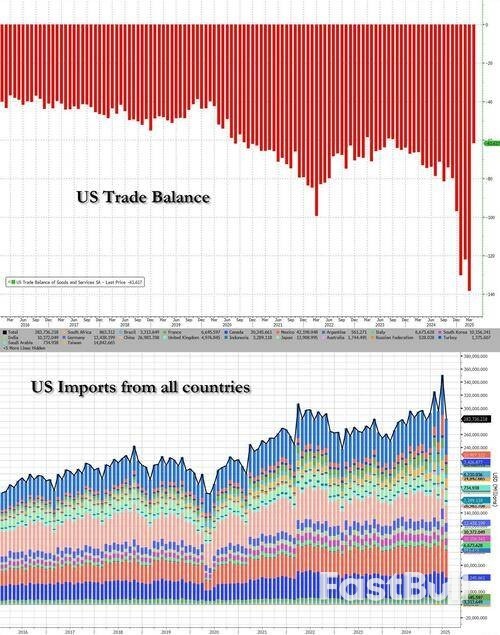
          Trade data are going from lows to highs as well, which in some cases makes the Covid-episode data look pale. As the Commerce Department confirmed, the US trade deficit for April shrunk by the most on record, to $61.6bn from $138.3bn in March, driven by the largest-ever decline in imports.

          Frontloading in the run-up the tariffs clearly was massive and then collapsed. This also suggests that after its big negative contribution to US GDP growth in Q1 it will be a significant positive factor in Q2. Inventory effects will likely attenuate some of its effect. Bloomberg noted that a drop in imports of pharmaceuticals from Ireland was responsible for an almost $20bn swing in the deficit. The opposite (statistical) effect is thus going to be seen in Europe in Q2. Ireland yesterday reported a significant upward revision in Q1 GDP (which now points to a revision in Eurozone GDP growth to around +0.6% q/q (!) from 0.3% previously). But this will obviously turn to a significant drag in Q2 as those US trade numbers for April just signaled.

          Staying in Europe, the ECB seemingly presented itself as an anchor of stability in these times of highs and lows. Lagarde’s new mantra is now “well positioned”, which could be viewed in our opinion as code language for “we’re done cutting, unless…”. This becomes even clearer when you compare it to the previous mantra Lagarde introduced in March when she called ECB policy “meaningfully less restrictive”. We had expected little to no guidance from yesterday’s policy meeting, but these new words – despite lower oil prices and a stronger euro – lead us to maintain our view that we have reached the terminal rate.

          However, the ECB leaves ample room to respond if things do not work out the way they envisage. Indeed, it lowered its inflation forecast significantly with core inflation positioned around 2% for the coming years. Moreover, its new scenario analyses unveiled a dovish reaction function to a potential escalation of trade tensions. Should this happen, and paused tariffs were to be reinstated, the ECB’s economists estimate that this could lower GDP growth through 2027 by about 1% cumulatively. And, interestingly, they conclude that inflation would be somewhat lower as well: in such a scenario inflation would average 1.8% in 2027, and that includes the assumption that the EU retaliates. By contrast, our own econometric analysis indicates that European tariffs on the US would be (mildly) inflationary instead.

          Lagarde did say that their modelling exercise assumed that higher tariffs could lead to lower demand for euro area exports and to countries with overcapacity rerouting their exports to the euro area thereby putting more downward pressure on inflation. However, she acknowledged that the ECB’s analysis did not include any inflationary impact from a disruption of supply chains. Although this effect, admittedly, is surrounded by even more uncertainty, we did take this into account in our own scenario analysis (which explains why we still have inflation somewhat above the ECB’s target even in 2026). And one only need to take a quick glance at container freight rates (benchmark composite by WCI up by a staggering 175% compared to last month) to understand why be believe the ECB the ECB could be under-estimating the potential highs.

          Time will tell, of course. But one thing that the ECB may be right about, is the (initial) downward pressure on imported goods prices due to a diversion of trade. The European Commission yesterday published its first assessment from its trade diversion monitoring tool that was launched in April. The early warning system tracks shipments and prices of goods at a high level of detail. In the short-run lower prices may benefit European importers and thereby consumers, but if those prices are the result of overcapacity in other parts of the world (such as China) this could also undermine European producers. The South China Morning Post reported that “in the month to May 25, imports of light-emitting diodes surged 156 per cent, while their price fell 65 per cent. Shipments of industrial robots shot up by 315 per cent, paired with a 35 per cent price decline. And imports of some bars and rods made from steel alloy soared by over 1,000 per cent as their price plunged 86 per cent.”

          Whilst such figures can be extremely volatile due to their level of detail, seasonal patterns etc. and make no distinction between the origin of the content, a heatmap by the Commission shows that China was a significant contributor to these changes. The FT writes that the surge in steel imports, driven by trade diversion, is setting off alarm bells in the steel sector. Forecasting the next steps by the European Commission is a rather speculative affair, but we’d not be surprised if this leads to some form of action. This year the Commission has already launched more than 10 cases against China and/or Chinese producers (based on our count of news articles on the EU’s trade defense website).

          Source: Zero Hedge

          To stay updated on all economic events of today, please check out our Economic calendar
          Risk Warnings and Disclaimers
          You understand and acknowledge that there is a high degree of risk involved in trading. Following any strategies or investment methods may lead to potential losses. The content on the site is provided by our contributors and analysts for information purposes only. You are solely responsible for determining whether any trading assets, securities, strategy, or any other product is suitable for investing based on your own investment objectives and financial situation.
          Add to Favorites
          Share

          Exclusive-China Issues Rare Earth Licenses To Suppliers Of Top 3 US Automakers, Sources Say

          Damon

          Economic

          China has granted temporary export licenses to rare-earth suppliers of the top three U.S. automakers, two sources familiar with the matter said, as supply chain disruptions begin to surface from Beijing's export curbs on those materials.

          At least some of the licenses are valid for six months, the two sources said, declining to be named because the information is not public. It was not immediately clear what quantity or items are covered by the approval or whether the move signals China is preparing to ease the rare-earths licensing process, which industry groups say is cumbersome and has created a supply bottleneck.

          China's decision in April to restrict exports of a wide range of rare earths and related magnets has tripped up the supply chains central to automakers, aerospace manufacturers, semiconductor companies and military contractors around the world.

          China's dominance of the critical mineral industry, key to the green energy transition, is increasingly viewed as a key point of leverage for Beijing in its trade war with U.S. President Donald Trump. China produces around 90% of the world's rare earths, and auto industry representatives have warned of increasing threats to production due to their dependency on it for those parts.

          Suppliers of three big U.S. automakers, General Motors,, Ford and Jeep-maker Stellantis got clearance for some rare earth export licenses on Monday, one of the two sources said.

          GM and Ford each declined to comment. Stellantis said it is working with suppliers "to ensure an efficient licensing process" and that so far the company has been able to "address immediate production concerns without major disruptions."

          China's Ministry of Commerce did not immediately respond to a faxed request for comment.

          China's critical-mineral export controls have become a focus on Trump's criticism of Beijing, which he says has violated the truce reached last month to roll back tariffs and trade restrictions.

          On Thursday, Trump and Chinese President Xi Jinping had a lengthy phone call to iron out trade differences. Trump said in social-media post that "there should no longer be any questions respecting the complexity of Rare Earth products." Both sides said teams will meet again soon.

          U.S. auto companies are already feeling the impact of the restrictions. Ford shut down production of its Explorer SUV at its Chicago plant for a week in May because of a rare-earth shortage, the company said.

          Source: Yahoo Finance

          To stay updated on all economic events of today, please check out our Economic calendar
          Risk Warnings and Disclaimers
          You understand and acknowledge that there is a high degree of risk involved in trading. Following any strategies or investment methods may lead to potential losses. The content on the site is provided by our contributors and analysts for information purposes only. You are solely responsible for determining whether any trading assets, securities, strategy, or any other product is suitable for investing based on your own investment objectives and financial situation.
          Add to Favorites
          Share

          Jobs Report Beats Expectations But Downward Revisions Raise Red Flags

          ING

          Economic

          A respectable jobs market in May with firm employment growth and stable unemployment, but the risks are skewed toward more weakness in coming months as trade uncertainty and concerns for consumer spending lead firms to become much more cautious on hiring.

          Respectable Jobs Data for May

          The May US jobs report shows nonfarm payrolls rising 139k versus the 126k consensus and April’s print of 147k. April was initially reported as 177k, and together with adjustments to March’s numbers, we get a net 95k of downward revisions to the previous two months of jobs data.

          The unemployment rate held at 4.2% while wage growth was a touch stronger at 0.4% MoM/3.9% YoY versus 0.2/3.9% in April. Average weekly hours stayed at 34.3.

          On balance, a pretty decent outcome given the weakness seen in the employment components of key business surveys, but the risks are increasingly skewed towards cooler jobs growth in the coming months.

          Monthly Change in Nonfarm Payrolls (000s)

          Source: Macrobond, ING

          Job Growth Is Concentrated in Two Sectors

          The details show that manufacturing employment fell 8k, retail dropped 7k, while temporary help fell 20k, with federal government employment falling 22k - the fourth consecutive monthly decline in this component. However, the usual suspects that have been providing the job gains over the past couple of years came through once again, with private education and healthcare services up 87k and leisure and hospitality up 48k.

          After the revisions, we see that government, leisure & hospitality, and private education and healthcare services account for 87% of all the jobs the US has created since January 2023.

          Traditional sectors that typically signify a strong US economy have not been adding jobs in any menanigful way - think tech, business services, transport & logistics, construction, financial services etc. The chart below shows the cumulative increase in jobs contributed by sector.

          Source: Macrobond, ING

          Risks of Weaker Jobs Figures Ahead

          Our suspicion is that government, private education, healthcare services, and leisure and hospitality will become much less supportive through the year and potentially even act as a drag on job creation in 4Q. Private healthcare jobs are vulnerable to President Trump’s desire for reduced spending on health programmes and if consumers do start to become more cautious in their spending, reflecting the steep falls in sentiment, then discretionary spending on eating and drinking in bars and restaurants and other entertainment tends to be the first thing that gets cut.

          We also expect to see Federal government workers shrinking as a legacy of Elon Musk’s efforts to get a grip on government spending.

          Note too the Federal Reserve’s own Beige Book’s assessment of the jobs market from earlier this week, which stated that "comments about uncertainty delaying hiring were widespread. All Districts described lower labor demand, citing declining hours worked and overtime, hiring pauses, and staff reduction plans".

          The lack of clarity on the US global trading environment and concerns over the resilience of consumer demand are making businesses act more cautiously, and we have to be braced for softer jobs numbers ahead.

          Inflation, though, remains a key concern with the Beige Book warning of "as strong, significant, or substantial" cost and price increases. Until there is some clarity on which way the economny is heading the Fed will remain on hold with little prospect of a rate change before the fourth quarter.

          Source: Investing

          To stay updated on all economic events of today, please check out our Economic calendar
          Risk Warnings and Disclaimers
          You understand and acknowledge that there is a high degree of risk involved in trading. Following any strategies or investment methods may lead to potential losses. The content on the site is provided by our contributors and analysts for information purposes only. You are solely responsible for determining whether any trading assets, securities, strategy, or any other product is suitable for investing based on your own investment objectives and financial situation.
          Add to Favorites
          Share

          Trump Is Holding Back From Calling Out China Over Russia War Aid

          Devin

          Russia-Ukraine Conflict

          President Donald Trump is holding back from pushing China to halt support for Russia’s war machine as he focuses on other issues in the relationship with its biggest geopolitical rival, according to US and European officials familiar with the matter.

          The US administration will hone in on bilateral concerns with Beijing as it pushes the conflict in Ukraine further down the list of American foreign policy priorities, said the officials, who spoke on condition of anonymity to discuss private deliberations. Some cautioned that Trump could still change his stance at any time.

          If the White House does sustain that approach, it would mark a shift from longstanding positions of the US and Group of Seven to call out China as a key enabler of Russia’s war effort, pushing Beijing to use its leverage to bring Vladimir Putin to the negotiating table. G-7 foreign ministers condemned its support for Moscow in a March statement.

          Trump insisted that “nothing was discussed concerning Russia/Ukraine” with Chinese President Xi Jinping following a call between the two leaders on Thursday.

          Spokespeople for the White House didn’t immediately reply to a request for comment.

          The topic is likely to come up when G-7 leaders meet this month in Alberta, Canada, though it’s not clear if any leader will push the Trump administration to commit to language on China at the summit.

          The policy shift stems from the president’s team wanting to move away from a key foreign policy pillar of his predecessor, Joe Biden, that viewed every relationship with other governments through the lens of the war in Ukraine, one person familiar with the matter said.

          With tariffs, tech restrictions and rare earths on the list of issues between the US and China, the Trump team wants to use leverage points with Beijing on matters that are more important for the US national interest than Ukraine, the person said.

          Trump isn’t keen to call out China directly for its support of Moscow’s war machine while he is negotiating with Putin to find an end to the conflict, one of the people said.

          Republican Senator Lindsey Graham, a close Trump ally, has said he aims to have new sanctions imposed on Russia before the G-7 summit. He is pushing a Senate bill that has more than 80 co-sponsors which is aimed at limiting funding for Moscow’s war effort by stopping China and India from purchasing cheap oil from Russia.

          US officials criticize European counterparts for continuing to buy energy from there even as they call out Beijing’s export shipments — a practice that so far has not resulted in China cutting off its help, the people added.

          For its part, the European Union has so far kept up public pressure, along with raising the matter in bilateral contacts. The bloc’s chief diplomat, Kaja Kallas, accused Beijing of fueling Russia’s war with dual-use exports in a speech in Singapore last week.

          Moscow has managed to skirt trade restrictions and obtain sanctioned technologies and parts used in weapons or needed to make them, mostly by importing components from China.

          Bloomberg reported last month that Beijing has also curbed exports of drones and drone parts to Ukraine and the west, while continuing to supply Moscow.

          China has repeatedly claimed that it controls external sales of so-called dual use goods like drones that can be used for military purposes, and that it doesn’t provide lethal weapons to either side in the war.

          Bloomberg reported last summer that Chinese and Russian companies were working together on developing attack drones.

          The Biden administration and EU later sanctioned several Chinese firms for aiding Moscow’s drone manufacturing operations and providing critical components, including as part of a recent package of measures adopted by Brussels in May.

          Trump has so far refrained from pursuing any new sanctions over the war.

          Source: Bloomberg Europe

          Risk Warnings and Disclaimers
          You understand and acknowledge that there is a high degree of risk involved in trading. Following any strategies or investment methods may lead to potential losses. The content on the site is provided by our contributors and analysts for information purposes only. You are solely responsible for determining whether any trading assets, securities, strategy, or any other product is suitable for investing based on your own investment objectives and financial situation.
          Add to Favorites
          Share
          FastBull
          Copyright © 2025 FastBull Ltd

          728 RM B 7/F GEE LOK IND BLDG NO 34 HUNG TO RD KWUN TONG KLN HONG KONG

          TelegramInstagramTwitterfacebooklinkedin
          App Store Google Play Google Play
          Products
          Charts

          Chats

          Q&A with Experts
          Screeners
          Economic Calendar
          Data
          Tools
          Membership
          Features
          Function
          Markets
          Copy Trading
          Latest Signals
          Contests
          News
          Analysis
          24/7
          Columns
          Education
          Company
          Careers
          About Us
          Contact Us
          Advertising
          Help Center
          Feedback
          User Agreement
          Privacy Policy
          Business

          White Label

          Data API

          Web Plug-ins

          Poster Maker

          Affiliate Program

          Risk Disclosure

          The risk of loss in trading financial instruments such as stocks, FX, commodities, futures, bonds, ETFs and crypto can be substantial. You may sustain a total loss of the funds that you deposit with your broker. Therefore, you should carefully consider whether such trading is suitable for you in light of your circumstances and financial resources.

          No decision to invest should be made without thoroughly conducting due diligence by yourself or consulting with your financial advisors. Our web content might not suit you since we don't know your financial conditions and investment needs. Our financial information might have latency or contain inaccuracy, so you should be fully responsible for any of your trading and investment decisions. The company will not be responsible for your capital loss.

          Without getting permission from the website, you are not allowed to copy the website's graphics, texts, or trademarks. Intellectual property rights in the content or data incorporated into this website belong to its providers and exchange merchants.

          Not Logged In

          Log in to access more features

          FastBull Membership

          Not yet

          Purchase

          Become a signal provider
          Help Center
          Customer Service
          Dark Mode
          Price Up/Down Colors

          Log In

          Sign Up

          Position
          Layout
          Fullscreen
          Default to Chart
          The chart page opens by default when you visit fastbull.com