• Trade
  • Markets
  • Copy
  • Contests
  • News
  • 24/7
  • Calendar
  • Q&A
  • Chats
Trending
Screeners
SYMBOL
LAST
BID
ASK
HIGH
LOW
NET CHG.
%CHG.
SPREAD
SPX
S&P 500 Index
6827.42
6827.42
6827.42
6899.86
6801.80
-73.58
-1.07%
--
DJI
Dow Jones Industrial Average
48458.04
48458.04
48458.04
48886.86
48334.10
-245.98
-0.51%
--
IXIC
NASDAQ Composite Index
23195.16
23195.16
23195.16
23554.89
23094.51
-398.69
-1.69%
--
USDX
US Dollar Index
97.950
98.030
97.950
98.500
97.950
-0.370
-0.38%
--
EURUSD
Euro / US Dollar
1.17394
1.17409
1.17394
1.17496
1.17192
+0.00011
+ 0.01%
--
GBPUSD
Pound Sterling / US Dollar
1.33707
1.33732
1.33707
1.33997
1.33419
-0.00148
-0.11%
--
XAUUSD
Gold / US Dollar
4299.39
4299.39
4299.39
4353.41
4257.10
+20.10
+ 0.47%
--
WTI
Light Sweet Crude Oil
57.233
57.485
57.233
58.011
56.969
-0.408
-0.71%
--

Community Accounts

Signal Accounts
--
Profit Accounts
--
Loss Accounts
--
View More

Become a signal provider

Sell trading signals to earn additional income

View More

Guide to Copy Trading

Get started with ease and confidence

View More

Signal Accounts for Members

All Signal Accounts

Best Return
  • Best Return
  • Best P/L
  • Best MDD
Past 1W
  • Past 1W
  • Past 1M
  • Past 1Y

All Contests

  • All
  • Trump Updates
  • Recommend
  • Stocks
  • Cryptocurrencies
  • Central Banks
  • Featured News
Top News Only
Share

Pentagon Says Two USA Army Soldiers And One Civilian USA Interpreter Were Killed, And Three Were Wounded In Syria

Share

Israel Says It Kills Senior Hamas Commander Raed Saed In Gaza

Share

Ukraine's Navy Says Russian Drone Attack Hit Civilian Turkish Vessel Carrying Sunflower Oil To Egypt On Saturday

Share

Israeli Military Says It Put Planned Strike On South Lebanon Site On Hold After Lebanese Army Requested Access

Share

Norwegian Nobel Committee: Calls On The Belarusian Authorities To Release All Political Prisoners

Share

Norwegian Nobel Committee: His Freedom Is A Deeply Welcome And Long-Awaited Moment

Share

Ukraine Says It Received 114 Prisoners From Belarus

Share

USA Embassy In Lithuania: Maria Kalesnikava Is Not Going To Vilnius

Share

USA Embassy In Lithuania: Other Prisoners Are Being Sent From Belarus To Ukraine

Share

Ukraine President Zelenskiy: Five Ukrainians Released By Belarus In US-Brokered Deal

Share

USA Vilnius Embassy: USA Stands Ready For "Additional Engagement With Belarus That Advances USA Interests"

Share

USA Vilnius Embassy: Belarus, USA, Other Citizens Among The Prisoners Released Into Lithuania

Share

USA Vilnius Embassy: USA Will Continue Diplomatic Efforts To Free The Remaining Political Prisoners In Belarus

Share

USA Vilnius Embassy: Belarus Releases 123 Prisoners Following Meeting Of President Trump's Envoy Coale And Belarus President Lukashenko

Share

USA Vilnius Embassy: Masatoshi Nakanishi, Aliaksandr Syrytsa Are Among The Prisoners Released By Belarus

Share

USA Vilnius Embassy: Maria Kalesnikava And Viktor Babaryka Are Among The Prisoners Released By Belarus

Share

USA Vilnius Embassy: Nobel Peace Prize Laureate Ales Bialiatski Is Among The Prisoners Released By Belarus

Share

Belarusian Presidential Administration Telegram Channel: Lukashenko Has Pardoned 123 Prisoners As Part Of Deal With US

Share

Two Local Syrian Officials: Joint US-Syrian Military Patrol In Central Syria Came Under Fire From Unknown Assailants

Share

Israeli Military Says It Targeted 'Key Hamas Terrorist' In Gaza City

TIME
ACT
FCST
PREV
U.K. Trade Balance Non-EU (SA) (Oct)

A:--

F: --

P: --

U.K. Trade Balance (Oct)

A:--

F: --

P: --

U.K. Services Index MoM

A:--

F: --

P: --

U.K. Construction Output MoM (SA) (Oct)

A:--

F: --

P: --

U.K. Industrial Output YoY (Oct)

A:--

F: --

P: --

U.K. Trade Balance (SA) (Oct)

A:--

F: --

P: --

U.K. Trade Balance EU (SA) (Oct)

A:--

F: --

P: --

U.K. Manufacturing Output YoY (Oct)

A:--

F: --

P: --

U.K. GDP MoM (Oct)

A:--

F: --

P: --

U.K. GDP YoY (SA) (Oct)

A:--

F: --

P: --

U.K. Industrial Output MoM (Oct)

A:--

F: --

P: --

U.K. Construction Output YoY (Oct)

A:--

F: --

P: --

France HICP Final MoM (Nov)

A:--

F: --

P: --

China, Mainland Outstanding Loans Growth YoY (Nov)

A:--

F: --

P: --

China, Mainland M2 Money Supply YoY (Nov)

A:--

F: --

P: --

China, Mainland M0 Money Supply YoY (Nov)

A:--

F: --

P: --

China, Mainland M1 Money Supply YoY (Nov)

A:--

F: --

P: --

India CPI YoY (Nov)

A:--

F: --

P: --

India Deposit Gowth YoY

A:--

F: --

P: --

Brazil Services Growth YoY (Oct)

A:--

F: --

P: --

Mexico Industrial Output YoY (Oct)

A:--

F: --

P: --

Russia Trade Balance (Oct)

A:--

F: --

P: --

Philadelphia Fed President Henry Paulson delivers a speech
Canada Building Permits MoM (SA) (Oct)

A:--

F: --

P: --

Canada Wholesale Sales YoY (Oct)

A:--

F: --

P: --

Canada Wholesale Inventory MoM (Oct)

A:--

F: --

P: --

Canada Wholesale Inventory YoY (Oct)

A:--

F: --

P: --

Canada Wholesale Sales MoM (SA) (Oct)

A:--

F: --

P: --

Germany Current Account (Not SA) (Oct)

A:--

F: --

P: --

U.S. Weekly Total Rig Count

A:--

F: --

P: --

U.S. Weekly Total Oil Rig Count

A:--

F: --

P: --

Japan Tankan Large Non-Manufacturing Diffusion Index (Q4)

--

F: --

P: --

Japan Tankan Small Manufacturing Outlook Index (Q4)

--

F: --

P: --

Japan Tankan Large Non-Manufacturing Outlook Index (Q4)

--

F: --

P: --

Japan Tankan Large Manufacturing Outlook Index (Q4)

--

F: --

P: --

Japan Tankan Small Manufacturing Diffusion Index (Q4)

--

F: --

P: --

Japan Tankan Large Manufacturing Diffusion Index (Q4)

--

F: --

P: --

Japan Tankan Large-Enterprise Capital Expenditure YoY (Q4)

--

F: --

P: --

U.K. Rightmove House Price Index YoY (Dec)

--

F: --

P: --

China, Mainland Industrial Output YoY (YTD) (Nov)

--

F: --

P: --

China, Mainland Urban Area Unemployment Rate (Nov)

--

F: --

P: --

Saudi Arabia CPI YoY (Nov)

--

F: --

P: --

Euro Zone Industrial Output YoY (Oct)

--

F: --

P: --

Euro Zone Industrial Output MoM (Oct)

--

F: --

P: --

Canada Existing Home Sales MoM (Nov)

--

F: --

P: --

Euro Zone Total Reserve Assets (Nov)

--

F: --

P: --

U.K. Inflation Rate Expectations

--

F: --

P: --

Canada National Economic Confidence Index

--

F: --

P: --

Canada New Housing Starts (Nov)

--

F: --

P: --

U.S. NY Fed Manufacturing Employment Index (Dec)

--

F: --

P: --

U.S. NY Fed Manufacturing Index (Dec)

--

F: --

P: --

Canada Core CPI YoY (Nov)

--

F: --

P: --

Canada Manufacturing Unfilled Orders MoM (Oct)

--

F: --

P: --

Canada Manufacturing New Orders MoM (Oct)

--

F: --

P: --

Canada Core CPI MoM (Nov)

--

F: --

P: --

Canada Manufacturing Inventory MoM (Oct)

--

F: --

P: --

Canada CPI YoY (Nov)

--

F: --

P: --

Canada CPI MoM (Nov)

--

F: --

P: --

Canada CPI YoY (SA) (Nov)

--

F: --

P: --

Canada Core CPI MoM (SA) (Nov)

--

F: --

P: --

Q&A with Experts
    • All
    • Chatrooms
    • Groups
    • Friends
    Connecting
    .
    .
    .
    Type here...
    Add Symbol or Code

      No matching data

      All
      Trump Updates
      Recommend
      Stocks
      Cryptocurrencies
      Central Banks
      Featured News
      • All
      • Russia-Ukraine Conflict
      • Middle East Flashpoint
      • All
      • Russia-Ukraine Conflict
      • Middle East Flashpoint
      Search
      Products

      Charts Free Forever

      Chats Q&A with Experts
      Screeners Economic Calendar Data Tools
      Membership Features
      Data Warehouse Market Trends Institutional Data Policy Rates Macro

      Market Trends

      Market Sentiment Order Book Forex Correlations

      Top Indicators

      Charts Free Forever
      Markets

      News

      News Analysis 24/7 Columns Education
      From Institutions From Analysts
      Topics Columnists

      Latest Views

      Latest Views

      Trending Topics

      Top Columnists

      Latest Update

      Signals

      Copy Rankings Latest Signals Become a signal provider AI Rating
      Contests
      Brokers

      Overview Brokers Assessment Rankings Regulators News Claims
      Broker listing Forex Brokers Comparison Tool Live Spread Comparison Scam
      Q&A Complaint Scam Alert Videos Tips to Detect Scam
      More

      Business
      Events
      Careers About Us Advertising Help Center

      White Label

      Data API

      Web Plug-ins

      Affiliate Program

      Awards Institution Evaluation IB Seminar Salon Event Exhibition
      Vietnam Thailand Singapore Dubai
      Fans Party Investment Sharing Session
      FastBull Summit BrokersView Expo
      Recent Searches
        Top Searches
          Markets
          News
          Analysis
          User
          24/7
          Economic Calendar
          Education
          Data
          • Names
          • Latest
          • Prev

          View All

          No data

          Scan to Download

          Faster Charts, Chat Faster!

          Download App
          English
          • English
          • Español
          • العربية
          • Bahasa Indonesia
          • Bahasa Melayu
          • Tiếng Việt
          • ภาษาไทย
          • Français
          • Italiano
          • Türkçe
          • Русский язык
          • 简中
          • 繁中
          Open Account
          Search
          Products
          Charts Free Forever
          Markets
          News
          Signals

          Copy Rankings Latest Signals Become a signal provider AI Rating
          Contests
          Brokers

          Overview Brokers Assessment Rankings Regulators News Claims
          Broker listing Forex Brokers Comparison Tool Live Spread Comparison Scam
          Q&A Complaint Scam Alert Videos Tips to Detect Scam
          More

          Business
          Events
          Careers About Us Advertising Help Center

          White Label

          Data API

          Web Plug-ins

          Affiliate Program

          Awards Institution Evaluation IB Seminar Salon Event Exhibition
          Vietnam Thailand Singapore Dubai
          Fans Party Investment Sharing Session
          FastBull Summit BrokersView Expo

          Carry-Trade Blowup Haunts Markets Rattled by Rapid-Fire Unwind

          Thomas

          Bond

          Summary:

          By now, last Monday's global market meltdown looks more like a brief tremor, a fleeting panic unleashed...
          By now, last Monday's global market meltdown looks more like a brief tremor, a fleeting panic unleashed by a small policy shift from the Bank of Japan (BOJ) and resurgent fears of a US recession.
          But the way it unfolded so rapidly — and just as quickly faded out — is exposing how vulnerable markets are to a strategy that hedge funds exploited to bankroll hundreds of billions of dollars of bets in virtually every corner of the world.
          The yen carry trade, as it's known, was a sure-fire recipe for easy profits: Just borrow in Japan, the world's last haven of rock-bottom interest rates, then plough it into Mexican bonds yielding over 10%, Nvidia's soaring shares or even bitcoin. When the yen kept falling, the loans became even cheaper to repay, and the pay-offs turned that much bigger.
          Then, seemingly all at once, investors bailed out of the trade, in turn helping to fuel a furious rebound in the yen and a swift exodus from equities and other currencies as traders dumped assets to meet margin calls. It roiled Japan's stock market, too, setting off the fiercest one-day sell-off since 1987 on concern the surge in the currency would hammer exporters.
          “The yen carry trade remains the epicentre of everything in markets right now,” said David Lutz, the head of exchange-traded funds at JonesTrading.
          The pressure had been building up for weeks as markets in carry-trade hot spots sputtered, the Nasdaq 100 Index slid off record highs and worries mounted that the Federal Reserve had kept monetary policy too tight for too long.
          Then came the spark: an interest rate hike in Japan. The BOJ's benchmark is now still a mere 0.25%, the lowest in the industrial world, but the increase at the end of last month was large enough to force investors to rethink their long-held belief that Japanese borrowing costs would always remain pinned near zero.
          Even though markets have steadied, the episode is raising alarms about how much leverage had built up around Japan as its central bank kept pumping out cash despite the post-pandemic inflation surge. That's left anxious traders trying to gauge whether the bulk of the unwinding is over — or whether it will continue rippling through markets in the weeks ahead.
          Coming up with an answer is tricky because there are no official estimates for how much money is tied up in carry trades. According to GlobalData TS Lombard, there was some US$1.1 trillion (RM4.87 trillion) piled into the strategy, assuming all overseas borrowing in Japan since the end of 2022 was used to finance it and domestic investors used leverage for their foreign purchases.
          After last week's dramatic unwinding, strategists at JPMorgan Chase & Co reckoned that three-quarters of global currency carry trades have now been closed out, while those at Citigroup Inc said the current level of positioning has taken markets out of the “danger zone”.
          But others like BNY believe the unwind has further room to run, potentially driving the yen towards 100 to the US dollar — a fall of over 30% from where the currency pair ended last week.
          “Further carry-trade unwinding seems likely but the most significant and destructive part of this bubble-burst is now behind us,” Steven Barrow, the head of Group of 10 strategy at Standard Bank in London, said in a note to clients last week.
          The bubble, as Barrow called it, has decades-old roots. In the 1990s, with Japan's economy shadowed by a real estate crash, policymakers there slashed interest rates to zero. The trade has even been blamed by International Monetary Fund economists for playing a part in the 2008 financial crisis.
          By 2016, the BOJ had nevertheless pushed rates into negative territory.
          The incentive for speculators to borrow in Japan increased once other central banks started racing to contain the steep spike in inflation after the world reopened from the pandemic. As rates were lifted all around the world, the BOJ kept its benchmark beneath zero — widening the profits that could be made on carry trades.
          The result was a wave of speculative cash that flowed out of Japan, putting downward pressure on the yen as traders sold the currency to buy those of the countries where they were investing the proceeds.
          The impact was particularly stark in Latin America, which offered rates well above those in the US and Europe. In 2022 and 2023, currencies like the Brazilian real and the Mexican peso rose sharply, becoming some of the world's best performers.
          By one measure, borrowing in the yen and investing in Mexico, for example, produced returns of 40% last year alone. The strategy continued to rack up gains, with yen-funded trades in a basket of eight emerging-market currencies returning just over 17% this year to early July.
          “To go long the peso was such a no-brainer just a few months ago — but those days are definitely behind us,” said Alejandro Cuadrado, the head of global foreign exchange and Latin America strategy at Banco Bilbao Vizcaya Argentaria SA in New York.
          When the yen started rebounding sharply from its weakest levels in decades, that created a feedback loop as traders unwound carry trades to lock in their gains — pushing the yen up further as investors purchased it to close out their loans. It accelerated after the BOJ hiked rates on July 31 for a second time this year and surprisingly weak US job figures fanned fears that the Fed had waited too long to reverse course.
          After the unwind hit Japan's stock market on Aug 5, driving the Nikkei down 12%, BOJ deputy governor Shinichi Uchida stepped in to assure investors the central bank won't be raising rates as long as market instability persists. The markets steadied, with signs that hedge funds pulled back some bets that the yen would continue to gain.
          The recent turn has, at least temporarily, likely tamped down the carry trade, with traders anticipating more volatility in foreign exchange markets this year.
          “No trade lasts forever — and, the facts have changed,” said Jack McIntyre, a senior portfolio manager at Brandywine Global Investment Management. “The BOJ tightened and something broke — in this case the carry trade.”

          Source: Bloomberg

          Risk Warnings and Disclaimers
          You understand and acknowledge that there is a high degree of risk involved in trading. Following any strategies or investment methods may lead to potential losses. The content on the site is provided by our contributors and analysts for information purposes only. You are solely responsible for determining whether any trading assets, securities, strategy, or any other product is suitable for investing based on your own investment objectives and financial situation.
          Add to Favorites
          Share

          Weekly Economic & Financial Commentary: A Wild Week in a Data Desert

          WELLS FARGO

          Economic

          U.S. Review

          A Wild Week in a Data Desert

          Last week's run of weak U.S. data, capped by a troubling rise in the unemployment rate and a slowdown in nonfarm payroll growth, helped spark a wild week in global markets.
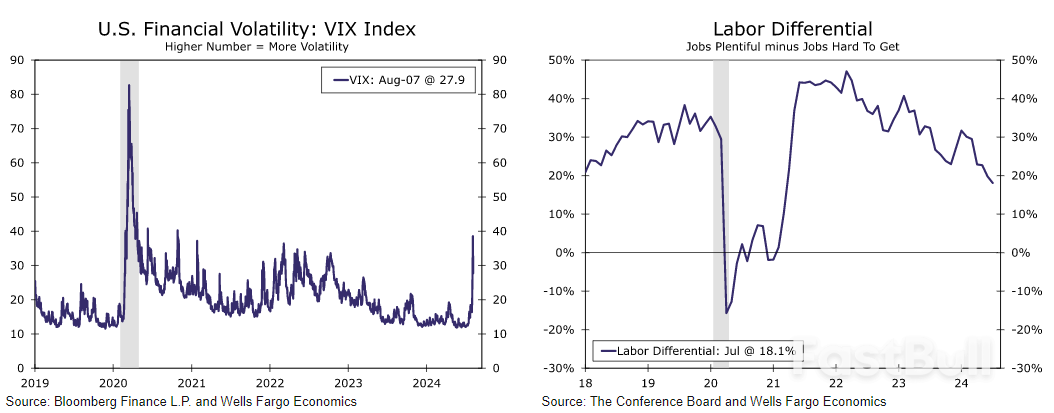
          It began Sunday night U.S. time when Asia markets opened and Japanese stocks fell a whopping 12%, propelled in part by an unwinding of the "yen carry trade" where traders borrow in a low-yielding currency and invest the proceeds in higher-yielding assets in a different currency. This financial market turbulence spilled over into the United States, and when paired with rising economic uncertainty, U.S. equities swung around sharply from days of steep losses to stretches of big gains. The VIX spiked to highs not seen since the pandemic (chart), and the 10-year Treasury yield traversed a range of 20 bps between Monday's lows and Thursday's highs.
          The limited economic data we did receive this week provided a bit of optimism. The ISM services index bounced back to 51.4 in July from an unusually weak 48.8 reading in June, led by much stronger readings for business activity, new orders and employment. Initial jobless claims ticked lower in the week ended August 3, although continuing claims did not show the same improvement.
          Weekly Economic & Financial Commentary: A Wild Week in a Data Desert_1
          Looking through the financial market volatility, we believe that the U.S. economy is losing momentum, and the risks of a recession in the next 12 months are on the rise. Nonfarm payrolls have risen by an average of 170K over the past three months. This is a solid pace of growth, but it marks a clear deceleration from the pace over the past year.
          Furthermore, the breadth of job growth has narrowed considerably. The government and healthcare & social assistance industries have added 56% of the new jobs created over the past three months despite those industries accounting for just 29% of total employment. The unemployment rate has increased 0.9 of a percentage point from its low of 3.4% in April 2023 and triggered the "Sahm Rule" last month. In the survey data, more and more consumers are saying that jobs are "hard to get," while fewer are sayings jobs "are plentiful" (chart). Meanwhile, on the inflation side of the Federal Reserve's dual mandate, the core PCE deflator has risen just 2.6% over the past year and 2.3% (annualized) over the past three months.
          This is not to say that the U.S. economy suddenly has fallen off a cliff. The U.S. economy likely is still expanding, albeit at a slower pace than the past couple of years. There are good reasons to think that the recent rise in the unemployment rate may be driven in part by Hurricane Beryl's effects and labor force re-entrants. But with the labor market weakening on trend and inflation nearly back to the central bank's target, the balance of risks for monetary policy is tilted toward being excessively tight.
          Given this, we have made some changes to our forecast for the fed funds rate. We expect the FOMC to cut the fed funds rate by 50 bps at its September meeting, 50 bps at its November meeting and 25 bps at its December meeting for a cumulative 125 bps of easing through year-end. We look for another 75 bps of rate cuts through the first half of next year followed by a long pause from the FOMC as it assesses the impact from previous policy easing and feels its way to a neutral stance of monetary policy. If realized, we think a shift in U.S. monetary policy from restrictive to neutral can help sustain the U.S. economic expansion into 2025 and beyond.
          Weekly Economic & Financial Commentary: A Wild Week in a Data Desert_2

          CPI • Wednesday

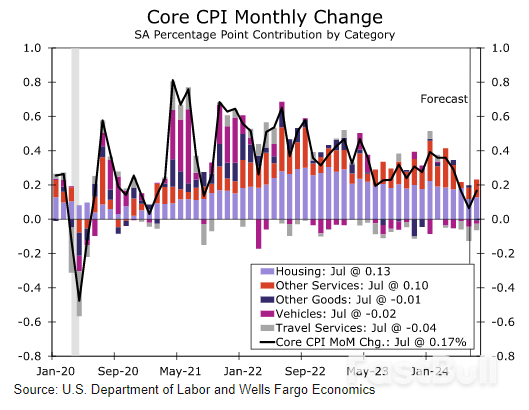
          The June CPI report was one of the most encouraging reports the FOMC had received since it began raising rates. Food and energy prices led the charge, with consumer prices declining 0.1% on the month. Excluding food and energy, core consumer prices rose a modest 0.1%, or the smallest such increase since early 2021.
          Perhaps most encouraging in the report were core services prices, which increased only 0.1%, a marked improvement from the previous six-month average monthly gain of 0.4%. Core goods prices continued their deflationary streak for a fourth consecutive month, decreasing 0.1%. With core goods prices consistently coming down and the outlook for core services prices moderating through the rest of the year, the risks to the inflation and labor sides of the FOMC's dual mandate are in better balance.
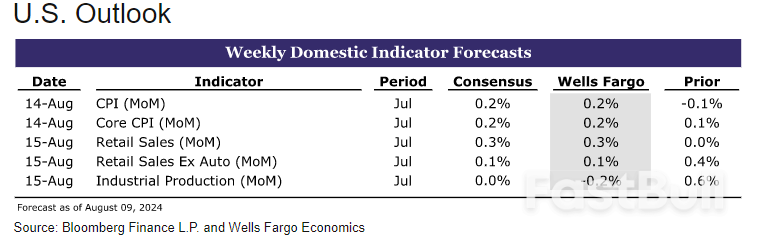
          We look for headline CPI to have advanced 0.2% in July, which would keep the year-over-year rate steady at more than a three-year low of 3.0%. The core CPI also looks set to advance 0.2% in July amid a rebound in some of the more volatile "super core" components. Looking beyond July, we expect inflation to continue to subside.
          Weekly Economic & Financial Commentary: A Wild Week in a Data Desert_3

          Retail Sales • Thursday

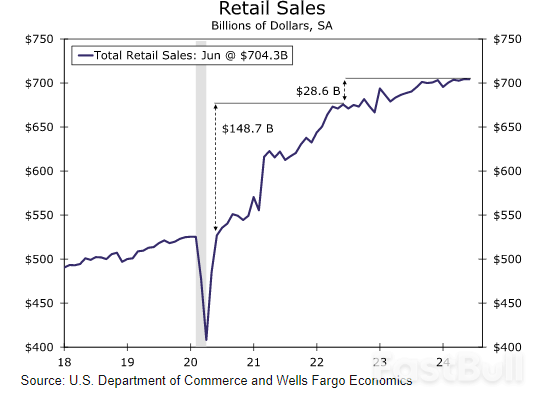
          Despite the flat headline retail sales number in June, retail spending still came in ahead of expectations and core retail spending held steady. Control group retail sales rose an impressive 0.9%, driven by a 1.9% surge in nonstore sales.
          Strength was apparent elsewhere in the report, with building material store sales increasing 1.4% over the month, bucking the residential sector trend of sluggish home sales. Most of the weakness in the top-line number of last month's report was due to a 2.0% decline in auto sales and a 3.0% decline in gasoline sales. While June's retail sales was a show of consumer resilience, it is still consistent with a moderation from the swift pace of retail spending that followed the pandemic. Consider that of the nearly $180 billion growth in retail sales that has occurred over the past four years since the COVID recession, over 83% of that growth occurred in the first two years of that stretch.
          We expect a continuation of the recent moderate pace of growth in July data, with headline retail sales rising 0.3% amid a rebound in auto sales. Furthermore, we expect that retail sales ex-auto sales to rise a more modest 0.1%. The outlook for retail sales through the rest of the year is constrained by a slowdown in the labor market and slower real income growth.Weekly Economic & Financial Commentary: A Wild Week in a Data Desert_4

          Industrial Production • Thursday

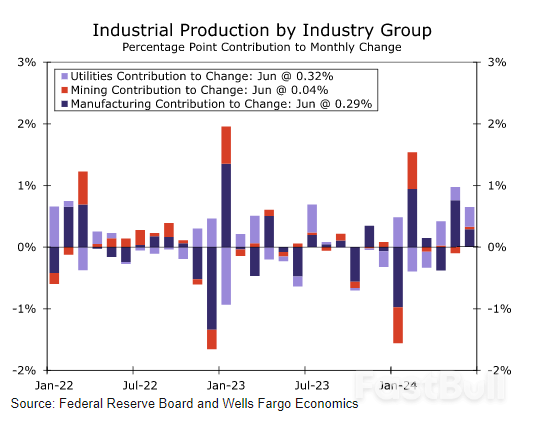
          The Industrial Production Index reached a new cycle high in June, after notching the largest back-to-back monthly gains since 2021. A solid 0.4% gain in manufacturing production along with a 2.8% increase in utilities production led the charge.
          On an industry level, chemicals and food & beverages both modestly added to June industrial production. Even so, industrial production has still not surpassed its prior peak reached in September 2018. The impact of higher rates in the industrial sector has been consequential. Take, for example, that the quarterly CAGR for industrial production did not surpass 1.5% for the nearly two years between Q2-2022 and Q2-2024, aligning with the beginning of the tightening cycle of the FOMC. Before the marked rise in interest rates, industrial production expanded at an average 3.9% annualized rate over Q1-2021 through Q2-2022.
          We expect industrial production to decline 0.2% in July, as still high interest rates remain a formidable barrier to sustaining the recent strength in the sector. We forecast capacity utilization to decline a touch to 78.6%. The start of FOMC easing should provide the industrial sector with some breathing room, but a full recovery remains some ways off.Weekly Economic & Financial Commentary: A Wild Week in a Data Desert_5

          International Review

          A Mixed Week for Foreign Central Banks, International Data

          This week's central bank activity saw monetary policy announcements from Australia, Mexico and India. The Reserve Bank of Australia (RBA) held its Cash Rate steady at 4.35%, while its accompanying statement leaned hawkish in tone. The central bank said that inflation is proving persistent, and that the process of returning inflation to target is proving slow and bumpy.
          Indeed, in its updated economic projections, the RBA forecasted a slightly slower return of inflation to target than previously. The central bank envisages inflation returning to the 2%-3% target late in 2025, and approaching the midpoint in 2026. The RBA noted resilience in the labor market and said that wage growth is still elevated considering the trend of productivity growth, while also noting weakness in the broader economy.
          The RBA indicated that policy will need to be sufficiently restrictive until it is confident inflation is moving sustainably towards the target range, and in the post-meeting press conference Governor Bullock suggested it might not reach that judgement before the end of this year. As a result and despite recent market volatility, our view remains that an initial 25 bps RBA rate cut will come in February 2025.
          This week's Reserve Bank of India (RBI) monetary policy announcement also leaned hawkish in tone. The central bank held its repurchase rate at 6.50%, while also repeating that it would continue to focus on the withdrawal of policy accommodation. The central bank highlighted "stubborn" food inflation, which Governor Das said could not be ignored.
          Meanwhile, deputy governor Patra said that considering a higher potential economic growth rate, the neutral interest rate has risen, and that the current level of the policy rate is probably exactly right. Even though two policymakers voted to lower interest rates (versus four policymakers who voted to hold rates steady), the hawkish comments mean we do not expect an imminent reduction in India's policy interest rates. An initial RBI policy rate cut may not come until late in Q4, or beyond.
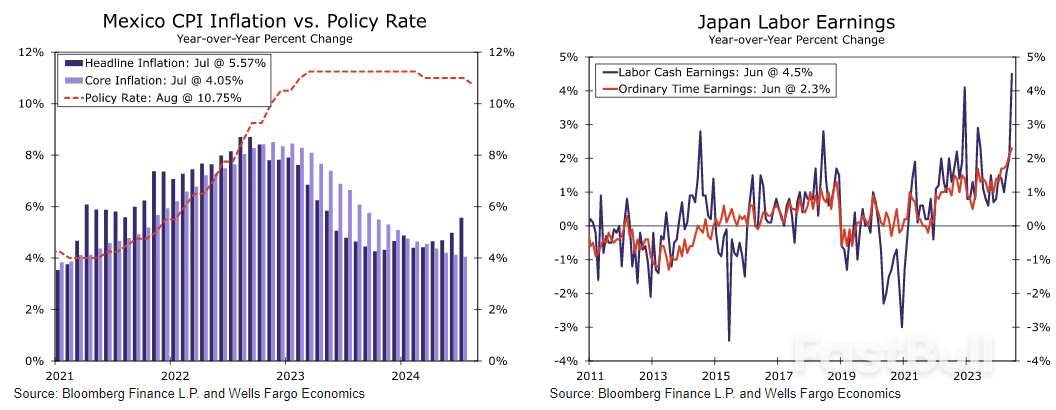
          Leaning in the other direction, Mexico's central bank—Banxico—cut its policy rate by 25 bps to 10.75% at this week's monetary policy announcement. The decision to lower interest rates was finely balanced, both in terms of analyst forecasts as well as Banxico policymakers, who voted 3-2 to reduce the policy rate.
          In terms of a rationale behind the easing as well as the possibility of further rate cuts to come, Banxico said it would consider the effects of weakness in economic activity, and said that growth risks were biased to the downside. The rate cut came even as the central bank raised its near-term headline inflation forecasts on the back of supply shocks, including higher food prices and a weaker peso, while leaving its core inflation forecasts broadly unchanged. Still, even after this week's rate cut, we expect Banxico to pursue a relatively gradual pace of monetary easing going forward, in view of some remaining upside risks to inflation, as well as the volatility of the Mexican currency.
          Weekly Economic & Financial Commentary: A Wild Week in a Data Desert_6
          In this week's data, Japanese wage growth showed some further firming in June, potentially supporting the case for further Bank of Japan tightening if and when a sense of calm returns to global financial markets. June labor cash earnings rose 4.5% year-over-year, far exceeding the consensus forecast for a 2.4% gain. Given the large increase in wages, real—or inflation-adjusted—cash earnings were positive for the first time in 27 months, rising 1.1%.
          To be sure, the pay gain was driven by one-off payments, likely reflecting bonuses, or back pay of the base salary increases agreed to earlier this year. That said, underlying wage growth also appears to be on a firming trend. Ordinary time earnings rose 2.3%, the largest increase since 1994, while measured on a same-sample basis, regular pay for full-time workers rose 2.7%. While we view firming wage growth and elevated inflation as important elements of any potential further Bank of Japan tightening, when and whether the central bank delivers further rate hikes will also likely be dependent on a stabilization in global financial markets.
          In New Zealand, the second quarter labor market report was a bit firmer than expected. Q2 employment unexpectedly rose 0.4% quarter-over-quarter, while the jobless rate rose less than expected to 4.6%. That said, the employment gain was not as strong as it appears at first glance—the increase was driven entirely by part-time jobs, with full-time jobs and hours worked both down during the quarter.
          On the wage front, the private sector labor cost index rose 0.9% quarter-over-quarter, a bit more than expected, but eased to 3.6% year-over-year. While the mixed details of the report should pave the way for the Reserve Bank of New Zealand to lower interest rates in the months ahead, we don't view it as soft enough to trigger an immediate rate cut. We expect the central bank to hold its policy rate steady at 5.50% at next week's monetary policy announcement.
          Canada's July labor market report was mixed but, we think, still consistent with another rate cut and the Bank of Canada's next announcement in September. Employment unexpectedly fell by 2.8K, although that reflected a large drop in part-time jobs as full-time jobs rose sharply. The unemployment rate was lower than forecast, holding steady at 6.4%, while hourly wages for permanent employees slowed but by less than the forecasted 5.2% year-over-year.
          Weekly Economic & Financial Commentary: A Wild Week in a Data Desert_7

          U.K. CPI • Wednesday

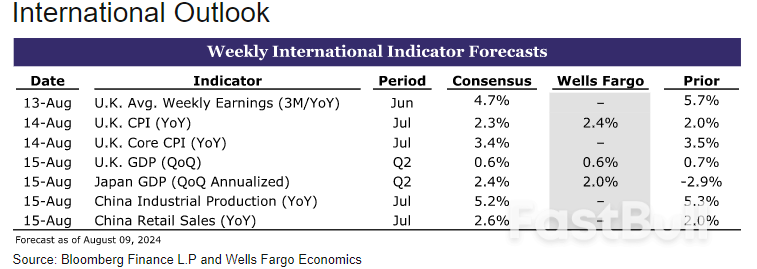
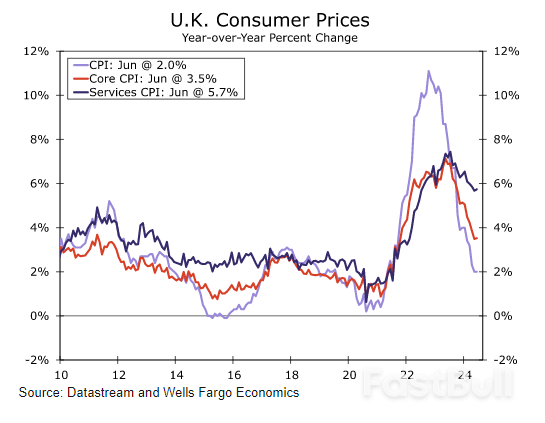
          A swath of economic data from the United Kingdom coming out next week will provide market participants with insight into how the Bank of England’s (BoE) monetary easing efforts could evolve in the coming months. In its decision to deliver an initial 25 bps policy rate cut last week, BoE policymakers signaled that they would be taking a cautious approach to rate cuts, given that risks around the inflation outlook remain. Policymakers forecast headline CPI inflation to rebound to 2.8% in the second half of this year before returning closer to target in the medium term.
          In terms of next week’s CPI inflation data for July, consensus economists expect the headline CPI to quicken to 2.3% but for a slight moderation in the core CPI to 3.4% and the services CPI to 5.5%. Other economic data coming out next week for the U.K. include second quarter GDP and June wage growth. Consensus economists expect the economy to grow 0.6% quarter-over-quarter, which would confirm the U.K. recovery is gathering momentum. Average weekly earnings are expected to decelerate to 4.6% in the three months to June as compared to the same period last year.
          In terms of our own monetary policy outlook for the BoE, we believe central bank officials will wait until November to deliver another 25 bps policy rate cut, which would be consistent with its plan for a gradual pace of monetary easing. If next week’s inflation and wage growth data were to surprise to the downside, an earlier rate cut (in September) could potentially be in play.
          Weekly Economic & Financial Commentary: A Wild Week in a Data Desert_8

          Japan GDP • Thursday

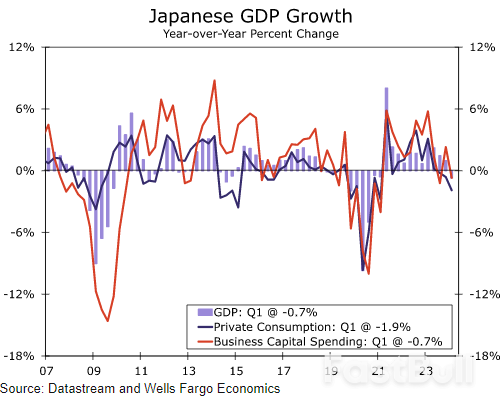
          Next week will see the release of Japan's GDP figures for the second quarter. After contracting at a 2.9% quarterly annualized pace in the first three months of 2024, the Japanese economy is expected to grow at a 2.4% pace in Q2. Some of the underlying details of the GDP report are expected to be somewhat encouraging, too. Private consumption growth and business spending growth are both expected to turn positive, rising 0.6% and 0.8% quarter-over-quarter (not annualized) respectively.
          The question on everyone’s mind will be: What implications do these data have for the Bank of Japan’s (BoJ) monetary policy normalization efforts? In our view, if economic growth can recover and remain steady, and wage growth can also remain sturdy, additional BoJ rate hikes remain possible. In a recent report following the BoJ's July tightening, we laid out a path for further rate hikes in October 2024 and January 2025. With that being said, the past week has seen much turmoil in global markets. If this environment continues, or intensifies, this could impact whether, or to what extent, the BoJ follows through with additional rate increases.Weekly Economic & Financial Commentary: A Wild Week in a Data Desert_9

          China Industrial Production and Retail Sales • Thursday

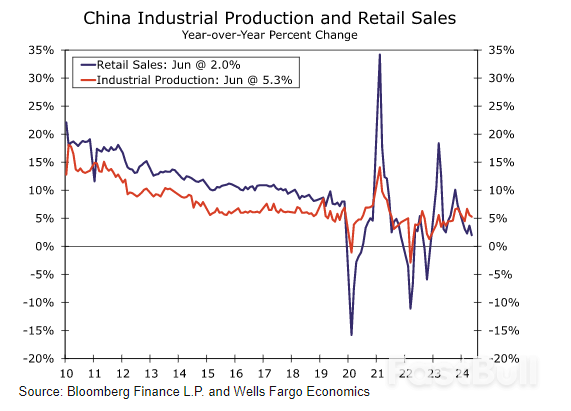
          Next week, China’s industrial production and retail sales data for July will provide market participants with insight into how the economy performed at the start of the third quarter. Consensus forecasts for the July activity data are mixed, with industrial production growth forecast to ease to 5.2% year-over-year and retail sales growth is forecast to pick up to 2.6%. If these consensus forecasts are realized, the pace of growth would still not be that impressive by recent or historical standards for China. We also note that both measures of activity have surprised to the downside several times in recent months.
          In the bigger picture, Chinese economic data have been generally underwhelming as of late. Second quarter GDP growth missed the official growth target of “around 5%” with a 4.7% year-over-year reading. The manufacturing PMI has spent five of the past seven months below the 50 “breakeven” level, and its non-manufacturing counterpart has slid lately. All in all, it is not the most encouraging picture for the economic superpower. As we wrote in a recent report, we expect economic growth to continue to underwhelm and slow in the medium term. We look for overall GDP growth of 4.8% in 2024 and 4.5% in 2025.Weekly Economic & Financial Commentary: A Wild Week in a Data Desert_10

          Credit Market Insights

          Households Are Feeling the Pinch

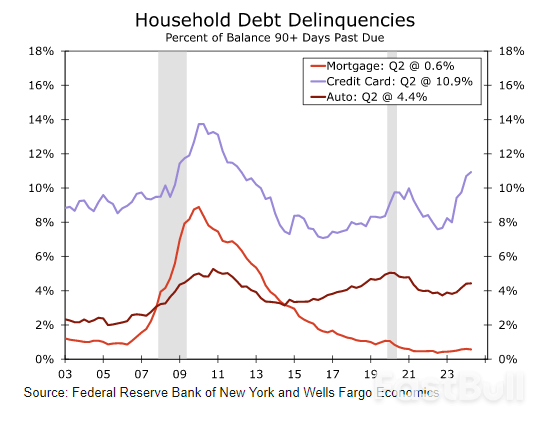
          The Federal Reserve Bank of New York released its Q2 Household Debt and Credit Report this week. The report provides context into the dynamics and flows of national household debt. This week's report showed total debt reached $17.8 trillion (+$109 billion from the last quarter)—the highest in the report's history. Even as households continue to borrow, household debt has increased at a slower rate in recent quarters, suggesting consumers may be feeling the pinch of higher rates.
          Concern over delinquency rates has continued to persist, given the high rate environment. While the report highlighted aggregate delinquency rates held steady at 3.2% for the quarter, the transition for certain debt balances, namely credit cards and auto loans, have become elevated. These severely delinquent loans (90+ days past due) for households have increased to 4.4% for auto loans and 10.9% for credit cards. These growing rates suggest that many households are struggling to manage their debt obligations in current market conditions.
          Households are also turning to other sources of borrowing. With homeowners holding a near-record share of equity in their homes today and many refinancing at low rates throughout the pandemic, mortgage delinquencies remain low. These trends are further extrapolated through other metrics as well. Households have, however, increasingly tapped HELOCs to leverage that equity by using their homes as collateral. Such balances have increased by 20% since 2021. With the Federal Reserve having held the fed funds rate at 5.25%–5.50% since July 2023, refinancing activity has plummeted as many homeowners locked in previously low mortgage rates, shifting households to seek HELOCs as an alternative instrument to access liquidity in the short term.
          We ultimately expect some reprieve is on the horizon for households and look for the Fed to begin easing policy in September with a 50 bps cut followed with further cuts through mid-2025. While these anticipated rate cuts should provide relief, it will take some time for more accommodative conditions to reach households.
          Furthermore, the Federal Reserve's Consumer Credit report indicated an $8.9 billion increase in June, roughly $5 billion less than the increase in May. But all of that gain was due to nonrevolving credit (like auto and student loans), while revolving credit dropped by $1.7 billion, which is not only the second drop in three months, but also only the second drop since April 2021. This suggests consumers are feeling the pinch of tighter monetary policy.
          Looking ahead, these recent data underscore the balance and management households must maintain in this volatile and high interest environment. Rising debt levels along with continued delinquencies emphasize household situations with increasing concern for financial costs in the near- to mid-term. While rate easing is expected soon, the burden of previous debts coupled with economic uncertainty certainly places pressure on the shoulders of consumers.
          Weekly Economic & Financial Commentary: A Wild Week in a Data Desert_11

          Topic of the Week

          Have Lower Bond Yields Started the Easing Process Early?

          As we noted in the U.S. Domestic Review, it was a roller coaster ride this week in financial markets. The volatility was partially owed to a string of weak economic data, which sparked concerns that a more substantial reduction in the federal funds target rate range would be needed in order to prevent a recession in the United States.
          As of this writing, markets were priced for about 100 bps of easing for the remainder of 2024, a dramatic change from 50 bps priced just one month earlier. A decline in interest rates across the yield curve has accompanied the change in monetary policy expectations, with the two-year Treasury yield falling 57 bps to 4.0% and the 10-year Treasury yield falling 29 bps to 4.0% over the past month. Our view is roughly in line with current market expectations for an easing to cycle to begin with a 50 bps cut at the September 17-18 FOMC meeting.
          But with the meeting still more than five weeks out on the calendar, could the recent move lower in bond yields already be helping foster improvement in the sectors of the economy most affected by high interest rates? One way that decreased long-term rates may be giving the economy an early lift is through the housing market.
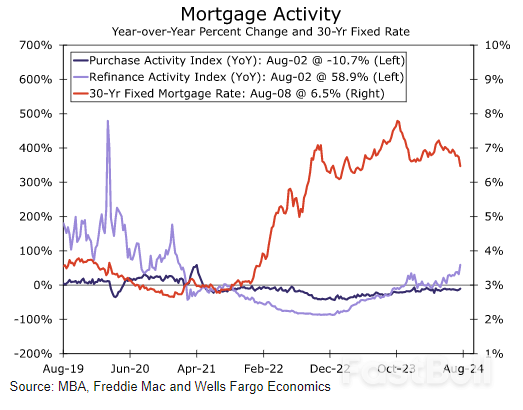
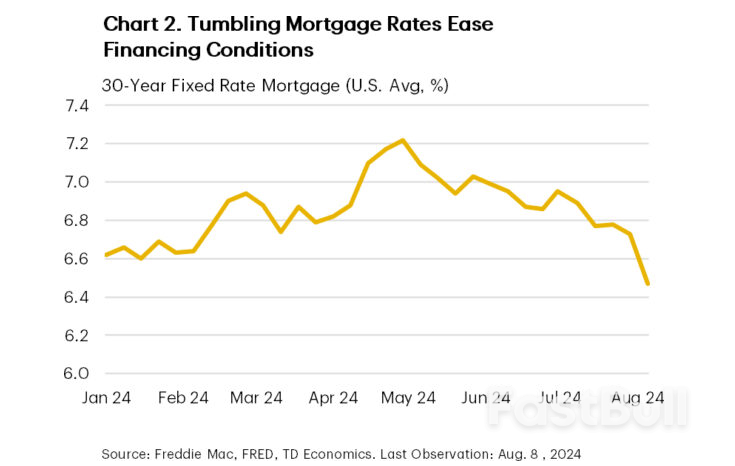
          According to Freddie Mac, the average 30-year mortgage rate declined to 6.47% during the week ended August 8, the lowest in more than a year and 75 bps below this year's peak of 7.22% hit back in early May. Lower mortgage rates typically boost the residential sector through increased home sales and higher home prices. What's more, declining financing costs can lift home builder confidence and foster growth in single-family construction. Consumer spending can also benefit, as categories of spending related to housing, such as spending at building material and furniture stores, increase alongside the pickup in residential activity.
          So far, there has been little evidence that the relatively sharp pullback in mortgage rates has resulted in a noticeable improvement in the housing sector. Despite inching up in the week ended August 2, mortgage applications for purchase fell during July as a whole. Zooming out, the purchase applications index is still not far from the cycle low hit in October 2023 when mortgage rates were close to 8%.
          Lower financing costs should eventually bring about a stronger improvement, but the lethargic response so far looks partially owed to the softening in the labor market that has occurred this year, which has resulted in a higher unemployment rate and more tepid income growth for prospective buyers. It is also a reminder that a drop in rates is not likely to be a panacea for a housing market still constrained by adverse affordability issues stemming from a structural shortage of available homes.
          That said, the decrease in rates has led to an upturn in refinancing activity. Refinance applications are still low, yet are up almost 59% on a year-to-year basis at the end of last week. The uptick means some relief is on the way for those with high monthly mortgage payments. It is also a potential sign that homeowners are dipping further into the deep pool of equity accumulated over the past several years.
          All told, a monetary policy pivot is almost certainly forthcoming; however, mortgage demand largely has been unresponsive so far despite a fairly significant dip in mortgage rates. This development serves as a reminder of the unique challenges the Federal Reserve is sure to encounter as they seek to dial back restriction on the economy.Weekly Economic & Financial Commentary: A Wild Week in a Data Desert_12
          To stay updated on all economic events of today, please check out our Economic calendar
          Risk Warnings and Disclaimers
          You understand and acknowledge that there is a high degree of risk involved in trading. Following any strategies or investment methods may lead to potential losses. The content on the site is provided by our contributors and analysts for information purposes only. You are solely responsible for determining whether any trading assets, securities, strategy, or any other product is suitable for investing based on your own investment objectives and financial situation.
          Add to Favorites
          Share

          China's Bond Market Rattled as Central Bank Squares Off with Bond Bulls

          Thomas

          Economic

          Bond

          China's bond market, the world's second largest, is on edge following a turbulent week in which the central bank started intervening heavily to stem a plunge in yields even as the economy is struggling.
          But die-hard investors say the bull market in government bonds still has legs, citing China's wobbly economy, deflationary pressures and low investor appetite for riskier assets.
          "We remain actively bullish," said a bond fund manager, undeterred by unprecedented government moves to cool the sizzling treasury market and arrest a plunge in yields, which move inversely to prices.
          "We don't see a rosy economic picture ... and we're under peer pressure to generate returns," said the Beijing-based manager who asked to be anonymous due to sensitivity of the topic.
          Even those who have turned bearish appear half-hearted. Treasury futures investor Wang Hongfei said he chose to be "opportunistic" in the short term, trading quickly in skirmishes as the market tussle with regulators intensifies.
          China's central bank has repeatedly warned of potentially destabilising bubble risksas investors chase government bonds and scurry away from volatile stocks and a sinking property market, while banks cut deposit rates. Falling yields also complicate the People's Bank of China's (PBOC) efforts to stabilise the weakening yuan.
          But with the PBOC now turning threats into action to tame bond bulls, authorities have opened a new battle front - following wars of attrition long fought against speculators and unwelcome price moves in the country's stock and currency markets.
          Unlike the West, "China's financial markets, including the bond market, are subject to top-down regulation," said Ryan Yonk, economist with the American Institute for Economic Research.
          As the economy sputters, "Chinese officials will face increasing difficulty in maintaining such tightly controlled financial markets, and additional interventions are likely, and may signal the very instability Chinese officials are seeking to avoid."

          First Shot

          The first shot was fired last Monday, when China's long-dated yields hit record lows amid a global rout that drove money into safe havens such as treasuries.
          State banks were seen selling large amounts of 10-year and 30-year treasuries after treasury futures jumped to record highs.
          Debt dumping by state banks - confirmed by data and traders - continued throughout the week, mirroring how the central bank uses big banks as agents at times to influence the yuan currency market, traders said.
          Late on Friday, the central bank said it will gradually increase the purchase and sale of treasury bonds in its open market operations.
          PBOC Governor Pan Gongsheng was previously head of China's foreign currency regulator, so "it appears to be the same playbook," said a Shanghai-based fund manager.
          In another warning shot to bond buyers, the PBOC ceased providing cash through open market operations on Wednesday for the first time since 2020, contributing to the biggest weekly cash withdrawal in four months in support of yields.
          Dealing a further blow to market sentiment, China's interbank watchdog said it would investigate four rural commercial banks for suspected bond market manipulation, and would report several misbehaving financial institutions to the PBOC for penalty.
          The PBOC did not reply to a Reuters request for comment.

          'Sword of Damocles'

          To be sure, the flurry of measures have made some investors cautious. Both China's 10-year and 30-year treasury futures posted their first weekly fall in a month.
          "Taking all factors into account, it would be prudent to exercise additional caution regarding China duration risk," Kiyong Seong, lead Asia macro strategist at Societe Generale said, referring to the risk of holding long-dated bonds.
          "While the scale of any selloff in China bonds may not be substantial in the medium and long term due to the fragile growth momentum in China, chasing duration returns in China does not seem appropriate in our view."
          Tan Yiming, analyst at Minsheng Securities, wrote in a note: "The sword of Damocles is falling."
          But in a so-called "asset famine" environment where high-yielding assets are in short supply, "the bond bull remains alive," Tan said.
          The Shanghai-based fund manager said there's no reason to throw in the towel without seeing clear signs of economic improvement, and his strategy is to "buy on the dip".
          "You cannot change market direction using technical tools, just as you cannot change the temperature by adjusting the thermometer," he said.
          The PBOC moves could change the tempo of bond price rises, but not the uptrend, he said. "If you hold long enough, you will make money."
          However, rising volatility shows the central bank is at least making some progress in giving investors pause for thought.
          Chun Lai Wu, head of Asia Asset Allocation at UBS Global Wealth Management, cautioned that expected support to Chinese bonds from any monetary easing will likely be offset somewhat by stepped-up government bond issuance.
          China's 30-year treasury yield is currently around 2.37%, compared with 3% a year ago.
          "Over the long term, we could see the ... yield drift higher, maybe towards 2.5%, if indeed we see the economic recovery continue and inflation begin to return."

          ($1 = 7.1715 Chinese yuan renminbi)

          Source: Reuters

          To stay updated on all economic events of today, please check out our Economic calendar
          Risk Warnings and Disclaimers
          You understand and acknowledge that there is a high degree of risk involved in trading. Following any strategies or investment methods may lead to potential losses. The content on the site is provided by our contributors and analysts for information purposes only. You are solely responsible for determining whether any trading assets, securities, strategy, or any other product is suitable for investing based on your own investment objectives and financial situation.
          Add to Favorites
          Share

          The Weekly Bottom Line: Bumps in the Road

          TD Securities

          Economic

          U.S. – Bumps in the Road

          After last Friday’s disappointing payrolls report sent equities tumbling and bonds flying, markets have taken a bit of a breather this week. The U.S. 10-year treasury yield is back to 3.9%, within basis points of where it was last Thursday, while equities have retraced roughly half of their losses since Friday – although they are still well off their mid-July highs
          The payrolls data set off alarm bells and traders piled into bets of impending rate cuts and a steep slowdown in economic activity. Fed funds futures are pricing 100 basis points of rate cuts from the Fed through the end of 2024. Importantly, with only three meetings to go, this suggests a 50-basis point cut could come as early as September.
          We think this is a tad overdone. To be sure, rate relief is on the way, however our expectation is that the Fed will deliver three more cuts through December. The difference is slight but reflects the fact that we still see an economy that’s gradually gearing down, rather than one where the bottom is falling out.
          For instance, take last week’s jobs report. Job growth slowed sharply to 114k jobs from 179k the month prior, with the services sector kicking its smallest addition of the post-pandemic recovery. On the face of it, the second consecutive month of decelerating job growth reflects waning momentum. However, job growth needed to cool to tame inflation and from this lens, the average of 170k jobs gained over the past three months, combined with a cooling in inflation, is a pace the Fed would be happy to accept.
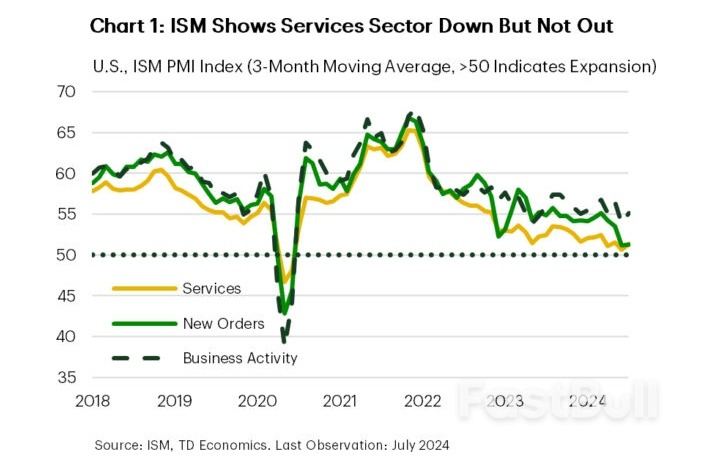
          Beyond the labor market, there are signs that economic activity is holding up. This week the ISM services index surprised to the upside, showing the sector regained some momentum to continue expanding. The details of the report were solid with new orders, overall activity and even employment all showing gains (Chart 1).The Weekly Bottom Line: Bumps in the Road_1
          Moreover, falling bond yields are helping ease financial conditions. Thirty-year mortgage rates are down below 6.5%, from 6.9% a month ago (Chart 2). Data from the National Association of Realtors showed June’s pending home sales up nearly 5% month-on-month (m/m), and with a further drawdown in financing costs in July, further recovery in actual sales could be in the offing.The Weekly Bottom Line: Bumps in the Road_2
          These indicators suggest an economy that continues to mosey along, slower than before, but not yet hitting a wall. And remember, the Fed remains data dependent, so for a sense of how the Fed will respond in September, two upcoming events will be in focus. First up, next week’s release of July’s Consumer Price Index (CPI). We are looking for a firming in core CPI (ex. food and energy) to 0.2% month-on-month. While this implies an annual figure of 3.2%, it would sink the three- and six-month percent changes in core CPI to roughly 1.6% and 2.9% annualized, respectively, comfortably extending the cooling in price gains.
          The update on inflation then lays the groundwork for the next big event, the Fed’s Jackson Hole Economic Symposium on August 22-24th. Chairman Powell is slated to speak, so markets will be closely parsing his statements for any insights into the Fed’s read of recent events.

          Canada – Keep Calm, Carry On

          Canadian markets spent the holiday-shortened week digesting the rapid shift in market sentiment stemming from growth worries south of the border. Recent events in the U.S. and Japan have created volatile market conditions that have spilt over to Canadian markets. Yields whipsawed, with front-end yields rising 15 basis points, partially reversing the 30 bps rally the week prior. The Canadian dollar also caught a bid, up just over a tenth of a cent to 0.728/USD. Despite the external noise, we’d argue the economic outlook for Canada is stable and there isn’t a need to ring the alarm bells just yet.
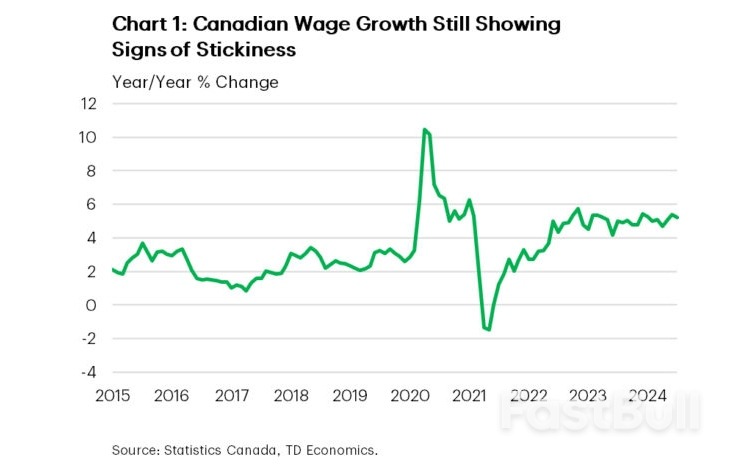
          With a soft U.S. payrolls print last week spurring knee-jerk reactions, Canada’s job market updates were being watched with an even closer eye. Like our southern counterparts, Canada disappointed against expectations, with virtually no job growth recorded in July. But unlike the past several months, labour force growth pulled back which helped keep the unemployment rate steady at 6.4%.Meanwhile, wages as measured by the Labour Force Survey are still growing at 5.0%, which will continue to be on the Bank of Canada’s (BoC) radar (Chart 1). The labour market has no doubt lost steam, but it is holding up relatively well and is evolving roughly in line with what we’d expect from past economic cycles.The Weekly Bottom Line: Bumps in the Road_3
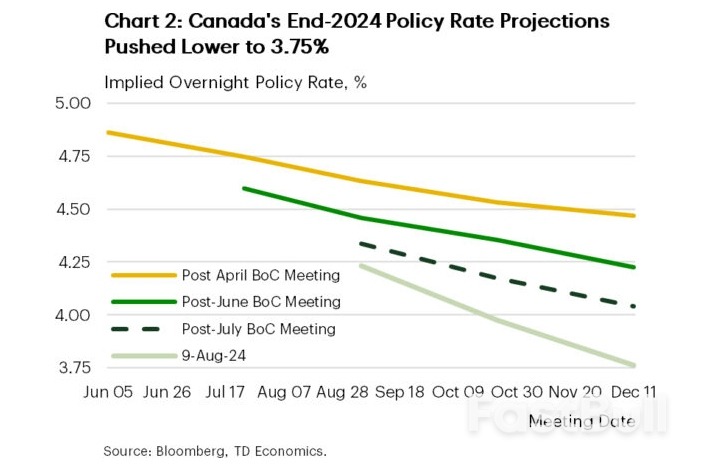
          The Bank of Canada will use the labour data as a marker in their next policy decision. The Bank has firmly entered their rate easing cycle and so the question becomes how the path for policy rates looks over the rest of the year. Governor Macklem’s dovish tilt at last month’s meeting had markets re-jigging their rate cut expectations for the remaining three announcements this year, to now see Canada’s policy rate at 3.75% at year-end (Chart 2). This aligns with our thinking as it keeps interest rates on a slowly declining path and balances the objectives of supporting growth without reigniting inflation.The Weekly Bottom Line: Bumps in the Road_4
          The BoC’s Summary of Deliberations also released this week reiterated an important shift in the BoC’s thinking from last meeting. New in their messaging was the emphasis on the downside risks to inflation via excess supply and how it has taken on an increased weight in monetary policy discussions. This is an important shift in sentiment, as it’s indicative of a central bank concerned that the still high level of the policy rate may be exerting too much slowing in the economy.
          Economic growth in Canada’s economy is by no means advancing at breakneck speed, but we don’t foresee a deterioration–or a recession–on the horizon. Domestically, the Canadian consumer bounced back in the first quarter of this year with contributions from spending expected to remain in coming quarters. Further, Canada’s trade picture is firming up as the recently operational Trans Mountain Pipeline expansion boosts energy exports, a theme we expect to persist of the coming months. At this stage, the BoC has enough confidence to gradually deliver rate relief to the economy with a soft-landing scenario still being the likely outcome.
          To stay updated on all economic events of today, please check out our Economic calendar
          Risk Warnings and Disclaimers
          You understand and acknowledge that there is a high degree of risk involved in trading. Following any strategies or investment methods may lead to potential losses. The content on the site is provided by our contributors and analysts for information purposes only. You are solely responsible for determining whether any trading assets, securities, strategy, or any other product is suitable for investing based on your own investment objectives and financial situation.
          Add to Favorites
          Share

          Volatility Shock Fades, India CPI on Deck

          Samantha Luan

          Economic

          A week is not just a long time in politics.
          Seven days ago a huge unwind in the yen carry trade and selloff in megacap U.S. tech triggered a wave of volatility that sent global markets reeling and investors running for the safety of U.S. Treasuries.
          As the new trading week gets underway in Asia on Monday, that seems a long time ago - many assets have recovered much of these losses, volatility has subsided, and traders have heavily scaled back their rate cut expectations.
          The question now is whether that momentum can be sustained. Some investors will seize upon lower equity volatility to push up risky assets again; others will be wary of potential aftershocks in any corner of the market, especially in mid-August when liquidity is much thinner than usual.
          Monday's Asian calendar is light. Indian consumer price inflation is the main event, leaving markets at the mercy of global forces.
          If that's the case, Monday should be relatively calm. Wall Street rose on Friday, meaning the Nasdaq and S&P 500 ended last week essentially flat. Treasury yields fell on Friday but registered their biggest weekly rise in months.
          Stronger-than-expected U.S. economic data suggesting recession fears are overblown, and a couple of poorly-received U.S. debt auctions, pushed yields higher. No bad thing, perhaps, if you think the previous week's plunge was excessive.
          Asian markets' rebound last week was pretty impressive. After the Nikkei registered its second biggest fall on record and its third largest ever rise in the space of 24 hours, the index ended the week down only 2.5%.
          Other benchmark indices fared even better - the MSCI Asia ex-Japan and MSCI World index both ended flat, and the MSCI Emerging Market index rose 0.2%.
          In currencies, U.S. futures market data on Friday showed that hedge funds slashed their net short yen position in the week to Aug. 6 by 62,000 contracts. That is the biggest yen-bullish weekly swing since the Fukushima disaster in February 2011, and third biggest since comparable data started in 1986.
          If this is representative of the broader FX market, the short yen 'carry trade' has been mostly wiped out. Do traders begin shorting the yen and putting on carry trades again, or not?
          Indian inflation is the main data point in Asia and comes after the Reserve Bank of India last week kept its key interest rate unchanged at 6.50%, dismissing the market turbulence and focusing on getting inflation down to its 4% medium term target.
          The consensus in a Reuters poll is for annual consumer inflation in July to fall to 3.65% from 5.08% in June. That would be the first time in five years below the RBI's medium-term target.
          Here are key developments that could provide more direction to Asian markets on Monday:
          - India interest rate decision
          - India industrial production (June)
          - Germany wholesale inflation (July)

          Source: Rueters

          To stay updated on all economic events of today, please check out our Economic calendar
          Risk Warnings and Disclaimers
          You understand and acknowledge that there is a high degree of risk involved in trading. Following any strategies or investment methods may lead to potential losses. The content on the site is provided by our contributors and analysts for information purposes only. You are solely responsible for determining whether any trading assets, securities, strategy, or any other product is suitable for investing based on your own investment objectives and financial situation.
          Add to Favorites
          Share

          How Much Damage Would a Cyber-Attack Cause in the Middle East?

          Kevin Du

          Economic

          With the Middle East's emergence as a growing technology centre, it may be at a point where it is susceptible to a dreaded situation – a cyber attack.
          And coupled with its leading role in the global energy sector, any episode that would rattle the region's tech infrastructure may have far-reaching consequences, taking root within its growing economies.
          "Technology is universally integrated into many day-to-day processes, therefore, a cyber attack would be just as damaging to the Middle East as it would be to anywhere else in the world," Maher Yamout, a lead security researcher at Kaspersky, told The National.
          "All economies rely heavily on computers and technology in general. The growing fusion of the digital and physical world is an international development that is not slowing down at any rate. As a result, similarities in the potential damage among major economies are a given."
          A high price
          The spotlight on the Middle East has grown in recent years as governments in the region ramp up their efforts to prepare their societies for the economy of the future, one underpinned by digital technology.
          The push, led by the UAE and Saudi Arabia, has attracted attention and investments from companies such as Oracle, Google and Amazon, and highlights increasing investor confidence in the region.
          In just about every industry, the Middle East is attempting to integrate the latest innovation to promote inclusiveness and reach the widest possible chunk of its population, especially now with services at the tip of one's fingers.
          However, that also opens up opportunities for the digital underworld, which focuses on potentially lucrative demographics and economies.
          "The region has shifted its approach towards knowledge-based sectors … this digital transformation – and the concurrent economic growth and prosperity – increases its attractiveness for hostile actors who are motivated by financial gain or political reasons, and also the number of vulnerabilities available to them," Haider Pasha, chief security officer at Palo Alto Networks, told The National.
          Compared to other regions, cyber incidents in the Middle East have been relatively low, said Simon Bell, a cyber practice leader at New York-based consultancy Marsh McLennan.
          Also, due to the far lower penetration of cyber insurance, the recovery for business is "likely to be more challenging and slower", he told The National.
          But that does not mean the threat is insignificant. According to the latest IBM Cost of Data Breach report, the average cost of a cyber breach in the Middle East was slightly more than $8 million in 2023, a record for the region and the second highest globally behind only the US.
          "The region has been experiencing a significant increase in phishing attacks and smishing attacks, which is a strong indication that such attacks are proving to be lucrative for cyber adversaries," Pepijn de Jong, a senior vice president and head of cyber advisory services at Marsh McLennan, told The National.
          Phishing and smishing – two types of spoofing attacks – are growing in the Middle East, New York-based Marsh McLennan said.
          Other popular weapons of choice for cyber criminals are malware, denial-of-service attacks and identity-based attacks, according to US cyber security company CrowdStrike.
          In addition, the percentage of organisations globally that have reported costs of $1 million or more for their worst breach in the past three years rose to 36 per cent, from 27 per cent in 2023, according to PwC's 2024 Global Digital Trust Insights report.
          The corresponding number for those in the Middle East this year is 29 per cent.
          That means the damage from cyber attacks in the region could be far greater than the global average, said James Maude, field chief technology officer of US IT management company BeyondTrust.
          "As the Middle East experiences a significant increase in digital transformation projects and technology investments, the risk of significant damage from a cyber attack will continue to grow," he told The National.
          Malware detections in the UAE rose by about 12 per cent from January to May 2024, a broader trend affecting many countries in Europe, the Middle East and Africa, Swiss cyber security company Acronis said in a July report.
          Bahrain had the highest detection rate, followed by Egypt. The two countries and South Korea the three biggest targets during the first quarter of the year, it said.
          Moreover, while the Middle East is rapidly modernising and embracing digital technology, cyber security measures may not always keep pace, leaving critical infrastructure exposed.
          "This makes the potential impact of a cyber attack in the Middle East far-reaching, affecting not just the local economies but also having serious global consequences," Sertan Selcuk, vice president at Florida-based cyber security company Opswat, told The National.
          That consequence would be felt in the industry that has long been the mainstay of the Middle East – energy.
          Energy crisis?
          The effects of a cyber attack would not be limited to the Middle East, as the disruption it may cause would most certainly affect energy supply chains, with end consumers bearing the brunt of it.
          With the region home to some of the world's largest oil and gas producers, any cyber attack can be "particularly damaging due to the region's crucial role in the global energy market", Mr Selcuk said.
          "Any disruption here could cause significant ripple effects globally, leading to energy shortages and price hikes."
          The Middle East accounted for about a third of the world's oil production in 2023, exporting about 15 million barrels per day, data from Statista shows.
          "The energy sector is one of the most important and sensitive sectors that must protected from cyber attacks due to the devastating impact this sector might have on Middle Eastern economies," Mr de Jong said.
          Cyber attacks around the world are a critical issue today. Taking into consideration the way digital transformation changes the way companies operate, suspect actors on the web also increase the volume and sophistication of their attacks.
          The number of attacks against the energy industry and critical national infrastructure is "rising dramatically, in quantity, magnitude and impact", a February report from the World Governments Summit and consultancy EY said.
          There have been no notable cyber incidents in Middle East energy but in the US and Canada, attacks have risen by about 71 per cent from 2021 to 2022, the report showed.
          Complicating matters is geopolitical tension in parts of the Middle East: With its escalation, any high-profile or state-owned businesses will be at increased risk of cyber attacks from hacktivists, Mr Maude said.
          Analysts have listed energy, finance, stock exchanges and health care as the industries that are most at risk.
          "A breach of these entities could lead to substantial financial losses, erode trust … and destabilise the economy," Saran Paramasivam, a regional director at Indian software company Zoho, told The National.
          What can be done?
          Given that breaches affecting multiple environments incur the highest costs and longest resolution times, "substantial investments in security measures are imperative to mitigate both financial losses and operational disruption", Mr Paramasivam added.
          Organisations and investors in the region are taking note: The Middle East's cyber security market is projected to surpass $24 billion by 2028, from an estimated $14.8 billion in 2023, growing at a compound annual rate of more than 10 per cent, according to research company Markets and Markets.
          And in as much as the region could be susceptible to an attack, it can also be viewed as "ripe for reinvention" as the top three cyber investment priorities for the Middle East are modernisation of infrastructure, optimisation of current technology and an "improved risk posture", according to PwC.
          Aside from the dollars, the Middle East is also actively advancing its cyber security landscape by protecting its critical infrastructure, developing regulations, addressing skill shortage and improving incident responses, Mr Pasha said.
          "The region is also investing in advanced technologies and talent development, and working towards better data protection and regulatory frameworks," he said.
          The security of critical infrastructure should be a priority: A 2022 Kaspersky report identified the Middle East as one of the top five global regions with the highest incidence of malware aimed at industrial control systems, making it an easy target for cyber criminals.
          It does not matter if the technology used is old or new – stay outdated and fall prey to tried and tested techniques, or be updated and still be victimised by bad actors who are steps ahead, argues Mr Selcuk.
          Systems that operate on outdated legacy platforms presents "significant challenges when updates, patch management and log collections require access through USBs, vendor laptops or other peripheral media", Mr Selcuk said.
          Enterprises also need to ensure a top-to-bottom approach – from the server level and its authorised users, down to the personal devices of its end users – as cyber attackers can comb through a network to find any opening they will be able to exploit.
          "Cloud environments are also susceptible to misconfigurations, leading to improper access controls or accidental data exposure. Insider threats, such as privileged user abuse or data theft, cannot be overlooked," Mr Paramasivam said.
          "Finally, mobile devices, with their increasing role in both personal and professional life, introduce vulnerabilities through unsecured devices and malicious applications."

          Source: The National News

          To stay updated on all economic events of today, please check out our Economic calendar
          Risk Warnings and Disclaimers
          You understand and acknowledge that there is a high degree of risk involved in trading. Following any strategies or investment methods may lead to potential losses. The content on the site is provided by our contributors and analysts for information purposes only. You are solely responsible for determining whether any trading assets, securities, strategy, or any other product is suitable for investing based on your own investment objectives and financial situation.
          Add to Favorites
          Share

          The Bull Stock Market Secret Behind America's Wild Election

          Alex

          Economic

          Stocks

          With an assassination attempt and a late candidate swap, America's election ride has been wild. But what does it mean for stocks? No one really knows.
          But the market couldn't care less about the drama.
          What matters is that uncertainty will prevail, fuelling election years' normal second-half stock market surge, a US-based tailwind with global power. Let me show you why.
          Headlines portray America's election as a wild rollercoaster. Twisty and occasionally upside-down. The candidates' personalities and colourful sound bites – usually unflattering – steal the spotlight.
          But stocks look past this. They don't care about candidates' temperaments, gaffes or rhetoric. To markets, it is all noise, distracting from what really matters: Uncertainty will fall. We will get a winner, and markets will rally around them.
          The Bull Stock Market Secret Behind America's Wild Election_1This is a massive tailwind. Stocks hate question marks. They make investors and businesses nervous, discouraging risk taking. Early in most election years, question marks and fears abound. Myriad candidates typically clog the party primary races. They compete by playing to their bases – the extreme fringes of both parties – touting extremely scary views.
          Hence elevated uncertainty usually stalls markets early in election years, when US returns average just 2.8 per cent in the first half since 1925.
          But in the second half, uncertainty melts and stocks melt up.
          Rowdy party primary races bring two nominees. Then we get vice presidential candidates. Party conventions render somewhat clear policy platforms. Rhetoric moderates as both sides court independent voters. State-by-state polls come into focus, showing investors each candidate's path to victory – and how wide it is.
          Meanwhile, with Congress out campaigning, legislation grinds to a halt. Markets gain clarity and need not fret sudden policy disruptions. They love it!
          The S&P 500 averages 9.2 per cent in US election years' second halves. Fun fact: This includes 15 years with positive first halves. Of these, the second half rose all but once in history (1948), with 8.9 per cent average returns.
          This year started as an apparent exception. A rematch between President Joe Biden and former president Donald Trump looked destined, bringing unusually early low uncertainty. Absent scary primary noise, stocks shined.
          Mr. Biden's late-June debate stumble changed everything, amping up switcheroo talk. Then came the abhorrent assassination attempt on Mr. Trump. Soon, Mr. Biden dropped out, endorsing Vice President Kamala Harris. Early rumblings emerged that some top Democrats didn't think she was viable. Would they coronate her? Or would the mid-August party convention be a multicandidate cage fight? All seemed to stoke uncertainty.
          But it stabilised fast. Post-debate poll numbers initially swung a bit from Mr. Biden to third-party candidates, but they evened out. After the assassination attempt on Mr. Trump, stocks kept rising. Ms. Harris quickly attracted endorsements and top Democratic donors. As I write, we have only a handful of polls pitting her against Mr. Trump. But they have tightened from Mr. Trump's early-July margins over Mr. Biden.
          This doesn't seal the deal for her. Honeymoon periods normally boost polling but usually don't stick. Then came the drama of who she would pick as her running mate. Regardless, by mid-August, we will have two decisive candidates, which means more clarity. The victory path will coalesce. Not with national polls. America votes state-by-state, via the Electoral College. Most states are already locked in. America's best election site, 270toWin.com, shows just five currently up for grabs: Nevada, Arizona, Wisconsin, Michigan and Pennsylvania. To these, I add Georgia, which waffles between toss-up and likely Mr. Trump.
          This gives Mr. Trump a baseline of 235 electoral votes versus 226 for Ms. Harris. The winner needs 270. Now comes the harder, more crucial campaign battle: building late-stage ground games to mobilise marginal voters in these swing states. This takes money and know-how. The Democrats have more money, but Mr. Biden's debate flub revealed hidden weakness in states they assumed were safe: Minnesota, New Jersey, New Hampshire, Maine and even Virginia.
          They have sufficient cash for TV and direct mail blitzes there. But can they build the ground game without distracting from the swing states?
          Ms. Harris's success hinges on this. Her only real path to victory runs through Pennsylvania. If Mr. Trump wins this, he almost certainly wins Georgia, a much more Republican state. That gets him to 270. Will Ms. Harris turn out enough city and suburban voters to win? Or will Mr. Trump rally the more rural and industrial base?
          Either way, we will have a winner, making stocks party hard late in the election year.
          And after? Stocks' 2025 political impact hinges on the government's make-up, including both houses of Congress. If golden gridlock continues, squashing market-menacing bills, stocks should love it. If not, risks may lurk.
          But 2025 is distant and too early to assess today. For now, simply enjoy late 2024's great stock market.

          Source: The National News

          To stay updated on all economic events of today, please check out our Economic calendar
          Risk Warnings and Disclaimers
          You understand and acknowledge that there is a high degree of risk involved in trading. Following any strategies or investment methods may lead to potential losses. The content on the site is provided by our contributors and analysts for information purposes only. You are solely responsible for determining whether any trading assets, securities, strategy, or any other product is suitable for investing based on your own investment objectives and financial situation.
          Add to Favorites
          Share
          FastBull
          Copyright © 2025 FastBull Ltd

          728 RM B 7/F GEE LOK IND BLDG NO 34 HUNG TO RD KWUN TONG KLN HONG KONG

          TelegramInstagramTwitterfacebooklinkedin
          App Store Google Play Google Play
          Products
          Charts

          Chats

          Q&A with Experts
          Screeners
          Economic Calendar
          Data
          Tools
          Membership
          Features
          Function
          Markets
          Copy Trading
          Latest Signals
          Contests
          News
          Analysis
          24/7
          Columns
          Education
          Company
          Careers
          About Us
          Contact Us
          Advertising
          Help Center
          Feedback
          User Agreement
          Privacy Policy
          Business

          White Label

          Data API

          Web Plug-ins

          Poster Maker

          Affiliate Program

          Risk Disclosure

          The risk of loss in trading financial instruments such as stocks, FX, commodities, futures, bonds, ETFs and crypto can be substantial. You may sustain a total loss of the funds that you deposit with your broker. Therefore, you should carefully consider whether such trading is suitable for you in light of your circumstances and financial resources.

          No decision to invest should be made without thoroughly conducting due diligence by yourself or consulting with your financial advisors. Our web content might not suit you since we don't know your financial conditions and investment needs. Our financial information might have latency or contain inaccuracy, so you should be fully responsible for any of your trading and investment decisions. The company will not be responsible for your capital loss.

          Without getting permission from the website, you are not allowed to copy the website's graphics, texts, or trademarks. Intellectual property rights in the content or data incorporated into this website belong to its providers and exchange merchants.

          Not Logged In

          Log in to access more features

          FastBull Membership

          Not yet

          Purchase

          Become a signal provider
          Help Center
          Customer Service
          Dark Mode
          Price Up/Down Colors

          Log In

          Sign Up

          Position
          Layout
          Fullscreen
          Default to Chart
          The chart page opens by default when you visit fastbull.com