Markets
News
Analysis
User
24/7
Economic Calendar
Education
Data
- Names
- Latest
- Prev



Signal Accounts for Members
All Signal Accounts
All Contests


Indonesia Lending Facility Rate (Jan)A:--
F: --
P: --
South Africa Core CPI YoY (Dec)A:--
F: --
P: --
South Africa CPI YoY (Dec)A:--
F: --
P: --
IEA Oil Market Report
U.K. CBI Industrial Output Expectations (Jan)A:--
F: --
U.K. CBI Industrial Prices Expectations (Jan)A:--
F: --
P: --
South Africa Retail Sales YoY (Nov)A:--
F: --
P: --
U.K. CBI Industrial Trends - Orders (Jan)A:--
F: --
P: --
Mexico Retail Sales MoM (Nov)A:--
F: --
P: --
U.S. MBA Mortgage Application Activity Index WoWA:--
F: --
P: --
Canada Industrial Product Price Index YoY (Dec)A:--
F: --
Canada Industrial Product Price Index MoM (Dec)A:--
F: --
U.S. Weekly Redbook Index YoYA:--
F: --
P: --
U.S. Pending Home Sales Index YoY (Dec)A:--
F: --
P: --
U.S. Pending Home Sales Index MoM (SA) (Dec)A:--
F: --
P: --
U.S. Construction Spending MoM (Oct)A:--
F: --
U.S. Pending Home Sales Index (Dec)A:--
F: --
P: --
U.S. API Weekly Refined Oil StocksA:--
F: --
P: --
U.S. API Weekly Gasoline StocksA:--
F: --
P: --
U.S. API Weekly Cushing Crude Oil Stocks--
F: --
P: --
U.S. API Weekly Crude Oil StocksA:--
F: --
P: --
South Korea GDP Prelim YoY (SA) (Q4)A:--
F: --
P: --
South Korea GDP Prelim QoQ (SA) (Q4)A:--
F: --
P: --
Japan Imports YoY (Dec)A:--
F: --
P: --
Japan Exports YoY (Dec)A:--
F: --
P: --
Japan Goods Trade Balance (SA) (Dec)A:--
F: --
P: --
Japan Trade Balance (Not SA) (Dec)A:--
F: --
Australia Employment (Dec)A:--
F: --
Australia Labor Force Participation Rate (SA) (Dec)A:--
F: --
P: --
Australia Unemployment Rate (SA) (Dec)A:--
F: --
P: --
Australia Full-time Employment (SA) (Dec)A:--
F: --
P: --
Turkey Consumer Confidence Index (Jan)--
F: --
P: --
Turkey Capacity Utilization (Jan)--
F: --
P: --
Turkey Late Liquidity Window Rate (LON) (Jan)--
F: --
P: --
Turkey Overnight Lending Rate (O/N) (Jan)--
F: --
P: --
Turkey 1-Week Repo Rate--
F: --
P: --
U.K. CBI Distributive Trades (Jan)--
F: --
P: --
U.K. CBI Retail Sales Expectations Index (Jan)--
F: --
P: --
U.S. Weekly Continued Jobless Claims (SA)--
F: --
P: --
U.S. Initial Jobless Claims 4-Week Avg. (SA)--
F: --
P: --
U.S. Real Personal Consumption Expenditures Final QoQ (Q3)--
F: --
P: --
Canada New Housing Price Index MoM (Dec)--
F: --
P: --
U.S. Weekly Initial Jobless Claims (SA)--
F: --
P: --
U.S. Real GDP Annualized QoQ Final (Q3)--
F: --
P: --
U.S. PCE Price Index Final QoQ (AR) (Q3)--
F: --
P: --
U.S. PCE Price Index MoM (Nov)--
F: --
P: --
U.S. PCE Price Index YoY (SA) (Nov)--
F: --
P: --
U.S. Real Personal Consumption Expenditures MoM (Nov)--
F: --
P: --
U.S. Personal Income MoM (Nov)--
F: --
P: --
U.S. Core PCE Price Index MoM (Nov)--
F: --
P: --
U.S. Personal Outlays MoM (SA) (Nov)--
F: --
P: --
U.S. Dallas Fed PCE Price Index YoY (Nov)--
F: --
P: --
U.S. Core PCE Price Index YoY (Nov)--
F: --
P: --
U.S. EIA Weekly Natural Gas Stocks Change--
F: --
P: --
U.S. Kansas Fed Manufacturing Composite Index (Jan)--
F: --
P: --
U.S. Kansas Fed Manufacturing Production Index (Jan)--
F: --
P: --
U.S. EIA Weekly Crude Stocks Change--
F: --
P: --
U.S. EIA Weekly Crude Demand Projected by Production--
F: --
P: --


No matching data
Latest Views
Latest Views
Trending Topics
Top Columnists
Latest Update
White Label
Data API
Web Plug-ins
Affiliate Program
View All

No data
Analysts anticipate a stronger Canadian dollar, fueled by expected Fed easing and resolved trade uncertainty.
Foreign exchange analysts have raised their forecasts for the Canadian dollar, anticipating it will strengthen more than previously expected over the next year. The improved outlook is largely tied to expected interest rate cuts from the U.S. Federal Reserve and reduced economic uncertainty from a review of the North American trade pact.
According to a Reuters poll of 38 analysts conducted from January 5-7, the median projection sees the Canadian dollar firming to 1.38 per U.S. dollar within three months. This is an upgrade from the 1.39 level expected in last month’s survey. Looking ahead 12 months, the currency is forecast to gain 2.7%, reaching 1.35 against the greenback, a revision from the 1.36 previously predicted.
The bullish sentiment hinges on a combination of factors that favor the Canadian currency. These include a softer U.S. dollar driven by Fed easing, a general "risk-on" mood in markets, and greater clarity on regional trade.
"We expect USD-CAD to weaken from the Fed easing interest rates, risk-on sentiment, broad USD weakness and the resolution of USMCA uncertainty by the middle of the year encouraging investors to become more optimistic on the Canadian dollar," said Jayati Bharadwaj, a global FX strategist at TD Securities.
The United States-Mexico-Canada Agreement (USMCA), which governs much of Canada's tariff-free exports, is scheduled for a joint review in 2026. A smooth resolution is expected to bolster investor confidence.
Despite the positive outlook, some risks remain on the horizon. A potential increase in Venezuelan oil exports to the U.S. could create competition for Canadian companies that sell similar heavy crude, possibly weakening Canada's position in trade negotiations.
However, Canadian Prime Minister Mark Carney has stated that Canadian crude is low-risk and will remain competitive even if Venezuelan production rises. He has also committed to billions in spending on infrastructure and other measures designed to increase productivity, which could further support Canada's economy.
A key factor distinguishing the two economies is their central bank policy. Unlike the Fed, the Bank of Canada has signaled a potential end to its monetary easing after lowering its benchmark interest rate to 2.25%. Currently, investors see a roughly 50% chance that the Canadian central bank could begin tightening its policy by the end of 2026.
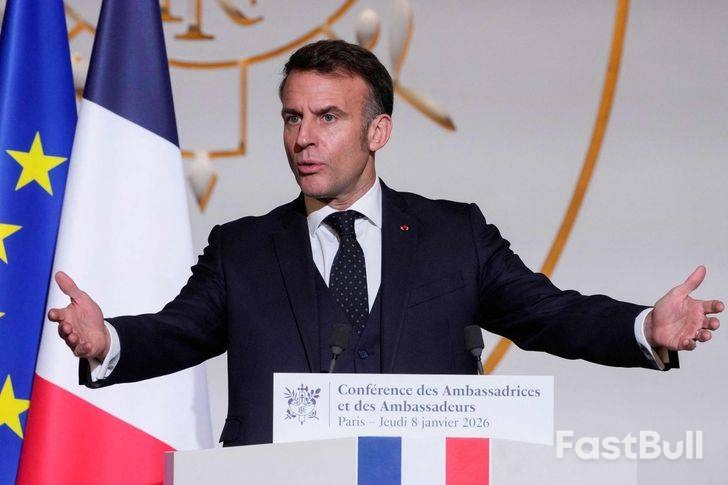
French President Emmanuel Macron has declared that the United States is "breaking free from international rules" and increasingly turning its back on its allies. His remarks highlight growing European concern over Washington's unpredictable foreign policy.
Speaking to French ambassadors at the Elysee Palace, Macron’s comments come as European leaders work to formulate a response to assertive U.S. actions, including its stance on Venezuela’s leader Nicolas Maduro and Donald Trump’s interest in Greenland.

"The U.S. is an established power, but one that is gradually turning away from some of its allies and breaking free from international rules that it was still promoting recently," he stated.
Macron also warned that global cooperation is faltering, creating a more dangerous and divided world. "Multilateral institutions are functioning less and less effectively," he said, adding, "We are living in a world of great powers with a real temptation to divide up the world."
In this shifting global landscape, Macron argued that Europe must act decisively to protect its own interests. He specifically called for the "consolidation" of the continent's regulatory power over the technology sector.
The French president stressed the need to safeguard academic independence and advocated for "the possibility of having a controlled information space where opinions can be exchanged completely freely, but where choices are not made by the algorithms of a few."
His comments reinforce Brussels' recent moves to rein in major tech companies through a powerful legal framework. This includes two key pieces of legislation:
• The Digital Markets Act (DMA): A law designed to ensure fair competition in the digital marketplace.
• The Digital Services Act (DSA): A regulation focused on content moderation and holding platforms accountable for illegal content.
These regulations have faced sharp criticism from Washington, which has accused Europe of an attempt to "coerce" American social media companies into censoring viewpoints.
However, Macron remained firm in his support for the new rules. "The DSA and DMA are two regulations that must be defended," he concluded.
France's aerospace industry is sounding the alarm over the growing trend of global supply chains being used as geopolitical weapons. Industry leaders have expressed serious concern that dependencies on critical materials, especially rare earths sourced from China, are creating strategic vulnerabilities.

Olivier Andries, president of the French aerospace association GIFAS and CEO of engine manufacturer Safran, highlighted the sector's precarious position. He noted that 90% of the industry's rare earth needs are supplied by China, a country currently in a tense trade relationship with the United States.
"There is a trend towards the weaponisation of the supply chain, towards using the dependency on critical supplies to create a geopolitical advantage," Andries stated. "That is particularly the case for rare earths which is a very sensitive topic."
While major manufacturers like Airbus and Boeing have largely been insulated from the U.S.-led tariff war due to their deeply integrated global supply chains, anxiety over the availability of specialist minerals persists. These materials are used in small but vital quantities in advanced products like jet engines.
Andries added that the concerns extend beyond the sheer quantity of materials like samarium. He pointed to "intrusive" questions from Chinese authorities regarding the final destination of these resources, a tactic that mirrors the extra-territorial approach sometimes used by the U.S. In his view, this issue is significant enough that it must be addressed at a European level.
The supply chain issue is part of a broader call for greater European strategic autonomy. Andries referenced recent remarks by U.S. President Donald Trump about Greenland as an example of why Europe must cultivate its own sovereignty.
"These rather uninhibited messages only increase the growing awareness in Europe that while we are of course partners and allies of the United States, we have to cultivate our own sovereignty and not totally entrust our future to another state," he explained.
The dispute over the Danish territory has alarmed NATO allies, adding to a sense of urgency for Europe to strengthen its own defense capabilities.
Adding to the external pressures are domestic challenges. Andries expressed concern over the lack of a French domestic budget for 2026, stating that parliamentarians had "lost direction." This comes as Prime Minister Sebastien Lecornu is making a new attempt to pass the budget. However, Andries confirmed that France's defense spending remains on track for now, driven by increased European military investment in response to U.S. political pressure and the conflict in Ukraine.
Tensions are also evident in multinational defense collaborations. Regarding the Franco-German-Spanish FCAS fighter project, Andries acknowledged a "very strong political will" from French and German leaders to move forward. However, he cautioned, "for things to advance, you also need to have agreements and the manufacturers accepting to work together."
The project has been marked by disputes between Airbus and Dassault Aviation. Dassault has been critical of Germany's decision to purchase U.S.-made F-35 fighter jets while also participating in European defense programs.
To navigate this complex landscape, Andries urged French suppliers to increase investment in the coming years. This would prepare them to capitalize on rising European defense spending and contribute to the next generation of commercial airliners.
President Donald Trump’s proposal for a $1.5 trillion defense budget has captured investor attention, but a closer look at Washington's fiscal and political landscape suggests the figure is almost certainly out of reach.
For fiscal year 2025, the U.S. defense budget includes $832 billion in discretionary funding, supplemented by $150 billion in previously legislated mandatory funding that will be spent over time.
Even reaching a more modest $1 trillion budget for fiscal 2026—a figure previously floated by the White House—would be a heavy lift. That level of spending would likely require a second reconciliation bill, as standard appropriations are only expected to increase slightly.
Pushing the defense budget all the way to $1.5 trillion would demand an additional $670 billion in mandatory funding through reconciliation. Tobin Marcus, an analyst at Wolfe Research, described this outcome as "extraordinarily unlikely" in a recent report, stating, "So there's no way we'll literally hit that $1.5T number."
While the headline number seems improbable, Marcus notes it may be possible for Congress to use the reconciliation process to push defense funding closer to the $1 trillion mark. This would be most feasible if the legislation remained narrowly focused on defense.
However, even this more limited goal faces significant obstacles. Marcus expressed skepticism that a second reconciliation bill will pass at all, pointing to a growing list of competing priorities all vying for the same legislative pathway.
The push for increased defense spending is not happening in a vacuum. The reconciliation process is also being targeted for several other major initiatives:
• President Trump has shown interest in using it to pass consumer stimulus checks.
• House Speaker Mike Johnson has discussed separate healthcare legislation.
• Fiscal conservatives are expecting to use the process to pursue entitlement cuts that were excluded from previous budget agreements.
According to Marcus, these colliding demands create a political logjam. With a narrow and "restive" Republican majority in the House, the ambitious effort to dramatically expand defense funding is likely to "collapse under its own weight."
White Label
Data API
Web Plug-ins
Poster Maker
Affiliate Program
The risk of loss in trading financial instruments such as stocks, FX, commodities, futures, bonds, ETFs and crypto can be substantial. You may sustain a total loss of the funds that you deposit with your broker. Therefore, you should carefully consider whether such trading is suitable for you in light of your circumstances and financial resources.
No decision to invest should be made without thoroughly conducting due diligence by yourself or consulting with your financial advisors. Our web content might not suit you since we don't know your financial conditions and investment needs. Our financial information might have latency or contain inaccuracy, so you should be fully responsible for any of your trading and investment decisions. The company will not be responsible for your capital loss.
Without getting permission from the website, you are not allowed to copy the website's graphics, texts, or trademarks. Intellectual property rights in the content or data incorporated into this website belong to its providers and exchange merchants.
Not Logged In
Log in to access more features

FastBull Membership
Not yet
Purchase
Log In
Sign Up