• Trade
  • Markets
  • Copy
  • Contests
  • News
  • 24/7
  • Calendar
  • Q&A
  • Chats
Trending
Screeners
SYMBOL
LAST
BID
ASK
HIGH
LOW
NET CHG.
%CHG.
SPREAD
SPX
S&P 500 Index
6827.42
6827.42
6827.42
6899.86
6801.80
-73.58
-1.07%
--
DJI
Dow Jones Industrial Average
48458.04
48458.04
48458.04
48886.86
48334.10
-245.98
-0.51%
--
IXIC
NASDAQ Composite Index
23195.16
23195.16
23195.16
23554.89
23094.51
-398.69
-1.69%
--
USDX
US Dollar Index
97.910
97.990
97.910
98.070
97.890
-0.040
-0.04%
--
EURUSD
Euro / US Dollar
1.17403
1.17410
1.17403
1.17447
1.17262
+0.00009
+ 0.01%
--
GBPUSD
Pound Sterling / US Dollar
1.33800
1.33809
1.33800
1.33856
1.33546
+0.00093
+ 0.07%
--
XAUUSD
Gold / US Dollar
4345.77
4346.18
4345.77
4350.16
4294.68
+46.38
+ 1.08%
--
WTI
Light Sweet Crude Oil
57.342
57.372
57.342
57.601
57.194
+0.109
+ 0.19%
--

Community Accounts

Signal Accounts
--
Profit Accounts
--
Loss Accounts
--
View More

Become a signal provider

Sell trading signals to earn additional income

View More

Guide to Copy Trading

Get started with ease and confidence

View More

Signal Accounts for Members

All Signal Accounts

Best Return
  • Best Return
  • Best P/L
  • Best MDD
Past 1W
  • Past 1W
  • Past 1M
  • Past 1Y

All Contests

  • All
  • Trump Updates
  • Recommend
  • Stocks
  • Cryptocurrencies
  • Central Banks
  • Featured News
Top News Only
Share

Cronos Group Up 4%, Sndl Up 1.4%

Share

London Metal Exchange: Intends To Publish A Consultation On The Proposed Changes To Our Rules In Response To The Regime Early In2026

Share

London Metal Exchange: Announces Publication Of Update Describing How The London Metal Exchange Plans To Implement The Fca Policy Statement 25/1 On Commodity Reform

Share

USA - Listed Shares Of Gold Miners Rise Premarket After Gold Rises About 1%

Share

The Council Of The European Union: In Light Of The Situation In Venezuela, The Council Decided Today To Extend The Existing Restrictions For Another Year, Until 10 January 2027

Share

Ivory Coast 2025/26 Cocoa Arrivals Reached 894000 T By December 14 Versus 895000 T Year Ago - Exporters' Estimate

Share

Ishares MSCI Chile ETF Up 3.9% Premarket After Jose Antonio Kast Wins Chile's Presidential Election On Sunday

Share

Spain's Debt-To-GDP Ratio Falls To 103.2% In Third Quarter 2025

Share

China's Central Bank: Authorises DBS Bank As Yuan Clearing Bank In Singapore

Share

Bank Of Korea - South Korea Central Bank, Nps Agree To Extend Currency Swap Agreement For Another Year

Share

Poland's CPI At 0.1% Month-On-Month In November Versus 0.1% Released Earlier

Share

London Metal Exchange (LME): Copper Inventories Decreased By 25 Tons, Aluminum Inventories Decreased By 50 Tons, Nickel Inventories Increased By 360 Tons, Zinc Inventories Increased By 2,550 Tons, Lead Inventories Increased By 17,725 Tons, And Tin Inventories Increased By 125 Tons

Share

Polish Inflation At 2.5% Year-On-Year In November

Share

Poland's January-October Import Up 5.4% To 309.3 Billion Euros

Share

Poland's January-October Trade Balance At -5.1 Billion Euros

Share

Poland's January-October Export Up 2.8% To 304.3 Billion Euros

Share

Ceasefire Negotiations Between Ukraine And US Representatives In Berlin To Continue Monday Morning - German Source Familiar With The Schedule

Share

Spain's IBEX Hits Fresh Record High, Up Over 1%

Share

Spot Silver Rises Nearly 3% To $63.82/Oz

Share

France's Foreign Minister Says He Suggesd To EU's Kallas That US Representatives Brief EU Foreign Ministers On Gaza Peace Plan During Their Meeting

TIME
ACT
FCST
PREV
France HICP Final MoM (Nov)

A:--

F: --

P: --

China, Mainland Outstanding Loans Growth YoY (Nov)

A:--

F: --

P: --

China, Mainland M2 Money Supply YoY (Nov)

A:--

F: --

P: --

China, Mainland M0 Money Supply YoY (Nov)

A:--

F: --

P: --

China, Mainland M1 Money Supply YoY (Nov)

A:--

F: --

P: --

India CPI YoY (Nov)

A:--

F: --

P: --

India Deposit Gowth YoY

A:--

F: --

P: --

Brazil Services Growth YoY (Oct)

A:--

F: --

P: --

Mexico Industrial Output YoY (Oct)

A:--

F: --

P: --

Russia Trade Balance (Oct)

A:--

F: --

P: --

Philadelphia Fed President Henry Paulson delivers a speech
Canada Building Permits MoM (SA) (Oct)

A:--

F: --

P: --

Canada Wholesale Sales YoY (Oct)

A:--

F: --

P: --

Canada Wholesale Inventory MoM (Oct)

A:--

F: --

P: --

Canada Wholesale Inventory YoY (Oct)

A:--

F: --

P: --

Canada Wholesale Sales MoM (SA) (Oct)

A:--

F: --

P: --

Germany Current Account (Not SA) (Oct)

A:--

F: --

P: --

U.S. Weekly Total Rig Count

A:--

F: --

P: --

U.S. Weekly Total Oil Rig Count

A:--

F: --

P: --

Japan Tankan Small Manufacturing Outlook Index (Q4)

A:--

F: --

P: --

Japan Tankan Large Non-Manufacturing Diffusion Index (Q4)

A:--

F: --

P: --

Japan Tankan Large Non-Manufacturing Outlook Index (Q4)

A:--

F: --

P: --

Japan Tankan Large Manufacturing Outlook Index (Q4)

A:--

F: --

P: --

Japan Tankan Small Manufacturing Diffusion Index (Q4)

A:--

F: --

P: --

Japan Tankan Large Manufacturing Diffusion Index (Q4)

A:--

F: --

P: --

Japan Tankan Large-Enterprise Capital Expenditure YoY (Q4)

A:--

F: --

P: --

U.K. Rightmove House Price Index YoY (Dec)

A:--

F: --

P: --

China, Mainland Industrial Output YoY (YTD) (Nov)

A:--

F: --

P: --

China, Mainland Urban Area Unemployment Rate (Nov)

A:--

F: --

P: --

Saudi Arabia CPI YoY (Nov)

A:--

F: --

P: --

Euro Zone Industrial Output YoY (Oct)

--

F: --

P: --

Euro Zone Industrial Output MoM (Oct)

--

F: --

P: --

Canada Existing Home Sales MoM (Nov)

--

F: --

P: --

Euro Zone Total Reserve Assets (Nov)

--

F: --

P: --

U.K. Inflation Rate Expectations

--

F: --

P: --

Canada National Economic Confidence Index

--

F: --

P: --

Canada New Housing Starts (Nov)

--

F: --

P: --

U.S. NY Fed Manufacturing Employment Index (Dec)

--

F: --

P: --

U.S. NY Fed Manufacturing Index (Dec)

--

F: --

P: --

Canada Core CPI YoY (Nov)

--

F: --

P: --

Canada Manufacturing Unfilled Orders MoM (Oct)

--

F: --

P: --

U.S. NY Fed Manufacturing Prices Received Index (Dec)

--

F: --

P: --

U.S. NY Fed Manufacturing New Orders Index (Dec)

--

F: --

P: --

Canada Manufacturing New Orders MoM (Oct)

--

F: --

P: --

Canada Core CPI MoM (Nov)

--

F: --

P: --

Canada Trimmed CPI YoY (SA) (Nov)

--

F: --

P: --

Canada Manufacturing Inventory MoM (Oct)

--

F: --

P: --

Canada CPI YoY (Nov)

--

F: --

P: --

Canada CPI MoM (Nov)

--

F: --

P: --

Canada CPI YoY (SA) (Nov)

--

F: --

P: --

Canada Core CPI MoM (SA) (Nov)

--

F: --

P: --

Canada CPI MoM (SA) (Nov)

--

F: --

P: --

Federal Reserve Board Governor Milan delivered a speech
U.S. NAHB Housing Market Index (Dec)

--

F: --

P: --

Australia Composite PMI Prelim (Dec)

--

F: --

P: --

Australia Services PMI Prelim (Dec)

--

F: --

P: --

Australia Manufacturing PMI Prelim (Dec)

--

F: --

P: --

Japan Manufacturing PMI Prelim (SA) (Dec)

--

F: --

P: --

U.K. Unemployment Claimant Count (Nov)

--

F: --

P: --

U.K. Unemployment Rate (Nov)

--

F: --

P: --

U.K. 3-Month ILO Unemployment Rate (Oct)

--

F: --

P: --

Q&A with Experts
    • All
    • Chatrooms
    • Groups
    • Friends
    Connecting
    .
    .
    .
    Type here...
    Add Symbol or Code

      No matching data

      All
      Trump Updates
      Recommend
      Stocks
      Cryptocurrencies
      Central Banks
      Featured News
      • All
      • Russia-Ukraine Conflict
      • Middle East Flashpoint
      • All
      • Russia-Ukraine Conflict
      • Middle East Flashpoint
      Search
      Products

      Charts Free Forever

      Chats Q&A with Experts
      Screeners Economic Calendar Data Tools
      Membership Features
      Data Warehouse Market Trends Institutional Data Policy Rates Macro

      Market Trends

      Market Sentiment Order Book Forex Correlations

      Top Indicators

      Charts Free Forever
      Markets

      News

      News Analysis 24/7 Columns Education
      From Institutions From Analysts
      Topics Columnists

      Latest Views

      Latest Views

      Trending Topics

      Top Columnists

      Latest Update

      Signals

      Copy Rankings Latest Signals Become a signal provider AI Rating
      Contests
      Brokers

      Overview Brokers Assessment Rankings Regulators News Claims
      Broker listing Forex Brokers Comparison Tool Live Spread Comparison Scam
      Q&A Complaint Scam Alert Videos Tips to Detect Scam
      More

      Business
      Events
      Careers About Us Advertising Help Center

      White Label

      Data API

      Web Plug-ins

      Affiliate Program

      Awards Institution Evaluation IB Seminar Salon Event Exhibition
      Vietnam Thailand Singapore Dubai
      Fans Party Investment Sharing Session
      FastBull Summit BrokersView Expo
      Recent Searches
        Top Searches
          Markets
          News
          Analysis
          User
          24/7
          Economic Calendar
          Education
          Data
          • Names
          • Latest
          • Prev

          View All

          No data

          Scan to Download

          Faster Charts, Chat Faster!

          Download App
          English
          • English
          • Español
          • العربية
          • Bahasa Indonesia
          • Bahasa Melayu
          • Tiếng Việt
          • ภาษาไทย
          • Français
          • Italiano
          • Türkçe
          • Русский язык
          • 简中
          • 繁中
          Open Account
          Search
          Products
          Charts Free Forever
          Markets
          News
          Signals

          Copy Rankings Latest Signals Become a signal provider AI Rating
          Contests
          Brokers

          Overview Brokers Assessment Rankings Regulators News Claims
          Broker listing Forex Brokers Comparison Tool Live Spread Comparison Scam
          Q&A Complaint Scam Alert Videos Tips to Detect Scam
          More

          Business
          Events
          Careers About Us Advertising Help Center

          White Label

          Data API

          Web Plug-ins

          Affiliate Program

          Awards Institution Evaluation IB Seminar Salon Event Exhibition
          Vietnam Thailand Singapore Dubai
          Fans Party Investment Sharing Session
          FastBull Summit BrokersView Expo

          Can COP27 Deter Africa from A 'Dash for Gas' In Green Energy Transition

          Devin

          Energy

          Summary:

          It may not be on the official agenda at the COP27 climate summit in Egypt, but the thorny question of whether African nations should receive financial support to produce, use and export natural gas as part of a clean energy transition is on everyone's lips.

          It may not be on the official agenda at the COP27 climate summit in Egypt, but the thorny question of whether African nations should receive financial support to produce, use and export natural gas as part of a clean energy transition is on everyone's lips.
          Climate campaigners have pitched themselves against African governments that believe they should be allowed to use gas - which emits less climate-heating carbon dioxide than coal and oil when burned - to develop their economies and provide power to 600 million Africans who still lack access to electricity.
          Activists raised the alarm last month when Tarek El Molla, Egypt's minister of petroleum and mineral resources, told a ministerial meeting of the Gas Exporting Countries Forum (GECF) that fossil gas is "the perfect solution" to "achieving the energy trilemma for security, sustainability and affordability".
          GECF member countries - which include Algeria, Egypt, Equatorial Guinea and Mozambique - agreed that COP27 and next year's COP in the United Arab Emirates, also in the GECF, present "a great opportunity" to make the case for gas in the energy transition and efforts to meet global development goals.
          But advocates for renewables are calling for no more investment in gas - especially in new infrastructure that would facilitate its export to European countries, which have been seeking fresh supplies since committing to cut their use of gas from Russia by two-thirds this year after it invaded Ukraine.
          The International Energy Agency has said investors should not fund new oil, gas and coal supply projects if the world wants to reach net-zero emissions by mid-century, as required to meet the goals of the Paris Agreement to keep global warming "well below" 2 degrees Celsius and ideally to 1.5C.
          Mohamed Adow, director of Nairobi-based think tank Power Shift Africa, told journalists at COP27 in Sharm el-Sheikh on Monday that Europe is seeking to make Africa its "gas station", while failing to provide adequate funding to boost renewable energy such as solar.
          "We can't let Africa - that has missed all the fossil fuel-powered industrialisation - now become a victim because of the short-sighted selfish colonialist interests of particularly Europe," he said.
          European countries, including Germany and Italy, have been criticised by climate activists this year for encouraging governments such as Senegal, Nigeria and Mozambique - behind closed doors - to develop and export their fossil gas reserves, in what is often dubbed a "dash for gas".

          'Transition fuel'

          Their efforts seem to have fallen on receptive ears, with Senegalese President Macky Sall in a July speech welcoming growing international support for developing gas resources in Africa as part of the continent's energy transition.
          Days before, the European Parliament had backed new European Union rules labelling investments in gas and nuclear power plants as climate-friendly.
          Later in July, the African Union (AU) and other pan-African institutions adopted a common position on energy access and just transition that said Africa would continue to deploy all forms of its "abundant energy resources including renewable and non-renewable energy to address energy demand".
          "Natural gas, green and low-carbon hydrogen and nuclear energy will therefore be expected to play a crucial role in expanding modern energy access in the short to medium term while enhancing the uptake of renewables in the long term," it added.
          Gas-rich Nigeria, for example - where about four in 10 people live without electricity - has made clear in its Energy Transition Plan that it will need to boost the use of gas for power production and cleaner cooking until 2030 while also developing solar and hydrogen.
          The plan says natural gas is a "transition fuel" on Nigeria's path to net-zero emissions by 2060 and projects gas consumption will grow by about 25% from a 2019 baseline by 2030.
          It also projects growth in oil and gas refining through to mid-century but says greenhouse gas emissions from refining activities can be offset, or abated, by applying "Carbon Capture Utilization and Storage" (CCUS) - technology used to stop emissions escaping into the atmosphere.

          'Greenwashing' gas?

          Activists such as Lorraine Chiponda, co-lead of the "Don't Gas Africa" campaign, have branded promises to abate emissions from the extraction and use of fossil gas as a "false solution" - and an attempt by the industry at "greenwashing gas".
          "Our governments must not fall into a trap of developing new gas infrastructure in Europe or Africa, which will continue to harm communities and enrich big polluters while winding up as stranded assets," she told a briefing at COP27 on Monday.
          John Kerry, the U.S. special envoy on climate change, said last month at an event in London, that gas - including in Africa - "will be part of this (green) energy transition for sure if managed correctly and effectively".
          Switching to gas from coal and oil can provide an immediate reduction in climate-heating emissions of 30%, he noted.
          But, he added, building new gas infrastructure - which would last for 30 to 40 years - would only be a realistic option if it included ways to capture the emissions.
          Even then, it might not be cost-competitive with cleaner alternatives such as green hydrogen, Kerry added, warning of the risk of stranded gas assets.

          Funding Shortfall

          Vikram Singh, of the U.S.-based Rocky Mountain Institute, said his nonprofit's research showed the battle to limit global warming to 1.5C "will be won or lost in the Global South".
          Renewables are the best solution to provide electricity to rural communities in Africa, he said, adding that the continent is home to 60% of the world's solar resources, which have so far been little used.
          "It's really a shame that it's not being leveraged more when it's proving to be a cheaper, more effective and scalable approach to energy access (than fossil fuels)," he added.
          Only 16 out of 54 African states have significant gas reserves, he said, with 60% of those reserves held in four countries - Algeria, Angola, Nigeria and Mozambique.
          Those governments, together with Senegal, will push behind the scenes at COP27 for access from donors to preferential financial support to exploit those resources, he added.
          Meanwhile, energy and development experts say wealthy nations are not delivering climate finance to expand renewables on a scale that would allow Africa to leapfrog fossil fuels.
          Donor governments believe the answer may lie in "just energy transition partnerships" (JETPs) of the kind they are putting together for some countries that rely heavily on fossil fuels.
          South Africa won the first such $8.5 billion deal at last year's COP26 summit to wean itself off coal.
          But discussions on a JETP for Senegal have floundered over the role of gas in its future energy mix, observers say, with Britain insisting support cannot be used to expand fossil fuels.
          Nigeria, meanwhile is on the hunt for an initial $10 billion for its energy transition.
          But its environment minister said last month that African governments would push at COP27 for a "softening of the conditions" to access climate finance, noting that many Nigerians' livelihoods still depend on its fossil fuel-heavy energy mix.
          Bogolo Kenewendo, Africa director and special advisor to the U.N. Climate Change High-Level Champions Team, said African nations had started talking about a green development pathway.
          "That green development pathway will not happen if financing for dirtier industries is still nine times more than financing for greener industries - and while the continent only still attracts 3% of climate financing," she said ahead of COP27.

          Source: Reuters

          Risk Warnings and Disclaimers
          You understand and acknowledge that there is a high degree of risk involved in trading. Following any strategies or investment methods may lead to potential losses. The content on the site is provided by our contributors and analysts for information purposes only. You are solely responsible for determining whether any trading assets, securities, strategy, or any other product is suitable for investing based on your own investment objectives and financial situation.
          Comments
          Add to Favorites
          Share

          COP27: What's on the U.N. Climate Talks Agenda

          Kevin Du

          Energy

          The U.N. climate conference taking place in Egypt until Nov. 18 has much to discuss, from financing the transition to clean energy to protecting the world's forests and future-proofing cities.
          Here are some of the most-watched topics on the agenda in the sun-baked resort of Sharm el-Sheikh.

          Fossil Fuels and Backsliding

          Countries at last year's COP26 talks agreed for the first time to "phase down" coal production and trim other fossil fuel subsidies. Voluntary side deals also touted plans to curb fossil fuel financing and to limit planet-warming methane emissions, chiefly from the fossil fuel and agriculture industries.
          But the energy disruption caused by war in Europe has led several European Union members to reopen or extend coal plants' life and to lock in liquefied natural gas (LNG) shipments. Meanwhile, China continues to approve new coal mines, and Vietnam and Indonesia seek to boost coal production.
          The backsliding by major economies on their promises to shift from fossil fuels has led some nations, especially in Africa, to call for a formal recognition that they should be allowed to develop their fossil fuel reserves.
          The United Arab Emirates, a member of the Organization of the Petroleum Exporting Countries and host of next year's COP28 talks, has said it will be "a responsible supplier" of oil and gas for as long as the world needs.

          Paying Up for The Damage

          As host of COP27, Egypt has made the issue of "loss and damage," or compensation for losses from climate-related disasters, a focus.
          Following a breakthrough at the weekend as this year's summit began, the issue for the first time is part of the U.N. talks' formal agenda.
          Wealthy countries have resisted creating a funding mechanism that could suggest liability for historic climate damages, but developing countries are united in demanding that a Loss and Damage fund be established.
          The United States and the European Union have shown more openness to having a serious discussion, but remain wary of creating a fund, especially as they face domestic pressure to deal with economic weakness and a cost-of-living crisis caused by high energy prices.

          Adapting To a Warmer World

          High-income countries have yet to meet their pledge to deliver $100 billion a year in climate finance. Only $80 billion per year was delivered in 2019. Nevertheless, the talks will address boosting that annual goal upward from $100 billion from 2025.
          To date, about a quarter of that financing has gone to projects for adapting communities for a warmer world.
          Low-income and climate-vulnerable countries want to ensure that the share spent on adaptation is doubled by 2025 - a pledge made at last year's U.N. climate talks in Glasgow, Scotland.
          That's still shy of what experts say is needed: a report by the U.N. Trade and Development office estimates adaptation costs in developing countries will total $300 billion in 2030.

          'Fundamental reform' of development banks?

          High-level voices have called for an overhaul of international financial institutions. At the annual World Bank meetings last month, the United States and Germany called for "a fundamental reform" of the bank to respond to challenges including climate change on a global scale, rather than country by country.
          Some reformers are asking for more grants and concessional loans that would prevent lower- and middle-income countries from having to pay high interest rates.
          U.S. Special Envoy John Kerry said in a speech last month that reforms would be crucial to "address the crisis of this moment," and that there were proposals that could "unlock several hundred billion dollars in additional MDB [multinational development bank] lending capacity without requiring new shareholder capital" and without risking credit rating downgrades.

          Keeping 1.5 Alive

          At COP26, countries promised to "revisit and strengthen" their national climate plans, called Nationally Determined Contributions, or NDCs, by the end of this year to ensure they are aligned with the Paris Agreement goal of preventing warming beyond 1.5 degrees Celsius above pre-industrial temperatures.
          But last month's U.N. "synthesis report" on NDCs submitted this year show that only 24 countries out of 194 have updated their plans.
          There may be some new momentum in Egypt. Australia's new government strengthened its pledge to cut emissions 43% by 2030, a significant improvement from its 2015 target of 26-28% below 2005 levels by 2030. Chile, Mexico, Turkey and Vietnam are also expected to announce new plans.
          Meanwhile, Brazil's election of Luis Inacio "Lula" da Silva as president on Sunday bolsters global efforts to end deforestation.

          Source: Reuters

          Risk Warnings and Disclaimers
          You understand and acknowledge that there is a high degree of risk involved in trading. Following any strategies or investment methods may lead to potential losses. The content on the site is provided by our contributors and analysts for information purposes only. You are solely responsible for determining whether any trading assets, securities, strategy, or any other product is suitable for investing based on your own investment objectives and financial situation.
          Comments
          Add to Favorites
          Share

          Has Europe's Energy Crisis Been Lifted?

          King Ten

          Energy

          Whether the Full Storage of Natural Gas into Winter Can Be Sustained

          The accumulation of natural gas in Europe led to negative gas prices, partly due to the credit of the US. Previously, the United States signed an energy cooperation agreement with the EU, committing to give the EU an additional 15 billion cubic meters of LNG in 2022. Facts have proved that the US has indeed exceeded its promises and basically filled the vacancy of Russian gas.
          Besides, Europe was taking precautions at that time and actively adopting energy substitution on the demand side. Most countries announced the resumption of coal power to accelerate the demand substitution. At the same time, Europe also encouraged domestic enterprises, residents, organizations, and business activities in Europe to save energy and control natural gas demand in 2022 at the lowest point in recent years. Coupled with the coincidence of the off-season of natural gas demand in the past few months, it has led to the accumulation phenomenon we have seen. So can this be sustained?
          Let's look at a series of statistics. Till March of next year, the consumption of natural gas accounts for more than 55% of the year. The demand is expected to get a boost. The vast majority of European Liquefied Natural Gas (LNG) supplies come from the United States, Qatar, and Russia, which together account for 70% of total imports. However, Russia accounts for about 20% of this, and considering pipelines, Russia accounts for 48% of the total EU natural gas imports. If the Russian natural gas supply continues to be completely cut off, the gap will be about 80 billion cubic meters.
          Between January and October 2022, the EU imported about 48 billion cubic meters of LNG from the US, more than double the volume imported in all of 2021. However, the US can hardly provide more marginal increments. Even if Europe reduces demand by all means, there is still a large gap between supply and demand. This indicates that the subsequent European inventory will enter a stage of accelerated de-industrialization.

          Beware of the Energy Crisis Escalating Again

          The overall structure of Europe’s energy is still dominated by fossil energy. In the primary energy consumption structure, oil and natural gas account for as much as 59%. However, Europe's domestic oil and gas are highly dependent on imports, and its foreign dependence is as high as more than 90%, which is at a disadvantage in the energy security game. Judging from the economic performance of Europe in 2021, the energy security issue, with natural gas supply as its core, has become a critical variable affecting European economic stability. There are three vital factors that should be aware of.
          The first is the complete cut-off of Russian gas. Since the beginning of November, Russia's last major pipeline (Velke Kapusany) has also been almost cut off, which means that the small amount of supply of Russian gas in the past few months will also be shut down completely. The damage this has done to Europe's energy supply is enormous.
          The second is the marginal reduction of U.S. LNG supply. The exports of the U.S. LNG have been marginally decreasing in recent months, and inventories remain at historically low levels. Meanwhile, the supply of the US is beginning to tighten as well, especially as the demand for self-heating increases in winter. It cannot be forgotten to mention that the United States is still the largest energy consumer, so the probability of a decrease in exports is greatly increased.
          Finally, whether the global economy can recover and whether demand can return, especially the demand of China. In early October, China began stopping reselling LNG to Europe, in order to meet domestic winter demand. If China's economy recovers and demand gradually increases, the international LNG market may face tougher competition, as China is the world's third-largest natural gas consumer and importer.
          Risk Warnings and Disclaimers
          You understand and acknowledge that there is a high degree of risk involved in trading. Following any strategies or investment methods may lead to potential losses. The content on the site is provided by our contributors and analysts for information purposes only. You are solely responsible for determining whether any trading assets, securities, strategy, or any other product is suitable for investing based on your own investment objectives and financial situation.
          Comments
          Add to Favorites
          Share

          Cholera's Return to Lebanon Exposes Clean Water Crisis

          Devin

          Energy

          Maha El Hamed and her family can no longer afford to buy bottled water when the taps run dry - a regular occurrence in her refugee camp in northern Lebanon.
          "When we don't have tap water, we rely on the nearest pond," the Syrian said as she sat beside the hospital bed of her seriously ill 4-year-old son - victim of a cholera outbreak that is bringing more misery to crisis-hit Lebanon.
          In just one month, the outbreak has spread throughout the country of six million, infecting nearly 2,000 people and killing 17, according to the latest health ministry data.
          Lebanon had been cholera-free since 1993, but its public services are suffering under a brutal economic crisis now in its fourth year, while infighting among the country's faction-riven elite has paralysed its governing institutions.
          Cholera, a diarrhoeal disease spread by ingestion of food or water tainted with human faeces, can kill within hours if untreated, with children most at risk.
          El Hamed, whose son needed resuscitation when he was admitted to Al-Rassi Governmental Hospital in Akkar district last week, said she was praying he would recover - and dreading going home to the same dire situation.
          "We will have to return to drinking the same infectious water that brought us here," the 34-year-old Syrian told the Thomson Reuters Foundation as she waited at the hospital for doctors to update her on her son's condition.

          Contaminated

          The U.N. children's agency UNICEF says cash-strapped refugees and Lebanese families are being forced to rely on contaminated water sources due to inadequate piped supplies and the rising cost of private alternatives.
          Access to sufficient supplies of clean tap water has become patchy as distribution systems fail - partly due to widespread power cuts that bring pumping stations and purification plants to a standstill, according to UNICEF.
          "We're suffering from the chronic inability to deliver clean water and electricity to homes and camps. This leads to more problems with sewage treatment and disposal," said Ghassan Dbaibo, director of the Center for Infectious Disease Research at the American University of Beirut Medical Center.
          Like many people in Lebanon, El Hamed is suspicious about the safety of the tap water - even when it does flow, preferring to buy bottled water for drinking and cooking instead.
          But soaring inflation has seen the price of bottled water increase by three to five times over the past year, putting it out of reach of many people in Lebanon, where 80% of the population now lives in poverty.
          El Hamed said her husband's pay as a construction worker could no longer stretch to bottled water, forcing them to drink the "filthy" tap water.
          For their other water needs, such as washing and laundry, El Hamed's family and their neighbours share tankers of filtered water from private suppliers, but that is also becoming increasingly expensive - leaving the pond as their only option.
          The cholera outbreak could also put further strain on short-staffed and underfunded healthcare facilities.
          At the Al-Rassi hospital, director Muhammad Khadrin said some cholera patients required emergency treatment, potentially causing a shortage of beds.
          "We're trying to expand the department to be able to handle more cases, but the situation today is very difficult, and we don't know to what extent the ministry will be able to afford the expansion," he said.
          The World Health Organization's representative in Lebanon, Abdinasir Abubakar, said he feared the worst was yet to come in the cholera outbreak despite the entity's efforts to supply clean water and sanitation kits.

          Syria Outbreak

          Government officials think the cholera cases stem from an outbreak in neighbouring Syria.
          Syria's Health Ministry declared a cholera outbreak in Aleppo in September, reporting nine deaths. The cases are thought to be related to individuals drinking contaminated water from the Euphrates River, the United Nations said.
          Lebanon's outbreak risks fuelling hostility towards the roughly 1.5 million refugees Syrian refugees who have sought refuge in Lebanon during their nation's 11-year war, according to the Samir Kassir Foundation (SKF), a Beirut-based freedom of expression nonprofit and a funding partner of the Thomson Reuters Foundation.
          "In October, when cholera first appeared in Lebanon, we saw an increase in hate speech directed at Syrians," said Widad Jarbouh, a researcher at the SKF.
          Around the world, conflicts and natural disasters have resulted in an unprecedented rise in cholera outbreaks globally, the WHO said last month, prompting moves to ration vaccine supplies.
          Lebanon received its first batch of vaccines earlier this month. The vaccines will play "an essential role" in limiting the disease's spread, Health Minister Firass Abiad told a news conference.
          A spokesperson for the Ministry said that so far, the vaccines would be given to frontline healthcare workers with the rest destined for families living in high-risk areas, including the northern towns where health authorities have set up an emergency field hospital.
          There are also concerns that cholera could reach the country's overcrowded and squalid prisons.
          "The outbreak is still ahead of us," said the WHO's Abubakar.

          Source: Reuters

          Risk Warnings and Disclaimers
          You understand and acknowledge that there is a high degree of risk involved in trading. Following any strategies or investment methods may lead to potential losses. The content on the site is provided by our contributors and analysts for information purposes only. You are solely responsible for determining whether any trading assets, securities, strategy, or any other product is suitable for investing based on your own investment objectives and financial situation.
          Comments
          Add to Favorites
          Share

          How Long Will It Take to Know Who Won in U.S. Midterm Elections?

          Thomas

          Political

          Here is some advice for anyone following Tuesday's U.S. midterm elections: Be ready for a long night and maybe days of waiting before it's clear whether Republicans or President Joe Biden's Democrats will control Congress.
          All 435 seats in the U.S. House of Representatives are up for grabs, as are 35 U.S. Senate seats and 36 governorships.
          Republicans would need to pick up five seats to take a majority in the House and just one to control the Senate. Nonpartisan election forecasters and opinion polls suggest Republicans have a very strong chance of winning a House majority, a result that could become clear Tuesday evening, with control of the Senate likely to be closer fought and likely to take longer to be resolved.
          A massive wave of Republican support could lead to declarations of victory hours after polls close.
          But with dozens of races expected to be close and key states like Pennsylvania already warning it could take days to count every ballot, experts say there's a good chance America goes to bed on election night without knowing who won.
          "When it comes to knowing the results, we should move away from talking about Election Day and think instead about election week," said Nathan Gonzales, who publishes the nonpartisan newsletter Inside Elections.

          Blue Mirage, Red Mirage

          The earliest vote tallies will be skewed by how quickly states count mail ballots.
          Because Democrats vote by mail more often than Republicans, states that let officials get an early jump on counting mail ballots could report big Democratic leads early on that evaporate as vote counters work through piles of Republican-leaning ballots that were cast on election day.
          In these "blue mirage" states - which include Florida and North Carolina - election officials are allowed to remove mail ballots from their envelopes before Election Day and load them in vote counting machines, allowing for speedy counting.
          States including Pennsylvania and Wisconsin don't allow officials to open the envelopes until Election Day, leading to a possible "red mirage" in which Republican-leaning Election Day ballots are reported earlier, with many Democratic-leaning mail ballots counted later.
          Experts like Joe Lenski, co-founder of Edison Research, which will be tracking hundreds of races on Tuesday and supplying Reuters and other media organizations with results, will keep an eye on the mix of different types of ballots each state is counting throughout the night.
          "Blue mirage, red mirage, whatever. You just have to look at what types of votes are getting reported to know where you are in that state," said Lenski.

          So, when do we know which party won?

          The first wave of vote tallies is expected on the East Coast between 7 p.m. and 8 p.m. ET (0000-0100 GMT Wednesday, Nov. 9). An early indication of Republican success could come if the races expected to be close - like Virginia's 7th congressional district or a U.S. Senate seat in North Carolina - turn out to be Democratic routs.
          By around 10 p.m. or 11 p.m. ET, when polls in the Midwest will be closed for an hour or more, it's possible Republicans will have enough momentum for experts at U.S. media organizations to project control of the House, said Kyle Kondik, a political analyst at the University of Virginia's Center for Politics.
          If the fight for the House still looks close as vote tallies start coming in from the West Coast - where there could be more than a dozen tight House races - it could be days before control of the chamber is known, experts said.
          California typically takes weeks to count all its ballots, in part because it counts ballots postmarked by Election Day even if they arrive days afterward. Nevada and Washington state also allow late ballots if postmarked by Nov. 8, slowing down the march to final results.
          "If the House is really on the edge, that would matter," said Kondik.
          It may take longer, perhaps weeks longer, to know which party will control the Senate, with close contests in Pennsylvania, Arizona and Georgia likely to determine final control.
          If Georgia's Senate race is as close as expected and no candidate receives more than 50% of the vote, a run-off election would be scheduled for Dec. 6, possibly meaning it will be unclear who will control the chamber until then. The new Congress is set to be inaugurated on Jan. 3, 2023.

          Source: Reuters

          Risk Warnings and Disclaimers
          You understand and acknowledge that there is a high degree of risk involved in trading. Following any strategies or investment methods may lead to potential losses. The content on the site is provided by our contributors and analysts for information purposes only. You are solely responsible for determining whether any trading assets, securities, strategy, or any other product is suitable for investing based on your own investment objectives and financial situation.
          Comments
          Add to Favorites
          Share

          Yellen Heads to India to Draw Surging Economic Power Closer to U.S. Orbit

          Devin
          Janet Yellen embarks on her first trip to India as U.S. Treasury Secretary on Tuesday, focusing more on the similarities of the world's two largest democracies and opportunities for deeper ties than on past trade and geopolitical spats.
          Yellen is not expected to dwell on India's failure to condemn Russia's war in Ukraine, nor on India's massive increase in purchases of discounted Russian oil this year.
          A Treasury official said the United States was not seeking to dissuade India from buying Russian crude as G7 allies and Australia finalize details on a Western-imposed price cap on Russian oil exports planned for Dec. 5.
          On the contrary, the official told reporters that India will benefit from the cap's lower prices.
          In addition to participating in the 12-year-old U.S.-India Economic and Financial Partnership dialogue in New Delhi, Yellen will meet with Indian technology executives and discuss India's leadership agenda for the Group of 20 major economies next year with Finance Minister Nirmala Sitharaman.
          Yellen later travels to Bali, Indonesia for the G20 leaders summit as the group continues to struggle with deep divisions over the Ukraine conflict.

          India's Decade

          Yellen's visit to India comes as the country rides the early stages of an economic boom that has outstripped China's growth rate in recent years and is rapidly expanding its manufacturing base.
          Morgan Stanley last week said in a research report titled "Why This Is India's Decade," that the country's annual GDP is set double to $7.5 trillion by 2031, making it the world's third largest, with manufacturing's share rising to 21% from 15.6% currently.
          With India's growing economic clout, Washington and New Delhi have a "responsibility" to deepen their ties, greatly expanding trade and investment flows, said Atul Keshap, a former career U.S. diplomat who is now president of the U.S.-India Business Council.
          "We're both part of a high-trust ecosystem. Our companies collaborate with each other at the highest end of the value spectrum," Keshap said. "Strategically, we have a lot of convergence and therefore economically we ought to have convergence."

          Tensions, Alignment

          But the economic relationship has challenges, including trade disputes over U.S. steel duties and India's retaliatory tariffs on Harley-Davidson motorcycles.
          Differences over digital trade and India's data localization rules have dogged trade negotiations for years.
          While India is part of the Biden administration's signature Asian engagement project, the Indo-Pacific Economic Framework, it has opted against joining the IPEF trade pillar negotiations.
          But among topics that Yellen plans to push is strengthening pandemic-battered supply chains through "friend-shoring," or diversifying away from a COVID-restricted and increasingly authoritarian China to U.S. allies.
          "That's a message that's extremely appealing to India," said Richard Rossow, an India expert at the Center for Strategic and International Studies in Washington.
          Both India and the United States have growing anxieties about their heavy reliance on China for manufactured goods and inputs from pharmaceutical ingredients to electronics, and India is eager to capture investment that is migrating away from China, he said.
          The Treasury official said the two democracies were committed "to upholding the rules-based international order at a critical time for the cause of freedom."
          Yellen also will likely find a receptive audience on her call to vastly increase multilateral development banks' lending capacity to meet climate transition needs.
          India sees this as a key way to meet both its climate goals and growing power needs, while developing its technology and industrial base for green energy, said Ambitabh Kant, India's G20 sherpa.
          He told a CSIS event last week that the IMF and World Bank "need to become institutions for driving climate action."

          Source: Reuters

          Risk Warnings and Disclaimers
          You understand and acknowledge that there is a high degree of risk involved in trading. Following any strategies or investment methods may lead to potential losses. The content on the site is provided by our contributors and analysts for information purposes only. You are solely responsible for determining whether any trading assets, securities, strategy, or any other product is suitable for investing based on your own investment objectives and financial situation.
          Comments
          Add to Favorites
          Share

          Australia's Lopsided Swaps Market Creates Pockets of Pricing Mayhem

          Alex
          Volatility has exploded in an obscure but important corner of Australia's $113-billion-a-day interest-rate derivatives market, with disruption flowing across fixed income products.
          Dealers say the typically stable market for swapping fixed and floating rate payments has turned wild due to a combination of policy changes, speculation and skewed flows.
          Banks and corporations use the market to manage interest rate risks and traders depend on it as reference for pricing other assets.
          All have been affected by the dramatic surge in the cost of swaps relative to bonds and liquidity has rapidly dried up.
          "Getting large trades done in the wholesale market now is much more difficult than even three-to-six months ago," said Mark Elworthy, head of Australia and New Zealand rates trading at Bank of America Securities in Sydney.
          "Trades that would normally take a few minutes could sometime take days to execute."
          That's also caught the attention of policymakers, though it's unclear what tools authorities could use, if any, to restore a functioning market.
          To make a swap, market participants turn to a dealer or bank to facilitate the deal. For a premium, participants can turn fixed incomes or liabilities into floating exposures, or vice versa.
          Nobody is certain of the exact trigger, but the usually reliable relationship between that premium and government bond yields broke down during October and early November.
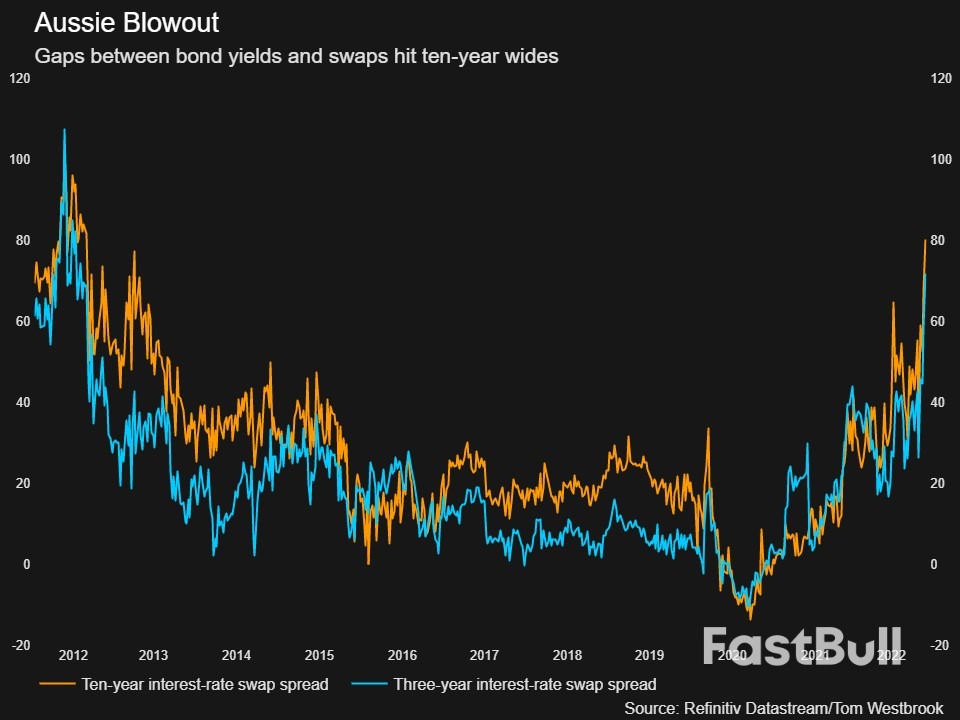
          The gap between the two rates shot to its widest in a decade for the two main tenors and the "bond-swap spread" has moved at its fastest pace in years.
          The benchmark bond yield-to-swaps spreads at three-year and 10-year tenors flung to decade highs last week, with the three-year topping 65 basis points and the 10-year flirting with 80 bps, before sharply recoiling.
          That has meant higher hedging costs for banks and corporations and mark-to-market losses for portfolios that hold debt priced relative to the bond-swap spread.
          Non-government bonds make up a fifth of the widely tracked Bloomberg Australia composite index and are likely marked against swaps, Elworthy said.

          Australia's Lopsided Swaps Market Creates Pockets of Pricing Mayhem_1Drained

          Part of the issue is a lack of bond market supply. Australia's central bank holds about a third of sovereign debt, thanks to its massive bond buying monetary stimulus during the pandemic.
          That scarcity has now made bonds relatively more expensive, which means lower yields.
          Meanwhile, swaps rates have moved the other way as dealers seek to limit their own exposure to rate risk, heightened as markets have been caught off-guard by shifts in the Reserve Bank of Australia's tone and outlook as it hikes interest rates.
          Most theories traders offer on what has driven the disruption relate to money flows, particularly from Australia's big four banks, but also from hedge funds who have been wrong-footed by the moves.
          Andrew Lilley, chief interest rates strategist at Sydney-based investment bank Barrenjoey, says the winding down of a central bank liquidity facility this year is also a factor.
          The so-called Committed Liquidity Facility allowed banks to swap fewer liquid assets for cash with the RBA.
          Its withdrawal means institutions are instead now scrambling for high-grade assets, chiefly fixed-rate semi-government debt, as liquid capital for prudential purposes.
          Those new bond holdings then need to be hedged, which Lilley says has pushed up demand to swap fixed income streams by 50% more than usual, which in turn blows out the bonds-swaps gap.
          Last week, the RBA's head of domestic markets, Jonathan Kearns, noted the swaps market dysfunction.
          "I think we have to be always very attentive," he told a forum in Sydney.

          Disorderly

          Other factors include a relative dearth of foreign debt issued in Australian dollars, which would ordinarily generate receiving demand when issuers swap their liabilities to their home currencies.
          Hedge funds also appear to have stepped in to try and take advantage of the market dysfunction, but have been blindsided as well, market players said.
          "People who had tried to play the widening, maybe they got stopped out, which led to that disorderly widening," said ANZ senior rates strategist Jack Chalmers.
          The global backdrop has also been unhelpful, with September's meltdown in British government debt sending companies "panicking to hedge," according to Robert Hong, head of fixed income credit in Asia at financial services firm StoneX.
          To be sure, there are no major signs of spillover to bank funding costs or wider financial markets. Nor are other swap markets globally seeing similar pressures.
          But the speed of price moves has created concern about skewed supply and demand flows.
          "We usually think of interest-rate derivatives markets as having highly elastic supply," Lilley said. "But now it's behaving a little bit more like a commodities market. As we're getting small changes in demand, we're getting extremely large changes in price."

          Source: Reuters

          Risk Warnings and Disclaimers
          You understand and acknowledge that there is a high degree of risk involved in trading. Following any strategies or investment methods may lead to potential losses. The content on the site is provided by our contributors and analysts for information purposes only. You are solely responsible for determining whether any trading assets, securities, strategy, or any other product is suitable for investing based on your own investment objectives and financial situation.
          Comments
          Add to Favorites
          Share
          FastBull
          Copyright © 2025 FastBull Ltd

          728 RM B 7/F GEE LOK IND BLDG NO 34 HUNG TO RD KWUN TONG KLN HONG KONG

          TelegramInstagramTwitterfacebooklinkedin
          App Store Google Play Google Play
          Products
          Charts

          Chats

          Q&A with Experts
          Screeners
          Economic Calendar
          Data
          Tools
          Membership
          Features
          Function
          Markets
          Copy Trading
          Latest Signals
          Contests
          News
          Analysis
          24/7
          Columns
          Education
          Company
          Careers
          About Us
          Contact Us
          Advertising
          Help Center
          Feedback
          User Agreement
          Privacy Policy
          Business

          White Label

          Data API

          Web Plug-ins

          Poster Maker

          Affiliate Program

          Risk Disclosure

          The risk of loss in trading financial instruments such as stocks, FX, commodities, futures, bonds, ETFs and crypto can be substantial. You may sustain a total loss of the funds that you deposit with your broker. Therefore, you should carefully consider whether such trading is suitable for you in light of your circumstances and financial resources.

          No decision to invest should be made without thoroughly conducting due diligence by yourself or consulting with your financial advisors. Our web content might not suit you since we don't know your financial conditions and investment needs. Our financial information might have latency or contain inaccuracy, so you should be fully responsible for any of your trading and investment decisions. The company will not be responsible for your capital loss.

          Without getting permission from the website, you are not allowed to copy the website's graphics, texts, or trademarks. Intellectual property rights in the content or data incorporated into this website belong to its providers and exchange merchants.

          Not Logged In

          Log in to access more features

          FastBull Membership

          Not yet

          Purchase

          Become a signal provider
          Help Center
          Customer Service
          Dark Mode
          Price Up/Down Colors

          Log In

          Sign Up

          Position
          Layout
          Fullscreen
          Default to Chart
          The chart page opens by default when you visit fastbull.com