
• Trade
  • Markets
  • Copy
  • Contests
  • News
  • 24/7
  • Calendar
  • Q&A
  • Chats
Trending
Screeners
SYMBOL
LAST
BID
ASK
HIGH
LOW
NET CHG.
%CHG.
SPREAD
SPX
S&P 500 Index
6827.42
6827.42
6827.42
6899.86
6801.80
-73.58
-1.07%
--
DJI
Dow Jones Industrial Average
48458.04
48458.04
48458.04
48886.86
48334.10
-245.98
-0.51%
--
IXIC
NASDAQ Composite Index
23195.16
23195.16
23195.16
23554.89
23094.51
-398.69
-1.69%
--
USDX
US Dollar Index
97.950
98.030
97.950
98.500
97.950
-0.370
-0.38%
--
EURUSD
Euro / US Dollar
1.17394
1.17409
1.17394
1.17496
1.17192
+0.00011
+ 0.01%
--
GBPUSD
Pound Sterling / US Dollar
1.33707
1.33732
1.33707
1.33997
1.33419
-0.00148
-0.11%
--
XAUUSD
Gold / US Dollar
4299.39
4299.39
4299.39
4353.41
4257.10
+20.10
+ 0.47%
--
WTI
Light Sweet Crude Oil
57.233
57.485
57.233
58.011
56.969
-0.408
-0.71%
--

Community Accounts

Signal Accounts
--
Profit Accounts
--
Loss Accounts
--
View More

Become a signal provider

Sell trading signals to earn additional income

View More

Guide to Copy Trading

Get started with ease and confidence

View More

Signal Accounts for Members

All Signal Accounts

Best Return
  • Best Return
  • Best P/L
  • Best MDD
Past 1W
  • Past 1W
  • Past 1M
  • Past 1Y

All Contests

  • All
  • Trump Updates
  • Recommend
  • Stocks
  • Cryptocurrencies
  • Central Banks
  • Featured News
Top News Only
Share

Iranian Media Says 18 Crew Members Of Foreign Tanker Seized In Gulf Of Oman Over Carrying 'Smuggled Fuel' Detained

Share

Regional Governor: Two Killed In Ukrainian Drone Strike On Russia's Saratov

Share

Chinese Foreign Ministry - China Foreign Minister Met With United Arab Emirates Counterpart On Dec 12

Share

China's Central Financial And Economic Affairs Commission Deputy Director: Will Expand Export And Increase Import In 2026

Share

Thai Leader Anutin: Landmine Blast That Killed Thai Soldiers 'Not A Roadside Accident'

Share

Thai Leader Anutin: Thailand To Continue Military Action Until 'We Feel No More Harm'

Share

Cambodian Prime Minister Hun Manet Says He Had Phone Calls With Trump And Malaysian Leader Anwar About Ceasefire

Share

Cambodia's Hun Manet Says USA, Malaysia Should Verify 'Which Side Fired First' In Latest Conflict

Share

Cambodia's Hun Manet: Cambodia Maintains Its Stance In Seeking Peaceful Resolution Of Disputes

Share

Nasdaq Companies: Allergan, Ferrovia, Insmed, Monolithic Power Systems, Seagate Technology, And Western Digital Will Be Added To The NASDAQ 100 Index. Biogen, CdW, GlobalFoundries, Lululemon, ON Semiconductor, And Tradedesk Will Be Removed From The NASDAQ 100 Index

Share

Witkoff Headed To Berlin This Weekend To Meet With Zelenskiy, European Leaders -Wsj Reporter On X

Share

Russia Attacks Two Ukrainian Ports, Damaging Three Turkish-Owned Vessels

Share

[Historic Flooding Occurs In At Least Four Rivers In Washington State Due To Days Of Torrential Rains] Multiple Areas In Washington State Have Been Hit By Severe Flooding Due To Days Of Torrential Rains, With At Least Four Rivers Experiencing Historic Flooding. Reporters Learned On The 12th That The Floods Caused By The Torrential Rains In Washington State Have Destroyed Homes And Closed Several Highways. Experts Warn That Even More Severe Flooding May Occur In The Future. A State Of Emergency Has Been Declared In Washington State

Share

Trump Says Proposed Free Economic Zone In Donbas Would Work

Share

Trump: I Think My Voice Should Be Heard

Share

Trump Says Will Be Choosing New Fed Chair In Near Future

Share

Trump Says Proposed Free Economic Zone In Donbas Complex But Would Work

Share

Trump Says Land Strikes In Venezuela Will Start Happening

Share

US President Trump: Thailand And Cambodia Are In A Good Situation

Share

State Media: North Korean Leader Kim Hails Troops Returning From Russia Mission

TIME
ACT
FCST
PREV
U.K. Trade Balance Non-EU (SA) (Oct)

A:--

F: --

P: --

U.K. Trade Balance (Oct)

A:--

F: --

P: --

U.K. Services Index MoM

A:--

F: --

P: --

U.K. Construction Output MoM (SA) (Oct)

A:--

F: --

P: --

U.K. Industrial Output YoY (Oct)

A:--

F: --

P: --

U.K. Trade Balance (SA) (Oct)

A:--

F: --

P: --

U.K. Trade Balance EU (SA) (Oct)

A:--

F: --

P: --

U.K. Manufacturing Output YoY (Oct)

A:--

F: --

P: --

U.K. GDP MoM (Oct)

A:--

F: --

P: --

U.K. GDP YoY (SA) (Oct)

A:--

F: --

P: --

U.K. Industrial Output MoM (Oct)

A:--

F: --

P: --

U.K. Construction Output YoY (Oct)

A:--

F: --

P: --

France HICP Final MoM (Nov)

A:--

F: --

P: --

China, Mainland Outstanding Loans Growth YoY (Nov)

A:--

F: --

P: --

China, Mainland M2 Money Supply YoY (Nov)

A:--

F: --

P: --

China, Mainland M0 Money Supply YoY (Nov)

A:--

F: --

P: --

China, Mainland M1 Money Supply YoY (Nov)

A:--

F: --

P: --

India CPI YoY (Nov)

A:--

F: --

P: --

India Deposit Gowth YoY

A:--

F: --

P: --

Brazil Services Growth YoY (Oct)

A:--

F: --

P: --

Mexico Industrial Output YoY (Oct)

A:--

F: --

P: --

Russia Trade Balance (Oct)

A:--

F: --

P: --

Philadelphia Fed President Henry Paulson delivers a speech
Canada Building Permits MoM (SA) (Oct)

A:--

F: --

P: --

Canada Wholesale Sales YoY (Oct)

A:--

F: --

P: --

Canada Wholesale Inventory MoM (Oct)

A:--

F: --

P: --

Canada Wholesale Inventory YoY (Oct)

A:--

F: --

P: --

Canada Wholesale Sales MoM (SA) (Oct)

A:--

F: --

P: --

Germany Current Account (Not SA) (Oct)

A:--

F: --

P: --

U.S. Weekly Total Rig Count

A:--

F: --

P: --

U.S. Weekly Total Oil Rig Count

A:--

F: --

P: --

Japan Tankan Large Non-Manufacturing Diffusion Index (Q4)

--

F: --

P: --

Japan Tankan Small Manufacturing Outlook Index (Q4)

--

F: --

P: --

Japan Tankan Large Non-Manufacturing Outlook Index (Q4)

--

F: --

P: --

Japan Tankan Large Manufacturing Outlook Index (Q4)

--

F: --

P: --

Japan Tankan Small Manufacturing Diffusion Index (Q4)

--

F: --

P: --

Japan Tankan Large Manufacturing Diffusion Index (Q4)

--

F: --

P: --

Japan Tankan Large-Enterprise Capital Expenditure YoY (Q4)

--

F: --

P: --

U.K. Rightmove House Price Index YoY (Dec)

--

F: --

P: --

China, Mainland Industrial Output YoY (YTD) (Nov)

--

F: --

P: --

China, Mainland Urban Area Unemployment Rate (Nov)

--

F: --

P: --

Saudi Arabia CPI YoY (Nov)

--

F: --

P: --

Euro Zone Industrial Output YoY (Oct)

--

F: --

P: --

Euro Zone Industrial Output MoM (Oct)

--

F: --

P: --

Canada Existing Home Sales MoM (Nov)

--

F: --

P: --

Euro Zone Total Reserve Assets (Nov)

--

F: --

P: --

U.K. Inflation Rate Expectations

--

F: --

P: --

Canada National Economic Confidence Index

--

F: --

P: --

Canada New Housing Starts (Nov)

--

F: --

P: --

U.S. NY Fed Manufacturing Employment Index (Dec)

--

F: --

P: --

U.S. NY Fed Manufacturing Index (Dec)

--

F: --

P: --

Canada Core CPI YoY (Nov)

--

F: --

P: --

Canada Manufacturing Unfilled Orders MoM (Oct)

--

F: --

P: --

Canada Manufacturing New Orders MoM (Oct)

--

F: --

P: --

Canada Core CPI MoM (Nov)

--

F: --

P: --

Canada Manufacturing Inventory MoM (Oct)

--

F: --

P: --

Canada CPI YoY (Nov)

--

F: --

P: --

Canada CPI MoM (Nov)

--

F: --

P: --

Canada CPI YoY (SA) (Nov)

--

F: --

P: --

Canada Core CPI MoM (SA) (Nov)

--

F: --

P: --

Q&A with Experts
    • All
    • Chatrooms
    • Groups
    • Friends
    Connecting
    .
    .
    .
    Type here...
    Add Symbol or Code

      No matching data

      All
      Trump Updates
      Recommend
      Stocks
      Cryptocurrencies
      Central Banks
      Featured News
      • All
      • Russia-Ukraine Conflict
      • Middle East Flashpoint
      • All
      • Russia-Ukraine Conflict
      • Middle East Flashpoint
      Search
      Products

      Charts Free Forever

      Chats Q&A with Experts
      Screeners Economic Calendar Data Tools
      Membership Features
      Data Warehouse Market Trends Institutional Data Policy Rates Macro

      Market Trends

      Market Sentiment Order Book Forex Correlations

      Top Indicators

      Charts Free Forever
      Markets

      News

      News Analysis 24/7 Columns Education
      From Institutions From Analysts
      Topics Columnists

      Latest Views

      Latest Views

      Trending Topics

      Top Columnists

      Latest Update

      Signals

      Copy Rankings Latest Signals Become a signal provider AI Rating
      Contests
      Brokers

      Overview Brokers Assessment Rankings Regulators News Claims
      Broker listing Forex Brokers Comparison Tool Live Spread Comparison Scam
      Q&A Complaint Scam Alert Videos Tips to Detect Scam
      More

      Business
      Events
      Careers About Us Advertising Help Center

      White Label

      Data API

      Web Plug-ins

      Affiliate Program

      Awards Institution Evaluation IB Seminar Salon Event Exhibition
      Vietnam Thailand Singapore Dubai
      Fans Party Investment Sharing Session
      FastBull Summit BrokersView Expo
      Recent Searches
        Top Searches
          Markets
          News
          Analysis
          User
          24/7
          Economic Calendar
          Education
          Data
          • Names
          • Latest
          • Prev

          View All

          No data

          Scan to Download

          Faster Charts, Chat Faster!

          Download App
          English
          • English
          • Español
          • العربية
          • Bahasa Indonesia
          • Bahasa Melayu
          • Tiếng Việt
          • ภาษาไทย
          • Français
          • Italiano
          • Türkçe
          • Русский язык
          • 简中
          • 繁中
          Open Account
          Search
          Products
          Charts Free Forever
          Markets
          News
          Signals

          Copy Rankings Latest Signals Become a signal provider AI Rating
          Contests
          Brokers

          Overview Brokers Assessment Rankings Regulators News Claims
          Broker listing Forex Brokers Comparison Tool Live Spread Comparison Scam
          Q&A Complaint Scam Alert Videos Tips to Detect Scam
          More

          Business
          Events
          Careers About Us Advertising Help Center

          White Label

          Data API

          Web Plug-ins

          Affiliate Program

          Awards Institution Evaluation IB Seminar Salon Event Exhibition
          Vietnam Thailand Singapore Dubai
          Fans Party Investment Sharing Session
          FastBull Summit BrokersView Expo

          Busy Bitcoin Births New Breed of Crypto

          Kevin Du

          Cryptocurrency

          Summary:

          Things are heating up on the bitcoin blockchain.
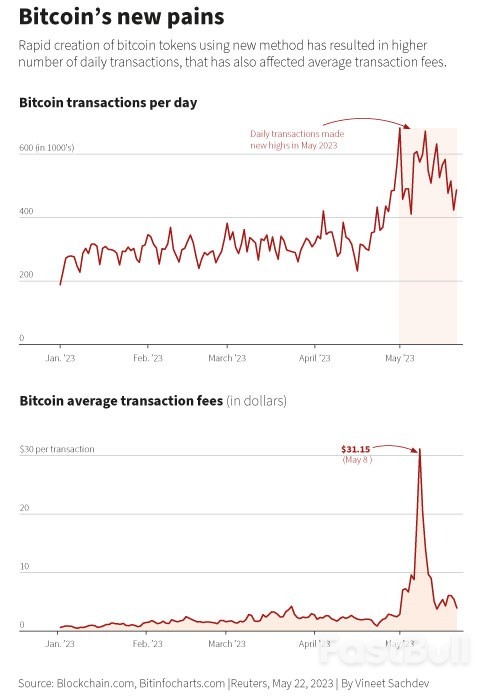
          Daily transactions have rocketed to an all-time high of 682,000 this month, according to data from Glassnode, almost 40% higher than the previous peak in 2017. Bitcoin's dominance, or its share of the overall $1.16 trillion cryptocurrency market, has swelled to 44% from 38% at the start of the year.
          What's going on?
          Enter BRC-20, the first class of crypto tokens to be built on the bitcoin blockchain, besides bitcoin itself. Nearly 25,000 of the experimental coins have already been minted this year, sending transactions through the roof.
          "BRC-20 tokens are a phenomenon we haven't seen before," said Gordon Grant, co-head of trading at Genesis trading.
          Primarily due to the creation of these tokens, the average daily transactions over seven days stands at more than 531,000, nearly twice as high as a month ago, according to Blockchain.com data.
          This new class of crypto has no specific use beyond speculation, akin to memecoins. Yet its nascent popularity points to interest in bitcoin not just as a store of value or payments method, but as the foundation for developing new coins and applications - previously considered the domain of more modern blockchains such as Ethereum and Solana.
          Some investors and developers view bitcoin's blockchain as a safer long-term basis for creating tokens and applications in the wake of the crypto carnage that followed the collapse of high-profile firms like FTX and a general flight from riskier assets, according to market players.
          "People have seen what is possible with other blockchains and they want it on bitcoin, as the oldest network, bitcoin has a track record that people can trust," said Alex Miller, CEO at bitcoin developer network Hiro.
          Still, the BRC-20 frenzy has been volatile.
          The total value of these tokens - which are typically traded in secondary markets, particularly decentralized exchanges - exceeded $1 billion in early May, but has since fallen back to $446 million, according to tracker BRC-20.io.
          Busy Bitcoin Births New Breed of Crypto_1Inscribed On Satoshi
          As bitcoin's blockchain wasn't originally developed to support a crypto ecosystem, unlike Ethereum and Solana, BRC-20 tokens are created using ordinals theory, which allows data to be inscribed on each satoshi - the smallest denomination of bitcoin, or one hundred millionth.
          "There isn't much utility when it comes to BRC-20 tokens and Ordinals," said CJ Reim, contributor at blockchain firm CoreDAO, though he sees the trend as "promising" in terms of interest in building products on the bitcoin blockchain.
          The race to create these new coins hasn't had a significant impact on the price of bitcoin, which has been trading under $30,000 since mid-April.
          The rapid creation of BRC-20 tokens hasn't been without contention, with detractors saying the issuance of these tokens has made it more difficult for users who want to use bitcoin for its originally intended purposes.
          "Gas" fees, or transactions costs on the bitcoin blockchain have soared over the past month, with the total dollar-denominated fees paid per day touching near a new all-time-high of $17.8 million per day, according to Glassnode data.
          The median transaction fee spiked as high as $30.91 versus a range of 90 cents and $4.23 between January and May 1, Blockchain.com data showed.
          The network has also slowed considerably. The congestion was so acute, that the world's largest crypto exchange Binance had to briefly pause bitcoin withdrawals on May 7.
          "Although congestion has eased somewhat, it is still elevated and at its peak users were waiting over 30 hours for transactions to be confirmed," said Nauman Sheikh, head of treasury management at digital asset investment manager Wave Digital Assets.
          "This has pushed the limitations of bitcoin's technology."

          Source: Reuters

          Risk Warnings and Disclaimers
          You understand and acknowledge that there is a high degree of risk involved in trading. Following any strategies or investment methods may lead to potential losses. The content on the site is provided by our contributors and analysts for information purposes only. You are solely responsible for determining whether any trading assets, securities, strategy, or any other product is suitable for investing based on your own investment objectives and financial situation.
          Comments
          Add to Favorites
          Share

          Ronaldo and Messi Part of Saudi Arabia's Multibillion-Dollar Plan to Clean Up Image

          Warren Takunda
          In a surprising turn of events, two of the greatest footballers of all time, Cristiano Ronaldo and Lionel Messi, have become an integral part of Saudi Arabia's ambitious plan to revamp its global image. With a multibillion-dollar initiative aimed at diversifying its economy and attracting international investments, the Kingdom of Saudi Arabia is leveraging the immense popularity and global appeal of these football icons to enhance its reputation and foster positive perceptions worldwide.

          Saudi Arabia's Image Makeover

          Over the years, Saudi Arabia has faced scrutiny and criticism regarding various human rights issues and its conservative societal norms. Recognizing the importance of improving its global perception, the country has embarked on an extensive campaign to showcase its commitment to change and openness. This initiative seeks to reshape Saudi Arabia's image by emphasizing its economic transformation, cultural reforms, and social progress.

          The Role of Ronaldo and Messi

          Enter Cristiano Ronaldo and Lionel Messi, two sports figures with an unparalleled global fan base and widespread influence. Both players have signed lucrative sponsorship deals with Saudi Arabia, becoming brand ambassadors for the country's initiative to reposition itself as a modern and progressive nation.
          Through their immense popularity and massive social media following, Ronaldo and Messi are expected to promote Saudi Arabia's transformational agenda to a diverse range of audiences worldwide. The footballers' involvement in this venture is aimed at shedding light on the country's economic diversification efforts and the advancements it has made in various sectors, such as entertainment, tourism, and technology.

          Economic Diversification and International Investments

          Central to Saudi Arabia's strategy is the Vision 2030 plan, a comprehensive blueprint designed to reduce the country's dependency on oil revenue and develop a more diverse and sustainable economy. By attracting international investments and fostering innovation, Saudi Arabia aims to create a thriving business environment and boost sectors such as tourism, entertainment, renewable energy, and technology.
          The inclusion of Ronaldo and Messi in this initiative is a testament to the global appeal of Saudi Arabia's economic diversification efforts. The football stars will feature in promotional campaigns highlighting the country's investment opportunities and showcasing its potential as a destination for foreign businesses and tourists.

          Public Perception and Social Reforms

          In addition to economic transformation, Saudi Arabia has been actively implementing social reforms aimed at improving the lives of its citizens and promoting a more inclusive and tolerant society. These reforms include granting women the right to drive, loosening restrictions on entertainment, and encouraging cultural exchange.
          By associating themselves with Saudi Arabia's modernization drive, Ronaldo and Messi can help reshape public perception by highlighting the positive changes taking place within the country. Their participation in events and initiatives aimed at showcasing Saudi Arabia's progress in social reforms will likely contribute to a more nuanced understanding of the nation's evolving values and aspirations.

          Criticism and Controversy

          It is important to note that Saudi Arabia's initiative to improve its global image through the involvement of Ronaldo and Messi has not been without controversy. Critics argue that the footballers' participation serves as a form of whitewashing, diverting attention from the country's human rights concerns and potential violations.
          However, proponents of the partnership argue that Ronaldo and Messi's involvement provides an opportunity for constructive engagement and dialogue. By leveraging their influence, the footballers can potentially encourage positive change and raise awareness about important issues within Saudi Arabia and globally.
          Saudi Arabia's decision to enlist the support of Cristiano Ronaldo and Lionel Messi as part of its multibillion-dollar plan to improve its global image signifies the growing recognition of the power of sports icons in shaping public perception. The involvement of these legendary footballers is a strategic move to enhance Saudi Arabia's reputation, attract international investments, and highlight the country's economic diversification and social reforms. While the initiative is not without controversy.
          Risk Warnings and Disclaimers
          You understand and acknowledge that there is a high degree of risk involved in trading. Following any strategies or investment methods may lead to potential losses. The content on the site is provided by our contributors and analysts for information purposes only. You are solely responsible for determining whether any trading assets, securities, strategy, or any other product is suitable for investing based on your own investment objectives and financial situation.
          Comments
          Add to Favorites
          Share

          Low Volatility Sees Carry Trade in Focus

          Samantha Luan

          Forex

          USD: Dollar does ok in a carry trade world
          Talks to prevent a U.S. Treasury debt default trundle on. Yesterday's discussions between President Joe Biden and House Speaker Kevin McCarthy to raise the debt ceiling were described as 'productive.' Apart from the slightest of kinks in the one-month part of the USD/JPY volatility term structure, it is hard to discern much risk priced around a possible 'X' date (U.S. Treasury runs out of money) in June.
          Instead the stand-out is the lower levels of traded FX volatility around the world – both in the developed and emerging FX space. Volatility has fallen back to pre-Ukraine invasion levels in early 2022 as investors fear a prolonged period of unchanged rates, e.g. will the Fed hike, cut, or leave rates unchanged all year? Lower levels of volatility go hand-in-hand with a slightly more constructive risk environment, where the MSCI World equity index is edging up to the highs of the year. Here it seems investors are preferring to put some money to work absent of clear signs of the sky falling in on the back of tighter credit conditions.
          Putting money to work in the FX space means a look at the carry trade – or expecting spot FX to put-perform steep forward curves. For example, selling USD/MXN three months forward would return 2%, should spot USD/MXN stick around current levels. And looking at volatility-adjusted returns around the world, the currencies of Latin America (especially the Mexican peso) and Central and Eastern Europe (especially the Hungarian forint) offer the best risk-adjusted return. These have been the outperformers this year and could continue to do well unless U.S. debt ceiling negotiations take a turn for the worse.
          Offering overnight rates in excess of 5.00%, the dollar scores quite well on carry trade metrics. And the current environment probably explains why the Japanese yen is performing poorly despite all the perceived risk. Expect the dollar to stay slightly bid in this rangy FX environment until there are much clearer signs of U.S. disinflation and a slowing activity – which we have argued is more a story for the third quarter.
          For today, look out for U.S. PMI releases, new home sales data and perhaps some remarks from Fed Chair Jerome Powell. DXY to trade well within a 102.80-103.60 range.
          EUR: Positioning still seems quite long
          Despite the correction in EUR/USD from nearly 1.11 to 1.08, net speculative long euro positioning still seems quite stretched, and presents an outside risk in EUR/USD to the 1.05 area should conditions drive it there. Such conditions could include serious speculation over another couple of Fed rate hikes (only another 10bp of hikes is currently priced) or severe dislocation in U.S. money markets if the U.S. Treasury gets very close to an unthinkable default on its debt. Neither of those is our baseline view and instead EUR/USD probably hangs around this 1.08 area for a while. We think the third quarter will be the period when clear signs of U.S. disinflation and weaker activity data drive a much more obvious dollar bear trend.
          In Europe today, look out for some eurozone May PMI numbers and also the March current account data. Having seen a monthly deficit as wide as €36bn last summer on the back of the energy spike, the eurozone current account is now returning towards more familiar monthly surpluses in the €25-30bn area. This serves as a reminder that EUR/USD is still probably undervalued on a medium-term basis.
          GBP: Services PMI in focus
          In the past, the release of services PMI data has been a driver of sterling given the large representation of the services sector in the UK economy. Another positive reading is expected today in the 55 area. Such an outcome would unlikely dent the market's current pricing of an 84% probability that the Bank of England hikes by 25bp on 22 June. Far more important to that debate will be the UK April CPI data released tomorrow.
          0.8660-0.8735 is the clear EUR/GBP range and it will probably be tomorrow's CPI figures which pose the best chance of a range break-out.
          NZD: RBNZ to deliver hawkish 25bp hike
          In New Zealand, the Reserve Bank of New Zealand (RBNZ) is expected to raise rates by 25bp to 5.50% overnight. This is also our call and what markets are fully pricing in, so all eyes will be on the new set of economic and rate forecasts. The RBNZ had originally signalled rates would have peaked at 5.50%, and there hasn't been much in the economic data to suggest an urgency to revise the peak rate higher: the jobs market has remained tight, but inflation slowed more than expected in the first quarter.
          What truly changed the economic backdrop was the government's budget announcement last week, with a fiscal boost that exceeded expectations and a sharp revision in growth forecasts, which no longer include a recession this year. When adding consistently higher-than-expected inbound migration figures (which the RBNZ itself deemed as an inflationary event), it is likely that the Reserve Bank will acknowledge fresh upside risks for prices tomorrow, and will add more tightening to the rate projections. Markets are pricing in a 5.80% peak, but we think the RBNZ may push the projected peak up to 6.00%.
          NZD/USD remains largely driven by the global and USD story, but AUD/NZD has seen increasing pressure on the Reserve Bank of Australia (RBA)-RBNZ policy divergence. A hawkish 25bp hike by the RBNZ tomorrow could give NZD/USD some support even if USD stays bid while pressuring AUD/NZD further: the 1.0485 December lows may soon be tested.

          Source: ING

          Risk Warnings and Disclaimers
          You understand and acknowledge that there is a high degree of risk involved in trading. Following any strategies or investment methods may lead to potential losses. The content on the site is provided by our contributors and analysts for information purposes only. You are solely responsible for determining whether any trading assets, securities, strategy, or any other product is suitable for investing based on your own investment objectives and financial situation.
          Comments
          Add to Favorites
          Share

          Japanese Yen Trades Near 6-Month Low Amidst Divergent Monetary Policies

          Warren Takunda

          Traders' Opinions

          The Japanese yen, a currency known for its stability, is currently trading at its weakest level against the US dollar in six months. This decline is primarily driven by the divergence in monetary policy between the United States and Japan. While the Bank of Japan maintains its key short-term interest rate at -0.1% despite strong inflationary pressures, the US Federal Reserve shows no signs of easing and has led traders to reevaluate their near-term rate cut expectations. Additionally, ongoing concerns surrounding the US debt ceiling negotiations have further heightened market uncertainties.

          Japanese Yen Trades Near 6-Month Low Amidst Divergent Monetary Policies_1Yen-Dollar Exchange Rate

          As of the latest trading session, the Japanese yen is trading at 138 per US dollar, marking its weakest level since the end of November. This downward trend reflects the market's reaction to the contrasting monetary policies pursued by the Bank of Japan and the Federal Reserve.

          Bank of Japan's Monetary Policy

          Despite a surge in inflationary pressures, the Bank of Japan has chosen to maintain its key short-term interest rate at -0.1%. In April, Japan's headline inflation rate unexpectedly accelerated to 3.5%, surpassing forecasts of a slowdown to 2.5%. Additionally, the core inflation rate rose to a three-month high of 3.4%. These figures suggest that the Bank of Japan may need to reassess its monetary policy stance to address the growing inflationary concerns.

          US Federal Reserve's Monetary Policy

          In contrast to Japan, the US Federal Reserve has shown no indications of easing its monetary policy. Traders have been slowly pricing out near-term rate cut expectations as US inflation data remains stubbornly high, retail sales display strength, and the labor market continues to perform well. These factors have led investors to recalibrate their expectations for the US dollar, which has contributed to the yen's relative weakness.

          US Debt Ceiling Concerns

          Another factor influencing the yen's performance is the ongoing US debt ceiling negotiations. With the June 1st deadline approaching, little progress has been made in resolving this crucial issue. Investors are closely monitoring these negotiations, as a failure to reach an agreement could lead to severe consequences for the global economy and financial markets. This uncertainty has added to the risk-off sentiment and impacted the yen's value.

          Market Outlook

          The current divergence in monetary policies and the uncertainty surrounding the US debt ceiling negotiations are likely to continue influencing the yen's performance in the near term. Traders and investors will closely monitor economic indicators and developments in both Japan and the United States to assess future market movements.
          The Japanese yen's recent weakness against the US dollar can be attributed to the contrasting monetary policies pursued by the Bank of Japan and the US Federal Reserve. While Japan faces inflationary pressures, the Bank of Japan has maintained its key interest rate at -0.1%. In contrast, the Federal Reserve has shown no signs of easing and has led traders to reevaluate their expectations for the US dollar. Additionally, concerns over the US debt ceiling negotiations have further heightened market uncertainties. As traders and investors navigate these challenges, they will closely monitor economic indicators and developments to anticipate future market movements and potential impacts on the Japanese yen.
          Risk Warnings and Disclaimers
          You understand and acknowledge that there is a high degree of risk involved in trading. Following any strategies or investment methods may lead to potential losses. The content on the site is provided by our contributors and analysts for information purposes only. You are solely responsible for determining whether any trading assets, securities, strategy, or any other product is suitable for investing based on your own investment objectives and financial situation.
          Comments
          Add to Favorites
          Share

          The Commodities Feed: Debt Ceiling Talks & a More Hawkish Fed

          Owen Li

          Commodity

          Energy - oil edges higher
          The oil market managed to edge higher yesterday despite there still being little progress in U.S. debt ceiling talks as well as some hawkish comments from Fed officials. A couple of officials suggested that the Fed may still have to hike rates further. Obviously, the more the Fed increases rates, the more likely we are to see a hard landing, which would hit oil demand hard. For now, we are assuming that 2023 U.S. oil demand will be largely flat year-on-year. Despite the move higher yesterday, sentiment still remains mostly negative in the oil market and this is evident in positioning data which shows that speculators have reduced their net long in ICE Brent significantly in recent weeks. Positioning data shows that there is still a sizeable gross short in ICE Brent, however, these shorts will want to be careful as we approach the next OPEC+ meeting, which is scheduled for 4 June. OPEC+ have surprised the market a couple of times recently, so market participants may be reluctant to carry too much risk into this meeting.
          The 650Mbbls/d Dangote oil refinery in Nigeria has finally opened after years of delays. While the refiner has said it will start shipping refined products by July or August, it is still unclear how quickly it will be able to ramp up operations. According to reports, there has been little in the way of commercial activity from the refiner, which suggests that any meaningful volumes coming out of the refinery will still be several months away at least. The refinery will be important for both crude and product trade flows when fully operating, potentially meaning reduced crude exports as well as reduced imports of refined products.
          Metals – Global aluminium output remains flat
          The latest numbers from the International Aluminium Association (IAI) show that daily global primary aluminium output stood at 187.6kt in April, compared to 187.5kt a month earlier. Total monthly output for the metal remained almost flat year-on-year at 5.63mt in April, although it was down 3.2% MoM. Cumulative aluminium production over the first four months of the year rose 2% YoY to 22.6mt. Chinese output is estimated to have fallen 3.2% MoM, while remaining flat YoY at 3.3mt in April. Although YTD production is still up 3.3% to 13.3mt. Production in Western and Central Europe is still under pressure, falling 2.6% MoM and 8.2% YoY to 262kt in April.
          Agriculture – ISO expects global sugar surplus to shrink
          In its latest report, the International Sugar Organization (ISO) expects the global sugar surplus to fall to 852kt in 2022/23, down about 79% from its previous estimate. Total sugar output projections were trimmed to 177.4mt for 2022/23, compared to a previous estimate of 180.4mt, due to lower output from the EU, India and Thailand. In contrast, the group expects global consumption to increase to 176.5mt in 2022/23, up by 233kt from its previous estimate.
          The latest reports from the Joint Coordination Centre showed that Ukraine's exports under the Black Sea Grain Initiative stood at 118.3kt for the week ending 21 May, down 78% WoW. While the deal has been extended for two months, no inbound vessels were cleared in that week which led to a significant drop in volumes. However, considering the recent extension, we may see a revival in Ukrainian exports in the weeks ahead.
          The USDA's weekly export inspection data for the week ending 18 May show that U.S. corn and wheat shipments rose while soybean exports eased over the last week. U.S. weekly inspections of corn for export stood at 1,323.1kt, up from 1,173.8kt in the previous week but lower than the 1,752.5kt reported a year ago. For wheat, export inspections stood at 407.7kt, up from 263.4kt last week and 275.5kt seen for the same period last year. Soybean export inspections stood at 155.1kt, lower than 186.8kt from a week ago and 582.3kt from a year ago.
          The USDA's latest crop progress report continues to show that U.S. corn plantings are progressing well with 81% of plantings completed, this is up from 69% at the same stage last year and also above the 5-year average of 75%. Similarly, soybean plantings are advancing quickly with 66% planted as of 21 May, well above the 47% seen at the same stage last year and also above the 5-year average of 52%. Meanwhile, spring wheat plantings are 64% complete, which is above the 48% planted at the same stage last season, but still below the 5-year average of 73% for this time of year.

          Source: ING

          Risk Warnings and Disclaimers
          You understand and acknowledge that there is a high degree of risk involved in trading. Following any strategies or investment methods may lead to potential losses. The content on the site is provided by our contributors and analysts for information purposes only. You are solely responsible for determining whether any trading assets, securities, strategy, or any other product is suitable for investing based on your own investment objectives and financial situation.
          Comments
          Add to Favorites
          Share

          US 10-Year Treasury Yield Rebounds Amid Monetary Policy and Debt Ceiling Uncertainties

          Warren Takunda

          Traders' Opinions

          The US 10-year Treasury yield experienced a notable rebound, overcoming early losses to trade slightly higher at 3.7%. This marks the highest level since mid-March, as market participants carefully evaluate the monetary policy outlook and the ongoing impasse over the debt ceiling in the United States. Several key factors, including recent statements from Federal Reserve officials and the negotiations surrounding the debt ceiling, have contributed to the fluctuating expectations regarding interest rate hikes.

          Monetary Policy Outlook

          Federal Reserve President Neel Kashkari recently commented that the decision on whether to pause or hike rates in June is a close call. Similarly, James Bullard, St. Louis Fed President, suggested that there may still be a need to raise rates by another half-point later this year. However, Federal Reserve Chair Jerome Powell expressed the possibility of avoiding further rate increases due to concerns about stress in the banking sector and its potential impact on inflation. These mixed messages have led to uncertainty among market participants regarding the future trajectory of interest rates.

          Market Sentiment

          Traders are closely monitoring the monetary policy discussions and adjusting their expectations accordingly. Currently, there is a 78% probability assigned by traders that the Federal Reserve will maintain interest rates at their current levels in June. This indicates a growing sentiment for a potential pause in the rate hike cycle, reflecting the market's cautious approach amid conflicting views from key policymakers. Such uncertainty surrounding interest rates can have a significant impact on various sectors, including bonds, equities, and the overall economy.

          Debt Ceiling Impasse

          In addition to the monetary policy deliberations, negotiations regarding the US debt ceiling have added another layer of uncertainty to the financial landscape. President Joe Biden is scheduled to meet with House Speaker Kevin McCarthy to continue discussions on this critical issue. These talks follow an unsuccessful meeting between key negotiators held on Friday. The debt ceiling refers to the limit set on the amount of debt that the US government can legally borrow to finance its operations. Failure to raise the debt ceiling could result in significant consequences, such as a potential default on existing obligations, a downgrade of the country's credit rating, and heightened market volatility.

          Impact on Financial Markets

          The rebound in the 10-year Treasury yield reflects the market's response to these complex dynamics. Higher yields indicate increased borrowing costs for the government, potentially impacting borrowing rates for businesses and individuals. Rising yields can also attract investors seeking higher returns, potentially leading to a shift of capital away from other assets such as equities. Therefore, the fluctuation in the US 10-year Treasury yield not only impacts the bond market but also influences broader financial markets, including stocks, currencies, and commodities.
          The US 10-year Treasury yield has rebounded to its highest level since mid-March, as market participants navigate the uncertain terrain of monetary policy and the ongoing debt ceiling negotiations. The mixed messages from Federal Reserve officials regarding interest rate hikes have created an atmosphere of uncertainty, with traders currently assigning a high probability to a pause in rate increases in June. Simultaneously, the negotiations surrounding the debt ceiling pose additional challenges for market participants, as failure to raise the limit could have significant repercussions for the US economy and global financial markets. Investors and analysts will closely monitor developments in these areas, as they seek to understand the potential impacts on various asset classes and the overall economic outlook.
          Risk Warnings and Disclaimers
          You understand and acknowledge that there is a high degree of risk involved in trading. Following any strategies or investment methods may lead to potential losses. The content on the site is provided by our contributors and analysts for information purposes only. You are solely responsible for determining whether any trading assets, securities, strategy, or any other product is suitable for investing based on your own investment objectives and financial situation.
          Comments
          Add to Favorites
          Share

          Europe Set for Flat Open Ahead of Flash PMIs

          Devin

          Forex

          European markets got off to a slow start to the week yesterday, finishing slightly lower, with the FTSE100 outperforming, with sentiment subdued ahead of the resumption of debt ceiling talks later in the day.
          U.S. markets didn't fare much better with modest gains for the Nasdaq 100 which posted a new one year high, before slipping back, while the S&P500 finished the day unchanged, while markets in Asia slipped back as debt ceiling talks began again.
          In a similar pattern to last week, U.S. yields also edged back towards their highs of last week on the back of hawkish comments from St. Louis Fed President James Bullard, who said he expected to see another 2 rate hikes this year, and Minneapolis Fed President Neel Kashkari who gave a slightly more nuanced view, saying that it might be prudent to pause in June to evaluate progress, although it remained a close call. Kashkari did go on to add that rates might need to go to 6% if inflation is more persistent than expected.
          Yesterday's caution looks set to carry over into today's European open where we look set to see a flat open, as we look ahead to European flash PMIs, as well as the latest UK public sector borrowing numbers.
          In March, the government saw borrowing increase by £21.5bn, the second highest March figure since records began, as the curtain came down on a fiscal year that saw borrowing expand sharply due to rising interest rates and the energy price cap.
          Nonetheless the picture could have been worse with total borrowing for 2023 coming in at £139.2bn, significantly below some of the more pessimistic expectations that were laid out at the end of last year. Nonetheless it was still £18.1bn higher than the previous year.
          As we look ahead to today's April numbers, the amount the government borrows on a monthly basis should start to come down now that the government is no longer contributing to consumers' monthly energy bills to the tune of £67 per month.
          Consensus forecasts are for borrowing to slow to £19.1bn in April.
          One of the more notable trends we've seen in recent months has been an ongoing divergence between services sector activity and manufacturing activity.
          All across the board manufacturing PMI have got progressively weaker, or has struggled with prices also falling back, while employment measures have been stagnating.
          Compare that to services sector activity which has been improving and has continued to do so into Q2 as falling energy prices help to free up disposable income and thus prompt a bit of a consumer rebound.
          The bigger question comes about how long this trend can continue, as we head into Q2, and although pricing pressures have been slowing, prices have still been rising, notably when it comes to wages.
          In Germany services activity rose to a one year high in April, as did France, while manufacturing slipped further into contraction.
          UK numbers exhibited similar traits, with strong services, and weak manufacturing. Will this continue in May, or are we at risk of a pullback when it comes to services when the data is released later this morning?
          Expectations are for manufacturing activity to improve modestly across the board with France, Germany and UK readings forecast to come in at 46, 45 and 48 respectively.
          Services on the other hand are expected to slow modestly to 54, 55 and 55.3, with the extra bank holiday in May potentially acting as a drag on UK activity.
          EUR/USD – continues to struggle near to the 1.0840 area for the time being. We need to see a move through 1.0840 to target a return to the 1.0920 level. Still have support at the 1.0760 area, with a break below 1.0760 targeting a potential move towards 1.0610, with initial support at 1.0710.
          GBP/USD – still finding support just above the 1.2370/80 trend line support from the October lows last year. Resistance currently all the way back at 1.2540. Below 1.2360 opens the potential for a move back towards 1.2270.
          EUR/GBP – finding resistance just below the 0.8740 area and the 200-day SMA, while holding above the May low at 0.8660 key support. A move below 0.8650 could see a move towards 0.8620.
          USD/JPY – finding support just above the 200-day SMA at 137.00. While above here the risk is for a move towards 139.60 which is a 50% retracement of the down move from the recent highs at 151.95 and lows at 127.20. A fall below 136.80 targets a return to 135.60.

          Source: CMC

          Risk Warnings and Disclaimers
          You understand and acknowledge that there is a high degree of risk involved in trading. Following any strategies or investment methods may lead to potential losses. The content on the site is provided by our contributors and analysts for information purposes only. You are solely responsible for determining whether any trading assets, securities, strategy, or any other product is suitable for investing based on your own investment objectives and financial situation.
          Comments
          Add to Favorites
          Share
          FastBull
          Copyright © 2025 FastBull Ltd

          728 RM B 7/F GEE LOK IND BLDG NO 34 HUNG TO RD KWUN TONG KLN HONG KONG

          TelegramInstagramTwitterfacebooklinkedin
          App Store Google Play Google Play
          Products
          Charts

          Chats

          Q&A with Experts
          Screeners
          Economic Calendar
          Data
          Tools
          Membership
          Features
          Function
          Markets
          Copy Trading
          Latest Signals
          Contests
          News
          Analysis
          24/7
          Columns
          Education
          Company
          Careers
          About Us
          Contact Us
          Advertising
          Help Center
          Feedback
          User Agreement
          Privacy Policy
          Business

          White Label

          Data API

          Web Plug-ins

          Poster Maker

          Affiliate Program

          Risk Disclosure

          The risk of loss in trading financial instruments such as stocks, FX, commodities, futures, bonds, ETFs and crypto can be substantial. You may sustain a total loss of the funds that you deposit with your broker. Therefore, you should carefully consider whether such trading is suitable for you in light of your circumstances and financial resources.

          No decision to invest should be made without thoroughly conducting due diligence by yourself or consulting with your financial advisors. Our web content might not suit you since we don't know your financial conditions and investment needs. Our financial information might have latency or contain inaccuracy, so you should be fully responsible for any of your trading and investment decisions. The company will not be responsible for your capital loss.

          Without getting permission from the website, you are not allowed to copy the website's graphics, texts, or trademarks. Intellectual property rights in the content or data incorporated into this website belong to its providers and exchange merchants.

          Not Logged In

          Log in to access more features

          FastBull Membership

          Not yet

          Purchase

          Become a signal provider
          Help Center
          Customer Service
          Dark Mode
          Price Up/Down Colors

          Log In

          Sign Up

          Position
          Layout
          Fullscreen
          Default to Chart
          The chart page opens by default when you visit fastbull.com