• Trade
  • Markets
  • Copy
  • Contests
  • News
  • 24/7
  • Calendar
  • Q&A
  • Chats
Trending
Screeners
SYMBOL
LAST
BID
ASK
HIGH
LOW
NET CHG.
%CHG.
SPREAD
SPX
S&P 500 Index
6827.42
6827.42
6827.42
6899.86
6801.80
-73.58
-1.07%
--
DJI
Dow Jones Industrial Average
48458.04
48458.04
48458.04
48886.86
48334.10
-245.98
-0.51%
--
IXIC
NASDAQ Composite Index
23195.16
23195.16
23195.16
23554.89
23094.51
-398.69
-1.69%
--
USDX
US Dollar Index
97.950
98.030
97.950
98.500
97.950
-0.370
-0.38%
--
EURUSD
Euro / US Dollar
1.17394
1.17409
1.17394
1.17496
1.17192
+0.00011
+ 0.01%
--
GBPUSD
Pound Sterling / US Dollar
1.33707
1.33732
1.33707
1.33997
1.33419
-0.00148
-0.11%
--
XAUUSD
Gold / US Dollar
4299.39
4299.39
4299.39
4353.41
4257.10
+20.10
+ 0.47%
--
WTI
Light Sweet Crude Oil
57.233
57.485
57.233
58.011
56.969
-0.408
-0.71%
--

Community Accounts

Signal Accounts
--
Profit Accounts
--
Loss Accounts
--
View More

Become a signal provider

Sell trading signals to earn additional income

View More

Guide to Copy Trading

Get started with ease and confidence

View More

Signal Accounts for Members

All Signal Accounts

Best Return
  • Best Return
  • Best P/L
  • Best MDD
Past 1W
  • Past 1W
  • Past 1M
  • Past 1Y

All Contests

  • All
  • Trump Updates
  • Recommend
  • Stocks
  • Cryptocurrencies
  • Central Banks
  • Featured News
Top News Only
Share

USA Embassy In Lithuania: Maria Kalesnikava Is Not Going To Vilnius

Share

USA Embassy In Lithuania: Other Prisoners Are Being Sent From Belarus To Ukraine

Share

Ukraine President Zelenskiy: Five Ukrainians Released By Belarus In US-Brokered Deal

Share

USA Vilnius Embassy: USA Stands Ready For "Additional Engagement With Belarus That Advances USA Interests"

Share

USA Vilnius Embassy: Belarus, USA, Other Citizens Among The Prisoners Released Into Lithuania

Share

USA Vilnius Embassy: USA Will Continue Diplomatic Efforts To Free The Remaining Political Prisoners In Belarus

Share

USA Vilnius Embassy: Belarus Releases 123 Prisoners Following Meeting Of President Trump's Envoy Coale And Belarus President Lukashenko

Share

USA Vilnius Embassy: Masatoshi Nakanishi, Aliaksandr Syrytsa Are Among The Prisoners Released By Belarus

Share

USA Vilnius Embassy: Maria Kalesnikava And Viktor Babaryka Are Among The Prisoners Released By Belarus

Share

USA Vilnius Embassy: Nobel Peace Prize Laureate Ales Bialiatski Is Among The Prisoners Released By Belarus

Share

Belarusian Presidential Administration Telegram Channel: Lukashenko Has Pardoned 123 Prisoners As Part Of Deal With US

Share

Two Local Syrian Officials: Joint US-Syrian Military Patrol In Central Syria Came Under Fire From Unknown Assailants

Share

Israeli Military Says It Targeted 'Key Hamas Terrorist' In Gaza City

Share

Rwanda's Actions In Eastern Drc Are A Clear Violation Of Washington Accords Signed By President Trump - Secretary Of State Rubio

Share

Israeli Military Issues Evacuation Warning In Southern Lebanon Village Ahead Of Strike - Spokesperson On X

Share

Belarusian State Media Cites US Envoy Coale As Saying He Discussed Ukraine And Venezuela With Lukashenko

Share

Belarusian State Media Cites US Envoy Coale As Saying That US Removes Sanctions On Belarusian Potassium

Share

Thai Prime Minister: No Ceasefire Agreement With Cambodia

Share

US, Ukraine To Discuss Ceasefire In Berlin Ahead Of European Summit

Share

Incoming Czech Prime Minister Babis: Czech Republic Will Not Take On Guarantees For Ukraine Financing, European Commission Must Find Alternatives

TIME
ACT
FCST
PREV
U.K. Trade Balance Non-EU (SA) (Oct)

A:--

F: --

P: --

U.K. Trade Balance (Oct)

A:--

F: --

P: --

U.K. Services Index MoM

A:--

F: --

P: --

U.K. Construction Output MoM (SA) (Oct)

A:--

F: --

P: --

U.K. Industrial Output YoY (Oct)

A:--

F: --

P: --

U.K. Trade Balance (SA) (Oct)

A:--

F: --

P: --

U.K. Trade Balance EU (SA) (Oct)

A:--

F: --

P: --

U.K. Manufacturing Output YoY (Oct)

A:--

F: --

P: --

U.K. GDP MoM (Oct)

A:--

F: --

P: --

U.K. GDP YoY (SA) (Oct)

A:--

F: --

P: --

U.K. Industrial Output MoM (Oct)

A:--

F: --

P: --

U.K. Construction Output YoY (Oct)

A:--

F: --

P: --

France HICP Final MoM (Nov)

A:--

F: --

P: --

China, Mainland Outstanding Loans Growth YoY (Nov)

A:--

F: --

P: --

China, Mainland M2 Money Supply YoY (Nov)

A:--

F: --

P: --

China, Mainland M0 Money Supply YoY (Nov)

A:--

F: --

P: --

China, Mainland M1 Money Supply YoY (Nov)

A:--

F: --

P: --

India CPI YoY (Nov)

A:--

F: --

P: --

India Deposit Gowth YoY

A:--

F: --

P: --

Brazil Services Growth YoY (Oct)

A:--

F: --

P: --

Mexico Industrial Output YoY (Oct)

A:--

F: --

P: --

Russia Trade Balance (Oct)

A:--

F: --

P: --

Philadelphia Fed President Henry Paulson delivers a speech
Canada Building Permits MoM (SA) (Oct)

A:--

F: --

P: --

Canada Wholesale Sales YoY (Oct)

A:--

F: --

P: --

Canada Wholesale Inventory MoM (Oct)

A:--

F: --

P: --

Canada Wholesale Inventory YoY (Oct)

A:--

F: --

P: --

Canada Wholesale Sales MoM (SA) (Oct)

A:--

F: --

P: --

Germany Current Account (Not SA) (Oct)

A:--

F: --

P: --

U.S. Weekly Total Rig Count

A:--

F: --

P: --

U.S. Weekly Total Oil Rig Count

A:--

F: --

P: --

Japan Tankan Large Non-Manufacturing Diffusion Index (Q4)

--

F: --

P: --

Japan Tankan Small Manufacturing Outlook Index (Q4)

--

F: --

P: --

Japan Tankan Large Non-Manufacturing Outlook Index (Q4)

--

F: --

P: --

Japan Tankan Large Manufacturing Outlook Index (Q4)

--

F: --

P: --

Japan Tankan Small Manufacturing Diffusion Index (Q4)

--

F: --

P: --

Japan Tankan Large Manufacturing Diffusion Index (Q4)

--

F: --

P: --

Japan Tankan Large-Enterprise Capital Expenditure YoY (Q4)

--

F: --

P: --

U.K. Rightmove House Price Index YoY (Dec)

--

F: --

P: --

China, Mainland Industrial Output YoY (YTD) (Nov)

--

F: --

P: --

China, Mainland Urban Area Unemployment Rate (Nov)

--

F: --

P: --

Saudi Arabia CPI YoY (Nov)

--

F: --

P: --

Euro Zone Industrial Output YoY (Oct)

--

F: --

P: --

Euro Zone Industrial Output MoM (Oct)

--

F: --

P: --

Canada Existing Home Sales MoM (Nov)

--

F: --

P: --

Euro Zone Total Reserve Assets (Nov)

--

F: --

P: --

U.K. Inflation Rate Expectations

--

F: --

P: --

Canada National Economic Confidence Index

--

F: --

P: --

Canada New Housing Starts (Nov)

--

F: --

P: --

U.S. NY Fed Manufacturing Employment Index (Dec)

--

F: --

P: --

U.S. NY Fed Manufacturing Index (Dec)

--

F: --

P: --

Canada Core CPI YoY (Nov)

--

F: --

P: --

Canada Manufacturing Unfilled Orders MoM (Oct)

--

F: --

P: --

Canada Manufacturing New Orders MoM (Oct)

--

F: --

P: --

Canada Core CPI MoM (Nov)

--

F: --

P: --

Canada Manufacturing Inventory MoM (Oct)

--

F: --

P: --

Canada CPI YoY (Nov)

--

F: --

P: --

Canada CPI MoM (Nov)

--

F: --

P: --

Canada CPI YoY (SA) (Nov)

--

F: --

P: --

Canada Core CPI MoM (SA) (Nov)

--

F: --

P: --

Q&A with Experts
    • All
    • Chatrooms
    • Groups
    • Friends
    Connecting
    .
    .
    .
    Type here...
    Add Symbol or Code

      No matching data

      All
      Trump Updates
      Recommend
      Stocks
      Cryptocurrencies
      Central Banks
      Featured News
      • All
      • Russia-Ukraine Conflict
      • Middle East Flashpoint
      • All
      • Russia-Ukraine Conflict
      • Middle East Flashpoint
      Search
      Products

      Charts Free Forever

      Chats Q&A with Experts
      Screeners Economic Calendar Data Tools
      Membership Features
      Data Warehouse Market Trends Institutional Data Policy Rates Macro

      Market Trends

      Market Sentiment Order Book Forex Correlations

      Top Indicators

      Charts Free Forever
      Markets

      News

      News Analysis 24/7 Columns Education
      From Institutions From Analysts
      Topics Columnists

      Latest Views

      Latest Views

      Trending Topics

      Top Columnists

      Latest Update

      Signals

      Copy Rankings Latest Signals Become a signal provider AI Rating
      Contests
      Brokers

      Overview Brokers Assessment Rankings Regulators News Claims
      Broker listing Forex Brokers Comparison Tool Live Spread Comparison Scam
      Q&A Complaint Scam Alert Videos Tips to Detect Scam
      More

      Business
      Events
      Careers About Us Advertising Help Center

      White Label

      Data API

      Web Plug-ins

      Affiliate Program

      Awards Institution Evaluation IB Seminar Salon Event Exhibition
      Vietnam Thailand Singapore Dubai
      Fans Party Investment Sharing Session
      FastBull Summit BrokersView Expo
      Recent Searches
        Top Searches
          Markets
          News
          Analysis
          User
          24/7
          Economic Calendar
          Education
          Data
          • Names
          • Latest
          • Prev

          View All

          No data

          Scan to Download

          Faster Charts, Chat Faster!

          Download App
          English
          • English
          • Español
          • العربية
          • Bahasa Indonesia
          • Bahasa Melayu
          • Tiếng Việt
          • ภาษาไทย
          • Français
          • Italiano
          • Türkçe
          • Русский язык
          • 简中
          • 繁中
          Open Account
          Search
          Products
          Charts Free Forever
          Markets
          News
          Signals

          Copy Rankings Latest Signals Become a signal provider AI Rating
          Contests
          Brokers

          Overview Brokers Assessment Rankings Regulators News Claims
          Broker listing Forex Brokers Comparison Tool Live Spread Comparison Scam
          Q&A Complaint Scam Alert Videos Tips to Detect Scam
          More

          Business
          Events
          Careers About Us Advertising Help Center

          White Label

          Data API

          Web Plug-ins

          Affiliate Program

          Awards Institution Evaluation IB Seminar Salon Event Exhibition
          Vietnam Thailand Singapore Dubai
          Fans Party Investment Sharing Session
          FastBull Summit BrokersView Expo

          Bruised by Stock Market, Chinese Rush into Banned Bitcoin

          Kevin Du

          Cryptocurrency

          Economic

          Summary:

          Dylan Run, a Shanghai-based finance sector executive, started moving a bit of his money into cryptocurrencies in early 2023, when he realized that the Chinese economy and its stock markets were going downhill.

          Dylan Run, a Shanghai-based finance sector executive, started moving a bit of his money into cryptocurrencies in early 2023, when he realized that the Chinese economy and its stock markets were going downhill.
          Crypto trading and mining have been banned in China since 2021. Run used bank cards issued by small rural commercial banks to buy cryptocurrencies through grey-market dealers, and capped each transaction at 50,000 yuan ($6,978) to escape scrutiny.
          "Bitcoin is a safe haven, like gold," says Run.
          He now owns roughly 1-million-yuan worth of cryptocurrencies, accounting for half of his investment portfolio, compared with just 40% in Chinese equities.
          His crypto investments are up 45%. China's stock market, meanwhile, has been sinking for 3 years.
          Like Run, more and more Chinese investors are using creative ways to own bitcoin and other crypto assets that they believe are safer than investing in crumbling stock and property markets at home.
          They operate in a grey area. While cryptocurrency is banned in mainland China and there are strict controls on capital movement across the border, people are still able to trade tokens such as bitcoin on crypto exchanges such as OKX and Binance, or through other over-the-counter channels.
          Mainland investors can also open overseas bank accounts to buy crypto assets.
          After Hong Kong's open endorsement of digital assets last year, Chinese citizens are also using their $50,000 annual forex purchase quotas to move money into cryptocurrency accounts in the territory. Under Chinese rules, the money can only be used for purposes such as overseas travel or education.
          China's economic downturn "has made investment on the mainland risky, uncertain and disappointing, so people are looking to allocate assets offshore", said a senior executive of a Hong Kong-based cryptocurrency exchange, who declined to be identified due to sensitivity of the topic.
          Bitcoin and crypto assets have attracted such investors, he said: "Almost everyday, we see mainland investors coming into this market."
          As retail investors make a dash for cryptocurrencies, China's brokers and other financial institutions aren't far behind. Starved of growth opportunities at home, many of them are exploring crypto-related businesses in Hong Kong.
          "If you are a Chinese brokerage, facing a sluggish stock market, weak demand for IPOs, and shrinkage in other businesses, you need a growth story to tell your shareholders and the board," said the exchange executive.
          The Hong Kong subsidiaries of Bank of China, China Asset Management (ChinaAMC) and Harvest Fund Management Co are all exploring businesses in the territory that deal in digital assets.
          Ill-Gotten
          Access to bitcoin isn't that difficult on the mainland, according to Reuters' checks of online crypto exchanges and interviews with retail investors.
          Exchanges such as OKX and Binance still offer trading services for Chinese investors, and guide them to use fintech platforms such as Ant Group's Alipay and Tencent's WeChat Pay to convert yuan into stablecoins with dealers, to trade cryptocurrencies.
          OKX and Binance did not reply Reuters requests for comment.
          Crypto data platform Chainalysis says crypto-related activities in China have bounced, and its global ranking in terms of peer-to-peer trade volume jumped to the 13th place in 2023, from 144 in 2022.
          Despite being banned, the Chinese crypto market recorded an estimated $86.4 billion in raw transaction volume between July 2022 and June 2023, dwarfing Hong Kong, which witnessed $64 billion in crypto trading, Chainalysis said. And the proportion of large retail transactions of $10,000-$1 million is nearly twice the global average of 3.6%.
          Much of China's crypto activity "takes place through over-the-counters or through informal, grey market peer-to-peer businesses," Chainalysis said in the report.
          Brick-and-mortar crypto exchange stores, have sprouted in Hong Kong's busy business and shopping streets. These offline shops are lightly regulated.
          At Crypto HK, a popular crypto store in the Admiralty district, customers can buy cryptocurrencies with a minimum HK$500 ($64) and are not required to provide any identity documents.
          The underground crypto market in China is thriving.
          Michael Wang, a dealer who helps individuals buy digital assets, says daily volumes run into several million yuan or even dozens of millions.
          Charlie Wong, a 35-year-old buy-side equity analyst, bought bitcoin via the Hashkey Exchange, an officially recognised marketplace in Hong Kong.
          "It is hard to find opportunties in traditional fields. Chinese stocks and other assets perform poorly ... the economy is undergoing a crucial transition," he said.
          China's crackdown on the property sector over the past three years has battered prices of homes, which were traditionally the mainstay in household savings portfolios. The stock market has fared even worse, with the benchmark CSI 300 Index down by half its value since early 2021.
          Bitcoin, by contrast, has leapt 50% since mid-October, and is known for its wild swings.
          Wong believes Chinese officials are cognisant of how disruptive bitcoin can be and yet aware of its huge potential, and hence their endorsement of crypto trading in Hong Kong, to keep a toehold in the crypto business booming in financial centres such as Singapore and New York.
          Hong Kong, though autonomously governed, is a Chinese special administrative region.
          Chainalysis reckons the developments "have created speculation that the Chinese government may be warming to cryptocurrency and that Hong Kong may be a testing ground for these efforts."
          ($1 = 7.1659 Chinese yuan renminbi)
          ($1 = 7.8197 Hong Kong dollars)

          Source: Reuters

          To stay updated on all economic events of today, please check out our Economic calendar
          Risk Warnings and Disclaimers
          You understand and acknowledge that there is a high degree of risk involved in trading. Following any strategies or investment methods may lead to potential losses. The content on the site is provided by our contributors and analysts for information purposes only. You are solely responsible for determining whether any trading assets, securities, strategy, or any other product is suitable for investing based on your own investment objectives and financial situation.
          Comments
          Add to Favorites
          Share

          Why It's Too Early for Investors to Declare Victory Over Inflation

          Cohen

          Economic

          Stocks

          Stock markets have had a bumpy start to the year, especially in Europe and the UK, bringing 2023’s end-of-year rally to a crashing halt.
          Investors who hoped their portfolios would pick up in 2024 where they left off may be feeling sorry for themselves, but they need to check their privilege.
          After the economic and political volatility of recent years, 2024 was never going to be a parade and a pullback was always on the cards. It might even be a buying opportunity.
          Shares soared in November and December as hopes grew that inflation was finally on the run and monetary easing would duly follow.
          Markets were cheerfully pencilling in six interest rate cuts by the US Federal Reserve in 2024, starting as early as March.
          They glibly ignored co-ordinated warnings by the Fed, European Central Bank and the Bank of England that it was too early to declare victory over inflation.
          Then January’s data landed, and it looked like the central banks had called it right.
          Instead of falling, US consumer price inflation climbed to 3.4 per cent in December, from 3.1 per cent in November.
          In the eurozone, it jumped to 2.9 per cent from 2.4 per cent, and to 4 per cent from 3.9 per cent in the UK.
          That increase of 10 basis points was enough to wipe almost 2 per cent off London’s FTSE 100 index, its biggest one-day drop in five months.
          Inflation isn't behaving as markets thought it would and could take longer than expected to return to the central bank target of 2 per cent, says Joshua Mahony, chief market analyst at online trading platform IG.
          "The size of the recent increases caught many off guard."
          Investors desperately need the jolt of optimism that falling inflation would bring. They should get it, too. If they're patient.
          James Smith, developed market economist at ING, warns against reading too much into just one month’s data.
          "The wider inflation story is looking brighter, despite this latest setback," he says.
          ING forecasts that US inflation will fall to 2.5 per cent in the second quarter, then slip below the Fed's target to 1.9 per cent in the third.
          UK inflation will fall at a faster rate, hitting 1.7 per cent as early as April or May, although price growth could prove stickier in Europe.
          Jeremy Batstone-Carr, European strategist at Raymond James, shares Mr Smith’s optimism, suggesting that after January’s "small upwards nudge", inflation should continue to slide in the coming months.
          He says this isn’t a forecast but a "mathematical consequence" of last year’s price spikes falling out of annualised calculations.
          Yet, while Europe, the UK and emerging markets are having a hard winter, spring appears to have arrived early in the US.
          Last Friday, the S&P 500 flew to an all-time high of 4,839.8, wiping out all the losses of the last two years.
          Investors appear to have shrugged off fears that the so-called Magnificent Seven mega-caps – Microsoft, Apple, Google-owner Alphabet, Amazon, Nvidia, Facebook-owner Meta and Tesla – are overvalued.
          The Nasdaq jumped 1.7 per cent on Friday, but remains 4 per cent off its 2021 peak, which suggests there could be more fun to come.
          It wasn’t the smoothest start to 2024 for Big Tech, says Matthew Weller, global head of research at City Index and Forex.
          "But they’ve quickly got back on track due to strong US economic data," he adds.
          He notes that the Magnificent Seven are collectively trading at an "eye-watering" price-to-earnings ratio of 50 times earnings.
          Yet, they look good as earnings season approaches.
          "The only thing that could drag down the Nasdaq 100 now may be poor results," Mr Weller says.
          January’s inflation data may have disappointed, but it also showed that the US is in pretty good shape, still growing, still creating jobs, still consuming. Its economy can withstand higher interest rates.
          Europe, the UK and emerging markets less so. They desperately need that first rate cut to have any chance of playing catch up with the buoyant US stock market.
          Today's biggest worries are mostly geopolitical, as fears grow that the Middle East conflict could escalate, while the US-China stand-off isn’t helping.
          Samy Chaar, chief economist at Lombard Odier, says markets still expect the Israel-Hamas conflict to remain "largely localised".
          "Red Sea attacks are affecting trade, but should have a manageable inflationary impact," he says.
          "We expect oil prices to drift up towards the low-end of $80 to $90 a barrel range, with short-lived price spikes possible in an extreme scenario."
          He notes that "the past 25 years of Middle East turmoil have had limited impact on global growth and financial markets", and even suggests that further volatility "could offer opportunities for tactically adding risk to portfolios".
          William Dinning, chief investment officer at fund manager Waverton, says a recession is still a threat, with markets currently pricing in "the best soft landing scenario of all time".
          However, markets could struggle if that doesn't happen.
          Ed Davies, co-founder of digital platform TPP, says January’s disappointing inflation data doesn't fundamentally change the macro picture.
          "Global growth is slowing, inflation should continue to moderate, and central banks will likely need to cut rates to stave off recession," he adds.
          When that happens, markets could rally and in the interim, investors need to perform their usual trick of tuning out the short-term noise and focusing on the long term, according to Mr Davies.
          This year was never going to be smooth sailing and risks remain. Investors will, no doubt, spend the next few months glued to inflation data, but they shouldn’t look at it too closely.
          That first rate cut will come and others will follow. Investors should hold tight and buy the dips rather than fear them.
          The big question is whether to invest in the booming US stock market – or go bargain-seeking elsewhere.

          Source: The National News

          To stay updated on all economic events of today, please check out our Economic calendar
          Risk Warnings and Disclaimers
          You understand and acknowledge that there is a high degree of risk involved in trading. Following any strategies or investment methods may lead to potential losses. The content on the site is provided by our contributors and analysts for information purposes only. You are solely responsible for determining whether any trading assets, securities, strategy, or any other product is suitable for investing based on your own investment objectives and financial situation.
          Comments
          Add to Favorites
          Share

          Silver Attracts Buyers, Bouncing Back from Recent Lows in Ongoing Market Trend

          Chandan Gupta

          Traders' Opinions

          Commodity

          Fundamental Analysis

          Navigating the silver market requires a keen eye on key indicators. A potential downside looms, but the probability of breaching the $22 level, leading to a slide towards $21, seems increasingly unlikely. The prevailing sentiment suggests that market participants are leaning towards buying on dips, underscoring a positive current market environment.
          However, a cautious approach is necessary, with a spotlight on interest rates and their inverse relationship with silver prices. The delicate dance between the US dollar and silver is another critical factor warranting attention. These interconnected elements add layers of complexity to the silver market dynamics.
          In the short term, silver seems to bask in a positive outlook, but the question lingers: can this translate into a viable long-term buy-and-hold strategy? It's a conundrum that remains to be unraveled. An additional layer to this puzzle is the economic and industrial demand for silver. As a versatile industrial metal, silver's prices are notably swayed by fluctuations in demand. This distinct characteristic sets silver apart from its commodity counterparts, such as gold.
          However, silver's inherent volatility demands caution from traders and investors alike. Prudent position sizing becomes crucial in navigating the potential risks associated with the metal's price swings. An overly aggressive stance in the silver market could spell significant impacts on portfolios if not managed with care. While the current trends offer enticing opportunities, the volatility of silver requires a careful balancing act, ensuring that the potential gains don't come at the cost of substantial losses.
          In essence, the silver market is akin to a dynamic dance, with market participants delicately gauging the rhythm of its movements. The potential for upsides and downsides is ever-present, and strategic maneuvering is paramount. It's a landscape where careful observation, a nuanced understanding of interplaying factors, and a cautious approach to risk management are the keys to successful navigation.
          As silver continues to assert its unique position in the commodities realm, traders and investors are reminded that the metal's idiosyncrasies demand a respectful approach. While the allure of potential gains beckons, the potential pitfalls of silver's volatility must not be underestimated. In the grand scheme of investment strategies, silver may offer a glittering opportunity, but the journey requires a careful and measured dance to ensure that the shine doesn't fade amid the twists and turns of the market.

          Technical Analysis

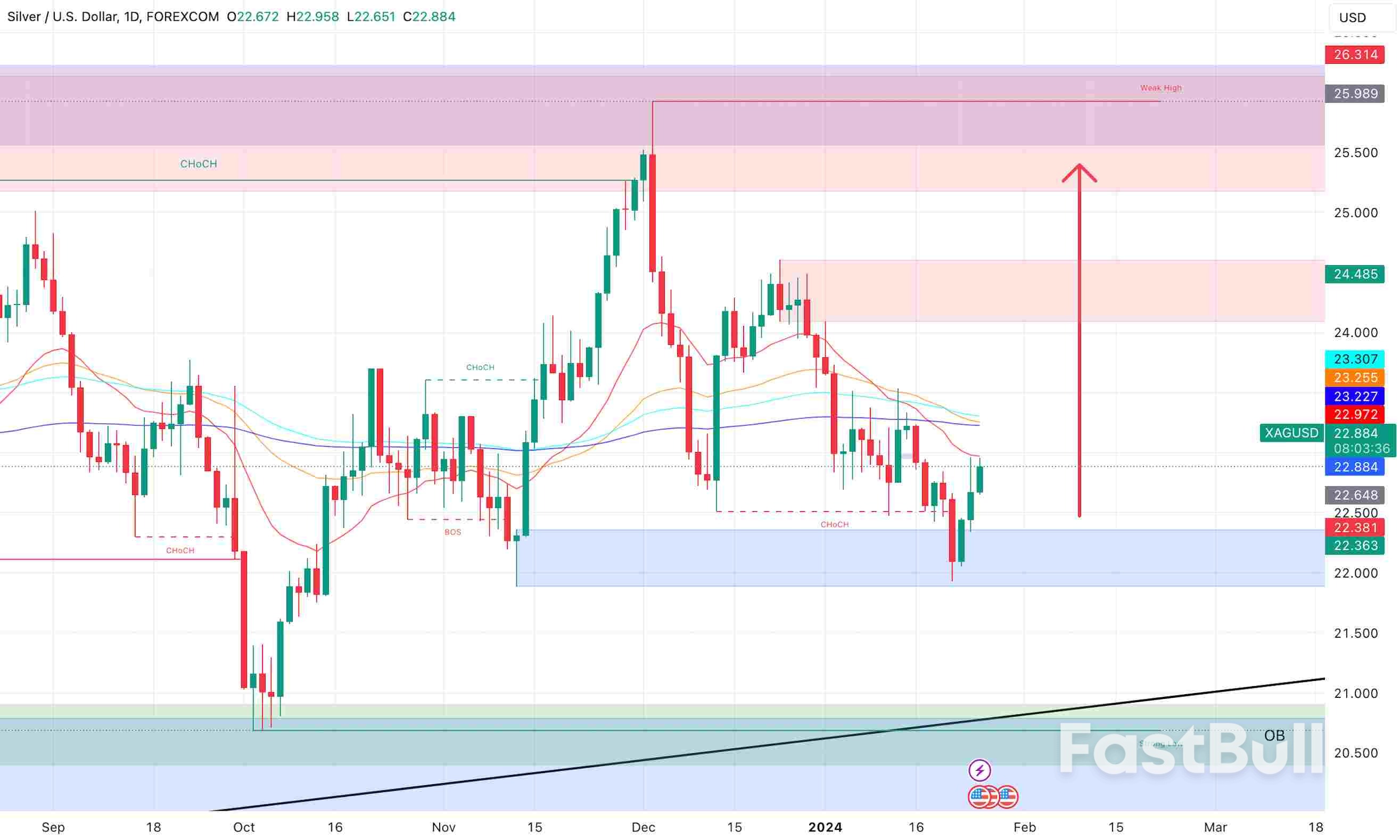
          In the recent trading session, silver staged an impressive rally, solidifying its standing with the $22 mark as a robust support level. The prevailing market dynamics are fueling a growing optimism that silver prices will continue their upward trajectory. The immediate goal in sight for silver is the 200-day Exponential Moving Average, positioned around the $23.20 mark.
          As we navigate this landscape, the market encounters a structural hurdle at the $23.50 level. If resistance surfaces here, many are likely to perceive it as a strategic buying opportunity. The pivotal moment to monitor is whether silver can overcome the $23.50 barrier. A successful breach could potentially set the stage for a move towards the $24.50 mark.
          Looking beyond, breaking the $24.50 level may open doors to an advance towards the $26 level. This particular milestone corresponds to the peak of a more extended consolidation phase anticipated to dominate the market throughout the year. The prospect of reaching this level is intriguing, akin to contemplating a potential unlocking of the market's floodgates. However, a note of realism tempers these expectations, acknowledging that achieving this feat anytime soon seems highly improbable.
          In essence, the silver market is navigating a landscape marked by critical levels and potential breakthroughs. The recent rally and the consolidation phase ahead paint a dynamic picture. The $22 mark emerges as a sturdy pillar of support, suggesting resilience in the face of market fluctuations. The optimism surrounding silver's future gains momentum, fueled by the pursuit of the 200-day Exponential Moving Average at $23.20.
          As we approach the structural hurdle at $23.50, the market sentiment is poised for a strategic pivot. Here, resistance transforms into opportunity for discerning investors. The crucial juncture unfolds as silver seeks to surmount the $23.50 barrier. Success in this endeavor opens up possibilities, paving the way for a potential move towards $24.50.
          Peering further into the horizon, the coveted $26 level beckons, standing as the pinnacle of a more extended market narrative. Yet, a dose of reality tempers the anticipation, acknowledging the formidable challenges of realizing this ambitious milestone in the near term.Silver Attracts Buyers, Bouncing Back from Recent Lows in Ongoing Market Trend_1
          Risk Warnings and Disclaimers
          You understand and acknowledge that there is a high degree of risk involved in trading. Following any strategies or investment methods may lead to potential losses. The content on the site is provided by our contributors and analysts for information purposes only. You are solely responsible for determining whether any trading assets, securities, strategy, or any other product is suitable for investing based on your own investment objectives and financial situation.
          Comments
          Add to Favorites
          Share

          UK Engages with U.S. Republicans Regarding Ukraine: Motives Unveiled

          Ukadike Micheal

          Economic

          Russia-Ukraine Conflict

          In recent weeks, the "special relationship" between Britain and the United States has taken on a new dimension as Britain has sought to bolster support for Ukraine, particularly among American politicians who are skeptical of providing further military aid to the country. This effort has involved high-level discussions and appeals to key figures in the U.S. political landscape, reflecting Britain's unwavering commitment to supporting Ukraine in the face of Russian aggression.
          The United Kingdom's steadfast support for Ukraine has remained resolute and nonpartisan, even amid political divisions on other issues within the country. This solidarity extends across political parties, with both the Conservative government and the Labour Party uniting in defense of Ukraine. The public sentiment in Britain also aligns with this stance, with a majority of people favoring military assistance to Ukraine and expressing a willingness to provide aid for as long as necessary.
          The significance of Ukraine's struggle is deeply felt in Britain, with many perceiving the conflict as a threat to the security of Europe and the UK itself. The proximity of the war, just over three hours away by plane, has contributed to a sense of urgency and concern about the potential consequences of a Russian victory in Ukraine. This sentiment has been reinforced by political leaders and military figures, who have emphasized the importance of supporting Ukraine as a crucial element of collective security.
          Britain's proactive stance on Ukraine is not an isolated instance but rather reflects a broader pattern of trans-Atlantic cooperation and influence. The UK's collaboration with the United States in addressing international conflicts, such as the recent joint airstrikes in Yemen, illustrates the dynamic interplay between the two countries in shaping global security policy.
          While the UK values its relationship with the United States, it is not hesitant to assert its own perspective and push for alignment when necessary. This approach is evident in the UK's efforts to nudge the U.S. towards a more supportive stance on Ukraine, underscoring the nuanced nature of the trans-Atlantic partnership.
          The contrast between the UK and the U.S. on the issue of Ukraine is particularly noteworthy as both countries navigate election cycles that can influence their foreign policy decisions. Despite potential political challenges, Ukraine has not become a divisive issue in British politics, owing in part to the consensus across party lines and the broader public support for aiding Ukraine.
          In light of the upcoming elections, the issue of national security, including support for Ukraine, holds significance for political parties in Britain. For Labour, in particular, demonstrating a strong commitment to national security and patriotism is crucial in countering perceptions of inadequacy in this area. This has led to a concerted effort to dispel past associations with anti-patriotic sentiments and to reaffirm the party's dedication to security and defense.
          The historical context of the UK's position on Russia and Ukraine further informs its current stance, with a deep-seated skepticism towards Russian motives and a commitment to countering Russian aggression. This perspective has been reinforced by events such as the poisoning of a former Russian intelligence agent and his daughter in Salisbury, England, which heightened the UK's suspicions of Russian activities.
          From a strategic standpoint, Britain's support for Ukraine serves as a means of asserting its global leadership role, particularly in the post-Brexit era. By championing security guarantees and demonstrating a proactive approach to international conflicts, the UK seeks to position itself as a key player on the global stage, garnering recognition for its leadership in addressing critical security challenges.
          The UK's unwavering support for Ukraine, its proactive engagement with the United States, and its broader strategic positioning underscore its commitment to global security and leadership. This approach reflects a nuanced and assertive foreign policy strategy that seeks to navigate complex international dynamics while upholding key principles of collective security and stability.

          Source: New York Times

          To stay updated on all economic events of today, please check out our Economic calendar
          Risk Warnings and Disclaimers
          You understand and acknowledge that there is a high degree of risk involved in trading. Following any strategies or investment methods may lead to potential losses. The content on the site is provided by our contributors and analysts for information purposes only. You are solely responsible for determining whether any trading assets, securities, strategy, or any other product is suitable for investing based on your own investment objectives and financial situation.
          Comments
          Add to Favorites
          Share

          The Federal Reserve Faces Political Entanglement Regardless of Its Actions

          Ukadike Micheal

          Economic

          Forex

          The challenge for the Federal Reserve lies in maintaining both actual and perceived independence, particularly as discussions emerge around potential interest rate cuts during an election year. Investors debate whether the Fed might be compelled to adjust rates before the election campaigns gain momentum, with concerns arising about the delicate balance between economic considerations and political influences.
          Amidst suspicions of the Fed's motives, there is a lingering expectation that the central bank might initiate rate cuts in March, despite robust job and inflation figures and opposition from some Fed policymakers against immediate easing. The need to appear free of partisanship becomes crucial, especially in a hyperpartisan political environment where conspiracy theories and skepticism about the Fed's motives are not uncommon.
          The history of the Federal Reserve's actions close to election periods adds complexity to the ongoing debate. While past transcripts reveal discussions about politics during election years, the Fed emphasizes its focus on economic considerations rather than attempting to influence political outcomes. The challenge for the Fed is to navigate the intersection of economic policy and political perceptions, particularly given the impact that its decisions can have on financial markets.
          The potential for accusations of politicization looms large, especially if the timing and scale of rate cuts align with election dynamics. Observers differ on the significance of this influence, with some arguing that if rate cuts are already in progress early in the year, concerns about politicization may lose their potency.
          Gary Cohn, former director of the National Economic Council during the Trump administration, highlights the challenge of managing the perception of political influence. The Fed's pivotal meeting in December, where the possibility of rate cuts was acknowledged by Chairman Jerome Powell, is seen by some as already carrying a political undertone. However, Cohn trusts the Fed's ability to prioritize economic considerations over political pressures.
          The overarching concern for the Fed in today's hyperpartisan climate is that any action it takes may be interpreted as taking sides. President Trump's history of publicly attempting to influence the Fed's decisions challenges the traditional norm of politicians refraining from such interventions. As the Fed treads carefully to maintain an appearance of independence, the potential for scrutiny and discussions among investors about perceived behavioral shifts remains high.
          The Federal Reserve faces the delicate task of balancing economic imperatives with the need to be perceived as politically neutral. The ongoing debates around interest rate cuts, coupled with the hyperpartisan political environment, underscore the challenges of navigating monetary policy in an election year. As the Fed strives to uphold its independence, the impact of its decisions on financial markets and the broader economy will continue to be closely scrutinized, with investors keenly observing whether the central bank can maintain its commitment to economic principles amidst political pressures.

          Source: Wall Street Journal

          To stay updated on all economic events of today, please check out our Economic calendar
          Risk Warnings and Disclaimers
          You understand and acknowledge that there is a high degree of risk involved in trading. Following any strategies or investment methods may lead to potential losses. The content on the site is provided by our contributors and analysts for information purposes only. You are solely responsible for determining whether any trading assets, securities, strategy, or any other product is suitable for investing based on your own investment objectives and financial situation.
          Comments
          Add to Favorites
          Share

          Surge in Mortgage Applications Persists Despite Climbing Interest Rates

          Ukadike Micheal

          Economic

          Forex

          Despite a slight increase in mortgage rates, the Mortgage Bankers Association's (MBA) home-purchase applications index rose by 3.7% for the week ending Jan. 19, indicating continued strength in the housing market. The average rate for the popular 30-year loan started the year at 6.78%, slightly higher than the previous week, but down from the October peak of 8%.
          Joel Kan, MBA's deputy chief economist, noted that while mortgage rates saw a modest increase, there is an ongoing upward trend in home purchase activity. Applications for mortgages to purchase homes increased by 8% compared to the previous week, despite a year-over-year decline of 18%.
          However, the demand for refinancing experienced a decline of 7% from the previous week, and refinance applications are down about 8% compared to the same period last year. Kan explained, "Refinance applications declined over the week and remained at low levels. There is still little incentive for homeowners to refinance with rates at these levels."
          The housing market, sensitive to interest rate changes, had cooled due to the Federal Reserve's aggressive tightening campaign, which saw 11 consecutive rate hikes over the past two years. The effort aimed to combat stubborn inflation and slow down the economy. Despite this, many economists now believe the central bank is finished raising interest rates, contributing to a decline in mortgage rates. However, higher rates have impacted consumer demand and severely constrained inventory, as sellers who secured low mortgage rates before the pandemic are hesitant to sell in the current high-rate environment.
          A separate report by Realtor.com highlights that available home supply remains significantly reduced, down by 34.3% from typical levels before the COVID-19 pandemic began in early 2020. The combination of limited inventory and sustained demand contributes to the challenges faced by prospective homebuyers.
          The housing market continues to demonstrate resilience, with rising home-purchase applications despite a marginal increase in mortgage rates. The delicate balance between demand, interest rates, and available inventory shapes the evolving landscape of the real estate market. As the Federal Reserve's stance on interest rates stabilizes, attention will remain on how these factors influence homebuying patterns and the overall health of the housing sector in the coming months.

          Source: Fox News

          To stay updated on all economic events of today, please check out our Economic calendar
          Risk Warnings and Disclaimers
          You understand and acknowledge that there is a high degree of risk involved in trading. Following any strategies or investment methods may lead to potential losses. The content on the site is provided by our contributors and analysts for information purposes only. You are solely responsible for determining whether any trading assets, securities, strategy, or any other product is suitable for investing based on your own investment objectives and financial situation.
          Comments
          Add to Favorites
          Share

          Trump Wins New Hampshire

          Danske Bank

          Forex

          Economic

          In focus today

          Today, we will get January PMIs for both the euro area and the US. They will be the first indicator on how the major economies performed at the beginning of 2024.
          In the euro area, the manufacturing PMIs have risen since October in a signal of activity bottoming out in Q4 2023. We expect that the gradual rebound continued in January. The service PMIs have been relatively stable around the 48.5 level in the previous five months, and we expect this to be the case also in January.
          From Sweden we will get the monthly inflation survey from Prospera for January. We see it as unlikely to deliver any big surprises, as inflation is gradually easing towards the target.
          In the afternoon at 15:45 CET, Bank of Canada will announce their rate decision after their policy meeting. In line with market consensus, we expect them to hold policy rate unchanged at 5.00%. We will keep an eye on any signals on how long the bank expects to hold the rates at current level. Our base case is for a 25bp rat cut in March although recent developments has increased the risk that the first rate cut will not come until summer.

          Economic and market news

          What happened overnight

          In the US, Donald Trump has now won two out of two states in the race to become Republican nominee in the presidential election. At the deadline for this publication Donald Trump won 11 out of 22 delegates corresponding to 54.6% of the votes, while Nikki Haley won 8 corresponding to 43.5%, with three delegates left to be decided. Haley indicated last night that she will continue in the race despite her significant defeat.
          In the red sea, the US hit two anti-ship missiles from the Houthi rebels in Yemen, which were aimed at the Red Sea and prepared to launch.
          In Japan, we got PMIs for January. The manufacturing PMI was more or less unchanged (48.0 in January against 47.9 in December). Service PMI increased from 51.5 in December to 52.7 in January. This means, that we continue to see modest decline in manufacturing and an even stronger service sector in Japan. Continued strong domestic demand in Japan keeps the upside risk to inflation present.

          What happened yesterday

          Turkey's parliament approves Swedish NATO membership bid. The Swedish NATO bid has now overcome a major hurdle and an about 20-month delay to become a NATO member. President Erdogan's AKP and its allies all voted in favour of Swedish membership. He is expected to sign the bill in the coming days. The only NATO member left to approve Sweden's bid is Hungary.
          In the euro area, the results of ECB's Q4 bank lending survey was published. The survey was broadly in line with expectations, and hence we do not see it altering the monetary policy stance at the upcoming monetary policy meeting on Thursday. Most banks reported that credit standards are still tightened in 2023 Q4 and that loan demand declined. Yet, it was to a smaller extent than in the previous quarters, as more banks reported unchanged credit standards and loan demand while fewer reported tightening standards and decreased demand than in the previous survey.
          Consumer confidence in the Euro area declined unexpectedly from -15.1 to -16.1. Market expected an increase to -14.3. Consumer confidence is thereby still stuck at low levels which is likely also the explanation to the sluggish consumption ratio. Hence, with consumer confidence still at low levels the upswing in private consumption that better confidence would support is still not in sight.
          In Denmark, consumer confidence rose from -13 to -8.4. The consumer confidence is still at low levels but increasing again, after it fell in December. The increase was mainly driven by improved assessment of the economic and household financial situation over the last 12 months.
          Equities: Global equities ended higher yesterday as most US indices rally into the cash close and hence secured another set of all-time highs. That said, Europe and Japan were still lower and in global indices 4 out of 10 sectors were lower. Earnings season is picking up speed and if history repeats itself, we will see some days with what we call odd sector correlations as big individual companies are disturbing the picture because of either super solid or super weak earnings. Yesterday in the US, Dow -0.3%, S&P 500 +0.3%, Nasdaq +0.4% and Russell 2000 -0.4%. Asian markets are mostly in red this morning with China sticking out on the positive side as people continue to speculate in very equity market focus stimulus coming. European and US futures are higher. In Europe some of this is catch-up to the US cash session while US futures are boosted by better-than-expected earnings after the bell yesterday.
          FI: Global yields rose across the board throughout yesterday's session as markets digested the rumours of new Chinese stimulus and the still significant amount of issuance. 10Y Bund yields ended up by 6bp, while the front end was up by a couple of basis points. Implied volatility drifted slightly higher in EUR swaptions markets, while the Bund ASW-spread continued to widen.
          FX: USD/JPY could not really decide what to do after the well-anticipated BOJ decision, first a knee-jerk spike, then a sharp sell-off, and after that back above pre-BOJ levels. CNH has held on to gains after the news about government support to the Chinese stock market. Meanwhile, the USD firmed vs EUR and Scandies where USD/SEK tried to make USD/NOK company above 10.50. USD/SEK has gained 6% in three weeks (!) – we continue to like the topside as a strategic position for 2024.
          To stay updated on all economic events of today, please check out our Economic calendar
          Risk Warnings and Disclaimers
          You understand and acknowledge that there is a high degree of risk involved in trading. Following any strategies or investment methods may lead to potential losses. The content on the site is provided by our contributors and analysts for information purposes only. You are solely responsible for determining whether any trading assets, securities, strategy, or any other product is suitable for investing based on your own investment objectives and financial situation.
          Comments
          Add to Favorites
          Share
          FastBull
          Copyright © 2025 FastBull Ltd

          728 RM B 7/F GEE LOK IND BLDG NO 34 HUNG TO RD KWUN TONG KLN HONG KONG

          TelegramInstagramTwitterfacebooklinkedin
          App Store Google Play Google Play
          Products
          Charts

          Chats

          Q&A with Experts
          Screeners
          Economic Calendar
          Data
          Tools
          Membership
          Features
          Function
          Markets
          Copy Trading
          Latest Signals
          Contests
          News
          Analysis
          24/7
          Columns
          Education
          Company
          Careers
          About Us
          Contact Us
          Advertising
          Help Center
          Feedback
          User Agreement
          Privacy Policy
          Business

          White Label

          Data API

          Web Plug-ins

          Poster Maker

          Affiliate Program

          Risk Disclosure

          The risk of loss in trading financial instruments such as stocks, FX, commodities, futures, bonds, ETFs and crypto can be substantial. You may sustain a total loss of the funds that you deposit with your broker. Therefore, you should carefully consider whether such trading is suitable for you in light of your circumstances and financial resources.

          No decision to invest should be made without thoroughly conducting due diligence by yourself or consulting with your financial advisors. Our web content might not suit you since we don't know your financial conditions and investment needs. Our financial information might have latency or contain inaccuracy, so you should be fully responsible for any of your trading and investment decisions. The company will not be responsible for your capital loss.

          Without getting permission from the website, you are not allowed to copy the website's graphics, texts, or trademarks. Intellectual property rights in the content or data incorporated into this website belong to its providers and exchange merchants.

          Not Logged In

          Log in to access more features

          FastBull Membership

          Not yet

          Purchase

          Become a signal provider
          Help Center
          Customer Service
          Dark Mode
          Price Up/Down Colors

          Log In

          Sign Up

          Position
          Layout
          Fullscreen
          Default to Chart
          The chart page opens by default when you visit fastbull.com