• Trade
  • Markets
  • Copy
  • Contests
  • News
  • 24/7
  • Calendar
  • Q&A
  • Chats
Trending
Screeners
SYMBOL
LAST
BID
ASK
HIGH
LOW
NET CHG.
%CHG.
SPREAD
SPX
S&P 500 Index
6857.13
6857.13
6857.13
6865.94
6827.13
+7.41
+ 0.11%
--
DJI
Dow Jones Industrial Average
47850.93
47850.93
47850.93
48049.72
47692.96
-31.96
-0.07%
--
IXIC
NASDAQ Composite Index
23505.13
23505.13
23505.13
23528.53
23372.33
+51.04
+ 0.22%
--
USDX
US Dollar Index
98.880
98.960
98.880
98.980
98.880
-0.100
-0.10%
--
EURUSD
Euro / US Dollar
1.16554
1.16561
1.16554
1.16557
1.16408
+0.00109
+ 0.09%
--
GBPUSD
Pound Sterling / US Dollar
1.33408
1.33417
1.33408
1.33411
1.33165
+0.00137
+ 0.10%
--
XAUUSD
Gold / US Dollar
4220.24
4220.58
4220.24
4221.12
4194.54
+13.07
+ 0.31%
--
WTI
Light Sweet Crude Oil
59.276
59.313
59.276
59.469
59.187
-0.107
-0.18%
--

Community Accounts

Signal Accounts
--
Profit Accounts
--
Loss Accounts
--
View More

Become a signal provider

Sell trading signals to earn additional income

View More

Guide to Copy Trading

Get started with ease and confidence

View More

Signal Accounts for Members

All Signal Accounts

Best Return
  • Best Return
  • Best P/L
  • Best MDD
Past 1W
  • Past 1W
  • Past 1M
  • Past 1Y

All Contests

  • All
  • Trump Updates
  • Recommend
  • Stocks
  • Cryptocurrencies
  • Central Banks
  • Featured News
Top News Only
Share

India's NIFTY IT Index Last Up 1.3%

Share

India's Nifty 50 Index Rises 0.35%

Share

Israel Sets 2026 Defence Budget At $34 Billion

Share

Russia Says Azov Sea's Port Of Temryuk Damaged In Ukrainian Attack

Share

Israel's Defense Budget For 2026 Will Be 112 Billion Israeli Shekels - Defense Minister Office

Share

One India Rate Panel Member Ram Singh Was Of View That Stance Should Be Changed To 'Accommodative' From 'Neutral' - Monetary Policy Committee Statement

Share

Reserve Bank Of India Chief: Will Continue To Meet Productive Needs Of Economy In Proactive Manner

Share

Reserve Bank Of India Chief: System Level Financial Parameters Of Nbfcs Sound

Share

Reserve Bank Of India Chief: Dollar Rupee Swap To Be For 3 Years, To Be Conducted This Month

Share

India's Nifty Realty Index Extend Gains, Last Up 1.4%

Share

India's Nifty Psu Bank Index Rises 1%

Share

Reserve Bank Of India Chief: Commited To Providing Sufficient Durable Liquidity

Share

Reserve Bank Of India Chief: Transmission Has Been Broad Based Across Sectors, Satisfactory

Share

Reserve Bank Of India Chief: As Of Nov 28, India's Forex Reserves Stood At $686 Billion

Share

Reserve Bank Of India Chief: Healthy Services Exports With Strong Remittances To Keep Cad Modest In This Year

Share

Reserve Bank Of India Chief: CPI Inflation Seen At 0.6% In Q3 Fy26

Share

Reserve Bank Of India Chief: Fy26 CPI Inflation Seen At 2% Versus 2.6% Previously

Share

India's Nifty Realty Index Up 1% After Reserve Bank Of India's Rate Cut

Share

India's Nifty Psu Bank Index Turns Positive, Up 0.43% After Reserve Bank Of India's Rate Cut

Share

Reserve Bank Of India Chief: Merchandise Exports Face Some Headwinds

TIME
ACT
FCST
PREV
Turkey Trade Balance

A:--

F: --

P: --

Germany Construction PMI (SA) (Nov)

A:--

F: --

P: --

Euro Zone IHS Markit Construction PMI (Nov)

A:--

F: --

P: --

Italy IHS Markit Construction PMI (Nov)

A:--

F: --

P: --

U.K. Markit/CIPS Construction PMI (Nov)

A:--

F: --

P: --

France 10-Year OAT Auction Avg. Yield

A:--

F: --

P: --

Euro Zone Retail Sales MoM (Oct)

A:--

F: --

P: --

Euro Zone Retail Sales YoY (Oct)

A:--

F: --

P: --

Brazil GDP YoY (Q3)

A:--

F: --

P: --

U.S. Challenger Job Cuts (Nov)

A:--

F: --

P: --

U.S. Challenger Job Cuts MoM (Nov)

A:--

F: --

P: --

U.S. Challenger Job Cuts YoY (Nov)

A:--

F: --

P: --

U.S. Initial Jobless Claims 4-Week Avg. (SA)

A:--

F: --

P: --

U.S. Weekly Initial Jobless Claims (SA)

A:--

F: --

P: --

U.S. Weekly Continued Jobless Claims (SA)

A:--

F: --

P: --

Canada Ivey PMI (SA) (Nov)

A:--

F: --

P: --

Canada Ivey PMI (Not SA) (Nov)

A:--

F: --

P: --

U.S. Non-Defense Capital Durable Goods Orders Revised MoM (Excl. Aircraft) (SA) (Sept)

A:--

F: --

P: --
U.S. Factory Orders MoM (Excl. Transport) (Sept)

A:--

F: --

P: --

U.S. Factory Orders MoM (Sept)

A:--

F: --

P: --

U.S. Factory Orders MoM (Excl. Defense) (Sept)

A:--

F: --

P: --

U.S. EIA Weekly Natural Gas Stocks Change

A:--

F: --

P: --

Saudi Arabia Crude Oil Production

A:--

F: --

P: --

U.S. Weekly Treasuries Held by Foreign Central Banks

A:--

F: --

P: --

Japan Foreign Exchange Reserves (Nov)

A:--

F: --

P: --

India Repo Rate

A:--

F: --

P: --

India Benchmark Interest Rate

A:--

F: --

P: --

India Reverse Repo Rate

A:--

F: --

P: --

India Cash Reserve Ratio

A:--

F: --

P: --

Japan Leading Indicators Prelim (Oct)

A:--

F: --

P: --

U.K. Halifax House Price Index YoY (SA) (Nov)

--

F: --

P: --

U.K. Halifax House Price Index MoM (SA) (Nov)

--

F: --

P: --

France Current Account (Not SA) (Oct)

--

F: --

P: --

France Trade Balance (SA) (Oct)

--

F: --

P: --

France Industrial Output MoM (SA) (Oct)

--

F: --

P: --

Italy Retail Sales MoM (SA) (Oct)

--

F: --

P: --

Euro Zone Employment YoY (SA) (Q3)

--

F: --

P: --

Euro Zone GDP Final YoY (Q3)

--

F: --

P: --

Euro Zone GDP Final QoQ (Q3)

--

F: --

P: --

Euro Zone Employment Final QoQ (SA) (Q3)

--

F: --

P: --

Euro Zone Employment Final (SA) (Q3)

--

F: --

P: --
Brazil PPI MoM (Oct)

--

F: --

P: --

Mexico Consumer Confidence Index (Nov)

--

F: --

P: --

Canada Unemployment Rate (SA) (Nov)

--

F: --

P: --

Canada Labor Force Participation Rate (SA) (Nov)

--

F: --

P: --

Canada Employment (SA) (Nov)

--

F: --

P: --

Canada Part-Time Employment (SA) (Nov)

--

F: --

P: --

Canada Full-time Employment (SA) (Nov)

--

F: --

P: --

U.S. Dallas Fed PCE Price Index YoY (Sept)

--

F: --

P: --

U.S. PCE Price Index YoY (SA) (Sept)

--

F: --

P: --

U.S. PCE Price Index MoM (Sept)

--

F: --

P: --

U.S. Personal Outlays MoM (SA) (Sept)

--

F: --

P: --

U.S. Core PCE Price Index MoM (Sept)

--

F: --

P: --

U.S. UMich 5-Year-Ahead Inflation Expectations Prelim YoY (Dec)

--

F: --

P: --

U.S. Core PCE Price Index YoY (Sept)

--

F: --

P: --

U.S. 5-10 Year-Ahead Inflation Expectations (Dec)

--

F: --

P: --

U.S. UMich Current Economic Conditions Index Prelim (Dec)

--

F: --

P: --

U.S. UMich Consumer Sentiment Index Prelim (Dec)

--

F: --

P: --

U.S. UMich 1-Year-Ahead Inflation Expectations Prelim (Dec)

--

F: --

P: --

U.S. UMich Consumer Expectations Index Prelim (Dec)

--

F: --

P: --

Q&A with Experts
    • All
    • Chatrooms
    • Groups
    • Friends
    Connecting
    .
    .
    .
    Type here...
    Add Symbol or Code

      No matching data

      All
      Trump Updates
      Recommend
      Stocks
      Cryptocurrencies
      Central Banks
      Featured News
      • All
      • Russia-Ukraine Conflict
      • Middle East Flashpoint
      • All
      • Russia-Ukraine Conflict
      • Middle East Flashpoint
      Search
      Products

      Charts Free Forever

      Chats Q&A with Experts
      Screeners Economic Calendar Data Tools
      Membership Features
      Data Warehouse Market Trends Institutional Data Policy Rates Macro

      Market Trends

      Market Sentiment Order Book Forex Correlations

      Top Indicators

      Charts Free Forever
      Markets

      News

      News Analysis 24/7 Columns Education
      From Institutions From Analysts
      Topics Columnists

      Latest Views

      Latest Views

      Trending Topics

      Top Columnists

      Latest Update

      Signals

      Copy Rankings Latest Signals Become a signal provider AI Rating
      Contests
      Brokers

      Overview Brokers Assessment Rankings Regulators News Claims
      Broker listing Forex Brokers Comparison Tool Live Spread Comparison Scam
      Q&A Complaint Scam Alert Videos Tips to Detect Scam
      More

      Business
      Events
      Careers About Us Advertising Help Center

      White Label

      Data API

      Web Plug-ins

      Affiliate Program

      Awards Institution Evaluation IB Seminar Salon Event Exhibition
      Vietnam Thailand Singapore Dubai
      Fans Party Investment Sharing Session
      FastBull Summit BrokersView Expo
      Recent Searches
        Top Searches
          Markets
          News
          Analysis
          User
          24/7
          Economic Calendar
          Education
          Data
          • Names
          • Latest
          • Prev

          View All

          No data

          Scan to Download

          Faster Charts, Chat Faster!

          Download App
          English
          • English
          • Español
          • العربية
          • Bahasa Indonesia
          • Bahasa Melayu
          • Tiếng Việt
          • ภาษาไทย
          • Français
          • Italiano
          • Türkçe
          • Русский язык
          • 简中
          • 繁中
          Open Account
          Search
          Products
          Charts Free Forever
          Markets
          News
          Signals

          Copy Rankings Latest Signals Become a signal provider AI Rating
          Contests
          Brokers

          Overview Brokers Assessment Rankings Regulators News Claims
          Broker listing Forex Brokers Comparison Tool Live Spread Comparison Scam
          Q&A Complaint Scam Alert Videos Tips to Detect Scam
          More

          Business
          Events
          Careers About Us Advertising Help Center

          White Label

          Data API

          Web Plug-ins

          Affiliate Program

          Awards Institution Evaluation IB Seminar Salon Event Exhibition
          Vietnam Thailand Singapore Dubai
          Fans Party Investment Sharing Session
          FastBull Summit BrokersView Expo

          BofA Sees Bank Of Canada Holding Rates In October, Says December Cut More Likely

          Damon

          Central Bank

          Summary:

           Analysts at BofA Global Research expect the Bank of Canada (BoC) to maintain its key policy rate at 2.50% during the upcoming October 29 meeting, delaying rate cuts until December. Their view hinges on residual strength in Canada's labor market and persistently elevated core inflation, both of which are viewed as significant headwinds to immediate easing.

          Analysts at BofA Global Research expect the Bank of Canada (BoC) to maintain its key policy rate at 2.50% during the upcoming October 29 meeting, delaying rate cuts until December. Their view hinges on residual strength in Canada's labor market and persistently elevated core inflation, both of which are viewed as significant headwinds to immediate easing.

          In their latest note, Carlos Capistran and colleagues emphasize, "We expect the BoC to keep its policy rate unchanged at 2.50% on October 29." The report points to sticky core inflation measures, averaging 3.15% in September, and a robust rebound in employment, noting a +60.4k net job gain last month, as justifications for the central bank holding policy steady.

          Economic growth in Canada remains subdued, although July brought a modest reprieve with a 0.2% month-over-month GDP expansion. This was buoyed by gains in extractive and manufacturing industries; however, weak retail trade and tepid consumer spending continue to restrain momentum, casting doubt on the resilience of the recovery.

          Headline inflation rose to 2.4% in September from 1.9% in August, with core measures edging up as well, driven primarily by fading disinflation in gasoline prices. "Rising inflation limits the BoC's room to cut the policy rate in October," the BofA team cautioned, adding that inflation persistence keeps the central bank in a cautious stance, despite broader weakness in economic activity.

          The BoC is expected to maintain its meeting-by-meeting flexibility, but forward guidance will likely tilt dovish should inflation begin to ease. Capistran and his co-authors see the central bank delivering two 25bp cuts, one each in December and January, bringing the policy rate down to 2.00% by early next year.

          In rate markets, the CAD curve is seen "pricing out cuts—but not enough," suggesting scope for front-end rates to decline further as policy easing resumes. Similarly, BofA's FX strategists argue the risk/reward now favors positioning for a lower USD/CAD, especially given low implied volatility and recent USD strength priced into the currency pair.

          Market expectations for a surprise rate cut in October still remain elevated, with implied odds around 70%. However, BofA views this as overly aggressive, stating the market "reflects a BoC that is more in a hurry than it may need to be," signaling greater scope for disappointment if the central bank ultimately opts for patience.

          Source: Investing

          Risk Warnings and Disclaimers
          You understand and acknowledge that there is a high degree of risk involved in trading. Following any strategies or investment methods may lead to potential losses. The content on the site is provided by our contributors and analysts for information purposes only. You are solely responsible for determining whether any trading assets, securities, strategy, or any other product is suitable for investing based on your own investment objectives and financial situation.
          Add to Favorites
          Share

          China's Battery Giants Flood Overseas Markets As Exports Surge 220%

          Samantha Luan

          Stocks

          Forex

          Economic

          Last year, China's battery industry average utilization rate cratered to just a third of maximum capacity amid severe overcapacity following years of massive investment and expansion. This put smaller manufacturers under severe pressure and fueled further industry consolidation, while also forcing producers to increasingly seek overseas markets. Luckily, these efforts appear to be paying off: China Energy Storage Alliance has reported that Chinese battery storage forms secured ~200 overseas orders totalling 186 gigawatt-hours (GWh) in the first half of this year, good for a more than 220% year-over-year surge. Not surprisingly, just 5.34 GWh– less than 3% of the total--came from the United States amid hefty tariffs by the Trump administration compared to nearly 60% that came from the Middle East, Europe and Australia.

          Back in April, the Trump administration imposed duties of up to 3,521% on solar imports from Vietnam, Cambodia, Malaysia and Thailand, with the finalized tariffs applying to shipments from China’s solar heavyweights, including JinkoSolar and Trina Solar. Further, Chinese firms are increasingly diversifying their production bases in a bid to mitigate growing tariff risks from Washington. Currently, Chinese solar manufacturers have installed ~80% of overseas capacity including solar wafers, solar cells and modules in Southeast Asia.

          “The industry used to say that you either go overseas or exit the game,” said Gao Jifan, chairman of Trina Solar.

          “Now, due to tariffs, simply exporting isn’t enough; you must also localise production abroad.”

          China’s battery storage sector is also benefiting from a rebound by the local markets thanks to policy support by Beijing. China’s National Energy Administration recently unveiled a plan to mobilize 250 billion yuan (~$32 billion) in new investment to build 180 gigawatts of new energy storage capacity by 2027. Lately, Chinese companies that operate in the energy storage space have been posting robust growth as fundamentals continue to improve. During the first half of 2025, 47 of 55 listed companies in the Chinese energy storage sector were profitable. China’s Contemporary Amperex Technology Co., one of the largest li-ion battery manufacturers in the world, reported H1 2025 operating revenue of RMB178.886 billion ($25.15 billion), good for a 7.3% increase year over year while net profit attributable to shareholders clocked in at RMB30.485 billion, up 33.33%. In its interim report, CATL revealed that sustained rapid growth in demand for energy storage cells driven by the global clean energy transition has been driving its impressive performance.

          That said, battery storage expansion is expected to be a global trend: energy research and consulting firm Wood Mackenzie has projected that global investment in battery storage will reach approximately $1.2 trillion by 2034. This investment will be needed to support the installation of over 5,900 GW of new wind and solar capacity during that period. The report emphasizes that advanced, grid-forming battery technology is crucial for maintaining grid stability as renewable energy sources become more prevalent.

          U.S. Battery Storage Explodes

          For years, battery systems have only played a marginal role in U.S. electricity networks, with power utilities focusing more on building out capacity from natural gas plants and renewable energy sources. According to energy data portal Cleanview, five years ago, the United States had 74 times more wind farm capacity and 30 times more solar capacity than battery capacity within its power generation system.

          However, steady cost declines coupled with rising energy density levels have encouraged utilities to ramp up their battery installations, with battery storage output now exceeding other power sources in certain power markets. And, it’s boom time for the U.S. utility-scale battery storage market: currently, there are only around 5 times more solar and wind capacity in the country compared to battery capacity, thanks in large part to a 40% decline in battery prices since 2022. Currently, 19 states have installed 100 MW or more of utility-scale battery storage. According to Cleanview, there are just under 30,000 megawatts (MW) of utility battery capacity across the U.S., good for a massive 15-fold increase since 2020. For some context, the U.S. solar sector has added 84,200 MW over the timeframe, while the wind sector has increased its capacity by just 7,000 MW. Falling costs is the biggest reason for the surge in U.S. battery deployments: according to financial advisory and asset management firm Lazard the levelized cost of electricity (LCOE) for utility-scale solar farms paired with batteries ranges from $50-$131 per megawatt hour (MWh). This makes the pair competitive with new natural gas peaking plants (LCOE of $47 to $170 per MWh) and even new coal-fired plants with LCOE of $114 per MWh.

          According to Lazard's 2025 LCOE+ report, new-build renewable energy power plants are the most competitive form of power generation on an unsubsidized basis (i.e., without tax subsidies). This is highly significant in the current era of unprecedented power demand growth in large part due to the AI boom and clean energy manufacturing. Renewables also stand out as the quickest-to-deploy generation resource, with the solar plus battery combination often boasting far shorter deployment times compared to constructing new natural gas power plants. California is, by far, the national leader in utility-scale battery storage, accounting for ~13,000 MW or about 42% of the national total. According to the California Energy Commission, the California Independent System Operator has installed ~21,000 MW of solar capacity and ~12,400 MW of battery capacity, allowing the state to rely heavily on batteries during peak demand periods.

          Source: Zero Hedge

          To stay updated on all economic events of today, please check out our Economic calendar
          Risk Warnings and Disclaimers
          You understand and acknowledge that there is a high degree of risk involved in trading. Following any strategies or investment methods may lead to potential losses. The content on the site is provided by our contributors and analysts for information purposes only. You are solely responsible for determining whether any trading assets, securities, strategy, or any other product is suitable for investing based on your own investment objectives and financial situation.
          Add to Favorites
          Share

          Could Silver Lead the Next Major Market Cycle?

          Adam

          Commodity

          Silver’s rising, who are its top producers and AI is writing faster than humans!

          Are We Still in the Early Stages of a Major Cycle Where Silver Outperforms US Equities?

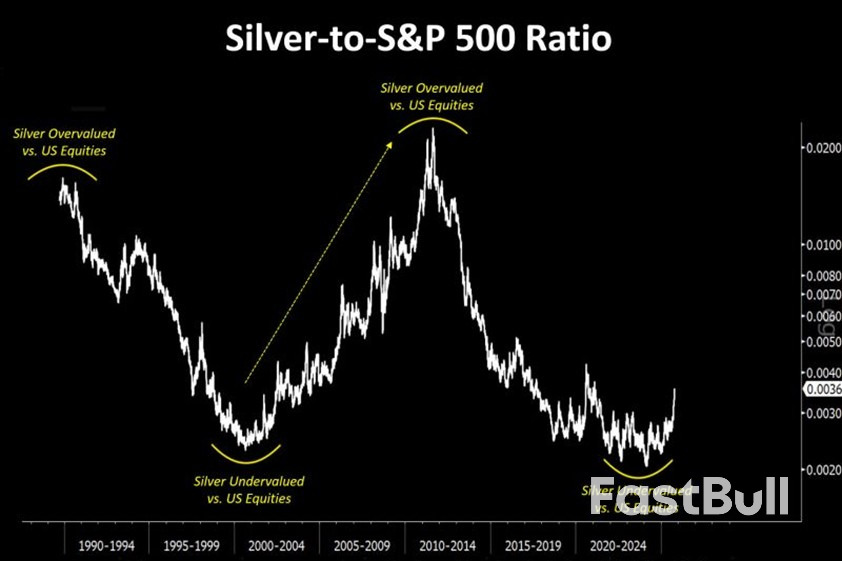
          Silver has broken through the key $50 resistance level and continues to set new all-time highs. The chart below, plotting silver relative to S&P 500, suggests we may only be in the early phase of a broader capital rotation into hard assets.
          Could Silver Lead the Next Major Market Cycle?_1

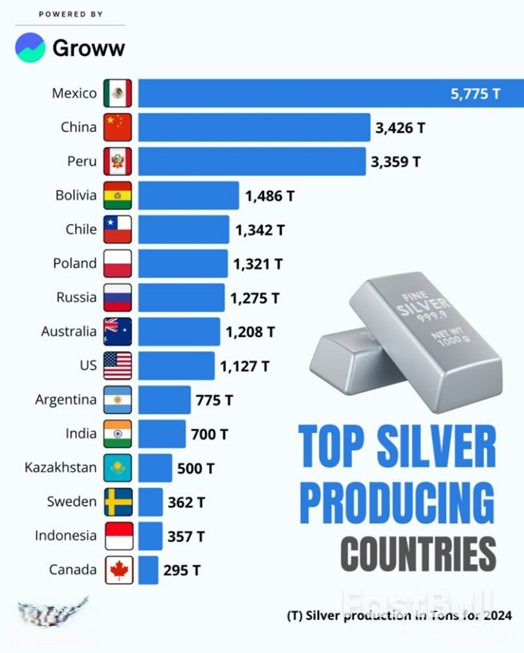
          The World’s Largest Silver Producers

          Mexico remains the world’s top silver producer in 2024, followed by China and Peru.
          Could Silver Lead the Next Major Market Cycle?_2

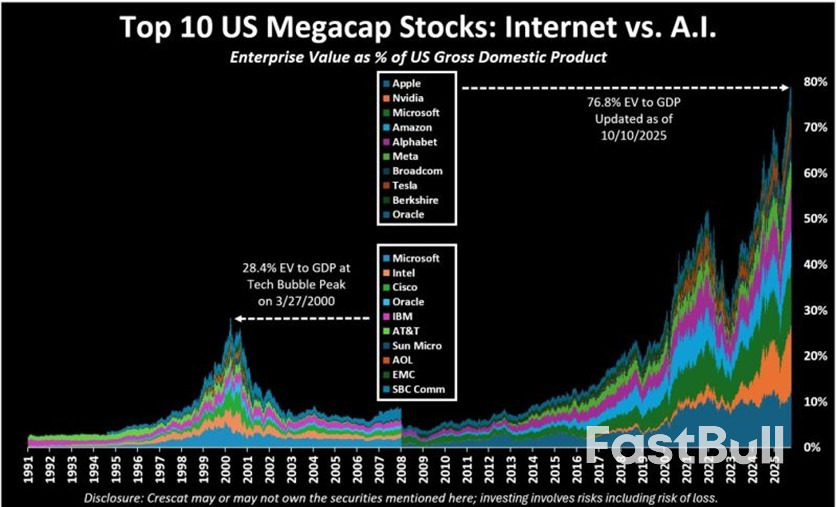
          Signs of Irrational Exuberance on US Stocks?

          Despite lingering caution, investor positioning in US equities has reached euphoric levels, showing a widespread disregard for risk. The top 10 US mega-cap stocks now trade at 270% higher EV-to-GDP multiples than the 10 largest tech and telecom firms at the 2000 bubble peak. Similarly, the Buffett Indicator (total market cap-to-GDP) far exceeds dot-com era levels.
          Could Silver Lead the Next Major Market Cycle?_3
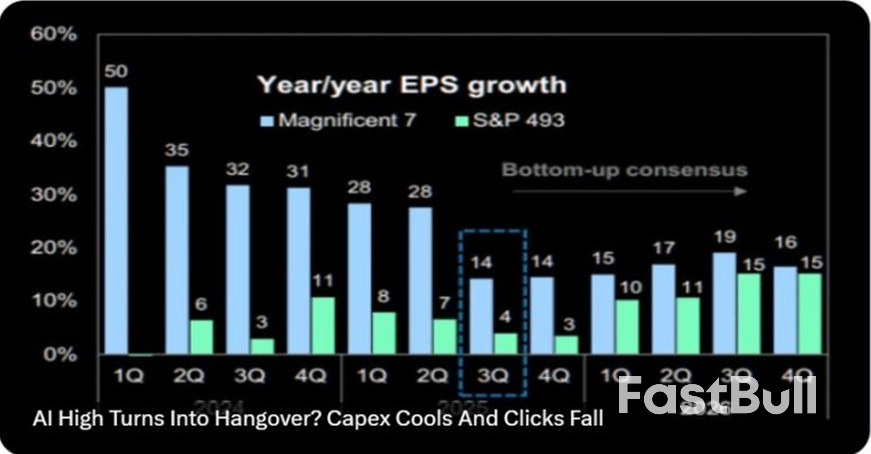
          Magnificent Seven Earnings Growth Is Expected to Slow Down Meaningfully Going Forward
          Analysts now expect earnings for the Magnificent 7 to grow by just +14% y/y in 3Q, half the pace of the prior quarter and well below the ~30% average of the past year. The silver lining, however, is that lower forecasts are easier to beat, as seen in previous quarters.
          Could Silver Lead the Next Major Market Cycle?_4

          One of the Biggest Threats to the Entire AI boom Is Power

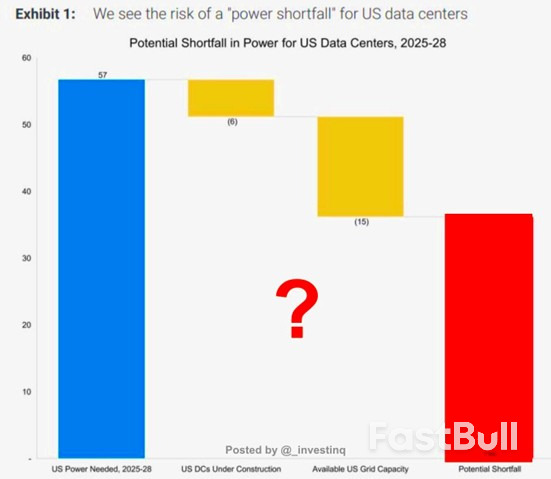
          Morgan Stanley projects US data centre demand to reach ~57 GW by 2028, yet only 18–21 GW of capacity exists or is under construction, leaving a 36 GW shortfall. Without massive energy investment, the AI revolution may soon hit a hard ceiling.
          Could Silver Lead the Next Major Market Cycle?_5
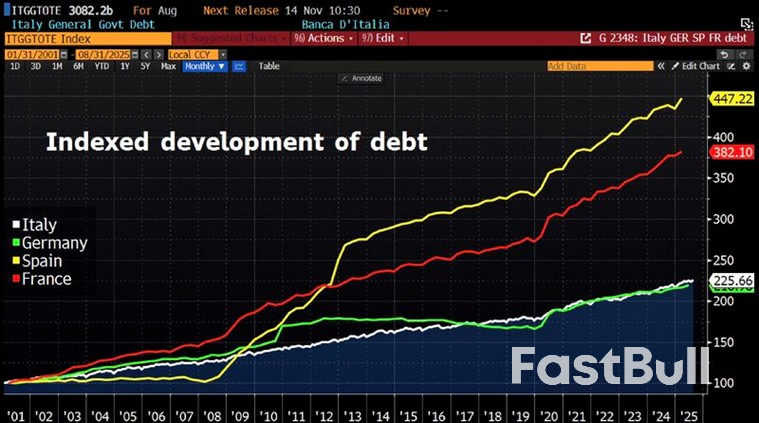
          How Fast is European Sovereign Debt Growing?
          Germany’s public debt has reached a new record high. Since 2000, its debt growth has matched Italy’s pace, even if Italy’s total debt level remains far higher. Relative to France or Spain, however, Germany’s position still appears comparatively stable.
          Could Silver Lead the Next Major Market Cycle?_6

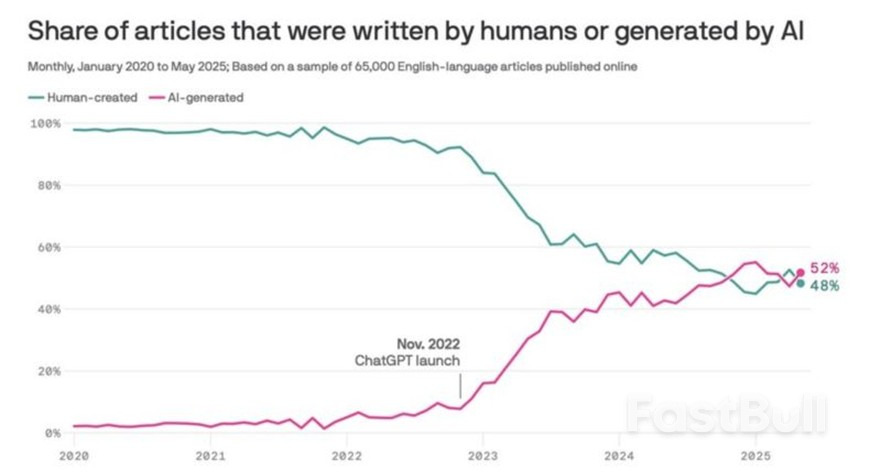
          AI Now Writes More Articles Than Humans

          Oxford researchers estimate that AI-generated articles now outnumber human-written ones, rising from ~5% in 2020 to 52% by May 2025, and projected to exceed 90% next year. The main driver is cost. AI content costs under $0.01 per piece, versus $10–100 for humans. The growing risk, however, is that as AI increasingly trains on its own output, originality erodes and idea diversity fades.
          Could Silver Lead the Next Major Market Cycle?_7

          Source: investing

          Risk Warnings and Disclaimers
          You understand and acknowledge that there is a high degree of risk involved in trading. Following any strategies or investment methods may lead to potential losses. The content on the site is provided by our contributors and analysts for information purposes only. You are solely responsible for determining whether any trading assets, securities, strategy, or any other product is suitable for investing based on your own investment objectives and financial situation.
          Add to Favorites
          Share

          US-Korea Focusing on Structure of $350 Billion Deal, Not FX Swap

          Michelle

          Economic

          Forex

          South Korea and the US are focusing on the structure of a $350 billion investment pledge by Seoul, rather than a currency swap, according to Finance Minister Koo Yun Cheol.

          Officials in Washington including Treasury Secretary Scott Bessent now see the potential for a shock to Seoul's foreign-exchange market from an "upfront" deployment of funds, Koo told Bloomberg TV in an interview on Wednesday that also touched on weakness in the won stemming from the unfinished deal, car tariffs and AI technology.

          "Secretary Bessent fully understands the difficulties in Korea's FX market and is having internal discussions on how to respond to the situation," Koo said.

          The comments come ahead of US President Donald Trump's visit to South Korea next week for the Asia-Pacific Economic Cooperation summit in Gyeongju. Trump is expected to meet with President Lee Jae Myung and Chinese President Xi Jinping for separate bilateral talks that may shape trade relations for years to come.

          Koo said Seoul is prioritizing the negotiation of a balanced composition for the investment package, likely involving a mix of direct investments, loans, and guarantees. With talks still underway, he declined to elaborate on the breakdown, adding that Korea's need for any financial safeguards will ultimately depend on how the deal is built.

          "Whether a currency swap is needed — and to what extent — will depend entirely on how the deal is structured. It may not be necessary at all, or it could be arranged on a smaller scale," he added.

          South Korean Prime Minister Kim Min-seok told Bloomberg last month that the investment pledge would shock the Korean economy without a swap agreement. The Bank of Korea said earlier this week that $20 billion a year is probably the maximum the government can provide without affecting the currency market.

          Koo's indication that the swap itself is not the sticking point, suggests that Seoul's raising of the issue may have gained it some bargaining leverage in the negotiations.

          Presidential policy chief Kim Yong-beom flew back to Washington on Wednesday alongside Industry Minister Kim Jung-kwan, just days after returning home. Koo said the government is aiming to finalize the deal during next week's APEC summit and will make every effort to meet that goal.

          The renewed push follows a separate $550 billion investment pledge between the US and Japan, formalized through a memorandum of understanding. That deal raised eyebrows for some of its conditions. The memorandum stipulated that if Tokyo didn't provide funds for projects suggested by Trump within 45 days, the US could consider raising tariffs. Details of the structure of the Japanese investment pledge also remain opaque.

          The prolonged negotiations between Washington and Seoul, which have dragged on for more than two months since the initial deal was announced in late July, suggest a finalized Korean deal may be more detailed than Japan's.

          With the details still unresolved, US tariffs on Korean cars remain at 25%. That leaves Korean automakers at a disadvantage compared with Japanese rivals, who now face levies of just 15%.

          South Korea, which has long enjoyed a zero tariff on auto exports to the US under a free trade agreement, is now at risk of losing that edge. Japan previously faced a 2.5% tariff, meaning Korea benefited from a relative advantage, one that would disappear if both countries are subjected to the same 15% rate under the new framework.

          Koo said Seoul has repeatedly flagged this disadvantage to Trump and other US officials. But he said Washington hasn't been particularly receptive on that point. Korean negotiators will continue to press their case, he added.

          The concerns over the currency impact of the investment pledge come at a time of weakness in the won. The currency hit its weakest against the dollar since 2009 in April and after a short-lived rally has started to weaken again. The won was around 1432.55 against the dollar on Wednesday evening in Seoul.

          "We believe much of the recent depreciation reflects market concern that the deal hasn't been finalized," he said. "Once the tariff issue is resolved, that uncertainty will likely fade."

          Despite earlier speculation that the US might object to the currency's decline as a bid to gain a competitive advantage, Koo said Treasury officials have expressed no concern on that front and fully understand Korea's situation.

          Koo said the government is accelerating plans to launch 24-hour trading of the won that would further enhance market access and reduce the so-called Korea discount on equities. That's also a key prerequisite for MSCI Developed Market inclusion. Technical preparations are already underway, and the goal is to implement the new system as quickly as possible, Koo added.

          Beyond trade and currency, Koo stressed that Korea's broader economic strategy hinges on building an innovation-driven economy. The government is channeling resources into artificial intelligence, digital transformation, and deep-tech sectors to address structural challenges such as population aging, a declining birthrate, and rising debt-to-GDP levels.

          He said the government's 58% debt projection represents a worst-case scenario assuming most of its targeted investments fail. But even partial success — say, 10% of its innovation projects — could yield high-bandwidth memory-level breakthroughs that boost productivity, expand economic growth, and improve fiscal stability.

          "We're not simply expanding the budget — we're concentrating spending on transformative technologies," Koo said. "Even limited success could reduce our debt ratio."

          Source: Bloomberg Europe

          To stay updated on all economic events of today, please check out our Economic calendar
          Risk Warnings and Disclaimers
          You understand and acknowledge that there is a high degree of risk involved in trading. Following any strategies or investment methods may lead to potential losses. The content on the site is provided by our contributors and analysts for information purposes only. You are solely responsible for determining whether any trading assets, securities, strategy, or any other product is suitable for investing based on your own investment objectives and financial situation.
          Add to Favorites
          Share

          Bitcoin Risks Drop Toward $100K as ‘Insider’ Whale Moves BTC to Exchanges

          Warren Takunda

          Cryptocurrency

          Key takeaways:
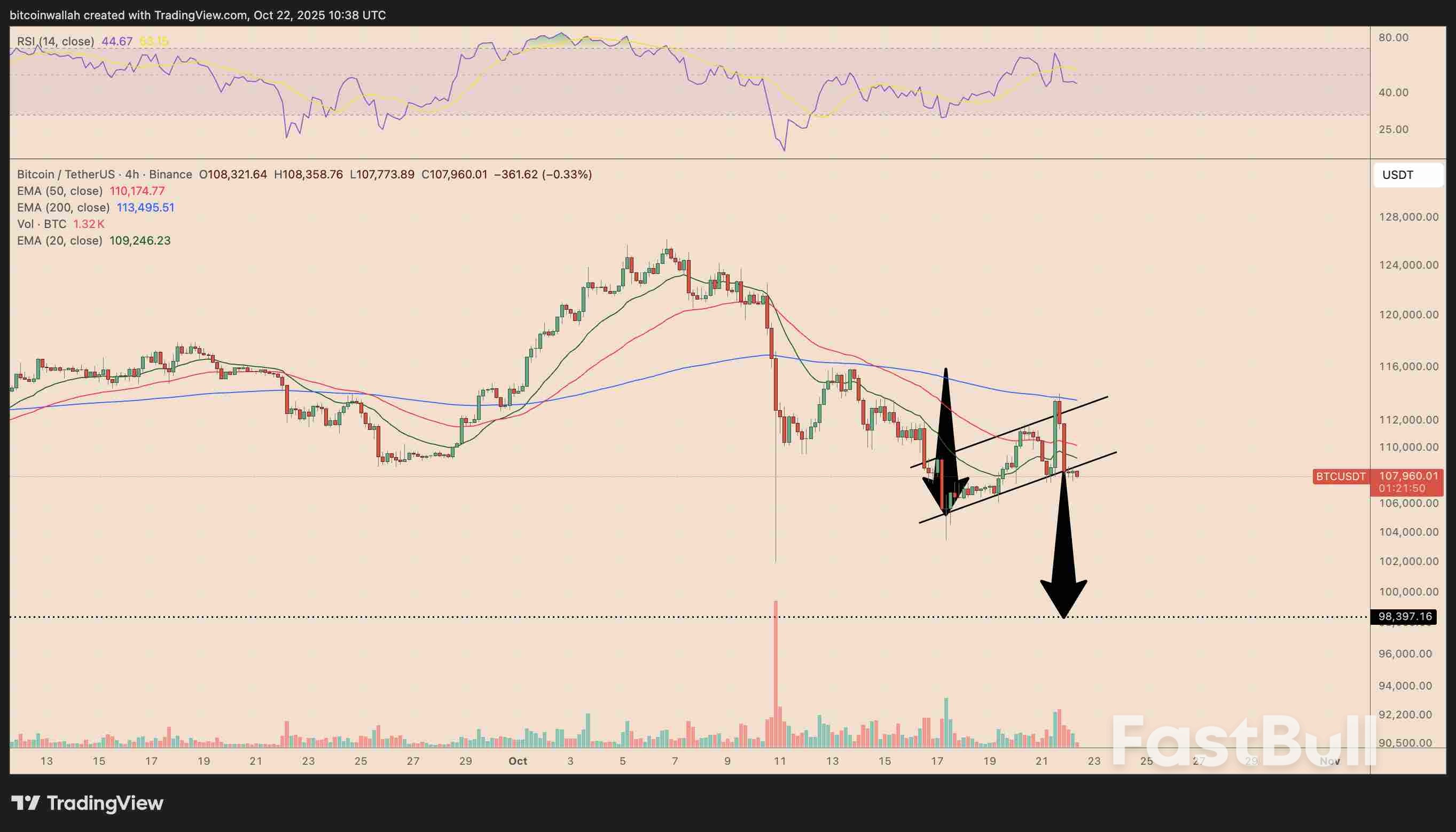
          Bitcoin risks testing $100,000 after breaking a key support level of a bear flag.
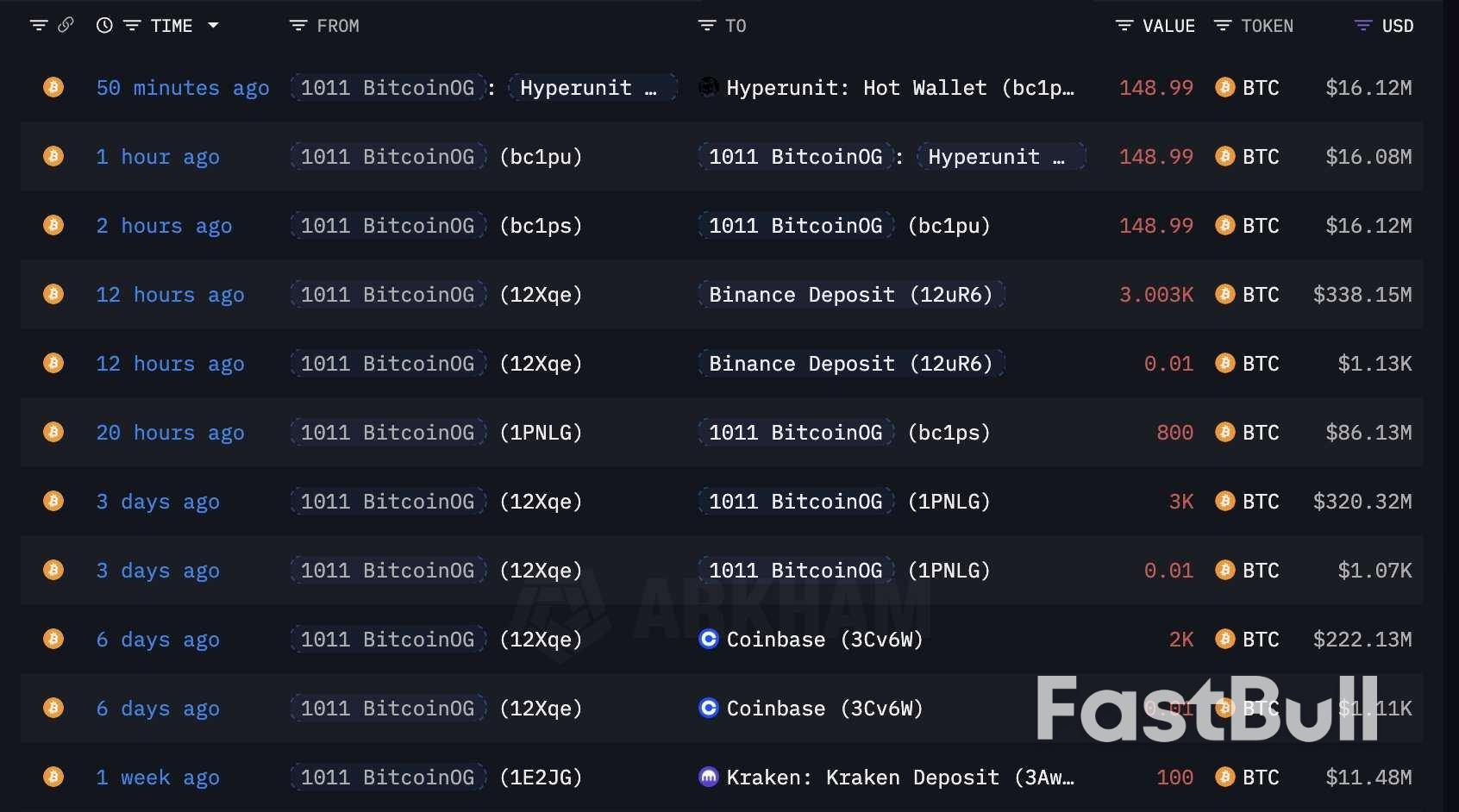
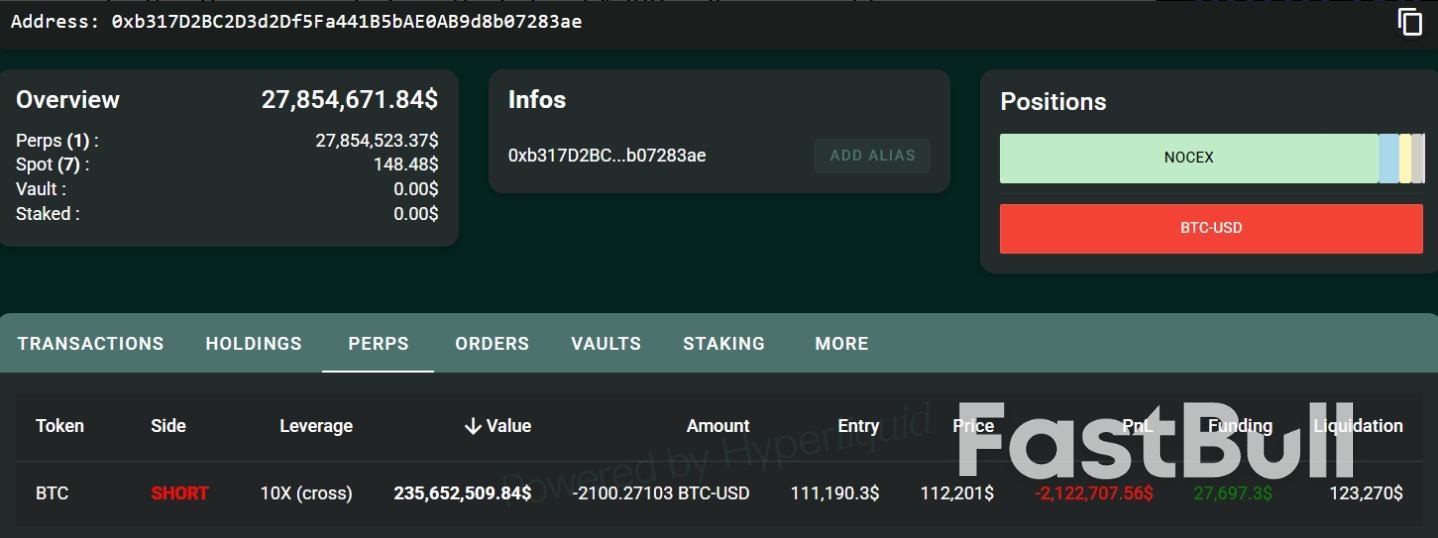
          The so-called “insider” whale moved 5,252 BTC ($588 million) to exchanges and opened a new $234 million short.
          Bitcoin is showing signs of technical weakness after breaking below a key short-term support level, coinciding with large BTC transfers from a so-called “insider” entity to major exchanges.

          Bear flag setup targets BTC prices below $100,000

          The BTC/USDT 4-hour chart shows Bitcoin slipping under the lower trendline of a bear flag, a continuation pattern that often signals further downside following a brief consolidation.Bitcoin Risks Drop Toward $100K as ‘Insider’ Whale Moves BTC to Exchanges_1

          BTC/USDT four-hour chart. Source: TradingView

          The projected target from the pattern breakdown points to around $98,000, aligning with the mid-June swing low.
          BTC also trades below its 20- (green) and 50-4H (red) exponential moving averages (EMAs), aligning with the $109,000-110,000 resistance area. Failure to reclaim this area as support could further validate the bearish setup.

          Mysterious whale bets more on Bitcoin dropping

          Bitcoin’s bear flag setup emerges against the backdrop of renewed activity by a notorious whale accused of manipulating prices.
          It is the same entity that pocketed over $200 million shorting Bitcoin during the China tariff crash two weeks ago. This so-called “insider” whale and “$10B Hyperunit Whale” has resurfaced with multiple massive bearish bets.
          First, it has transferred 5,252 BTC, worth about $588 million, to major exchanges including Coinbase, Binance, and Kraken, according to Arkham data.Bitcoin Risks Drop Toward $100K as ‘Insider’ Whale Moves BTC to Exchanges_2

          Source: Arkham

          Such large inflows often indicate the intention to sell or hedge positions.
          Meanwhile, the whale’s new $234 million short position on Hyperliquid, opened near $111,190 per BTC, is already sitting on about $6.7 million in unrealized profit, suggesting confidence that the downtrend has further to go.Bitcoin Risks Drop Toward $100K as ‘Insider’ Whale Moves BTC to Exchanges_3

          Source: Hypurrscan.IO

          Analyst CryptoNobler called the whale move “pure manipulation,” suggesting that it may intentionally dump his Bitcoin holdings in hopes that the prices drop toward its short position targets.
          The true identity of the whale remains unconfirmed, but blockchain sleuths have linked the wallet to Garrett Jin, former CEO of the defunct exchange BitForex.
          In now-deleted posts, Jin acknowledged the connection after clashing with Binance CEO CZ on X, later claiming the fund belongs to clients and not to him personally.
          Crypto analyst Quinten François has voiced skepticism over the alleged link between the Hyperliquid whale and BitForex’s former CEO, suggesting the connection might be “too neat to be credible” given the circumstantial nature of the evidence.

          Source: Cointelegraph

          Risk Warnings and Disclaimers
          You understand and acknowledge that there is a high degree of risk involved in trading. Following any strategies or investment methods may lead to potential losses. The content on the site is provided by our contributors and analysts for information purposes only. You are solely responsible for determining whether any trading assets, securities, strategy, or any other product is suitable for investing based on your own investment objectives and financial situation.
          Add to Favorites
          Share

          Historic precious metals decline reveals market divergence between gold and silver

          Adam

          Commodity

          Economic

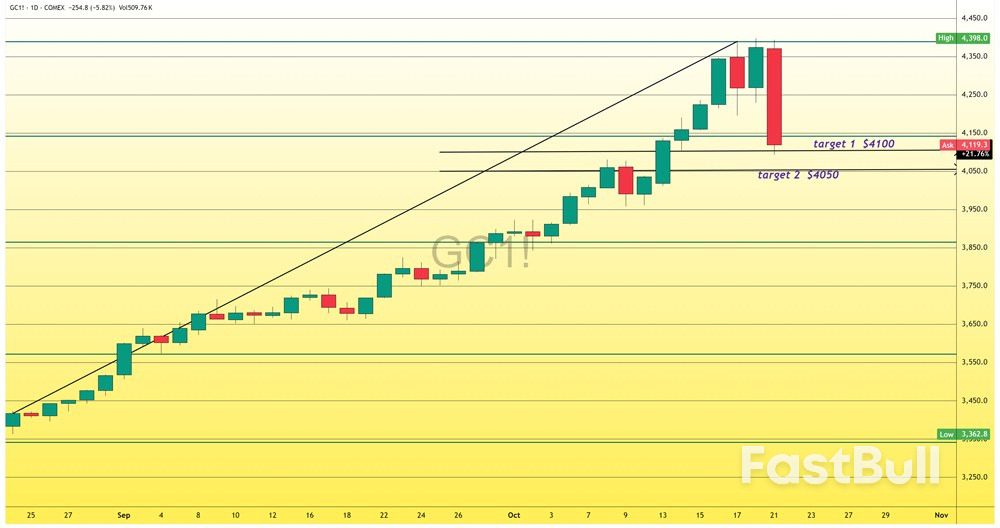
          The precious metals market experienced a dramatic downturn as gold plummeted $235, representing a 5.39% decline—the steepest single-day drop for the front-month contract since June 2013, according to FactSet data. Silver mirrored this bearish sentiment with its own substantial retreat, falling $3.72 (7.2%) to close at $48.66 in spot markets, marking its largest net decline since September 2011.
          Historic precious metals decline reveals market divergence between gold and silver_1
          For seasoned traders, gold's correction comes as no surprise. The market had been overdue for a significant pullback, and experienced market participants understood that when the reversal materialized, it would be both swift and severe. The extended rally without meaningful retracement created conditions ripe for a sharp decline, validating concerns that had been building among technical analysts.
          What stands out in this downturn is silver's comparative performance against gold. Historically, silver's percentage losses during sharp declines typically double those of gold, reflecting its higher volatility profile. However, this pattern failed to materialize in the recent sell-off. Silver's 7.2% decline, while substantial, was proportionally modest compared to gold's 5.39% drop, suggesting underlying strength in the white metal's market structure.
          This divergence becomes particularly meaningful when examined within the context of each metal's recent trajectory. Gold has been on a historic rally unprecedented in nearly five decades, characterized by parabolic price action that inevitably invites correction. Silver's advance, by contrast, has been measured and methodical—a gradual appreciation that suggests sustainability rather than speculative excess.
          The Valuation Gap
          The disparity in valuation between gold and silver presents a compelling case for further silver appreciation. At its recent peak, silver traded less than 10% above its 2011 record high. Gold, meanwhile, surged more than 128% beyond its 2011 benchmark at yesterday's apex. This stark contrast suggests silver remains substantially undervalued relative to its sister metal.
          As market participants reassess fair value following gold's correction, attention may shift toward silver's more attractive risk-reward profile. The revaluation process could prove significant, particularly given the fundamental supply constraints facing the silver market.
          Silver's supply situation has grown increasingly precarious, with mine production unable to satisfy surging demand. This structural deficit has manifested most visibly in physical premiums across global markets.
          London has experienced a liquidity crunch as suppliers struggle to meet voracious demand for the white metal, with traders paying approximately $1.35 premiums over North American prices.
          India's appetite for silver has intensified even more dramatically, creating what can only be described as a supply famine. Sellers in the Indian market have commanded premiums ranging from 10% to 25% above global spot prices—an extraordinary markup that underscores the severity of physical shortage and the intensity of demand.
          Gold's recent correction must be viewed through the lens of its exceptional run. The yellow metal has not experienced a true correction—defined as a 10% or greater decline—since October 2023, when all-time highs hovered around $2,500. From that reference point, gold rallied approximately $2,000 without experiencing a double-digit percentage retracement. Such an extended advance without meaningful consolidation virtually guaranteed an eventual sharp reversal.
          The current market dynamic suggests a potential rebalancing between gold and silver valuations. While gold's correction addresses overextended technical conditions, silver's gradual appreciation pattern and compelling supply-demand fundamentals position it favorably for continued gains. As investors digest gold's dramatic retreat and reassess precious metals allocations, silver's relative undervaluation and physical market tightness may attract increasing attention from both industrial users and investment capital seeking value in the precious metals complex.

          Source: kitco

          To stay updated on all economic events of today, please check out our Economic calendar
          Risk Warnings and Disclaimers
          You understand and acknowledge that there is a high degree of risk involved in trading. Following any strategies or investment methods may lead to potential losses. The content on the site is provided by our contributors and analysts for information purposes only. You are solely responsible for determining whether any trading assets, securities, strategy, or any other product is suitable for investing based on your own investment objectives and financial situation.
          Add to Favorites
          Share

          BOE Is Closely Monitoring Leveraged Finance After US Collapses

          Glendon

          Economic

          Forex

          The Bank of England is "closely monitoring" standards in leveraged finance markets and watching out for signs of forced selling by investors after the high-profile collapse of two US companies, according to an executive at the bank.

          Officials want to see what the fallout from Tricolor Holdings and First Brands Group says about "underwriting standards in practice, where the risk has been distributed within the financial system, the ability of those who ultimately hold the risk to be able to withstand this shock and behaviorally what might they do in response," Martin Arrowsmith, co-head of the central bank's Market Based Finance Division, said at a conference Wednesday.

          The collapse of two large constituents in credit markets has set firms looking at their books for distress, and the likes of JPMorgan Chase & Co.'s Jamie Dimon suggesting there are "cockroaches" triggering losses in corporate lending.

          Bank of England Governor Andrew Bailey stoked the debate on the systemic threat posed by private credit, stressing in comments Tuesday to a Parliament committee the critical role ratings companies will play in thwarting a sequel to the great financial crisis.

          While Arrowsmith said he wasn't concerned about any individual credit outside of the UK, he is interested in how banks and investors such as managers of collateralized loan obligations behaved in response to problems.

          "For instance, the actions of some of the CLOs to sell out of the exposure, while sensible individually, if it was a more widespread issue and there's lots of quasi forced selling, what does that mean for the functioning of some of these markets in stress," he said at the Association for Financial Markets in Europe's High Yield and Private Credit Conference.

          He said that the Bank of England, along with other policymakers, has been watching and calling out some of the "looseness" in markets for a while, and has been talking about issues in the so-called broadly syndicated lending space for at least a decade.

          Source: Bloomberg Europe

          To stay updated on all economic events of today, please check out our Economic calendar
          Risk Warnings and Disclaimers
          You understand and acknowledge that there is a high degree of risk involved in trading. Following any strategies or investment methods may lead to potential losses. The content on the site is provided by our contributors and analysts for information purposes only. You are solely responsible for determining whether any trading assets, securities, strategy, or any other product is suitable for investing based on your own investment objectives and financial situation.
          Add to Favorites
          Share
          FastBull
          Copyright © 2025 FastBull Ltd

          728 RM B 7/F GEE LOK IND BLDG NO 34 HUNG TO RD KWUN TONG KLN HONG KONG

          TelegramInstagramTwitterfacebooklinkedin
          App Store Google Play Google Play
          Products
          Charts

          Chats

          Q&A with Experts
          Screeners
          Economic Calendar
          Data
          Tools
          Membership
          Features
          Function
          Markets
          Copy Trading
          Latest Signals
          Contests
          News
          Analysis
          24/7
          Columns
          Education
          Company
          Careers
          About Us
          Contact Us
          Advertising
          Help Center
          Feedback
          User Agreement
          Privacy Policy
          Business

          White Label

          Data API

          Web Plug-ins

          Poster Maker

          Affiliate Program

          Risk Disclosure

          The risk of loss in trading financial instruments such as stocks, FX, commodities, futures, bonds, ETFs and crypto can be substantial. You may sustain a total loss of the funds that you deposit with your broker. Therefore, you should carefully consider whether such trading is suitable for you in light of your circumstances and financial resources.

          No decision to invest should be made without thoroughly conducting due diligence by yourself or consulting with your financial advisors. Our web content might not suit you since we don't know your financial conditions and investment needs. Our financial information might have latency or contain inaccuracy, so you should be fully responsible for any of your trading and investment decisions. The company will not be responsible for your capital loss.

          Without getting permission from the website, you are not allowed to copy the website's graphics, texts, or trademarks. Intellectual property rights in the content or data incorporated into this website belong to its providers and exchange merchants.

          Not Logged In

          Log in to access more features

          FastBull Membership

          Not yet

          Purchase

          Become a signal provider
          Help Center
          Customer Service
          Dark Mode
          Price Up/Down Colors

          Log In

          Sign Up
          Position
          Layout
          Fullscreen
          Default to Chart
          The chart page opens by default when you visit fastbull.com