• Trade
  • Markets
  • Copy
  • Contests
  • News
  • 24/7
  • Calendar
  • Q&A
  • Chats
Trending
Screeners
SYMBOL
LAST
BID
ASK
HIGH
LOW
NET CHG.
%CHG.
SPREAD
SPX
S&P 500 Index
6827.42
6827.42
6827.42
6899.86
6801.80
-73.58
-1.07%
--
DJI
Dow Jones Industrial Average
48458.04
48458.04
48458.04
48886.86
48334.10
-245.98
-0.51%
--
IXIC
NASDAQ Composite Index
23195.16
23195.16
23195.16
23554.89
23094.51
-398.69
-1.69%
--
USDX
US Dollar Index
97.950
98.030
97.950
98.500
97.950
-0.370
-0.38%
--
EURUSD
Euro / US Dollar
1.17394
1.17409
1.17394
1.17496
1.17192
+0.00011
+ 0.01%
--
GBPUSD
Pound Sterling / US Dollar
1.33707
1.33732
1.33707
1.33997
1.33419
-0.00148
-0.11%
--
XAUUSD
Gold / US Dollar
4299.39
4299.39
4299.39
4353.41
4257.10
+20.10
+ 0.47%
--
WTI
Light Sweet Crude Oil
57.233
57.485
57.233
58.011
56.969
-0.408
-0.71%
--

Community Accounts

Signal Accounts
--
Profit Accounts
--
Loss Accounts
--
View More

Become a signal provider

Sell trading signals to earn additional income

View More

Guide to Copy Trading

Get started with ease and confidence

View More

Signal Accounts for Members

All Signal Accounts

Best Return
  • Best Return
  • Best P/L
  • Best MDD
Past 1W
  • Past 1W
  • Past 1M
  • Past 1Y

All Contests

  • All
  • Trump Updates
  • Recommend
  • Stocks
  • Cryptocurrencies
  • Central Banks
  • Featured News
Top News Only
Share

Iranian Media Says 18 Crew Members Of Foreign Tanker Seized In Gulf Of Oman Over Carrying 'Smuggled Fuel' Detained

Share

Regional Governor: Two Killed In Ukrainian Drone Strike On Russia's Saratov

Share

Chinese Foreign Ministry - China Foreign Minister Met With United Arab Emirates Counterpart On Dec 12

Share

China's Central Financial And Economic Affairs Commission Deputy Director: Will Expand Export And Increase Import In 2026

Share

Thai Leader Anutin: Landmine Blast That Killed Thai Soldiers 'Not A Roadside Accident'

Share

Thai Leader Anutin: Thailand To Continue Military Action Until 'We Feel No More Harm'

Share

Cambodian Prime Minister Hun Manet Says He Had Phone Calls With Trump And Malaysian Leader Anwar About Ceasefire

Share

Cambodia's Hun Manet Says USA, Malaysia Should Verify 'Which Side Fired First' In Latest Conflict

Share

Cambodia's Hun Manet: Cambodia Maintains Its Stance In Seeking Peaceful Resolution Of Disputes

Share

Nasdaq Companies: Allergan, Ferrovia, Insmed, Monolithic Power Systems, Seagate Technology, And Western Digital Will Be Added To The NASDAQ 100 Index. Biogen, CdW, GlobalFoundries, Lululemon, ON Semiconductor, And Tradedesk Will Be Removed From The NASDAQ 100 Index

Share

Witkoff Headed To Berlin This Weekend To Meet With Zelenskiy, European Leaders -Wsj Reporter On X

Share

Russia Attacks Two Ukrainian Ports, Damaging Three Turkish-Owned Vessels

Share

[Historic Flooding Occurs In At Least Four Rivers In Washington State Due To Days Of Torrential Rains] Multiple Areas In Washington State Have Been Hit By Severe Flooding Due To Days Of Torrential Rains, With At Least Four Rivers Experiencing Historic Flooding. Reporters Learned On The 12th That The Floods Caused By The Torrential Rains In Washington State Have Destroyed Homes And Closed Several Highways. Experts Warn That Even More Severe Flooding May Occur In The Future. A State Of Emergency Has Been Declared In Washington State

Share

Trump Says Proposed Free Economic Zone In Donbas Would Work

Share

Trump: I Think My Voice Should Be Heard

Share

Trump Says Will Be Choosing New Fed Chair In Near Future

Share

Trump Says Proposed Free Economic Zone In Donbas Complex But Would Work

Share

Trump Says Land Strikes In Venezuela Will Start Happening

Share

US President Trump: Thailand And Cambodia Are In A Good Situation

Share

State Media: North Korean Leader Kim Hails Troops Returning From Russia Mission

TIME
ACT
FCST
PREV
U.K. Trade Balance Non-EU (SA) (Oct)

A:--

F: --

P: --

U.K. Trade Balance (Oct)

A:--

F: --

P: --

U.K. Services Index MoM

A:--

F: --

P: --

U.K. Construction Output MoM (SA) (Oct)

A:--

F: --

P: --

U.K. Industrial Output YoY (Oct)

A:--

F: --

P: --

U.K. Trade Balance (SA) (Oct)

A:--

F: --

P: --

U.K. Trade Balance EU (SA) (Oct)

A:--

F: --

P: --

U.K. Manufacturing Output YoY (Oct)

A:--

F: --

P: --

U.K. GDP MoM (Oct)

A:--

F: --

P: --

U.K. GDP YoY (SA) (Oct)

A:--

F: --

P: --

U.K. Industrial Output MoM (Oct)

A:--

F: --

P: --

U.K. Construction Output YoY (Oct)

A:--

F: --

P: --

France HICP Final MoM (Nov)

A:--

F: --

P: --

China, Mainland Outstanding Loans Growth YoY (Nov)

A:--

F: --

P: --

China, Mainland M2 Money Supply YoY (Nov)

A:--

F: --

P: --

China, Mainland M0 Money Supply YoY (Nov)

A:--

F: --

P: --

China, Mainland M1 Money Supply YoY (Nov)

A:--

F: --

P: --

India CPI YoY (Nov)

A:--

F: --

P: --

India Deposit Gowth YoY

A:--

F: --

P: --

Brazil Services Growth YoY (Oct)

A:--

F: --

P: --

Mexico Industrial Output YoY (Oct)

A:--

F: --

P: --

Russia Trade Balance (Oct)

A:--

F: --

P: --

Philadelphia Fed President Henry Paulson delivers a speech
Canada Building Permits MoM (SA) (Oct)

A:--

F: --

P: --

Canada Wholesale Sales YoY (Oct)

A:--

F: --

P: --

Canada Wholesale Inventory MoM (Oct)

A:--

F: --

P: --

Canada Wholesale Inventory YoY (Oct)

A:--

F: --

P: --

Canada Wholesale Sales MoM (SA) (Oct)

A:--

F: --

P: --

Germany Current Account (Not SA) (Oct)

A:--

F: --

P: --

U.S. Weekly Total Rig Count

A:--

F: --

P: --

U.S. Weekly Total Oil Rig Count

A:--

F: --

P: --

Japan Tankan Large Non-Manufacturing Diffusion Index (Q4)

--

F: --

P: --

Japan Tankan Small Manufacturing Outlook Index (Q4)

--

F: --

P: --

Japan Tankan Large Non-Manufacturing Outlook Index (Q4)

--

F: --

P: --

Japan Tankan Large Manufacturing Outlook Index (Q4)

--

F: --

P: --

Japan Tankan Small Manufacturing Diffusion Index (Q4)

--

F: --

P: --

Japan Tankan Large Manufacturing Diffusion Index (Q4)

--

F: --

P: --

Japan Tankan Large-Enterprise Capital Expenditure YoY (Q4)

--

F: --

P: --

U.K. Rightmove House Price Index YoY (Dec)

--

F: --

P: --

China, Mainland Industrial Output YoY (YTD) (Nov)

--

F: --

P: --

China, Mainland Urban Area Unemployment Rate (Nov)

--

F: --

P: --

Saudi Arabia CPI YoY (Nov)

--

F: --

P: --

Euro Zone Industrial Output YoY (Oct)

--

F: --

P: --

Euro Zone Industrial Output MoM (Oct)

--

F: --

P: --

Canada Existing Home Sales MoM (Nov)

--

F: --

P: --

Euro Zone Total Reserve Assets (Nov)

--

F: --

P: --

U.K. Inflation Rate Expectations

--

F: --

P: --

Canada National Economic Confidence Index

--

F: --

P: --

Canada New Housing Starts (Nov)

--

F: --

P: --

U.S. NY Fed Manufacturing Employment Index (Dec)

--

F: --

P: --

U.S. NY Fed Manufacturing Index (Dec)

--

F: --

P: --

Canada Core CPI YoY (Nov)

--

F: --

P: --

Canada Manufacturing Unfilled Orders MoM (Oct)

--

F: --

P: --

Canada Manufacturing New Orders MoM (Oct)

--

F: --

P: --

Canada Core CPI MoM (Nov)

--

F: --

P: --

Canada Manufacturing Inventory MoM (Oct)

--

F: --

P: --

Canada CPI YoY (Nov)

--

F: --

P: --

Canada CPI MoM (Nov)

--

F: --

P: --

Canada CPI YoY (SA) (Nov)

--

F: --

P: --

Canada Core CPI MoM (SA) (Nov)

--

F: --

P: --

Q&A with Experts
    • All
    • Chatrooms
    • Groups
    • Friends
    Connecting
    .
    .
    .
    Type here...
    Add Symbol or Code

      No matching data

      All
      Trump Updates
      Recommend
      Stocks
      Cryptocurrencies
      Central Banks
      Featured News
      • All
      • Russia-Ukraine Conflict
      • Middle East Flashpoint
      • All
      • Russia-Ukraine Conflict
      • Middle East Flashpoint
      Search
      Products

      Charts Free Forever

      Chats Q&A with Experts
      Screeners Economic Calendar Data Tools
      Membership Features
      Data Warehouse Market Trends Institutional Data Policy Rates Macro

      Market Trends

      Market Sentiment Order Book Forex Correlations

      Top Indicators

      Charts Free Forever
      Markets

      News

      News Analysis 24/7 Columns Education
      From Institutions From Analysts
      Topics Columnists

      Latest Views

      Latest Views

      Trending Topics

      Top Columnists

      Latest Update

      Signals

      Copy Rankings Latest Signals Become a signal provider AI Rating
      Contests
      Brokers

      Overview Brokers Assessment Rankings Regulators News Claims
      Broker listing Forex Brokers Comparison Tool Live Spread Comparison Scam
      Q&A Complaint Scam Alert Videos Tips to Detect Scam
      More

      Business
      Events
      Careers About Us Advertising Help Center

      White Label

      Data API

      Web Plug-ins

      Affiliate Program

      Awards Institution Evaluation IB Seminar Salon Event Exhibition
      Vietnam Thailand Singapore Dubai
      Fans Party Investment Sharing Session
      FastBull Summit BrokersView Expo
      Recent Searches
        Top Searches
          Markets
          News
          Analysis
          User
          24/7
          Economic Calendar
          Education
          Data
          • Names
          • Latest
          • Prev

          View All

          No data

          Scan to Download

          Faster Charts, Chat Faster!

          Download App
          English
          • English
          • Español
          • العربية
          • Bahasa Indonesia
          • Bahasa Melayu
          • Tiếng Việt
          • ภาษาไทย
          • Français
          • Italiano
          • Türkçe
          • Русский язык
          • 简中
          • 繁中
          Open Account
          Search
          Products
          Charts Free Forever
          Markets
          News
          Signals

          Copy Rankings Latest Signals Become a signal provider AI Rating
          Contests
          Brokers

          Overview Brokers Assessment Rankings Regulators News Claims
          Broker listing Forex Brokers Comparison Tool Live Spread Comparison Scam
          Q&A Complaint Scam Alert Videos Tips to Detect Scam
          More

          Business
          Events
          Careers About Us Advertising Help Center

          White Label

          Data API

          Web Plug-ins

          Affiliate Program

          Awards Institution Evaluation IB Seminar Salon Event Exhibition
          Vietnam Thailand Singapore Dubai
          Fans Party Investment Sharing Session
          FastBull Summit BrokersView Expo

          Bitcoin 'Power Law' Sees Up to 300% BTC Price Gains by Late 2025

          Warren Takunda

          Cryptocurrency

          Summary:

          BTC price momentum is still at least three months from returning upward, says analysis, but the outlook for the coming years should delight Bitcoin bulls.
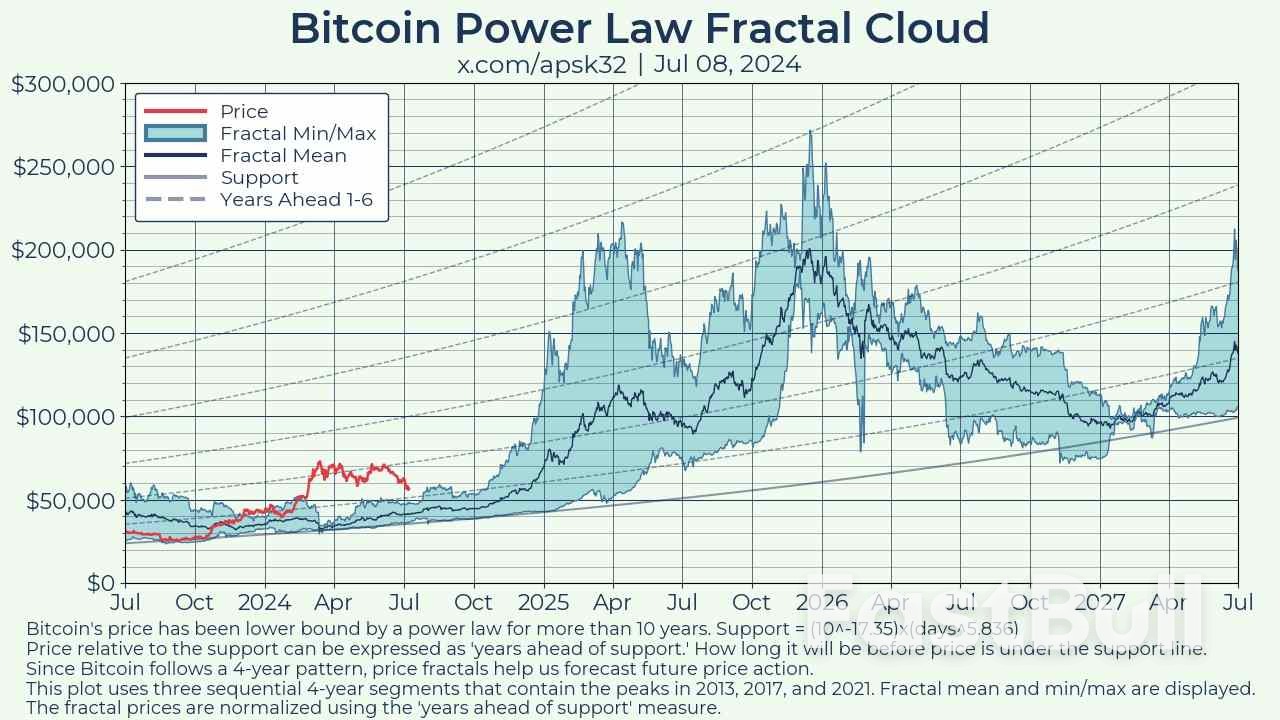
          Bitcoin has three months to go until the bull market resumes — but can still see 300% gains by 2026.

          BTC price "acceleration" not due for at least 3 months

          In a post on X (formerly Twitter) on July 9, Apsk32 returned to his Power Law metric to chart likely Bitcoin market performance in the years to come.
          The Power Law essentially provides a lower BTC price support band which has held since BTC/USD traded at just $1. Several other bands, or “time contours,” provide additional price information, ultimately giving a $1 million price target for 2036.
          “Time contours tell us how long it will be before the support forces current prices upwards. For 12 years, every bear market has returned to this support line,” part of a previous X post from June explains.
          “The support passes one million dollars in 2036 and bitcoin isn't stopping there.”
          Now, relaying past price action onto the current four-year cycle, as defined by Apsk32, is helping to explain current market behavior — including the ongoing 25% drop from March’s $73,800 all-time highs.
          “If bitcoin's cycle pattern continues, price should remain inside or near this blue cloud,” the latest post summarized.
          “The ETFs pushed us out of the cloud and now we're reverting back. We're 3+ months away from upwards acceleration and we could see prices go up 4x by the end of 2025.”

          Bitcoin 'Power Law' Sees Up to 300% BTC Price Gains by Late 2025_1Bitcoin Power Law Fractal Cloud. Source: Apsk32/X
          An accompanying chart shows the so-called “Power Law Fractal Cloud” — a guideline range for BTC/USD going forward.
          “Does the price have to stay within the cloud? Absolutely not,” Apsk32 acknowledged.
          “This time could be different, in fact it already is.”

          Bitcoin "moving from weak to strong hands"

          As Cointelegraph continues to report, Bitcoin traders are poised for further BTC price downside as a feeling of fear takes over across crypto.
          Sub-$50,000 levels have returned to the radar, these again bringing the current drawdown in line with those past.
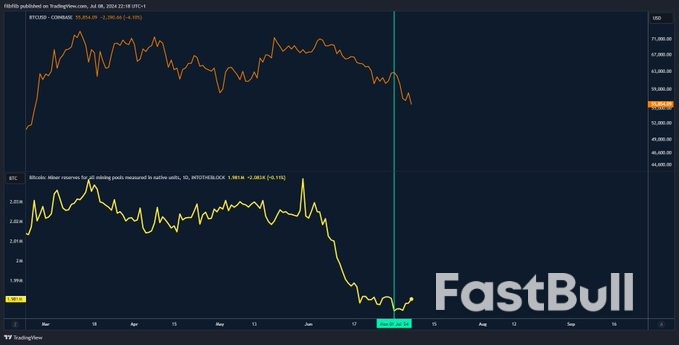
          Sources of optimism meanwhile include reduced selling by Bitcoin miners over the past month, along with a return to net inflows for the United States spot Bitcoin exchange-traded funds (ETFs).Bitcoin 'Power Law' Sees Up to 300% BTC Price Gains by Late 2025_2

          Source: Filbfilb

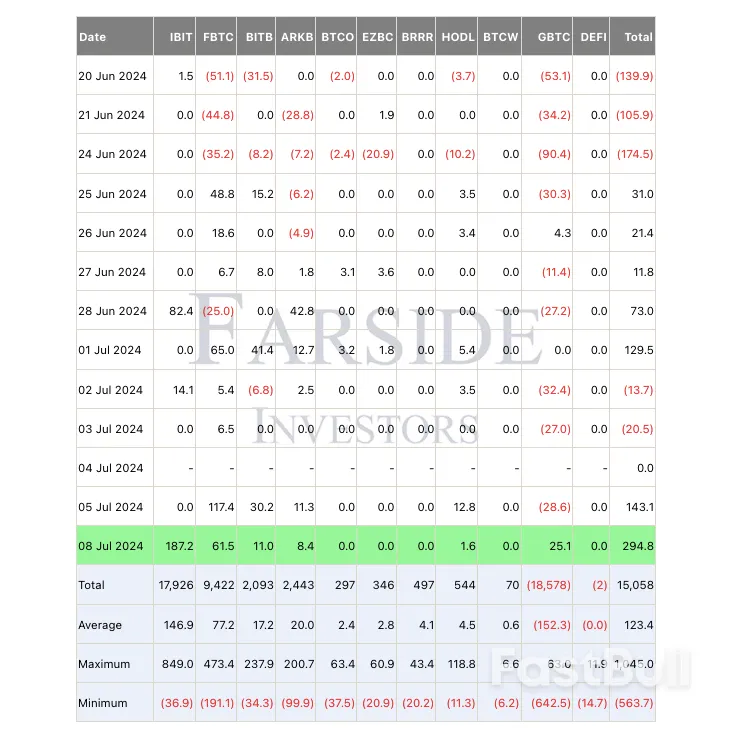
          The latter saw inflows of nearly $300 million on July 8, marking their best single-day tally in over a month, per data from sources including United Kingdom-based investment firm Farside Investors.Bitcoin 'Power Law' Sees Up to 300% BTC Price Gains by Late 2025_3

          U.S. spot Bitcoin ETF net flows (screenshot). Source: Farside Investors

          "Looks like the boomers & institutions are buying the dip here, while Germany offloads a bunch of coins," popular trader Jelle wrote in part of a response, contrasting ETF buying with BTC sales by the German government.
          "Coins moving from weak, to strong hands."

          Source: Cointelegraph

          Risk Warnings and Disclaimers
          You understand and acknowledge that there is a high degree of risk involved in trading. Following any strategies or investment methods may lead to potential losses. The content on the site is provided by our contributors and analysts for information purposes only. You are solely responsible for determining whether any trading assets, securities, strategy, or any other product is suitable for investing based on your own investment objectives and financial situation.
          Add to Favorites
          Share

          U.S. Dollar Rises as Markets Await Powell's Testimony

          Alex

          Economic

          The U.S. dollar edged higher on Tuesday from its lowest levels in almost a month versus major peers in the previous session, as traders awaited testimony from Federal Reserve Chair Jerome Powell days after an unexpectedly soft U.S. jobs report. The euro held its ground after Monday's sharp swings as investors came to terms with a hung parliament in France, indicating potential political gridlock, but lessening fiscal concerns from far-right or leftist victories.
          The U.S. dollar index, which measures the currency against six major peers, was last up 0.1% at 105.06, rising from an overnight low of 104.80, a 3-1/2-week trough. The index slumped nearly 1% last week, exacerbated by Friday's monthly payrolls report, boosting bets for the Fed to soon start cutting rates.
          Traders currently see about a 76% chance of a rate cut at the September meeting, up from 66% a week ago, according to the CME Group's FedWatch Tool. Another cut is expected by December. "The recent run of weaker economic data (is) pointing to the prospect of Powell being more willing to signal the potential for rate cuts," said Derek Halpenny, currency strategist at MUFG. "We see the dollar as vulnerable to further selling today given the macro backdrop." Chair Powell is set to give two days of testimony before Congress, beginning later in the day, with the Senate and followed by the House on Wednesday.
          The consumer price index (CPI) data on Thursday could also be crucial, market watchers said, with recent numbers showing a cooling from unexpectedly high levels at the start of the year. The euro was trading lower at $1.0819, not far from Monday's nearly four-week peak of $1.0845. The single currency also dipped as low as $1.07915 the same day.
          Europe's single currency has bounced around in recent weeks due to uncertainty over French politics, which still remains even after Sunday's vote. The French left said on Monday it wanted to run the government, but conceded talks would be tough and take time. "The euro appears to be waiting for cues from French coalition talks, with scenarios ranging from a left-wing government to a market-friendly technocrat prime minister," said Francesco Pesole, currency strategist at ING. "FX volatility has continued to drop in the meantime, but EU politics, Powell's testimony today and U.S. CPI on Thursday may revamp it." Sterling was also down slightly at $1.2799, after rising as high as $1.28455 on Monday, its strongest levels since June 12.
          The yen was little changed at 160.93 per dollar, finding some equilibrium this week after rebounding from Wednesday's nearly 38-year trough of 161.96. The currency has found little succour in increased speculation the Bank of Japan may raise rates again on July 31, following the first hike since 2007 in March. Japan's central bank is also due to announce a plan for quantitative tightening at its month-end policy meeting. The BOJ on Tuesday released a summary of opinions it collected in a survey of bond market participants on how the central bank should taper its huge bond purchases.

          Source:Devdiscourse

          To stay updated on all economic events of today, please check out our Economic calendar
          Risk Warnings and Disclaimers
          You understand and acknowledge that there is a high degree of risk involved in trading. Following any strategies or investment methods may lead to potential losses. The content on the site is provided by our contributors and analysts for information purposes only. You are solely responsible for determining whether any trading assets, securities, strategy, or any other product is suitable for investing based on your own investment objectives and financial situation.
          Add to Favorites
          Share

          How a Trump Election Victory Could Ruffle Latin American Markets

          Cohen

          Economic

          The possibility of former President Donald Trump winning back the White House in November has investors preparing for various scenarios, with "America's backyard" high on the list of markets to look out for.
          The Trump administration had terse relations with much of Latin America, including during the distribution of COVID-19 vaccines and when the U.S. government withheld key financial aid in exchange for stricter migration policies in Central America.
          Below are flash points identified by investors anticipating how a possible second Trump administration could impact the region:

          A Good Neighbor

          Mexico has long been an emerging markets weather vane for U.S. policy and its impact on wider emerging markets, but this time domestic factors would make the situation more complex.
          Trump's 2016 election win sent the peso down nearly 8% in a week.
          But this time around, the peso is already down 6% this year after slumping in June when the ruling party in the country's election closed in on a super-majority, with markets fearing constitutional changes and diminished checks and balances.
          On U.S.-Mexico relations, trade is expected to top the agenda, according to analysts. Trump spearheaded the revamp of the U.S.-Mexico-Canada (USMCA) trade deal and a scheduled review is two years away. The next U.S. president gets a chance to confirm whether his country will stay in it.
          "Trump is very unlikely to exit USMCA, but he might threaten to do so in order to extract higher tariffs and more inward investment in U.S. manufacturing," said Hasnain Malik, head of equity research at Tellimer in Dubai.
          "For Mexico, more broadly, the relationship will be less comfortable, with Trump's focus on border controls potentially hurting longer-term growth of remittances."
          The peso is expected to be volatile ahead of the U.S. election as traders use it to hedge or to double down on the probability of Biden being reelected.How a Trump Election Victory Could Ruffle Latin American Markets_1

          Personal Relationships

          Two of Latin America's most flamboyant right-wing populists - El Salvador's President Nayib Bukele and Argentina's President Javier Milei - featured with Trump in February's Conservative Political Action Conference, which is the largest meeting of U.S. conservative activists and politicians. Both countries are looking for financial support from the Washington-based International Monetary Fund (IMF).
          Back in 2018, Trump outspokenly supported Argentina's then-president Mauricio Macri in his push for IMF money, which developed into a massive $44 billion program. Milei, a public Trump-backer, is widely expected to ask for fresh cash once the current program ends in December - if not before.
          El Salvador's Bukele is also expected to reengage with the IMF after the U.S. election with the aim of getting a new program. An El Salvador offer in April of a bond that would bump up returns if the country failed to get either a new IMF program or a significant credit rating lift in the next 18 months was seen by analysts as a Bukele bet on Trump winning the White House and putting in a good word for him at the IMF.
          "(Bukele) is pretty tight with the Republicans," said Thys Louw, portfolio manager with Ninety One, adding El Salvador is also trying to find new financing elsewhere.
          "The hope is that once you get a Trump administration, they'll lean on the IMF, and the IMF will be much more lenient towards them."How a Trump Election Victory Could Ruffle Latin American Markets_2

          Venezuela Sanctions Prospects

          The way Venezuela's July 28 presidential election will unfold could likely determine whether it has any prospect of rejoining the international community. In his previous term, Trump ratcheted up sanctions against the South American oil producer; Biden has tried to reestablish ties with a view of guaranteeing fair elections.
          The next U.S. president will likely determine whether a massive debt restructuring - Venezuela owes at least $60 billion on sovereign bonds alone - will come to pass, as it requires new bond issuance, currently barred by U.S. sanctions.
          "Venezuela is one of those countries that is likely to be subject to change under a Trump administration," said Bradley Wickens, CEO of Broad Reach Investment Management, adding Venezuelan bonds trading at deeply distressed prices could be enticing to investors against the backdrop of a detente between Washington and Caracas.
          "Not sure that continues under Trump."
          Relationships with Cuba and Nicaragua, both led by authoritarian governments, are also expected to strain further under a Trump administration.How a Trump Election Victory Could Ruffle Latin American Markets_3

          China Trade War Escalation

          Hurdles and added costs to trade with China imposed during the Trump administration were kept in place by Biden, who has further ratcheted up the heat on Beijing.
          Some analysts expect if the trade war with China intensifies, Beijing might opt to devalue its currency to make exports more competitive. Such a move could be felt by commodity exporters in Latin America, with Brazil, Argentina, Mexico and Chile among Beijing's largest regional trade partners.How a Trump Election Victory Could Ruffle Latin American Markets_4

          Source: Reuters

          To stay updated on all economic events of today, please check out our Economic calendar
          Risk Warnings and Disclaimers
          You understand and acknowledge that there is a high degree of risk involved in trading. Following any strategies or investment methods may lead to potential losses. The content on the site is provided by our contributors and analysts for information purposes only. You are solely responsible for determining whether any trading assets, securities, strategy, or any other product is suitable for investing based on your own investment objectives and financial situation.
          Add to Favorites
          Share

          Iran’s New President May Be A Reformist, But Change Remains Distant

          Cohen

          Economic

          Political

          Iran on Friday elected its first "reformist" president in 20 years, signaling many voters' rejection of hardline conservative policies amid low turnout of just 49%, according to official figures.
          Masoud Pezeshkian, a former health minister and member of parliament, was the most moderate of the candidates vying for the presidency after the sudden death of former President Ibrahim Raisi in a helicopter crash in May.
          Described as a "token reformist" and "second-tier candidate" by many analysts, the 69-year-old Pezeshkian was seen as having scant chance at the presidency as he lacked name recognition and was up against a highly conservative system.
          "The whole election process leading to Pezeshkian's victory now has indeed been surprising. It does mark a notable shift in Iran's political landscape," Sina Toossi, a senior non-resident fellow at the Center for International Policy, told CNBC.
          The result, Toossi said, "reflects a complex interplay of voter discontent, abstention, and a desire for change. Despite the heavily controlled and undemocratic nature of the election process, Pezeshkian's success signals a rejection of hardline extremism and an appetite for reform and better relations with the global community."
          His victory at the polls was all the more surprising given the fact that Iran's ultra-conservative Guardian Council decides who is allowed to run for election in the first place, heavily favoring conservative candidates.
          Still, Pezeshkian "faces substantial challenges from entrenched hardliners and external pressures, making his presidency a critical and uncertain chapter for Iran's future," Toossi said.

          How much can change, really?

          Pezeshkian, a former heart surgeon who served as minister of health under the 1997-2005 mandate of Iran's last reformist president Mohammad Khatami, said he wants to loosen social restrictions like Iran's strict hijab law and improve relations with the West, including potentially restarting nuclear talks with world powers.
          But "reformist" is a relative term in Iran, as Pezeshkian still voices his support for the supreme leader Ayatollah Ali Khamenei and has expressed no intention to challenge the theocratic system of the Islamic Republic.
          Pezeshkian "is a reformist who has many times over the last few weeks come out and said that Khamenei's way, or direction, is the way, and he fully intends to follow that path," said Nader Itayim, Mideast Gulf editor at Argus Media.
          "He's not a reformist who is going to try to come in and shake things up. In that sense he's a low-risk option" for Khamenei and may have been seen by religious authorities as "manageable," Itayim said.
          For Behnam Ben Taleblu, a senior fellow at the Foundation for Defense of Democracies at the Washington-based think tank Foundation for Defense of Democracies, the election of Pezeshkian is nothing more than a cosmetic change.
          “Pezeshkhian offers the regime the chance to once again offer stylistic changes in exchange for substantive concessions from the West,” Ben Taleblu said.
          “Faced with mounting domestic and international challenges, particularly after the 2022-2023 ‘Women, Life, Freedom’ nationwide uprising against the regime, Tehran is trying to again tempt the West with the same fiction of moderation.”
          Months of protests for women’s rights and the downfall of the Iranian regime rocked Iran and its hardline government following the death of a young Kurdish Iranian woman named Mahsa Amini in September 2022. Amini died in police custody after being arrested for allegedly improperly wearing her headscarf, which women in Iran are required to wear.
          The protests led to severe crackdowns and frequent internet blackouts by Iranian authorities, as well as thousands of arrests and several executions.
          But despite Pezeshkian’s stated support for relaxing things like headscarf penalties, Iran-focused human rights groups are not optimistic.
          “Anyone pledging loyalty to the [Iranian] constitution, a ‘reformist,’ a ‘moderate,’ a ‘conservative,’ … is ultimately a hardliner by democratic standards,” the Washington-based Abdorrahman Boroumand Center for Human Rights in Iran wrote in a report Friday. “This is why many Iranians have lost hope in bringing about change through the ballot boxes and are boycotting elections.”
          “The choice of the president may lead to minor shifts but, even in the best case scenario, it will fail to bring significant change to Iran,” the report read. “The core structure of Iran’s theocratic regime, where a Supreme Leader’s authority eclipses that of any president, will remain steadfastly intact… In essence, Iran’s theocracy is designed to resist meaningful change.”

          What if Trump wins?

          Turning to foreign policy, analysts predict no change in the support and funding for regional proxy groups like Hezbollah in Lebanon, Hamas in the Gaza Strip and the Houthi rebels in Yemen — something that the Iranian president himself has little power over anyway.
          Pezeshkian wants to focus on sanctions relief for Iran and its battered economy and has talked about repairing some relations with the West, particularly on the issue the Iranian nuclear deal, which lifted harsh economic sanctions in exchange for curbs on the country’s nuclear program.
          Iran is now closer than ever to bomb-making capability, according to the International Atomic Energy Agency — and at the same time, former President Donald Trump, who introduced a strict set of sanctions against Tehran during his previous term, may return to the White House in November. If Trump takes office and maintains his previously staunch position of piling sanctions on Iran and abandoning the nuclear deal, then Pezeshkian’s goals are essentially futile.
          The Iranian election result presents a “potential to open up to the West, but comes at precisely the wrong time given we are at the [potential] end of the Biden presidency, and likely a Trump presidency and the GOP hawks will have zero interest of engagement with Iran,” Tim Ash, senior emerging markets strategist at RBC BlueBay Asset Management, said in an email note.
          “Notable I think that Iran, like the Gulf states, would want to concentrate on the economy as a drive to alleviate political pressure,” he added, “but seems unlikely that given the U.S. political cycle, and events in Gaza, there will be any desire to open up to ‘reformers’ in Iran.”

          Source:CNBC

          To stay updated on all economic events of today, please check out our Economic calendar
          Risk Warnings and Disclaimers
          You understand and acknowledge that there is a high degree of risk involved in trading. Following any strategies or investment methods may lead to potential losses. The content on the site is provided by our contributors and analysts for information purposes only. You are solely responsible for determining whether any trading assets, securities, strategy, or any other product is suitable for investing based on your own investment objectives and financial situation.
          Add to Favorites
          Share

          BOJ Sounds Out Market Players Before Finalizing Bond-Buying Cuts

          Alex

          Central Bank

          Economic

          The Bank of Japan started sounding out market participants for their views on how aggressively it should cut back its bond-buying as it looks to finalize its plans at the end of this month.
          Representatives from banks, securities firms and those buying bonds for financial institutions offered a wide range of suggestions for the targeted monthly purchases by the central bank in a survey conducted ahead of hearings on Tuesday and Wednesday.
          Among the answers received, respondees suggested cutting the BOJ’s monthly buying of Japanese government bonds to zero, to a range between ¥2 trillion ($12.4 billion) and ¥3 trillion, and to ¥4 trillion, reference materials released by the bank showed. The figures compare with the current monthly purchase pace of roughly ¥6 trillion.
          BOJ Sounds Out Market Players Before Finalizing Bond-Buying Cuts_1
          These views along with the favored form of guidance on purchases and the best maturity zones to target were among the themes discussed during the first hearing on Tuesday, a BOJ official said.
          The reference materials didn’t indicate the specifics of the BOJ’s plans for cutting back its bond purchases. But by holding the meetings the bank can say it gave participants in the market a chance to convey their views as it assesses how quickly it can reduce its huge footprint in the bond market ahead of the unveiling of its plans on July 31.
          “The BOJ likely has some plans already,” said Naomi Muguruma, chief fixed-income strategist at Mitsubishi UFJ Morgan Stanley Securities Co. “What it wants to show is a stance of proceeding cautiously by hosting the gatherings.”
          The BOJ has long been characterized as the whale in the pond of Japanese government debt as it pushed other buyers out of the water during an aggressive quantitative easing program that lasted more than a decade.
          During that time the bank scooped up more than half of Japan’s outstanding government bonds, creating the potential for its quantitative tightening moves to have major ripples in the market.
          Governor Kazuo Ueda’s board decided to slow the pace of bond buying at a policy meeting last month. The BOJ chief said he wanted to construct the plan carefully and that it merited hearings with market players before it was finalized conclusion.
          “These two days are going to be critical,” said Yuuki Fukumoto, senior financial researcher at NLI Research Institute. “For the BOJ, the key point is to hear and gather information on how much more bond-buying the market can take to assuage its concerns.”
          According to a Bloomberg survey late last month, BOJ watchers predict the central bank will start by reducing its monthly purchases to around ¥5 trillion from the current ¥6 trillion. They expect that pace to slow to ¥3 trillion in two years.
          Ueda said the size of the reduction would be “sizable” while declining to elaborate further at a post-meeting press conference on June 14. Takahide Kiuchi, a former BOJ board member, said Ueda’s comments implied the reduction would be bigger than the expected first cut.
          “Ueda must have been aware that the ¥5 trillion figure has been doing the rounds for a while before he made that remark,” Kiuchi said. “So it could even be as low as ¥3 trillion.”
          A larger cut than consensus may help ease pressure on the yen by crystalizing the BOJ’s aggressive stance on QT, according to some analysts. The yen weakened to a 38-year low this month, fueling views that the bank will want to avoid any further dovish signals.
          The BOJ’s plans are highly significant for the finance ministry. The retreat of the BOJ as the main buyer in the market has implications for yields that could push up the servicing costs of Japan’s massive national debt. It will also likely require a rethink of its own bond issuance management.
          At the same time, a half-hearted reduction could send the yen lower, forcing the ministry to intervene in markets again to prop up the currency.
          “These are important talks so I’ll be carefully watching out for what is discussed,” Finance Minister Shunichi Suzuki said Tuesday morning. “I haven’t made any specific requests.”
          While some economists surveyed expect the bank’s purchases to eventually fall to zero, Atsushi Miyanoya, a former BOJ executive director, said there is “absolutely no chance” of that happening. The bank already bought close to ¥2 trillion of bonds per month to stabilize the market before it kicked off a massive monetary easing program in 2013.
          The BOJ ended its large-scale easing in March but decided to keep buying roughly the same amount of bonds to avoid triggering shockwaves in financial markets.
          The central bank’s ¥585 trillion pile of bonds is bigger than the size of the world’s fourth-largest economy and a key reason bond players must be on a high alert for the BOJ’s next move.

          Source:Bloomberg

          To stay updated on all economic events of today, please check out our Economic calendar
          Risk Warnings and Disclaimers
          You understand and acknowledge that there is a high degree of risk involved in trading. Following any strategies or investment methods may lead to potential losses. The content on the site is provided by our contributors and analysts for information purposes only. You are solely responsible for determining whether any trading assets, securities, strategy, or any other product is suitable for investing based on your own investment objectives and financial situation.
          Add to Favorites
          Share

          World Shares Mixed as Investors Await Powell Testimony

          Warren Takunda

          Economic

          Stocks

          Global shares were mixed on Tuesday as investors waited to see if U.S. Federal Reserve Chair Jerome Powell would sound supportive of rate cuts after evidence the U.S. labour market is cooling.
          The Euro STOXX 600 fell 0.2%, with euro zone blue chip stocks down by a similar amount. Energy shares tracking lower oil prices, led the losses, falling 0.9%.
          Wall Street, however, was set for a brighter open with S&P 500 futures up 0.2% and Nasdaq futures gaining 0.4. Wall Street on Monday had inched higher to close at record peaks on Monday.
          Powell is set to appear before Congress on Tuesday and Wednesday, as investors wagered a slew of soft labour market data has boosted the chance of a rate cut in September to about 80%.
          The Fed chair's testimony pushed investor focus away from France, where political deadlock in the euro zone's second biggest economy cooled concerns over the potential fiscal impact of far-left or far-right policies.
          France is facing a hung parliament after a surprise left-wing surge blocked Marine Le Pen's quest to bring the far-right to power. The euro swung on Monday, but as the dust settled, the single currency was on Tuesday steady close to a four-week high.
          "U.S.-wise, the Fed policy is important but not the only driver," said Alexandre Marquis, senior portfolio manager at asset manager Unigestion. "Corporate earnings, this helps alleviate the disappointing expectations for rate cuts."
          Euro zone bond yields also inched higher ahead of the Powell testimony. Germany's 10-year bond yield , the benchmark for the euro zone bloc, rose 1 basis point to 2.53%.
          The closely watched gap between French and German borrowing costs, which rose to the highest since 2012 in late June at 85 bps on fears of a far-right victory, held steady at 66 bps.
          France's hung parliament has reassured markets, Deutsche Bank analysts wrote, as "it makes it difficult for any policies to be implemented, with neither the far-left or the far-right able to implement their programme on these numbers."
          Earlier, Japan's Nikkei index jumped 1.96%, touching a record high, supported by semiconductor shares and a pummelled yen, which boosts the foreign earnings of Japanese companies.
          MSCI's broadest index of Asia-Pacific shares outside Japan edged 0.4% higher, just a touch below a two-year top a day earlier.

          TWO RATE CUTS?

          U.S. consumer price data due on Thursday will also give further clues to the health of the U.S. economy. Headline inflation for June is expected to slow to 3.1%, from 3.3% in May, with core inflation forecast steady at 3.4%.
          For the remainder of 2024, markets have fully priced in a total 50 basis points of easing, equivalent to two rate cuts.
          The euro held its ground at $1.082 as investors came to terms with the results in France.
          The U.S. dollar steadied near four-week lows at 105.02 against a basket of currencies, offering some respite to the battered yen. The Japanese currency held at 160.87 per dollar, having plumbed a 38-year low of 161.96 per dollar last week.
          Oil prices were steady after a hurricane that hit a key U.S. oil-producing hub in Texas caused less damage than markets had expected, easing concerns over supply disruption.
          Brent futures fell 0.4% to $85.41 a barrel, while U.S. West Texas Intermediate crude climbed 2 cents to $82.33.

          Source: Reuters

          To stay updated on all economic events of today, please check out our Economic calendar
          Risk Warnings and Disclaimers
          You understand and acknowledge that there is a high degree of risk involved in trading. Following any strategies or investment methods may lead to potential losses. The content on the site is provided by our contributors and analysts for information purposes only. You are solely responsible for determining whether any trading assets, securities, strategy, or any other product is suitable for investing based on your own investment objectives and financial situation.
          Add to Favorites
          Share

          Japan Households' Offshore Investments Top Trade Deficit, Weakening Yen

          Warren Takunda

          Economic

          Overseas asset purchases by Japanese individuals through a newly revamped tax-free investment scheme have emerged as a major factor driving down the yen, with their scale likely surpassing the country's trade deficit during the first half of this year.
          Japanese investment trust management companies and asset management firms purchased 6.16 trillion yen ($38 billion) more offshore equities and investment fund shares than they have sold during the first six months, according to statistics published Monday by the Ministry of Finance.
          That marks a new record for the period. The figure far surpasses Japan's trade deficit for the same period, which is expected to be around 4 trillion yen.
          Offshore investments has been fueled by the launch in January of the newly revised Nippon Individual Savings Accounts (NISA) program. Asset managers have been making roughly 1 trillion yen per month in overseas investments on a net basis this year thanks to the tax-exempt scheme.
          Japan's institutional investors have not made offshore investments on such a scale. Banks bought just 220.7 billion yen in overseas assets on a net basis during the first half of the year. Pensions net sold 9.43 trillion yen during the same period.
          Fueling the gush of funds into offshore assets are retail investors who are shifting savings into investment in the face of inflation. The consumer price index (CPI) that excludes fresh food and energy prices has consistently risen by more than 2% each month on the year since the fall of 2022.
          The CPI in May stood at 2.1%, above the Bank of Japan's price stabilization target of 2%.
          There are few financial products in Japan that generate returns of more than 2%. One-year time deposits of at least 3 million yen offered yields below 0.1% in June.
          Japanese government bonds being sold to retail investors this month offered yields below 1%. This is true for both the three- or five-year fixed-rate JGBs and the 10-year floating rate JGB.
          Projected dividend yields by Nikkei Stock Average equities are at 1.75%, which is still below the inflation rate.
          "Investment money tends to flow to Western and other countries where corporate and overall economic growth expectations are high," said Soichiro Tateishi, an economist at the Japan Research Institute.
          When Japanese residents purchase dollar-denominated stocks or bonds through mutual funds without currency hedging, they end up selling the yen against the dollar. The rise in investments through NISA has put additional pressure on the yen.
          When investors cash out their holdings help push up the yen. But NISA is premised on long-term investing, so the program is not expected to help prop up the Japanese currency anytime soon.
          Japan's trade deficit has long been cited as a structural factor driving down the yen. As an energy importer, Japan has suffered a trade deficit since the 2011 earthquake and tsunami, which forced Japan to import more energy to offset the nuclear plant shutdowns.
          In the January-May period, the trade deficit stood at 3.45 trillion yen. The figure rises to 3.83 trillion when data through mid-June is included.
          An expert panel under the Ministry of Finance released a report last Tuesday saying the newly revamped NISA program factored into the increasing investments in overseas assets by Japanese households.
          "This is not necessarily a bad thing in itself, but it does raise concerns from an account balance perspective," said Masato Kanda, the outgoing vice finance minister for international affairs who hosted the panel's discussions.
          Some experts expressed alarm at the capital flight by retail investors.
          "Funds held by Japanese workers are flowing overseas through the new NISA program," said one expert.
          The yen is now hovering at 160 per dollar, compared to the 140 per dollar range at the beginning of the year. One way to turn the tide among retail investors would be to burnish the appeal of Japanese equities and other financial products.
          Japanese corporations "are starting to take action to improve profitability and capital efficiency," said Shingo Ide, chief financial engineer at the NLI Research Institute.
          But any significant changes to current trends are anticipated to take time.

          Source: NikkeiAsia

          To stay updated on all economic events of today, please check out our Economic calendar
          Risk Warnings and Disclaimers
          You understand and acknowledge that there is a high degree of risk involved in trading. Following any strategies or investment methods may lead to potential losses. The content on the site is provided by our contributors and analysts for information purposes only. You are solely responsible for determining whether any trading assets, securities, strategy, or any other product is suitable for investing based on your own investment objectives and financial situation.
          Add to Favorites
          Share
          FastBull
          Copyright © 2025 FastBull Ltd

          728 RM B 7/F GEE LOK IND BLDG NO 34 HUNG TO RD KWUN TONG KLN HONG KONG

          TelegramInstagramTwitterfacebooklinkedin
          App Store Google Play Google Play
          Products
          Charts

          Chats

          Q&A with Experts
          Screeners
          Economic Calendar
          Data
          Tools
          Membership
          Features
          Function
          Markets
          Copy Trading
          Latest Signals
          Contests
          News
          Analysis
          24/7
          Columns
          Education
          Company
          Careers
          About Us
          Contact Us
          Advertising
          Help Center
          Feedback
          User Agreement
          Privacy Policy
          Business

          White Label

          Data API

          Web Plug-ins

          Poster Maker

          Affiliate Program

          Risk Disclosure

          The risk of loss in trading financial instruments such as stocks, FX, commodities, futures, bonds, ETFs and crypto can be substantial. You may sustain a total loss of the funds that you deposit with your broker. Therefore, you should carefully consider whether such trading is suitable for you in light of your circumstances and financial resources.

          No decision to invest should be made without thoroughly conducting due diligence by yourself or consulting with your financial advisors. Our web content might not suit you since we don't know your financial conditions and investment needs. Our financial information might have latency or contain inaccuracy, so you should be fully responsible for any of your trading and investment decisions. The company will not be responsible for your capital loss.

          Without getting permission from the website, you are not allowed to copy the website's graphics, texts, or trademarks. Intellectual property rights in the content or data incorporated into this website belong to its providers and exchange merchants.

          Not Logged In

          Log in to access more features

          FastBull Membership

          Not yet

          Purchase

          Become a signal provider
          Help Center
          Customer Service
          Dark Mode
          Price Up/Down Colors

          Log In

          Sign Up

          Position
          Layout
          Fullscreen
          Default to Chart
          The chart page opens by default when you visit fastbull.com