• Trade
  • Markets
  • Copy
  • Contests
  • News
  • 24/7
  • Calendar
  • Q&A
  • Chats
Trending
Screeners
SYMBOL
LAST
BID
ASK
HIGH
LOW
NET CHG.
%CHG.
SPREAD
SPX
S&P 500 Index
6827.42
6827.42
6827.42
6899.86
6801.80
-73.58
-1.07%
--
DJI
Dow Jones Industrial Average
48458.04
48458.04
48458.04
48886.86
48334.10
-245.98
-0.51%
--
IXIC
NASDAQ Composite Index
23195.16
23195.16
23195.16
23554.89
23094.51
-398.69
-1.69%
--
USDX
US Dollar Index
97.950
98.030
97.950
98.500
97.950
-0.370
-0.38%
--
EURUSD
Euro / US Dollar
1.17394
1.17409
1.17394
1.17496
1.17192
+0.00011
+ 0.01%
--
GBPUSD
Pound Sterling / US Dollar
1.33707
1.33732
1.33707
1.33997
1.33419
-0.00148
-0.11%
--
XAUUSD
Gold / US Dollar
4299.39
4299.39
4299.39
4353.41
4257.10
+20.10
+ 0.47%
--
WTI
Light Sweet Crude Oil
57.233
57.485
57.233
58.011
56.969
-0.408
-0.71%
--

Community Accounts

Signal Accounts
--
Profit Accounts
--
Loss Accounts
--
View More

Become a signal provider

Sell trading signals to earn additional income

View More

Guide to Copy Trading

Get started with ease and confidence

View More

Signal Accounts for Members

All Signal Accounts

Best Return
  • Best Return
  • Best P/L
  • Best MDD
Past 1W
  • Past 1W
  • Past 1M
  • Past 1Y

All Contests

  • All
  • Trump Updates
  • Recommend
  • Stocks
  • Cryptocurrencies
  • Central Banks
  • Featured News
Top News Only
Share

Iranian Media Says 18 Crew Members Of Foreign Tanker Seized In Gulf Of Oman Over Carrying 'Smuggled Fuel' Detained

Share

Regional Governor: Two Killed In Ukrainian Drone Strike On Russia's Saratov

Share

Chinese Foreign Ministry - China Foreign Minister Met With United Arab Emirates Counterpart On Dec 12

Share

China's Central Financial And Economic Affairs Commission Deputy Director: Will Expand Export And Increase Import In 2026

Share

Thai Leader Anutin: Landmine Blast That Killed Thai Soldiers 'Not A Roadside Accident'

Share

Thai Leader Anutin: Thailand To Continue Military Action Until 'We Feel No More Harm'

Share

Cambodian Prime Minister Hun Manet Says He Had Phone Calls With Trump And Malaysian Leader Anwar About Ceasefire

Share

Cambodia's Hun Manet Says USA, Malaysia Should Verify 'Which Side Fired First' In Latest Conflict

Share

Cambodia's Hun Manet: Cambodia Maintains Its Stance In Seeking Peaceful Resolution Of Disputes

Share

Nasdaq Companies: Allergan, Ferrovia, Insmed, Monolithic Power Systems, Seagate Technology, And Western Digital Will Be Added To The NASDAQ 100 Index. Biogen, CdW, GlobalFoundries, Lululemon, ON Semiconductor, And Tradedesk Will Be Removed From The NASDAQ 100 Index

Share

Witkoff Headed To Berlin This Weekend To Meet With Zelenskiy, European Leaders -Wsj Reporter On X

Share

Russia Attacks Two Ukrainian Ports, Damaging Three Turkish-Owned Vessels

Share

[Historic Flooding Occurs In At Least Four Rivers In Washington State Due To Days Of Torrential Rains] Multiple Areas In Washington State Have Been Hit By Severe Flooding Due To Days Of Torrential Rains, With At Least Four Rivers Experiencing Historic Flooding. Reporters Learned On The 12th That The Floods Caused By The Torrential Rains In Washington State Have Destroyed Homes And Closed Several Highways. Experts Warn That Even More Severe Flooding May Occur In The Future. A State Of Emergency Has Been Declared In Washington State

Share

Trump Says Proposed Free Economic Zone In Donbas Would Work

Share

Trump: I Think My Voice Should Be Heard

Share

Trump Says Will Be Choosing New Fed Chair In Near Future

Share

Trump Says Proposed Free Economic Zone In Donbas Complex But Would Work

Share

Trump Says Land Strikes In Venezuela Will Start Happening

Share

US President Trump: Thailand And Cambodia Are In A Good Situation

Share

State Media: North Korean Leader Kim Hails Troops Returning From Russia Mission

TIME
ACT
FCST
PREV
U.K. Trade Balance Non-EU (SA) (Oct)

A:--

F: --

P: --

U.K. Trade Balance (Oct)

A:--

F: --

P: --

U.K. Services Index MoM

A:--

F: --

P: --

U.K. Construction Output MoM (SA) (Oct)

A:--

F: --

P: --

U.K. Industrial Output YoY (Oct)

A:--

F: --

P: --

U.K. Trade Balance (SA) (Oct)

A:--

F: --

P: --

U.K. Trade Balance EU (SA) (Oct)

A:--

F: --

P: --

U.K. Manufacturing Output YoY (Oct)

A:--

F: --

P: --

U.K. GDP MoM (Oct)

A:--

F: --

P: --

U.K. GDP YoY (SA) (Oct)

A:--

F: --

P: --

U.K. Industrial Output MoM (Oct)

A:--

F: --

P: --

U.K. Construction Output YoY (Oct)

A:--

F: --

P: --

France HICP Final MoM (Nov)

A:--

F: --

P: --

China, Mainland Outstanding Loans Growth YoY (Nov)

A:--

F: --

P: --

China, Mainland M2 Money Supply YoY (Nov)

A:--

F: --

P: --

China, Mainland M0 Money Supply YoY (Nov)

A:--

F: --

P: --

China, Mainland M1 Money Supply YoY (Nov)

A:--

F: --

P: --

India CPI YoY (Nov)

A:--

F: --

P: --

India Deposit Gowth YoY

A:--

F: --

P: --

Brazil Services Growth YoY (Oct)

A:--

F: --

P: --

Mexico Industrial Output YoY (Oct)

A:--

F: --

P: --

Russia Trade Balance (Oct)

A:--

F: --

P: --

Philadelphia Fed President Henry Paulson delivers a speech
Canada Building Permits MoM (SA) (Oct)

A:--

F: --

P: --

Canada Wholesale Sales YoY (Oct)

A:--

F: --

P: --

Canada Wholesale Inventory MoM (Oct)

A:--

F: --

P: --

Canada Wholesale Inventory YoY (Oct)

A:--

F: --

P: --

Canada Wholesale Sales MoM (SA) (Oct)

A:--

F: --

P: --

Germany Current Account (Not SA) (Oct)

A:--

F: --

P: --

U.S. Weekly Total Rig Count

A:--

F: --

P: --

U.S. Weekly Total Oil Rig Count

A:--

F: --

P: --

Japan Tankan Large Non-Manufacturing Diffusion Index (Q4)

--

F: --

P: --

Japan Tankan Small Manufacturing Outlook Index (Q4)

--

F: --

P: --

Japan Tankan Large Non-Manufacturing Outlook Index (Q4)

--

F: --

P: --

Japan Tankan Large Manufacturing Outlook Index (Q4)

--

F: --

P: --

Japan Tankan Small Manufacturing Diffusion Index (Q4)

--

F: --

P: --

Japan Tankan Large Manufacturing Diffusion Index (Q4)

--

F: --

P: --

Japan Tankan Large-Enterprise Capital Expenditure YoY (Q4)

--

F: --

P: --

U.K. Rightmove House Price Index YoY (Dec)

--

F: --

P: --

China, Mainland Industrial Output YoY (YTD) (Nov)

--

F: --

P: --

China, Mainland Urban Area Unemployment Rate (Nov)

--

F: --

P: --

Saudi Arabia CPI YoY (Nov)

--

F: --

P: --

Euro Zone Industrial Output YoY (Oct)

--

F: --

P: --

Euro Zone Industrial Output MoM (Oct)

--

F: --

P: --

Canada Existing Home Sales MoM (Nov)

--

F: --

P: --

Euro Zone Total Reserve Assets (Nov)

--

F: --

P: --

U.K. Inflation Rate Expectations

--

F: --

P: --

Canada National Economic Confidence Index

--

F: --

P: --

Canada New Housing Starts (Nov)

--

F: --

P: --

U.S. NY Fed Manufacturing Employment Index (Dec)

--

F: --

P: --

U.S. NY Fed Manufacturing Index (Dec)

--

F: --

P: --

Canada Core CPI YoY (Nov)

--

F: --

P: --

Canada Manufacturing Unfilled Orders MoM (Oct)

--

F: --

P: --

Canada Manufacturing New Orders MoM (Oct)

--

F: --

P: --

Canada Core CPI MoM (Nov)

--

F: --

P: --

Canada Manufacturing Inventory MoM (Oct)

--

F: --

P: --

Canada CPI YoY (Nov)

--

F: --

P: --

Canada CPI MoM (Nov)

--

F: --

P: --

Canada CPI YoY (SA) (Nov)

--

F: --

P: --

Canada Core CPI MoM (SA) (Nov)

--

F: --

P: --

Q&A with Experts
    • All
    • Chatrooms
    • Groups
    • Friends
    Connecting
    .
    .
    .
    Type here...
    Add Symbol or Code

      No matching data

      All
      Trump Updates
      Recommend
      Stocks
      Cryptocurrencies
      Central Banks
      Featured News
      • All
      • Russia-Ukraine Conflict
      • Middle East Flashpoint
      • All
      • Russia-Ukraine Conflict
      • Middle East Flashpoint
      Search
      Products

      Charts Free Forever

      Chats Q&A with Experts
      Screeners Economic Calendar Data Tools
      Membership Features
      Data Warehouse Market Trends Institutional Data Policy Rates Macro

      Market Trends

      Market Sentiment Order Book Forex Correlations

      Top Indicators

      Charts Free Forever
      Markets

      News

      News Analysis 24/7 Columns Education
      From Institutions From Analysts
      Topics Columnists

      Latest Views

      Latest Views

      Trending Topics

      Top Columnists

      Latest Update

      Signals

      Copy Rankings Latest Signals Become a signal provider AI Rating
      Contests
      Brokers

      Overview Brokers Assessment Rankings Regulators News Claims
      Broker listing Forex Brokers Comparison Tool Live Spread Comparison Scam
      Q&A Complaint Scam Alert Videos Tips to Detect Scam
      More

      Business
      Events
      Careers About Us Advertising Help Center

      White Label

      Data API

      Web Plug-ins

      Affiliate Program

      Awards Institution Evaluation IB Seminar Salon Event Exhibition
      Vietnam Thailand Singapore Dubai
      Fans Party Investment Sharing Session
      FastBull Summit BrokersView Expo
      Recent Searches
        Top Searches
          Markets
          News
          Analysis
          User
          24/7
          Economic Calendar
          Education
          Data
          • Names
          • Latest
          • Prev

          View All

          No data

          Scan to Download

          Faster Charts, Chat Faster!

          Download App
          English
          • English
          • Español
          • العربية
          • Bahasa Indonesia
          • Bahasa Melayu
          • Tiếng Việt
          • ภาษาไทย
          • Français
          • Italiano
          • Türkçe
          • Русский язык
          • 简中
          • 繁中
          Open Account
          Search
          Products
          Charts Free Forever
          Markets
          News
          Signals

          Copy Rankings Latest Signals Become a signal provider AI Rating
          Contests
          Brokers

          Overview Brokers Assessment Rankings Regulators News Claims
          Broker listing Forex Brokers Comparison Tool Live Spread Comparison Scam
          Q&A Complaint Scam Alert Videos Tips to Detect Scam
          More

          Business
          Events
          Careers About Us Advertising Help Center

          White Label

          Data API

          Web Plug-ins

          Affiliate Program

          Awards Institution Evaluation IB Seminar Salon Event Exhibition
          Vietnam Thailand Singapore Dubai
          Fans Party Investment Sharing Session
          FastBull Summit BrokersView Expo

          Bitcoin Jumps, Retakes $111,000, Leading Crypto Stocks Higher as Markets Stabilize After October Sell-off

          Manuel

          Cryptocurrency

          Summary:

          Trading platforms Robinhood (HOOD) and Coinbase (COIN) jumped nearly 4.5% and 2.5% respectively. Stablecoin issuer Circle (CRCL) also gained 3.5% as momentum in the digital asset space grew.
          Bitcoin (BTC-USD) jumped Monday to retake the $110,000 level, giving crypto stocks a boost and lifting hopes that this month's jolt in markets was a speed bump rather than signaling a broader turn in the cycle.
          "Bitcoin is currently in a re-accumulation phase following its short-term correction, with market sentiment stabilizing and institutional demand remaining resilient," Linh Tran, market analyst at online broker XS.com, wrote on Monday.
          Along with bitcoin's rise, Strategy (MSTR) stock gained more than 2% after the company disclosed it bought 168 bitcoins at an average price of $112,051 between Oct. 13 and Oct. 19. The company's SEC filing on Monday showed it now holds a total of 640,418 bitcoins, with an aggregate purchase price of $47.4 billion.
          Trading platforms Robinhood (HOOD) and Coinbase (COIN) jumped nearly 4.5% and 2.5% respectively. Stablecoin issuer Circle (CRCL) also gained 3.5% as momentum in the digital asset space grew.
          Crypto mining companies, which also focus their powerful infrastructure networks on AI and high-performance computing (HPC), were soaring as well on Monday.
          Bitcoin miner MARA Holdings (MARA) which has expanded into HPC data centers and AI, gained 6% on Monday. Its peer, Bit Digital (BTBT), also rose 15%, while Cipher Mining (CIFR) rallied 6%.
          Adding to the optimism was news that Japan's main financial regulator was considering policy changes that would allow Japanese banks to hold bitcoin and other cryptocurrencies, a sign of growing institutional acceptance.
          Along with bitcoin's rise, other digital assets gained on Monday, with ether (ETH) reclaiming the $4,000 level following a drawdown to $3,700 last week.
          BlackRock head of digital assets Robert Mitchnick noted in an interview with Yahoo Finance that the recent bitcoin mini-crash and sharp sell-off in other digital assets was driven by highly leveraged speculative trading, especially on offshore futures exchanges.
          Less than 2% of total bitcoin ownership is represented by the futures contracts held in these offshore exchanges, though they account for the majority of daily trading volume, Mitchnick noted.
          "Over time, the more sophisticated sort of long-term buy-and-hold-type investing activity takes over and predominates, but not with that short-term noise," Mitchnick told Yahoo Finance.

          Source: Yahoo Finance

          Risk Warnings and Disclaimers
          You understand and acknowledge that there is a high degree of risk involved in trading. Following any strategies or investment methods may lead to potential losses. The content on the site is provided by our contributors and analysts for information purposes only. You are solely responsible for determining whether any trading assets, securities, strategy, or any other product is suitable for investing based on your own investment objectives and financial situation.
          Add to Favorites
          Share

          OpenAI Builds $300B Bubble Machine: The Feedback Loop Rewiring Wall Street Finance

          Manuel

          Stocks

          On energy, grid availability and delivered cost per megawatt-hour shape the feasible pace of model scaling.
          Goldman Sachs projects global data center electricity demand rising about 165 percent by 2030 compared to 2023. This trajectory will push data center operators toward long-term power purchase agreements, on-site generation, and siting shifts as new clusters come online in 2026–2029.
          McKinsey coverage cited across trade press places the U.S. trajectory at roughly 25 percent compound growth to 2030, with U.S. data centers potentially consuming more than 14 percent of national electricity by decade-end, which raises planning risk if interconnection queues and permitting timelines stretch relative to hardware deliveries.
          The regulatory lane remains fluid, although the UK Competition and Markets Authority concluded in March 2025 that Microsoft’s partnership with OpenAI did not qualify for a merger investigation, a baseline that may be revisited if new equity-linked supply arrangements intensify market power concerns around access and pricing.
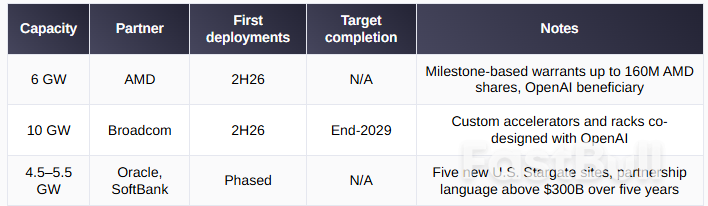
          Custom silicon is the cost lever to watch as Broadcom’s program moves from design to deployment.
          If the accelerator, networking and rack co-design work delivers material performance per watt gains, inference cost of goods and training efficiency can reset the unit economics of the circular model toward self-funding cash flows as utilization builds.
          Execution risk sits with toolchains, packaging and memory bandwidth, and the timeline begins in 2H26 with a multi-year ramp through 2029, so financial outcomes for vendors and operators will track the speed at which those gains appear in audited margins and contract pricing.
          The immediate map of commitments is clear, and the conversion of framework deals into firm purchase orders, disclosed in vendor filings and press updates, is a near-term checkpoint.
          CoreWeave’s financing and deal flow, including any corporate actions and the evolution of Nvidia’s ownership, will show how tight the loop becomes between supplier equity, infra capacity and OpenAI’s demand pathway.
          Apple’s system-level integrations widened consumer surface area in 2024 with privacy terms that state requests are not stored by OpenAI and IP addresses are obscured, which provides a counterpoint to enterprise adoption cycles that tend to move on compliance and ROI milestones rather than device reach alone.
          The question for portfolio and treasury planning is how the announced gigawatts match realized workload growth, regional power deliverability and the cost trajectory through 2028. A practical way to track the shift from circular to sustainable is to pair data-center utilization metrics with energy contract coverage ratios and the mix of revenue from usage-linked enterprise agreements.
          If those measures improve as 2H26 deployments begin, the financing loops embedded in these deals function as bridge capital to a steadier compute economy rather than as a source of correlation risk across vendors, infra providers, and the lab.OpenAI Builds $300B Bubble Machine: The Feedback Loop Rewiring Wall Street Finance_1
          The forward path concentrates into a 24 to 36-month window when the first Broadcom systems and AMD waves come online, power contracts finalize at Stargate sites, and revenue-backed consumption ramps through enterprise channels. OpenAI says the Broadcom rollout finishes by the end of 2029.

          Source: Cryptoslate

          Risk Warnings and Disclaimers
          You understand and acknowledge that there is a high degree of risk involved in trading. Following any strategies or investment methods may lead to potential losses. The content on the site is provided by our contributors and analysts for information purposes only. You are solely responsible for determining whether any trading assets, securities, strategy, or any other product is suitable for investing based on your own investment objectives and financial situation.
          Add to Favorites
          Share

          Some Analysts see Imminent Fed Halt to Balance Sheet Drawdown on Rate Turbulence

          Manuel

          Central Bank

          Bond

          Some Wall Street analysts now believe the Federal Reserve will pull the plug on its long-running effort to shrink its balance sheet at the end of the month.
          These central bank watchers believe the ground has shifted for quantitative tightening, or QT, due to mounting money market friction, which could threaten the Fed’s control over the interest rate target it uses to achieve its inflation and employment goals.
          Stopping the withdrawal of liquidity by QT at the October 28-29 Federal Open Market Committee meeting would help ensure the technical aspects of monetary policy continue to run well, these analysts reckon.
          “We expect the FOMC to end its securities runoffs at this month’s meeting,” analysts at Wrightson ICAP said in a note over the weekend. While they’re skeptical genuine liquidity tightness has emerged in money markets, some of the recent turbulence in short-term lending “is clearly a sufficient warning sign to justify moving on to the next phase of the Fed’s normalization plan.”
          Evercore ISI forecasters wrote on Monday “we think the Fed will now signal the end of QT at its October meeting with a view to wrapping up before year-end pressures, although the actual end may come a month or two after the announcement.”
          Jefferies analysts told clients “we expect that the Fed will completely cease QT at the next meeting at the end of the month,” although the Fed is likely to allow mortgage bonds, which have been very slow to come off its books due to challenging housing market conditions, to expire at the current pace.
          The shift in sentiment follows market moves last week that saw some key short-term borrowing rates rise as some financial firms unexpectedly tapped the Fed’s Standing Repo Facility, which exists to provide fast cash loans collateralized by bond holdings.
          Also signaling market friction: A rise in repo borrowing costs and the Secured Overnight Financing Rate, as the federal funds rate, the Fed’s main interest rate target, drifted higher in its current range of between 4% and 4.25%.
          That all happened as Fed Chair Jerome Powell in remarks on October 14, said QT might end “in coming months,” even as he echoed other Fed officials who have said recently there remains plenty of liquidity in the financial system. Fed Governor Christopher Waller, who spoke in New York on Thursday, said “we're about at that point” where the financial system has the right amount of liquidity, as measured by banking sector reserves.

          QT RIP

          The QT process is designed to remove liquidity from the financial system added during the COVID-19 pandemic. In a bid to provide stimulus and bond market stability the Fed aggressively bought Treasury and mortgage bonds to lower long-term interest rates.
          Those purchases, kicking off in large size in the spring of 2020, more than doubled total Fed holdings to $9 trillion by the summer of 2022. Since then the Fed has allowed a set amount of bonds to mature and not be replaced, taking holdings to the current level of $6.6 trillion.
          The Fed has said it seeks to leave enough liquidity in the system to allow for firm control over short-term interest rates and to allow for normal money market volatility. The challenge for the Fed is that it’s unclear how much liquidity it can remove before markets grow too volatile, so Wall Street has struggled to predict when QT would end.
          The recent chop in money markets is driven by a number of factors, Fed balance sheet policy included. “There are a number of reasons why this is the case, including some idiosyncratic factors related to tax payment dates, Treasury auction settlements, and increased bill issuance; the biggest factor is the result of the Fed's ongoing balance sheet normalization,” the Jefferies analysts wrote.
          Still, the challenge of getting a hold on the amount of money market liquidity that would meet the Fed criteria has kept alive views that QT has further to run, especially as bank reserve levels thus far have been stable and QT has thus far mainly extinguished excess liquidity parked in the Fed’s reverse repo facility. To that end, bank reserves have come down but have been fairly close to $3 trillion for some time.

          Source: Reuters

          Risk Warnings and Disclaimers
          You understand and acknowledge that there is a high degree of risk involved in trading. Following any strategies or investment methods may lead to potential losses. The content on the site is provided by our contributors and analysts for information purposes only. You are solely responsible for determining whether any trading assets, securities, strategy, or any other product is suitable for investing based on your own investment objectives and financial situation.
          Add to Favorites
          Share

          Trump's Rare Earth Pact With Australia Sets the Table for ighly Anticipated Meeting With China Next Week

          Manuel

          Economic

          China–U.S. Trade War

          President Trump and Australian Prime Minister Anthony Albanese signed the framework of the critical minerals deal Monday that aims to boost US access to both the mining and processing of Australian rare earth resources.
          It was a move aimed squarely at China — which recently moved to choke off its own rare earth mineral exports — and is set to be just the first display of friendliness between Trump and China's regional adversaries in the days ahead.
          "We'll be doing a little bit of a tour," Trump said Monday at the White House. "I'll be in Malaysia. I'll be in Japan."
          It's a coordinated string of diplomatic outreach that — far from coincidentally — comes as the anticipation grows for a meeting between Trump and Chinese President Xi Jinping set for next week in South Korea.
          Trump in recent days listed the array of tricky issues on the table between the US and China. Those include a wish for increased soybean purchases from the US, a crackdown on fentanyl, questions around Taiwan, the race for AI dominance, and, of course, that thorny issue of China's recent moves to close off its rare earth exports globally.
          "I don't want them to play the rare earth game with us," Trump told reporters as he flew back to Washington on Sunday evening.
          Trump noted Monday that China may offer threats over the rare earths issue. But, he added, his counterthreat would be triple-digit tariffs. "I could threaten them with many other things," he added.

          A presidential itinerary set to span Asia

          Trump's success in reaching out to these Chinese rivals remains far from certain. That's because many remain unhappy with Trump's tariffs.
          Analysts are also often quick to note that China holds significant leverage of its own, starting with its near monopoly — 90% of the market, by some estimates — on both the mining and processing capacity to produce these rare earth minerals that are key for modern electronics.
          "Even with the ongoing flurry of efforts to reshore/onshore/friendshore rare earths production, the U.S. is still many years away from self-sufficiency," Ellen Ehrnrooth and Ed Mills of Raymond James noted in a recent analysis.
          They added that Chinese access to US semiconductors is likely to be another item on the agenda at China's behest.
          Until then, Trump's tour with China's neighbors is set for the days ahead.
          This weekend, the president is scheduled to travel to Malaysia for a gathering of the Association of Southeast Asian Nations (ASEAN). This alliance of 10 countries in Southeast Asia is often promoted as an economic counterbalance to China.
          It's a stop that will also see Treasury Secretary Scott Bessent meeting directly with his Chinese counterparts in Malaysia. This will continue to set the table for the meeting the following week between the two presidents.
          Bessent called a first meeting last week in Washington with Chinese Vice Premier He Lifeng "frank and detailed."
          Also on the President's itinerary is Japan, as well as the Asia-Pacific Economic Cooperation (APEC) summit in Gyeongju, South Korea.
          That final gathering is scheduled to run throughout the coming week and will be attended by both President Trump and Xi — where they are scheduled to meet on the sidelines.
          Trump's tour is just one of many diplomatic efforts to set the agenda for next week's meeting. China has its own ongoing diplomatic efforts, as well as the 20th Central Committee of the Communist Party of China plenary session in Beijing this week.

          A tense meeting Trump promises could lead to 'a good deal'

          It remains to be seen how much the agreement with Australia — which promises to provide at least $1 billion in financing and increase cooperation starting over the next year in new extraction and processing efforts — will be able to close the gap if China continues its restrictive stance.
          "It's all about de-risking," top Trump economic adviser Kevin Hassett told reporters Monday of the meeting. "Australia is really, really going to be helpful in the effort to take the global economy and make it less risky, less exposed to the kind of rare earth extortion that we're seeing from the Chinese."
          Trump has also repeatedly talked up his relationship with President Xi. He has suggested that the meeting could even result in a new wide-ranging deal — not just avert escalation, but improve relations.
          "It's going to be very exciting," Trump noted Monday of the meeting, adding, "I think we'll work out something good for both countries," even as he again refused to rule out moving forward with the 100% additional tariffs he has promised to put into effect on Nov. 1.
          It's the latest in a series of comments that have cheered markets — for now. But the happy talk has led some analysts to warn that tensions between the world's two largest economies could quickly rise again.
          "Trump's more than willing to take short-term pain for long-term gain on both," Terry Haines of Pangaea Policy wrote to clients this week. He added that recent comments from Trump that tariffs are unsustainable may not mean the end to tensions.
          The administration's view is that "high US tariffs are 'unsustainable' *for China*," Haines wrote, adding that "tariffs remain major US geopolitical and economic leverage that's not going to be unilaterally abandoned."

          Source: Yahoo Finance

          To stay updated on all economic events of today, please check out our Economic calendar
          Risk Warnings and Disclaimers
          You understand and acknowledge that there is a high degree of risk involved in trading. Following any strategies or investment methods may lead to potential losses. The content on the site is provided by our contributors and analysts for information purposes only. You are solely responsible for determining whether any trading assets, securities, strategy, or any other product is suitable for investing based on your own investment objectives and financial situation.
          Add to Favorites
          Share

          Global Companies hit by More Than $35 Billion in US Tariffs, but Outlook Stabilizing

          Manuel

          China–U.S. Trade War

          Economic

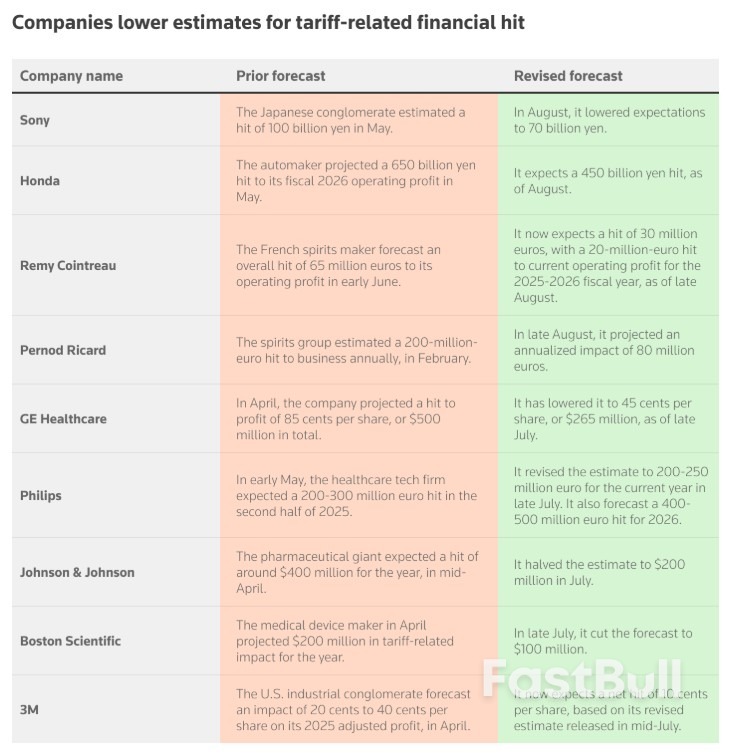
          Global companies have flagged more than $35 billion in costs from U.S. tariffs heading into third-quarter earnings, but many are lowering their initial forecasts as new trade deals reduce exposure to President Donald Trump's levies.
          Trump's trade war has hiked U.S. tariffs to their highest levels since the 1930s, and the president has regularly threatened more duties, but overall, the fog that paralyzed many businesses is clearing, allowing executives to forecast costs and make plans - including some price hikes.Companies expected a combined financial hit of $21.0 billion to $22.9 billion for 2025, with an impact of nearly $15 billion calculated for 2026, according to a Reuters analysis of hundreds of corporate statements, regulatory filings and earnings calls between July 16 and September 30.
          The total of more than $35 billion compares with $34 billion tallied in May, shortly after Trump's "Liberation Day" tariffs in April rattled global supply chains. But the trajectory masks a shift: the increase is largely due to Toyota's (7203.T) $9.5 billion estimate. Many other companies have lowered their earlier worst-case forecasts after Trump reached lower-rate trade deals with the EU and Japan. The figures combine annual and partial-year estimates from an overlapping group of firms. Both groups include about 60 firms.French spirits makers Remy Cointreau (RCOP.PA) and Pernod Ricard PERP.PA both lowered estimates of tariff pain after the EU deal, while Sony (6758.T) in August cut its forecast. Trump also carved out exceptions, with only about a third of Brazil's exports facing a 50% tariff, for instance.
          “Tariffs are getting clearer and clearer. And we believe that tariffs will be just another variable of our business equation that we need to be ready to manage, and we will,” Stellantis (STLAM.MI) CEO Antonio Filosa told Reuters in a mid-October interview, introducing new details of a $13 billion, four-year investment in U.S. manufacturing. Stellantis in July warned of a 1.5 billion-euro this year.
          "I think there is this sense that we reached a kind of landing point with some of the bilateral trade deals," said International Chamber of Commerce Deputy Secretary General Andrew Wilson.
          "But there will continue to be much greater complexity and this massive uncertainty."
          Case in point: Trump earlier this month floated the idea of additional 100% tariffs on China. On Friday, he said the proposed tariffs would not be sustainable, and blamed Beijing for the latest tensions in trade talks between the two countries.

          CONSUMER AND MANUFACTURING HIT HARDEST

          S&P 500 companies are projected to show an earnings growth rate of 9.3% in the July-September period, a decline from 13.8% in the second quarter, according to LSEG data. Much of that is on the back of the U.S. IT sector, driven by AI investment. Europe's Stoxx 600 is expected to clock 0.5% growth, down from 4% in the previous quarter.
          The pain is concentrated on companies that depend on countries that do not have trade deals.
          Nike (NKE.N), heavily dependent on suppliers in Vietnam and other Asian countries, raised its tariff impact estimate late last month to $1.5 billion from $1 billion. In Europe, Tefal kitchen-ware maker SEB (SEBF.PA) recently cut its profit outlook, citing weaker demand as customers adopted a wait-and-see attitude partly due to tariffs, while H&M (HMb.ST) cautioned that U.S. tariffs on imports would weigh more heavily on margins in the quarter through November.
          "We are cautious about the U.S. heading into the fourth quarter, both connected to the impact of tariffs on the gross margin but equally also the consumer sentiment," H&M CEO Daniel Erver told Reuters. "We can see the price increases."
          Price increases are the most frequent effect of tariffs cited by companies in the Reuters tracker.
          Carmakers including Ford (F.N), Stellantis, Volkswagen (VOWG.DE) and Toyota collectively have reported billions in tariff-related costs. Ford, for instance, is expecting a cumulative $3 billion impact.
          Still, optimism has ticked up among automakers and auto parts suppliers as Trump has moved toward significant tariff relief for U.S. auto production that could effectively eliminate many of the costs that have hit top car companies.
          Drug makers also have started rolling out deals on drug pricing and manufacturing that are tied to U.S. tariff exemptions. Pfizer (PFE.N) and AstraZeneca (AZN.L) have led the way, and others are expected to follow.
          Global Companies hit by More Than $35 Billion in US Tariffs, but Outlook Stabilizing_1

          Source: Reuters

          To stay updated on all economic events of today, please check out our Economic calendar
          Risk Warnings and Disclaimers
          You understand and acknowledge that there is a high degree of risk involved in trading. Following any strategies or investment methods may lead to potential losses. The content on the site is provided by our contributors and analysts for information purposes only. You are solely responsible for determining whether any trading assets, securities, strategy, or any other product is suitable for investing based on your own investment objectives and financial situation.
          Add to Favorites
          Share

          Australia And US Sign Multi-billion Dollar Investment And Defense Deal

          Owen Li

          Political

          Australia and the United States signed a major investment agreement on Monday that includes billions in critical minerals projects, defense systems, and other investments, according to the White House.

          The deal commits both nations to invest more than $3 billion in critical mineral projects over the next six months. Additionally, the Pentagon will invest in a Gallium refinery in Western Australia.

          As part of the agreement, Australia will purchase $1.2 billion in Anduril unmanned underwater vehicles and will receive Apache helicopters in a separate $2.6 billion deal.

          Australia’s superannuation funds will significantly increase their investments in the United States, reaching $1.44 trillion by 2035 - almost $1 trillion more than current levels.

          The agreement also includes a $2 billion investment from Australia in U.S. companies for its Joint Air Battle Management System.

          Source: Investing

          Risk Warnings and Disclaimers
          You understand and acknowledge that there is a high degree of risk involved in trading. Following any strategies or investment methods may lead to potential losses. The content on the site is provided by our contributors and analysts for information purposes only. You are solely responsible for determining whether any trading assets, securities, strategy, or any other product is suitable for investing based on your own investment objectives and financial situation.
          Add to Favorites
          Share

          What will happen next in this topsy-turvy stock market? Choose your own Wall Street adventure!

          Adam

          Stocks

          Economic

          The stock market is sending mixed signals at the moment, caught in a tangle of overlapping anxieties. Predicting its next move depends heavily on which narrative you want to believe.

          Adventure No. 1: Trouble with banks

          You could choose door No. 1 and subscribe to the dominant concern of the week: A number of high-profile bankruptcies in consumer-facing industries may have exposed an underlying economic weakness that threatens parts of the banking sector.
          A small number of regional banks have reported some bad loans this past week. The bankruptcies of a major auto parts company and a subprime auto lender have exposed bigger lenders, including JPMorgan and Wall Street finance company Jefferies, to potentially significant losses.
          A number of the lenders are alleging they were victims of fraud. But if you believe these are canaries in the coal mine – and not a series of isolated incidents – it might mean a growing number of consumers won’t be able to pay back their loans or may rein in their spending with companies that owe banks a bunch of money. That could drag down lenders that are most susceptible if the economy really starts to take a turn for the worse.
          To paraphrase JPMorgan CEO Jamie Dimon this week, these bank problems may be cockroaches that could signal the presence of other hidden cockroaches.

          Adventure No. 2: The trade route

          Markets hit their most recent record just last Wednesday. But they started to stumble after China ramped up export controls on key rare-earth minerals that the Trump administration has been negotiating for months to free up. Those rare-earths are used in practically everything that beeps, including consumer electronics and military equipment.
          President Donald Trump last Friday said he’s had enough, threatening a major re-escalation of the global trade war. He said he’d send China’s tariffs higher by 100 percentage points and saw no need to meet with Chinese leader Xi Jinping in a high-profile planned meeting in South Korea later this month.
          Trump and his administration quickly walked back those threats, confirming a Xi meeting was still on. And today Trump said he understood significantly higher tariffs on China wouldn’t be sustainable.
          But Trump has changed his mind on tariffs before, and it’s too soon to count out a major escalation in trade tensions. If that happens, Morgan Stanley analysts predicted the market could quickly tumble 11% into a correction.

          Adventure No. 3: The AI bubble

          Big Tech and the promise of AI have fueled the historic rise in stocks this year, particularly since April. But analysts have warned in recent months that this is a one-legged stool – and AI companies’ high valuations can’t support the market forever.
          Some see echoes of the dot-com bubble in the late 1990s that went bust in the early 2000s. Stocks have never been pricier as measured by the ratio of share price to companies’ actual sales. And the top eight most valuable stocks on the market – all worth north of $1 trillion – are all heavily invested in AI.
          All that froth suggests to some that valuations have gotten out of whack with reality, and the AI-powered gains are due for a serious reality check.
          Still, bubbles are notoriously hard to predict, and Wall Street’s majority opinion appears to be that the run-up in AI stocks as just the beginning of a long-run trend that will power the stock market for many years to come.

          Adventure No. 4: Stagflation and the Fed

          Investors have largely ignored the economic impact of President Donald Trump’s tariffs over the past six months, as prognosticators’ worst predictions about high inflation and a slowing economy have failed to come to fruition.
          However, inflation is on the rise, albeit slowly. Hiring has slowed to a crawl. Trade with the United States has slowed due to higher tariffs. And some consumers have been jostled by rising prices, with delinquencies and subprime debt rising for lower-income tiers.
          Ironically, cracks in the economy have helped drive stocks higher, because the underperforming job market forced the wait-and-see Federal Reserve to lose patience and start its recent rate-cutting campaign.
          But the Fed may not be able to cut rates for long if so-called stagflation – high inflation and stagnant economic growth – becomes a real concern. At that point, the Fed may be forced to deal with an inflation problem all over again.

          Adventure No. 5: Buy the dip

          Geopolitical tensions could be easing in Ukraine and the Middle East, and meetings are lined up between Trump and his Chinese counterpart; and with Russia’s President Vladimir Putin. As with the recent ceasefire in Gaza, those meetings have the potential to turn down the temperature, at least somewhat, in some of the most concerning parts of the globe.
          Meanwhile, worries about oversupply have pressured the oil market, with the price of Brent and WTI both at near five-month lows – potentially easing the inflation burden for Americans, if gas prices follow oil prices lower.
          And the latest concerns about regional banks, though bringing back bad memories of a couple years ago, may prove to be as contained as the regional bank crisis of 2023.
          More bad headlines may continue to jostle the markets in the near-term. But not much has really changed: Stocks are down just about 2% from their record high. If they fall further, that could present a good buying opportunity to get back into the market when stocks are relatively cheap.
          “We would view deeper pullbacks as opportunities to lean in, as the bull market still deserves the benefit of the doubt,” said Keith Lerner, chief market strategist at Truist, in a note to clients Friday
          Put another way: “We are keeping our powder dry and ready to buy the dip,” said Mohit Kumar, chief economist at Jefferies.

          Source: cnn

          To stay updated on all economic events of today, please check out our Economic calendar
          Risk Warnings and Disclaimers
          You understand and acknowledge that there is a high degree of risk involved in trading. Following any strategies or investment methods may lead to potential losses. The content on the site is provided by our contributors and analysts for information purposes only. You are solely responsible for determining whether any trading assets, securities, strategy, or any other product is suitable for investing based on your own investment objectives and financial situation.
          Add to Favorites
          Share
          FastBull
          Copyright © 2025 FastBull Ltd

          728 RM B 7/F GEE LOK IND BLDG NO 34 HUNG TO RD KWUN TONG KLN HONG KONG

          TelegramInstagramTwitterfacebooklinkedin
          App Store Google Play Google Play
          Products
          Charts

          Chats

          Q&A with Experts
          Screeners
          Economic Calendar
          Data
          Tools
          Membership
          Features
          Function
          Markets
          Copy Trading
          Latest Signals
          Contests
          News
          Analysis
          24/7
          Columns
          Education
          Company
          Careers
          About Us
          Contact Us
          Advertising
          Help Center
          Feedback
          User Agreement
          Privacy Policy
          Business

          White Label

          Data API

          Web Plug-ins

          Poster Maker

          Affiliate Program

          Risk Disclosure

          The risk of loss in trading financial instruments such as stocks, FX, commodities, futures, bonds, ETFs and crypto can be substantial. You may sustain a total loss of the funds that you deposit with your broker. Therefore, you should carefully consider whether such trading is suitable for you in light of your circumstances and financial resources.

          No decision to invest should be made without thoroughly conducting due diligence by yourself or consulting with your financial advisors. Our web content might not suit you since we don't know your financial conditions and investment needs. Our financial information might have latency or contain inaccuracy, so you should be fully responsible for any of your trading and investment decisions. The company will not be responsible for your capital loss.

          Without getting permission from the website, you are not allowed to copy the website's graphics, texts, or trademarks. Intellectual property rights in the content or data incorporated into this website belong to its providers and exchange merchants.

          Not Logged In

          Log in to access more features

          FastBull Membership

          Not yet

          Purchase

          Become a signal provider
          Help Center
          Customer Service
          Dark Mode
          Price Up/Down Colors

          Log In

          Sign Up

          Position
          Layout
          Fullscreen
          Default to Chart
          The chart page opens by default when you visit fastbull.com
