• Trade
  • Markets
  • Copy
  • Contests
  • News
  • 24/7
  • Calendar
  • Q&A
  • Chats
Trending
Screeners
SYMBOL
LAST
BID
ASK
HIGH
LOW
NET CHG.
%CHG.
SPREAD
SPX
S&P 500 Index
6774.75
6774.75
6774.75
6816.12
6758.51
+53.32
+ 0.79%
--
DJI
Dow Jones Industrial Average
47951.84
47951.84
47951.84
48365.93
47849.48
+65.88
+ 0.14%
--
IXIC
NASDAQ Composite Index
23006.35
23006.35
23006.35
23149.61
22906.23
+313.02
+ 1.38%
--
USDX
US Dollar Index
98.280
98.360
98.280
98.320
98.050
+0.220
+ 0.22%
--
EURUSD
Euro / US Dollar
1.17141
1.17148
1.17141
1.17285
1.17032
-0.00092
-0.08%
--
GBPUSD
Pound Sterling / US Dollar
1.33807
1.33815
1.33807
1.33873
1.33627
+0.00004
0.00%
--
XAUUSD
Gold / US Dollar
4330.52
4330.93
4330.52
4336.82
4309.03
-2.14
-0.05%
--
WTI
Light Sweet Crude Oil
55.768
55.806
55.768
55.948
55.579
0.000
0.00%
--

Community Accounts

Signal Accounts
--
Profit Accounts
--
Loss Accounts
--
View More

Become a signal provider

Sell trading signals to earn additional income

View More

Guide to Copy Trading

Get started with ease and confidence

View More

Signal Accounts for Members

All Signal Accounts

Best Return
  • Best Return
  • Best P/L
  • Best MDD
Past 1W
  • Past 1W
  • Past 1M
  • Past 1Y

All Contests

  • All
  • Trump Updates
  • Recommend
  • Stocks
  • Cryptocurrencies
  • Central Banks
  • Featured News
Top News Only
Share

German Federal Cartel Office - Although The Portfolio Companies Of Warburg Pincus Have Some Overlap With PSI's Activities, They Are Not Active In The Core Area Of PSI's Services

Share

Nbc News - Trump Said He Doesn't Believe It's Necessary To Repeal The Affordable Care Act, Also Known As Obamacare

Share

India's Nifty 50 Index Provisionally Ends 0.56% Higher

Share

European Central Bank Governing Council Member Nagel: Recovery Will Be Subdued Initially, It Will Then Slowly Pick Up

Share

Bundesbank Raises 2026 Inflation Forecast For Germany To 2.2% From 1.5% Seen In June Projection

Share

Indian Rupee Rises Sharply On Interbank Order Matching System , Last Up 1.1% At 89.35

Share

Russian President Putin: We Will Defend Our Interests In Courts

Share

Russian President Putin: That Would Undermine Trust In Eurozone

Share

Russian President Putin: Cooling Of Economy In 2025 Is A 'Conscious' Decision

Share

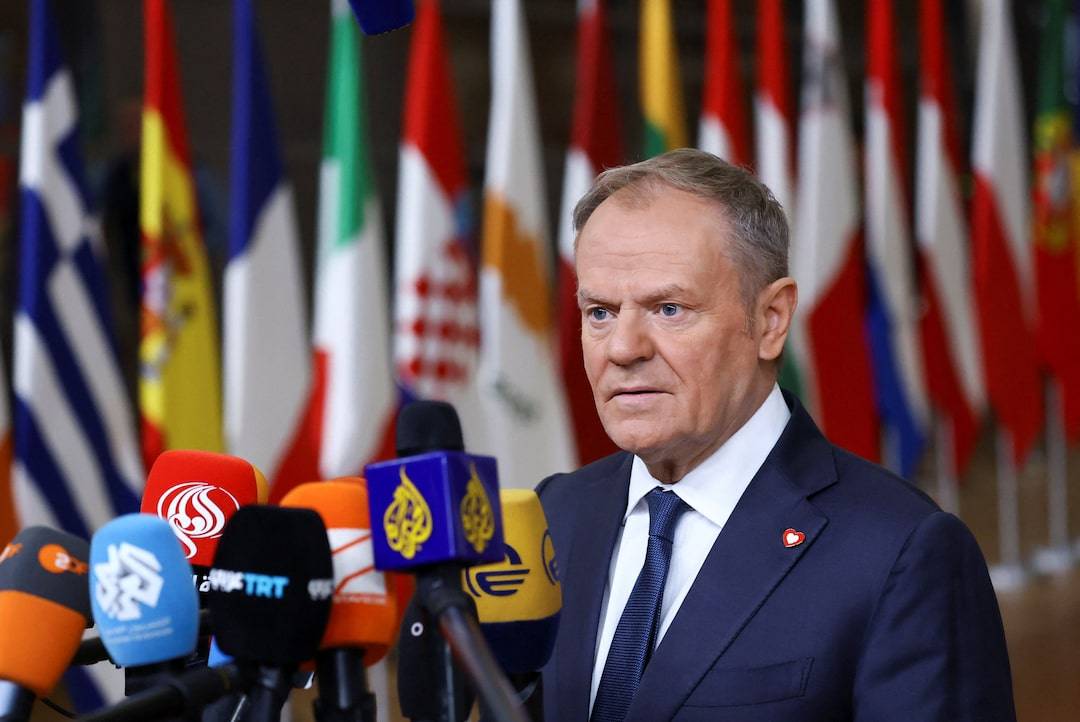
Polish Prime Minister Says Loan For Ukraine Gives It Stronger Negotiating Position

Share

Catalan Regional Official: Japan Has Accepted Importing Pork From Within Containment Zone Processed Before October 29 Swine Fever Outbreak

Share

China Commerce Ministry: China Files WTO Case Against India Over Ict Tariffs And Photovoltaic Subsidies

Share

China Commerce Ministry: Urges India To Correct Wrong Practice On Telecom Tariffs

Share

Russian President Putin: We Have Managed To Balance The Budget

Share

European Central Bank Governing Council Member Rehn: Growth In Euro Area Highly Uncertain Due To Trade War And Tensions

Share

Russian President Putin: Inflation Seen Below 6% By Year End

Share

Pakistan Finance Ministry: Inaugural Panda Bond Issuance Targeted For January

Share

France Prime Minister: Starting Monday, I Will Meet With Key Political Leaders To Consult With Them On The Steps To Be Taken

Share

France Prime Minister: Parliament Will Be Unable To Vote On A Budget For France Before The End Of The Year

Share

Russia's Medinsky: Russia Handed Over 1000 Bodies Of Killed Soldiers To Ukraine, Received 26 Bodies

TIME
ACT
FCST
PREV
U.S. Cleveland Fed CPI MoM (SA) (Nov)

A:--

F: --

P: --

U.S. Kansas Fed Manufacturing Composite Index (Dec)

A:--

F: --

P: --

Mexico Policy Interest Rate

A:--

F: --

P: --

Argentina Trade Balance (Nov)

A:--

F: --

P: --

Argentina Unemployment Rate (Q3)

A:--

F: --

P: --

South Korea PPI MoM (Nov)

A:--

F: --

P: --

U.S. Weekly Treasuries Held by Foreign Central Banks

A:--

F: --

P: --

Japan National CPI MoM (Not SA) (Nov)

A:--

F: --

P: --

Japan CPI MoM (Nov)

A:--

F: --

P: --

Japan National Core CPI YoY (Nov)

A:--

F: --

P: --

Japan CPI YoY (Excl. Fresh Food & Energy) (Nov)

A:--

F: --

P: --

Japan National CPI MoM (Excl. Food & Energy) (Nov)

A:--

F: --

P: --

Japan National CPI YoY (Excl. Food & Energy) (Nov)

A:--

F: --

P: --

Japan National CPI YoY (Nov)

A:--

F: --

P: --

Japan National CPI MoM (Nov)

A:--

F: --

P: --

U.K. GfK Consumer Confidence Index (Dec)

A:--

F: --

P: --

Japan Benchmark Interest Rate

A:--

F: --

P: --

BOJ Monetary Policy Statement
Australia Commodity Price YoY

A:--

F: --

P: --

BOJ Press Conference
Turkey Consumer Confidence Index (Dec)

A:--

F: --

P: --

U.K. Retail Sales YoY (SA) (Nov)

A:--

F: --

P: --
U.K. Core Retail Sales YoY (SA) (Nov)

A:--

F: --

P: --
Germany PPI YoY (Nov)

A:--

F: --

P: --

Germany PPI MoM (Nov)

A:--

F: --

P: --

Germany GfK Consumer Confidence Index (SA) (Jan)

A:--

F: --

P: --
U.K. Retail Sales MoM (SA) (Nov)

A:--

F: --

P: --

France PPI MoM (Nov)

A:--

F: --

P: --

Euro Zone Current Account (Not SA) (Oct)

A:--

F: --

P: --

Euro Zone Current Account (SA) (Oct)

A:--

F: --

P: --

Russia Key Rate

--

F: --

P: --

U.K. CBI Distributive Trades (Dec)

--

F: --

P: --

U.K. CBI Retail Sales Expectations Index (Dec)

--

F: --

P: --

Brazil Current Account (Nov)

--

F: --

P: --

Canada Retail Sales MoM (SA) (Oct)

--

F: --

P: --

Canada New Housing Price Index MoM (Nov)

--

F: --

P: --

Canada Core Retail Sales MoM (SA) (Oct)

--

F: --

P: --

U.S. Existing Home Sales Annualized MoM (Nov)

--

F: --

P: --

U.S. UMich Consumer Sentiment Index Final (Dec)

--

F: --

P: --

U.S. Dallas Fed PCE Price Index YoY (Oct)

--

F: --

P: --

U.S. Conference Board Employment Trends Index (SA) (Nov)

--

F: --

P: --

Euro Zone Consumer Confidence Index Prelim (Dec)

--

F: --

P: --

U.S. UMich 1-Year-Ahead Inflation Expectations Final (Dec)

--

F: --

P: --

U.S. UMich Consumer Expectations Index Final (Dec)

--

F: --

P: --

U.S. UMich Current Economic Conditions Index Final (Dec)

--

F: --

P: --

U.S. Existing Home Sales Annualized Total (Nov)

--

F: --

P: --

U.S. Weekly Total Rig Count

--

F: --

P: --

U.S. Weekly Total Oil Rig Count

--

F: --

P: --

Argentina Retail Sales YoY (Oct)

--

F: --

P: --

China, Mainland 5-Year Loan Prime Rate

--

F: --

P: --

China, Mainland 1-Year Loan Prime Rate (LPR)

--

F: --

P: --

U.K. Current Account (Q3)

--

F: --

P: --

U.K. GDP Final YoY (Q3)

--

F: --

P: --

U.K. GDP Final QoQ (Q3)

--

F: --

P: --

Italy PPI YoY (Nov)

--

F: --

P: --

Mexico Economic Activity Index YoY (Oct)

--

F: --

P: --

Canada National Economic Confidence Index

--

F: --

P: --

Canada Industrial Product Price Index YoY (Nov)

--

F: --

P: --

U.S. Chicago Fed National Activity Index (Nov)

--

F: --

P: --

Canada Industrial Product Price Index MoM (Nov)

--

F: --

P: --

Q&A with Experts
    • All
    • Chatrooms
    • Groups
    • Friends
    Connecting
    .
    .
    .
    Type here...
    Add Symbol or Code

      No matching data

      All
      Trump Updates
      Recommend
      Stocks
      Cryptocurrencies
      Central Banks
      Featured News
      • All
      • Russia-Ukraine Conflict
      • Middle East Flashpoint
      • All
      • Russia-Ukraine Conflict
      • Middle East Flashpoint
      Search
      Products

      Charts Free Forever

      Chats Q&A with Experts
      Screeners Economic Calendar Data Tools
      Membership Features
      Data Warehouse Market Trends Institutional Data Policy Rates Macro

      Market Trends

      Market Sentiment Order Book Forex Correlations

      Top Indicators

      Charts Free Forever
      Markets

      News

      News Analysis 24/7 Columns Education
      From Institutions From Analysts
      Topics Columnists

      Latest Views

      Latest Views

      Trending Topics

      Top Columnists

      Latest Update

      Signals

      Copy Rankings Latest Signals Become a signal provider AI Rating
      Contests
      Brokers

      Overview Brokers Assessment Rankings Regulators News Claims
      Broker listing Forex Brokers Comparison Tool Live Spread Comparison Scam
      Q&A Complaint Scam Alert Videos Tips to Detect Scam
      More

      Business
      Events
      Careers About Us Advertising Help Center

      White Label

      Data API

      Web Plug-ins

      Affiliate Program

      Awards Institution Evaluation IB Seminar Salon Event Exhibition
      Vietnam Thailand Singapore Dubai
      Fans Party Investment Sharing Session
      FastBull Summit BrokersView Expo
      Recent Searches
        Top Searches
          Markets
          News
          Analysis
          User
          24/7
          Economic Calendar
          Education
          Data
          • Names
          • Latest
          • Prev

          View All

          No data

          Scan to Download

          Faster Charts, Chat Faster!

          Download App
          English
          • English
          • Español
          • العربية
          • Bahasa Indonesia
          • Bahasa Melayu
          • Tiếng Việt
          • ภาษาไทย
          • Français
          • Italiano
          • Türkçe
          • Русский язык
          • 简中
          • 繁中
          Open Account
          Search
          Products
          Charts Free Forever
          Markets
          News
          Signals

          Copy Rankings Latest Signals Become a signal provider AI Rating
          Contests
          Brokers

          Overview Brokers Assessment Rankings Regulators News Claims
          Broker listing Forex Brokers Comparison Tool Live Spread Comparison Scam
          Q&A Complaint Scam Alert Videos Tips to Detect Scam
          More

          Business
          Events
          Careers About Us Advertising Help Center

          White Label

          Data API

          Web Plug-ins

          Affiliate Program

          Awards Institution Evaluation IB Seminar Salon Event Exhibition
          Vietnam Thailand Singapore Dubai
          Fans Party Investment Sharing Session
          FastBull Summit BrokersView Expo

          Bank of Japan to Raise Rates to 30-Year High, Signaling Policy Shift Despite Economic Uncertainty

          Gerik

          Economic

          Summary:

          The Bank of Japan is expected to raise its policy interest rate to 0.75%, the highest level since 1995, reflecting confidence in persistent inflation and wage growth...

          A Historic Pivot in Japan’s Monetary Policy

          On Friday, the Bank of Japan is set to raise its short-term interest rate to 0.75% from 0.5%, marking its highest policy rate since 1995. This would be the BOJ’s third rate hike since exiting its ultra-loose monetary regime in 2023 and represents a significant milestone in Governor Kazuo Ueda’s gradual efforts to normalize policy in an economy long dominated by deflation and stagnant wages.
          The decision comes at the conclusion of the BOJ’s two-day policy meeting and is widely anticipated by markets, with 90% of economists in a Reuters poll forecasting the rate move. This trajectory aligns with the central bank’s growing confidence that Japan is achieving its 2% inflation target on a more sustainable basis.
          While a 0.75% rate is still low by international standards, it marks a turning point for Japan, which was the last major economy to exit negative interest rates. Importantly, this move reflects the BOJ’s belief that recent wage growth trends and persistent core inflation 3% in November will support long-term price stability.

          Inflation Anchored Above Target and Wages Strengthen

          One of the key drivers behind the BOJ’s anticipated rate hike is the resilience of inflation. Core CPI rose to 3% in November, remaining above the central bank’s 2% target for nearly four years. This persistence has been partly attributed to high food prices and import costs, but also reflects improving domestic wage conditions.
          Central bank surveys indicate that Japanese businesses are showing increased confidence and are expected to continue raising wages in 2026. This development supports the BOJ’s long-standing condition for policy tightening: sustained wage growth that reinforces inflation expectations.
          The central bank is also responding to the risk of falling behind the inflation curve. Several BOJ board members have signaled their willingness to tighten further in order to prevent entrenched inflation and to solidify the credibility of the central bank’s inflation target.

          Ueda's Balancing Act: Hike Now, Caution Later

          Although the rate hike itself is largely expected, markets are closely watching Governor Ueda’s post-meeting press conference for forward guidance. Analysts anticipate that Ueda will reinforce the message that Japan’s real interest rates will remain accommodative even after this hike, and that further normalization is likely.
          However, the BOJ is not expected to commit to a specific path or timetable for future rate hikes. According to sources cited by Reuters, the central bank will refrain from publishing an updated estimate of its neutral rate the theoretical rate that neither stimulates nor restricts the economy during this meeting. The BOJ currently estimates the neutral range to be between 1% and 2.5%, but has acknowledged uncertainty around this figure.
          This strategic ambiguity allows the BOJ to retain flexibility. As global economic uncertainties remain particularly with U.S. tariffs and geopolitical risks it appears the BOJ prefers a gradual approach. Evercore ISI analysts expect the next hike to occur between July and September, contingent on an economic rebound from current soft patches.

          Domestic and Global Implications of the BOJ’s Move

          The implications of the BOJ’s shift are not limited to Japan’s domestic economy. As Japanese rates climb, the yen may begin to regain strength, reducing its attractiveness as a funding currency in global carry trades. This could reverberate across international markets, particularly in currency and bond sectors.
          At the same time, the move may signal the end of Japan’s era as the global outlier in monetary policy. With the European Central Bank and other institutions now holding or cutting rates, Japan’s move in the opposite direction highlights a divergence in monetary policy trajectories.
          For Japanese households and businesses, the new policy stance introduces both opportunities and risks. On one hand, higher rates could bolster the yen and curb import-driven inflation. On the other, rising borrowing costs may dampen consumption and investment in a still-fragile recovery.

          A Cautious Yet Consequential Shift

          The BOJ’s rate hike to 0.75% marks a historic shift in Japan’s post-deflation monetary narrative. While modest in size, the move is symbolically significant, reinforcing the central bank’s commitment to a sustainable inflation path supported by wage growth and domestic demand.
          However, the path forward remains cautious. Without a clear commitment on the speed or magnitude of future hikes, the BOJ is signaling its readiness to act, while remaining sensitive to both internal and external risks. In the absence of updated neutral rate estimates, investors will have to rely on Ueda’s language to gauge whether this hike is the beginning of a new chapter or merely a strategic pause in a long journey toward policy normalization.

          Source: Reuters

          To stay updated on all economic events of today, please check out our Economic calendar
          Risk Warnings and Disclaimers
          You understand and acknowledge that there is a high degree of risk involved in trading. Following any strategies or investment methods may lead to potential losses. The content on the site is provided by our contributors and analysts for information purposes only. You are solely responsible for determining whether any trading assets, securities, strategy, or any other product is suitable for investing based on your own investment objectives and financial situation.
          Add to Favorites
          Share

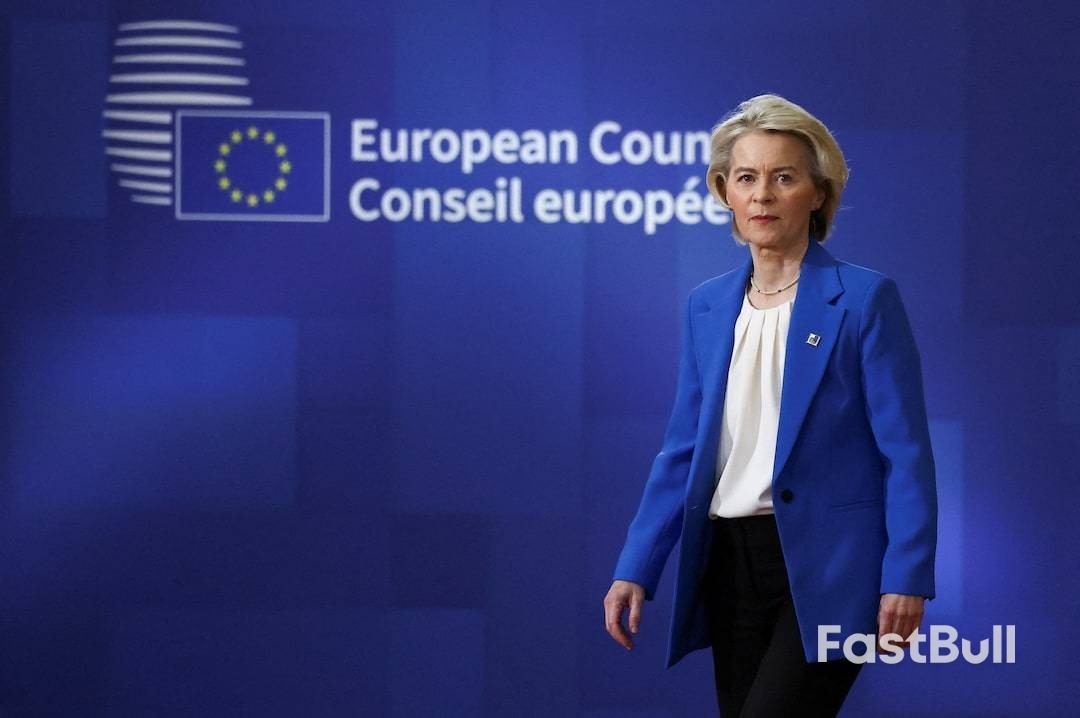
          EU Changes Tack From Using Frozen Russian Assets To Joint Borrowing For Ukraine

          Samantha Luan

          Political

          Economic

          · Asset plan proved too controversial for quick decision, diplomats say
          · Belgium wanted guarantees against potential Russian legal claims
          · EU leaders aimed to counter Trump's claim they are 'weak'

          European Union leaders decided on Friday to borrow cash to fund Ukraine's defence against Russia rather than use frozen Russian assets, diplomats said.

          "We have a deal. Decision to provide 90 billion euros of support to Ukraine for 2026-27 approved," EU summit chairman Antonio Costa posted on social media in the early hours of Friday morning after hours of talks.

          Costa did not specify the source of the funding but a draft text of the summit's conclusions, seen by Reuters, said it would come from borrowing on capital markets, secured against the EU budget.

          The deal will not affect the financial obligations of Hungary, Slovakia and the Czech Republic, which did not want to contribute to the financing of Ukraine, the text said.

          At the same time, EU governments and the European Parliament would continue working on setting up a loan for Ukraine that would be based on the frozen Russian central bank assets, it said.

          The loan to Ukraine based on the joint borrowing would only be repaid by Ukraine once it receives war reparations from Moscow. Until then, the Russian assets would remain immobilised and the EU reserved the right to use them to repay the loan, according to the text.

          "It's good in the sense that Ukraine will secure funding for 2 years," one EU diplomat said.

          The move follows hours of discussions among leaders on the technical details of a loan based on the frozen Russian assets, which turned out to be too complex or politically demanding to sort out at this stage, diplomats said.

          "We have gone from saving Ukraine, to saving face, at least that of those who have been pushing for the use of the frozen assets," a second EU diplomat said.

          The main difficulty in the use of the Russian money was providing Belgium, where 185 billion of the total 210 billion euros of Russian assets in Europe are held, with sufficient guarantees against financial and legal risks from potential Russian retaliation for the release of the money to Ukraine.

          HUNGARY SCORES A WIN

          The EU sees Russia's war as a threat to its own security and wants to keep Ukraine financed and fighting.

          EU Changes Tack From Using Frozen Russian Assets To Joint Borrowing For Ukraine_1

          EU Changes Tack From Using Frozen Russian Assets To Joint Borrowing For Ukraine_2EU Changes Tack From Using Frozen Russian Assets To Joint Borrowing For Ukraine_3

          With public finances across the EU already strained by high debt levels, the European Commission had proposed using frozen Russian central bank assets to secure a huge loan of 90 billion euros to Kyiv, with joint borrowing against the EU budget as a second option.

          The joint borrowing was difficult because it requires unanimity. Moscow-friendly Hungary had said it would oppose it, just as it opposed the use of Russian assets.

          But Hungarian Prime Minister Viktor Orban appeared to have agreed not to block the borrowing as long as his country, Slovakia and the Czech Republic were excluded from the guarantees for the debt.

          "Orban got what he wanted: no reparation loan. And EU action without participation of Hungary, Czech Republic and Slovakia," a third EU diplomat said.

          'CAN'T AFFORD TO FAIL'

          Several EU leaders arriving at the summit said it was imperative they find a solution to keep Ukraine financed and fighting for the next two years. They were also keen to show European countries' strength and resolve after U.S. President Donald Trump last week called them "weak".

          "We just can't afford to fail," EU foreign policy chief Kaja Kallas said.

          Ukrainian President Volodymyr Zelenskiy, who took part in the summit, urged the bloc to agree to use the Russian assets to provide the funds he said would allow Ukraine to keep fighting.

          "The decision now on the table – the decision to fully use Russian assets to defend against Russian aggression – is one of the clearest and most morally justified decisions that could ever be made," he said.

          BELGIUM WANTED MORE GUARANTEES ON RISK SHARING

          Belgian Prime Minister Bart De Wever told his country's parliament early on Thursday that he had not yet seen guarantees that answered his concerns on legal and liquidity risks for Belgium to agree to the use of the Russian assets.

          Russia's central bank has said the EU plans to use its assets are illegal. It filed a lawsuit in Moscow this week seeking $230 billion in damages from clearing house Euroclear.

          The stakes for finding money for Kyiv are high because without the EU's financial help Ukraine will run out of money in the second quarter of next year and most likely lose the war to Russia, which the EU fears would bring closer the threat of Russian aggression against the bloc.

          Source: Reuters

          To stay updated on all economic events of today, please check out our Economic calendar
          Risk Warnings and Disclaimers
          You understand and acknowledge that there is a high degree of risk involved in trading. Following any strategies or investment methods may lead to potential losses. The content on the site is provided by our contributors and analysts for information purposes only. You are solely responsible for determining whether any trading assets, securities, strategy, or any other product is suitable for investing based on your own investment objectives and financial situation.
          Add to Favorites
          Share

          November CPI Triggers Market Rally, But Data Quality Clouds the Outlook

          Gerik

          Economic

          Inflation Surprise Fuels Market Optimism

          U.S. equity markets snapped a four-day losing streak on Thursday after the release of the November Consumer Price Index (CPI), which showed inflation rising at an annual pace of 2.7%. This figure was notably below the 3.1% consensus forecast from economists polled by Dow Jones. Core CPI, which excludes volatile food and energy components, also surprised to the downside at 2.6% versus the expected 3.0%.
          Investor sentiment shifted swiftly in response. The S&P 500 rose 0.79%, the Dow Jones Industrial Average edged up 0.14%, and the Nasdaq Composite led the rally with a 1.38% gain. Markets interpreted the data as a green light for potential monetary easing in 2026, with hopes that the disinflationary trend might pave the way for rate cuts.

          Data Integrity Under Scrutiny

          Despite the initial market cheer, analysts and economists have raised red flags regarding the underlying reliability of November’s inflation report. The Bureau of Labor Statistics (BLS) confirmed that the data was affected by the historic 43-day government shutdown, which prevented the collection of October price data and forced the use of partial or outdated inputs.
          For example, certain October data were “carried forward” from September, and in some housing categories, inflation was reportedly recorded as zero. Evercore ISI’s Krishna Guha suggested that this likely led to distorted figures in rent and shelter inflation for selected cities. These adjustments render the report statistically noisy, raising concerns that the CPI may not accurately reflect current inflationary pressures.
          This deviation introduces ambiguity in interpreting whether the decline in inflation is a real structural improvement or a technical artifact of incomplete data. Federal Reserve Chair Jerome Powell once likened monetary policy to “navigating by the stars under cloudy skies.” In this case, analysts argue that the available stars might not be stars at all, but mere projections shaped by missing information.

          Mixed Signals for Fed Policy

          While the CPI figures appear dovish on the surface, the lack of clarity on short-term inflation dynamics complicates the Federal Reserve’s policy calculus. If policymakers assume the November figures are skewed downward, they may hesitate to adjust interest rates based solely on this data point.
          Nonetheless, the market’s reaction reflects broader expectations of easing in 2026, especially if inflation readings in the coming months validate the current trend. José Torres, senior economist at Interactive Brokers, emphasized that a sustained inflation rate below 3% would significantly support the case for monetary accommodation in the coming year.
          Yet, the absence of October’s data and the methodological compromises made in November’s report mean the Fed might remain cautious in its December assessment. Without a full inflation trajectory, the risk of misjudging the price outlook remains high.

          Holiday Euphoria Meets Structural Ambiguity

          The strength of Thursday’s market rebound may also reflect seasonal factors, with investors exhibiting optimism as the year-end approaches. Boosted further by a 10.2% surge in Micron shares following an earnings beat, investor sentiment appears to be driven by a mixture of holiday cheer and macro hope.
          However, the durability of this rally hinges on future data clarity. If January or February inflation figures reveal that November’s dip was misleading, the Fed may pivot back toward a more hawkish stance, dampening expectations for early rate cuts.

          Market Reaction Outpaces Policy Reality

          While investors welcomed the CPI surprise as a signal of easing inflation, the structural integrity of the data undermines its reliability as a policy guide. The lack of monthly comparisons, the use of outdated inputs, and acknowledged zero-inflation placeholders cast a shadow over the report’s credibility.
          In the absence of robust data, market enthusiasm may prove premature. The true state of inflation will only become clearer once future reports correct for current gaps and inconsistencies. Until then, monetary policy remains suspended in uncertainty with the path of rate decisions likely to depend less on a single report and more on a longer-term trend that is yet to be confirmed.

          Source: CNBC

          To stay updated on all economic events of today, please check out our Economic calendar
          Risk Warnings and Disclaimers
          You understand and acknowledge that there is a high degree of risk involved in trading. Following any strategies or investment methods may lead to potential losses. The content on the site is provided by our contributors and analysts for information purposes only. You are solely responsible for determining whether any trading assets, securities, strategy, or any other product is suitable for investing based on your own investment objectives and financial situation.
          Add to Favorites
          Share

          Police Probe Links Between Brown University Shooting, Killing Of MIT Professor

          Winkelmann

          Political

          Economic

          The makeshift memorial outside the Barus & Holley engineering building continues to grow as the manhunt continues for the gunman, following a shooting at Brown University in Providence, Rhode Island, U.S. December 17, 2025. REUTERS/Taylor Coester

          Law enforcement officers are investigating a link between a mass shooting at Brown University in Providence that killed two people last weekend and the shooting death of a Massachusetts Institute of Technology professor two days later near Boston, a person familiar with the matter said.

          The source, who spoke on condition of anonymity as they were not authorized to discuss the matter, did not provide more details on why investigators think the two cases may be linked.

          The new twist comes five days after the shooting at Brown University and during a manhunt for the shooter. The violence shook Rhode Island's capital city of Providence, and brought pressure on investigators to crack open the case.

          The Brown shooting occurred on December 13 inside a classroom building, killing two students and wounding at least eight others.

          Two days later, MIT professor Nuno Loureiro, 47, was fatally shot in his home in Brookline, Massachusetts on Monday evening. Brookline is 49 miles north of Brown's campus.

          Earlier this week, an FBI official said authorities did not believe there was any link between Saturday's shooting at Brown and the MIT's professor's murder. Loureiro was a member of the departments of nuclear science and engineering and physics as well as MIT's Plasma Science and Fusion Center.

          SEEKING THE PUBLIC'S HELP

          Investigators in Providence said the suspect in the Brown University shooting escaped on foot into nearby streets, prompting a search that relied heavily on residential security footage because of a lack of surveillance cameras in the classroom building and surrounding area.

          Police released images and video of a masked man believed to be the shooter, based on survivor accounts, and have repeatedly asked for the public's help in identifying that man. The footage showed the suspect walking in a nearby neighborhood both before and immediately after the attack, including moments when police vehicles arrived with flashing lights.

          "He could be anywhere," Providence Police Chief Oscar Perez said on Wednesday, adding that authorities did not initially know the suspect's identity or motive.

          Providence Mayor Brett Smiley said residents and students had grown "restless and eager" for an arrest as the search stretched into several days.

          Police also circulated photos of another unidentified man seen near the area, saying they wanted to speak with him as a potential witness who may have relevant information.

          Authorities initially announced a person was in custody a day after the shooting, but later released that individual after determining he was not involved.

          Source: Reuters

          To stay updated on all economic events of today, please check out our Economic calendar
          Risk Warnings and Disclaimers
          You understand and acknowledge that there is a high degree of risk involved in trading. Following any strategies or investment methods may lead to potential losses. The content on the site is provided by our contributors and analysts for information purposes only. You are solely responsible for determining whether any trading assets, securities, strategy, or any other product is suitable for investing based on your own investment objectives and financial situation.
          Add to Favorites
          Share

          November CPI: Take It With The Entire Salt Shaker

          Patricia Franklin

          The November CPI report creates more questions than answers about the recent pace of price growth. Consumer prices rose 2.7% in the 12 months ending in November, materially below our expectations for a 3.0% gain. The core index similarly fell short of expectations, advancing 2.6% over the past 12 months versus our forecast for a 2.9% increase. The stark miss comes on the heels of the longest-ever government shutdown that led the BLS to skip October data collection and not begin the November collection process until the middle of the month.

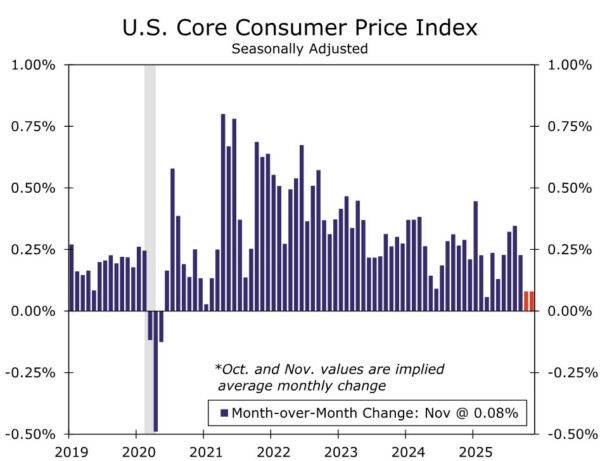
          As such, we caution against reading too much into today's report. The November data suggest core prices rose 0.16% over the past two months, or an average of 0.08% per month. For comparison, the core index has increased at an average monthly pace of 0.25% this year. CPI data are not revised, and as a result we believe the data will be noisy for at least another month or two. A bounce back in prices in the December CPI report to be released on January 13 is probably coming. Through the noise, we believe inflation is slowing on trend, even if today's reading overstates the magnitude of the slowdown. We remain comfortable with our current projection of rate cuts from the FOMC in March and June of next year.

          Inflation Is Slowing, but Not This Much

          The government shutdown appears to have caused issues in the consumer price inflation data collection process. The two-month percent change in headline and core CPI were 0.20% and 0.16%, respectively, meaningfully below our forecasts of 0.45% and 0.48%. For context, the two-month change in headline and core CPI from July to September was 0.69% and 0.57%, respectively. This pushed the year-ago pace of headline and core CPI inflation down to 2.7% and 2.6%, a steep decline from 3.0% and 3.1% in September. The slowdown was broad-based across nearly all categories, adding to our suspicions that the shutdown's disruptions caused issues in the data. Data collection didn't begin until the second half of November, which may have skewed the sample more than we anticipated.

          Food prices rose 0.06% over the past two months, a significantly slower pace than the 0.25% average monthly rise this year. Taking a step back from this report's noise, forward-looking measures of food-related commodities have slipped into deflation territory, which, when coupled with recent rollbacks on select food tariffs, point to a disinflationary trend in food inflation even if not to the extent implied in today's report. Energy was the lone category that came in reasonably near expectations, rising 1.08% over the past two months and up 4.1% year-over-year in November. This is likely due to gasoline prices being collected from a non survey source and thus being one of the few sub-categories the BLS was able to publish price data for in October. New and used autos prices were also produced under their usual methodology and came in a touch stronger than we expected.

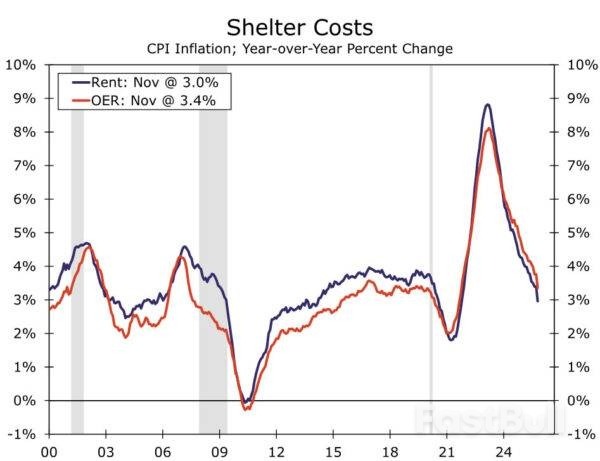
          Core goods prices rose only 0.06% between September and November, compared to a 0.15% average monthly rise headed into this report. Similarly, core services rose only 0.16% over the past two months. Shelter inflation was a prime example of the puzzlingly weak inflation data in core. Owners' equivalent rent rose 0.27% over two months, while rents rose just 0.13%. The weak outturn lead these categories down to 3.4% and 3.0%, respectively, on a year-over-year basis, breaking away from their recent trends (chart). In short, we are not putting much weight on the details of this report, and we anticipate a bounce back in the December reading to be released on January 13.

          While materially softer than expected, we think the collection issues around this particular report means it will do little to change Fed officials' current views on inflation. Inflation pressures are softening, but not to this degree. With the Fed waiting for (reliable) inflation data before cutting rates again, today's data add to our conviction that the FOMC will be on hold at the January meeting. That said, data issues aside, our belief is that inflation is slowing on trend, even if today's print overstates the slowdown. When paired with the softening in the labor market, we remain comfortable with rate cuts in March and June of next year. At that point, we believe cleaner data will give the Committee more confidence that inflation is leveling off and will soon be moving back toward 2%.

          Source: ACTIONFOREX

          Risk Warnings and Disclaimers
          You understand and acknowledge that there is a high degree of risk involved in trading. Following any strategies or investment methods may lead to potential losses. The content on the site is provided by our contributors and analysts for information purposes only. You are solely responsible for determining whether any trading assets, securities, strategy, or any other product is suitable for investing based on your own investment objectives and financial situation.
          Add to Favorites
          Share

          US Appeals Court To Consider Reviving Apple App Store Class Action

          Samantha Luan

          Stocks

          Political

          A U.S. appeals court said on Thursday it will consider whether millions of Apple customers can band together in a lawsuit accusing the iPhone maker of monopolizing the market for apps and inflating prices, after a trial judge stripped the case of class action status earlier this year.

          In a brieforder, the San Francisco-based 9th U.S. Circuit Court of Appeals said it will review a ruling that decertified a class of nearly 200 million consumers who claim Apple's App Store rules led to $20 billion in overcharges.

          U.S. District Judge Yvonne Gonzalez Rogers in Oakland, California, ruled in October that the customers failed to provide a model "capable of reliably showing classwide injury and damages in one stroke" by matching Apple accounts to consumers, while limiting the number of "unharmed" consumers in the class.

          The three plaintiffs asked the appeals court to overturn the decision and revive the class action before their individual claims are decided. Class actions can expose companies to far greater damages than individual lawsuits.

          Apple did not immediately respond to a request for comment.

          Mark Rifkin, a lawyer for the plaintiffs, said they "look forward to briefing and arguing the merits of the appeal in the Ninth Circuit."

          The lawsuit, filed in 2011, accuses Apple of violating U.S. antitrust law by too tightly restraining how customers download apps and pay for transactions, causing overcharges for apps and in-app content on their iPhones and iPads. Apple has denied any wrongdoing.

          In their appeal, the consumers called the decertification ruling "manifestly erroneous," saying they showed Apple's conduct harmed virtually all class members.

          They warned the ruling creates a "death knell" for claims worth only $268 collectively for the three named plaintiffs.

          Apple told the appeals court that the plaintiffs still can pursue individual claims and that review was unwarranted because the decertification order turned on fact-specific rulings, not unsettled law.

          The case is In re Apple iPhone Antitrust Litigation, 9th U.S. Circuit Court of Appeals, No. 25-7122.

          Source: TradingView

          Risk Warnings and Disclaimers
          You understand and acknowledge that there is a high degree of risk involved in trading. Following any strategies or investment methods may lead to potential losses. The content on the site is provided by our contributors and analysts for information purposes only. You are solely responsible for determining whether any trading assets, securities, strategy, or any other product is suitable for investing based on your own investment objectives and financial situation.
          Add to Favorites
          Share

          Japan's Core Inflation Steady In November, Stays Above BOJ Target

          Justin

          Political

          Forex

          Economic

          Central Bank

          People walk at a shopping area of Shinjuku in Tokyo, Japan, September 11, 2025. REUTERS/Fabrizio Bensch/File Photo

          · November core CPI rises 3.0% yr/yr, matches forecast
          · Index excluding fresh food, fuel up 3.0% yr/yr in November
          · Data reinforces expectations of BOJ rate hike to 0.75%

          Japan's core consumer prices rose 3.0% in November from a year earlier, data showed on Friday, staying above the central bank's 2% target for the 44th straight month.

          The outcome reinforces market expectations the Bank of Japan will raise interest rates to 0.75% from 0.5% at a two-day policy meeting concluding on Friday.

          The increase in the core consumer price index (CPI), which excludes volatile fresh food prices, matched a median market forecast and was steady from the year-on-year pace of rise in October.

          An index stripping away volatile fresh food and fuel costs, which is closely watched by the BOJ as a better gauge of underlying price trends, rose 3.0% in November from a year earlier, compared with a 3.1% increase in October.

          The BOJ exited a decade-long, radical stimulus programme last year and raised short-term interest rates to 0.5% in January on the view Japan was on the cusp of sustainably hitting its 2% inflation target.

          With stubbornly high food prices keeping inflation above its 2% target, a growing number of BOJ board members have signaled their readiness to vote for a rate hike to avoid being behind the curve in addressing the risk of too-high inflation.

          Source: Reuters

          To stay updated on all economic events of today, please check out our Economic calendar
          Risk Warnings and Disclaimers
          You understand and acknowledge that there is a high degree of risk involved in trading. Following any strategies or investment methods may lead to potential losses. The content on the site is provided by our contributors and analysts for information purposes only. You are solely responsible for determining whether any trading assets, securities, strategy, or any other product is suitable for investing based on your own investment objectives and financial situation.
          Add to Favorites
          Share
          FastBull
          Copyright © 2025 FastBull Ltd

          728 RM B 7/F GEE LOK IND BLDG NO 34 HUNG TO RD KWUN TONG KLN HONG KONG

          TelegramInstagramTwitterfacebooklinkedin
          App Store Google Play Google Play
          Products
          Charts

          Chats

          Q&A with Experts
          Screeners
          Economic Calendar
          Data
          Tools
          Membership
          Features
          Function
          Markets
          Copy Trading
          Latest Signals
          Contests
          News
          Analysis
          24/7
          Columns
          Education
          Company
          Careers
          About Us
          Contact Us
          Advertising
          Help Center
          Feedback
          User Agreement
          Privacy Policy
          Personal Information Protection Statement
          Business

          White Label

          Data API

          Web Plug-ins

          Poster Maker

          Affiliate Program

          Risk Disclosure

          The risk of loss in trading financial instruments such as stocks, FX, commodities, futures, bonds, ETFs and crypto can be substantial. You may sustain a total loss of the funds that you deposit with your broker. Therefore, you should carefully consider whether such trading is suitable for you in light of your circumstances and financial resources.

          No decision to invest should be made without thoroughly conducting due diligence by yourself or consulting with your financial advisors. Our web content might not suit you since we don't know your financial conditions and investment needs. Our financial information might have latency or contain inaccuracy, so you should be fully responsible for any of your trading and investment decisions. The company will not be responsible for your capital loss.

          Without getting permission from the website, you are not allowed to copy the website's graphics, texts, or trademarks. Intellectual property rights in the content or data incorporated into this website belong to its providers and exchange merchants.

          Not Logged In

          Log in to access more features

          FastBull Membership

          Not yet

          Purchase

          Become a signal provider
          Help Center
          Customer Service
          Dark Mode
          Price Up/Down Colors

          Log In

          Sign Up

          Position
          Layout
          Fullscreen
          Default to Chart
          The chart page opens by default when you visit fastbull.com