Markets
News
Analysis
User
24/7
Economic Calendar
Education
Data
- Names
- Latest
- Prev


Signal Accounts for Members
All Signal Accounts
All Contests


U.K. Rightmove House Price Index YoY (Dec)A:--
F: --
P: --
China, Mainland Industrial Output YoY (YTD) (Nov)A:--
F: --
P: --
China, Mainland Urban Area Unemployment Rate (Nov)A:--
F: --
P: --
Saudi Arabia CPI YoY (Nov)A:--
F: --
P: --
Euro Zone Industrial Output YoY (Oct)A:--
F: --
P: --
Euro Zone Industrial Output MoM (Oct)A:--
F: --
P: --
Canada Existing Home Sales MoM (Nov)A:--
F: --
P: --
Canada National Economic Confidence IndexA:--
F: --
P: --
Canada New Housing Starts (Nov)A:--
F: --
U.S. NY Fed Manufacturing Employment Index (Dec)A:--
F: --
P: --
U.S. NY Fed Manufacturing Index (Dec)A:--
F: --
P: --
Canada Core CPI YoY (Nov)A:--
F: --
P: --
Canada Manufacturing Unfilled Orders MoM (Oct)A:--
F: --
P: --
U.S. NY Fed Manufacturing Prices Received Index (Dec)A:--
F: --
P: --
U.S. NY Fed Manufacturing New Orders Index (Dec)A:--
F: --
P: --
Canada Manufacturing New Orders MoM (Oct)A:--
F: --
P: --
Canada Core CPI MoM (Nov)A:--
F: --
P: --
Canada Trimmed CPI YoY (SA) (Nov)A:--
F: --
P: --
Canada Manufacturing Inventory MoM (Oct)A:--
F: --
P: --
Canada CPI YoY (Nov)A:--
F: --
P: --
Canada CPI MoM (Nov)A:--
F: --
P: --
Canada CPI YoY (SA) (Nov)A:--
F: --
P: --
Canada Core CPI MoM (SA) (Nov)A:--
F: --
P: --
Canada CPI MoM (SA) (Nov)A:--
F: --
P: --
Federal Reserve Board Governor Milan delivered a speech
U.S. NAHB Housing Market Index (Dec)A:--
F: --
P: --
Australia Composite PMI Prelim (Dec)A:--
F: --
P: --
Australia Services PMI Prelim (Dec)A:--
F: --
P: --
Australia Manufacturing PMI Prelim (Dec)A:--
F: --
P: --
Japan Manufacturing PMI Prelim (SA) (Dec)A:--
F: --
P: --
U.K. 3-Month ILO Employment Change (Oct)--
F: --
P: --
U.K. Unemployment Claimant Count (Nov)--
F: --
P: --
U.K. Unemployment Rate (Nov)--
F: --
P: --
U.K. 3-Month ILO Unemployment Rate (Oct)--
F: --
P: --
U.K. Average Weekly Earnings (3-Month Average, Including Bonuses) YoY (Oct)--
F: --
P: --
U.K. Average Weekly Earnings (3-Month Average, Excluding Bonuses) YoY (Oct)--
F: --
P: --
France Services PMI Prelim (Dec)--
F: --
P: --
France Composite PMI Prelim (SA) (Dec)--
F: --
P: --
France Manufacturing PMI Prelim (Dec)--
F: --
P: --
Germany Services PMI Prelim (SA) (Dec)--
F: --
P: --
Germany Manufacturing PMI Prelim (SA) (Dec)--
F: --
P: --
Germany Composite PMI Prelim (SA) (Dec)--
F: --
P: --
Euro Zone Composite PMI Prelim (SA) (Dec)--
F: --
P: --
Euro Zone Services PMI Prelim (SA) (Dec)--
F: --
P: --
Euro Zone Manufacturing PMI Prelim (SA) (Dec)--
F: --
P: --
U.K. Services PMI Prelim (Dec)--
F: --
P: --
U.K. Manufacturing PMI Prelim (Dec)--
F: --
P: --
U.K. Composite PMI Prelim (Dec)--
F: --
P: --
Euro Zone ZEW Economic Sentiment Index (Dec)--
F: --
P: --
Germany ZEW Current Conditions Index (Dec)--
F: --
P: --
Germany ZEW Economic Sentiment Index (Dec)--
F: --
P: --
Euro Zone Trade Balance (Not SA) (Oct)--
F: --
P: --
Euro Zone ZEW Current Conditions Index (Dec)--
F: --
P: --
Euro Zone Trade Balance (SA) (Oct)--
F: --
P: --
Euro Zone Total Reserve Assets (Nov)--
F: --
P: --
U.K. Inflation Rate Expectations--
F: --
P: --
U.S. Unemployment Rate (SA) (Nov)--
F: --
P: --
U.S. Nonfarm Payrolls (SA) (Nov)--
F: --
P: --
U.S. Retail Sales MoM (Excl. Gas Stations & Vehicle Dealers) (SA) (Oct)--
F: --
P: --
U.S. Retail Sales MoM (Excl. Automobile) (SA) (Oct)--
F: --
P: --


No matching data
Latest Views
Latest Views
Trending Topics
Top Columnists
Latest Update
White Label
Data API
Web Plug-ins
Affiliate Program
View All

No data
The Bank of Japan sees limited need for emergency intervention to restrain rising bond yields, a move that runs counter to its effort to roll back stimulus...
The Bank of Japan sees limited need for emergency intervention to restrain rising bond yields, a move that runs counter to its effort to roll back stimulus, three sources familiar with its thinking said.
Growing market anticipation of an interest rate hike in December has pushed up the benchmark 10-year Japanese government bond (JGB) yield to an 18-year high this week, drawing attention to how the central bank could respond.
BOJ Governor Kazuo Ueda, speaking in parliament on Tuesday, said recent increases in bond yields were "somewhat rapid" and reiterated the central bank's readiness to respond nimbly in exceptional circumstances.
Policymakers are keeping a watchful eye on market moves but are reluctant to take action presently, such as ramping up bond purchases or conducting emergency market operations, the sources said, citing a high threshold for intervention.
They also see no imminent need to tweak the BOJ's plan to steadily reduce bond purchases, including for super-long tenors that have recently led to yields rising to record highs, they said.
"It would take a panicky sell-off that is out of sync with fundamentals, something Japan isn't seeing right now," said one of the sources on the high hurdle for the BOJ to ramp up bond buying, a view echoed by two other sources.
Rather, the recent yield rises are due to investors taking a wait-and-see approach on uncertainty over how far the BOJ could eventually raise rates, and how much of bonds the government will sell to fund next fiscal year's budget, they said.
Ueda has signalled the BOJ will offer some clarity on its future rate-hike path when the board decides to raise rates to 0.75% from 0.5% - a move markets expect at next week's policy meeting.
Last year, the BOJ exited a decade-long, massive stimulus including by ditching its bond yield curve control and slowing the pace of JGB purchases.
In laying out its taper plan, the BOJ said that while long-term rates should be determined by markets, it will respond "nimbly" if yields rise rapidly in a way out of sync with fundamentals.
Ueda has repeated the language, whenever asked about yield moves at press briefings or in parliament, including on Tuesday.
The 10-year JGB yield rose to an 18-year high of 1.97% on Monday, approaching the psychologically important 2% line that has not been breached for nearly two decades.
The BOJ will focus on what is driving the moves rather than specific yield levels, and stay cautious on intervening as doing so would give a wrong signal to markets that it could discontinue efforts to normalise policy, the sources said.
Intervening would also give markets the impression the BOJ has a line in the sand on where it would step in, running counter to its attempt to have market forces drive bond price moves, they said.
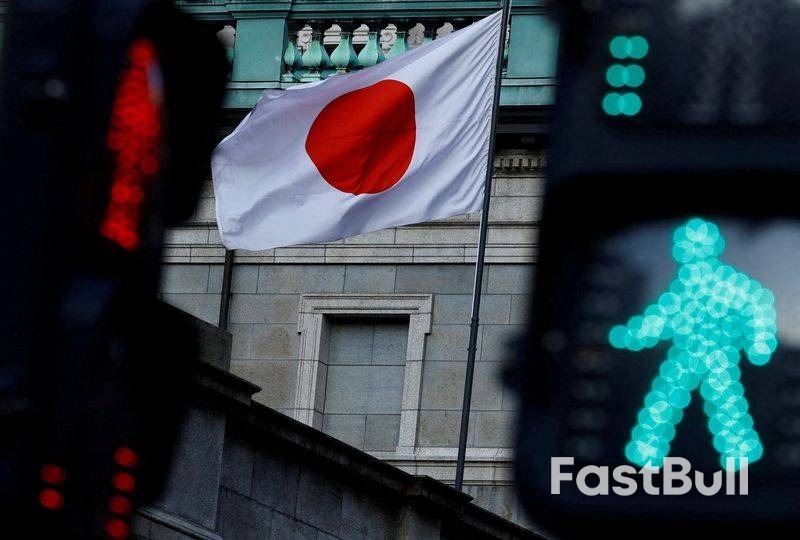
Yields around the globe have been climbing in recent weeks, as many central banks signalled they are either at or near the end of their own easing cycles, while the BOJ is widely anticipated to hike rates at its policy meeting next week.
JGB yields have also risen on expectations that Prime Minister Sanae Takaichi's expansionary fiscal policy would lead to a huge issuance of bonds, at a time the BOJ was reducing its presence in the market.

Big Tech is doubling down on investing billions in India, drawn by its abundance of resources for building data centers, a large talent and digital user pool, and market opportunity.
In under 24 hours, Microsoft and Amazon pledged more than $50 billion toward India's cloud and AI infrastructure, while Intel on Monday announced plans to make chips in the country to capitalize on its growing PC demand and speedy AI adoption.
While India trails the U.S. and China in the race to develop a native AI foundational model, and lacks a large domestic AI infrastructure company, it wants to leverage its expertise in the information technology sector to create and deploy AI applications at enterprise level, also offering Big Tech companies a huge opportunity.
Having a model or computing is not enough for any enterprise to use AI effectively, and it requires companies making application layer and a large talent pool to deploy them, S. Krishnan, secretary at India's Ministry of Electronics and Information Technology, told CNBC.
Stanford University ranks India among the top four countries along with the U.S., China and the UK in the global and national AI vibrancy ranking. GitHub, a community of developers, has ranked India at the top with the global share of 24% of all projects.
India's opportunity lies more in "developing applications" which will be used to drive revenues for AI companies, Krishnan said.
On Tuesday, Microsoft announced $17.5 billion in investment in the country, spread over 4 years, aimed at expanding hyperscale infrastructure, embedding AI into national platforms, and advancing workforce readiness.
"This scale of capex gives Microsoft first‑mover advantage in GPU‑rich data centers while making Azure the preferred platform for India's AI workloads, as well as deepening alignment with the government's AI public infrastructure push," said Tarun Pathak, research Director at Counterpoint Research.
Amazon on Wednesday announced plans to invest over $35 billion, on top of the $40 billion it has already invested in the country.
Over the past few months, AI and tech majors such as OpenAI, Google, and Perplexity have offered their tools for free to millions in India, with Google also firming up its plans to invest $15 billion toward building data center capacity for a new AI hub in southern India.
"India combines a huge digital user base, rapidly growing cloud and AI demand, and a high-talent IT ecosystem that can build and consume AI at scale, making it more than just a market for users and instead a core engineering and deployment hub," Pathak said.
India has several advantages when it comes to building data centers. Markets such as Japan, Australia, China and Singapore in the Asia Pacific region have matured. Singapore, one of the oldest data center hubs in the region, has limited room to deploy large-scale data centers due to land availability issues.
India has abundant space for large-scale data center developments. When compared with data center hubs in Europe, power costs in India are relatively low. Coupled with India's growing renewable energy capacity — critical for power-hungry data centers — and the economics begin to look compelling.
Local demand, fueled by the rise of e-commerce — a major driver of data center growth in recent years — and potential new rules for storing social media data, strengthens the case.
Put simply: India is entering a sweet spot where global cloud providers, AI players, and domestic digitalization all converge to create one of the world's hottest data center markets.
"India is a pivotal market and one of the fastest‑growing regions for AI spending in Asia Pacific," said Deepika Giri, associate vice president and head of research, big data & AI, at International Data Corporation.
"A major gap, and therefore a significant opportunity, lies in the shortage of suitable compute infrastructure for running AI models," she added. Big Tech is looking to capitalize on the infrastructure opportunity in India by investing heavily in the cloud and data center space.
Global companies are expanding capacities closer to service bases in IT cities such as Bangalore, Hyderabad and Pune from traditional centers like Mumbai and Chennai which are closer to landing cables, as they build data centers in India for the world, Krishnan said.
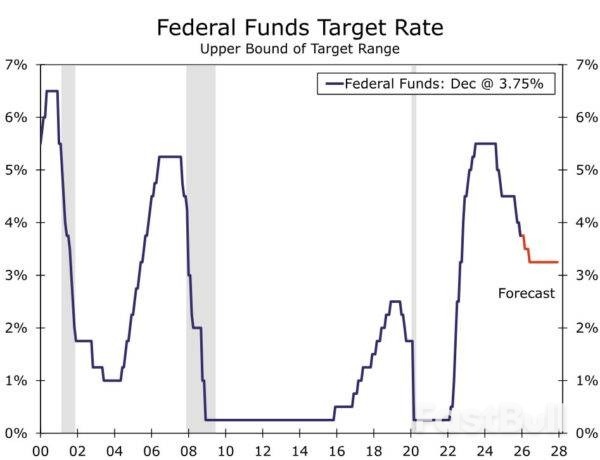
As expected, the FOMC reduced the fed funds target range by 25 bps to 3.50%-3.75% at the conclusion of its December meeting. As was also anticipated, the decision was not unanimous. Three voting members did not support the policy decision, with dissents registered in both a more hawkish and dovish direction. Specifically, Governor Miran dissented in favor of a steeper, 50 bps cut, while Presidents Schmid (Kansas City) and Goolsbee (Chicago) dissented in favor in keeping the policy rate unchanged.

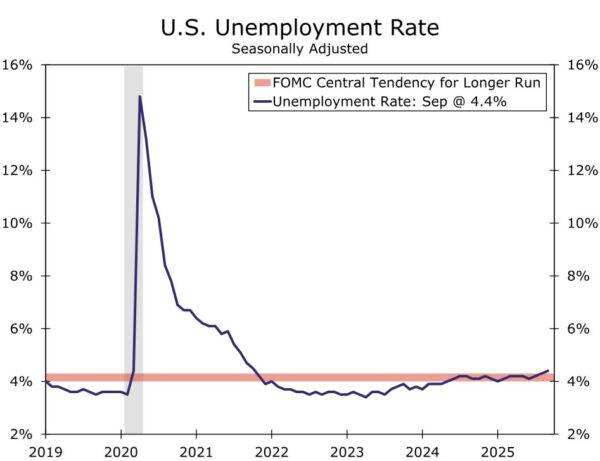
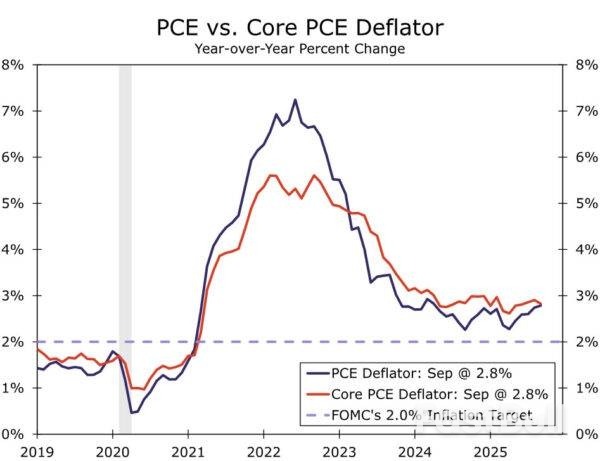
The dispersed views on the best course of action reflect the tricky environment the FOMC finds itself in. The FOMC did not have several key readings on the economy as originally scheduled due to the government shutdown (e.g., Q3 GDP, Oct. & Nov. Employment Situation and CPI, etc.). But, the latest data available continue to indicate some tension in the Committee's employment and inflation mandates (Figures 1 & 2).

With 75 bps of cuts since September and policy not as clearly restrictive, the bar for additional easing has been raised. In the post meeting statement, the Committee gave itself more optionality around future cuts, saying that "In considering the extent and timing of additional adjustments to the target range…", with the emphasized text new to the statement. The suggestion that the FOMC will not be so ready to cut rates again in the near term likely helped to limit the number of hawkish dissents.
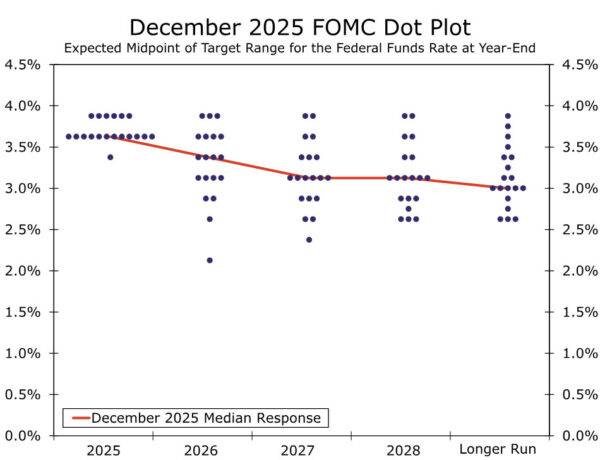
The Summary of Economic Projections did signal some broader unease among the Committee besides the two hawkish dissents. The dot plot revealed that six participants in total did not favor reducing the policy rate at today's meeting, implying four non-voting regional presidents also preferred to hold the policy rate steady. Nonetheless, a bias toward further easing persists among the Committee. The median dot for year-end 2026 and 2027 remained at 3.375% and 3.125%, respectively. The longer-run median was unchanged at 3.00%, with the dot plot illustrating that all but two participants see the current policy rate at least somewhat restrictive.

The biggest change to the SEP was a major upward revision to the 2026 growth outlook, with the median projection rising from 1.8% to 2.3%. Some of this change likely reflects the government shutdown, with Q4-2025 real GDP growth expected to see a material drag, setting the economy up for a bounce-back in Q4-2026. That said, this dynamic cannot fully explain the change, and it puts the median FOMC participant closer to our above-consensus forecast of 2.5% real GDP growth next year. Elsewhere, the changes generally were smaller, with some modest downward revisions to the inflation forecasts next year, and no change to the median longer run projections for the real GDP growth and the unemployment rate.

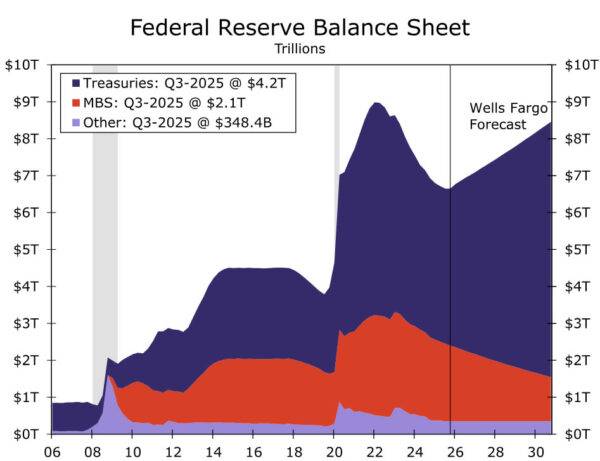
The Federal Reserve also announced that it will begin growing its balance sheet again in the coming days through the purchase of Treasury bills. As we have discussed previously, these purchases are meant to maintain short-term interest rate control, keep bank reserves ample and ensure the smooth functioning of financial markets. Fed officials have been clear for months that this step in no way represents a change in the stance of monetary policy. We agree with this assessment, and the beginning of reserve management purchases (RMPs) will have no bearing on our view of the stance of monetary policy.

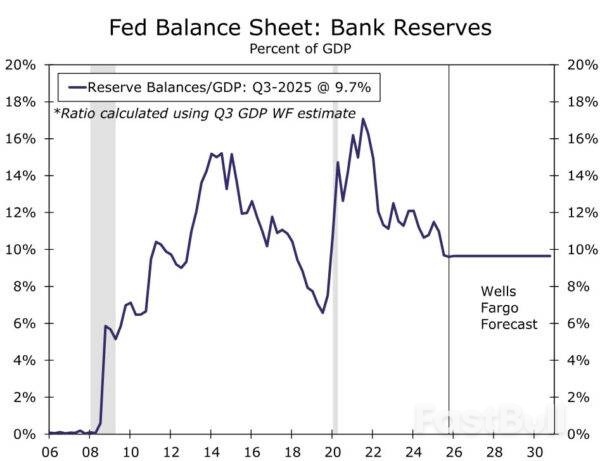
Specifically, the central bank announced that RMPs will begin on December 12 with an initial pace of $40 billion for the month. The post-meeting guidance stated that "the pace of RMPs will remain elevated for a few months to offset expected large increases in non-reserve liabilities in April. After that, the pace of total purchases will likely be significantly reduced in line with expected seasonal patterns in Federal Reserve liabilities." Our working assumption has been that the medium term, "equilibrium" pace of RMPs will be $25 billion per month to keep bank reserves ample. We read the above guidance as indicating that RMPs will downshift to roughly this pace starting in the spring. If realized, the Fed's balance sheet will grow by roughly $370 billion in 2026, and the reserve-to-GDP ratio will be 9.7% at the end of next year, comfortably above the lows in September 2019 when repo markets blew up (Figure 6).

Our base case remains that the current easing cycle is not over yet but rather that it is entering a slower phase. While the labor market is far from collapsing, the softening in conditions to the wrong side of "maximum employment" supports policy returning to a more neutral position. Directional progress on inflation next year should resume as the initial lift from tariffs fade, which would reduce the tension between the FOMC's employment and inflation mandate. We continue to look for two 25 bps rate cuts next year at the March and June meetings. Next week's economic data, specifically the "one and a half" employment report on Tuesday and the November CPI on Thursday, will be key to the outlook. We will have reports out previewing these data releases in the coming days.


Oil prices were broadly stable on Thursday as investors shifted their focus back to Russia-Ukraine peace talks while watching for any fallout from a U.S. seizure of a sanctioned tanker off the coast of Venezuela.
Brent crude futures dipped 5 cents, or 0.08%, to $62.16 a barrel at 0400 GMT, while U.S. West Texas Intermediate crude was down 1 cent, or 0.02%, at $58.45 a barrel.
The benchmarks settled higher a day earlier after the U.S. said it seized an oil tanker off the coast of Venezuela, as escalating tensions between the two countries raised concerns about supply disruptions.
"So far, the seizure has not trickled down to the market, but further escalation will impose heavy crude price volatility," said Emril Jamil, a senior oil analyst at LSEG.
"The market remains in limbo, eyeing the Russian-Ukraine peace deal progress."
On Wednesday, U.S. President Donald Trump said "we've just seized a tanker on the coast of Venezuela, large tanker, very large, largest one ever, actually, and other things are happening."
Trump administration officials did not name the vessel. British maritime risk management group Vanguard said the tanker, Skipper, was believed to have been seized off Venezuela.
Traders and industry sources said Asian buyers are demanding steep discounts on Venezuelan crude, pressured by a surge of sanctioned oil from Russia and Iran and heightened loading risks in the South American country as the U.S. boosts its military presence in the Caribbean.
Investors were more focused on developments in Russia-Ukraine peace talks. The leaders of Britain, France and Germany held a call with Trump to discuss Washington's latest peace efforts to end the war in Ukraine, in what they said was a "critical moment" in the process.
Reports of Ukraine striking a vessel from Russia's shadow fleet lent support to prices for now, IG market analyst Tony Sycamore said in a note.
"These developments are likely to keep crude oil above our key $55 support level into year-end, barring an unexpected peace deal in Ukraine," Sycamore said.
In other news, a sharply divided Federal Reserve reduced its benchmark interest rate. Lower rates can reduce consumer borrowing costs and boost economic growth and oil demand.
Meanwhile, a drawdown in U.S. crude inventories also lent support to prices even though the drop was milder than expected.
Crude inventories fell by 1.8 million barrels to 425.7 million barrels in the week ended December 5, the Energy Information Administration said in its weekly Petroleum Status Report, compared with analysts' expectations in a Reuters poll for a draw of 2.3 million barrels.
White Label
Data API
Web Plug-ins
Poster Maker
Affiliate Program
The risk of loss in trading financial instruments such as stocks, FX, commodities, futures, bonds, ETFs and crypto can be substantial. You may sustain a total loss of the funds that you deposit with your broker. Therefore, you should carefully consider whether such trading is suitable for you in light of your circumstances and financial resources.
No decision to invest should be made without thoroughly conducting due diligence by yourself or consulting with your financial advisors. Our web content might not suit you since we don't know your financial conditions and investment needs. Our financial information might have latency or contain inaccuracy, so you should be fully responsible for any of your trading and investment decisions. The company will not be responsible for your capital loss.
Without getting permission from the website, you are not allowed to copy the website's graphics, texts, or trademarks. Intellectual property rights in the content or data incorporated into this website belong to its providers and exchange merchants.
Not Logged In
Log in to access more features

FastBull Membership
Not yet
Purchase
Log In
Sign Up