• Trade
  • Markets
  • Copy
  • Contests
  • News
  • 24/7
  • Calendar
  • Q&A
  • Chats
Trending
Screeners
SYMBOL
LAST
BID
ASK
HIGH
LOW
NET CHG.
%CHG.
SPREAD
SPX
S&P 500 Index
6857.13
6857.13
6857.13
6865.94
6827.13
+7.41
+ 0.11%
--
DJI
Dow Jones Industrial Average
47850.93
47850.93
47850.93
48049.72
47692.96
-31.96
-0.07%
--
IXIC
NASDAQ Composite Index
23505.13
23505.13
23505.13
23528.53
23372.33
+51.04
+ 0.22%
--
USDX
US Dollar Index
98.870
98.950
98.870
98.980
98.870
-0.110
-0.11%
--
EURUSD
Euro / US Dollar
1.16556
1.16563
1.16556
1.16561
1.16408
+0.00111
+ 0.10%
--
GBPUSD
Pound Sterling / US Dollar
1.33407
1.33414
1.33407
1.33413
1.33165
+0.00136
+ 0.10%
--
XAUUSD
Gold / US Dollar
4219.82
4220.16
4219.82
4221.12
4194.54
+12.65
+ 0.30%
--
WTI
Light Sweet Crude Oil
59.277
59.314
59.277
59.469
59.187
-0.106
-0.18%
--

Community Accounts

Signal Accounts
--
Profit Accounts
--
Loss Accounts
--
View More

Become a signal provider

Sell trading signals to earn additional income

View More

Guide to Copy Trading

Get started with ease and confidence

View More

Signal Accounts for Members

All Signal Accounts

Best Return
  • Best Return
  • Best P/L
  • Best MDD
Past 1W
  • Past 1W
  • Past 1M
  • Past 1Y

All Contests

  • All
  • Trump Updates
  • Recommend
  • Stocks
  • Cryptocurrencies
  • Central Banks
  • Featured News
Top News Only
Share

Cctv - China, France: Signed Protocol On Sanitary, Phytosanitary Requirements For Export Of French Alfalfa Grass

Share

India's NIFTY IT Index Last Up 1.3%

Share

India's Nifty 50 Index Rises 0.35%

Share

Israel Sets 2026 Defence Budget At $34 Billion

Share

Russia Says Azov Sea's Port Of Temryuk Damaged In Ukrainian Attack

Share

Israel's Defense Budget For 2026 Will Be 112 Billion Israeli Shekels - Defense Minister Office

Share

One India Rate Panel Member Ram Singh Was Of View That Stance Should Be Changed To 'Accommodative' From 'Neutral' - Monetary Policy Committee Statement

Share

Reserve Bank Of India Chief: Will Continue To Meet Productive Needs Of Economy In Proactive Manner

Share

Reserve Bank Of India Chief: System Level Financial Parameters Of Nbfcs Sound

Share

Reserve Bank Of India Chief: Dollar Rupee Swap To Be For 3 Years, To Be Conducted This Month

Share

India's Nifty Realty Index Extend Gains, Last Up 1.4%

Share

India's Nifty Psu Bank Index Rises 1%

Share

Reserve Bank Of India Chief: Commited To Providing Sufficient Durable Liquidity

Share

Reserve Bank Of India Chief: Transmission Has Been Broad Based Across Sectors, Satisfactory

Share

Reserve Bank Of India Chief: As Of Nov 28, India's Forex Reserves Stood At $686 Billion

Share

Reserve Bank Of India Chief: Healthy Services Exports With Strong Remittances To Keep Cad Modest In This Year

Share

Reserve Bank Of India Chief: CPI Inflation Seen At 0.6% In Q3 Fy26

Share

Reserve Bank Of India Chief: Fy26 CPI Inflation Seen At 2% Versus 2.6% Previously

Share

India's Nifty Realty Index Up 1% After Reserve Bank Of India's Rate Cut

Share

India's Nifty Psu Bank Index Turns Positive, Up 0.43% After Reserve Bank Of India's Rate Cut

TIME
ACT
FCST
PREV
Turkey Trade Balance

A:--

F: --

P: --

Germany Construction PMI (SA) (Nov)

A:--

F: --

P: --

Euro Zone IHS Markit Construction PMI (Nov)

A:--

F: --

P: --

Italy IHS Markit Construction PMI (Nov)

A:--

F: --

P: --

U.K. Markit/CIPS Construction PMI (Nov)

A:--

F: --

P: --

France 10-Year OAT Auction Avg. Yield

A:--

F: --

P: --

Euro Zone Retail Sales MoM (Oct)

A:--

F: --

P: --

Euro Zone Retail Sales YoY (Oct)

A:--

F: --

P: --

Brazil GDP YoY (Q3)

A:--

F: --

P: --

U.S. Challenger Job Cuts (Nov)

A:--

F: --

P: --

U.S. Challenger Job Cuts MoM (Nov)

A:--

F: --

P: --

U.S. Challenger Job Cuts YoY (Nov)

A:--

F: --

P: --

U.S. Initial Jobless Claims 4-Week Avg. (SA)

A:--

F: --

P: --

U.S. Weekly Initial Jobless Claims (SA)

A:--

F: --

P: --

U.S. Weekly Continued Jobless Claims (SA)

A:--

F: --

P: --

Canada Ivey PMI (SA) (Nov)

A:--

F: --

P: --

Canada Ivey PMI (Not SA) (Nov)

A:--

F: --

P: --

U.S. Non-Defense Capital Durable Goods Orders Revised MoM (Excl. Aircraft) (SA) (Sept)

A:--

F: --

P: --
U.S. Factory Orders MoM (Excl. Transport) (Sept)

A:--

F: --

P: --

U.S. Factory Orders MoM (Sept)

A:--

F: --

P: --

U.S. Factory Orders MoM (Excl. Defense) (Sept)

A:--

F: --

P: --

U.S. EIA Weekly Natural Gas Stocks Change

A:--

F: --

P: --

Saudi Arabia Crude Oil Production

A:--

F: --

P: --

U.S. Weekly Treasuries Held by Foreign Central Banks

A:--

F: --

P: --

Japan Foreign Exchange Reserves (Nov)

A:--

F: --

P: --

India Repo Rate

A:--

F: --

P: --

India Benchmark Interest Rate

A:--

F: --

P: --

India Reverse Repo Rate

A:--

F: --

P: --

India Cash Reserve Ratio

A:--

F: --

P: --

Japan Leading Indicators Prelim (Oct)

A:--

F: --

P: --

U.K. Halifax House Price Index YoY (SA) (Nov)

--

F: --

P: --

U.K. Halifax House Price Index MoM (SA) (Nov)

--

F: --

P: --

France Current Account (Not SA) (Oct)

--

F: --

P: --

France Trade Balance (SA) (Oct)

--

F: --

P: --

France Industrial Output MoM (SA) (Oct)

--

F: --

P: --

Italy Retail Sales MoM (SA) (Oct)

--

F: --

P: --

Euro Zone Employment YoY (SA) (Q3)

--

F: --

P: --

Euro Zone GDP Final YoY (Q3)

--

F: --

P: --

Euro Zone GDP Final QoQ (Q3)

--

F: --

P: --

Euro Zone Employment Final QoQ (SA) (Q3)

--

F: --

P: --

Euro Zone Employment Final (SA) (Q3)

--

F: --

P: --
Brazil PPI MoM (Oct)

--

F: --

P: --

Mexico Consumer Confidence Index (Nov)

--

F: --

P: --

Canada Unemployment Rate (SA) (Nov)

--

F: --

P: --

Canada Labor Force Participation Rate (SA) (Nov)

--

F: --

P: --

Canada Employment (SA) (Nov)

--

F: --

P: --

Canada Part-Time Employment (SA) (Nov)

--

F: --

P: --

Canada Full-time Employment (SA) (Nov)

--

F: --

P: --

U.S. Dallas Fed PCE Price Index YoY (Sept)

--

F: --

P: --

U.S. PCE Price Index YoY (SA) (Sept)

--

F: --

P: --

U.S. PCE Price Index MoM (Sept)

--

F: --

P: --

U.S. Personal Outlays MoM (SA) (Sept)

--

F: --

P: --

U.S. Core PCE Price Index MoM (Sept)

--

F: --

P: --

U.S. UMich 5-Year-Ahead Inflation Expectations Prelim YoY (Dec)

--

F: --

P: --

U.S. Core PCE Price Index YoY (Sept)

--

F: --

P: --

U.S. 5-10 Year-Ahead Inflation Expectations (Dec)

--

F: --

P: --

U.S. UMich Current Economic Conditions Index Prelim (Dec)

--

F: --

P: --

U.S. UMich Consumer Sentiment Index Prelim (Dec)

--

F: --

P: --

U.S. UMich 1-Year-Ahead Inflation Expectations Prelim (Dec)

--

F: --

P: --

U.S. UMich Consumer Expectations Index Prelim (Dec)

--

F: --

P: --

Q&A with Experts
    • All
    • Chatrooms
    • Groups
    • Friends
    Connecting
    .
    .
    .
    Type here...
    Add Symbol or Code

      No matching data

      All
      Trump Updates
      Recommend
      Stocks
      Cryptocurrencies
      Central Banks
      Featured News
      • All
      • Russia-Ukraine Conflict
      • Middle East Flashpoint
      • All
      • Russia-Ukraine Conflict
      • Middle East Flashpoint
      Search
      Products

      Charts Free Forever

      Chats Q&A with Experts
      Screeners Economic Calendar Data Tools
      Membership Features
      Data Warehouse Market Trends Institutional Data Policy Rates Macro

      Market Trends

      Market Sentiment Order Book Forex Correlations

      Top Indicators

      Charts Free Forever
      Markets

      News

      News Analysis 24/7 Columns Education
      From Institutions From Analysts
      Topics Columnists

      Latest Views

      Latest Views

      Trending Topics

      Top Columnists

      Latest Update

      Signals

      Copy Rankings Latest Signals Become a signal provider AI Rating
      Contests
      Brokers

      Overview Brokers Assessment Rankings Regulators News Claims
      Broker listing Forex Brokers Comparison Tool Live Spread Comparison Scam
      Q&A Complaint Scam Alert Videos Tips to Detect Scam
      More

      Business
      Events
      Careers About Us Advertising Help Center

      White Label

      Data API

      Web Plug-ins

      Affiliate Program

      Awards Institution Evaluation IB Seminar Salon Event Exhibition
      Vietnam Thailand Singapore Dubai
      Fans Party Investment Sharing Session
      FastBull Summit BrokersView Expo
      Recent Searches
        Top Searches
          Markets
          News
          Analysis
          User
          24/7
          Economic Calendar
          Education
          Data
          • Names
          • Latest
          • Prev

          View All

          No data

          Scan to Download

          Faster Charts, Chat Faster!

          Download App
          English
          • English
          • Español
          • العربية
          • Bahasa Indonesia
          • Bahasa Melayu
          • Tiếng Việt
          • ภาษาไทย
          • Français
          • Italiano
          • Türkçe
          • Русский язык
          • 简中
          • 繁中
          Open Account
          Search
          Products
          Charts Free Forever
          Markets
          News
          Signals

          Copy Rankings Latest Signals Become a signal provider AI Rating
          Contests
          Brokers

          Overview Brokers Assessment Rankings Regulators News Claims
          Broker listing Forex Brokers Comparison Tool Live Spread Comparison Scam
          Q&A Complaint Scam Alert Videos Tips to Detect Scam
          More

          Business
          Events
          Careers About Us Advertising Help Center

          White Label

          Data API

          Web Plug-ins

          Affiliate Program

          Awards Institution Evaluation IB Seminar Salon Event Exhibition
          Vietnam Thailand Singapore Dubai
          Fans Party Investment Sharing Session
          FastBull Summit BrokersView Expo

          Bank Of England Warns Debt-Fueled Spending Boom Could Unravel

          Daniel Carter

          Economic

          Central Bank

          Summary:

          The Bank of England warned that a multi-trillion dollar spending boom in artificial intelligence infrastructure financed by debt risks unraveling given "materially stretched" stock market valuations.

          The UK central bank said on Tuesday that a correction in AI stocks would spill over to wider debt markets and pointed to early warning signs in credit default swaps of companies leaning on debt to fund their investments.
          While currently investment in the technology is mostly driven by cash held by "hyperscalers," it said around half of the expected $5 trillion of AI spending over the next five years will be financed externally, largely through debt.
          In its twice-yearly Financial Stability Report, the BOE said that a sharp fall in stock valuations could hit UK household wealth, feeding through to consumer spending. It would also trigger losses on lending to firms investing heavily in AI infrastructure, ramping up borrowing costs for companies more widely.
          It's the latest warning about a possible AI bubble collapsing, with some drawing parallels with the dotcom boom that burst in stock markets in the early 2000s. As concerns build that valuations are reaching irrational levels, firms are investing heavily in AI infrastructure, such as building out the data centers needed for the technology.
          The BOE estimates that AI has driven two thirds of this year's gains on the S&P 500 index and investment in the technology was behind half of US economic growth in the first half of 2025.
          "The financing of AI development is reaching an inflection point," the BOE said. "If material credit losses on AI lending were to occur (directly or indirectly), this could have spillovers to broader credit conditions including in the UK."
          The central bank said there has recently been rising corporate debt issuance by AI companies and pointed to some warning signs building.
          "The five-year credit default swap spreads of Oracle – an AI company which has lower free cash flow margins than some other larger hyperscalers and has issued a large amount of debt this year to finance AI infrastructure spending – has widened from less than 40 basis points to around 120 basis points since end-July," it said.
          That contrasts with the steady credit default swap spreads of US investment-grade corporates more broadly.
          Credit default swaps insure against a company defaulting on its debts. They usually rise when investor confidence in the firm's credit quality falls.

          Source: Bloomberg Europe

          To stay updated on all economic events of today, please check out our Economic calendar
          Risk Warnings and Disclaimers
          You understand and acknowledge that there is a high degree of risk involved in trading. Following any strategies or investment methods may lead to potential losses. The content on the site is provided by our contributors and analysts for information purposes only. You are solely responsible for determining whether any trading assets, securities, strategy, or any other product is suitable for investing based on your own investment objectives and financial situation.
          Add to Favorites
          Share

          EU Faces Uphill Battle to Shift Household Savings Away from Cash and Toward Productive Investment

          Gerik

          Economic

          Persistent Fragmentation Hampers Capital Market Integration

          The European Union's ambition to build a unified capital market that channels domestic savings into productive investment remains elusive. Although more than 60 legislative proposals have been introduced since 2015, national divisions and regulatory complexity have slowed momentum. A 2024 report warned that €300 billion in savings leave the EU annually, often flowing into U.S. firms that later reinvest in Europe. Former Italian Prime Minister Enrico Letta described this capital outflow as a form of “collective suicide,” underscoring the detrimental consequences of ongoing fragmentation.
          The European Central Bank echoed these concerns in a May 2025 study, attributing the slow progress to diverging national interests, regulatory overload, and shifting political will. A new reform package aimed at enhancing integration particularly under the Savings and Investments Union (SIU) is set to be unveiled this week.

          Household Saving Behavior Reflects Deep-Rooted Risk Aversion

          The EU’s slow progress is mirrored in the financial behavior of its citizens. Over the past five years, household holdings in cash and bank deposits increased by 15%, reaching €12.1 trillion or about 30% of household wealth. This contrasts with the U.S., where only 11% of wealth is held in cash. In Germany, a particularly risk-averse nation, over 40% of household financial assets are stored in cash or deposits, with just 12% in equities.
          This pattern highlights a strong cultural resistance to investing in capital markets. It is not merely a product of financial illiteracy but also linked to trust issues with financial intermediaries. For instance, one retired Italian doctor expressed reluctance to invest due to opaque fees and difficulty reaching his bank revealing a clear causal link between limited trust and low investment participation.

          ‘Finance Europe’ Label and PIR Expansion Reflect Grassroots Efforts

          With centralized EU reforms moving slowly, some countries have begun experimenting with local solutions. A pilot initiative led by Spain proposes a “Finance Europe” label to help savers identify investment products that support EU-based companies. This label, coupled with assessments of regulatory barriers and market demand, aims to make domestic investment more accessible and appealing.
          At the same time, think tanks in Italy, France, Germany, and Spain are exploring the expansion of Italy’s PIR (Piani Individuali di Risparmio) scheme to the EU level. The PIR, launched in 2017, successfully attracted €21 billion over five years by offering tax incentives for long-term investments in Italian firms. The proposed EU-wide version would shift the requirement from 70% investment in one national economy to a broader focus on EU-wide companies, with a smaller portion still allocated domestically. The success of the Italian model provides a correlation between tax incentives and increased retail investor participation.

          Reform Plans Under SIU Aim to Empower Institutions

          The upcoming SIU framework will reportedly propose expanded authority for the European Securities and Markets Authority (ESMA) and measures to eliminate cross-border obstacles for asset managers and trading platforms. These institutional changes, if implemented effectively, could provide the necessary infrastructure to support retail investment. However, without accompanying national follow-through and cultural shifts, these reforms risk being symbolic.
          Critics, including Dutch and Italian market regulators, emphasize the need for simplicity, transparency, and investor protection. As the SIU builds upon the Retail Investment Strategy (RIS), the updated focus on reducing burdens for the financial industry may dilute its original goals, which were centered on investor empowerment.

          Low Returns and Inflation Erode Confidence

          EU households also face a fundamental economic disincentive: low deposit returns. As of September, euro area current accounts yielded just 0.25% on average, with term deposits offering 1.78% both below the 2.2% inflation rate. This negative real return disincentivizes saving in traditional accounts but has not yet translated into greater capital market participation. In contrast, U.S. households experienced a 151% rise in net wealth from 2009 to 2023, compared to only 55% in the euro area a divergence partly driven by more aggressive equity investment and higher returns on financial products.
          While the EU continues to develop frameworks like the SIU and push for more empowered regulatory bodies, the core challenge lies in altering investor behavior and rebuilding trust in financial markets. Without coordinated national implementation, attractive product design, and cultural reorientation, savers are unlikely to shift away from the safety of cash. The EU’s comparative disadvantage in wealth accumulation stems not only from policy but also from structural and psychological barriers, which must be addressed in tandem for integration efforts to succeed.

          Source: Reuters

          To stay updated on all economic events of today, please check out our Economic calendar
          Risk Warnings and Disclaimers
          You understand and acknowledge that there is a high degree of risk involved in trading. Following any strategies or investment methods may lead to potential losses. The content on the site is provided by our contributors and analysts for information purposes only. You are solely responsible for determining whether any trading assets, securities, strategy, or any other product is suitable for investing based on your own investment objectives and financial situation.
          Add to Favorites
          Share

          Zafrul: China Signals Interest In Strengthening Trade And Investment, Proposes MOU

          Winkelmann

          Political

          Economic

          China has signalled its intention to deepen trade and investment cooperation with Malaysia by proposing a memorandum of understanding (MOU), following recent discussions in Beijing on the Agreement on Reciprocal Trade (ART), said Investment, Trade and Industry Minister Tengku Datuk Seri Zafrul Abdul Aziz.

          He said the proposed MOU remains at a preliminary stage but is expected to centre on two-way investments and strategic sectors where Malaysian capabilities support Chinese companies.

          "We had one meeting so far, and we will update accordingly (on the industries that will be covered).

          "We are also identifying strategic sectors in which Malaysia can support Chinese companies, both in establishing their presence here and expanding across Asean," he told reporters after a dialogue session with the Concorde Club at Wisma Bernama on Tuesday.

          The session, titled "Farewell MITI, Hello New Horizons", was chaired by Malaysian National News Agency (Bernama) chairman Datuk Seri Wong Chun Wai. The Concorde Club is an informal group comprising senior editors from local and foreign media organisations.

          Zafrul said Malaysia sent a team to Beijing last week to brief Chinese officials on the wording and implications of the ART, following earlier discussions.

          He said China was satisfied with Malaysia's explanation and indicated its intention to strengthen bilateral trade and investment cooperation.

          "They proposed the idea of an MOU, and even in Kuala Lumpur, they had already talked about that possibility. In Beijing, they discussed it in greater detail — particularly their commitment to push for this MOU.

          "As I mentioned in Parliament yesterday (Monday, Dec 1), it was not that they do not want to work with us. In fact, it shows that they want to work even more closely with us, and they want this to be more tangible," said Zafrul.

          On rare earth elements (REEs), he said Malaysia welcomes participation from global players but has yet to receive formal proposals.

          "We welcome China, the United States, Australia and others to invest in developing the midstream and downstream REE industry. However, we have not approved any licences from China or other countries apart from Lynas, as no applications have been submitted yet," Zafrul said.

          Commenting on reports that China had asked semiconductor manufacturer Nexperia in Negeri Sembilan to halt global expansion, the minister said Malaysian operations remain unaffected.

          "Operations are still ongoing. I spoke to the Malaysian Investment Development Authority (Mida) yesterday. So, we will wait for the company to respond to us. As of today, it is still business as usual," he said.

          Zafrul, who has served two terms as senator since 2020, completes his six-year tenure in the Dewan Negara on Dec 2, 2025. He was reappointed in December 2022.

          He was first appointed as senator in 2020 to join the Cabinet under then prime minister Tan Sri Muhyiddin Yassin, and has since served in multiple administrations, including under Datuk Seri Ismail Sabri Yaakob.

          On Nov 13, 2025, Zafrul informed Prime Minister Datuk Seri Anwar Ibrahim of his intention to assist his successor following the end of his ministerial term.

          The prime minister said he would announce Zafrul's new role on Wednesday (Dec 3).

          Source: Theedgemarkets

          To stay updated on all economic events of today, please check out our Economic calendar
          Risk Warnings and Disclaimers
          You understand and acknowledge that there is a high degree of risk involved in trading. Following any strategies or investment methods may lead to potential losses. The content on the site is provided by our contributors and analysts for information purposes only. You are solely responsible for determining whether any trading assets, securities, strategy, or any other product is suitable for investing based on your own investment objectives and financial situation.
          Add to Favorites
          Share

          Uk House Prices Rise Despite Budget Tax Fears, Says Nationwide

          Justin

          Political

          Economic

          UK house prices rose last month despite uncertainty before the budget, according to Nationwide, which predicted that the newly announced "mansion tax" would have a limited impact on the housing market.

          The UK's biggest building society said the average house price rose 0.3% month on month in November, higher than a 0.1% increase predicted by economists polled by Reuters. The average price of a home was £272,998, up from £272,226 in October.

          Last week, the chancellor, Rachel Reeves, announced a new high-value council tax surcharge in England on homes worth £2m or more from April 2028.

          There will be four price bands, with the surcharge starting at £2,500 a year for properties valued at more than £2m and rising to £7,500 for properties worth more than £5m.

          "The changes to property taxes announced in the budget are unlikely to have a significant impact on the housing market," said Robert Gardner, the chief economist at Nationwide. "The high value council tax surcharge … will apply to less than 1% of properties in England and around 3% in London."

          While the rate of annual house price growth slowed significantly to 1.8%, the slowest rate since last June, economists had expected a 1.4% rise. In October, the annual rate of growth was 2.4%.

          "Against a backdrop of subdued consumer confidence and signs of weakening in the labour market, this performance indicates resilience," Gardner said. "The housing market has remained fairly stable in recent months with house prices rising at a modest pace."

          Lower interest rates have helped to support activity. The Bank of England last lowered borrowing costs in August, but last month decided to keep interest rates at 4% in a close-run vote by the Bank's monetary policy committee.

          However, the Bank said that inflation is already likely to have peaked at 3.8%, below its previous prediction of a peak of 4%, paving the way for further cuts.

          Mark Harris, the chief executive of the mortgage broker SPF Private Clients, said: "While the market has been a little quieter as some adopted a 'wait and see' approach, lenders have remained keen to lend, with funds available to do so.

          "With talk of another base rate reduction this month, borrowers may be tempted to hold on in the hope of cheaper rates to come but those concerned about budgeting and rate rises might wish to consider locking into a cheaper rate now several months ahead of when they might need it."

          Sarah Coles, the head of personal finance at Hargreaves Lansdown, said buyers waited to see what was in the budget.

          She added: "There's a decent chance that 2026 will usher in more positivity. We often see a boost in January, and despite challenges, there are a few things working in the market's favour. The budget brought a property tax that will only affect a small slice of the market."

          Source: GUARDIAN

          To stay updated on all economic events of today, please check out our Economic calendar
          Risk Warnings and Disclaimers
          You understand and acknowledge that there is a high degree of risk involved in trading. Following any strategies or investment methods may lead to potential losses. The content on the site is provided by our contributors and analysts for information purposes only. You are solely responsible for determining whether any trading assets, securities, strategy, or any other product is suitable for investing based on your own investment objectives and financial situation.
          Add to Favorites
          Share

          Weak US Economic Data Strengthens Support For XAUUSD

          Winkelmann

          Commodity

          Forex

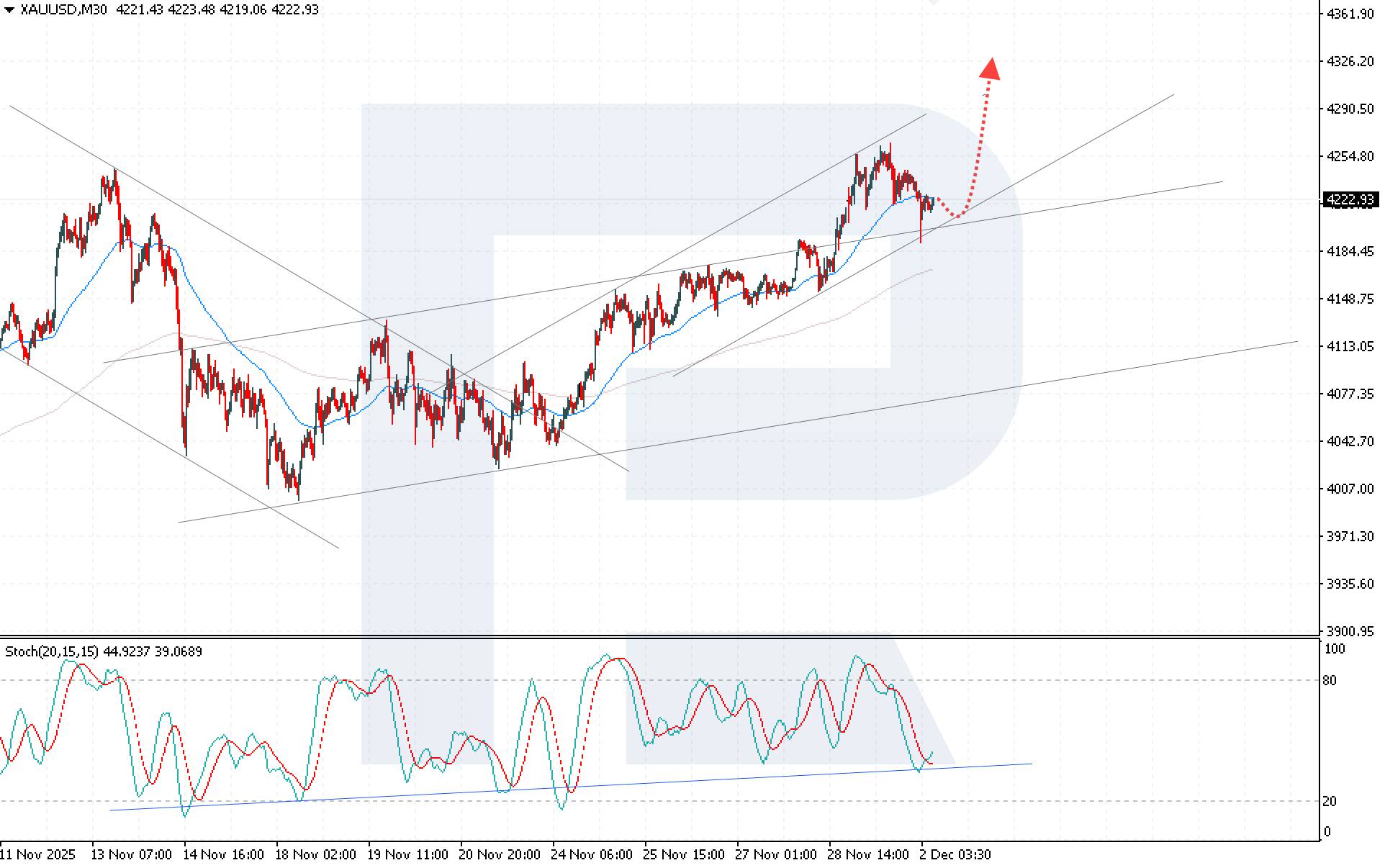
          XAUUSD prices are under pressure; however, key macroeconomic and monetary factors continue to generate bullish signals, with quotes currently at 4,222 USD.

          XAUUSD forecast: key trading points

          · The US manufacturing sector is contracting for the ninth consecutive month
          · Weak US macroeconomic data supports demand for gold
          · XAUUSD forecast for 2 December 2025: 4,3250

          Fundamental analysis

          XAUUSD quotes are declining slightly as sellers firmly defend the 4,235 USD resistance level. Gold had previously gained upward momentum amid rising expectations that the Federal Reserve would cut interest rates as early as next week. Traders are pricing in an 87.2% probability of a 25-basis-point rate cut, driven by weak US macroeconomic statistics and dovish comments from Fed officials.

          Monday's data release showed that the US ISM manufacturing PMI fell to 48.2 in November 2025, marking the lowest reading in four months, down from 48.7 in September and below market expectations of 48.6. The sector has now been contracting for nine consecutive months, with the pace of decline accelerating.

          Market attention now turns to Federal Reserve Chairman Jerome Powell, who is scheduled to speak today. His comments may provide additional signals regarding the future interest rate trajectory.

          XAUUSD technical analysis

          XAUUSD quotes are edging lower, but buying pressure persists: after testing the EMA-65, prices have rebounded confidently. The XAUUSD price forecast suggests the bearish correction is nearing completion, followed by a potential resumption of growth towards the 4,3250 USD level.

          The Stochastic Oscillator further confirms the bullish scenario, with the signal lines bouncing from the support level and crossing upwards, indicating strengthening buying activity.

          A breakout and firm consolidation above 4,245 USD will serve as key confirmation of the end of the correction and the formation of a new bullish impulse.

          Summary

          Weak US economic data and expectations of a Federal Reserve rate cut continue to form solid support for XAUUSD, despite ongoing selling pressure near the key resistance zone. Today's XAUUSD analysis indicates the completion of the correction and a high likelihood of renewed growth towards 4,3250 USD.

          Source: RoboForex

          Risk Warnings and Disclaimers
          You understand and acknowledge that there is a high degree of risk involved in trading. Following any strategies or investment methods may lead to potential losses. The content on the site is provided by our contributors and analysts for information purposes only. You are solely responsible for determining whether any trading assets, securities, strategy, or any other product is suitable for investing based on your own investment objectives and financial situation.
          Add to Favorites
          Share

          Bank of America Endorses Crypto Exposure for Wealth Clients Amid Shifting Wall Street Attitudes

          Gerik

          Economic

          A Strategic Pivot: Bank of America Embraces Digital Assets

          Bank of America (BAC) has formally recommended that its wealth management clients across Merrill, Private Bank, and Merrill Edge platforms consider dedicating 1% to 4% of their portfolios to cryptocurrencies. This represents a notable shift from previous policy, which only allowed access to crypto products upon client request. Now, over 15,000 wealth advisers can proactively suggest digital asset exposure, signaling a new era of institutional engagement in the crypto space.
          Chris Hyzy, CIO at Bank of America Private Bank, noted that the recommendation targets investors who are not only comfortable with volatility but are also seeking innovation-driven themes in their portfolios. He emphasized that crypto exposure should be executed through regulated vehicles with a thoughtful allocation strategy that balances both the opportunities and risks inherent in digital assets.

          Bitcoin ETFs Gain Legitimacy in Traditional Finance

          Starting January 5, Bank of America’s CIO team will begin covering four major bitcoin ETFs: Bitwise Bitcoin ETF (BITB), Fidelity’s Wise Origin Bitcoin Fund (FBTC), Grayscale’s Bitcoin Mini Trust (BTC), and BlackRock’s iShares Bitcoin Trust (IBIT). This marks a critical step in the institutional validation of crypto, with BofA acknowledging both investor demand and the expanding role of exchange-traded products in making crypto more accessible and regulated.
          The range of 1% to 4% allocation is differentiated by risk tolerance. For more conservative clients, a 1% allocation is considered appropriate, while the upper range caters to those with higher risk appetite. This tailored guidance reflects a correlation between client profile and asset class exposure rather than a universal prescription.

          Broader Institutional Momentum Favors Crypto

          Bank of America’s move follows similar recommendations from leading financial institutions. Morgan Stanley’s global investment committee suggested a 2% to 4% crypto allocation in October, citing increasing investor interest despite its speculative nature. BlackRock proposed a 1% to 2% allocation earlier in 2025, and Fidelity went further with a 2% to 5% range, even recommending up to 7.5% for investors under 30.
          Meanwhile, other financial powerhouses are expanding crypto access. Vanguard has started allowing crypto ETFs and mutual funds on its platform. Morgan Stanley, Charles Schwab, Fidelity, and JPMorgan have already enabled clients to invest in crypto ETFs, while fintech firms like SoFi now offer direct crypto trading.
          This broader shift highlights a clear causal relationship between institutional legitimacy and client access. As crypto becomes increasingly integrated into traditional financial infrastructure, it enhances investor confidence and promotes more balanced portfolio strategies.

          Policy Shifts and Market Volatility Create a Complex Landscape

          The expansion in crypto services has been facilitated by a pro-crypto shift in U.S. regulatory posture under the Trump administration, which has removed several restrictive measures previously set during the Biden era. This deregulatory wave has improved clarity around crypto-related banking activity, allowing more institutions to deepen their involvement in digital asset markets.
          Despite the structural tailwinds, the crypto market remains volatile. Bitcoin, which hit an all-time high of over $126,000 in early October, has since plunged by nearly a third to around $85,000. This sharp decline, coupled with a year-to-date drop of about 10%, stands in contrast to the S&P 500’s 15% gain. The inverse performance trend underscores the high-risk, high-reward nature of digital assets and supports Bank of America's cautious tone.
          Bank of America’s guidance to include crypto in wealth portfolios, supported by structured ETF coverage and risk-based allocation bands, illustrates a maturing view of digital assets within the financial establishment. While crypto prices have slumped recently, the institutional infrastructure surrounding the asset class is solidifying. This reflects a complex dynamic: short-term volatility may persist, but long-term integration into traditional portfolios is accelerating. The link between regulatory clarity, institutional endorsement, and client demand has become increasingly causal, reinforcing crypto’s role as a viable albeit volatile component of modern wealth strategy.

          Source: Reuters

          To stay updated on all economic events of today, please check out our Economic calendar
          Risk Warnings and Disclaimers
          You understand and acknowledge that there is a high degree of risk involved in trading. Following any strategies or investment methods may lead to potential losses. The content on the site is provided by our contributors and analysts for information purposes only. You are solely responsible for determining whether any trading assets, securities, strategy, or any other product is suitable for investing based on your own investment objectives and financial situation.
          Add to Favorites
          Share

          Dollar Downside Risks Persist

          ING

          Forex

          Economic

          Dollar Downside Risks Persist_1


          USD: Still vulnerable

          The dollar came under pressure yesterday during European hours but recovered during New York's session, potentially thanks to some safe haven flows abandoning high-beta currencies. Admittedly, the current market environment – bonds and risky assets both falling – isn't giving clear-cut indications for FX. Some risk stabilisation is likely needed to bring the dollar lower, which remains our call for this week.

          As discussed recently, the dollar remains expensive relative to its short-term rate differentials across most of the G10. Yesterday's ISM manufacturing didn't move pricing for a December cut as expected: prices paid were a bit higher than expected, but the headline index print was soft. We expect that the remainder of the week will validate the market's dovish pricing for next week's Fed meeting.

          Part of yesterday's market instability was driven by a bond market selloff in Japan following hawkish comments by BoJ Governor Kazuo Ueda. After yesterday's spike in 10-year JGBs yields by around 6bp, this morning we see some calming and a decline of almost 3bp from the highs, and pricing for a December hike is 20bp.

          USD/JPY briefly traded below 155.0 yesterday before the USD rebound: we think conditions for a new break lower this week are all there unless we hear some softening of the hawkish tone by Ueda or other officials.


          EUR: Cool CPI not a game-changer

          Developments in the Russia-Ukraine peace talks remain the most relevant topic for the euro this week. As US Special Envoy Steve Witkoff meets with President Putin today, we should gain a clearer sense of how close we are to any agreement.

          On the macro side, today's CPI shouldn't move the needle dramatically for ECB rate expectations. However, we expect this flash November estimate to show headline CPI slowing from 2.1% to 2.0% and core from 2.4% to 2.3%, which are both 0.1 percentage points below consensus. If anything, the risks are slightly on the downside for the euro, but our expectation is for a neutral FX impact nonetheless and EUR/USD can eye 1.170 again soon if USD drops in line with our call.

          HUF: No change is good news

          Moody's decision on Friday to leave the sovereign rating unchanged, including a negative outlook, was received positively by the market. Apparently, the market saw the risk of a downgrade as realistic after the government raised fiscal targets for this year and next year to a 5% GDP deficit. It seems that one milestone is behind us, but Hungary is not out of the woods yet.

          This Friday will be the Fitch rating review. Fitch was more optimistic about the fiscal situation than Moody's, and, therefore, the government's review causes a larger deviation from the forecast. Moreover, Fitch still has a "stable" outlook for the rating, which makes Hungary more sensitive to any changes in the fiscal path. The question is whether the market becomes more optimistic after Moody's decision or priced in these differences and a possible deterioration in Fitch's outlook, which is our baseline, could change the current optimism.

          EUR/HUF jumped below 381 yesterday, new lows, and as we mentioned last week, testing 380 is probably just a matter of time. Although Fitch's decision this Friday will probably be negative, it is already priced in to some extent. At the same time, the promise of peace between Ukraine and Russia will offset the potentially negative impact, in our view.

          As we discussed here yesterday, the market is still pessimistic about progress in the negotiations, and a possible agreement would provide a boost to FX across the CEE region. Therefore, the short-term picture for HUF remains bullish in our view.


          CEE: Turkey doesn't need to rush into further rate cuts

          Yesterday's PMI data in the CEE region showed an improvement in sentiment in all countries except Romania, which was closed for a public holiday, and we will see the data only today. This is good news across the region and, after a long time of promising some improvement in the numbers next year, this increases our conviction in the baseline recovery scenario.

          In Turkey, yesterday's GDP numbers showed some slowdown in the economy, but the result is not as bad as we expected. Therefore, our economist raised our estimate of full-year growth from 3.4% to 3.8%. Inflation numbers from Istanbul yesterday showed some upside, suggesting a higher risk for Wednesday's headline number vs market expectations (31.7%).

          Overall, it seems that the Central Bank of Turkey will not rush into further rate cuts and 100bp is our baseline for the meeting next week. This would also mean a longer period of stable carry trades and, in our opinion, later changes in the current FX regime, maintaining TRY on a stable weakening path, compensated by sufficient carry.

          Source: ING

          To stay updated on all economic events of today, please check out our Economic calendar
          Risk Warnings and Disclaimers
          You understand and acknowledge that there is a high degree of risk involved in trading. Following any strategies or investment methods may lead to potential losses. The content on the site is provided by our contributors and analysts for information purposes only. You are solely responsible for determining whether any trading assets, securities, strategy, or any other product is suitable for investing based on your own investment objectives and financial situation.
          Add to Favorites
          Share
          FastBull
          Copyright © 2025 FastBull Ltd

          728 RM B 7/F GEE LOK IND BLDG NO 34 HUNG TO RD KWUN TONG KLN HONG KONG

          TelegramInstagramTwitterfacebooklinkedin
          App Store Google Play Google Play
          Products
          Charts

          Chats

          Q&A with Experts
          Screeners
          Economic Calendar
          Data
          Tools
          Membership
          Features
          Function
          Markets
          Copy Trading
          Latest Signals
          Contests
          News
          Analysis
          24/7
          Columns
          Education
          Company
          Careers
          About Us
          Contact Us
          Advertising
          Help Center
          Feedback
          User Agreement
          Privacy Policy
          Business

          White Label

          Data API

          Web Plug-ins

          Poster Maker

          Affiliate Program

          Risk Disclosure

          The risk of loss in trading financial instruments such as stocks, FX, commodities, futures, bonds, ETFs and crypto can be substantial. You may sustain a total loss of the funds that you deposit with your broker. Therefore, you should carefully consider whether such trading is suitable for you in light of your circumstances and financial resources.

          No decision to invest should be made without thoroughly conducting due diligence by yourself or consulting with your financial advisors. Our web content might not suit you since we don't know your financial conditions and investment needs. Our financial information might have latency or contain inaccuracy, so you should be fully responsible for any of your trading and investment decisions. The company will not be responsible for your capital loss.

          Without getting permission from the website, you are not allowed to copy the website's graphics, texts, or trademarks. Intellectual property rights in the content or data incorporated into this website belong to its providers and exchange merchants.

          Not Logged In

          Log in to access more features

          FastBull Membership

          Not yet

          Purchase

          Become a signal provider
          Help Center
          Customer Service
          Dark Mode
          Price Up/Down Colors

          Log In

          Sign Up

          Position
          Layout
          Fullscreen
          Default to Chart
          The chart page opens by default when you visit fastbull.com