• Trade
  • Markets
  • Copy
  • Contests
  • News
  • 24/7
  • Calendar
  • Q&A
  • Chats
Trending
Screeners
SYMBOL
LAST
BID
ASK
HIGH
LOW
NET CHG.
%CHG.
SPREAD
SPX
S&P 500 Index
6857.13
6857.13
6857.13
6865.94
6827.13
+7.41
+ 0.11%
--
DJI
Dow Jones Industrial Average
47850.93
47850.93
47850.93
48049.72
47692.96
-31.96
-0.07%
--
IXIC
NASDAQ Composite Index
23505.13
23505.13
23505.13
23528.53
23372.33
+51.04
+ 0.22%
--
USDX
US Dollar Index
98.910
98.990
98.910
99.000
98.740
-0.070
-0.07%
--
EURUSD
Euro / US Dollar
1.16528
1.16537
1.16528
1.16715
1.16408
+0.00083
+ 0.07%
--
GBPUSD
Pound Sterling / US Dollar
1.33468
1.33475
1.33468
1.33622
1.33165
+0.00197
+ 0.15%
--
XAUUSD
Gold / US Dollar
4228.25
4228.66
4228.25
4230.62
4194.54
+21.08
+ 0.50%
--
WTI
Light Sweet Crude Oil
59.224
59.254
59.224
59.543
59.187
-0.159
-0.27%
--

Community Accounts

Signal Accounts
--
Profit Accounts
--
Loss Accounts
--
View More

Become a signal provider

Sell trading signals to earn additional income

View More

Guide to Copy Trading

Get started with ease and confidence

View More

Signal Accounts for Members

All Signal Accounts

Best Return
  • Best Return
  • Best P/L
  • Best MDD
Past 1W
  • Past 1W
  • Past 1M
  • Past 1Y

All Contests

  • All
  • Trump Updates
  • Recommend
  • Stocks
  • Cryptocurrencies
  • Central Banks
  • Featured News
Top News Only
Share

Russia's Rosatom Discusses With India Possibility Of Localising Production Of Nuclear Fuel For Nuclear Power Plants

Share

Russia Offered India To Localise Production Of Su-57 - Tass Cites Chemezov

Share

Argentina Economy Ministry: Launches 6.50% National Treasury Bond In USA Dollars Maturing On November 30, 2029

Share

Czech Defence Group Csg: Framework Agreement For Period Of 7 Years, Includes Potential Use Of EU's Safe Program

Share

India Aviation Regulator: Committee Shall Submit Its Finding, Recommendation To Regulator Within 15 Days

Share

Brazil October PPI -0.48% From Previous Month

Share

Netflix To Acquire Warner Bros. Following The Separation Of Discovery Global For A Total Enterprise Value Of $82.7 Billion (Equity Value Of $72.0 Billion)

Share

Tass Cites Kremlin: Russia Will Continue Its Actions In Ukraine If Kyiv Refuses To Settle The Conflict

Share

India's Forex Reserves Fall To $686.23 Billion As Of Nov 28

Share

Reserve Bank Of India Says Federal Government Had No Outstanding Loans With It As On Nov 28

Share

Lebanon Says Ceasefire Talks Aim Mainly At Halting Israel's Hostilities

Share

Russia Plans To Boost Oil Exports From Western Ports By 27% In December From November -Sources And Reuters Calculations

Share

Sberbank: Estimated Investment Of $100 Million In Technology, Team Expansion, And New Offices In India

Share

Sberbank Says Sberbank Unveils Major Expansion Strategy For India, Plans Full-Scale Banking, Education, And Tech Transfer

Share

India Government: Expect That Flight Schedules Will Begin To Stabilise And Return To Normal By Dec 6

Share

EU: Tiktok Agrees To Changes To Advertising Repositories To Ensure Transparency, No Fine

Share

EU Tech Chief: Not EU's Intention To Impose Highest Fines, X Fine Is Proportionate, Based On Nature Of Infringement, Impact On EU Users

Share

EU Regulators: EU Investigation Into X's Dissemination Of Illegal Content, Measures To Counter Disinformation Continues

Share

Ukraine's Military Says It Hit Russian Port In Krasnodar Region

Share

Jumped The Gun, Says Morgan Stanley, Reverses Dec Fed Rate Call To 25Bps Cut

TIME
ACT
FCST
PREV
U.S. Initial Jobless Claims 4-Week Avg. (SA)

A:--

F: --

P: --

U.S. Weekly Continued Jobless Claims (SA)

A:--

F: --

P: --

Canada Ivey PMI (SA) (Nov)

A:--

F: --

P: --

Canada Ivey PMI (Not SA) (Nov)

A:--

F: --

P: --

U.S. Non-Defense Capital Durable Goods Orders Revised MoM (Excl. Aircraft) (SA) (Sept)

A:--

F: --

P: --
U.S. Factory Orders MoM (Excl. Transport) (Sept)

A:--

F: --

P: --

U.S. Factory Orders MoM (Sept)

A:--

F: --

P: --

U.S. Factory Orders MoM (Excl. Defense) (Sept)

A:--

F: --

P: --

U.S. EIA Weekly Natural Gas Stocks Change

A:--

F: --

P: --

Saudi Arabia Crude Oil Production

A:--

F: --

P: --

U.S. Weekly Treasuries Held by Foreign Central Banks

A:--

F: --

P: --

Japan Foreign Exchange Reserves (Nov)

A:--

F: --

P: --

India Repo Rate

A:--

F: --

P: --

India Benchmark Interest Rate

A:--

F: --

P: --

India Reverse Repo Rate

A:--

F: --

P: --

India Cash Reserve Ratio

A:--

F: --

P: --

Japan Leading Indicators Prelim (Oct)

A:--

F: --

P: --

U.K. Halifax House Price Index YoY (SA) (Nov)

A:--

F: --

P: --

U.K. Halifax House Price Index MoM (SA) (Nov)

A:--

F: --

P: --

France Current Account (Not SA) (Oct)

A:--

F: --

P: --

France Trade Balance (SA) (Oct)

A:--

F: --

P: --

France Industrial Output MoM (SA) (Oct)

A:--

F: --

P: --

Italy Retail Sales MoM (SA) (Oct)

A:--

F: --

P: --

Euro Zone Employment YoY (SA) (Q3)

A:--

F: --

P: --

Euro Zone GDP Final YoY (Q3)

A:--

F: --

P: --

Euro Zone GDP Final QoQ (Q3)

A:--

F: --

P: --

Euro Zone Employment Final QoQ (SA) (Q3)

A:--

F: --

P: --

Euro Zone Employment Final (SA) (Q3)

A:--

F: --

P: --
Brazil PPI MoM (Oct)

A:--

F: --

P: --

Mexico Consumer Confidence Index (Nov)

A:--

F: --

P: --

Canada Unemployment Rate (SA) (Nov)

--

F: --

P: --

Canada Labor Force Participation Rate (SA) (Nov)

--

F: --

P: --

Canada Employment (SA) (Nov)

--

F: --

P: --

Canada Part-Time Employment (SA) (Nov)

--

F: --

P: --

Canada Full-time Employment (SA) (Nov)

--

F: --

P: --

U.S. Personal Income MoM (Sept)

--

F: --

P: --

U.S. Dallas Fed PCE Price Index YoY (Sept)

--

F: --

P: --

U.S. PCE Price Index YoY (SA) (Sept)

--

F: --

P: --

U.S. PCE Price Index MoM (Sept)

--

F: --

P: --

U.S. Personal Outlays MoM (SA) (Sept)

--

F: --

P: --

U.S. Core PCE Price Index MoM (Sept)

--

F: --

P: --

U.S. UMich 5-Year-Ahead Inflation Expectations Prelim YoY (Dec)

--

F: --

P: --

U.S. Core PCE Price Index YoY (Sept)

--

F: --

P: --

U.S. Real Personal Consumption Expenditures MoM (Sept)

--

F: --

P: --

U.S. 5-10 Year-Ahead Inflation Expectations (Dec)

--

F: --

P: --

U.S. UMich Current Economic Conditions Index Prelim (Dec)

--

F: --

P: --

U.S. UMich Consumer Sentiment Index Prelim (Dec)

--

F: --

P: --

U.S. UMich 1-Year-Ahead Inflation Expectations Prelim (Dec)

--

F: --

P: --

U.S. UMich Consumer Expectations Index Prelim (Dec)

--

F: --

P: --

U.S. Weekly Total Rig Count

--

F: --

P: --

U.S. Weekly Total Oil Rig Count

--

F: --

P: --

U.S. Consumer Credit (SA) (Oct)

--

F: --

P: --

China, Mainland Foreign Exchange Reserves (Nov)

--

F: --

P: --

China, Mainland Exports YoY (USD) (Nov)

--

F: --

P: --

China, Mainland Imports YoY (CNH) (Nov)

--

F: --

P: --

China, Mainland Imports YoY (USD) (Nov)

--

F: --

P: --

China, Mainland Imports (CNH) (Nov)

--

F: --

P: --

China, Mainland Trade Balance (CNH) (Nov)

--

F: --

P: --

China, Mainland Exports (Nov)

--

F: --

P: --

Q&A with Experts
    • All
    • Chatrooms
    • Groups
    • Friends
    Connecting
    .
    .
    .
    Type here...
    Add Symbol or Code

      No matching data

      All
      Trump Updates
      Recommend
      Stocks
      Cryptocurrencies
      Central Banks
      Featured News
      • All
      • Russia-Ukraine Conflict
      • Middle East Flashpoint
      • All
      • Russia-Ukraine Conflict
      • Middle East Flashpoint
      Search
      Products

      Charts Free Forever

      Chats Q&A with Experts
      Screeners Economic Calendar Data Tools
      Membership Features
      Data Warehouse Market Trends Institutional Data Policy Rates Macro

      Market Trends

      Market Sentiment Order Book Forex Correlations

      Top Indicators

      Charts Free Forever
      Markets

      News

      News Analysis 24/7 Columns Education
      From Institutions From Analysts
      Topics Columnists

      Latest Views

      Latest Views

      Trending Topics

      Top Columnists

      Latest Update

      Signals

      Copy Rankings Latest Signals Become a signal provider AI Rating
      Contests
      Brokers

      Overview Brokers Assessment Rankings Regulators News Claims
      Broker listing Forex Brokers Comparison Tool Live Spread Comparison Scam
      Q&A Complaint Scam Alert Videos Tips to Detect Scam
      More

      Business
      Events
      Careers About Us Advertising Help Center

      White Label

      Data API

      Web Plug-ins

      Affiliate Program

      Awards Institution Evaluation IB Seminar Salon Event Exhibition
      Vietnam Thailand Singapore Dubai
      Fans Party Investment Sharing Session
      FastBull Summit BrokersView Expo
      Recent Searches
        Top Searches
          Markets
          News
          Analysis
          User
          24/7
          Economic Calendar
          Education
          Data
          • Names
          • Latest
          • Prev

          View All

          No data

          Scan to Download

          Faster Charts, Chat Faster!

          Download App
          English
          • English
          • Español
          • العربية
          • Bahasa Indonesia
          • Bahasa Melayu
          • Tiếng Việt
          • ภาษาไทย
          • Français
          • Italiano
          • Türkçe
          • Русский язык
          • 简中
          • 繁中
          Open Account
          Search
          Products
          Charts Free Forever
          Markets
          News
          Signals

          Copy Rankings Latest Signals Become a signal provider AI Rating
          Contests
          Brokers

          Overview Brokers Assessment Rankings Regulators News Claims
          Broker listing Forex Brokers Comparison Tool Live Spread Comparison Scam
          Q&A Complaint Scam Alert Videos Tips to Detect Scam
          More

          Business
          Events
          Careers About Us Advertising Help Center

          White Label

          Data API

          Web Plug-ins

          Affiliate Program

          Awards Institution Evaluation IB Seminar Salon Event Exhibition
          Vietnam Thailand Singapore Dubai
          Fans Party Investment Sharing Session
          FastBull Summit BrokersView Expo

          Bank Of Canada Expected To Cut Ahead Of Carney’s Budget

          Isaac Bennett
          Summary:

          The Bank of Canada is likely to cut interest rates to help an economy that's suffering more damage from US tariffs, even as Prime Minister Mark Carney finalizes plans for a stimulative budget to boost growth.

          The Bank of Canada is likely to cut interest rates to help an economy that's suffering more damage from US tariffs, even as Prime Minister Mark Carney finalizes plans for a stimulative budget to boost growth.

          Markets and economists expect officials led by Governor Tiff Macklem to lower the benchmark overnight rate by 25 basis points for a second consecutive meeting on Wednesday, bringing the policy rate to 2.25%, the lowest since July 2022.

          As of Tuesday morning, traders in overnight index swaps were pricing in a greater than 80% chance of a cut.

          Canada's economy is still reeling from the trade dispute with the US, which has slammed the country's exporters and inflamed uncertainty for businesses. Last week, US President Donald Trump threatened to increase taxes on Canadian products yet again after he became annoyed with an Ontario government television advertisement that used the words of Ronald Reagan to criticize tariffs.

          The most recent consumer price figures weren't great: inflation accelerated to 2.4% in September and core measures were tracking above 3%. So another rate reduction would signal just how worried policymakers are about the downside risks for growth.

          "As much as the bank is still cautious on inflation and officials' acknowledgment that they can only help the economy transition, this is still a big demand shock," Veronica Clark, an economist at Citigroup Inc., said by email.

          As for the government's Nov. 4 budget, which will increase spending, it's not going to be enough to offset weakness in the private sector, Clark said.

          Speaking to reporters in Washington this month, Macklem called Canada's labor market "soft" despite a strong September jobs report. He pointed to the 7.1% unemployment rate and suggested that economic growth of about 1% in the near term won't be enough to close the output gap. Officials have also downplayed the bank's so-called preferred measures of inflation.

          "Communications have been quite dovish during the inter-meeting period, which is the reason why market pricing has increased despite a stock of data surprises that has turned quite positive," said Ian Pollick, global head of fixed income, commodities and currency strategy at Canadian Imperial Bank of Commerce.

          That dovishness is based, in part, on the sour mood of business executives. The central bank's survey of firms showed expectations for weaker demand over the next year. Non-residential business investment contracted at a 10.1% annualized rate in the second quarter. Pessimism is mounting, and Stellantis NV and General Motors Co. have created doubt about the future of two Ontario auto plants.

          Carney's government has pledged to take steps to improve infrastructure, housing, the military and business competitiveness in next week's budget. That will lead to a wider federal deficit. Economists surveyed by Bloomberg expect Canada's fiscal shortfall to surge to C$70 billion ($50 billion), and some see the deficit rising to C$100 billion, which would be more than 3% of gross domestic product.

          "The ongoing manufacturing recession will not end because Ottawa is aiming to boost investment," Fred Demers, head strategist of multi-asset solutions for BMO Global Asset Management, said by email. "The budget will help offset some of the pain, but there is still plenty of pain for Canada into 2026."

          Central bank officials have repeatedly said fiscal policy is the best way to respond to the trade war. Monetary policy can help, but it's a blunter tool.

          In any event, the Bank of Canada won't be able to factor in the details of the budget until its December rate decision.

          The central bank on Wednesday will also publish its usual suite of projections for growth and inflation for the first time since January in a monetary policy report. Since April, the bank has offered analysis of potential economic outcomes — but tariffs made "point forecasts" too difficult.

          A quarter percentage point cut this week would bring the overnight rate to the bottom of the bank's estimated range for the neutral rate of interest, where borrowing costs theoretically neither stimulate nor restrict growth.

          With the federal government also set to offer guidance on debt issuance and duration next week, the central bank may also opt to update plans on how it will manage its balance sheet. In January, it said it would resume purchases of treasury bills in the last three months of this year.

          The US Federal Reserve is also expected to cut borrowing costs on Wednesday.

          Source: Bloomberg Europe

          Risk Warnings and Disclaimers
          You understand and acknowledge that there is a high degree of risk involved in trading. Following any strategies or investment methods may lead to potential losses. The content on the site is provided by our contributors and analysts for information purposes only. You are solely responsible for determining whether any trading assets, securities, strategy, or any other product is suitable for investing based on your own investment objectives and financial situation.
          Add to Favorites
          Share

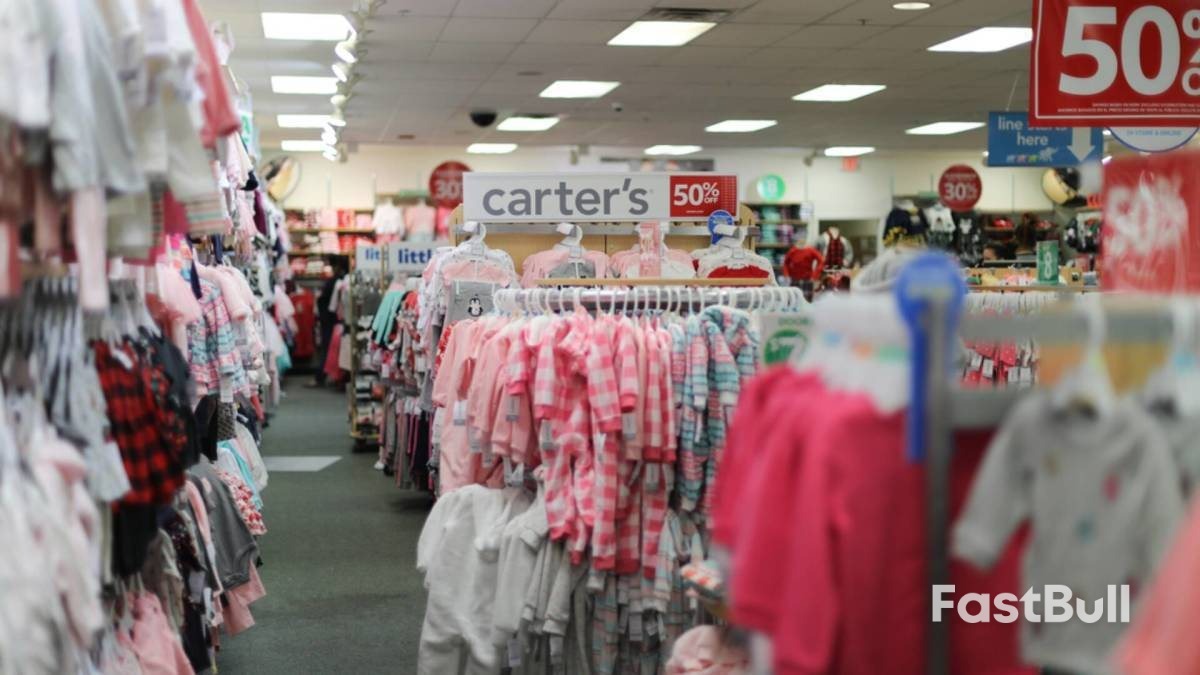
          Popular Children's Retailer Closing 150 Stores

          Winkelmann

          Forex

          Economic

          When you have kids, you don't just take on the responsibility of raising them. You also take on a world of expenses. And these days, a lot of parents are struggling.A whopping 59% of parents have gone into debt just to meet their children's needs, according to a 2025 National Debt Relief survey. And 42% of U.S. parents have credit card debt, with the average balance clocking in at $14,556.

          Given that so many parents are struggling with higher costs, it stands to reason that some are cutting back on spending wherever possible to keep their debt to a minimum. That could mean skipping nonessential clothing purchases and favoring secondhand apparel over items that are new.

          That's bad news for clothing retailers, though. And while parents may be more likely to cut back on apparel purchases for themselves rather than their kids, when push comes to shove, many will do whatever's needed to stay afloat.Meanwhile, one popular children's clothing retailer is gearing up to close stores after a disappointing fiscal quarter.If this trend continues, parents could be left with fewer choices for kids' apparel, exacerbating their financial pain.

          A popular children's retailer is closing 150 stores.

          Carter's shares key store closure update

          Carter's is a name any parent of young children is apt to recognize. The company operates more than 1,000 retail locations in North America and Mexico and owns several popular clothing brands, including OshKosh B'gosh.

          But Carter's unveiled some disappointing numbers during its most recent earnings call.During the company's third fiscal quarter, net sales fell 0.1% to $757.8 million, compared to $758.5 million a year prior.Net income, meanwhile, plunged substantially to $11.6 million, down from $58.3 million on a year-over-year basis.

          Now, the company is making plans to close 150 stores. It's also doing a corporate restructuring that will leave 300 office employees out of a job.Most of the closures will be U.S. stores, but a few of the closures are slated for locations in Canada and Mexico. Roughly 100 stores will be closed during fiscal year 2025 and 2026, with additional closures to come later."As we've discussed previously, our physical store fleet must be honed," said Carter's CEO and President Douglas Palladini.

          A troubling retail trend is emerging

          Carter's isn't the only U.S. retailer that's been battered by lingering inflation. And now, tariffs are wreaking further havoc.Since Carter's sources a large portion of its product line from Asian countries, tariffs are eating into the company's profits in a very serious way. The company has also seen a decline in the U.S. wholesale space as the big-name retailers it supplies rethink their own inventory needs.Carter's is trying to minimize the impact of tariffs by sourcing its merchandise more strategically. It's a strategy many retailers are adopting during these uncertain times. But whether it works is a different story.

          Meanwhile, if Carter's continues to struggle, it's consumers – most notably parents – who stand to get hurt.

          If the company's financial struggles continue, it may join the ranks of the numerous retailers that have resorted to bankruptcy in recent years.A Carter's bankruptcy could spell disaster for parents who rely on the company's products to clothe their children during their early years. While other companies produce children's apparel, losing a key player could leave parents with fewer choices – and higher costs.Closing underperforming store locations could help shore up Carter's balance sheet enough to weather the ongoing tariff storm. But it remains to be seen whether that strategy saves the company in the long run.

          Source: Yahoo Finance

          To stay updated on all economic events of today, please check out our Economic calendar
          Risk Warnings and Disclaimers
          You understand and acknowledge that there is a high degree of risk involved in trading. Following any strategies or investment methods may lead to potential losses. The content on the site is provided by our contributors and analysts for information purposes only. You are solely responsible for determining whether any trading assets, securities, strategy, or any other product is suitable for investing based on your own investment objectives and financial situation.
          Add to Favorites
          Share

          Bank Of Canada Preview: Rate Cut Expected

          Winkelmann

          Forex

          Political

          Economic

          Summary

          As we highlighted in our October International Economic Outlook, our views on the Bank of Canada (BoC) have changed. We now expect the BoC to cut its policy rate by 25 bps to 2.25% at October's meeting, marking a shift from our prior forecast of a hold through December and through all of 2026. While we view tomorrow's action to ease as the final cut in the BoC's easing cycle, we believe the balance of risk is tilted toward more easing as uncertainty is elevated and growth prospects are subdued.

          Bank of Canada Preview

          In our October International Economic Outlook, we made an explicit adjustment to our Bank of Canada (BoC) forecast profile. To that point, we adjusted our view on the BoC's October monetary policy decision, and we now expect BoC policymakers to deliver a 25 bps rate cut at this month's meeting. Our revised view stems from our assessment of overall BoC monetary policy space, but also, in our view, policymakers' seemingly stronger preference to support economic activity rather than control inflation.

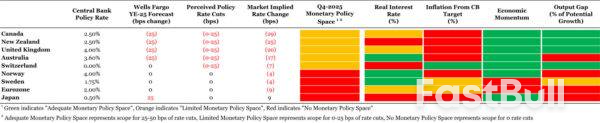
          As far as monetary policy space, our forward-looking framework—which aggregates indicators including real interest rates, inflation trajectory, economic growth momentum and output gap—suggests that the Bank of Canada has room for additional interest rate cuts. In fairness, our framework says cutting rates is a close call as indicators are split. Split in the sense that policy settings and inflation indicators suggest the BoC should keep rates unchanged, but growth-related indicators say monetary policy should continue to be adjusted in a more accommodative direction, at least when all indicators are evenly weighted when assessed. However, as mentioned, we believe policymakers have communicated more of a bias toward supporting growth and are not overly concerned with inflation. Evidence can be found in the BoC's prior official statement where policymakers were rather clear in that inflation risks have settled, but the economic outlook was deteriorating amid elevated uncertainty.

          While recent inflation and jobs data surprised to the upside, we have yet to detect a change in sentiment on inflation from policymakers and the unemployment rate remains elevated. At the same time, uncertainty has increased as the Trump administration has signaled an additional 10% tariff will be imposed on Canadian exports to the United States. Reinforcing an elevated degree of uncertainty was a Q3 business outlook survey that painted a pessimistic picture of forward-looking growth prospects. This growth concern is compounded by mixed signals on consumer spending. Retail sales showed positive momentum in August, but Statistics Canada's advance retail estimate points to a September contraction that will further complicate Q3 consumption and overall growth. Point being, when we adjust our framework to weigh growth momentum and growth prospects more heavily, we believe BoC policymakers have incentive to ease monetary policy in October rather than keep interest rates steady (Figure 1).

          Bank Of Canada Preview: Rate Cut Expected_1

          Source: Bloomberg Finance L.P. and Wells Fargo Economics

          For now, we believe the October cut will be the final rate reduction in the Bank of Canada's easing cycle. A cut this month would mean a terminal BoC rate of 2.25%; however, we believe the balance of risk is tilted toward more easing, with a terminal rate of 2.00% certainly a possibility. Leading indicators suggest growth is set to be sluggish for at least another quarter and possibly longer should latest tariff threats be imposed and should Canada opt to reinstate retaliatory tariffs amid the latest trade spat. A Federal Reserve that is also likely to be lowering policy rates into 2026 could also generate additional policy space for BoC policymakers to continue easing past October. To emphasize downside risks to our terminal rate forecast, our monetary policy framework, even after accounting for a cut in October, still screens that the BoC can deliver further easing, easing that financial markets are not fully priced for. Our framework also flags the BoC as having the most space of G10 central banks to continue easing past October, although similar to the dynamics around the October rate decision, there is a fine line between opting for more easing and holding rates steady. And finally, in addition to risks being skewed toward further easing beyond October, we do not anticipate Bank of Canada policymakers shifting toward rate hikes any time over our forecast horizon. Perhaps this longer-term BoC outlook can change over time, but for now, we do not see the evolution of Canada's economy as consistent with tighter monetary policy through Q1-2027.

          Source: ACTIONFOREX

          To stay updated on all economic events of today, please check out our Economic calendar
          Risk Warnings and Disclaimers
          You understand and acknowledge that there is a high degree of risk involved in trading. Following any strategies or investment methods may lead to potential losses. The content on the site is provided by our contributors and analysts for information purposes only. You are solely responsible for determining whether any trading assets, securities, strategy, or any other product is suitable for investing based on your own investment objectives and financial situation.
          Add to Favorites
          Share

          Australia Q3 CPI Inflation Accelerates 3.2% Y/y On Surging Electricity Costs

          Samantha Luan

          Forex

          Economic

          Investing.com-- Australia's consumer prices rose at their fastest quarterly pace in over two years in the September quarter, driven by a sharp rise in electricity costs and higher housing and travel expenses, highlighting persistent price pressures.CPI inflation rose 1.3% quarter-on-quarter in Q3, more than expectations of 1.1%, and picked up from 0.7% in the previous quarter, data from the Australian Bureau of Statistics showed on Wednesday.CPI rose 3.2% year-on-year in Q3, up sharply from 2.1% in the June quarter, and beating forecasts of 3% growth.

          It marked the highest quarterly increase since March 2023 and the strongest annual reading since June 2024, when inflation was 3.8%.Underlying inflation, as represented by trimmed mean CPI, rose 3% y-o-y in Q3, against expectations that it would remain steady at 2.7%. On a q-o-q basis, the figure also grew more than expected."The largest contributor to the quarterly movement was electricity costs, which rose by 9.0%," said Michelle Marquardt, ABS head of prices statistics. She noted that price reviews and delays in energy rebate payments across some states boosted out-of-pocket electricity costs.

          Housing, recreation, and transport were also the main contributors to the quarterly rise, with holiday travel and accommodation up 2.9% and automotive fuel prices rising 2.0%.Food and non-alcoholic beverages climbed 3.1% from a year earlier, while services inflation strengthened to 3.5%, led by rents and medical costs.The ABS also reported that its monthly CPI indicator rose 3.5% in September, up from 3.0% in August, underscoring renewed price pressures ahead of the transition to a full monthly CPI release in November.

          The RBA has turned cautious in its recent meetings with monthly inflation figures picking up, remaining near the upper end of the central bank's target range. Last month, the RBA held its cash rate steady at 3.60%, opting to wait for clearer signs from inflation and labor market data.

          Source: Investing

          To stay updated on all economic events of today, please check out our Economic calendar
          Risk Warnings and Disclaimers
          You understand and acknowledge that there is a high degree of risk involved in trading. Following any strategies or investment methods may lead to potential losses. The content on the site is provided by our contributors and analysts for information purposes only. You are solely responsible for determining whether any trading assets, securities, strategy, or any other product is suitable for investing based on your own investment objectives and financial situation.
          Add to Favorites
          Share

          What To Expect From The Dutch Election

          Justin

          Political

          Forex

          Economic

          The Netherlands heads to the polls for the third time in less than five years on October 29. Here is an overview of how the general election works and what to expect in coming months.

          WHY IS A NEW ELECTION NEEDED?

          The election was forced by far-right leader Geert Wilders in June, when he unexpectedly toppled the fragile right-wing coalition dominated by his Freedom Party (PVV), blaming coalition partners for not supporting his plan to halt all asylum migration.Wilders won the previous election in November 2023 by a surprisingly wide margin, but had to give up his ambition to be prime minister to form a governing coalition. That government, led by the politically independent career bureaucrat Dick Schoof, failed to implement major policy aims and was brought down by Wilders in under a year.

          HOW WILL IT WORK?

          Voting for the 150-seat Lower House of parliament will take place on Wednesday, October 29. Most polls open at 7:30 a.m. (0630 GMT), although some open an hour earlier, and close at 9 p.m. (2000 GMT), when a first exit poll is released with an indication of the final result.Votes are counted by hand, with preliminary results coming in overnight.Parties will need to win roughly 70,000 votes to gain a seat in parliament.In 2023, 15 parties made it into the Lower House, and roughly the same number is expected to make the cut this year, with 27 on the ballot.

          WHAT ARE THE EXPECTATIONS FOR THIS ELECTION?

          Wilders' PVV has led the polls since the collapse of the government, but in the final week before the vote his lead has narrowed. He's estimated to gain between 25 and 29 seats, down from the 37 seats won in 2023.Seat forecasts for the other leading parties are the left-wing GroenLinks/PvdA and the centre-left D66 at around 25 and the centre-right Christian Democrats (CDA) at 19 seats.

          The right-wing VVD has lost the dominant position it had under the leadership of Mark Rutte, the current chief of NATO and longest-serving prime minister in Dutch history. After being part of the chaotic PVV-coalition, the VVD is now polling around 15 seats, down from an already relatively low 24 in 2023.But recent elections have shown that much can happen in the last days before the vote and on the eve of the election, over a third of the voters were still seen to be undecided.

          WHAT WILL HAPPEN NEXT?

          As no party ever gets a majority of the votes, the Netherlands is always led by coalitions, which take months to form.A difficult formation looms again, as several of the leading parties have already excluded working with each other and the electorate is highly splintered.This has made Wilders' chances of finally becoming prime minister especially small, as the CDA, VVD and the left-wing GL/PvdA have all ruled him out.

          Polls indicate that without the CDA, Wilders has no viable path to a majority, leaving either the party that finishes second behind him, or the one that manages to defeat him, in the driver's seat.But even then, prospects for a quick formation aren't immediately brightened, as the VVD has also said it will not join a coalition with GL/PvdA.

          IS THERE A DEADLINE?

          There is no time limit on the formation of a coalition, and parties could decide to change prospective partners along the way.The last three government formations took more than seven months. Rutte's last coalition set the all-time record with 299 days between March 2021 and January 2022.That government collapsed after just two years, paving the way for the election won by Wilders.

          Source: TradingView

          To stay updated on all economic events of today, please check out our Economic calendar
          Risk Warnings and Disclaimers
          You understand and acknowledge that there is a high degree of risk involved in trading. Following any strategies or investment methods may lead to potential losses. The content on the site is provided by our contributors and analysts for information purposes only. You are solely responsible for determining whether any trading assets, securities, strategy, or any other product is suitable for investing based on your own investment objectives and financial situation.
          Add to Favorites
          Share

          Focus On Quantitative Tightening Tweaks From The Fed

          ING

          Forex

          Political

          Economic

          Bond


          US Treasuries tread water while front end tightness dominates into the Fed

          The yield on the US 10-year Treasury is hovering around 4%, while the 2-year is sticking close to 3.5%. There's not much difference between the two, so the yield curve is pretty flat. The drop in the 10-year yield has been helped by a narrowing in the swap spread to the secured overnight financing rate (SOFR). It's shrunk by more than 10 basis points, from the mid-50s to the low 40s. This shift started just before the release of the 2025 fiscal deficit, which came in slightly lower than the 2024 figure. It's still high, but a bit lower -- a small positive. One reason for the improvement is higher tariff revenue, which reached $120 billion -- more than last year. Even though the overall debt situation is still troubling, the bond market doesn't seem to be reacting negatively for now.

          At the same time, the heavy net issuance of bills is affecting money market conditions. The Treasury cash balance continues to grow, while reserves decline. Repo has tightened up, and the funds rate has risen, partly due to competition among the various places where players can place cash. In the end, it's a relative-value trade; upside pressure on repo — and, by extension, SOFR— presents a tempting bucket for liquidity. The Federal Reserve may well have to consider buying bills to build reserves if this continues. That said, the reserves position looks broadly balanced. And the Fed is neither providing nor withdrawing liquidity from the system to any great extent. The USD basis premium on cross-currency is up a tad, but not to any material extent. The best solution is a loosening of US big bank supplementary liquidity requirements .

          At the Federal Open Market Committee meeting, ending 29 October, policymakers will likely craft a plan for quantitative tightening (QT). We know the Fed is uncomfortable having MBS on its balance sheet. So an interesting move could be to leave the MBS roll-off as it is (capped at USD$35bn), but to offset whatever rolls off on a monthly basis (closer to USD$15bn) with buying of T-bills (to help keep reserves from falling).

          Fed meeting preview

          The market is heading into the Fed meeting with clear expectations for one 25-bp cut, as concerns about the job market outweigh lingering fears of tariff-driven inflation. It does not end there, as the next cut in December is also almost fully priced. Overall, the market is pricing in an easing of more than 100 bp over the next 12 months.

          Currently, the government shutdown means there is less data to guide expectations. The Fed finds itself in a similar position, having no clear read on the jobs market beyond anecdotal evidence it collects -- like the Beige Book -- and private-sector surveys and data such as ADP and ISMs. Given remaining inflation concerns, it would thus take a quite deliberate hawkish tilt from the Fed to move rates away from current levels; we have seen some stabilisation in the 10y UST around the 4% level.

          Treasuries, and their spread over the SOFR overnight index swap (OIS) rate, might react more to any news that the Fed intends to end quantitative tightening, in particular, the roll-off of Treasuries from its balance sheet. As we mentioned before, the Fed also holds MBS on its balance sheet. But it might be inclined to let these continue to roll off. In that case, replacing them with (shorter-dated) Treasuries or Tbills could prove quite supportive for the market.

          The US is the main driver of EUR rates, maybe too much so

          With the European Central Bank clearly on hold, we see very little volatility in euro rates driven by domestic factors. Therefore, they may seek their cues elsewhere. In fact, the only time we saw less volatility for 2Y swap rates was when the ECB was at the zero lower bound. It means daily volatility in euro rates is, for the most part, driven by external factors. And because the front end is so firmly anchored, this is mostly expressed by moves further out the curve.

          That also means that any changes to the Fed's forward guidance on its easing path may have little spillover to the eurozone. Spillovers from 10Y UST yields due to risk sentiment leave a clear mark on euro markets, as we have seen in the past weeks. But we doubt the Fed will trigger such a risk-off move. We do think 10Y euro rates may have already followed US rates too low for too long, and thus the balance of risk is more tilted towards a move higher from here.

          Wednesday's events and market view

          After Spain's GDP numbers, the highlight will be the Fed meeting. US wholesale inventories data will likely be delayed due to the government shutdown, but pending home sales should still be released.

          In terms of issuance, we have the UK auction £3.75bn of 7Y Gilts and Germany has scheduled a 10Y Bund auction for €4.5bn. From the US, we will have 2Y FRNs totalling $30bn.

          Source: ING

          To stay updated on all economic events of today, please check out our Economic calendar
          Risk Warnings and Disclaimers
          You understand and acknowledge that there is a high degree of risk involved in trading. Following any strategies or investment methods may lead to potential losses. The content on the site is provided by our contributors and analysts for information purposes only. You are solely responsible for determining whether any trading assets, securities, strategy, or any other product is suitable for investing based on your own investment objectives and financial situation.
          Add to Favorites
          Share

          Australia’s Inflation Tops Forecasts At 3.2%, Highest In Over A Year

          Oliver Scott

          Australia's consumer prices rose 3.2% in the third quarter, the strongest gain in more than a year, the Australian Bureau of Statistics said Wednesday. The increase exceeded the 2.1% rise seen in the second quarter and was above the 3% forecast by economists polled by Reuters.

          The figure also pushed inflation beyond the Reserve Bank of Australia's 2%–3% target band for the first time since the second quarter of 2024, underscoring the challenge policymakers face in curbing persistent price pressures.

          The RBA had cautioned in its September Statement on Monetary Policy that inflation for the quarter could come in "higher than expected," citing sticky prices in housing and market services.

          RBA Governor Michelle Bullock said last month that inflation in those areas was "a little higher than we were expecting," though she stressed that it did not indicate that inflation was "running away."

          In August, the central bank had forecast that underlying inflation would continue to moderate to around the midpoint of the 2%–3% range, with the cash rate assumed to follow a "gradual easing path."

          Recent headline CPI readings for July and August came in above expectations for both months, at 2.8% and 3% respectively. September's inflation figures

          Australia's central bank kept its policy rate steady at its last meeting, noting that inflation remained stubborn in some parts of the economy.

          The country's economy outperformed expectations in the second quarter, growing 1.8% from a year earlier, marking the fastest pace of growth since September 2023. It was higher than the 1.6% expected by economists polled by Reuters and the 1.3% seen in the previous quarter.

          Source: CNBC

          Risk Warnings and Disclaimers
          You understand and acknowledge that there is a high degree of risk involved in trading. Following any strategies or investment methods may lead to potential losses. The content on the site is provided by our contributors and analysts for information purposes only. You are solely responsible for determining whether any trading assets, securities, strategy, or any other product is suitable for investing based on your own investment objectives and financial situation.
          Add to Favorites
          Share
          FastBull
          Copyright © 2025 FastBull Ltd

          728 RM B 7/F GEE LOK IND BLDG NO 34 HUNG TO RD KWUN TONG KLN HONG KONG

          TelegramInstagramTwitterfacebooklinkedin
          App Store Google Play Google Play
          Products
          Charts

          Chats

          Q&A with Experts
          Screeners
          Economic Calendar
          Data
          Tools
          Membership
          Features
          Function
          Markets
          Copy Trading
          Latest Signals
          Contests
          News
          Analysis
          24/7
          Columns
          Education
          Company
          Careers
          About Us
          Contact Us
          Advertising
          Help Center
          Feedback
          User Agreement
          Privacy Policy
          Business

          White Label

          Data API

          Web Plug-ins

          Poster Maker

          Affiliate Program

          Risk Disclosure

          The risk of loss in trading financial instruments such as stocks, FX, commodities, futures, bonds, ETFs and crypto can be substantial. You may sustain a total loss of the funds that you deposit with your broker. Therefore, you should carefully consider whether such trading is suitable for you in light of your circumstances and financial resources.

          No decision to invest should be made without thoroughly conducting due diligence by yourself or consulting with your financial advisors. Our web content might not suit you since we don't know your financial conditions and investment needs. Our financial information might have latency or contain inaccuracy, so you should be fully responsible for any of your trading and investment decisions. The company will not be responsible for your capital loss.

          Without getting permission from the website, you are not allowed to copy the website's graphics, texts, or trademarks. Intellectual property rights in the content or data incorporated into this website belong to its providers and exchange merchants.

          Not Logged In

          Log in to access more features

          FastBull Membership

          Not yet

          Purchase

          Become a signal provider
          Help Center
          Customer Service
          Dark Mode
          Price Up/Down Colors

          Log In

          Sign Up

          Position
          Layout
          Fullscreen
          Default to Chart
          The chart page opens by default when you visit fastbull.com