• Trade
  • Markets
  • Copy
  • Contests
  • News
  • 24/7
  • Calendar
  • Q&A
  • Chats
Trending
Screeners
SYMBOL
LAST
BID
ASK
HIGH
LOW
NET CHG.
%CHG.
SPREAD
SPX
S&P 500 Index
6846.50
6846.50
6846.50
6878.28
6827.18
-23.90
-0.35%
--
DJI
Dow Jones Industrial Average
47739.31
47739.31
47739.31
47971.51
47611.93
-215.67
-0.45%
--
IXIC
NASDAQ Composite Index
23545.89
23545.89
23545.89
23698.93
23455.05
-32.22
-0.14%
--
USDX
US Dollar Index
99.000
99.080
99.000
99.000
99.000
+0.050
+ 0.05%
--
EURUSD
Euro / US Dollar
1.16351
1.16381
1.16351
1.16365
1.16322
-0.00013
-0.01%
--
GBPUSD
Pound Sterling / US Dollar
1.33192
1.33240
1.33192
1.33217
1.33140
-0.00013
-0.01%
--
XAUUSD
Gold / US Dollar
4189.70
4190.14
4189.70
4218.85
4175.92
-8.21
-0.20%
--
WTI
Light Sweet Crude Oil
58.555
58.807
58.555
60.084
58.495
-1.254
-2.10%
--

Community Accounts

Signal Accounts
--
Profit Accounts
--
Loss Accounts
--
View More

Become a signal provider

Sell trading signals to earn additional income

View More

Guide to Copy Trading

Get started with ease and confidence

View More

Signal Accounts for Members

All Signal Accounts

Best Return
  • Best Return
  • Best P/L
  • Best MDD
Past 1W
  • Past 1W
  • Past 1M
  • Past 1Y

All Contests

  • All
  • Trump Updates
  • Recommend
  • Stocks
  • Cryptocurrencies
  • Central Banks
  • Featured News
Top News Only
Share

Ukraine's Security Must Be Guaranteed, In The Long Term, As A First Line Of Defence For Our Union, Says European Commission President

Share

Ukraine's Sovereignty Must Be Respected, Says European Commission President

Share

The Goal Is A Strong Ukraine, On The Battlefield And At The Negotiating Table, Says European Commission President

Share

As Peace Talks Are Ongoing, The EU Remains Ironclad In Its Support For Ukraine, Says European Commission President

Share

Pepsico: Asking USA-Based Pepna Employees As Well As Pbus Division Offices And Pfus Region Offices To Work Remotely This Week

Share

A U.S. Judge Ruled That President Trump’s Ban On Several Wind Power Projects Was Illegal

Share

Senior USA Administration Official: We Continue To Monitor Drc-Rwanda Situation Closely, Continue To Work With All Sides To Ensure Commitments Are Honored

Share

Israeli Military Says It Has Struck Infrastructure Belonging To Hezbollah In Several Areas In Southern Lebanon

Share

SPDR Gold Holdings Down 0.11%, Or 1.14 Tonnes

Share

On Monday (December 8), In Late New York Trading, S&P 500 Futures Fell 0.21%, Dow Jones Futures Fell 0.43%, NASDAQ 100 Futures Fell 0.08%, And Russell 2000 Futures Fell 0.04%

Share

Morgan Stanley: Data Center ABS Spreads Are Expected To Widen In 2026

Share

(US Stocks) The Philadelphia Gold And Silver Index Closed Down 2.34% At 311.01 Points. (Global Session) The NYSE Arca Gold Miners Index Closed Down 2.17%, Hitting A Daily Low Of 2235.45 Points; US Stocks Remained Slightly Down Before The Opening Bell—holding Steady Around 2280 Points—before Briefly Rising Slightly

Share

IMF: IMF Executive Board Approves Extension Of The Extended Credit Facility Arrangement With Nepal

Share

Trump: Same Approach Will Apply To Amd, Intel, And Other Great American Companies

Share

Trump: Department Of Commerce Is Finalizing Details

Share

Trump: $25% Will Be Paid To United States Of America

Share

Trump: President Xi Responded Positively

Share

[Consumer Discretionary ETFs Fell Over 1.4%, Leading The Decline Among US Sector ETFs; Semiconductor ETFs Rose Over 1.1%] On Monday (December 8), The Consumer Discretionary ETF Fell 1.45%, The Energy ETF Fell 1.09%, The Internet ETF Fell 0.18%, The Regional Banks ETF Rose 0.34%, The Technology ETF Rose 0.70%, The Global Technology ETF Rose 0.93%, And The Semiconductor ETF Rose 1.13%

Share

Trump: I Have Informed President Xi, Of China, That United States Will Allow Nvidia To Ship Its H200 Products To Approved Customers In China

Share

Argentina's Merval Index Closed Up 0.02% At 3.047 Million Points. It Rose To A New Daily High Of 3.165 Million Points In Early Trading In Buenos Aires Before Gradually Giving Back Its Gains

TIME
ACT
FCST
PREV
France Trade Balance (SA) (Oct)

A:--

F: --

P: --
Euro Zone Employment YoY (SA) (Q3)

A:--

F: --

P: --
Canada Part-Time Employment (SA) (Nov)

A:--

F: --

P: --

Canada Unemployment Rate (SA) (Nov)

A:--

F: --

P: --

Canada Full-time Employment (SA) (Nov)

A:--

F: --

P: --

Canada Labor Force Participation Rate (SA) (Nov)

A:--

F: --

P: --

Canada Employment (SA) (Nov)

A:--

F: --

P: --

U.S. PCE Price Index MoM (Sept)

A:--

F: --

P: --

U.S. Personal Income MoM (Sept)

A:--

F: --

P: --

U.S. Core PCE Price Index MoM (Sept)

A:--

F: --

P: --

U.S. PCE Price Index YoY (SA) (Sept)

A:--

F: --

P: --

U.S. Core PCE Price Index YoY (Sept)

A:--

F: --

P: --

U.S. Personal Outlays MoM (SA) (Sept)

A:--

F: --

P: --
U.S. 5-10 Year-Ahead Inflation Expectations (Dec)

A:--

F: --

P: --

U.S. Real Personal Consumption Expenditures MoM (Sept)

A:--

F: --

P: --
U.S. Weekly Total Rig Count

A:--

F: --

P: --

U.S. Weekly Total Oil Rig Count

A:--

F: --

P: --

U.S. Consumer Credit (SA) (Oct)

A:--

F: --

P: --
China, Mainland Foreign Exchange Reserves (Nov)

A:--

F: --

P: --

Japan Trade Balance (Oct)

A:--

F: --

P: --

Japan Nominal GDP Revised QoQ (Q3)

A:--

F: --

P: --

China, Mainland Imports YoY (CNH) (Nov)

A:--

F: --

P: --

China, Mainland Exports (Nov)

A:--

F: --

P: --

China, Mainland Imports (CNH) (Nov)

A:--

F: --

P: --

China, Mainland Trade Balance (CNH) (Nov)

A:--

F: --

P: --

China, Mainland Exports YoY (USD) (Nov)

A:--

F: --

P: --

China, Mainland Imports YoY (USD) (Nov)

A:--

F: --

P: --

Germany Industrial Output MoM (SA) (Oct)

A:--

F: --

P: --
Euro Zone Sentix Investor Confidence Index (Dec)

A:--

F: --

P: --

Canada National Economic Confidence Index

A:--

F: --

P: --

U.K. BRC Like-For-Like Retail Sales YoY (Nov)

--

F: --

P: --

U.K. BRC Overall Retail Sales YoY (Nov)

--

F: --

P: --

Australia Overnight (Borrowing) Key Rate

--

F: --

P: --

RBA Rate Statement
RBA Press Conference
Germany Exports MoM (SA) (Oct)

--

F: --

P: --

U.S. NFIB Small Business Optimism Index (SA) (Nov)

--

F: --

P: --

Mexico 12-Month Inflation (CPI) (Nov)

--

F: --

P: --

Mexico Core CPI YoY (Nov)

--

F: --

P: --

Mexico PPI YoY (Nov)

--

F: --

P: --

U.S. Weekly Redbook Index YoY

--

F: --

P: --

U.S. JOLTS Job Openings (SA) (Oct)

--

F: --

P: --

China, Mainland M1 Money Supply YoY (Nov)

--

F: --

P: --

China, Mainland M0 Money Supply YoY (Nov)

--

F: --

P: --

China, Mainland M2 Money Supply YoY (Nov)

--

F: --

P: --

U.S. EIA Short-Term Crude Production Forecast For The Year (Dec)

--

F: --

P: --

U.S. EIA Natural Gas Production Forecast For The Next Year (Dec)

--

F: --

P: --

U.S. EIA Short-Term Crude Production Forecast For The Next Year (Dec)

--

F: --

P: --

EIA Monthly Short-Term Energy Outlook
U.S. API Weekly Gasoline Stocks

--

F: --

P: --

U.S. API Weekly Cushing Crude Oil Stocks

--

F: --

P: --

U.S. API Weekly Crude Oil Stocks

--

F: --

P: --

U.S. API Weekly Refined Oil Stocks

--

F: --

P: --

South Korea Unemployment Rate (SA) (Nov)

--

F: --

P: --

Japan Reuters Tankan Non-Manufacturers Index (Dec)

--

F: --

P: --

Japan Reuters Tankan Manufacturers Index (Dec)

--

F: --

P: --

Japan Domestic Enterprise Commodity Price Index MoM (Nov)

--

F: --

P: --

Japan Domestic Enterprise Commodity Price Index YoY (Nov)

--

F: --

P: --

China, Mainland PPI YoY (Nov)

--

F: --

P: --

China, Mainland CPI MoM (Nov)

--

F: --

P: --

Italy Industrial Output YoY (SA) (Oct)

--

F: --

P: --

Q&A with Experts
    • All
    • Chatrooms
    • Groups
    • Friends
    Connecting
    .
    .
    .
    Type here...
    Add Symbol or Code

      No matching data

      All
      Trump Updates
      Recommend
      Stocks
      Cryptocurrencies
      Central Banks
      Featured News
      • All
      • Russia-Ukraine Conflict
      • Middle East Flashpoint
      • All
      • Russia-Ukraine Conflict
      • Middle East Flashpoint
      Search
      Products

      Charts Free Forever

      Chats Q&A with Experts
      Screeners Economic Calendar Data Tools
      Membership Features
      Data Warehouse Market Trends Institutional Data Policy Rates Macro

      Market Trends

      Market Sentiment Order Book Forex Correlations

      Top Indicators

      Charts Free Forever
      Markets

      News

      News Analysis 24/7 Columns Education
      From Institutions From Analysts
      Topics Columnists

      Latest Views

      Latest Views

      Trending Topics

      Top Columnists

      Latest Update

      Signals

      Copy Rankings Latest Signals Become a signal provider AI Rating
      Contests
      Brokers

      Overview Brokers Assessment Rankings Regulators News Claims
      Broker listing Forex Brokers Comparison Tool Live Spread Comparison Scam
      Q&A Complaint Scam Alert Videos Tips to Detect Scam
      More

      Business
      Events
      Careers About Us Advertising Help Center

      White Label

      Data API

      Web Plug-ins

      Affiliate Program

      Awards Institution Evaluation IB Seminar Salon Event Exhibition
      Vietnam Thailand Singapore Dubai
      Fans Party Investment Sharing Session
      FastBull Summit BrokersView Expo
      Recent Searches
        Top Searches
          Markets
          News
          Analysis
          User
          24/7
          Economic Calendar
          Education
          Data
          • Names
          • Latest
          • Prev

          View All

          No data

          Scan to Download

          Faster Charts, Chat Faster!

          Download App
          English
          • English
          • Español
          • العربية
          • Bahasa Indonesia
          • Bahasa Melayu
          • Tiếng Việt
          • ภาษาไทย
          • Français
          • Italiano
          • Türkçe
          • Русский язык
          • 简中
          • 繁中
          Open Account
          Search
          Products
          Charts Free Forever
          Markets
          News
          Signals

          Copy Rankings Latest Signals Become a signal provider AI Rating
          Contests
          Brokers

          Overview Brokers Assessment Rankings Regulators News Claims
          Broker listing Forex Brokers Comparison Tool Live Spread Comparison Scam
          Q&A Complaint Scam Alert Videos Tips to Detect Scam
          More

          Business
          Events
          Careers About Us Advertising Help Center

          White Label

          Data API

          Web Plug-ins

          Affiliate Program

          Awards Institution Evaluation IB Seminar Salon Event Exhibition
          Vietnam Thailand Singapore Dubai
          Fans Party Investment Sharing Session
          FastBull Summit BrokersView Expo

          Amazon Q3 Earnings Beat on top and Bottom Lines as AWS Growth Sends Stock Higher

          Manuel

          Stocks

          Summary:

          For the quarter, Amazon reported earnings per share (EPS) of $1.95 on revenue of $180.2 billion, better than analysts' expectations of EPS of $1.58 and revenue of $177.8 billion.
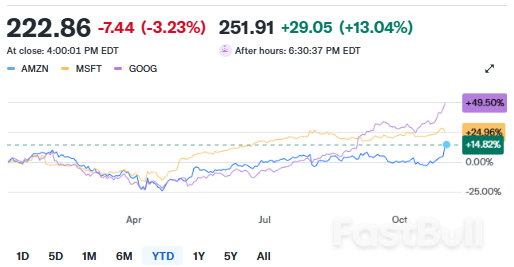
          Amazon (AMZN) reported its third quarter earnings after the bell on Thursday, beating on the top and bottom lines as its cloud business grew faster than expected.
          The results come just a day after rivals Microsoft (MSFT) and Google (GOOG, GOOGL) announced their own results, with both companies saying they'll spend more on AI data centers going forward.
          "You're going to see us continue to be very aggressive in investing in capacity because we see the demand," CEO Andy Jassy said on the company's earnings call with analysts.
          Amazon stock rose more than 13% following the report.Amazon Q3 Earnings Beat on top and Bottom Lines as AWS Growth Sends Stock Higher_1
          For the quarter, Amazon reported earnings per share (EPS) of $1.95 on revenue of $180.2 billion, better than analysts' expectations of EPS of $1.58 and revenue of $177.8 billion.
          Amazon's AWS brought in $33.01 billion in revenue versus an anticipated $32.4 billion.
          The company also said adoption of its Trainium2 AI chip has become a multibillion-dollar business that grew 150% quarter over quarter, and that it launched its Project Rainier AI cluster with 500,000 Trainium 2 chips.
          Still, Amazon's stock is lagging both Microsoft's and Google's by a wide margin, climbing just 2.4% year to date versus Microsoft, which is up 24%, and Google, which has jumped 49%.
          Part of that has to do with the perception that AWS simply isn't capturing as much of the AI market as its biggest rivals.
          While Microsoft counts OpenAI (OPAI.PVT) among its most important AI clients, and Google has Gemini, Amazon relies on Anthropic for massive AI exposure. And the company splits that with Google, which also provides cloud computing services to Anthropic (ANTH.PVT).
          On Wednesday, Amazon said the AI startup signed up to use 1 million custom Amazon chips to train and run its AI models. While that's a win for Amazon, Anthropic announced a similar deal with Google just last week.

          Source: Yahoo Finance

          Risk Warnings and Disclaimers
          You understand and acknowledge that there is a high degree of risk involved in trading. Following any strategies or investment methods may lead to potential losses. The content on the site is provided by our contributors and analysts for information purposes only. You are solely responsible for determining whether any trading assets, securities, strategy, or any other product is suitable for investing based on your own investment objectives and financial situation.
          Add to Favorites
          Share

          Gold Pushes Higher as Market Digests Outcome of Xi-Trump Meeting

          Manuel

          Commodity

          Political

          Gold advanced following a run of losses, as traders digested the outcome of a meeting between US President Donald Trump and Chinese leader Xi Jinping.
          Bullion rose as much as 2.5%, after falling almost 5% over the previous four sessions. Trump said it was an “amazing meeting” and that China would halt rare earth controls and resume purchases of American soybeans. Xi said his country is willing to cooperate with the US in areas such as trade, energy and artificial intelligence, according to the official Xinhua News Agency.
          The outcome is poised to resolve — at least for now — months of trade brinkmanship. Still, it falls short of a comprehensive agreement that addresses issues at the heart of the US-China economic competition.
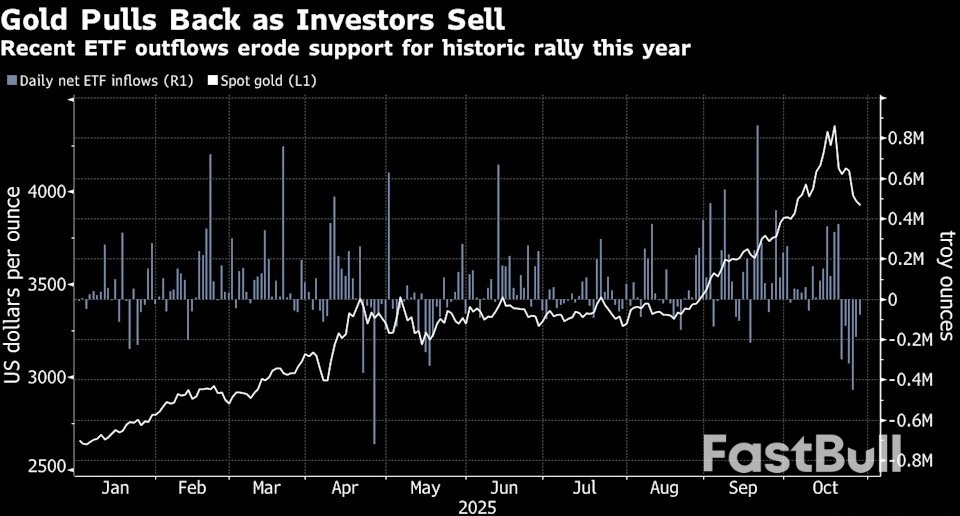
          “This looks like an early attempt to reset the US–China narrative by re-engaging selective trade channels to restore confidence,” said Charu Chanana, chief investment strategist at Saxo Markets in Singapore. “Gold is, however, still sniffing out uncertainty — pricing a soft easing bias from the Fed and lingering geopolitical risk.”Gold Pushes Higher as Market Digests Outcome of Xi-Trump Meeting_1
          Meanwhile, Federal Reserve Chair Jerome Powell downplayed the likelihood of a December interest-rate reduction after a widely expected quarter-point cut on Wednesday amid a slowing US labor market. Higher rates are typically negative for non-yielding bullion.
          The precious metal has retreated sharply in recent days following a scorching rally that drove prices to a record above $4,380 an ounce last week.
          Still, even after its recent pullback, gold has advanced about 50% this year, supported by central-bank buying and interest in the so-called debasement trade, in which investors avoid sovereign debt and currencies to protect themselves from runaway budget deficits.
          “The market has experienced a natural correction, but we continue to view this bull market as incomparable with prior bull markets in terms of the breadth and depth of potential monetary demand,” Sebastian Mullins, head of multi-asset and fixed income at Schroders, said in a note.
          Spot gold rose 2.4% to $4,024.54 an ounce as of 5:03 p.m. in New York. The Bloomberg Dollar Spot Index rose 0.4%. Silver rose for a third day, while platinum and palladium both advanced.

          Source: Bloomberg

          Risk Warnings and Disclaimers
          You understand and acknowledge that there is a high degree of risk involved in trading. Following any strategies or investment methods may lead to potential losses. The content on the site is provided by our contributors and analysts for information purposes only. You are solely responsible for determining whether any trading assets, securities, strategy, or any other product is suitable for investing based on your own investment objectives and financial situation.
          Add to Favorites
          Share

          Apple Beats Q4 Estimates on Top and Bottom Lines, but iPhone Revenue Comes up Short

          Manuel

          Stocks

          Apple (AAPL) announced its fourth quarter earnings on Thursday, beating on the top and bottom lines, but falling just short of analysts' expectations on iPhone sales and revenue out of China.
          Apple stock was off more than 2% following the report.
          “Our September quarter results capped off a record fiscal year, with revenue reaching $416 billion, as well as double-digit EPS growth,” Apple CFO Kevan Parekh said in a statement.
          “And thanks to our very high levels of customer satisfaction and loyalty, our installed base of active devices also reached a new all-time high across all product categories and geographic segments,” Parekh added.
          The announcement comes just days after Apple's market capitalization crossed the $4 trillion mark, putting it in the same category as Microsoft and Nvidia, which have both broken through the threshold. Microsoft has since fallen back below $4 trillion, while Nvidia has rocketed past a $5 trillion market cap.
          For the fourth quarter, Apple saw earnings per share (EPS) of $1.85 on revenue of $102.5 billion. Wall Street analysts were anticipating EPS of $1.77 on revenue of $102.2 billion.
          Apple's iPhone business, its most important, brought in $49.03 billion in revenue, shy of expectations of $49.3 billion.
          The iPhone 17 lineup includes a number of improvements over the iPhone 16, including design enhancements for the iPhone 17 Pro and Pro Max. Apple also did away with its iPhone Plus model in favor of the iPhone Air, a new entry into the iPhone family that sports a thinner, lighter design.
          Importantly, Apple's fourth quarter accounts for a small portion of iPhone 17 sales, as the phones were only on sale for a few weeks ahead of the end of the financial period. Still, any revenue impact helps to provide guidance for the year ahead.
          Greater China revenue was also below expectations, coming in at $14.49 billion versus expectations of $16.43 billion.
          Apple's Services segment, it's second largest behind the iPhone business, saw revenue of $28.7 billion. Wall Street was antcipating $28.2 billion.
          The iPad and Mac segments saw revenue of $6.95 billion and $8.73 billion, respectively. Wearables revenue was $9 billion.

          Source: Yahoo Finance

          Risk Warnings and Disclaimers
          You understand and acknowledge that there is a high degree of risk involved in trading. Following any strategies or investment methods may lead to potential losses. The content on the site is provided by our contributors and analysts for information purposes only. You are solely responsible for determining whether any trading assets, securities, strategy, or any other product is suitable for investing based on your own investment objectives and financial situation.
          Add to Favorites
          Share

          Will Fusaka keep users on L2? Upcoming Ethereum upgrade eyes up to 60% fee cuts

          Manuel

          Cryptocurrency

          On the Ethereum mainnet, gas prices may remain roughly flat, although future adjustments to block gas targets could reduce them by another 10-20%.
          The passkey and proposer updates, however, could make a difference in how Ethereum feels to use. With WebAuthn support, wallets can integrate biometric or device-based logins, removing the friction of seed phrases and passwords. With pre-confirmations enabled by predictable proposer schedules, users can expect near-instant confirmations for routine transactions, especially on rollups.
          The net result is that Ethereum becomes smoother to use without pulling anyone back to L1. The rails get faster, but they’re still pointed toward the rollup lane.

          L1 as settlement, L2 as experience

          Ethereum’s architecture is no longer a debate between monolithic and modular design: it’s modular by choice. Layer 1’s purpose is to serve as the high-security settlement and data availability base, while actual user activity is moved to Layer 2.
          Fusaka reinforces this split. When blob capacity increases, L2s can handle higher throughput for games, social apps, and micro-transactions that would be uneconomical on mainnet. The improvements to login and confirmation workflows make these L2 environments feel native and instantaneous, erasing much of the UX gap that once favored L1.
          Where might users still choose Layer 1? In narrow cases, it involves high-value settlements, institution-scale transfers, or situations where block-ordering precision is crucial, such as miner extractable value (MEV) management or DeFi clearing. But those scenarios represent a small fraction of total on-chain activity. For the rest, L2 remains the natural home.

          The bigger narrative: Ethereum as a layered internet

          Viewed from above, Fusaka is less about gas optimization and more about maturity. It gives Ethereum a scalable framework for adjusting data capacity (BPOs) without disruptive forks, and a UX layer that makes Web3 feel more like Web2.
          Yet its philosophy is clear: the network isn’t trying to centralize traffic on mainnet. It’s building an expressway system where rollups handle local traffic, and L1 serves as the courthouse where everything eventually gets notarized.
          There’s also a monetary layer to the story. Cheaper data posting could drive a wave of new low-value applications, like social, payments, and gaming, back into rollups. Each of these still consumes ETH through blob fees, and with EIP-7918’s fee floor, those fees contribute to ETH burn. Ethereum’s burn rate could even tick higher if activity expands faster than fees decline, despite cheaper user costs.
          On the validator side, PeerDAS lightens the load on bandwidth but may create a new reliance on “supernodes” that store full blob data. That’s a decentralization trade-off the community will continue to debate: how to scale data availability without narrowing participation.
          The balance Ethereum is striking here, between throughput, usability, and trust, mirrors the broader direction of crypto infrastructure. L1s are hardening into secure bases, while L2s absorb experimentation and scale.

          The takeaway

          Fusaka isn’t a bid to reclaim the spotlight for the Ethereum mainnet. It’s the opposite: a deliberate move to strengthen the foundations for a rollup-centric future.
          The upgrade expands data capacity, stabilizes fees, and modernizes wallet experience, but it does so in service of the layers above. Ethereum’s L1 becomes safer and smarter, while users continue to live on L2s that now run cheaper and faster than before.
          By the time BPO1 and BPO2 roll out early next year, the real signals to watch will be blob utilization versus capacity, L2 fee compression, and wallet adoption of passkeys. The outcome will define how frictionless Ethereum feels in 2026, not by pulling people back to the main chain, but by making the off-ramps almost invisible.

          Source: Cryptoslate

          Risk Warnings and Disclaimers
          You understand and acknowledge that there is a high degree of risk involved in trading. Following any strategies or investment methods may lead to potential losses. The content on the site is provided by our contributors and analysts for information purposes only. You are solely responsible for determining whether any trading assets, securities, strategy, or any other product is suitable for investing based on your own investment objectives and financial situation.
          Add to Favorites
          Share

          Meta to Sell $30 Billion of Bonds in Year’s Biggest Offering

          Manuel

          Bond

          Stocks

          Meta Platforms Inc. is planning to sell $30 billion of investment-grade bonds on Thursday, the biggest high-grade corporate bond offering of the year, after the company received record orders for the debt.
          The bond sale comes a day after Chief Executive Officer Mark Zuckerberg warned that the company would spend even more aggressively on artificial intelligence in the coming year. Morgan Stanley expects big tech companies known as hyperscalers to spend about $3 trillion on infrastructure like data centers between now and the end of 2028, with roughly half of that likely financed through the companies’ cash flows.
          Thursday’s bond sale is the biggest high-grade note offering since 2023, when Pfizer Inc. sold $31 billion of debt. Investors placed $125 billion of orders for Meta’s bonds, surpassing the prior record from 2018, when investors placed $120 billion of orders for bonds from CVS Health Corp. That offering was a $40 billion debt sale.
          There’s a lot more debt coming from tech companies. Credit markets will play a big role as an alternative source of funding for AI investment, according to Andrew Sheets, global head of corporate credit research at Morgan Stanley.
          “Most of this AI-related CapEx is still ahead of us,” Sheets said in an interview with Bloomberg on Thursday. “It’s only just starting to ramp up, so this theme will be with us for a while.”
          Technology firms are capitalizing on falling borrowing costs as the Federal Reserve cuts interest rates and investors race to lock in still-elevated yields. Meta is infusing artificial intelligence services into its key products, including Facebook and Instagram. The company said on Wednesday that it expects to spend as much as $72 billion on capital expenditure this year, and that its capital spending will grow considerably faster in 2026 than it will this year.
          Meta’s shares fell as much as 14% on Thursday. A spokesperson declined to comment.
          Other blockbuster deals from the tech sector include Oracle Corp.’s $18 billion high-grade offering last month. Banks are also preparing to launch a $38 billion debt offering that will help fund data centers tied to Oracle in what would be the largest such deal for AI to come to market, Bloomberg reported last week. The $27 billion private bond sale earlier this month is for a Meta project in Louisiana that will be 80%-owned by Blue Owl Capital Inc.
          “Spreads are historically tight, so it isn’t a terrible time from their perspective to borrow,” said Scott Kimball, chief investment officer at Loop Capital Asset Management. “Investors need to look past the large amounts of cash and high equity cushions and focus on the ones who will prove the most successful.”

          Spending Aggressively

          In the US high-grade market, Meta is set to issue notes in six parts, ranging from five to 40 years in length, according to a person familiar with the matter who asked not to be identified as they’re not authorized to speak publicly. The $4.5 billion, 40-year portion will likely yield 1.1 percentage point more than benchmark Treasuries, after initial talk of about 1.4 percentage point, the person said.
          The company last sold unsecured corporate notes in the US in August 2024. Portions of that offering were among the most actively traded notes in the US market on Thursday, according to Trace, as investors cleared out space for the new notes.
          Meta is competing with top tech rivals, including Alphabet Inc. and Microsoft Corp., that are plowing vast sums of money into AI research. Artificial intelligence technology could boost productivity for workers in areas including law, accounting, and economics, and in a worst-case scenario, put many white-collar workers out of jobs.
          Zuckerberg and Meta Chief Financial Officer Susan Li spent much of their earnings call on Wednesday working to convince analysts that Meta’s AI investments are paying off now — and will in the future — by helping the company better target ads and content. Revenue rose 26% to $51.2 billion in the third quarter, signaling that Meta’s core advertising business, which generates about 98% of that revenue, remains strong.
          “We want to make sure we’re not under-investing,” said Zuckerberg on the call after posting third-quarter results.
          Zuckerberg said that even if Meta develops too much computing power, the excess capacity could improve the core business. The company could also find a way to sell it, he said, the way rivals Microsoft and Google already do.
          “I think that it’s the right strategy to aggressively front-load building capacity,” Zuckerberg said.
          Meta is leading a seven-borrower docket on Thursday that includes Yankee banks HSBC Holdings Plc and NatWest Markets Plc. Citigroup Inc. and Morgan Stanley are managing Meta’s bond sale. Citi and Morgan Stanley declined to comment, while Meta didn’t respond to requests for comment.

          Source: Bloomberg

          Risk Warnings and Disclaimers
          You understand and acknowledge that there is a high degree of risk involved in trading. Following any strategies or investment methods may lead to potential losses. The content on the site is provided by our contributors and analysts for information purposes only. You are solely responsible for determining whether any trading assets, securities, strategy, or any other product is suitable for investing based on your own investment objectives and financial situation.
          Add to Favorites
          Share

          Average Long-Term US Mortgage Rate Dips to 6.17%, its Lowest Level in More Than a Year

          Manuel

          Bond

          Economic

          The average rate on a 30-year U.S. mortgage fell for the fourth week in a row to its lowest level in more than a year.
          Lower mortgage rates boost homebuyers’ purchasing power. They also benefit homeowners eager to refinance their current home loan to a more attractive rate.
          The average long-term mortgage rate dropped to 6.17% from 6.19% last week, mortgage buyer Freddie Mac said Thursday. A year ago, the rate averaged 6.72%.
          The last time the average rate was lower was on Oct. 3, 2024, when it was 6.12%.
          Borrowing costs on 15-year fixed-rate mortgages, popular with homeowners refinancing their home loans, also eased this week. The average rate dropped to 5.41% from 5.44% last week. A year ago, it was 5.99%, Freddie Mac said.
          Mortgage rates are influenced by several factors, from the Federal Reserve’s interest rate policy decisions to bond market investors’ expectations for the economy and inflation. They generally follow the trajectory of the 10-year Treasury yield, which lenders use as a guide to pricing home loans.
          The average rate on a 30-year mortgage has remained above 6% since September 2022, the year mortgage rates began climbing from historic lows. The housing market has been in a slump ever since.
          Sales of previously occupied U.S. homes sank last year to their lowest level in nearly 30 years. Sales have been sluggish this year, but accelerated last month to their fastest pace since February as mortgage rates eased.
          Mortgage rates began declining in July in the lead-up to the Federal Reserve’s decision in September to cut its main interest rate for the first time in a year amid growing concern over the U.S. labor market.
          The Fed lowered its key interest rate again this week in a bid to help boost the slowing job market. However, Chair Jerome Powell warned that it “is not a foregone conclusion” that the Fed will cut again in December at its next meeting.
          That caused the 10-year Treasury yield to climb. The yield was at 4.08% in midday trading Thursday after hovering below 4% much of the past two weeks.
          The Fed could also pump the brakes on more rate cuts if inflation climbs further amid the Trump administration’s expanding use of tariffs, because lower rates can worsen inflation.
          Bond investors demand higher returns as long as inflation remains elevated, so if inflation ticks upward that could translate into higher yields on the 10-year Treasury note, pushing up mortgage rates.
          The central bank doesn’t set mortgage rates, and even when it cuts its short-term rates that doesn’t necessarily mean rates on home loans will necessarily decline.
          Last fall, after the Fed cut its rate for the first time in more than four years, mortgage rates marched higher, eventually reaching just above 7% in January this year.
          The pullback in rates has helped spur homeowners who bought in recent years after rates climbed above 6% to refinance their home loan to a lower rate.
          Mortgage applications, which include loans to buy a home or refinance an existing mortgage, jumped 7.1% last week from a week earlier, according to the Mortgage Bankers Association.
          Applications for mortgage refinance loans rose 9% and were up more than twofold versus the same week last year.
          Even so, mortgage rates would have to drop below 6% to make refinancing an attractive option to a broader swath of homeowners. That’s because about 80% of U.S. homes with a mortgage have a rate below 6% and 53% have a rate below 4%, according to Realtor.com.

          Source: AP

          To stay updated on all economic events of today, please check out our Economic calendar
          Risk Warnings and Disclaimers
          You understand and acknowledge that there is a high degree of risk involved in trading. Following any strategies or investment methods may lead to potential losses. The content on the site is provided by our contributors and analysts for information purposes only. You are solely responsible for determining whether any trading assets, securities, strategy, or any other product is suitable for investing based on your own investment objectives and financial situation.
          Add to Favorites
          Share

          Shipping Sector Skeptical Trump's Trade Truce With China Will Reverse Decline

          Justin

          Economic

          American shippers were already unhappy about their business outlook after President Donald Trump imposed steep new tariffs on China in April.

          And they were not feeling much happier on Thursday, even after Trump announced a new trade truce with Chinese President Xi Jinping.

          The consensus among U.S. shippers and logistics managers is that the deal is largely rhetoric and that it does not change the substance of the disagreements on trade between the two nations.

          The note that tariffs on Chinese imports, even after the 10-percentage-point cut announced, remain high enough to put a serious dent on import volume.

          The effective rate on Chinese imports is still around a minimum of 47% because tariffs are layered on top of each other depending on the physical characteristics of individual imports.

          Alan Baer, the CEO of the trucking company OL USA, told CNBC on Thursday, "Uncertainty remains at the forefront of every client conversation as we look out to 2026."

          "Risk management of inventory levels combined with avoiding tariff variability is a central theme for the first half of 2026," Baer said.

          Before Trump and Xi met in South Korea, the effect of the American president's on-again, off-again tariff threats was seen in U.S. Customs data on containers arriving in the United States from China.

          "Apparel has taken the biggest hit so far, with woven apparel down more than 50% and knitted apparel down over 40%," said Ben Tracy, vice president of strategic business development at Vizion, which aggregates trade data for logistics managers.

          "Furniture and toys show the steepest drops by total volume, falling between 20 to 25%," Tracy said on Thursday.

          New data from Vizion shows that year-to-date, the number of containers shipped from China is 2.9 million, which is 700,000 fewer containers than shipped during the same period in 2024

          The same data also shows that there are currently 247,000 containers from China on the water headed to the United States. That is about 50,000 fewer containers on the water during the same month in 2024.

          Fewer containers to ship means lower profits for trucking companies, warehouse firms, and railroads.

          The markedly lower container volume is reflected in the Logistics Managers' Index, a key metric that tracks inventory levels, warehouse costs, transportation capacity, and pricing.

          The LMI over the past two months suggests the freight industry might be headed for a recession.

          LMI authors have said that a negative index trend would need to continue for at least three months it would indicate an actual recession.

          John Gold, vice president of supply chain and customs policy at the National Retail Federation, said that the deal announced by Trump, which cuts so-called fentanyl tariffs on Chinese imports from 20% to 10%, "certainly provides relief to companies, especially if it leads to further de-escalation of tariffs between the U.S. and China.

          "While the tariff rate is still high with the fentanyl and reciprocal tariffs in place, it is a much better alternative we were facing with an additional 100% tariffs," Gold said.

          But he said the remaining tariffs are "harmful" and that "we encourage the administration to continue negotiations with China, as well as other trading partners" to remove those duties.

          Source: CNBC

          To stay updated on all economic events of today, please check out our Economic calendar
          Risk Warnings and Disclaimers
          You understand and acknowledge that there is a high degree of risk involved in trading. Following any strategies or investment methods may lead to potential losses. The content on the site is provided by our contributors and analysts for information purposes only. You are solely responsible for determining whether any trading assets, securities, strategy, or any other product is suitable for investing based on your own investment objectives and financial situation.
          Add to Favorites
          Share
          FastBull
          Copyright © 2025 FastBull Ltd

          728 RM B 7/F GEE LOK IND BLDG NO 34 HUNG TO RD KWUN TONG KLN HONG KONG

          TelegramInstagramTwitterfacebooklinkedin
          App Store Google Play Google Play
          Products
          Charts

          Chats

          Q&A with Experts
          Screeners
          Economic Calendar
          Data
          Tools
          Membership
          Features
          Function
          Markets
          Copy Trading
          Latest Signals
          Contests
          News
          Analysis
          24/7
          Columns
          Education
          Company
          Careers
          About Us
          Contact Us
          Advertising
          Help Center
          Feedback
          User Agreement
          Privacy Policy
          Business

          White Label

          Data API

          Web Plug-ins

          Poster Maker

          Affiliate Program

          Risk Disclosure

          The risk of loss in trading financial instruments such as stocks, FX, commodities, futures, bonds, ETFs and crypto can be substantial. You may sustain a total loss of the funds that you deposit with your broker. Therefore, you should carefully consider whether such trading is suitable for you in light of your circumstances and financial resources.

          No decision to invest should be made without thoroughly conducting due diligence by yourself or consulting with your financial advisors. Our web content might not suit you since we don't know your financial conditions and investment needs. Our financial information might have latency or contain inaccuracy, so you should be fully responsible for any of your trading and investment decisions. The company will not be responsible for your capital loss.

          Without getting permission from the website, you are not allowed to copy the website's graphics, texts, or trademarks. Intellectual property rights in the content or data incorporated into this website belong to its providers and exchange merchants.

          Not Logged In

          Log in to access more features

          FastBull Membership

          Not yet

          Purchase

          Become a signal provider
          Help Center
          Customer Service
          Dark Mode
          Price Up/Down Colors

          Log In

          Sign Up

          Position
          Layout
          Fullscreen
          Default to Chart
          The chart page opens by default when you visit fastbull.com
