• Trade
  • Markets
  • Copy
  • Contests
  • News
  • 24/7
  • Calendar
  • Q&A
  • Chats
Trending
Screeners
SYMBOL
LAST
BID
ASK
HIGH
LOW
NET CHG.
%CHG.
SPREAD
SPX
S&P 500 Index
6827.42
6827.42
6827.42
6899.86
6801.80
-73.58
-1.07%
--
DJI
Dow Jones Industrial Average
48458.04
48458.04
48458.04
48886.86
48334.10
-245.98
-0.51%
--
IXIC
NASDAQ Composite Index
23195.16
23195.16
23195.16
23554.89
23094.51
-398.69
-1.69%
--
USDX
US Dollar Index
97.950
98.030
97.950
98.500
97.950
-0.370
-0.38%
--
EURUSD
Euro / US Dollar
1.17394
1.17409
1.17394
1.17496
1.17192
+0.00011
+ 0.01%
--
GBPUSD
Pound Sterling / US Dollar
1.33707
1.33732
1.33707
1.33997
1.33419
-0.00148
-0.11%
--
XAUUSD
Gold / US Dollar
4299.39
4299.39
4299.39
4353.41
4257.10
+20.10
+ 0.47%
--
WTI
Light Sweet Crude Oil
57.233
57.485
57.233
58.011
56.969
-0.408
-0.71%
--

Community Accounts

Signal Accounts
--
Profit Accounts
--
Loss Accounts
--
View More

Become a signal provider

Sell trading signals to earn additional income

View More

Guide to Copy Trading

Get started with ease and confidence

View More

Signal Accounts for Members

All Signal Accounts

Best Return
  • Best Return
  • Best P/L
  • Best MDD
Past 1W
  • Past 1W
  • Past 1M
  • Past 1Y

All Contests

  • All
  • Trump Updates
  • Recommend
  • Stocks
  • Cryptocurrencies
  • Central Banks
  • Featured News
Top News Only
Share

Trump Isn't Certain His Economic Policies Will Translate To Midterm Wins

Share

The United States And Mexico Have Reached An Agreement On How To Resolve The Water Dispute In The Rio Grande Basin (which Borders Texas). Starting December 15, Mexico Will Supply The U.S. With An Additional 20.2 Acre-feet (a Unit Of Volume For Irrigation). The Agreement Seeks To “strengthen Water Management In The Rio Grande Basin” Within The Framework Of The 1944 Water Treaty

Share

U.S. Transportation Secretary Duffy: The Engine Of United Airlines Flight 803 That Malfunctioned Caught Fire

Share

Ukraine President Zelenskiy: He Will Meet US, European Representatives About Peace

Share

UK Prime Minister Office: Prime Minister Starmer Spoke To The President Of The European Commission Ursula Von Der Leyen This Evening - Downing Street Spokesperson

Share

Trump: We Will Retaliate Against ISIS

Share

Trump Says We Mourn The Loss Of Three Great Patriots In Syria In An Ambush

Share

Syrian Interior Ministry Spokesperson Confirms Attacker Was Member Of Security Forces With Extremist Ideology

Share

Syrian Interior Ministry Says Attacker Did Not Have Leadership Role In Security Forces, Did Not Say If He Was Junior Member

Share

Man Who Attacked Syrian, US Military Was Member Of Syrian Security Forces -Three Local Syrian Officials

Share

US Envoy Coale Says Belarus President Lukashenko Agreed To Do All He Can To Stop Weather Balloons Flying Into Lithuania

Share

Ukraine Says Russian Drone Attack Hit Civilian Turkish Vessel

Share

Islamic State Attacker In Syria Was Lone Gunman, Who Was Killed -USA Central Command

Share

US Envoy John Coale Says Around 1000 Remaining Political Prisoners In Belarus Could Be Released In Coming Months

Share

US Defense Secretary Hegseth: Attacker Was Killed By Partner Forces

Share

Pentagon Says Two USA Army Soldiers And One Civilian USA Interpreter Were Killed, And Three Were Wounded In Syria

Share

Israel Says It Kills Senior Hamas Commander Raed Saed In Gaza

Share

Ukraine's Navy Says Russian Drone Attack Hit Civilian Turkish Vessel Carrying Sunflower Oil To Egypt On Saturday

Share

Israeli Military Says It Put Planned Strike On South Lebanon Site On Hold After Lebanese Army Requested Access

Share

Norwegian Nobel Committee: Calls On The Belarusian Authorities To Release All Political Prisoners

TIME
ACT
FCST
PREV
U.K. Trade Balance (Oct)

A:--

F: --

P: --

U.K. Services Index MoM

A:--

F: --

P: --

U.K. Construction Output MoM (SA) (Oct)

A:--

F: --

P: --

U.K. Industrial Output YoY (Oct)

A:--

F: --

P: --

U.K. Trade Balance (SA) (Oct)

A:--

F: --

P: --

U.K. Trade Balance EU (SA) (Oct)

A:--

F: --

P: --

U.K. Manufacturing Output YoY (Oct)

A:--

F: --

P: --

U.K. GDP MoM (Oct)

A:--

F: --

P: --

U.K. GDP YoY (SA) (Oct)

A:--

F: --

P: --

U.K. Industrial Output MoM (Oct)

A:--

F: --

P: --

U.K. Construction Output YoY (Oct)

A:--

F: --

P: --

France HICP Final MoM (Nov)

A:--

F: --

P: --

China, Mainland Outstanding Loans Growth YoY (Nov)

A:--

F: --

P: --

China, Mainland M2 Money Supply YoY (Nov)

A:--

F: --

P: --

China, Mainland M0 Money Supply YoY (Nov)

A:--

F: --

P: --

China, Mainland M1 Money Supply YoY (Nov)

A:--

F: --

P: --

India CPI YoY (Nov)

A:--

F: --

P: --

India Deposit Gowth YoY

A:--

F: --

P: --

Brazil Services Growth YoY (Oct)

A:--

F: --

P: --

Mexico Industrial Output YoY (Oct)

A:--

F: --

P: --

Russia Trade Balance (Oct)

A:--

F: --

P: --

Philadelphia Fed President Henry Paulson delivers a speech
Canada Building Permits MoM (SA) (Oct)

A:--

F: --

P: --

Canada Wholesale Sales YoY (Oct)

A:--

F: --

P: --

Canada Wholesale Inventory MoM (Oct)

A:--

F: --

P: --

Canada Wholesale Inventory YoY (Oct)

A:--

F: --

P: --

Canada Wholesale Sales MoM (SA) (Oct)

A:--

F: --

P: --

Germany Current Account (Not SA) (Oct)

A:--

F: --

P: --

U.S. Weekly Total Rig Count

A:--

F: --

P: --

U.S. Weekly Total Oil Rig Count

A:--

F: --

P: --

Japan Tankan Large Non-Manufacturing Diffusion Index (Q4)

--

F: --

P: --

Japan Tankan Small Manufacturing Outlook Index (Q4)

--

F: --

P: --

Japan Tankan Large Non-Manufacturing Outlook Index (Q4)

--

F: --

P: --

Japan Tankan Large Manufacturing Outlook Index (Q4)

--

F: --

P: --

Japan Tankan Small Manufacturing Diffusion Index (Q4)

--

F: --

P: --

Japan Tankan Large Manufacturing Diffusion Index (Q4)

--

F: --

P: --

Japan Tankan Large-Enterprise Capital Expenditure YoY (Q4)

--

F: --

P: --

U.K. Rightmove House Price Index YoY (Dec)

--

F: --

P: --

China, Mainland Industrial Output YoY (YTD) (Nov)

--

F: --

P: --

China, Mainland Urban Area Unemployment Rate (Nov)

--

F: --

P: --

Saudi Arabia CPI YoY (Nov)

--

F: --

P: --

Euro Zone Industrial Output YoY (Oct)

--

F: --

P: --

Euro Zone Industrial Output MoM (Oct)

--

F: --

P: --

Canada Existing Home Sales MoM (Nov)

--

F: --

P: --

Euro Zone Total Reserve Assets (Nov)

--

F: --

P: --

U.K. Inflation Rate Expectations

--

F: --

P: --

Canada National Economic Confidence Index

--

F: --

P: --

Canada New Housing Starts (Nov)

--

F: --

P: --

U.S. NY Fed Manufacturing Employment Index (Dec)

--

F: --

P: --

U.S. NY Fed Manufacturing Index (Dec)

--

F: --

P: --

Canada Core CPI YoY (Nov)

--

F: --

P: --

Canada Manufacturing Unfilled Orders MoM (Oct)

--

F: --

P: --

Canada Manufacturing New Orders MoM (Oct)

--

F: --

P: --

Canada Core CPI MoM (Nov)

--

F: --

P: --

Canada Manufacturing Inventory MoM (Oct)

--

F: --

P: --

Canada CPI YoY (Nov)

--

F: --

P: --

Canada CPI MoM (Nov)

--

F: --

P: --

Canada CPI YoY (SA) (Nov)

--

F: --

P: --

Canada Core CPI MoM (SA) (Nov)

--

F: --

P: --

Canada CPI MoM (SA) (Nov)

--

F: --

P: --

Q&A with Experts
    • All
    • Chatrooms
    • Groups
    • Friends
    Connecting
    .
    .
    .
    Type here...
    Add Symbol or Code

      No matching data

      All
      Trump Updates
      Recommend
      Stocks
      Cryptocurrencies
      Central Banks
      Featured News
      • All
      • Russia-Ukraine Conflict
      • Middle East Flashpoint
      • All
      • Russia-Ukraine Conflict
      • Middle East Flashpoint
      Search
      Products

      Charts Free Forever

      Chats Q&A with Experts
      Screeners Economic Calendar Data Tools
      Membership Features
      Data Warehouse Market Trends Institutional Data Policy Rates Macro

      Market Trends

      Market Sentiment Order Book Forex Correlations

      Top Indicators

      Charts Free Forever
      Markets

      News

      News Analysis 24/7 Columns Education
      From Institutions From Analysts
      Topics Columnists

      Latest Views

      Latest Views

      Trending Topics

      Top Columnists

      Latest Update

      Signals

      Copy Rankings Latest Signals Become a signal provider AI Rating
      Contests
      Brokers

      Overview Brokers Assessment Rankings Regulators News Claims
      Broker listing Forex Brokers Comparison Tool Live Spread Comparison Scam
      Q&A Complaint Scam Alert Videos Tips to Detect Scam
      More

      Business
      Events
      Careers About Us Advertising Help Center

      White Label

      Data API

      Web Plug-ins

      Affiliate Program

      Awards Institution Evaluation IB Seminar Salon Event Exhibition
      Vietnam Thailand Singapore Dubai
      Fans Party Investment Sharing Session
      FastBull Summit BrokersView Expo
      Recent Searches
        Top Searches
          Markets
          News
          Analysis
          User
          24/7
          Economic Calendar
          Education
          Data
          • Names
          • Latest
          • Prev

          View All

          No data

          Scan to Download

          Faster Charts, Chat Faster!

          Download App
          English
          • English
          • Español
          • العربية
          • Bahasa Indonesia
          • Bahasa Melayu
          • Tiếng Việt
          • ภาษาไทย
          • Français
          • Italiano
          • Türkçe
          • Русский язык
          • 简中
          • 繁中
          Open Account
          Search
          Products
          Charts Free Forever
          Markets
          News
          Signals

          Copy Rankings Latest Signals Become a signal provider AI Rating
          Contests
          Brokers

          Overview Brokers Assessment Rankings Regulators News Claims
          Broker listing Forex Brokers Comparison Tool Live Spread Comparison Scam
          Q&A Complaint Scam Alert Videos Tips to Detect Scam
          More

          Business
          Events
          Careers About Us Advertising Help Center

          White Label

          Data API

          Web Plug-ins

          Affiliate Program

          Awards Institution Evaluation IB Seminar Salon Event Exhibition
          Vietnam Thailand Singapore Dubai
          Fans Party Investment Sharing Session
          FastBull Summit BrokersView Expo

          A Gold and Silver Boom? Macro Hints at Early Stages of a Bull Market

          Adam

          Commodity

          Summary:

          Gold and silver likely entering a new bull market after 2022’s macro shift. Short-term corrections possible, but long-term outlook favors precious metals over stocks.
          Big Picture Macro & Precious Metals Bottom Line

          It’s a bull market, (or per Old Turkey, “it’s a bull market, you know”). Thrills and spills ahead.
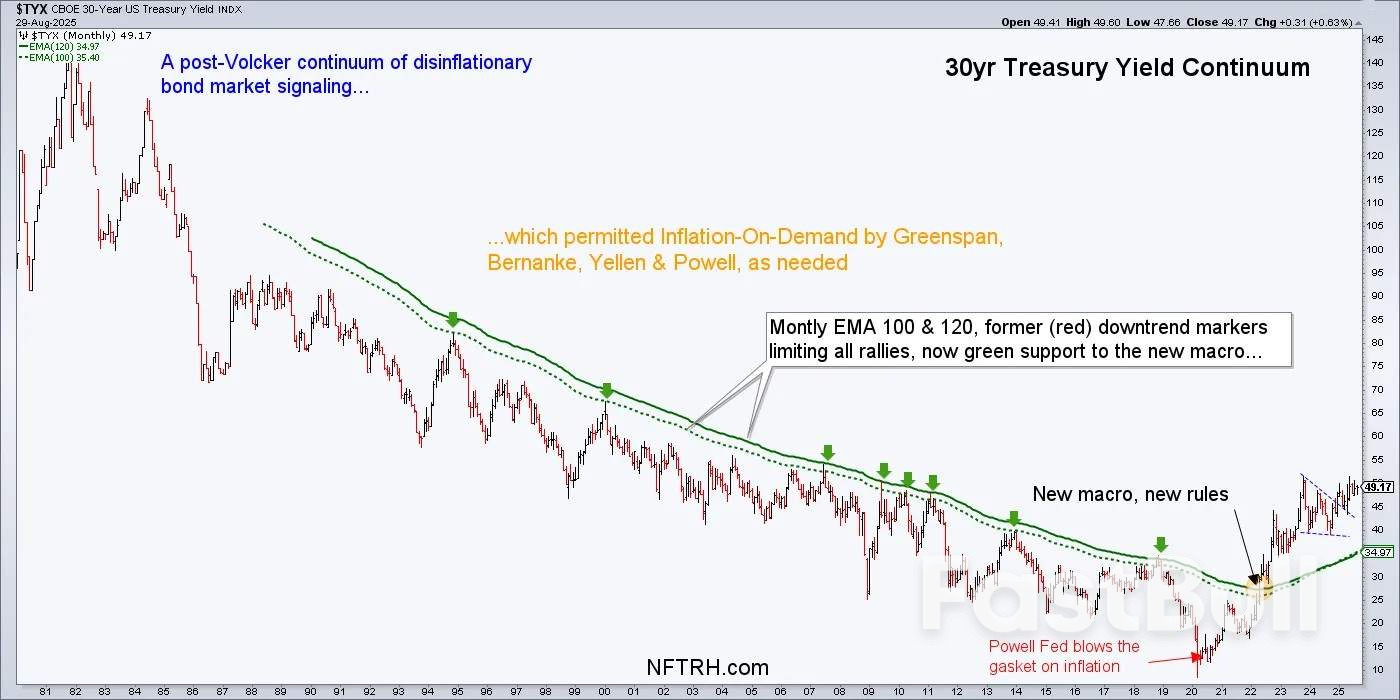
          But the supporting theme is the new macro and its new rules that we’ve anticipated since the 30-year Treasury yield Continuum broke to the upside in 2022. Since then the job has been to interpret the implications of this big picture macro trend break, along with other indicators of major change.
          A Gold and Silver Boom? Macro Hints at Early Stages of a Bull Market_1
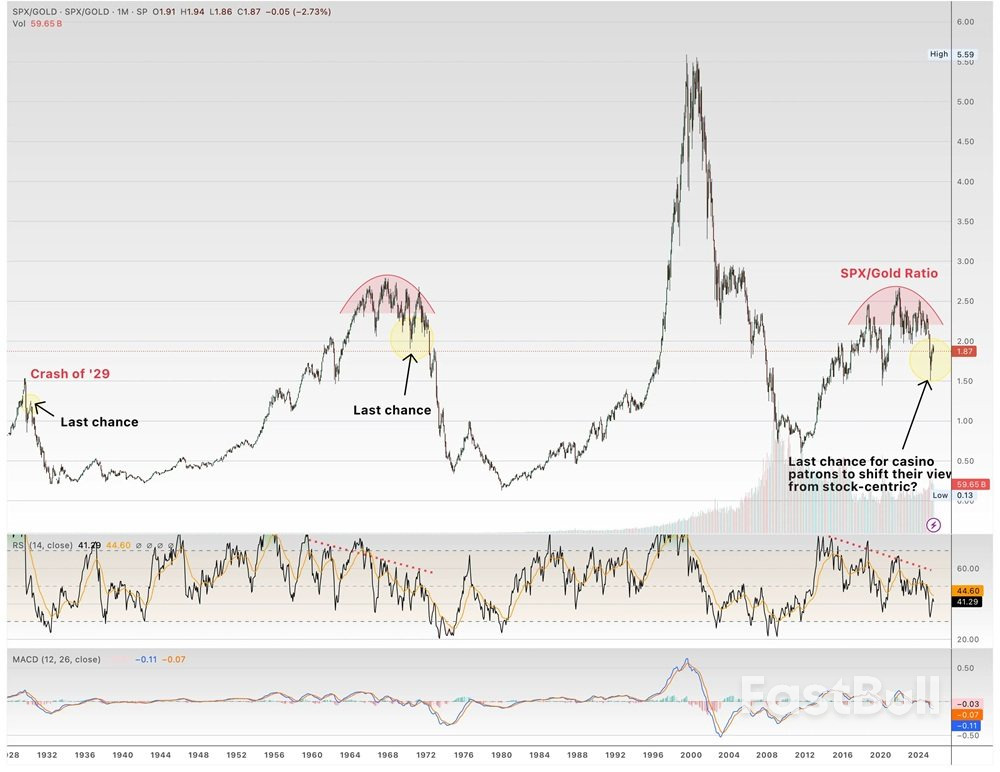
          The long-term SPX/gold chart above [included in this excerpt per edit below] hearkens back to the 1970s. So, in essence, does the Continuum’s long disinflationary trend, which was birthed in the 1980s after Fed chief Volcker whipped inflation through very hawkish interest rate policy in the 1970s.
          The then new trend in disinflationary bond market signaling allowed policymakers of subsequent decades to routinely paint prosperity into the macro at will. This was most obvious during the Inflation on Demand era, launched compliments of Alan Greenspan, post-2001. But that was not real prosperity. It was inflationary policy, given license by the long bond’s decades of disinflationary signaling (thank you, Volcker), a license that became ever more abusive post-Greenspan.
          It was the core reason we now have a society so divided. As I have written many times, it is the act of inflating money supplies and monetary aggregates through bond market manipulation that has fabulously benefited the wealthy and routinely impaired the not wealthy. This is the root of our social problems.
          In modern day reality TV America, the easy target is the other political party. And why not? They are both bankrupt of truly transformative ideas that would be helpful to a healthy society. They are little more than corporate divisions of particular ideologies that in my opinion are way past their shelf lives, as currently practiced.
          So the Everyman blames the other side of the aisle, because the Everyman is programmed that way. We are TV programmed as a whole, while alternate media from YouTube to Substack * to X put forth everything from sound, progressive and thoughtful ways forward to utter ignorance and hatred. But at least they are saying what they think. Unlike major media, saying most often what its corporate boardrooms think.
          Well, that programming is done. It’s just that a vast majority don’t know it yet because a vast majority don’t know that the macro framework has changed or more importantly, the implications of that change. The bond market signaling circa 1987-2022 is done. The stage is set for the preeminent monetary asset to rise as monetary policy is rendered more dysfunctional than the pre-2022 era.
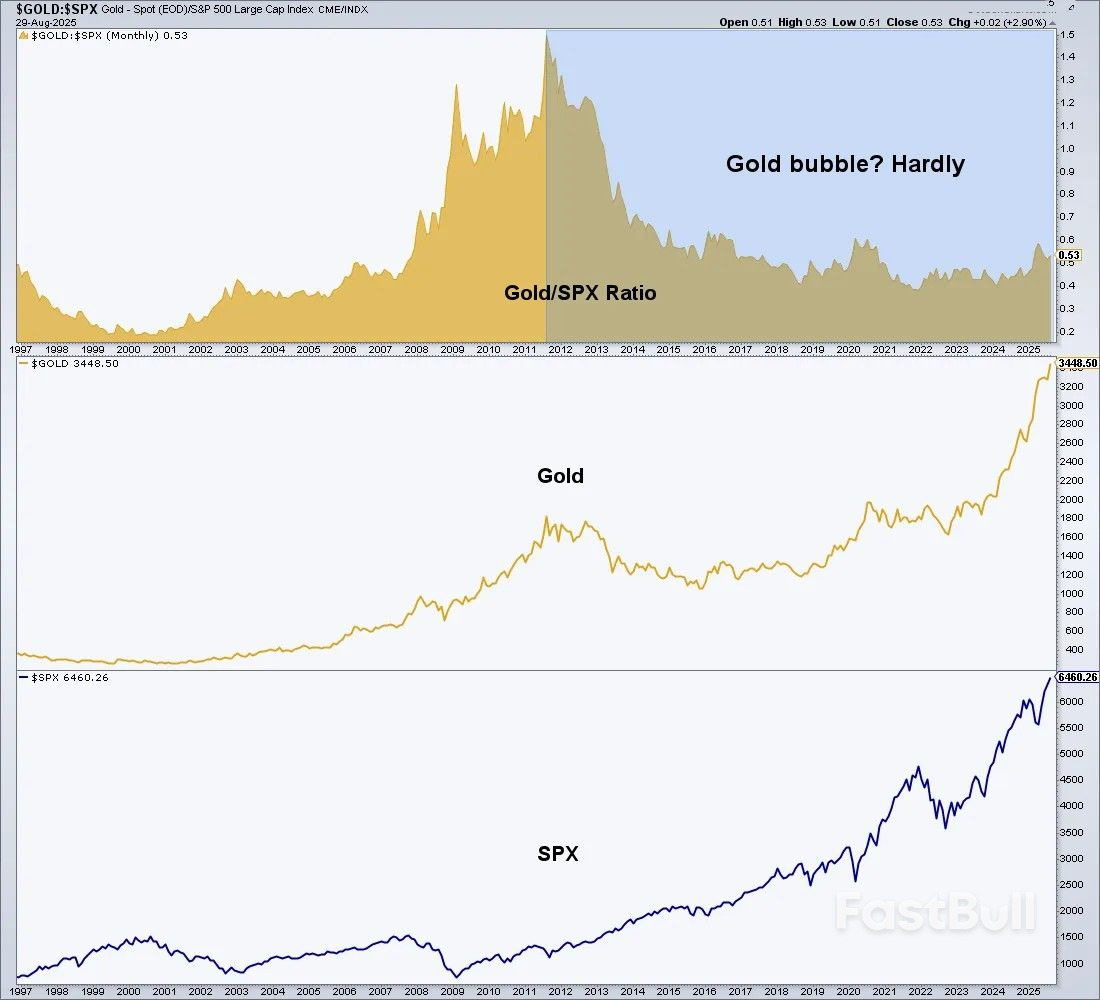
          This is my ideology speaking. I’ve quietly held this general ideology for decades. But now, it is time. The two charts of gold in relation to the S&P 500 included in this edition [each included below] show the profound changes in the monetary value asset vs. the prime inflation-stoked paper asset. They also show that on the big picture, we ain’t seen nothin’ yet.
          In the short-term, as we have shown in the report above, gold stocks are at a target and a classic technical halt/correction point. A correction from such an overbought state could feel quite severe. That’s the TA. Know if you’re a trader or a holder.
          But there are other options in play here, from upside laser show to chop & grind. The former does not feel as likely as the latter.
          Regardless, per the changes to the macro that became symbolically evident in 2022, and especially per gold’s long-term status vs. the stock market, it’s likely early innings in the bull market.
          * Nod to Substack for having a much higher ratio of quality to ignorance than the other two, in my opinion.
          [edit] Here are the two charts showing a compelling case for gold over stocks in the new macro. The first being a very long-term chart of the SPX/Gold ratio showing the case for major stock market under-performance, even if nominal prices go sideways. The second chart is self-explanatory.
          A bubble in gold? Gold has not even gotten going yet on a relative basis to the market that benefited from all of that inflationary policy, pre-2022.
          A Gold and Silver Boom? Macro Hints at Early Stages of a Bull Market_2A Gold and Silver Boom? Macro Hints at Early Stages of a Bull Market_3

          Source: investing

          Risk Warnings and Disclaimers
          You understand and acknowledge that there is a high degree of risk involved in trading. Following any strategies or investment methods may lead to potential losses. The content on the site is provided by our contributors and analysts for information purposes only. You are solely responsible for determining whether any trading assets, securities, strategy, or any other product is suitable for investing based on your own investment objectives and financial situation.
          Add to Favorites
          Share

          China’s EV maker deliveries rebound, buoyed by cheaper new models

          Adam

          Economic

          From China’s electric carmaker giant BYD to startup Nio, the latest reports for August show EV demand rebounded after a slump earlier in the summer amid a fierce price war.
          BYD announced it shipped 371,501 units in August, nearly 22% growth from a year ago.
          Meanwhile, Nio, Leapmotor, and Xpeng set new delivery records after launching models with wallet-friendly price tags, that started deliveries from end July to end August.
          Nio — which debuted a new model in August — set a new record with 31,305 shipments in the same month, exceeding the 20,000 range clocked for four straight months, with a slight decline in July.
          The August spike is owed in large part to its sub-brand, Onvo, which made 16,434 deliveries in August compared to a mere 5,976 in July. That also marks Onvo’s first month of delivery in the five-digit range.
          Under its family-oriented brand Onvo, the EV startup launched a new SUV model, the L90, that began its six-seater variation deliveries on Aug. 1. The seven-seater version is scheduled for deliveries in late September.
          Shares of Nio also popped on the launch of its namesake brand’s SUV, the ES8 —priced from 308,800 yuan ($43,305) onwards— for pre-order with deliveries also scheduled in late September.
          Similarly, Leapmotor set an all-time high record of 57,066 deliveries in August on the sales of its new model, the B01, which launched on July 24. That’s an 88% increase year over year and higher than July’s 50,129 deliveries.
          The surge in Leapmotor’s sales was partly due to the success of the B01 model, that sold more than 10,000 units within the first month of its launch and the buzz garnered from a new color release of the B10 model.
          The latest sales figure marks the largest jump since March this year, when deliveries of the Stellantis-backed EV maker spiked from 25,287 in February to 37,095 in March.
          Similarly, Xpeng recorded a new monthly high of 37,709 deliveries in August on its new P7 model which launched sales from Aug. 28. The new model was competitively priced from 219,800 yuan onwards, making it one of the lowest priced EVs in the market.
          Xiaomi maintained its delivery range in August with over 30,000 deliveries, after notching its first delivery surge since March following the rollout of the YU7 SUV in July. The EV carmaker did not report the exact numbers.
          Other EV makers rebounded only slightly for the month. Following deliveries that plateaued from June to July, Geely-owned Zeekr, recorded 17,626 sales in August, a marginal climb from the 16,977 units in July.
          Controversy drags sales
          Meanwhile, Li Auto clocked its third continuous month of decline with 28,529 deliveries in August, down from 30,731 units in the previous month, despite launching a competitively-priced model, Li i8, on July 29.
          The company came under fire in August for a video of a collision test between the Li i8 and a truck from Dongfeng Liuzhou, another automobile company, which some netizens claimed had unfair test conditions.
          Though Li Auto initially defended their calculated and controversial marketing tactic, they later apologized to the truck company.
          The August decline was marginal compared to the last two months, but it could signal a broader disapproval against the EV price war.
          Huawei-backed Harmony Intelligent Mobility Alliance —which includes brands such as Aito, Chery, and Maextro— also saw lower car deliveries at 44,579 units in August, compared to 47,752 in July. The company did not attribute or break down its deliveries according to any particular brands or models.

          Source: cnbc

          To stay updated on all economic events of today, please check out our Economic calendar
          Risk Warnings and Disclaimers
          You understand and acknowledge that there is a high degree of risk involved in trading. Following any strategies or investment methods may lead to potential losses. The content on the site is provided by our contributors and analysts for information purposes only. You are solely responsible for determining whether any trading assets, securities, strategy, or any other product is suitable for investing based on your own investment objectives and financial situation.
          Add to Favorites
          Share

          Unstoppable Gold Price Rally: Why $3,500 Is Just The Beginning

          Devin

          Economic

          Commodity

          The financial world is buzzing as the Gold Price Rally continues its impressive ascent, recently soaring past the $3,510 per ounce mark. This significant milestone isn’t just a number; it signals a powerful shift in investor sentiment and global economic dynamics. For those tracking market movements, whether in traditional assets or the dynamic world of cryptocurrencies, understanding this rally is crucial. Gold, often seen as a timeless safe haven, is once again proving its mettle, drawing considerable attention and sparking discussions about its future trajectory.

          What’s Fueling This Remarkable Gold Price Rally?

          Several intertwined factors are converging to propel the Gold Price Rally to unprecedented levels. This isn’t a singular event but a reflection of broader economic and geopolitical currents. Investors are increasingly seeking stability amidst uncertainty, and gold historically offers just that.

          • Inflationary Pressures: Persistent inflation in major economies erodes purchasing power, making tangible assets like gold more attractive. It acts as a hedge against rising costs.
          • Geopolitical Tensions: Global conflicts and political instability often drive investors towards safe-haven assets. Gold’s status as a universal store of value makes it a go-to choice during turbulent times.
          • Central Bank Demand: Central banks worldwide have been significant buyers of gold, diversifying their reserves away from traditional currencies. This institutional demand provides a strong foundational support for the price.
          • Weakening Dollar: A softer U.S. dollar typically makes gold cheaper for international buyers, increasing demand and pushing prices higher.

          These elements combine to create a compelling narrative for gold’s current strength, illustrating its enduring appeal in a complex financial landscape.

          Beyond $3,500: What Does the Gold Price Rally Mean for Investors?

          The breaking of the $3,500 barrier for gold is more than just a headline; it prompts a re-evaluation of investment strategies. For many, the Gold Price Rally reinforces gold’s role as a critical component of a diversified portfolio. While cryptocurrencies offer high growth potential, gold provides a different kind of security.

          Investors often look to gold for:

          • Portfolio Diversification: Gold tends to have a low correlation with other asset classes like stocks and bonds, meaning it can perform well when others struggle. This helps reduce overall portfolio risk.
          • Wealth Preservation: Over the long term, gold has a track record of preserving wealth, especially during periods of economic downturns or currency devaluation.
          • Liquidity: Gold markets are highly liquid, allowing investors to buy and sell with relative ease.

          Understanding these benefits helps investors, including those heavily invested in digital assets, consider how gold might complement their existing holdings and provide a layer of stability.

          Navigating the Future: Potential Challenges and Opportunities in the Gold Price Rally

          While the current momentum behind the Gold Price Rally is strong, no asset moves in a straight line indefinitely. Prudent investors consider both the opportunities and potential challenges ahead. The path forward for gold will likely be influenced by a dynamic interplay of global economic policies and market sentiment.

          Potential Challenges:

          • Interest Rate Hikes: If central banks globally continue to raise interest rates aggressively, the opportunity cost of holding non-yielding gold increases, potentially dampening demand.
          • Dollar Strength: A sudden and sustained strengthening of the U.S. dollar could make gold more expensive for international buyers, putting downward pressure on prices.
          • Economic Recovery: A robust global economic recovery could shift investor focus from safe havens like gold to growth-oriented assets.

          Opportunities:

          • Continued Inflation: If inflation remains stubbornly high, gold’s appeal as an inflation hedge will persist.
          • Geopolitical Instability: Ongoing global uncertainties will likely sustain demand for gold as a safe haven.
          • Emerging Market Demand: Growing wealth in emerging markets could lead to increased demand for gold, both for investment and cultural purposes.

          For those looking at long-term strategies, monitoring these factors is key to understanding the sustained potential of gold.

          The Enduring Luster of Gold

          The remarkable Gold Price Rally past $3,500 is a testament to its enduring role in the global financial system. It serves as a potent reminder of the importance of diversification and the search for stability in an ever-changing economic landscape. Whether you are a seasoned investor or new to market dynamics, gold’s current performance offers valuable insights into prevailing market sentiments and future economic outlooks. As the world continues to navigate complex challenges, gold’s timeless appeal as a store of value and a hedge against uncertainty remains as strong as ever, making it a crucial asset to watch.

          Frequently Asked Questions About the Gold Price Rally

          Here are some common questions about the current surge in gold prices:

          • Q: What is driving the current Gold Price Rally?A: The rally is primarily driven by a combination of persistent inflation, escalating geopolitical tensions, strong central bank buying, and a relatively weaker U.S. dollar, all contributing to increased safe-haven demand.
          • Q: Is gold a good investment in 2024?A: Many analysts view gold as a valuable asset for portfolio diversification and wealth preservation, especially during uncertain economic times. Its role as an inflation hedge makes it attractive, though investment decisions should always align with individual financial goals.
          • Q: How does gold compare to cryptocurrencies as an investment?A: Gold is a traditional safe-haven asset with a long history of stability and value preservation, while cryptocurrencies are newer, more volatile assets offering high growth potential. They serve different roles in a diversified portfolio; gold for stability, crypto for aggressive growth.
          • Q: What are the risks associated with investing in gold?A: While often stable, gold prices can be influenced by factors like interest rate changes, U.S. dollar strength, and global economic recovery, which could lead to price fluctuations. It also does not offer yield like some other investments.
          • Q: Will the Gold Price Rally continue to climb past $3,500?A: While no guarantees exist, many market indicators suggest continued support for gold. Factors like ongoing inflation concerns and geopolitical instability could sustain its upward momentum, but market conditions can change rapidly.

          The Gold Price Rally is a topic of significant interest for investors globally. If you found this analysis insightful, consider sharing it with your network on social media. Your engagement helps us continue to provide valuable market insights and discussions. Stay informed and share the knowledge!

          To learn more about the latest gold price trends, explore our article on key developments shaping financial markets and investment strategies.

          This post Unstoppable Gold Price Rally: Why $3,500 is Just the Beginning first appeared on BitcoinWorld and is written by Editorial Team

          Source: CryptoSlate

          To stay updated on all economic events of today, please check out our Economic calendar
          Risk Warnings and Disclaimers
          You understand and acknowledge that there is a high degree of risk involved in trading. Following any strategies or investment methods may lead to potential losses. The content on the site is provided by our contributors and analysts for information purposes only. You are solely responsible for determining whether any trading assets, securities, strategy, or any other product is suitable for investing based on your own investment objectives and financial situation.
          Add to Favorites
          Share

          Who Really Wins From AI? Small Business and These 8.8%+ Dividends

          Adam

          Economic

          If tariffs really are going to crush the economy, someone forgot to tell the nation’s small businesses! Truth is, these “mom-and-pop shops” are thinking big—and growing.
          And we’re here to play this “disconnect” for sweet 8.8%+ dividends.
          Small Biz Bullishness by the Numbers
          According to the latest NFIB survey, in July, 13% of small business owners said their businesses were in “excellent” shape, a five-point gain since June. And 52% said they were in “good” condition (a three-point rise). Only 4% said “poor,” a three-point drop.
          The good times look set to keep rolling for these businesses, too: 36% of owners said they see higher sales ahead. That may not sound huge, but it’s a 14-point jump since June—a big swing in just one month.
          This report is no outlier: The CNBC SurveyMonkey Small Business Confidence Index tells us that in Q2, 46% of small-business owners said the economy is excellent or good, up sharply from just 30% in the previous quarter!
          Small Businesses Are the Real AI Winners
          A big slice of that enthusiasm can be chalked up to two letters: AI.
          Ask any small business owner about the biggest challenges they face and they’ll likely all say finding good workers. AI helps with that—and it’s a lot cheaper than humans, too!
          A few months ago, Shanell Camp, owner of Shaded by Shanell (an up-and-coming beauty brand) explained her excitement to me about ChatGPT, her “go to” resource for brainstorming, marketing help and more.
          “I even named him Ace. We are in a full-blown work relationship. That is my best friend, my assistant, my email writer—everything. I use ChatGPT for a lot of stuff in business and it’s very, very helpful.”
          Shanell and Ace are a dynamic duo. Together they’re taking on giant beauty brands with much deeper pockets. And they’re doing it without Shanell having to hire.
          The numbers back up her AI excitement. According to the US Chamber of Commerce’s Impact of Technology on Small Business Report, 58% of small businesses use the tech. That’s a big jump from 40% last year and 23% in 2023.
          More AI use is locked in, as 80% of owners say it will help them grow future sales.
          Lower Costs + Higher Sales = Rapid Expansion
          You and I both know that when businesses feel bullish, they do one thing: expand. That, of course, requires capital. Where are they going to get the cash?
          For years, they’ve bypassed stingy banks and looked to business development companies (BDCs). Bottom line here is when small business cooks, BDC profits sizzle!
          Let’s look at two top BDCs to consider as small businesses bulk up. The first is a new player some readers have recently asked about (an 11.3% dividend tends to get their attention!). The other is what I call the “BDC bully”: It doesn’t pay as much (but still a gaudy 8.8%)—but its huge size lets it be very picky about who it lends to.
          High-Yield BDC #1: A “New Kid” Crashing the BDC Party
          The Morgan Stanley Direct Lending Fund (NYSE:MSDL), payer of that 11.3% divvie, has all the markings of an overlooked bargain: It’s new, launched in January 2024; it’s small, with a $1.5-billion market cap, and it’s cheap (of course!) at 86% of book value.
          A bargain-priced 11.3% payer? MSDL, you have our attention!
          That price-to-book measure only shows the BDC’s price against its physical assets and loan book. It doesn’t account for MSDL’s hidden value—of which there is a lot.
          Start with management. As the name says, the BDC is backed by Morgan Stanley (NYSE:MS), more specifically, by MS Capital Partners Adviser, a Morgan subsidiary. That gives MSDL the expertise and resources of the 90-year-old investment bank—an edge few start-ups can match.
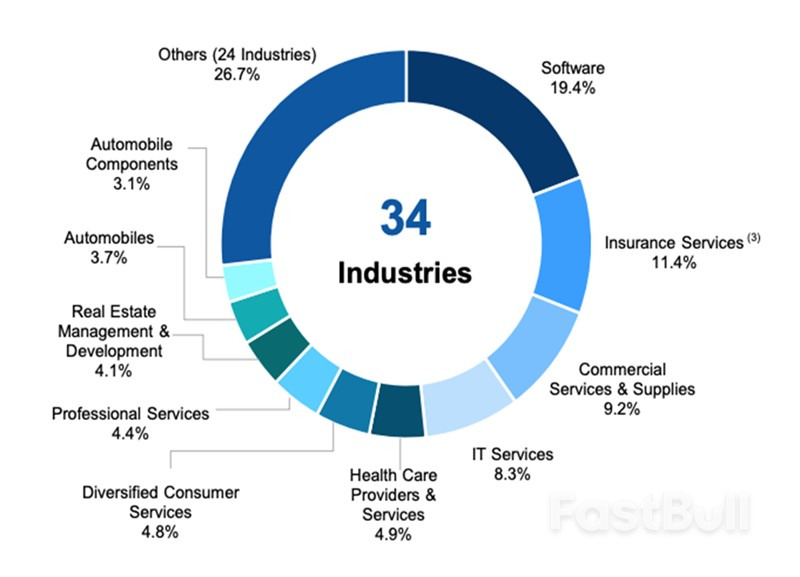
          Management knows how to control risk: As of June 1, 96.4% of MSDL’s loans were “first lien.” So if bankruptcy hits one of these borrowers, MSDL is first to be repaid. But the team has taken steps to minimize even that outcome, with a portfolio spread across a range of industries:
          Who Really Wins From AI? Small Business and These 8.8%+ Dividends_1
          The dividend? It’s covered by net investment income (NII), with $0.50 in NII over the last quarter matching the $0.50 quarterly payout.
          There’s good reason to think that coverage will improve. Which leads us to interest rates, always a critical factor for BDC profits.
          Here too, there’s a “bullish disconnect” for us to exploit. When the Fed cuts its policy rate—pacesetter for the rate at which financial institutions lend to each other—BDC loan income typically declines, especially floating-rate loans, an MSDL specialty (99.6% of its portfolio).
          The Fed is likely to cut in September. This seems like bad news, but the crowd is missing the real story, as lower rates drive up loan demand, especially when businesses plan to grow (see small-business optimism above). That helps offset lower loan income and gives BDCs more floating-rate loans (whose income will gain when rates rise again).
          MSDL has already grown its loan book, from 192 borrowers a year ago to 214. Its portfolio value has also risen from $3.5 billion to $3.8 billion. I expect that to continue as MSDL establishes itself and small-biz optimism rolls on.
          High-Yield BDC #2: A “Bully” Paying a Steady 8.8% Dividend
          Those strengths are enough to put MSDL on our Contrarian Income Report watch list. But we prefer portfolio holding Ares Capital (NASDAQ:ARCC) for one main reason: scale.
          ARCC is the biggest BDC by far, with over $29 billion in assets. This brings a steady stream of deal flow, helping management dictate favorable loan terms.
          That’s why Ares is our “BDC bully”: Its size helps ARCC both be picky and grow quickly: As of June 30, it had 566 borrowers, twice MSDL’s number.
          As well, delinquent loans were just 1.2% of the portfolio’s value in Q2—healthy for a lender in the “middle-market” credit space (companies with $10 million to $1 billion in sales), like ARCC.
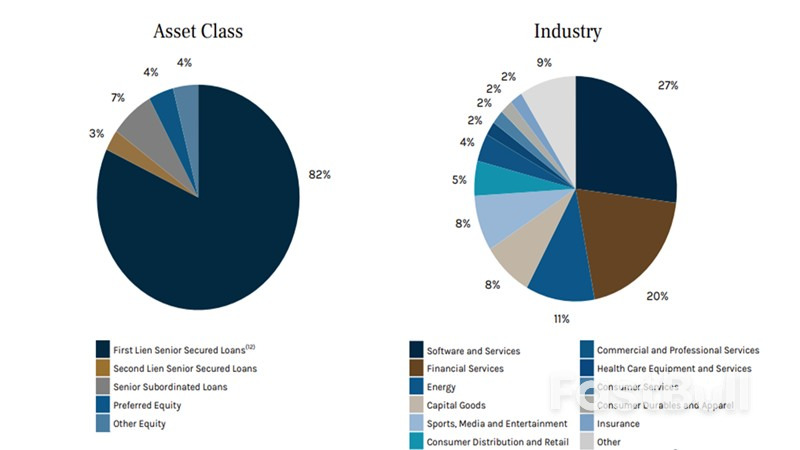
          ARCC’s ability to grab the “pick of the litter” among borrowers has also let it build a diverse portfolio, with a lean toward those lower-risk first-lien loans:
          Who Really Wins From AI? Small Business and These 8.8%+ Dividends_2
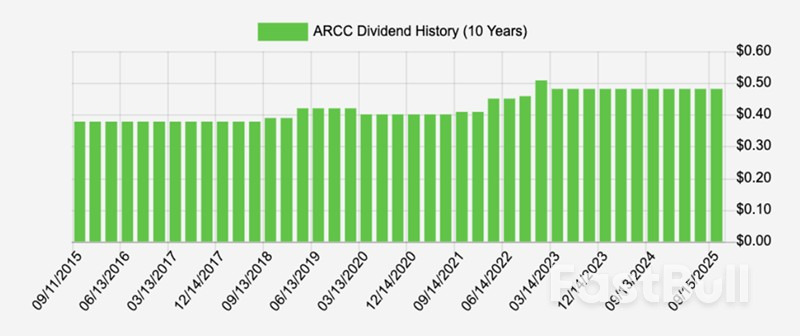
          ARCC continues to aggressively write new loans at attractive yields. Last quarter, the fund generated NII of $0.49 per share, covering its $0.48 quarterly dividend.
          We also have a lot more dividend history to go on here, with ARCC going public more than two decades ago, in 2004. That history is very favorable indeed:
          Who Really Wins From AI? Small Business and These 8.8%+ Dividends_3
          About 69% of ARCC’s portfolio is floating rate, but management is steering more loans that way, including 96% of the $1.1 billion of new loans written in July. That’s a smart move as future rate cuts spur more small-biz borrowing.
          Finally, ARCC trades around 1.1-times book value, fair in light of its dominant position and long history. Sure, we’d like to buy “cheap,” but investors rarely knock our “BDC bully” below 1. So we’ll happily buy here and collect ARCC’s 8.8% payout while we wait for its next run up.

          Source: investing

          To stay updated on all economic events of today, please check out our Economic calendar
          Risk Warnings and Disclaimers
          You understand and acknowledge that there is a high degree of risk involved in trading. Following any strategies or investment methods may lead to potential losses. The content on the site is provided by our contributors and analysts for information purposes only. You are solely responsible for determining whether any trading assets, securities, strategy, or any other product is suitable for investing based on your own investment objectives and financial situation.
          Add to Favorites
          Share

          ECB's Muller Says It Makes Sense To Hold Rates And Watch Economy

          Daniel Carter

          Central Bank

          Economic

          The European Central Bank can afford to keep interest rates steady next week as inflation hovers close to its target and the economy shows resilience, Governing Council member Madis Muller said.
          Asked about expectations that officials will keep borrowing costs unchanged on Sept. 11, the Estonian central-bank chief told Bloomberg Adria that such a view "makes sense" since economic activity is likely to gradually pick up.
          "It's reasonable right now to take the time and monitor the economic data as it comes in the following months and take any different decisions if necessary," he said.
          The comments underscore that after eight cuts and a first pause in July, appetite in the Governing Council for further easing is waning. Executive Board member Isabel Schnabel said in a Reuters interview that she doesn't see any reason for further cuts, citing upside risks to the inflation outlook.
          In contrast, Finland's Olli Rehn told Boersen-Zeitung that the Governing Council shouldn't be complacent on downside risks to prices. He echoed his Lithuanian counterpart — Gediminas Simkus — who told Econostream that "I continue to think that risks to the economy and to inflation are still tilted to the downside."
          Muller said new ECB forecasts next week won't change significantly from the previous batch in June.
          "In light of all of this turmoil that we have seen in the recent past, starting with the trade policy in the US, also the impact of war in Ukraine that we have now for a number of years, the economy has held up quite well in Europe," Muller said. Looking at recent data, "we could still assume that we are more or less on the path that was already there during the last round of projections for the ECB."

          Source: Bloomberg Europe

          To stay updated on all economic events of today, please check out our Economic calendar
          Risk Warnings and Disclaimers
          You understand and acknowledge that there is a high degree of risk involved in trading. Following any strategies or investment methods may lead to potential losses. The content on the site is provided by our contributors and analysts for information purposes only. You are solely responsible for determining whether any trading assets, securities, strategy, or any other product is suitable for investing based on your own investment objectives and financial situation.
          Add to Favorites
          Share

          Wall Street Pulls Further From Its Records Under The Weight Of Pressure From The Bond Market

          Thomas

          Economic

          Wall Street is pulling further from its records on Tuesday, ground down by tightening pressure from the bond market.

          The S&P 500 sank 0.9 per cent after falling as much as 1.4 per cent at the start of trading. The Dow Jones Industrial Average was down 305 points, or 0.7 per cent, as of 10:10 a.m. Eastern time, and the Nasdaq composite was down 1.1 per cent. All three are still relatively close to their recently set all-time highs.

          Nvidia and other companies that have benefited from the frenzy around artificial-intelligence technology were some of the heaviest weights on the market. They have soared for years on belief that they’re at the vanguard of the next revolution for the global economy. But they’ve also shot so high that critics say their prices have simply become too expensive.

          Nvidia, whose chips are powering much of the move into AI, fell 2.1 per cent.

          Other losing Big Tech stocks included Amazon, which fell 1.9 per cent, and Alphabet, which sank 1.8 per cent.

          The overall stock market was feeling pressure from rising yields in the bond market, where the 10-year Treasury yield climbed to 4.26 per cent from 4.23 per cent late Friday. When bonds are paying more in interest, investors are less willing to pay high prices for stocks.

          Longer-term bond yields are on the rise around the world, in part because of worries about how difficult it will be for governments to repay their growing mountains of debt.

          In the United States, longer-term Treasury yields are feeling added pressure from President Donald Trump’s attacks on the Federal Reserve for not cutting interest rates sooner. The fear is that a less independent Fed will be less likely to make the unpopular decisions needed to keep inflation under control, such as keeping short-term interest rates higher than investors would like.

          Tuesday was also the first opportunity for trading in the U.S. Treasury market after a federal appeals court ruled that Trump overstepped his legal authority when announcing sweeping tariffs on almost every country on Earth, though it left the tariffs in place for now. While the tariffs have created confusion and may have hurt the U.S. job market, they also have brought in revenue that could help the U.S. government pay some of its debt.

          In another signal about increasing worries in financial markets, the price of gold rose 1.1 per cent and was near its record. The metal has often provided a haven for investors in times of uncertainty.

          Treasury yields did trim their gains a bit after a report said U.S. manufacturing contracted by more last month than economists expected. Many companies told the Institute for Supply Management’s survey that tariffs are continuing to make conditions chaotic.

          “Too much uncertainty for us and our customers regarding tariffs and the U.S./global economy,” said one company in the chemical products industry said, while noting that orders across most product lines have weakened.

          The worse-than-expected report could give the Federal Reserve more leeway to cut its main interest rate for the first time this year at its next meeting in a couple of weeks. That in turn helped stock prices trim their losses.

          On Wall Street, Constellation Brands tumbled 6.8 per cent after the beer, wine and spirits company warned that it’s seen a slowdown in purchases of its high-end beers, particularly among its Hispanic customers. That pushed it to slash its forecast for profit this fiscal year.

          Kraft Heinz fell 3.5 per cent after announcing that it’s splitting into two, a decade after a merger of the brands created one of the biggest food companies on the planet.

          One of the companies will include shelf stable meals and include brands such as Heinz, Philadelphia cream cheese and Kraft Mac & Cheese. The other will include the Oscar Mayer, Kraft Singles and Lunchables brands. The official names of the two companies will be released later.

          Among the market’s few gainers was PepsiCo, which rose 2.9 per cent after an investment firm said it sent suggestions to the company’s board to reaccelerate its growth and boost financial performance. The investor, Elliott Management, has a history of buying into companies and then pushing for big changes that can lead to better stock performance.

          In stock markets abroad, indexes slumped across Europe, with Germany’s DAX losing 1.7 per cent. That was after a more mixed finish in Asia, where indexes rose 0.9 per cent in Seoul but fell 0.5 per cent in Hong Kong.

          Source: BNN BIoomberg

          To stay updated on all economic events of today, please check out our Economic calendar
          Risk Warnings and Disclaimers
          You understand and acknowledge that there is a high degree of risk involved in trading. Following any strategies or investment methods may lead to potential losses. The content on the site is provided by our contributors and analysts for information purposes only. You are solely responsible for determining whether any trading assets, securities, strategy, or any other product is suitable for investing based on your own investment objectives and financial situation.
          Add to Favorites
          Share

          Trump Says India Offered To Cut Its Tariffs To ‘nothing’

          Winkelmann

          Economic

          Political

          Forex

          President Donald Trump said India has offered to cut its tariff rates following the US imposition last week of 50% levies as punishment for its purchases of Russian oil.“They have now offered to cut their Tariffs to nothing, but it’s getting late. They should have done so years ago,” Trump said in a Truth Social post Monday. It wasn’t clear when the offer was made, or whether the White House plans to reopen trade talks with India.

          The new US tariffs doubled the existing 25% duty on Indian exports. The levies hit more than 55% of goods shipped to the US — India’s biggest market — and hurt labour-intensive industries like textiles and jewellery the most. Key exports like electronics and pharmaceuticals are exempt, sparing Apple Inc’s massive new factory investments in India for now.The tariffs have stunned Indian officials and follow months of trade talks between New Delhi and Washington. India was among the first countries to open trade talks with the Trump administration, but its own high tariffs and protectionist policies in sectors such as agriculture and dairy have frustrated US negotiators.

          India’s Ministry of External Affairs did not respond to a request for comment outside regular office hours and the White House didn’t immediately respond to requests for comment. The US Trade Representative’s Office also didn’t immediately respond.As part of its trade negotiations, India had expressed willingness to offer zero tariffs on some goods like auto components and pharmaceuticals, while barriers on sectors like agriculture and dairy remained red lines it wouldn’t breach, Bloomberg News has reported earlier.

          India has also made several moves to satisfy Trump’s grievances this year, including overhauling its tariff regime to reduce import duties on prominent American goods like bourbon whiskey and high-end motorcycles made by Harley-Davidson Inc.But Trump has grown frustrated with India for buying Russian oil, which he said helps fund President Vladimir Putin’s war in Ukraine.

          Indian Prime Minister Narendra Modi and Putin met in China, signalling that New Delhi’s ties with Moscow remain firm despite the relentless pressure from the Trump administration. Modi declared Monday that India and Russia share a “special” relationship.Modi has also taken steps to mend ties with China. He held talks with Chinese President Xi Jinping in Tianjin on Sunday at a regional security and economic summit, with both sides pledging to be partners, not rivals. They discussed border issues, resuming direct flights and increasing trade, according to official readouts.

          Source: Theedgemarkets

          To stay updated on all economic events of today, please check out our Economic calendar
          Risk Warnings and Disclaimers
          You understand and acknowledge that there is a high degree of risk involved in trading. Following any strategies or investment methods may lead to potential losses. The content on the site is provided by our contributors and analysts for information purposes only. You are solely responsible for determining whether any trading assets, securities, strategy, or any other product is suitable for investing based on your own investment objectives and financial situation.
          Add to Favorites
          Share
          FastBull
          Copyright © 2025 FastBull Ltd

          728 RM B 7/F GEE LOK IND BLDG NO 34 HUNG TO RD KWUN TONG KLN HONG KONG

          TelegramInstagramTwitterfacebooklinkedin
          App Store Google Play Google Play
          Products
          Charts

          Chats

          Q&A with Experts
          Screeners
          Economic Calendar
          Data
          Tools
          Membership
          Features
          Function
          Markets
          Copy Trading
          Latest Signals
          Contests
          News
          Analysis
          24/7
          Columns
          Education
          Company
          Careers
          About Us
          Contact Us
          Advertising
          Help Center
          Feedback
          User Agreement
          Privacy Policy
          Business

          White Label

          Data API

          Web Plug-ins

          Poster Maker

          Affiliate Program

          Risk Disclosure

          The risk of loss in trading financial instruments such as stocks, FX, commodities, futures, bonds, ETFs and crypto can be substantial. You may sustain a total loss of the funds that you deposit with your broker. Therefore, you should carefully consider whether such trading is suitable for you in light of your circumstances and financial resources.

          No decision to invest should be made without thoroughly conducting due diligence by yourself or consulting with your financial advisors. Our web content might not suit you since we don't know your financial conditions and investment needs. Our financial information might have latency or contain inaccuracy, so you should be fully responsible for any of your trading and investment decisions. The company will not be responsible for your capital loss.

          Without getting permission from the website, you are not allowed to copy the website's graphics, texts, or trademarks. Intellectual property rights in the content or data incorporated into this website belong to its providers and exchange merchants.

          Not Logged In

          Log in to access more features

          FastBull Membership

          Not yet

          Purchase

          Become a signal provider
          Help Center
          Customer Service
          Dark Mode
          Price Up/Down Colors

          Log In

          Sign Up

          Position
          Layout
          Fullscreen
          Default to Chart
          The chart page opens by default when you visit fastbull.com