• Trade
  • Markets
  • Copy
  • Contests
  • News
  • 24/7
  • Calendar
  • Q&A
  • Chats
Trending
Screeners
SYMBOL
LAST
BID
ASK
HIGH
LOW
NET CHG.
%CHG.
SPREAD
SPX
S&P 500 Index
6827.42
6827.42
6827.42
6899.86
6801.80
-73.58
-1.07%
--
DJI
Dow Jones Industrial Average
48458.04
48458.04
48458.04
48886.86
48334.10
-245.98
-0.51%
--
IXIC
NASDAQ Composite Index
23195.16
23195.16
23195.16
23554.89
23094.51
-398.69
-1.69%
--
USDX
US Dollar Index
97.950
98.030
97.950
98.500
97.950
-0.370
-0.38%
--
EURUSD
Euro / US Dollar
1.17394
1.17409
1.17394
1.17496
1.17192
+0.00011
+ 0.01%
--
GBPUSD
Pound Sterling / US Dollar
1.33707
1.33732
1.33707
1.33997
1.33419
-0.00148
-0.11%
--
XAUUSD
Gold / US Dollar
4299.39
4299.39
4299.39
4353.41
4257.10
+20.10
+ 0.47%
--
WTI
Light Sweet Crude Oil
57.233
57.485
57.233
58.011
56.969
-0.408
-0.71%
--

Community Accounts

Signal Accounts
--
Profit Accounts
--
Loss Accounts
--
View More

Become a signal provider

Sell trading signals to earn additional income

View More

Guide to Copy Trading

Get started with ease and confidence

View More

Signal Accounts for Members

All Signal Accounts

Best Return
  • Best Return
  • Best P/L
  • Best MDD
Past 1W
  • Past 1W
  • Past 1M
  • Past 1Y

All Contests

  • All
  • Trump Updates
  • Recommend
  • Stocks
  • Cryptocurrencies
  • Central Banks
  • Featured News
Top News Only
Share

USA Embassy In Lithuania: Maria Kalesnikava Is Not Going To Vilnius

Share

USA Embassy In Lithuania: Other Prisoners Are Being Sent From Belarus To Ukraine

Share

Ukraine President Zelenskiy: Five Ukrainians Released By Belarus In US-Brokered Deal

Share

USA Vilnius Embassy: USA Stands Ready For "Additional Engagement With Belarus That Advances USA Interests"

Share

USA Vilnius Embassy: Belarus, USA, Other Citizens Among The Prisoners Released Into Lithuania

Share

USA Vilnius Embassy: USA Will Continue Diplomatic Efforts To Free The Remaining Political Prisoners In Belarus

Share

USA Vilnius Embassy: Belarus Releases 123 Prisoners Following Meeting Of President Trump's Envoy Coale And Belarus President Lukashenko

Share

USA Vilnius Embassy: Masatoshi Nakanishi, Aliaksandr Syrytsa Are Among The Prisoners Released By Belarus

Share

USA Vilnius Embassy: Maria Kalesnikava And Viktor Babaryka Are Among The Prisoners Released By Belarus

Share

USA Vilnius Embassy: Nobel Peace Prize Laureate Ales Bialiatski Is Among The Prisoners Released By Belarus

Share

Belarusian Presidential Administration Telegram Channel: Lukashenko Has Pardoned 123 Prisoners As Part Of Deal With US

Share

Two Local Syrian Officials: Joint US-Syrian Military Patrol In Central Syria Came Under Fire From Unknown Assailants

Share

Israeli Military Says It Targeted 'Key Hamas Terrorist' In Gaza City

Share

Rwanda's Actions In Eastern Drc Are A Clear Violation Of Washington Accords Signed By President Trump - Secretary Of State Rubio

Share

Israeli Military Issues Evacuation Warning In Southern Lebanon Village Ahead Of Strike - Spokesperson On X

Share

Belarusian State Media Cites US Envoy Coale As Saying He Discussed Ukraine And Venezuela With Lukashenko

Share

Belarusian State Media Cites US Envoy Coale As Saying That US Removes Sanctions On Belarusian Potassium

Share

Thai Prime Minister: No Ceasefire Agreement With Cambodia

Share

US, Ukraine To Discuss Ceasefire In Berlin Ahead Of European Summit

Share

Incoming Czech Prime Minister Babis: Czech Republic Will Not Take On Guarantees For Ukraine Financing, European Commission Must Find Alternatives

TIME
ACT
FCST
PREV
U.K. Trade Balance Non-EU (SA) (Oct)

A:--

F: --

P: --

U.K. Trade Balance (Oct)

A:--

F: --

P: --

U.K. Services Index MoM

A:--

F: --

P: --

U.K. Construction Output MoM (SA) (Oct)

A:--

F: --

P: --

U.K. Industrial Output YoY (Oct)

A:--

F: --

P: --

U.K. Trade Balance (SA) (Oct)

A:--

F: --

P: --

U.K. Trade Balance EU (SA) (Oct)

A:--

F: --

P: --

U.K. Manufacturing Output YoY (Oct)

A:--

F: --

P: --

U.K. GDP MoM (Oct)

A:--

F: --

P: --

U.K. GDP YoY (SA) (Oct)

A:--

F: --

P: --

U.K. Industrial Output MoM (Oct)

A:--

F: --

P: --

U.K. Construction Output YoY (Oct)

A:--

F: --

P: --

France HICP Final MoM (Nov)

A:--

F: --

P: --

China, Mainland Outstanding Loans Growth YoY (Nov)

A:--

F: --

P: --

China, Mainland M2 Money Supply YoY (Nov)

A:--

F: --

P: --

China, Mainland M0 Money Supply YoY (Nov)

A:--

F: --

P: --

China, Mainland M1 Money Supply YoY (Nov)

A:--

F: --

P: --

India CPI YoY (Nov)

A:--

F: --

P: --

India Deposit Gowth YoY

A:--

F: --

P: --

Brazil Services Growth YoY (Oct)

A:--

F: --

P: --

Mexico Industrial Output YoY (Oct)

A:--

F: --

P: --

Russia Trade Balance (Oct)

A:--

F: --

P: --

Philadelphia Fed President Henry Paulson delivers a speech
Canada Building Permits MoM (SA) (Oct)

A:--

F: --

P: --

Canada Wholesale Sales YoY (Oct)

A:--

F: --

P: --

Canada Wholesale Inventory MoM (Oct)

A:--

F: --

P: --

Canada Wholesale Inventory YoY (Oct)

A:--

F: --

P: --

Canada Wholesale Sales MoM (SA) (Oct)

A:--

F: --

P: --

Germany Current Account (Not SA) (Oct)

A:--

F: --

P: --

U.S. Weekly Total Rig Count

A:--

F: --

P: --

U.S. Weekly Total Oil Rig Count

A:--

F: --

P: --

Japan Tankan Large Non-Manufacturing Diffusion Index (Q4)

--

F: --

P: --

Japan Tankan Small Manufacturing Outlook Index (Q4)

--

F: --

P: --

Japan Tankan Large Non-Manufacturing Outlook Index (Q4)

--

F: --

P: --

Japan Tankan Large Manufacturing Outlook Index (Q4)

--

F: --

P: --

Japan Tankan Small Manufacturing Diffusion Index (Q4)

--

F: --

P: --

Japan Tankan Large Manufacturing Diffusion Index (Q4)

--

F: --

P: --

Japan Tankan Large-Enterprise Capital Expenditure YoY (Q4)

--

F: --

P: --

U.K. Rightmove House Price Index YoY (Dec)

--

F: --

P: --

China, Mainland Industrial Output YoY (YTD) (Nov)

--

F: --

P: --

China, Mainland Urban Area Unemployment Rate (Nov)

--

F: --

P: --

Saudi Arabia CPI YoY (Nov)

--

F: --

P: --

Euro Zone Industrial Output YoY (Oct)

--

F: --

P: --

Euro Zone Industrial Output MoM (Oct)

--

F: --

P: --

Canada Existing Home Sales MoM (Nov)

--

F: --

P: --

Euro Zone Total Reserve Assets (Nov)

--

F: --

P: --

U.K. Inflation Rate Expectations

--

F: --

P: --

Canada National Economic Confidence Index

--

F: --

P: --

Canada New Housing Starts (Nov)

--

F: --

P: --

U.S. NY Fed Manufacturing Employment Index (Dec)

--

F: --

P: --

U.S. NY Fed Manufacturing Index (Dec)

--

F: --

P: --

Canada Core CPI YoY (Nov)

--

F: --

P: --

Canada Manufacturing Unfilled Orders MoM (Oct)

--

F: --

P: --

Canada Manufacturing New Orders MoM (Oct)

--

F: --

P: --

Canada Core CPI MoM (Nov)

--

F: --

P: --

Canada Manufacturing Inventory MoM (Oct)

--

F: --

P: --

Canada CPI YoY (Nov)

--

F: --

P: --

Canada CPI MoM (Nov)

--

F: --

P: --

Canada CPI YoY (SA) (Nov)

--

F: --

P: --

Canada Core CPI MoM (SA) (Nov)

--

F: --

P: --

Q&A with Experts
    • All
    • Chatrooms
    • Groups
    • Friends
    Connecting
    .
    .
    .
    Type here...
    Add Symbol or Code

      No matching data

      All
      Trump Updates
      Recommend
      Stocks
      Cryptocurrencies
      Central Banks
      Featured News
      • All
      • Russia-Ukraine Conflict
      • Middle East Flashpoint
      • All
      • Russia-Ukraine Conflict
      • Middle East Flashpoint
      Search
      Products

      Charts Free Forever

      Chats Q&A with Experts
      Screeners Economic Calendar Data Tools
      Membership Features
      Data Warehouse Market Trends Institutional Data Policy Rates Macro

      Market Trends

      Market Sentiment Order Book Forex Correlations

      Top Indicators

      Charts Free Forever
      Markets

      News

      News Analysis 24/7 Columns Education
      From Institutions From Analysts
      Topics Columnists

      Latest Views

      Latest Views

      Trending Topics

      Top Columnists

      Latest Update

      Signals

      Copy Rankings Latest Signals Become a signal provider AI Rating
      Contests
      Brokers

      Overview Brokers Assessment Rankings Regulators News Claims
      Broker listing Forex Brokers Comparison Tool Live Spread Comparison Scam
      Q&A Complaint Scam Alert Videos Tips to Detect Scam
      More

      Business
      Events
      Careers About Us Advertising Help Center

      White Label

      Data API

      Web Plug-ins

      Affiliate Program

      Awards Institution Evaluation IB Seminar Salon Event Exhibition
      Vietnam Thailand Singapore Dubai
      Fans Party Investment Sharing Session
      FastBull Summit BrokersView Expo
      Recent Searches
        Top Searches
          Markets
          News
          Analysis
          User
          24/7
          Economic Calendar
          Education
          Data
          • Names
          • Latest
          • Prev

          View All

          No data

          Scan to Download

          Faster Charts, Chat Faster!

          Download App
          English
          • English
          • Español
          • العربية
          • Bahasa Indonesia
          • Bahasa Melayu
          • Tiếng Việt
          • ภาษาไทย
          • Français
          • Italiano
          • Türkçe
          • Русский язык
          • 简中
          • 繁中
          Open Account
          Search
          Products
          Charts Free Forever
          Markets
          News
          Signals

          Copy Rankings Latest Signals Become a signal provider AI Rating
          Contests
          Brokers

          Overview Brokers Assessment Rankings Regulators News Claims
          Broker listing Forex Brokers Comparison Tool Live Spread Comparison Scam
          Q&A Complaint Scam Alert Videos Tips to Detect Scam
          More

          Business
          Events
          Careers About Us Advertising Help Center

          White Label

          Data API

          Web Plug-ins

          Affiliate Program

          Awards Institution Evaluation IB Seminar Salon Event Exhibition
          Vietnam Thailand Singapore Dubai
          Fans Party Investment Sharing Session
          FastBull Summit BrokersView Expo

          A Close Call on the Bank of Canada Today

          Samantha Luan

          Forex

          Summary:

          We expect a hawkish hold by the Bank of Canada today, but pressure on policymakers to hike has risen and it's admittedly rather a close call. We don't think it's a make-or-break event for CAD – but we should keep an eye on the implications of a hike for the broader market and the dollar.

          USD: Lack of domestic factors
          A quiet data calendar has left the pricing for the Federal Reserve's June meeting little changed, with a 20-25% implied probability of a hike after the soft ISM services figures on Monday. That and the generally supported environment for equities haven't triggered any substantial dollar correction though.
          The market's bearish mood on European currencies remains the prevailing theme, and the dollar's resilience probably denotes reluctance to add dollar shorts ahead of the US CPI risk event on 13th June – which is still seen as having the potential to tilt the balance to a hike the following day.
          We think markets will watch the Bank of Canada decision (which we discuss in detail in the CAD section below) with great interest today. Following the Reserve Bank of Australia rate hike yesterday, another hawkish surprise from a developed central bank in the run-up to the FOMC meeting could cause the revamp of some hawkish speculation, especially considering Canada's economic affinity with the US.
          Given the lack of other market-moving events today, a BoC hike could end up supporting the USD too. But, as discussed in our BoC preview, we expect a hawkish hold – in which case the spill-over into the dollar may not be very material given that should be insufficient to prompt markets to price out the implied chances of a Fed June hike currently embedded in the USD curve.
          EUR: European currencies still unloved
          The euro continues to suffer from a softening inflation story in the eurozone. Yesterday, April's report on consumer expectations showed a considerable drop (12-month gauge down to 4.1% from 5.0% in a month), which triggered a rally in the euro area's front-end yields. This has prevented any re-tightening in the 2-year EUR-USD swap rate gap, despite the slight decline in Fed hawkish expectations after Monday's US ISM numbers.
          While easing inflation should build a case for the doves, ECB communication has not seen drastic changes as we head into next week's policy announcement. Yesterday, President Christine Lagarde reiterated her call for more tightening, and her hawkish tone is probably a key factor keeping markets attached to the 40-45bp pricing for the July meeting. We have other speakers to keep an eye on today. Barring major dovish remarks, and unless a BoC hike has a positive spill-over on the dollar, we feel EUR/USD can remain anchored to 1.0700 for now.
          Elsewhere in Europe, pressure on Scandinavian currencies has resumed. EUR/SEK is trading at 11.684 this morning: the intra-day all-time print is at 11.79, and as we have reiterated multiple times in recent publications, the lack of any support from the Riksbank is making it hard to pick a top for the pair in the near term. The financially-distressed Swedish landlord SBB is reportedly denying rumours about discounted sales of its business units, but a default warning from creditors has emerged and the centrality of the firm in the Swedish real estate space means more risk premium (related to a property market collapse) could be priced into SEK now. A recovery for the krona seems unlikely in the near term.
          CAD: Our call is a BoC hawkish hold today
          The Bank of Canada moved considerably earlier than other central banks to the dovish side of the spectrum and has kept rates on hold since January. Now, stubborn inflation, an ultra-tight labour market and a more benign growth backdrop are building the case for a return to monetary tightening. Markets are attaching a 45% implied probability that a 25bp hike will be delivered today.
          While admitting it's a rather close call, we think a hawkish hold is more likely (here's our full meeting preview), as policymakers may want to err on the side of caution while assessing the lagged effect of monetary tightening. We still expect a return to 2% inflation in Canada in the early part of 2024 with the help of softer commodity prices. Developments in the US also play a rather important role for the BoC: recent jitters in the US economic outlook (ISM reports recently added to recession fears) and the proximity to a "toss-up" FOMC meeting would also warrant an extension of the pause.
          Still, we expect another hold by the BoC to be accompanied by hawkish language. Markets are pricing in 40bp of tightening by the end of the summer, and we doubt policymakers have an interest in pushing back or significantly disappointing the market's hawkish expectations given recent data. So, as long as a hold contains enough hints at potential future tightening, we think the negative impact on CAD should be short-lived and we keep favouring the loonie against other pro-cyclical currencies in the current risk environment.
          CEE: Dovish NBP leads us to bearish view on zloty
          Today, another series of economic data from the CEE region continues. Industrial production data will be published in Hungary and retail sales for April in the Czech Republic. Later, the Czech National Bank will release intervention numbers for April – but it can be assumed that the central bank was not active in the market given the current EUR/CZK level. The last time the central bank intervened in the FX market was last October.
          Later today, at 3pm local time, we will see a press conference from the Governor of the National Bank of Poland. As expected, rates remained unchanged yesterday and the statement didn't show anything new either. Today's press conference will be the main focus of the market and we can expect a rather dovish tone supported by lower-than-expected inflation for May.
          The situation in the FX market in the region remains unclear in what direction it will take. The Polish zloty will of course be the main focus. Given the expected dovish tone of the governor, the market is likely to be open to price in more monetary easing, pushing the interest rate differential down. However, this is not the main driver at the moment and if anything, it is more global sentiment that is deciding the zloty. At the same time, it is hard to see what role the MinFin operation in the FX market may play in the strongest levels of the zloty since June 2021. However, the strong long market positioning and dovish NBP leads us to a rather bearish view on the zloty and we see a rather higher EUR/PLN after the end of the press conference today above 4.490.

          Source: ING

          Risk Warnings and Disclaimers
          You understand and acknowledge that there is a high degree of risk involved in trading. Following any strategies or investment methods may lead to potential losses. The content on the site is provided by our contributors and analysts for information purposes only. You are solely responsible for determining whether any trading assets, securities, strategy, or any other product is suitable for investing based on your own investment objectives and financial situation.
          Comments
          Add to Favorites
          Share

          China Exports Experience Sharper Decline Than Expected, Weighed Down by Weak Global Demand

          Warren Takunda

          Economic

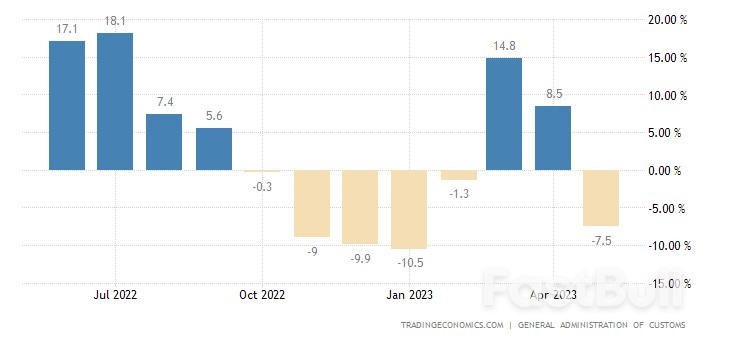
          China's exports witnessed a significant downturn in May 2023, registering a year-on-year contraction of 7.5%, amounting to USD 283.5 billion. This decline follows a period of steady growth in April, when exports expanded by 8.5%. The latest figures indicate the first negative growth since February and the most substantial decline in four months. Surprisingly, the slump in exports surpassed market expectations, which had predicted a more moderate decrease of 0.4%. The disappointing performance can be attributed to insufficient global demand, hampering the recovery of outbound shipments.China Exports Experience Sharper Decline Than Expected, Weighed Down by Weak Global Demand_1
          The weakened global appetite for Chinese goods poses a challenge for the world's second-largest economy, which heavily relies on exports to sustain its growth trajectory. The decline in exports signals potential headwinds for China's manufacturing and trade sectors, which could have wider implications for its overall economic health.
          China's Trade Surplus Narrows to Three-Month Low amid Struggling Exports
          China Exports Experience Sharper Decline Than Expected, Weighed Down by Weak Global Demand_2China's trade surplus for May 2023 contracted to USD 65.81 billion, marking a significant decline from USD 78.40 billion recorded during the corresponding period last year. The latest surplus figure fell short of market forecasts of USD 92 billion and represents the smallest surplus recorded since February. The narrowing trade surplus can be attributed to a sharper decline in exports compared to imports, a trend directly influenced by weak global demand.
          The country's exports contracted by 7.5% on a year-on-year basis, reaching a three-month low of USD 283.5 billion. This decline not only represents the first negative growth in three months but also signifies the steepest drop since January, far exceeding market expectations of a modest 0.4% decline. In contrast, imports declined by 4.5%, mainly driven by weakening domestic demand, softening commodity prices, and the strength of the US dollar.
          Furthermore, the politically sensitive trade surplus between China and the United States witnessed a substantial increase of 27.8% year-on-year, reaching USD 359.48 billion during the first five months of this year. This surge in surplus may add further strain to the already tense trade relations between the two economic giants.
          China's Imports Continue to Decline, Though at a Slower Pace Than Predicted
          China Exports Experience Sharper Decline Than Expected, Weighed Down by Weak Global Demand_3Imports into China displayed resilience in May 2023, falling by 4.5% year-on-year to USD 217.69 billion. While this decline continues the downward trend in purchases for the third consecutive month, it is worth noting that the drop was less severe than market estimates, which had projected an 8.0% decrease. In April, imports had experienced a 7.9% plunge.
          The decline in imports can be attributed to weakened domestic demand, softened commodity prices, and the stronger US dollar. Notably, purchases of copper declined by 4.6% compared to the previous year, following a significant 12.5% drop in April. However, there were exceptions to the downward trend, with imports of crude oil growing by 12.2% and iron ore increasing by 4%. Moreover, the import of soybeans surged by 24% to reach a record 12.02 million tonnes. This remarkable increase was primarily due to the delayed unloading of cargoes, resulting from strict inspections implemented in the previous month.
          Considering the cumulative data for the first five months of 2023, imports into China have declined by 6.7% compared to the same period in 2022. The persistence of this downward trend in imports could signal ongoing challenges for China's domestic consumption and manufacturing sectors, which rely on imported goods and raw materials
          To stay updated on all economic events of today, please check out our Economic calendar
          Risk Warnings and Disclaimers
          You understand and acknowledge that there is a high degree of risk involved in trading. Following any strategies or investment methods may lead to potential losses. The content on the site is provided by our contributors and analysts for information purposes only. You are solely responsible for determining whether any trading assets, securities, strategy, or any other product is suitable for investing based on your own investment objectives and financial situation.
          Comments
          Add to Favorites
          Share

          Aussie Holds Strong Despite Poor China Trade Data, Loonie Awaits BoC

          Samantha Luan

          Forex

          Australian Dollar is staying generally firm in Asian session today, as supported by hawkish comments from RBA Governor Philip Lowe. More tightening could still be underway after yesterday's surprised rate hike. Aussie basically shrugged off Weaker than expected Q1 GDP growth. Meanwhile, market reactions to the poor set of trade data from China was surprisingly indifferent.
          The forex markets are generally quiet though, with most major pairs and crosses stuck inside yesterday's range. Canadian Dollar softens slightly as focus turns to BoC rate decision. There is room for an hawkish twist even if there is no surprised rate hike, which could give the Loonie a lift. Dollar, Euro are the weaker ones for now while Yen is trying to resume its near term recovery.
          Technically, the main focus continues to be on the overdue breakout of Dollar from its narrow range against European majors and Yen. A few critical thresholds are under the spotlight and could catalyze significant market moves. Key levels to watch include 1.0634 support in EUR/USD, 1.2306 support in GBP/USD, 0.9146 resistance in USD/CHF, and 140.90 resistance in USD/JPY. Firm break of any of these levels could ring the bell for Dollar's resurgence.
          Aussie Holds Strong Despite Poor China Trade Data, Loonie Awaits BoC_1In Asia, at the time of writing, Nikkei is down -1.00%. Hong Kong HSI is up 0.97%. China Shanghai SSE is up 0.02%. Singapore Strait Times is down -0.33%. Japan 10-year JGB yield is down -0.0054 at 0.418. Overnight, DOW rose 0.03%. S&P 500 rose 0.24%. NASDAQ rose 0.36%. 10-year yield rose 0.006 to 3.699.

          RBA Lowe: Some further tightening of monetary policy may be required

          In a speech, RBA Governor Philip Lowe revealed further insight into the central bank's decision-making process and concerns regarding inflation. Lowe underscored RBA's decision to raise interest rates once more yesterday as an effort to confidently bring inflation back to target within a reasonable timeframe.
          Governor Lowe said, "Yesterday's decision to increase interest rates again was taken to provide greater confidence that inflation will return to target within a reasonable timeframe."
          He attributed this decision to a recent influx of data, suggesting "greater upside risks" to the Bank's inflation outlook. Persistent inflation in services prices, both domestically and abroad, combined with recent data on inflation, wages, and housing prices outpacing forecasts, were contributing factors.
          The Governor noted, "Given this shift in risks and the already fairly drawn-out return of inflation to target, the Board judged that a further increase in interest rates was warranted."
          However, he also highlighted various factors the Board will monitor closely in the coming months, including developments in the global economy, domestic household spending, the growth rate in unit labour costs, and inflation expectations.
          While acknowledging that the RBA remains on a narrow path, Lowe pointed out "significant risks", particularly the possibility that "inflation stays too high for too long".
          He concluded, "Some further tightening of monetary policy may be required, but that will depend upon how the economy and inflation evolve. The Board will continue to pay close attention to developments in the global economy, trends in household spending, and the outlook for inflation and the labour market."

          Australia's Q1 GDP grew only 0.2% qoq, domestic price growth decelerated

          Australia's GDP expanded by 0.2% qoq in Q1, missing expectations of 0.3% qoq growth. This marked the slowest rate of growth since the September 2021 quarter.
          Head of National Accounts at the Australian Bureau of Statistics, Katherine Keenan, remarked on this development. "This is the sixth straight rise in quarterly GDP but the slowest growth since the COVID-19 Delta lockdowns in September quarter 2021," she said.
          The GDP implicit price deflator, a measure of price changes, climbed by 1.9% in the quarter and by 6.8% from March 2022. A significant contributor to this increase was rise in terms of trade by 2.8%, led by steeper decline in import prices (-4.0%) than export prices (-1.4%).
          Fall in import prices, the largest since December 2010, was propelled by global drop in oil prices and appreciation of Australian dollar. Meanwhile, a decrease in export prices was led by rural and mining commodities.
          Domestic price growth decelerated to 1.1% as goods inflation eased. This is a downturn from the 1.4% increase observed in the December 2022 quarter.

          China's exported fell -7.5% yoy in May, trade surplus shrank to USD 65.8B

          In May, China's exports significantly contracted, defying expectations. The country's exports shrunk by -7.5% yoy to USD 283.5B, which was far below expectation of -0.4% yoy contraction. This marks the second-lowest export value since May 2022, with the only lower figure being the seasonally affected USD 213.8B recorded in February. Imports also contracted by -4.5% yoy to USD 217.7B, outperforming the forecasted 8.0% yoy contraction.
          However, the most striking observation comes in the form of China's trade surplus. It fell sharply from USD 90.2B to USD 65.8B, defying the predicted figure of USD 94.2B. This represents the lowest level since the COVID-driven decline observed in April 2022.

          BoC in focus, a coin flip for hold or hike?

          As BoC meets today, many observers anticipate the bank will maintain its pause, leaving interest rates untouched at 4.50%. However, recent economic developments have injected a dose of doubt into the mix. Market speculation reveals that there is approximately a 45% probability of a 25-basis point adjustment, making this rate decision look more like a coin toss.
          The prevailing viewpoint among economists is that BoC might defer any rate changes until its July meeting. Two crucial reasons fortify this standpoint. First, the July assembly aligns with the release of a fresh batch of economic projections, offering BoC ground to justify any rate recalibrations. Second, the subsequent press conference would grant Governor Tiff Macklem the opportunity to explain their decision to a watchful audience.
          However, if the central bank is indeed leaning towards a rate adjustment in July, then today's announcement might carry a hint of hawkishness. If so, this shift could be a strategic move to prepare the markets for potential changes ahead, and give Canadian Dollar a lift.
          Some previews on BoC:
          · Will the BoC Resume Interest Rate Hikes?
          · Forward Guidance: Canada May be in for Another Rate Hike—But July More Likely than June
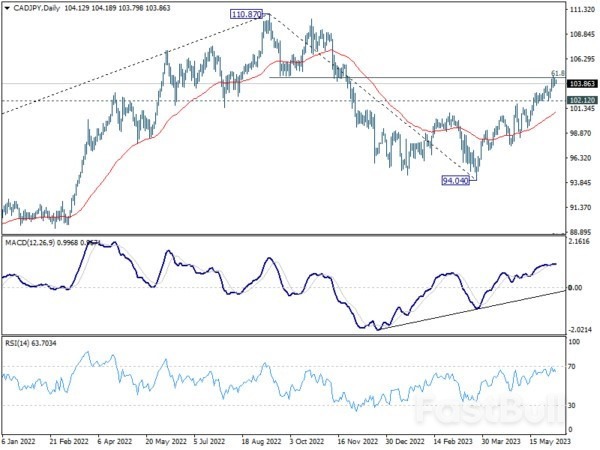
          CAD/JPY has been losing upside momentum as seen in 4H MACD, even though the rally from 94.04 extended. Such rise is seen as the second leg of the corrective pattern from 110.87. It's now pressing an important fibonacci resistance of 61.8% retracement of 110.87 to 94.04 at 104.44.
          Decisive break of 104.44, as prompted by hawkish BoC, could trigger upside re-acceleration to retest 110.87 high. But for now, firm break there is not expected yet.
          On the other hand, break of 102.12 support will indicate rejection by 104.44. More importantly, the pattern from 110.87 might have then started the third leg. Sustained trading below 55 D EMA (now at 100.88) would bring deeper fall back towards 94.04.Aussie Holds Strong Despite Poor China Trade Data, Loonie Awaits BoC_2

          Aussie Holds Strong Despite Poor China Trade Data, Loonie Awaits BoC_3Elsewhere

          Swiss unemployment rate and foreign currency reserves, Germany industrial production, France trade balance, and Italy retail sales will be released in European session. Later in the day, both US and Canada will publish trade balance.

          AUD/USD Daily Report

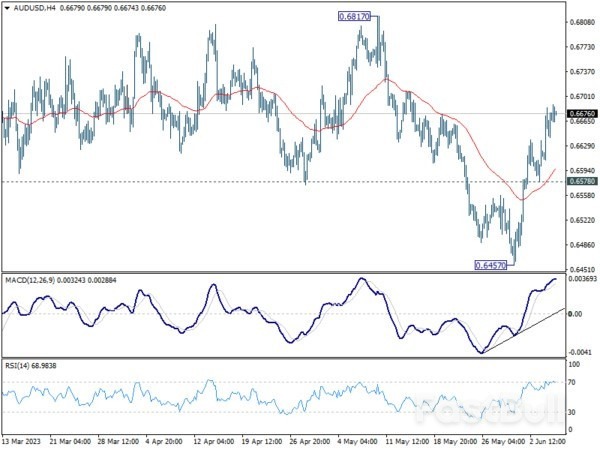
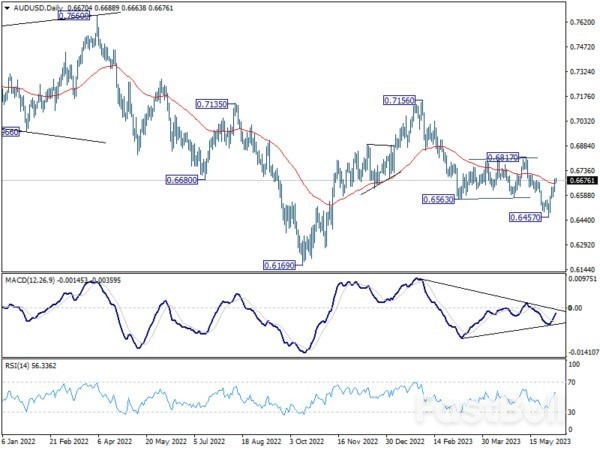
          AUD/USD's rise from 0.6457 is still in progress and intraday bias stays on the upside for 0.6817 key structural resistance. On the downside, though, break of 0.6578 minor support will retain near term bearishness, and turn bias back to the downside for retesting 0.6457 low instead.Aussie Holds Strong Despite Poor China Trade Data, Loonie Awaits BoC_4
          In the bigger picture, rejection by 55 W EMA (now at 0.6811) keeps medium term outlook bearish. Current development suggests that down trend from 0.8006 (2021 high) is possibly still in progress. Retest of 0.6169 (2022 low) should be seen next. Firm break there will confirm down trend resumption. For now, this will remain the favored case as long as 0.6817 resistance holds.

          Aussie Holds Strong Despite Poor China Trade Data, Loonie Awaits BoC_5Source: ActionForex.com

          Risk Warnings and Disclaimers
          You understand and acknowledge that there is a high degree of risk involved in trading. Following any strategies or investment methods may lead to potential losses. The content on the site is provided by our contributors and analysts for information purposes only. You are solely responsible for determining whether any trading assets, securities, strategy, or any other product is suitable for investing based on your own investment objectives and financial situation.
          Comments
          Add to Favorites
          Share

          GBPAUD Faces Bearish Pressure Amidst Australian Rate Hike and Weak GDP Figures

          Warren Takunda

          Traders' Opinions

          GBPAUD Faces Bearish Pressure Amidst Australian Rate Hike and Weak GDP Figures_1The GBPAUD pair has recently experienced a significant decline following its encounter with a monthly horizontal resistance level. Moreover, the break of a rising trend line has further strengthened the bearish bias in the market. However, a potential bullish correction may be on the horizon as the price approaches a robust horizontal support zone. This article will delve into the current market conditions surrounding GBPAUD, taking into account the 61.8% Fibonacci zone, the broken channel, and the 20 EMA, and discuss the impact of Australia's unexpected interest rate hike and weaker-than-expected GDP figures on the Australian dollar.
          Bearish Momentum and Potential Bullish Correction
          GBPAUD has been enduring a substantial drop after encountering a significant monthly horizontal resistance level. This development has contributed to the prevailing bearish sentiment surrounding the pair. In addition, the breach of a rising trend line has intensified the bearish bias. Traders and investors should closely monitor the price movement as it approaches a strong horizontal support zone. This support zone may serve as a catalyst for a potential bullish correctional movement. Market participants should keep a keen eye on the confluence zone formed by the 61.8% Fibonacci retracement level, the broken channel, and the 20 EMA (Exponential Moving Average), as it is likely to play a crucial role in determining the future direction of GBPAUD.
          Australian Interest Rate Hike
          The recent surprise decision by the Reserve Bank of Australia (RBA) to raise its key interest rate by 25 basis points to 4.10% has sent shockwaves through the market. This interest rate hike has brought the Australian 3-year bond yield to 3.71%, reaching its highest level since October. The RBA's move caught many market participants off guard, as the general expectation was for rates to remain unchanged. Such a significant rate hike signifies the central bank's confidence in the Australian economy's strength. However, this unexpected development has introduced new dynamics that may impact the Australian dollar and subsequently influence the GBPAUD pair.
          Weak Australian GDP Figures
          Adding to the mix of market-moving events is the disappointing performance of Australia's GDP. The latest GDP figures reveal a decline, both in comparison to previous levels and market expectations. Prior to the release, the market anticipated a decrease in GDP from 2.70% to 2.40%. However, the reality turned out to be even more discouraging, with the figure coming in at 2.30%. This weaker-than-expected GDP data has created additional pressure on the Australian currency, as it raises concerns about the overall health and resilience of the Australian economy.
          The GBPAUD pair has witnessed a significant downturn following its encounter with a monthly horizontal resistance level, reinforced by the break of a rising trend line. However, traders should be cautious, as a potential bullish correctional movement may occur near a strong horizontal support zone. The confluence zone of the 61.8% Fibonacci retracement level, the broken channel, and the 20 EMA holds the key to determining the pair's future direction.
          The recent surprise interest rate hike by the Reserve Bank of Australia has further added to the complexity of the market environment. The Australian 3-year bond yield has reached its highest level since October, signaling the RBA's confidence in the strength of the economy. However, weaker-than-expected GDP figures have raised concerns about the Australian economy's overall performance, exerting pressure on the Australian dollar.
          Risk Warnings and Disclaimers
          You understand and acknowledge that there is a high degree of risk involved in trading. Following any strategies or investment methods may lead to potential losses. The content on the site is provided by our contributors and analysts for information purposes only. You are solely responsible for determining whether any trading assets, securities, strategy, or any other product is suitable for investing based on your own investment objectives and financial situation.
          Comments
          Add to Favorites
          Share

          Stingy European Savers will Help the ECB, Not LVMH

          Devin

          Economic

          Pandemic-era lockdowns and government stimulus have left euro zone citizens with 1 trillion euros in extra savings. In the U.S., a similar cash bonanza fuelled a consumption spree that's keeping inflation high. Europeans, however, are likely to hold on to the cash. That will leave consumer goods giants like $445 billion LVMH downcast, but the European Central Bank pretty pleased.
          Money, as the old saying goes, can't buy you happiness. But two years of unhappiness can leave you with a lot of it. The human and social tragedy of the Covid-19 crisis, followed by the energy shock caused by Russia's invasion of Ukraine, boosted the amount of European households' "excess savings" – the cash accumulated over and above the pre-pandemic norm.
          Euro zone citizens put as much as 1 trillion euros – or 8% of GDP – in their piggy banks since the health emergency, according to Oxford Economics' estimates. Those funds came from two main sources: forgone consumption and government help. As countries-imposed lockdowns that shuttered vast swathes of their economies, consumers had fewer opportunities to spend money.
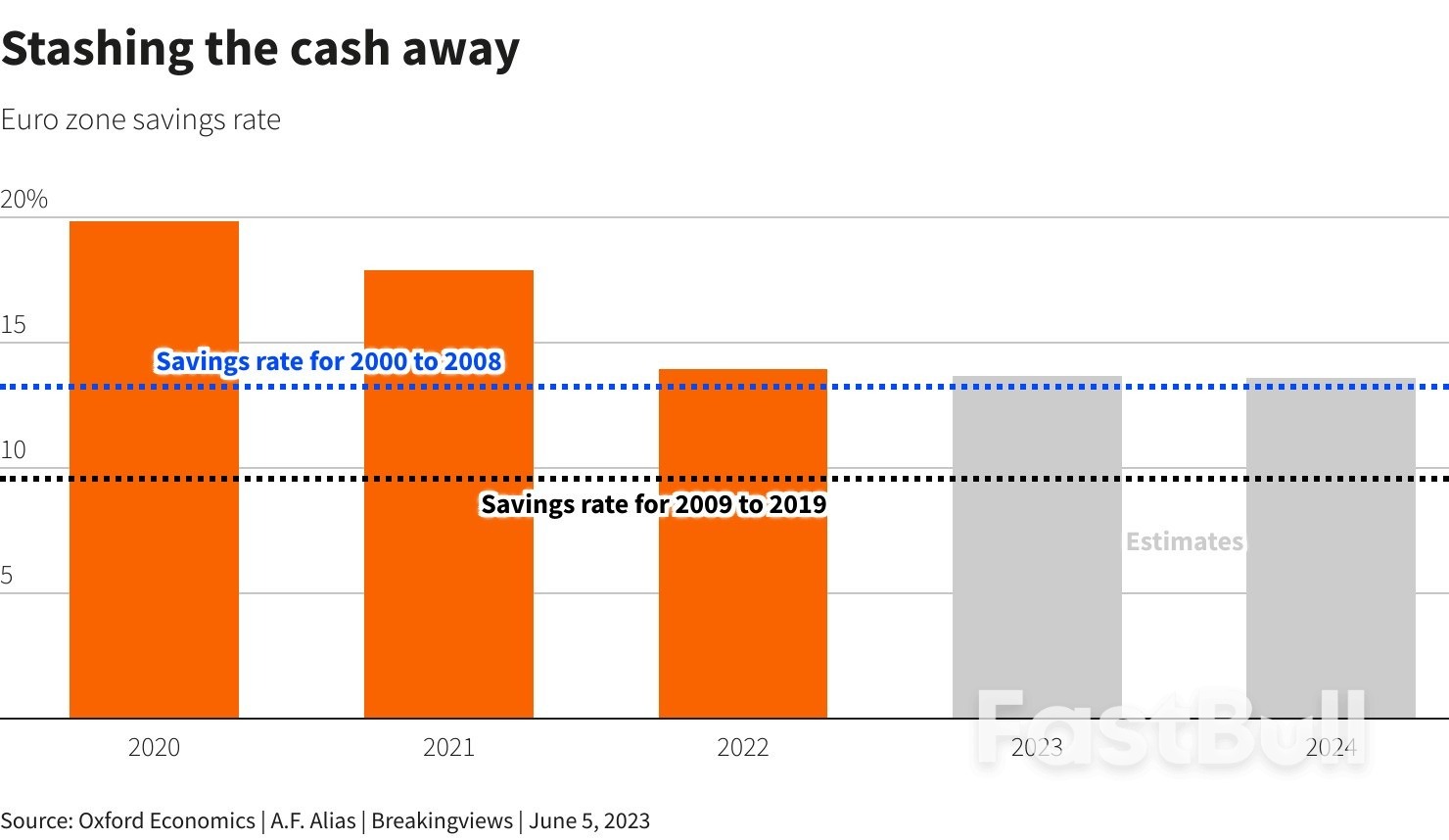
          At the same time, government interventions – first to counter the pandemic and then the spike in energy prices caused by the war – ensured that employment and income levels did not dip dramatically. As a result, the saving rate for the euro zone – the percentage of income households stash away – shot up to an average of 17.2% between 2020 and 2022, compared to an average of 12.9% between 2000 and 2019.
          Stingy European Savers will Help the ECB, Not LVMH_1Thanks to $5 trillion in fiscal support doled out by the White House since 2020, U.S. citizens' excess savings grew even bigger. They peaked at around $2.1 trillion – around 9% of GDP – in August 2021, according to a recent study by the Federal Reserve Bank of San Francisco. Americans' response to the federal injection of cash was unlike anything seen in previous periods of economic hardship. Instead of nibbling away at their savings slowly, like they had done in every recession since the 1970s, U.S. consumers hit the malls, online shopping sites and the beach as soon as lockdowns eased. In less than two years, they have spent $1.6 trillion of their excess savings, the San Francisco Fed estimates.
          This shopping splurge has had a positive effect on economic growth. Inflation-adjusted personal consumption expenditures – which account for around two-thirds of U.S. GDP – rose by 27% between April 2020 and March 2023, compared with just 7% between 2017 and 2020. That helped boost the profits of companies who sold the services and wares Americans craved, from electric car maker Tesla and supermarket giant Walmart to United Airlines and American Airlines.
          The flip side, though, has been stubborn inflation, especially in the services sector. Prices for services excluding energy rose at an annualised 6.8% in April, a major reason why overall inflation – at 4.9% – remains well above the U.S. Federal Reserve's 2% target.
          European consumers are unlikely to follow their U.S. peers down to the mall or the beach, for three main reasons. First, there is evidence that in Europe it was richer households who saved the most during the pandemic. That's because the euro zone fiscal stimulus was smaller than in the U.S. and didn't include direct transfers such as stimulus cheques mailed to low- and middle-income citizens. European data on savings' distribution are fuzzier than U.S. ones, but Allianz estimates that the richest 20% of consumers held around two-thirds of savings in Germany, France, Italy and Spain at the end of last year. These people are more likely to use the windfall to add to their wealth than support consumption because they already have a lot of goods and services.
          Secondly, there has been an ongoing war at the continent's borders. That's added the continued risk of another energy crisis. High consumer prices and tightening credit conditions also suggest Europeans will keep their money in their pockets.
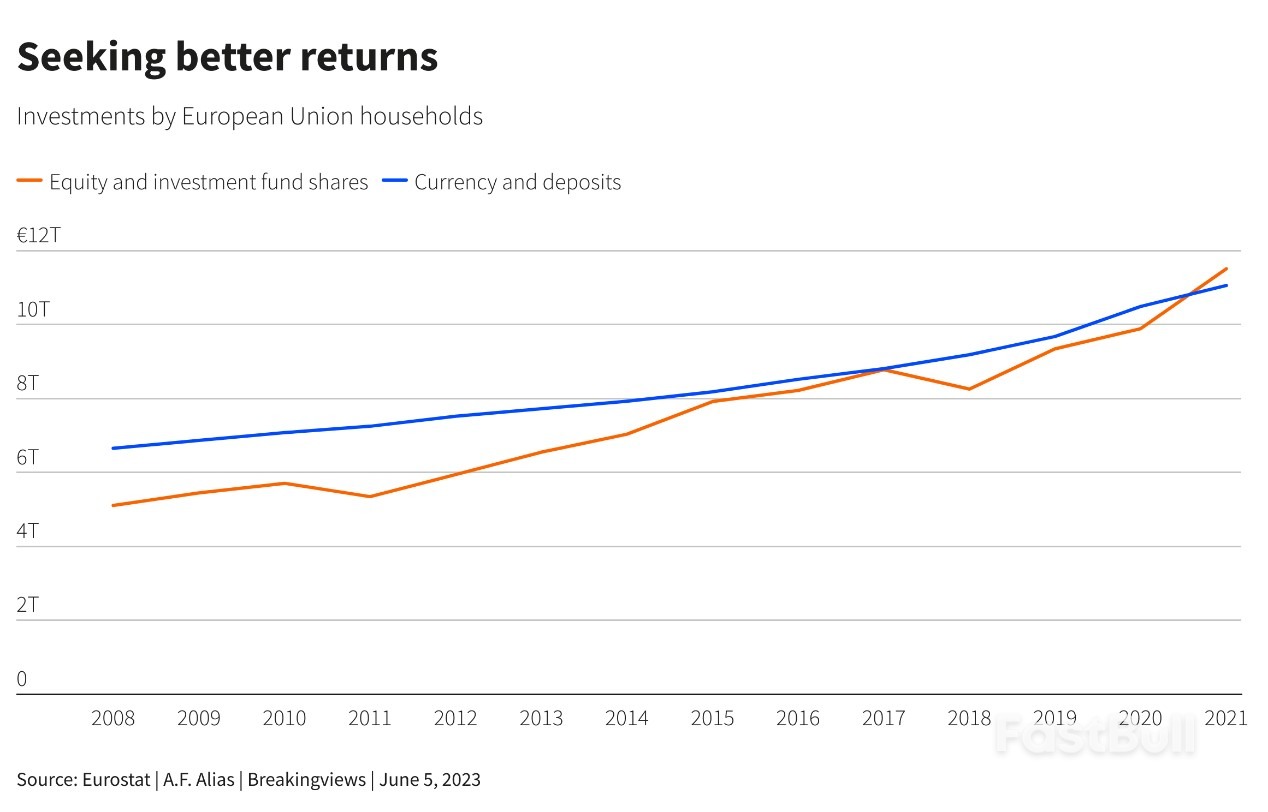
          Finally, euro zone savers have been favouring the higher returns offered by illiquid assets instead of sticking with easily accessible cash. Admittedly, overnight bank deposits, the safest and least remunerative form of savings that doesn't involve a mattress, soared by 5.5% of euro zone GDP in early 2021 – more than double the average between 2000 and 2019, according to Société Générale estimates. But as of end-2021, equity and investment fund shares had overtaken currency and deposits as the largest asset for euro zone households for the first time since 2008, according to official data. These investments account for 33% of euro zone citizens' total financial assets, compared to 30% before the pandemic.
          Stingy European Savers will Help the ECB, Not LVMH_2Such parsimony is welcome news for ECB President Christine Lagarde. She has raised the cost of money by 375 basis points since July 2022, taking the deposit rate from negative to 3.25%. Yet inflation still rose at an annual rate of 6.1% in May, more than three times the ECB's 2% target. Less spending by consumers should pave the way for lower prices, especially for services, where inflation has been accelerating since last year, rising from an annualised 3.5% in May 2022 to 5% last month.
          Shareholders and chief executives of companies selling goods and services may have to worry, however. Consumer discretionary stocks like LVMH and Germany's BMW have led European shares higher this year, rising by more than 20%, while service providers such as airlines have enjoyed bumper profits. Once post-pandemic demand is exhausted, though, these companies may struggle to extract money from stingy savers.
          Granted, luxury groups and carmakers derive a sizable portion of their revenues from Asia, and they are more likely to persuade richer households to part with their cash. And airlines can hope that businesspeople and non-European tourists keep taking to the skies. But if Europeans decide not to live the American Dream and tighten their belts instead, the economy and companies' bottom lines will feel the pinch.

          Source: Reuters

          To stay updated on all economic events of today, please check out our Economic calendar
          Risk Warnings and Disclaimers
          You understand and acknowledge that there is a high degree of risk involved in trading. Following any strategies or investment methods may lead to potential losses. The content on the site is provided by our contributors and analysts for information purposes only. You are solely responsible for determining whether any trading assets, securities, strategy, or any other product is suitable for investing based on your own investment objectives and financial situation.
          Comments
          Add to Favorites
          Share

          SEC Files Lawsuit Against Coinbase Alleging Violation of Securities Rules

          Warren Takunda

          Cryptocurrency

          Traders' Opinions

          In a significant development impacting the cryptocurrency market, the U.S. Securities and Exchange Commission (SEC) has filed a lawsuit against Coinbase Global Inc., one of the world's leading crypto platforms. The SEC alleges that Coinbase allowed users to trade a multitude of crypto tokens that qualify as unregistered securities, a violation of the regulatory body's rules. This legal action follows closely on the heels of the SEC's lawsuit against Binance, the largest cryptocurrency exchange globally, and its founder, Changpeng Zhao.
          The SEC's complaint, filed in federal court in New York on Tuesday, June 6th, 2023, accuses Coinbase of evading disclosure requirements designed to safeguard investors. According to sources familiar with the matter, the lawsuit claims that Coinbase has been operating outside the regulatory framework by facilitating the trading of tokens that should have been registered as securities. The SEC alleges that this practice continued for several years, potentially exposing investors to undue risk.
          Coinbase, however, vehemently denies the allegations and maintains its commitment to compliance with regulatory standards. The company asserts that it neither lists securities nor offers products that qualify as such. Coinbase has consistently aimed to provide a secure and reliable platform for users to trade cryptocurrencies, abiding by legal and regulatory obligations.
          This legal clash between Coinbase and the SEC reflects the increasing scrutiny that regulatory bodies are placing on the rapidly evolving cryptocurrency industry. As digital assets gain mainstream acceptance, regulators are seeking to establish clear guidelines and ensure investor protection. The SEC's lawsuit against both Coinbase and Binance, the two prominent players in the crypto market, highlights their determination to enforce compliance in the "Wild West" of investing.
          The implications of this lawsuit extend beyond Coinbase itself. The outcome could set precedents that shape the future regulatory landscape for the cryptocurrency industry as a whole. Market participants and investors will closely monitor the proceedings, as they will likely influence the legal framework surrounding digital assets.
          Coinbase's stock performance is also under scrutiny in light of these developments. Market analysts are divided over the impact of the SEC lawsuit on the company's valuation. Some view the dip in Coinbase's stock as a potential buying opportunity, while others caution against investing until there is more clarity regarding the lawsuit's outcome. Investors are advised to exercise caution and conduct thorough due diligence before making any investment decisions.
          As this legal battle unfolds, it will undoubtedly impact the perception and confidence in the cryptocurrency market. Stakeholders across the industry, including exchanges, investors, and regulators, will closely watch the proceedings, as they hold implications for the future direction of crypto regulations.
          Risk Warnings and Disclaimers
          You understand and acknowledge that there is a high degree of risk involved in trading. Following any strategies or investment methods may lead to potential losses. The content on the site is provided by our contributors and analysts for information purposes only. You are solely responsible for determining whether any trading assets, securities, strategy, or any other product is suitable for investing based on your own investment objectives and financial situation.
          Comments
          Add to Favorites
          Share

          Could Bank of Canada Follow the RBA and Hike Rates?

          Alex

          Forex

          Central Bank

          European markets managed to eke out a positive session yesterday, despite some disappointing economic numbers, and an unexpected rate hike from the RBA, which could be the first of a series of rate hikes from other central banks over the course of the next few days.
          Financials helped drive the move higher, in the same fashion as we saw in US trading which also saw a positive close, and the S&P500 close at its highest levels this year. What was especially notable about yesterday's move higher was it was led by the Russell 2000 which closed at 3-month highs despite short-term yields pushing higher on the day.
          The rise in short term yields appears to suggest that markets are not only pricing in further rate hikes, but also the likelihood that rates are likely to stay at current levels for longer.
          For the time being this doesn't appear to be affecting sentiment around equities but that could change if economic data continues to disappoint, which in some cases it has been.
          Looking towards today's European open, Asia markets have had to digest the latest trade numbers for May from China at a time when there are real concerns that the recovery there is running on fumes.
          While the relaxation in covid restrictions at the end of last year prompted a solid rebound in economic activity, the last two months have seen this pickup in economic activity run into some trouble in the aftermath of Chinese New Year.
          China trade in March saw the elements of a pickup in economic activity, with a strong surge in exports of 14.8%, while imports improved as well, although they were still negative. This rebound in economic activity is slowing already if recent inflation and consumption data is any guide.
          Factory gate prices have been deflating for the last 6 months and look set to get worse later this week.
          There was no improvement in the April import numbers as they got worse with a sharp decline of -7.9%, although some of that may be down to lower prices in some areas, rather than lower volumes. Export growth slowed in April to 8.5%, while recent manufacturing and services PMI numbers have also pointed to an economy that is seeing evidence of a slowdown in economic activity.
          With concerns about a slowdown in the Chinese economy growing, today's trade numbers have served to reinforce those concerns, with imports coming in at -4.5% and exports plunging by -7.5%, a one year low.
          While the imports numbers were better than expected the plunge in exports into negative territory for the first time in 3 months is a real concern suggesting that while domestic demand is starting to turn higher, global demand is starting to falter, and that the Chinese government may need to do more to boost the local economy.
          Having seen the RBA surprise the markets with another 25bps rate hike yesterday, today it' s the turn of the Bank of Canada, who in April signalled that they would keep rates on hold at 4.5% as policymakers looked to assess the impact recent rate hikes have had on the Canadian economy.
          Since then, the Canadian economy has shown that it is holding up well, while inflation appears to be edging up again. April CPI saw headline CPI nudge up to 4.4% year on year, while core prices also came in firmer. With the labour market remaining solid, after positive jobs reports in March and April, and a slide in the unemployment rate to 5%, and wages at 5.2% the prospect of another rate hike remains high. The consensus is for no change however we could see the Bank of Canada follow the RBA with a 25bps hike of their own, pushing the headline rate to 4.75%.
          EUR/USD – currently trading between resistance at the 1.0780 highs of last week, and support back at the recent lows at 1.0635. We need to see a break of this range with broader resistance at the 1.0820/30 level.
          GBP/USD – currently trading between resistance at the 1.2540 area and last week's highs and support at the 1.2300 level. Still in the uptrend from the March lows, while we have trend line resistance from the 2021 highs at 1.2630. This, along with the May highs at 1.2680 is a key barrier for a move towards the 1.3000 area.
          EUR/GBP – support remains at the 0.8560 level and last week's lows, just above the December 2022 lows at 0.8558. Currently have resistance at the 0.8660 area. We also have major resistance at the 0.8720 area.
          USD/JPY – yesterday's rebound is currently struggling to make it above the 140.00 area. Is the US dollar trying to carve out a top? The main resistance remains at 140.95 area. We have support at the 138.40 area which if broken could see a move back to the 137.00.

          Source: CMC

          Risk Warnings and Disclaimers
          You understand and acknowledge that there is a high degree of risk involved in trading. Following any strategies or investment methods may lead to potential losses. The content on the site is provided by our contributors and analysts for information purposes only. You are solely responsible for determining whether any trading assets, securities, strategy, or any other product is suitable for investing based on your own investment objectives and financial situation.
          Comments
          Add to Favorites
          Share
          FastBull
          Copyright © 2025 FastBull Ltd

          728 RM B 7/F GEE LOK IND BLDG NO 34 HUNG TO RD KWUN TONG KLN HONG KONG

          TelegramInstagramTwitterfacebooklinkedin
          App Store Google Play Google Play
          Products
          Charts

          Chats

          Q&A with Experts
          Screeners
          Economic Calendar
          Data
          Tools
          Membership
          Features
          Function
          Markets
          Copy Trading
          Latest Signals
          Contests
          News
          Analysis
          24/7
          Columns
          Education
          Company
          Careers
          About Us
          Contact Us
          Advertising
          Help Center
          Feedback
          User Agreement
          Privacy Policy
          Business

          White Label

          Data API

          Web Plug-ins

          Poster Maker

          Affiliate Program

          Risk Disclosure

          The risk of loss in trading financial instruments such as stocks, FX, commodities, futures, bonds, ETFs and crypto can be substantial. You may sustain a total loss of the funds that you deposit with your broker. Therefore, you should carefully consider whether such trading is suitable for you in light of your circumstances and financial resources.

          No decision to invest should be made without thoroughly conducting due diligence by yourself or consulting with your financial advisors. Our web content might not suit you since we don't know your financial conditions and investment needs. Our financial information might have latency or contain inaccuracy, so you should be fully responsible for any of your trading and investment decisions. The company will not be responsible for your capital loss.

          Without getting permission from the website, you are not allowed to copy the website's graphics, texts, or trademarks. Intellectual property rights in the content or data incorporated into this website belong to its providers and exchange merchants.

          Not Logged In

          Log in to access more features

          FastBull Membership

          Not yet

          Purchase

          Become a signal provider
          Help Center
          Customer Service
          Dark Mode
          Price Up/Down Colors

          Log In

          Sign Up

          Position
          Layout
          Fullscreen
          Default to Chart
          The chart page opens by default when you visit fastbull.com