• Trade
  • Markets
  • Copy
  • Contests
  • News
  • 24/7
  • Calendar
  • Q&A
  • Chats
Trending
Screeners
SYMBOL
LAST
BID
ASK
HIGH
LOW
NET CHG.
%CHG.
SPREAD
SPX
S&P 500 Index
6857.13
6857.13
6857.13
6865.94
6827.13
+7.41
+ 0.11%
--
DJI
Dow Jones Industrial Average
47850.93
47850.93
47850.93
48049.72
47692.96
-31.96
-0.07%
--
IXIC
NASDAQ Composite Index
23505.13
23505.13
23505.13
23528.53
23372.33
+51.04
+ 0.22%
--
USDX
US Dollar Index
98.760
98.840
98.760
98.980
98.750
-0.220
-0.22%
--
EURUSD
Euro / US Dollar
1.16686
1.16694
1.16686
1.16692
1.16408
+0.00241
+ 0.21%
--
GBPUSD
Pound Sterling / US Dollar
1.33607
1.33616
1.33607
1.33612
1.33165
+0.00336
+ 0.25%
--
XAUUSD
Gold / US Dollar
4227.03
4227.44
4227.03
4230.62
4194.54
+19.86
+ 0.47%
--
WTI
Light Sweet Crude Oil
59.398
59.435
59.398
59.469
59.187
+0.015
+ 0.03%
--

Community Accounts

Signal Accounts
--
Profit Accounts
--
Loss Accounts
--
View More

Become a signal provider

Sell trading signals to earn additional income

View More

Guide to Copy Trading

Get started with ease and confidence

View More

Signal Accounts for Members

All Signal Accounts

Best Return
  • Best Return
  • Best P/L
  • Best MDD
Past 1W
  • Past 1W
  • Past 1M
  • Past 1Y

All Contests

  • All
  • Trump Updates
  • Recommend
  • Stocks
  • Cryptocurrencies
  • Central Banks
  • Featured News
Top News Only
Share

Shanghai Rubber Warehouse Stocks Up 7336 Tons

Share

Shanghai Tin Warehouse Stocks Up 506 Tons

Share

Reserve Bank Of India Chief Malhotra: Goal Is To Have Inflation Be Around 4%

Share

Ukmto Says Master Has Confirmed That The Small Crafts Have Left The Scene, Vessel Is Proceeding To Its Next Port Of Call

Share

Shanghai Nickel Warehouse Stocks Up 1726 Tons

Share

Shanghai Lead Warehouse Stocks Down 3064 Tons

Share

Shanghai Zinc Warehouse Stocks Down 4000 Tons

Share

Shanghai Aluminium Warehouse Stocks Up 8353 Tons

Share

Shanghai Copper Warehouse Stocks Down 9025 Tons

Share

Equinor: Preliminary Estimates Indicate Reservoirs May Contain Between 5 -18 Million Standard Cubic Meters Of Recoverable Oil Equivalents

Share

Japan Chief Cabinet Secretary Kihara: Government To Take Appropriate Steps On Excessive And Disorderly Moves In Foreign Exchange Market, If Necessary

Share

[Report: Amazon Pays €180 Million To Italy To End Tax And Labor Investigations] Amazon Has Paid A Settlement And Dismantled Its Monitoring System For Delivery Drivers In Italy, Ending An Investigation Into Alleged Tax Fraud And Illegal Labor Practices. In July 2024, The Group's Logistics Services Division Was Accused Of Circumventing Labor And Tax Laws By Relying On Cooperatives Or Limited Liability Companies To Supply Workers, Evading VAT, And Reducing Social Security Payments. Sources Say The Group Has Now Paid Approximately €180 Million To Italian Tax Authorities As Part Of A €1 Billion Settlement Involving 33 Companies

Share

Airbus - Booked 797 Gross Aircraft Orders In January-November

Share

[Market Update] Spot Gold Broke Through $4,230 Per Ounce, Up 0.51% On The Day

Share

Reserve Bank Of India Chief Malhotra: There Will Be Ample Liquidity As Long As We Are In An Easing Cycle

Share

Reserve Bank Of India Chief Malhotra: Quantum Of System Liquidity Will Be Managed To Ensure Monetary Transmission Is Happening

Share

China's Foreign Ministry: World Bank, IMF, WTO Top Officials To Join

Share

China's Foreign Ministry: China To Hold 1+1 Dialogue With International Economic Orgs On Dec 9

Share

Reserve Bank Of India Chief Malhotra: 5% Of Inr Depreciation Leads To 35 Bps Of Inflation

Share

Eurostoxx 50 Futures Up 0.14%, DAX Futures Up 0.12%, CAC 40 Futures Up 0.26%, FTSE Futures Up 0.03%

TIME
ACT
FCST
PREV
Euro Zone IHS Markit Construction PMI (Nov)

A:--

F: --

P: --

Italy IHS Markit Construction PMI (Nov)

A:--

F: --

P: --

U.K. Markit/CIPS Construction PMI (Nov)

A:--

F: --

P: --

France 10-Year OAT Auction Avg. Yield

A:--

F: --

P: --

Euro Zone Retail Sales MoM (Oct)

A:--

F: --

P: --

Euro Zone Retail Sales YoY (Oct)

A:--

F: --

P: --

Brazil GDP YoY (Q3)

A:--

F: --

P: --

U.S. Challenger Job Cuts (Nov)

A:--

F: --

P: --

U.S. Challenger Job Cuts MoM (Nov)

A:--

F: --

P: --

U.S. Challenger Job Cuts YoY (Nov)

A:--

F: --

P: --

U.S. Initial Jobless Claims 4-Week Avg. (SA)

A:--

F: --

P: --

U.S. Weekly Initial Jobless Claims (SA)

A:--

F: --

P: --

U.S. Weekly Continued Jobless Claims (SA)

A:--

F: --

P: --

Canada Ivey PMI (SA) (Nov)

A:--

F: --

P: --

Canada Ivey PMI (Not SA) (Nov)

A:--

F: --

P: --

U.S. Non-Defense Capital Durable Goods Orders Revised MoM (Excl. Aircraft) (SA) (Sept)

A:--

F: --

P: --
U.S. Factory Orders MoM (Excl. Transport) (Sept)

A:--

F: --

P: --

U.S. Factory Orders MoM (Sept)

A:--

F: --

P: --

U.S. Factory Orders MoM (Excl. Defense) (Sept)

A:--

F: --

P: --

U.S. EIA Weekly Natural Gas Stocks Change

A:--

F: --

P: --

Saudi Arabia Crude Oil Production

A:--

F: --

P: --

U.S. Weekly Treasuries Held by Foreign Central Banks

A:--

F: --

P: --

Japan Foreign Exchange Reserves (Nov)

A:--

F: --

P: --

India Repo Rate

A:--

F: --

P: --

India Benchmark Interest Rate

A:--

F: --

P: --

India Reverse Repo Rate

A:--

F: --

P: --

India Cash Reserve Ratio

A:--

F: --

P: --

Japan Leading Indicators Prelim (Oct)

A:--

F: --

P: --

U.K. Halifax House Price Index YoY (SA) (Nov)

A:--

F: --

P: --

U.K. Halifax House Price Index MoM (SA) (Nov)

A:--

F: --

P: --

France Current Account (Not SA) (Oct)

--

F: --

P: --

France Trade Balance (SA) (Oct)

--

F: --

P: --

France Industrial Output MoM (SA) (Oct)

--

F: --

P: --

Italy Retail Sales MoM (SA) (Oct)

--

F: --

P: --

Euro Zone Employment YoY (SA) (Q3)

--

F: --

P: --

Euro Zone GDP Final YoY (Q3)

--

F: --

P: --

Euro Zone GDP Final QoQ (Q3)

--

F: --

P: --

Euro Zone Employment Final QoQ (SA) (Q3)

--

F: --

P: --

Euro Zone Employment Final (SA) (Q3)

--

F: --

P: --
Brazil PPI MoM (Oct)

--

F: --

P: --

Mexico Consumer Confidence Index (Nov)

--

F: --

P: --

Canada Unemployment Rate (SA) (Nov)

--

F: --

P: --

Canada Labor Force Participation Rate (SA) (Nov)

--

F: --

P: --

Canada Employment (SA) (Nov)

--

F: --

P: --

Canada Part-Time Employment (SA) (Nov)

--

F: --

P: --

Canada Full-time Employment (SA) (Nov)

--

F: --

P: --

U.S. Personal Income MoM (Sept)

--

F: --

P: --

U.S. Dallas Fed PCE Price Index YoY (Sept)

--

F: --

P: --

U.S. PCE Price Index YoY (SA) (Sept)

--

F: --

P: --

U.S. PCE Price Index MoM (Sept)

--

F: --

P: --

U.S. Personal Outlays MoM (SA) (Sept)

--

F: --

P: --

U.S. Core PCE Price Index MoM (Sept)

--

F: --

P: --

U.S. UMich 5-Year-Ahead Inflation Expectations Prelim YoY (Dec)

--

F: --

P: --

U.S. Core PCE Price Index YoY (Sept)

--

F: --

P: --

U.S. Real Personal Consumption Expenditures MoM (Sept)

--

F: --

P: --

U.S. 5-10 Year-Ahead Inflation Expectations (Dec)

--

F: --

P: --

U.S. UMich Current Economic Conditions Index Prelim (Dec)

--

F: --

P: --

U.S. UMich Consumer Sentiment Index Prelim (Dec)

--

F: --

P: --

U.S. UMich 1-Year-Ahead Inflation Expectations Prelim (Dec)

--

F: --

P: --

U.S. UMich Consumer Expectations Index Prelim (Dec)

--

F: --

P: --

Q&A with Experts
    • All
    • Chatrooms
    • Groups
    • Friends
    Connecting
    .
    .
    .
    Type here...
    Add Symbol or Code

      No matching data

      All
      Trump Updates
      Recommend
      Stocks
      Cryptocurrencies
      Central Banks
      Featured News
      • All
      • Russia-Ukraine Conflict
      • Middle East Flashpoint
      • All
      • Russia-Ukraine Conflict
      • Middle East Flashpoint

      Search
      Products

      Charts Free Forever

      Chats Q&A with Experts
      Screeners Economic Calendar Data Tools
      Membership Features
      Data Warehouse Market Trends Institutional Data Policy Rates Macro

      Market Trends

      Market Sentiment Order Book Forex Correlations

      Top Indicators

      Charts Free Forever
      Markets

      News

      News Analysis 24/7 Columns Education
      From Institutions From Analysts
      Topics Columnists

      Latest Views

      Latest Views

      Trending Topics

      Top Columnists

      Latest Update

      Signals

      Copy Rankings Latest Signals Become a signal provider AI Rating
      Contests
      Brokers

      Overview Brokers Assessment Rankings Regulators News Claims
      Broker listing Forex Brokers Comparison Tool Live Spread Comparison Scam
      Q&A Complaint Scam Alert Videos Tips to Detect Scam
      More

      Business
      Events
      Careers About Us Advertising Help Center

      White Label

      Data API

      Web Plug-ins

      Affiliate Program

      Awards Institution Evaluation IB Seminar Salon Event Exhibition
      Vietnam Thailand Singapore Dubai
      Fans Party Investment Sharing Session
      FastBull Summit BrokersView Expo
      Recent Searches
        Top Searches
          Markets
          News
          Analysis
          User
          24/7
          Economic Calendar
          Education
          Data
          • Names
          • Latest
          • Prev

          View All

          No data

          Scan to Download

          Faster Charts, Chat Faster!

          Download App
          English
          • English
          • Español
          • العربية
          • Bahasa Indonesia
          • Bahasa Melayu
          • Tiếng Việt
          • ภาษาไทย
          • Français
          • Italiano
          • Türkçe
          • Русский язык
          • 简中
          • 繁中
          Open Account
          Search
          Products
          Charts Free Forever
          Markets
          News
          Signals

          Copy Rankings Latest Signals Become a signal provider AI Rating
          Contests
          Brokers

          Overview Brokers Assessment Rankings Regulators News Claims
          Broker listing Forex Brokers Comparison Tool Live Spread Comparison Scam
          Q&A Complaint Scam Alert Videos Tips to Detect Scam
          More

          Business
          Events
          Careers About Us Advertising Help Center

          White Label

          Data API

          Web Plug-ins

          Affiliate Program

          Awards Institution Evaluation IB Seminar Salon Event Exhibition
          Vietnam Thailand Singapore Dubai
          Fans Party Investment Sharing Session
          FastBull Summit BrokersView Expo

          Week Ahead – US CPI and RBNZ Decision on Tap Amidst Tariff Mayhem

          XM

          Economic

          Summary:

          Dollar traders await US CPI data amid global trade turbulence.RBNZ to cut by 25bps, could maintain dovish stance.China’s CPI and PPI to reveal tariff impact on inflation.Strong UK GDP data could help the pound climb higher.

          Trump’s “Liberation Day” increases recession fears

          The dollar suffered against all its major peers this week, while equites extended their bloodbath after US President Donald Trump announced more aggressive-than-anticipated tariffs on US trading partners.
          Trump stated that his administration will proceed with a 10% baseline tariff on all imports to the US, while higher duties will be imposed on some of the nation’s biggest trading partners. For example, China was hit with a new 34% levy on top of the already imposed 20%, while closer allies like Japan and the UK were not exempted, with the former facing a 24% tariff rate and the latter the baseline 10%. The European Union will be subject to a 20% rate. The base 10% tariffs will go into effect on April 5 and the higher reciprocal rates on April 9, and both China and the EU were quick to respond that if those tariffs take effect, they will retaliate.
          With the Atlanta Fed GDPNow model already pointing to a severe 3.7% contraction of the US economy, investors have become even more fearful about a potential recession this year, which is also evident by the fact that they have ramped up their Fed rate cut bets, despite the central bank sticking to its prior projection of 50bps worth of reductions for this year. Currently, investors are pricing in nearly 100bps worth of cuts by December, which translates into four quarter-point cuts.
          Week Ahead – US CPI and RBNZ Decision on Tap Amidst Tariff Mayhem_1

          Will sticky inflation complicate the Fed’s job

          With all that in mind, dollar traders will fix their attention on the US CPI data for March, due out on Thursday. Tariffs are not only posing a threat to economic activity but also presenting an upside risk to inflation. Inflation in the US has been proving more persistent than expected, even before tariffs on steel and aluminium were incorporated into the calculation, with the core PCE index for February rising to 2.8% y/y.
          This further complicates the Fed’s work as it may find itself between a rock and a hard place – trying to safeguard economic activity on the one hand and prevent inflation from spiralling out of control on the other. With the prices subindex of the ISM manufacturing PMI for March climbing to 69.4 from 62.4, the risks of the CPIs appear skewed to the upside.
          Week Ahead – US CPI and RBNZ Decision on Tap Amidst Tariff Mayhem_2
          Further acceleration may prompt traders to scale back some of their rate cut bets, and the dollar may stage a modest rebound alongside US Treasury yields. However, higher borrowing costs for longer could risk an even deeper recession down the line. Thus, with recession fears still elevated, any recovery in the US dollar could prove both limited and short-lived.
          The minutes from the March 18-19 FOMC decision will be published on Wednesday, the PPI numbers for March on Thursday, and the preliminary University of Michigan (UoM) consumer sentiment index for April on Friday. Given that the latest Fed meeting took place before the April 2 tariff announcements – and bearing in mind that new economic projections, including a new dot plot, were released – the minutes may not draw significant market attention. Investors may instead focus more on additional signs of where inflation may be headed. Thus, beyond the CPI numbers, the PPI data and the UoM inflation expectations could also act as key market movers.

          RBNZ set to cut rates, focus to fall on guidance

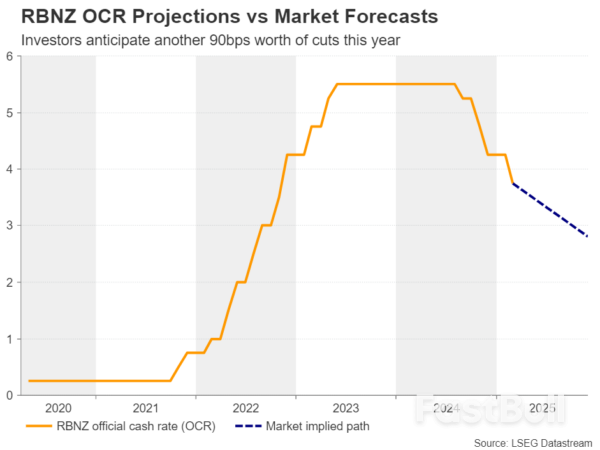
          There is also a central bank deciding on monetary policy next week and that’s the Reserve Bank of New Zealand (RBNZ). At its latest gathering on February 19, this central bank lowered its benchmark interest rate by 50bps, signalling the likelihood of more reductions in the coming months and projecting that rates will be around 3% by year-end – 75bps below the current level of 3.75%. Officials also cited global uncertainties and domestic economic risks relating to US President Trump’s trade policies.
          Since then, the only noteworthy economic data released from New Zealand have been the retail sales and GDP prints for Q4, both of which exceeded expectations. Yet, investors believe that the Bank should implement an additional 90bps in rate cuts before the end of the year.
          Week Ahead – US CPI and RBNZ Decision on Tap Amidst Tariff Mayhem_3
          With China, New Zealand’s main trading partner, being Trump’s primary focus when it comes to tariffs, it is difficult to envision a scenario where the RBNZ adopts a less dovish tone than it did previously. Market participants are nearly certain about a 25bps cut at this gathering, with the probability of a back-to-back quarter-point reduction in May standing at 75%.
          Taking all this into account and considering the heightened risk that the trade war between the US and China could further escalate if China retaliates, the RBNZ may once again accompany its rate decision with a clear signal of its readiness to continue easing. This would likely encourage kiwi sellers to extend their positions.

          China inflation and UK GDP also on the agenda

          Speaking of China, during the Asian morning on Thursday, the world’s second-largest economy will release its CPI and PPI numbers for March and traders may be eagerly waiting to see the impact of the tariffs announced back on March 4 on consumer prices.
          From the UK, the monthly GDP for February is due to be released on Friday, alongside the industrial and manufacturing production figures for the same month. UK data has been coming in slightly better than expected, with GDP for Q4 revealing moderate expansion despite forecasts of contraction. However, the monthly reading for January showed negative growth. The composite PMI improved in March, and retail sales for February significantly exceeded expectations.
          Week Ahead – US CPI and RBNZ Decision on Tap Amidst Tariff Mayhem_4
          Combined with the fact that UK inflation remains elevated despite slowing somewhat in February, the overall economic outlook supports the Bank of England’s stance that there is no urgency to cut rates aggressively, especially after the UK was subject only to the US baseline 10% tariff. However, market participants are still assigning a high 85% probability to a 25bps reduction at the next decision on May 8. Therefore, a strong set of data may be required to reduce that probability and allow the pound to gain further ground.

          Source:XM

          To stay updated on all economic events of today, please check out our Economic calendar
          Risk Warnings and Disclaimers
          You understand and acknowledge that there is a high degree of risk involved in trading. Following any strategies or investment methods may lead to potential losses. The content on the site is provided by our contributors and analysts for information purposes only. You are solely responsible for determining whether any trading assets, securities, strategy, or any other product is suitable for investing based on your own investment objectives and financial situation.
          Add to Favorites
          Share

          Trump has thrown away US soft power

          Thomas

          Economic

          President Donald Trump’s ‘Liberation Day’, one of the most egregiously disastrous policy pronouncements in American history, is causing immeasurable self-harm to the US economy and perhaps putting the nail in the coffin of Pax Americana.
          The US economic hit will be enormous. Trump’s tariff hikes exceeded the high end of lofty expectations. Coupled with Trump’s earlier actions, the effective US tariff puts the 1930 Smoot-Hawley Tariff Act to shame.
          Some analysts estimate consumer prices will rise by over two percentage points, household income and consumption will be badly thumped, especially for the lowest-income quintile, and gross domestic product may be cut by nearly 1pp in 2025. Estimates of budgetary impact vary. But the administration’s claims that revenue will rise by $6tn by 2035 are gibberish; conventional estimates including dynamic effects are under $3tn, hardly offsetting Trump’s irresponsible tax cut plans. Trump’s hopes for a revolution in US manufacturing – less than 10% of the economy – are likely to be a pipe dream.
          The Federal Reserve’s task just got trickier. Inflation and recession risks are rising. Will the Fed fret about inflation given its pandemic experience, maintain a balanced approach to its dual mandate or shift to combatting possible labour market weakness?

          Global fallout

          Alas, the harm from Trump’s wrongheaded trade war is not confined to the US. It is global. Retaliation will only magnify the impacts.
          China’s economy, already in the doldrums, will be slammed by effective tariffs that are now in line with, if not exceeding, Trump’s campaign promises of 60%. Estimated Chinese growth losses vary, clustering in the 1% to 2% of GDP range.
          Trump had already announced 20% tariffs on Chinese goods before layering on top the 34% reciprocal tariffs, in addition to tariffs still in place from the first administration. China had taken a restrained approach to these announcements, but the gloves have now come off with China reportedly adding a 34% tariff to match Trump’s “reciprocal” tariff.
          At home, the leadership will face pressures to pursue more stimulative fiscal and monetary policies. The authorities have sought to steady the renminbi amid a massive current account surplus but sharp capital outflow pressures. They could let the renminbi fall to offset some of the tariff hikes. But given the renminbi’s highly competitive valuation and fears of a repeat of the 2015-16 massive financial outflows, authorities may hold the line.
          The rest of Asia is also a big loser. Only a few years ago, US officials were delighted to see firms leaving China. Companies that relocated to Vietnam for supply chain resilience just got clobbered with massive 46% reciprocal tariffs. Thailand, Malaysia and Cambodia fared little better. These countries should have room to cut rates and allow exchange rate depreciation.
          European growth estimates vary, but activity may take a hit of around +/-0.5pp to 1pp of GDP. Automotive tariffs could especially hurt German growth prospects and it is unclear when Germany’s planned fiscal changes will boost the economy. The euro area inflation impact may not be great, especially if the euro remains relatively flat or even rises. The fallout of lower oil prices may prove disinflationary. That may increase scope for and pressure on the European Central Bank to cut further than currently foreseen.
          Canada and Mexico now most likely face recession.

          What does this mean for America and the dollar?

          Global financial markets are in turmoil, mired in equity losses. There is blood on the street.
          Many analysts asserted that large tariffs would be dollar positive – foreign exports would cost more and be less competitive. But the dollar has instead plummeted.
          A range of factors could be at play. US rates and equities had already been tumbling on heightened growth and recession fears and declines accelerated on steroids following Trump’s announcements. Expectations for Fed cuts are rising. The dollar frequently appreciates in a sharp risk-off environment, but perhaps it is losing its lustre as the US is the source of disquiet. Is this a telltale sign?
          While analysts focus on near-term economic fallout, far bigger ramifications relate to America’s role in the international order. Enormous worldwide economic gains were sparked by America’s post-second world war security umbrella, its backing for trade liberalisation and its prosperous economy.
          The US had turned more inward over past decades, especially as economic challenges mounted at home. But it still retained a largely outward focus.
          That Europe is stepping up to defend itself and rely less on the US is a positive development, though far too much crockery had to be broken for Europe to act. President Xi Jinping is looking good by default. Those who now argue Trump’s actions are aimed at a geopolitical reordering may simply be engaged in post-hoc rationalisation of chaos and long-time Trumpian tariff love.
          With Trump backing Russia over Ukraine, questioning Nato’s usefulness, insulting Canada and Mexico, suggesting the European Union exists to ‘screw’ America, asserting our friends have ‘raped’ and ‘pillaged’ the US, and threatening Greenland and Panama, to say nothing of attacking democratic norms and institutions at home, Trump has tossed aside America’s soft power.
          The world has lost trust in the US and can no longer regard it as a reliable partner. Pax Americana and the gift and legacy of the so-called ‘Greatest Generation’ to America and the world is being thrown away. Trump’s tariff announcement is likely to be a nail in the coffin. What comes next?

          Source:Mark Sobel

          To stay updated on all economic events of today, please check out our Economic calendar
          Risk Warnings and Disclaimers
          You understand and acknowledge that there is a high degree of risk involved in trading. Following any strategies or investment methods may lead to potential losses. The content on the site is provided by our contributors and analysts for information purposes only. You are solely responsible for determining whether any trading assets, securities, strategy, or any other product is suitable for investing based on your own investment objectives and financial situation.
          Add to Favorites
          Share

          What US tariffs mean for the UK economy, rate cuts, taxes and trade

          ING

          Economic

          Financial markets have ramped up rate cut expectations

          UK Prime Minister Keir Starmer has put a brave face on the US tariffs announcement this week. Financial markets, by contrast, seem much less sanguine.
          Britain may have seen a more modest 10% tariff imposed compared to the EU’s 20%. But markets have staged a more dramatic repricing of Bank of England rate cuts than we’ve seen for the ECB. An extra 40-basis points worth of easing is priced over the next year, compared to ten days ago.
          To steal a quote from Chris Turner's FX daily, Wednesday's tariff announcement has been a great leveller for global central bank expectations. Economies like the UK, where less aggressive policy easing had been expected over recent months, have seen more dramatic changes in rate expectations since Wednesday’s announcement.

          What tariffs mean for UK growth

          Perhaps that market reaction overstates the economic impact here in Britain, even though we think markets have been underestimating BoE rate cuts for some time. The UK is less exposed to President Trump’s trade war, at least directly. US exports account for 2.2% of UK GDP, where it is closer to 3% in the EU on average and nearer 4% in Germany.
          Of course, it is a big deal for specific sectors: 10% of what Britain exports to the US is cars, while pharmaceuticals are also vulnerable to forthcoming tariffs.
          Still, the overall hit from tariffs on Britain's GDP is perhaps only 0.2% or so. Certainly not enough to decisively change the outlook for UK growth. And remember there are some decent tailwinds for growth this year, notably from government spending.
          Public expenditure is rising significantly this year, both for day-to-day and infrastructure. And for all the talk of cuts at the Spring Statement, spending is actually set to rise even faster across the next fiscal year than was planned back in October.
          However, tariffs would be more problematic if the US and eurozone enter recession. That’s not our base case in either economy, though a slowdown would still be felt much more widely across the UK economy and potentially be a much greater source of downside.
          The Office for Budget Responsibility (OBR) recently estimated that a 20ppt increase in the average US tariff charged globally – akin to what we’ve seen – could shave up to a percentage point off UK GDP, mostly from the secondary hit of weaker international demand.
          We’ll be updating our forecasts next week, but we’re more likely to shave the numbers for late 2025 and into 2026. Before then, the much more immediate unknown is this weekend’s hike in Employer’s National Insurance (social security). It amounts to a 27% increase in the amount of tax paid by companies on an average employee’s salary. Survey after survey have shown it has lowered hiring intentions. So far though, redundancy notifications submitted to the government haven’t risen.

          What tariffs mean for UK inflation

          As for inflation, the fact that the government hasn’t retaliated to the US tariff announcement thus far means the impact should be minimal. And if anything, it could prove deflationary further down the line as economic growth cools and the threat of dumping from other big global producers rises.
          The Bank of England has been wary about the forthcoming energy-driven rise in headline inflation from the 3% to 4% area and the ripple effects that might feed into service-sector prices. Services inflation is stuck around 5%, though we’re more confident than the Bank that this should come closer to 4% in the second quarter, assuming April’s annual price hikes prove more modest than a year earlier.
          That’s principally why we expect the Bank to continue cutting rates once per quarter for the rest of this year. We don’t think the tariffs necessarily change that. But we have long felt that the Bank will take rates down to 3.25% in 2026. Markets are increasingly reaching this conclusion too.

          What tariffs mean for the public finances

          Tariffs undoubtedly make further tax hikes in the Autumn look even more inevitable than they already did. Remember Chancellor Rachel Reeves has only minimal headroom left over under her main fiscal rule, which requires a current budget balance by the end of the decade. And having changed the rules significantly last October, scope to do so again so quickly is limited.
          Ultimtely, the public finances are operating on fine margins and it would only take small negative changes in the economic outlook to erase that £9.9bn fiscal headroom, just as we saw in March. Even before the tariffs arrived, we felt it was likely the OBR would have to revise down its medium-term growth forecasts, having only just bolstered them on the back of recent planning reforms. That downgrade now looks like a foregone conclusion.
          We've argued before that we think the scope to cut public spending plans further is very limited, and if anything these may need to increase again later this year. That's why we expect further tax hikes to come through.

          What tariffs mean for US and EU trade talks

          All of this matters immensely when it comes to the UK’s negotiations with the US. The government hopes concessions, which might include watering down the Digital Services Tax (which raises £800mn annually) and changes to digital safety laws, will be enough to roll back the tariffs.
          But the things that have held back a US-UK trade deal in the past - agricultural access for chicken and beef - look, if anything, more challenging to resolve than in the past.
          That's because the UK is seeking a veterinary deal with the European Union, which would see the UK formally align with EU food/plant standards in exchange for removing border checks on these products. And that alignment could go further.
          Labour is formally against joining a customs union or the wider single market for goods, but we wouldn’t be surprised to see movement in this direction. For all the Brexit drama, Britain hasn’t actually materially diverged in many – if any – areas of product regulation.

          The UK trades much more intensively with the EU than US

          Whether the EU agrees to all that is another story, but making concessions to the US in trade talks certainly could make it harder.
          Starmer’s government faces a choice. And the reality is that it is much more likely to choose closer ties with Europe over America. Some of that is down to geopolitics and defence. But the government is also making a big priority out of driving up economic growth – and most importantly, making sure any policy announcements are recognised by the Office for Budget Responsibility’s forecasts.
          The simple fact is that closer EU ties would have a larger economic impact than aligning more closely with the US economy – and by extension, those OBR forecasts. We’ve previously written how EU realignment might be worth an extra 0.1 to 0.2ppts on annual GDP growth in each year of the OBR’s forecast. That’s not a game-changer for the amount of headroom the Chancellor would have to play with, but it would help mitigate the downward impetus from weaker global growth.

          Source:ING

          To stay updated on all economic events of today, please check out our Economic calendar
          Risk Warnings and Disclaimers
          You understand and acknowledge that there is a high degree of risk involved in trading. Following any strategies or investment methods may lead to potential losses. The content on the site is provided by our contributors and analysts for information purposes only. You are solely responsible for determining whether any trading assets, securities, strategy, or any other product is suitable for investing based on your own investment objectives and financial situation.
          Add to Favorites
          Share

          Gold Short Term Trading Contest: The challenge awaits! FastBull announces second trading contest

          FastBull Events
          Gold Short Term Trading Contest: The challenge awaits! FastBull announces 2nd Trading Contest_1
          Important notice: Registration for the contest is free !
          Dear global trading elite, are you ready to once again climb to the top and showcase your mastery of short-term gold trading? Following the success of the 2024 FastBull Trading Competition, we are excited to announce the official launch of the 2025 FastBull Gold Short-Term Trading Competition. This is FastBull's second global trading event and we look forward to witnessing the emergence of a new generation of trading champions together with you all.
          The contest is specially designed for short-term trading enthusiasts, focusing on the highly popular trading instrument Gold (XAUUSD) to provide a fair and exciting playing field. Whether you are a seasoned trading veteran or an ambitious newcomer, as long as you are over 18 years of age, FastBull cordially invites you to participate.
          Contest highlights  :
          Registration Period :  April 5, 2025 00:00 - April 17, 2025 00:00 (UTC +00)
          Contest Period : April 17, 2025 00:00 - May 1, 2025 00:00 (UTC +00)
          Total Prize Pool: A total of $3,500 in prizes will be awarded to the best traders.
          1st place: $2,000
          2nd place: $1,000
          3rd place: $500
          A level playing field:  Each participant will be provided with a dedicated account pre-loaded with USD 10,000 virtual starting capital to be used for all trading activities.
           Gold Trading Exclusive : This contest exclusively supports trading XAUUSD, allowing you to leverage your expertise in a familiar market .
          Flexible trading volumes:  Supports trade sizes from 0.01 to 1.00 lots to accommodate a variety of trading strategies.
          Position Holding Requirements:  Contestants must execute a minimum of 50 market orders with a holding period of more than 60 seconds during the Contest Period.
          Strict Anti-Manipulation Measures:  The contest will be closely monitored to ensure fairness and integrity.
          Rule  Description :
          Account:  The system will automatically generate a dedicated account initialized with a virtual balance of 10,000 USD.
          Trading Instruments:  Limited to XAUUSD trading only, trade sizes allowed are 0.01 to 1.00 lots.
          Position Holding Requirements: You must complete a minimum of 50 market orders and hold each order for at least 60 seconds.
          Maximum simultaneous orders:  You can have up to 10 orders (including pending orders) open at one time.
          No Fraud  :  Automated trading (bots) are not permitted and any form of fraud is strictly prohibited.
          Where is the contest  held?
          The Gold Short Term Trading Contest will be held exclusively on the FastBull platform. You can participate via the FastBull chart or the FastBull app. When trading, select the contest account, which is distinguished by a gold background and a trophy icon.
          How do I register ?
          The sign-up portal will officially open on April 5, 2025. Simply visit the FastBull Trading Contest page and click on the Register button to complete the easy sign-up process.
          Important Notes:
          Registration for this contest is completely free!
          Registration is limited to one per user. Multiple registrations will be invalid.
          Please review the complete contest rules carefully: https://www.fastbull.com/trading-contest/rules
          The excitement of last year's contest is still vivid, with many seasoned traders coming forward to showcase their talents. This year, we are embarking on this journey once again and hoping to witness even more promising traders in action. There are also huge prizes up for grabs, waiting for you to win!
          Why wait? Act now and participate in the 2025 FastBull Gold short-term trading contest, show off your exceptional trading skills and reap the glory and rewards that await you! Sign up now and compete for huge cash prizes!
          https://www.fastbull.com/trading-contest/
          We look forward to your participation!
          Risk Warnings and Disclaimers
          You understand and acknowledge that there is a high degree of risk involved in trading. Following any strategies or investment methods may lead to potential losses. The content on the site is provided by our contributors and analysts for information purposes only. You are solely responsible for determining whether any trading assets, securities, strategy, or any other product is suitable for investing based on your own investment objectives and financial situation.
          Add to Favorites
          Share

          Today’S Oil Prices Aren’T Survivable For Us Producers

          Saif

          Commodity

          Today’s WTI prices are not sustainable for some US producers.

          A perfect storm began to brew late Wednesday. First came President Trump’s broadside tariff blitz—blanket duties slapped on all U.S. trading partners, sparking fears of a global trade war. Yes, energy was exempt from the tariffs. Still, investors didn’t need much convincing. Stocks plunged on Thursday, recession talk started buzzing, and oil got hammered in the crossfire. Suddenly, the demand side of the oil equation is looking very shaky.

          Then came the second punch: OPEC+. The cartel announced it would be adding three times the expected amount of supply starting in May. That’s not exactly what you want to hear when traders are already running scared over demand destruction.

          Thursday ended up being a sharp one-day drop. Friday brought even more pain. Brent crude was down 7.01% at 12:10 pm in New York, while WTI sank to $61.73—well below the breakeven point for many U.S. shale producers—$65 on average, according to the Dallas Fed’s latest survey.

          So, how long does this last? If tariffs stick around and slow the global economy, we could be looking at a “lower for longer” oil environment again—something the industry hasn’t had to contend with since COVID lockdowns.

          But it’s not all gloom. Some analysts think these tariffs are more bark than bite—an opening gambit to strong-arm trade partners into concessions. If that’s the case, oil prices may rebound quickly. Until then, buckle up. Crude is suddenly in crisis mode, and the usual safety nets—OPEC+ cuts, Asian demand, U.S. shale restraint—aren’t doing the job.

          Source: OILPRICE

          Risk Warnings and Disclaimers
          You understand and acknowledge that there is a high degree of risk involved in trading. Following any strategies or investment methods may lead to potential losses. The content on the site is provided by our contributors and analysts for information purposes only. You are solely responsible for determining whether any trading assets, securities, strategy, or any other product is suitable for investing based on your own investment objectives and financial situation.
          Add to Favorites
          Share

          Trump Talks Up Tariff Deals As Markets Slide

          Thomas

          Economic

          Trump via his social media platform said today he spoke with Vietnam Communist Party leader To Lam, who promised to cut their tariffs to zero on US products. Under the plan Trump unveiled on 2 April, US imports from Vietnam will be subject to a 46pc tariff.

          Trump late Thursday told reporters that a deal on tariffs is possible "if somebody said that we're going to give you something that's so phenomenal." He mentioned a possible deal with China over the sale of social platform TikTok, which is owned by Chinese company ByteDance. "We have a situation with Tiktok where China will probably say, we'll approve a deal, but will you do something on the tariff?", Trump said.

          The Trump administration is forcing ByteDance to sell TikTok to a US company, but Beijing must approve the sale.

          "The tariffs give us great power to negotiate," Trump said.

          But China's commerce ministry today unveiled a 34pc tariff on all imports from the US from 10 April, and vowed that no exemptions will be granted, unlike in its previous round of tit-for-tat tariffs on US commodities.

          Trump on 2 April announced a 10pc baseline tax on all foreign imports starting on 5 April, while many major US trading partners would be subject to an even higher tax beginning on 9 April. Imports from the EU would be subject to a 20pc tariff beginning on 9 April and imports from China subject to a 34pc tariff in addition to the previously imposed 20pc tariffs.

          "CHINA PLAYED IT WRONG, THEY PANICKED - THE ONE THING THEY CANNOT AFFORD TO DO!", Trump said on social media after the announcement from Beijing.

          Trump's executive order exempted energy commodities and many critical minerals from new tariffs, as well as trade already covered under the US Mexico Canada free trade agreement (USMCA).

          But oil and stock markets continued to slide today as economists and investors concluded that the US tariffs and potential foreign counter-measures would lead to a protracted trade war and reduce economic growth globally.

          The latest tariffs are likely to cut global growth rates by 0.5 percentage points and reduce US GDP growth by 1pc in 2025-26, analysts with investment bank Standard Chartered said in a note to clients today.

          Federal Reserve chairman Jay Powell, speaking at a conference in Arlington, Virginia, today, warned that the latest bout of tariffs will lead to "higher inflation and slower growth." IMF executive director Kristalina Georgieva issued a similar warning on Thursday evening.

          Trump retorted via his social media platform that "This would be a PERFECT time for Fed Chairman Jerome Powell to cut Interest Rates."

          What's next?

          Despite touting possible deals to avoid high tariffs, Trump also said today that investors planning to move manufacturing to the US should expect no changes in his tariff policies.

          Trump's cabinet also struggled to articulate what comes next, with commerce secretary Howard Lutnick saying that Trump would not lift the tariffs announced this week, while treasury secretary Scott Bessent said deals over tariff levels were possible.

          Secretary of state Marco Rubio, speaking to reporters on a trip to Brussels, Belgium, said that "it's not fair to say that the economies are crashing — markets are crashing because markets are based on the stock value of companies who today are embedded in modes of production that are bad for the US.

          "The markets will adjust business around the world, including in trade," Rubio said. "They just need to know what the rules are."

          Source: Argus Media

          To stay updated on all economic events of today, please check out our Economic calendar
          Risk Warnings and Disclaimers
          You understand and acknowledge that there is a high degree of risk involved in trading. Following any strategies or investment methods may lead to potential losses. The content on the site is provided by our contributors and analysts for information purposes only. You are solely responsible for determining whether any trading assets, securities, strategy, or any other product is suitable for investing based on your own investment objectives and financial situation.
          Add to Favorites
          Share

          Tariffs And Their Impact Larger Than Expected: Powell

          Kevin Du

          Central Bank

          Federal Reserve chairman Jerome Powell said today tariff increases unveiled by US president Donald Trump will be "significantly larger" than expected, as will the expected economic fallout.

          "The same is likely to be true of the economic effects, which will include higher inflation and slower growth," Powell said today at the Society for Advancing Business Editing and Writing's annual conference in Arlington, Virginia.

          The central bank will continue to carefully monitor incoming data to assess the outlook and the balance of risks, he said.

          "We're well positioned to wait for greater clarity before considering any adjustments to our policy stance," Powell added. "It is too soon to say what will be the appropriate path for monetary policy."

          As of 1pm ET today, Fed funds futures markets are pricing in 29pc odds of a quarter point cut by the Federal Reserve at its next meeting in May and 99pc odds of at least a quarter point rate cut in June. Earlier in the day the June odds were at 100pc.

          The Fed chairman spoke after trillions of dollars in value were wiped off stock markets around the world and crude prices plummeted following Trump's rollout of across-the-board tariffs earlier in the week.

          Just before his appearance, Trump pressed Powell in a post on his social media platform to "STOP PLAYING POLITICS!" and cut interest rates without delay.

          A closely-watched government report showed the US added a greater-than-expected 228,000 jobs in March, showing hiring was picking up last month.

          Source: Argus Media

          Risk Warnings and Disclaimers
          You understand and acknowledge that there is a high degree of risk involved in trading. Following any strategies or investment methods may lead to potential losses. The content on the site is provided by our contributors and analysts for information purposes only. You are solely responsible for determining whether any trading assets, securities, strategy, or any other product is suitable for investing based on your own investment objectives and financial situation.
          Add to Favorites
          Share
          FastBull
          Copyright © 2025 FastBull Ltd

          728 RM B 7/F GEE LOK IND BLDG NO 34 HUNG TO RD KWUN TONG KLN HONG KONG

          TelegramInstagramTwitterfacebooklinkedin
          App Store Google Play Google Play
          Products
          Charts

          Chats

          Q&A with Experts
          Screeners
          Economic Calendar
          Data
          Tools
          Membership
          Features
          Function
          Markets
          Copy Trading
          Latest Signals
          Contests
          News
          Analysis
          24/7
          Columns
          Education
          Company
          Careers
          About Us
          Contact Us
          Advertising
          Help Center
          Feedback
          User Agreement
          Privacy Policy
          Business

          White Label

          Data API

          Web Plug-ins

          Poster Maker

          Affiliate Program

          Risk Disclosure

          The risk of loss in trading financial instruments such as stocks, FX, commodities, futures, bonds, ETFs and crypto can be substantial. You may sustain a total loss of the funds that you deposit with your broker. Therefore, you should carefully consider whether such trading is suitable for you in light of your circumstances and financial resources.

          No decision to invest should be made without thoroughly conducting due diligence by yourself or consulting with your financial advisors. Our web content might not suit you since we don't know your financial conditions and investment needs. Our financial information might have latency or contain inaccuracy, so you should be fully responsible for any of your trading and investment decisions. The company will not be responsible for your capital loss.

          Without getting permission from the website, you are not allowed to copy the website's graphics, texts, or trademarks. Intellectual property rights in the content or data incorporated into this website belong to its providers and exchange merchants.

          Not Logged In

          Log in to access more features

          FastBull Membership

          Not yet

          Purchase

          Become a signal provider
          Help Center
          Customer Service
          Dark Mode
          Price Up/Down Colors

          Log In

          Sign Up

          Position
          Layout
          Fullscreen
          Default to Chart
          The chart page opens by default when you visit fastbull.com