• Trade
  • Markets
  • Copy
  • Contests
  • News
  • 24/7
  • Calendar
  • Q&A
  • Chats
Trending
Screeners
SYMBOL
LAST
BID
ASK
HIGH
LOW
NET CHG.
%CHG.
SPREAD
SPX
S&P 500 Index
6857.13
6857.13
6857.13
6865.94
6827.13
+7.41
+ 0.11%
--
DJI
Dow Jones Industrial Average
47850.93
47850.93
47850.93
48049.72
47692.96
-31.96
-0.07%
--
IXIC
NASDAQ Composite Index
23505.13
23505.13
23505.13
23528.53
23372.33
+51.04
+ 0.22%
--
USDX
US Dollar Index
98.880
98.960
98.880
98.980
98.880
-0.100
-0.10%
--
EURUSD
Euro / US Dollar
1.16557
1.16564
1.16557
1.16557
1.16408
+0.00112
+ 0.10%
--
GBPUSD
Pound Sterling / US Dollar
1.33411
1.33419
1.33411
1.33411
1.33165
+0.00140
+ 0.11%
--
XAUUSD
Gold / US Dollar
4219.51
4219.96
4219.51
4219.63
4194.54
+12.34
+ 0.29%
--
WTI
Light Sweet Crude Oil
59.279
59.316
59.279
59.469
59.187
-0.104
-0.18%
--

Community Accounts

Signal Accounts
--
Profit Accounts
--
Loss Accounts
--
View More

Become a signal provider

Sell trading signals to earn additional income

View More

Guide to Copy Trading

Get started with ease and confidence

View More

Signal Accounts for Members

All Signal Accounts

Best Return
  • Best Return
  • Best P/L
  • Best MDD
Past 1W
  • Past 1W
  • Past 1M
  • Past 1Y

All Contests

  • All
  • Trump Updates
  • Recommend
  • Stocks
  • Cryptocurrencies
  • Central Banks
  • Featured News
Top News Only
Share

India's NIFTY IT Index Last Up 1.3%

Share

India's Nifty 50 Index Rises 0.35%

Share

Israel Sets 2026 Defence Budget At $34 Billion

Share

Russia Says Azov Sea's Port Of Temryuk Damaged In Ukrainian Attack

Share

Israel's Defense Budget For 2026 Will Be 112 Billion Israeli Shekels - Defense Minister Office

Share

One India Rate Panel Member Ram Singh Was Of View That Stance Should Be Changed To 'Accommodative' From 'Neutral' - Monetary Policy Committee Statement

Share

Reserve Bank Of India Chief: Will Continue To Meet Productive Needs Of Economy In Proactive Manner

Share

Reserve Bank Of India Chief: System Level Financial Parameters Of Nbfcs Sound

Share

Reserve Bank Of India Chief: Dollar Rupee Swap To Be For 3 Years, To Be Conducted This Month

Share

India's Nifty Realty Index Extend Gains, Last Up 1.4%

Share

India's Nifty Psu Bank Index Rises 1%

Share

Reserve Bank Of India Chief: Commited To Providing Sufficient Durable Liquidity

Share

Reserve Bank Of India Chief: Transmission Has Been Broad Based Across Sectors, Satisfactory

Share

Reserve Bank Of India Chief: As Of Nov 28, India's Forex Reserves Stood At $686 Billion

Share

Reserve Bank Of India Chief: Healthy Services Exports With Strong Remittances To Keep Cad Modest In This Year

Share

Reserve Bank Of India Chief: CPI Inflation Seen At 0.6% In Q3 Fy26

Share

Reserve Bank Of India Chief: Fy26 CPI Inflation Seen At 2% Versus 2.6% Previously

Share

India's Nifty Realty Index Up 1% After Reserve Bank Of India's Rate Cut

Share

India's Nifty Psu Bank Index Turns Positive, Up 0.43% After Reserve Bank Of India's Rate Cut

Share

Reserve Bank Of India Chief: Merchandise Exports Face Some Headwinds

TIME
ACT
FCST
PREV
Turkey Trade Balance

A:--

F: --

P: --

Germany Construction PMI (SA) (Nov)

A:--

F: --

P: --

Euro Zone IHS Markit Construction PMI (Nov)

A:--

F: --

P: --

Italy IHS Markit Construction PMI (Nov)

A:--

F: --

P: --

U.K. Markit/CIPS Construction PMI (Nov)

A:--

F: --

P: --

France 10-Year OAT Auction Avg. Yield

A:--

F: --

P: --

Euro Zone Retail Sales MoM (Oct)

A:--

F: --

P: --

Euro Zone Retail Sales YoY (Oct)

A:--

F: --

P: --

Brazil GDP YoY (Q3)

A:--

F: --

P: --

U.S. Challenger Job Cuts (Nov)

A:--

F: --

P: --

U.S. Challenger Job Cuts MoM (Nov)

A:--

F: --

P: --

U.S. Challenger Job Cuts YoY (Nov)

A:--

F: --

P: --

U.S. Initial Jobless Claims 4-Week Avg. (SA)

A:--

F: --

P: --

U.S. Weekly Initial Jobless Claims (SA)

A:--

F: --

P: --

U.S. Weekly Continued Jobless Claims (SA)

A:--

F: --

P: --

Canada Ivey PMI (SA) (Nov)

A:--

F: --

P: --

Canada Ivey PMI (Not SA) (Nov)

A:--

F: --

P: --

U.S. Non-Defense Capital Durable Goods Orders Revised MoM (Excl. Aircraft) (SA) (Sept)

A:--

F: --

P: --
U.S. Factory Orders MoM (Excl. Transport) (Sept)

A:--

F: --

P: --

U.S. Factory Orders MoM (Sept)

A:--

F: --

P: --

U.S. Factory Orders MoM (Excl. Defense) (Sept)

A:--

F: --

P: --

U.S. EIA Weekly Natural Gas Stocks Change

A:--

F: --

P: --

Saudi Arabia Crude Oil Production

A:--

F: --

P: --

U.S. Weekly Treasuries Held by Foreign Central Banks

A:--

F: --

P: --

Japan Foreign Exchange Reserves (Nov)

A:--

F: --

P: --

India Repo Rate

A:--

F: --

P: --

India Benchmark Interest Rate

A:--

F: --

P: --

India Reverse Repo Rate

A:--

F: --

P: --

India Cash Reserve Ratio

A:--

F: --

P: --

Japan Leading Indicators Prelim (Oct)

A:--

F: --

P: --

U.K. Halifax House Price Index YoY (SA) (Nov)

--

F: --

P: --

U.K. Halifax House Price Index MoM (SA) (Nov)

--

F: --

P: --

France Current Account (Not SA) (Oct)

--

F: --

P: --

France Trade Balance (SA) (Oct)

--

F: --

P: --

France Industrial Output MoM (SA) (Oct)

--

F: --

P: --

Italy Retail Sales MoM (SA) (Oct)

--

F: --

P: --

Euro Zone Employment YoY (SA) (Q3)

--

F: --

P: --

Euro Zone GDP Final YoY (Q3)

--

F: --

P: --

Euro Zone GDP Final QoQ (Q3)

--

F: --

P: --

Euro Zone Employment Final QoQ (SA) (Q3)

--

F: --

P: --

Euro Zone Employment Final (SA) (Q3)

--

F: --

P: --
Brazil PPI MoM (Oct)

--

F: --

P: --

Mexico Consumer Confidence Index (Nov)

--

F: --

P: --

Canada Unemployment Rate (SA) (Nov)

--

F: --

P: --

Canada Labor Force Participation Rate (SA) (Nov)

--

F: --

P: --

Canada Employment (SA) (Nov)

--

F: --

P: --

Canada Part-Time Employment (SA) (Nov)

--

F: --

P: --

Canada Full-time Employment (SA) (Nov)

--

F: --

P: --

U.S. Dallas Fed PCE Price Index YoY (Sept)

--

F: --

P: --

U.S. PCE Price Index YoY (SA) (Sept)

--

F: --

P: --

U.S. PCE Price Index MoM (Sept)

--

F: --

P: --

U.S. Personal Outlays MoM (SA) (Sept)

--

F: --

P: --

U.S. Core PCE Price Index MoM (Sept)

--

F: --

P: --

U.S. UMich 5-Year-Ahead Inflation Expectations Prelim YoY (Dec)

--

F: --

P: --

U.S. Core PCE Price Index YoY (Sept)

--

F: --

P: --

U.S. 5-10 Year-Ahead Inflation Expectations (Dec)

--

F: --

P: --

U.S. UMich Current Economic Conditions Index Prelim (Dec)

--

F: --

P: --

U.S. UMich Consumer Sentiment Index Prelim (Dec)

--

F: --

P: --

U.S. UMich 1-Year-Ahead Inflation Expectations Prelim (Dec)

--

F: --

P: --

U.S. UMich Consumer Expectations Index Prelim (Dec)

--

F: --

P: --

Q&A with Experts
    • All
    • Chatrooms
    • Groups
    • Friends
    Connecting
    .
    .
    .
    Type here...
    Add Symbol or Code

      No matching data

      All
      Trump Updates
      Recommend
      Stocks
      Cryptocurrencies
      Central Banks
      Featured News
      • All
      • Russia-Ukraine Conflict
      • Middle East Flashpoint
      • All
      • Russia-Ukraine Conflict
      • Middle East Flashpoint

      Search
      Products

      Charts Free Forever

      Chats Q&A with Experts
      Screeners Economic Calendar Data Tools
      Membership Features
      Data Warehouse Market Trends Institutional Data Policy Rates Macro

      Market Trends

      Market Sentiment Order Book Forex Correlations

      Top Indicators

      Charts Free Forever
      Markets

      News

      News Analysis 24/7 Columns Education
      From Institutions From Analysts
      Topics Columnists

      Latest Views

      Latest Views

      Trending Topics

      Top Columnists

      Latest Update

      Signals

      Copy Rankings Latest Signals Become a signal provider AI Rating
      Contests
      Brokers

      Overview Brokers Assessment Rankings Regulators News Claims
      Broker listing Forex Brokers Comparison Tool Live Spread Comparison Scam
      Q&A Complaint Scam Alert Videos Tips to Detect Scam
      More

      Business
      Events
      Careers About Us Advertising Help Center

      White Label

      Data API

      Web Plug-ins

      Affiliate Program

      Awards Institution Evaluation IB Seminar Salon Event Exhibition
      Vietnam Thailand Singapore Dubai
      Fans Party Investment Sharing Session
      FastBull Summit BrokersView Expo
      Recent Searches
        Top Searches
          Markets
          News
          Analysis
          User
          24/7
          Economic Calendar
          Education
          Data
          • Names
          • Latest
          • Prev

          View All

          No data

          Scan to Download

          Faster Charts, Chat Faster!

          Download App
          English
          • English
          • Español
          • العربية
          • Bahasa Indonesia
          • Bahasa Melayu
          • Tiếng Việt
          • ภาษาไทย
          • Français
          • Italiano
          • Türkçe
          • Русский язык
          • 简中
          • 繁中
          Open Account
          Search
          Products
          Charts Free Forever
          Markets
          News
          Signals

          Copy Rankings Latest Signals Become a signal provider AI Rating
          Contests
          Brokers

          Overview Brokers Assessment Rankings Regulators News Claims
          Broker listing Forex Brokers Comparison Tool Live Spread Comparison Scam
          Q&A Complaint Scam Alert Videos Tips to Detect Scam
          More

          Business
          Events
          Careers About Us Advertising Help Center

          White Label

          Data API

          Web Plug-ins

          Affiliate Program

          Awards Institution Evaluation IB Seminar Salon Event Exhibition
          Vietnam Thailand Singapore Dubai
          Fans Party Investment Sharing Session
          FastBull Summit BrokersView Expo

          US Employment Drops In November, Fed Rate Cut Expectations Rise

          Danske Bank

          Forex

          Economic

          Summary:

          In the US, the Challenger report of November layoff and hiring announcements is due for release in the afternoon. While not usually a tier-1 market mover, it is one of the few timely data points on labour markets that will be available for the Fed before next week's meeting due to the delays caused by the government shutdown.

          In focus today

          In the US, the Challenger report of November layoff and hiring announcements is due for release in the afternoon. While not usually a tier-1 market mover, it is one of the few timely data points on labour markets that will be available for the Fed before next week's meeting due to the delays caused by the government shutdown.

          In Sweden, the preliminary inflation figures for November are released today. Our forecast is CPIF excluding energy at 2.8%, CPIF at 2.8%, and CPI at 0.8%. The monthly change in core inflation from October to November is estimated at -0.19, primarily attributed to Black Friday sales. Higher prices for electricity and petrol are expected to result in a monthly increase in CPIF of 0.25%.

          Economic and market news

          What happened overnight

          In Japan, Bank of Japan Governor Kazuo Ueda flagged uncertainty about how far rates can be raised due to the difficulty of estimating the country's neutral interest rate, which is currently projected between 1% and 2.5%. Ueda also hinted at a potential rate hike to 0.75% later this month as the central bank evaluates the "pros and cons" of tightening monetary policy.

          In China, government advisers expect Beijing to stick to its 5% GDP growth target for 2026 as policymakers seek to counter deflationary pressures, a property slump, and weak consumer demand. Fiscal and monetary stimulus, including bond issuance and subsidies, are likely to continue, while leaders aim to gradually shift towards a consumption-led economic model over the next five years.

          What happened yesterday

          In the US, private sector employment decreased by 32k in November, according to the ADP report (cons: +10k). The decline was driven by manufacturing job losses, while services employment remained more resilient, aligning with weaker forward-looking signals from PMI and ISM data. This supports expectations for a Fed rate cut next week, with EUR/USD ticking higher. Meanwhile, ISM services PMI rose to 52.6 in November (cons: 52.1, prev: 52.4). Positively for the Fed, the price index declined sharply, suggesting easing inflation pressures, though the PMI index sent a conflicting signal. Looking across the two surveys, it seems that service sector activity continues to grow at a decent pace.

          US Secretary of Treasury Scott Bessent advocated that Federal Reserve regional bank presidents must have lived in their districts for at least three years. This is an interesting headline because it suggests the administration is preparing to get involved with the (re-)nominations of Regional Fed presidents, due in February. Regional Feds elect their own presidents, but the picks are subject to the approval of Fed governors, who are nominated by US president.

          In the euro area, the final composite PMI for November was revised up to 52.8 (flash: 52.4), driven by an upward revision in services PMI to 53.6 (flash: 53.1), while manufacturing PMI was slightly lowered to 49.6 (flash: 49.7). According to the PMIs, the services sector is now growing at its fastest pace in two and a half years, highlighting resilience in the domestic economy and supporting expectations for unchanged policy rates from the ECB.

          In the UK, PMIs fell to 51.2 (prior 52.2) but came in stronger than consensus expectations at 50.5. It reflected the seventh consecutive month of expansion in the UK's private sector activity, with the upside surprise sparking a strengthening of the GBP.

          In Switzerland, November inflation came in lower than expected. Headline inflation dropped to 0.0% (cons: 0.1%, prior: 0.1%) and core inflation edged lower as well to 0.4% (cons: 0.5%, prior: 0.5%). The SNB is still expected to remain firmly on hold at the next meeting in December, keeping the policy rate at 0%. SNB members have reiterated that inflation below 0% would be tolerable for a short period of time. We expect the first course of action to be FX intervention before resorting to a cut into negative territory.

          In Sweden, services PMI rose strongly to 59.1 in November (prev: 55.9), signalling robust growth in the sector. Business volumes saw a significant jump to 65.2 (prev: 55.3), while the employment index edged higher to 49.9 (prev: 47.8). Overall, the data adds to the recent positive signals from the Swedish economy.

          In Poland, the central bank cut its main interest rate by 25bp to 4.00%, marking the sixth rate cut this year, following a sharper-than-expected drop in November inflation to 2.4% y/y (cons: 2.6%). The Monetary Policy Council highlighted risks from fiscal policy, wage dynamics, and global inflation but indicated future rate decisions would depend on incoming data.

          The European Commission unveiled an "economic security doctrine" aimed at cutting over-reliance on Chinese metals and other single-source suppliers. The REsourceEU Action Plan seeks to diversify supply chains, accelerate trade measures, and prioritise support for businesses reducing foreign dependencies in critical sectors.

          Equities: Equities pushed higher again yesterday, led by the US but notably not driven by mega-cap tech. Instead, gains were broad-based, with the VIX edging lower and min vol stocks underperforming. Small caps materially outperformed, marking another classic shift towards a slightly more constructive investor risk-optic. In our view, somewhat interesting given that macro data was generally solid, particularly in Europe, while the US delivered a disappointing ADP print, which remains our primary concern. In US yesterday, Dow +0.9%, S&P 500 +0.3%, Nasdaq +0.2%, Russell 2000 +1.9%. Asian equities trade higher this morning, predominantly supported by Japan on renewed expectations of a fiscal "bazooka" and a persistently accommodative global monetary backdrop ex-Japan. European equity futures are modestly firmer, whereas US futures are essentially flat.

          FI and FX: GBP was the top performer during yesterday's session as final November PMIs came in a lot stronger than expected. CHF was largely unfazed by lower-than-expected November CPI. EUR/USD rose to the 1.1670 mark supported by weaker US data while EUR/SEK and EUR/NOK tracked lower during yesterday's session. US yields moved lower during yesterday's session, both in swap and Treasury space, dropping 2-3bp across the curve. In euro space, the moves were very limited with yields largely trading flat across curves and tenors.

          Source: Danske Bank

          To stay updated on all economic events of today, please check out our Economic calendar
          Risk Warnings and Disclaimers
          You understand and acknowledge that there is a high degree of risk involved in trading. Following any strategies or investment methods may lead to potential losses. The content on the site is provided by our contributors and analysts for information purposes only. You are solely responsible for determining whether any trading assets, securities, strategy, or any other product is suitable for investing based on your own investment objectives and financial situation.
          Add to Favorites
          Share

          Initial Jobless Claims Ahead; Salesforce Lifts Guidance - What’s Moving Markets

          Winkelmann

          Forex

          Economic

          Commodity

          Futures tied to U.S. stock indices are subdued, with traders gearing up for key job market data and assessing the possibility of a cut to U.S. interest rates later this month. Salesforce lifts its full-year revenue and adjusted profit forecast, thanks to solid demand for its artificial intelligence agents. Elsewhere, crude prices edge higher after renewed Ukrainian attacks on Russian oil infrastructure.

          1. Futures waver

          U.S. stock futures hovered around the flatline on Thursday, paring back some earlier gains, as investors eyed upcoming economic data that could factor into expectations for a Federal Reserve interest rate cut later this month.

          By 03:31 ET (08:31 GMT), the Dow futures contract was mostly unchanged, S&P 500 futures had dropped 5 points, or 0.1%, and Nasdaq 100 futures had fallen 38 points, or 0.2%.

          The main averages on Wall Street climbed in the prior session. Traders assessed a decline in a measure of private-sector payrolls, as well as a separate survey from the Institute for Supply Management showing a contraction in services sector employment and a dip in a subindex of prices paid.

          Taken together, the figures helped to bolster wagers that the Fed, gauging a waning labor market and signs of sticky but broadly steady inflation, would slash rates by 25 basis points at its December 9-10 meeting. The odds of such a reduction now stand at roughly 89%, according to CME FedWatch.

          Markets were also shrugging off a media report that multiple divisions at tech giant Microsoft had lowered their sales growth targets for certain artificial intelligence-related products. Shares of Microsoft, who denied the report, fell by 2.5%.

          2. Initial jobless claims ahead

          Investors will have the chance to pour over more job market data on Thursday, when the U.S. Labor Department releases its weekly reading of first-time applications for unemployment benefits.

          Economists anticipate that the reading will come in at 219,000, up marginally from 216,000 in the prior week but still hovering around recent levels.

          Last week's numbers marked a seven-month low for the metric, indicating that while layoffs and firings remained low, demand for Americans looking for work has stayed muted.

          Although there has been a relative dearth of more comprehensive official employment data due to a record-long federal government shutdown, the Fed argued at meetings in October and September that there is enough evidence of a slowing in the labor market to warrant easing in borrowing costs.

          3. Salesforce raises outlook

          Shares of Salesforce rose by more than 2% in extended hours trading after the company lifted its fiscal 2026 revenue and adjusted income guidance.

          Underpinning the upbeat outlook were projections for strong growth in demand for the company's AI-enhanced agent platform, especially among its enterprise clients.

          The forecast highlights the benefits Salesforce is anticipating from a growing amount of businesses moving to adopt AI tools to help streamline their operations. Mega-cap tech groups, such as Oracle, have particularly used the firm's AI agents, which can both automate tasks and make some decisions.

          In a statement, CEO Marc Benioff said its Agentforce and Data 360 products have been "the momentum drivers," notching annual recurring revenues of almost $1.4 billion, representing "explosive" growth of 114% year-over-year.

          4. Gold dips

          Gold prices edged lower, weighed by profit-taking even as investors grew more confident that the Fed will cut interest rates next week.

          Spot gold was down 0.3% at $4,191.55 an ounce by 02:28 ET (07:28 GMT). U.S. Gold Futures for February delivery also slipped 0.3% to $4,219.46.

          The prospect of lower interest rates tends to bode well for non-yielding assets such as bullion.

          Along with the weekly initial jobless claims data due out later today, attention is on the delayed September Personal Consumption Expenditures price index -- the Fed's preferred inflation metric -- on Friday.

          5. Oil ticks higher

          Oil prices rose after more strikes on Russian oil infrastructure raised threats to global supply, adding to the lack of progress in diplomatic efforts to end the war in Ukraine.

          Brent futures climbed 0.4% to $62.92 a barrel, and U.S. West Texas Intermediate crude futures rose 0.6% to $59.29 a barrel.

          A Reuters report on Wednesday, citing sources, said that Ukrainian forces struck the Druzhba pipeline in Russia's central Tambov region, reviving concerns over potential disruptions to Russian oil exports.

          At the same time, high-level peace talks between U.S. and Russian officials concluded without any breakthrough earlier this week.

          Source: Investing

          To stay updated on all economic events of today, please check out our Economic calendar
          Risk Warnings and Disclaimers
          You understand and acknowledge that there is a high degree of risk involved in trading. Following any strategies or investment methods may lead to potential losses. The content on the site is provided by our contributors and analysts for information purposes only. You are solely responsible for determining whether any trading assets, securities, strategy, or any other product is suitable for investing based on your own investment objectives and financial situation.
          Add to Favorites
          Share

          US Passed, Japan Scored

          Swissquote

          Forex

          Stocks

          Commodity

          The US economy lost 32'000 jobs in November. And no, it's not AI's fault. Small companies with fewer than 50 employees shed 120'000 jobs last month, according to the latest ADP report. Those losses outweighed gains in bigger companies. Overall, 32'000 people lost their jobs — the fourth negative print in the last six months. On average, the big and beautiful US economy has added fewer than 20'000 jobs per month over the past six months — a level comfortably pointing at recession.

          Add to that the big companies, like Apple and Microsoft, planning headcount reductions — this time citing AI — and you get a pretty… amazing picture for the financial markets.

          The job losses will push the Federal Reserve (Fed) toward faster and deeper rate cuts. And if, on top of that, people slow their spending because they're out of work and inflation eases, that would be the cherry on top.

          Odd, but that's exactly how markets process information.

          Yesterday was a typical "bad news is good news" session. You could see the cheery mood across US assets: job losses sent the 2-year Treasury yield below 3.50%, the probability of a 25bp cut in December rose to 90%, and the S&P 500 traded at 6'862 — just 58 points, or less than 1%, below its all-time high.

          Interestingly, technology stocks — normally more sensitive to yields because much of their valuation is based on future revenue discounted to today — barely moved. The Magnificent Seven stayed stoic. Microsoft was busy denying a report from The Information claiming it lowered growth targets for AI software sales after many salespeople missed their goals last fiscal year. Investors read it as: "They're not selling enough AI products, their targets are being lowered, and all these investments could be garbage." Microsoft shares closed 2.5% lower. Nvidia lost 1% despite news that it could get approval to sell chips to China — if China is still willing to buy, which is no longer guaranteed.

          Tesla, on the other hand, gained more than 4% — for reasons I can't fully explain. Tesla sales are crashing in Europe, the company warned that UK sales are weakening, and Michael Burry called Tesla "ridiculously overvalued." I agree. Tesla has become a massive meme stock, with a PE ratio near 300: you buy the share for around $446.74 as per yesterday's close and earn roughly $1.50 per share. Expensive, yes — but some people like it. Plus, there was some non-EV-friendly news: Trump lowered climate goals, which sent Stellantis up almost 8% in Milan. Go figure why Tesla rallied.

          Overall, the US session was solid. And the Japanese session was excellent, as a sale of 30-year government bonds drew the strongest demand since 2019 — at the current multi-decade high yield, near 3.40%. Given that pressure in JGBs has been a major risk to global risk appetite — even more so since the Bank of Japan (BoJ) head on Monday hinted at a possible rate hike this month — the rally in JGBs helped lift the Nikkei by 2%.

          US futures, however, look mixed despite the rally in Asia. Nasdaq futures are slightly negative at the time of writing. Perhaps Morgan Stanley's news that it is considering offloading some data-center exposure didn't help. According to their calculations, the big cloud companies will spend around $3 trillion on data centers through 2028, but their cash flow can fund only half. Oracle's CDS — now a barometer of AI-related risk — spiked to a 16-year high, hinting that appetite is fading.

          Investors are awaiting tomorrow's PCE numbers, which could further clear the path for rate cuts beyond December. At this pace of economic deterioration, the Fed may have little choice but to cut further. The question is whether softening Fed expectations will revive tech risk appetite, or if the rally will shift to non-tech and smaller companies. The Russell 2000, for example, rallied nearly 2% yesterday on the back of the weak ADP report. Fading AI enthusiasm due to high valuations, combined with lower yields, could push funds toward these companies.

          In FX, the US dollar slipped below its 50-DMA and is testing a major Fibonacci support — if broken, it could enter a medium-term bearish zone. The broadly softening USD, on rising dovish Fed expectations, lifted the EURUSD above its 100-DMA. Europeans are unlikely to move rates next year, as inflation is around 2% and risks are two-sided. In Switzerland, zero inflation and strong demand for the franc continue to worry the Swiss National Bank (SNB), which doesn't want to cut rates below zero. If the Fed cuts enough to lift global risk appetite, it could reduce the rush to Swiss francs.

          A Fed cut is also positive for European stocks: lower US yields lift equities, and a stronger euro enhances returns in USD terms.

          Elsewhere, copper rallied more than 2% on COMEX, amid concerns that potential US tariffs could squeeze supply. Metals remain investor favorites as appetite for traditional currencies wanes.

          As we head toward year-end: it's time to explore non-tech, non-US pockets of the market. Emerging-market indices benefit when the dollar softens, and European indices have performed very well this year to close the valuation gap. There's certainly more to take advantage of, though it's less flashy than the US tech story.

          Source: Swissquote Bank SA

          Risk Warnings and Disclaimers
          You understand and acknowledge that there is a high degree of risk involved in trading. Following any strategies or investment methods may lead to potential losses. The content on the site is provided by our contributors and analysts for information purposes only. You are solely responsible for determining whether any trading assets, securities, strategy, or any other product is suitable for investing based on your own investment objectives and financial situation.
          Add to Favorites
          Share

          Putin Says Russia Will Take All Of Ukraine's Donbas Region Militarily

          Daniel Carter

          Political

          Russia-Ukraine Conflict

          President Vladimir Putin said in an interview published on Thursday that Russia would take full control of Ukraine's Donbas region by force unless Ukrainian forces withdraw, something Kyiv has flatly rejected.
          Putin sent tens of thousands of troops into Ukraine in February 2022 after eight years of fighting between Russian-backed separatists and Ukrainian troops in the Donbas, which is made up of the Donetsk and Luhansk regions.
          "Either we liberate these territories by force of arms, or Ukrainian troops leave these territories," Putin told India Today ahead of a visit to New Delhi, according to a clip shown on Russian state television.
          Ukraine says it does not want to gift Russia its own territory that Moscow has failed to win on the battlefield, and Ukrainian President Volodymyr Zelenskiy has said Moscow should not be rewarded for a war it started.
          Russia currently controls 19.2% of Ukraine, including Crimea, which it annexed in 2014, all of Luhansk, more than 80% of Donetsk, about 75% of Kherson and Zaporizhzhia, and slivers of the Kharkiv, Sumy, Mykolaiv and Dnipropetrovsk regions.
          About 5,000 square km (1,900 square miles) of Donetsk remains under Ukrainian control.
          In discussions with the United States over the outline of a possible peace deal to end the war, Russia has repeatedly said that it wants control over the whole of Donbas - and that the United States should informally recognise Moscow's control.
          Russia in 2022 declared that the Ukrainian regions of Luhansk, Donetsk, Kherson and Zaporizhzhia were now part of Russia after referenda that the West and Kyiv dismissed as a sham. Most countries recognise the regions - and Crimea - as part of Ukraine.
          Putin received U.S. envoys Steve Witkoff and Jared Kushner in the Kremlin on Tuesday, and said that Russia had accepted some U.S. proposals on Ukraine, and that talks should continue.
          Russia's RIA state news agency cited Putin as saying that his meeting with Witkoff and Kushner had been "very useful" and that it had been based on proposals he and President Donald Trump had discussed in Alaska in August.

          Source: Reuters

          Risk Warnings and Disclaimers
          You understand and acknowledge that there is a high degree of risk involved in trading. Following any strategies or investment methods may lead to potential losses. The content on the site is provided by our contributors and analysts for information purposes only. You are solely responsible for determining whether any trading assets, securities, strategy, or any other product is suitable for investing based on your own investment objectives and financial situation.
          Add to Favorites
          Share

          Falling US Employment Strengthens The Bearish Outlook For USDJPY

          Justin

          Forex

          Technical Analysis

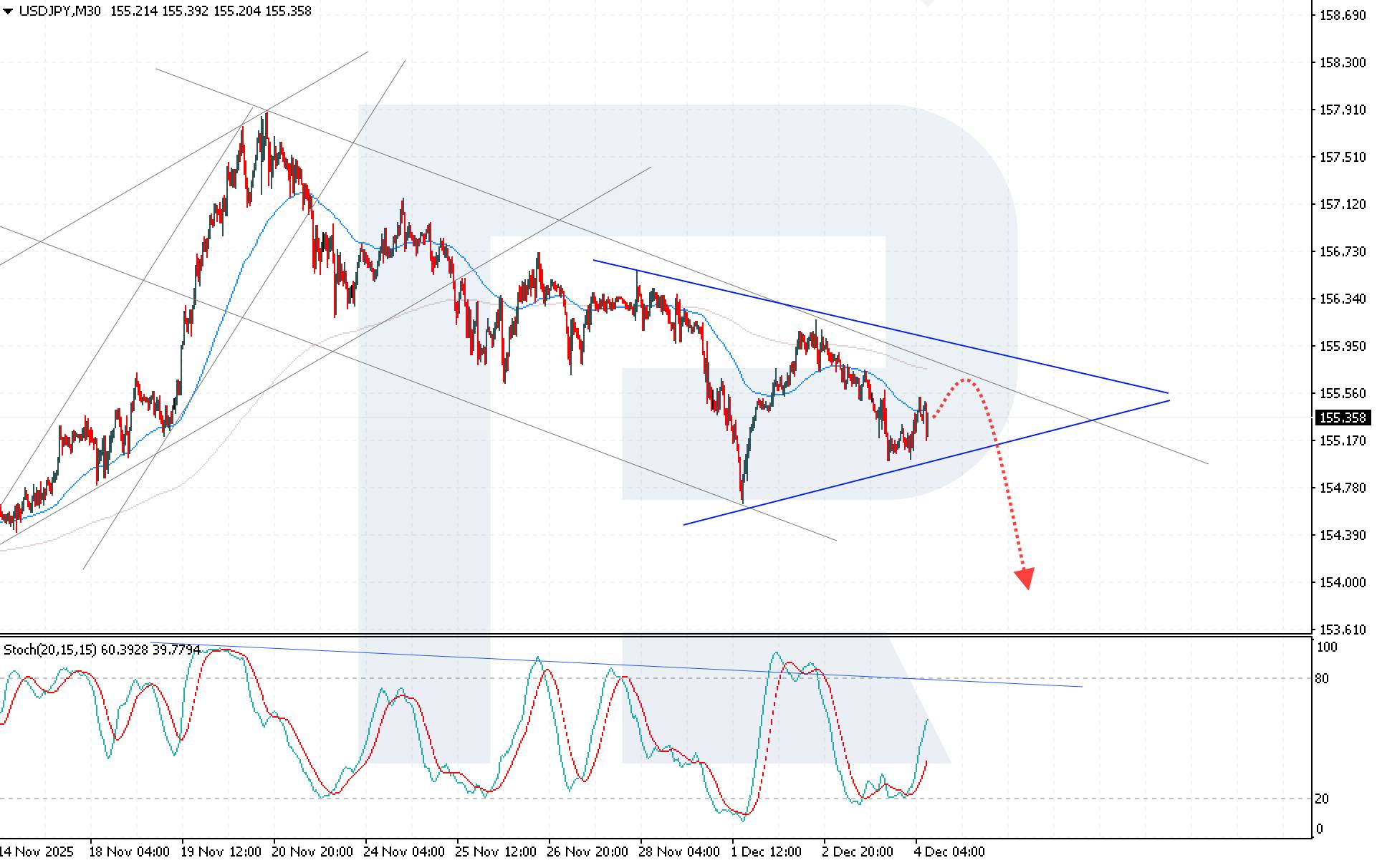
          The USDJPY rate remains under pressure as a combination of weak US data and expectations of BoJ tightening supports the yen. The current quote is 155.35.

          USDJPY forecast: key trading points

          · The Japanese yen is hovering near a two-week high
          · The ADP Research report showed a decline of 32 thousand jobs in the US private sector
          · Weak US labour market data increased expectations of a Fed rate cut at the December meeting
          · USDJPY forecast for 4 December 2025: 153.85

          Fundamental analysis

          The USDJPY rate is slightly strengthening after rebounding from the 154.90 support level. Meanwhile, the Japanese yen remains near its strongest level in two weeks as the market increases bets that the Bank of Japan will raise interest rates this month.

          Additional support for the yen came from a weakening US dollar. Soft US labour market data boosted expectations that the Federal Reserve will cut the benchmark interest rate at the December meeting. The ADP Research report released on Wednesday showed the largest decline in private sector employment since March 2023 – minus 32 thousand jobs, while analysts had expected an increase of 10 thousand.

          The statistics strengthen the case for further easing by the Federal Reserve. Labour demand in the US remains weak, consumer spending is beginning to weaken, and inflation risks are diminishing. Against this backdrop, the USDJPY forecast for today remains negative.

          USDJPY technical analysis

          The USDJPY pair is undergoing a correction, forming a Triangle pattern. Sellers continue to keep the price below the EMA-65, maintaining an overall bearish tone.

          The USDJPY forecast suggests a short-term bullish correction towards 155.55. This area acts as key resistance within the Triangle. After testing the 155.55 level, the pair could resume its downward movement towards 153.85. The Stochastic Oscillator confirms the likelihood of a bearish scenario: its signal lines have turned upwards from oversold territory and are approaching the descending resistance line.

          A consolidation below 154.65 will serve as key confirmation of continued downward momentum and signal a breakout below the Triangle's lower boundary.

          Summary

          Amid weak US labour market data and expectations of Fed policy easing, the USDJPY rate remains under pressure. Technical analysis of USDJPY indicates a high probability of a bearish impulse towards 153.85 if the price consolidates below 154.65.

          Editors' picks

          EURUSD 2026-2027 forecast: key market trends and future predictions

          This article provides the EURUSD forecast for 2026 and 2027 and highlights the main factors determining the direction of the pair's movements. We will apply technical analysis, take into account the opinions of leading experts, large banks, and financial institutions, and study AI-based forecasts. This comprehensive insight into EURUSD predictions should help investors and traders make informed decisions.

          Gold (XAUUSD) forecast 2026 and beyond: expert insights, price predictions, and analysis

          This article offers a Gold (XAUUSD) price forecast for 2026 and beyond, combining technical analysis, expert forecasts, and key macroeconomic factors. It explains the drivers behind gold's recent surge, explores potential scenarios including a move toward 4,500 to 5,000 USD per ounce, and highlights why the metal remains a strong hedge during global uncertainty.

          Source: RoboForex

          Risk Warnings and Disclaimers
          You understand and acknowledge that there is a high degree of risk involved in trading. Following any strategies or investment methods may lead to potential losses. The content on the site is provided by our contributors and analysts for information purposes only. You are solely responsible for determining whether any trading assets, securities, strategy, or any other product is suitable for investing based on your own investment objectives and financial situation.
          Add to Favorites
          Share

          Bank of Japan’s Dilemma Deepens Amid Surging Bond Yields and December Rate Hike Expectations

          Gerik

          Economic

          Policy Dilemma: Between Inflation Control and Fiscal Fragility

          The Bank of Japan (BOJ) is facing an intensifying policy conundrum. On one side, inflation has remained persistently above its 2% target for 43 consecutive months, prompting expectations of a long-awaited rate hike in December. BOJ Governor Kazuo Ueda has already signaled that a 0.25% hike is under serious consideration, which would lift the policy rate to 0.75%. According to Reuters, the government is likely to tolerate this move, even under the traditionally dovish leadership of Prime Minister Sanae Takaichi.
          Yet on the other side lies a fragile fiscal environment exacerbated by a historic rise in government bond yields. The yield on 10-year Japanese Government Bonds (JGBs) surged to 1.917% the highest since 2007 while 20-year and 30-year bonds have reached levels unseen since the 1990s. This sharp increase in borrowing costs threatens to derail Japan’s already slowing economy and places mounting pressure on government finances, especially as Tokyo rolls out its largest stimulus package since the pandemic, requiring 11.7 trillion yen in fresh debt issuance.

          The Legacy of Yield Curve Control and the Threat of Imported Inflation

          Japan’s move to abandon its Yield Curve Control (YCC) policy in March 2024 was a turning point in its normalization trajectory. With the cap on 10-year yields removed, the bond market has experienced heightened volatility and now poses a risk to policy signaling. If the BOJ continues to raise rates to battle inflation, yields could climb further, undermining public debt sustainability. On the flip side, any dovish pivot or return to YCC could weaken the yen, stoking imported inflation a key vulnerability for an import-reliant nation.
          As of now, the USD/JPY hovers near 155, keeping pressure on import prices. Analysts such as Anindya Banerjee warn that resuming quantitative easing to curb yields may reignite inflationary pressures through a weaker currency, complicating the BOJ’s inflation-control agenda.

          Domestic and Global Repercussions: Carry Trade Risks and Repatriation Debates

          The international landscape also casts a long shadow. Rising Japanese yields reduce the incentive for yen-funded carry trades a practice where investors borrow low-yield yen to invest in higher-yielding foreign assets. In August 2024, an unexpected BOJ hike triggered a global sell-off as carry trades unwound, leading Japan's Nikkei to crash 12.4% in one session.
          Although the risk of a similar systemic event in 2025 appears low, the narrowing yield differential with the U.S. and possible Federal Reserve cuts could trigger episodic volatility. Experts like Masahiko Loo from State Street and Justin Heng from HSBC believe large-scale repatriation is unlikely, thanks to structural investments by Japanese trust banks and life insurers, supported by the Nippon Individual Savings Account (NISA) program. In fact, Japanese investors have already bought 11.7 trillion yen in foreign debt from January to October 2025, compared to 4.2 trillion yen for the whole of 2024.

          All Eyes on the December Meeting

          The BOJ's policy decision at the December 18–19 meeting will not only signal the central bank’s inflation-fighting resolve but also its tolerance for fiscal and market volatility. Governor Ueda’s messaging on the terminal rate how high interest rates will eventually go remains vague, keeping markets on edge.
          The path ahead is precarious. With inflation still sticky, bond yields surging, the yen vulnerable, and fiscal stimulus expanding, the BOJ’s move in December could either reinforce confidence in its normalization strategy or open the door to heightened volatility both at home and abroad. Markets, for now, are pricing in an 80% probability of a December hike, but the true impact will be determined by what comes after and how clearly that path is communicated.

          Source: Reuters

          To stay updated on all economic events of today, please check out our Economic calendar
          Risk Warnings and Disclaimers
          You understand and acknowledge that there is a high degree of risk involved in trading. Following any strategies or investment methods may lead to potential losses. The content on the site is provided by our contributors and analysts for information purposes only. You are solely responsible for determining whether any trading assets, securities, strategy, or any other product is suitable for investing based on your own investment objectives and financial situation.
          Add to Favorites
          Share

          General Market Analysis – 4/12/25

          IC Markets

          Forex

          Stocks

          US Stocks Push Higher after Weaker Data – Dow up 0.8%

          US stocks pushed higher in the latest session, extending their recent momentum as weaker-than-expected US jobs data strengthened expectations for an imminent Federal Reserve rate cut. The Dow led the gains, rising 0.86% to close at 47,882, while the S&P 500 added 0.30% to finish at 6,849. The Nasdaq advanced more modestly, up 0.17% at 23,454.

          The softer ADP Non-Farm figures drove Treasury yields lower, with the 2-year slipping 2.4 basis points to 3.484% and the 10-year easing 2.7 basis points to 4.059%. The US dollar also weakened further, with the USD Index falling 0.46% to 98.87. Oil prices continued to move higher as faltering Russia–Ukraine peace talks kept geopolitical tensions elevated. Brent crude rose 0.56% to settle at $62.80, while WTI crude climbed 0.82% to $59.12. Gold traded in another rare tight range, slipping marginally by 0.05% to close at $4,204.13.

          Pound in Focus for FX Markets

          Sterling jumped into trader focus yesterday as the FX Gods aligned to see it drive higher against the dollar and on the crosses. Cable powered over 1% on the day with little respite in the move, and it was a similar story on the crosses with EUR/GBP losing 0.6% across all three trading sessions. There was no definitive driver of the move, but it does appear that a few different factors combined to see the outsized move occur. Most traders agree that the speculative side of the market was short, and stop-losses in Cable above 1.3270 and 1.3300 would have contributed to the move.

          Services and Composite PMI data also came in stronger than expected, but not by a degree that you would normally expect to move the market by that degree. The weaker US ADP number would have contributed to the move in Cable, and this could have fed through to cross moves as well, but overall traders feel that the move may have been overdone given other moves in the majors. Now, traders will be watching the pound closely in coming sessions to see whether the move is justified or whether we see a bit of retracement back into recent ranges.

          Quieter Day on the Economic Calendar Today

          The macroeconomic calendar is quieter during the first two sessions of the day today, but attention will shift back to the US tonight with some more key labour-market indicators due. Investors will be watching Challenger job cuts data earlier in the session, which has sprung up in importance since the government shutdown; last time out, they came in at 173%, and anything higher is likely to back last night's ADP data miss and push rate-cut expectations up even further.

          Later in the session, we have the release of the weekly unemployment claims, with expectations for a 219k print firmly priced in. Canada's Ivey PMI is also scheduled north of the border, with anything significantly off the expected 53.6 print likely to see volatility in the loonie.

          Source: IC Markets

          Risk Warnings and Disclaimers
          You understand and acknowledge that there is a high degree of risk involved in trading. Following any strategies or investment methods may lead to potential losses. The content on the site is provided by our contributors and analysts for information purposes only. You are solely responsible for determining whether any trading assets, securities, strategy, or any other product is suitable for investing based on your own investment objectives and financial situation.
          Add to Favorites
          Share
          FastBull
          Copyright © 2025 FastBull Ltd

          728 RM B 7/F GEE LOK IND BLDG NO 34 HUNG TO RD KWUN TONG KLN HONG KONG

          TelegramInstagramTwitterfacebooklinkedin
          App Store Google Play Google Play
          Products
          Charts

          Chats

          Q&A with Experts
          Screeners
          Economic Calendar
          Data
          Tools
          Membership
          Features
          Function
          Markets
          Copy Trading
          Latest Signals
          Contests
          News
          Analysis
          24/7
          Columns
          Education
          Company
          Careers
          About Us
          Contact Us
          Advertising
          Help Center
          Feedback
          User Agreement
          Privacy Policy
          Business

          White Label

          Data API

          Web Plug-ins

          Poster Maker

          Affiliate Program

          Risk Disclosure

          The risk of loss in trading financial instruments such as stocks, FX, commodities, futures, bonds, ETFs and crypto can be substantial. You may sustain a total loss of the funds that you deposit with your broker. Therefore, you should carefully consider whether such trading is suitable for you in light of your circumstances and financial resources.

          No decision to invest should be made without thoroughly conducting due diligence by yourself or consulting with your financial advisors. Our web content might not suit you since we don't know your financial conditions and investment needs. Our financial information might have latency or contain inaccuracy, so you should be fully responsible for any of your trading and investment decisions. The company will not be responsible for your capital loss.

          Without getting permission from the website, you are not allowed to copy the website's graphics, texts, or trademarks. Intellectual property rights in the content or data incorporated into this website belong to its providers and exchange merchants.

          Not Logged In

          Log in to access more features

          FastBull Membership

          Not yet

          Purchase

          Become a signal provider
          Help Center
          Customer Service
          Dark Mode
          Price Up/Down Colors

          Log In

          Sign Up

          Position
          Layout
          Fullscreen
          Default to Chart
          The chart page opens by default when you visit fastbull.com