

Markets
News
Analysis
User
24/7
Economic Calendar
Education
Data
- Names
- Latest
- Prev



Signal Accounts for Members
All Signal Accounts
All Contests
 Japan Tankan Small Manufacturing Outlook Index (Q4)
A:--
F: --
P: --
Japan Tankan Large Non-Manufacturing Outlook Index (Q4)A:--
F: --
P: --
Japan Tankan Large Manufacturing Outlook Index (Q4)A:--
F: --
P: --
Japan Tankan Small Manufacturing Diffusion Index (Q4)A:--
F: --
P: --
Japan Tankan Large-Enterprise Capital Expenditure YoY (Q4)A:--
F: --
P: --
 U.K. Rightmove House Price Index YoY (Dec)
A:--
F: --
P: --
 China, Mainland Industrial Output YoY (YTD) (Nov)
A:--
F: --
P: --
China, Mainland Urban Area Unemployment Rate (Nov)A:--
F: --
P: --
 Saudi Arabia CPI YoY (Nov)
A:--
F: --
P: --
 Euro Zone Industrial Output YoY (Oct)
A:--
F: --
P: --
Euro Zone Industrial Output MoM (Oct)A:--
F: --
P: --
 Canada Existing Home Sales MoM (Nov)
A:--
F: --
P: --
Canada National Economic Confidence IndexA:--
F: --
P: --
Canada New Housing Starts (Nov)A:--
F: --
 U.S. NY Fed Manufacturing Employment Index (Dec)
A:--
F: --
P: --
U.S. NY Fed Manufacturing Index (Dec)A:--
F: --
P: --
Canada Core CPI YoY (Nov)A:--
F: --
P: --
Canada Manufacturing Unfilled Orders MoM (Oct)A:--
F: --
P: --
U.S. NY Fed Manufacturing Prices Received Index (Dec)A:--
F: --
P: --
U.S. NY Fed Manufacturing New Orders Index (Dec)A:--
F: --
P: --
Canada Manufacturing New Orders MoM (Oct)A:--
F: --
P: --
Canada Core CPI MoM (Nov)A:--
F: --
P: --
Canada Trimmed CPI YoY (SA) (Nov)A:--
F: --
P: --
Canada Manufacturing Inventory MoM (Oct)A:--
F: --
P: --
Canada CPI YoY (Nov)A:--
F: --
P: --
Canada CPI MoM (Nov)A:--
F: --
P: --
Canada CPI YoY (SA) (Nov)A:--
F: --
P: --
Canada Core CPI MoM (SA) (Nov)A:--
F: --
P: --
Canada CPI MoM (SA) (Nov)A:--
F: --
P: --
Federal Reserve Board Governor Milan delivered a speech U.S. NAHB Housing Market Index (Dec)A:--
F: --
P: --
 Australia Composite PMI Prelim (Dec)
--
F: --
P: --
Australia Services PMI Prelim (Dec)--
F: --
P: --
Australia Manufacturing PMI Prelim (Dec)--
F: --
P: --
Japan Manufacturing PMI Prelim (SA) (Dec)--
F: --
P: --
U.K. 3-Month ILO Employment Change (Oct)--
F: --
P: --
U.K. Unemployment Claimant Count (Nov)--
F: --
P: --
U.K. Unemployment Rate (Nov)--
F: --
P: --
U.K. 3-Month ILO Unemployment Rate (Oct)--
F: --
P: --
U.K. Average Weekly Earnings (3-Month Average, Including Bonuses) YoY (Oct)--
F: --
P: --
U.K. Average Weekly Earnings (3-Month Average, Excluding Bonuses) YoY (Oct)--
F: --
P: --
 France Services PMI Prelim (Dec)
--
F: --
P: --
France Composite PMI Prelim (SA) (Dec)--
F: --
P: --
France Manufacturing PMI Prelim (Dec)--
F: --
P: --
 Germany Services PMI Prelim (SA) (Dec)
--
F: --
P: --
Germany Manufacturing PMI Prelim (SA) (Dec)--
F: --
P: --
Germany Composite PMI Prelim (SA) (Dec)--
F: --
P: --
Euro Zone Composite PMI Prelim (SA) (Dec)--
F: --
P: --
Euro Zone Services PMI Prelim (SA) (Dec)--
F: --
P: --
Euro Zone Manufacturing PMI Prelim (SA) (Dec)--
F: --
P: --
U.K. Services PMI Prelim (Dec)--
F: --
P: --
U.K. Manufacturing PMI Prelim (Dec)--
F: --
P: --
U.K. Composite PMI Prelim (Dec)--
F: --
P: --
Euro Zone ZEW Economic Sentiment Index (Dec)--
F: --
P: --
Germany ZEW Current Conditions Index (Dec)--
F: --
P: --
Germany ZEW Economic Sentiment Index (Dec)--
F: --
P: --
Euro Zone Trade Balance (Not SA) (Oct)--
F: --
P: --
Euro Zone ZEW Current Conditions Index (Dec)--
F: --
P: --
Euro Zone Trade Balance (SA) (Oct)--
F: --
P: --
U.S. Retail Sales MoM (Excl. Gas Stations & Vehicle Dealers) (SA) (Oct)--
F: --
P: --
U.S. Retail Sales MoM (Excl. Automobile) (SA) (Oct)--
F: --
P: --


No matching data

Latest Views
Latest Views
Trending Topics
Top Columnists
Latest Update
White Label
Data API
Web Plug-ins
Affiliate Program
View All
No data
The Nasdaq 100 index showed sharp volatility yesterday following the interest rate announcement. The market action can be interpreted as follows:→ First, the FOMC decision
The Nasdaq 100 index (US Tech 100 mini on FXOpen) showed sharp volatility yesterday following the interest rate announcement. The market action can be interpreted as follows:
→ First, the FOMC decision was released: as expected, the Federal Funds Rate was cut from 4.00% to 3.75% (a bullish catalyst), which pushed the index up towards point A.
→ However, half an hour later Jerome Powell's press conference began, and his tone was noticeably hawkish (a bearish catalyst). The Fed Chair signalled that the rate-cutting cycle has been paused because inflation remains elevated and additional labour-market data is needed. As a result, the index fell sharply from point A to the low at point B.
Meanwhile, Donald Trump criticised the Fed's decision, arguing that rates should be cut far more aggressively. This adds to uncertainty, especially given expectations that Powell will leave his post in May 2026.
Bearish pressure on the tech index intensified further after Oracle's earnings release — see yesterday's post for details. The results disappointed investors, fuelling renewed talk of an AI bubble, and ORCL shares plunged around 11% in after-hours trading.
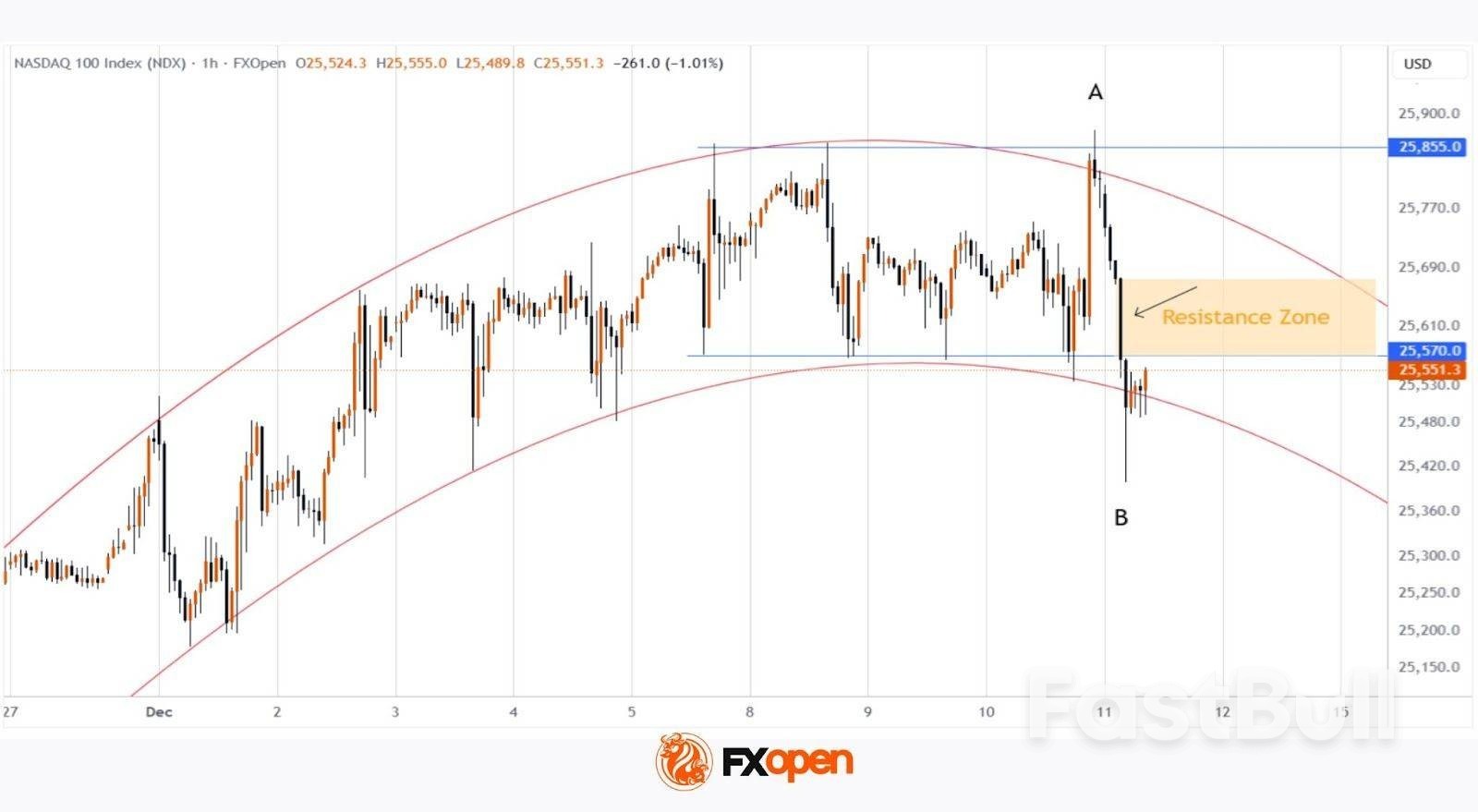
Looking at recent price action in the Nasdaq 100 (US Tech 100 mini on FXOpen), the index appears to be forming a bearish Rounding Top pattern:
→ The peak at point A resembles a bull trap, as the price only slightly exceeded the December highs before reversing — in SMC terms, a sign of a bearish liquidity grab.
→ The price then broke support from several recent sessions around 25,570 after forming a large bearish candle (marked by the arrow). This indicates strong selling pressure (a market imbalance) and the area may now act as resistance.
It is possible that bulls will attempt to recover some of yesterday's losses today. However, if any rebound stalls near this resistance zone, the Nasdaq 100 (US Tech 100 mini on FXOpen) may continue to drift lower along a rounding downward trajectory.
The Fed cut its policy rate for the third consecutive meeting by 25 bps yesterday to 3.5%-3.75%. The Fed still has to balance a weakening labour market against somewhat elevated inflation. There was again no consensus within the FOMC on how to address these opposing factors, as one member (Stephen Miran) voted for a 50 bps cut, but two others (Schmid and Goolsbee) wanted to keep the policy rate unchanged. The dots even showed a total of 6 out of 19 members in favour of the status quo. The median Federal Funds Rate projection for 2026 and 2027 remained unchanged at respectively 3.25%-3.5% and 3%-3.25%. Fed chair Powell indicated that the policy rate now is "within the range of plausible neutral estimates", allowing the Fed to assess incoming data, with a January rate cut seen as rather unlikely.
However, part of Powell's analysis allowed the market to consider a less hawkish interpretation. PCE inflation forecasts for this (2.9% from 3%) and next (2.4% from 2.6%) faced downward revisions. Powell's working hypothesis is still that most of the current elevated inflation was temporary due to higher goods prices driven by tariffs. Services inflation has been cooling. In addition, the Fed chair pointed at ongoing downside risks to the labour market, especially as current estimates on employment growth probably present an over-estimation. Markets responded to the "dovish" opening created by the labour market remarks.
The US curve bull steepened, with yields declining between 7.7 bps (2-y) and -2.1 bps (30-y), assuming that the Fed focus remains slightly more tilted to maximum employment part of its dual mandate. An additional announcement to start buying T-bills (and other short-term Treasury securities) from next week on at a $40bn pace to maintain a situation of ample reserves added to the bull steepening move. By nearing neutral interest rate levels, the bar for additional rate cuts in early 2026 has been raised. Nevertheless, in case of weak (labour) market data next week and/or January, the debate on an additional precautionary rate cut might rapidly resurface.
On other markets, equities rebounded yesterday with the Fed upwardly revising its growth forecasts, especially for next year (2.3% from 1.8% in September) and the Fed chair elaborating on ongoing high productivity gains supported. The combination of losing interest rate support and a risk rebound weighed on the dollar. DXY eased further from the 99.2 area early in the session to close at 98.79. EUR/USD closed just below the 1.17 big figure (1.1695).
Today's eco calendar is thin, apart from weekly jobless claims. The Swiss national bank is expected to keep its policy rate unchanged at 0%. Even as Powell indicated that the Fed is now in a position to wait, we assume that both US yields and the dollar remain more sensitive to weaker than expected (labour market) data.
The Bank of Canada as expected kept the policy rate unchanged at 2.5%. Economic growth at a 2.6% annualized clip in Q2 was surprisingly strong, it said, but that was the result of a steep drop in imports. The BoC anticipates a weak Q4 number with the import normalizing hanging in the balance with a grow in domestic demand. Growth is forecast to pick up in 2026, although uncertainty remains high.
The labour market is a similar "on the one hand, but on the other" narrative. after solid employment gains over the last three months. Inflation, 2.2% in October, should remain close to the 2% target with the BoC willing to look through some choppiness in the coming months. Underlying gauges hover around 2.5%. The central bank concludes that "the current policy rate at about the right level to keep inflation close to 2% while helping the economy through this period of structural adjustment." Canadian swap yields fell up to 5 bps at the front. USD/CAD ended lower below 1.38 but that was mainly a US dollar move.
Brazil's central bank left the policy rate at 15% and kept their view of an economy cooling while inflation, though still above the 3% target, is improving. They lowered CPI forecasts to hit 3.2% in 2027Q2 (from 3.3%), which is their relevant policy horizon for now. Risks remain symmetrical.
The 15% level is considered "appropriate" to bring inflation to target, considered a slight dovish change compared to November's "will be enough". The Brazilian real's strengthening over much of 2025 probably helps explain the downwardly adjusted CPI forecasts. But its recent weakening to a two month low of USD/BRL 5.47 warrants ongoing caution, meaning the 15% level may be the reference for the time being..
In Norway, the Regional Survey is due for release. We expect it to confirm that growth continues to rise at a moderate pace, with capacity utilization largely unchanged and indicate that the level of activity is somewhat below normal. Specifically, we expect that respondents in the survey will expect 0.3-0.4% growth next quarter, that capacity utilization will be unchanged at 35% and that the number of companies experiencing labour shortages will fall from 25% to 24%.
In Sweden, the final figures for November inflation are being published. The preliminary figures surprised to the downside, with CPI at 0.3% y/y, CPIF 2.3% y/y, and CPIF ex. energy 2.4% y/y. As preliminary estimates are generally reliable, significant revisions are unlikely. It will be interesting to analyse the details to understand the factors behind the surprise. Specifically, whether the low outcome is linked to seasonal variations or other underlying causes.
In central bank space, attention turns to the Swiss National Bank, where we forecast the rate to remain unchanged at 0.00%. The Central Bank of Turkey is also set to release its rate decision.
What happened yesterday
In the US, the Federal Reserve cut its policy rate target by 25bp to 3.50-3.75% last night, as widely anticipated. Miran voted for a larger 50bp cut, while Schmid and Goolsbee dissented in favour of a hold, also in line with our expectations. We (and the markets) had expected Powell to push back against market pricing further rate cuts for 2026. However, his avoidance of strong forward guidance led to a decline in UST yields and broad USD weakening during the press conference. We maintain our Fed call and expect two final rate cuts in March and June. The Fed also announced reserve management purchases of T-bills starting 12 December at USD 40bn per month, indicating more front-loaded easing to liquidity policies than we anticipated.
Ahead of the meeting, the US Q3 Employment Cost Index signalled slightly slower-than-expected wage growth at 0.8% q/q (prior: 1.0%). This pace is close to ideal for the Fed – supporting consumption without driving inflation – and is positive for overall risk sentiment.
In Sweden, October economic activity data showed a slight decline, with lower production in the business sector as well as declining household consumption. The GDP indicator fell by 0.3% m/m, though its volatility warrants cautious interpretation. Overall, the data aligned with our expectations of slower growth for Q4, reflecting lagged effects of the summer slowdown, and does not alter the positive outlook heading into 2026.
In Norway, November core inflation declined to 3.0% y/y (cons: 3.1%, prior: 3.0%), driven by domestic and imported goods ex. food. Annual growth in household appliances and electronics dropped close to September levels, indicating that volatility was likely influenced by Black week adjustments. The print is marginally lower than Norges Bank's estimate from the September MPR at 3.1%, reinforcing the disinflationary trend. While this is unlikely to affect Norges Bank's rate path next week, it provides scope for signalling a more aggressive cutting cycle, dependent on the Regional Network survey today.
In Canada, the Bank of Canada kept the rate unchanged at 2.25% as widely expected.
In Denmark, November inflation held steady at 2.1% y/y. Food prices declined 0.9% from October, which could potentially have a positive impact on consumer sentiment.
Equities: Equity investors cheered the not-so-hawkish Fed cut yesterday. S&P 500 jumped 1% at the press conference, eventually closing 0.7% higher and small cap Russell 2000 1.3% higher. The rate decision triggered a clear cyclical preference in markets: Value cyclicals like materials, industrials, and consumer discretionary were all ~2% higher. This is interesting. Previously this year we have seen cyclical growth stocks – mag 7, basically – rallying at dovish surprises. This time, it was more of a "run it hot" reaction in markets, where expectations of stronger macro fuelled the move higher rather than lower yields. This fits our narrative very well.
One sector worth highlighting is health care, performing very strong in the risk-on session yesterday. This is a bit odd in a historical context, but health care has been behaving like a cyclical sector in recent trading. This has certainly been a tremendous rally, but we take profits today and neutralize our health care sector call. Reason for this is that the positive health care call has been a valuation call, and this argument has rapidly changed. The relative discount has gone from 20% to 10% vs global markets the last three months, which we think is a fair discount at this part of the cycle. For instance, health care now trades close to the multiple of consumer staples, after a 20% discount at the bottom.
FI and FX: Yesterday's Fed rate cut was a rather balanced one, but given that markets expected a hawkish cut, market reactions were slightly to the soft side. Rates rallied somewhat and the USD weakened a tad with EUR/USD trading at 1.169. Only tiny and transitory, negative reactions in EUR/SEK and EUR/NOK following the FOMC decision. Ahead of the Fed rate decision European rates rose once again, resulting in the fifth consecutive day of higher rates. Potential rate cuts for the ECB have by now been eliminated for 2026. This morning, EUR/SEK is back at 10.84 and EUR/NOK trades at 11.83.
728 RM B 7/F GEE LOK IND BLDG NO 34 HUNG TO RD KWUN TONG KLN HONG KONG


White Label
Data API
Web Plug-ins
Poster Maker
Affiliate Program
The risk of loss in trading financial instruments such as stocks, FX, commodities, futures, bonds, ETFs and crypto can be substantial. You may sustain a total loss of the funds that you deposit with your broker. Therefore, you should carefully consider whether such trading is suitable for you in light of your circumstances and financial resources.
No decision to invest should be made without thoroughly conducting due diligence by yourself or consulting with your financial advisors. Our web content might not suit you since we don't know your financial conditions and investment needs. Our financial information might have latency or contain inaccuracy, so you should be fully responsible for any of your trading and investment decisions. The company will not be responsible for your capital loss.
Without getting permission from the website, you are not allowed to copy the website's graphics, texts, or trademarks. Intellectual property rights in the content or data incorporated into this website belong to its providers and exchange merchants.
Not Logged In
Log in to access more features

FastBull Membership
Not yet
Purchase


Log In
Sign Up


