• Trade
  • Markets
  • Copy
  • Contests
  • News
  • 24/7
  • Calendar
  • Q&A
  • Chats
Trending
Screeners
SYMBOL
LAST
BID
ASK
HIGH
LOW
NET CHG.
%CHG.
SPREAD
SPX
S&P 500 Index
6857.13
6857.13
6857.13
6865.94
6827.13
+7.41
+ 0.11%
--
DJI
Dow Jones Industrial Average
47850.93
47850.93
47850.93
48049.72
47692.96
-31.96
-0.07%
--
IXIC
NASDAQ Composite Index
23505.13
23505.13
23505.13
23528.53
23372.33
+51.04
+ 0.22%
--
USDX
US Dollar Index
98.880
98.960
98.880
98.980
98.880
-0.100
-0.10%
--
EURUSD
Euro / US Dollar
1.16552
1.16559
1.16552
1.16555
1.16408
+0.00107
+ 0.09%
--
GBPUSD
Pound Sterling / US Dollar
1.33409
1.33416
1.33409
1.33409
1.33165
+0.00138
+ 0.10%
--
XAUUSD
Gold / US Dollar
4217.98
4218.43
4217.98
4218.45
4194.54
+10.81
+ 0.26%
--
WTI
Light Sweet Crude Oil
59.271
59.308
59.271
59.469
59.187
-0.112
-0.19%
--

Community Accounts

Signal Accounts
--
Profit Accounts
--
Loss Accounts
--
View More

Become a signal provider

Sell trading signals to earn additional income

View More

Guide to Copy Trading

Get started with ease and confidence

View More

Signal Accounts for Members

All Signal Accounts

Best Return
  • Best Return
  • Best P/L
  • Best MDD
Past 1W
  • Past 1W
  • Past 1M
  • Past 1Y

All Contests

  • All
  • Trump Updates
  • Recommend
  • Stocks
  • Cryptocurrencies
  • Central Banks
  • Featured News
Top News Only
Share

India's NIFTY IT Index Last Up 1.3%

Share

India's Nifty 50 Index Rises 0.35%

Share

Israel Sets 2026 Defence Budget At $34 Billion

Share

Russia Says Azov Sea's Port Of Temryuk Damaged In Ukrainian Attack

Share

Israel's Defense Budget For 2026 Will Be 112 Billion Israeli Shekels - Defense Minister Office

Share

One India Rate Panel Member Ram Singh Was Of View That Stance Should Be Changed To 'Accommodative' From 'Neutral' - Monetary Policy Committee Statement

Share

Reserve Bank Of India Chief: Will Continue To Meet Productive Needs Of Economy In Proactive Manner

Share

Reserve Bank Of India Chief: System Level Financial Parameters Of Nbfcs Sound

Share

Reserve Bank Of India Chief: Dollar Rupee Swap To Be For 3 Years, To Be Conducted This Month

Share

India's Nifty Realty Index Extend Gains, Last Up 1.4%

Share

India's Nifty Psu Bank Index Rises 1%

Share

Reserve Bank Of India Chief: Commited To Providing Sufficient Durable Liquidity

Share

Reserve Bank Of India Chief: Transmission Has Been Broad Based Across Sectors, Satisfactory

Share

Reserve Bank Of India Chief: As Of Nov 28, India's Forex Reserves Stood At $686 Billion

Share

Reserve Bank Of India Chief: Healthy Services Exports With Strong Remittances To Keep Cad Modest In This Year

Share

Reserve Bank Of India Chief: CPI Inflation Seen At 0.6% In Q3 Fy26

Share

Reserve Bank Of India Chief: Fy26 CPI Inflation Seen At 2% Versus 2.6% Previously

Share

India's Nifty Realty Index Up 1% After Reserve Bank Of India's Rate Cut

Share

India's Nifty Psu Bank Index Turns Positive, Up 0.43% After Reserve Bank Of India's Rate Cut

Share

Reserve Bank Of India Chief: Merchandise Exports Face Some Headwinds

TIME
ACT
FCST
PREV
Turkey Trade Balance

A:--

F: --

P: --

Germany Construction PMI (SA) (Nov)

A:--

F: --

P: --

Euro Zone IHS Markit Construction PMI (Nov)

A:--

F: --

P: --

Italy IHS Markit Construction PMI (Nov)

A:--

F: --

P: --

U.K. Markit/CIPS Construction PMI (Nov)

A:--

F: --

P: --

France 10-Year OAT Auction Avg. Yield

A:--

F: --

P: --

Euro Zone Retail Sales MoM (Oct)

A:--

F: --

P: --

Euro Zone Retail Sales YoY (Oct)

A:--

F: --

P: --

Brazil GDP YoY (Q3)

A:--

F: --

P: --

U.S. Challenger Job Cuts (Nov)

A:--

F: --

P: --

U.S. Challenger Job Cuts MoM (Nov)

A:--

F: --

P: --

U.S. Challenger Job Cuts YoY (Nov)

A:--

F: --

P: --

U.S. Initial Jobless Claims 4-Week Avg. (SA)

A:--

F: --

P: --

U.S. Weekly Initial Jobless Claims (SA)

A:--

F: --

P: --

U.S. Weekly Continued Jobless Claims (SA)

A:--

F: --

P: --

Canada Ivey PMI (SA) (Nov)

A:--

F: --

P: --

Canada Ivey PMI (Not SA) (Nov)

A:--

F: --

P: --

U.S. Non-Defense Capital Durable Goods Orders Revised MoM (Excl. Aircraft) (SA) (Sept)

A:--

F: --

P: --
U.S. Factory Orders MoM (Excl. Transport) (Sept)

A:--

F: --

P: --

U.S. Factory Orders MoM (Sept)

A:--

F: --

P: --

U.S. Factory Orders MoM (Excl. Defense) (Sept)

A:--

F: --

P: --

U.S. EIA Weekly Natural Gas Stocks Change

A:--

F: --

P: --

Saudi Arabia Crude Oil Production

A:--

F: --

P: --

U.S. Weekly Treasuries Held by Foreign Central Banks

A:--

F: --

P: --

Japan Foreign Exchange Reserves (Nov)

A:--

F: --

P: --

India Repo Rate

A:--

F: --

P: --

India Benchmark Interest Rate

A:--

F: --

P: --

India Reverse Repo Rate

A:--

F: --

P: --

India Cash Reserve Ratio

A:--

F: --

P: --

Japan Leading Indicators Prelim (Oct)

A:--

F: --

P: --

U.K. Halifax House Price Index YoY (SA) (Nov)

--

F: --

P: --

U.K. Halifax House Price Index MoM (SA) (Nov)

--

F: --

P: --

France Current Account (Not SA) (Oct)

--

F: --

P: --

France Trade Balance (SA) (Oct)

--

F: --

P: --

France Industrial Output MoM (SA) (Oct)

--

F: --

P: --

Italy Retail Sales MoM (SA) (Oct)

--

F: --

P: --

Euro Zone Employment YoY (SA) (Q3)

--

F: --

P: --

Euro Zone GDP Final YoY (Q3)

--

F: --

P: --

Euro Zone GDP Final QoQ (Q3)

--

F: --

P: --

Euro Zone Employment Final QoQ (SA) (Q3)

--

F: --

P: --

Euro Zone Employment Final (SA) (Q3)

--

F: --

P: --
Brazil PPI MoM (Oct)

--

F: --

P: --

Mexico Consumer Confidence Index (Nov)

--

F: --

P: --

Canada Unemployment Rate (SA) (Nov)

--

F: --

P: --

Canada Labor Force Participation Rate (SA) (Nov)

--

F: --

P: --

Canada Employment (SA) (Nov)

--

F: --

P: --

Canada Part-Time Employment (SA) (Nov)

--

F: --

P: --

Canada Full-time Employment (SA) (Nov)

--

F: --

P: --

U.S. Dallas Fed PCE Price Index YoY (Sept)

--

F: --

P: --

U.S. PCE Price Index YoY (SA) (Sept)

--

F: --

P: --

U.S. PCE Price Index MoM (Sept)

--

F: --

P: --

U.S. Personal Outlays MoM (SA) (Sept)

--

F: --

P: --

U.S. Core PCE Price Index MoM (Sept)

--

F: --

P: --

U.S. UMich 5-Year-Ahead Inflation Expectations Prelim YoY (Dec)

--

F: --

P: --

U.S. Core PCE Price Index YoY (Sept)

--

F: --

P: --

U.S. 5-10 Year-Ahead Inflation Expectations (Dec)

--

F: --

P: --

U.S. UMich Current Economic Conditions Index Prelim (Dec)

--

F: --

P: --

U.S. UMich Consumer Sentiment Index Prelim (Dec)

--

F: --

P: --

U.S. UMich 1-Year-Ahead Inflation Expectations Prelim (Dec)

--

F: --

P: --

U.S. UMich Consumer Expectations Index Prelim (Dec)

--

F: --

P: --

Q&A with Experts
    • All
    • Chatrooms
    • Groups
    • Friends
    Connecting
    .
    .
    .
    Type here...
    Add Symbol or Code

      No matching data

      All
      Trump Updates
      Recommend
      Stocks
      Cryptocurrencies
      Central Banks
      Featured News
      • All
      • Russia-Ukraine Conflict
      • Middle East Flashpoint
      • All
      • Russia-Ukraine Conflict
      • Middle East Flashpoint

      Search
      Products

      Charts Free Forever

      Chats Q&A with Experts
      Screeners Economic Calendar Data Tools
      Membership Features
      Data Warehouse Market Trends Institutional Data Policy Rates Macro

      Market Trends

      Market Sentiment Order Book Forex Correlations

      Top Indicators

      Charts Free Forever
      Markets

      News

      News Analysis 24/7 Columns Education
      From Institutions From Analysts
      Topics Columnists

      Latest Views

      Latest Views

      Trending Topics

      Top Columnists

      Latest Update

      Signals

      Copy Rankings Latest Signals Become a signal provider AI Rating
      Contests
      Brokers

      Overview Brokers Assessment Rankings Regulators News Claims
      Broker listing Forex Brokers Comparison Tool Live Spread Comparison Scam
      Q&A Complaint Scam Alert Videos Tips to Detect Scam
      More

      Business
      Events
      Careers About Us Advertising Help Center

      White Label

      Data API

      Web Plug-ins

      Affiliate Program

      Awards Institution Evaluation IB Seminar Salon Event Exhibition
      Vietnam Thailand Singapore Dubai
      Fans Party Investment Sharing Session
      FastBull Summit BrokersView Expo
      Recent Searches
        Top Searches
          Markets
          News
          Analysis
          User
          24/7
          Economic Calendar
          Education
          Data
          • Names
          • Latest
          • Prev

          View All

          No data

          Scan to Download

          Faster Charts, Chat Faster!

          Download App
          English
          • English
          • Español
          • العربية
          • Bahasa Indonesia
          • Bahasa Melayu
          • Tiếng Việt
          • ภาษาไทย
          • Français
          • Italiano
          • Türkçe
          • Русский язык
          • 简中
          • 繁中
          Open Account
          Search
          Products
          Charts Free Forever
          Markets
          News
          Signals

          Copy Rankings Latest Signals Become a signal provider AI Rating
          Contests
          Brokers

          Overview Brokers Assessment Rankings Regulators News Claims
          Broker listing Forex Brokers Comparison Tool Live Spread Comparison Scam
          Q&A Complaint Scam Alert Videos Tips to Detect Scam
          More

          Business
          Events
          Careers About Us Advertising Help Center

          White Label

          Data API

          Web Plug-ins

          Affiliate Program

          Awards Institution Evaluation IB Seminar Salon Event Exhibition
          Vietnam Thailand Singapore Dubai
          Fans Party Investment Sharing Session
          FastBull Summit BrokersView Expo

          Gold Outlook: Bulls Rally On Rate Cut Bets, Dip Buying Back In Favor

          Pepperstone

          Forex

          Commodity

          Summary:

          Over the past week, precious metals broadly advanced, with gold bulls standing out.

          Over the past week, precious metals broadly advanced, with gold bulls standing out. The rally is mainly driven by a sharp repricing of U.S. interest rate expectations: Fed officials have delivered consecutive dovish signals, December rate cut odds surged, and markets anticipate the next Fed chair may lean even more toward easing, all boosting bullish sentiment.

          With the Thanksgiving holiday behind us, the market will return to a "data-driven" rhythm this week. Traders will focus on key U.S. economic releases, including ISM Services PMI, ADP employment data, and core PCE inflation. With the Fed entering a blackout period, even marginal data changes could trigger outsized market reactions.

          Technical Outlook: Bulls Back in Control, $4,250 Key

          Looking at the XAUUSD daily chart, gold buying regained momentum last week, with a nearly 3.8% weekly gain. While markets expected thin holiday trading, Friday's strong push broke that assumption, allowing gold to comfortably surpass $4,200.
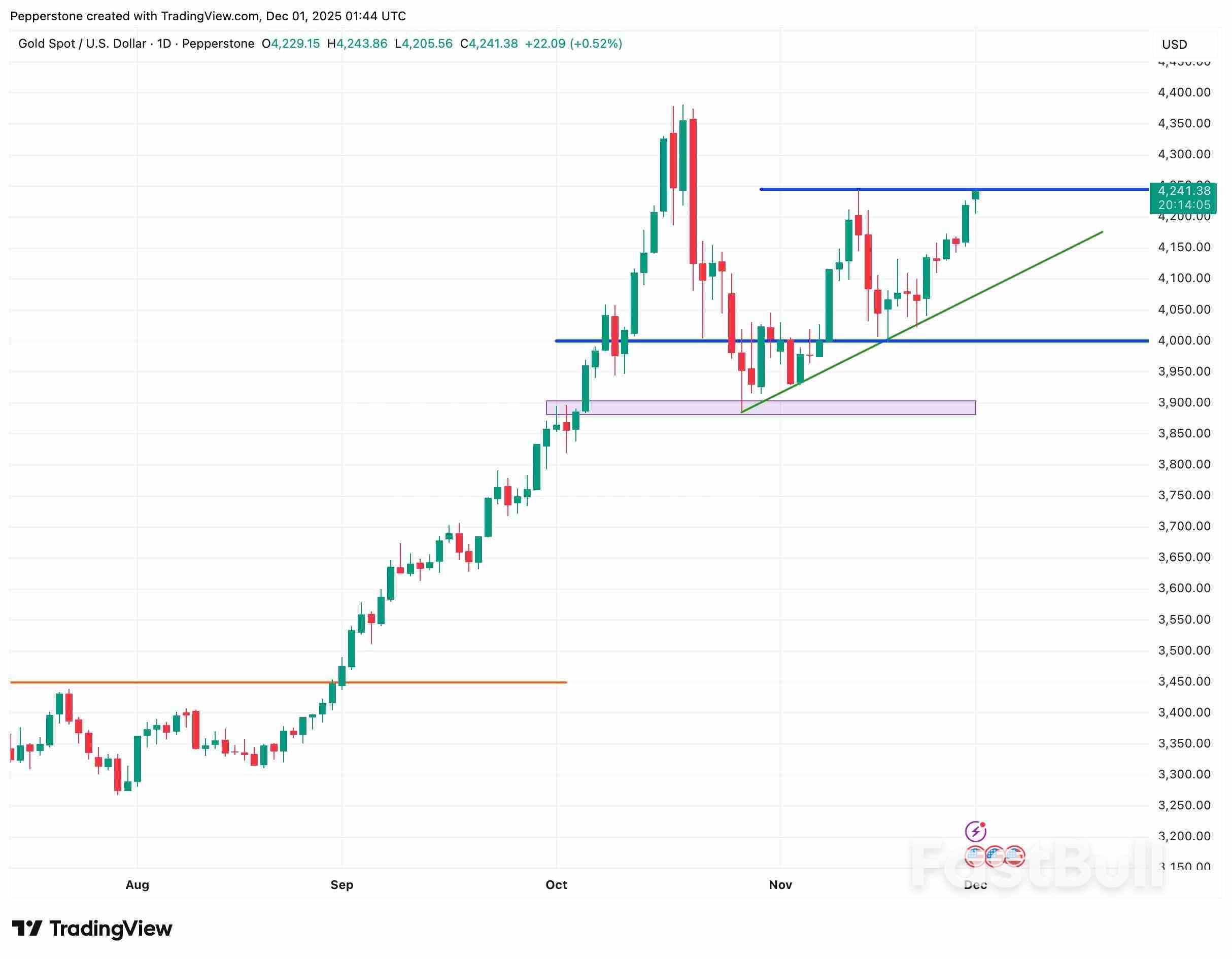
          With the holiday over and CME's earlier technical issues resolved, price discovery should be more robust this week. Gold is currently challenging its mid-November high of $4,250. A close above this level would open the door for a push toward $4,300 and potentially revisit the all-time high of $4,381.

          On the downside, profit-taking at elevated levels could find support around $4,200 and further down at $4,130. Overall, technicals remain bullish, though the strength of the breakout and market sentiment will need confirmation from this week's data.

          Fed Rate Cut Odds Surge, Supporting Gold Bulls

          The recent acceleration in gold is mainly fueled by a shift in Fed policy expectations. Dovish tones are now clear—both Fed Governor Waller and NY Fed President Williams have publicly backed a December rate cut, altering the market's baseline expectations.

          Economic data also support this trend. U.S. retail sales slowed in September, consumer confidence fell to 88.7 in November—the lowest since April—and the Fed's Beige Book showed cooling hiring, reduced hours, and even some layoffs, with consumer spending easing. Overall, U.S. economic momentum is weakening, while inflation, though moderating, remains sticky.

          Against this backdrop, bets on a December Fed rate cut have surged, currently priced near 90%. Stronger rate cut expectations imply lower real rates, the key logic supporting a rise in non-yielding assets like gold.

          Dollar performance reflects this shift. As the U.S. interest rate advantage fades, the dollar index has come under pressure. Meanwhile, policy shifts in Japan add to dollar weakness.

          Sanae Takahashi's aggressive fiscal stance has raised concerns over the continuation of Abenomics, while Ueda hinted at a possible December rate hike (current odds above 60%), increasing the potential for a yen rebound. If realized, this would further weaken the dollar and provide additional support for gold.

          Hassett Poised to Lead, Dovish Tilt Boosts Gold

          Treasury Secretary Janet Yellen indicated that President Trump may announce the next Fed chair before Christmas. Current NEC Director Hassett, a long-time proponent of Trump-style monetary easing, is the frontrunner, with betting markets pricing his nomination at roughly 64%.

          Markets expect that if Hassett takes the helm, his stance will be more dovish, likely keeping rates lower than under Powell. This expectation has pushed traders to increase bets on future rate cuts and raises questions about Fed independence, naturally benefiting non-yielding, safe-haven gold.

          Moreover, concerns over aggressive rate cuts heighten attention to U.S. debt expansion, while central bank gold buying provides a solid floor. Together, these factors make it difficult to break gold's upward path in the near term.

          Final Week Before the Rate Decision: Can Gold Keep Rising?

          In short, gold bulls have surged recently, driven by higher December rate cut bets, a softer dollar, and expectations of a more dovish next Fed chair. Central banks continue to accumulate gold, and geopolitical risks remain, offering additional support.

          In a low-rate, uncertain U.S. economic environment, gold's path of least resistance remains upward, with dip buying still the prevailing strategy. Any short-term pullbacks are likely to be limited.

          This week marks the final week before the December Fed meeting. Fed officials will enter a blackout period, amplifying the market impact of economic data. Key releases include Wednesday's November ADP private payrolls and ISM Services PMI, and Friday's delayed September core PCE.

          Consensus is for ADP jobs to rise 10k, below 42k previously, while core PCE is expected to fall from 2.9% YoY to 2.8%. If results align, showing a soft labor market with controlled inflation, they could reinforce December rate cut bets, pressuring the dollar and modestly lifting gold. Even if employment improves slightly and inflation remains sticky, it's unlikely to change market pricing for cuts, leaving gold in a narrow trading range.

          Additionally, as major central banks diverge in policy paths—especially the RBA, NZD central bank, and BoJ returning to a rate hike trajectory—traders should monitor yield differentials for both risk and opportunity when trading gold.

          Source: Pepperstone

          Risk Warnings and Disclaimers
          You understand and acknowledge that there is a high degree of risk involved in trading. Following any strategies or investment methods may lead to potential losses. The content on the site is provided by our contributors and analysts for information purposes only. You are solely responsible for determining whether any trading assets, securities, strategy, or any other product is suitable for investing based on your own investment objectives and financial situation.
          Add to Favorites
          Share

          Cyber Monday 2025 Poised to Break Records Despite Economic Anxiety

          Gerik

          Economic

          Surging Online Deals Propel Cyber Monday Spending

          Amid an uncertain economic climate, U.S. shoppers are on track to set a new record this Cyber Monday, with Adobe Analytics forecasting $14.2 billion in online sales up 6.3% from 2024. This follows a strong Black Friday showing with $11.8 billion in online purchases and $6.4 billion on Thanksgiving Day, indicating a robust start to the peak of the holiday shopping season.
          Consumers are taking advantage of elevated discounts, particularly on electronics and apparel, where average markdowns hit 30% and 26%, respectively. The strong momentum supports the view that shoppers are frontloading purchases to capitalize on the best prices, turning Cyber Monday into a high-stakes “last call” for significant holiday savings.

          Mobile Commerce and AI Fueling Sales Growth

          Mobile devices have overtaken desktops as the dominant shopping platform, with 56.1% of online holiday spending equivalent to $142.7 billion expected to be conducted via smartphones and other handheld electronics. Adobe predicts mobile transactions will hit a new milestone on Cyber Monday, as convenience and AI-powered shopping assistants guide consumers through personalized deals.
          AI’s growing role in shaping e-commerce behavior is evident. Salesforce estimates AI contributed to $14.2 billion of the $79 billion spent globally on Black Friday, showing a direct relationship between personalized product recommendations and consumer decision-making at scale.

          Economic Pressures Shift Consumer Payment Behavior

          Despite high sales figures, underlying economic concerns persist. Inflation, layoffs, and the residual impact of the 43-day government shutdown have dampened confidence. Rising tariffs under President Donald Trump’s trade policies have further elevated import prices, tightening household budgets.
          In response, more shoppers are relying on deferred payment options. Adobe estimates that “buy now, pay later” (BNPL) plans will account for $20.2 billion in online holiday purchases, up 11% year-over-year. Cyber Monday alone is expected to see BNPL purchases surpass $1 billion, much of it via mobile platforms. This shift indicates a behavioral change in how consumers manage cash flow under financial stress a correlation that highlights the increasing normalization of short-term credit tools in retail.

          Growth Slowing, But Spending Still Strong

          The National Retail Federation expects U.S. holiday sales to exceed $1 trillion for the first time, though growth will moderate to between 3.7% and 4.2%, compared to 4.3% in 2024. Credit card delinquencies are rising, suggesting a fragile foundation beneath the record-setting spending.
          Still, the psychology of urgency around Cyber Monday deals, combined with newer digital shopping tools and flexible payment models, is helping push volumes higher even as the economic backdrop remains turbulent. Popular items like the Nintendo Switch 2, Labubu Dolls, and flagship smartphones such as the iPhone 17 and Galaxy S25 are expected to be among the top sellers.

          A Record-Breaking Cyber Monday With Caveats

          Cyber Monday 2025 is shaping up to be the biggest yet, powered by strategic discounting, mobile access, AI-enhanced shopping, and consumer willingness to spend despite cautionary economic signals. However, the record figures mask underlying vulnerabilities: a reliance on credit, trade-related price pressures, and the fragility of household financial stability.
          This year’s performance reflects not just the success of digital commerce infrastructure but also the precarious balance between consumer desire and economic reality a trend likely to persist through the rest of the holiday season and into 2026.

          Source: Reuters

          To stay updated on all economic events of today, please check out our Economic calendar
          Risk Warnings and Disclaimers
          You understand and acknowledge that there is a high degree of risk involved in trading. Following any strategies or investment methods may lead to potential losses. The content on the site is provided by our contributors and analysts for information purposes only. You are solely responsible for determining whether any trading assets, securities, strategy, or any other product is suitable for investing based on your own investment objectives and financial situation.
          Add to Favorites
          Share

          Zootopia 2 Breaks Records In China With $275 Million Opening

          Winkelmann

          Forex

          Economic

          Key points:

          · Zootopia 2 grosses 1.95 billion yuan at Chinese box office in six days
          · Hollywood's influence in China remains limited despite Zootopia 2's success
          · Shanghai Disney resort features world's only Zootopia-themed land
          · Bob Iger attends Shanghai premiere amid local marketing efforts

          Disney'sZootopia 2 became the highest-grossing animated foreign film ever in China, despite generally muted interest in overseas movies in the country.

          As of Monday morning Beijing time, box office tracker Maoyan showed Zootopia 2's local box office tally reaching 1.95 billion yuan ($275.6 million) in its first six days of release.

          "It is Disney's most important movie in China this year, for sure," said Ashley Dudarenok, founder of China digital consultancy Chozan, with its themes of personal resilience and societal harmony resonating with local audiences.

          Its runaway success in China - where Zootopia 2 sales accounted for around 95% of all movie ticket sales over its opening weekend - is particularly notable given the changing environment for foreign films in China over the nine years since the first Zootopia film was released. The original Zootopia also became China's most popular foreign animated film when it was released in 2016.

          Hollywood films were caught up earlier this year in the China-U.S. trade war. Beijing curbed the number of U.S. films that were allowed to be shown in China in retaliation for higher tariffs on Chinese goods - a move analysts said would only have a limited impact, given the waning influence of foreign films in China.

          AN EXCEPTION, NOT THE RULE

          Hollywood studios once looked to China, the world's second-largest film market, to help boost their box office performances. But domestic movies increasingly have outperformed Hollywood fare in China. Earlier this year, local animation "Ne Zha 2" eclipsed Pixar's "Inside Out 2" to become the world's highest-grossing animated film of all time after raking in nearly $2 billion at the Chinese box office.

          Even so, Disney seemed confident that Zootopia 2 would find a significant audience in China, with Chief Executive Bob Iger travelling to Shanghai for a local premiere a fortnight ago. In addition, Disney partnered with China Eastern Airlineson a Zootopia 2-themed plane.

          And the Shanghai Disneyland resort is home to the world's only Zootopia-themed land, which opened in 2023 to capitalise on local affection for the original film.

          "Disney is heavily reliant on huge blockbuster releases, which in turn become IP and monetise through experiences, merchandise and other areas," said PP Foresight analyst Paolo Pescatore, adding that in spite of geopolitical tensions and an uncertain macroeconomic environment, China remains a "massive and expanding market for its theme parks, movies and merchandise."

          According to Chris Fenton, author of "Feeding the Dragon: Inside the Trillion Dollar Dilemma Facing Hollywood, the NBA, and American Business," a potential downside of Zootopia 2's success could be the false hope it might give Hollywood studios that China could be rekindling a love affair with foreign films.

          "Beijing doesn't view Hollywood as a solution to restrained consumer spending [in China], so I wouldn't read into this being a pivot on Beijing's part," he said. "Beijing knows if Hollywood sees some continued promise in their market, filmmakers will continue to kowtow to Beijing's storytelling requirements."

          ($1 = 7.0750 Chinese yuan)

          Source: TradingView

          To stay updated on all economic events of today, please check out our Economic calendar
          Risk Warnings and Disclaimers
          You understand and acknowledge that there is a high degree of risk involved in trading. Following any strategies or investment methods may lead to potential losses. The content on the site is provided by our contributors and analysts for information purposes only. You are solely responsible for determining whether any trading assets, securities, strategy, or any other product is suitable for investing based on your own investment objectives and financial situation.
          Add to Favorites
          Share

          South Korea’s November Exports Surge on Chip Boom and U.S. Trade Deal

          Gerik

          Economic

          Record Chip Shipments Drive Export Acceleration

          South Korea posted a sixth consecutive monthly export increase in November, underpinned by a booming semiconductor sector. Exports jumped 8.4% year-over-year to $61.04 billion, outperforming the 5.7% median estimate from economists polled by Reuters and accelerating from October’s 3.5% growth.
          At the core of this performance was a 38.5% surge in semiconductor exports, reaching an all-time monthly high of $17.26 billion. This growth reflects heightened global demand for advanced memory chips used in data centers and AI infrastructure, lifting chip prices and solidifying semiconductors as the economy’s primary growth engine.
          This chip-driven growth also supports the Bank of Korea’s recent decision to revise its economic outlook upward, signaling the potential end of its monetary easing phase. The central bank's optimism is strongly tied to this tech-led export momentum.

          Automobile Exports Rebound After U.S. Trade Agreement

          Automobile exports also climbed significantly, up 13.7% in November, buoyed by the successful resolution of trade negotiations with the United States. The new trade deal, finalized in early November, helped ease uncertainty over tariffs that had clouded South Korea’s auto industry outlook for months.
          However, despite the trade agreement, overall shipments to the U.S. slightly declined by 0.2% due to persistent weakness in steel, machinery, and auto parts exports highlighting that while headline sectors have stabilized, tariff-related disruptions still linger in key industrial segments.

          Mixed Performance Across Major Markets

          Shipments to China increased by 6.9%, indicating a moderate recovery in regional demand and continued stabilization in China’s economic activity. Exports to Southeast Asian countries also grew by 6.3%, showing broader regional resilience.
          Conversely, shipments to the European Union declined by 1.9%, underlining that demand in European markets remains weak, possibly due to inflationary pressures and softer consumption.

          Imports Lag, Trade Surplus Hits Multi-Year High

          While exports soared, imports rose modestly by just 1.2% to $51.30 billion, missing expectations of a 3.4% increase and reflecting subdued domestic demand. This divergence led to a robust trade surplus of $9.7 billion the largest monthly surplus since September 2017 up from $6.0 billion in October.
          The widening surplus illustrates a structural dynamic where South Korea’s export strength, particularly in high-tech goods, is outpacing import demand, contributing positively to GDP and external balances.

          Trade Resilience Reinforces Policy Stability

          South Korea’s strong November trade figures reinforce the resilience of its export-driven economy amid global uncertainty. Record chip sales and auto export recovery are not only supporting headline growth but also giving policymakers room to pause monetary easing.
          As global semiconductor demand continues to rise and supply chains recalibrate post-pandemic, South Korea appears well-positioned to sustain export strength into 2026. However, continued monitoring of tariff impacts, especially in the U.S. and EU, will be essential to ensure balanced growth across all sectors.

          Source: Reuters

          To stay updated on all economic events of today, please check out our Economic calendar
          Risk Warnings and Disclaimers
          You understand and acknowledge that there is a high degree of risk involved in trading. Following any strategies or investment methods may lead to potential losses. The content on the site is provided by our contributors and analysts for information purposes only. You are solely responsible for determining whether any trading assets, securities, strategy, or any other product is suitable for investing based on your own investment objectives and financial situation.
          Add to Favorites
          Share

          Copper Sets Record High As Top Chinese Smelters Plan To Cut Output

          Justin

          Commodity

          Political

          Copper touched new peaks on Monday after top Chinese smelters agreed to a plan to cut output in 2026 and on record-high premium offers by Codelco, the world's biggest copper producing company.

          The most-active copper contract on the Shanghai Futures Exchangesurged 2.08% to 89,020 yuan ($12,583.40) per metric ton as of 0230 GMT, after setting a record high at 89,650 yuan.

          The benchmark three month copperon the London Metal Exchange, meanwhile, also climbed to a new all-time high of$11,294.5 a ton, after setting a record high on Friday.

          The London copper contract was up 0.24% to $11,216 a ton as of 0230 GMT.

          The China Smelters Purchase Team (CSPT), a group of the largest Chinese copper smelters, said on Friday that its members have agreed to cut production by more than 10% in 2026 in a bid to combat negative copper concentrate processing fees.

          Traders are also positioning themselves after bullish headlines from last week's Asia Copper Week 2025 in Shanghai.

          Chile's Codelco, the world's top copper producer, sought a dramatic hike in copper premiums to Chinese buyers, as high as $350 a ton during the week, a level many saw as no longer relevant for Chinese participants, suggesting little spillover into copper supply-demand dynamics locally.

          Offers for Codelco's United States clients also saw a surge above $500 a ton, according to sources, participants saw the Codelco premiums as designed for those who have access to the Comex exchange to profit from the Comex-LME arbitrage amid tariff uncertainties.

          Rising optimism of an interest rate cut by the Federal Reserve in December also helped copper to set new peaks, as greater economic activity is associated with higher demand for copper.

          The U.S. Dollarcontinued to soften, supporting the market by making commodities traded with the greenback cheaper for investors using other currencies.

          Among other SHFE base metals, aluminiumrose 1.44%, zincadded 0.78%, nickelwas up 0.26%, tinsurged 2.68%, and leadwas little changed.

          Elsewhere among LME metals, aluminiumwas up 0.21%, zincticked 0.13% higher, nickelgained 0.34%, tinrose 1.08%. The London leadalso posted little changed.

          Source: TradingView

          Risk Warnings and Disclaimers
          You understand and acknowledge that there is a high degree of risk involved in trading. Following any strategies or investment methods may lead to potential losses. The content on the site is provided by our contributors and analysts for information purposes only. You are solely responsible for determining whether any trading assets, securities, strategy, or any other product is suitable for investing based on your own investment objectives and financial situation.
          Add to Favorites
          Share

          Australia Expands Grain-Fed Beef Exports as U.S. Supply Shrinks

          Gerik

          Economic

          Feedlots Drive Australia’s Beef Export Transformation

          Australia is undergoing a structural shift in its cattle industry as feedlot-based grain-feeding becomes increasingly central to export strategies. In facilities like the Gundamain feedlot, cattle are fattened on high-energy diets over 90 days to meet soaring demand for marbled, grain-fed beef a product type favored in Japan, South Korea, and China.
          From just 1 million cattle on feed in 2020, Australia now counts a record 1.6 million animals in feedlots as of mid-2025. That number is projected to rise to 2 million by 2027, signaling a major reconfiguration in the country’s traditional grass-based beef production model.

          Export Surge and U.S. Market Disruption

          Australian grain-fed beef exports reached 324,421 tons in the first nine months of 2025, up 45% from the same period in 2020. Most of this volume is heading to Asian nations where demand for quality, grain-fed beef is intensifying. Meanwhile, U.S. exports to these same regions have weakened, due in part to a historic decline in American cattle numbers driven by prolonged droughts.
          According to the U.S. Department of Agriculture, the country had 11.7 million cattle on feed as of November 1 down 260,000 year-over-year and the lowest since the 1950s. The resulting production slump has allowed Australian beef, considered a near substitute for U.S. meat in terms of flavor and marbling, to gain competitive ground.

          Strategic Resilience Through Feedlots

          Feedlots are helping Australia counteract its own climatic volatility. By relying less on natural pasture and more on grain-based diets, producers can ensure consistent supply regardless of rainfall. While droughts still pose challenges for grain output, Australia produces far more grain than needed for domestic feedlots, ensuring resilience in production chains.
          Meat analyst Matt Dalgleish underscores that feedlots offer security of supply, enabling producers to meet contractual obligations throughout the year a significant advantage in international markets.

          Profitability Fuels Expansion Despite Constraints

          Grain-fed beef commands higher prices, and operators are seizing the opportunity. Simon Quilty of Global AgriTrends forecasts feedlot numbers will reach 1.75 million in 2026 and hit 2 million the following year. Companies such as Mort & Co, JBS, NH Foods, and Teys Australia (partly owned by Cargill) are leading this expansion.
          Still, Australia is unlikely to fully replicate the U.S. feedlot model, where over 90% of cattle are grain-finished. High capital costs and expectations of a U.S. supply rebound are capping aggressive new investment. Furthermore, Australia maintains a robust market for grass-fed beef, perceived by many consumers as more natural and environmentally friendly.

          Dual Market Strategy: Grass vs. Grain

          Australia is approaching a 50-50 split between grain- and grass-finished cattle. Grain-fed animals offer higher immediate returns, but grass-fed beef is gaining value in premium sustainability-conscious markets. This dual-market flexibility positions Australia uniquely to meet both industrial demand and emerging ethical consumption trends.
          With the U.S. retreating under the weight of climatic stress and supply limitations, Australia’s feedlot-driven beef sector is emerging as a dominant force in global meat trade. The country's ability to scale up grain-fed production without sacrificing its grass-fed reputation gives it a strategic edge.
          As long as global demand for premium beef remains strong particularly in Asia Australia appears poised to consolidate its standing as a reliable and diversified exporter, while U.S. recovery efforts continue at a cautious pace.

          Sourpce: Reuters

          To stay updated on all economic events of today, please check out our Economic calendar
          Risk Warnings and Disclaimers
          You understand and acknowledge that there is a high degree of risk involved in trading. Following any strategies or investment methods may lead to potential losses. The content on the site is provided by our contributors and analysts for information purposes only. You are solely responsible for determining whether any trading assets, securities, strategy, or any other product is suitable for investing based on your own investment objectives and financial situation.
          Add to Favorites
          Share

          India Bonds May Struggle For Firm Direction As Market Divided Over RBI Rate Cut

          Justin

          Bond

          Economic

          Indian government bonds might open without a clear direction at the start of the month on Monday, as strong economic growth data has split the market on whether the central bank would cut interest rates this week or wait longer.

          The benchmark 10-year yield (IN063335G=CC) is likely to hover between 6.53% and 6.58%, according to a trader at a private bank. It ended at 6.5463% on Friday, giving up the modest declines of the month. Bond yields move inversely to prices.

          "The growth data may be favorable for the broader economy, but it is proving to be a silent drag on bonds, as it makes it harder for the central bank to justify cutting rates," the trader said.

          India's economy expanded at a sharper-than-expected clip of 8.2% in the July-September quarter, up from 7.8% in April-June, prompting analysts to raise their full-year growth estimates to above 7%.

          India's robust growth numbers for the September quarter are raising questions about the need for lower interest rates even as record-low inflation gives the Reserve Bank of India ample room to resume reductions later this week, analysts said.

          A majority of economists polled by Reuters ahead of Friday's GDP data release had expected the RBI's key policy repo rate to be pared by 25 basis points to 5.25% on December 5, followed by a pause through 2026.

          "Broad basing growth, sans any rate cut, may necessitate ushering in a "neutral regime" tantamount to "calibrated easing" by targeting yields and liquidity management simultaneously," State Bank of India Chief Economist Soumya Kanti Ghosh said.

          Source: TradingView

          To stay updated on all economic events of today, please check out our Economic calendar
          Risk Warnings and Disclaimers
          You understand and acknowledge that there is a high degree of risk involved in trading. Following any strategies or investment methods may lead to potential losses. The content on the site is provided by our contributors and analysts for information purposes only. You are solely responsible for determining whether any trading assets, securities, strategy, or any other product is suitable for investing based on your own investment objectives and financial situation.
          Add to Favorites
          Share
          FastBull
          Copyright © 2025 FastBull Ltd

          728 RM B 7/F GEE LOK IND BLDG NO 34 HUNG TO RD KWUN TONG KLN HONG KONG

          TelegramInstagramTwitterfacebooklinkedin
          App Store Google Play Google Play
          Products
          Charts

          Chats

          Q&A with Experts
          Screeners
          Economic Calendar
          Data
          Tools
          Membership
          Features
          Function
          Markets
          Copy Trading
          Latest Signals
          Contests
          News
          Analysis
          24/7
          Columns
          Education
          Company
          Careers
          About Us
          Contact Us
          Advertising
          Help Center
          Feedback
          User Agreement
          Privacy Policy
          Business

          White Label

          Data API

          Web Plug-ins

          Poster Maker

          Affiliate Program

          Risk Disclosure

          The risk of loss in trading financial instruments such as stocks, FX, commodities, futures, bonds, ETFs and crypto can be substantial. You may sustain a total loss of the funds that you deposit with your broker. Therefore, you should carefully consider whether such trading is suitable for you in light of your circumstances and financial resources.

          No decision to invest should be made without thoroughly conducting due diligence by yourself or consulting with your financial advisors. Our web content might not suit you since we don't know your financial conditions and investment needs. Our financial information might have latency or contain inaccuracy, so you should be fully responsible for any of your trading and investment decisions. The company will not be responsible for your capital loss.

          Without getting permission from the website, you are not allowed to copy the website's graphics, texts, or trademarks. Intellectual property rights in the content or data incorporated into this website belong to its providers and exchange merchants.

          Not Logged In

          Log in to access more features

          FastBull Membership

          Not yet

          Purchase

          Become a signal provider
          Help Center
          Customer Service
          Dark Mode
          Price Up/Down Colors

          Log In

          Sign Up

          Position
          Layout
          Fullscreen
          Default to Chart
          The chart page opens by default when you visit fastbull.com