• Trade
  • Markets
  • Copy
  • Contests
  • News
  • 24/7
  • Calendar
  • Q&A
  • Chats
Trending
Screeners
SYMBOL
LAST
BID
ASK
HIGH
LOW
NET CHG.
%CHG.
SPREAD
SPX
S&P 500 Index
6870.39
6870.39
6870.39
6895.79
6858.28
+13.27
+ 0.19%
--
DJI
Dow Jones Industrial Average
47954.98
47954.98
47954.98
48133.54
47871.51
+104.05
+ 0.22%
--
IXIC
NASDAQ Composite Index
23578.12
23578.12
23578.12
23680.03
23506.00
+72.99
+ 0.31%
--
USDX
US Dollar Index
98.900
98.980
98.900
98.960
98.730
-0.050
-0.05%
--
EURUSD
Euro / US Dollar
1.16499
1.16506
1.16499
1.16717
1.16341
+0.00073
+ 0.06%
--
GBPUSD
Pound Sterling / US Dollar
1.33235
1.33244
1.33235
1.33462
1.33136
-0.00077
-0.06%
--
XAUUSD
Gold / US Dollar
4207.26
4207.69
4207.26
4218.85
4190.61
+9.35
+ 0.22%
--
WTI
Light Sweet Crude Oil
59.338
59.368
59.338
60.084
59.247
-0.471
-0.79%
--

Community Accounts

Signal Accounts
--
Profit Accounts
--
Loss Accounts
--
View More

Become a signal provider

Sell trading signals to earn additional income

View More

Guide to Copy Trading

Get started with ease and confidence

View More

Signal Accounts for Members

All Signal Accounts

Best Return
  • Best Return
  • Best P/L
  • Best MDD
Past 1W
  • Past 1W
  • Past 1M
  • Past 1Y

All Contests

  • All
  • Trump Updates
  • Recommend
  • Stocks
  • Cryptocurrencies
  • Central Banks
  • Featured News
Top News Only
Share

Sudan's Paramilitary RSF Say They Controlled Oil-Rich Area Of Heglig In Kordofan

Share

German Government Spokesperson: We See Russia As A Threat To Our Security

Share

Thai Army Chief Of Staff: Thailand Seeking To Cripple Cambodia's Military Capability

Share

German Government Spokesperson: We Reject Criticism Of Europe In New US National Security Strategy

Share

Ivory Coast 2025/26 Cocoa Arrivals Reached 803000 T By December 7 Versus 820000 T A Year Ago - Exporters' Estimate

Share

EU To Delay Proposals For Automotive Sector, Including Co2 Emissions, To Dec 16, Draft EU Commission Document Shows

Share

Kremlin: India Buys Energy Where It Is Profitable To And As Far As We Understand They Will Continue To Do That

Share

Turkey's Main Banking Index Up 2.5%

Share

Turkey's Main BIST-100 Index Up 1.9%

Share

Hungary's Preliminary November Budget Balance Huf -403 Billion

Share

Indian Rupee Down 0.1% At 90.07 Per USA Dollar As Of 3:30 P.M. Ist, Previous Close 89.98

Share

India's Nifty 50 Index Provisionally Ends 0.96% Lower

Share

[JPMorgan: US Stock Rally May Stagnate Following Fed Rate Cut] JPMorgan Strategists Say The Recent Rally In US Stocks May Stall As Investors Take Profits Following The Anticipated Fed Rate Cut. The Market Currently Predicts A 92% Probability Of The Fed Lowering Borrowing Costs On Wednesday. Expectations Of A Rate Cut Have Continued To Rise, Fueled By Positive Signals From Policymakers In Recent Weeks. "Investors May Be More Inclined To Lock In Gains At The End Of The Year Rather Than Increase Directional Exposure," Mislav Matejka's Team Wrote In A Report

Share

Russian Defence Ministry: Russian Forces Take Control Of Novodanylivka In Ukraine's Zaporizhzhia Region

Share

Russian Defence Ministry: Russian Forces Take Control Of Chervone In Ukraine's Donetsk Region

Share

French Finance Ministry: Government Started Process To Block Temporarily Shein Platform

Share

Finance Minister: Indonesia To Impose Coal Export Tax Of Up To 5% Next Year

Share

[Trump Considering Fired Homeland Security Secretary Noem? White House Denies] According To Reports From US Media Outlets Such As The Daily Beast And The UK's Independent, The White House Has Denied Reports That US President Trump Is Considering Firing Homeland Security Secretary Noem. White House Spokesperson Abigail Jackson Posted On Social Media On The 7th Local Time, Calling The Claims "fake News" And Stating That "Secretary Noem Has Done An Excellent Job Implementing The President's Agenda And 'making America Safe Again'."

Share

HKEX: Standard Chartered Bought Back 571604 Total Shares On Other Exchanges For Gbp9.5 Million On Dec 5

Share

Morgan Stanley Reiterates Bullish Outlook On US Stocks Due To Fed Rate Cut Expectations. Morgan Stanley Strategists Believe That The US Stock Market Faces A "bullish Outlook" Given Improved Earnings Expectations And Anticipated Fed Rate Cuts. They Expect Strong Corporate Earnings By 2026, And Anticipate The Fed Will Cut Rates Based On Lagging Or Mildly Weak Labor Markets. They Expect The US Consumer Discretionary Sector And Small-cap Stocks To Continue To Outperform

TIME
ACT
FCST
PREV
France Industrial Output MoM (SA) (Oct)

A:--

F: --

P: --
France Trade Balance (SA) (Oct)

A:--

F: --

P: --
Euro Zone Employment YoY (SA) (Q3)

A:--

F: --

P: --
Canada Part-Time Employment (SA) (Nov)

A:--

F: --

P: --

Canada Unemployment Rate (SA) (Nov)

A:--

F: --

P: --

Canada Full-time Employment (SA) (Nov)

A:--

F: --

P: --

Canada Labor Force Participation Rate (SA) (Nov)

A:--

F: --

P: --

Canada Employment (SA) (Nov)

A:--

F: --

P: --

U.S. PCE Price Index MoM (Sept)

A:--

F: --

P: --

U.S. Personal Income MoM (Sept)

A:--

F: --

P: --

U.S. Core PCE Price Index MoM (Sept)

A:--

F: --

P: --

U.S. PCE Price Index YoY (SA) (Sept)

A:--

F: --

P: --

U.S. Core PCE Price Index YoY (Sept)

A:--

F: --

P: --

U.S. Personal Outlays MoM (SA) (Sept)

A:--

F: --

P: --
U.S. 5-10 Year-Ahead Inflation Expectations (Dec)

A:--

F: --

P: --

U.S. Real Personal Consumption Expenditures MoM (Sept)

A:--

F: --

P: --
U.S. Weekly Total Rig Count

A:--

F: --

P: --

U.S. Weekly Total Oil Rig Count

A:--

F: --

P: --

U.S. Consumer Credit (SA) (Oct)

A:--

F: --

P: --
China, Mainland Foreign Exchange Reserves (Nov)

A:--

F: --

P: --

Japan Trade Balance (Oct)

A:--

F: --

P: --

Japan Nominal GDP Revised QoQ (Q3)

A:--

F: --

P: --

China, Mainland Imports YoY (CNH) (Nov)

A:--

F: --

P: --

China, Mainland Exports (Nov)

A:--

F: --

P: --

China, Mainland Imports (CNH) (Nov)

A:--

F: --

P: --

China, Mainland Trade Balance (CNH) (Nov)

A:--

F: --

P: --

China, Mainland Exports YoY (USD) (Nov)

A:--

F: --

P: --

China, Mainland Imports YoY (USD) (Nov)

A:--

F: --

P: --

Germany Industrial Output MoM (SA) (Oct)

A:--

F: --

P: --
Euro Zone Sentix Investor Confidence Index (Dec)

A:--

F: --

P: --

Canada National Economic Confidence Index

--

F: --

P: --

U.K. BRC Like-For-Like Retail Sales YoY (Nov)

--

F: --

P: --

U.K. BRC Overall Retail Sales YoY (Nov)

--

F: --

P: --

Australia Overnight (Borrowing) Key Rate

--

F: --

P: --

RBA Rate Statement
RBA Press Conference
Germany Exports MoM (SA) (Oct)

--

F: --

P: --

U.S. NFIB Small Business Optimism Index (SA) (Nov)

--

F: --

P: --

Mexico 12-Month Inflation (CPI) (Nov)

--

F: --

P: --

Mexico Core CPI YoY (Nov)

--

F: --

P: --

Mexico PPI YoY (Nov)

--

F: --

P: --

U.S. Weekly Redbook Index YoY

--

F: --

P: --

U.S. JOLTS Job Openings (SA) (Oct)

--

F: --

P: --

China, Mainland M1 Money Supply YoY (Nov)

--

F: --

P: --

China, Mainland M0 Money Supply YoY (Nov)

--

F: --

P: --

China, Mainland M2 Money Supply YoY (Nov)

--

F: --

P: --

U.S. EIA Short-Term Crude Production Forecast For The Year (Dec)

--

F: --

P: --

U.S. EIA Natural Gas Production Forecast For The Next Year (Dec)

--

F: --

P: --

U.S. EIA Short-Term Crude Production Forecast For The Next Year (Dec)

--

F: --

P: --

EIA Monthly Short-Term Energy Outlook
U.S. API Weekly Gasoline Stocks

--

F: --

P: --

U.S. API Weekly Cushing Crude Oil Stocks

--

F: --

P: --

U.S. API Weekly Crude Oil Stocks

--

F: --

P: --

U.S. API Weekly Refined Oil Stocks

--

F: --

P: --

South Korea Unemployment Rate (SA) (Nov)

--

F: --

P: --

Japan Reuters Tankan Non-Manufacturers Index (Dec)

--

F: --

P: --

Japan Reuters Tankan Manufacturers Index (Dec)

--

F: --

P: --

Japan Domestic Enterprise Commodity Price Index MoM (Nov)

--

F: --

P: --

Japan Domestic Enterprise Commodity Price Index YoY (Nov)

--

F: --

P: --

China, Mainland PPI YoY (Nov)

--

F: --

P: --

Q&A with Experts
    • All
    • Chatrooms
    • Groups
    • Friends
    Connecting
    .
    .
    .
    Type here...
    Add Symbol or Code

      No matching data

      All
      Trump Updates
      Recommend
      Stocks
      Cryptocurrencies
      Central Banks
      Featured News
      • All
      • Russia-Ukraine Conflict
      • Middle East Flashpoint
      • All
      • Russia-Ukraine Conflict
      • Middle East Flashpoint

      Search
      Products

      Charts Free Forever

      Chats Q&A with Experts
      Screeners Economic Calendar Data Tools
      Membership Features
      Data Warehouse Market Trends Institutional Data Policy Rates Macro

      Market Trends

      Market Sentiment Order Book Forex Correlations

      Top Indicators

      Charts Free Forever
      Markets

      News

      News Analysis 24/7 Columns Education
      From Institutions From Analysts
      Topics Columnists

      Latest Views

      Latest Views

      Trending Topics

      Top Columnists

      Latest Update

      Signals

      Copy Rankings Latest Signals Become a signal provider AI Rating
      Contests
      Brokers

      Overview Brokers Assessment Rankings Regulators News Claims
      Broker listing Forex Brokers Comparison Tool Live Spread Comparison Scam
      Q&A Complaint Scam Alert Videos Tips to Detect Scam
      More

      Business
      Events
      Careers About Us Advertising Help Center

      White Label

      Data API

      Web Plug-ins

      Affiliate Program

      Awards Institution Evaluation IB Seminar Salon Event Exhibition
      Vietnam Thailand Singapore Dubai
      Fans Party Investment Sharing Session
      FastBull Summit BrokersView Expo
      Recent Searches
        Top Searches
          Markets
          News
          Analysis
          User
          24/7
          Economic Calendar
          Education
          Data
          • Names
          • Latest
          • Prev

          View All

          No data

          Scan to Download

          Faster Charts, Chat Faster!

          Download App
          English
          • English
          • Español
          • العربية
          • Bahasa Indonesia
          • Bahasa Melayu
          • Tiếng Việt
          • ภาษาไทย
          • Français
          • Italiano
          • Türkçe
          • Русский язык
          • 简中
          • 繁中
          Open Account
          Search
          Products
          Charts Free Forever
          Markets
          News
          Signals

          Copy Rankings Latest Signals Become a signal provider AI Rating
          Contests
          Brokers

          Overview Brokers Assessment Rankings Regulators News Claims
          Broker listing Forex Brokers Comparison Tool Live Spread Comparison Scam
          Q&A Complaint Scam Alert Videos Tips to Detect Scam
          More

          Business
          Events
          Careers About Us Advertising Help Center

          White Label

          Data API

          Web Plug-ins

          Affiliate Program

          Awards Institution Evaluation IB Seminar Salon Event Exhibition
          Vietnam Thailand Singapore Dubai
          Fans Party Investment Sharing Session
          FastBull Summit BrokersView Expo

          Does the Easter Break Affect Markets?

          XM

          Forex

          Energy

          Summary:

          Oil prices tends to rally before and after Easter Sunday. Euro/dollar’s performance becomes clearer when drilling down the data...
          Most participants who trade based on seasonal patterns, enjoy combining the market's performance with certain events like the Christmas and Easter breaks. This report focuses on the performance of certain key market assets:
          (1) during the final week before Easter Sunday
          (2) the first week after Easter
          (3) 30 days after Easter Sunday.
          While past performance is not a guarantor of future performance, this analysis aims to highlight some interesting historical findings.
          In addition, results filtered by the month when Easter Sunday occurs. There have been five instances since 2000 of Easter Sunday happening during March, which matches what will happen in 2024.
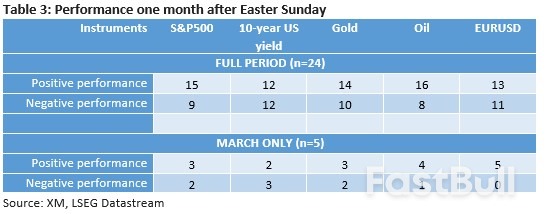
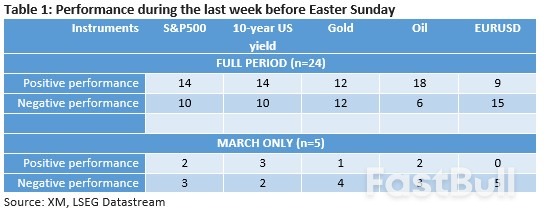
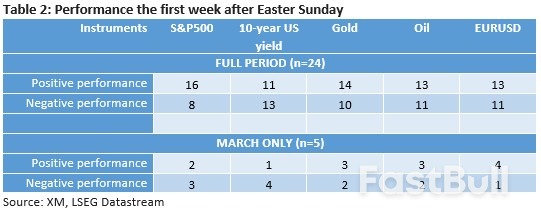
          The S&P500 index, the 10-year US Treasury yield, euro/dollar, WTI and Gold have been under the microscope with the findings presented in Tables 1, 2 and 3 below, using daily data since 2000.

          Tendency for lower euro/dollar and higher oil prices before Easter Sunday

          As made evident by Table 1 below, euro/dollar tends to finish the last week before Easter Sunday in the red. On the flip side, oil prices tend to increase, possibly due to the public's increased travel needs fuelling demand for oil products. More importantly, there is a clearer signal when Easter Sunday falls in March, like in 2024. Euro/dollar has dropped in each of the five instances, while gold recorded an average drop of 3.6% in four of these periods.Does the Easter Break Affect Markets?_1

          Mixed performance in the first week after Easter Sunday

          The analysis did not show significant performance patterns during the first week after Easter Sunday. One could argue that there is a 66.7% probability of an S&P 500 index rally, which could be sufficient for certain traders. However, the picture becomes more interesting when focusing on Easter Sunday falling in March. The 10-year US yield tends to drop by an average of 15bps while, more importantly, euro/dollar usually rallies by 1.6%.Does the Easter Break Affect Markets?_2

          Performance one month after Easter is promising

          There does not appear to be a strong pattern in the performance of the key assets examined during the first month after Easter Sunday. The full results, presented in Table 3 below, point a to small bias for higher S&P 500 and higher oil prices, which becomes stronger when examining the 2014-2023 period only, especially for US equities.
          Interestingly, the findings become slightly more promising when focusing only on Easter Sunday falling during March. In this case, there is a strong tendency of euro/dollar rallying by around 2.2% and oil prices climbing by 5% in the five instances examined.
          Does the Easter Break Affect Markets?_3To conclude, oil prices tend to increase in the week before Easter Sunday and during the first month after Easter. Euro/dollar experiences a sell-off one week before Easter, but then it tends to rally during the first month after Easter when Easter Sunday falls in March. Finally, the S&P 500 index tends to climb after Easter, a bias which is stronger when focusing only on the past 10 Easter breaks.
          Risk Warnings and Disclaimers
          You understand and acknowledge that there is a high degree of risk involved in trading. Following any strategies or investment methods may lead to potential losses. The content on the site is provided by our contributors and analysts for information purposes only. You are solely responsible for determining whether any trading assets, securities, strategy, or any other product is suitable for investing based on your own investment objectives and financial situation.
          Add to Favorites
          Share

          India Wants to Become A 'Developed' Country - Can It Break Out of The Middle-Income Trap?

          Thomas

          Economic

          India is now officially the world's fastest-growing large economy, as well as the world's most populous country. But New Delhi's sights are set still higher. The country's finance ministry released a report at the end of January confidently predicting that India, currently the world's fifth-largest national economy (excluding the supra-national EU), will climb up to third position by the end of the decade. A number of major US private financial institutions have since endorsed this forecast, highlighting India as a top investment opportunity, especially given mainland China's de-prioritisation of high growth and disengagement with western capital.
          Far less attention has been paid to an even more ambitious goal stated by India's chief economic adviser during the original report's release. Anantha Nageswaran announced that the government intended to achieve “developed” country status by 2047, a century after independence from the UK. In order for this to happen, India's Human Development Index (HDI) status will have to climb from medium, past high, to very high. Similarly, per capita incomes would have to increase sevenfold from lower-middle income status to reach the high-income bracket.
          This is a far, far harder task than increasing the overall size of the economy, in part because one has very little automatic impact on the other. Despite steady growth in the size of India's economy (both in absolute terms and relative to other countries) over the past three decades, India's current ranking for inequality-adjusted HDI (IHDI) is 108 out of 156, and 132 out of 190 in terms of per capita income. In other words, although most Indians have been lifted out of dire poverty, their incomes, education levels and life expectancies remain very modest in comparison to the average person born into a highly developed economy.
          Although the contrast in India's case is particularly extreme, the underlying problem is near-universal. Decades of evidence shows that turning a developing middle-income country into a developed high-income one is far, far harder than lifting up low-income countries into middle income. This is known as the “middle-income trap”, which even China, although close, is not yet certain to escape. Despite decades of explosive growth, China still only ranks 61st in the world for per capita income, and 67th for IHDI. And now, between the shrinking size of China's ageing workforce and its new non-growth-focused policy framework, it is unclear how much forward momentum the country has.
          But making sense of development in India is complicated by the fact the country has some of the largest internal regional disparities to be found anywhere in the world, and rapid economic growth has only widened these differences. The state of Goa, for example, has the highest per capita income in India, comparable to Colombia and Ecuador, which are “upper-middle income” countries. This figure is almost ten times that of Bihar, which puts the state at the level of “low income” countries like Eritrea and the Democratic Republic of the Congo. Tragically, average life expectancies correspond with those disparities: Goa's is at 73.3 years, and Bihar's is almost a decade shorter.
          The problem is that India's highest-income and most developed areas, like Goa, are amongst its smallest. Although India has 36 states and union territories, the twelve largest states together hold 80 per cent of the national population. Tellingly, none of these big states, including star performers like Gujarat, Maharashtra, Tamil Nadu and Karnataka have climbed above lower-middle income status and a medium level of HDI. Given that Bihar's population of 130 million is almost 10 times that of Goa, even big gains by Goa (like moving from “high” to “very high” levels of HDI) do very little to lift India as a whole. This means India must focus its efforts on the places where the bulk of its population lives in order to make dramatic overall improvements.
          Uttar Pradesh, India's most populous state, with close to a quarter of a billion people, has particularly low levels of income, life expectancy and education, as do neighbouring Bihar and Madhya Pradesh. These three adjoining states hold a staggering 450 million people together and represent the largest cluster of poverty, illiteracy, malnutrition and lower life expectancy in India.
          Although the central government has significantly expanded welfare schemes such as health insurance, and is increasingly enabling online enrolment, physical access remains highly problematic. Transport networks remain highly underdeveloped, and while primary schools and clinics are insufficient and badly under-resourced. In many cases, marginalised populations have been conditioned by dominant ones to not compete with them for access. It is hard to imagine progress of the kind envisioned until the complex challenges of these three states in particular are tackled, requiring not just the reallocation of resources, but reforms to governance structures and the involvement of grassroots social movements.
          But if accelerating development in these highly challenged regions does in fact become a top-level policy priority at the state and central government levels, India does enjoy three major enablers. As noted in one of my earlier columns, the government and Reserve Bank have done an outstanding job of maintaining stability in the face of global economic volatility, while much of South Asia has struggled to remain afloat.
          Second, India's combination of high growth and a large, young labour pool provide tremendous potential, especially if training and education are made available. And third, mobile broadband penetration India's massive investment in digital public infrastructure paves the way for those even at the bottom of society to benefit from inclusion with banking, education, governance and a rapidly expanding welfare net.India's escape into broad-based prosperity is far from impossible, but it is certainly not inevitable either. Sustained efforts by every level of government require broad-based public support. India's voters (the country is in an election year), especially relatively well-off ones, must understand these policies as a vital element of India's long-term economic success, rather than dismiss them as populist pandering.
          One of the most important elements of the escape from the middle-income trap is the transition from state-led and export-led growth to domestic consumption-led growth. That kind of spending by individuals and families is simply not possible until hundreds of millions more Indian households can experience financial security, which in turn is not possible without access to health, education and a regular income.

          Source: The National News

          To stay updated on all economic events of today, please check out our Economic calendar
          Risk Warnings and Disclaimers
          You understand and acknowledge that there is a high degree of risk involved in trading. Following any strategies or investment methods may lead to potential losses. The content on the site is provided by our contributors and analysts for information purposes only. You are solely responsible for determining whether any trading assets, securities, strategy, or any other product is suitable for investing based on your own investment objectives and financial situation.
          Add to Favorites
          Share

          Japan as No 4: Recent Losses and Future Trajectories

          Thomas

          Economic

          In recent days, news has emerged that Japan has lost its coveted position as the world's third-largest economy to Germany. The decline has been widely attributed to the yen's steep fall against the dollar over the past two years. However, some analysts are less sanguine, critiquing the nation's lack of structural reforms, such as high non-tariff barriers and weak female participation in the labour force, at least relative to other major economies.
          Indeed, Japan's reluctance to revamp its industrial organisation more vigorously is believed to have prolonged its stagnation since the bursting of the asset bubble in the 1990s. To a large extent, this has allowed other hungrier economies, especially those with a huge, young population, to overtake Japan. China usurped Japan's position in 2010, and according to the International Monetary Fund, India is poised to do the same in the near future.
          What, if any, are the green shoots for the Japanese economy then? First and foremost, the Japanese stock market has seemingly shrugged off pessimism surrounding the economy's slip to the fourth spot, surpassing a level last seen 34 years ago when the country was at the peak of its ascendancy. While it is too early to declare that “Japan is back”, the surge in interest is underpinned by several factors including an improvement in corporate governance, favourable asset valuation due to the yen's depreciation, and fund managers reallocating investment from the decelerating Chinese market to Japan.
          In any case, the key to a sustained bull run is whether money will be able to circulate to the smaller companies on the stock exchange, in addition to the broader Japanese industrial ecosystem. It is also crucial that Japanese policymakers leverage this momentum to push bolder reforms. Some noteworthy recent measures include moves by major companies to raise employee compensation, which has witnessed years of slow growth, as well as the liberalisation of taxi and bus licences to non-Japanese speakers, once deemed unimaginable by more conservative quarters.
          Second, and perhaps more importantly to Southeast Asia, how do such shifts inform regional development? Recent trends indicate that environmental sustainability ranks among the foremost priorities for virtually all Southeast Asian economies. To this end, the looming transition to a low-carbon economy stands to widen economic disparities between nations unless swift, decisive action is taken.
          This is where Japan and Southeast Asia can collaborate. An oft-cited example is the production of electric vehicles (EVs). Most energy analysts would point out that Japanese automakers, despite their preponderance in the market for internal combustion engine vehicles, have been undercut by more aggressive counterparts from other major economies in the manufacture and sales of EVs. Indeed, Thai Prime Minister Srettha Thavisin recently warned Japanese automakers that they could be left further behind unless they quickly transition to producing more EVs. There is a subtext to his message: Srettha was pushing for more technology cooperation between the Japanese automakers and Thai suppliers. In its inimitable understated style, the Japanese leadership seemingly responded to this call during last December's Asean-Japan Commemorative Summit. Japan has promised to curate a master plan to foster a competitive and green automotive industry with its Southeast Asian counterparts, in addition to a series of implementation plans in other domains.
          The crux of the matter is that introducing path-breaking technologies presents challenges that even the most advanced nations like Japan cannot solve on their own. Therefore, closer cooperation and perhaps “co-creation” with developing nations — especially those within Southeast Asia — warrants more serious consideration. In addition, environmental sustainability is no longer a choice but a necessity to maintain a competitive edge in the global economy. It is far better to adjust to these new dynamics of structural transformation by proactively working with like-minded partners. Effective execution on this and related matters is likely to generate a rising tide lifting all boats.

          Source: The Edge Malasla

          To stay updated on all economic events of today, please check out our Economic calendar
          Risk Warnings and Disclaimers
          You understand and acknowledge that there is a high degree of risk involved in trading. Following any strategies or investment methods may lead to potential losses. The content on the site is provided by our contributors and analysts for information purposes only. You are solely responsible for determining whether any trading assets, securities, strategy, or any other product is suitable for investing based on your own investment objectives and financial situation.
          Add to Favorites
          Share

          European Gas Markets: Post-War Outlook

          Devin

          Energy

          In 2022, Europe witnessed a perilous energy crisis. Natural gas prices soared, hitting a historic high of more than 330 euros per megawatt hour in August 2022. The main culprit was tight gas supplies following Russia's invasion of Ukraine, coinciding with several disruptions affecting alternatives to natural gas: low wind-generation capacity, nuclear-power outages in France, drought affecting hydropower generation in Norway and curtailed coal transportation in Germany. These problems limited the scope for substitution.
          Fast forward to over a year later, and European energy markets seem to have gone from scarcity to plenty. Gas prices have hovered between 22 and 30 euros per megawatt hour since the beginning of this year. The crippling 2022 crisis seems to have been forgotten by many, even though the war in Ukraine is still ongoing – along with rising tensions in the Middle East and Houthi militant attacks on Red Sea shipping, which threaten the liquefied natural gas (LNG) trade.
          Several developments have led to this drastic change, chief among them the evolution of the gas trade and its globalization through LNG. This trend is unlikely to be reversed. The European Union has attracted LNG cargoes to fill the gap left by the loss of Russian pipeline gas, resolving a major crisis within a relatively short period.
          Since the fallout with Russia, the European gas market has undergone structural shifts in supply, creating opportunities for non-Russian exporters. Whether these opportunities are temporary or long-lasting will largely depend on the EU's ability to deliver on its ambitious green energy targets, set in 2022 under dire circumstances that have since subsided. European Gas Markets: Post-War Outlook_1

          Russian supplies cut off

          For years, Russia was Europe's largest gas supplier, accounting for more than 40 percent of the EU's total gas imports in 2021, mostly via an extensive web of pipelines that were developed over decades. Europe was also Russia's biggest market, with Germany its largest single customer, absorbing more than half of Russia's exports to the EU. When Russia started to gradually curtail supplies to Europe in 2021 – and then stopped providing gas altogether to several EU countries following its invasion of Ukraine – gas prices jumped.
          Europe saw a significant reduction in natural gas demand, which fell by 7 percent in 2023 to its lowest level since 1995. This came in response to high prices but also subdued economic activity (not only in Europe but also in competing markets, primarily Asia) as well as mild weather. The EU's gas import needs subsequently declined to their lowest levels in recent years.European Gas Markets: Post-War Outlook_2

          The EU's policy response

          Policy measures introduced across Europe further helped with the demand adjustment. For instance, in the summer of 2022, the EU set a six-month voluntary target to reduce natural gas consumption by 15 percent compared to average 2017-2022 consumption. The EU further introduced mandatory gas storage targets, with member states required to fill sites to 80 percent of capacity by November 1, 2022, and to 90 percent by November 1, 2023. Gas storage plays an important role in balancing gas markets during winter because it is used as a buffer in times of high demand (mainly for heating) and tight supply.
          Meanwhile, the increased power generation from renewables and the improving availability of nuclear power helped alleviate some of the pressure on gas demand. In the last quarter of 2023, Europe's power producers generated more electricity from wind than from coal for the first time. Prolonged maintenance shutdowns in France are now complete and the country's nuclear power generation recovered in 2023. In 2024 it is expected to boast the most available capacity in at least five years, boosting electricity exports to neighboring countries.

          European Gas Markets: Post-War Outlook_3Substituting Russian gas

          The EU has yet to sanction Russian gas, which continues to flow to the bloc – unlike oil and coal, which are subject to restrictive sanctions. In 2023, the EU imported 30 billion cubic meters of gas from Russia, equal to the total consumption of Spain, the EU's fourth-largest gas consumer (after Germany, Italy and France).
          Although EU gas demand peaked in 2010 and is today around 19 percent lower than that high, natural gas continues to play a vital role in the European energy system. It is the second-largest fuel for the EU's primary energy demand, accounting for about 21 percent, after oil (38 percent). Europe is also a major net importing region, competing for gas supplies with Asia, the other sizeable importing region. There, the total gas consumption of China (the world's largest LNG importer) exceeds that of the EU even though it makes up only 8 percent of the country's primary energy mix.
          While substitutes exist for each usage of gas, these are not always readily available. Green energy is gradually capturing market share from fossil fuels, but to replace gas at scale, the EU needs to significantly expand investment – a process that takes time. Furthermore, because of the intermittency problem related to electricity generation from renewable energy, gas is the typical fuel of choice for generating back-up power.European Gas Markets: Post-War Outlook_4
          While Europe has seen some fuel sources replaced with others, substitution has mostly taken place between different suppliers of natural gas. The large supply gap created by Russia's decision to halt most gas deliveries to Europe was largely filled by LNG and Norwegian pipeline supplies. In addition to LNG, the key alternatives to Russian gas are Norway (which sends mostly pipeline gas but also LNG) and pipeline gas deliveries from North Africa. Azerbaijan also delivers gas to Southeast Europe and Italy.
          Of these sources, however, LNG – which is transported by tanker and thus more mobile than pipeline gas – remains an indispensable supplement for the EU to replace Russian pipeline gas at current levels of consumption. This is simply because deliveries from Norway, North Africa and Azerbaijan are limited by production and/or pipeline capacity and are likely to stay at current levels, with limited upside potential through the middle of this decade.
          The United States has been the biggest beneficiary of the supply shock in Europe. Nearly 70 percent of U.S. LNG exports were destined for Europe in 2022, up from 32 percent in 2021. In 2023, the country still provided nearly half of the EU's total LNG imports – exceeding supplies from the Middle East, Africa and Russia combined. Ironically, LNG deliveries from Russia to the EU also received a boost in 2022, up by almost 30 percent from 2021 levels, before marginally dropping in 2023.

          Before and after the war

          Before the war in Ukraine, gas demand in Europe was growing slowly. Between 2011 and 2021, European demand grew at a marginal rate of 0.2 percent per year, compared to 4 percent in Asia. The EU had long enacted several policies to reduce its dependence on fossil fuels, limiting the potential for gas exporters to expand their footprint in the region – unlike in Asia, which offers lucrative and long-term opportunities. Two months after Russia invaded Ukraine, the EU adopted the REPowerEU plan to rapidly reduce dependence on Russian fossil fuels and fast forward the green transition.
          Presented in May 2022, it suggested that an earlier EU-wide target of 32 percent from renewable energy by 2030 needed upward revision to accelerate the green transition. The European Commission proposed increasing the target to 45 percent by 2030. As part of the plan, the EU also committed to phasing out Russian gas by 2027 and to generally minimizing the bloc's reliance on imported fossil fuels, as Europe transitions to a green-dominated energy system.

          Source: GIS

          Risk Warnings and Disclaimers
          You understand and acknowledge that there is a high degree of risk involved in trading. Following any strategies or investment methods may lead to potential losses. The content on the site is provided by our contributors and analysts for information purposes only. You are solely responsible for determining whether any trading assets, securities, strategy, or any other product is suitable for investing based on your own investment objectives and financial situation.
          Add to Favorites
          Share

          The Great Central Bank Policy Reversal Kicks Off

          Devin

          Economic

          Central Bank

          The world's biggest central banks are on the starting line of reversing a record string of interest rate hikes but the way down for borrowing costs will look very different from the way up.
          There will be no floodgates or fireworks. Instead, banks on opposite sides of the Atlantic are likely to move in the smallest increments with periodic pauses, fearing that ultra-low unemployment could rekindle inflation rates still above their targets.
          The eventual bottom for interest rates is also set to be far higher than the historic lows of the last decade and mega-shifts in the structure of the global economy could put borrowing costs on a higher path for years to come.
          Central banks started to jack up rates from late 2021 as post-pandemic supply constraints and surging energy prices on Russia's war in Ukraine sent inflation into double-digit territory across much of the world.
          This seemingly synchronized response tamed prices and inflation will be just above or already at target - 2% for most big economies - this year.
          "The bottom line is that across the OECD, central banks... are softening up again, or are about to do so," investment bank Macquarie said in a note to clients.
          Indeed, the Swiss National Bank became the first major central bank ease policy on Thursday with a surprise 25 basis point cut to its key rate as inflation is already in the 0% to 2% target range.
          The move also ends rampant investor speculation that policymakers will be hesitant to move before the U.S. Federal Reserve since any rate cut is certain to weaken a currency and push up imported inflation.
          The European Central Bank is bound to be next in June after incessantly repeated references to that meeting painted the bank into a corner.
          The Fed and the Bank of England both hinted they could be next but have kept their language sufficiently vague to make moves in either June or July possible, provided data do not upset plans.
          Still, investors expect the Fed, the ECB and the BoE to each deliver only 75 basis points of cuts by the end of this year, in three 25 basis point moves, tiny changes compared to rate hikes in 2022 when they sometimes increased rates by that much in a single day.
          The pricing also suggests cuts at just three out of the five meetings each will hold between June and the end of the year, so pauses are also on the cards.
          To be sure, these banks are not the first to cut rates. Some emerging market economies, like Brazil, Mexico, Hungary and the Czech Republic have all cut rates already, but financial markets take their cue from the major central banks, so their influence on financial instruments is oversized.

          Outlier

          The Federal Reserve could in fact end up being the outlier this time.
          The U.S. economy is chugging along and the Fed even upgraded its growth projections this week, meaning it may end up cutting rates when growth remains strong, or delaying cuts if inflation proves stubborn. In Europe, data continues to paint a bleak picture, with activity stabilizing at a low level.
          The U.S. election in November adds to the Fed's dilemma.
          Policymakers do not want to be seen interfering with the vote, so if they cut, they need to do it well clear of November.
          "Traditionally, the Fed would not pivot rates policy to cushion inequality," Societe Generale strategist Albert Edwards said. "But growing inequality has been a key issue ever since the 2008 Global Financial Crisis triggered a backlash against ‘The Establishment’ - most evident in the rise in popularism."
          "Might the unfolding inequality crisis force the Fed to bow to intense political pressure to cut rates faster and deeper? I think that is entirely plausible," Edwards said.
          Fed Chair Jerome Powell in congressional testimony earlier this month said policymakers would "keep our heads down and do our jobs" ahead of the elections.
          All the while Europe continues to struggle. Germany is in recession, Britain is barely growing after a recession, and the rest of the continent is staying in positive territory mostly from unexpectedly strong data out of Southern Europe, traditionally the euro zone's weak spot.
          Where rate cuts could end in either 2024 or 2025 remains far too uncertain but policymakers appear confident that the ultra low rates - negative in some cases - will not be revisited.
          In fact, some argue that the world is undergoing such profound changes that the historic downtrend in the so-called neutral rate, which neither stimulates nor slows growth, could reverse.
          "We may now be facing such a turning point," ECB Executive Board member Isabel Schnabel said this week.
          "The exceptional investment needs arising from structural challenges related to the climate transition, the digital transformation and geopolitical shifts may have a persistent positive impact on the natural rate of interest."

          Source: Reuters

          To stay updated on all economic events of today, please check out our Economic calendar
          Risk Warnings and Disclaimers
          You understand and acknowledge that there is a high degree of risk involved in trading. Following any strategies or investment methods may lead to potential losses. The content on the site is provided by our contributors and analysts for information purposes only. You are solely responsible for determining whether any trading assets, securities, strategy, or any other product is suitable for investing based on your own investment objectives and financial situation.
          Add to Favorites
          Share

          How a Third-Party Candidate Could Put Trump in the White House

          Alex

          Political

          Democrats and Republicans dominate the U.S. two-party political system, but independent candidates like Robert F. Kennedy Jr. and other third-party challengers could have a major impact in this year's presidential election.
          Reuters spoke to a dozen strategists who are gaming out how a third-party candidate could land in the unusual U.S. electoral college system.
          Early scenarios show a third-party candidate is likely to take more votes from President Joe Biden, a Democrat, than Republican former President Donald Trump. Even narrow margins could make a difference in a handful of battleground states that are decided by a thin sliver of votes and could go Democrat or Republican.
          Those states are crucial in amassing the 270 electoral college votes needed for victory.

          Narrow Margins and RFK Jr.

          November's most important battleground states are Michigan, Wisconsin, Pennsylvania, Arizona, Georgia, Nevada and North Carolina. In the 2020 election, Biden won all these states except North Carolina; they were all decided by less than 3% of the vote.
          How a Third-Party Candidate Could Put Trump in the White House_1Kennedy is running on a platform of limiting U.S. intervention in foreign conflicts, cheaper housing and reining in corporate power, and has positioned himself as an outsider alternative to Biden and Trump. He has the support of 15% of registered voters, a recent Reuters/Ipsos poll shows.
          Even a fraction of that support could be meaningful in the battleground states, which allocate all their electoral votes to the candidate who gets the most individual votes. Strategists are zeroing in on Pennsylvania, which has 19 electoral votes, and where Biden won with just 50% of overall votes in 2020 versus Trump's 48.8%.
          If Biden loses Pennsylvania, he'd need a repeat win of Georgia, Arizona, Wisconsin and Michigan to get to 270. If he loses Georgia, too, then Trump wins the White House.
          It could be an echo of the 2000 election, when third-party candidate Ralph Nader ran as an alternative to Democrat Al Gore and Republican George W. Bush, some strategists say. Nader was polling at about 5%, recalls Seth Masket, a political science professor at the University of Denver.
          "In the end, he only pulled about 3% of the vote in Florida. But that proved to be enough," Masket said. Bush and Gore's vote margin in Florida was so narrow that the dispute went to the Supreme Court, which ultimately decided the election for Bush.

          Trump's Hard Floor

          Both Biden and Trump have low overall approval ratings - at or below 40% in many polls - but a third party is not expected to damage Trump as much because his voter base is loyal, strategists say.
          That means he is unlikely to lose core voters if any third party is presented, although it is harder for him to gain supporters.
          "He probably can't get above, let's say 47% of the vote," estimates Matt Bennett, executive vice president for public affairs at Third Way, a center-left think tank working with Democrats to thwart third-party bids. "But he also isn't going to drop very much."
          Lucas Holtz, a political analyst for Third Way, estimates the Trump's hard floor - or minimum share of the vote thanks to his committed supporters - is 35.5%.
          Biden, on the other hand, could gain voters but does not enjoy the same loyal base, strategists say, making him the most vulnerable to a third-party effort.
          "Uncommitted" protest votes in Michigan's primary last month garnered 14% of the state's Democrat voters who are upset over Biden backing Israel's military campaign against Hamas in Gaza, for example.

          How a Third-Party Candidate Could Put Trump in the White House_2No one gets 270 votes

          Another question is whether a third-party candidate could siphon off enough of the 538 electoral votes at stake to stop Biden or Trump from reaching the 270-vote threshold.
          It's very unlikely but not impossible, strategists say. Theodore Roosevelt's third-party Progressives got 88 electoral votes in 1912, while George Wallace's pro-segregation party got 46 in 1968. George W. Bush won in 2000 by just five electoral college votes.
          Strategists are gaming out two potential "contingent election" scenarios in which no one secures 270 electoral votes.
          In those scenarios, a third-party candidate would beat Biden to win Wisconsin, with its 10 electoral votes, or Michigan, with its 15 electoral votes, but Trump would still win Arizona, Georgia, North Carolina and Nevada.
          That would result in neither candidate reaching 270 votes, at which point the Republican-controlled U.S. House of Representatives would elect a president by allocating one vote to each of the U.S.'s 50 states.
          A simple majority, 26 state votes, would decide the presidency, a situation that would elect Trump. Currently, Republicans control 26 state delegations, while Democrats control 22.
          The Senate, controlled by Democrats, would elect a vice president from the two vice presidential candidates with the most electoral votes. In that unlikely scenario, the U.S. could wind up with a Republican president and Democratic vice president for the first time in history.

          A clean third-party victory?

          It is hard for political analysts to envisage a third-party candidate amassing 270 electoral votes on their own because outside of the swing states, either Republicans or Democrats control too much of the overall vote.
          Ross Perot, a third-party candidate who got 19% of the national popular vote in 1992, still did not win any state or pick up a single electoral college vote.
          "There's no one really that popular," political science professor Masket said.

          Source: Yahoo

          Risk Warnings and Disclaimers
          You understand and acknowledge that there is a high degree of risk involved in trading. Following any strategies or investment methods may lead to potential losses. The content on the site is provided by our contributors and analysts for information purposes only. You are solely responsible for determining whether any trading assets, securities, strategy, or any other product is suitable for investing based on your own investment objectives and financial situation.
          Add to Favorites
          Share

          Once Burnt, Investors Curb Enthusiasm for India's Startups

          Thomas

          Economic

          Investors, once eager to pump in billions of dollars in promising Indian tech ventures, are now going slow and cutting smaller cheques. They've been burnt by ignominious falls from grace - and valuations - for once-marquee young firms or market debutants of recent years such as digital payments company Paytm.
          Karthik Reddy, managing partner at India's Blume Ventures, which has invested in hundreds of early-stage startups, said his firm plans to do about eight new deals this year compared with 12 last year. It will invest bigger sums in firms it is confident about instead of spreading funds across more companies.
          "When your existing portfolio is not showing gains, it is hard to be excited to do more," he told Reuters.
          Investors looking at Indian startups are much more focused on potential profitability, less enamoured with tech companies and more interested in stable brick-and-mortar businesses, according to Reuters interviews with six executives at foreign and domestic investment firms as well as two CEOs at startups.
          In January and February, India's startups raised about $900 million - a pace that signals another slow year after a six-year low of just $8 billion in 2023, Venture Intelligence data shows.
          That's a far cry from the record $36 billion raised in 2021 or even the $24 billion in 2022. In contrast, India's stock market-spurred on by 8%-plus economic growth- has surged 19% since the beginning of last year, hitting a record high this month.
          The two-thirds drop in funding last year for Indian startups was also much steeper than the 36% drop for U.S. startups and the 42% drop for Chinese startups, CBInsights data shows.
          Significantly, Blume's next fund is set to be either equal in size or smaller than its last one which raised $290 million - an unusual development for a top Indian venture capital firm.
          India's 10 biggest venture capital firms have over the past decade always embarked on bigger funds than their last one, a Reuters analysis shows.
          "In this environment. I don't think we can make big returns with more money," Reddy said.

          Lucky Is Not a Business Model

          Less startup funding can have a broader economic impact. In the last eight years, startups generated 20-25% of India's new jobs and 10-15% of its economic growth, an Indian trade body and McKinsey said in a report this month.
          Much of the blame for investors' relative reticence towards startups - described by Prime Minister Narendra Modi as the "backbone" of the country - can be laid at the sharp turnarounds in fortune for Paytm, online educational firm Byju and Uber-rival Ola Cabs.
          Paytm's shares have plunged 80% since its 2021 listing. It was criticised at the time for valuing itself too high and is now in crisis after the central bank ordered its banking arm wound down for persistent non-compliance.
          Byju, once the poster child for India's startup ecosystem, was valued at $22 billion in 2022 but now values itself at around $200 million. It's at loggerheads with investors over a rights issue and cannot pay its staff.
          In some cases, valuations have plunged even without a major crisis. Vanguard, an investor in Ola Cabs, slashed the ride-hailing firm's valuation to $1.9 billion, a drop of 74% from 2021, although it did not give a reason.
          Ashish Sharma, chief executive at Temasek-backed InnoVen Capital which has invested $1.5 billion in Asian startups, said it was clear with hindsight that too much capital was poured into some sectors, leading to sharp increases in valuations.
          "Some companies got lucky ... (but) getting lucky cannot be a business model."
          "One change is that we need to be more cautious when evaluating high growth/ high (cash) burn businesses and assess if the assessable market is large enough that it can attract growth investors to raise the next round of capital," he added.
          India's Nexus Venture Partners, which manages $2 billion, is "broad-basing" its bets beyond typical tech startups to capture a larger portion of the economy and because traditional sectors are less risky, according to a source with direct knowledge of the matter who declined to be identified.
          Nexus, which has since December backed a sportswear manufacturer and a coffee chain, did not respond to a request for comment.
          In one brighter sign, Japan's SoftBank is considering deploying up to $300 million in India this year, according to a source briefed on its plans.
          That comes after not signing a single new cheque in India in two years - a sharper pullback than in other regions by the tech investment behemoth.
          "Most (Indian) startups were too richly valued and SoftBank could not justify those valuations," said the source who was not authorised to speak to media and declined to be identified.
          SoftBank, which invested $11 billion in Indian startups between 2014 and 2021, did not respond to Reuters requests for comment.

          Source: Reuters

          To stay updated on all economic events of today, please check out our Economic calendar
          Risk Warnings and Disclaimers
          You understand and acknowledge that there is a high degree of risk involved in trading. Following any strategies or investment methods may lead to potential losses. The content on the site is provided by our contributors and analysts for information purposes only. You are solely responsible for determining whether any trading assets, securities, strategy, or any other product is suitable for investing based on your own investment objectives and financial situation.
          Add to Favorites
          Share
          FastBull
          Copyright © 2025 FastBull Ltd

          728 RM B 7/F GEE LOK IND BLDG NO 34 HUNG TO RD KWUN TONG KLN HONG KONG

          TelegramInstagramTwitterfacebooklinkedin
          App Store Google Play Google Play
          Products
          Charts

          Chats

          Q&A with Experts
          Screeners
          Economic Calendar
          Data
          Tools
          Membership
          Features
          Function
          Markets
          Copy Trading
          Latest Signals
          Contests
          News
          Analysis
          24/7
          Columns
          Education
          Company
          Careers
          About Us
          Contact Us
          Advertising
          Help Center
          Feedback
          User Agreement
          Privacy Policy
          Business

          White Label

          Data API

          Web Plug-ins

          Poster Maker

          Affiliate Program

          Risk Disclosure

          The risk of loss in trading financial instruments such as stocks, FX, commodities, futures, bonds, ETFs and crypto can be substantial. You may sustain a total loss of the funds that you deposit with your broker. Therefore, you should carefully consider whether such trading is suitable for you in light of your circumstances and financial resources.

          No decision to invest should be made without thoroughly conducting due diligence by yourself or consulting with your financial advisors. Our web content might not suit you since we don't know your financial conditions and investment needs. Our financial information might have latency or contain inaccuracy, so you should be fully responsible for any of your trading and investment decisions. The company will not be responsible for your capital loss.

          Without getting permission from the website, you are not allowed to copy the website's graphics, texts, or trademarks. Intellectual property rights in the content or data incorporated into this website belong to its providers and exchange merchants.

          Not Logged In

          Log in to access more features

          FastBull Membership

          Not yet

          Purchase

          Become a signal provider
          Help Center
          Customer Service
          Dark Mode
          Price Up/Down Colors

          Log In

          Sign Up

          Position
          Layout
          Fullscreen
          Default to Chart
          The chart page opens by default when you visit fastbull.com