• Trade
  • Markets
  • Copy
  • Contests
  • News
  • 24/7
  • Calendar
  • Q&A
  • Chats
Trending
Screeners
SYMBOL
LAST
BID
ASK
HIGH
LOW
NET CHG.
%CHG.
SPREAD
SPX
S&P 500 Index
6816.23
6816.23
6816.23
6861.30
6814.69
-11.18
-0.16%
--
DJI
Dow Jones Industrial Average
48385.33
48385.33
48385.33
48679.14
48369.74
-72.71
-0.15%
--
IXIC
NASDAQ Composite Index
23090.22
23090.22
23090.22
23345.56
23088.52
-104.94
-0.45%
--
USDX
US Dollar Index
97.750
97.830
97.750
98.070
97.740
-0.200
-0.20%
--
EURUSD
Euro / US Dollar
1.17667
1.17675
1.17667
1.17686
1.17262
+0.00273
+ 0.23%
--
GBPUSD
Pound Sterling / US Dollar
1.33944
1.33954
1.33944
1.34014
1.33546
+0.00237
+ 0.18%
--
XAUUSD
Gold / US Dollar
4325.63
4325.97
4325.63
4350.16
4294.68
+26.24
+ 0.61%
--
WTI
Light Sweet Crude Oil
56.782
56.812
56.782
57.601
56.635
-0.451
-0.79%
--

Community Accounts

Signal Accounts
--
Profit Accounts
--
Loss Accounts
--
View More

Become a signal provider

Sell trading signals to earn additional income

View More

Guide to Copy Trading

Get started with ease and confidence

View More

Signal Accounts for Members

All Signal Accounts

Best Return
  • Best Return
  • Best P/L
  • Best MDD
Past 1W
  • Past 1W
  • Past 1M
  • Past 1Y

All Contests

  • All
  • Trump Updates
  • Recommend
  • Stocks
  • Cryptocurrencies
  • Central Banks
  • Featured News
Top News Only
Share

Russian Central Bank: Sets Official Rouble Rate For December 16 At 79.4495 Roubles Per USA Dollar (Previous Rate - 79.7296)

Share

Miran: Steps The Fed Took To Inject Credit Into The Housing Market Have Contributed To The Housing Affordability Issues That Households Are Facing

Share

Spot Platinum Rises 3% To $1798.18/Oz

Share

Miran: Do Not Support Sales Of Mortgage-Backed Securities Because It Might At This Point Involve The Fed Realizing Losses On Its Holdings

Share

Miran: Would Prefer An All Treasury Balance Sheet Unless There Is Another Crisis Centered In The Housing Market

Share

Miran: The Standing Repo Facility Is Not As Effective As Fed Hoped It Would Be

Share

Miran: The Renewal Of Treasury Bill Purchases By The Fed Are Not QE, And Will Continue To Transfer Some Risk To Private Markets

Share

USA Attorney General Bondi: Justice Department, Fbi Foils 'Terror Plot' In California's Orange County And Los Angeles

Share

Mexico Central Bank Poll: Private Sector Analysts See End-2026 Exchange Rate At 19.23 Pesos Per USD Versus 19.26 Pesos Per USD In Previous Poll

Share

Mexico Central Bank Poll: Private Sector Analysts See End-2025 Exchange Rate At 18.50 Pesos Per USD Versus 18.70 Pesos Per USD In Previous Poll

Share

Mexico Central Bank Poll: Private Sector Analysts See 2027 Core Inflation At 3.75%

Share

Mexico Central Bank Poll: Private Sector Analysts See 2026 Core Inflation At 3.90% Versus 3.90% In Previous Poll

Share

Mexico Central Bank Poll: Private Sector Analysts See 2025 Core Inflation At 4.24% Versus 4.25% In Previous Poll

Share

French Presidential Residence Elysee: Macron Will Go To Berlin On Monday For Talks On Ukraine

Share

Mexico Central Bank Poll: Private Sector Analysts See 2026 Headline Inflation At 3.88% Versus 3.90% In Previous Poll

Share

Mexico Central Bank Poll: Private Sector Analysts See 2025 Headline Inflation At 3.75% Versus 3.74% In Previous Poll

Share

Ukraine's Sbu Says It Hit Russian Submarine In Novorossiysk

Share

Pap - Poland Had Budget Deficit Of Pln 244.9 Billion At End Nov 2025

Share

All Three Major U.S. Stock Indexes Fell

Share

Ukrainians Told USA Side That Further Discussion Needed, Territorial Question Still Unresolved On Monday, According To Official Familiar With Matter

TIME
ACT
FCST
PREV
Japan Tankan Small Manufacturing Outlook Index (Q4)

A:--

F: --

P: --

Japan Tankan Large Non-Manufacturing Outlook Index (Q4)

A:--

F: --

P: --

Japan Tankan Large Manufacturing Outlook Index (Q4)

A:--

F: --

P: --

Japan Tankan Small Manufacturing Diffusion Index (Q4)

A:--

F: --

P: --

Japan Tankan Large-Enterprise Capital Expenditure YoY (Q4)

A:--

F: --

P: --

U.K. Rightmove House Price Index YoY (Dec)

A:--

F: --

P: --

China, Mainland Industrial Output YoY (YTD) (Nov)

A:--

F: --

P: --

China, Mainland Urban Area Unemployment Rate (Nov)

A:--

F: --

P: --

Saudi Arabia CPI YoY (Nov)

A:--

F: --

P: --

Euro Zone Industrial Output YoY (Oct)

A:--

F: --

P: --

Euro Zone Industrial Output MoM (Oct)

A:--

F: --

P: --

Canada Existing Home Sales MoM (Nov)

A:--

F: --

P: --

Canada National Economic Confidence Index

A:--

F: --

P: --

Canada New Housing Starts (Nov)

A:--

F: --

P: --
U.S. NY Fed Manufacturing Employment Index (Dec)

A:--

F: --

P: --

U.S. NY Fed Manufacturing Index (Dec)

A:--

F: --

P: --

Canada Core CPI YoY (Nov)

A:--

F: --

P: --

Canada Manufacturing Unfilled Orders MoM (Oct)

A:--

F: --

P: --

U.S. NY Fed Manufacturing Prices Received Index (Dec)

A:--

F: --

P: --

U.S. NY Fed Manufacturing New Orders Index (Dec)

A:--

F: --

P: --

Canada Manufacturing New Orders MoM (Oct)

A:--

F: --

P: --

Canada Core CPI MoM (Nov)

A:--

F: --

P: --

Canada Trimmed CPI YoY (SA) (Nov)

A:--

F: --

P: --

Canada Manufacturing Inventory MoM (Oct)

A:--

F: --

P: --

Canada CPI YoY (Nov)

A:--

F: --

P: --

Canada CPI MoM (Nov)

A:--

F: --

P: --

Canada CPI YoY (SA) (Nov)

A:--

F: --

P: --

Canada Core CPI MoM (SA) (Nov)

A:--

F: --

P: --

Canada CPI MoM (SA) (Nov)

A:--

F: --

P: --

Federal Reserve Board Governor Milan delivered a speech
U.S. NAHB Housing Market Index (Dec)

A:--

F: --

P: --

Australia Composite PMI Prelim (Dec)

--

F: --

P: --

Australia Services PMI Prelim (Dec)

--

F: --

P: --

Australia Manufacturing PMI Prelim (Dec)

--

F: --

P: --

Japan Manufacturing PMI Prelim (SA) (Dec)

--

F: --

P: --

U.K. 3-Month ILO Employment Change (Oct)

--

F: --

P: --

U.K. Unemployment Claimant Count (Nov)

--

F: --

P: --

U.K. Unemployment Rate (Nov)

--

F: --

P: --

U.K. 3-Month ILO Unemployment Rate (Oct)

--

F: --

P: --

U.K. Average Weekly Earnings (3-Month Average, Including Bonuses) YoY (Oct)

--

F: --

P: --

U.K. Average Weekly Earnings (3-Month Average, Excluding Bonuses) YoY (Oct)

--

F: --

P: --

France Services PMI Prelim (Dec)

--

F: --

P: --

France Composite PMI Prelim (SA) (Dec)

--

F: --

P: --

France Manufacturing PMI Prelim (Dec)

--

F: --

P: --

Germany Services PMI Prelim (SA) (Dec)

--

F: --

P: --

Germany Manufacturing PMI Prelim (SA) (Dec)

--

F: --

P: --

Germany Composite PMI Prelim (SA) (Dec)

--

F: --

P: --

Euro Zone Composite PMI Prelim (SA) (Dec)

--

F: --

P: --

Euro Zone Services PMI Prelim (SA) (Dec)

--

F: --

P: --

Euro Zone Manufacturing PMI Prelim (SA) (Dec)

--

F: --

P: --

U.K. Services PMI Prelim (Dec)

--

F: --

P: --

U.K. Manufacturing PMI Prelim (Dec)

--

F: --

P: --

U.K. Composite PMI Prelim (Dec)

--

F: --

P: --

Euro Zone ZEW Economic Sentiment Index (Dec)

--

F: --

P: --

Germany ZEW Current Conditions Index (Dec)

--

F: --

P: --

Germany ZEW Economic Sentiment Index (Dec)

--

F: --

P: --

Euro Zone Trade Balance (Not SA) (Oct)

--

F: --

P: --

Euro Zone ZEW Current Conditions Index (Dec)

--

F: --

P: --

Euro Zone Trade Balance (SA) (Oct)

--

F: --

P: --

U.S. Retail Sales MoM (Excl. Gas Stations & Vehicle Dealers) (SA) (Oct)

--

F: --

P: --

U.S. Retail Sales MoM (Excl. Automobile) (SA) (Oct)

--

F: --

P: --

Q&A with Experts
    • All
    • Chatrooms
    • Groups
    • Friends
    Connecting
    .
    .
    .
    Type here...
    Add Symbol or Code

      No matching data

      All
      Trump Updates
      Recommend
      Stocks
      Cryptocurrencies
      Central Banks
      Featured News
      • All
      • Russia-Ukraine Conflict
      • Middle East Flashpoint
      • All
      • Russia-Ukraine Conflict
      • Middle East Flashpoint

      Search
      Products

      Charts Free Forever

      Chats Q&A with Experts
      Screeners Economic Calendar Data Tools
      Membership Features
      Data Warehouse Market Trends Institutional Data Policy Rates Macro

      Market Trends

      Market Sentiment Order Book Forex Correlations

      Top Indicators

      Charts Free Forever
      Markets

      News

      News Analysis 24/7 Columns Education
      From Institutions From Analysts
      Topics Columnists

      Latest Views

      Latest Views

      Trending Topics

      Top Columnists

      Latest Update

      Signals

      Copy Rankings Latest Signals Become a signal provider AI Rating
      Contests
      Brokers

      Overview Brokers Assessment Rankings Regulators News Claims
      Broker listing Forex Brokers Comparison Tool Live Spread Comparison Scam
      Q&A Complaint Scam Alert Videos Tips to Detect Scam
      More

      Business
      Events
      Careers About Us Advertising Help Center

      White Label

      Data API

      Web Plug-ins

      Affiliate Program

      Awards Institution Evaluation IB Seminar Salon Event Exhibition
      Vietnam Thailand Singapore Dubai
      Fans Party Investment Sharing Session
      FastBull Summit BrokersView Expo
      Recent Searches
        Top Searches
          Markets
          News
          Analysis
          User
          24/7
          Economic Calendar
          Education
          Data
          • Names
          • Latest
          • Prev

          View All

          No data

          Scan to Download

          Faster Charts, Chat Faster!

          Download App
          English
          • English
          • Español
          • العربية
          • Bahasa Indonesia
          • Bahasa Melayu
          • Tiếng Việt
          • ภาษาไทย
          • Français
          • Italiano
          • Türkçe
          • Русский язык
          • 简中
          • 繁中
          Open Account
          Search
          Products
          Charts Free Forever
          Markets
          News
          Signals

          Copy Rankings Latest Signals Become a signal provider AI Rating
          Contests
          Brokers

          Overview Brokers Assessment Rankings Regulators News Claims
          Broker listing Forex Brokers Comparison Tool Live Spread Comparison Scam
          Q&A Complaint Scam Alert Videos Tips to Detect Scam
          More

          Business
          Events
          Careers About Us Advertising Help Center

          White Label

          Data API

          Web Plug-ins

          Affiliate Program

          Awards Institution Evaluation IB Seminar Salon Event Exhibition
          Vietnam Thailand Singapore Dubai
          Fans Party Investment Sharing Session
          FastBull Summit BrokersView Expo

          December 2025 ECB Preview: Standing Pat Once Again

          Pepperstone

          Forex

          Economic

          Summary:

          Rates On Hold: The ECB should maintain all policy settings at the December meeting, holding the deposit rate steady at 2.00%; Forecasts In Focus: December's staff macroeconomic projections will be they key area of focus, particularly whether an inflation undershoot is foreseen for 2028; Easing Cycle Over: The upcoming meet should do nothing to dispel the idea that the easing cycle is done & dusted, though policy tightening remains some considerable way off.

          Summary

          • Rates On Hold: The ECB should maintain all policy settings at the December meeting, holding the deposit rate steady at 2.00%
          • Forecasts In Focus: December's staff macroeconomic projections will be they key area of focus, particularly whether an inflation undershoot is foreseen for 2028
          • Easing Cycle Over: The upcoming meet should do nothing to dispel the idea that the easing cycle is done & dusted, though policy tightening remains some considerable way off

          After what most market participants would describe as an incredibly dull October confab, the ECB's Governing Council aren't especially likely to deliver much more by way of excitement this time around, with policymakers still in a 'good place', and being set to round out the year by standing pat on all policy instruments.

          Done & Dusted On Rates

          As alluded to above, the ECB's Governing Council are set to stand pat at the conclusion of the December policy meeting, maintaining the deposit rate at 2.00%. Such a decision to stand pat comes not only as the EUR OIS curve discounts next-to-no chance of any further easing, but also amid little indication from any GC members that they presently see a desire to reduce rates further. All signs point to the easing cycle having now come to an end, and 2.00% being this cycle's terminal rate.
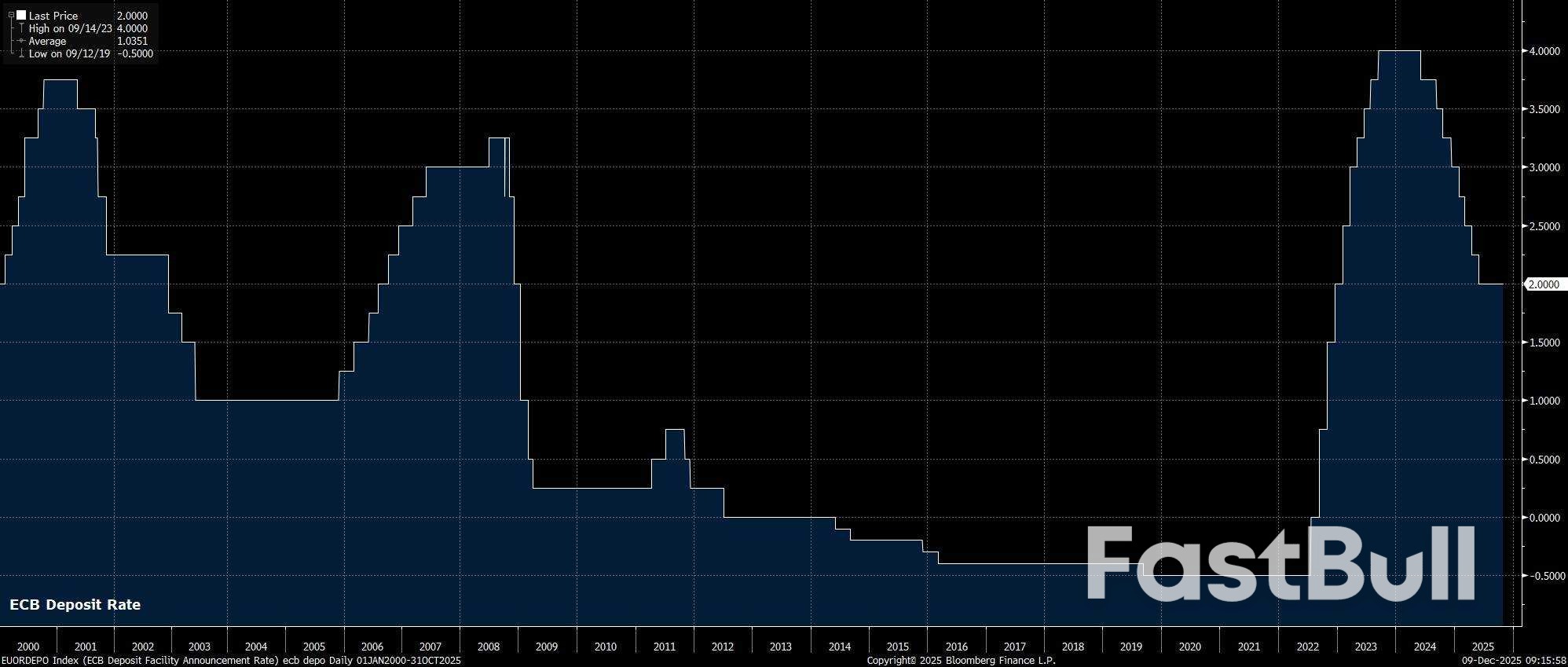
          That said, the swaps curve has got rather excitable of late, now discounting around a 1-in-5 chance that the ECB will deliver a 25bp hike by the end of next year, spurred on by hawkish comments from Exec. Board member Schnabel in recent days. That pricing does appear rather over-ambitious at this juncture, given the likelihood of a relatively sustained inflation undershoot, hence participants will be watching for any explicit pushback on the idea that policy will be tightened within the next 12 months.

          Guidance To Remain Unchanged

          With the GC set to hold all policy settings steady, focus will naturally fall on whether policymakers decide to make any guidance tweaks.

          The chances of said tweaks, however, range between 'incredibly slim' and 'none at all', with the accompanying policy statement set to simply reiterate the commentary that has been used for many months, and is now incredibly familiar to all participants. Consequently, the statement will repeat that policymakers will continue to adopt a 'data-dependent' and 'meeting-by-meeting' approach to upcoming decisions, while also making no 'pre-commitment' to a particular policy path.

          Updated Projections To Drive Policy Path

          Perhaps the most interesting area of the December confab will be the updated round of staff macroeconomic projections, particularly the first read on how the projections see the eurozone economy evolving into 2028.

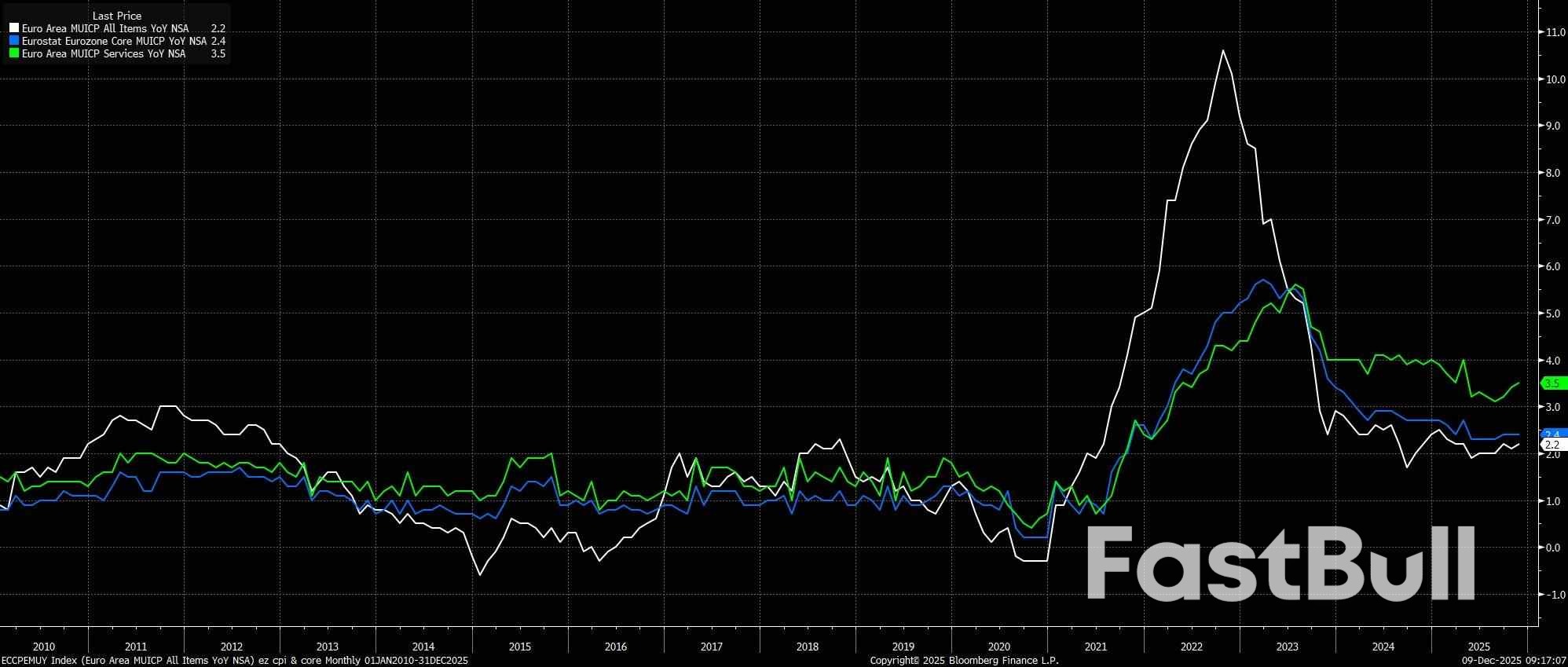
          On inflation, the projections are again likely to point to headline CPI undershooting the 2% target both next year, and in 2027. While services inflation has started to bubble away once more in recent months, the beginning of 2026 will see a significant energy-induced base effect impact the data, dragging headline price metrics (much) lower in the first half of the year.

          The two key areas of focus for the upcoming inflation projections will be, firstly, whether headline inflation is set to have risen back to 2% by the end of the horizon, in 2028. Secondly, if another undershoot is pencilled in for that year, the question becomes one of whether the Governing Council's doves view that as reason enough to begin pushing for further policy easing, in the early months of next year.
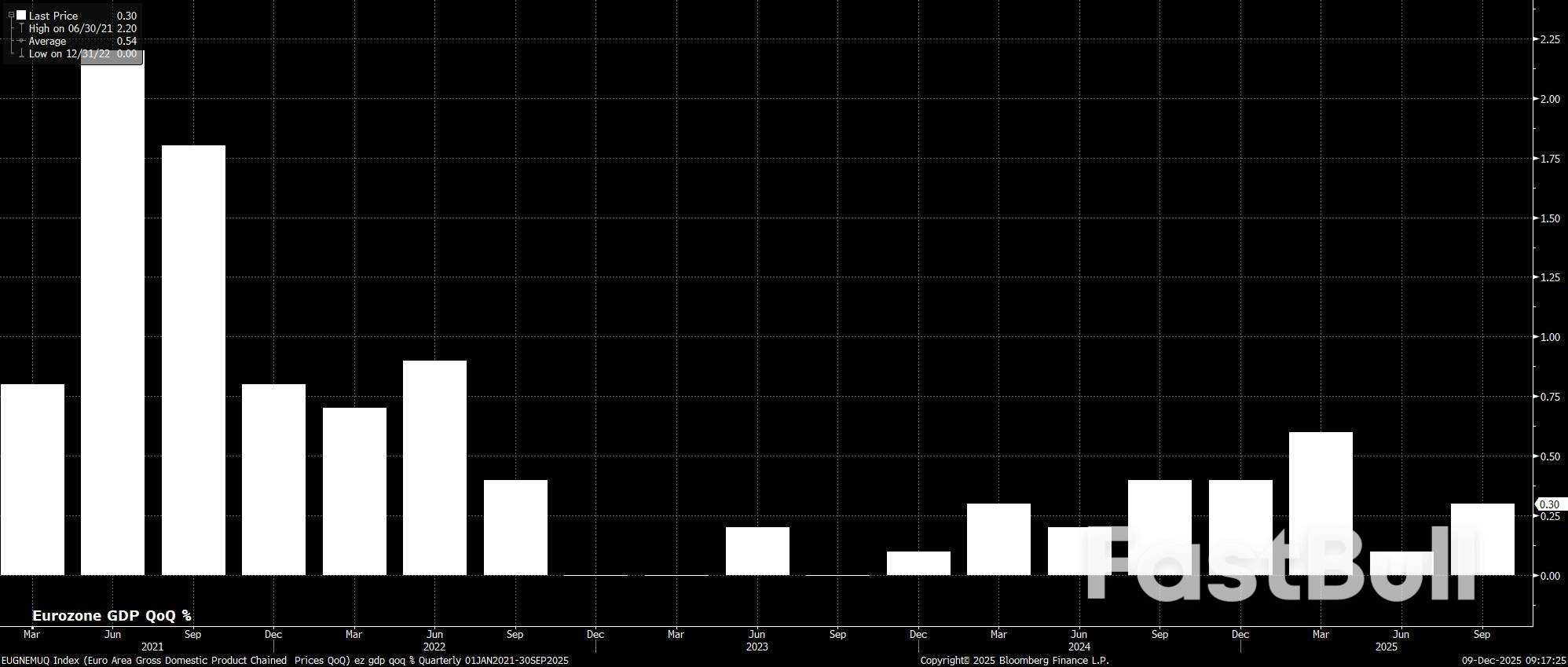
          Meanwhile, on growth, there are likely to be relatively little by way of significant changes to the forecast GDP growth path, not least considering that many of the headwinds which have buffeted the eurozone economy in 2025 will increasingly turn to tailwinds as we move into the new year. Said tailwinds are relatively numerous, including increased certainty in terms of global trading relationships (especially with the US), as well as the lagged effects of ECB policy easing, plus a broadly looser fiscal stance next year.

          Of course, said fiscal stance will not be entirely equal across the bloc. The vast majority of any fiscal boost next year will come from Germany, where not only is a significant increase on defence and infrastructure spending on the cards, but also a considerable number of tax changes which should provide a boost to personal consumption. That, in turn, at an aggregate level, is likely to offset the impact of further fiscal consolidation in both France, and Italy, which should result in the overall GDP growth forecast remaining broadly unchanged, seeing the eurozone work its way back towards potential growth in 2027 and 2028.
          Lagarde's Press Conference Shan't Rock The Boat

          Turning to the post-meeting press conference, it seems highly unlikely that President Lagarde will seek to 'rock the boat' to any significant degree, thus raising the prospect of another turgid and dull affair, in keeping with the remarks delivered last time out, in October.

          As a result, it is highly likely that Lagarde will simply reiterate the remarks that she made last time out, namely that policy is still in a 'good place', and that the ECB will ensure policy remains in such a place, while likely also confirming that the December decision to stand pat was a unanimous one.

          As always, in addition to the presser, any post-meeting 'sources' stories will also be closely watched, particularly in determining how much weight, if any, policymakers are placing on the 2028 inflation forecasts.

          Conclusion

          On the whole, the December ECB confab is unlikely to be one that goes down as a game-changer in terms of the broader policy outlook.

          While the GC's doves may seek to argue for another rate reduction early next-year, it remains likely that an overwhelming majority of policymakers see little-to-no need to shift to a more accommodative policy stance. Barring a material deterioration in economic growth, policymakers are likely to be relatively comfortable tolerating a modest inflation under-shoot, continuing to place more weight on 'hard' data, as opposed to staff projections.

          As such, the base case remains that the ECB's easing cycle has now come to an end, and that the next rate move will indeed be a hike. Such a hike, however, is near-certain not to come next year, with the deposit rate set to remain at 2.00% through the end of 2026, and the matter of policy tightening one that will, eventually, be addressed in 2027.

          Source: Pepperstone

          To stay updated on all economic events of today, please check out our Economic calendar
          Risk Warnings and Disclaimers
          You understand and acknowledge that there is a high degree of risk involved in trading. Following any strategies or investment methods may lead to potential losses. The content on the site is provided by our contributors and analysts for information purposes only. You are solely responsible for determining whether any trading assets, securities, strategy, or any other product is suitable for investing based on your own investment objectives and financial situation.
          Add to Favorites
          Share

          Saudi Arabia Bets on Data Embassies in Sovereign AI Strategy, But Doubts Persist Over Global Viability

          Gerik

          Economic

          Saudi Arabia’s Sovereign AI Ambitions Center on Data Hosting Innovation

          Amid an intensifying race for artificial intelligence dominance, Saudi Arabia is positioning itself as a global data infrastructure hub by proposing a new class of facilities: data embassies. These data centers would store sensitive national information for foreign governments within Saudi territory, but under the legal jurisdiction of the originating country mimicking the diplomatic protections of physical embassies.
          The concept, though not entirely new, remains rare. Estonia and Monaco operate the only two functioning data embassies, both located in Luxembourg, primarily for security reasons tied to cyber threats and climate change. Saudi Arabia, however, seeks to scale the model to a global framework, leveraging its geographic centrality, cheap land, and abundant capital to host the next generation of data infrastructure.
          The kingdom’s Global AI Hub Law, introduced in April 2025, outlines three potential levels of data sovereignty for guest countries, ranging from full autonomy to hybrid legal structures that would include Saudi court involvement. If implemented, this would make Saudi Arabia the first G20 nation to codify a formal data embassy regime.

          Legal Ambiguity and Trust Deficit Could Undermine Scalability

          While Saudi Arabia sees this initiative as a geopolitical differentiator, international legal experts remain cautious. Viktor Mayer-Schönberger, professor of internet governance at Oxford University, notes that without existing international legal standards, data embassies must rely on bilateral treaties, which can be slow to negotiate and fragile without trust between parties.
          This trust hurdle becomes particularly daunting in politically sensitive scenarios, such as the U.S.-China dispute over TikTok. Mayer-Schönberger argues that a data embassy arrangement between adversarial nations would likely be unworkable, as mutual suspicion outweighs legal formalism.
          Moreover, there is growing concern over how national sovereignty is defined. As Nathalie Barrera from Palo Alto Networks points out, sovereignty remains an amorphous term, with different interpretations across jurisdictions. For France, sovereignty might involve rigid data localization laws, while for Spain it may emphasize resilience and access controls complicating the uniform application of data embassy models.

          Strategic Geography vs Environmental Trade-offs

          Saudi Arabia is presenting itself as an attractive partner for data embassy deals by highlighting its low-cost infrastructure, expansive land availability, and strategic location bridging Europe, Asia, and the Middle East. These factors could appeal to countries with limited energy or real estate capacity to build their own data centers.
          However, the kingdom’s climate and energy profile poses challenges. Despite ambitions to harness solar energy, Saudi Arabia’s grid remains 64% powered by oil, according to the IEA. Additionally, water scarcity critical for cooling high-density data centers raises further ESG (Environmental, Social, and Governance) red flags. As Hortense Bioy from Morningstar Sustainalytics notes, the global expansion of data centers is already under scrutiny for their carbon and water intensity.
          This creates a potential trade-off: countries seeking data sovereignty may gain jurisdictional control by hosting data in Saudi Arabia, but at the cost of aligning with a fossil-fuel dependent infrastructure, potentially undermining their own sustainability targets.

          Globalization in Retreat: Can Data Embassies Thrive?

          The push for data embassies reflects a larger global trend away from the open-data norms of the past. The rise of AI sovereignty, national security concerns, and economic protectionism has fueled the fragmentation of internet governance. In this environment, data embassies appear as a creative solution but also one constrained by growing political divides.
          Mayer-Schönberger remains skeptical that the model will scale beyond niche applications. “The nation state remains too powerful and globalization is waning,” he said, underscoring that political self-interest, not technical innovation, will likely dictate the future of cross-border data governance.
          Saudi Arabia’s data embassy initiative is a bold and timely attempt to reimagine digital sovereignty in an age of AI geopolitics. Yet its practical success depends on forging trust-based international partnerships, navigating undefined legal terrain, and overcoming environmental concerns. While the model may appeal to smaller or allied nations in need of off-site data resilience, its ability to become a global standard is uncertain in a world increasingly shaped by strategic rivalry and data nationalism.

          Source: CNBC

          To stay updated on all economic events of today, please check out our Economic calendar
          Risk Warnings and Disclaimers
          You understand and acknowledge that there is a high degree of risk involved in trading. Following any strategies or investment methods may lead to potential losses. The content on the site is provided by our contributors and analysts for information purposes only. You are solely responsible for determining whether any trading assets, securities, strategy, or any other product is suitable for investing based on your own investment objectives and financial situation.
          Add to Favorites
          Share

          Global Economic Outlook 2026: Financial System Risk; Trade, Public Debt, Geopolitical Uncertainties

          Winkelmann

          Forex

          Economic

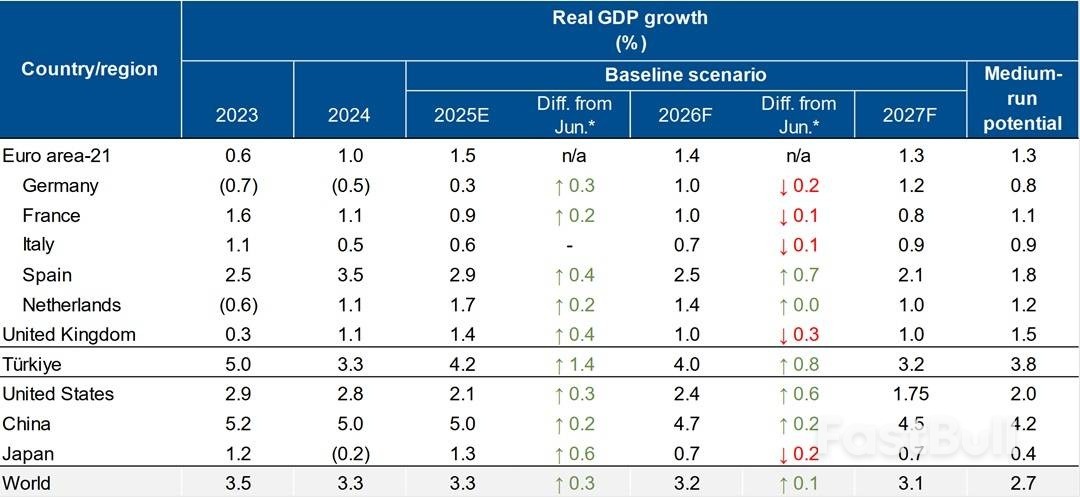
          Scope Ratings (Scope) has slightly revised up its global growth estimate for 2025 since June forecasting. The agency now sees global growth of 3.3% for this year before a resilient 3.2% next year (Table 1).

          Euro area-21 growth expectations remain moderate: 1.4% next year after the 1.5% this year.

          A pick-up is foreseen in the German economy (to 1.0% growth next year) alongside moderate growth in France (1.0%) and Italy (0.7%).

          The European economy nevertheless continues to be buoyed by strong recovery across much of the periphery. Ireland is forecast for 3.0% growth next year, with Spain at 2.5%, Portugal (2.1%) and Greece (2.0%). Growth in parts of central and eastern Europe bolsters the regional economy, including growth of 3.2% in 2026 in Bulgaria after euro accession. Meanwhile, the UK economy may grow a moderate 1.0% next year.

          Scope has revised US growth up to around 2% for this year before the US economy grows an above-potential 2.4% next year. The rating agency projects growth of 4.7% for next year in China after the economy achieves its 5% growth target for this year, supported by the recent temporary easing in US-China trading tensions.

          %, projections as of December 2025

          *Changes compared with June 2025's Global Economic Outlook. Negative growth rates presented in parentheses. Source: Scope Ratings forecasts, regional and national statistical offices, IMF.

          Negative Tilt to Macro Risk

          Nevertheless, the balance of medium-run risks for the global economic and credit outlook remains tilted to the downside. Four factors are relevant here:

          1.Financial-system risks driven by elevated valuations across multiple asset classes and a long-standing expectation of corrections in rising markets; leverage risks in the non-bank financial intermediation sector including in private credit, risks in the less-regulated artificial intelligence and cryptocurrency sectors; higher borrowing rates for longer; and US and global financial deregulation.
          2.Protectionist and volatile global trade policies spearheaded by the US but also affecting the policies of other governments.
          3.Many governments face intensifying budgetary and public debt challenges, which may facilitate market re-appraisals of sovereign risk.
          4.Heightened geopolitical uncertainties, including Russia's continuing war in Ukraine and fragilities in the Middle East.

          US Policy Shifts Pose Global Risks

          Recent US policy has had significant effects on the global economy. Pro-cyclical tax cuts, rate reductions and deregulation may present near-term support for the US and global economy, but at the cost of raising longer-run economic imbalances.

          The unwinding of post-war alliances and the war in Ukraine have prompted greater European defence expenditure and increased associated risks for sovereign debt sustainability while amplifying the chance of greater geopolitical fragility. The US decisions to halt foreign aid and review its participation in international financial institutions have raised concerns for developing economies. A reversal of climate commitments exacerbates natural-disaster risks for vulnerable countries.

          Elevated borrowing rates and financial deregulation undermine longer-run financial resilience. Scope sees higher steady-state borrowing rates lasting for longer. This is although many central banks continue easing policy, while institutions such as the ECB are on hold and the Bank of Japan gradually tightens. Sustained higher borrowing rates interact adversely with elevated market valuations and financial deregulation.

          Sector Outlooks across the rating franchises entering 2026 range from negative for the sovereign asset class, to balanced for financial institutions, to modestly positive for sub-sectors of structured finance.

          Webinar: Register here to engage with Dennis Shen, Chair of Scope Ratings' Macroeconomic Council, on Thursday, 15 January 2026 (3 pm CET) as he outlines the principal factors behind the agency's outlook of growing risks facing the resilient global economy.

          Source: FX Empire

          To stay updated on all economic events of today, please check out our Economic calendar
          Risk Warnings and Disclaimers
          You understand and acknowledge that there is a high degree of risk involved in trading. Following any strategies or investment methods may lead to potential losses. The content on the site is provided by our contributors and analysts for information purposes only. You are solely responsible for determining whether any trading assets, securities, strategy, or any other product is suitable for investing based on your own investment objectives and financial situation.
          Add to Favorites
          Share

          RBA Holds Cash Rate At 3.6%, Focused On Upside

          Westpac

          Forex

          Economic

          Central Bank

          The RBA kept the cash rate on hold as expected. The Board was slightly more hawkish but Governor Bullock was firmly focused on the upside risks to inflation. We are less convinced that capacity constraints will be an issue for inflation, which could bring back the debate for rate cuts.

          · As widely expected, the RBA kept the cash rate on hold at 3.6% in a unanimous decision. The statement struck a slightly more hawkish note but in the following media conference Governor Michele Bullock was focused on the upside risks to inflation.
          · Following the media conference, the probability of a rate hike has risen. But we see this to be dependent on data over the coming months and a more likely scenario is a prolonged pause.
          · Rate cuts could still be brought back to the table if our view that supply will not be a constraint and the economy can grow faster without triggering inflation is realised.
          · As such, our current baseline is for two 25bp rate cuts but not until mid-2026. This would bring the cash rate to 3.1% –125bp below its peak this monetary policy cycle.

          Today's decision by the RBA to leave the cash rate unchanged at 3.6% was widely anticipated by the market and economists. It was a unanimous decision. The statement struck a slightly more hawkish note but in the following media conference, Governor Bullock indicated that the Board was focused on the upside risks to inflation.

          She confirmed that at today's meeting "a rate cut was not on the table", adding that supply and demand conditions are a little tight. The potential necessary conditions for a rate hike in 2026 were also discussed as the Board believe the balance of risks for inflation have tilted to the upside.

          While the Board acknowledged that some of the recent increase in underlying inflation was due to temporary factors, they still saw some signs of a broader pick-up. They also remain concerned over labour market tightness and strong growth in broader measures of wages and high unit labour costs.

          They will continue to monitor these factors against a backdrop of what they believe to be a stronger pick up in private demand that could lead to capacity pressures.

          But as our Chief Economist Luci Ellis recently noted in "Swing up, you won't hit a wall", the view that stronger private demand will quickly collide with supply constraints is misplaced. Indeed, we think the RBA and some other economists' projection of trend growth of 2% is too conservative. We see 2¼% or higher as realistic given population, participation, and potential productivity gains.

          There is no denying that overall productivity has been very weak. But as we have previously highlighted, this in part reflects the rapid increase in the share of the care economy over recent years, which is very labour intensive and mechanically less productive than the market sector. But as private demand and the market sector become an increasing driver of economic growth, this will support an improvement in headline productivity measures. This is not just a shift in the composition of the economy. The recovery in business investment, as seen in the Q3 National Accounts, and the solid lift in private business capex intentions will see the share of business investment lift from its historical lows. With more capital per worker, we will see stronger productivity. Then there is the technological innovation and adoption, including an eventual lift from AI.

          It is also worth noting that the economy is not booming. Real disposable income per person has only just returned to 2020 levels, the stimulatory impact of Stage 3 tax cuts are rolling off and with rates on hold for longer, the boost from earlier rate cuts will also fade.

          Overall, we do not expect the economy to hit a hard capacity wall any time soon. If this view proves correct, the economy can grow faster without triggering further inflation, reducing the need for slightly restrictive policy.

          Indeed, we expect core inflation to ease back toward, and eventually below, the mid-point of the target band by the end of 2026. Much of the recent increase reflects higher administrative prices, seasonal volatility and the removal of cost-of-living assistance. These are unlikely to be repeated to the same extent. Further out, as productivity improves and wage inflation moderates this will also support lower core inflation.

          As such, our current baseline is for two more 25bp rate cuts but not until mid-2026. This would bring the policy rate to 3.1% – 125bp below its peak this monetary cycle.

          Still, following Governor Bullock's comments in today's press conference, the probability of a rate hike has risen. This would be dependent on persistence of the current reacceleration in inflation. Instead, we see the risks as being more tilted to a prolonged pause. The evolution of the data over the coming months will see the RBA reassess the sustainability of inflation moving back to target and the restrictiveness of current policy settings.

          Source: Westpac Banking Corporation

          To stay updated on all economic events of today, please check out our Economic calendar
          Risk Warnings and Disclaimers
          You understand and acknowledge that there is a high degree of risk involved in trading. Following any strategies or investment methods may lead to potential losses. The content on the site is provided by our contributors and analysts for information purposes only. You are solely responsible for determining whether any trading assets, securities, strategy, or any other product is suitable for investing based on your own investment objectives and financial situation.
          Add to Favorites
          Share

          Europe Nears Deal on Using Frozen Russian Assets as U.S. Pressure on Ukraine Grows

          Gerik

          Political

          Russia-Ukraine Conflict

          Europe Pushes Ahead on Asset-Based Support for Ukraine

          Following high-level talks in London, European leaders have expressed growing confidence that a deal can be struck by year-end to use immobilized Russian central bank assets in support of Ukraine. UK Prime Minister Keir Starmer's office confirmed that "positive progress" was made on plans to back a €90 billion ($105 billion) loan aimed at funding Ukraine’s reconstruction, even as internal EU resistance particularly from Belgium, where a significant portion of the assets are held has slowed progress.
          Finnish Foreign Minister Elina Valtonen told Bloomberg that a legally and politically sustainable framework is close, emphasizing that using Russian state assets to support Ukraine is not only justified but necessary. A final decision is expected at the EU leaders’ summit in Brussels on December 18.

          US Stalls on Security Guarantees as Europe Seeks Unity

          While Europe moves toward a financial solution, deepening strategic divergence with the United States has become apparent. The Trump administration has largely paused direct aid to Ukraine, instead floating a 28-point peace plan that, according to officials in Kyiv and Brussels, initially leaned too far in Russia’s favor. Though the framework has since been revised to a 20-point version, the updated plan still lacks clear consensus, especially on key issues like NATO membership and territorial integrity.
          Ukrainian President Volodymyr Zelenskiy stated that the most sensitive components control over Donetsk and Luhansk and binding U.S. security guarantees remain unresolved. He emphasized that a ceasefire must align with the current front line and rejected any proposal requiring Ukrainian troop withdrawal from contested regions. The US, meanwhile, has proposed turning parts of Donbas into a demilitarized zone, which Kyiv and its European backers view as an unacceptable concession to Moscow.

          Zelenskiy Navigates Diplomatic Tightrope Amid US-Russia Peace Talks

          The London summit, attended by leaders from the UK, France, Germany, and representatives from other NATO and EU member states, was followed by broader coordination calls with senior figures from Italy, Poland, the Netherlands, Sweden, and Turkey. These discussions underscored Europe’s growing concern that the US-led negotiations are sidelining allies and veering toward a settlement that lacks enforceable protections for Ukraine.
          Trump’s appointment of his envoy Steve Witkoff and son-in-law Jared Kushner to help broker the deal has added to European skepticism. In contrast, Ukraine continues diplomatic outreach, with Zelenskiy shuttling between Brussels and Rome, and indicating a willingness to meet Trump in person if substantive progress can be achieved.
          Trump, speaking to reporters, criticized Zelenskiy for not reviewing the latest proposal and claimed that Russia was “fine with it.” His administration's latest national security strategy reflects a diminished appetite for prolonged engagement, asserting that Europe harbors "unrealistic expectations" for the war.

          Geopolitical Implications and the Path Ahead

          The proposal to repurpose frozen Russian assets has gained traction partly due to the financial vacuum left by declining US support. The EU estimates Ukraine will require at least €135 billion over the next two years to maintain core government functions and military resilience. As such, the asset-based loan model could become the backbone of Western support moving forward.
          However, the legality of diverting frozen sovereign assets remains contested within international financial frameworks, and member states like Belgium have raised concerns about setting a precedent that could weaken future central bank protections globally. Still, the moral and political argument for such a move has gained ground as the war drags on and reconstruction needs mount.

          Europe Advances While Transatlantic Unity Falters

          As negotiations around Ukraine's future intensify, Europe is proactively seeking financial and political solutions to support Kyiv, including repurposing Russian state assets and aligning on long-term reconstruction. In contrast, the United States under Trump’s recalibrated foreign policy appears more focused on ending the war quickly, even at the risk of undermining Ukraine’s sovereignty.
          With time running out before key summits and decisions, the outcome of these parallel efforts will shape the future of European security, postwar reconstruction, and the balance of power between democratic alliances and autocratic regimes. Whether Kyiv secures both the funding and the guarantees it needs depends on how aligned or fractured its Western allies remain in the crucial weeks ahead.

          Source: Reuters

          Risk Warnings and Disclaimers
          You understand and acknowledge that there is a high degree of risk involved in trading. Following any strategies or investment methods may lead to potential losses. The content on the site is provided by our contributors and analysts for information purposes only. You are solely responsible for determining whether any trading assets, securities, strategy, or any other product is suitable for investing based on your own investment objectives and financial situation.
          Add to Favorites
          Share

          EURUSD In Positive Territory, But The Market Focus May Shift

          Justin

          Forex

          Commodity

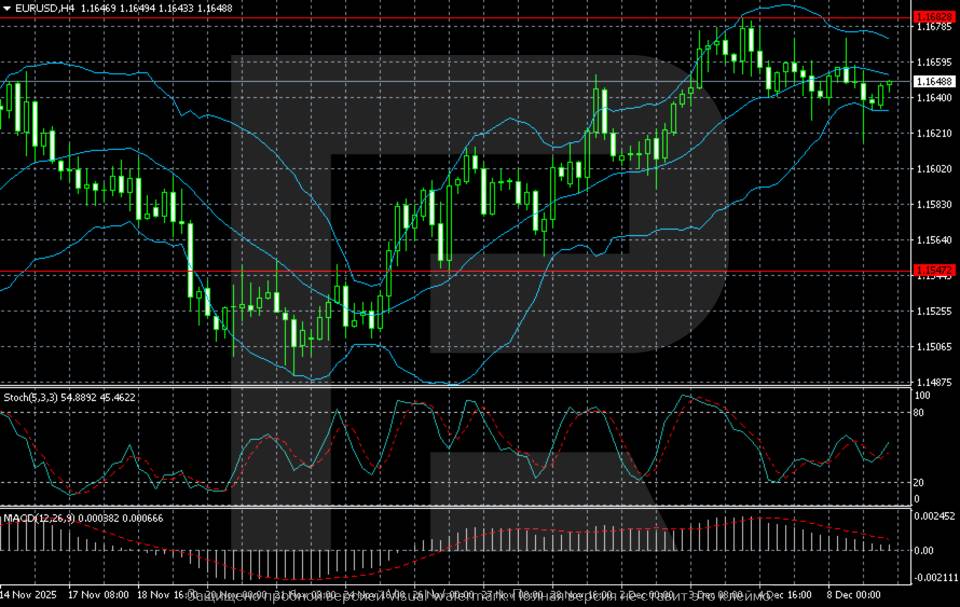
          The EURUSD pair has risen to 1.1648. All eyes are on the Federal Reserve's December meeting.

          EURUSD forecast: key trading points

          · Market focus: delayed US labour market data is in the spotlight
          · Current trend: the EURUSD pair is rising ahead of the Fed's decision
          · EURUSD forecast for 9 December 2025: 1.1682

          Fundamental analysis

          The EURUSD rate is edging higher on Tuesday, reaching 1.1648. However, overall, the major currency pair continues to move sideways ahead of the two-day Federal Reserve meeting, where the market is nearly unanimous in expecting a rate cut.

          The likelihood of a 25-basis-point rate reduction on Wednesday is estimated at about 87%, up from around 67% a month ago. Still, the outlook for 2026 remains uncertain. A hawkish cut is possible, in which Jerome Powell signals caution regarding further easing steps.

          Investors are also awaiting key US macroeconomic releases. Today, the postponed JOLTS job openings report for October will be published, followed by initial jobless claims and the trade balance later in the week.

          The EURUSD forecast is favourable.

          EURUSD technical analysis

          On the H4 chart, the EURUSD pair maintains a moderately bullish trajectory, but upward momentum has noticeably weakened. The price is consolidating below the 1.1682 resistance level, which has repeatedly capped attempts at growth. Quotes are currently moving along the middle Bollinger Band, indicating the absence of a strong trend. The upper band is slightly turning downwards, reflecting lower volatility.

          The Stochastic Oscillator is in the mid-range around 45, giving no clear signals. The market is out of oversold territory but lacks a confident bullish trigger. MACD remains positive, yet its histogram is declining, underscoring weakening bullish momentum and a likely phase of sideways consolidation.

          The nearest support level is located at 1.1547 – the level from which the previous strong recovery began. The resistance stands at 1.1682. A breakout above this level would open the path towards 1.1750. As long as the pair trades between these boundaries, the baseline scenario is consolidation within the range with a mild upward tilt.

          Summary

          The EURUSD pair is rising slightly, but very cautiously. The EURUSD forecast for today, 9 December 2025, suggests a mild upward move towards 1.1682.

          EURUSD 2026-2027 forecast: key market trends and future predictions

          This article provides the EURUSD forecast for 2026 and 2027 and highlights the main factors determining the direction of the pair's movements. We will apply technical analysis, take into account the opinions of leading experts, large banks, and financial institutions, and study AI-based forecasts. This comprehensive insight into EURUSD predictions should help investors and traders make informed decisions.

          Gold (XAUUSD) forecast 2026 and beyond: expert insights, price predictions, and analysis

          Dive deep into the Gold (XAUUSD) price outlook for 2026 and beyond, combining technical analysis, expert forecasts, and key macroeconomic factors. It explains the drivers behind gold's recent surge, explores potential scenarios including a move toward 4,500 to 5,000 USD per ounce, and highlights why the metal remains a strong hedge during global uncertainty.

          Source: RoboForex

          Risk Warnings and Disclaimers
          You understand and acknowledge that there is a high degree of risk involved in trading. Following any strategies or investment methods may lead to potential losses. The content on the site is provided by our contributors and analysts for information purposes only. You are solely responsible for determining whether any trading assets, securities, strategy, or any other product is suitable for investing based on your own investment objectives and financial situation.
          Add to Favorites
          Share

          BAT Warns 2026 Growth At Low End Of Range Despite U.S. Nicotine Gains

          Winkelmann

          Economic

          Stocks

          British American Tobacco on Tuesday reaffirmed its 2026 growth targets but said performance will likely come in at the lower end of its 3% to 5% revenue growth range, as the London-based tobacco company navigates a transition to nicotine alternatives amid regional headwinds.

          The company expects approximately 2% revenue and adjusted profit growth for fiscal year 2025, with New Category products, encompassing heated tobacco, vapor and nicotine pouches, accelerating to double-digit growth in the second half.

          Chief executive Tadeu Marroco said the company remains "focused on establishing glo Hilo as a premium offering in the largest Heated Products profit pools" with launches in Japan in September and Poland in October, with additional rollouts planned for 2026.

          BAT's U.S. operations showed the strongest momentum, with value share rising 20 basis points while volume share remained flat.

          The company's Velo Plus nicotine pouch drove Modern Oral volume share up 920 basis points in the U.S. market, where BAT said it is on track for full-year profitability in its New Category business.

          The Velo brand achieved 15.9% volume share of Total Oral products and 31.8% of Modern Oral products globally, representing increases of 460 basis points and 590 basis points respectively.

          BAT's Vuse vapor brand, which maintained global leadership in tracked channels with value share in top markets up 10 basis points, showed improved second-half performance despite ongoing challenges from illicit products.

          The company expects full-year Vuse revenue to decline in the high-single digits, compared to a 13% drop in the first half.

          Regional performance varied significantly. The Americas excluding the U.S., led by Brazil, Turkey and Mexico, delivered strong results. However, the Asia-Pacific, Middle East and Africa region faced material fiscal and regulatory headwinds in Bangladesh and Pakistan that will impact adjusted profit growth.

          The company's glo heated tobacco product line saw volume share in top markets decline 1.2 percentage points, impacted by competition in Japan.

          BAT's Americas excluding U.S. volume share for glo declined 60 basis points as the company made resource allocation decisions ahead of the glo Hilo rollout.

          Globally, BAT's group value share in top cigarette markets remained flat while volume share declined 10 basis points. The company projects global tobacco industry volume will decline approximately 2% for 2025.

          BAT announced £1.3 billion in share buybacks for fiscal year 2026, up from £1.1 billion in 2025. The company expects operating cash flow conversion to exceed 95% in 2025, with gross capital expenditure of approximately £1.2 billion.

          For fiscal year 2025, BAT projects mid-single digit New Category revenue growth at constant rates, with approximately 2% adjusted profit from operations growth at constant rates.

          The company anticipates a roughly 3% translational foreign exchange headwind on adjusted profit from operations and approximately 4% on adjusted earnings per share. Net finance costs are projected at approximately £1.8 billion.

          Source: Investing

          To stay updated on all economic events of today, please check out our Economic calendar
          Risk Warnings and Disclaimers
          You understand and acknowledge that there is a high degree of risk involved in trading. Following any strategies or investment methods may lead to potential losses. The content on the site is provided by our contributors and analysts for information purposes only. You are solely responsible for determining whether any trading assets, securities, strategy, or any other product is suitable for investing based on your own investment objectives and financial situation.
          Add to Favorites
          Share
          FastBull
          Copyright © 2025 FastBull Ltd

          728 RM B 7/F GEE LOK IND BLDG NO 34 HUNG TO RD KWUN TONG KLN HONG KONG

          TelegramInstagramTwitterfacebooklinkedin
          App Store Google Play Google Play
          Products
          Charts

          Chats

          Q&A with Experts
          Screeners
          Economic Calendar
          Data
          Tools
          Membership
          Features
          Function
          Markets
          Copy Trading
          Latest Signals
          Contests
          News
          Analysis
          24/7
          Columns
          Education
          Company
          Careers
          About Us
          Contact Us
          Advertising
          Help Center
          Feedback
          User Agreement
          Privacy Policy
          Business

          White Label

          Data API

          Web Plug-ins

          Poster Maker

          Affiliate Program

          Risk Disclosure

          The risk of loss in trading financial instruments such as stocks, FX, commodities, futures, bonds, ETFs and crypto can be substantial. You may sustain a total loss of the funds that you deposit with your broker. Therefore, you should carefully consider whether such trading is suitable for you in light of your circumstances and financial resources.

          No decision to invest should be made without thoroughly conducting due diligence by yourself or consulting with your financial advisors. Our web content might not suit you since we don't know your financial conditions and investment needs. Our financial information might have latency or contain inaccuracy, so you should be fully responsible for any of your trading and investment decisions. The company will not be responsible for your capital loss.

          Without getting permission from the website, you are not allowed to copy the website's graphics, texts, or trademarks. Intellectual property rights in the content or data incorporated into this website belong to its providers and exchange merchants.

          Not Logged In

          Log in to access more features

          FastBull Membership

          Not yet

          Purchase

          Become a signal provider
          Help Center
          Customer Service
          Dark Mode
          Price Up/Down Colors

          Log In

          Sign Up

          Position
          Layout
          Fullscreen
          Default to Chart
          The chart page opens by default when you visit fastbull.com