• Trade
  • Markets
  • Copy
  • Contests
  • News
  • 24/7
  • Calendar
  • Q&A
  • Chats
Trending
Screeners
SYMBOL
LAST
BID
ASK
HIGH
LOW
NET CHG.
%CHG.
SPREAD
SPX
S&P 500 Index
6827.42
6827.42
6827.42
6899.86
6801.80
-73.58
-1.07%
--
DJI
Dow Jones Industrial Average
48458.04
48458.04
48458.04
48886.86
48334.10
-245.98
-0.51%
--
IXIC
NASDAQ Composite Index
23195.16
23195.16
23195.16
23554.89
23094.51
-398.69
-1.69%
--
USDX
US Dollar Index
97.920
98.000
97.920
98.070
97.810
-0.030
-0.03%
--
EURUSD
Euro / US Dollar
1.17461
1.17468
1.17461
1.17596
1.17262
+0.00067
+ 0.06%
--
GBPUSD
Pound Sterling / US Dollar
1.33854
1.33861
1.33854
1.33961
1.33546
+0.00147
+ 0.11%
--
XAUUSD
Gold / US Dollar
4330.84
4331.25
4330.84
4350.16
4294.68
+31.45
+ 0.73%
--
WTI
Light Sweet Crude Oil
56.880
56.910
56.880
57.601
56.789
-0.353
-0.62%
--

Community Accounts

Signal Accounts
--
Profit Accounts
--
Loss Accounts
--
View More

Become a signal provider

Sell trading signals to earn additional income

View More

Guide to Copy Trading

Get started with ease and confidence

View More

Signal Accounts for Members

All Signal Accounts

Best Return
  • Best Return
  • Best P/L
  • Best MDD
Past 1W
  • Past 1W
  • Past 1M
  • Past 1Y

All Contests

  • All
  • Trump Updates
  • Recommend
  • Stocks
  • Cryptocurrencies
  • Central Banks
  • Featured News
Top News Only
Share

Portugal Treasury Expects 2026 Net Financing Needs At 29.4 Billion Euros, Up From 25.8 Billion In 2025

Share

Bank Of America Says With Indonesia's Smelter Now Ramping Up, It Expects Aluminium Supply Growth To Accelerate To 2.6% Year On Year In 2026

Share

Bank Of America Expects A Deficit In Aluminium Next Year And Sees Prices Pushing Above $3000/T

Share

Fed Data - USA Effective Federal Funds Rate At 3.64 Percent On 12 December On $102 Billion In Trades Versus 3.64 Percent On $99 Billion On 11 December

Share

Brazil's Petrobras Says No Impact Seen On Oil, Petroleum Products Output As Workers Start Planned Strike

Share

Statement: US Travel Group Warns New Proposed Trump Administration Requirements For Foreign Tourists To Provide Social Media Histories Could Mean Millions Of People Opting Not To Visit

Share

Blackrock: Kerry White Will Become Head Of Citi Investment Management At Citi Wealth

Share

Blackrock: Rob Jasminski, Head Of Citi Investment Management, Has Joined With Team

Share

Blackrock: Effective Dec 15, Citi Investment Management Employees Will Join Blackrock

Share

Blackrock: Formally Launch Citi Portfolio Solutions Powered By Blackrock

Share

According To Data From The Federal Reserve Bank Of New York, The Secured Overnight Funding Rate (Sofr) Was 3.67% On The Previous Trading Day (December 15), Compared To 3.66% The Day Before

Share

Peru Energy And Mines Ministry: Copper Production Up 4.8% Year-On-Year In October To 248192 Metric Tons

Share

Security Source: Ukrainian Drones Hits Russian Oil Infrastructure In Caspian Sea For Third Time

Share

Spot Palladium Extends Gains, Last Up 5% To $1562.7/Oz

Share

Mexico's Economy Ministry Announces Start Of Anti-Dumping Investigation And Anti-Subsidy Investigations Into USA Pork Imports

Share

Canada Nov CPI Common +2.8%, CPI Median +2.8%, CPI Trim +2.8% On Year

Share

NY Fed's Empire State Prices Paid Index +37.6 In December Versus+49.0 In November

Share

Canada Nov Consumer Prices +0.1% On Month, +2.2% On Year

Share

Canada Nov CPI Core -0.1% On Month, +2.9% On Year

Share

Canada Nov Core CPI, Seasonally Adjusted +0.2% On Month, Oct +0.3% (Unrevised)

TIME
ACT
FCST
PREV
Japan Tankan Small Manufacturing Outlook Index (Q4)

A:--

F: --

P: --

Japan Tankan Large Non-Manufacturing Outlook Index (Q4)

A:--

F: --

P: --

Japan Tankan Large Manufacturing Outlook Index (Q4)

A:--

F: --

P: --

Japan Tankan Small Manufacturing Diffusion Index (Q4)

A:--

F: --

P: --

Japan Tankan Large Manufacturing Diffusion Index (Q4)

A:--

F: --

P: --

Japan Tankan Large-Enterprise Capital Expenditure YoY (Q4)

A:--

F: --

P: --

U.K. Rightmove House Price Index YoY (Dec)

A:--

F: --

P: --

China, Mainland Industrial Output YoY (YTD) (Nov)

A:--

F: --

P: --

China, Mainland Urban Area Unemployment Rate (Nov)

A:--

F: --

P: --

Saudi Arabia CPI YoY (Nov)

A:--

F: --

P: --

Euro Zone Industrial Output YoY (Oct)

A:--

F: --

P: --

Euro Zone Industrial Output MoM (Oct)

A:--

F: --

P: --

Canada Existing Home Sales MoM (Nov)

A:--

F: --

P: --

Canada National Economic Confidence Index

A:--

F: --

P: --

Canada New Housing Starts (Nov)

A:--

F: --

P: --
U.S. NY Fed Manufacturing Employment Index (Dec)

A:--

F: --

P: --

U.S. NY Fed Manufacturing Index (Dec)

A:--

F: --

P: --

Canada Core CPI YoY (Nov)

A:--

F: --

P: --

Canada Manufacturing Unfilled Orders MoM (Oct)

A:--

F: --

P: --

U.S. NY Fed Manufacturing Prices Received Index (Dec)

A:--

F: --

P: --

U.S. NY Fed Manufacturing New Orders Index (Dec)

A:--

F: --

P: --

Canada Manufacturing New Orders MoM (Oct)

A:--

F: --

P: --

Canada Core CPI MoM (Nov)

A:--

F: --

P: --

Canada Trimmed CPI YoY (SA) (Nov)

A:--

F: --

P: --

Canada Manufacturing Inventory MoM (Oct)

A:--

F: --

P: --

Canada CPI YoY (Nov)

A:--

F: --

P: --

Canada CPI MoM (Nov)

A:--

F: --

P: --

Canada CPI YoY (SA) (Nov)

A:--

F: --

P: --

Canada Core CPI MoM (SA) (Nov)

A:--

F: --

P: --

Canada CPI MoM (SA) (Nov)

A:--

F: --

P: --

Federal Reserve Board Governor Milan delivered a speech
U.S. NAHB Housing Market Index (Dec)

--

F: --

P: --

Australia Composite PMI Prelim (Dec)

--

F: --

P: --

Australia Services PMI Prelim (Dec)

--

F: --

P: --

Australia Manufacturing PMI Prelim (Dec)

--

F: --

P: --

Japan Manufacturing PMI Prelim (SA) (Dec)

--

F: --

P: --

U.K. 3-Month ILO Employment Change (Oct)

--

F: --

P: --

U.K. Unemployment Claimant Count (Nov)

--

F: --

P: --

U.K. Unemployment Rate (Nov)

--

F: --

P: --

U.K. 3-Month ILO Unemployment Rate (Oct)

--

F: --

P: --

U.K. Average Weekly Earnings (3-Month Average, Including Bonuses) YoY (Oct)

--

F: --

P: --

U.K. Average Weekly Earnings (3-Month Average, Excluding Bonuses) YoY (Oct)

--

F: --

P: --

France Services PMI Prelim (Dec)

--

F: --

P: --

France Composite PMI Prelim (SA) (Dec)

--

F: --

P: --

France Manufacturing PMI Prelim (Dec)

--

F: --

P: --

Germany Services PMI Prelim (SA) (Dec)

--

F: --

P: --

Germany Manufacturing PMI Prelim (SA) (Dec)

--

F: --

P: --

Germany Composite PMI Prelim (SA) (Dec)

--

F: --

P: --

Euro Zone Composite PMI Prelim (SA) (Dec)

--

F: --

P: --

Euro Zone Services PMI Prelim (SA) (Dec)

--

F: --

P: --

Euro Zone Manufacturing PMI Prelim (SA) (Dec)

--

F: --

P: --

U.K. Services PMI Prelim (Dec)

--

F: --

P: --

U.K. Manufacturing PMI Prelim (Dec)

--

F: --

P: --

U.K. Composite PMI Prelim (Dec)

--

F: --

P: --

Euro Zone ZEW Economic Sentiment Index (Dec)

--

F: --

P: --

Germany ZEW Current Conditions Index (Dec)

--

F: --

P: --

Germany ZEW Economic Sentiment Index (Dec)

--

F: --

P: --

Euro Zone Trade Balance (Not SA) (Oct)

--

F: --

P: --

Euro Zone ZEW Current Conditions Index (Dec)

--

F: --

P: --

Euro Zone Trade Balance (SA) (Oct)

--

F: --

P: --

U.S. Retail Sales MoM (Excl. Automobile) (SA) (Oct)

--

F: --

P: --

Q&A with Experts
    • All
    • Chatrooms
    • Groups
    • Friends
    Connecting
    .
    .
    .
    Type here...
    Add Symbol or Code

      No matching data

      All
      Trump Updates
      Recommend
      Stocks
      Cryptocurrencies
      Central Banks
      Featured News
      • All
      • Russia-Ukraine Conflict
      • Middle East Flashpoint
      • All
      • Russia-Ukraine Conflict
      • Middle East Flashpoint

      Search
      Products

      Charts Free Forever

      Chats Q&A with Experts
      Screeners Economic Calendar Data Tools
      Membership Features
      Data Warehouse Market Trends Institutional Data Policy Rates Macro

      Market Trends

      Market Sentiment Order Book Forex Correlations

      Top Indicators

      Charts Free Forever
      Markets

      News

      News Analysis 24/7 Columns Education
      From Institutions From Analysts
      Topics Columnists

      Latest Views

      Latest Views

      Trending Topics

      Top Columnists

      Latest Update

      Signals

      Copy Rankings Latest Signals Become a signal provider AI Rating
      Contests
      Brokers

      Overview Brokers Assessment Rankings Regulators News Claims
      Broker listing Forex Brokers Comparison Tool Live Spread Comparison Scam
      Q&A Complaint Scam Alert Videos Tips to Detect Scam
      More

      Business
      Events
      Careers About Us Advertising Help Center

      White Label

      Data API

      Web Plug-ins

      Affiliate Program

      Awards Institution Evaluation IB Seminar Salon Event Exhibition
      Vietnam Thailand Singapore Dubai
      Fans Party Investment Sharing Session
      FastBull Summit BrokersView Expo
      Recent Searches
        Top Searches
          Markets
          News
          Analysis
          User
          24/7
          Economic Calendar
          Education
          Data
          • Names
          • Latest
          • Prev

          View All

          No data

          Scan to Download

          Faster Charts, Chat Faster!

          Download App
          English
          • English
          • Español
          • العربية
          • Bahasa Indonesia
          • Bahasa Melayu
          • Tiếng Việt
          • ภาษาไทย
          • Français
          • Italiano
          • Türkçe
          • Русский язык
          • 简中
          • 繁中
          Open Account
          Search
          Products
          Charts Free Forever
          Markets
          News
          Signals

          Copy Rankings Latest Signals Become a signal provider AI Rating
          Contests
          Brokers

          Overview Brokers Assessment Rankings Regulators News Claims
          Broker listing Forex Brokers Comparison Tool Live Spread Comparison Scam
          Q&A Complaint Scam Alert Videos Tips to Detect Scam
          More

          Business
          Events
          Careers About Us Advertising Help Center

          White Label

          Data API

          Web Plug-ins

          Affiliate Program

          Awards Institution Evaluation IB Seminar Salon Event Exhibition
          Vietnam Thailand Singapore Dubai
          Fans Party Investment Sharing Session
          FastBull Summit BrokersView Expo

          Asia Week Ahead: Rate Decisions In South Korea And Philippines, Key Data On Japan, India, And China

          ING

          Economic

          Political

          Forex

          Summary:

          The Bank of Korea's meeting on Thursday will be a highlight of the week. The market widely expects no action, but it will pay close attention to the latest quarterly macro outlook report.

          South Korea: BoK's next rate cut likely in October

          The Bank of Korea's meeting on Thursday will be a highlight of the week. The market widely expects no action, but it will pay close attention to the latest quarterly macro outlook report. With inflation anchored at 2% and growth projected to pick up in the second half of 2025, financial stability remains the priority. The BoK will probably wait for clearer signs of moderation in house prices before taking action. It may raise its 2025 GDP forecast from 0.8% year-on-year to 1.0%, and its 2026 GDP forecast from 1.6% to 1.7%. GDP in the second quarter was stronger than expected. On top of that, consumption is likely to soar in the third quarter, largely due to government cash payout programmes. This will be reflected in next week's consumer sentiment survey and retail sales, which should improve compared to the previous month. However, the fiscal outlook could be a drag unless more expansionary policies are implemented. Also, sluggish construction investment should weigh on overall growth. The BoK will remain cautious amid tariff-related uncertainty, even as the US–Korea trade deal should be welcomed by the central bank. The inflation outlook is expected to be revised up to 2.0% for 2025 (vs a 1.9% May outlook), with the 2026 outlook unchanged at 1.8%. A below-2% rate paves the way for further easing. Even if the BoK revises the growth outlook upwards, it would still be below potential GDP. With the negative output gap expected to persist, the BoK should ease monetary conditions -- most likely in October.

          Philippines: BSP expected to cut interest rates by 25 bps

          We continue to expect Bangko Sentral ng Pilipinas (BSP) to cut rates by 25bp to 5%. We don't believe that the relative strength in growth data will deter the central bank from cutting rates in August as CPI inflation remains firmly below the inflation target. While CPI readings should accelerate from here, contained domestic rice prices and a reversal in oil should keep inflation subdued. Additionally, recent comments by the BSP suggest more active steps to intervene in FX markets to contain currency volatility. This should keep imported inflation contained.

          Japan: Inflation is expected to cool down

          Tokyo's inflation data is widely anticipated, with headline prices set to slow to 2.6% year-on-year in August from 2.9% in July. This decline is mainly due to falling energy prices, while fresh food prices continue to rise. Core inflation, excluding fresh food and energy, is expected to remain above 3%, which would bolster the Bank of Japan’s confidence that underlying prices are approaching 2%. Meanwhile, industrial production is expected to decline by 1.2% month-on-month seasonally adjusted in July, partially offsetting the previous month's 2.1% gain. The temporary increase in output related to tariff-related front-loading might normalise in July. However, retail sales are expected to rise, supported by solid wage growth. The unemployment rate is expected to remain at 2.5%, signalling tight labour market conditions which will eventually lead to more sustainable wage growth.

          India: Q2 GDP growth expected to slow down

          We expect second-quarter Indian GDP growth to ease to 6.4% YoY, below market expectations. High-frequency indicators point to a moderation in both private consumption and investment. Additionally, higher-than-expected tariffs and rising uncertainty around India's trade policy with the US are emerging as downside risks to the 2025 growth outlook.

          China: Industrial profits likely to remain under pressure

          Industrial profits data for July, out on Wednesday, is likely to show continued downward pressure. Moving forward, “anti-involution” measures to combat deflationary price wars will be important in tackling the high proportion of loss-making enterprises and excess industrial capacity. But given the negative externalities of such a policy drive, this will likely be a very gradual process. Profits could remain under pressure this year.

          Key events in Asia next week
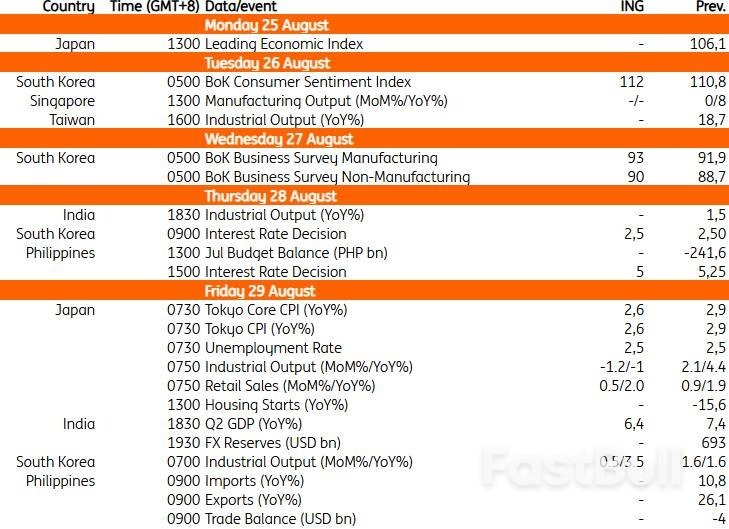
          Source: ING

          To stay updated on all economic events of today, please check out our Economic calendar
          Risk Warnings and Disclaimers
          You understand and acknowledge that there is a high degree of risk involved in trading. Following any strategies or investment methods may lead to potential losses. The content on the site is provided by our contributors and analysts for information purposes only. You are solely responsible for determining whether any trading assets, securities, strategy, or any other product is suitable for investing based on your own investment objectives and financial situation.
          Add to Favorites
          Share

          IC Markets Asia Fundamental Forecast | 22 August 2025

          IC Markets

          Commodity

          Forex

          Economic

          What happened in the U.S session?

          The U.S. session was shaped by anticipation of Fed policy signals, softer labor market data, retail sector disappointments, and rising volatility impacting tech, retail equities, oil prices, and the dollar most noticeably. President Donald Trump renewed criticism of Powell and pressured another Fed governor, Lisa Cook, for alleged mortgage improprieties, raising uncertainty over Fed governance and policy direction.

          What does it mean for the Asia sessions?

          Friday, August 22, 2025, is a critical day for Asian traders due to anticipated signals from U.S. Fed Chair Powell at the Jackson Hole Symposium, fresh inflation and retail data from Japan, Singapore, India, the UK, and Canada, and continued shifts in global risk sentiment and legislative headlines. Stay alert for volatility in USD, GBP, CAD, JPY, and SGD crosses, as well as for news impacting Asian tech and energy stocks. Emissions data show a 1% YoY decline in CO2 for the first half of 2025, signaling ongoing energy transitions that may affect commodity demand and regional market sentiment.

          The Dollar Index (DXY)

          The US Dollar faces downside pressure ahead of Powell’s pivotal Jackson Hole speech, with volatility expected to spike as traders respond to Fed policy signals regarding interest rates. Markets are highly sensitive to Powell’s tone at Jackson Hole. If he signals dovishness (rate cut likely), expect further USD declines and rallies in risk assets. Hawkishness (holding rates) could provide brief USD support.Central Bank Notes:

          ● The Board of Governors of the Federal Reserve System voted unanimously to maintain the Federal Funds Rate in a target range of 4.25% to 4.50% at its meeting on July 29–30, 2025, keeping policy unchanged for the fifth consecutive meeting.
          ● The Committee reiterated its objective of achieving maximum employment and inflation at the rate of 2% over the longer run. While uncertainty around the economic outlook has diminished since earlier in the year, the Committee notes that challenges remain and continued vigilance is warranted.
          ● Policymakers remain highly attentive to risks on both sides of their dual mandate. The unemployment rate remains low, near 4.2%–4.5%, and labor market conditions are described as solid. However, inflation is still somewhat elevated, with the PCE price index at 2.6% and core inflation forecast at 3.1% for year-end 2025, up from earlier projections; tariff-related pressures are cited as a contributing factor.
          ● The Committee acknowledged that recent economic activity has expanded at a solid pace, with second-quarter annualized growth estimates near 2.4%. However, GDP growth for 2025 has been revised downward to 1.4% (from 1.7% projected in March), reflecting expectations of a slowdown in the coming quarters.
          ● In the revised Summary of Economic Projections, the unemployment rate is expected to average 4.5% in 2025, and headline PCE inflation is forecast at 3.0% for the year, with core PCE at 3.1%. Policymakers continue to anticipate that inflation will moderate gradually, with ongoing risks from tariffs and global conditions.
          ● The Committee reaffirmed its data-dependent and risk-aware approach to future policy decisions. Officials stated they are prepared to adjust the stance of monetary policy as appropriate if risks emerge that could impede progress toward the Fed’s goals.
          ● As previously outlined, the Committee continues the measured run-off of its securities holdings. The pace of balance sheet reduction, which slowed since April (monthly redemption cap on Treasury securities reduced from $25B to $5B, while holding agency MBS cap steady at $35B), was left unchanged this month to support orderly market functioning and financial conditions.
          ● The next meeting is scheduled for 16 to 17 September 2025.

          Next 24 Hours Bias

          Medium Bearish

          Gold (XAU)

          Gold remains moderately bullish on August 22, 2025, supported by central bank expectations and risk-off sentiment. Watch for breakouts above $3,439–$3,575 for further rallies, while a drop below $3,225 signals deeper corrections. Domestic markets (e.g., India) have shown resilience, recovering recent losses and sustaining strong demand amid ongoing global volatility. The gold market reacted last week to softer US inflation data, increased odds of Fed rate cuts in September, and persistent geopolitical uncertainties, fueling demand for gold as a safe-haven asset.Next 24 Hours Bias

          Medium Bullish

          The Australian Dollar (AUD)

          The Australian Dollar is under pressure as of August 22, 2025, with slight prospects for a technical rebound that remain dependent on key resistance levels and unfolding global economic events. Solid domestic data is being overshadowed by external factors, particularly US Dollar strength and upcoming Fed decisions.The Australian Dollar remains influenced by US monetary policy signals, including possible Fed rate moves. Persistent US Dollar strength and market jitters related to geopolitics and Federal Reserve independence are contributing to volatility for the AUD. Australia’s central bank, meanwhile, maintains a steady policy rate, citing resilience in demand and the labor market.Central Bank Notes:

          ● The RBA held its cash rate steady at 3.85% at the August meeting on 11–12 August 2025, maintaining its stance after keeping rates unchanged in July. The decision was widely expected, reflecting confidence that inflation is settling sustainably within the target.
          ● Inflation continues to moderate, though headline outcomes for the September quarter are not yet available. Timely indicators suggest price pressures in housing-related services and insurance remain elevated, even as tradables inflation stays subdued.
          ● The RBA’s preferred measure, trimmed mean inflation, is estimated to track close to 2.8–2.9%, signaling continued progress toward the midpoint of the 2–3% target range. Headline CPI is likely near 2.3%, subject to volatility in energy and food prices.
          ● Global conditions remain a source of uncertainty. The market reaction to ongoing U.S.–EU trade frictions has tempered slightly, but volatility persists across equity and commodity markets. These developments continue to feed into Australia’s trade outlook and business sentiment.
          ● Domestic demand showed further signs of recovery. Household consumption strengthened modestly over the winter months, helped by improving real incomes and a stabilizing housing market. However, business investment intentions remain mixed, with service industries stronger than manufacturing and construction.
          ● Labour market conditions remain relatively tight, but indicators point to reduced momentum compared with the first half of 2025. Job vacancies have eased, and while employment growth continues, underutilization edged slightly higher for the first time this year.
          ● Wage growth has moderated further, consistent with easing labour demand, though unit labour costs remain above average due to weak productivity performance. The RBA continues to flag productivity as a medium-term risk to cost dynamics.
          ● Forward-looking indicators suggest consumption growth may be softer than previously assumed, with households cautious despite modest income gains. Elevated rents and high borrowing costs continue to weigh on discretionary spending.
          ● The Board reasserted the risk that household spending may underperform forecasts, potentially dampening business conditions and leading to weaker labour demand if confidence fails to strengthen.
          ● The overall stance of monetary policy remains mildly restrictive, consistent with inflation outcomes near target and ongoing progress toward balance in the economy. The Board judged it prudent to leave rates unchanged, while emphasizing that adjustments remain contingent on incoming data.
          ● The Reserve Bank reaffirmed its commitment to price stability and full employment, noting its readiness to adjust settings if conditions diverge materially from baseline projections..
          ● The next meeting is on 8 to 9 September 2025.
          Next 24 Hours Bias

          Weak Bearish

          The Kiwi Dollar (NZD)

          NZD is under significant pressure due to the central bank’s dovish pivot, with further declines anticipated unless global sentiment shifts or economic data surprises. The NZD has sunk to its lowest levels since April 2025, primarily caused by the Reserve Bank of New Zealand (RBNZ) announcing a 25 basis point rate cut to 3.00%. The RBNZ further signaled more rate cuts ahead, targeting a trough near 2.5% by year-end. Markets are pricing in additional easing, pushing the NZD/USD down 1.2% and reaching multi-month lows versus both the US dollar and Australian dollar.

          Central Bank Notes:

          ● The Monetary Policy Committee (MPC) agreed to cut the Official Cash Rate (OCR) by 25 basis points to 3.00% on 20 August 2025, marking a three-year low and continuing the easing cycle after July’s pause. The vote was split 4-2, with two members advocating a 50-basis-point cut, highlighting diverging views within the Committee.
          ● Policymakers indicated that significant uncertainty and a stalling economic recovery prompted this move, leaving the door open for further rate cuts later in the year, with a possible trough around 2.5% by December.
          ● Annual consumer price index inflation rose to 2.7% in the June quarter and is expected to reach 3% for the September quarter—at the upper end of the MPC’s 1 to 3% target band—but medium-term expectations remain anchored near the 2% midpoint..
          ● Despite the near-term uptick, headline inflation is projected to return toward 2% by mid-2026, as tradables inflation pressures ease and significant spare capacity continues to dampen domestic price momentum.
          ● Domestic financial conditions are broadly aligning with MPC expectations, as lower wholesale rates have translated into reduced borrowing costs for households. However, declining consumption and investment demand, higher unemployment, and subdued wage growth reflect ongoing economic slack.
          ● GDP growth stalled in the second quarter of 2025, contrasting with earlier projections. High-frequency indicators point to continued weakness driven by rising prices for essentials, weakening household savings, and constrained business lending.
          ● The MPC cautioned that ongoing global tariff uncertainties and policy shifts, especially recent changes in US trade regulations, could amplify market volatility and present both upside and downside risks to New Zealand’s recovery.
          ● Subject to medium-term inflation pressures continuing to ease as projected, the MPC signaled scope for further OCR cuts, possibly down to 2.5% by year-end, consistent with the latest Monetary Policy Statement outlook.

          ● The next meeting is on 22 October 2025.

          Next 24 Hours Bias

          Medium Bearish

          The Japanese Yen (JPY)

          The Japanese yen is showing mixed trends with short-term bearish technicals, but expectations for BOJ rate hikes in the coming months and external factors could drive future volatility. According to a Reuters poll, nearly two-thirds of economists expect the Bank of Japan (BOJ) to raise its key interest rate by at least 25 basis points in Q4 2025, possibly in October. Most economists do not expect any changes at the mid-September policy meeting, but a sizable majority foresee increased borrowing costs next quarter.

          Central Bank Notes:

          ● The Policy Board of the Bank of Japan decided on 31 July, by a unanimous vote, to set the following guidelines for money market operations for the inter-meeting period:
          ● The Bank will encourage the uncollateralized overnight call rate to remain at around 0.5%.
          ● The BOJ will maintain its gradual reduction of monthly outright purchases of Japanese Government Bonds (JGBs). The scheduled amount of long-term government bond purchases will, in principle, continue to decrease by about ¥400 billion each quarter from January to March 2026, and by about ¥200 billion each quarter from April to June 2026 onward, targeting a purchase level near ¥2 trillion in January to March 2027.
          ● Japan’s economy is experiencing a moderate recovery overall, though some sectors remain sluggish. Overseas economies are generally growing moderately, but recent trade policies in major economies have introduced pockets of weakness. Exports and industrial production in Japan are essentially flat, with any uptick largely driven by front-loaded demand ahead of U.S. tariff increases.
          ● On the price front, the year-on-year rate of change in consumer prices (excluding fresh food) remains in the mid-3% range. This reflects continued wage pass-through, previous import cost surges, and further increases in food prices, particularly rice. Expectations for future inflation have begun to rise moderately.
          ● The effects of the earlier import price and food cost increases are expected to fade during the outlook period. There may be a temporary stagnation in core inflation as overall growth momentum softens.
          ● Looking forward, the economy is likely to see a slower growth pace in the near term as overseas economies feel the pinch of ongoing global trade policies, putting downward pressure on Japanese corporate profits. Accommodative financial conditions are expected to buffer these headwinds somewhat. In the medium term, as global growth recovers, Japan’s growth rate is also expected to improve.
          ● With renewed economic expansion, intensifying labor shortages, and a steady rise in medium- to long-term expected inflation rates, core inflation is projected to gradually pick up. By the latter half of the BOJ’s projection period, inflation is forecast to move in line with the 2% price stability target.
          ● There are multiple risks to the outlook, with especially elevated uncertainty regarding the future path of global trade policies and overseas price trends. The BOJ will continue to closely monitor their impact on financial and foreign exchange markets, as well as on Japan’s economy and inflation.
          ● The next meeting is scheduled for 17 to 18 September 2025.

          Next 24 Hours BiasWeak Bullish

          Oil

          Oil prices on August 22, 2025, show stabilization after volatile movements, with a mild upward trend driven by bullish inventory news and hopes for a Fed rate cut. However, technical signals caution for further bearish pressure amid ongoing geopolitical uncertainty and evolving supply dynamics. The latest U.S. Energy Information Administration (EIA) report showed a larger-than-expected draw of 6 million barrels in crude inventories, with gasoline stocks falling 2.7 million barrels. This signals tightening supplies and resilient demand, supporting bullish sentiment.Next 24 Hours Bias

          Medium Bullish

          Source: IC Markets

          To stay updated on all economic events of today, please check out our Economic calendar
          Risk Warnings and Disclaimers
          You understand and acknowledge that there is a high degree of risk involved in trading. Following any strategies or investment methods may lead to potential losses. The content on the site is provided by our contributors and analysts for information purposes only. You are solely responsible for determining whether any trading assets, securities, strategy, or any other product is suitable for investing based on your own investment objectives and financial situation.
          Add to Favorites
          Share

          Geopolitical Tensions Rattle Markets, U.S. and Japanese Inflation Intensifies Policy Debate

          FastBull Featured

          Daily News

          [Quick Facts]

          1. The UK, France, Italy, and other Countries, the EU condemn Israel's approved new settlement housing plan.
          2. Israeli PM says he aims to end the war on terms acceptable to Israel.
          3. U.S. DOJ to investigate Fed Governor Cook, urge Powell to remove her.
          4. Japan's inflation remains well above BOJ's 2% target.
          5. Trump may change his approach to Ukraine in two weeks.
          6. Goolsbee: Hope dangerous inflation data is just a temporary phenomenon.
          7. Bostic: Still expects one rate cut this year, highlights the need to monitor the labor market.
          8. U.S. manufacturing activity expands at the fastest pace since 2022.
          9. Schmid: Maintaining moderately restrictive monetary policy remains appropriate.

          [News Details]

          The UK, France, Italy, and other Countries, the EU condemn Israel's approved new settlement housing plan
          Foreign ministers of 22 countries, including the UK, France, and Italy, along with the EU’s High Representative for Foreign Affairs and Security Policy, issued a joint statement on August 21st, strongly condemning Israel's approval of plans to build over 3,400 new settlement homes in Area E1 in the West Bank.
          Published on the UK government's website, the joint statement stated that Israel's decision to approve the plan is unacceptable and violates international law. "We call on Israel to urgently reverse this decision and not to implement it," the statement said. It noted that the plan provides no benefit to the Israeli people. Instead, it risks undermining security, fueling more violence and instability, and taking us further away from peace. The Israeli government's unilateral actions contradict our shared aspirations for security and prosperity in the Middle East, it added. The Israeli government must halt settlement construction, comply with UN Security Council Resolution 2334, and lift financial restrictions on the Palestinian Authority.
          Israeli PM says he aims to end the war on terms acceptable to Israel
          On the evening of August 21st (early morning of August 22nd, Beijing time), Israeli Prime Minister Benjamin Netanyahu delivered a video statement, announcing that he had directed negotiations to begin immediately to secure the release of all Israeli detainees in the Gaza Strip and end the war on "terms acceptable to Israel." He also stated that he had approved plans for the IDF to take control of Gaza City.
          U.S. DOJ to investigate Fed Governor Cook, urge Powell to remove her
          The U.S. Department of Justice plans to investigate Federal Reserve Governor Lisa Cook and has urged Chair Jerome Powell to remove her from the Board. A senior DOJ official sent a letter to Powell on Thursday informing him of the matter and urging Cook's removal. The letter was from DOJ official Ed Martin, who previously led similar investigations into California Senator Adam Schiff and New York Attorney General Letitia James. In the letter, Martin said further review of Cook's case is needed. "At this time, I encourage you to remove Ms Cook from your board," Martin wrote. "Do it today before it is too late! After all, no American thinks it is appropriate that she serve during this time with a cloud hanging over her." On Wednesday, after former President Trump called for her resignation, Cook stated she would remain at the Fed.
          Japan's inflation remains well above BOJ's 2% target
          Government data released on Friday showed that Japan's core consumer price index (CPI), excluding fresh food, rose 3.1% year-on-year in July, down from a 3.3% increase in June. This growth rate was higher than the 3.0% expected in a survey of economists by data provider Quick.
          Trade uncertainty eased after the Japan-U.S. agreement, and economists and investors expect the Bank of Japan (BOJ) to resume monetary tightening in the near term. Persistent inflation, particularly rising food prices, has eroded consumers' wallets. In its latest outlook report released at the end of July, the BOJ's policy board raised its inflation forecasts. It now expects consumer prices excluding fresh food to rise 2.7% in the current fiscal year ending March 2026. The BOJ kept its policy settings unchanged at its July meeting. Governor Kazuo Ueda noted that the risk of falling behind in addressing inflation is low, while emphasizing that the impact of U.S. tariffs on Japan's economy remains unclear.
          For now, Japan's consumer inflation remains far above the BOJ's 2% target, reinforcing expectations of an imminent rate hike.
          Trump may change his approach to Ukraine in two weeks
          U.S. President Donald Trump stated that a clear peaceful solution to the Ukraine conflict will be defined within the next two weeks, adding that he may alter his approach to the issue afterward. When asked about a deadline for a peaceful resolution during an interview with radio host Todd Starnes, Trump said, "I'll let you know. I would say within two weeks we will know one way or another. After that, we may have to take a different approach."
          Goolsbee: Hope dangerous inflation data is just a temporary phenomenon
          In remarks on Thursday, Chicago Fed President Austan Goolsbee noted that the latest inflation report showed services inflation has indeed started to surge, with a month-on-month increase of 1.1%, the largest jump since March 2022. While it remains unclear whether this rise is directly driven by tariffs or other external factors, he called it a red flag. He hoped this was just a one-off blip, not a reversal of the trend, saying that the September meeting will be a real-time one. Goolsbee also explained it was unreasonable to make a judgment based on a single report. It is necessary to confirm that inflation is truly returning to a downward path.
          Bostic: Still expects one rate cut this year, highlights the need to monitor the labor market
          Atlanta Fed President Raphael Bostic said on Thursday that he still believes only one rate cut will be needed this year, but noted that the trajectory of the labor market "could be concerning" and warrants attention. However, he added that any point forecast or forward guidance comes with a wide confidence interval, and he is not wedded to any particular view.
          U.S. manufacturing activity expands at the fastest pace since 2022
          Stronger demand drove U.S. manufacturing activity to expand at its fastest pace in over three years, exacerbating ongoing inflationary pressures. The flash manufacturing purchasing managers' index (PMI) from S&P Global rose 3.5 points to 53.3 in August, the highest since May 2022. A reading above 50 indicates expansion. The rebound in manufacturing indicators also lifted the composite PMI, encompassing service sector data, to its highest level so far this year. Chris Williamson, Chief Business Economist at S&P Global Market Intelligence, said companies in both manufacturing and services reported stronger demand conditions, though they still face challenges in meeting increased sales.
          Schmid: Maintaining moderately restrictive monetary policy remains appropriate
          Kansas Fed President Jeffrey Schmid said on Thursday that inflation risks are slightly elevated compared to the labor market, and monetary policy is generally in a good place. However, as the economy approaches optimal levels of the dual mandate (maximum employment and price stability), he noted, determining how to make marginal adjustments to the policy rate has become more challenging. The debate over when to cut rates hinges on whether individual policymakers view current policy as overly restrictive. Schmid believed policy is slightly tight, and the Fed is on a good path.

          [Today's Focus]

          UTC+8 14:00 UK July Retail Sales MoM (Seasonally Adjusted)
          UTC+8 20:30 Canada June Retail Sales MoM
          UTC+8 22:00 Federal Reserve Chair Jerome Powell Speaks at the Jackson Hole Global Central Bankers' Symposium
          Risk Warnings and Disclaimers
          You understand and acknowledge that there is a high degree of risk involved in trading. Following any strategies or investment methods may lead to potential losses. The content on the site is provided by our contributors and analysts for information purposes only. You are solely responsible for determining whether any trading assets, securities, strategy, or any other product is suitable for investing based on your own investment objectives and financial situation.
          Add to Favorites
          Share

          Japan’s Core Inflation Cools in July but Remains Above BOJ Target

          Gerik

          Economic

          Japan Reports Cooling Core Inflation Amid Easing Rice Prices

          Japan’s core inflation rate fell to 3.1% in July from 3.3% in June, slightly higher than the 3% economists had expected. Headline inflation mirrored this trend, also dipping to 3.1%, marking the lowest reading since November 2024. The “core-core” inflation rate, which excludes both fresh food and energy prices and is closely monitored by the Bank of Japan (BOJ), held steady at 3.4%, signaling persistent underlying inflationary pressures.
          The moderation in July inflation was largely influenced by the easing of rice prices, which dropped to 90.7% in July from a peak of 100.2% in June, after two months of dramatic price increases. Earlier this year, rice shortages had driven prices for a five-kilogram bag to an average of 4,285 yen, with premium varieties reaching 4,469 yen. By early August, the average price had fallen to 3,737 yen per bag, indicating some relief for consumers.

          Monetary Policy Implications

          Despite the slowdown, inflation remains consistently above the BOJ’s 2% target for the 40th consecutive month. Jesper Koll, director at Monex Group, suggested that the central bank is “behind the curve” in addressing inflation, arguing that policy rates may need to rise to between 2.5% and 3.5% to achieve neutral real interest rates. The BOJ’s current policy rate stands at just 0.5%, reflecting a cautious approach that some analysts fear could mirror past mistakes from the 1990s, when delayed policy responses contributed to prolonged deflation and slow growth.
          The inflation data follows Japan’s better-than-expected economic growth of 0.3% in the second quarter, driven largely by net exports. However, July trade figures were disappointing, with exports falling at their fastest pace in over four years, primarily due to weaker shipments to the United States and China. A recent trade agreement with Washington, reducing the threatened reciprocal tariff from 25% to 15%, may provide some relief to exporters in the near term.
          While rice price easing has tempered headline inflation, underlying inflation pressures remain, keeping the BOJ under scrutiny. Analysts anticipate that further policy adjustments may be necessary if inflation continues to exceed the 2% target, balancing the need to support growth while preventing erosion of consumer purchasing power.

          Source: CNBC

          To stay updated on all economic events of today, please check out our Economic calendar
          Risk Warnings and Disclaimers
          You understand and acknowledge that there is a high degree of risk involved in trading. Following any strategies or investment methods may lead to potential losses. The content on the site is provided by our contributors and analysts for information purposes only. You are solely responsible for determining whether any trading assets, securities, strategy, or any other product is suitable for investing based on your own investment objectives and financial situation.
          Add to Favorites
          Share

          Asian Stocks Cautious as Traders Await Powell’s Jackson Hole Speech

          Gerik

          Economic

          Stocks

          Asian Markets Tread Carefully Ahead of Powell’s Speech

          Asian stock markets opened cautiously on Friday as investors awaited signals from Federal Reserve Chair Jerome Powell at the annual Jackson Hole symposium. The upcoming speech is expected to provide insight into the likelihood of a September rate cut, particularly in light of recent weakness in the U.S. labor market. Carol Kong, economist and currency strategist at Commonwealth Bank of Australia, noted that “markets are on edge ahead of the all-important Jackson Hole speech,” highlighting the heightened anticipation among traders.
          MSCI’s broadest index of Asia-Pacific shares outside Japan rose 0.2%, extending its monthly gain to 1.6%. South Korea’s Kospi led regional gains with a 1% increase, while China’s CSI 300 Index was on track for its third consecutive day of gains. Japan’s Nikkei 225 oscillated between small gains and losses, finishing slightly up 0.1%.

          Currency Markets

          The Japanese yen held steady at 148.45 per U.S. dollar after July data showed core consumer prices exceeding expectations and remaining above the Bank of Japan’s inflation target. The U.S. dollar index, measuring the greenback against major currencies, remained steady at 98.60 after four consecutive days of gains. Traders are weighing recent Fed statements, which were lukewarm on a near-term rate cut, against economic data that show a mixed picture. The euro traded at $1.1607, supported by details of a recent EU-U.S. framework trade deal.
          Traders had initially priced in a high probability of a September rate cut following weaker-than-expected U.S. payroll data and limited tariff-driven inflation pressures. However, Fed minutes from July tempered these expectations, with the CME FedWatch tool now indicating a 75% likelihood of a 25-basis-point cut, down from 82.4% the previous day. Analysts anticipate Powell will likely avoid giving definitive guidance ahead of upcoming non-farm payroll and CPI data, leaving markets in a cautious stance.

          Economic Indicators

          U.S. economic data remain mixed. Manufacturing PMI showed the fastest growth in orders in 18 months, suggesting stronger activity, yet labor market data indicated weakness as new jobless claims rose for the largest three-month increase in recent years, and unemployment relief claims reached a near four-year high.
          Oil prices pulled back slightly, with Brent crude down 0.3% to $67.45 per barrel after strong gains on Thursday amid geopolitical tensions between Russia and Ukraine and signs of robust U.S. demand. Gold prices edged lower by 0.1%, with spot bullion at $3,334.20 per troy ounce.
          Market participants remain cautious, closely monitoring Powell’s comments for any clues on U.S. monetary policy. Any unexpected signal, particularly one that challenges current market expectations for a September rate cut, could trigger short-term volatility in both equities and currencies.

          Source: Reuters

          To stay updated on all economic events of today, please check out our Economic calendar
          Risk Warnings and Disclaimers
          You understand and acknowledge that there is a high degree of risk involved in trading. Following any strategies or investment methods may lead to potential losses. The content on the site is provided by our contributors and analysts for information purposes only. You are solely responsible for determining whether any trading assets, securities, strategy, or any other product is suitable for investing based on your own investment objectives and financial situation.
          Add to Favorites
          Share

          Nvidia Looking To Halt H20 Chip Production After China Cracks Down On Purchases

          Samantha Luan

          Stocks

          Forex

          Political

          Economic

          Nvidia Looking To Halt H20 Chip Production After China Cracks Down On Purchases_1

          An Nvidia chip is seen through a magnifying glass in Beijing, China, on August 1, 2025.

          Nvidia has asked some of its component suppliers to stop production related to its made-for-China H20 general processing units, as Beijing cracks down on the American chip darling, The Information reported Friday.The directive comes weeks after the Chinese government told local tech companies to stop buying the chips due to alleged security concerns, the report said, citing people with knowledge of the matter.

          Nvidia reportedly as asked Arizona-based Amkor Technology, which handles the advanced packaging of Nvidia's H20 chips, and South Korea's Samsung Electronics, which supplies memory for them to halt production. Samsung and Amkor did not immediately respond to CNBC's request for comment.A separate report from Reuters, citing sources, said that Nvidia had asked Foxconn to suspend work related to the H20s. Foxconn did not immediately respond to a request for comment.In response to an inquiry from CNBC, an Nvidia spokesperson said "We constantly manage our supply chain to address market conditions."

          The news further throws the return of the H20s to the China market in doubt, after Washington said it would issue export licenses, allowing the chip's exports to China — whose shipment had effectively been banned in April.Last month, the Cyberspace Administration of China had summoned Nvidia regarding national security concerns with the H20s and had asked the company to provide information on the chips.

          Beijing has raised concerns that the chips could be have certain tracking technology or "backdoors," allowing them to be operated remotely. U.S. lawmakers have proposed legislation that would require AI chips under export regulations to be equipped with location-tracking systems to avoid their illegal shipments.Speaking to reporters in Taiwan on Friday, Nvidia CEO Jensen Huang acknowledged that China had asked questions about security "backdoors," and that the company had made it clear they do not exist.

          "Hopefully the response that we've given to the Chinese government will be sufficient. We're in discussions with them," he said, adding that Nvidia had been "surprised" by the queries."As you know, [Beijing] requested and urged us to secure licenses for the H20s, for some time and I've worked quite hard to help them secure the licenses, and so hopefully this will be resolved," he said.Nvidia in a statement on Friday said "The market can use the H20 with confidence."

          It added: "As both governments recognize, the H20 is not a military product or for government infrastructure. China won't rely on American chips for government operations, just like the U.S. government would not rely on chips from China. However, allowing U.S. chips for beneficial commercial business use is good for everyone."

          Last month, Nvidia had reportedly sent notices to major tech companies and AI developers urging them against the use of the H20s, in what first had appeared as a soft mandate. The Information later reported that Beijing had told some firms, including ByteDance, Alibaba and Tencent, to halt orders of the chips altogether, until the completion of a national security review.It had been seen as a major win for Nvidia when Huang announced last month that the U.S. government would allow sales of the company's H20 chips to China.

          However, the national security scrutiny the H20s are now facing from the Chinese side, highlights the difficulties of navigating Nvidia's business through increasing tensions and shifting trade policy between Washington and Beijing.Chip industry analysts have also said Beijing's actions appear to reinforce its commitment to its own chip self-sufficiency campaigns and its intention to resist the Trump administration's plan to keep American AI hardware dominant in China.

          Source: CNBC

          To stay updated on all economic events of today, please check out our Economic calendar
          Risk Warnings and Disclaimers
          You understand and acknowledge that there is a high degree of risk involved in trading. Following any strategies or investment methods may lead to potential losses. The content on the site is provided by our contributors and analysts for information purposes only. You are solely responsible for determining whether any trading assets, securities, strategy, or any other product is suitable for investing based on your own investment objectives and financial situation.
          Add to Favorites
          Share

          Currencies Cautious Ahead of Powell’s Jackson Hole Speech

          Gerik

          Economic

          U.S. Dollar Holds Steady as Markets Eye Powell’s Speech

          The U.S. dollar traded steadily on Friday, poised for a strong weekly performance as investors awaited Federal Reserve Chair Jerome Powell’s speech at the annual Jackson Hole conference in Wyoming. Market participants are watching closely for guidance on the near-term trajectory of U.S. interest rates.
          An unexpectedly weak July jobs report, alongside downward revisions to hiring in May and June, initially fueled hopes for an imminent reduction in borrowing costs. Traders even considered a jumbo rate cut for the upcoming September meeting. However, cautious comments from other Fed policymakers and recent data indicating persistent inflationary pressures tempered those expectations. According to the CME FedWatch tool, traders now price a 75% probability of a 25-basis-point cut in September, down from 92% a week earlier.

          Powell’s Speech Could Shape Market Direction

          Analysts expect Powell to avoid pre-committing to a rate cut in September. Charu Chanana, chief investment strategist at Saxo, noted that while the Fed balances its dual mandate, inflation currently poses a larger risk than labor. With additional inflation and payroll data pending before the September meeting, Powell is likely to maintain flexibility, leaving markets uncertain and the dollar vulnerable to directional moves. Joseph Capurso from Commonwealth Bank of Australia highlighted that if Powell challenges the high market expectations for a September cut, the dollar could see asymmetric upside.
          The euro traded at $1.1613, down 0.8% for the week, while sterling remained steady at $1.3416, nearly 1% lower for the week. The dollar index, which tracks the U.S. currency against six major peers, was at 98.61, up 0.7% on the week, breaking a two-week losing streak.
          The Japanese yen fell to 148.45 per dollar, marking a weekly drop of over 0.8% amid slower core inflation that remains above the Bank of Japan’s 2% target, keeping expectations of an October rate hike alive. Economists anticipate core inflation in Japan to persist above 3%, supporting continued monetary normalization.
          The Australian dollar was little changed at $0.6425, on course for a 1.2% weekly decline, while the New Zealand dollar slipped to $0.58145, heading for a 1.8% weekly drop, its largest in over four months.
          Markets are likely to remain cautious until Powell provides clear guidance at Jackson Hole. Any deviation from current market expectations could lead to significant short-term currency fluctuations, particularly for the U.S. dollar, which faces asymmetric risks given the high probability priced in for a September rate cut.

          Source: Reuters

          To stay updated on all economic events of today, please check out our Economic calendar
          Risk Warnings and Disclaimers
          You understand and acknowledge that there is a high degree of risk involved in trading. Following any strategies or investment methods may lead to potential losses. The content on the site is provided by our contributors and analysts for information purposes only. You are solely responsible for determining whether any trading assets, securities, strategy, or any other product is suitable for investing based on your own investment objectives and financial situation.
          Add to Favorites
          Share
          FastBull
          Copyright © 2025 FastBull Ltd

          728 RM B 7/F GEE LOK IND BLDG NO 34 HUNG TO RD KWUN TONG KLN HONG KONG

          TelegramInstagramTwitterfacebooklinkedin
          App Store Google Play Google Play
          Products
          Charts

          Chats

          Q&A with Experts
          Screeners
          Economic Calendar
          Data
          Tools
          Membership
          Features
          Function
          Markets
          Copy Trading
          Latest Signals
          Contests
          News
          Analysis
          24/7
          Columns
          Education
          Company
          Careers
          About Us
          Contact Us
          Advertising
          Help Center
          Feedback
          User Agreement
          Privacy Policy
          Business

          White Label

          Data API

          Web Plug-ins

          Poster Maker

          Affiliate Program

          Risk Disclosure

          The risk of loss in trading financial instruments such as stocks, FX, commodities, futures, bonds, ETFs and crypto can be substantial. You may sustain a total loss of the funds that you deposit with your broker. Therefore, you should carefully consider whether such trading is suitable for you in light of your circumstances and financial resources.

          No decision to invest should be made without thoroughly conducting due diligence by yourself or consulting with your financial advisors. Our web content might not suit you since we don't know your financial conditions and investment needs. Our financial information might have latency or contain inaccuracy, so you should be fully responsible for any of your trading and investment decisions. The company will not be responsible for your capital loss.

          Without getting permission from the website, you are not allowed to copy the website's graphics, texts, or trademarks. Intellectual property rights in the content or data incorporated into this website belong to its providers and exchange merchants.

          Not Logged In

          Log in to access more features

          FastBull Membership

          Not yet

          Purchase

          Become a signal provider
          Help Center
          Customer Service
          Dark Mode
          Price Up/Down Colors

          Log In

          Sign Up

          Position
          Layout
          Fullscreen
          Default to Chart
          The chart page opens by default when you visit fastbull.com
