• Trade
  • Markets
  • Copy
  • Contests
  • News
  • 24/7
  • Calendar
  • Q&A
  • Chats
Trending
Screeners
SYMBOL
LAST
BID
ASK
HIGH
LOW
NET CHG.
%CHG.
SPREAD
SPX
S&P 500 Index
6857.13
6857.13
6857.13
6865.94
6827.13
+7.41
+ 0.11%
--
DJI
Dow Jones Industrial Average
47850.93
47850.93
47850.93
48049.72
47692.96
-31.96
-0.07%
--
IXIC
NASDAQ Composite Index
23505.13
23505.13
23505.13
23528.53
23372.33
+51.04
+ 0.22%
--
USDX
US Dollar Index
98.900
98.980
98.900
98.980
98.740
-0.080
-0.08%
--
EURUSD
Euro / US Dollar
1.16519
1.16526
1.16519
1.16715
1.16408
+0.00074
+ 0.06%
--
GBPUSD
Pound Sterling / US Dollar
1.33455
1.33463
1.33455
1.33622
1.33165
+0.00184
+ 0.14%
--
XAUUSD
Gold / US Dollar
4223.84
4224.25
4223.84
4230.62
4194.54
+16.67
+ 0.40%
--
WTI
Light Sweet Crude Oil
59.503
59.533
59.503
59.543
59.187
+0.120
+ 0.20%
--

Community Accounts

Signal Accounts
--
Profit Accounts
--
Loss Accounts
--
View More

Become a signal provider

Sell trading signals to earn additional income

View More

Guide to Copy Trading

Get started with ease and confidence

View More

Signal Accounts for Members

All Signal Accounts

Best Return
  • Best Return
  • Best P/L
  • Best MDD
Past 1W
  • Past 1W
  • Past 1M
  • Past 1Y

All Contests

  • All
  • Trump Updates
  • Recommend
  • Stocks
  • Cryptocurrencies
  • Central Banks
  • Featured News
Top News Only
Share

Morgan Stanley Expects Fed To Cut Rates By 25 Bps Each In January And April 2026 Taking Terminal Target Range To 3.0%-3.25%

Share

Azerbaijan's Socar Says Socar And Ucc Holding Sign Memorandum Of Understanding On Fuel Supply To Damascus International Airport

Share

Fca: Measures Include Review Of Credit Union Regulations & Launch Of Mutual Societies Development Unit By Fca

Share

Morgan Stanley Expects US Fed To Cut Interest Rates By 25 Bps In December 2025 Versus Prior Forecast Of No Rate Cut

Share

Russian Defence Ministry Says Russian Forces Capture Bezimenne In Ukraine's Donetsk Region

Share

Bank Of England: Regulators Announce Plans To Support Growth Of Mutuals Sector

Share

[US Government Concealed Records Of Attacks On Venezuelan Ships? US Watchdog: Lawsuit Filed] On December 4th Local Time, The Organization "US Watch" Announced That It Has Filed A Lawsuit Against The US Department Of Defense And The Department Of Justice, Alleging That The Two Departments "illegally Concealed Records Regarding US Government Attacks On Venezuelan Ships." US Watch Stated That The Lawsuit Targets Four Unanswered Requests. These Requests, Based On The Freedom Of Information Act, Aim To Obtain Records From The US Department Of Defense And The Department Of Justice Regarding The US Military Attacks On Ships On September 2nd And 15th. The US Government Claims These Ships Were "involved In Drug Trafficking" But Has Provided No Evidence. Furthermore, The Lawsuit Documents Released By The Organization Mention That Experts Say That If Survivors Of The Initial Attacks Were Killed As Reported, This Could Constitute A War Crime

Share

Standard Chartered Bought Back Total 573082 Shares On Other Exchanges For Gbp9.5 Million On Dec 4 - HKEX

Share

Russian President Putin: Russia Is Ready To Provide Uninterrupted Fuel Supplies To India

Share

French President Macron: Unity Between Europe And The US On Ukraine Is Essential, There Is No Distrust

Share

Russian President Putin: Numerous Agreements Signed Today Aimed To Strengthening Cooperation With India

Share

Russian President Putin: Talks With Indian Colleagues And Meeting With Prime Minister Modi Were Useful

Share

India Prime Minister Modi: Trying For Early Conclusion Of FTA With Eurasian Economic Union

Share

India Prime Minister Modi: India-Russia Agreed On Economic Cooperation Program To Expand Trade Till 2030

Share

India Government: Indian Firms Sign Deal With Russia's Uralchem To Set Up Urea Plant In Russia

Share

UN FAO Forecasts Global Cereal Production In 2025 At 3.003 Billion Metric Tons Versus 2.990 Billion Tons Estimated Last Month

Share

Cores - Spain October Crude Oil Imports Rise 14.8% Year-On-Year To 5.7 Million Tonnes

Share

USA S&P 500 E-Mini Futures Up 0.18%, NASDAQ 100 Futures Up 0.4%, Dow Futures Flat

Share

London Metal Exchange: Copper Inventories Decreased By 275 Tons, Zinc Inventories Increased By 1,050 Tons, Lead Inventories Decreased By 4,500 Tons, Nickel Inventories Remained Unchanged, Aluminum Inventories Decreased By 2,600 Tons, And Tin Inventories Decreased By 90 Tons

Share

India Government: Deal With Russia On Migration

TIME
ACT
FCST
PREV
France 10-Year OAT Auction Avg. Yield

A:--

F: --

P: --

Euro Zone Retail Sales YoY (Oct)

A:--

F: --

P: --

Brazil GDP YoY (Q3)

A:--

F: --

P: --

U.S. Challenger Job Cuts (Nov)

A:--

F: --

P: --

U.S. Challenger Job Cuts MoM (Nov)

A:--

F: --

P: --

U.S. Challenger Job Cuts YoY (Nov)

A:--

F: --

P: --

U.S. Initial Jobless Claims 4-Week Avg. (SA)

A:--

F: --

P: --

U.S. Weekly Initial Jobless Claims (SA)

A:--

F: --

P: --

U.S. Weekly Continued Jobless Claims (SA)

A:--

F: --

P: --

Canada Ivey PMI (SA) (Nov)

A:--

F: --

P: --

Canada Ivey PMI (Not SA) (Nov)

A:--

F: --

P: --

U.S. Non-Defense Capital Durable Goods Orders Revised MoM (Excl. Aircraft) (SA) (Sept)

A:--

F: --

P: --
U.S. Factory Orders MoM (Excl. Transport) (Sept)

A:--

F: --

P: --

U.S. Factory Orders MoM (Sept)

A:--

F: --

P: --

U.S. Factory Orders MoM (Excl. Defense) (Sept)

A:--

F: --

P: --

U.S. EIA Weekly Natural Gas Stocks Change

A:--

F: --

P: --

Saudi Arabia Crude Oil Production

A:--

F: --

P: --

U.S. Weekly Treasuries Held by Foreign Central Banks

A:--

F: --

P: --

Japan Foreign Exchange Reserves (Nov)

A:--

F: --

P: --

India Repo Rate

A:--

F: --

P: --

India Benchmark Interest Rate

A:--

F: --

P: --

India Reverse Repo Rate

A:--

F: --

P: --

India Cash Reserve Ratio

A:--

F: --

P: --

Japan Leading Indicators Prelim (Oct)

A:--

F: --

P: --

U.K. Halifax House Price Index YoY (SA) (Nov)

A:--

F: --

P: --

U.K. Halifax House Price Index MoM (SA) (Nov)

A:--

F: --

P: --

France Current Account (Not SA) (Oct)

A:--

F: --

P: --

France Trade Balance (SA) (Oct)

A:--

F: --

P: --

France Industrial Output MoM (SA) (Oct)

A:--

F: --

P: --

Italy Retail Sales MoM (SA) (Oct)

A:--

F: --

P: --

Euro Zone Employment YoY (SA) (Q3)

--

F: --

P: --

Euro Zone GDP Final YoY (Q3)

--

F: --

P: --

Euro Zone GDP Final QoQ (Q3)

--

F: --

P: --

Euro Zone Employment Final QoQ (SA) (Q3)

--

F: --

P: --

Euro Zone Employment Final (SA) (Q3)

--

F: --

P: --
Brazil PPI MoM (Oct)

--

F: --

P: --

Mexico Consumer Confidence Index (Nov)

--

F: --

P: --

Canada Unemployment Rate (SA) (Nov)

--

F: --

P: --

Canada Labor Force Participation Rate (SA) (Nov)

--

F: --

P: --

Canada Employment (SA) (Nov)

--

F: --

P: --

Canada Part-Time Employment (SA) (Nov)

--

F: --

P: --

Canada Full-time Employment (SA) (Nov)

--

F: --

P: --

U.S. Personal Income MoM (Sept)

--

F: --

P: --

U.S. Dallas Fed PCE Price Index YoY (Sept)

--

F: --

P: --

U.S. PCE Price Index YoY (SA) (Sept)

--

F: --

P: --

U.S. PCE Price Index MoM (Sept)

--

F: --

P: --

U.S. Personal Outlays MoM (SA) (Sept)

--

F: --

P: --

U.S. Core PCE Price Index MoM (Sept)

--

F: --

P: --

U.S. UMich 5-Year-Ahead Inflation Expectations Prelim YoY (Dec)

--

F: --

P: --

U.S. Core PCE Price Index YoY (Sept)

--

F: --

P: --

U.S. Real Personal Consumption Expenditures MoM (Sept)

--

F: --

P: --

U.S. 5-10 Year-Ahead Inflation Expectations (Dec)

--

F: --

P: --

U.S. UMich Current Economic Conditions Index Prelim (Dec)

--

F: --

P: --

U.S. UMich Consumer Sentiment Index Prelim (Dec)

--

F: --

P: --

U.S. UMich 1-Year-Ahead Inflation Expectations Prelim (Dec)

--

F: --

P: --

U.S. UMich Consumer Expectations Index Prelim (Dec)

--

F: --

P: --

U.S. Weekly Total Rig Count

--

F: --

P: --

U.S. Weekly Total Oil Rig Count

--

F: --

P: --

U.S. Consumer Credit (SA) (Oct)

--

F: --

P: --

China, Mainland Foreign Exchange Reserves (Nov)

--

F: --

P: --

Q&A with Experts
    • All
    • Chatrooms
    • Groups
    • Friends
    Connecting
    .
    .
    .
    Type here...
    Add Symbol or Code

      No matching data

      All
      Trump Updates
      Recommend
      Stocks
      Cryptocurrencies
      Central Banks
      Featured News
      • All
      • Russia-Ukraine Conflict
      • Middle East Flashpoint
      • All
      • Russia-Ukraine Conflict
      • Middle East Flashpoint

      Search
      Products

      Charts Free Forever

      Chats Q&A with Experts
      Screeners Economic Calendar Data Tools
      Membership Features
      Data Warehouse Market Trends Institutional Data Policy Rates Macro

      Market Trends

      Market Sentiment Order Book Forex Correlations

      Top Indicators

      Charts Free Forever
      Markets

      News

      News Analysis 24/7 Columns Education
      From Institutions From Analysts
      Topics Columnists

      Latest Views

      Latest Views

      Trending Topics

      Top Columnists

      Latest Update

      Signals

      Copy Rankings Latest Signals Become a signal provider AI Rating
      Contests
      Brokers

      Overview Brokers Assessment Rankings Regulators News Claims
      Broker listing Forex Brokers Comparison Tool Live Spread Comparison Scam
      Q&A Complaint Scam Alert Videos Tips to Detect Scam
      More

      Business
      Events
      Careers About Us Advertising Help Center

      White Label

      Data API

      Web Plug-ins

      Affiliate Program

      Awards Institution Evaluation IB Seminar Salon Event Exhibition
      Vietnam Thailand Singapore Dubai
      Fans Party Investment Sharing Session
      FastBull Summit BrokersView Expo
      Recent Searches
        Top Searches
          Markets
          News
          Analysis
          User
          24/7
          Economic Calendar
          Education
          Data
          • Names
          • Latest
          • Prev

          View All

          No data

          Scan to Download

          Faster Charts, Chat Faster!

          Download App
          English
          • English
          • Español
          • العربية
          • Bahasa Indonesia
          • Bahasa Melayu
          • Tiếng Việt
          • ภาษาไทย
          • Français
          • Italiano
          • Türkçe
          • Русский язык
          • 简中
          • 繁中
          Open Account
          Search
          Products
          Charts Free Forever
          Markets
          News
          Signals

          Copy Rankings Latest Signals Become a signal provider AI Rating
          Contests
          Brokers

          Overview Brokers Assessment Rankings Regulators News Claims
          Broker listing Forex Brokers Comparison Tool Live Spread Comparison Scam
          Q&A Complaint Scam Alert Videos Tips to Detect Scam
          More

          Business
          Events
          Careers About Us Advertising Help Center

          White Label

          Data API

          Web Plug-ins

          Affiliate Program

          Awards Institution Evaluation IB Seminar Salon Event Exhibition
          Vietnam Thailand Singapore Dubai
          Fans Party Investment Sharing Session
          FastBull Summit BrokersView Expo

          A Wild First Week

          TD Securities

          Forex

          Economic

          Summary:

          The inaugural week of Trump’s presidency reminded markets how quickly sentiment can shift. The looming threat of tariffs could raise costs for businesses and consumers on both sides of the border.

          Canadian Highlights

          The inaugural week of Trump’s presidency reminded markets how quickly sentiment can shift. The looming threat of tariffs could raise costs for businesses and consumers on both sides of the border.

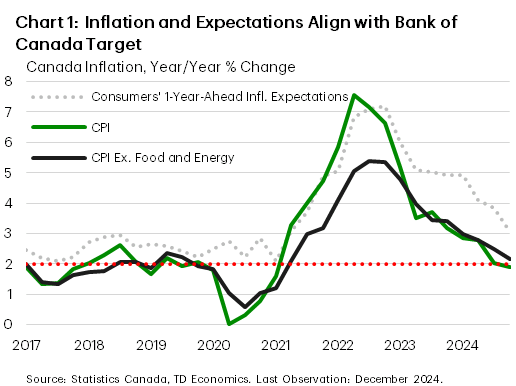
          For now, inflation is easing. December inflation data moved closer to the Bank of Canada’s target, with consumer inflation expectations anchoring around historical norms.

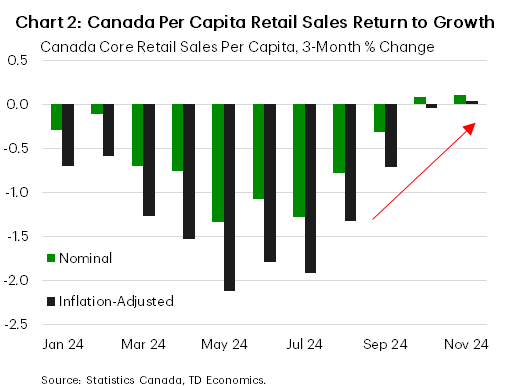
          Retail sales were weak in November, but December’s rebound in the flash estimate suggest stronger year-end activity, supporting a more gradual 25-basis-point cut next week.

          U.S. Highlights

          President Donald Trump was sworn in as 47th President on Monday and wasted no time signing a barrage of executive orders.

          While President Trump did not impose any tariffs in Week 1, he threatened Canada and Mexico with a 25% tariff (and later China with a 10% tariff) as early as February 1st.

          But without any immediate action, financial markets breathed a sigh of relief, though this could be short lived as the February 1st deadline quickly approaches.

          Canada – Tariff Threat Looms Just as Economy Shows Improvement

          If the inaugural week is anything to go by, the next four years of Trump’s presidency promise to be a roller coaster for Canada. Volatility in the Canadian dollar underscores how quickly sentiment can shift: reports of delayed tariffs early Monday lifted the Loonie by more over 1%, only for it to erase those gains later in the day, when Trump announced plans for tariffs as high as 25% on Mexico and Canada by February 1st. At the time of writing, the exchange rate has stabilized around $0.698 per CAD, about a percent lower than last week.

          As history shows tariffs beget tariffs. The Canadian government warned that if imposed, these tariffs will trigger retaliatory measures on up to C$150 billion worth of U.S. goods. Our report this week sets the record straight: Canada is America’s largest export market, with nearly US$350 billion goods and services crossing Canada’s border over the first three quarters of 2024. The negative impact of tariffs would ripple through business supply chains, raising costs and creating inflationary pressures at the retail level – far from the economic relief Trump promised during his campaign.

          A full-blown trade war remains an outlier scenario, but even targeted tariffs could undermine consumer demand on both sides of the border. The Bank of Canada’s recent Business Outlook Survey, sheds light on how firms perceived these risks in the fourth quarter of last year. Conducted after the presidential election but before Trump’s 25% tariff threat on Canada and Mexico in late November, businesses reported concerns over potentially higher input costs due to trade tensions. These costs, if realized, are likely to be passed on to consumers to some extent.

          This disruption comes just as the Canadian economy shows signs of recovery. December’s inflation data moved closer to the Bank of Canada’s 2% target (Chart 1). While some price categories were temporarily affected by GST tax break, others, like shelter inflation, have seen relief from lower rates. In addition, consumer inflation expectations – as measured by the Canadian Survey of Consumer Expectations – are settling around historical norms, reinforcing confidence in the Bank’s ability to instill price stability.
          Consumer demand, though soft, continues to recover. November’s retail sales data showed core retail sales (excluding autos and gas) declined by a sizeable 1.0%, but the three-month trend in real core retail sales per capita continued to recover (Chart 2). Spending at restaurants also saw robust gains in November, suggesting consumers are increasing outlays on discretionary areas. Furthermore, the strong flash estimate for December is encouraging, as the GST tax break would weigh on nominal spending tallies as they include GST receipts. On balance, this week’s data suggests that the Bank of Canada still needs to continue easing its key rate but proceed more cautiously, with a 25-basispoint cut next week. Markets will also scrutinize the accompanying Monetary Policy Report for insights into how the Bank is incorporating trade risks to its outlook.
          U.S. – A Wild First Week

          President Trump started his second term in office with a blitz of executive orders targeted at overhauling border and energy policies, pulling out of the global tax deal, unwinding signature Biden administration policies, and imposing a temporary freeze on federal hiring. But perhaps the most surprising development of the week was what didn’t materialize – an executive order to impose universal tariffs on major trading partners.

          However, President Trump did put Canada and Mexico (and later China) on notice, threatening each with a 25% tariff (10% on China) as early as February 1st, citing increased illegal immigration and drug flows as the primary motive. In addition, the President directed federal agencies to investigate “unfair and unbalanced” trade practices with the U.S. and has set a deadline of April 1st for specific policy recommendations. For now, President Trump has said “he isn’t ready to move ahead with universal tariffs on goods from around the world”, but his actions this week suggest that the tariff threats shouldn’t be taken lightly.

          Financial markets appeared to breath a sigh of relief, with the S&P 500 ending the week 2% higher. However, longer-term Treasury yields were little changed on the week, with the 10-year Treasury yield at 4.65% at the time of writing. Fed funds futures also remained largely unchanged, with 40 bps of cuts priced in by year-end.

          Should President Trump follow through on his tariff threats to Canada and Mexico, he would likely have to invoke the International Emergency Economic Powers Act due to both the tight timeline and the fact that he’s tying the tariffs to non-trade related issues. But we view this scenario as unlikely and see the tariff threats as a way of applying pressure to extract concessions. This would include tighter border security from its neighbors and perhaps and early reopening of the North American Trade deal ahead of the scheduled 2026 joint review.

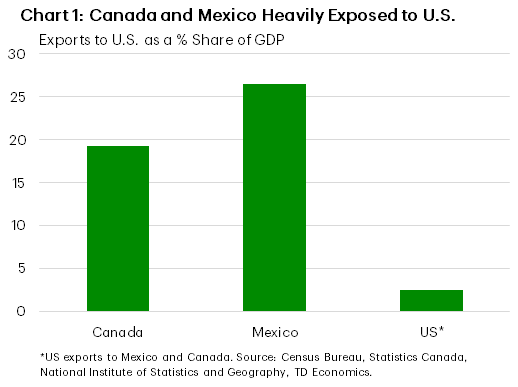
          While a full blown North American trade war would benefit no one, it’s clear that the northern and southern neighbors would feel the brunt of the impact. Measured as a share of GDP, exports from Canada and Mexico to the U.S. account for roughly 19% and 26% of their economies. However, combined U.S. exports to these two countries account for little more than 2% of its GDP (Chart 1). But beyond the hit to growth, there’s also the inflation impact to consider. Nearly 60% of the oil & gas imported into the U.S. comes from Canada. Should the U.S. impose a 25% tariff on these imports, or Canada restrict its oil exports as a retaliatory measure, then that alone would have an immediate price impact on U.S. consumers. Beyond the energy dependencies, the North American auto supply chain is also heavily intertwined. Disentangling the production process would be a costly endeavor.
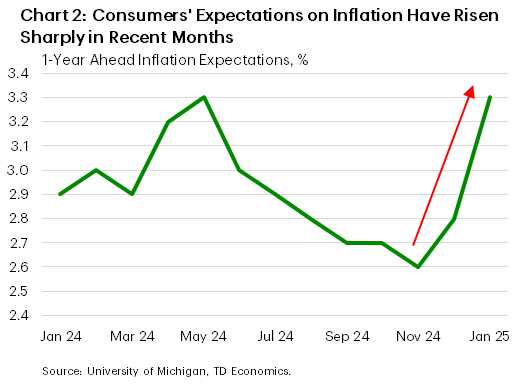
          Recent surveys of consumer confidence have already shown a growing unease on the future economic outlook and a jump in inflation expectations (Chart 2). Heighten inflation played a huge role in getting President Trump reelected, and it’ll likely serve as a governor on how far the Republicans are willing to push on tariffs.
          Source: ACTIONFOREX

          To stay updated on all economic events of today, please check out our Economic calendar
          Risk Warnings and Disclaimers
          You understand and acknowledge that there is a high degree of risk involved in trading. Following any strategies or investment methods may lead to potential losses. The content on the site is provided by our contributors and analysts for information purposes only. You are solely responsible for determining whether any trading assets, securities, strategy, or any other product is suitable for investing based on your own investment objectives and financial situation.
          Add to Favorites
          Share

          Crypto Market Has Increased Volatility

          Damon

          Cryptocurrency

          In the outgoing week, Bitcoin updated an all-time high, approaching a price of $110K and dragging the entire crypto market up with it. On Friday morning, capitalisation is moving up again, settling above $3.63 trillion. The market needs time to adjust to the current highs, and so far, there are more signs that this is a pause before further growth rather than the market hitting impenetrable resistance.

          That said, the sentiment index has been cruising in the greed zone, only going to extreme greed once. As was the case in mid-December, high sentiment index values intensified the selling.

          Bitcoin fell below $100K during the week, then approached $110K before gently re-emerging at 102K. The selling intensified on the approach to the peak of $110K in December and in January.

          However, support has also shifted above $100K, meaning market participants are now getting used to a six-figure price. Additionally, the market continues to bounce around mentions of Bitcoin and cryptocurrency reserves by Washington officials, which adds volatility but doesn’t help with direction.

          News Background

          If investors of all categories, from private to institutional, decide to allocate between 2% and 5% of their portfolios to the first cryptocurrency, its value could reach the $700,000 mark, BlackRock CEO Larry Fink said.

          Goldman Sachs CEO David Solomon commented that Bitcoin does not threaten the dollar’s status as a reserve currency, remaining a speculative asset. From a regulatory perspective, he said, the bank still cannot own and transact in the first cryptocurrency.

          Trading in XRP and SOL futures on the CME could begin on 10 February if approved by regulators. Such information appeared on a subdomain of the CME Group platform. A spokesperson for the exchange said that the beta version of the website was in the public domain ‘by mistake,’ and no decision has yet been made to launch the contracts.

          Investment firm Bitwise has filed an application to register the Dogecoin-based ETF (DOGE) with the Delaware (US) Department of State’s Division of Corporations. Decrypt notes that asset managers typically register legal entities with the state before filing formal applications with the SEC.

          Member of the US House of Representatives Gerald Connolly called for an investigation into possible conflicts of interest in connection with cryptocurrency projects of Donald Trump. In his opinion, it potentially violates ethical norms and creates risks to national security.

          Source: ACTIONFOREX

          Risk Warnings and Disclaimers
          You understand and acknowledge that there is a high degree of risk involved in trading. Following any strategies or investment methods may lead to potential losses. The content on the site is provided by our contributors and analysts for information purposes only. You are solely responsible for determining whether any trading assets, securities, strategy, or any other product is suitable for investing based on your own investment objectives and financial situation.
          Add to Favorites
          Share

          China Outlook 2025

          Owen Li

          Economic

          In response, Chinese policymakers introduced broad stimulus measures in 2024, including rate cuts and fiscal incentives to support markets. At a recent policy meeting, Beijing pledged to boost domestic demand and increase fiscal spending through higher debt issuance to prepare for potential external challenges such as renewed trade tensions with the US. These developments will shape the China outlook for 2025 and beyond.
          The International Monetary Fund (IMF) and the Asian Development Bank (ADB) expect China’s economy to slow further in 2024 and 2025, forecasting 4.8% and 4.5%, respectively. Some investment experts have similar or even worse forecasts. The new US administration under Donald Trump and the threat of tariffs are factors leading to a wide range of estimates on the impact of tariffs and China’s growth prospects.
          “We expect China’s GDP growth to slow to 4.0% in 2025 and 3.0% in 2026, with the assumption that the US hikes tariffs on China’s exports starting in September 2025 and China would increase policy support in response,” says UBS in their China outlook. They note that stricter U.S. tech restrictions and intensified decoupling efforts could amplify downside risks, while faster structural reforms in China could strengthen domestic confidence and economic performance.
          JP Morgan’s Asia Investment Strategy Team estimates a 60% tariff could lead to a 1-1.5 percentage point drag on economic growth over a twelve-month period. “Based on the experience of the last trade war, this could significantly reduce bilateral trade between the US and China. We estimate there will likely be a negative shock to economic growth through exports, investment, employment, and broader confidence,” the team says.
          Pictet Asset Management suggests that under their baseline scenario of a 20% tariff, additional Chinese policy measures, supported by a weaker RMB, could largely mitigate the adverse effects of U.S. tariffs. However, if tariffs were to rise by an additional 60%, the impact might prove too significant to fully counterbalance. “We think there is decent probability the government may set a growth target at around 5% or with a range between 4.5%-5% for 2025.”
          “Concerns about a prolonged trade war persist. However, government stimulus will be highly targeted, focusing on restoring trade and stock market balance,” notes Shasha Li Mafli, Fund Manager at Eric Sturdza Investments.
          “With China’s increasingly diversified trade relationships and reduced reliance on the US, trade risks are likely to be mitigated. China’s authorities will do whatever is necessary, even if in smaller steps than many Western observers expect, to support markets and consumer confidence,” adds Mafli.

          China Outlook: Equities

          The outlook for China’s equity markets in 2025 presents a mixed but cautiously optimistic picture. JP Morgan’s Asia Investment Strategy Team notes that offshore Chinese equities face headwinds from tariff concerns and a stronger dollar, limiting upside potential. While a more aggressive fiscal response from Beijing could offset economic challenges, clarity on such measures is still awaited. “Overall, this backdrop is more supportive for onshore China relative to offshore China, but we retain a neutral view on both markets in 2025 for now,” the team adds.
          Invesco’s Raymond Ma takes a more constructive view, highlighting the potential for substantial growth in Chinese equities as market expectations remain subdued. “As corporate fundamentals improve, we anticipate a reversal in top-line revenue and a reduction in the margin pressures that have persisted over the past three years. This may lead to a potential increase in return on equity and positive earnings revisions, enhancing investor sentiment. This recovery is expected to be supported by the ongoing stimulus measures,“ writes the Chief Investment Officer, Mainland China and Hong Kong.
          Allianz Global Investors observes that Chinese equities responded positively in late November despite news of additional tariffs from the US, indicating that some risks may already be priced in. They maintain an optimistic stance, citing supportive government measures and reasonable valuations. AGI sees opportunities in “buying the dips” during market weaknesses, expecting stronger corporate earnings and broader economic support to underpin investor sentiment.

          China Outlook: Bonds

          As for China bonds, Manulife Investment Management expects China’s pro-growth policies to stabilise its credit markets and support GDP growth.
          “We believe the authorities have clearly signalled that more forthright fiscal stimulus should be introduced in 2025,” says Murray Collis, CIO, Asia (ex-Japan) Fixed Income at Manulife IM.
          “China’s credit markets are expected to trade in a relatively stable range going into year-end, especially given the relatively contained overall reaction to the U.S. election result,” he adds.
          Collis maintains a positive duration view and expects the 10-year Chinese government bond (CGB) to range between 2.00% and 2.25% into year-end.
          Pictet Asset Management keeps a similar view, anticipating that the 10-year Chinese government bond yield will rebound to 2.0% by the end of 2025, driven by fiscal policy and structural reforms. They caution that aggressive monetary easing could raise concerns about a ‘Japanification’ of China’s bond market.

          Source:asia fund managers

          To stay updated on all economic events of today, please check out our Economic calendar
          Risk Warnings and Disclaimers
          You understand and acknowledge that there is a high degree of risk involved in trading. Following any strategies or investment methods may lead to potential losses. The content on the site is provided by our contributors and analysts for information purposes only. You are solely responsible for determining whether any trading assets, securities, strategy, or any other product is suitable for investing based on your own investment objectives and financial situation.
          Add to Favorites
          Share

          Bank Of Japan Hikes Rates, Signals More To Come

          WELLS FARGO

          Central Bank

          Forex

          The BoJ also forecast underlying inflation to remain at or above its 2% inflation target over the medium term, in our opinion a strong signal of further tightening to come. Comments from Governor Ueda also leaned hawkish, as he said the current policy rate is still far from its “neutral” level, and that he was not considering some specific rate level as a barrier.

          Against this backdrop, we continue to forecast a 25 bps rate hike to 0.75% at the BoJ’s April announcement. We now also forecast a final 25 bps rate increase to 1.00% in July, while acknowledging that the timing of that final rate hike could get pushed back depending on how local and global economic conditions evolve. Overall, we think the outlook for Bank of Japan tightening and eventual Fed easing could lead to a reasonably resilient yen through 2025, with more sustained and substantial yen weakness perhaps more likely in 2026 as the U.S. economy recovers.

          Bank Of Japan Takes A Further Step Along Its Monetary Policy Normalization Path

          In a widely expected decision, the Bank of Japan (BoJ) took another step along its monetary policy normalization path at this week’s meeting, raising its policy rate by 25 bps to 0.50%. In raising interest rates, the BoJ said growth and inflation have been developing generally in line with its forecasts, and also cited reasons for a firming in wage and price trends. The BoJ said:

          There have been many views expressed by firms stating that they will continue to raise wages steadily in this year’s annual spring labor-management wage negotiations; and

          With wages continuing to rise, there has been an increase in moves to reflect higher costs, such as increased personnel expenses and distribution costs, in selling prices.

          The Bank of Japan also noted relative stability in global financial markets, saying “while attention has been drawn to various uncertainties, global financial and capital markets have been stable on the whole, as overseas economies have followed a moderate growth path.”

          The Bank of Japan’s encouraging assessment of recent economic trends was also reinforced by upward revisions to its economic outlook. While the forecasts for GDP growth were little changed, there were some notable upward revisions to the central bank’s inflation forecasts. CPI ex-fresh food inflation is forecast at 2.7% for FY2024 (previously 2.5%), 2.4% for FY2025 (previously 1.9%) and 2.0% for FY2026 (previously 1.9%). In a similar vein, the outlook for CPI ex-fresh food and energy inflation was revised higher to 2.2% for FY 2024 (previously 2.0%), 2.1% for FY2025 (previously 1.9%) and 2.1% for FY2026 (unchanged). The forecast for Japan’s underlying inflation to remain at or above the central bank’s 2% inflation target over the medium term is, in our opinion, a strong signal of further tightening to come. The Bank of Japan indicated as much in its monetary policy announcement, saying that:

          Given that real interest rates are at significantly low levels, if the outlook for economic activity and prices presented in the January Outlook Report will be realized, the Bank will accordingly continue to raise the policy interest rate and adjust the degree of monetary accommodation.

          Hawkish Comments Hint at a Higher Terminal Policy Rate

          In addition to the Bank of Japan’s announcement, in our view, comments from Governor Ueda also point to multiple further rate hikes from the Bank of Japan over the balance of 2025. Ueda said he expected solid results from this year’s spring wage negotiations, a development we think would be supportive of another rate increase in April. Ueda also suggested global markets have been relatively calm in the initial days of President Trump’s administration. Interestingly, Ueda also said that even after this week’s rate increase, the current policy rate is still far from its “neutral” level, and that he was not considering some specific rate level as a barrier. He indicated that one BoJ analysis suggested the neutral rate could be somewhere between 1.00% and 2.50%. So long as overall economic trends remain encouraging, we view those comments as consistent with the BoJ eventually raising its policy rate to 1.00%, perhaps by its July announcement.

          Regarding recent economic trends, labor cash earnings rose 3.0% year-over-year in November and expectations for this year’s spring wage talks are upbeat. Inflation also remains elevated, with CPI ex-fresh food inflation at 3.0% year-over-year in December. Sentiment surveys, most notably the Tankan survey, have generally improved in recent quarters, consistent with steadier economic growth ahead. While these encouraging economic trends remain in place, and with global economic conditions perhaps more benign during the early part of this year as the U.S. economy advances at a steady pace and with Fed policy on hold, we view these conditions as most conducive for further Bank of Japan rate hikes. Against this backdrop, we continue to forecast a 25 bps rate hike to 0.75% at the BoJ’s April announcement. We now also forecast a final 25 bps rate increase to 1.00% in July, while acknowledging that the timing of that final rate hike could get pushed back depending on how local and global economic conditions evolve. Overall, we think the outlook for Bank of Japan tightening and eventual Fed easing could lead to a reasonably resilient yen through 2025, with more sustained and substantial yen weakness perhaps more likely in 2026 as the U.S. economy recovers.

          Source: ACTIONFOREX

          Risk Warnings and Disclaimers
          You understand and acknowledge that there is a high degree of risk involved in trading. Following any strategies or investment methods may lead to potential losses. The content on the site is provided by our contributors and analysts for information purposes only. You are solely responsible for determining whether any trading assets, securities, strategy, or any other product is suitable for investing based on your own investment objectives and financial situation.
          Add to Favorites
          Share

          Asia’s energy markets may stay volatile over Trump’s oil ambition and sanctions

          Owen Li

          Energy

          Asian energy markets are facing heightened uncertainties as prices swing over the latest Western sanctions targeting Russian oil shipments and US President Donald Trump’s push to expand American oil output, with analysts cautioning the volatility may persist for months.
          India and China, two of the world’s largest oil consumers, are facing the brunt of the impact after the US and the UK imposed the sanctions, analysts say.
          Trump declared on Monday – his first day in office – that the US was facing a national energy emergency, signalling that the world’s largest oil producer might increase its output.
          Benchmark Brent crude oil prices rose to US$80 per barrel in mid-January in the wake of the sanctions from US$73 on Christmas and have since fallen to US$79.13 as of Wednesday evening.
          Earlier this month, the outgoing Joe Biden administration said it was imposing sanctions on more than 200 entities and individuals involved in the sale and transport of Russian oil, including 183 vessels that it believed were part of a shadow fleet that had evaded an earlier round of similar sanctions.
          The UK government also imposed sanctions on Gazprom Neft and Surgutneftegas, two of Russia’s largest energy companies, saying their profits were “lining [Russian President Vladimir] Putin’s war chest and facilitating the war” in Ukraine.

          Source:scmp

          Risk Warnings and Disclaimers
          You understand and acknowledge that there is a high degree of risk involved in trading. Following any strategies or investment methods may lead to potential losses. The content on the site is provided by our contributors and analysts for information purposes only. You are solely responsible for determining whether any trading assets, securities, strategy, or any other product is suitable for investing based on your own investment objectives and financial situation.
          Add to Favorites
          Share

          Us Existing-home Sales Pick Up At End Of Worst Year Since 1995

          Winkelmann

          Economic

          Sales of previously owned homes in the US rose for the third straight month in December, entering 2025 with some momentum after the worst year in nearly three decades.

          Contract closings of existing homes last month increased 2.2% to an annualised rate of 4.24 million, the most since February, according to National Association of Realtors data released on Friday. That was in line with the estimate of economists surveyed by Bloomberg.

          The third straight pickup in monthly sales — the longest streak since late 2021, when mortgage rates were less than half of where they are now — signals that homeowners and buyers alike have come to terms with borrowing costs around 7%. The new-home market also appears to be stabilising, providing some early signs of optimism for the new year.

          “Home sales in the final months of the year showed solid recovery despite elevated mortgage rates,” NAR chief economist Lawrence Yun said in a prepared statement.

          However, for all of 2024, sales reached the lowest since 1995, when the US had about 70 million fewer people. It marked the third straight annual decline, stretches only ever seen in the 2006 housing crisis as well as the recessions around the early 1980s and 1990s.

          “The prospects for this year look better, but not by much as the triple threat of high mortgage rates, high home prices and low supply will continue,” Robert Frick, corporate economist at Navy Federal Credit Union, said by email.

          The median sale price, meantime, climbed 6% over the past 12 months to US$404,400 (RM1.8 million), reflecting more sales activity in the upper end of the market. That helped propel prices for the entire year to a record.

          After slowly creeping up for months, inventory dropped 13.5% in December from the prior month — which is typical at the end of the year. It’s still up 16.2% from December 2023.

          Fed cuts

          There was hope that 2024 could be a turning point for the housing market as the Federal Reserve started cutting interest rates. But mortgage rates track government bond yields, which rose nearly a full percentage point towards the end of the year after inflation proved stubborn, fueling concerns that officials eased policy too soon. They’re expected to keep rates steady at next week’s meeting.

          Treasury yields are still elevated as investors brace for the cost of President Donald Trump’s policies and price pressures are cooling only somewhat. That’s projected to keep mortgage rates on average above 6% through at least 2027, according to some estimates.

          In December, 53% of homes sold were on the market for less than a month, unchanged from November, while 16% sold for above the list price. Properties stayed on the market for 35 days on average, compared with 32 days in the previous month.

          Existing-home sales account for the majority of the US total and are calculated when a contract closes. The government will release figures on new-home sales on Monday.

          Separate data on Friday showed US business activity cooled this month on a slowdown in services, while consumer sentiment declined due to concerns about unemployment and potential tariffs’ impact on inflation.

          Source: Theedgemarkets

          To stay updated on all economic events of today, please check out our Economic calendar
          Risk Warnings and Disclaimers
          You understand and acknowledge that there is a high degree of risk involved in trading. Following any strategies or investment methods may lead to potential losses. The content on the site is provided by our contributors and analysts for information purposes only. You are solely responsible for determining whether any trading assets, securities, strategy, or any other product is suitable for investing based on your own investment objectives and financial situation.
          Add to Favorites
          Share

          India Outlook 2025

          Owen Li

          Economic

          The economy demonstrated robust GDP growth, the stock market showed moderate gains, and bonds attracted foreign inflows. Against this backdrop, the India outlook for 2025 is optimistic. India’s solid economic expansion, minimal reliance on Chinese and US consumer markets, strong domestic demand for equities, and a central bank committed to maintaining currency stability are expected to enhance the nation’s attractiveness to investors amid global uncertainty, according to analysts.
          Compared to 8.2% GDP growth in 2023, India‘s economy is losing some steam but is still the fastest-growing major economy, with a forecast of 7% in 2024 and 6.5% in 2025, according to IMF forecasts.
          The re-election of Donald Trump in the United States has stirred up markets, and trade tariffs are expected to have the most significant impact on global markets. For India, UBS sees three challenges from trade tariffs: slower global growth, delayed private capex recovery due to China’s manufacturing surplus, and pressure on India’s trade balance from RMB depreciation. However, the investment bank notes that global policy shifts may also create opportunities, bolstering India’s role in ‘China + 1’ supply chain strategies over the medium term.
          HSBC AM highlights that India, with its focus on domestic demand and limited reliance on U.S. exports, is among the least affected major economies by global trade disruptions. “Notably, there has been a gradual decoupling of India’s economic and financial markets from major global markets, including the US, Europe and Japan,” the asset manager notes in the 2025 Global Investment Outlook. “This has been demonstrated by a lower correlation of MSCI India with these major markets compared to the past five years, presenting appealing diversification benefits.“

          India Outlook: Equities

          Eastspring Investments points out that the Indian economy faces some cyclical challenges but says India’s equity market presents a structural opportunity. “Ongoing reforms, rising urbanisation, and supply chain shifts are expected to support India’s economic and earnings growth over the longer term,” the asset manager states.
          Matthews Asia notes a recent pullback in earnings growth, which caused a small correction in the market. “The weakness in earnings has been fairly consistent across the board but the main impact has been in the mid- and small-cap space and in consumer segments. We believe earnings expectations for mid- and small-cap companies were too high, while the earnings of consumer-facing companies were weak. India remains an expensive market but fundamentally we still favour areas that are producing good earnings,” says Sean Taylor, Chief Investment Officer, Matthews Asia.
          The Indian equity market reached over $4 tn in valuation in 2024 for the first time.
          Kenneth Ng, Portfolio Manager with the Asian Equities team at Lion Global Investors, sees India as “one of the structural stories of the coming decade”. “India has given 14% compounded returns over the last twenty years, and we see enough catalysts for it to still repeat that in the next twenty,” the portfolio manager says.

          India Outlook: Bonds

          Investment experts believe that Indian bonds will perform well in 2025. The expected interest rate cuts by the central bank in response to the slowdown in economic growth sustained foreign inflows linked to index inclusion, and steady demand from local pension and insurance funds should increase the attractiveness of Indian government bonds.
          In June 2024, JP Morgan began including Indian government bonds in its Emerging Market Global Bond Index (JPM GBI EM). Gradually adding 1% each month, Indian bonds will hold a total weight of 10% in the index upon conclusion on March 31, 2025. According to clearing house data, this triggered net inflows from overseas investors of about $14.5 bn.
          “For 2025, foreign inflows into the Indian government bond market are expected to remain strong but may not match the record levels of 2024,” says Wei Li, Portfolio Manager at BNP Paribas Asset Management, citing inflation expectations, policy adjustments and global market fluctuations as reasons.
          Schroders highlights that the ten-year local government bond yields in India (6.9%) are well-positioned to provide potentially high returns in 2025. “However, it’s important to consider active hedging of currency risks in these local bond markets, especially given the current strength of the US dollar and the potential for a renewed global trade war following the inauguration of the new Trump administration in early 2025,” cautions Abdallah Guezour, Head of Emerging Market Debt at Schroders.

          Source:asia fund managers

          To stay updated on all economic events of today, please check out our Economic calendar
          Risk Warnings and Disclaimers
          You understand and acknowledge that there is a high degree of risk involved in trading. Following any strategies or investment methods may lead to potential losses. The content on the site is provided by our contributors and analysts for information purposes only. You are solely responsible for determining whether any trading assets, securities, strategy, or any other product is suitable for investing based on your own investment objectives and financial situation.
          Add to Favorites
          Share
          FastBull
          Copyright © 2025 FastBull Ltd

          728 RM B 7/F GEE LOK IND BLDG NO 34 HUNG TO RD KWUN TONG KLN HONG KONG

          TelegramInstagramTwitterfacebooklinkedin
          App Store Google Play Google Play
          Products
          Charts

          Chats

          Q&A with Experts
          Screeners
          Economic Calendar
          Data
          Tools
          Membership
          Features
          Function
          Markets
          Copy Trading
          Latest Signals
          Contests
          News
          Analysis
          24/7
          Columns
          Education
          Company
          Careers
          About Us
          Contact Us
          Advertising
          Help Center
          Feedback
          User Agreement
          Privacy Policy
          Business

          White Label

          Data API

          Web Plug-ins

          Poster Maker

          Affiliate Program

          Risk Disclosure

          The risk of loss in trading financial instruments such as stocks, FX, commodities, futures, bonds, ETFs and crypto can be substantial. You may sustain a total loss of the funds that you deposit with your broker. Therefore, you should carefully consider whether such trading is suitable for you in light of your circumstances and financial resources.

          No decision to invest should be made without thoroughly conducting due diligence by yourself or consulting with your financial advisors. Our web content might not suit you since we don't know your financial conditions and investment needs. Our financial information might have latency or contain inaccuracy, so you should be fully responsible for any of your trading and investment decisions. The company will not be responsible for your capital loss.

          Without getting permission from the website, you are not allowed to copy the website's graphics, texts, or trademarks. Intellectual property rights in the content or data incorporated into this website belong to its providers and exchange merchants.

          Not Logged In

          Log in to access more features

          FastBull Membership

          Not yet

          Purchase

          Become a signal provider
          Help Center
          Customer Service
          Dark Mode
          Price Up/Down Colors

          Log In

          Sign Up

          Position
          Layout
          Fullscreen
          Default to Chart
          The chart page opens by default when you visit fastbull.com